

ISO 22762-5:2021
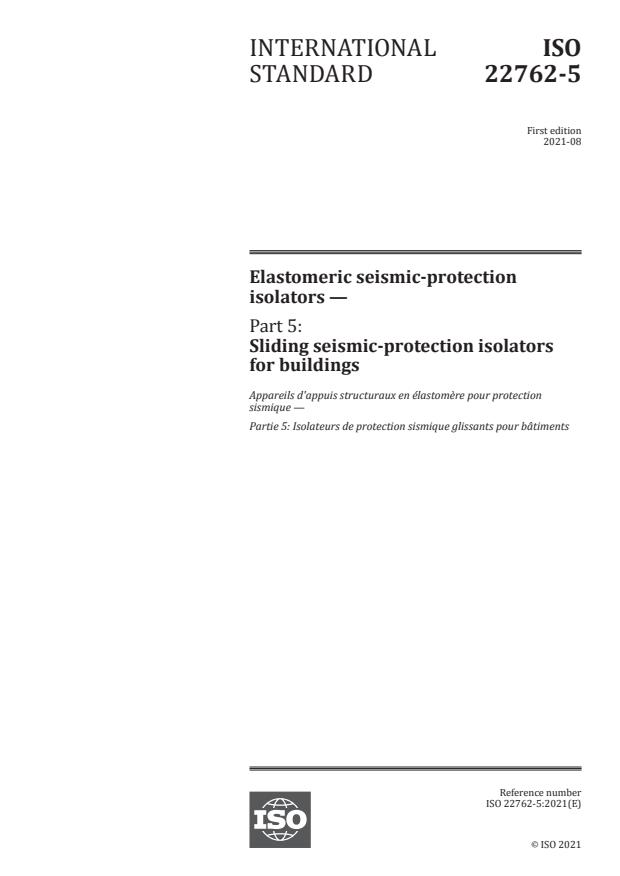
(Main)Elastomeric seismic-protection isolators — Part 5: Sliding seismic-protection isolators for buildings
General Information
- Abstract
This document specifies minimum requirements and test methods for flat sliding seismic-protection isolators used for buildings and the materials used in the manufacture of such isolators. It is applicable to flat sliding seismic-protection isolators used to provide buildings with protection from earthquake damage. The sliders are each mounted on elastomeric bearings to provide vertical compliance and rotational flexibility about horizontal axes.
- Status
- Published
- Publication Date
- 09-Aug-2021
- Technical Committee
- ISO/TC 45/SC 4 - Products (other than hoses)
- Drafting Committee
- ISO/TC 45/SC 4/WG 9 - Elastomeric isolators
- Current Stage
- 9093 - International Standard confirmed
- Start Date
- 25-Jun-2026
- Completion Date
- 29-Aug-2026
Buy Documents
ISO 22762-5:2021 - Elastomeric seismic-protection isolators
ISO 22762-5:2021 - Elastomeric seismic-protection isolators — Part 5: Sliding seismic-protection isolators for buildings/10/2021
Overview
ISO 22762-5:2021 - Elastomeric seismic-protection isolators: Part 5 - Sliding seismic-protection isolators for buildings specifies minimum requirements and test methods for flat sliding seismic-protection isolators and the materials used in their manufacture. It applies to flat sliding isolators that protect buildings from earthquake damage, where each slider is mounted on elastomeric bearings to provide vertical compliance and rotational flexibility about horizontal axes.
Key topics and technical requirements
This standard addresses the full lifecycle of sliding isolators, with emphasis on performance, safety and quality control. Major technical topics include:
- Classification and identification
- Isolator types, sliding friction coefficient categories, cross-section definitions.
- Requirements
- General functional and performance requirements, tolerances, design compressive force and horizontal velocity considerations.
- Materials
- Specifications and test methods for rubber materials, sliding materials, and steels used for flanges, plates and backing components.
- Testing and performance evaluation
- Type and routine tests including:
- Compression, shear stiffness and friction coefficient tests
- Compressive-shear tests
- Dependence tests: compressive force, velocity, repeated deformation, temperature, vertical loading time
- Ultimate shear and durability tests (degradation and creep)
- Rubber-specific tests: tensile, hardness, ozone resistance.
- Type and routine tests including:
- Design rules
- Vertical stiffness, horizontal properties, maximum displacement and compressive load limits for elastic sliding bearings.
- Manufacturing and QA
- Tolerances, measurement methods, marking and labelling, test methods and quality assurance procedures.
Applications and users
ISO 22762-5 is intended for practical use where seismic isolation is specified or evaluated:
- Structural and seismic engineers designing base-isolated buildings
- Manufacturers developing and producing sliding seismic-protection isolators
- Testing laboratories performing type and routine tests, durability and material tests
- Specifiers, procurement teams and building authorities writing performance-based specifications and conformity checks
- Consultants and certification bodies responsible for verification, marking and quality assurance
Typical applications include base isolation systems for small-to-large buildings seeking reduced earthquake forces, improved post-earthquake functionality and controlled displacement via elastomeric-supported sliding bearings.
Related standards
- ISO 22762 series (other parts cover general test methods and related isolator types). Check the ISO website for the complete series and cross-references (ISO/TC 45 responsibility).
Keywords: ISO 22762-5:2021, sliding seismic-protection isolators, elastomeric isolators, seismic isolation, test methods, durability testing, rubber material tests, building protection.
Buy Documents
ISO 22762-5:2021 - Elastomeric seismic-protection isolators
ISO 22762-5:2021 - Elastomeric seismic-protection isolators — Part 5: Sliding seismic-protection isolators for buildings/10/2021
Get Certified
Connect with accredited certification bodies for this standard

DIN CERTCO
DIN Group product certification.
DIBt (Deutsches Institut für Bautechnik)
German Institute for Building Technology.

Aboma Certification B.V.
Specialized in construction, metal, and transport sectors.
Sponsored listings
Frequently Asked Questions
ISO 22762-5:2021 is a standard published by the International Organization for Standardization (ISO). Its full title is "Elastomeric seismic-protection isolators — Part 5: Sliding seismic-protection isolators for buildings". This standard covers: This document specifies minimum requirements and test methods for flat sliding seismic-protection isolators used for buildings and the materials used in the manufacture of such isolators. It is applicable to flat sliding seismic-protection isolators used to provide buildings with protection from earthquake damage. The sliders are each mounted on elastomeric bearings to provide vertical compliance and rotational flexibility about horizontal axes.
This document specifies minimum requirements and test methods for flat sliding seismic-protection isolators used for buildings and the materials used in the manufacture of such isolators. It is applicable to flat sliding seismic-protection isolators used to provide buildings with protection from earthquake damage. The sliders are each mounted on elastomeric bearings to provide vertical compliance and rotational flexibility about horizontal axes.
ISO 22762-5:2021 is classified under the following ICS (International Classification for Standards) categories: 83.140.99 - Other rubber and plastics products; 91.120.25 - Seismic and vibration protection. The ICS classification helps identify the subject area and facilitates finding related standards.
ISO 22762-5:2021 is available in PDF format for immediate download after purchase. The document can be added to your cart and obtained through the secure checkout process. Digital delivery ensures instant access to the complete standard document.
Standards Content (Sample)
INTERNATIONAL ISO
STANDARD 22762-5
First edition
2021-08
Elastomeric seismic-protection
isolators —
Part 5:
Sliding seismic-protection isolators
for buildings
Appareils d'appuis structuraux en élastomère pour protection
sismique —
Partie 5: Isolateurs de protection sismique glissants pour bâtiments
Reference number
©
ISO 2021
© ISO 2021
All rights reserved. Unless otherwise specified, or required in the context of its implementation, no part of this publication may
be reproduced or utilized otherwise in any form or by any means, electronic or mechanical, including photocopying, or posting
on the internet or an intranet, without prior written permission. Permission can be requested from either ISO at the address
below or ISO’s member body in the country of the requester.
ISO copyright office
CP 401 • Ch. de Blandonnet 8
CH-1214 Vernier, Geneva
Phone: +41 22 749 01 11
Email: copyright@iso.org
Website: www.iso.org
Published in Switzerland
ii © ISO 2021 – All rights reserved
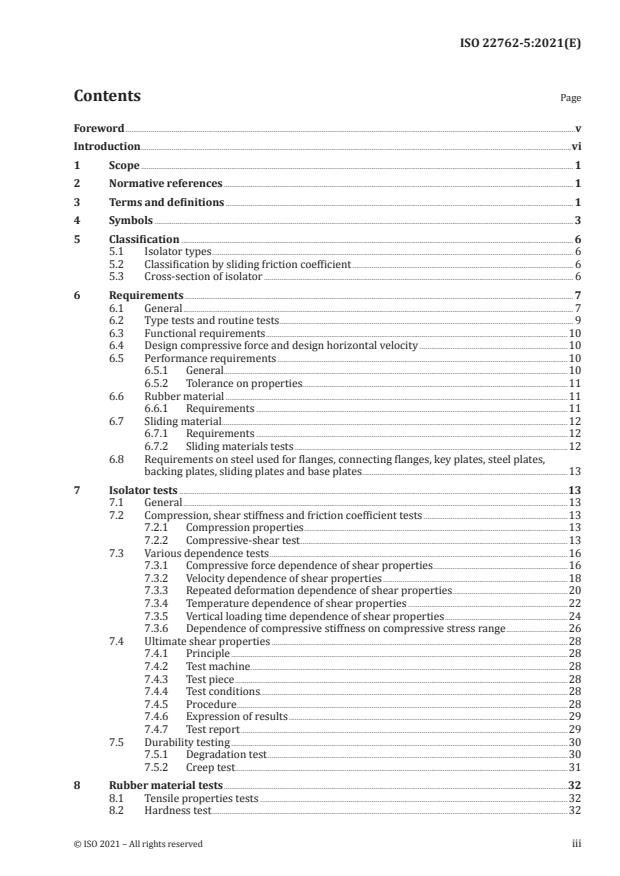
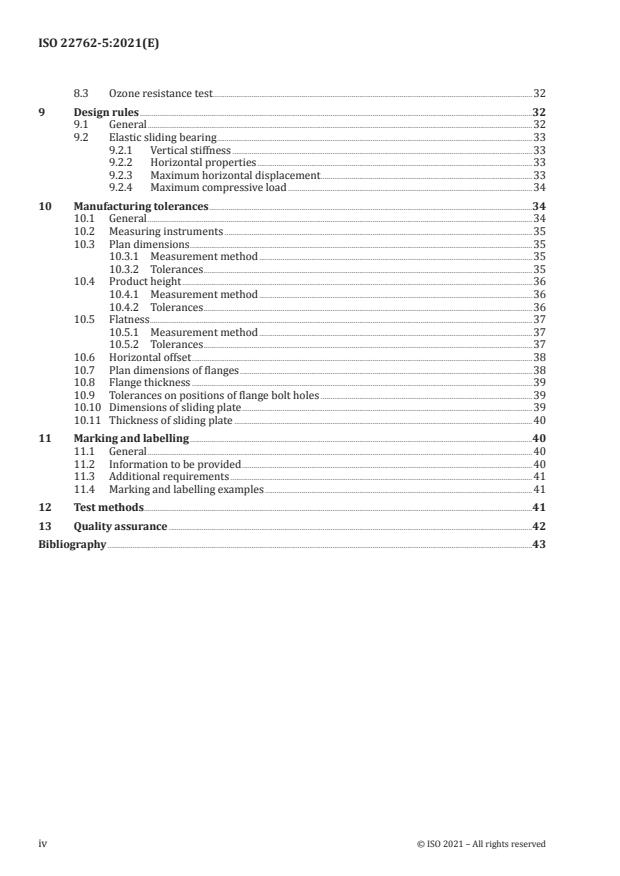
Contents Page
Foreword .v
Introduction .vi
1 Scope . 1
2 Normative references . 1
3 Terms and definitions . 1
4 Symbols . 3
5 Classification . 6
5.1 Isolator types . 6
5.2 Classification by sliding friction coefficient . 6
5.3 Cross-section of isolator . 6
6 Requirements . 7
6.1 General . 7
6.2 Type tests and routine tests. 9
6.3 Functional requirements .10
6.4 Design compressive force and design horizontal velocity .10
6.5 Performance requirements .10
6.5.1 General.10
6.5.2 Tolerance on properties.11
6.6 Rubber material .11
6.6.1 Requirements .11
6.7 Sliding material.12
6.7.1 Requirements .12
6.7.2 Sliding materials tests .12
6.8 Requirements on steel used for flanges, connecting flanges, key plates, steel plates,
backing plates, sliding plates and base plates .13
7 Isolator tests .13
7.1 General .13
7.2 Compression, shear stiffness and friction coefficient tests .13
7.2.1 Compression properties .13
7.2.2 Compressive-shear test .13
7.3 Various dependence tests .16
7.3.1 Compressive force dependence of shear properties .16
7.3.2 Velocity dependence of shear properties .18
7.3.3 Repeated deformation dependence of shear properties .20
7.3.4 Temperature dependence of shear properties .22
7.3.5 Vertical loading time dependence of shear properties .24
7.3.6 Dependence of compressive stiffness on compressive stress range .26
7.4 Ultimate shear properties .28
7.4.1 Principle .28
7.4.2 Test machine .28
7.4.3 Test piece .28
7.4.4 Test conditions.28
7.4.5 Procedure .28
7.4.6 Expression of results .29
7.4.7 Test report .29
7.5 Durability testing .30
7.5.1 Degradation test .30
7.5.2 Creep test . .31
8 Rubber material tests .32
8.1 Tensile properties tests .32
8.2 Hardness test .32
8.3 Ozone resistance test .32
9 Design rules .32
9.1 General .32
9.2 Elastic sliding bearing .33
9.2.1 Vertical stiffness .33
9.2.2 Horizontal properties .33
9.2.3 Maximum horizontal displacement .33
9.2.4 Maximum compressive load .34
10 Manufacturing tolerances .34
10.1 General .34
10.2 Measuring instruments .35
10.3 Plan dimensions .35
10.3.1 Measurement method .35
10.3.2 Tolerances .35
10.4 Product height .36
10.4.1 Measurement method .36
10.4.2 Tolerances .36
10.5 Flatness .37
10.5.1 Measurement method .37
10.5.2 Tolerances .37
10.6 Horizontal offset .38
10.7 Plan dimensions of flanges .38
10.8 Flange thickness .39
10.9 Tolerances on positions of flange bolt holes .39
10.10 Dimensions of sliding plate .39
10.11 Thickness of sliding plate .40
11 Marking and labelling .40
11.1 General .40
11.2 Information to be provided .40
11.3 Additional requirements .41
11.4 Marking and labelling examples .41
12 Test methods .41
13 Quality assurance .42
Bibliography .43
iv © ISO 2021 – All rights reserved
Foreword
ISO (the International Organization for Standardization) is a worldwide federation of national standards
bodies (ISO member bodies). The work of preparing International Standards is normally carried out
through ISO technical committees. Each member body interested in a subject for which a technical
committee has been established has the right to be represented on that committee. International
organizations, governmental and non-governmental, in liaison with ISO, also take part in the work.
ISO collaborates closely with the International Electrotechnical Commission (IEC) on all matters of
electrotechnical standardization.
The procedures used to develop this document and those intended for its further maintenance are
described in the ISO/IEC Directives, Part 1. In particular, the different approval criteria needed for the
different types of ISO documents should be noted. This document was drafted in accordance with the
editorial rules of the ISO/IEC Directives, Part 2 (see www .iso .org/ directives).
Attention is drawn to the possibility that some of the elements of this document may be the subject of
patent rights. ISO shall not be held responsible for identifying any or all such patent rights. Details of
any patent rights identified during the development of the document will be in the Introduction and/or
on the ISO list of patent declarations received (see www .iso .org/ patents).
Any trade name used in this document is information given for the convenience of users and does not
constitute an endorsement.
For an explanation of the voluntary nature of standards, the meaning of ISO specific terms and
expressions related to conformity assessment, as well as information about ISO's adherence to the
World Trade Organization (WTO) principles in the Technical Barriers to Trade (TBT), see www .iso .org/
iso/ foreword .html.
This document was prepared by Technical Committee ISO/TC 45, Rubber and Rubber Products,
Subcommittee SC 4, Products (other than hoses).
A list of all parts in the ISO 22762 series can be found on the ISO website.
Any feedback or questions on this document should be directed to the user’s national standards body. A
complete listing of these bodies can be found at www .iso .org/ members .html.
Introduction
The ISO 22762 series consists of five parts related to specifications for isolators. They are: ISO 22762-1
for test method, ISO 22762-2 for bridges, ISO 22762-3 for buildings, ISO/TS 22762-4 for guidance of
ISO 22762-3, and ISO 22762-5 for elastomeric sliding isolators for buildings.
This document specifies minimum requirements and test methods for elastomeric sliding isolators
used for buildings and the rubber material used in the manufacture of such isolators.
vi © ISO 2021 – All rights reserved
INTERNATIONAL STANDARD ISO 22762-5:2021(E)
Elastomeric seismic-protection isolators —
Part 5:
Sliding seismic-protection isolators for buildings
1 Scope
This document specifies minimum requirements and test methods for flat sliding seismic-protection
isolators used for buildings and the materials used in the manufacture of such isolators.
It is applicable to flat sliding seismic-protection isolators used to provide buildings with protection
from earthquake damage. The sliders are each mounted on elastomeric bearings to provide vertical
compliance and rotational flexibility about horizontal axes.
2 Normative references
The following documents are referred to in the text in such a way that some or all of their content
constitutes requirements of this document. For dated references, only the edition cited applies. For
undated references, the latest edition of the referenced document (including any amendments) applies.
ISO 37, Rubber, vulcanized or thermoplastic — Determination of tensile stress-strain properties
ISO 48-2, Rubber, vulcanized or thermoplastic — Determination of hardness — Part 2: Hardness between
10 IRHD and 100 IRHD
ISO 48-5, Rubber, vulcanized or thermoplastic — Determination of hardness — Part 5: Indentation
hardness by IRHD pocket meter method
ISO 527, Plastics — Determination of tensile properties
ISO 868, Plastics and ebonite — Determination of indentation hardness by means of a durometer (Shore
hardness)
ISO 1431-1, Rubber, vulcanized or thermoplastic — Resistance to ozone cracking — Part 1: Static and
dynamic strain testing
ISO 2039, Plastics — Determination of hardness
ISO 22762-1, Elastomeric seismic-protection isolators — Part 1: Test methods
3 Terms and definitions
For the purposes of this document, the following terms and definitions apply.
ISO and IEC maintain terminology databases for use in standardization at the following addresses:
— ISO Online browsing platform: available at https:// www .iso .org/ obp
— IEC Electropedia: available at https:// www .electropedia .org/
3.1
breaking
rupture of elastomeric isolator due to compression (or tension)-shear loading
3.2
buckling
state when elastomeric isolators lose their stability under compression-shear loading
3.3
compressive properties
K
v
compressive stiffness for elastomeric sliding isolators
3.4
compression-shear testing machine
machine used to test sliding isolators, which has the capability of shear loading under constant
compressive load
3.5
contact time
time from the end of subjecting the test piece to a compressive force to the start of subjecting a shear
force when performing the compressive-shear test
3.6
cover rubber
rubber wrapped around the outside of inner rubber and reinforcing steel plates before or after curing of
elastomeric isolators for the purposes of protecting the inner rubber from deterioration due to oxygen,
ozone and other natural elements and protecting the reinforcing plates from corrosion
3.7
design compressive stress
long-term compressive force on the sliding isolator imposed by the structure
3.8
effective loaded area
area sustaining vertical load in elastomeric isolators, which corresponds to the area of reinforcing steel
plates
3.9
effective width
smallest of the two side lengths of inner rubber to which direction shear displacement is not restricted
3.10
elastomeric sliding isolator
sliding isolator with rubber bearing which consists of multi-layered vulcanized rubber sheets and
reinforcing steel plates
3.11
first shape factor
ratio of effective loaded area (3.8) to free deformation area of one inner rubber layer between steel
plates
3.12
inner rubber
rubber between multi-layered steel plates inside an elastomeric isolator
3.13
maximum compressive stress
peak stress acting briefly on sliding isolators in compressive direction during an earthquake
3.14
routine test
test for quality control of the production isolators during and after manufacturing
2 © ISO 2021 – All rights reserved
3.15
second shape factor
〈circular elastomeric isolator〉 ratio of the diameter of the inner rubber (3.12) to the total thickness of
the inner rubber (3.12)
3.16
second shape factor
〈square or square elastomeric isolator〉 ratio of the effective width (3.9) of the inner rubber (3.12) to the
total thickness of the inner rubber (3.12)
3.17
shear properties of sliding isolators
comprehensive term that covers characteristics determined from isolator tests:
— initial shear stiffness, K , for elastomeric sliding isolator (3.10);
i
— friction coefficient, μ, for elastomeric sliding isolator (3.10).
3.18
sliding material
material which provides sliding functionality, when used as counterface to sliding plate
3.19
sliding plate
plate which provides sliding functionality
3.20
sliding friction coefficient
ratio of friction force versus normal compression force of sliding friction pair
3.21
standard value
value of isolator property defined by manufacturer based on the results of type test
3.22
structural engineer
engineer who is in charge of designing the structure for base-isolated buildings and is responsible for
specifying the requirements for sliding isolators
3.23
type test
test for verification either of material properties and isolator performances during development of the
product or that project design parameters are achieved
3.24
ultimate properties
properties at either buckling (3.2) or breaking (3.1) of an isolator under compression-shear loading
4 Symbols
For the purposes of this document, the symbols given in Table 1 apply.
Table 1 — Symbols and descriptions
Symbol Description
A effective plan area of elastomeric sliding isolator, excluding cover rubber portion
A effective area of bolt
b
A overlap area between the top and bottom elastomer area of isolator
e
A effective loaded area of isolator
load
Table 1 (continued)
Symbol Description
A area of the sliding material
s
a side length of square elastomeric isolator, excluding cover rubber thickness
a length of the square isolator, including cover rubber thickness
e
a side length of square flange
f
a side length of square sliding material
s
a side length of square sliding plate
sp
a′ length of the square isolator, including cover rubber thickness
B effective width for bending of flange
c bolt hole pitch circle diameter of on flange
D diameter of sliding material
s
D′ outer diameter of circular isolator, including cover rubber
D diameter of flange
f
d inner diameter of reinforcing steel plate
i
d diameter of bolt hole
k
d outer diameter of reinforcing steel plate
E apparent Young's modulus of bonded rubber layer
ap
E apparent Young's modulus corrected, if necessary, by allowing for compressibility
c
s
E apparent Young’s modulus corrected for bulk compressibility depending on its shape factor (S )
c 1
E bulk modulus of rubber
∞
E Young's modulus of rubber
G shear modulus
G (γ) equivalent linear shear modulus at shear strain
eq
H height of sliding isolator, including mounting flange
H height of sliding isolator, excluding mounting flange
n
K initial shear stiffness
i
K compressive stiffness
v
L length of one side of a square flange
f
M resistance to rotation
M moment acting on bolt
f
M moment acting on isolator
r
n number of rubber layers
n number of fixing bolts
b
P compressive force
P design compressive force in absence of seismic action effects
P maximum compressive force including seismic action effects
max
P minimum compressive force including seismic actions effects
min
Q shear force
Q shear force at break
b
Q shear force at buckling
buk
Q characteristic strength
d
S first shape factor
S second shape factor
T temperature
4 © ISO 2021 – All rights reserved
Table 1 (continued)
Symbol Description
T standard temperature, 23 °C or 27 °C;
where specified tolerance is ±2 °C, T is standard laboratory temperature
T total rubber thickness, given by T = n × t
r r r
t thickness of one rubber layer
r
t , t thickness of rubber layer laminated on each side of plate
r1 r2
t thickness of one reinforcing steel plate
s
t protruding length of sliding material
sm
t thickness of outside cover rubber
U(γ) function giving ratio of characteristic strength to maximum shear force of a loop
V uplift force
v loading velocity
v design horizontal velocity
v for building: nominal horizontal velocity recommended by manufacturer
nom
W energy dissipated per cycle
d
X shear displacement
X design shear displacement
X shear displacement at break
b
X shear displacement at buckling
buk
X shear displacement due to quasi-static shear movement
s
X maximum shear displacement
max
X shear displacement due to dynamic shear movement
d
Y compressive displacement
Z section modulus of flange
α coefficient of linear thermal expansion
γ shear strain of laminated rubber
γ shear strain at break of laminated rubber
b
γ local shear strain due to compressive force of laminated rubber
c
γ local shear strain due to rotation of laminated rubber
r
γ ultimate shear strain of laminated rubber
u
δ horizontal offset of isolator
H
δ difference in isolator height measured between two points at opposite extremes of the isolator
v
ε compressive strain of laminated rubber
ε creep strain
cr
ζ ratio of total height of rubber and steel layers to total rubber height
θ rotation angle of isolator about the diameter of a circular bearing or about an axis through a square
bearing
λ correction factor for calculation of stress in reinforcing steel plates
η correction factor for calculation of critical stress
κ correction factor for apparent Young's modulus according to hardness
Σγ total local shear strain
ρ safety factor for roll-out
R
σ compressive stress in isolator
σ design compressive stress
σ tensile stress in bolt
B
Table 1 (continued)
Symbol Description
σ bending stress in flange
b
σ allowable bending stress in steel
bf
σ critical stress in isolator
cr
σ allowable tensile stress in steel
f
σ maximum compressive stress
max
σ minimum compressive stress
min
σ nominal long-term compressive stress recommended by manufacturer for building
nom
σ compressive stress in laminated rubber
r
σ tensile stress in reinforcing steel plate
s
σ allowable tensile stress in steel plate
sa
σ compressive stress in sliding material
sm
σ design compressive stress in sliding material
sm0
σ maximum compressive stress in sliding material
sm,max
σ minimum compressive stress in sliding material
sm,min
σ for building: nominal long-term compressive stress in sliding material recommended by manufac-
sm,nom
turer
σ yield stress of steel for flanges and reinforcing steel plates
sy
σ tensile strength of steel for flanges and reinforcing steel plates
su
t shear stress in bolt
b
τ allowable shear stress in steel
f
ϕ factor for computation of buckling stability
ξ factor for computation of critical stress
μ friction coefficient
5 Classification
5.1 Isolator types
Sliding isolators are classified by performance, sliding friction coefficient and shape.
5.2 Classification by sliding friction coefficient
Sliding isolators are classified as the following three types by sliding friction coefficient:
— low-friction sliding isolator: μ < 0,015;
— intermediate-friction sliding isolator: 0,015 ≤ μ < 0,09;
— high-friction sliding isolator: 0,09 ≤ μ.
5.3 Cross-section of isolator
A typical cross-section of the isolator is given in Figure 1.
6 © ISO 2021 – All rights reserved
a) Circular type b) Square type
Elastomeric sliding isolator
Key
1 sliding material
2 sliding plate
3 laminated rubber
Figure 1 — Cross-section of isolator
6 Requirements
6.1 General
Sliding isolators for buildings and the materials used in manufacture shall meet the requirements
specified in this clause. For test items (see Table 2) that have no specific required values, the
manufacturer shall define the values and inform the purchaser prior to production.
The standard temperature for determining the properties of elastomeric isolators is 23 °C or 27 °C
in accordance with prevailing International Standards. However, it is advisable to establish a range
of working temperatures taking into consideration actual environmental temperatures and possible
changes in temperatures at the work site where the elastomeric isolators are installed.
NOTE Some of these properties can be determined using one of the standard test pieces detailed in Table 3
and Table 4. The standard test piece is used for non-specific product testing, such as testing for the development
of new materials and products.
Table 2 — Test pieces for type testing of elastic sliding bearings
Test piece
Properties Test item
Scale Minimum number
Compressive properties Compressive stiffness Full-scale only 3
Shear stiffness
Shear properties Full-scale only 3
Friction coefficient
Compressive stress dependency Full-scale only 3
Velocity dependency Scale A, STD-S 3
Dependency of shear
Repeated loading dependency Scale A 3
properties
Temperature dependency Scale A, STD-R, SBS 3
Vertical loading time dependency Scale A, STD-S 2
Dependency of compres-
Compressive stress dependency Scale B 3
sive properties
Ultimate horizontal displacement Scale B 3
Ultimate properties
Ultimate compressive load Scale B 3
Ageing Scale A, STD-R, SBS 2
Durability
Creep Scale A 2
Scale A: Scaling such that, for a circular bearing, diameter of reinforcing steel plates ≥150 mm, for a square bearing, side
length reinforcing steel plates ≥100 mm and, for both types, rubber layer thickness ≥1,5 mm and thickness of reinforcing
steel plates ≥0,5 mm.
Scale B: Scaling such that, for a circular bearing, diameter reinforcing steel plates ≥400 mm, for a square bearing, side
length reinforcing steel plates ≥400 mm and, for both types, rubber layer thickness ≥1,5 mm and thickness of reinforcing
steel plates ≥0,5 mm. Minimum scale factor 0.5.
STD-S = standard test piece for sliding material and sliding plate (see Table 3).
STD-R = standard test piece for laminated rubber (see Table 4).
SBS = shear-block test piece specified in ISO 22762-1:2018, 5.8.3.
Table 3 — Standard test piece for sliding material and sliding plate
Item Circle Square
Sliding material outer
D 150 250 400 ― ― ―
s
diameter, mm
Sliding material side
a × a — — — 100 × 100 240 × 240 400 × 400
s s
length, mm
Protruding length of
a
t 1 to 4 1 to 4 1 to 4 1 to 4 1 to 4 1 to 4
sm
sliding material, mm
Sliding plate side length,
a × a 400 × 400 650 × 650 1 200 × 1 200 400 × 400 650 × 650 1 200 × 1 200
sp sp
mm
NOTE Size of sliding plate should be decided by considering a displacement amplitude in the test.
a
t is apparent thickness (see Figure 2).
sm
Table 4 — Standard test piece for laminated rubber
Item Circle Square
Reinforcing steel plate outer
d 150 250 400 ― ― ―
diameter, mm
Reinforcing steel plate side length,
a × a ― ― ― 100 × 100 240 × 240 400 × 400
mm
Reinforcing steel plate inner
d 7,5 12,5 25 7,5 12,5 25
i
diameter, mm
8 © ISO 2021 – All rights reserved
Table 4 (continued)
Item Circle Square
Thickness of a single reinforcing
t 1 to 2 2 to 3 3 to 4 1 to 2 2 to 3 3 to 4
s
steel plate, mm
Thickness of a single rubber layer,
t 1,5 2,0 4,0 1,5 2,0 4,0
r
mm
Number of rubber layers n 20 25 25 20 25 25
Thickness of outside cover rubber,
t 4 6 8 4 6 8
mm
a) Simple attachment b) Attachment using recess
Key
1 sliding material
2 steel body
3 sliding plate
4 recess
Figure 2 — Attachment method of sliding material and steel body
6.2 Type tests and routine tests
6.2.1 Testing to be carried out on sliding isolators is classified into “type tests” and “routine tests”.
6.2.2 Type tests shall be conducted either to ensure that project design parameters have been
achieved (in which case the test results shall be submitted to the structural engineer for review prior
to production) or to verify isolator performance and material properties during development of the
product. The test piece for each type test shall be full-scale or one of the options specified in Table 3 and
Table 4. The test piece shall not have been subjected to any previous test programme.
6.2.3 Previous type test results may be substituted, provided the following conditions are met.
a) Isolators are fabricated in a similar manner and from the same compound and adhesive.
b) All corresponding external and internal dimensions are within 10 % of each other. Flange plates
are excluded.
c) First and second shape factors are equal to or larger than those in previous tests.
d) The test conditions, such as maximum and minimum vertical load applied in the ultimate property
test (see 7.4), are more severe.
Routine tests are carried out during production for quality control. Sampling is allowed for routine
testing for projects with agreement between structural engineer and manufacturer. Sampling shall be
conducted randomly and cover not less than 20 % of the production of any isolator design. For a given
project, tests shall cover not less than four test pieces for each size and not less than 20 test pieces in
total.
6.3 Functional requirements
Sliding isolators for buildings are designed and manufactured to have the performance characteristics
required so that they slide (and deform, if required) in all directions with the proper friction force (and
stiffness, if required) during an earthquake.
In the application of sliding isolators, attention shall be paid to the following points.
a) The isolators shall be installed horizontally between the structure and foundation.
b) Once installed, the isolators shall not be subjected to a constant shear force.
c) The rotation at the top of the isolator caused by bending deformation shall be carefully considered.
d) Exposed steel surfaces, such as the surfaces of mounting flanges, shall be properly painted or
galvanized to prevent rusting.
e) Proper maintenance shall be carried out on installed isolators to prevent any abnormalities such as
distortion, cracks or rust occurring.
f) Fire protection of the isolators may be required.
g) The seismic gap shall be maintained at all times.
h) Contamination-covers on sliding plates may be required, in case of installing them on foundation
side.
6.4 Design compressive force and design horizontal velocity
6.4.1 The design stress of sliding material and laminated rubber bearing are defined by Formulae (1)
and (2) with the design force:
P P
P
0 max
min
σσ==,,σ = (1)
sm0 sm,max sm,min
A A A
s s s
P P P
0 max min
σσ==,,σ = (2)
0 max min
A A A
6.4.2 The design compressive forces, P , and maximum and minimum compressive forces, respectively
P and P , and the design horizontal velocity, v , for an isolator shall be provided by the structural
max min o
engineer. If the P , P , P and v are not known at the time of type testing, the design stress and
0 max min o
design horizontal velocity to be used for testing can be determined as given by Formulae (3) and (4):
σσ==,σσ2⋅ (3)
sm0 sm,nom sm,max sm,nom
ν =ν (4)
0 nom
where
σ and ν are determined by the manufacturer.
sm,nom nom
6.5 Performance requirements
6.5.1 General
The sliding isolators shall be tested and the results recorded using the specified test methods. They
shall satisfy all of the requirements listed below. The test items are summarized in Table 5, which
10 © ISO 2021 – All rights reserved
indicates those type tests that are optional, where a material test piece may substitute an isolator, and
the tests to be performed as routine tests. The standard value obtained from the tests shall be reported.
Table 5 — Tests on elastomeric sliding isolators
Routine Type test
Property Test item Test method
test
Compressive Compressive stiffness
7.2.1 X X
properties
Shear stiffness
Shear properties 7.2.2 X X
Friction coefficient
Compressive stress dependency 7.3.1 N/A X
Velocity dependency 7.3.2 N/A X(m)
Dependency of shear
Repeated loading dependency 7.3.3 N/A X
properties
Temperature dependency 7.3.4 N/A X(m)
Vertical loading time dependency 7.3.5 N/A Opt.
Dependency of com-
Compressive stress dependency 7.3.6 N/A Opt.
pressive properties
Ultimate horizontal displacement 7.4 N/A X
Ultimate property
Ultimate compressive load 7.4 N/A X
Property change 7.5.1 N/A X(m)
Durability
Creep 7.5.2 N/A X
X = test to be conducted with isolators
X(m) = test can be conducted either with isolators, with standard test pieces for sliding material and sliding plate, with
standard test pieces for laminated rubber or with shear-block test pieces of rubber.
N/A = not applicable
Opt. = optional. The structural engineer can request that any optional test has to be carried out.
6.5.2 Tolerance on properties
The compressive stiffness, K , shall be within ±30 % of the design value.
v
The initial shear stiffness, K , shall be within ±30 % of the design value.
i
The friction coefficient, μ, shall be within ±50 % of the design value in the case of low-friction sliding
isolator.
The friction coefficient, μ, shall be within ±40 % of the design value in the case of intermediate-friction
sliding isolator.
The friction coefficient, μ, shall be within ±30 % of the design value in the case of high-friction sliding
isolator.
6.6 Rubber material
6.6.1 Requirements
The reference values of rubber materials used for the elastomeric sliding isolators are specified for
performance items in Table 6. However, the test piece used for the rubber materials test shall be
manufactured from the unvulcanized rubber material collected in the manufacturing process of the
elastomeric seismic sliding isolators. Also, the ozone resistance of the cover rubber shall be no cracks
on when tested according to ISO 1431-1 (ozone resistance test).
In addition to the reference values of the rubber material shall be satisfied the required performance
shown in Table 6.
Table 6 — Required performance of rubber material
Inner rubber
Property Required item Test method
NR CR
Tensile strength MPa ≥11 ≥11
Tensile Elongation at break % ≥550 ≥400
ISO 22762-1:2018, 5.3
properties
100 % mod-
Tolerance % ±40 N/A
ulus
Hardness Hardness Tolerance IRHD ±5 ±5 ISO 22762-1:2018, 5.5
6.7 Sliding material
6.7.1 Requirements
The reference values of the sliding materials used for the sliding isolators are determined for the
performance item indicating the characteristics of each sliding material. However, the test pieces used
for the sliding material test shall be manufactured from the sliding material collected during the sliding
material manufacturing process.
Oil, grease, or lubricant shall only be used for low-friction sliding isolators. Their durability shall be
verified.
Dimples shall only be allowed with lubricants for low-friction sliding isolators.
Required properties for sliding material are shown in Table 7.
Table 7 — Required properties of sliding material
Modified ultra-high
Property Required item PTFE molecular weight Filled PTFE Polyamide
polyethylene
Density Density Mg/m 2,13 to 2,19 0,93 to 0,98 1,80 to 2,80 1,00 to 1,50
Tensile strength MPa ≥20 ≥30 ≥6 ≥50
Tensile
properties
Elongation at break % ≥200 ≥250 ≥70 ≥2
HRR ≥23 ≥26 ≥25 ≥70
Hardness Hardness
HDD ≥54 N/A N/A N/A
HRR (Rockwell hardness of plastics using the Rockwell R hardness scales) specified in ISO 2039-2:1987.
HDD (hardness by means of a durometer of type D) specified in ISO 868:2003.
6.7.2 Sliding materials tests
For the sliding materials used for the sliding bearings, their strength for vertical load bearing
performance, and hardness shall be properly measured.
6.7.2.1 Tensile property tests
The tensile properties tests shall be in accordance with ISO 527. However, the
...
INTERNATIONAL ISO
STANDARD 22762-5
First edition
2021-08
Elastomeric seismic-protection
isolators —
Part 5:
Sliding seismic-protection isolators
for buildings
Appareils d'appuis structuraux en élastomère pour protection
sismique —
Partie 5: Isolateurs de protection sismique glissants pour bâtiments
Reference number
©
ISO 2021
© ISO 2021
All rights reserved. Unless otherwise specified, or required in the context of its implementation, no part of this publication may
be reproduced or utilized otherwise in any form or by any means, electronic or mechanical, including photocopying, or posting
on the internet or an intranet, without prior written permission. Permission can be requested from either ISO at the address
below or ISO’s member body in the country of the requester.
ISO copyright office
CP 401 • Ch. de Blandonnet 8
CH-1214 Vernier, Geneva
Phone: +41 22 749 01 11
Email: copyright@iso.org
Website: www.iso.org
Published in Switzerland
ii © ISO 2021 – All rights reserved
Contents Page
Foreword .v
Introduction .vi
1 Scope . 1
2 Normative references . 1
3 Terms and definitions . 1
4 Symbols . 3
5 Classification . 6
5.1 Isolator types . 6
5.2 Classification by sliding friction coefficient . 6
5.3 Cross-section of isolator . 6
6 Requirements . 7
6.1 General . 7
6.2 Type tests and routine tests. 9
6.3 Functional requirements .10
6.4 Design compressive force and design horizontal velocity .10
6.5 Performance requirements .10
6.5.1 General.10
6.5.2 Tolerance on properties.11
6.6 Rubber material .11
6.6.1 Requirements .11
6.7 Sliding material.12
6.7.1 Requirements .12
6.7.2 Sliding materials tests .12
6.8 Requirements on steel used for flanges, connecting flanges, key plates, steel plates,
backing plates, sliding plates and base plates .13
7 Isolator tests .13
7.1 General .13
7.2 Compression, shear stiffness and friction coefficient tests .13
7.2.1 Compression properties .13
7.2.2 Compressive-shear test .13
7.3 Various dependence tests .16
7.3.1 Compressive force dependence of shear properties .16
7.3.2 Velocity dependence of shear properties .18
7.3.3 Repeated deformation dependence of shear properties .20
7.3.4 Temperature dependence of shear properties .22
7.3.5 Vertical loading time dependence of shear properties .24
7.3.6 Dependence of compressive stiffness on compressive stress range .26
7.4 Ultimate shear properties .28
7.4.1 Principle .28
7.4.2 Test machine .28
7.4.3 Test piece .28
7.4.4 Test conditions.28
7.4.5 Procedure .28
7.4.6 Expression of results .29
7.4.7 Test report .29
7.5 Durability testing .30
7.5.1 Degradation test .30
7.5.2 Creep test . .31
8 Rubber material tests .32
8.1 Tensile properties tests .32
8.2 Hardness test .32
8.3 Ozone resistance test .32
9 Design rules .32
9.1 General .32
9.2 Elastic sliding bearing .33
9.2.1 Vertical stiffness .33
9.2.2 Horizontal properties .33
9.2.3 Maximum horizontal displacement .33
9.2.4 Maximum compressive load .34
10 Manufacturing tolerances .34
10.1 General .34
10.2 Measuring instruments .35
10.3 Plan dimensions .35
10.3.1 Measurement method .35
10.3.2 Tolerances .35
10.4 Product height .36
10.4.1 Measurement method .36
10.4.2 Tolerances .36
10.5 Flatness .37
10.5.1 Measurement method .37
10.5.2 Tolerances .37
10.6 Horizontal offset .38
10.7 Plan dimensions of flanges .38
10.8 Flange thickness .39
10.9 Tolerances on positions of flange bolt holes .39
10.10 Dimensions of sliding plate .39
10.11 Thickness of sliding plate .40
11 Marking and labelling .40
11.1 General .40
11.2 Information to be provided .40
11.3 Additional requirements .41
11.4 Marking and labelling examples .41
12 Test methods .41
13 Quality assurance .42
Bibliography .43
iv © ISO 2021 – All rights reserved
Foreword
ISO (the International Organization for Standardization) is a worldwide federation of national standards
bodies (ISO member bodies). The work of preparing International Standards is normally carried out
through ISO technical committees. Each member body interested in a subject for which a technical
committee has been established has the right to be represented on that committee. International
organizations, governmental and non-governmental, in liaison with ISO, also take part in the work.
ISO collaborates closely with the International Electrotechnical Commission (IEC) on all matters of
electrotechnical standardization.
The procedures used to develop this document and those intended for its further maintenance are
described in the ISO/IEC Directives, Part 1. In particular, the different approval criteria needed for the
different types of ISO documents should be noted. This document was drafted in accordance with the
editorial rules of the ISO/IEC Directives, Part 2 (see www .iso .org/ directives).
Attention is drawn to the possibility that some of the elements of this document may be the subject of
patent rights. ISO shall not be held responsible for identifying any or all such patent rights. Details of
any patent rights identified during the development of the document will be in the Introduction and/or
on the ISO list of patent declarations received (see www .iso .org/ patents).
Any trade name used in this document is information given for the convenience of users and does not
constitute an endorsement.
For an explanation of the voluntary nature of standards, the meaning of ISO specific terms and
expressions related to conformity assessment, as well as information about ISO's adherence to the
World Trade Organization (WTO) principles in the Technical Barriers to Trade (TBT), see www .iso .org/
iso/ foreword .html.
This document was prepared by Technical Committee ISO/TC 45, Rubber and Rubber Products,
Subcommittee SC 4, Products (other than hoses).
A list of all parts in the ISO 22762 series can be found on the ISO website.
Any feedback or questions on this document should be directed to the user’s national standards body. A
complete listing of these bodies can be found at www .iso .org/ members .html.
Introduction
The ISO 22762 series consists of five parts related to specifications for isolators. They are: ISO 22762-1
for test method, ISO 22762-2 for bridges, ISO 22762-3 for buildings, ISO/TS 22762-4 for guidance of
ISO 22762-3, and ISO 22762-5 for elastomeric sliding isolators for buildings.
This document specifies minimum requirements and test methods for elastomeric sliding isolators
used for buildings and the rubber material used in the manufacture of such isolators.
vi © ISO 2021 – All rights reserved
INTERNATIONAL STANDARD ISO 22762-5:2021(E)
Elastomeric seismic-protection isolators —
Part 5:
Sliding seismic-protection isolators for buildings
1 Scope
This document specifies minimum requirements and test methods for flat sliding seismic-protection
isolators used for buildings and the materials used in the manufacture of such isolators.
It is applicable to flat sliding seismic-protection isolators used to provide buildings with protection
from earthquake damage. The sliders are each mounted on elastomeric bearings to provide vertical
compliance and rotational flexibility about horizontal axes.
2 Normative references
The following documents are referred to in the text in such a way that some or all of their content
constitutes requirements of this document. For dated references, only the edition cited applies. For
undated references, the latest edition of the referenced document (including any amendments) applies.
ISO 37, Rubber, vulcanized or thermoplastic — Determination of tensile stress-strain properties
ISO 48-2, Rubber, vulcanized or thermoplastic — Determination of hardness — Part 2: Hardness between
10 IRHD and 100 IRHD
ISO 48-5, Rubber, vulcanized or thermoplastic — Determination of hardness — Part 5: Indentation
hardness by IRHD pocket meter method
ISO 527, Plastics — Determination of tensile properties
ISO 868, Plastics and ebonite — Determination of indentation hardness by means of a durometer (Shore
hardness)
ISO 1431-1, Rubber, vulcanized or thermoplastic — Resistance to ozone cracking — Part 1: Static and
dynamic strain testing
ISO 2039, Plastics — Determination of hardness
ISO 22762-1, Elastomeric seismic-protection isolators — Part 1: Test methods
3 Terms and definitions
For the purposes of this document, the following terms and definitions apply.
ISO and IEC maintain terminology databases for use in standardization at the following addresses:
— ISO Online browsing platform: available at https:// www .iso .org/ obp
— IEC Electropedia: available at https:// www .electropedia .org/
3.1
breaking
rupture of elastomeric isolator due to compression (or tension)-shear loading
3.2
buckling
state when elastomeric isolators lose their stability under compression-shear loading
3.3
compressive properties
K
v
compressive stiffness for elastomeric sliding isolators
3.4
compression-shear testing machine
machine used to test sliding isolators, which has the capability of shear loading under constant
compressive load
3.5
contact time
time from the end of subjecting the test piece to a compressive force to the start of subjecting a shear
force when performing the compressive-shear test
3.6
cover rubber
rubber wrapped around the outside of inner rubber and reinforcing steel plates before or after curing of
elastomeric isolators for the purposes of protecting the inner rubber from deterioration due to oxygen,
ozone and other natural elements and protecting the reinforcing plates from corrosion
3.7
design compressive stress
long-term compressive force on the sliding isolator imposed by the structure
3.8
effective loaded area
area sustaining vertical load in elastomeric isolators, which corresponds to the area of reinforcing steel
plates
3.9
effective width
smallest of the two side lengths of inner rubber to which direction shear displacement is not restricted
3.10
elastomeric sliding isolator
sliding isolator with rubber bearing which consists of multi-layered vulcanized rubber sheets and
reinforcing steel plates
3.11
first shape factor
ratio of effective loaded area (3.8) to free deformation area of one inner rubber layer between steel
plates
3.12
inner rubber
rubber between multi-layered steel plates inside an elastomeric isolator
3.13
maximum compressive stress
peak stress acting briefly on sliding isolators in compressive direction during an earthquake
3.14
routine test
test for quality control of the production isolators during and after manufacturing
2 © ISO 2021 – All rights reserved
3.15
second shape factor
〈circular elastomeric isolator〉 ratio of the diameter of the inner rubber (3.12) to the total thickness of
the inner rubber (3.12)
3.16
second shape factor
〈square or square elastomeric isolator〉 ratio of the effective width (3.9) of the inner rubber (3.12) to the
total thickness of the inner rubber (3.12)
3.17
shear properties of sliding isolators
comprehensive term that covers characteristics determined from isolator tests:
— initial shear stiffness, K , for elastomeric sliding isolator (3.10);
i
— friction coefficient, μ, for elastomeric sliding isolator (3.10).
3.18
sliding material
material which provides sliding functionality, when used as counterface to sliding plate
3.19
sliding plate
plate which provides sliding functionality
3.20
sliding friction coefficient
ratio of friction force versus normal compression force of sliding friction pair
3.21
standard value
value of isolator property defined by manufacturer based on the results of type test
3.22
structural engineer
engineer who is in charge of designing the structure for base-isolated buildings and is responsible for
specifying the requirements for sliding isolators
3.23
type test
test for verification either of material properties and isolator performances during development of the
product or that project design parameters are achieved
3.24
ultimate properties
properties at either buckling (3.2) or breaking (3.1) of an isolator under compression-shear loading
4 Symbols
For the purposes of this document, the symbols given in Table 1 apply.
Table 1 — Symbols and descriptions
Symbol Description
A effective plan area of elastomeric sliding isolator, excluding cover rubber portion
A effective area of bolt
b
A overlap area between the top and bottom elastomer area of isolator
e
A effective loaded area of isolator
load
Table 1 (continued)
Symbol Description
A area of the sliding material
s
a side length of square elastomeric isolator, excluding cover rubber thickness
a length of the square isolator, including cover rubber thickness
e
a side length of square flange
f
a side length of square sliding material
s
a side length of square sliding plate
sp
a′ length of the square isolator, including cover rubber thickness
B effective width for bending of flange
c bolt hole pitch circle diameter of on flange
D diameter of sliding material
s
D′ outer diameter of circular isolator, including cover rubber
D diameter of flange
f
d inner diameter of reinforcing steel plate
i
d diameter of bolt hole
k
d outer diameter of reinforcing steel plate
E apparent Young's modulus of bonded rubber layer
ap
E apparent Young's modulus corrected, if necessary, by allowing for compressibility
c
s
E apparent Young’s modulus corrected for bulk compressibility depending on its shape factor (S )
c 1
E bulk modulus of rubber
∞
E Young's modulus of rubber
G shear modulus
G (γ) equivalent linear shear modulus at shear strain
eq
H height of sliding isolator, including mounting flange
H height of sliding isolator, excluding mounting flange
n
K initial shear stiffness
i
K compressive stiffness
v
L length of one side of a square flange
f
M resistance to rotation
M moment acting on bolt
f
M moment acting on isolator
r
n number of rubber layers
n number of fixing bolts
b
P compressive force
P design compressive force in absence of seismic action effects
P maximum compressive force including seismic action effects
max
P minimum compressive force including seismic actions effects
min
Q shear force
Q shear force at break
b
Q shear force at buckling
buk
Q characteristic strength
d
S first shape factor
S second shape factor
T temperature
4 © ISO 2021 – All rights reserved
Table 1 (continued)
Symbol Description
T standard temperature, 23 °C or 27 °C;
where specified tolerance is ±2 °C, T is standard laboratory temperature
T total rubber thickness, given by T = n × t
r r r
t thickness of one rubber layer
r
t , t thickness of rubber layer laminated on each side of plate
r1 r2
t thickness of one reinforcing steel plate
s
t protruding length of sliding material
sm
t thickness of outside cover rubber
U(γ) function giving ratio of characteristic strength to maximum shear force of a loop
V uplift force
v loading velocity
v design horizontal velocity
v for building: nominal horizontal velocity recommended by manufacturer
nom
W energy dissipated per cycle
d
X shear displacement
X design shear displacement
X shear displacement at break
b
X shear displacement at buckling
buk
X shear displacement due to quasi-static shear movement
s
X maximum shear displacement
max
X shear displacement due to dynamic shear movement
d
Y compressive displacement
Z section modulus of flange
α coefficient of linear thermal expansion
γ shear strain of laminated rubber
γ shear strain at break of laminated rubber
b
γ local shear strain due to compressive force of laminated rubber
c
γ local shear strain due to rotation of laminated rubber
r
γ ultimate shear strain of laminated rubber
u
δ horizontal offset of isolator
H
δ difference in isolator height measured between two points at opposite extremes of the isolator
v
ε compressive strain of laminated rubber
ε creep strain
cr
ζ ratio of total height of rubber and steel layers to total rubber height
θ rotation angle of isolator about the diameter of a circular bearing or about an axis through a square
bearing
λ correction factor for calculation of stress in reinforcing steel plates
η correction factor for calculation of critical stress
κ correction factor for apparent Young's modulus according to hardness
Σγ total local shear strain
ρ safety factor for roll-out
R
σ compressive stress in isolator
σ design compressive stress
σ tensile stress in bolt
B
Table 1 (continued)
Symbol Description
σ bending stress in flange
b
σ allowable bending stress in steel
bf
σ critical stress in isolator
cr
σ allowable tensile stress in steel
f
σ maximum compressive stress
max
σ minimum compressive stress
min
σ nominal long-term compressive stress recommended by manufacturer for building
nom
σ compressive stress in laminated rubber
r
σ tensile stress in reinforcing steel plate
s
σ allowable tensile stress in steel plate
sa
σ compressive stress in sliding material
sm
σ design compressive stress in sliding material
sm0
σ maximum compressive stress in sliding material
sm,max
σ minimum compressive stress in sliding material
sm,min
σ for building: nominal long-term compressive stress in sliding material recommended by manufac-
sm,nom
turer
σ yield stress of steel for flanges and reinforcing steel plates
sy
σ tensile strength of steel for flanges and reinforcing steel plates
su
t shear stress in bolt
b
τ allowable shear stress in steel
f
ϕ factor for computation of buckling stability
ξ factor for computation of critical stress
μ friction coefficient
5 Classification
5.1 Isolator types
Sliding isolators are classified by performance, sliding friction coefficient and shape.
5.2 Classification by sliding friction coefficient
Sliding isolators are classified as the following three types by sliding friction coefficient:
— low-friction sliding isolator: μ < 0,015;
— intermediate-friction sliding isolator: 0,015 ≤ μ < 0,09;
— high-friction sliding isolator: 0,09 ≤ μ.
5.3 Cross-section of isolator
A typical cross-section of the isolator is given in Figure 1.
6 © ISO 2021 – All rights reserved
a) Circular type b) Square type
Elastomeric sliding isolator
Key
1 sliding material
2 sliding plate
3 laminated rubber
Figure 1 — Cross-section of isolator
6 Requirements
6.1 General
Sliding isolators for buildings and the materials used in manufacture shall meet the requirements
specified in this clause. For test items (see Table 2) that have no specific required values, the
manufacturer shall define the values and inform the purchaser prior to production.
The standard temperature for determining the properties of elastomeric isolators is 23 °C or 27 °C
in accordance with prevailing International Standards. However, it is advisable to establish a range
of working temperatures taking into consideration actual environmental temperatures and possible
changes in temperatures at the work site where the elastomeric isolators are installed.
NOTE Some of these properties can be determined using one of the standard test pieces detailed in Table 3
and Table 4. The standard test piece is used for non-specific product testing, such as testing for the development
of new materials and products.
Table 2 — Test pieces for type testing of elastic sliding bearings
Test piece
Properties Test item
Scale Minimum number
Compressive properties Compressive stiffness Full-scale only 3
Shear stiffness
Shear properties Full-scale only 3
Friction coefficient
Compressive stress dependency Full-scale only 3
Velocity dependency Scale A, STD-S 3
Dependency of shear
Repeated loading dependency Scale A 3
properties
Temperature dependency Scale A, STD-R, SBS 3
Vertical loading time dependency Scale A, STD-S 2
Dependency of compres-
Compressive stress dependency Scale B 3
sive properties
Ultimate horizontal displacement Scale B 3
Ultimate properties
Ultimate compressive load Scale B 3
Ageing Scale A, STD-R, SBS 2
Durability
Creep Scale A 2
Scale A: Scaling such that, for a circular bearing, diameter of reinforcing steel plates ≥150 mm, for a square bearing, side
length reinforcing steel plates ≥100 mm and, for both types, rubber layer thickness ≥1,5 mm and thickness of reinforcing
steel plates ≥0,5 mm.
Scale B: Scaling such that, for a circular bearing, diameter reinforcing steel plates ≥400 mm, for a square bearing, side
length reinforcing steel plates ≥400 mm and, for both types, rubber layer thickness ≥1,5 mm and thickness of reinforcing
steel plates ≥0,5 mm. Minimum scale factor 0.5.
STD-S = standard test piece for sliding material and sliding plate (see Table 3).
STD-R = standard test piece for laminated rubber (see Table 4).
SBS = shear-block test piece specified in ISO 22762-1:2018, 5.8.3.
Table 3 — Standard test piece for sliding material and sliding plate
Item Circle Square
Sliding material outer
D 150 250 400 ― ― ―
s
diameter, mm
Sliding material side
a × a — — — 100 × 100 240 × 240 400 × 400
s s
length, mm
Protruding length of
a
t 1 to 4 1 to 4 1 to 4 1 to 4 1 to 4 1 to 4
sm
sliding material, mm
Sliding plate side length,
a × a 400 × 400 650 × 650 1 200 × 1 200 400 × 400 650 × 650 1 200 × 1 200
sp sp
mm
NOTE Size of sliding plate should be decided by considering a displacement amplitude in the test.
a
t is apparent thickness (see Figure 2).
sm
Table 4 — Standard test piece for laminated rubber
Item Circle Square
Reinforcing steel plate outer
d 150 250 400 ― ― ―
diameter, mm
Reinforcing steel plate side length,
a × a ― ― ― 100 × 100 240 × 240 400 × 400
mm
Reinforcing steel plate inner
d 7,5 12,5 25 7,5 12,5 25
i
diameter, mm
8 © ISO 2021 – All rights reserved
Table 4 (continued)
Item Circle Square
Thickness of a single reinforcing
t 1 to 2 2 to 3 3 to 4 1 to 2 2 to 3 3 to 4
s
steel plate, mm
Thickness of a single rubber layer,
t 1,5 2,0 4,0 1,5 2,0 4,0
r
mm
Number of rubber layers n 20 25 25 20 25 25
Thickness of outside cover rubber,
t 4 6 8 4 6 8
mm
a) Simple attachment b) Attachment using recess
Key
1 sliding material
2 steel body
3 sliding plate
4 recess
Figure 2 — Attachment method of sliding material and steel body
6.2 Type tests and routine tests
6.2.1 Testing to be carried out on sliding isolators is classified into “type tests” and “routine tests”.
6.2.2 Type tests shall be conducted either to ensure that project design parameters have been
achieved (in which case the test results shall be submitted to the structural engineer for review prior
to production) or to verify isolator performance and material properties during development of the
product. The test piece for each type test shall be full-scale or one of the options specified in Table 3 and
Table 4. The test piece shall not have been subjected to any previous test programme.
6.2.3 Previous type test results may be substituted, provided the following conditions are met.
a) Isolators are fabricated in a similar manner and from the same compound and adhesive.
b) All corresponding external and internal dimensions are within 10 % of each other. Flange plates
are excluded.
c) First and second shape factors are equal to or larger than those in previous tests.
d) The test conditions, such as maximum and minimum vertical load applied in the ultimate property
test (see 7.4), are more severe.
Routine tests are carried out during production for quality control. Sampling is allowed for routine
testing for projects with agreement between structural engineer and manufacturer. Sampling shall be
conducted randomly and cover not less than 20 % of the production of any isolator design. For a given
project, tests shall cover not less than four test pieces for each size and not less than 20 test pieces in
total.
6.3 Functional requirements
Sliding isolators for buildings are designed and manufactured to have the performance characteristics
required so that they slide (and deform, if required) in all directions with the proper friction force (and
stiffness, if required) during an earthquake.
In the application of sliding isolators, attention shall be paid to the following points.
a) The isolators shall be installed horizontally between the structure and foundation.
b) Once installed, the isolators shall not be subjected to a constant shear force.
c) The rotation at the top of the isolator caused by bending deformation shall be carefully considered.
d) Exposed steel surfaces, such as the surfaces of mounting flanges, shall be properly painted or
galvanized to prevent rusting.
e) Proper maintenance shall be carried out on installed isolators to prevent any abnormalities such as
distortion, cracks or rust occurring.
f) Fire protection of the isolators may be required.
g) The seismic gap shall be maintained at all times.
h) Contamination-covers on sliding plates may be required, in case of installing them on foundation
side.
6.4 Design compressive force and design horizontal velocity
6.4.1 The design stress of sliding material and laminated rubber bearing are defined by Formulae (1)
and (2) with the design force:
P P
P
0 max
min
σσ==,,σ = (1)
sm0 sm,max sm,min
A A A
s s s
P P P
0 max min
σσ==,,σ = (2)
0 max min
A A A
6.4.2 The design compressive forces, P , and maximum and minimum compressive forces, respectively
P and P , and the design horizontal velocity, v , for an isolator shall be provided by the structural
max min o
engineer. If the P , P , P and v are not known at the time of type testing, the design stress and
0 max min o
design horizontal velocity to be used for testing can be determined as given by Formulae (3) and (4):
σσ==,σσ2⋅ (3)
sm0 sm,nom sm,max sm,nom
ν =ν (4)
0 nom
where
σ and ν are determined by the manufacturer.
sm,nom nom
6.5 Performance requirements
6.5.1 General
The sliding isolators shall be tested and the results recorded using the specified test methods. They
shall satisfy all of the requirements listed below. The test items are summarized in Table 5, which
10 © ISO 2021 – All rights reserved
indicates those type tests that are optional, where a material test piece may substitute an isolator, and
the tests to be performed as routine tests. The standard value obtained from the tests shall be reported.
Table 5 — Tests on elastomeric sliding isolators
Routine Type test
Property Test item Test method
test
Compressive Compressive stiffness
7.2.1 X X
properties
Shear stiffness
Shear properties 7.2.2 X X
Friction coefficient
Compressive stress dependency 7.3.1 N/A X
Velocity dependency 7.3.2 N/A X(m)
Dependency of shear
Repeated loading dependency 7.3.3 N/A X
properties
Temperature dependency 7.3.4 N/A X(m)
Vertical loading time dependency 7.3.5 N/A Opt.
Dependency of com-
Compressive stress dependency 7.3.6 N/A Opt.
pressive properties
Ultimate horizontal displacement 7.4 N/A X
Ultimate property
Ultimate compressive load 7.4 N/A X
Property change 7.5.1 N/A X(m)
Durability
Creep 7.5.2 N/A X
X = test to be conducted with isolators
X(m) = test can be conducted either with isolators, with standard test pieces for sliding material and sliding plate, with
standard test pieces for laminated rubber or with shear-block test pieces of rubber.
N/A = not applicable
Opt. = optional. The structural engineer can request that any optional test has to be carried out.
6.5.2 Tolerance on properties
The compressive stiffness, K , shall be within ±30 % of the design value.
v
The initial shear stiffness, K , shall be within ±30 % of the design value.
i
The friction coefficient, μ, shall be within ±50 % of the design value in the case of low-friction sliding
isolator.
The friction coefficient, μ, shall be within ±40 % of the design value in the case of intermediate-friction
sliding isolator.
The friction coefficient, μ, shall be within ±30 % of the design value in the case of high-friction sliding
isolator.
6.6 Rubber material
6.6.1 Requirements
The reference values of rubber materials used for the elastomeric sliding isolators are specified for
performance items in Table 6. However, the test piece used for the rubber materials test shall be
manufactured from the unvulcanized rubber material collected in the manufacturing process of the
elastomeric seismic sliding isolators. Also, the ozone resistance of the cover rubber shall be no cracks
on when tested according to ISO 1431-1 (ozone resistance test).
In addition to the reference values of the rubber material shall be satisfied the required performance
shown in Table 6.
Table 6 — Required performance of rubber material
Inner rubber
Property Required item Test method
NR CR
Tensile strength MPa ≥11 ≥11
Tensile Elongation at break % ≥550 ≥400
ISO 22762-1:2018, 5.3
properties
100 % mod-
Tolerance % ±40 N/A
ulus
Hardness Hardness Tolerance IRHD ±5 ±5 ISO 22762-1:2018, 5.5
6.7 Sliding material
6.7.1 Requirements
The reference values of the sliding materials used for the sliding isolators are determined for the
performance item indicating the characteristics of each sliding material. However, the test pieces used
for the sliding material test shall be manufactured from the sliding material collected during the sliding
material manufacturing process.
Oil, grease, or lubricant shall only be used for low-friction sliding isolators. Their durability shall be
verified.
Dimples shall only be allowed with lubricants for low-friction sliding isolators.
Required properties for sliding material are shown in Table 7.
Table 7 — Required properties of sliding material
Modified ultra-high
Property Required item PTFE molecular weight Filled PTFE Polyamide
polyethylene
Density Density Mg/m 2,13 to 2,19 0,93 to 0,98 1,80 to 2,80 1,00 to 1,50
Tensile strength MPa ≥20 ≥30 ≥6 ≥50
Tensile
properties
Elongation at break % ≥200 ≥250 ≥70 ≥2
HRR ≥23 ≥26 ≥25 ≥70
Hardness Hardness
HDD ≥54 N/A N/A N/A
HRR (Rockwell hardness of plastics using the Rockwell R hardness scales) specified in ISO 2039-2:1987.
HDD (hardness by means of a durometer of type D) specified in ISO 868:2003.
6.7.2 Sliding materials tests
For the sliding materials used for the sliding bearings, their strength for vertical load bearing
performance, and hardness shall be properly measured.
6.7.2.1 Tensile property tests
The tensile properties tests shall be in accordance with ISO 527. However, the
...