

ISO 25518:2021
(Main)Single-use rubber gloves for general applications — Specification
General Information
- Abstract
This document specifies the physical requirements and sampling and testing methods for single-use rubber gloves, made from natural rubber latex, synthetic rubber latex or rubber solution, intended for general applications, but not gloves intended for medical purposes. It does not cover the safe and proper usage of the gloves.
- Status
- Published
- Publication Date
- 28-Oct-2021
- Technical Committee
- ISO/TC 45/SC 4 - Products (other than hoses)
- Drafting Committee
- ISO/TC 45/SC 4/WG 5 - Gloves and other latex products
- Current Stage
- 9060 - Close of review
- Completion Date
- 02-Sep-2031
Buy Documents


ISO 25518:2021 - Single-use rubber gloves for general applications -- Specification
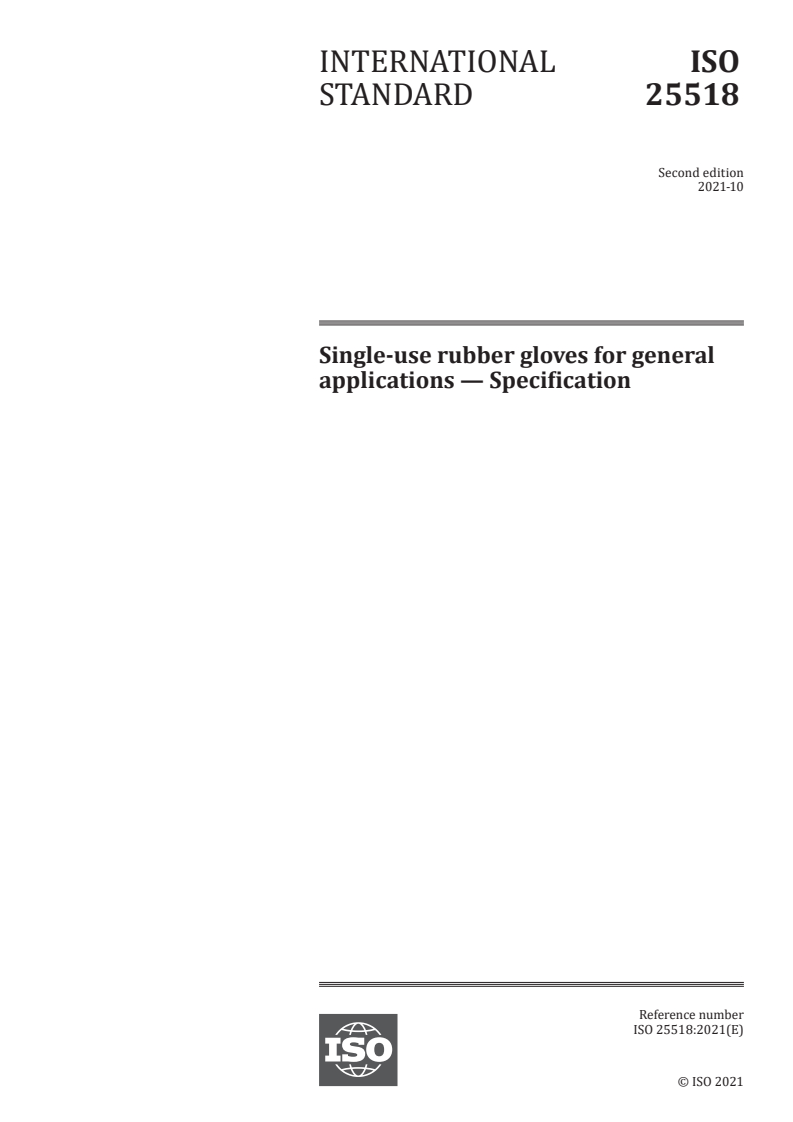
ISO 25518:2021 - Single-use rubber gloves for general applications — Specification/29/2021
Overview
ISO 25518:2021 specifies requirements, sampling and test methods for single‑use rubber gloves for general applications (not for medical use). It covers gloves made from natural rubber latex, synthetic rubber latex or rubber solution and defines physical requirements, tensile performance, watertightness testing, sampling plans and labelling information. The standard does not address safe or proper use of gloves.
Key topics and technical requirements
- Materials and disclosures
- Gloves must be made from suitable, non‑toxic materials; pigments, lubricants and surface treatments must be disclosed on request.
- Dimensions
- Sizes from XS to XL are defined by palm width (W) and minimum length (L). Example ranges: XS ≤ 80 mm width, S 80 ±10 mm, M 95 ±10 mm, L 110 ±10 mm, XL ≥110 mm; minimum lengths typically 220–230 mm. Measurements follow the standard’s specified points and mandrel method.
- Watertightness
- Annex A describes a watertightness procedure using a hollow mandrel and 1 000 cm³ water (observe for leaks immediately and after 2–4 min; disregard leakage within 40 mm of the cuff).
- Tensile properties and ageing
- Tensile testing uses ISO 37 (type 2 dumb‑bell pieces); results use median of three specimens taken from palm/back.
- Minimums: force at break and elongation before and after accelerated ageing are specified; accelerated ageing follows ISO 188 (e.g., 70 °C for 168 h or 100 °C for 22 h).
- Sampling and inspection
- Lot inspection follows ISO 2859‑1. The standard sets inspection levels and AQLs (e.g., dimensions S‑2 AQL 6.5; watertightness S‑4 AQL 4.0; tensile S‑2 AQL 6.5).
- Labelling
- Required markings: manufacturer/trademark, material, textured/smooth and powdered/powder‑free status (powder‑free residue limit specified), size, lot number, date of manufacture (YYYY-MM), approximate quantity, storage instructions and the words “NOT FOR MEDICAL OR INDUSTRIAL USE” (or equivalent).
Applications and users
ISO 25518:2021 is practical for:
- Glove manufacturers - product design, in‑line QC, product specifications and batch release.
- Testing and QC laboratories - test methods for tensile, watertightness and accelerated ageing.
- Procurement and specification writers - purchase specifications for non‑medical single‑use rubber gloves.
- Regulatory bodies and auditors - conformity checks and labelling verification.
- Suppliers and distributors - packaging and marking compliance.
Keywords: ISO 25518:2021, single‑use rubber gloves, specification, watertightness test, tensile properties, accelerated ageing, sampling AQL, glove labelling, powder‑free gloves.
Related standards
- ISO 37 - Rubber - Determination of tensile stress‑strain properties
- ISO 188 - Rubber - Accelerated ageing and heat resistance tests
- ISO 2859‑1 - Sampling procedures for inspection by attributes (AQL)
Relations
- Effective Date
- 23-Apr-2020
Buy Documents
ISO 25518:2021 - Single-use rubber gloves for general applications -- Specification
ISO 25518:2021 - Single-use rubber gloves for general applications — Specification/29/2021
Get Certified
Connect with accredited certification bodies for this standard

DIN CERTCO
DIN Group product certification.

Smithers Quality Assessments
US management systems and product certification.
Sponsored listings
Frequently Asked Questions
ISO 25518:2021 is a standard published by the International Organization for Standardization (ISO). Its full title is "Single-use rubber gloves for general applications — Specification". This standard covers: This document specifies the physical requirements and sampling and testing methods for single-use rubber gloves, made from natural rubber latex, synthetic rubber latex or rubber solution, intended for general applications, but not gloves intended for medical purposes. It does not cover the safe and proper usage of the gloves.
This document specifies the physical requirements and sampling and testing methods for single-use rubber gloves, made from natural rubber latex, synthetic rubber latex or rubber solution, intended for general applications, but not gloves intended for medical purposes. It does not cover the safe and proper usage of the gloves.
ISO 25518:2021 is classified under the following ICS (International Classification for Standards) categories: 83.140.99 - Other rubber and plastics products. The ICS classification helps identify the subject area and facilitates finding related standards.
ISO 25518:2021 has the following relationships with other standards: It is inter standard links to ISO 25518:2009. Understanding these relationships helps ensure you are using the most current and applicable version of the standard.
ISO 25518:2021 is available in PDF format for immediate download after purchase. The document can be added to your cart and obtained through the secure checkout process. Digital delivery ensures instant access to the complete standard document.
Standards Content (Sample)
INTERNATIONAL ISO
STANDARD 25518
Second edition
2021-10
Single-use rubber gloves for general
applications — Specification
Reference number
© ISO 2021
All rights reserved. Unless otherwise specified, or required in the context of its implementation, no part of this publication may
be reproduced or utilized otherwise in any form or by any means, electronic or mechanical, including photocopying, or posting on
the internet or an intranet, without prior written permission. Permission can be requested from either ISO at the address below
or ISO’s member body in the country of the requester.
ISO copyright office
CP 401 • Ch. de Blandonnet 8
CH-1214 Vernier, Geneva
Phone: +41 22 749 01 11
Email: copyright@iso.org
Website: www.iso.org
Published in Switzerland
ii
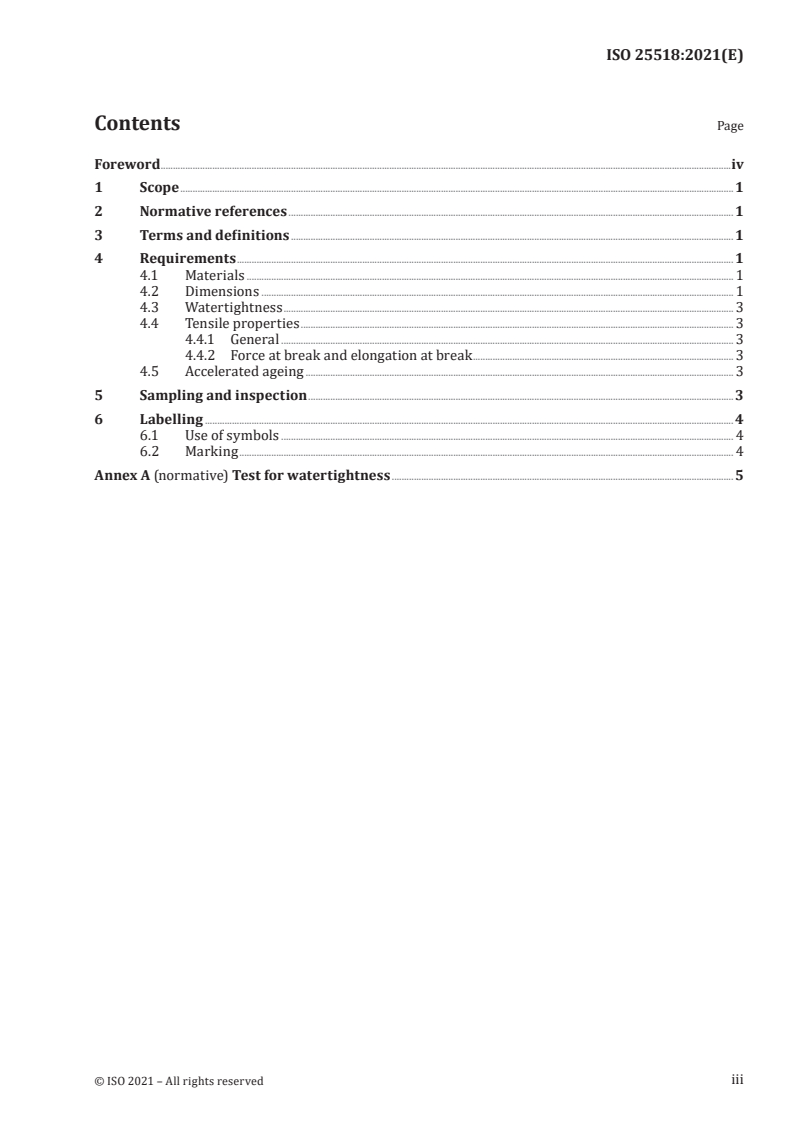
Contents Page
Foreword .iv
1 Scope . 1
2 Normative references . 1
3 Terms and definitions . 1
4 Requirements . 1
4.1 Materials . 1
4.2 Dimensions . 1
4.3 Watertightness . 3
4.4 Tensile properties . 3
4.4.1 General . 3
4.4.2 Force at break and elongation at break . 3
4.5 Accelerated ageing . 3
5 Sampling and inspection .3
6 Labelling . 4
6.1 Use of symbols . 4
6.2 Marking . 4
Annex A (normative) Test for watertightness . 5
iii
Foreword
ISO (the International Organization for Standardization) is a worldwide federation of national standards
bodies (ISO member bodies). The work of preparing International Standards is normally carried out
through ISO technical committees. Each member body interested in a subject for which a technical
committee has been established has the right to be represented on that committee. International
organizations, governmental and non-governmental, in liaison with ISO, also take part in the work.
ISO collaborates closely with the International Electrotechnical Commission (IEC) on all matters of
electrotechnical standardization.
The procedures used to develop this document and those intended for its further maintenance are
described in the ISO/IEC Directives, Part 1. In particular, the different approval criteria needed for the
different types of ISO documents should be noted. This document was drafted in accordance with the
editorial rules of the ISO/IEC Directives, Part 2 (see www.iso.org/directives).
Attention is drawn to the possibility that some of the elements of this document may be the subject of
patent rights. ISO shall not be held responsible for identifying any or all such patent rights. Details of
any patent rights identified during the development of the document will be in the Introduction and/or
on the ISO list of patent declarations received (see www.iso.org/patents).
Any trade name used in this document is information given for the convenience of users and does not
constitute an endorsement.
For an explanation of the voluntary nature of standards, the meaning of ISO specific terms and
expressions related to conformity assessment, as well as information about ISO's adherence to
the World Trade Organization (WTO) principles in the Technical Barriers to Trade (TBT), see
www.iso.org/iso/foreword.html.
This document was prepared by Technical Committee ISO/TC 45, Rubber and rubber products,
Subcommittee SC 4, Products (other than hoses).
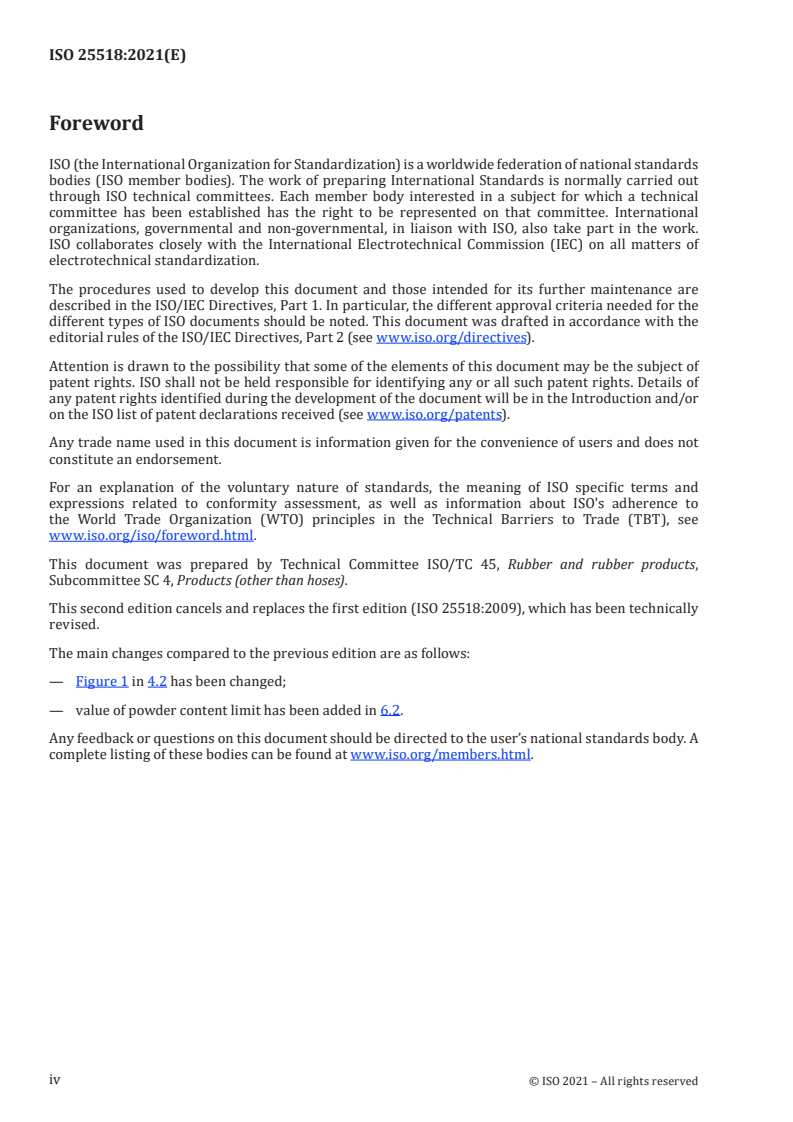
This second edition cancels and replaces the first edition (ISO 25518:2009), which has been technically
revised.
The main changes compared to the previous edition are as follows:
— Figure 1 in 4.2 has been changed;
— value of powder content limit has been added in 6.2.
Any feedback or questions on this document should be directed to the user’s national standards body. A
complete listing of these bodies can be found at www.iso.org/members.html.
iv
INTERNATIONAL STANDARD ISO 25518:2021(E)
Single-use rubber gloves for general applications —
Specification
WARNING — Persons using this document should be familiar with normal laboratory practices.
This document does not purport to address all of the safety problems, if any, associated with its
use. It is the responsibility of the user to establish appropriate safety and health practices and to
ensure compliance with any regulatory conditions.
1 Scope
This document specifies the physical requirements and sampling and testing methods for single-use
rubber gloves, made from natural rubber latex, synthetic rubber latex or rubber solution, intended for
general applications, but not gloves intended for medical purposes.
It does not cover the safe and proper usage of the gloves.
2 Normative references
The following documents are referred to in the text in such a way that some or all of their content
constitutes requirements of this document. For dated references, only the edition cited applies. For
undated references, the latest edition of the referenced document (including any amendments)
...
INTERNATIONAL ISO
STANDARD 25518
Second edition
2021-10
Single-use rubber gloves for general
applications — Specification
Reference number
© ISO 2021
All rights reserved. Unless otherwise specified, or required in the context of its implementation, no part of this publication may
be reproduced or utilized otherwise in any form or by any means, electronic or mechanical, including photocopying, or posting on
the internet or an intranet, without prior written permission. Permission can be requested from either ISO at the address below
or ISO’s member body in the country of the requester.
ISO copyright office
CP 401 • Ch. de Blandonnet 8
CH-1214 Vernier, Geneva
Phone: +41 22 749 01 11
Email: copyright@iso.org
Website: www.iso.org
Published in Switzerland
ii
Contents Page
Foreword .iv
1 Scope . 1
2 Normative references . 1
3 Terms and definitions . 1
4 Requirements . 1
4.1 Materials . 1
4.2 Dimensions . 1
4.3 Watertightness . 3
4.4 Tensile properties . 3
4.4.1 General . 3
4.4.2 Force at break and elongation at break . 3
4.5 Accelerated ageing . 3
5 Sampling and inspection .3
6 Labelling . 4
6.1 Use of symbols . 4
6.2 Marking . 4
Annex A (normative) Test for watertightness . 5
iii
Foreword
ISO (the International Organization for Standardization) is a worldwide federation of national standards
bodies (ISO member bodies). The work of preparing International Standards is normally carried out
through ISO technical committees. Each member body interested in a subject for which a technical
committee has been established has the right to be represented on that committee. International
organizations, governmental and non-governmental, in liaison with ISO, also take part in the work.
ISO collaborates closely with the International Electrotechnical Commission (IEC) on all matters of
electrotechnical standardization.
The procedures used to develop this document and those intended for its further maintenance are
described in the ISO/IEC Directives, Part 1. In particular, the different approval criteria needed for the
different types of ISO documents should be noted. This document was drafted in accordance with the
editorial rules of the ISO/IEC Directives, Part 2 (see www.iso.org/directives).
Attention is drawn to the possibility that some of the elements of this document may be the subject of
patent rights. ISO shall not be held responsible for identifying any or all such patent rights. Details of
any patent rights identified during the development of the document will be in the Introduction and/or
on the ISO list of patent declarations received (see www.iso.org/patents).
Any trade name used in this document is information given for the convenience of users and does not
constitute an endorsement.
For an explanation of the voluntary nature of standards, the meaning of ISO specific terms and
expressions related to conformity assessment, as well as information about ISO's adherence to
the World Trade Organization (WTO) principles in the Technical Barriers to Trade (TBT), see
www.iso.org/iso/foreword.html.
This document was prepared by Technical Committee ISO/TC 45, Rubber and rubber products,
Subcommittee SC 4, Products (other than hoses).
This second edition cancels and replaces the first edition (ISO 25518:2009), which has been technically
revised.
The main changes compared to the previous edition are as follows:
— Figure 1 in 4.2 has been changed;
— value of powder content limit has been added in 6.2.
Any feedback or questions on this document should be directed to the user’s national standards body. A
complete listing of these bodies can be found at www.iso.org/members.html.
iv
INTERNATIONAL STANDARD ISO 25518:2021(E)
Single-use rubber gloves for general applications —
Specification
WARNING — Persons using this document should be familiar with normal laboratory practices.
This document does not purport to address all of the safety problems, if any, associated with its
use. It is the responsibility of the user to establish appropriate safety and health practices and to
ensure compliance with any regulatory conditions.
1 Scope
This document specifies the physical requirements and sampling and testing methods for single-use
rubber gloves, made from natural rubber latex, synthetic rubber latex or rubber solution, intended for
general applications, but not gloves intended for medical purposes.
It does not cover the safe and proper usage of the gloves.
2 Normative references
The following documents are referred to in the text in such a way that some or all of their content
constitutes requirements of this document. For dated references, only the edition cited applies. For
undated references, the latest edition of the referenced document (including any amendments)
...