


ISO/PRF 20427
(Main)Pigments and extenders — Dispersion procedure for sedimentation-based particle sizing of suspended pigment or extender with liquid sedimentation methods
Pigments and extenders — Dispersion procedure for sedimentation-based particle sizing of suspended pigment or extender with liquid sedimentation methods
This document specifies sample preparation methods to determine the size distribution of separate particles of a single pigment or extender, which is dispersed in a liquid by application of a standardized dispersion procedure, using an ultrasonic device, shaker device or wet jet mill. The sample preparation methods described are optimized for measurements carried out with a particle sizing technique based on sedimentation. This technique relies on particle migration due to gravitation or centrifugal forces and requires a density contrast between the particles and the liquid phase.
Pigments et matières de charge — Mode opératoire de dispersion pour la détermination granulométrique basée sur la sédimentation des pigments ou matières de charge en suspension par des méthodes de sédimentation dans un liquide
Le présent document décrit des méthodes de préparation d’échantillon pour la détermination de la distribution granulométrique de particules séparées d’un pigment ou d’une matière de charge unique, qui est dispersé(e) dans un liquide en appliquant un mode opératoire de dispersion normalisé à l’aide d’un dispositif à ultrasons, d’un agitateur ou d’un broyeur à jets en voie humide. Les méthodes de préparation d’échantillon décrites sont optimisées pour les mesurages effectués avec une technique de détermination granulométrique basée sur la sédimentation. Cette technique repose sur la migration des particules due à la gravité ou aux forces centrifuges et nécessite un contraste de densité entre les particules et la phase liquide.
General Information
- Status
- Not Published
- Technical Committee
- ISO/TC 256 - Pigments, dyestuffs and extenders
- Drafting Committee
- ISO/TC 256/WG 2 - Nanotechnological properties of pigments and extenders
- Current Stage
- 5020 - FDIS ballot initiated: 2 months. Proof sent to secretariat
- Start Date
- 23-Jan-2026
- Completion Date
- 12-Feb-2026
Relations
- Effective Date
- 12-Feb-2026
- Consolidates
ISO 1096:2021 - Plywood — Classification - Effective Date
- 07-Jan-2025
- Effective Date
- 07-Jan-2025
Overview
ISO/PRF 20427:2026 sets out standardized procedures for the dispersion of pigments and extenders in a liquid medium for sedimentation-based particle size analysis. Developed by ISO Technical Committee 256, this international standard focuses on the sample preparation required to accurately determine particle size distributions using liquid sedimentation methods. The primary aim is to ensure uniformity and repeatability in the measurement process, which is critical for applications requiring precise pigment and extender characterization.
This standard applies a variety of dispersion methods, including ultrasonic devices, shaker devices, and wet jet mills. The procedures are optimized to maximize the effectiveness of sedimentation-based analytical techniques, which rely on the movement of particles under gravitational or centrifugal force due to density differences between the particles and the dispersing liquid.
Key Topics
- Standardized Sample Preparation: Procedures for preparing pigment and extender samples to ensure accurate and reproducible sedimentation-based particle size measurements.
- Dispersion Techniques: Guidelines for using ultrasonic devices (probe or bath type), shaker devices, and wet jet mills, along with their respective principles and operational settings.
- Sedimentation Methods: Description of particle sizing techniques based on sedimentation, including gravitation-based methods and centrifugal devices (disc-type and cuvette-type centrifuges).
- Energy Input Protocols: Normative protocols for determining the energy input during dispersion, crucial for achieving optimal suspension and preventing aggregation.
- Measurement Consistency: Recommendations for selecting appropriate reagents, implementing sampling practices, and standardizing result expression to ensure reliability across laboratories.
Applications
Implementing ISO/PRF 20427 is valuable in industries where colored pigments and mineral extenders are essential components, such as:
- Paints, Coatings, and Inks: Ensuring uniform particle size improves color strength, gloss, and stability of final products.
- Plastics and Polymers: Accurate dispersion and sizing of pigments affect opacity, hue, and processing behavior.
- Ceramics and Construction Materials: Sedimentation-based particle sizing ensures consistent texture and performance in advanced material formulations.
- Chemical and Pharmaceutical Manufacturing: Precise control of extender particle size influences suspension behavior, blending properties, and efficacy in drug formulations.
- Research and Quality Control Laboratories: Reliable sample preparation and size measurement protocols support method development and compliance with industry regulations.
By following the sample preparation and dispersion procedures described in ISO/PRF 20427, organizations can achieve higher accuracy, reproducibility, and cross-laboratory comparability in sedimentation-based particle size analyses.
Related Standards
Organizations adopting ISO/PRF 20427 may also reference these related ISO standards to expand their quality control and particle analysis capabilities:
- ISO 13317 Series: Covers methods for particle size analysis based on sedimentation techniques.
- ISO 787-24: General methods for the determination of particle size distribution of pigments and extenders.
- ISO 14887: Sample preparation guidelines for particulate materials for size analysis.
- ISO 4619 / ISO 18451: Pertains to the terminology and specifications for pigments and extenders.
Adhering to ISO/PRF 20427 and its related standards ensures standardized procedures, enhances quality assurance, and supports international best practices in particle sizing of pigments and extenders.
Keywords: ISO 20427, pigment dispersion, extender dispersion, sedimentation particle sizing, ultrasonic dispersion, wet jet mill, shaker device, particle size analysis, quality control standards, industrial pigments, sedimentation methods.
ISO/PRF 20427 - Pigments and extenders — Dispersion procedure for sedimentation-based particle sizing of suspended pigment or extender with liquid sedimentation methods Released:23. 01. 2026
REDLINE ISO/PRF 20427 - Pigments and extenders — Dispersion procedure for sedimentation-based particle sizing of suspended pigment or extender with liquid sedimentation methods Released:23. 01. 2026
Frequently Asked Questions
ISO/PRF 20427 is a draft published by the International Organization for Standardization (ISO). Its full title is "Pigments and extenders — Dispersion procedure for sedimentation-based particle sizing of suspended pigment or extender with liquid sedimentation methods". This standard covers: This document specifies sample preparation methods to determine the size distribution of separate particles of a single pigment or extender, which is dispersed in a liquid by application of a standardized dispersion procedure, using an ultrasonic device, shaker device or wet jet mill. The sample preparation methods described are optimized for measurements carried out with a particle sizing technique based on sedimentation. This technique relies on particle migration due to gravitation or centrifugal forces and requires a density contrast between the particles and the liquid phase.
This document specifies sample preparation methods to determine the size distribution of separate particles of a single pigment or extender, which is dispersed in a liquid by application of a standardized dispersion procedure, using an ultrasonic device, shaker device or wet jet mill. The sample preparation methods described are optimized for measurements carried out with a particle sizing technique based on sedimentation. This technique relies on particle migration due to gravitation or centrifugal forces and requires a density contrast between the particles and the liquid phase.
ISO/PRF 20427 is classified under the following ICS (International Classification for Standards) categories: 87.060.10 - Pigments and extenders. The ICS classification helps identify the subject area and facilitates finding related standards.
ISO/PRF 20427 has the following relationships with other standards: It is inter standard links to prEN ISO 20427, ISO 1096:2021, ISO 20427:2023. Understanding these relationships helps ensure you are using the most current and applicable version of the standard.
ISO/PRF 20427 is available in PDF format for immediate download after purchase. The document can be added to your cart and obtained through the secure checkout process. Digital delivery ensures instant access to the complete standard document.
Standards Content (Sample)
International
Standard
ISO 20427
Second edition
Pigments and extenders —
Dispersion procedure for
sedimentation-based particle sizing
of suspended pigment or extender
with liquid sedimentation methods
Pigments et matières de charge — Mode opératoire de
dispersion pour la détermination granulométrique basée sur la
sédimentation des pigments ou matières de charge en suspension
par des méthodes de sédimentation dans un liquide
PROOF/ÉPREUVE
Reference number
ISO 20427:2026(en) © ISO 2026
ISO 20427:2026(en)
© ISO 2026
All rights reserved. Unless otherwise specified, or required in the context of its implementation, no part of this publication may
be reproduced or utilized otherwise in any form or by any means, electronic or mechanical, including photocopying, or posting on
the internet or an intranet, without prior written permission. Permission can be requested from either ISO at the address below
or ISO’s member body in the country of the requester.
ISO copyright office
CP 401 • Ch. de Blandonnet 8
CH-1214 Vernier, Geneva
Phone: +41 22 749 01 11
Email: copyright@iso.org
Website: www.iso.org
Published in Switzerland
PROOF/ÉPREUVE
ii
ISO 20427:2026(en)
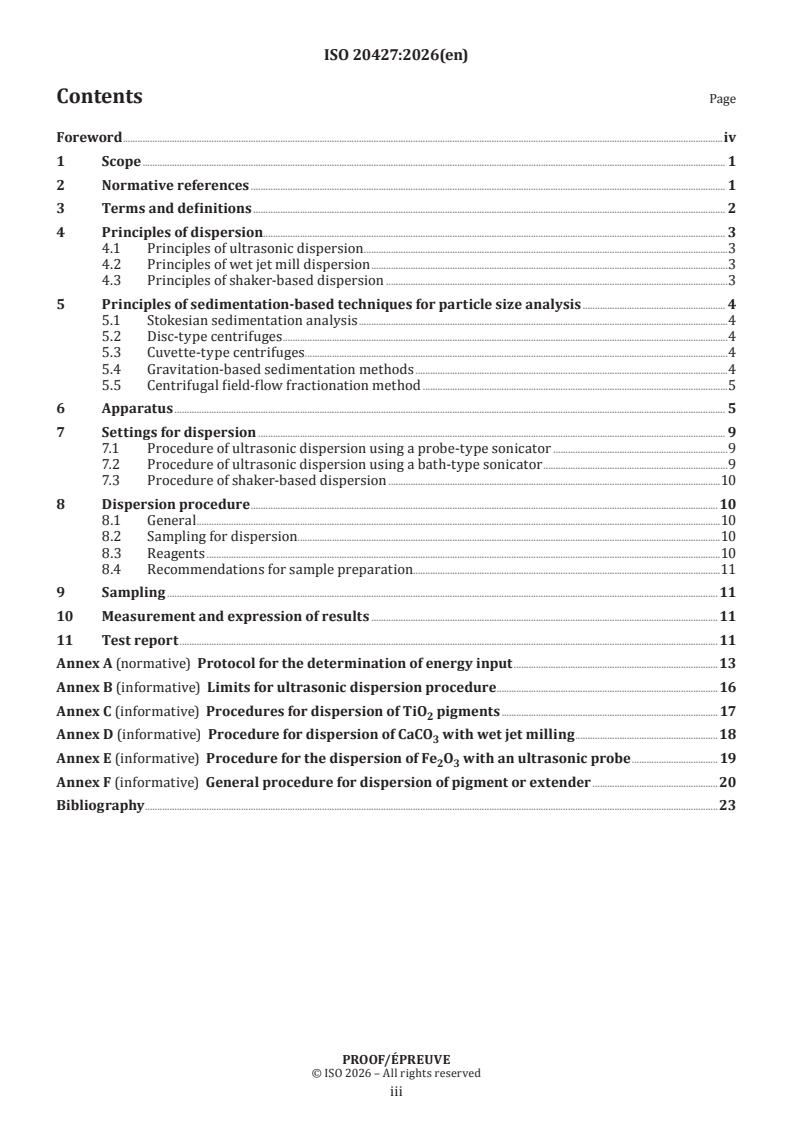
Contents Page
Foreword .iv
1 Scope . 1
2 Normative references . 1
3 Terms and definitions . 2
4 Principles of dispersion. 3
4.1 Principles of ultrasonic dispersion .3
4.2 Principles of wet jet mill dispersion .3
4.3 Principles of shaker-based dispersion .3
5 Principles of sedimentation-based techniques for particle size analysis . 4
5.1 Stokesian sedimentation analysis .4
5.2 Disc-type centrifuges .4
5.3 Cuvette-type centrifuges . .4
5.4 Gravitation-based sedimentation methods .4
5.5 Centrifugal field-flow fractionation method .5
6 Apparatus . 5
7 Settings for dispersion . 9
7.1 Procedure of ultrasonic dispersion using a probe-type sonicator .9
7.2 Procedure of ultrasonic dispersion using a bath-type sonicator .9
7.3 Procedure of shaker-based dispersion .10
8 Dispersion procedure . 10
8.1 General .10
8.2 Sampling for dispersion.10
8.3 Reagents .10
8.4 Recommendations for sample preparation.11
9 Sampling .11
10 Measurement and expression of results .11
11 Test report .11
Annex A (normative) Protocol for the determination of energy input .13
Annex B (informative) Limits for ultrasonic dispersion procedure .16
Annex C (informative) Procedures for dispersion of TiO pigments . 17
Annex D (informative) Procedure for dispersion of CaCO with wet jet milling .18
Annex E (informative) Procedure for the dispersion of Fe O with an ultrasonic probe . 19
2 3
Annex F (informative) General procedure for dispersion of pigment or extender .20
Bibliography .23
PROOF/ÉPREUVE
iii
ISO 20427:2026(en)
Foreword
ISO (the International Organization for Standardization) is a worldwide federation of national standards
bodies (ISO member bodies). The work of preparing International Standards is normally carried out through
ISO technical committees. Each member body interested in a subject for which a technical committee
has been established has the right to be represented on that committee. International organizations,
governmental and non-governmental, in liaison with ISO, also take part in the work. ISO collaborates closely
with the International Electrotechnical Commission (IEC) on all matters of electrotechnical standardization.
The procedures used to develop this document and those intended for its further maintenance are described
in the ISO/IEC Directives, Part 1. In particular, the different approval criteria needed for the different types
of ISO document should be noted. This document was drafted in accordance with the editorial rules of the
ISO/IEC Directives, Part 2 (see www.iso.org/directives).
ISO draws attention to the possibility that the implementation of this document may involve the use of (a)
patent(s). ISO takes no position concerning the evidence, validity or applicability of any claimed patent
rights in respect thereof. As of the date of publication of this document, ISO had not received notice of (a)
patent(s) which may be required to implement this document. However, implementers are cautioned that
this may not represent the latest information, which may be obtained from the patent database available at
www.iso.org/patents. ISO shall not be held responsible for identifying any or all such patent rights.
Any trade name used in this document is information given for the convenience of users and does not
constitute an endorsement.
For an explanation of the voluntary nature of standards, the meaning of ISO specific terms and expressions
related to conformity assessment, as well as information about ISO's adherence to the World Trade
Organization (WTO) principles in the Technical Barriers to Trade (TBT), see www.iso.org/iso/foreword.html.
This document was prepared by Technical Committee ISO/TC 256, Pigments, dyestuffs and extenders, in
collaboration with the European Committee for Standardization (CEN) Technical Committee CEN/TC 298,
Pigments and extenders, in accordance with the Agreement on technical cooperation between ISO and CEN
(Vienna Agreement).
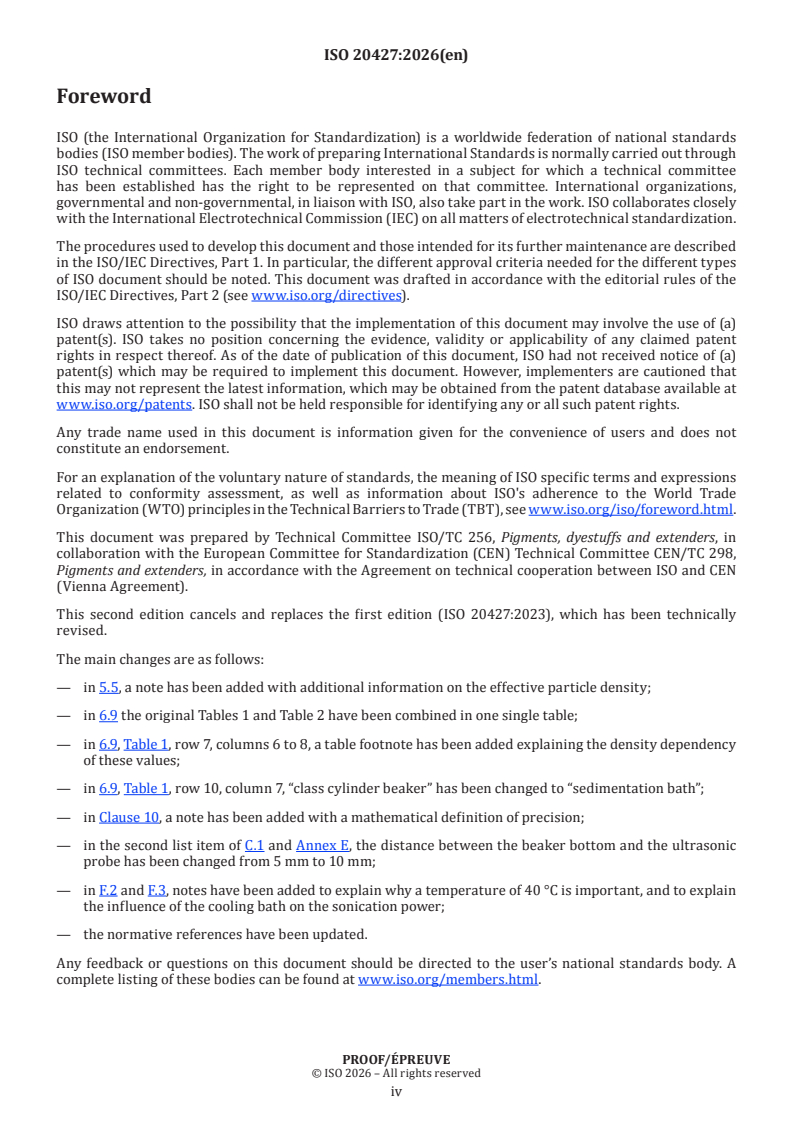
This second edition cancels and replaces the first edition (ISO 20427:2023), which has been technically
revised.
The main changes are as follows:
— in 5.5, a note has been added with additional information on the effective particle density;
— in 6.9 the original Tables 1 and Table 2 have been combined in one single table;
— in 6.9, Table 1, row 7, columns 6 to 8, a table footnote has been added explaining the density dependency
of these values;
— in 6.9, Table 1, row 10, column 7, “class cylinder beaker” has been changed to “sedimentation bath”;
— in Clause 10, a note has been added with a mathematical definition of precision;
— in the second list item of C.1 and Annex E, the distance between the beaker bottom and the ultrasonic
probe has been changed from 5 mm to 10 mm;
— in F.2 and F.3, notes have been added to explain why a temperature of 40 °C is important, and to explain
the influence of the cooling bath on the sonication power;
— the normative references have been updated.
Any feedback or questions on this document should be directed to the user’s national standards body. A
complete listing of these bodies can be found at www.iso.org/members.html.
PROOF/ÉPREUVE
iv
International Standard ISO 20427:2026(en)
Pigments and extenders — Dispersion procedure for
sedimentation-based particle sizing of suspended pigment or
extender with liquid sedimentation methods
1 Scope
This document specifies sample preparation methods to determine the size distribution of separate particles
of a single pigment or extender, which is dispersed in a liquid by application of a standardized dispersion
procedure, using an ultrasonic device, shaker device or wet jet mill.
The sample preparation methods described are optimized for measurements carried out with a particle
sizing technique based on sedimentation. This technique relies on particle migration due to gravitation or
centrifugal forces and requires a density contrast between the particles and the liquid phase.
2 Normative references
The following documents are referred to in the text in such a way that some or all of their content constitutes
requirements of this document. For dated references, only the edition cited applies. For undated references,
the latest edition of the referenced document (including any amendments) applies.
ISO 3696, Water for analytical laboratory use — Specification and test methods
ISO 9276-1, Representation of results of particle size analysis — Part 1: Graphical representation
ISO 13317-1, Determination of particle size distribution by gravitational liquid sedimentation methods — Part
1: General principles, requirements and guidance
ISO 13317-2, Determination of particle size distribution by gravitational liquid sedimentation methods — Part
2: Fixed pipette method
ISO 13317-3, Determination of particle size distribution by gravitational liquid sedimentation methods — Part
3: X-ray gravitational technique
ISO 13317-4, Determination of particle size distribution by gravitational liquid sedimentation methods — Part
4: Balance method
ISO 13317-5, Determination of particle size distribution by gravitational liquid sedimentation methods — Part
5: Photosedimentation techniques
ISO 13318-1, Determination of particle size distribution by centrifugal liquid sedimentation methods — Part 1:
General principles, requirements and guidance
ISO 13318-2, Determination of particle size distribution by centrifugal liquid sedimentation methods — Part 2:
Photocentrifuge method
ISO 13318-3, Determination of particle size distribution by centrifugal liquid sedimentation methods — Part 3:
Centrifugal X-ray method
ISO 18451 (all parts), Pigments, dyestuffs and extenders — Terminology
ISO 15528, Paints, varnishes and raw materials for paints and varnishes — Sampling
ASTM D5965, Standard Test Methods for Density of Coating Powders
PROOF/ÉPREUVE
ISO 20427:2026(en)
3 Terms and definitions
For the purposes of this document, the terms and definitions given in the ISO 18451 series and the following
apply.
ISO and IEC maintain terminology databases for use in standardization at the following addresses:
— ISO Online browsing platform: available at https:// www .iso .org/ obp
— IEC Electropedia: available at https:// www .electropedia .org/
3.1
nanoscale
length range from approximately 1 nm to 100 nm
Note 1 to entry: Properties that are not extrapolations from a larger size are predominantly exhibited in this size
range. For such properties, the size limits are considered approximate.
Note 2 to entry: The lower limit in this definition (approximately 1 nm) is introduced to avoid single and small groups
of atoms from being designated as nano-objects or elements of nanostructures, which can be implied by the absence
of a lower limit.
[SOURCE: ISO 80004-1:2023, 3.1.1 — modified, notes 1 and 2 to entry have been added.]
3.2
nanoparticle
nano-object with all external dimensions in the nanoscale (3.1) where the lengths of the longest and the
shortest axes of the nano-object do not differ significantly
Note 1 to entry: If the dimensions differ significantly (typically by more than three times), terms such as nanofibre or
nanoplate are preferred to the term nanoparticle.
[SOURCE: ISO 80004-1:2023, 3.3.4, modified — “where the lengths of the longest and the shortest axes of the
nano-object do not differ significantly” has been added to the definition.]
3.3
agglomerate
collection of weakly or medium strongly bound particles where the resulting external surface area is similar
to the sum of the surface areas of the individual components
Note 1 to entry: The forces holding an agglomerate together are weak forces, for example van der Waals or simple
physical entanglement.
Note 2 to entry: Agglomerates are also termed secondary particles and the original source particles are termed
primary particles (3.5).
[SOURCE: ISO 80004-1:2023, 3.2.4]
3.4
aggregate
particle comprising strongly bonded or fused particles where the resulting external surface area is
significantly smaller than the sum of surface areas of the individual components
Note 1 to entry: The forces holding an aggregate together are strong forces, for example covalent or ionic bonds, or
those resulting from sintering or complex physical entanglement, or otherwise combined former primary particles
(3.5).
Note 2 to entry: Aggregates are also termed secondary particles and the original source particles are termed primary
particles.
[SOURCE: ISO 80004-1:2023, 3.2.5, modified — “or otherwise combined former primary particles” has been
added to the end of note 1 to entry.]
PROOF/ÉPREUVE
ISO 20427:2026(en)
3.5
primary particle
single nano-object with at least one of three external dimensions at the nanoscale (3.1)
Note 1 to entry: Sometimes, if the primary particle is present in crystalline form, it also contains twinning boundaries.
3.6
spin fluid
inert liquid which is injected into the disc of a disc centrifuge photosedimentometer prior to the sample to
define a certain radius dependent gradient of viscosity for sedimentation
Note 1 to entry: Alkaline conditions minimize agglomeration of dispersed aggregates in most cases.
3.7
wet jet milling
dispersing method of particles in liquid phase using the complex shear force arising from turbulent flow in
the channel and cavitation from the abrupt pressure change
Note 1 to entry: This method is also called high pressure homogenizer method.
4 Principles of dispersion
4.1 Principles of ultrasonic dispersion
A piezo electrical ceramic material is driven by an applied alternating current electrical field to expand and
shrink periodically at an ultrasonic frequency in the range of 15 kHz to 80 kHz or more. This movement
creates acoustic waves moving through the dispersion, which produce cavitation bubbles. The collapse of
these cavitation bubbles leads locally to strong thermal effects and shear-stress, which are responsible for
the destruction of agglomerates and even aggregates.
Energy density of sonication, temperature and particle volume concentration of the dispersion are critical
parameters of sonication and shall be held at recipe values strictly.
In addition to probe-type sonicators ultra sonic (US) baths, inverted cup-horn sonicators and so-called vial-
tweeters also exist. US baths, cup-horn dispersers and vial-tweeters are known as indirect dispersers, where
sound energy is inserted via the wall of the container. Determining the energy input of these dispersers is
[9]
much more difficult than for probe sonication, but contamination is reduced.
4.2 Principles of wet jet mill dispersion
The wet jet milling method is a wet-type milling to disintegrate agglomerates of powder samples in liquid. In
this method, particles suspended in a liquid medium are passed through a narrow channel at high pressure.
Then, the suspension of the particles is enhanced by the complex shear force arising from turbulent flow in
the channel. In addition, the high pressure in the narrow channel induces the cavitation bubbles from the
abrupt pressure change. The burst of the cavitation bubbles then works to disperse powder samples in the
liquid phase, as in the ultra-sonication method. The advantage of this dispersion technique is that it yields
suspensions with low contamination, unlike the ultra-sonic homogenizer method. The pressure range is the
important factor to disperse the powder samples in the liquid phase. Typically, the pressure range is from
[10][11]
80 MPa to 245 MPa.
4.3 Principles of shaker-based dispersion
The shaker device shall be built like a plate with holders for the high-density polyethylene (HDPE) bottles
(see Annex B). A successful dispersion is achieved when the plate is shaking vertically from back to front
with a vibration amplitude of minimum 32 mm and a frequency of 660 Hz.
The following aspects should be considered:
— inclusion of grinding beads, high loading;
PROOF/ÉPREUVE
ISO 20427:2026(en)
— particle dispersion limitations: agglomerates/aggregates < 100 µm in a liquid (viscous medium);
— grinding beads are agitated by rotary, tumbling and/or 2D-vibratory motion of the container/vessel;
— shear and elongational stress on agglomerates at squeezing of liquid between colliding grinding beads
[12][13]
and impulse exchange from collisions of agglomerates with grinding beads.
5 Principles of sedimentation-based techniques for particle size analysis
5.1 Stokesian sedimentation analysis
For all sedimentation-based procedures for particle sizing, which are cited in this document, Stokesian
sedimentation analysis of dispersions is used. ISO 13318-1 describes in detail the general procedure and
calculations used to approach a particle size distribution of dispersed particles.
5.2 Disc-type centrifuges
The particles settle within an optically clear, rotating disc. When particles approach the outside edge of
the rotating disc, they block or scatter a portion of a light beam or X-ray beam that passes through the disc.
The change in light intensity shall be continuously recorded and converted by the operating software into a
particle size distribution, in accordance with ISO 13318-1.
Instead of detecting the local particle concentration with optical turbidity, X-ray absorption shall be used in
certain instruments with the advantage of direct particle mass dependency, in accordance with ISO 13318-3.
5.3 Cuvette-type centrifuges
The cuvette-type centrifuge is a special analytical centrifuge that instantaneously measures the particle
concentration at one or more radial positions within the rotating sedimentation cuvette.
For instance, space- and time-resolved extinction of the transmitted light across the entire length of the
sample allows the analysis of particle and droplet velocity distributions for creaming and sedimentation
phenomena without the need of any material data. This process additionally performs particle sizing
according to ISO 13318-2.
−1 −1
The centrifugal speed of these instruments is typically between 50 min and 60 000 min . Instruments with
−1
a centrifugal speed below 10 000 min are typically called cuvette centrifuges. Devices which can rotate
−1 −1
above 10 000 min rotation are called ultracentrifuge. For centrifugal speeds greater than 6 000 min , the
detection of particle sizes is limited to 1 µm or below.
5.4 Gravitation-based sedimentation methods
The gravitation-based liquid sedimentation shall be executed using four different techniques:
— the fixed pipette method in accordance with ISO 13317-2;
— the X-ray gravitation-based technique in accordance with ISO 13317-3;
— the balance method in accordance with ISO 13317-4; and
— the gravitation-based photosedimentation in accordance with ISO 13317-5.
Using the balance method in accordance with ISO 13317-4 and the pipette method in accordance with
ISO 13317-2, it is challenging to achieve a resolution below 1 µm due to the limitations of the detection
mechanisms employed. The X-ray sedimentation on the other hand depends on vibration isolation and
detector quality. It can resolve 100 nm, similar to the photosedimentation.
Therefore, only the liquid X-ray sedimentation according to ISO 13317-1 and ISO 13317-3 is included in this
document.
PROOF/ÉPREUVE
ISO 20427:2026(en)
The concentration of a dispersed sample is measured by the attenuation of an X-ray beam. A stable, narrow,
monochromatic collimated beam of X-rays passes through a suspension of the sample and is detected
at a known distance from the top of the sample cell. The sample cell is filled completely with the sample
suspension for the duration of the analysis. The settling height at which the particle concentration is
determined may be reduced during the analysis for the purpose of obtaining a more rapid analysis compared
to an analysis where all measurements are made at the same height value. The cumulative mass percentage of
the sample present at a given sedimentation height is continuously determined. The X-ray signal attenuation
at the known height is compared to the attenuation in the suspending liquid and also to the attenuation in
the homogeneously dispersed sample present in the liquid. The attenuation of the emergent X-ray beam is
proportional to the mass of the powder in the beam.
5.5 Centrifugal field-flow fractionation method
Field-flow fractionation is a flow-based separation methodology. Centrifugal field-flow fractionation is
a separation technique that uses a centrifugal field applied perpendicular to a circular channel that spins
around its axis to achieve size separation of particles between the limits of 10 nm and 50 µm. In this method,
separation is governed by a combination of size and effective particle density, indicating that applicable size
range is dependent on and limited by the effective particle density.
NOTE The effective particle density is defined by the particle's hydrodynamic diameter, which depends on the
particle shape. It is only identical to the material density measured with He-Pycnometry if the particles are spherical.
With an increasing degree of aggregation or deviation from a spherical shape, the effective particle density decreases.
In centrifugal field-flow fractionation, the mobile phase and analyte flow longitudinally through the channel.
The channel is designed to separate the sample components along its length, resulting in the elution of
constituents at different times. The channel and its large aspect ratio are designed to promote parabolic or
near-parabolic laminar flow between two infinite planes under normal operational conditions. Fractionation
is achieved during passage through the channel, based on the velocity flow profile, after which the mobile
phase containing separated constituents exits to either online detectors or a fraction collector for off-line
analysis, or both. Common detectors used for analysis of the pigment and extender include ultraviolet-visible
(UV-Vis) absorbance, fluorescence, multi-angle light scattering (MALS), dynamic light scattering (DLS) and
element detectors such as the inductively coupled plasma mass spectrometer (ICP-MS). Combinational
analysis of the sizing and concentration evaluation detectors, as well as the size distribution analysis have
been performed using this method according to ISO/TS 21362.
6 Apparatus
Use standard laboratory apparatus, together with the following.
6.1 Apparatus for ultrasonic dispersion:
a) Probe-type sonicator, with at least 100 W power and a frequency of 10 kHz to 100 kHz.
This type of sonicator has been found to be an effective means of dispersing particulate materials in liquid
dispersion from agglomerates into discrete primary particles or/and aggregates. The temperature of the
dispersion during sonication shall be held as low as possible, around typical room temperature, in order to
maintain conditions for good stability of the dispersing agents.
b) Bath-type sonicator, with at least 50 W power and a frequency of 10 kHz to 100 kHz.
6.2 Apparatus for wet jet milling, designed for dispersing, crushing, emulsifying, and surface-modifying
[14][15]
materials under pressures of up to 245 MPa .
It comprises high-voltage and ultra-high-pressure components. During operation, the powder suspension
is pressurized by the intensifier, accelerated through the nozzle, and dispersed via complex shear forces
from turbulent flow and cavitation induced by sudden pressure changes. The maximum jet pressure
is determined by the nozzle diameter, typically ranging from 0,05 mm to 0,15 mm. To prevent clogging,
the particle diameter shall be smaller than the nozzle diameter, ideally less than half of it. The apparatus
processes at approximately 0,1 l/min and is compatible with both organic and aqueous solvents. However,
PROOF/ÉPREUVE
ISO 20427:2026(en)
water is generally recommended, as organic solvents such as acetone, acids, or alcohol can compromise the
sealing components of the apparatus.
WARNING — Ignoring safety precautions and wrong handling or operation can cause serious or
minor injuries and damage to this apparatus or other properties.
WARNING — Do not operate the apparatus with the solvent boiling point exceeded. Blow-off of the
material or solvent caused by bumping or equipment damage caused by high-pressure steam can
injure the body.
See Annex D for an example of a detailed procedure of wet jet milling dispersion, as well as a detailed
description for energy estimation.
1)
6.3 Apparatus for shaker-based dispersion, such as Disperser DAS.
6.4 Analytical balance, accurate to the nearest 0,1 mg.
6.5 Beaker, based on the sonicator size, 50 ml to 300 ml tall-form.
6.6 Magnetic stirring device with stirrer bar.
6.7 Syringes, 1 ml, 2 ml, 10 ml and 20 ml or better corresponding pipettes.
6.8 Cooled bath.
6.9 Liquid sedimentation-based detection systems for particle size measurement.
Table 1 shows examples of liquid sedimentation-based devices that can be used as measuring instruments,
which are available at the time of publication of this document.
1) Disperser DAS is an example of a suitable product available commercially. This information is given for the convenience
of users of this document and does not constitute an endorsement by ISO of this product.
PROOF/ÉPREUVE
ISO 20427:2026(en)
PROOF/ÉPREUVE
Table 1 — Examples of liquid sedimentation-based devices
Type Photo-centrifuge X-ray-centrifuge Analytical X Ray Cuvette Sedimentation X-ray Filed-flow
ultra- sedimentation – balance Cuvette fractional
centrifuge movable cuvette analysis sedimenta- device
tion
Subtype/ Disc centri- Cuvette centri- Disc centrifuge Cuvette cen- ISO 13317-3 ISO 13317-4 ISO 13317-3 ISO/TS 21362
Standard fuge fuge trifuge
Wavelength/ex- 405 nm or Multiple wave- Data to be delivered Multiple 0,138 nm / — 0,071 nm / Optical
−15 −15
citation energy 470 nm or lengths from apparatus wavelengths or 1,442·10 J 2,801·10 J
multiple wave-
650 nm manufacturer xenon light (9 keV) (17,48 keV)
405 nm to lengths are
870 nm available
−1 −1 −1 −1
Acceleration range 600 min to 500 min to 600 min to (Middle of cell) — — — 0 min to
−1 −1 −1 −1
−1
at the bottom 24 000 min 4 000 min 18 000 min 12 000 min
1 000 min to
−1
5 times to
Not preferred: 60 000 min
2 300 times
Rotation speed
earth gravity
(at cell bottom)
Type of detection Light extinction Light extinction X-ray extinction Light extinc- X-ray extinction Computational X-ray extinc- Light scattering
versus time versus time and versus time tion or re- versus time detection using tion versus
UV-Vis absorp-
position fractive index a commercial time and
tion
versus time balance space STEP
Refractive
(space- and
index
time-resolved
Fluorescence
extinction
ICP-MS
profiles)
Technology
Sample volume 100 µl to 400 µl 100 µl to 100 µl to 400 µl 350 µl to 80 ml 1 l 0,2 ml to 20 µl to 100 µl
2 000 µl 400 µl 1,6 ml
Sample concen- 0,01 % to 10 % 0,01 % to 20 % 0,1 % to 30 % 0,01 % to 1 % Min. 2,5 % Min. 2,5 % Min. 2 % Dependent on
a a
tration in mass or (volume frac- (volume frac- (mass fraction) (mass fraction) (mass fraction) (mass frac- the samples
a
volume tion) tion) tion)
Spin fluid volume 10 ml to 20 ml — 10 ml to 40 ml — — — — —
Number of samples 1 Up to 12 1 Up to 14 1 1 1 1
a
This value varies depending on the density since the detection depends on the volume of the substance to be detected.
ISO 20427:2026(en)
PROOF/ÉPREUVE
Table 1 (continued)
Type Photo-centrifuge X-ray-centrifuge Analytical X Ray Cuvette Sedimentation X-ray Filed-flow
ultra- sedimentatio
...
Formatted
...
Style Definition
...
Style Definition
...
Style Definition
...
Style Definition
...
ISO/DISPRF 20427:2025(en)
Style Definition
...
ISO/TC 256
Style Definition
...
Style Definition
...
Secretariat: DIN
Style Definition
...
Date: 2025-03-092026-01-23
Style Definition
...
Style Definition
...
Style Definition
...
Style Definition
...
Style Definition
...
Style Definition
...
Pigments and extenders — Dispersion procedure for sedimentation-
Style Definition
...
based particle sizing of suspended pigment or extender with liquid
Style Definition
...
sedimentation methods
Style Definition
...
Pigments et matières de charge — Mode opératoire de dispersion pour la détermination granulométrique basée
Style Definition
...
sur la sédimentation des pigments ou matières de charge en suspension par des méthodes de sédimentation
Style Definition
...
dans un liquide
Style Definition
...
Style Definition
...
Style Definition
...
Style Definition
...
Style Definition
...
Style Definition
...
Style Definition
...
Style Definition
...
PROOF
Style Definition
...
Style Definition
...
Style Definition
...
Style Definition
...
Style Definition
...
Style Definition
...
Style Definition
...
Style Definition
...
TThhiiss d drraftaft i iss s suubbmmiitttteded t too a pa pararallel vallel vootte e iinn I ISSOO,, C CEENN.
Style Definition
...
Style Definition
...
Style Definition
...
Style Definition
...
Style Definition
...
Style Definition
...
Style Definition
...
Style Definition
...
Style Definition
...
Style Definition
...
Style Definition
...
Style Definition
...
Style Definition
...
Style Definition
...
Style Definition
...
Style Definition
...
Style Definition
...
Style Definition
...
Style Definition
...
Style Definition
...
Style Definition
...
St l D fi iti
Formatted: Font: Bold
Formatted: HeaderCentered
Formatted: Default Paragraph Font
Formatted: Indent: Left: 0 cm, Right: 0 cm, Space
All rights reserved. Unless otherwise specified, or required in the context of its implementation, no part of this publication
Before: 0 pt, No page break before, Adjust space
may be reproduced or utilized otherwise in any form or by any means, electronic or mechanical, including photocopying,
between Latin and Asian text, Adjust space between
or posting on the internet or an intranet, without prior written permission. Permission can be requested from either ISO
Asian text and numbers
at the address below or ISO’s member body in the country of the requester.
ISO copyright office
CP 401 • Ch. de Blandonnet 8
CH-1214 Vernier, Geneva
Phone: + 41 22 749 01 11
EmailE-mail: copyright@iso.org
Website: www.iso.orgwww.iso.org
Published in Switzerland
Formatted: English (United Kingdom)
Formatted: Font: 10 pt
Formatted: Font: 10 pt
Formatted: Font: 11 pt
Formatted: FooterPageRomanNumber, Space After: 0
pt, Line spacing: single
ii © ISO #### 2026 – All rights reserved
ii
ISO/DISPRF 20427:20252026(en)
Formatted: Font: Bold
Formatted: Font: Bold
Formatted: Font: Bold
Contents
Formatted: HeaderCentered, Left
Formatted: Adjust space between Latin and Asian text,
Foreword . vi
Adjust space between Asian text and numbers
1 Scope . 1
2 Normative references . 1
3 Terms and definitions . 2
4 Principles of dispersion . 3
4.1 Principles of ultrasonic dispersion . 3
4.2 Principles of wet jet mill dispersion . 3
4.3 Principles of shaker-based dispersion . 4
5 Principles of sedimentation-based techniques for particle size analysis . 4
5.1 Stokesian sedimentation analysis . 4
5.2 Disc-type centrifuges . 4
5.3 Cuvette-type centrifuges . 4
5.4 Gravitation-based sedimentation methods. 5
5.5 Centrifugal field-flow fractionation method . 5
6 Apparatus . 6
7 Settings for dispersion . 1
7.1 Procedure of ultrasonic dispersion using a probe-type sonicator . 1
7.2 Procedure of ultrasonic dispersion using a bath-type sonicator . 1
7.3 Procedure of shaker-based dispersion . 2
8 Dispersion procedure . 2
8.1 General. 2
8.2 Sampling for dispersion . 2
8.3 Reagents . 3
8.4 Recommendations for sample preparation . 3
9 Sampling . 3
10 Measurement and expression of results . 3
11 Test report . 4
Annex A (normative) Protocol for the determination of energy input . 5
Annex B (informative) Limits for ultrasonic dispersion procedure . 9
Annex C (informative) Procedures for dispersion of TiO2 pigments . 10
Annex D (informative) Procedure for dispersion of CaCO3 with wet jet milling . 12
Annex E (informative) Procedure for the dispersion of Fe O with an ultrasonic probe . 13
2 3
Annex F (informative) General procedure for dispersion of pigment or extender . 14
Bibliography . 17
Formatted: Font: 10 pt
Foreword . v
Formatted: Font: 10 pt
1 Scope . 1
Formatted: FooterCentered, Left, Space Before: 0 pt,
2 Normative references . 1
Tab stops: Not at 17.2 cm
3 Terms and definitions . 2
Formatted: Font: 11 pt
4 Principles of dispersion . 3
Formatted: FooterPageRomanNumber, Left, Space
4.1 Principles of ultrasonic dispersion . 3
After: 0 pt, Tab stops: Not at 17.2 cm
iii
Formatted: Font: Bold
Formatted: HeaderCentered
4.2 Principle of wet jet mill dispersion . 3
4.3 Principle of shaker-based dispersion . 3
5 Principles of sedimentation-based techniques for particle size analysis . 4
5.1 Stokesian sedimentation analysis . 4
5.2 Disc-type centrifuges . 4
5.3 Cuvette-type centrifuges . 4
5.4 Gravitation-based sedimentation methods. 4
5.5 Centrifugal field-flow fractionation method . 5
6 Apparatus . 5
7 Settings for dispersion . 8
7.1 Procedure of ultrasonic dispersion using a probe-type sonicator . 8
7.2 Procedure of ultrasonic dispersion using a bath-type sonicator . 8
7.3 Procedure of shaker-based dispersion . 9
8 Dispersion procedure . 9
8.1 General. 9
8.2 Sampling for dispersion . 9
8.3 Reagents . 10
8.4 Recommendations for sample preparation . 10
9 Sampling . 10
10 Measurement and expression of results . 10
11 Test report . 11
Annex A (normative) Protocol for the determination of energy input. 12
A.1 Protocol for the determination of energy input at ultrasonication . 12
A.1.1 Procedure . 12
A.1.2 Data analysis . 12
A.1.3 Assumptions . 12
A.2 Protocol for the determination of energy input at shaker-based dispersion . 13
A.2.1 General. 13
A.2.2 Procedure . 13
A.2.3 Data analysis . 13
A.3 Protocol for the determination of energy input at wet jet milling . 14
A.3.1 Procedure . 14
A.3.2 Data analysis . 14
A.3.3 Assumptions . 14
Annex B (informative) Limits for ultrasonic dispersion procedure . 15
Annex C (informative) Procedures for dispersion of TiO pigments. 16
C.1 Procedure for dispersion of TiO pigments with ultrasonic probe . 16
C.2 Procedure for dispersion of TiO pigments with a shaker. 16
Formatted: Font: 10 pt
Annex D (informative) Procedure for dispersion of CaCO3 with wet jet milling . 17
Formatted: Font: 10 pt
Annex E (informative) Procedure for the dispersion of Fe O with an ultrasonic probe . 18
2 3
Formatted: Font: 11 pt
Annex F (informative) Procedure for dispersion of carbon black . 19
Formatted: FooterPageRomanNumber, Space After: 0
pt, Line spacing: single
iv © ISO #### 2026 – All rights reserved
iv
ISO/DISPRF 20427:20252026(en)
Formatted: Font: Bold
Formatted: Font: Bold
Formatted: Font: Bold
Annex G (informative) General procedure for dispersion of pigment or extender . 20
Formatted: HeaderCentered, Left
G.1 General. 20
G.2 Probe-type ultrasonicator . 20
G.3 Bath-type ultrasonicator . 21
G.4 Shaker-based dispersing device . 21
G.5 Wet jet milling . 21
Bibliography . 23
Formatted: Font: 10 pt
Formatted: Font: 10 pt
Formatted: FooterCentered, Left, Space Before: 0 pt,
Tab stops: Not at 17.2 cm
Formatted: Font: 11 pt
Formatted: FooterPageRomanNumber, Left, Space
After: 0 pt, Tab stops: Not at 17.2 cm
v
Formatted: Font: Bold
Formatted: HeaderCentered
Foreword Formatted: Adjust space between Latin and Asian text,
Adjust space between Asian text and numbers
ISO (the International Organization for Standardization) is a worldwide federation of national standards
bodies (ISO member bodies). The work of preparing International Standards is normally carried out through
ISO technical committees. Each member body interested in a subject for which a technical committee has been
established has the right to be represented on that committee. International organizations, governmental and
non-governmental, in liaison with ISO, also take part in the work. ISO collaborates closely with the
International Electrotechnical Commission (IEC) on all matters of electrotechnical standardization.
The procedures used to develop this document and those intended for its further maintenance are described
in the ISO/IEC Directives, Part 1. In particular, the different approval criteria needed for the different types of
ISO document should be noted. This document was drafted in accordance with the editorial rules of the
ISO/IEC Directives, Part 2 (see www.iso.org/directives).
Formatted: English (United Kingdom)
ISO draws attention to the possibility that the implementation of this document may involve the use of (a)
patent(s). ISO takes no position concerning the evidence, validity or applicability of any claimed patent rights
in respect thereof. As of the date of publication of this document, ISO had not received notice of (a) patent(s)
which may be required to implement this document. However, implementers are cautioned that this may not
represent the latest information, which may be obtained from the patent database available at
www.iso.org/patents.www.iso.org/patents. ISO shall not be held responsible for identifying any or all such
patent rights.
Any trade name used in this document is information given for the convenience of users and does not
constitute an endorsement.
For an explanation of the voluntary nature of standards, the meaning of ISO specific terms and expressions
related to conformity assessment, as well as information about ISO's adherence to the World Trade
Organization (WTO) principles in the Technical Barriers to Trade (TBT), see
www.iso.org/iso/foreword.htmlwww.iso.org/iso/foreword.html.
Formatted: English (United Kingdom)
This document was prepared by Technical Committee ISO/TC 256, Pigments, dyestuffs and extenders, in
Formatted: Adjust space between Latin and Asian text,
collaboration with the European Committee for Standardization (CEN) Technical Committee CEN/TC 298, Adjust space between Asian text and numbers
Pigments and extenders, in accordance with the Agreement on technical cooperation between ISO and CEN
Formatted: Font: Not Italic
(Vienna Agreement).
Formatted: Font: Not Italic
This second edition cancels and replaces the first edition (ISO 20427:2023), which has been technically
Formatted: Default Paragraph Font
revised.
Formatted: Default Paragraph Font
Formatted: Default Paragraph Font
The main changes are as follows:
— — in 5.5,5.5, a note has been added with additional information on the effective particle density;
Formatted: Adjust space between Latin and Asian text,
Adjust space between Asian text and numbers, Tab
— — in 6.96.9 the original Tables 1 and Table 2 have been combined in one single table;
stops: Not at 0.7 cm + 1.4 cm + 2.1 cm + 2.8 cm +
3.5 cm + 4.2 cm + 4.9 cm + 5.6 cm + 6.3 cm + 7 cm
— — in 6.9, Table 1,in 6.9, Table 1, row 7, columns 6 to 8, a table footnote has been added explaining
the density dependency of these values;
— — in 6.9, Table 1,6.9, Table 1, row 10, column 7, “class cylinder beaker” has been changed to
“sedimentation bath”;
Formatted: Font: 10 pt
— — in Clause 10,Clause 10, a note has been added with a mathematical definition of precision;
Formatted: Font: 10 pt
— — in the second list item of C.1C.1 and Annex E,Annex E, the distance between the beaker bottom
Formatted: Font: 11 pt
and the ultrasonic probe has been changed from 5 mm to 10 mm;
Formatted: FooterPageRomanNumber, Space After: 0
pt, Line spacing: single
vi © ISO #### 2026 – All rights reserved
vi
ISO/DISPRF 20427:20252026(en)
Formatted: Font: Bold
Formatted: Font: Bold
Formatted: Font: Bold
— — in G.2 and G.3, footnotesin F.2 and F.3, notes have been added to explain why a temperature of
Formatted: HeaderCentered, Left
40 °C is important, and to explain the influence of the cooling bath on the sonication power;
— — the normative references have been updated.
Any feedback or questions on this document should be directed to the user’s national standards body. A
Formatted: English (United Kingdom)
complete listing of these bodies can be found at www.iso.org/members.htmlwww.iso.org/members.html.
Formatted: English (United Kingdom)
Formatted: Font: 10 pt
Formatted: Font: 10 pt
Formatted: FooterCentered, Left, Space Before: 0 pt,
Tab stops: Not at 17.2 cm
Formatted: Font: 11 pt
Formatted: FooterPageRomanNumber, Left, Space
After: 0 pt, Tab stops: Not at 17.2 cm
vii
DRAFT International Standard ISO/DIS 20427:2025(en)
Formatted: Main Title 1, Adjust space between Latin
Pigments and extenders — Dispersion procedure for sedimentation-
and Asian text, Adjust space between Asian text and
based particle sizing of suspended pigment or extender with liquid
numbers
sedimentation methods
1 Scope
This document specifies sample preparation methods to determine the size distribution of separate particles
of a single pigment or extender, which is dispersed in a liquid by application of a standardized dispersion
procedure, using an ultrasonic device, shaker device or wet jet mill.
The sample preparation methods described are optimized for measurements carried out with a particle sizing
technique based on sedimentation. This technique relies on particle migration due to gravitation or centrifugal
forces and requires a density contrast between the particles and the liquid phase.
2 Normative references
The following documents are referred to in the text in such a way that some or all of their content constitutes
requirements of this document. For dated references, only the edition cited applies. For undated references,
the latest edition of the referenced document (including any amendments) applies.
ISO 3696, Water for analytical laboratory use — Specification and test methods
Formatted: Default Paragraph Font
Formatted
...
ISO 9276--1, Representation of results of particle size analysis — Part 1: Graphical representation
Formatted: Adjust space between Latin and Asian text,
Adjust space between Asian text and numbers, Tab
ISO 13317--1, Determination of particle size distribution by gravitational liquid sedimentation methods —
stops: Not at 0.7 cm + 1.4 cm + 2.1 cm + 2.8 cm +
Part 1: General principles, requirements and guidance
3.5 cm + 4.2 cm + 4.9 cm + 5.6 cm + 6.3 cm + 7 cm
ISO 13317--2, Determination of particle size distribution by gravitational liquid sedimentation methods —
Formatted
...
Part 2: Fixed pipette method
Formatted
...
Formatted
ISO 13317--3, Determination of particle size distribution by gravitational liquid sedimentation methods — .
Part 3: X-ray gravitational technique
Formatted
...
ISO 13317--4, Determination of particle size distribution by gravitational liquid sedimentation methods —
Formatted
...
Part 4: Balance method
ISO 13317--5, Determination of particle size distribution by gravitational liquid sedimentation methods —
Formatted
...
Part 5: Photosedimentation techniques
ISO 13318--1:2001, Determination of particle size distribution by centrifugal liquid sedimentation
Formatted
...
methods — Part 1: General principles, requirements and guidelinesguidance
ISO 13318--2, Determination of particle size distribution by centrifugal liquid sedimentation methods — Part
Formatted
...
2: Photocentrifuge method
ISO 13318--3, Determination of particle size distribution by centrifugal liquid sedimentation methods — Part
Formatted
...
3: Centrifugal X-ray method
ISO 18451 (all parts), Pigments, dyestuffs and extenders — Terminology
Formatted
...
Formatted: Font: Bold
Formatted: HeaderCentered
ISO 15528, Paints, varnishes and raw materials for paints and varnishes — Sampling
Formatted: Default Paragraph Font
Formatted: Default Paragraph Font
ASTM D5965, Standard Test Methods for Density of Coating Powders
Formatted: Default Paragraph Font
3 Terms and definitions
Formatted: Default Paragraph Font
Formatted: Default Paragraph Font
For the purposes of this document, the terms and definitions given in the ISO 18451 series and the following
Formatted: Default Paragraph Font
apply.
Formatted: Adjust space between Latin and Asian text,
ISO and IEC maintain terminology databases for use in standardization at the following addresses:
Adjust space between Asian text and numbers
Formatted: Default Paragraph Font
— — ISO Online browsing platform: available at https://www.iso.org/obphttps://www.iso.org/obp
Formatted: Default Paragraph Font
— — IEC Electropedia: available at https://www.electropedia.org/https://www.electropedia.org/
Formatted: Default Paragraph Font
Formatted: English (United Kingdom)
3.1 3.1
nanoscale
Formatted: Font: Cambria, 11 pt, English (United
length range from approximately 1 nm to 100 nm
Kingdom)
Formatted: English (United Kingdom)
Note 1 to entry: Properties that are not extrapolations from a larger size are predominantly exhibited in this size range.
For such properties, the size limits are considered approximate.
Formatted: English (United Kingdom)
Formatted: Font: Cambria, English (United Kingdom)
Note 2 to entry: The lower limit in this definition (approximately 1 nm) is introduced to avoid single and small groups
of atoms from being designated as nano-objects or elements of nanostructures, which can be implied by the absence of a Formatted
...
lower limit.
Formatted
...
[SOURCE: ISO 80004--1:2023, 3.1.1 — modified, notes 1 and 2 to entry have been added.]
Formatted
...
Formatted: Default Paragraph Font
3.2 3.2
nanoparticle Formatted: Default Paragraph Font
nano-object with all external dimensions in the nanoscale (3.1)(3.1) where the lengths of the longest and the
Formatted: Default Paragraph Font
shortest axes of the nano-object do not differ significantly
Formatted: Default Paragraph Font
Note 1 to entry: If the dimensions differ significantly (typically by more than three times), terms such as nanofibre or
Formatted: Default Paragraph Font
nanoplate may are preferred to the term nanoparticle.
Formatted
...
[SOURCE: ISO 80004--1:2023, 3.3.4, modified — "“where the lengths of the longest and the shortest axes of
Formatted: Default Paragraph Font
the nano-object do not differ significantly"” has been added to the definition.]
Formatted: Default Paragraph Font
Formatted: Default Paragraph Font
3.3 3.3
agglomerate
Formatted: Default Paragraph Font
collection of weakly or medium strongly bound particles where the resulting external surface area is similar
Formatted: Default Paragraph Font
to the sum of the surface areas of the individual components
Formatted
...
Note 1 to entry: The forces holding an agglomerate together are weak forces, for example van der Waals or simple
Formatted
...
physical entanglement.
Note 2 to entry: Agglomerates are also termed secondary particles and the original source particles are termed primary
particles (3.5).(3.5).
Formatted: Default Paragraph Font
Formatted: Default Paragraph Font
[SOURCE: ISO 80004-1:2023, 3.2.4]
Formatted: Default Paragraph Font
3.4 3.4
Formatted: Default Paragraph Font
aggregate
particle comprising strongly bonded or fused particles where the resulting external surface area is
Formatted: Default Paragraph Font
significantly smaller than the sum of surface areas of the individual components
Formatted
...
2 © ISO #### – All rights reserved
ISO/DIS 20427:2025(en)
Note 1 to entry: The forces holding an aggregate together are strong forces, for example covalent or ionic bonds, or those
Formatted: Adjust space between Latin and Asian text,
resulting from sintering or complex physical entanglement, or otherwise combined former primary particles (3.5).(3.5).
Adjust space between Asian text and numbers, Tab
stops: Not at 0.7 cm + 1.4 cm + 2.1 cm + 2.8 cm +
Note 2 to entry: Aggregates are also termed secondary particles and the original source particles are termed primary
3.5 cm + 4.2 cm + 4.9 cm + 5.6 cm + 6.3 cm + 7 cm
particles.
[SOURCE: ISO 80004--1:2023, 3.2.5, modified — "“or otherwise combined former primary particles"” has
Formatted: Default Paragraph Font
been added to the end of note 1 to entry.]
Formatted: Default Paragraph Font
Formatted: Default Paragraph Font
3.5 3.5
primary particle
Formatted: Default Paragraph Font
single nano-object with at least one of three external dimensions at the nanoscale (3.1)(3.1)
Formatted: Default Paragraph Font
Note 1 to entry: Sometimes, if the primary particle is present in crystalline form, it also contains twinning boundaries.
Formatted: Adjust space between Latin and Asian text,
Adjust space between Asian text and numbers
3.6 3.6
Formatted: Font: Not Italic
spin fluid
Formatted: Adjust space between Latin and Asian text,
inert liquid which is injected into the disc of a disc centrifuge photosedimentometer prior to the sample to
Adjust space between Asian text and numbers, Tab
define a certain radius dependent gradient of viscosity for sedimentation
stops: Not at 0.7 cm + 1.4 cm + 2.1 cm + 2.8 cm +
3.5 cm + 4.2 cm + 4.9 cm + 5.6 cm + 6.3 cm + 7 cm
Note 1 to entry: Alkaline conditions minimize agglomeration of dispersed aggregates in most cases.
Formatted: TermNum2, Adjust space between Latin
3.7 3.7
and Asian text, Adjust space between Asian text and
wet jet milling
numbers
dispersing method of particles in liquid phase using the complex shear force arising from turbulent flow in the
Formatted: Adjust space between Latin and Asian text,
channel and cavitation from the abrupt pressure change
Adjust space between Asian text and numbers, Tab
stops: Not at 0.7 cm + 1.4 cm + 2.1 cm + 2.8 cm +
Note 1 to entry: This method is also called high pressure homogenizer method.
3.5 cm + 4.2 cm + 4.9 cm + 5.6 cm + 6.3 cm + 7 cm
Formatted: TermNum2, Adjust space between Latin
4 Principles of dispersion
and Asian text, Adjust space between Asian text and
numbers
4.1 Principles of ultrasonic dispersion
Formatted: Adjust space between Latin and Asian text,
Adjust space between Asian text and numbers, Tab
A piezo electrical ceramic material is driven by an applied alternating current electrical field to expand and
stops: Not at 0.7 cm + 1.4 cm + 2.1 cm + 2.8 cm +
shrink periodically at an ultrasonic frequency in the range of 15 kHz to 80 kHz or more. This movement creates
3.5 cm + 4.2 cm + 4.9 cm + 5.6 cm + 6.3 cm + 7 cm
acoustic waves moving through the dispersion, which produce cavitation bubbles. The collapse of these
cavitation bubbles leads locally to strong thermal effects and shear-stress, which are responsible for the Formatted: Adjust space between Latin and Asian text,
destruction of agglomerates and even aggregates. Adjust space between Asian text and numbers
Formatted: Adjust space between Latin and Asian text,
Energy density of sonication, temperature and particle volume concentration of the dispersion are critical
Adjust space between Asian text and numbers, Tab
parameters of sonication and shall be held at recipe values strictly.
stops: Not at 0.71 cm
Formatted: Adjust space between Latin and Asian text,
In addition to probe-type sonicators ultra sonic (US) baths, inverted cup-horn sonicators and so-called vial-
Adjust space between Asian text and numbers
tweeters also exist. US baths, cup-horn dispersers and vial-tweeters are known as indirect dispersers, where
sound energy is inserted via the wall of the container. Determining the energy input of these dispersers is
[9] [9]
much more difficult than for probe sonication, but contamination is reduced. .
4.2 Principles of wet jet mill dispersion
Formatted: Adjust space between Latin and Asian text,
Adjust space between Asian text and numbers, Tab
The wet jet milling method is a wet-type milling to disintegrate agglomerates of powder samples in liquid. In
stops: Not at 0.71 cm
this method, particles suspended in a liquid medium are passed through a narrow channel at high pressure.
Formatted: Adjust space between Latin and Asian text,
Then, the suspension of the particles is enhanced by the complex shear force arising from turbulent flow in
Adjust space between Asian text and numbers
the channel. In addition, the high pressure in the narrow channel induces the cavitation bubbles from the
abrupt pressure change. The burst of the cavitation bubbles then works to disperse powder samples in the
liquid phase, as in the ultra-sonication method. The advantage of this dispersion technique is that it yields
Formatted: Font: Bold
Formatted: HeaderCentered
suspensions with low contamination, unlike the ultra-sonic homogenizer method. The pressure range is the
important factor to disperse the powder samples in the liquid phase. Typically, the pressure range is from
[10][11] [10][11]
80 MPa to 245 MPa. .
4.3 Principles of shaker-based dispersion
Formatted: Adjust space between Latin and Asian text,
Adjust space between Asian text and numbers, Tab
The shaker device shall be built like a plate with holders for the high-density polyethylene (HDPE) bottles (see
stops: Not at 0.71 cm
Annex B).Annex B). A successful dispersion is achieved when the plate is shaking vertically from back to front
Formatted: Adjust space between Latin and Asian text,
with a vibration amplitude of minimum 32 mm and a frequency of 660 Hz.
Adjust space between Asian text and numbers
The following aspects should be considered:
— — inclusion of grinding beads, high loading;
Formatted: Adjust space between Latin and Asian text,
Adjust space between Asian text and numbers, Tab
— — particle dispersion limitations: agglomerates/aggregates < 100 µm in a liquid (viscous medium);
stops: Not at 0.7 cm + 1.4 cm + 2.1 cm + 2.8 cm +
3.5 cm + 4.2 cm + 4.9 cm + 5.6 cm + 6.3 cm + 7 cm
— — grinding beads are agitated by rotary, tumbling and/or 2D--vibratory motion of the container/vessel;
— — shear and elongational stress on agglomerates at squeezing of liquid between colliding grinding beads
[12][13] [12][13]
and impulse exchange from collisions of agglomerates with grinding beads. .
Formatted: Adjust space between Latin and Asian text,
5 Principles of sedimentation-based techniques for particle size analysis
Adjust space between Asian text and numbers
Formatted: Adjust space between Latin and Asian text,
5.1 Stokesian sedimentation analysis
Adjust space between Asian text and numbers, Tab
stops: Not at 0.71 cm
For all sedimentation-based procedures for particle sizing, which are cited in this document, Stokesian
Formatted: Adjust space between Latin and Asian text,
sedimentation analysis of dispersions is used. ISO 13318--1 describes in detail the general procedure and
Adjust space between Asian text and numbers
calculations used to approach a particle size distribution of dispersed particles.
Formatted: Default Paragraph Font
5.2 Disc-type centrifuges
Formatted: Default Paragraph Font
Formatted: Default Paragraph Font
The particles settle within an optically clear, rotating disc. When particles approach the outside edge of the
rotating disc, they block or scatter a portion of a light beam or X--ray beam that passes through the disc. The
Formatted: Adjust space between Latin and Asian text,
change in light intensity shall be continuously recorded and converted by the operating software into a
Adjust space between Asian text and numbers, Tab
particle size distribution, in accordance with ISO 13318--1.
stops: Not at 0.71 cm
Formatted: Adjust space between Latin and Asian text,
Instead of detecting the local particle concentration with optical turbidity, X--ray absorption shall be used in
Adjust space between Asian text and numbers
certain instruments with the advantage of direct particle mass dependency, in accordance with ISO 13318--3.
Formatted: Default Paragraph Font
5.3 Cuvette-type centrifuges
Formatted: Default Paragraph Font
Formatted: Default Paragraph Font
The cuvette-type centrifuge is a special analytical centrifuge that instantaneously measures the particle
concentration at one or more radial positions within the rotating sedimentation cuvette. Formatted: Default Paragraph Font
Formatted: Default Paragraph Font
For instance, space- and time-resolved extinction of the transmitted light across the entire length of the sample
Formatted: Default Paragraph Font
allows the analysis of particle and droplet velocity distributions for creaming and sedimentation phenomena
without the need of any material data. This process additionally performs particle sizing according to
Formatted: Adjust space between Latin and Asian text,
ISO 13318--2.
Adjust space between Asian text and numbers, Tab
stops: Not at 0.71 cm
−1 −1
The centrifugal speed of these instruments is typically between 50 min and 60 000 min . Instruments with
Formatted: Adjust space between Latin and Asian text,
−1
a centrifugal speed below 10 000 min are typically called cuvette centrifuges. Devices which can rotate above
Adjust space between Asian text and numbers
−1 −1
10 000 min rotation are called ultracentrifuge. For centrifugal speeds greater than 6 000 min , the detection
Formatted: Default Paragraph Font
of particle sizes is limited to 1 µm or below.
Formatted: Default Paragraph Font
Formatted: Default Paragraph Font
4 © ISO #### – All rights reserved
ISO/DIS 20427:2025(en)
5.4 Gravitation-based sedimentation methods
Formatted: Adjust space between Latin and Asian text,
Adjust space between Asian text and numbers, Tab
The gravitation-based liquid sedimentation shall be executed using four different techniques:
stops: Not at 0.71 cm
Formatted: Adjust space between Latin and Asian text,
— the fixed pipette method in accordance with ISO 13317--2;
Adjust space between Asian text and numbers
Formatted: Default Paragraph Font
— the X--ray gravitation-based technique in accordance with ISO 13317--3;
Formatted: Default Paragraph Font
— the balance method in accordance with ISO 13317--4; and
Formatted: Default Paragraph Font
Formatted: List Continue 1, No bullets or numbering,
— the gravitation-based photosedimentation in accordance with ISO 13317--5.
Adjust space between Latin and Asian text, Adjust space
between Asian text and numbers
Using the balance method in accordance with ISO 13317--4 and the pipette method in accordance with
ISO 13317--2, it is challenging to achieve a resolution below 1 µm due to the limitations of the detection
Formatted: Default Paragraph Font
mechanisms employed. The X--ray sedimentation on the other hand depends on vibration isolation and
Formatted: Default Paragraph Font
detector quality. It can resolve 100 nm, similar to the photosedimentation.
Formatted: Default Paragraph Font
Therefore, only the liquid X--ray sedimentation in accordance withaccording to ISO 13317--1 and ISO 13317--
Formatted: Default Paragraph Font
3 is included in this document.
Formatted: Default Paragraph Font
Formatted: Default Paragraph Font
The concentration of a dispersed sample is measured by the attenuation of an X--ray beam. A stable, narrow,
monochromatic collimated beam of X--rays passes through a suspension of the sample and is detected at a
Formatted: Default Paragraph Font
known distance from the top of the sample cell. The sample cell is filled completely with the sample suspension
Formatted: Default Paragraph Font
for the duration of the analysis. The settling height at which the particle concentration is determined may be
reduced during the analysis for the purpose of obtaining a more rapid analysis compared to an analysis where Formatted: Default Paragraph Font
all measurements are made at the same height value. The cumulative mass percentage of the sample present
Formatted: Default Paragraph Font
at a given sedimentation height is continuously determined. The X--ray signal attenuation at the known height
Formatted: Adjust space between Latin and Asian text,
is compared to the attenuation in the suspending liquid and also to the attenuation in the homogeneously
Adjust space between Asian text and numbers
dispersed sample present in the liquid. The attenuation of the emergent X--ray beam is proportional to the
mass of the powder in the beam. Formatted: Default Paragraph Font
Formatted: Default Paragraph Font
5.5 Centrifugal field-flow fractionation method
Formatted: Default Paragraph Font
Field-flow fractionation is a flow-based separation methodology. Centrifugal field-flow fractionation is a
Formatted: Default Paragraph Font
separation technique that uses a centrifugal field applied perpendicular to a circular channel that spins around
Formatted: Default Paragraph Font
its axis to achieve size separation of particles between the limits of 10 nm and 50 µm. In this method,
Formatted: Default Paragraph Font
separation is governed by a combination of size and effective particle density, indicating that applicable size
range is dependent on and limited by the effective particle density.
Formatted: Default Paragraph Font
Formatted: Default Paragraph Font
NOTE The effective particle density is defined by the particle's hydrodynamic diameter, which depends on the
particle shape. It is only identical to the material density measured with He-Pycnometry if the particles are spherical.
Formatted: Default Paragraph Font
With an increasing degree of aggregation or deviation from a spherical shape, the effective particle density decreases.
Formatted: Default Paragraph Font
In centrifugal field-flow fractionation , the mobile phase and analyte flow longitudinally through the channel. Formatted: Default Paragraph Font
The channel is designed to separate the sample components along its length, resulting in the elution of
Formatted
...
constituents at different times. The channel and its large aspect ratio are designed to promote parabolic or
Formatted
...
near-parabolic laminar flow between two infinite planes under normal operational conditions. Fractionation
is achieved during passage through the channel, based on the velocity flow profile, after which the mobile
Formatted
...
phase containing separated constituents exits to either online detectors or a fraction collector for off-line
Formatted
...
analysis, or both. Common detectors used for a
...
Questions, Comments and Discussion
Ask us and Technical Secretary will try to provide an answer. You can facilitate discussion about the standard in here.
Loading comments...