

ISO 3549:2024
(Main)Zinc dust pigments for paints — Specifications and test methods
General Information
- Abstract
This document specifies the requirements and corresponding test methods for zinc dust pigments suitable for use in protective coatings.
- Status
- Published
- Publication Date
- 07-Feb-2024
- Technical Committee
- ISO/TC 256 - Pigments, dyestuffs and extenders
- Drafting Committee
- ISO/TC 256 - Pigments, dyestuffs and extenders
- Current Stage
- 6060 - International Standard published
- Start Date
- 08-Feb-2024
- Due Date
- 21-Oct-2024
- Completion Date
- 08-Feb-2024
Buy Documents
ISO 3549:2024 - Zinc dust pigments for paints — Specifications and test methods Released:8. 02. 2024
ISO 3549:2024 - Pigments à base de poussière de zinc pour peintures — Spécifications et méthodes d'essai/26/2024

REDLINE ISO 3549:2024 - Pigments à base de poussière de zinc pour peintures — Spécifications et méthodes d'essai/26/2024
Overview
ISO 3549:2024 - "Zinc dust pigments for paints - Specifications and test methods" defines requirements and laboratory methods for zinc dust pigments intended for use in protective coatings. The third edition updates compositional tolerances, particle-size testing and analytical techniques to support consistent quality, performance and regulatory compliance for zinc-rich paints and corrosion-protection systems.
Key topics and technical requirements
- Scope and purpose: Specifies essential characteristics, tolerances and corresponding test methods for zinc dust pigments used in protective coatings.
- Types and composition: Introduces three pigment types (Type I, II and III) with differing requirements for metallic zinc content, impurities and particle characteristics. Composition and tolerances are given in normative tables.
- Particle size and sieve analysis: Nominal sieve sizes are now 125 µm, 75 µm and 45 µm. The maximum residue on the 45 µm sieve has been tightened (previously 5% mass fraction, now 0.5% mass fraction).
- Analytical methods: Covers a broad suite of test procedures, including:
- Determination of residue on sieve (particle-size distribution)
- Determination of total zinc and metallic zinc content
- Determination of contaminants: lead, cadmium, iron, arsenic and chloride
- Determination of matter insoluble in acid
- Modern instrumentation: Adds ICP‑OES (inductively coupled plasma–optical emission spectroscopy) as an accepted technique for elemental analysis.
- Sampling and reporting: Aligns sampling with ISO 15528 and requires standardized test reporting to ensure traceability and reproducibility.
- Updated normative references: References ISO 565 (test sieves) and ISO 3696 (water for analytical use) among others; CAS numbers for reagents are included.
Practical applications
- Quality control of zinc dust pigments during manufacture and before shipment.
- Raw‑material acceptance testing by paint and coatings manufacturers.
- Verification of pigment suitability for zinc‑rich, sacrificial corrosion‑protection coatings (e.g., primers for steel structures).
- Regulatory and safety screening for heavy-metal contaminants (lead, cadmium, arsenic).
- Laboratory method standardization for contract testing and supplier audits.
Who should use ISO 3549:2024
- Pigment manufacturers and suppliers
- Paint and coatings formulators and quality managers
- Third‑party testing laboratories and accreditation bodies
- Procurement specialists preparing material specifications
- Regulatory and compliance officers in protective coatings sectors
Related standards
- ISO 565 - Test sieves (nominal opening sizes)
- ISO 3696 - Water for analytical laboratory use
- ISO 15528 - Sampling of paints, varnishes and raw materials
ISO 3549:2024 provides a practical, up‑to‑date framework for ensuring zinc dust pigments meet performance, safety and consistency expectations in protective coatings applications.
Relations
- Consolidates
EN ISO 3549:2024 - Zinc dust pigments for paints - Specifications and test methods (ISO 3549:2024) - Effective Date
- 12-Feb-2026
- Effective Date
- 06-Jun-2022
- Effective Date
- 06-Jun-2022
Buy Documents
ISO 3549:2024 - Zinc dust pigments for paints — Specifications and test methods Released:8. 02. 2024
ISO 3549:2024 - Pigments à base de poussière de zinc pour peintures — Spécifications et méthodes d'essai/26/2024
REDLINE ISO 3549:2024 - Pigments à base de poussière de zinc pour peintures — Spécifications et méthodes d'essai/26/2024
Frequently Asked Questions
ISO 3549:2024 is a standard published by the International Organization for Standardization (ISO). Its full title is "Zinc dust pigments for paints — Specifications and test methods". This standard covers: This document specifies the requirements and corresponding test methods for zinc dust pigments suitable for use in protective coatings.
This document specifies the requirements and corresponding test methods for zinc dust pigments suitable for use in protective coatings.
ISO 3549:2024 is classified under the following ICS (International Classification for Standards) categories: 87.060.10 - Pigments and extenders. The ICS classification helps identify the subject area and facilitates finding related standards.
ISO 3549:2024 has the following relationships with other standards: It is inter standard links to EN ISO 3549:2024, ISO 80601-2-56:2017/Amd 1:2018, ISO 3549:1995. Understanding these relationships helps ensure you are using the most current and applicable version of the standard.
ISO 3549:2024 is available in PDF format for immediate download after purchase. The document can be added to your cart and obtained through the secure checkout process. Digital delivery ensures instant access to the complete standard document.
Standards Content (Sample)
International
Standard
ISO 3549
Third edition
Zinc dust pigments for paints —
2024-02
Specifications and test methods
Pigments à base de poussière de zinc pour peintures —
Spécifications et méthodes d'essai
Reference number
© ISO 2024
All rights reserved. Unless otherwise specified, or required in the context of its implementation, no part of this publication may
be reproduced or utilized otherwise in any form or by any means, electronic or mechanical, including photocopying, or posting on
the internet or an intranet, without prior written permission. Permission can be requested from either ISO at the address below
or ISO’s member body in the country of the requester.
ISO copyright office
CP 401 • Ch. de Blandonnet 8
CH-1214 Vernier, Geneva
Phone: +41 22 749 01 11
Email: copyright@iso.org
Website: www.iso.org
Published in Switzerland
ii
Contents Page
Foreword .v
1 Scope . 1
2 Normative references . 1
3 Terms and definitions . 1
4 Required characteristics and tolerances . 1
5 Sampling . 3
6 Determination of residue on sieve . 3
6.1 Principle .3
6.2 Apparatus .3
6.3 Checking and cleaning the sieve .5
6.4 Procedure .5
6.5 Expression of results . .5
7 Determination of total zinc content . 6
7.1 Principle .6
7.2 Reagents .6
7.3 Procedure .7
7.3.1 Test portion .7
7.3.2 Determination .7
7.4 Expression of results . .7
8 Determination of metallic zinc content . 8
8.1 Principle .8
8.2 Reagents and materials .8
8.3 Procedure .9
8.3.1 General .9
8.3.2 Test portion .9
8.3.3 Determination .9
8.4 Expression of results .9
9 Determination of lead, cadmium and iron content .10
9.1 Principle .10
9.2 Reagents and materials .10
9.3 Apparatus .11
9.4 Procedure .11
9.4.1 Test portion .11
9.4.2 Preparation of test solutions .11
9.4.3 Determination . 12
9.5 Expression of results . 12
10 Determination of arsenic content .13
10.1 Principle . 13
10.2 Reagents and materials . 13
10.3 Apparatus .14
10.4 Procedure . 15
10.4.1 Preparation of the calibration graph . 15
10.4.2 Test portion . 15
10.4.3 Preparation of the test solution .16
10.4.4 Determination .16
10.5 Expression of results .18
11 Determination of chloride content .18
11.1 Principle .18
11.2 Reagents and materials .18
11.3 Apparatus .18
11.4 Procedure .19
iii
11.4.1 Preparation of the calibration graph .19
11.4.2 Determination .19
12 Determination of matter insoluble in acid . 19
12.1 Reagents and materials .19
12.2 Apparatus .19
12.3 Procedure .19
12.3.1 Test portion .19
12.3.2 Determination . 20
12.4 Expression of results . . 20
13 Test report .20
Bibliography .21
iv
Foreword
ISO (the International Organization for Standardization) is a worldwide federation of national standards
bodies (ISO member bodies). The work of preparing International Standards is normally carried out through
ISO technical committees. Each member body interested in a subject for which a technical committee
has been established has the right to be represented on that committee. International organizations,
governmental and non-governmental, in liaison with ISO, also take part in the work. ISO collaborates closely
with the International Electrotechnical Commission (IEC) on all matters of electrotechnical standardization.
The procedures used to develop this document and those intended for its further maintenance are described
in the ISO/IEC Directives, Part 1. In particular, the different approval criteria needed for the different types
of ISO document should be noted. This document was drafted in accordance with the editorial rules of the
ISO/IEC Directives, Part 2 (see www.iso.org/directives).
ISO draws attention to the possibility that the implementation of this document may involve the use of (a)
patent(s). ISO takes no position concerning the evidence, validity or applicability of any claimed patent
rights in respect thereof. As of the date of publication of this document, ISO had not received notice of (a)
patent(s) which may be required to implement this document. However, implementers are cautioned that
this may not represent the latest information, which may be obtained from the patent database available at
www.iso.org/patents. ISO shall not be held responsible for identifying any or all such patent rights.
Any trade name used in this document is information given for the convenience of users and does not
constitute an endorsement.
For an explanation of the voluntary nature of standards, the meaning of ISO specific terms and expressions
related to conformity assessment, as well as information about ISO's adherence to the World Trade
Organization (WTO) principles in the Technical Barriers to Trade (TBT), see www.iso.org/iso/foreword.html.
This document was prepared by Technical Committee ISO/TC 256, Pigments, dyestuffs and extenders, in
collaboration with the European Committee for Standardization (CEN) Technical Committee CEN/TC 298,
Pigments and extenders, in accordance with the Agreement on technical cooperation between ISO and CEN
(Vienna Agreement).
This third edition cancels and replaces the second edition (ISO 3549:1995), which has been technically
revised.
The main changes are as follows:
— the maximum residue on the 45 µm sieve has been changed from 5 % mass fraction to 0,5 % mass
fraction;
— three types of zinc dust pigments (I, II and III) have been introduced with different requirements;
— inductively coupled plasma-optical emission spectroscopy (ICP-OES) has been added as an analytical
technique used for elemental analysis;
— the nominal size of sieve aperture has been changed from 125 µm – 90 µm – 45 µm to 125 µm –75 µm –
45 µm; ®
— CAS Registry Numbers have been added to the reagents;
— the normative references have been updated;
— a bibliography has been added.
Any feedback or questions on this document should be directed to the user’s national standards body. A
complete listing of these bodies can be found at www.iso.org/members.html.
v
International Standard ISO 3549:2024(en)
Zinc dust pigments for paints — Specifications and test
methods
1 Scope
This document specifies the requirements and corresponding test methods for zinc dust pigments suitable
for use in protective coatings.
2 Normative references
The following documents are referred to in the text in such a way that some or all of their content constitutes
requirements of this document. For dated references, only the edition cited applies. For undated references,
the latest edition of the referenced document (including any amendments) applies.
ISO 565, Test sieves — Metal wire cloth, perforated metal plate and electroformed sheet — Nominal sizes of
openings
ISO 3696, Water for analytical laboratory use — Specification and test methods
ISO 15528, Paints, varnishes and raw materials for paints and varnishes — Sampling
3 Terms and definitions
For the purposes of this document, the following terms and definitions apply.
ISO and IEC maintain terminology databases for use in standardization at the following addresses:
— ISO Online browsing platform: available at https:// www .iso .org/ obp
— IEC Electropedia: available at https:// www .electropedia .org/
3.1
zinc dust pigment
fine grey powder of essentially spheroidal particles, mainly consisting of metallic zinc
Note 1 to entry: Zinc dust pigments for paints can vary in their metallic zinc content, chemical purity, particle shape,
particle size distribution, mean and maximum diameter, etc. These variations are all likely to have an influence on the
zinc dust behaviour in paints with regard to parameters such as dispersibility, fineness of grind, reactivity, electrical
conductivity and packing properties.
4 Required characteristics and tolerances
4.1 For zinc dust pigments conforming to this document, the essential requirements are specified in
Table 1 and Table 2.
Table 1 — Composition of zinc dust pigment
Characteristic Unit Requirement Test method
Type I Type II Type III
Total zinc content % (mass min. 98 min. 98 min. 99 See Clause 7
fraction)
Metallic zinc content % (mass min. 94 min. 94 min. 97 See Clause 8
fraction)
a
Lead (Pb) content % (mass max. 0,1 max. 0,01 max. 0,002 See Clause 9
fraction)
a
Cadmium (Cd) content % (mass max. 0,03 max. 0,01 max. 0,001 See Clause 9
fraction)
a
Iron (Fe) content % (mass max. 0,005 max. 0,005 max. 0,002 See Clause 9
fraction)
a
Arsenic (As) content % (mass max. 0,000 5 max. 0,000 5 max. 0,000 5 See Clause 10
fraction)
Chloride (Cl) content % (mass max. 0,005 max. 0,005 max. 0,005 See Clause 11
fraction)
Matter insoluble in acid % (mass max. 0,05 max. 0,05 max. 0,05 See Clause 12
fraction)
a
Other suitable methods such as the induction coupled plasma (ICP-OES or ICP-MS) method may be agreed upon between the
interested parties.
NOTE If the zinc oxide content is required, this can be calculated by multiplying the difference between the total zinc content
and the metallic zinc content by 1,244 7.
Table 2 — Residue on sieve
Nominal size of sieve aperture Residue on sieve
Test method
µm % (mass fraction)
125 max. 0,01
75 max. 0,1 See Clause 6
45 max. 0,5
4.2 Requirements for other physical properties (surface area, particle size distribution, etc.) and the
choice of reference pigment to which these properties refer shall be the subject of agreement between the
1) 2)
interested parties. Particle size and/or particle size distribution data as D10 , D50 , shall be given with
reference to the measurement method and test conditions.
4.3 The reference pigment shall also conform to the requirements given in Table 1 and Table 2.
4.4 Inductively coupled plasma–optical emission spectroscopy (ICP-OES) is an analytical technique used
for elemental analysis. The ICP-OES instrument is used in atomic spectroscopy. During analysis, the sample
is decomposed by intense heat into a cloud of hot gases containing free atoms and ions of the element(s)
of interest. The high temperatures cause significant amounts of collisional excitation and ionization of the
sample atoms. Once the atoms or ions are in their excited state, they can decay to lower states through
thermal or radiative (emission) energy transitions. During ICP-OES analysis, the intensity of the light
emitted at specific wavelengths is measured and used to determine the concentration of the element(s) of
interest. In ICP-OES analysis the thermal excitation sources can populate a large number of different energy
levels for several different elements at the same time. All of the excited atoms and ions can then emit their
1) Industry term meaning the value of the particle diameter below which 10 % of the particles fall in the cumulative
particle size distribution.
2) Industry term meaning the value of the particle diameter below which 50 % of the particles fall in the cumulative
particle size distribution. It is also known as the median diameter.
characteristic radiation at the same time. This results in the flexibility to choose from several different
emissions concurrently and allows detection of multiple elements concurrently.
Sample preparation for ICP-OES analysis is very similar to the sample preparation for atomic absorption (AA;
see Clause 9 and Clause 10) with a variant. (0,500 0 ± 0,000 2) g of sample is dissolved in 100 ml 5 % (volume
fraction) HNO 68 % (mass fraction). For very resistant samples, an additional 10 % (volume fraction)
HCl 37 % (mass fraction) may be used in combination with microwave digestion. The 5 g/l solutions are
further diluted (1/200) with 5 % (volume fraction) HNO while adding 50 µg/l of Sc, Y, Rh and Lu as internal
standards. ICP measurement and standard preparation can be derived from ISO 22036.
5 Sampling
Take a representative sample of the product to be tested, in accordance with ISO 15528.
WARNING — The sample shall not be dried before testing, and any portion of the sample not used
shall not be returned to the sample container after having been manipulated.
6 Determination of residue on sieve
6.1 Principle
A suitable test portion of the sample is passed through an air-jet sieve apparatus, having sieves with nominal
mesh apertures of 45 µm, 75 µm and 125 µm. The residue on each of these sieves is determined.
6.2 Apparatus
6.2.1 Sieves, circular, with a sieving area of diameter 200 mm and with nominal mesh apertures of 45 µm,
75 µm and 125 µm, conforming to ISO 565. A transparent lid shall be provided to cover the sieve during use.
6.2.2 Air-jet sieve apparatus (see Figure 1), consisting of a cylindrical casing which contains a sieve (see
6.2.1). The base of the casing has an outlet (to which an extractor fan is connected) and an air inlet to permit
the injection of air.
−1 −1
The air inlet is connected to a jet rotating at 20 min to 25 min and consists of a slot-shaped nozzle located
beneath and very close to the sieve (see Figure 1). When the jet rotates, it blows air continuously through
the sieve, preventing the powder particles from settling. The air is extracted through the outlet, drawing the
finer particles through the sieve. The flow of air is controlled by adjusting a slot at the outlet.
The vacuum obtained shall be 1 250 Pa or lower.
Key
1 transparent lid
2 sieve
3 casing
4 rotating jet
5 manometer
6 adjustable slot
a
Air inlet.
b
To extractor fan.
Figure 1 — Air-jet sieve apparatus
6.2.3 Timer (for example a stopwatch), recording to the nearest 1 s or better. It may be equipped with a
switch for stopping the motor of the sieve apparatus (6.2.2).
6.2.4 Analytical balance, capable of weighing at least 50 g to the nearest 1 mg.
6.2.5 Mallet, of light construction, with a plastic head, suitable for tapping the apparatus to dislodge
powder adhering to the lid and sieve.
6.2.6 Clean brush
6.2.7 Stainless-steel boat
6.3 Checking and cleaning the sieve
Check that the sieve is clean, undamaged and not blocked by material used in a previous determination. A
magnifying glass of sufficient magnification is recommended to aid this inspection.
If cleaning of the sieve is necessary, an ultrasonic system is recommended for this purpose. It is also possible
to clean the sieve by turning it upside down on a clean sheet of paper and tapping vigorously to eliminate
any residual particles.
6.4 Procedure
Carry out the determination in duplicate.
6.4.1 Weigh, to the nearest 1 mg, a test portion of approximately 50 g (m ).
6.4.2 Secure the 45 µm sieve (6.2.1) in position in the sieve apparatus (6.2.2) and transfer the test portion
to the sieve.
6.4.3 Cover the sieve with the transparent lid, switch on the extractor fan and sieve apparatus (6.2.2)
and tap the lid and the sieve lightly from time to time with the mallet (6.2.5) to distribute the material and
dislodge adhering particles.
6.4.4 After 120 s, switch off the apparatus and remove the transparent lid and sieve. Recover the sieve
residue by turning the sieve upside down on a clean sheet of paper and tapping vigorously to ensure that all
particles are recovered.
6.4.5 Weigh the stainless-steel boat (6.2.7) to the nearest 1 mg (m ). Transfer the sieve residue to it and
reweigh to the nearest 1 mg (m ).
6.4.6 Repeat the operations described in 6.4.1 to 6.4.5 with the 75 µm sieve and then with the 125 µm
sieve on fresh 50 g portions of the sample.
6.5 Expression of results
Calculate the residue on each sieve, R, expressed as mass fraction in percent, using Formula (1):
mm−
()
R= ×100 (1)
m
where
m is the mass, in grams, of the test portion;
m is the mass, in grams, of the steel boat;
m is the mass, in grams, of the boat and the sieve residue.
If the two results (duplicates) for each sieve differ by more than one tenth of the maximum limit for that
sieve in Table 2, repeat the procedure.
Calculate the mean of two valid results (replicates) and report the result to three decimal places for the
125 µm sieve, two decimal places for the 75 µm sieve and one decimal place for the 45 µm sieve.
7 Determination of total zinc content
7.1 Principle
The zinc is titrated against (ethylenedinitrilo)tetraacetic acid (EDTA) solution.
7.2 Reagents
During the analysis, use only reagents of recognized analytical grade and only water of at least grade 3 purity
as specified in ISO 3696.
®3)
7.2.1 Hydrochloric acid, CAS Registry Number 7647-01-0, concentrated, 37 % (mass fraction),
ρ ≈ 1,19 g/ml.
7.2.2 Hydrochloric acid, CAS RN 7647-01-0, diluted 1 + 4.
Dilute 200 ml of concentrated hydrochloric acid (7.2.1) to 1 l with water.
7.2.3 Sulfuric acid, CAS RN 7664-93-9, diluted 1 + 1.
Slowly add, while cooling, 1 part by volume of concentrated sulfuric acid [approximately 96 % (mass
fraction), ρ ≈ 1,84 g/ml] to 1 part by volume of water.
7.2.4 Nitric acid, CAS RN 7697-37-2, concentrated, approximately 68 % (mass fraction), ρ ≈ 1,42 g/ml.
7.2.5 Ammonia solution, CAS RN 1336-21-6, approximately 25 % (mass fraction), ρ ≈ 0,81 g/ml.
7.2.6 Buffer solution
Dissolve 200 g of hydroxylammonium chloride (NH OH∙HCl) (CAS RN 5470-11-1) in approximately 300 ml of
water. Dissolve 28 g of sodium hydroxide (CAS RN 1310-73-2) in approximately 300 ml of water. Combine the
two solutions, cool and dilute to 1 l with water.
7.2.7 (Ethylenedinitrilo)tetraacetic acid (EDTA), disodium salt dihydrate, CAS RN 6381-92-6, standard
volumetric solution.
7.2.7.1 Preparation
Weigh, to the nearest 1 mg, about 20 g of disodium EDTA dihydrate, dissolve in water and make up to 1 l.
Store in a polyethylene bottle.
7.2.7.2 Standardization
Weigh, to the nearest 1 mg, approximately 1,5 g of 99,99 % pure zinc metal (m ) into a 250 ml beaker. Dissolve
in 20 ml of hydrochloric acid (7.2.1) and add 1 ml or 2 ml of nitric acid (7.2.4). After complete dissolution,
transfer quantitatively into a 500 ml volumetric flask, make up to the mark with water and mix thoroughly.
Pipette 50 ml of the zinc solution into a 500 ml conical flask. Add 200 ml of water and 3 drops of bromothymol
blue indicator (7.2.9), followed by ammonia solution (7.2.5), drop by drop, until the colour changes to blue.
Then add dilute hydrochloric acid (7.2.2) until the yellow colour returns. Finally add 20 ml of buffer solution
(7.2.6) and 3 drops of xylenol orange indicator (7.2.8) and titrate with EDTA solution (7.2.7.1) until the red
colour changes to pale yellow. ®
3) Chemical Abstracts Service (CAS) Registry Number is a trademark of the American Chemical Society (ACS). This
information is given for the convenience of users of this document and does not constitute an endorsement by ISO of the
product named. Equivalent products may be used if they can be shown to lead to the same results.
Calculate the zinc equivalent of the EDTA solution, ρ(Zn), expressed in grams per millilitre (i.e. the mass, in
grams, of zinc forming a complex with 1 ml of EDTA solution), using Formula (2):
m ×50 m
0 0
ρ()Zn = = (2)
500×V 10×V
0 0
where
m is the mass, in grams, of zinc metal used;
V is the volume, in millilitres, of EDTA solution used for the titration.
Carry out the titration three times and calculate the mean value of the zinc equivalent ρ(Zn), in grams per
millilitre.
7.2.8 Xylenol orange, CAS RN 1202864-39-8, 1 g/l indicator solution of the sodium salt in water.
7.2.9 Bromothymol blue, CAS RN 76-59-5, 1 g/l indicator solution in 96 % (volume fraction) ethanol.
7.3 Procedure
7.3.1 Test portion
Weigh, to the nearest 1 mg, 1,5 g
...
Norme
internationale
ISO 3549
Troisième édition
Pigments à base de poussière
2024-02
de zinc pour peintures —
Spécifications et méthodes d'essai
Zinc dust pigments for paints — Specifications and test methods
Numéro de référence
DOCUMENT PROTÉGÉ PAR COPYRIGHT
© ISO 2024
Tous droits réservés. Sauf prescription différente ou nécessité dans le contexte de sa mise en œuvre, aucune partie de cette
publication ne peut être reproduite ni utilisée sous quelque forme que ce soit et par aucun procédé, électronique ou mécanique,
y compris la photocopie, ou la diffusion sur l’internet ou sur un intranet, sans autorisation écrite préalable. Une autorisation peut
être demandée à l’ISO à l’adresse ci-après ou au comité membre de l’ISO dans le pays du demandeur.
ISO copyright office
Case postale 401 • Ch. de Blandonnet 8
CH-1214 Vernier, Genève
Tél.: +41 22 749 01 11
E-mail: copyright@iso.org
Web: www.iso.org
Publié en Suisse
ii
Sommaire Page
Avant-propos .v
1 Domaine d’application . 1
2 Références normatives . 1
3 Termes et définitions . 1
4 Caractéristiques requises et leurs tolérances . 2
5 Échantillonnage . 3
6 Détermination du refus sur tamis . 3
6.1 Principe .3
6.2 Appareillage .3
6.3 Contrôle et nettoyage du tamis .5
6.4 Mode opératoire .5
6.5 Expression des résultats .5
7 Détermination de la teneur totale en zinc . 6
7.1 Principe .6
7.2 Réactifs .6
7.3 Mode opératoire .7
7.3.1 Prise d’essai.7
7.3.2 Détermination .7
7.4 Expression des résultats . .7
8 Détermination de la teneur en zinc métallique . 8
8.1 Principe .8
8.2 Réactifs et produits .8
8.3 Mode opératoire .9
8.3.1 Généralités .9
8.3.2 Prise d’essai.9
8.3.3 Détermination .9
8.4 Expression des résultats .10
9 Détermination de la teneur en plomb, en cadmium et en fer .10
9.1 Principe .10
9.2 Réactifs et produits .10
9.3 Appareillage .11
9.4 Mode opératoire .11
9.4.1 Prise d’essai.11
9.4.2 Préparation des solutions d’essai . 12
9.4.3 Détermination . 12
9.5 Expression des résultats . 12
10 Détermination de la teneur en arsenic .13
10.1 Principe . 13
10.2 Réactifs et produits . 13
10.3 Appareillage . 15
10.4 Mode opératoire . 15
10.4.1 Établissement de la courbe d’étalonnage . 15
10.4.2 Prise d’essai.16
10.4.3 Préparation de la solution d’essai .16
10.4.4 Détermination .16
10.5 Expression des résultats .18
11 Détermination de la teneur en chlorure .18
11.1 Principe .18
11.2 Réactifs et produits .18
11.3 Appareillage .18
11.4 Mode opératoire .19
iii
11.4.1 Établissement de la courbe d’étalonnage .19
11.4.2 Détermination .19
12 Détermination de la teneur en matières insolubles dans l’acide . 19
12.1 Réactifs et produits .19
12.2 Appareillage .19
12.3 Mode opératoire .19
12.3.1 Prise d’essai.19
12.3.2 Détermination . 20
12.4 Expression des résultats . 20
13 Rapport d’essai .20
Bibliographie .21
iv
Avant-propos
L'ISO (Organisation internationale de normalisation) est une fédération mondiale d'organismes nationaux
de normalisation (comités membres de l'ISO). L'élaboration des Normes internationales est en général
confiée aux comités techniques de l'ISO. Chaque comité membre intéressé par une étude a le droit de faire
partie du comité technique créé à cet effet. Les organisations internationales, gouvernementales et non
gouvernementales, en liaison avec l'ISO participent également aux travaux. L'ISO collabore étroitement avec
la Commission électrotechnique internationale (IEC) en ce qui concerne la normalisation électrotechnique.
Les procédures utilisées pour élaborer le présent document et celles destinées à sa mise à jour sont
décrites dans les Directives ISO/IEC, Partie 1. Il convient, en particulier, de prendre note des différents
critères d'approbation requis pour les différents types de documents ISO. Le présent document a
été rédigé conformément aux règles de rédaction données dans les Directives ISO/IEC, Partie 2 (voir
www.iso.org/directives).
L’ISO attire l’attention sur le fait que la mise en application du présent document peut entraîner l’utilisation
d’un ou de plusieurs brevets. L’ISO ne prend pas position quant à la preuve, à la validité et à l’applicabilité de
tout droit de brevet revendiqué à cet égard. À la date de publication du présent document, l’ISO n'avait pas
reçu notification qu’un ou plusieurs brevets pouvaient être nécessaires à sa mise en application. Toutefois,
il y a lieu d’avertir les responsables de la mise en application du présent document que des informations
plus récentes sont susceptibles de figurer dans la base de données de brevets, disponible à l'adresse
www.iso.org/brevets. L’ISO ne saurait être tenue pour responsable de ne pas avoir identifié tout ou partie de
tels droits de propriété.
Les appellations commerciales éventuellement mentionnées dans le présent document sont données pour
information, par souci de commodité, à l’intention des utilisateurs et ne sauraient constituer un engagement.
Pour une explication de la nature volontaire des normes, la signification des termes et expressions
spécifiques de l'ISO liés à l'évaluation de la conformité, ou pour toute information au sujet de l'adhésion de
l'ISO aux principes de l’Organisation mondiale du commerce (OMC) concernant les obstacles techniques au
commerce (OTC), voir www.iso.org/avant-propos.
Le présent document a été élaboré par le comité technique ISO/TC 256, Pigments, colorants et matières de
charge, en collaboration avec le comité technique CEN/TC 298, Pigments et matières de charge, du Comité
européen de normalisation (CEN), conformément à l’Accord de coopération technique entre l’ISO et le CEN
(Accord de Vienne).
Cette troisième édition annule et remplace la deuxième édition (ISO 3549:1995), qui a fait l’objet d’une
révision technique.
Les principales modifications sont les suivantes:
— le refus maximal sur tamis de 45 µm est passé de 5 % en fraction massique à 0,5 % en fraction massique;
— trois types de pigments à base de poussière de zinc (I, II et III) ont été introduits, avec des exigences
différentes;
— la spectroscopie d’émission optique par plasma à couplage inductif (ICP-OES) a été ajoutée comme
technique analytique utilisée pour l’analyse élémentaire;
— la dimension nominale de l’ouverture du tamis a été modifiée de 125 µm – 90 µm – 45 µm à 125 µm –
75 µm – 45 µm; ®
— les Numéros de Registre CAS ont été ajoutés pour les réactifs;
— les références normatives ont été mises à jour;
— une bibliographie a été ajoutée.
v
Il convient que l’utilisateur adresse tout retour d’information ou toute question concernant le présent
document à l’organisme national de normalisation de son pays. Une liste exhaustive desdits organismes se
trouve à l’adresse www.iso.org/fr/members.html.
vi
Norme internationale ISO 3549:2024(fr)
Pigments à base de poussière de zinc pour peintures —
Spécifications et méthodes d'essai
1 Domaine d’application
Le présent document spécifie les exigences et les méthodes d’essai correspondantes des pigments à base de
poussière de zinc convenant à l’usage pour les revêtements protecteurs.
2 Références normatives
Les documents suivants sont cités dans le texte de sorte qu’ils constituent, pour tout ou partie de leur
contenu, des exigences du présent document. Pour les références datées, seule l’édition citée s’applique. Pour
les références non datées, la dernière édition du document de référence s'applique (y compris les éventuels
amendements).
ISO 565, Tamis de contrôle — Tissus métalliques, tôles métalliques perforées et feuilles électroformées —
Dimensions nominales des ouvertures
ISO 3696, Eau pour laboratoire à usage analytique — Spécification et méthodes d'essai
ISO 15528, Peintures, vernis et matières premières pour peintures et vernis — Échantillonnage
3 Termes et définitions
Pour les besoins du présent document, les termes et définitions suivants s’appliquent.
L’ISO et l’IEC tiennent à jour des bases de données terminologiques destinées à être utilisées en normalisation,
consultables aux adresses suivantes:
— ISO Online browsing platform: disponible à l’adresse https:// www .iso .org/ obp
— IEC Electropedia: disponible à l’adresse https:// www .electropedia .org/
3.1
pigment à base de poussière de zinc
fine poudre grise, formée de particules essentiellement sphéroïdales, composée principalement de zinc
métallique
Note 1 à l'article: Les pigments à base de poussière de zinc peuvent varier, par exemple dans leur teneur en zinc
métallique, leur pureté chimique, la forme des particules, la distribution granulométrique, les diamètres moyen et
maximal, etc. Toutes ces variations sont susceptibles d’avoir une influence sur le comportement de la poussière de zinc
dans la peinture, notamment sur les paramètres tels que l’aptitude à la dispersion, la finesse de broyage, la réactivité,
la conductivité électrique et les propriétés de tassement.
4 Caractéristiques requises et leurs tolérances
4.1 Pour les pigments à base de poussière de zinc conformes au présent document, les exigences
essentielles sont spécifiées dans le Tableau 1 et le Tableau 2.
Tableau 1 — Composition du pigment à base de poussière de zinc
Caractéristique Unité Exigence Méthode d’essai
Type I Type II Type III
Teneur totale en zinc % (fraction min. 98 min. 98 min. 99 Voir l’Article 7
massique)
Teneur en zinc métallique % (fraction min. 94 min. 94 min. 97 Voir l’Article 8
massique)
a
Teneur en plomb (Pb) % (fraction max. 0,1 max. 0,01 max. 0,002 Voir l’Article 9
massique)
a
Teneur en cadmium (Cd) % (fraction max. 0,03 max. 0,01 max. 0,001 Voir l’Article 9
massique)
a
Teneur en fer (Fe) % (fraction max. 0,005 max. 0,005 max. 0,002 Voir l’Article 9
massique)
a
Teneur en arsenic (As) % (fraction max. 0,000 5 max. 0,000 5 max. 0,000 5 Voir l’Article 10
massique)
Teneur en chlorure (Cl) % (fraction max. 0,005 max. 0,005 max. 0,005 Voir l’Article 11
massique)
Matières insolubles dans % (fraction max. 0,05 max. 0,05 max. 0,05 Voir l’Article 12
l’acide massique)
a
D’autres méthodes appropriées, telles que la méthode du plasma à couplage inductif (ICP-OES ou ICP-MS), peuvent faire
l’objet d’un accord entre les parties intéressées.
NOTE Si la teneur en oxyde de zinc est requise, celle-ci peut être calculée en multipliant la différence entre la teneur totale en
zinc et la teneur en zinc métallique par 1,244 7.
Tableau 2 — Refus sur tamis
Dimension nominale de l’ouverture du tamis Refus sur tamis
Méthode d’essai
µm % (fraction massique)
125 max. 0,01
75 max. 0,1 Voir l’Article 6
45 max. 0,5
4.2 Les exigences pour d’autres propriétés physiques (surface, distribution granulométrique, etc.) et pour
le choix du pigment de référence auquel ces propriétés se réfèrent doivent faire l’objet d’un accord entre
les parties intéressées. Les données de taille de particules et/ou de distribution granulométrique telles que
1) 2)
D10 , D50 , doivent être indiquées en faisant référence à la méthode de mesure et aux conditions d’essai.
4.3 Le pigment de référence doit aussi être conforme aux exigences indiquées dans le Tableau 1 et
le Tableau 2.
4.4 La spectroscopie d’émission optique par plasma à couplage inductif (ICP-OES) est une technique
analytique utilisée pour l’analyse élémentaire. L’instrument ICP-OES est utilisé en spectroscopie atomique.
Pendant l’analyse, l’échantillon est décomposé par une chaleur intense en un nuage de gaz chauds contenant
des atomes libres et des ions de l’élément ou des éléments d’intérêt. Les températures élevées entraînent
1) Terme technique désignant la valeur du diamètre de particules au-dessous de laquelle se trouvent 10 % des particules
de la distribution granulométrique cumulée.
2) Terme technique désignant la valeur du diamètre de particules au-dessous de laquelle se trouvent 50 % des particules
de la distribution granulométrique cumulée. Est aussi appelé diamètre médian.
des quantités significatives d’excitation par collision et d’ionisation des atomes de l’échantillon. Une fois les
atomes ou les ions dans leur état excité, ils peuvent se désintégrer à des états inférieurs par des transitions
d’énergie thermiques ou radiatives (émission). Pendant l’analyse par ICP-OES, l’intensité de la lumière émise
à des longueurs d’onde spécifiques est mesurée et est utilisée pour déterminer la concentration de l’élément
ou des éléments d’intérêt. En analyse par ICP-OES, les sources d’excitation thermique peuvent peupler un
grand nombre de niveaux d’énergie différents pour plusieurs éléments différents en même temps. Tous les
atomes et ions excités peuvent alors émettre leur rayonnement caractéristique en même temps. Cela donne
une flexibilité de choix de plusieurs émissions différentes en même temps et permet la détection de multiples
éléments simultanément.
La préparation de l’échantillon en vue de l’analyse par ICP-OES est très similaire à celle pour l’absorption
atomique (AA; voir l’Article 9 et l’Article 10) avec une variante: (0,500 0 ± 0,000 2) g d’échantillon est dissous
dans 100 ml avec 5 % (fraction volumique) de HNO à 68 % (fraction massique). Pour des échantillons très
résistants, une quantité supplémentaire de 10 % (fraction volumique) de HCl à 37 % (fraction massique)
peut être utilisée conjointement avec une digestion par microondes. Les solutions à 5 g/l sont ensuite
diluées (1/200) avec 5 % (fraction volumique) de HNO en ajoutant 50 µg/l de Sc, Y, Rh et Lu comme étalons
internes. La mesure par ICP et la préparation des étalons peuvent être issues de l’ISO 22036.
5 Échantillonnage
Prélever un échantillon représentatif du produit à soumettre à l’essai, conformément à l’ISO 15528.
AVERTISSEMENT — L’échantillon ne doit pas être séché avant l’essai, et aucune partie de l’échantillon
non utilisée ne doit être remise dans le récipient d’échantillons après manipulation.
6 Détermination du refus sur tamis
6.1 Principe
Une prise d’essai appropriée de l’échantillon est tamisée sur un appareil de tamisage à jet d’air équipé de
tamis d’ouvertures nominales de maille de 45 µm, 75 µm et 125 µm. Le résidu sur chacun de ces tamis est
déterminé.
6.2 Appareillage
6.2.1 Tamis, circulaires, avec une surface utile de 200 mm de diamètre et avec des ouvertures nominales
de maille de 45 µm, 75 µm et 125 µm, conformes à l’ISO 565. Le tamis doit être couvert d’un couvercle
transparent pendant l’utilisation.
6.2.2 Appareil de tamisage à jet d’air (voir la Figure 1), constitué d’un boîtier cylindrique qui contient
un tamis (voir 6.2.1). Il doit y avoir à la base du boîtier une ouverture (à laquelle est branché un ventilateur
d’extraction) et une arrivée d’air pour permettre l’injection.
L’arrivée d’air est connectée à une buse tournant à une vitesse de 20 r/min à 25 r/min, et est composée
d’un ajutage en forme de fente disposé sous le tamis et très près de celui-ci (voir la Figure 1). Lorsque la
buse tourne, elle souffle en continu de l’air à travers le tamis, ce qui empêche les particules de poudre de
se déposer. L’air est extrait par l’ouverture prévue à cet effet, en entraînant les particules les plus fines au
travers du tamis. Le débit d’air est contrôlé par réglage de la fente de sortie.
La dépression à réaliser doit être de 1 250 Pa ou moins.
Légende
1 couvercle transparent
2 tamis
3 boîtier
4 buse tournante
5 manomètre
6 ajutage réglable
a
Arrivée d’air.
b
Vers le ventilateur d’extraction.
Figure 1 — Appareil de tamisage à jet d’air
6.2.3 Horloge (par exemple, chronomètre), donnant le temps avec une précision d’au moins 1 s. Elle peut
être équipée d’un interrupteur pour l’arrêt automatique de l’appareil de tamisage (6.2.2).
6.2.4 Balance analytique, pouvant peser au moins 50 g avec une précision d’au moins 1 mg.
6.2.5 Maillet, de construction légère, avec tête en plastique, utilisable pour taper sur le couvercle de la
tamiseuse afin de déloger la poudre collant au couvercle et au tamis.
6.2.6 Pinceau propre
6.2.7 Nacelle en acier inoxydable
6.3 Contrôle et nettoyage du tamis
Vérifier que le tamis est propre, intact et non obstrué par de la matière restant d’une détermination
antérieure. Pour effectuer cette inspection, il est recommandé de s’aider d’une loupe ayant un grossissement
suffisant.
S’il est nécessaire de nettoyer le tamis, il est recommandé d’utiliser pour ce faire un système à ultrasons.
Il est aussi possible de nettoyer le tamis en le retournant sur une feuille de papier propre, en frappant
vigoureusement de façon à éliminer toute particule résiduelle.
6.4 Mode opératoire
Réaliser la détermination en double.
6.4.1 Peser, à 1 mg près, une prise d’essai d’environ 50 g (m ).
6.4.2 Placer le tamis de 45 µm (6.2.1) en position dans l’appareil de tamisage (6.2.2) et transférer la prise
d’essai sur le tamis.
6.4.3 Couvrir le tamis avec le couvercle transparent, mettre en marche le ventilateur d’extraction et
l’appareil de tamisage (6.2.2), et, de temps à autre, taper légèrement sur le couvercle et le tamis avec le
maillet (6.2.5) pour répartir la matière et déloger les particules adhérentes.
6.4.4 Après 120 s, arrêter l’appareil et enlever le couvercle transparent et le tamis. Recueillir le refus de
tamisage en retournant le tamis sur une feuille de papier propre et frapper vigoureusement afin d’être sûr
de récupérer toutes les particules.
6.4.5 Peser la nacelle en acier inoxydable (6.2.7) à 1 mg près (m ). Transférer le résidu de tamisage dans la
nacelle et peser à nouveau à 1 mg près (m ).
6.4.6 Sur de nouvelles prises d’essai de 50 g d’échantillon, répéter les opérations décrites de 6.4.1 à 6.4.5
avec le tamis de 75 µm et ensuite avec le tamis de 125 µm.
6.5 Expression des résultats
Calculer le résidu sur chaque tamis, R, exprimé en pourcentage en fraction massique, à l’aide de la Formule (1):
mm−
()
R= ×100 (1)
m
où
m est la masse, en grammes, de la prise d’essai;
m est la masse, en grammes, de la nacelle en acier;
m est la masse, en grammes, de la nacelle contenant le résidu de tamisage.
Si les deux résultats (mesures en double) pour chaque tamis diffèrent de plus d’un dixième de la limite
maximale indiquée dans le Tableau 2 pour ce tamis, répéter le mode opératoire.
Calculer la moyenne de deux résultats valides (réplicats) et consigner le résultat avec trois décimales pour le
tamis de 125 µm, avec deux décimales pour le tamis de 75 µm et avec une décimale pour le tamis de 45 µm.
7 Détermination de la teneur totale en zinc
7.1 Principe
Le zinc est titré à l’aide d’une solution d’acide (éthylène dinitrilo)tétraacétique (EDTA).
7.2 Réactifs
Au cours de l’analyse, utiliser uniquement des réactifs de qualité analytique reconnue et de l’eau de qualité 3
au minimum, comme spécifié dans l’ISO 3696.
® 3)
7.2.1 Acide chlorhydrique, numéro de registre CAS 7647-01-0, concentré, à 37 % (fraction massique),
ρ ≈ 1,19 g/ml.
7.2.2 Acide chlorhydrique, n° CAS 7647-01-0, dilué à 1 + 4.
Diluer 200 ml d’acide chlorhydrique concentré (7.2.1) à 1 l avec de l’eau.
7.2.3 Acide sulfurique, n° CAS 7664-93-9, dilué à 1 + 1.
Ajouter lentement, tout en refroidissant, 1 partie en volume d’acide sulfurique concentré [environ 96 %
(fraction massique), ρ ≈ 1,84 g/ml] à 1 partie en volume d’eau.
7.2.4 Acide nitrique, n° CAS 7697-37-2, concentré, à environ 68 % (fraction massique), ρ ≈ 1,42 g/ml.
7.2.5 Solution d’hydroxyde d’ammonium, n° CAS 1336-21-6, à environ 25 % (fraction massique),
ρ ≈ 0,81 g/ml.
7.2.6 Solution tampon
Dissoudre 200 g de chlorure d’hydroxylammonium (NH OH∙HCl) (n° CAS 5470‑11‑1), dans environ 300 ml
d’eau. Dissoudre 28 g d’hydroxyde de sodium (n° CAS 1310-73-2), dans environ 300 ml d’eau. Réunir les deux
solutions, refroidir et diluer à 1 l avec de l’eau.
7.2.7 Acide (éthylène dinitrilo) tétraacétique (EDTA), sel disodique dihydraté, n° CAS 6381-92-6,
solution titrée.
7.2.7.1 Préparation
Peser, à 1 mg près, environ 20 g de sel disodique dihydraté d’EDTA, dissoudre dans de l’eau et compléter à 1 l.
Conserver la solution dans une bouteille en polyéthylène.
7.2.7.2 Étalonnage
Peser, à 1 mg près, environ 1,5 g de zinc métallique pur à 99,99 % (m ) dans un bécher de 250 ml. Dissoudre
dans 20 ml d’acide chlorhydrique (7.2.1) et ajouter 1 ml ou 2 ml d’acide nitrique (7.2.4). Après dissolution
complète, transférer quantitativement dans une fiole jaugée de 500 ml, compléter jusqu’au trait de jauge
avec de l’eau et bien mélanger.
Transférer à la pipette 50 ml de la solution de zinc dans une fiole conique de 500 ml. Ajouter 200 ml
d’eau et 3 gouttes de la solution d’indicateur au bleu de bromothymol (7.2.9), puis ajouter la solution
d’hydroxyde d’ammonium (7.2.5) goutte à goutte jusqu’à ce que la couleur vire au bleu. Ajouter ensuite ®
3) Numéro de registre Chemical Abstracts Service (CAS) est une marque de l’American Chemical Society (ACS). Cette
information est donnée à l’intention des utilisateurs du présent document et ne signifie nullement que l’ISO approuve ou
recommande l’emploi exclusif du produit ainsi désigné. Des produits équivalents peuvent être utilisés s’il est démontré
qu’ils aboutissent aux mêmes résultats.
l’acide chlorhydrique dilué (7.2.2) jusqu’au retour de la couleur jaune. Ajouter finalement 20 ml de la solution
tampon (7.2.6) et 3 gouttes de la solution d’indicateur au xylénol-orange (7.2.8) et titrer avec la solution
d’EDTA (7.2.7.1) jusqu’à ce que la couleur rouge vire au jaune pâle.
Calculer l’équivalent en zinc de la solution d’EDTA, ρ(Zn), exprimé en grammes par millilitre (c’est-à-dire la
masse, en grammes, de zinc qui est complexée par 1 ml de solution d’EDTA), à l’aide de la Formule (2):
m ×50 m
0 0
ρ Zn = = (2)
()
500×V 10×V
0 0
où
m est la masse, en grammes, de zinc métallique utilisé;
V est le volume, en millilitres, de solution d’EDTA utilisé pour le titrage.
Répéter trois fois le titrage, et calculer la valeur moyenne de l’équivalent en zinc, ρ(Zn), en grammes par
millilitre.
7.2.8 Xylénol orange, n° CAS 1202864-39-8, solution d’indicateur à 1 g/l de son sel de sodium dans l’eau.
7.2.9 Bleu de bromothymol, n° CAS 76-59-5, solution d’indicateur à 1 g/l dans de l’éthanol à 96 %
(fraction volumique).
7.3 Mode opératoire
7.3.1 Prise d’essai
Peser, à 1 mg près, 1,5 g de l’échantillon (m ) dans un bécher de 250 ml.
7.3.2 Détermination
Réaliser la détermination en double.
Dissoudre la prise d’essai dans 20 ml d’acide chlorhydrique concentré (7.2.1) et ajouter 1 ml ou 2 ml d’acide
nitrique (7.2.4) pour s’assurer que tout le plomb présent est dissous. Ajouter 5 ml d’acide sulfurique (7.2.3)
et évaporer jusqu’à formation d’épaisses fumées blanches. Refroidir, puis ajouter 100 ml d’eau, faire bouillir
un court moment, et laisser reposer jusqu’au jour suivant.
Filtrer la solution sur un creuset à plaque en verre fritté ou en silice frittée (porosité P40), laver le bécher et
le creuset, recueillir le filtrat dans une fiole jaugée à un trait de 500 ml. Compléter jusqu’au trait de jauge et
bien mélanger.
Transférer à la pipette 50 ml de la solution dans une fiole conique de 500 ml. Ajouter 200 ml d’eau et 3 gouttes
de la solution d’indicateur au bleu de bromothymol (7.2.9), puis ajouter la solution d’hydroxyde d’ammonium
(7.2.5) goutte à goutte jusqu’à ce que la couleur vire au bleu. Ajouter ensuite l’acide chlorhydrique dilué
(7.2.2) jusqu’au retour de la couleur jaune. Ajouter finalement 20 ml de la solution tampon (7.2.6) et 3 gouttes
de la solution d’indicateur au xylénol-orange (7.2.8) et titrer avec la solution d’EDTA (7.2.7) jusqu’à ce que la
couleur rouge vire au jaune pâle.
7.4 Expression des résultats
Calculer la teneur totale en zinc, w(Zn) , exprimée en pourcentage en masse, à l’aide de la Formule (3):
t
1000××V ρ Zn
()
w()Zn = (3)
t
m
où
m est la masse, en grammes, de la prise d’essai;
ρ(Zn) est l’équivalent en zinc, en grammes par millilitre, de la solution d’EDTA;
V est le volume, en millilitres, de solution d’EDTA utilisé.
Si les deux résultats (mesures en double) diffèrent de plus de 0,5 % (fraction massique), répéter le mode
opératoire.
Calculer la moyenne de deux résultats valides (réplicats) et consigner le résultat à une décimale près.
8 Détermination de la teneur en zinc métallique
8.1 Principe
Une solution de sulfate de fer(lll) et une solution de sulfate de cuivre(ll) utilisée comme catalyseur sont
ajoutées à la prise d’essai du pigment à base de poussière de zinc. Le zinc est dissous sous forme de sulfate de
zinc et le sulfate de fer(ll) résultant est titré avec une solution de permanganate de potassium.
8.2 Réactifs et produits
Au cours de l’analyse, utiliser uniquement des réactifs de qualité analytique reconnue et de l’eau de qualité 3
au minimum, comme spécifié dans l’ISO 3696.
8.2.1 Azote, n° CAS 7727-37-9, de qualité commerciale, en bouteille.
8.2.2 Acide orthophosphorique, n° CAS 7664-38-2, à environ 85 % (fraction massique), ρ ≈ 1,71 g/ml.
8.2.3 Acide sulfurique, n° CAS 7664-93-9, dilué à 1 + 19.
Ajouter lentement, tout en refroidissant, 1 partie en volume d’acide sulfurique concentré [environ 96 %
(fraction massique), ρ ≈ 1,84 g/ml] à 19 parties en volume d’eau.
8.2.4 Sulfate de cuivre(ll), solution.
Dissoudre 200 g de sulfate de cuivre(ll) pentahydraté (CuSO ∙5H O) (n° CAS 7758-99-8), dans 1 l d’eau.
4 2
8.2.5 Sulfate de fer(III), solution saturée.
Dissoudre aussi complètement que possible 330 g de sulfate de fer(lll) [Fe (SO ) ] (n° CAS 7720‑78‑7), dans
2 4 3
1 l d’eau froide. Chauffer jusqu’à dissolution complète. Laisser refroidir jusqu’à la température ambiante,
puis filtrer.
8.2.6 Permanganate de potassium, n° CAS 7722-64-7, solution titrée, c(KMnO ) ≈ 0,06 mol/l.
8.2.6.1 Préparation
Peser 20 g de permanganate de potassium (KMnO ) dans un ballon de 3 l ou 4 l et ajouter 2 l d’eau. Faire
bouillir pendant 1 h, laisser refroidir et laisser au repos jusqu’au jour suivant.
Décanter à travers un filtre en laine de verre ou un filtre en verre fritté de porosité 0,5 µm dans une fiole
jaugée à un trait de 2 000 ml, compléter jusqu’au trait de jauge avec de l’eau et bien mélanger. Transférer
dans une bouteille en verre brun munie d’un bouchon rodé.
8.2.6.2 Étalonnage
Peser, à 1 mg près, 0,72 g d’oxalate de sodium (m ) (n° CAS 62-76-0), qui a été séché pendant 1 h à 105 °C dans
une fiole conique de 500 ml. Dissoudre dans environ 200 ml d’acide sulfurique dilué (8.2.3).
Chauffer jusqu’à début d’ébullition et titrer avec la solution de permanganate de potassium (8.2.6.1) jusqu’à
ce qu’une couleur rose apparaisse (volume de solution de permanganate de potassium utilisé: V ).
Calculer la concentration de la solution de permanganate de potassium, c(KMnO ), exprimée en moles par
litre, à l’aide de la Formule (4):
2×m
c()KMnO = ×1000 (4)
5××VM
0 ox
où
m est la masse, en grammes, d’oxalate de sodium utilisée;
V est le volume, en millilitres, de solution de permanganate de potassium utilisé pour le titrage;
M est la masse molaire, en grammes par mole, d’oxalate de sodium (M = 134,00 g/mol).
0x ox
Réaliser trois fois le titrage et calculer la valeur moyenne de la concentration de la solution de permanganate
de potassium, c(KMnO ), en moles par litre.
Réaliser cet étalonnage juste avant d’utiliser la solution.
8.3 Mode opératoire
8.3.1 Généralités
Réaliser la détermination en double et aussi rapidement que possible. S’assurer de ce que la fiole est gardée
fermée autant que faire se peut.
8.3.2 Prise d’essai
Prendre une fiole conique sèche de 750 ml et la remplir avec de l’azote (8.2.1). Boucher la fiole soigneusement
avec un bouchon en caoutchouc. Peser, à 0,1 mg près, environ 0,4 g d’échantillon (m ) et le laver rapidement
dans la fiole avec 4 ml ou 5 ml d’eau à l’aide d’un jet de pissette. Replacer immédiatement le bouchon en
caoutchouc. Empêcher autant que possible la formation d’agglomérats en agitant régulièrement.
8.3.3 Détermination
Ajouter dans la fiole 10 ml de la solution de sulfate de cuivre(ll) (8.2.4) et agiter vigoureusement
pendant 1 min environ pour éviter la formation d’agglomérats. Puis, à l’aide d’une pipette, laver le col de la
fiole pour détacher toute particule métallique avec 50 ml de solution de sulfate de fer(lll) (8.2.5), laquelle a
été préalablement désoxygénée par le passage dans la solution d’un courant d’azote (8.2.1) pendant 10 min.
Laisser reposer la fiole, agiter fréquemment jusqu’à dissolution complète. Cela prend de 15 min à 30 min.
Lorsque la dissolution est complète, ajouter 20 ml d’acide orthophosphorique (8.2.2) et 200 ml d’acide
sulfurique dilué (8.2.3) et titrer immédiatement avec la solution de permanganate de potassium (8.2.6)
jusqu’à l’obtention d’une couleur rose pâle (volume de solution de permanganate de potassium utilisé: V ).
Réaliser un essai à blanc en omettant la prise d’essai (volume de solution de permanganate de potassium
utilisé: V ).
8.4 Expression des résultats
Calculer la teneur en zinc métallique, w(Zn) , exprimée en pourcentage en masse, à l’aide de la Formule (5):
m
5()VV− ××cM(KMnO) ()Zn ×100 ()VV− ×c
12 4 12
w Zn = =×16,34 (5)
()
m
21m × 000 mm
1 1
où
c (KMnO )
est la concentration moyenne, en moles par litre, de la solution de permanganate de potassium;
m est la masse, en grammes, de la prise d’essai;
V est le volume, en millilitres, de solution de permanganate de potassium utilisé dans la
détermination;
V est le volume, en millilitres, de solution de permanganate de potassium utilisé pour l’essai
à blanc;
M(Zn) est la masse molaire, en grammes par mole, du zinc [M(Zn) = 65,37 g/mol].
Si les deux résultats (mesures en double) diffèrent de plus de 0,5 % (fraction massique), répéter le mode
opératoire.
Calculer la moyenne de deux résultats valides (réplicats) et consigner le résultat à une décimale près.
9 Détermination de la teneur en plomb, en cadmium et en fer
9.1 Principe
La solution d’essai est aspirée à l’intérieur d’une flamme acétylène/air dans un spectromètre d’absorption
atomique, et l’absorption est mesurée à des raies d’émission spectrale sélectionnées émises par des lampes à
cathode creuse ou des lampes à décharge.
9.2 Réactifs et produits
Au cours de l’analyse, utiliser uniquement des réactifs de qualité analytique reconnue et de l’eau de qualité 3
au minimum, comme spécifié dans l’ISO 3696.
9.2.1 Acide nitrique, n° CAS 7697-37-2, concentré, à environ 68 % (fraction massique), ρ ≈ 1,42 g/ml.
9.2.2 Plomb métallique, n° CAS 7439-92-1, d’une pureté minimale de 99,99 % (fraction massique).
9.2.3 Cadmium métallique, n° CAS 7440-43-9, d’une pureté minimale de 99,99 % (fraction massique).
9.2.4 Fer métallique, n° CAS 7439-89-6, d’une pureté minimale de 99,99 % (fraction massique).
9.2.5 Zinc métallique, n° CAS 7440-66-6, d’une pureté minimale de 99,999 9 % (fraction massique).
9.2.6 Plomb, cadmium et fer, solution mère étalon contenant 1 g de chacun des métaux par litre.
Peser, à 0,1 mg près, 1 g de cadmium (9.2.3) et 1 g de fer (9.2.4) dans un bécher de 500 ml. Dissoudre les
métaux dans environ 20 ml d’acide nitrique concentré (9.2.1), en chauffant, après avoir couvert avec un
verre de montre. Après dissolution complète, ajouter environ 40 ml d’eau. Peser, à 0,1 mg près, 1 g de plomb
(9.2.2) et l’introduire dans le bécher. Chauffer à nouveau pendant quelques minutes et, après dissolution
complète, chauffer jusqu’à début d’ébullition et laisser bouillir doucement pendant environ 5 min. Laisser
refroidir jusqu’à la température ambiante, puis transférer quantitativement dans une fiole jaugée à un trait
de 1 000 ml. Compléter jusqu’au trait de jauge avec de l’eau et bien mélanger.
1 ml de cette solution mère étalon contient 1 mg de plomb, de cadmium et de fer.
9.2.7 Plomb, cadmium et fer, solution étalon contenant 50 mg de chacun des métaux par litre.
À l’aide d’une pipette, transférer 25 ml de la solution obtenue comme décrit en 9.2.6 dans une fiole jaugée à
un trait de 500 ml, compléter jusqu’au trait de jauge avec de l’eau et bien mélanger.
1 ml de cette solution étalon contient 50 µg de plomb, de cadmium et de fer.
9.2.8 Plomb, cadmium et fer, solutions d’étalonnage.
Ces solutions diluées ne doivent plus être utilisées après un stockage de plus d’un mois.
9.2.8.1 Pour l’étalonnage dans la gamme de 0,000 1 % à 0,01 %
Peser, à 10 mg près, 10 g de zinc (9.2.5) dans cinq béchers de 300 ml. À l’aide de pipettes, ajouter
respectivement 0 ml
...
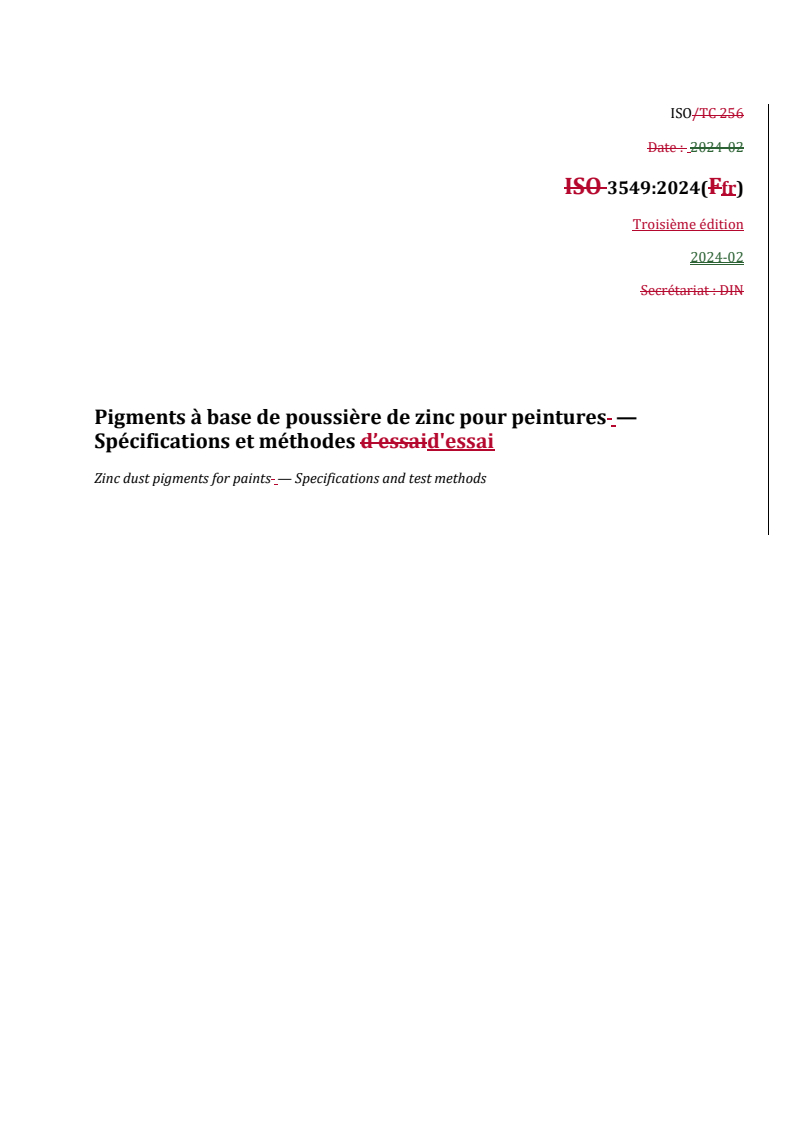
ISO/TC 256
Date : 2024-02
Troisième édition
2024-02
Secrétariat : DIN
Pigments à base de poussière de zinc pour peintures —
Spécifications et méthodes d’essaid'essai
Zinc dust pigments for paints — Specifications and test methods
DOCUMENT PROTÉGÉ PAR COPYRIGHT
ISO 3549:2024(fr)
Droits de reproductionTous droits réservés. Sauf prescription différente ou nécessité dans le contexte de sa mise en
œuvreoeuvre, aucune partie de cette publication ne peut être reproduite ni utilisée sous quelque forme que ce soit et par
aucun procédé, électronique ou mécanique, y compris la photocopie, ou la diffusion sur l’internet ou sur un intranet, sans
autorisation écrite préalable. Une autorisation peut être demandée à l’ISO à l’adresse ci-après ou au comité membre de
l’ISO dans le pays du demandeur.
ISO copyright office
CP 401 • Ch. de Blandonnet 8 • CP 401
CH-1214 Vernier, GenèveGeneva
Tel. Phone: + 41 22 749 01 11
E-mail : copyright@iso.org
Web : www.iso.org
Website: www.iso.org
Publié en Suisse
© ISO 2024 – Tous droits réservés
iiiiii
ISO 3549:2024(fr)
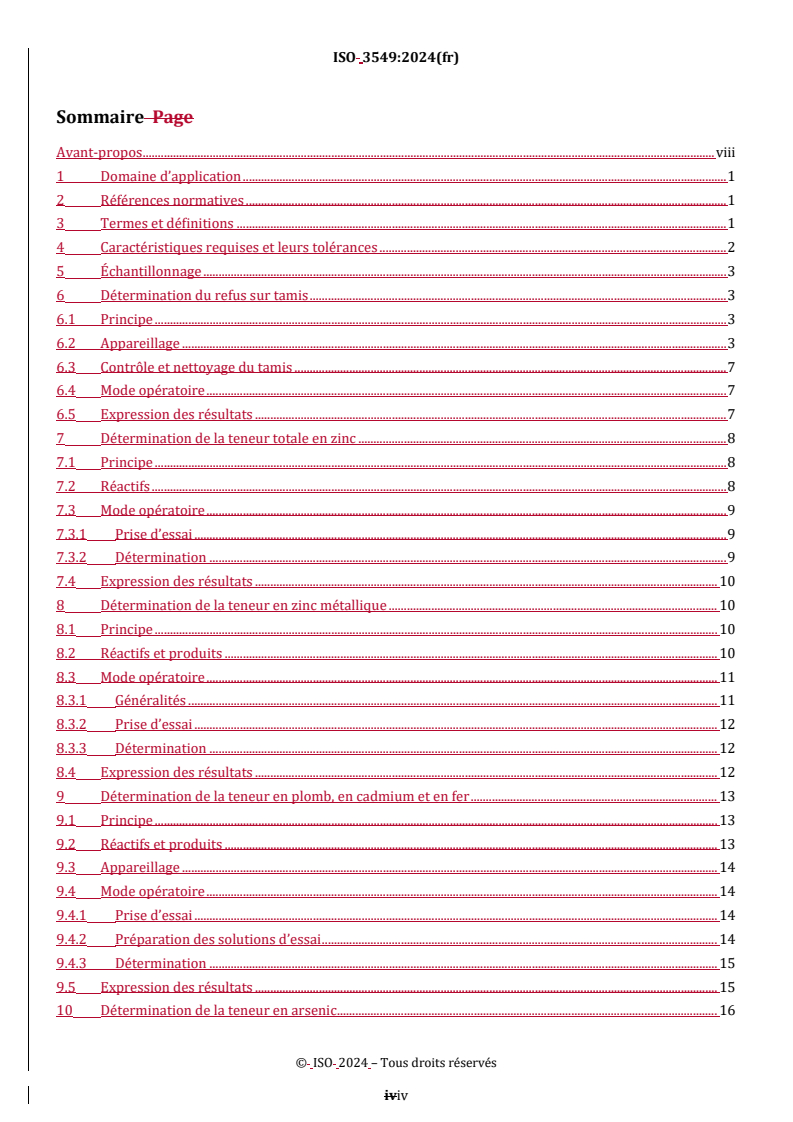
Sommaire Page
Avant-propos . viii
1 Domaine d’application . 1
2 Références normatives . 1
3 Termes et définitions . 1
4 Caractéristiques requises et leurs tolérances . 2
5 Échantillonnage . 3
6 Détermination du refus sur tamis . 3
6.1 Principe . 3
6.2 Appareillage . 3
6.3 Contrôle et nettoyage du tamis . 7
6.4 Mode opératoire . 7
6.5 Expression des résultats . 7
7 Détermination de la teneur totale en zinc . 8
7.1 Principe . 8
7.2 Réactifs . 8
7.3 Mode opératoire . 9
7.3.1 Prise d’essai . 9
7.3.2 Détermination . 9
7.4 Expression des résultats . 10
8 Détermination de la teneur en zinc métallique . 10
8.1 Principe . 10
8.2 Réactifs et produits . 10
8.3 Mode opératoire . 11
8.3.1 Généralités . 11
8.3.2 Prise d’essai . 12
8.3.3 Détermination . 12
8.4 Expression des résultats . 12
9 Détermination de la teneur en plomb, en cadmium et en fer . 13
9.1 Principe . 13
9.2 Réactifs et produits . 13
9.3 Appareillage . 14
9.4 Mode opératoire . 14
9.4.1 Prise d’essai . 14
9.4.2 Préparation des solutions d’essai . 14
9.4.3 Détermination . 15
9.5 Expression des résultats . 15
10 Détermination de la teneur en arsenic . 16
© ISO 2024 – Tous droits réservés
iviv
ISO 3549:2024(fr)
10.1 Principe . 16
10.2 Réactifs et produits . 16
10.3 Appareillage . 17
10.4 Mode opératoire . 18
10.4.1 Établissement de la courbe d’étalonnage . 18
10.4.2 Prise d’essai . 19
10.4.3 Préparation de la solution d’essai . 19
10.4.4 Détermination . 19
10.5 Expression des résultats . 22
11 Détermination de la teneur en chlorure . 22
11.1 Principe . 22
11.2 Réactifs et produits . 22
11.3 Appareillage . 23
11.4 Mode opératoire . 23
11.4.1 Établissement de la courbe d’étalonnage . 23
11.4.2 Détermination . 23
12 Détermination de la teneur en matières insolubles dans l’acide . 23
12.1 Réactifs et produits . 23
12.2 Appareillage . 23
12.3 Mode opératoire . 24
12.3.1 Prise d’essai . 24
12.3.2 Détermination . 24
12.4 Expression des résultats . 24
13 Rapport d’essai . 24
Bibliographie . 25
Avant-propos v
1 Domaine d’application 1
2 Références normatives 1
3 Termes et définitions 1
4 Caractéristiques requises et leurs tolérances 2
5 Échantillonnage 3
6 Détermination du refus sur tamis 4
6.1 Principe 4
6.2 Appareillage 4
6.3 Contrôle et nettoyage du tamis 6
6.4 Mode opératoire 6
6.5 Expression des résultats 6
© ISO 2024 – Tous droits réservés
vv
ISO 3549:2024(fr)
7 Détermination de la teneur totale en zinc 7
7.1 Principe 7
7.2 Réactifs 7
7.3 Mode opératoire 8
7.3.1 Prise d’essai 8
7.3.2 Détermination 8
7.4 Expression des résultats 9
8 Détermination de la teneur en zinc métallique 9
8.1 Principe 9
8.2 Réactifs et produits 9
8.3 Mode opératoire 10
8.3.1 Généralités 10
8.3.2 Prise d’essai 11
8.3.3 Détermination 11
8.4 Expression des résultats 11
9 Détermination de la teneur en plomb, en cadmium et en fer 12
9.1 Principe 12
9.2 Réactifs et produits 12
9.3 Appareillage 13
9.4 Mode opératoire 13
9.4.1 Prise d’essai 13
9.4.2 Préparation des solutions d’essai 13
9.4.3 Détermination 14
9.5 Expression des résultats 14
10 Détermination de la teneur en arsenic 15
10.1 Principe 15
10.2 Réactifs et produits 15
10.3 Appareillage 17
10.4 Mode opératoire 17
10.4.1 Établissement de la courbe d’étalonnage 17
10.4.2 Prise d’essai 18
10.4.3 Préparation de la solution d’essai 18
10.4.4 Détermination 18
10.5 Expression des résultats 21
11 Détermination de la teneur en chlorure 21
11.1 Principe 21
11.2 Réactifs et produits 21
11.3 Appareillage 22
11.4 Mode opératoire 22
© ISO 2024 – Tous droits réservés
vivi
ISO 3549:2024(fr)
11.4.1 Établissement de la courbe d’étalonnage 22
11.4.2 Détermination 22
12 Détermination de la teneur en matières insolubles dans l’acide 22
12.1 Réactifs et produits 22
12.2 Appareillage 23
12.3 Mode opératoire 23
12.3.1 Prise d’essai 23
12.3.2 Détermination 23
12.4 Expression des résultats 23
13 Rapport d’essai 23
Bibliographie 24
© ISO 2024 – Tous droits réservés
viivii
ISO 3549:2024(fr)
Avant-propos
L’ISOL'ISO (Organisation internationale de normalisation) est une fédération mondiale
d’organismesd'organismes nationaux de normalisation (comités membres de l’ISO). L’élaborationl'ISO).
L'élaboration des Normes internationales est en général confiée aux comités techniques de l’ISOl'ISO. Chaque
comité membre intéressé par une étude a le droit de faire partie du comité technique créé à cet effet. Les
organisations internationales, gouvernementales et non gouvernementales, en liaison avec l’ISOl'ISO
participent également aux travaux. L’ISOL'ISO collabore étroitement avec la Commission électrotechnique
internationale (IEC) en ce qui concerne la normalisation électrotechnique.
Les procédures utilisées pour élaborer le présent document et celles destinées à sa mise à jour sont décrites
dans les Directives ISO/IEC, Partie 1. Il convient, en particulier, de prendre note des différents critères
d’approbationd'approbation requis pour les différents types de documents ISO. Le présent document a été
rédigé conformément aux règles de rédaction données dans les Directives ISO/IEC, Partie 2
(voir www.iso.org/directives).
L’ISO attire l’attention sur le fait que la mise en application du présent document peut entraîner l’utilisation
d’un ou de plusieurs brevets. L’ISO ne prend pas position quant à la preuve, à la validité et à l’applicabilité de
tout droit de brevet revendiqué à cet égard. À la date de publication du présent document, l’ISO n’avaitn'avait
pas reçu notification qu’un ou plusieurs brevets pouvaient être nécessaires à sa mise en application. Toutefois,
il y a lieu d’avertir les responsables de la mise en application du présent document que des informations plus
récentes sont susceptibles de figurer dans la base de données de brevets, disponible à l’adressel'adresse
www.iso.org/brevets.www.iso.org/brevets. L’ISO ne saurait être tenue pour responsable de ne pas avoir
identifié tout ou partie de tels droits de brevetpropriété.
Les appellations commerciales éventuellement mentionnées dans le présent document sont données pour
information, par souci de commodité, à l’intention des utilisateurs et ne sauraient constituer un engagement.
Pour une explication de la nature volontaire des normes, la signification des termes et expressions spécifiques
de l’ISOl'ISO liés à l’évaluationl'évaluation de la conformité, ou pour toute information au sujet de
l’adhésionl'adhésion de l’ISOl'ISO aux principes de l’Organisation mondiale du commerce (OMC) concernant
les obstacles techniques au commerce (OTC), voir www.iso.org/iso/fr/avant-propos.htmlwww.iso.org/avant-
propos.
Le présent document a été élaboré par le comité technique ISO/TC 256, Pigments, colorants et matières de
charge, en collaboration avec le comité technique CEN/TC 298, Pigments et matières de charge, du Comité
européen de normalisation (CEN), conformément à l’Accord de coopération technique entre l’ISO et le CEN
(Accord de Vienne).
Cette troisième édition annule et remplace la deuxième édition (ISO 3549:1995), qui a fait l’objet d’une
révision technique.
Les principales modifications sont les suivantes :
— — le refus maximal sur tamis de 45 µm est passé de 5 % en fraction massique à 0,5 % en fraction
massique ;
— — trois types de pigments à base de poussière de zinc (I, II et III) ont été introduits, avec des exigences
différentes ;
— — la spectroscopie d’émission optique par plasma à couplage inductif (ICP-OES) a été ajoutée comme
technique analytique utilisée pour l’analyse élémentaire ;
© ISO 2024 – Tous droits réservés
viiiviii
ISO 3549:2024(fr)
— — la dimension nominale de l’ouverture du tamis a été modifiée de 125 µm – 90 µm – 45 µm à 125 µm –
75 µm – 45 µm ; ®
— — les Numéros de Registre CAS ont été ajoutés pour les réactifs ;
— — les références normatives ont été mises à jour ;
— — une bibliographie a été ajoutée.
Il convient que l’utilisateur adresse tout retour d’information ou toute question concernant le présent
document à l’organisme national de normalisation de son pays. Une liste exhaustive desdits organismes se
trouve à l’adresse www.iso.org/fr/members.htmlwww.iso.org/fr/members.html.
© ISO 2024 – Tous droits réservés
ixix
Norme Internationale ISO 3549:2024(fr)
Pigments à base de poussière de zinc pour peintures — Spécifications
et méthodes d’essaid'essai
1 Domaine d’application
Le présent document spécifie les exigences et les méthodes d’essai correspondantes des pigments à base de
poussière de zinc convenant à l’usage pour les revêtements protecteurs.
2 Références normatives
Les documents suivants sont cités dans le texte de sorte qu’ils constituent, pour tout ou partie de leur contenu,
des exigences du présent document. Pour les références datées, seule l’édition citée s’applique. Pour les
références non datées, la dernière édition du document de référence s'applique (y compris les éventuels
amendements).
ISO 565, Tamis de contrôle — Tissus métalliques, tôles métalliques perforées et feuilles électroformées —
Dimensions nominales des ouvertures
ISO 3696, Eau pour laboratoire à usage analytique — Spécification et méthodes d'essai
ISO 15528, Peintures, vernis et matières premières pour peintures et vernis — Échantillonnage
3 Termes et définitions
Pour les besoins du présent document, les termes et définitions suivants s’appliquent.
L’ISO et l’IEC tiennent à jour des bases de données terminologiques destinées à être utilisées en normalisation,
consultables aux adresses suivantes :
— — ISO Online browsing platform : disponible à l’adresse
https://www.iso.org/obphttps://www.iso.org/obp
— — IEC Electropedia : disponible à l’adresse
https://www.electropedia.org/https://www.electropedia.org/
3.1
pigment à base de poussière de zinc
fine poudre grise, formée de particules essentiellement sphéroïdales, composée principalement de zinc
métallique
Note 1 à l’article : à l'article: Les pigments à base de poussière de zinc peuvent varier, par exemple dans leur teneur en
zinc métallique, leur pureté chimique, la forme des particules, la distribution granulométrique, les diamètres moyen et
maximal, etc. Toutes ces variations sont susceptibles d’avoir une influence sur le comportement de la poussière de zinc
dans la peinture, notamment sur les paramètres tels que l’aptitude à la dispersion, la finesse de broyage, la réactivité, la
conductivité électrique et les propriétés de tassement.
ISO 3549:2024(fr)
4 Caractéristiques requises et leurs tolérances
4.1 Pour les pigments à base de poussière de zinc conformes au présent document, les exigences essentielles
sont spécifiées dans le Tableau 1Tableau 1 et le Tableau 2Tableau 2.
Tableau 1 — Composition du pigment à base de poussière de zinc
Caractéristique Unité Exigence Méthode d’essai
Type I Type II Type III
Teneur totale en zinc % (fraction min. 98 min. 98 min. 99 Voir l’Article 7Voir
massique) l’Article 7
Teneur en zinc % (fraction min. 94 min. 94 min. 97 Voir l’Article 8Voir
métallique massique) l’Article 8
Teneur en plomb (Pb) % (fraction max. 0,1 max. 0,01 max. 0,002 Voir
massique) l’Article 9l’Article 9
a
Teneur en cadmium (Cd) % (fraction max. 0,03 max. 0,01 max. 0,001 Voir
massique) l’Article 9l’Article 9
a
Teneur en fer (Fe) % (fraction max. 0,005 max. 0,005 max. 0,002 Voir
massique) l’Article 9l’Article 9
a
Teneur en arsenic (As) % (fraction max. 0,000 5 max. 0,000 5 max. 0,000 5 Voir
a
massique) l’Article 10 Voir
a
l’Article 10
Teneur en chlorure (Cl) % (fraction max. 0,005 max. 0,005 max. 0,005 Voir
massique) l’Article 11Voir
l’Article 11
Matières insolubles dans % (fraction max. 0,05 max. 0,05 max. 0,05 Voir
l’acide massique) l’Article 12Voir
l’Article 12
a
D’autres méthodes appropriées, telles que la méthode du plasma à couplage inductif (ICP-OES ou ICP-MS), peuvent faire
l’objet d’un accord entre les parties intéressées.
NOTE Si la teneur en oxyde de zinc est requise, celle-ci peut être calculée en multipliant la différence entre la teneur totale en
zinc et la teneur en zinc métallique par 1,244 7.
Tableau 2 — Refus sur tamis
Dimension nominale de l’ouverture du tamis Refus sur tamis
Méthode d’essai
µm % (fraction massique)
125 max. 0,01
Voir l’Article 6Voir
75 max. 0,1
l’Article 6
45 max. 0,5
4.2 Les exigences pour d’autres propriétés physiques (surface, distribution granulométrique, etc.) et pour
le choix du pigment de référence auquel ces propriétés se réfèrent doivent faire l’objet d’un accord entre les
© ISO 2024 – Tous droits réservés
ISO 3549:2024(fr)
1)
parties intéressées. Les données de taille de particules et/ou de distribution granulométrique telles que D10 ,,
2)
D50 ,, doivent être indiquées en faisant référence à la méthode de mesure et aux conditions d’essai.
4.3 Le pigment de référence doit aussi être conforme aux exigences indiquées dans le Tableau 1 et
le Tableau 2Tableau 1 et le Tableau 2.
4.4 La spectroscopie d’émission optique par plasma à couplage inductif (ICP-OES) est une technique
analytique utilisée pour l’analyse élémentaire. L’instrument ICP-OES est utilisé en spectroscopie atomique.
Pendant l’analyse, l’échantillon est décomposé par une chaleur intense en un nuage de gaz chauds contenant
des atomes libres et des ions de l’élément ou des éléments d’intérêt. Les températures élevées entraînent des
quantités significatives d’excitation par collision et d’ionisation des atomes de l’échantillon. Une fois les
atomes ou les ions dans leur état excité, ils peuvent se désintégrer à des états inférieurs par des transitions
d’énergie thermiques ou radiatives (émission). Pendant l’analyse par ICP--OES, l’intensité de la lumière émise
à des longueurs d’onde spécifiques est mesurée et est utilisée pour déterminer la concentration de l’élément
ou des éléments d’intérêt. En analyse par ICP-OES, les sources d’excitation thermique peuvent peupler un
grand nombre de niveaux d’énergie différents pour plusieurs éléments différents en même temps. Tous les
atomes et ions excités peuvent alors émettre leur rayonnement caractéristique en même temps. Cela donne
une flexibilité de choix de plusieurs émissions différentes en même temps et permet la détection de multiples
éléments simultanément.
La préparation de l’échantillon en vue de l’analyse par ICP-OES est très similaire à celle pour l’absorption
atomique (AA ; voir l’Article 9l’Article 9 et l’Article 10l’Article 10) avec une variante : (0,500 0 ± 0,000 2) g
d’échantillon est dissous dans 100 ml avec 5 % (fraction volumique) de HNO à 68 % (fraction massique).
Pour des échantillons très résistants, une quantité supplémentaire de 10 % (fraction volumique) de HCl
à 37 % (fraction massique) peut être utilisée conjointement avec une digestion par microondes. Les solutions
à 5 g/l sont ensuite diluées (1/200) avec 5 % (fraction volumique) de HNO en ajoutant 50 µg/l de Sc, Y, Rh et
Lu comme étalons internes. La mesure par ICP et la préparation des étalons peuvent être issues de l’ISO 22036.
5 Échantillonnage
Prélever un échantillon représentatif du produit à soumettre à l’essai, conformément à l’ISO 15528.
AVERTISSEMENT — L’échantillon ne doit pas être séché avant l’essai, et aucune partie de l’échantillon
non utilisée ne doit être remise dans le récipient d’échantillons après manipulation.
6 Détermination du refus sur tamis
6.1 Principe
Une prise d’essai appropriée de l’échantillon est tamisée sur un appareil de tamisage à jet d’air équipé de tamis
d’ouvertures nominales de maille de 45 µm, 75 µm et 125 µm. Le résidu sur chacun de ces tamis est déterminé.
6.2 Appareillage
6.2.1 Tamis, circulaires, avec une surface utile de 200 mm de diamètre et avec des ouvertures nominales de
maille de 45 µm, 75 µm et 125 µm, conformes à l’ISO 565. Le tamis doit être couvert d’un couvercle
transparent pendant l’utilisation.
1)
Terme technique désignant la valeur du diamètre de particules au-dessous de laquelle se trouvent 10 % des
particules de la distribution granulométrique cumulée.
2)
Terme technique désignant la valeur du diamètre de particules au-dessous de laquelle se trouvent 50 % des
particules de la distribution granulométrique cumulée. Est aussi appelé diamètre médian.
© ISO 2024 – Tous droits réservés
ISO 3549:2024(fr)
6.2.2 Appareil de tamisage à jet d’air (voir la Figure 1Figure 1), constitué d’un boîtier cylindrique qui
contient un tamis (voir 6.2.16.2.1). Il doit y avoir à la base du boîtier une ouverture (à laquelle est branché un
ventilateur d’extraction) et une arrivée d’air pour permettre l’injection.
L’arrivée d’air est connectée à une buse tournant à une vitesse de 20 trr/min à 25 trr/min, et est composée
d’un ajutage en forme de fente disposé sous le tamis et très près de celui-ci (voir la Figure 1).Figure 1). Lorsque
la buse tourne, elle souffle en continu de l’air à travers le tamis, ce qui empêche les particules de poudre de se
déposer. L’air est extrait par l’ouverture prévue à cet effet, en entraînant les particules les plus fines au travers
du tamis. Le débit d’air est contrôlé par réglage de la fente de sortie.
La dépression à réaliser doit être de 1 250 Pa ou moins.
© ISO 2024 – Tous droits réservés
ISO 3549:2024(fr)
© ISO 2024 – Tous droits réservés
ISO 3549:2024(fr)
Légende
1 couvercle transparent
2 tamis
3 boîtier
4 buse tournante
5 manomètre
6 ajutage réglable
a
Arrivée d’air.
b
Vers le ventilateur d’extraction.
Figure 1 — Appareil de tamisage à jet d’air
6.2.3 Horloge (par exemple, chronomètre), donnant le temps avec une précision d’au moins 1 s. Elle peut
être équipée d’un interrupteur pour l’arrêt automatique de l’appareil de tamisage (6.2.26.2.2).
6.2.4 Balance analytique, pouvant peser au moins 50 g avec une précision d’au moins 1 mg.
6.2.5 Maillet, de construction légère, avec tête en plastique, utilisable pour taper sur le couvercle de la
tamiseuse afin de déloger la poudre collant au couvercle et au tamis.
6.2.6 Pinceau propre
6.2.7 Nacelle en acier inoxydable
© ISO 2024 – Tous droits réservés
ISO 3549:2024(fr)
6.3 Contrôle et nettoyage du tamis
Vérifier que le tamis est propre, intact et non obstrué par de la matière restant d’une détermination antérieure.
Pour effectuer cette inspection, il est recommandé de s’aider d’une loupe ayant un grossissement suffisant.
S’il est nécessaire de nettoyer le tamis, il est recommandé d’utiliser pour ce faire un système à ultrasons. Il est
aussi possible de nettoyer le tamis en le retournant sur une feuille de papier propre, en frappant
vigoureusement de façon à éliminer toute particule résiduelle.
6.4 Mode opératoire
Réaliser la détermination en double.
6.4.1 Peser, à 1 mg près, une prise d’essai d’environ 50 g (m ).
6.4.2 Placer le tamis de 45 µm (6.2.16.2.1) en position dans l’appareil de tamisage (6.2.26.2.2) et transférer
la prise d’essai sur le tamis.
6.4.3 Couvrir le tamis avec le couvercle transparent, mettre en marche le ventilateur d’extraction et
l’appareil de tamisage (6.2.26.2.2), et, de temps à autre, taper légèrement sur le couvercle et le tamis avec le
maillet (6.2.56.2.5) pour répartir la matière et déloger les particules adhérentes.
6.4.4 Après 120 s, arrêter l’appareil et enlever le couvercle transparent et le tamis. Recueillir le refus de
tamisage en retournant le tamis sur une feuille de papier propre et frapper vigoureusement afin d’être sûr de
récupérer toutes les particules.
6.4.5 Peser la nacelle en acier inoxydable (6.2.76.2.7) à 1 mg près (m ). Transférer le résidu de tamisage
dans la nacelle et peser à nouveau à 1 mg près (m ).
6.4.6 Sur de nouvelles prises d’essai de 50 g d’échantillon, répéter les opérations décrites de 6.4.1
à 6.4.56.4.1 à 6.4.5 avec le tamis de 75 µm et ensuite avec le tamis de 125 µm.
6.5 Expression des résultats
Calculer le résidu sur chaque tamis, R, exprimé en pourcentage en fraction massique, à l’aide de
la Formule (1) :Formule (1):
(mm− ) (𝑚𝑚 −𝑚𝑚 )
2 1
2 1
𝑅𝑅 = ×100 (1)
R ×100
𝑚𝑚
m
où
m est la masse, en grammes, de la prise d’essai ;
m est la masse, en grammes, de la nacelle en acier ;
m est la masse, en grammes, de la nacelle contenant le résidu de tamisage.
Si les deux résultats (mesures en double) pour chaque tamis diffèrent de plus d’un dixième de la limite
maximale indiquée dans le Tableau 2Tableau 2 pour ce tamis, répéter le mode opératoire.
Calculer la moyenne de deux résultats valides (réplicats) et consigner le résultat avec trois décimales pour le
tamis de 125 µm, avec deux décimales pour le tamis de 75 µm et avec une décimale pour le tamis de 45 µm.
© ISO 2024 – Tous droits réservés
=
ISO 3549:2024(fr)
7 Détermination de la teneur totale en zinc
7.1 Principe
Le zinc est titré à l’aide d’une solution d’acide (éthylène dinitrilo)tétraacétique (EDTA).
7.2 Réactifs
Au cours de l’analyse, utiliser uniquement des réactifs de qualité analytique reconnue et de l’eau de qualité 3
au minimum, comme spécifié dans l’ISO 3696.
® 3)
7.2.1 Acide chlorhydrique, numéro de registre CAS 7647-01-0, concentré, à 37 % (fraction massique),
ρ ≈ 1,19 g/ml.
7.2.2 Acide chlorhydrique, n° CAS 7647--01--0, dilué à 1 + 4.
Diluer 200 ml d’acide chlorhydrique concentré (7.2.17.2.1) à 1 l avec de l’eau.
7.2.3 Acide sulfurique, n° CAS 7664--93--9, dilué à 1 + 1.
Ajouter lentement, tout en refroidissant, 1 partie en volume d’acide sulfurique concentré [environ 96 %
(fraction massique), ρ ≈ 1,84 g/ml] à 1 partie en volume d’eau.
7.2.4 Acide nitrique, n° CAS 7697--37--2, concentré, à environ 68 % (fraction massique), ρ ≈ 1,42 g/ml.
7.2.5 Solution d’hydroxyde d’ammonium, n° CAS 1336--21--6, à environ 25 % (fraction massique),
ρ ≈ 0,81 g/ml.
7.2.6 Solution tampon
Dissoudre 200 g de chlorure d’hydroxylammonium (NH OH∙HCl) (n° CAS 5470--11--1), dans environ 300 ml
d’eau. Dissoudre 28 g d’hydroxyde de sodium (n° CAS 1310--73--2), dans environ 300 ml d’eau. Réunir les
deux solutions, refroidir et diluer à 1 l avec de l’eau.
7.2.7 Acide (éthylène dinitrilo) tétraacétique (EDTA), sel disodique dihydraté, n° CAS 6381--92--6,
solution titrée.
7.2.7.1 Préparation
Peser, à 1 mg près, environ 20 g de sel disodique dihydraté d’EDTA, dissoudre dans de l’eau et compléter à 1 l.
Conserver la solution dans une bouteille en polyéthylène.
7.2.7.2 Étalonnage
Peser, à 1 mg près, environ 1,5 g de zinc métallique pur à 99,99 % (m ) dans un bécher de 250 ml. Dissoudre
dans 20 ml d’acide chlorhydrique (7.2.17.2.1) et ajouter 1 ml ou 2 ml d’acide nitrique (7.2.47.2.4). Après
dissolution complète, transférer quantitativement dans une fiole jaugée de 500 ml, compléter jusqu’au trait
de jauge avec de l’eau et bien mélanger.
3) ®
Numéro de registre Chemical Abstracts Service (CAS) est une marque de l’American Chemical Society (ACS).
Cette information est donnée à l’intention des utilisateurs du présent document et ne signifie nullement que l’ISO
approuve ou recommande l’emploi exclusif du produit ainsi désigné. Des produits équivalents peuvent être utilisés s’il
est démontré qu’ils aboutissent aux mêmes résultats.
© ISO 2024 – Tous droits réservés
ISO 3549:2024(fr)
Transférer à la pipette 50 ml de la solution de zinc dans une fiole conique de 500 ml. Ajouter 200 ml d’eau et
3 gouttes de la solution d’indicateur au bleu de bromothymol (7.2.97.2.9), puis ajouter la solution d’hydroxyde
d’ammonium (7.2.57.2.5) goutte à goutte jusqu’à ce que la couleur vire au bleu. Ajouter ensuite l’acide
chlorhydrique dilué (7.2.27.2.2) jusqu’au retour de la couleur jaune. Ajouter finalement 20 ml de la solution
tampon (7.2.67.2.6) et 3 gouttes de la solution d’indicateur au xylénol-orange (7.2.87.2.8) et titrer avec la
solution d’EDTA (7.2.7.17.2.7.1) jusqu’à ce que la couleur rouge vire au jaune pâle.
Calculer l’équivalent en zinc de la solution d’EDTA, ρ(Zn), exprimé en grammes par millilitre (c’est--à--dire la
masse, en grammes, de zinc qui est complexée par 1 ml de solution d’EDTA), à l’aide de la
Formule (2) :Formule (2):
m ×50 m
ρ Zn
( ) (2)
500××VV10
0 0
𝑚𝑚 ×50 𝑚𝑚
0 0
𝜌𝜌(Zn) = = (2)
500×𝑉𝑉 10×𝑉𝑉
0 0
où
m est la masse, en grammes, de zinc métallique utilisé ;
V est le volume, en millilitres, de solution d’EDTA utilisé pour le titrage.
Répéter trois fois le titrage, et calculer la valeur moyenne de l’équivalent en zinc, ρ(Zn), en grammes par
millilitre.
7.2.8 Xylénol orange, n° CAS 1202864--39--8, solution d’indicateur à 1 g/l de son sel de sodium dans l’eau.
7.2.9 Bleu de bromothymol, n° CAS 76--59--5, solution d’indicateur à 1 g/l dans de l’éthanol à 96 %
(fraction volumique).
7.3 Mode opératoire
7.3.1 Prise d’essai
Peser, à 1 mg près, 1,5 g de l’échantillon (m ) dans un bécher de 250 ml.
7.3.2 Détermination
Réaliser la détermination en double.
Dissoudre la prise d’essai dans 20 ml d’acide chlorhydrique concentré (7.2.17.2.1) et ajouter 1 ml ou 2 ml
d’acide nitrique (7.2.47.2.4) pour s’assurer que tout le plomb présent est dissous. Ajouter 5 ml d’acide
sulfurique (7.2.37.2.3) et évaporer jusqu’à formation d’épaisses fumées blanches. Refroidir, puis
ajouter 100 ml d’eau, faire bouillir un court moment, et laisser reposer jusqu’au jour suivant.
Filtrer la solution sur un creuset à plaque en verre fritté ou en silice frittée (porosité P40), laver le bécher et
le creuset, recueillir le filtrat dans une fiole jaugée à un trait de 500 ml. Compléter jusqu’au trait de jauge et
bien mélanger.
Transférer à la pipette 50 ml de la solution dans une fiole conique de 500 ml. Ajouter 200 ml d’eau et 3 gouttes
de la solution d’indicateur au bleu de bromothymol (7.2.97.2.9), puis ajouter la solution d’hydroxyde
d’ammonium (7.2.57.2.5) goutte à goutte jusqu’à ce que la couleur vire au bleu. Ajouter ensuite l’acide
chlorhydrique dilué (7.2.27.2.2) jusqu’au retour de la couleur jaune. Ajouter finalement 20 ml de la solution
© ISO 2024 – Tous droits réservés
==
ISO 3549:2024(fr)
tampon (7.2.67.2.6) et 3 gouttes de la solution d’indicateur au xylénol-orange (7.2.87.2.8) et titrer avec la
solution d’EDTA (7.2.77.2.7) jusqu’à ce que la couleur rouge vire au jaune pâle.
7.4 Expression des résultats
Calculer la teneur totale en zinc, w(Zn), exprimée en pourcentage en masse, à l’aide de la
t
Formule (3) :Formule (3):
1 000××V ρ Zn
( )
(3)
w(Zn) =
t
m
1 000×𝑉𝑉 ×𝜌𝜌(Zn)
𝑤𝑤(Zn) = (3)
t
𝑚𝑚
où
m est la masse, en grammes, de la prise d’essai ;
ρ(Zn) est l’équivalent en zinc, en grammes par millilitre, de la solution d’EDTA ;
V est le volume, en millilitres, de solution d’EDTA utilisé.
Si les deux résultats (mesures en double) diffèrent de plus de 0,5 % (fraction massique), répéter le mode
opératoire.
Calculer la moyenne de deux résultats valides (réplicats) et consigner le résultat à une décimale près.
8 Détermination de la teneur en zinc métallique
8.1 Principe
Une solution de sulfate de fer(lll) et une solution de sulfate de cuivre(ll) utilisée comme catalyseur sont
ajoutées à la prise d’essai du pigment à base de poussière de zinc. Le zinc est dissous sous forme de sulfate de
zinc et le sulfate de fer(ll) résultant est titré avec une solution de permanganate de potassium.
8.2 Réactifs et produits
Au cours de l’analyse, utiliser uniquement des réactifs de qualité analytique reconnue et de l’eau de qualité 3
au minimum, comme spécifié dans l’ISO 3696.
8.2.1 Azote, n° CAS 7727--37--9, de qualité commerciale, en bouteille.
8.2.2 Acide orthophosphorique, n° CAS 7664--38--2, à environ 85 % (fraction massique), ρ ≈ 1,71 g/ml.
8.2.3 Acide sulfurique, n° CAS 7664--93--9, dilué à 1 + 19.
Ajouter lentement, tout en refroidissant, 1 partie en volume d’acide sulfurique concentré [environ 96 %
(fraction massique), ρ ≈ 1,84 g/ml] à 19 parties en volume d’eau.
8.2.4 Sulfate de cuivre(ll), solution.
∙5H O) (n° CAS 7758--99--8), dans 1 l d’eau.
Dissoudre 200 g de sulfate de cuivre(ll) pentahydraté (CuSO
4 2
8.2.5 Sulfate de fer(III), solution saturée.
© ISO 2024 – Tous droits réservés
ISO 3549:2024(fr)
Dissoudre aussi complètement que possible 330 g de sulfate de fer(lll) [Fe (SO ) ] (n° CAS 7720--78--7), dans
2 4 3
1 l d’eau froide. Chauffer jusqu’à dissolution complète. Laisser refroidir jusqu’à la température ambiante, puis
filtrer.
8.2.6 Permanganate de potassium, n° CAS 7722--64--7, solution titrée, c(KMnO ) ≈ 0,06 mol/l.
8.2.6.1 Préparation
Peser 20 g de permanganate de potassium (KMnO ) dans un ballon de 3 l ou 4 l et ajouter 2 l d’eau. Faire
bouillir pendant 1 h, laisser refroidir et laisser au repos jusqu’au jour suivant.
Décanter à travers un filtre en laine de verre ou un filtre en verre fritté de porosité 0,5 µm dans une fiole jaugée
à un trait de 2 000 ml, compléter jusqu’au trait de jauge avec de l’eau et bien mélanger. Transférer dans une
bouteille en verre brun munie d’un bouchon rodé.
8.2.6.2 Étalonnage
Peser, à 1 mg près, 0,72 g d’oxalate de sodium (m ) (n° CAS 62--76--0,), qui a été séché pendant 1 h à 105 °C)
dans une fiole conique de 500 ml. Dissoudre dans environ 200 ml d’acide sulfurique dilué (8.2.38.2.3).
Chauffer jusqu’à début d’ébullition et titrer avec la solution de permanganate de potassium (8.2.6.18.2.6.1)
jusqu’à ce qu’une couleur rose apparaisse (volume de solution de permanganate de potassium utilisé : V ).
Calculer la concentration de la solution de permanganate de potassium, c(KMnO ), exprimée en moles par
litre, à l’aide de la Formule (4) :Formule (4):
2×m
c( KMnO ) × 1 000 (4)
5×VM×
0 ox
2×𝑚𝑚
𝑐𝑐(KMnO ) = ×1 000 (4)
5×𝑉𝑉 ×𝑀𝑀
0 ox
où
m est la masse, en grammes, d’oxalate de sodium utilisée ;
V est le volume, en millilitres, de solution de permanganate de potassium utilisé pour le titrage ;
M est la masse molaire, en grammes par mole, d’oxalate de sodium (M = 134,00 g/mol).
0x ox
Réaliser trois fois le titrage et calculer la valeur moyenne de la concentration de la solution de permanganate
de potassium, c(KMnO ), en moles par litre.
Réaliser cet étalonnage juste avant d’utiliser la solution.
8.3 Mode opératoire
8.3.1 Généralités
Réaliser la détermination en double et aussi rapidement que possible. S’assurer de ce que la fiole est gardée
fermée autant que faire se peut.
© ISO 2024 – Tous droits réservés
=
ISO 3549:2024(fr)
8.3.2 Prise d’essai
Prendre une fiole conique sèche de 750 ml et la remplir avec de l’azote (8.2.1).8.2.1). Boucher la fiole
soigneusement avec un bouchon en caoutchouc. Peser, à 0,1 mg près, environ 0,4 g d’échantillon (m ) et le
laver rapidement dans la fiole avec 4 ml ou 5 ml d’eau à l’aide d’un jet de pissette. Replacer immédiatement le
bouchon en caoutchouc. Empêcher autant que possible la formation d’agglomérats en agitant régulièrement.
8.3.3 Détermination
Ajouter dans la fiole 10 ml de la solution de sulfate de cuivre(ll) (8.2.48.2.4) et agiter vigoureusement
pendant 1 min environ pour éviter la formation d’agglomérats. Puis, à l’aide d’une pipette, laver le col de la
fiole pour détacher toute particule métallique avec 50 ml de solution de sulfate de fer(lll) (8.2.58.2.5), laquelle
a été préalablement désoxygénée par le passage dans la solution d’un courant d’azote (8.2.18.2.1)
pendant 10 min.
Laisser reposer la fiole, agiter fréquemment jusqu’à dissolution complète. Cela prend de 15 min à 30 min.
Lorsque la dissolution est complète, ajouter 20 ml d’acide orthophosphorique (8.2.28.2.2) et 200 ml d’acide
sulfurique dilué (8.2.38.2.3) et titrer immédiatement avec la solution de permanganate de
potassium (8.2.68.2.6) jusqu’à l’obtention d’une couleur rose pâle (volume de solution de permanganate de
potassium utilisé : V ).
Réaliser un essai à blanc en omettant la prise d’essai (volume de solution de permanganate de potassium
utilisé : V ).
8.4 Expression des résultats
Calculer la teneur en zinc métallique, w(Zn) , exprimée en pourcentage en masse, à l’aide de
m
la Formule (5) :Formule (5):
5(VV−×) c (KMnO )× M(Zn)×100 (VV−×) c
1 2 4 1 2
w Zn 16,34× (5)
( )
m
2mm× 1 000
5(𝑉𝑉−𝑉𝑉 )×𝑐𝑐¯(KMnO )×𝑀𝑀(Zn)×100
(𝑉𝑉−𝑉𝑉 )×𝑐𝑐¯
1 2 1 2
𝑤𝑤(Zn) = = 16,34× (5)
m
2𝑚𝑚 ×1 000 𝑚𝑚
1 1
où
𝑐𝑐¯(KMnO ) est la concentration moyenne, en moles par litre, de la solution de permanganate de
potassium ;
m est la masse, en grammes, de la prise d’essai ;
V est le volume, en millilitres, de solution de permanganate de potassium utilisé dans la
détermination ;
V est le volume, en millilitres, de solution de permanganate de potassium utilisé pour l’essai
à blanc ;
M(Zn) est la ma
...