


ISO/FDIS 15516
(Main)Ships and marine technology — Launching appliances for davit-launched lifeboats
Ships and marine technology — Launching appliances for davit-launched lifeboats
ISO 15516:2003 specifies the requirements of performances, design, construction, safety, maintenance and test of launching appliances for davit-launched lifeboats. ISO 15516:2003 is applicable to launching appliances for davit-launched lifeboats as well as launching appliances for davit-launched rescue boats on every kind of sea-going ship, including launching appliances for fast rescue boats on ro-ro passenger ships, but is not applicable to launching appliances for free-fall lifeboats. ISO 15516:2003 is also a reference for similar appliances on inland ships.
Navires et technologie maritime — Engins de mise à l'eau des embarcations de sauvetage sous bossoirs
General Information
- Status
- Withdrawn
- Technical Committee
- ISO/TC 8/SC 4 - Outfitting and deck machinery
- Drafting Committee
- ISO/TC 8/SC 4 - Outfitting and deck machinery
- Current Stage
- 5098 - Project deleted
- Start Date
- 02-Dec-2005
- Completion Date
- 12-Feb-2026
Relations
- Reactivates
ISO 15516:2006 - Ships and marine technology — Launching appliances for davit-launched lifeboats - Effective Date
- 15-Apr-2008

Get Certified
Connect with accredited certification bodies for this standard

DNV
DNV is an independent assurance and risk management provider.

Lloyd's Register
Lloyd's Register is a global professional services organisation specialising in engineering and technology.

ABS Quality Evaluations Inc.
American Bureau of Shipping quality certification.
Sponsored listings
Frequently Asked Questions
ISO/FDIS 15516 is a draft published by the International Organization for Standardization (ISO). Its full title is "Ships and marine technology — Launching appliances for davit-launched lifeboats". This standard covers: ISO 15516:2003 specifies the requirements of performances, design, construction, safety, maintenance and test of launching appliances for davit-launched lifeboats. ISO 15516:2003 is applicable to launching appliances for davit-launched lifeboats as well as launching appliances for davit-launched rescue boats on every kind of sea-going ship, including launching appliances for fast rescue boats on ro-ro passenger ships, but is not applicable to launching appliances for free-fall lifeboats. ISO 15516:2003 is also a reference for similar appliances on inland ships.
ISO 15516:2003 specifies the requirements of performances, design, construction, safety, maintenance and test of launching appliances for davit-launched lifeboats. ISO 15516:2003 is applicable to launching appliances for davit-launched lifeboats as well as launching appliances for davit-launched rescue boats on every kind of sea-going ship, including launching appliances for fast rescue boats on ro-ro passenger ships, but is not applicable to launching appliances for free-fall lifeboats. ISO 15516:2003 is also a reference for similar appliances on inland ships.
ISO/FDIS 15516 is classified under the following ICS (International Classification for Standards) categories: 47.020.50 - Deck equipment and installations; 47.040 - Seagoing vessels. The ICS classification helps identify the subject area and facilitates finding related standards.
ISO/FDIS 15516 has the following relationships with other standards: It is inter standard links to ISO 15516:2006. Understanding these relationships helps ensure you are using the most current and applicable version of the standard.
ISO/FDIS 15516 is available in PDF format for immediate download after purchase. The document can be added to your cart and obtained through the secure checkout process. Digital delivery ensures instant access to the complete standard document.
Standards Content (Sample)
FINAL
INTERNATIONAL ISO/FDIS
DRAFT
STANDARD 15516
ISO/TC 8/SC 4
Ships and marine technology —
Secretariat: SAC
Launching appliances for davit-launched
Voting begins on:
lifeboats
2003-09-11
Voting terminates on:
Navires et technologie maritime — Dispositifs de mise à l'eau des
2003-11-11
embarcations de sauvetage sous bossoirs
Please see the administrative notes on page iii
RECIPIENTS OF THIS DRAFT ARE INVITED TO
SUBMIT, WITH THEIR COMMENTS, NOTIFICATION
OF ANY RELEVANT PATENT RIGHTS OF WHICH
THEY ARE AWARE AND TO PROVIDE SUPPORT-
ING DOCUMENTATION.
IN ADDITION TO THEIR EVALUATION AS
Reference number
BEING ACCEPTABLE FOR INDUSTRIAL, TECHNO-
LOGICAL, COMMERCIAL AND USER PURPOSES,
DRAFT INTERNATIONAL STANDARDS MAY ON
OCCASION HAVE TO BE CONSIDERED IN THE
LIGHT OF THEIR POTENTIAL TO BECOME STAN-
DARDS TO WHICH REFERENCE MAY BE MADE IN
©
NATIONAL REGULATIONS. ISO 2003
PDF disclaimer
This PDF file may contain embedded typefaces. In accordance with Adobe's licensing policy, this file may be printed or viewed but
shall not be edited unless the typefaces which are embedded are licensed to and installed on the computer performing the editing. In
downloading this file, parties accept therein the responsibility of not infringing Adobe's licensing policy. The ISO Central Secretariat
accepts no liability in this area.
Adobe is a trademark of Adobe Systems Incorporated.
Details of the software products used to create this PDF file can be found in the General Info relative to the file; the PDF-creation
parameters were optimized for printing. Every care has been taken to ensure that the file is suitable for use by ISO member bodies. In
the unlikely event that a problem relating to it is found, please inform the Central Secretariat at the address given below.
Copyright notice
This ISO document is a Draft International Standard and is copyright-protected by ISO. Except as permitted
under the applicable laws of the user's country, neither this ISO draft nor any extract from it may be
reproduced, stored in a retrieval system or transmitted in any form or by any means, electronic,
photocopying, recording or otherwise, without prior written permission being secured.
Requests for permission to reproduce should be addressed to either ISO at the address below or ISO's
member body in the country of the requester.
ISO copyright office
Case postale 56 • CH-1211 Geneva 20
Tel. + 41 22 749 01 11
Fax + 41 22 749 09 47
E-mail copyright@iso.org
Web www.iso.org
Reproduction may be subject to royalty payments or a licensing agreement.
Violators may be prosecuted.
ii © ISO 2003 — All rights reserved
In accordance with the provisions of Council Resolution 15/1993, this document is circulated in the
English language only.
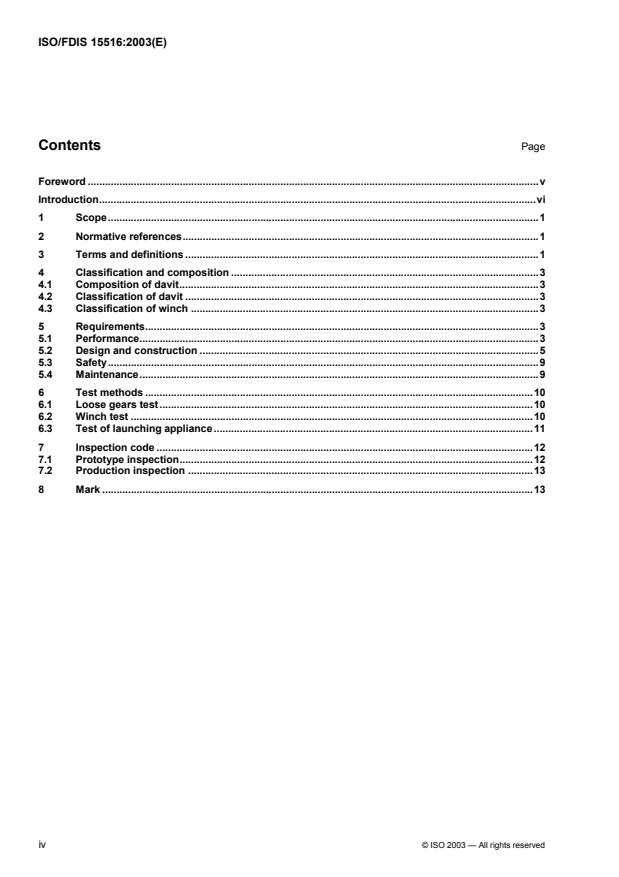
Contents Page
Foreword .v
Introduction.vi
1 Scope.1
2 Normative references.1
3 Terms and definitions .1
4 Classification and composition .3
4.1 Composition of davit.3
4.2 Classification of davit .3
4.3 Classification of winch .3
5 Requirements.3
5.1 Performance.3
5.2 Design and construction .5
5.3 Safety.9
5.4 Maintenance.9
6 Test methods .10
6.1 Loose gears test.10
6.2 Winch test .10
6.3 Test of launching appliance .11
7 Inspection code .12
7.1 Prototype inspection.12
7.2 Production inspection .13
8 Mark .13
iv © ISO 2003 — All rights reserved
Foreword
ISO (the International Organization for Standardization) is a worldwide federation of national standards bodies
(ISO member bodies). The work of preparing International Standards is normally carried out through ISO
technical committees. Each member body interested in a subject for which a technical committee has been
established has the right to be represented on that committee. International organizations, governmental and
non-governmental, in liaison with ISO, also take part in the work. ISO collaborates closely with the
International Electrotechnical Commission (IEC) on all matters of electrotechnical standardization.
International Standards are drafted in accordance with the rules given in the ISO/IEC Directives, Part 2.
The main task of technical committees is to prepare International Standards. Draft International Standards
adopted by the technical committees are circulated to the member bodies for voting. Publication as an
International Standard requires approval by at least 75 % of the member bodies casting a vote.
Attention is drawn to the possibility that some of the elements of this document may be the subject of patent
rights. ISO shall not be held responsible for identifying any or all such patent rights.
ISO 15516 was prepared by Technical Committee ISO/TC 8, Ships and marine technology, Subcommittee
SC 4, Outfitting and deck machinery.
Introduction
This International Standard which forms a code of practical interpretation and amplification of the
requirements of the CONVENTION FOR THE SAFETY OF LIFE AT SEA (SOLAS), deals with both winches
and davits for lifeboats to provide an identical basis for design, manufacture and acceptance of Launching
appliances for davit-launched lifeboats for use by ship-owners, shipbuilders and appropriate organizations.
This International Standard incorporates and revises the requirements of ISO 6067 and, as such, replaces
ISO 6067 in its entirety. Launching appliances for free-fall lifeboats are not covered by this standard because
of their different methods of launching, recovery and stowage. Considering the convenience in practice, this
standard specifies some values, such as the minimum speed of recovering light-loaded lifeboats by power
(when necessary) and the recovery speed of unpowered winch, which are not required by SOLAS but have
been given in ISO 6067. This International Standard is also applicable to launching appliances for fast rescue
boats on ro-ro passenger ships.
This International Standard is mainly based on AMENDMENTS from 1983 to 1996 to SOLAS 1974 and IMO
RESOLUTIONS and protocols concerned, especially MSC.47(66) AMENDMENTS TO THE INTERNATIONAL
CONVENTION FOR THE SAFETY OF LIFE AT SEA 1974, MSC.48(66) INTERNATIONAL LIFE-SAVING
APPLIANCE CODE and MSC.81(70) LIFE-SAVING APPLIANCE TEST.
vi © ISO 2003 — All rights reserved
FINAL DRAFT INTERNATIONAL STANDARD ISO/FDIS 15516:2003(E)
Ships and marine technology — Launching appliances for
davit-launched lifeboats
1 Scope
This International Standard specifies the requirements of performances, design, construction, safety,
maintenance and test of launching appliances for davit-launched lifeboats.
This International Standard is applicable to launching appliances for davit-launched lifeboats as well as
launching appliances for davit-launched rescue boats on every kind of sea-going ship, including launching
appliances for fast rescue boats on ro-ro passenger ships, but is not applicable to launching appliances for
free-fall lifeboats. This International Standard is also a reference for similar appliances on inland ships.
NOTE Every provision in this standard, unless expressly stated otherwise, is also applicable to launching appliances
for davit-launched rescue boats.
2 Normative references
The following referenced documents are indispensable for the application of this document. For dated
references, only the edition cited applies. For undated references, the latest edition of the referenced
document (including any amendments) applies.
ISO 2944, Fluid power systems and components — Nominal pressure
ISO 3828, Shipbuilding and marine structures — Deck machinery — Vocabulary
ISO 4413, Hydraulic fluid power — General rules relating to systems
ISO 4414, Pneumatic fluid power — General rules relating to systems
IEC 60092 (all parts), Electrical installations in ships
IEC 60529, Degrees of protection provided by enclosures (IP Code)
3 Terms and definitions
For the purposes of this document, the terms and definitions given in ISO 3828 and the following apply.
3.1
non-loaded boat
lifeboat or rescue boat fully equipped without persons
NOTE Hereinafter, both lifeboat and rescue boat are referred to as boat.
3.2
light-loaded lifeboat
lifeboat fully equipped and loaded by crew.
NOTE The number of crew members is provided by design and is at least 2 persons, each having an average mass
of 75 kg.
3.3
fully loaded lifeboat
boat fully equipped and loaded with a full complement of persons
3.4
boat davit
main structure of the launching appliance and its fittings, including loose gears, hanging-off pendants, lashings,
bowsing, tricking gears, etc.
3.5
loose gear
parts and assemblies withstanding loads during hoisting boat
EXAMPLES falls, blocks, suspension chains, links, padeyes, shackles, hooks, swivel, fastenings and other non-
structural fittings which bear loads during launching and recovery of boats
3.6
lifeboat winch
boat winch used for launching and recovering the lifeboat
3.7
rescue boat winch
boat winch used for launching and recovering the rescue boat
NOTE Hereinafter, lifeboat winch and rescue boat winch are referred to as winch.
3.8
maximum working load
load to a launching appliance during launching the maximum weight of fully loaded boats which can be
assigned to this launching appliance
3.9
maximum recovering load
load to the launching appliance during recovering the maximum weight of boats which can be assigned to this
launching appliance
NOTE For lifeboats, the weight of light-loaded lifeboats.
For rescue boats, the weight of fully-loaded boats.
For lifeboats which are also rescue boats, the weight of a non-loaded boat plus the weight of its rescue boat complement
of persons (minimum 6 persons).
3.10
lightest launching load
load to the launching appliance during launching the lightest weight of non-loaded boats which can be
assigned to the launching appliance
3.11
maximum working load of winch
maximum load held by falls at the winch drum, during launching and recovering the boat
3.12
hoisting load of winch
load held by the falls at the winch drum when a launching appliance hoists the maximum recovering load
2 © ISO 2003 — All rights reserved
3.13
maximum governing load
a load held by the falls at the winch drum when a launching appliance lowers the maximum weight of fully
loaded boats which is applicable to it
3.14
fleet angle
angle between the direction of the fall winding off the drum and the perpendicular plane of the drum axis
4 Classification and composition
A launching appliance generally consists of a davit in combination with a winch.
4.1 Composition of davit
A davit is generally composed of arms, frames, loose gears and other attachments, etc.
4.2 Classification of davit
The basic construction type of davit is mainly classified as a gravity davit and mechanical stored-power davit
according to the way to turn out davit arms, including other construction types of davits which comply with the
requirements of this International Standard.
4.3 Classification of winch
The basic types of winch are mainly classified as shown below (including other construction types of davits
which comply with the requirements of this International Standard).
4.3.1 Winches can be classified as
a) unpowered winch, or
b) powered winch.
The power of a winch can be electrical, hydraulic or pneumatic. Unpowered winches do not apply to rescue
boats.
4.3.2 Winches can also be classified according to purpose as
a) a lifeboat winch,
b) a rescue boat winch, or
c) the winch for both lifeboats and rescue boats. This winch has the performance of both a) and b).
5 Requirements
5.1 Performance
5.1.1 Launching of boat
5.1.1.1 A launching appliance shall be capable of safely lowering a non-loaded boat and a fully loaded
boat against a trim of up to 10° and a list of up to 20° either way.
5.1.1.2 Notwithstanding the requirement of 5.1.1.1, the launching appliances for oil tankers, chemical
tankers and gas carriers with a final angle of heel greater than 20° shall be capable of lowering non-loaded
boats and fully loaded boats at the final angle of heel on the lower side of the ship, taking into consideration
the final damaged waterline of the ship.
5.1.1.3 A launching appliance shall not depend on any means other than gravity or stored mechanical
power which is independent of the ship power supplies to launch the boat it serves.
5.1.1.4 A launching appliance shall be capable of lowering and halting boats in a controlled manner, and
the speed at which the boat is lowered into the water shall conform to Table 1.
Table 1
Lowering speed of boats
Boat condition
m/s
S = 0,4 + 0,02H
where
low limit S is the lowest limit of lowering speed;
H is the height in meters from davit head to the waterline with the ship
Fully loaded boat
at the lightest seagoing condition;
S S is the 1, when H > 30, or the value required by the Administration.
1,3 or the value required by the Administration
high limit
1,0 only for fast rescue boat launching appliances
low limit 0,7S (for a rescue boat with its weight less than 550 kg. This shall be
to the satisfaction of the Administration)
Non-loaded boat
high limit 1,0 or the value required by national administrations
NOTE The davit is supposed to be in the embarkation state when calculating H.
5.1.1.5 For the launching appliances for lifeboats on cargo ships of 20 000 tons and upwards and
launching appliances for rescue boats on all ships, it is taken into account that boats shall be capable of being
safely launched into water with the ship making headway at speeds of up to 5 knots in calm water.
5.1.2 Recovery of boats
5.1.2.1 A launching appliance shall be capable of recovering a light-loaded lifeboat or a fully loaded
rescue boat by power from water to stowed position under ship conditions of even keel. Every rescue boat
launching appliance shall be fitted with a powered winch.
5.1.2.2 The speed of recovering boat by power (when necessary) shall conform to Table 2.
Table 2
Boat state Speed of recovering boat by power
m/s
fully loaded rescue boat W 0,3
light-loaded lifeboat W 0,05
fully loaded fast rescue boat W 0,8
4 © ISO 2003 — All rights reserved
5.1.2.3 Every powered winch shall also be fitted with a hand gear capable of recovering light-loaded
lifeboat or fully loaded rescue boat from water to stowed position.
5.1.2.4 The recovering speed for unpowered winch of lifeboat shall be not less than 0,005 m/s.
5.1.3 Stowage of boats
5.1.3.1 A launching appliance shall serve only one boat. The stowed boat shall always be in a state of
continuous readiness for launching boats.
5.1.3.2 A launching appliance shall be so designed that boats can be embarked on and launched directly
from the stowed position, only if the launching appliance is carried on passenger ships where boats may be
embarked on from either the stowed position or the embarkation deck, but not from both places.
5.1.3.3 A launching appliance shall be so designed and arranged that it is convenient for people to
embark. Arrangement for rescue boat embarkation and recovery shall allow for safe and efficient handling of a
stretcher case.
5.1.4 Operation of launching appliances
5.1.4.1 A launching appliance may be actuated by one person on the ship’s deck, and the boat shall
always be visible to the person during operating.
5.1.4.2 There shall be a function such that a launching appliance can be remotely actuated to lower the
boat from a position within the boat and without a person remaining on the ship’s deck.
5.1.4.3 A launching appliance shall, as far as practicable, remain effective when operated in icy
conditions.
5.1.4.4 The launching appliance for a fast rescue boat shall be fitted with a device to dampen the forces
due to interaction with the wave when the fast rescue boat is launched or recovered. The device shall include
a flexible element to soften shock forces and a damping element to minimize oscillations.
5.1.4.5 The winch for a fast rescue boat shall be fitted with an automatic high-speed tensioning device
which prevents the fall from going slack in all sea-state conditions in which the fast rescue boat is intended to
operate.
5.2 Design and construction
5.2.1 Materials
5.2.1.1 The materials for launching appliances shall not be damaged during stowage throughout the air
temperature range − 30 °C to + 65 °C.
5.2.1.2 Materials exposed to weather shall be rot-proof, corrosion-resistant, deterioration-resistant, and
not be unduly affected by seawater. Painting, zinc-plating and other safeguarding may be adopted.
5.2.1.3 Structural members shall be made of shipbuilding plates with satisfactory formability and
weldability characteristics.
5.2.1.4 Grey cast-iron or similar fragile materials should be avoided. Winch gears should be made of
machine-cut steel, bronze or other suitable materials.
5.2.2 Safety factor
Loose gears, structural members and all other fittings used in connection with launching equipment shall be
designed with a factor of safety on the basis of the maximum load assigned, and the ultimate strength of the
materials used for construction, in accordance with Table 3.
Table 3
Name of parts Minimum safety factor
loose gears, hanging-off pendants and recovery 6
strops
structural members of davits and fittings 4,5
parts of winches 4,5
5.2.3 Davit arms and frames
5.2.3.1 The minimum thickness of steel plate of arms and frames and rolled-steel sections shall be not
less than 6 mm, only if the material is corrosion-resistant.
5.2.3.2 Gravity davits shall be so designed that there is a positive turning-out moment for a davit arm in
its stowed position, against a trim of up to 10° and an inboard list of up
...
Questions, Comments and Discussion
Ask us and Technical Secretary will try to provide an answer. You can facilitate discussion about the standard in here.
Loading comments...