


ISO/TS 19139:2007
(Main)Geographic information — Metadata — XML schema implementation
Geographic information — Metadata — XML schema implementation
ISO/TS 19139:2007 defines Geographic MetaData XML (gmd) encoding, an XML Schema implementation derived from ISO 19115.
Information géographique — Métadonnées — Implémentation de schémas XML
General Information
- Status
- Withdrawn
- Publication Date
- 16-Apr-2007
- Withdrawal Date
- 16-Apr-2007
- Technical Committee
- ISO/TC 211 - Geographic information/Geomatics
- Drafting Committee
- ISO/TC 211/WG 7 - Information communities
- Current Stage
- 9599 - Withdrawal of International Standard
- Start Date
- 25-Feb-2019
- Completion Date
- 12-Feb-2026
Relations
- Revised
ISO/TS 19139-1:2019 - Geographic information — XML schema implementation — Part 1: Encoding rules - Effective Date
- 16-Aug-2014
Get Certified
Connect with accredited certification bodies for this standard

BSI Group
BSI (British Standards Institution) is the business standards company that helps organizations make excellence a habit.

NYCE
Mexican standards and certification body.
Sponsored listings
Frequently Asked Questions
ISO/TS 19139:2007 is a technical specification published by the International Organization for Standardization (ISO). Its full title is "Geographic information — Metadata — XML schema implementation". This standard covers: ISO/TS 19139:2007 defines Geographic MetaData XML (gmd) encoding, an XML Schema implementation derived from ISO 19115.
ISO/TS 19139:2007 defines Geographic MetaData XML (gmd) encoding, an XML Schema implementation derived from ISO 19115.
ISO/TS 19139:2007 is classified under the following ICS (International Classification for Standards) categories: 35.240.70 - IT applications in science. The ICS classification helps identify the subject area and facilitates finding related standards.
ISO/TS 19139:2007 has the following relationships with other standards: It is inter standard links to ISO/TS 19139-1:2019. Understanding these relationships helps ensure you are using the most current and applicable version of the standard.
ISO/TS 19139:2007 is available in PDF format for immediate download after purchase. The document can be added to your cart and obtained through the secure checkout process. Digital delivery ensures instant access to the complete standard document.
Standards Content (Sample)
TECHNICAL ISO/TS
SPECIFICATION 19139
First edition
2007-04-15
Geographic information — Metadata —
XML schema implementation
Information géographique — Métadonnées — Implémentation de
schémas XML
Reference number
©
ISO 2007
PDF disclaimer
This PDF file may contain embedded typefaces. In accordance with Adobe's licensing policy, this file may be printed or viewed but
shall not be edited unless the typefaces which are embedded are licensed to and installed on the computer performing the editing. In
downloading this file, parties accept therein the responsibility of not infringing Adobe's licensing policy. The ISO Central Secretariat
accepts no liability in this area.
Adobe is a trademark of Adobe Systems Incorporated.
Details of the software products used to create this PDF file can be found in the General Info relative to the file; the PDF-creation
parameters were optimized for printing. Every care has been taken to ensure that the file is suitable for use by ISO member bodies. In
the unlikely event that a problem relating to it is found, please inform the Central Secretariat at the address given below.
© ISO 2007
All rights reserved. Unless otherwise specified, no part of this publication may be reproduced or utilized in any form or by any means,
electronic or mechanical, including photocopying and microfilm, without permission in writing from either ISO at the address below or
ISO's member body in the country of the requester.
ISO copyright office
Case postale 56 • CH-1211 Geneva 20
Tel. + 41 22 749 01 11
Fax + 41 22 749 09 47
E-mail copyright@iso.org
Web www.iso.org
Published in Switzerland
ii © ISO 2007 – All rights reserved
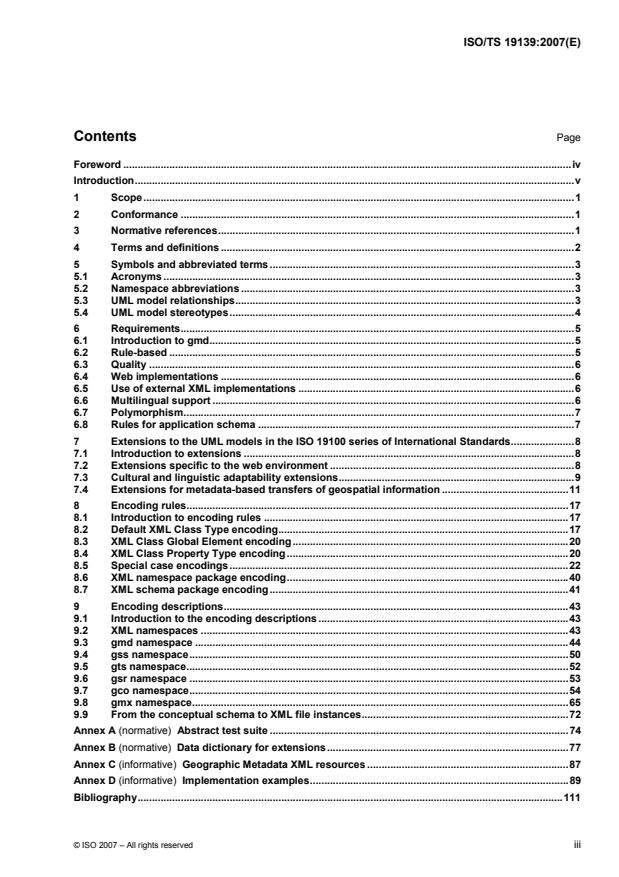
Contents Page
Foreword .iv
Introduction.v
1 Scope.1
2 Conformance .1
3 Normative references.1
4 Terms and definitions .2
5 Symbols and abbreviated terms .3
5.1 Acronyms .3
5.2 Namespace abbreviations .3
5.3 UML model relationships.3
5.4 UML model stereotypes.4
6 Requirements.5
6.1 Introduction to gmd.5
6.2 Rule-based .5
6.3 Quality .6
6.4 Web implementations .6
6.5 Use of external XML implementations .6
6.6 Multilingual support .6
6.7 Polymorphism.7
6.8 Rules for application schema .7
7 Extensions to the UML models in the ISO 19100 series of International Standards.8
7.1 Introduction to extensions .8
7.2 Extensions specific to the web environment .8
7.3 Cultural and linguistic adaptability extensions.9
7.4 Extensions for metadata-based transfers of geospatial information .11
8 Encoding rules.17
8.1 Introduction to encoding rules .17
8.2 Default XML Class Type encoding.17
8.3 XML Class Global Element encoding.20
8.4 XML Class Property Type encoding.20
8.5 Special case encodings.22
8.6 XML namespace package encoding.40
8.7 XML schema package encoding.41
9 Encoding descriptions.43
9.1 Introduction to the encoding descriptions .43
9.2 XML namespaces .43
9.3 gmd namespace .44
9.4 gss namespace.50
9.5 gts namespace.52
9.6 gsr namespace .53
9.7 gco namespace.54
9.8 gmx namespace.65
9.9 From the conceptual schema to XML file instances.72
Annex A (normative) Abstract test suite .74
Annex B (normative) Data dictionary for extensions.77
Annex C (informative) Geographic Metadata XML resources .87
Annex D (informative) Implementation examples.89
Bibliography.111
Foreword
ISO (the International Organization for Standardization) is a worldwide federation of national standards bodies
(ISO member bodies). The work of preparing International Standards is normally carried out through ISO
technical committees. Each member body interested in a subject for which a technical committee has been
established has the right to be represented on that committee. International organizations, governmental and
non-governmental, in liaison with ISO, also take part in the work. ISO collaborates closely with the
International Electrotechnical Commission (IEC) on all matters of electrotechnical standardization.
International Standards are drafted in accordance with the rules given in the ISO/IEC Directives, Part 2.
The main task of technical committees is to prepare International Standards. Draft International Standards
adopted by the technical committees are circulated to the member bodies for voting. Publication as an
International Standard requires approval by at least 75 % of the member bodies casting a vote.
In other circumstances, particularly when there is an urgent market requirement for such documents, a
technical committee may decide to publish other types of normative document:
⎯ an ISO Publicly Available Specification (ISO/PAS) represents an agreement between technical experts in
an ISO working group and is accepted for publication if it is approved by more than 50 % of the members
of the parent committee casting a vote;
⎯ an ISO Technical Specification (ISO/TS) represents an agreement between the members of a technical
committee and is accepted for publication if it is approved by 2/3 of the members of the committee casting
a vote.
An ISO/PAS or ISO/TS is reviewed after three years in order to decide whether it will be confirmed for a
further three years, revised to become an International Standard, or withdrawn. If the ISO/PAS or ISO/TS is
confirmed, it is reviewed again after a further three years, at which time it must either be transformed into an
International Standard or be withdrawn.
Attention is drawn to the possibility that some of the elements of this document may be the subject of patent
rights. ISO shall not be held responsible for identifying any or all such patent rights.
ISO/TS 19139 was prepared by Technical Committee ISO/TC 211, Geographic information/Geomatics.
iv © ISO 2007 – All rights reserved
Introduction
The importance of metadata describing digital geographic data is explained in detail in the text of ISO 19115.
ISO 19115 provides a structure for describing digital geographic data by defining metadata elements and
establishing a common set of metadata terminology, definitions and extension procedures. ISO 19115 is
abstract in that it provides a worldwide view of metadata relative to geographic information, but no encoding.
Since ISO 19115 does not provide any encoding, the actual implementation of geographic information
metadata could vary based on the interpretation of metadata producers. In an attempt to facilitate the
standardization of implementations, this comprehensive metadata implementation specification provides a
definitive, rule-based encoding for applying ISO 19115. This Technical Specification provides Extensible
Markup Language (XML) schemas that are meant to enhance interoperability by providing a common
specification for describing, validating and exchanging metadata about geographic datasets, dataset series,
individual geographic features, feature attributes, feature types, feature properties, etc.
ISO 19115 defines general-purpose metadata in the field of geographic information. More detailed metadata
for geographic data types and geographic services are defined in other ISO 19100 series standards and user
extensions (ISO 19115). This Technical Specification is also intended to define implementation guidelines for
general-purpose metadata. Where necessary, interpretations of some other ISO 19100 series standards are
incorporated.
ISO 19118 describes the requirements for creating encoding rules based on UML schemas and the
XML-based encoding rules as well as providing an introduction to XML. This Technical Specification utilizes
the encoding rules defined in ISO 19118 and provides the specific details of their application with regard to
deriving XML schema for the UML models in ISO 19115.
TECHNICAL SPECIFICATION ISO/TS 19139:2007(E)
Geographic information — Metadata — XML schema
implementation
1 Scope
This Technical Specification defines Geographic MetaData XML (gmd) encoding, an XML schema
implementation derived from ISO 19115.
2 Conformance
Conformance with this Technical Specification shall be checked using all the relevant tests specified in
Annex A. The framework, concepts, and methodology for testing, and the criteria to be achieved to claim
conformance are specified in ISO 19105.
3 Normative references
The following referenced documents are indispensable for the application of this document. For dated
references, only the edition cited applies. For undated references, the latest edition of the referenced
document (including any amendments) applies.
ISO 639-2, Codes for the representation of names of languages ― Part 2: Alpha-3 code
ISO 3166 (all parts), Codes for the representation of names of countries and their subdivisions
ISO 8601, Data elements and interchange formats — Information interchange — Representation of dates and
times
ISO/IEC 10646, Information technology ― Universal Multiple-Octet Coded Character Set (UCS)
ISO/TS 19103, Geographic information ― Conceptual schema language
ISO 19105, Geographic information — Conformance and testing
ISO 19107, Geographic information ― Spatial schema
ISO 19108, Geographic information ― Temporal schema
ISO 19109, Geographic information ― Rules for application schema
ISO 19110, Geographic information ― Methodology for feature cataloguing
1)
ISO 19111:― , Geographic information ― Spatial referencing by coordinates
ISO 19115:2003, Geographic information ― Metadata
1) To be published. (Revision of ISO 19111:2003)
ISO 19115:2003/Cor. 1:2006, Geographic information ― Metadata ― Technical Corrigendum 1
ISO 19117, Geographic information — Portrayal
ISO 19118:2005, Geographic information ― Encoding
2)
ISO 19136:― , Geographic information ― Geography Markup Language (GML)
W3C XMLName, Namespaces in XML. W3C Recommendation (14 January 1999)
W3C XMLSchema-1, XML Schema Part 1: Structures. W3C Recommendation (2 May 2001)
W3C XMLSchema-2, XML Schema Part 2: Datatypes. W3C Recommendation (2 May 2001)
W3C XML, Extensible Markup Language (XML) 1.0 (Second Edition), W3C Recommendation
(6 October 2000)
W3C XLink, XML Linking Language (XLink) Version 1.0. W3C Recommendation (27 June 2001)
4 Terms and definitions
For the purposes of this Technical Specification, the following terms and definitions apply.
4.1
namespace
collection of names, identified by a URI reference, that are used in XML documents as element names and
attribute names
[W3C XML]
4.2
package
general purpose mechanism for organizing elements into groups
[ISO/TS 19103, definition 4.2.22]
EXAMPLE Identification information; Metadata entity set information; Constraint information.
4.3
realization
semantic relationship between classifiers, wherein one classifier specifies a contract that another classifier
guarantees to carry out
[Booch 1999]
4.4
polymorphism
characteristic of being able to assign a different meaning or usage to something in different contexts –
specifically, to allow an entity such as a variable, a function, or an object to have more than one form
NOTE There are several different kinds of polymorphism.
[http://searchsmallbizit.techtarget.com]
2) To be published.
2 © ISO 2007 – All rights reserved
5 Symbols and abbreviated terms
5.1 Acronyms
UML Unified Modelling Language
XCT XML Class Type
XCPT XML Class Property Type
XCGE XML Class Global Element
XML Extensible Markup Language
XPath XML Path Language
XSD XML Schema Definition
XSL Extensible Style Language
XSLT XSL Transformation
5.2 Namespace abbreviations
In the lists below, the item on the left describes the common namespace prefix used to describe the elements
in the namespace. The second item is an English description of the namespace prefix, and the item in
parenthesis is the URI of the actual namespace. These URIs do not correspond necessarily to an effective
location of the schemas.
This first list corresponds to the namespaces defined by this Technical Specification.
gco Geographic Common extensible markup language (http://www.isotc211.org/2005/gco)
gmd Geographic MetaData extensible markup language (http://www.isotc211.org/2005/gmd)
gmx Geographic Metadata XML Schema (http://www.isotc211.org/2005/gmx)
gss Geographic Spatial Schema extensible markup (http://www.isotc211.org/2005/gss)
language
gsr Geographic Spatial Referencing extensible markup (http://www.isotc211.org/2005/gsr)
language
gts Geographic Temporal Schema extensible markup (http://www.isotc211.org/2005/gts)
language
This second list corresponds to external namespaces used by this Technical Specification.
gml Geography Markup Language (use the GML namespace URI stated in
ISO 19136)
xlink XML Linking Language (use the XLINK namespace URI stated in the
W3C XLink recommendation)
xs W3C XML base schemas (use the XML schema namespace URI stated in
the W3C XMLSchema-1 and
W3C XMLSchema-2 recommendations)
5.3 UML model relationships
The diagrams that appear in this Technical Specification are presented using the Unified Modelling Language
(UML) as the conceptual schema language as defined in ISO/TS 19103. ISO 19115:2003, Figure 2, also
displays the UML notation that is used to describe the metadata. In addition to the UML described in
ISO/TS 19103 and shown in ISO 19115, this Technical Specification uses the notation shown in Figure 1.
Figure 1 — UML Notation for Realization
The class that is the source of the connection (shown on the left in Figure 1) is guaranteed to carry out (or
implement) the specification of the class at the destination of the connection (shown on the right in Figure 1).
5.4 UML model stereotypes
A UML stereotype is an extension mechanism for existing UML concepts (see ISO 19115). In addition to the
stereotypes already defined in ISO 19115 for describing metadata, this Technical Specification defines
stereotypes necessary for a rules-based encoding into XML schema.
The elements of the UML diagrams depicted in Clause 9 can carry stereotypes specifying an XML
implementation. Those stereotypes are carried by classes representing XML elements or XML types, UML
attributes, UML links (realizations or dependencies) and UML packages.
In this Technical Specification the following stereotypes of classes are used.
a) <>: the class represents an implementation type encoded as an XML choice block. Each
property of the class is implemented as an element of the choice.
b) <>: the class represents an implementation type encoded as an XML complex type.
c) <>: the class represents an XML global element.
d) <>: the class represents an implementation type encoded as an XML simple type.
e) <>: the class represents an implementation type encoded as an XML complex type
with simple content.
In this Technical Specification the following stereotypes of attributes are used.
f) <>: the property is encoded as an XML attribute.
g) <>: the property is encoded as an XML element with a name and a type (
name=”propertyName” type=”propertyType”/>)
h) <>: this stereotype only applies to XML simple types derived from built-in XML types. A property
with the stereotype <> restricts the range of a built-in simple type.
i) <>: the property is encoded as a reference to an XML global element (
ref=”XCGE”/>).
In this Technical Specification the following stereotypes of links are used.
j) <>: (carried by realization relationships). The XCT of the abstract concept to implement is
substituted by the specified external implementation.
k) <>: (carried by realization relationships). The XCGE of the abstract concept to implement is
substituted by the specified external implementation.
l) <>: (carried by realization relationships). The XCPT of the abstract concept to implement is
substituted by the specified external implementation.
4 © ISO 2007 – All rights reserved
m) <>: (carried by dependency relationships). The source represents an XML schema
implementing the abstract concepts defined in the target.
n) <>: (carried by dependency relationships). The source and the target represent XML schemas.
The source includes () the target.
o) <>: (carried by dependency relationships). The source and the target represent sets of XML
objects grouped within the same namespace. The source imports () the target.
In this Technical Specification the following stereotypes of packages are used.
p) <>: The package represents an XML schema.
q) <>: The package represents a set of XML objects grouped within the same
namespace.
6 Requirements
6.1 Introduction to gmd
Geographic metadata is represented in ISO 19115 as a set of UML packages containing one or more UML
classes. ISO 19115 provides a universal, encoding-independent view of geographic information metadata.
This Technical Specification provides a universal implementation of ISO 19115 through an XML schema
encoding that conforms to the rules described in ISO 19118.
While the details of XML namespaces are not included in this Technical Specification, the contents of several
namespaces are defined here. A namespace is really a collection of names which can be used in XML
documents as element or attribute names. The namespace is used to identify the names with a particular
schema. A namespace is a URI, and the ones utilized in this Technical Specification are listed in 5.2. A URI is
often cumbersome for reading, writing and including in human discussion, so this Technical Specification will
more often refer to common namespace prefixes when identifying particulars about the contents of a
namespace. The primary namespace defined in this Technical Specification is
http://www.isotc211.org/2005/gmd and the namespace prefix is gmd which stands for Geographic MetaData
extensible markup language.
XML schema offers many alternatives for structuring information for exchange. ISO 19118 defines a set of
encoding rules for transforming a UML conceptual schema from the ISO 19100 series of documents into an
XML schema. Even within the pared down limitations of ISO 19118, there are still choices for the creation of
specific XML schemas. Clauses 7, 8 and 9 describe the details of encoding the ISO 19115 UML conceptual
schema and the UML models depicted in the respective ISO 19100 series of International Standards listed in
Clause 3, into a set of XML schemas. A description of geographic ISO/TS 19139 XML resources and
examples of metadata instance documents are included in Annexes C and D.
Before delving into the details of the encoding it is important to understand why certain encoding rules are
utilized in the development of gmd. Gaining an understanding of the rules will make the capabilities, limitations
and best-practice use of gmd clear. Some of the major goals for gmd were interoperability with other
ISO 19100 series specifications, predictability, extensibility and usability. Further details of these goals are
described in 6.2 to 6.8.
6.2 Rule-based
This XML schema implementation is a rule-based encoding built from the UML models in the ISO 19100
series of International Standards as required by ISO 19118. Using this methodology achieves a couple of the
goals mentioned in 6.1. First, the resulting gmd schemas are based directly on other ISO 19100 series
International Standards and therefore increase the chance for interoperability. Second, the resulting schema is
predictable since any class, attribute, association, etc. is encoded just as other UML elements of the same
type are encoded.
Although not discussed in detail in this Technical Specification, having a rule-based encoding also allows the
XML schemas to be generated in an automated or semi-automated fashion.
6.3 Quality
Quality in terms of the XML schema implementation implies simple XML schemas as well as the human
readability of the XML files. The structural complexity of the ISO 19100 series, particularly ISO 19115, implies
that it is not possible to provide simple XML schemas for geographic metadata. But the encoding rules are
defined so that a user can directly create and/or understand the content of an XML instance document using
the UML models in ISO 19115 as a basis. Additionally, an implementer can determine the XML schema
implementation of the UML models in ISO 19115 by knowing the encoding rules.
Another aspect to the quality of gmd is completeness. This Technical Specification encodes the entire UML
model from ISO 19115 without regard to a particular usage for gmd or a particular application schema that will
utilize gmd.
6.4 Web implementations
One of the goals stated in 6.1 is usability. Usability, as it pertains to the design of gmd, focuses on the
exchange of geographic metadata with the understanding that this will often happen in a web-like
environment. While there is no restraint against creating geographic metadata instance documents based on
gmd which never transfer across a network, there are many aspects to the design that are intended to aid
internet and web-like transfer of data.
6.5 Use of external XML implementations
Another design principle that aids interoperability and usability is the use of existing XML schemas. If an XML
schema standard already exists that encodes a part of the ISO 19100 series pertaining to geographic
metadata then it is advantageous to incorporate that XML schema standard into gmd. If gmd uses the external
XML schema directly, then interoperability is enhanced. It is also likely that software already exists that can
process instance documents that conform to the external XML. Furthermore, if the external schema is well
designed it might be more efficient than XML schema generated from a series of encoding rules and this
might help achieve the goal of usability.
While using an implementation that already exists has some important advantages, the external XML
schemas should not violate the primary design principles of gmd. For example, if an external XML schema
implements part of the ISO 19100 series but does so in a cumbersome, unusable manner then it is not
incorporated into gmd. Additionally, if an external XML schema does not readily meet the requirements stated
in 6.6 for multilingual support then it is not incorporated into gmd.
6.6 Multilingual support
Cultural and linguistic adaptability is a basic requirement for any textual metadata elements. In Annex J of
ISO 19115:2003, there is an informative discussion of multilingual textual metadata elements. In order to
enhance the chances for interoperability of implementations it is important that a normative mechanism for
multilingual support be included in this Technical Specification. The details of multilingual support are
described in 7.3 and 9.8.6 but for the sake of understanding the design of gmd it is important to understand
that special consideration is given to this requirement. The specific mechanisms used to achieve this goal are
polymorphism and codelist registers. Polymorphism is introduced in 6.7 and codelist registers are described in
7.4.4.4.
It is also important to understand that the multilingual support that exists in W3C XML is not sufficient for the
expression of geographic metadata. In W3C XML, “A special attribute named xml:lang may be inserted in
documents to specify the language used in the contents and attribute values of any element in an XML
document [W3C XML]”. If a particular element can only occur once based on the encoding rules discussed in
Clause 8 then the technique of using the special xml:lang attribute to indicate the language does not allow for
the specification of the same element in two or more languages.
6 © ISO 2007 – All rights reserved
6.7 Polymorphism
The term polymorphism is formally defined in Clause 4. In general terms, polymorphism means the ability to
assume different forms. In terms of this Technical Specification, the first obvious use for polymorphism is for
providing cultural and linguistic adaptability. This allows implementers to provide geographic metadata in one
or more languages without violating any cardinal rules defined in ISO 19115. Polymorphism provides more
than just support for multiple languages. It also allows user communities to better refine geographic metadata
to meet their organizational needs. For example, ISO 19115 contains an individualName attribute of type
CharacterString in the CI_ResponsibleParty class, but within an organization individuals may be described in
a more compartmentalized form (e.g. by first, middle and last names). Polymorphism allows implementers to
extend the more general format of individualName within their namespaces while still fully utilizing gmd and
still providing usable and understandable instance documents for users outside of their organization. The
characteristics of gmd that allow for polymorphism primarily derive from the property type encodings described
in 8.4.
6.8 Rules for application schema
ISO 19109 defines the rules for application schema and is comprised of two categories of models that are
related to metadata:
⎯ a General Feature Model that determines the particular way metadata and quality elements relate to
geographic features;
⎯ two interchange models: the traditional data transfer model and the interoperability model, each of them
implying an interrelation of the metadata with its resources.
With regards to the ISO 19109 General Feature Model, the following specific types of attribute can be defined
for a feature type:
⎯ metadata attributes (as instances of GF_MetadataAttributeType) whose data type is MD_Metadata or one
of its subclasses;
⎯ quality attributes (as instances of GF_QualitiyAttributeType) whose data type is DQ_Element or one of its
subclasses.
The use of geographic metadata XML schema in the context of these rules for application schema basically
consists of the use of the XML schema definitions corresponding to the metadata and quality attribute data
types. The use of XML schema definitions when encoding feature types using ISO 19136 is described in
9.9.2.
With regards to the ISO 19109 interchange models, the interoperability model is based on data interchange by
transactions and is designed for a large number of transactions involving simple interchange. In contrast, the
transfer model is designed for a lesser number of transactions with large amounts of well-organized data. The
ISO 19115 metadata conceptual schema and this Technical Specification are clearly designed to be a starting
point for providing more coherent transfer of geospatial data among and within user communities (i.e. transfer
model).
Additionally, it is important to understand that the interoperability model applies to the interaction between the
user application and a service provider, and that the interaction is fully determined by the service interface.
While the service interface may not require the use of a specific schema, the adoption of the geographic
metadata XML schema within an information-sharing community is highly recommended when applicable.
Interoperable interchanges by transfer needs to go further in terms of standardization. This is the purpose of
the “Extensions for metadata-based transfers of geospatial information” presented in 7.4.
7 Extensions to the UML models in the ISO 19100 series of International Standards
7.1 Introduction to extensions
It has already been stated that ISO 19115 provides an internationally-accepted, encoding-independent view of
geographic information metadata and that this Technical Specification provides a worldwide implementation of
ISO 19115 through an XML schema encoding. Before delving into the specifics of the encoding it is important
to recognise that once a specific implementation technology is identified there may be some specific
extensions required for the ISO 19100 series UML models. The purpose of these extensions may vary but
they are mainly intended to support the requirements stated in Clause 6. An extension might be created to
facilitate interoperability, ease of use, web-like environments, etc. The UML diagrams shown throughout
Clause 7 are the extensions identified to support an XML schema encoding of ISO 19115 and its related
ISO 19100 series of International Standards.
7.2 Extensions specific to the web environment
There are several extensions of the CharacterString class from ISO/TS 19103 that are necessary to add
convenience when working with XML documents. These extensions are specific to the World Wide Web
environment where XML documents are typically processed. Figure 2 defines the metadata required to
describe elements specific to working in a web environment. The data dictionary for this diagram is located in
B.2.1.
Figure 2 — Extensions to support web environments
The Anchor class is needed to support hyper-linking capabilities and to ensure a web-like implementation of
ISO 19115's RS_Identifier and MD_Identifier classes. Because Anchor is a subclass of CharacterString, the
code attribute of RS_Identifier and MD_Identifier can be implemented by instantiating Anchor and thus provide
a reference to the place where the information related to the code is available.
The FileName class is needed to support explicitly referencing of an external file corresponding to a property
containing the name of the file. This is valuable in the case of ISO 19115's MD_BrowseGraphic class with
regards to the fileName attribute. A human readable file name might be a useful value for population of this
attribute, but the additional src attribute provided by the FileName class can provide a machine-readable
absolute path to the location of the file.
The MimeFileType class is needed to support identification of the file type using the mime media type name
and subtype name. This is useful in the case of ISO 19115's MD_BrowseGraphic class with regards to the
fileType attribute. The value of the fileType attribute might be “JPEG” and the type attribute of the
MimeFileType class allows for the machine-readable Mime-type content-type expression such as
“image/jpeg”.
8 © ISO 2007 – All rights reserved
7.3 Cultural and linguistic adaptability extensions
7.3.1 Free text
The free text element in the domain of a CharacterString property type in ISO 19115 is intended to support a
textual metadata element having multiple instances of the same information in different locales. A locale
(identified as PT_Locale) is a combination of language, potentially a country, and a character encoding
(i.e. character set) in which localized character strings are expressed. Annex J of ISO 19115:2003, describes
this Free Text concept (identified as PT_FreeText) but does not include the conceptual schema to accompany
the description. This Technical Specification makes the use of PT_FreeText normatively by providing a
conceptual schema in Figure 3 as well as a corresponding data dictionary (see B.2.2).
Figure 3 — Free text and localized character string
As a consequence of introducing the Locale concept (PT_Locale), the Group concept (identified as
PT_Group) from ISO 19115:2003, Annex J is replaced by the concept of Localised String (identified as
LocalisedCharacterString). LocalisedCharacterString is a subtype of CharacterString whose value is
expressed in a single locale. An instance of a Free Text consequently is a CharacterString (with its value
expressed in a default language and character set that could be defined in an instance of MD_Metadata),
which also aggregates a series of Localised Character String translations via the textGroup role.
7.3.2 Multilingual metadata sets
An optional but repeatable attribute, locale, presented in Figure 4, was added to the class MD_Metadata of
ISO 19115 by corrigendum. This attribute is instantiated if – and only if – the metadata set is multilingual (at
least one of the metadata elements is an instance of PT_FreeText or one of its inherited classes).
Figure 4 — Attributes of MD_Metadata in the geographic metadata XML schema
7.3.3 Management of localized strings
An instance of free text is composed of default character strings and their translations in different locales
through the use of localized strings. This construct implies a distribution of localized strings throughout any
given multilingual metadata set. However, a more common way of managing multilingual sets of information
consists of grouping the localized strings per their locales. In order to ease the management of localized
strings, this Technical Specification describes the concept of locale container (identified as
PT_LocaleContainer). A locale container aggregates a set of localized strings related to a given locale (locale
attribute of PT_LocaleContainer). There is no direct relationship between a locale container and a metadata
set except that a locale container may aggregate localized strings of a metadata set.
Figure 5 — Translation container
This translation container concept is particularly useful in terms of the XML implementation of ISO 19115, but
it is applicable to any other implementation. Indeed, an XML file can only support data expressed in a single
character set, which is generally declared in the XML file header. Having all the localized strings stored in a
single XML file would limit the use of a single character set such as UTF-8. In order to avoid this,
⎯ the LocalisedCharacterString class is implemented specifically to allow a by-reference containment of the
PT_FreeText.textGroup property, and
⎯ the PT_LocaleContainer is the recommended root element to be instantiated in a dedicated XML file.
The localized string related to a given locale can be stored in a corresponding locale container (i.e. XML file)
and referenced from the PT_FreeText.textGroup property instances.
10 © ISO 2007 – All rights reserved
7.4 Extensions for metadata-based transfers of geospatial information
7.4.1 Transfer of datasets and aggregate datasets
Figure 6 reproduces Figure 3 of ISO 19115:2003, focusing on the classes and associations needed for
metadata-driven transfers of geospatial information. Datasets (DS_Dataset) may be part of aggregates
(DS_Aggregate) which may be subset or superset aggregates. Both aggregates and datasets are linked to
one or more sets of metadata elements (MD_Metadata).
Figure 6 — Datasets, aggregates and their metadata
Metadata-based transfers of geospatial information require the extension of ISO 19115 that is shown in
Figure 7.
Figure 7 — The generic interchange organization
In order to supply a generic interchange organization for transfer, two new concepts are introduced: transfer
dataset (MX_Dataset) and transfer aggregate (MX_Aggregate).
In the context of an interchange by transfer, the dataset data is organized in data files (MX_DataFile). Both
transfer datasets and aggregates may be accompanied by support files (MX_SupportFile) which may contain
resources needed to exploit them, or complementary information. The data files and the support files are
described in 7.4.3.
In practice, the information needed to exploit a dataset or an aggregate is not limited to their metadata.
Particularly:
⎯ the metadata cites the feature and portrayal catalogues but does not embed them;
⎯ the metadata instances reference information such as codelists, units of measure and coordinate
reference systems that all need to be accessed.
All of those resources may be managed externally in on-line registries, but it is usually necessary, in the
context of interchange by transfer, to be able to provide that information within the transfer datasets and
transfer aggregates. The abstract concept of catalogue (CT_Catalogue detailed in 7.4.4) corresponds exactly
to those resources needed to exploit the datasets, aggregates and their metadata. Herein, catalogues are
used in the context of interchange by transfer and are associated to transfer datasets (MX_Dataset) and
transfer aggregates (MX_Aggregate).
7.4.2 Management of aggregates
The subclassification of DS_Aggregate shown in Figure 6 is fully valid conceptually. Yet, in the context of a
data transfer, aggregation of datasets follows constraints (e.g. transfer media capacity) and requirements
which outweigh the pure design of geospatial aggregations. The transfer interchange mechanism is based on
transfer aggregates, but the initial nature of the geospatial aggregation can be expressed through the
hierarchyLevel attribute of MD_Metadata using the extension of the MD_ScopeCode codelist specified in
Figure 8.
12 © ISO 2007 – All rights reserved
Figure 8 — Extended scope code
Note that the transferAggregate specific value indicates that the aggregate makes sense only in the context of
the actual transfer interchange.
7.4.3 Transfer files
Figure 9 describes the support and data files concept. The data files are potentially related to one or many
feature types. Each data file has its own format which is generally described within the metadata of the
3)
dataset.
Figure 9 — Transfer files
3) It is also valid to describe the format of data files in the metadata of an aggregate in the case where the format is
homogenous over the full aggregate.
7.4.4 Catalogues
7.4.4.1 General concepts
The abstract concept of catalogue (CT_Catalogue) is shown in Figure 10. In the context
...
Questions, Comments and Discussion
Ask us and Technical Secretary will try to provide an answer. You can facilitate discussion about the standard in here.
Loading comments...