

ISO 3691-6:2021
(Main)Industrial trucks — Safety requirements and verification — Part 6: Burden and personnel carriers
General Information
- Abstract
This document gives safety requirements and the means for their verification for self-propelled carriers designed for carrying burdens without lifting, as defined in ISO 5053‑1:2020, and/or personnel carriers, having three or more wheels, a maximum speed not exceeding 56 km/h and a load capacity not exceeding 5 000 kg (hereafter referred to as carriers or trucks). This document is applicable to trucks equipped with a platform (which can be tilting) for the purpose of carrying materials or with a number of seats for the purpose of transporting passengers. It is not applicable to: — vehicles intended primarily for earth-moving or over-the-road hauling; — driverless trucks; — pedestrian controlled trucks; — golf cars; — tractors with a drawbar pull up to and including 20 000 N equipped with a platform for the purpose of carrying materials. This document deals with all significant hazards, hazardous situations or hazardous events, as listed in Annex A, relevant to the applicable machines when used as intended and under conditions of misuse which are reasonably foreseeable by the manufacturer. This document does not deal with hazard due to the risk of break-up during operation. It does not establish requirements for hazards that can occur when using trucks on public roads or when operating in potentially explosive atmospheres. It does not establish requirements to provide fire extinguishers. Regional requirements, additional to the requirements given in this document, are addressed in EN 16307‑6:2014 and ISO/TS 3691‑8:2019.
- Status
- Published
- Publication Date
- 12-Jul-2021
- Technical Committee
- ISO/TC 110/SC 2 - Safety of powered industrial trucks
- Drafting Committee
- ISO/TC 110/SC 2/WG 2 - Safety code
- Current Stage
- 6060 - International Standard published
- Start Date
- 13-Jul-2021
- Due Date
- 16-May-2022
- Completion Date
- 13-Jul-2021
Buy Documents



ISO 3691-6:2021 - Industrial trucks -- Safety requirements and verification

ISO 3691-6:2021 - Industrial trucks — Safety requirements and verification — Part 6: Burden and personnel carriers/13/2021



ISO 3691-6:2021 - Chariots de manutention -- Exigences de sécurité et vérification

ISO 3691-6:2021 - Chariots de manutention — Exigences de sécurité et vérification — Partie 6: Transporteurs de charges et de personnel/13/2021
Overview
ISO 3691-6:2021 - Industrial trucks: Safety requirements and verification - Part 6: Burden and personnel carriers specifies safety requirements and verification methods for self-propelled carriers designed to transport materials (without lifting) and/or passengers. It applies to carriers with three or more wheels, a maximum speed not exceeding 56 km/h, and a load capacity up to 5 000 kg. The standard covers trucks equipped with platforms (including tilting platforms) or seating for passengers and addresses significant hazards relevant to intended use and reasonably foreseeable misuse.
Key exclusions: vehicles intended primarily for earth‑moving or over‑the‑road hauling, driverless trucks, pedestrian‑controlled trucks, golf cars, and certain tractors. It does not address risk of structural break‑up during operation, use on public roads, explosive atmospheres, or the provision of fire extinguishers.
Key Topics and Requirements
ISO 3691-6:2021 organizes practical safety requirements and verification across the truck lifecycle. Major technical topics include:
- General safety principles and environmental/ electrical conditions
- Starting and movement controls (unauthorized start, unintended movement, speedometer requirements)
- Braking systems and performance, including energy‑supply failure scenarios
- Manual controls (travel, braking, steering, marking of controls)
- Power systems and accessories (exhaust, cooling, fuel tanks, LPG specifics, battery restraints)
- Operator and passenger positions (dimensions, seats, handholds, protection against crushing/shearing)
- Stability (aligned with ISO 22915‑17) and protective devices (warning devices, towing provisions)
- Visibility, lighting, EMC, noise and vibration requirements
- Transport, lifting and tie‑down points for safe handling and shipment
- Verification methods including functional testing and requirements for instruction handbooks, marking and information for use
The document also lists significant hazards in Annex A and is a Type‑C standard referenced to ISO 12100 for risk assessment principles.
Applications and Practical Value
ISO 3691-6 is used to design, manufacture, inspect and operate burden and personnel carriers safely. Practical applications include:
- Designing platforms and seating arrangements that meet dimensional and restraint requirements
- Specifying braking, steering and control systems to prevent unintended movement
- Developing operator manuals, maintenance instructions and marking for fleet safety compliance
- Preparing verification and functional test protocols during production and commissioning
Who Uses This Standard
Primary users include:
- Industrial truck manufacturers (design and compliance teams)
- Health & safety regulators and market surveillance bodies
- Maintenance and service providers
- Fleet managers and employers who operate burden or personnel carriers
- Certification and testing laboratories
Related Standards
- ISO 12100 (general machine safety / risk assessment)
- ISO 5053-1 (definitions for carriers)
- ISO 22915-17 (stability requirements referenced)
- EN 16307‑6:2014 and ISO/TS 3691‑8:2019 (regional and additional requirements)
Keywords: ISO 3691-6:2021, industrial trucks safety, burden and personnel carriers, safety requirements, verification, operator position, braking, stability, EMC.
Relations
- Effective Date
- 25-Aug-2026
- Effective Date
- 12-Feb-2026
- Effective Date
- 17-Jul-2021
Buy Documents
ISO 3691-6:2021 - Industrial trucks -- Safety requirements and verification
ISO 3691-6:2021 - Industrial trucks — Safety requirements and verification — Part 6: Burden and personnel carriers/13/2021
ISO 3691-6:2021 - Chariots de manutention -- Exigences de sécurité et vérification
ISO 3691-6:2021 - Chariots de manutention — Exigences de sécurité et vérification — Partie 6: Transporteurs de charges et de personnel/13/2021
Frequently Asked Questions
ISO 3691-6:2021 is a standard published by the International Organization for Standardization (ISO). Its full title is "Industrial trucks — Safety requirements and verification — Part 6: Burden and personnel carriers". This standard covers: This document gives safety requirements and the means for their verification for self-propelled carriers designed for carrying burdens without lifting, as defined in ISO 5053‑1:2020, and/or personnel carriers, having three or more wheels, a maximum speed not exceeding 56 km/h and a load capacity not exceeding 5 000 kg (hereafter referred to as carriers or trucks). This document is applicable to trucks equipped with a platform (which can be tilting) for the purpose of carrying materials or with a number of seats for the purpose of transporting passengers. It is not applicable to: — vehicles intended primarily for earth-moving or over-the-road hauling; — driverless trucks; — pedestrian controlled trucks; — golf cars; — tractors with a drawbar pull up to and including 20 000 N equipped with a platform for the purpose of carrying materials. This document deals with all significant hazards, hazardous situations or hazardous events, as listed in Annex A, relevant to the applicable machines when used as intended and under conditions of misuse which are reasonably foreseeable by the manufacturer. This document does not deal with hazard due to the risk of break-up during operation. It does not establish requirements for hazards that can occur when using trucks on public roads or when operating in potentially explosive atmospheres. It does not establish requirements to provide fire extinguishers. Regional requirements, additional to the requirements given in this document, are addressed in EN 16307‑6:2014 and ISO/TS 3691‑8:2019.
This document gives safety requirements and the means for their verification for self-propelled carriers designed for carrying burdens without lifting, as defined in ISO 5053‑1:2020, and/or personnel carriers, having three or more wheels, a maximum speed not exceeding 56 km/h and a load capacity not exceeding 5 000 kg (hereafter referred to as carriers or trucks). This document is applicable to trucks equipped with a platform (which can be tilting) for the purpose of carrying materials or with a number of seats for the purpose of transporting passengers. It is not applicable to: — vehicles intended primarily for earth-moving or over-the-road hauling; — driverless trucks; — pedestrian controlled trucks; — golf cars; — tractors with a drawbar pull up to and including 20 000 N equipped with a platform for the purpose of carrying materials. This document deals with all significant hazards, hazardous situations or hazardous events, as listed in Annex A, relevant to the applicable machines when used as intended and under conditions of misuse which are reasonably foreseeable by the manufacturer. This document does not deal with hazard due to the risk of break-up during operation. It does not establish requirements for hazards that can occur when using trucks on public roads or when operating in potentially explosive atmospheres. It does not establish requirements to provide fire extinguishers. Regional requirements, additional to the requirements given in this document, are addressed in EN 16307‑6:2014 and ISO/TS 3691‑8:2019.
ISO 3691-6:2021 is classified under the following ICS (International Classification for Standards) categories: 53.060 - Industrial trucks. The ICS classification helps identify the subject area and facilitates finding related standards.
ISO 3691-6:2021 has the following relationships with other standards: It is inter standard links to EN ISO 3691-4:2023, EN ISO 3691-6:2021, ISO 3691-6:2013. Understanding these relationships helps ensure you are using the most current and applicable version of the standard.
ISO 3691-6:2021 is available in PDF format for immediate download after purchase. The document can be added to your cart and obtained through the secure checkout process. Digital delivery ensures instant access to the complete standard document.
Standards Content (Sample)
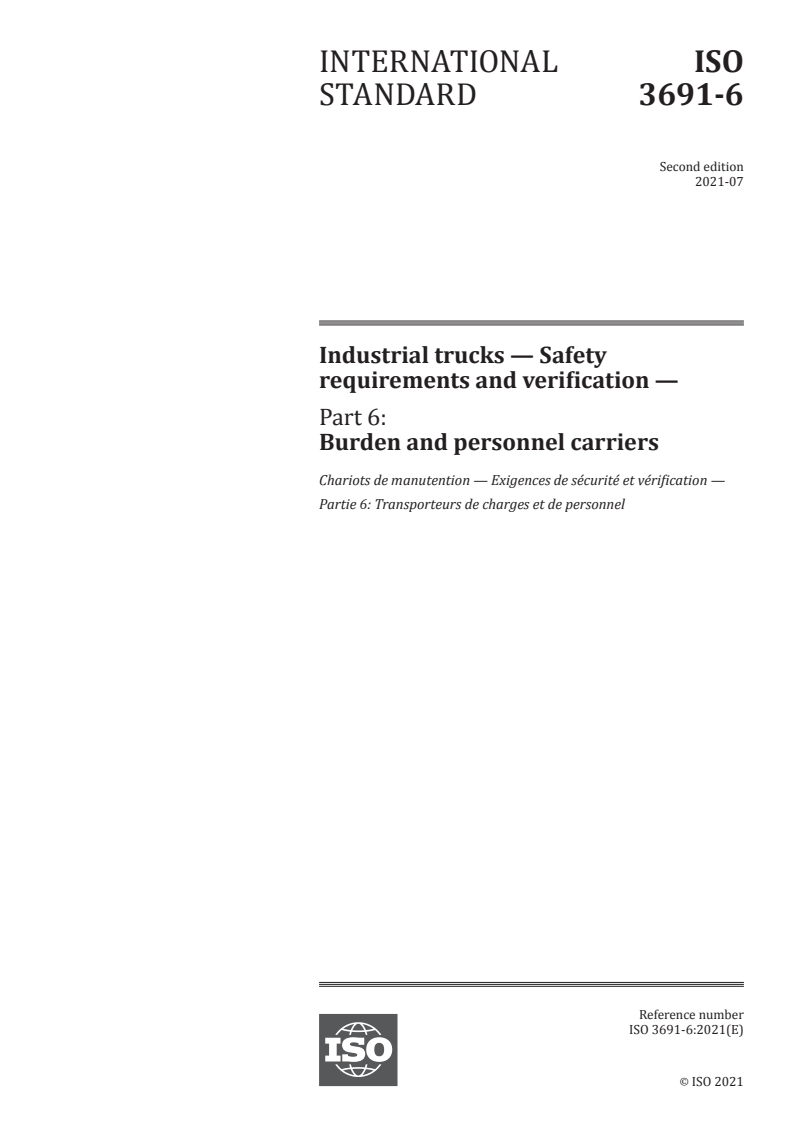
INTERNATIONAL ISO
STANDARD 3691-6
Second edition
2021-07
Industrial trucks — Safety
requirements and verification —
Part 6:
Burden and personnel carriers
Chariots de manutention — Exigences de sécurité et vérification —
Partie 6: Transporteurs de charges et de personnel
Reference number
©
ISO 2021
© ISO 2021
All rights reserved. Unless otherwise specified, or required in the context of its implementation, no part of this publication may
be reproduced or utilized otherwise in any form or by any means, electronic or mechanical, including photocopying, or posting
on the internet or an intranet, without prior written permission. Permission can be requested from either ISO at the address
below or ISO’s member body in the country of the requester.
ISO copyright office
CP 401 • Ch. de Blandonnet 8
CH-1214 Vernier, Geneva
Phone: +41 22 749 01 11
Email: copyright@iso.org
Website: www.iso.org
Published in Switzerland
ii © ISO 2021 – All rights reserved
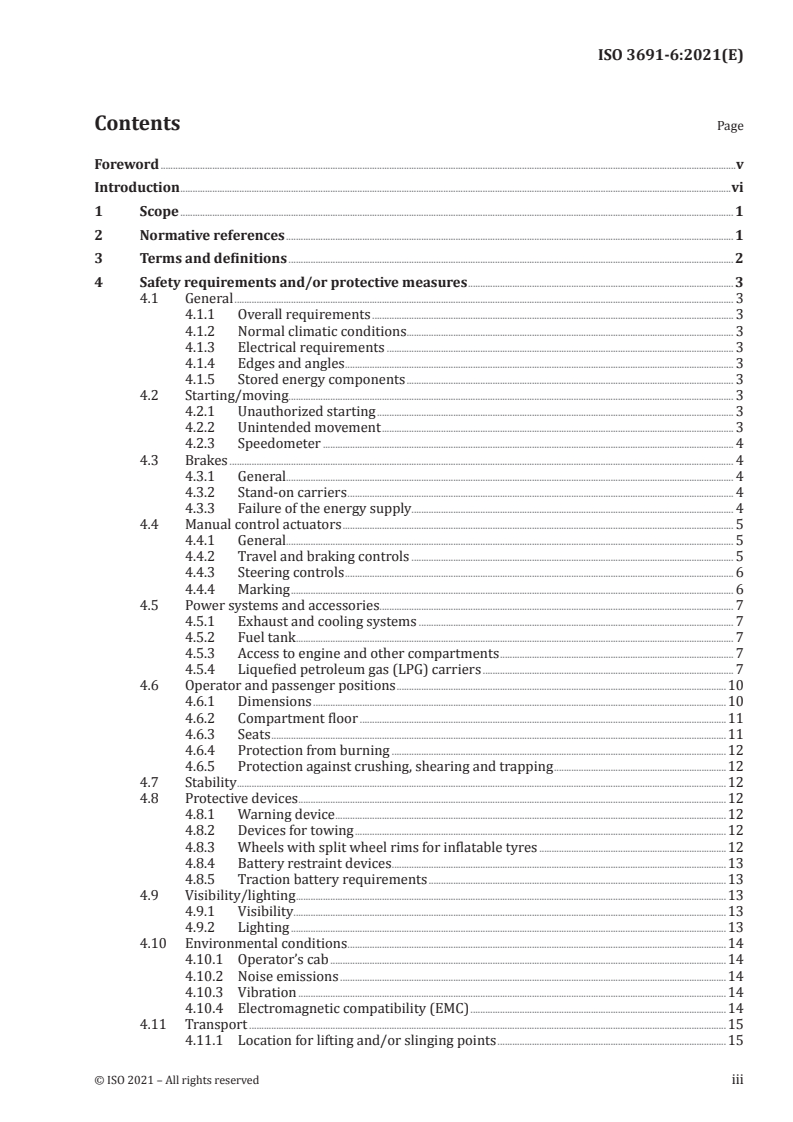
Contents Page
Foreword .v
Introduction .vi
1 Scope . 1
2 Normative references . 1
3 Terms and definitions . 2
4 Safety requirements and/or protective measures . 3
4.1 General . 3
4.1.1 Overall requirements . 3
4.1.2 Normal climatic conditions. 3
4.1.3 Electrical requirements . 3
4.1.4 Edges and angles . 3
4.1.5 Stored energy components . 3
4.2 Starting/moving. 3
4.2.1 Unauthorized starting . 3
4.2.2 Unintended movement . 3
4.2.3 Speedometer . 4
4.3 Brakes . 4
4.3.1 General. 4
4.3.2 Stand-on carriers . 4
4.3.3 Failure of the energy supply. 4
4.4 Manual control actuators . 5
4.4.1 General. 5
4.4.2 Travel and braking controls . 5
4.4.3 Steering controls . 6
4.4.4 Marking . 6
4.5 Power systems and accessories. 7
4.5.1 Exhaust and cooling systems . 7
4.5.2 Fuel tank . . 7
4.5.3 Access to engine and other compartments . 7
4.5.4 Liquefied petroleum gas (LPG) carriers . 7
4.6 Operator and passenger positions .10
4.6.1 Dimensions .10
4.6.2 Compartment floor .11
4.6.3 Seats .11
4.6.4 Protection from burning .12
4.6.5 Protection against crushing, shearing and trapping .12
4.7 Stability .12
4.8 Protective devices .12
4.8.1 Warning device .12
4.8.2 Devices for towing .12
4.8.3 Wheels with split wheel rims for inflatable tyres .12
4.8.4 Battery restraint devices .13
4.8.5 Traction battery requirements .13
4.9 Visibility/lighting .13
4.9.1 Visibility.13
4.9.2 Lighting .13
4.10 Environmental conditions .14
4.10.1 Operator’s cab .14
4.10.2 Noise emissions .14
4.10.3 Vibration .14
4.10.4 Electromagnetic compatibility (EMC) .14
4.11 Transport .15
4.11.1 Location for lifting and/or slinging points .15
4.11.2 Tie-down points .15
4.11.3 Slinging of removable attachments .15
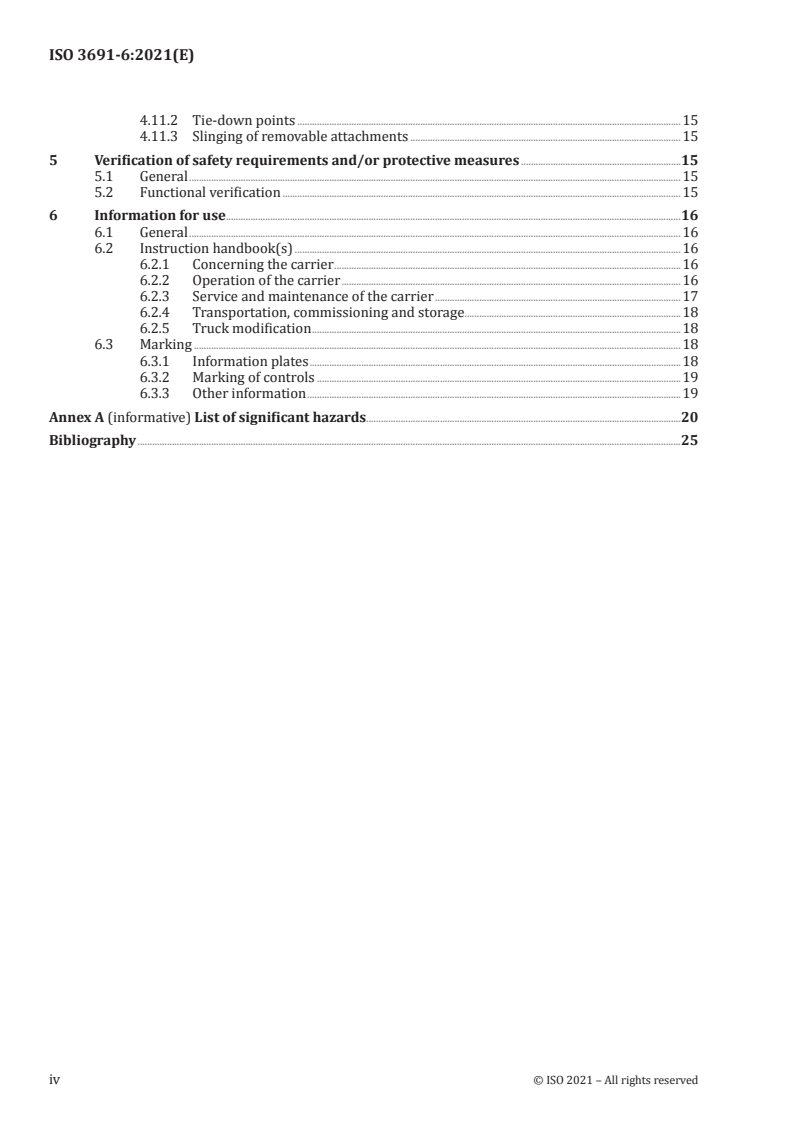
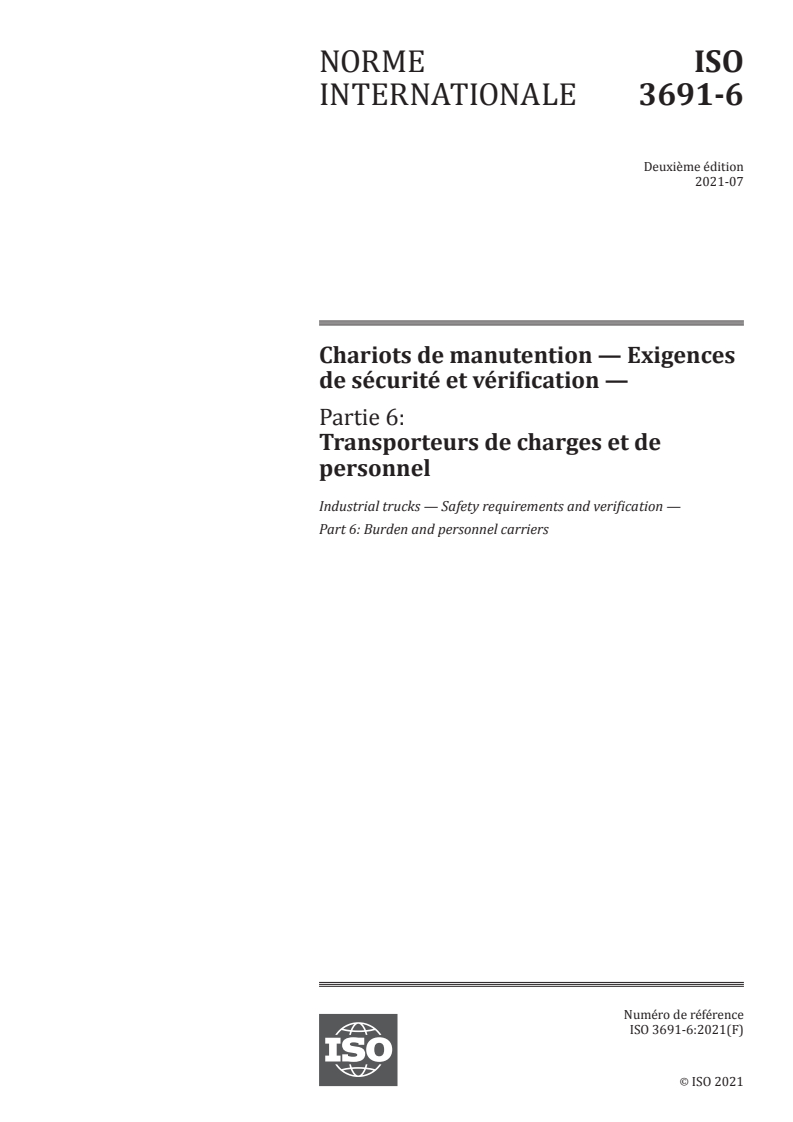
5 Verification of safety requirements and/or protective measures .15
5.1 General .15
5.2 Functional verification .15
6 Information for use .16
6.1 General .16
6.2 Instruction handbook(s) .16
6.2.1 Concerning the carrier .16
6.2.2 Operation of the carrier .16
6.2.3 Service and maintenance of the carrier .17
6.2.4 Transportation, commissioning and storage .18
6.2.5 Truck modification .18
6.3 Marking .18
6.3.1 Information plates .18
6.3.2 Marking of controls .19
6.3.3 Other information .19
Annex A (informative) List of significant hazards.20
Bibliography .25
iv © ISO 2021 – All rights reserved
Foreword
ISO (the International Organization for Standardization) is a worldwide federation of national standards
bodies (ISO member bodies). The work of preparing International Standards is normally carried out
through ISO technical committees. Each member body interested in a subject for which a technical
committee has been established has the right to be represented on that committee. International
organizations, governmental and non-governmental, in liaison with ISO, also take part in the work.
ISO collaborates closely with the International Electrotechnical Commission (IEC) on all matters of
electrotechnical standardization.
The procedures used to develop this document and those intended for its further maintenance are
described in the ISO/IEC Directives, Part 1. In particular, the different approval criteria needed for the
different types of ISO documents should be noted. This document was drafted in accordance with the
editorial rules of the ISO/IEC Directives, Part 2 (see www .iso .org/ directives).
Attention is drawn to the possibility that some of the elements of this document may be the subject of
patent rights. ISO shall not be held responsible for identifying any or all such patent rights. Details of
any patent rights identified during the development of the document will be in the Introduction and/or
on the ISO list of patent declarations received (see www .iso .org/ patents).
Any trade name used in this document is information given for the convenience of users and does not
constitute an endorsement.
For an explanation of the voluntary nature of standards, the meaning of ISO specific terms and
expressions related to conformity assessment, as well as information about ISO's adherence to the
World Trade Organization (WTO) principles in the Technical Barriers to Trade (TBT), see www .iso .org/
iso/ foreword .html.
This document was prepared by Technical Committee ISO/TC 110, Industrial trucks, Subcommittee
SC 2, Safety of industrial trucks, in collaboration with the European Committee for Standardization
(CEN) Technical Committee CEN/TC 150, Industrial Trucks – Safety, in accordance with the Agreement
on technical cooperation between ISO and CEN (Vienna Agreement).
This second edition cancels and replaces the first edition (ISO 3691-6:2013), which has been technically
revised.
The main changes compared to the previous edition are as follows:
— the Introduction has been modified;
— throughout the document, old references to ISO 5053 have been updated to ISO 5053-1 and references
to ISO/TS 3691-7 to EN 16307-6;
— in 4.7, the stability requirements have been changed to ISO 22915-17;
— in 4.6.3.1, the range for weight adjustment of the seat has been changed to "52 kg to 114 kg";
— in 4.6.3.3, the requirements for restraints and handholds have been clarified;
— in 6.2.2.1, list item t) has been added;
— in 6.2.5, the old requirement has been replaced by a reference to regional requirements outside
Europe in ISO/TS 3691-8.
A list of all parts in the ISO 3691 series can be found on the ISO website.
Any feedback or questions on this document should be directed to the user’s national standards body. A
complete listing of these bodies can be found at www .iso .org/ members .html.
Introduction
This document is a type-C standard as stated in ISO 12100.
This document is of relevance, in particular, for the following stakeholder groups representing the
market players with regard to machinery safety:
— machine manufacturers (small, medium and large enterprises);
— health and safety bodies (regulators, accident prevention organisations, market surveillance etc.)
Others can be affected by the level of machinery safety achieved with the means of the document by the
above-mentioned stakeholder groups:
— machine users/employers (small, medium and large enterprises);
— machine users/employees (e.g. trade unions, organizations for people with special needs);
— service providers, e. g. for maintenance (small, medium and large enterprises);
— consumers (in case of machinery intended for use by consumers).
The above-mentioned stakeholder groups have been given the possibility to participate at the drafting
process of this document.
The machinery concerned and the extent to which hazards, hazardous situations or hazardous events
are covered are indicated in the Scope of this document.
When requirements of this type-C standard are different from those which are stated in type-A or
type-B standards, the requirements of this type-C standard take precedence over the requirements of
the other standards for machines that have been designed and built according to the requirements of
this type-C standard.
This document does not repeat all the technical rules which are state-of-the-art and which are applicable
to the material used to construct the industrial truck. Reference to ISO 12100 is also necessary.
Structure
An important step forward in the work on the ISO 3691 series was the agreement to issue a new
structure of International Standards for industrial trucks having on one side basic standards for all
kinds of trucks and on the other side independent standards to cover the respective specific functions
of industrial trucks, e.g. visibility, noise, vibration, electrical requirements, etc.
Global relevance
From the beginning, the task of the working group was to revise ISO 3691:1980 and establish worldwide
basic standards to align with the major regulations in, for example, the European Union, Japan, Australia
and North America.
Every effort was made to develop a globally relevant International Standard. That goal was achieved
with most of the issues. For several potential problem areas, compromises were needed and will be
needed in the future. Where divergent regional requirements remain, these are addressed by the
EN 16307 series and ISO/TS 3691-8:2019.
vi © ISO 2021 – All rights reserved
INTERNATIONAL STANDARD ISO 3691-6:2021(E)
Industrial trucks — Safety requirements and
verification —
Part 6:
Burden and personnel carriers
1 Scope
This document gives safety requirements and the means for their verification for self-propelled
carriers designed for carrying burdens without lifting, as defined in ISO 5053-1:2020, and/or personnel
carriers, having three or more wheels, a maximum speed not exceeding 56 km/h and a load capacity
not exceeding 5 000 kg (hereafter referred to as carriers or trucks).
This document is applicable to trucks equipped with a platform (which can be tilting) for the purpose of
carrying materials or with a number of seats for the purpose of transporting passengers.
It is not applicable to:
— vehicles intended primarily for earth-moving or over-the-road hauling;
— driverless trucks;
— pedestrian controlled trucks;
— golf cars;
— tractors with a drawbar pull up to and including 20 000 N equipped with a platform for the purpose
of carrying materials.
This document deals with all significant hazards, hazardous situations or hazardous events, as listed
in Annex A, relevant to the applicable machines when used as intended and under conditions of misuse
which are reasonably foreseeable by the manufacturer.
This document does not deal with hazard due to the risk of break-up during operation.
It does not establish requirements for hazards that can occur when using trucks on public roads or
when operating in potentially explosive atmospheres.
It does not establish requirements to provide fire extinguishers.
Regional requirements, additional to the requirements given in this document, are addressed in
EN 16307-6:2014 and ISO/TS 3691-8:2019.
2 Normative references
The following documents are referred to in the text in such a way that some or all of their content
constitutes requirements of this document. For dated references, only the edition cited applies. For
undated references, the latest edition of the referenced document (including any amendments) applies.
ISO 2867:2011, Earth-moving machinery — Access systems
ISO 3287:1999, Powered industrial trucks — Symbols for operator controls and other displays
ISO 3411:2007, Earth-moving machinery — Physical dimensions of operators and minimum operator space
envelope
ISO 3795:1989, Road vehicles, and tractors and machinery for agriculture and forestry — Determination of
burning behaviour of interior materials
ISO 5010:2019, Earth-moving machinery — Rubber-tyred machines — Steering requirements
ISO 5053-1:2020, Industrial trucks — Vocabulary — Part 1: Types of industrial trucks
ISO 6292:2020, Powered industrial trucks and tractors — Brake performance and component strength
ISO 12100:2010, Safety of machinery — General principles for design — Risk assessment and risk reduction
ISO 13564-1:2012, Powered industrial trucks — Test methods for verification of visibility — Part 1: Sit-on
and stand-on operator trucks and variable-reach trucks up to and including 10 t capacity
ISO 13849-1:2006, Safety of machinery — Safety-related parts of control systems — Part 1: General
principles for design
ISO 15870:2000, Powered industrial trucks — Safety signs and hazard pictorials — General principles
ISO 20898:2008, Industrial trucks — Electrical requirements
ISO 21281:2005, Construction and layout of pedals of self-propelled sit-down rider-controlled industrial
trucks — Rules for the construction and layout of pedals
ISO 24135-1:2006, Industrial trucks — Specifications and test methods for operator restraint systems —
Part 1: Lap-type seat belts
ISO 22915-17:2020, Industrial trucks — Verification of stability — Part 17: Towing tractors, burden and
personnel carriers
3 Terms and definitions
For the purposes of this document, the terms and definitions given in ISO 5053-1:2020, ISO 12100:2010
and the following apply.
ISO and IEC maintain terminological databases for use in standardization at the following addresses:
— ISO Online browsing platform: available at https:// www .iso .org/ obp
— IEC Electropedia: available at https:// www .electropedia .org/
3.1
burden carrier
personnel carrier
mobile power-driven machine that is not self-loading, used for transporting material and/or personnel
on indoor and outdoor improved surfaces, but not for use on public roads
3.2
operator
designated person, trained and authorized, who is responsible for the movement and operation of
the carrier and, depending on the carrier type, can be transported by the carrier, or can be on foot
accompanying the truck or can be remote from the truck (remote-controlled by cables, radio, etc.)
3.3
normal operating position
position in which the operator is able to control all functions for driving as defined by the manufacturer
3.4
load capacity
maximum load, including the operator and passengers
2 © ISO 2021 – All rights reserved
3.5
capacity
operator and number of passengers permitted by the manufacturer
4 Safety requirements and/or protective measures
4.1 General
4.1.1 Overall requirements
Trucks shall comply with the safety requirements and/or protective measures of this clause. In addition,
the truck shall be designed according to the principles of ISO 12100:2010 for relevant but not significant
hazards which are not dealt with by this document.
4.1.2 Normal climatic conditions
For truck operation, the following climatic conditions apply:
— average ambient temperature for continuous duty: +25 °C
— maximum ambient temperature, short term (up to 1 h): +40 °C
— lowest ambient temperature for trucks intended for use in normal indoor conditions: +5 °C
— lowest ambient temperature for trucks intended for use in normal outdoor conditions: −20 °C
— altitude: up to 2 000 m
4.1.3 Electrical requirements
Electrical systems and equipment shall be in accordance with ISO 20898:2008. However, regional
requirements can exist (see EN 16307-6:2014 and ISO/TS 3691-8:2019).
4.1.4 Edges and angles
There shall be no sharp edges or angles posing a hazard in the area of the operator in the normal
operating position or in the area of access and egress of operators or passengers and during normal
operation and daily checks.
4.1.5 Stored energy components
Components which store energy and would cause a risk during removal or disassembly, e.g. hydraulic
accumulator or spring applied brakes, shall be provided with a means of releasing the energy before
removal or disassembly.
4.2 Starting/moving
4.2.1 Unauthorized starting
Carriers shall be provided with a device (e.g. a key, a code, a magnetic card) that prevents starting
without that device.
4.2.2 Unintended movement
4.2.2.1 Parking brake
A parking brake shall be provided complying with 4.3.1.
4.2.2.2 Internal combustion engine-powered carriers
Internal combustion engine-powered carriers shall be fitted with a device that prevents the engine
being started while the transmission is engaged.
4.2.2.3 Travel controls
Travel controls on internal combustion engine powered carriers shall be arranged so that, on level
ground, the carrier does not move from rest until the transmission has been engaged.
4.2.2.4 Powered travel movement
Powered travel movement of the carrier with a ride-on operator shall be possible only if the operator is
in the normal operating position.
Powered travel shall not occur automatically when the operator returns to the normal operator
position(s) without an additional operation, e.g. by requiring resetting the direction control or
reactivating speed control, etc.
4.2.2.5 Manual gearbox and manually operated clutch pedal
A carrier with an automotive-type manual gearbox and manually operated clutch pedal satisfies the
requirements of 4.2.2.2 and 4.2.2.4.
4.2.3 Speedometer
A speedometer shall be provided on ride-on carriers that have a maximum travel speed greater than
25 km/h.
4.3 Brakes
4.3.1 General
All carriers shall be designed with service and parking brakes complying with ISO 6292:2020. The
parking brake shall be equipped with a system preventing unintentional release.
Emergency braking is subject to regional requirements, additional to the requirements of this document
(see EN 16307-6:2014 and ISO/TS 3691-8:2019).
4.3.2 Stand-on carriers
Stand-on carriers shall be equipped with a brake system that automatically engages upon release of the
brake actuating control by the operator. This system may serve as the service and parking brake.
4.3.3 Failure of the energy supply
Failure of the energy supply for the brake release shall not result in loss of braking for automatically
acting brakes. The brake shall be automatically applied in the event of failure of energy supply to this
brake system.
4 © ISO 2021 – All rights reserved
4.4 Manual control actuators
4.4.1 General
4.4.1.1 Consistency with the carrier motions
Movement of these controls, where practicable, shall be consistent with the carrier motions being
operated. They shall be confined within the plan view outline of the carrier or tiller.
4.4.1.2 Multiple operators
If additional operating positions are fitted, i.e. more than one operator, the operation of these controls
shall only be possible from one operating position at a time, excepting the emergency disconnect switch,
which shall be operable from all positions.
4.4.1.3 Multiple operating positions
If more than one operating position is fitted for a single operator, the use of the controls of one operating
position shall preclude the use of the controls of other operating positions, excepting the emergency
disconnect switch, which shall be operable from all positions.
4.4.2 Travel and braking controls
4.4.2.1 General
The motion of the speed operating control shall be designed such that an increase in the movement
of the control increases the travel speed. When the control is released, it shall return to the neutral
position of the control actuator.
4.4.2.2 Sit-on carriers
Pedal operated travel and braking controls shall comply with ISO 21281:2005.
4.4.2.3 Differential locking
For carriers fitted with a pedal-operated differential lock, pressing on the pedal shall lock the
differential and it shall be unlocked by releasing the pedal. It shall be possible to unlock the differential
when the truck is moving.
4.4.2.4 Hand-operated direction control lever
The movement of a direction control lever shall correspond to the selected direction of travel.
4.4.2.5 Hand-operated accelerator control lever
The control lever shall be a hold-to-run control. It shall return to the neutral position when released.
Movement towards the front of the carrier or away from the operator shall increase speed.
4.4.2.6 Additional operation from outside the carrier
4.4.2.6.1 General
If travel control from outside the carrier is provided for the operator, the travel speed shall be limited to
6 km/h. These controls can be attached to the carrier or remote control can be provided. This operating
system can be made operable by means of a separate switch or automatically when the operator leaves
the normal operating position.
4.4.2.6.2 Security
If the control actuator is released, the drive unit shall switch off automatically and the brake shall be
engaged. Simultaneous operation from the operating positions shall be excluded.
4.4.2.6.3 Additional requirements for cable-connected remote control
Length and layout of the cables shall allow the operator to operate from outside of the area of hazard
of the truck and have visibility of the path of travel. It shall not be possible for the cable to become
entangled with the wheels.
On a portable control panel, the control elements, with the exception of the emergency stop, shall be
guarded against unintentional operation.
4.4.2.6.4 Additional requirements for cableless control
The transmission range shall be adequate for the operator to operate from outside the area of hazard of
the truck and have visibility in the path of travel.
On the portable control panel, the control elements for movement, with the exception of the emergency
stop, shall be guarded against unintentional operation.
−9
The reliability level shall be at least 10 and the hamming distance shall be 2. The remote control shall
meet the requirements of ISO 13849-1:2006: performance level PLc.
In case of communication being lost, the brake system shall engage within 0,5 s.
No control interference shall be possible when more than one truck is operating under remote control
at the same time.
4.4.2.6.5 Additional requirements for carriers with trailer coupling
The controls (e.g. rear touch device) shall be arranged such that the operator does not have to step
between the carrier and the trailer to operate them.
The rear touch device shall be secured against unintentional operation.
When operating the rear touch device, the carrier shall travel at a speed of not more than 2,5 km/h.
4.4.3 Steering controls
4.4.3.1 Direction
Clockwise rotation of the steering wheel or any equivalent movement of the steering control shall steer
the carrier to the right when driving forward.
For pedestrian-operated carriers fitted with a tiller, when travelling in the forward direction, clockwise
movement of the tiller shall steer the carrier to the right.
4.4.3.2 Failure of power supply
In the event of an interruption of the power supplied to the steering system (including a dead motor or
engine), it shall be possible to maintain the path being steered until the carrier is brought to a stop.
For carriers with a maximum travel speed above 20 km/h, the steering performance in the case of
power supply shall comply with ISO 5010:2019.
4.4.4 Marking
For marking, graphic symbols for controls shall comply with 6.3.2.
6 © ISO 2021 – All rights reserved
4.5 Power systems and accessories
4.5.1 Exhaust and cooling systems
4.5.1.1 Exhaust system
The exhaust system shall be designed in accordance with 4.6.4. The exhaust system shall be designed to
direct engine exhaust away from the operator position. Materials used in the vicinity of exhaust systems
shall not be flammable and shall be chosen and protected so that they are not adversely affected by heat
from the exhaust system.
4.5.1.2 Cooling system
The air flow through the cooling system shall be arranged so as to avoid discomfort to the operator/
passengers.
4.5.2 Fuel tank
4.5.2.1 Tank isolation
If a fuel tank is within or adjacent to the engine compartment and excessively high temperatures can
occur, the tank and/or filling arrangement shall be isolated from the electrical and exhaust systems
by suitable protection, e.g. a separate enclosure or baffles. The tank location and facilities for filling
shall be such that spillage or leakage does not drain into the engine or operator's compartment or onto
electrical or exhaust system parts.
4.5.2.2 Fuel spillage
Fuel spillage shall not be possible under normal operating conditions.
4.5.3 Access to engine and other compartments
4.5.3.1 Engine cover
An enclosed engine compartment shall satisfy fan guarding requirements when the manufacturer’s
recommended routine maintenance is performed with the engine off. If a fan can start (e.g. temperature
switch) when the engine is off, the fan shall be guarded. A safety warning sign shall be provided, and
included in the operator’s handbook. Warnings shall comply with 6.3.3.4.
Access from underneath is considered guarded if the access ground clearance is less than 600 mm
between the underside of the truck and level ground.
4.5.3.2 Unintentional closure
Where unintentional closure could cause injury, access covers (i.e. traction battery or engine covers)
shall be provided with means of preventing unintentional closure.
4.5.4 Liquefied petroleum gas (LPG) carriers
4.5.4.1 General
LPG-powered trucks are subject to regional requirements, additional to the requirements of this
document (see ISO/TS 3691-8:2019).
4.5.4.2 Containers
The following applies to the containers of trucks powered by LPG.
a) LPG containers shall be either permanently fixed to the truck or removable.
b) When LPG containers are removable, their fastenings shall permit easy handling and checking of
the installation after the exchange of containers.
c) Removable LPG containers that incorporate a pressure relief valve shall be positioned on the truck
so that the pressure relief valve opening is always in communication with the vapour space at the
top of the container. This may be accomplished, for example, by an indexing pin which positions the
container when the container is properly installed.
d) LPG containers shall be securely mounted to the truck to prevent movement. Fastening shall
withstand static loading of four times the filled container weight in any direction without
permanent visible deformation.
e) LPG containers shall be fitted on the truck such that exposure to abrasion, shock and the corrosive
action of the products handled by the truck is reduced.
f) LPG containers and their connections shall be installed such that there are no projections outside
the plan view outline of the truck.
g) If LPG containers are installed in a compartment, this compartment shall have permanent openings
at the bottom. The total surface area of these ventilation openings shall be at least 200 cm allowing
adequate ventilation to outside the truck.
h) If an additional LPG container is carried on the truck, it shall be secured in the same manner as the
main container.
i) LPG containers, whether fixed or removable, shall be equipped with a device to prevent
unintentional emission of gas or liquid, e.g. in the case of a pipe system failure. This does not apply
to pressure-relief valves.
j) Pipe fittings and accessories on LPG containers shall be protected against mechanical damage
when used as specified by the manufacturer.
k) The fuel take-off on the LPG container shall be equipped with an easily and quickly accessible
manually operated valve. The position and method of operation of this valve shall be clearly marked
on the valve handle or on the outside of the truck near the valve.
l) The fuel take-off shall be in a liquid form unless the LPG container and engine are specially
equipped for a direct vapour withdrawal.
m) Permanently mounted LPG containers to be filled by the user shall be fitted with the following:
— a pressure relief valve connected to the vapour space of the container that, when fitted inside
the compartments of trucks, shall have the discharge side of the relief valve piped to the
atmosphere away from the operator and that shall comply with 4.5.4.4 d);
— an 80 % fill stop valve;
— maximum level indicating devices that rely on bleeding to the atmosphere designed such that
the venting hole is no larger than 1,5 mm in diameter and that the parts of the device cannot be
completely withdrawn in normal gauging operations;
— maximum liquid level devices suitable for the LPG in use, indicating the maximum product level
and which shall not vent to the atmosphere.
8 © ISO 2021 – All rights reserved
n) LPG containers shall be positioned such that they are not exposed to the damaging effects of heat,
particularly heat from the engine or the exhaust system. If it is necessary to fit a heat shield, this
shall not inhibit ventilation.
4.5.4.3 Piping
The following applies to the piping used on trucks powered by LPG.
a) Connecting piping and all associated parts shall be easily accessible, protected against excessive
heat radiation, damage and wear, and shall be flexible enough to withstand vibration and
deformation in service, as follows:
— piping shall be so arranged that damage or leaks are easily detectable and that checks and
maintenance can be carried out;
— piping shall be installed such that it cannot be damaged by any excessive heat radiation from
hot parts of the truck;
— fully rigid pipes shall not be used for connecting the container to equipment on the engine;
— piping shall be so arranged that there are no projections outside the plan view outline of the
truck.
1)
b) Pressure hoses operating above 1 bar shall be supported at least every 500 mm. Rigid pipes shall
be supported at least every 600 mm.
c) Hoses, pipes and all connections operating at pressures above 1 bar shall be suitable for a working
pressure of 25 bar and shall withstand without bursting a test pressure of 75 bar. Hoses, pipes
and all connections operating below 1 bar shall withstand without bursting a test pressure of five
times the maximum working pressure.
d) Pressure shall not exceed the working pressure rating of components in any section of pipe work
containing LPG in liquid form between two shut-off valves that are closed. A pressure relief valve,
for example, or other suitable means may be used if necessary.
e) Aluminium piping shall not be used.
f) Hoses shall be as short as practical.
g) Pressure unions and joints operating above 1 bar shall be made of metal except for any constrained
sealing washers.
4.5.4.4 Equipment
The following applies to the equipment used on trucks powered by LPG.
a) The supply of gas shall be automatically cut off when the engine stops, irrespective of whether or
not the ignition system has been switched off.
b) For multi-fuel applications, the system shall be designed to avoid the possibility of LPG entering
any other fuel container and to shut off each fuel source before the alternative one is opened.
c) If the truck is equipped with two or more containers to supply fuel, they shall be connected via a
multi-way valve or other suitable means, so that LPG can only be drawn from one container at a
time. The use of two or more containers at the same time shall not be possible.
d) Pressure-relief valves or liquid-level indicators shall be installed such that they cannot discharge in
the direction of the operator or onto truck components that could be a source of ignition.
2 5 2
1) 1 bar = 0,1 MPa = 0,1 N/mm = 10 N/m .
e) If corrosion of a part would interfere with its proper functioning, that part shall be provided with a
corrosion-resistant protective coating.
f) All fuel system components shall be firmly secured to the truck.
g) Pressure-reducing valves shall be readily accessible for inspection and maintenance.
h) The engine compartment shall be designed in accordance with 4.5.4.2 g), in order to avoid any LPG
accumulation.
4.6 Operator and passenger positions
4.6.1 Dimensions
The operator’s seat or standing position shall be so located that the operator, while operating the
carrier, has enough room to stay within the plan view outline of the carrier. The dimensions shall be of
suitable ergonomic shape to accommodate at least a 5th percentile to a 95th percentile of the population
as defined in ISO 3411:2007, Figures 1 to 4, within the plan view outline of the carrier. The seat shall not
extend beyond the plan view outline of the carrier.
The minimum distance from the top edge of the seat back to the plan view outline of the carrier shall be
50 mm (see Figures 1 and 2).
Dimensions in millimetres
a
Direction of travel.
Figure 1 — Minimum distance — Front-seated operator
Dimensions in millimetres
a
Direction of travel.
Figure 2 — Minimum distance — Side-seated operator
10 © ISO 2021 – All rights reserved
For stand-on pedestrian and centr
...
INTERNATIONAL ISO
STANDARD 3691-6
Second edition
2021-07
Industrial trucks — Safety
requirements and verification —
Part 6:
Burden and personnel carriers
Chariots de manutention — Exigences de sécurité et vérification —
Partie 6: Transporteurs de charges et de personnel
Reference number
©
ISO 2021
© ISO 2021
All rights reserved. Unless otherwise specified, or required in the context of its implementation, no part of this publication may
be reproduced or utilized otherwise in any form or by any means, electronic or mechanical, including photocopying, or posting
on the internet or an intranet, without prior written permission. Permission can be requested from either ISO at the address
below or ISO’s member body in the country of the requester.
ISO copyright office
CP 401 • Ch. de Blandonnet 8
CH-1214 Vernier, Geneva
Phone: +41 22 749 01 11
Email: copyright@iso.org
Website: www.iso.org
Published in Switzerland
ii © ISO 2021 – All rights reserved
Contents Page
Foreword .v
Introduction .vi
1 Scope . 1
2 Normative references . 1
3 Terms and definitions . 2
4 Safety requirements and/or protective measures . 3
4.1 General . 3
4.1.1 Overall requirements . 3
4.1.2 Normal climatic conditions. 3
4.1.3 Electrical requirements . 3
4.1.4 Edges and angles . 3
4.1.5 Stored energy components . 3
4.2 Starting/moving. 3
4.2.1 Unauthorized starting . 3
4.2.2 Unintended movement . 3
4.2.3 Speedometer . 4
4.3 Brakes . 4
4.3.1 General. 4
4.3.2 Stand-on carriers . 4
4.3.3 Failure of the energy supply. 4
4.4 Manual control actuators . 5
4.4.1 General. 5
4.4.2 Travel and braking controls . 5
4.4.3 Steering controls . 6
4.4.4 Marking . 6
4.5 Power systems and accessories. 7
4.5.1 Exhaust and cooling systems . 7
4.5.2 Fuel tank . . 7
4.5.3 Access to engine and other compartments . 7
4.5.4 Liquefied petroleum gas (LPG) carriers . 7
4.6 Operator and passenger positions .10
4.6.1 Dimensions .10
4.6.2 Compartment floor .11
4.6.3 Seats .11
4.6.4 Protection from burning .12
4.6.5 Protection against crushing, shearing and trapping .12
4.7 Stability .12
4.8 Protective devices .12
4.8.1 Warning device .12
4.8.2 Devices for towing .12
4.8.3 Wheels with split wheel rims for inflatable tyres .12
4.8.4 Battery restraint devices .13
4.8.5 Traction battery requirements .13
4.9 Visibility/lighting .13
4.9.1 Visibility.13
4.9.2 Lighting .13
4.10 Environmental conditions .14
4.10.1 Operator’s cab .14
4.10.2 Noise emissions .14
4.10.3 Vibration .14
4.10.4 Electromagnetic compatibility (EMC) .14
4.11 Transport .15
4.11.1 Location for lifting and/or slinging points .15
4.11.2 Tie-down points .15
4.11.3 Slinging of removable attachments .15
5 Verification of safety requirements and/or protective measures .15
5.1 General .15
5.2 Functional verification .15
6 Information for use .16
6.1 General .16
6.2 Instruction handbook(s) .16
6.2.1 Concerning the carrier .16
6.2.2 Operation of the carrier .16
6.2.3 Service and maintenance of the carrier .17
6.2.4 Transportation, commissioning and storage .18
6.2.5 Truck modification .18
6.3 Marking .18
6.3.1 Information plates .18
6.3.2 Marking of controls .19
6.3.3 Other information .19
Annex A (informative) List of significant hazards.20
Bibliography .25
iv © ISO 2021 – All rights reserved
Foreword
ISO (the International Organization for Standardization) is a worldwide federation of national standards
bodies (ISO member bodies). The work of preparing International Standards is normally carried out
through ISO technical committees. Each member body interested in a subject for which a technical
committee has been established has the right to be represented on that committee. International
organizations, governmental and non-governmental, in liaison with ISO, also take part in the work.
ISO collaborates closely with the International Electrotechnical Commission (IEC) on all matters of
electrotechnical standardization.
The procedures used to develop this document and those intended for its further maintenance are
described in the ISO/IEC Directives, Part 1. In particular, the different approval criteria needed for the
different types of ISO documents should be noted. This document was drafted in accordance with the
editorial rules of the ISO/IEC Directives, Part 2 (see www .iso .org/ directives).
Attention is drawn to the possibility that some of the elements of this document may be the subject of
patent rights. ISO shall not be held responsible for identifying any or all such patent rights. Details of
any patent rights identified during the development of the document will be in the Introduction and/or
on the ISO list of patent declarations received (see www .iso .org/ patents).
Any trade name used in this document is information given for the convenience of users and does not
constitute an endorsement.
For an explanation of the voluntary nature of standards, the meaning of ISO specific terms and
expressions related to conformity assessment, as well as information about ISO's adherence to the
World Trade Organization (WTO) principles in the Technical Barriers to Trade (TBT), see www .iso .org/
iso/ foreword .html.
This document was prepared by Technical Committee ISO/TC 110, Industrial trucks, Subcommittee
SC 2, Safety of industrial trucks, in collaboration with the European Committee for Standardization
(CEN) Technical Committee CEN/TC 150, Industrial Trucks – Safety, in accordance with the Agreement
on technical cooperation between ISO and CEN (Vienna Agreement).
This second edition cancels and replaces the first edition (ISO 3691-6:2013), which has been technically
revised.
The main changes compared to the previous edition are as follows:
— the Introduction has been modified;
— throughout the document, old references to ISO 5053 have been updated to ISO 5053-1 and references
to ISO/TS 3691-7 to EN 16307-6;
— in 4.7, the stability requirements have been changed to ISO 22915-17;
— in 4.6.3.1, the range for weight adjustment of the seat has been changed to "52 kg to 114 kg";
— in 4.6.3.3, the requirements for restraints and handholds have been clarified;
— in 6.2.2.1, list item t) has been added;
— in 6.2.5, the old requirement has been replaced by a reference to regional requirements outside
Europe in ISO/TS 3691-8.
A list of all parts in the ISO 3691 series can be found on the ISO website.
Any feedback or questions on this document should be directed to the user’s national standards body. A
complete listing of these bodies can be found at www .iso .org/ members .html.
Introduction
This document is a type-C standard as stated in ISO 12100.
This document is of relevance, in particular, for the following stakeholder groups representing the
market players with regard to machinery safety:
— machine manufacturers (small, medium and large enterprises);
— health and safety bodies (regulators, accident prevention organisations, market surveillance etc.)
Others can be affected by the level of machinery safety achieved with the means of the document by the
above-mentioned stakeholder groups:
— machine users/employers (small, medium and large enterprises);
— machine users/employees (e.g. trade unions, organizations for people with special needs);
— service providers, e. g. for maintenance (small, medium and large enterprises);
— consumers (in case of machinery intended for use by consumers).
The above-mentioned stakeholder groups have been given the possibility to participate at the drafting
process of this document.
The machinery concerned and the extent to which hazards, hazardous situations or hazardous events
are covered are indicated in the Scope of this document.
When requirements of this type-C standard are different from those which are stated in type-A or
type-B standards, the requirements of this type-C standard take precedence over the requirements of
the other standards for machines that have been designed and built according to the requirements of
this type-C standard.
This document does not repeat all the technical rules which are state-of-the-art and which are applicable
to the material used to construct the industrial truck. Reference to ISO 12100 is also necessary.
Structure
An important step forward in the work on the ISO 3691 series was the agreement to issue a new
structure of International Standards for industrial trucks having on one side basic standards for all
kinds of trucks and on the other side independent standards to cover the respective specific functions
of industrial trucks, e.g. visibility, noise, vibration, electrical requirements, etc.
Global relevance
From the beginning, the task of the working group was to revise ISO 3691:1980 and establish worldwide
basic standards to align with the major regulations in, for example, the European Union, Japan, Australia
and North America.
Every effort was made to develop a globally relevant International Standard. That goal was achieved
with most of the issues. For several potential problem areas, compromises were needed and will be
needed in the future. Where divergent regional requirements remain, these are addressed by the
EN 16307 series and ISO/TS 3691-8:2019.
vi © ISO 2021 – All rights reserved
INTERNATIONAL STANDARD ISO 3691-6:2021(E)
Industrial trucks — Safety requirements and
verification —
Part 6:
Burden and personnel carriers
1 Scope
This document gives safety requirements and the means for their verification for self-propelled
carriers designed for carrying burdens without lifting, as defined in ISO 5053-1:2020, and/or personnel
carriers, having three or more wheels, a maximum speed not exceeding 56 km/h and a load capacity
not exceeding 5 000 kg (hereafter referred to as carriers or trucks).
This document is applicable to trucks equipped with a platform (which can be tilting) for the purpose of
carrying materials or with a number of seats for the purpose of transporting passengers.
It is not applicable to:
— vehicles intended primarily for earth-moving or over-the-road hauling;
— driverless trucks;
— pedestrian controlled trucks;
— golf cars;
— tractors with a drawbar pull up to and including 20 000 N equipped with a platform for the purpose
of carrying materials.
This document deals with all significant hazards, hazardous situations or hazardous events, as listed
in Annex A, relevant to the applicable machines when used as intended and under conditions of misuse
which are reasonably foreseeable by the manufacturer.
This document does not deal with hazard due to the risk of break-up during operation.
It does not establish requirements for hazards that can occur when using trucks on public roads or
when operating in potentially explosive atmospheres.
It does not establish requirements to provide fire extinguishers.
Regional requirements, additional to the requirements given in this document, are addressed in
EN 16307-6:2014 and ISO/TS 3691-8:2019.
2 Normative references
The following documents are referred to in the text in such a way that some or all of their content
constitutes requirements of this document. For dated references, only the edition cited applies. For
undated references, the latest edition of the referenced document (including any amendments) applies.
ISO 2867:2011, Earth-moving machinery — Access systems
ISO 3287:1999, Powered industrial trucks — Symbols for operator controls and other displays
ISO 3411:2007, Earth-moving machinery — Physical dimensions of operators and minimum operator space
envelope
ISO 3795:1989, Road vehicles, and tractors and machinery for agriculture and forestry — Determination of
burning behaviour of interior materials
ISO 5010:2019, Earth-moving machinery — Rubber-tyred machines — Steering requirements
ISO 5053-1:2020, Industrial trucks — Vocabulary — Part 1: Types of industrial trucks
ISO 6292:2020, Powered industrial trucks and tractors — Brake performance and component strength
ISO 12100:2010, Safety of machinery — General principles for design — Risk assessment and risk reduction
ISO 13564-1:2012, Powered industrial trucks — Test methods for verification of visibility — Part 1: Sit-on
and stand-on operator trucks and variable-reach trucks up to and including 10 t capacity
ISO 13849-1:2006, Safety of machinery — Safety-related parts of control systems — Part 1: General
principles for design
ISO 15870:2000, Powered industrial trucks — Safety signs and hazard pictorials — General principles
ISO 20898:2008, Industrial trucks — Electrical requirements
ISO 21281:2005, Construction and layout of pedals of self-propelled sit-down rider-controlled industrial
trucks — Rules for the construction and layout of pedals
ISO 24135-1:2006, Industrial trucks — Specifications and test methods for operator restraint systems —
Part 1: Lap-type seat belts
ISO 22915-17:2020, Industrial trucks — Verification of stability — Part 17: Towing tractors, burden and
personnel carriers
3 Terms and definitions
For the purposes of this document, the terms and definitions given in ISO 5053-1:2020, ISO 12100:2010
and the following apply.
ISO and IEC maintain terminological databases for use in standardization at the following addresses:
— ISO Online browsing platform: available at https:// www .iso .org/ obp
— IEC Electropedia: available at https:// www .electropedia .org/
3.1
burden carrier
personnel carrier
mobile power-driven machine that is not self-loading, used for transporting material and/or personnel
on indoor and outdoor improved surfaces, but not for use on public roads
3.2
operator
designated person, trained and authorized, who is responsible for the movement and operation of
the carrier and, depending on the carrier type, can be transported by the carrier, or can be on foot
accompanying the truck or can be remote from the truck (remote-controlled by cables, radio, etc.)
3.3
normal operating position
position in which the operator is able to control all functions for driving as defined by the manufacturer
3.4
load capacity
maximum load, including the operator and passengers
2 © ISO 2021 – All rights reserved
3.5
capacity
operator and number of passengers permitted by the manufacturer
4 Safety requirements and/or protective measures
4.1 General
4.1.1 Overall requirements
Trucks shall comply with the safety requirements and/or protective measures of this clause. In addition,
the truck shall be designed according to the principles of ISO 12100:2010 for relevant but not significant
hazards which are not dealt with by this document.
4.1.2 Normal climatic conditions
For truck operation, the following climatic conditions apply:
— average ambient temperature for continuous duty: +25 °C
— maximum ambient temperature, short term (up to 1 h): +40 °C
— lowest ambient temperature for trucks intended for use in normal indoor conditions: +5 °C
— lowest ambient temperature for trucks intended for use in normal outdoor conditions: −20 °C
— altitude: up to 2 000 m
4.1.3 Electrical requirements
Electrical systems and equipment shall be in accordance with ISO 20898:2008. However, regional
requirements can exist (see EN 16307-6:2014 and ISO/TS 3691-8:2019).
4.1.4 Edges and angles
There shall be no sharp edges or angles posing a hazard in the area of the operator in the normal
operating position or in the area of access and egress of operators or passengers and during normal
operation and daily checks.
4.1.5 Stored energy components
Components which store energy and would cause a risk during removal or disassembly, e.g. hydraulic
accumulator or spring applied brakes, shall be provided with a means of releasing the energy before
removal or disassembly.
4.2 Starting/moving
4.2.1 Unauthorized starting
Carriers shall be provided with a device (e.g. a key, a code, a magnetic card) that prevents starting
without that device.
4.2.2 Unintended movement
4.2.2.1 Parking brake
A parking brake shall be provided complying with 4.3.1.
4.2.2.2 Internal combustion engine-powered carriers
Internal combustion engine-powered carriers shall be fitted with a device that prevents the engine
being started while the transmission is engaged.
4.2.2.3 Travel controls
Travel controls on internal combustion engine powered carriers shall be arranged so that, on level
ground, the carrier does not move from rest until the transmission has been engaged.
4.2.2.4 Powered travel movement
Powered travel movement of the carrier with a ride-on operator shall be possible only if the operator is
in the normal operating position.
Powered travel shall not occur automatically when the operator returns to the normal operator
position(s) without an additional operation, e.g. by requiring resetting the direction control or
reactivating speed control, etc.
4.2.2.5 Manual gearbox and manually operated clutch pedal
A carrier with an automotive-type manual gearbox and manually operated clutch pedal satisfies the
requirements of 4.2.2.2 and 4.2.2.4.
4.2.3 Speedometer
A speedometer shall be provided on ride-on carriers that have a maximum travel speed greater than
25 km/h.
4.3 Brakes
4.3.1 General
All carriers shall be designed with service and parking brakes complying with ISO 6292:2020. The
parking brake shall be equipped with a system preventing unintentional release.
Emergency braking is subject to regional requirements, additional to the requirements of this document
(see EN 16307-6:2014 and ISO/TS 3691-8:2019).
4.3.2 Stand-on carriers
Stand-on carriers shall be equipped with a brake system that automatically engages upon release of the
brake actuating control by the operator. This system may serve as the service and parking brake.
4.3.3 Failure of the energy supply
Failure of the energy supply for the brake release shall not result in loss of braking for automatically
acting brakes. The brake shall be automatically applied in the event of failure of energy supply to this
brake system.
4 © ISO 2021 – All rights reserved
4.4 Manual control actuators
4.4.1 General
4.4.1.1 Consistency with the carrier motions
Movement of these controls, where practicable, shall be consistent with the carrier motions being
operated. They shall be confined within the plan view outline of the carrier or tiller.
4.4.1.2 Multiple operators
If additional operating positions are fitted, i.e. more than one operator, the operation of these controls
shall only be possible from one operating position at a time, excepting the emergency disconnect switch,
which shall be operable from all positions.
4.4.1.3 Multiple operating positions
If more than one operating position is fitted for a single operator, the use of the controls of one operating
position shall preclude the use of the controls of other operating positions, excepting the emergency
disconnect switch, which shall be operable from all positions.
4.4.2 Travel and braking controls
4.4.2.1 General
The motion of the speed operating control shall be designed such that an increase in the movement
of the control increases the travel speed. When the control is released, it shall return to the neutral
position of the control actuator.
4.4.2.2 Sit-on carriers
Pedal operated travel and braking controls shall comply with ISO 21281:2005.
4.4.2.3 Differential locking
For carriers fitted with a pedal-operated differential lock, pressing on the pedal shall lock the
differential and it shall be unlocked by releasing the pedal. It shall be possible to unlock the differential
when the truck is moving.
4.4.2.4 Hand-operated direction control lever
The movement of a direction control lever shall correspond to the selected direction of travel.
4.4.2.5 Hand-operated accelerator control lever
The control lever shall be a hold-to-run control. It shall return to the neutral position when released.
Movement towards the front of the carrier or away from the operator shall increase speed.
4.4.2.6 Additional operation from outside the carrier
4.4.2.6.1 General
If travel control from outside the carrier is provided for the operator, the travel speed shall be limited to
6 km/h. These controls can be attached to the carrier or remote control can be provided. This operating
system can be made operable by means of a separate switch or automatically when the operator leaves
the normal operating position.
4.4.2.6.2 Security
If the control actuator is released, the drive unit shall switch off automatically and the brake shall be
engaged. Simultaneous operation from the operating positions shall be excluded.
4.4.2.6.3 Additional requirements for cable-connected remote control
Length and layout of the cables shall allow the operator to operate from outside of the area of hazard
of the truck and have visibility of the path of travel. It shall not be possible for the cable to become
entangled with the wheels.
On a portable control panel, the control elements, with the exception of the emergency stop, shall be
guarded against unintentional operation.
4.4.2.6.4 Additional requirements for cableless control
The transmission range shall be adequate for the operator to operate from outside the area of hazard of
the truck and have visibility in the path of travel.
On the portable control panel, the control elements for movement, with the exception of the emergency
stop, shall be guarded against unintentional operation.
−9
The reliability level shall be at least 10 and the hamming distance shall be 2. The remote control shall
meet the requirements of ISO 13849-1:2006: performance level PLc.
In case of communication being lost, the brake system shall engage within 0,5 s.
No control interference shall be possible when more than one truck is operating under remote control
at the same time.
4.4.2.6.5 Additional requirements for carriers with trailer coupling
The controls (e.g. rear touch device) shall be arranged such that the operator does not have to step
between the carrier and the trailer to operate them.
The rear touch device shall be secured against unintentional operation.
When operating the rear touch device, the carrier shall travel at a speed of not more than 2,5 km/h.
4.4.3 Steering controls
4.4.3.1 Direction
Clockwise rotation of the steering wheel or any equivalent movement of the steering control shall steer
the carrier to the right when driving forward.
For pedestrian-operated carriers fitted with a tiller, when travelling in the forward direction, clockwise
movement of the tiller shall steer the carrier to the right.
4.4.3.2 Failure of power supply
In the event of an interruption of the power supplied to the steering system (including a dead motor or
engine), it shall be possible to maintain the path being steered until the carrier is brought to a stop.
For carriers with a maximum travel speed above 20 km/h, the steering performance in the case of
power supply shall comply with ISO 5010:2019.
4.4.4 Marking
For marking, graphic symbols for controls shall comply with 6.3.2.
6 © ISO 2021 – All rights reserved
4.5 Power systems and accessories
4.5.1 Exhaust and cooling systems
4.5.1.1 Exhaust system
The exhaust system shall be designed in accordance with 4.6.4. The exhaust system shall be designed to
direct engine exhaust away from the operator position. Materials used in the vicinity of exhaust systems
shall not be flammable and shall be chosen and protected so that they are not adversely affected by heat
from the exhaust system.
4.5.1.2 Cooling system
The air flow through the cooling system shall be arranged so as to avoid discomfort to the operator/
passengers.
4.5.2 Fuel tank
4.5.2.1 Tank isolation
If a fuel tank is within or adjacent to the engine compartment and excessively high temperatures can
occur, the tank and/or filling arrangement shall be isolated from the electrical and exhaust systems
by suitable protection, e.g. a separate enclosure or baffles. The tank location and facilities for filling
shall be such that spillage or leakage does not drain into the engine or operator's compartment or onto
electrical or exhaust system parts.
4.5.2.2 Fuel spillage
Fuel spillage shall not be possible under normal operating conditions.
4.5.3 Access to engine and other compartments
4.5.3.1 Engine cover
An enclosed engine compartment shall satisfy fan guarding requirements when the manufacturer’s
recommended routine maintenance is performed with the engine off. If a fan can start (e.g. temperature
switch) when the engine is off, the fan shall be guarded. A safety warning sign shall be provided, and
included in the operator’s handbook. Warnings shall comply with 6.3.3.4.
Access from underneath is considered guarded if the access ground clearance is less than 600 mm
between the underside of the truck and level ground.
4.5.3.2 Unintentional closure
Where unintentional closure could cause injury, access covers (i.e. traction battery or engine covers)
shall be provided with means of preventing unintentional closure.
4.5.4 Liquefied petroleum gas (LPG) carriers
4.5.4.1 General
LPG-powered trucks are subject to regional requirements, additional to the requirements of this
document (see ISO/TS 3691-8:2019).
4.5.4.2 Containers
The following applies to the containers of trucks powered by LPG.
a) LPG containers shall be either permanently fixed to the truck or removable.
b) When LPG containers are removable, their fastenings shall permit easy handling and checking of
the installation after the exchange of containers.
c) Removable LPG containers that incorporate a pressure relief valve shall be positioned on the truck
so that the pressure relief valve opening is always in communication with the vapour space at the
top of the container. This may be accomplished, for example, by an indexing pin which positions the
container when the container is properly installed.
d) LPG containers shall be securely mounted to the truck to prevent movement. Fastening shall
withstand static loading of four times the filled container weight in any direction without
permanent visible deformation.
e) LPG containers shall be fitted on the truck such that exposure to abrasion, shock and the corrosive
action of the products handled by the truck is reduced.
f) LPG containers and their connections shall be installed such that there are no projections outside
the plan view outline of the truck.
g) If LPG containers are installed in a compartment, this compartment shall have permanent openings
at the bottom. The total surface area of these ventilation openings shall be at least 200 cm allowing
adequate ventilation to outside the truck.
h) If an additional LPG container is carried on the truck, it shall be secured in the same manner as the
main container.
i) LPG containers, whether fixed or removable, shall be equipped with a device to prevent
unintentional emission of gas or liquid, e.g. in the case of a pipe system failure. This does not apply
to pressure-relief valves.
j) Pipe fittings and accessories on LPG containers shall be protected against mechanical damage
when used as specified by the manufacturer.
k) The fuel take-off on the LPG container shall be equipped with an easily and quickly accessible
manually operated valve. The position and method of operation of this valve shall be clearly marked
on the valve handle or on the outside of the truck near the valve.
l) The fuel take-off shall be in a liquid form unless the LPG container and engine are specially
equipped for a direct vapour withdrawal.
m) Permanently mounted LPG containers to be filled by the user shall be fitted with the following:
— a pressure relief valve connected to the vapour space of the container that, when fitted inside
the compartments of trucks, shall have the discharge side of the relief valve piped to the
atmosphere away from the operator and that shall comply with 4.5.4.4 d);
— an 80 % fill stop valve;
— maximum level indicating devices that rely on bleeding to the atmosphere designed such that
the venting hole is no larger than 1,5 mm in diameter and that the parts of the device cannot be
completely withdrawn in normal gauging operations;
— maximum liquid level devices suitable for the LPG in use, indicating the maximum product level
and which shall not vent to the atmosphere.
8 © ISO 2021 – All rights reserved
n) LPG containers shall be positioned such that they are not exposed to the damaging effects of heat,
particularly heat from the engine or the exhaust system. If it is necessary to fit a heat shield, this
shall not inhibit ventilation.
4.5.4.3 Piping
The following applies to the piping used on trucks powered by LPG.
a) Connecting piping and all associated parts shall be easily accessible, protected against excessive
heat radiation, damage and wear, and shall be flexible enough to withstand vibration and
deformation in service, as follows:
— piping shall be so arranged that damage or leaks are easily detectable and that checks and
maintenance can be carried out;
— piping shall be installed such that it cannot be damaged by any excessive heat radiation from
hot parts of the truck;
— fully rigid pipes shall not be used for connecting the container to equipment on the engine;
— piping shall be so arranged that there are no projections outside the plan view outline of the
truck.
1)
b) Pressure hoses operating above 1 bar shall be supported at least every 500 mm. Rigid pipes shall
be supported at least every 600 mm.
c) Hoses, pipes and all connections operating at pressures above 1 bar shall be suitable for a working
pressure of 25 bar and shall withstand without bursting a test pressure of 75 bar. Hoses, pipes
and all connections operating below 1 bar shall withstand without bursting a test pressure of five
times the maximum working pressure.
d) Pressure shall not exceed the working pressure rating of components in any section of pipe work
containing LPG in liquid form between two shut-off valves that are closed. A pressure relief valve,
for example, or other suitable means may be used if necessary.
e) Aluminium piping shall not be used.
f) Hoses shall be as short as practical.
g) Pressure unions and joints operating above 1 bar shall be made of metal except for any constrained
sealing washers.
4.5.4.4 Equipment
The following applies to the equipment used on trucks powered by LPG.
a) The supply of gas shall be automatically cut off when the engine stops, irrespective of whether or
not the ignition system has been switched off.
b) For multi-fuel applications, the system shall be designed to avoid the possibility of LPG entering
any other fuel container and to shut off each fuel source before the alternative one is opened.
c) If the truck is equipped with two or more containers to supply fuel, they shall be connected via a
multi-way valve or other suitable means, so that LPG can only be drawn from one container at a
time. The use of two or more containers at the same time shall not be possible.
d) Pressure-relief valves or liquid-level indicators shall be installed such that they cannot discharge in
the direction of the operator or onto truck components that could be a source of ignition.
2 5 2
1) 1 bar = 0,1 MPa = 0,1 N/mm = 10 N/m .
e) If corrosion of a part would interfere with its proper functioning, that part shall be provided with a
corrosion-resistant protective coating.
f) All fuel system components shall be firmly secured to the truck.
g) Pressure-reducing valves shall be readily accessible for inspection and maintenance.
h) The engine compartment shall be designed in accordance with 4.5.4.2 g), in order to avoid any LPG
accumulation.
4.6 Operator and passenger positions
4.6.1 Dimensions
The operator’s seat or standing position shall be so located that the operator, while operating the
carrier, has enough room to stay within the plan view outline of the carrier. The dimensions shall be of
suitable ergonomic shape to accommodate at least a 5th percentile to a 95th percentile of the population
as defined in ISO 3411:2007, Figures 1 to 4, within the plan view outline of the carrier. The seat shall not
extend beyond the plan view outline of the carrier.
The minimum distance from the top edge of the seat back to the plan view outline of the carrier shall be
50 mm (see Figures 1 and 2).
Dimensions in millimetres
a
Direction of travel.
Figure 1 — Minimum distance — Front-seated operator
Dimensions in millimetres
a
Direction of travel.
Figure 2 — Minimum distance — Side-seated operator
10 © ISO 2021 – All rights reserved
For stand-on pedestrian and centr
...
NORME ISO
INTERNATIONALE 3691-6
Deuxième édition
2021-07
Chariots de manutention — Exigences
de sécurité et vérification —
Partie 6:
Transporteurs de charges et de
personnel
Industrial trucks — Safety requirements and verification —
Part 6: Burden and personnel carriers
Numéro de référence
©
ISO 2021
DOCUMENT PROTÉGÉ PAR COPYRIGHT
© ISO 2021
Tous droits réservés. Sauf prescription différente ou nécessité dans le contexte de sa mise en œuvre, aucune partie de cette
publication ne peut être reproduite ni utilisée sous quelque forme que ce soit et par aucun procédé, électronique ou mécanique,
y compris la photocopie, ou la diffusion sur l’internet ou sur un intranet, sans autorisation écrite préalable. Une autorisation peut
être demandée à l’ISO à l’adresse ci-après ou au comité membre de l’ISO dans le pays du demandeur.
ISO copyright office
Case postale 401 • Ch. de Blandonnet 8
CH-1214 Vernier, Genève
Tél.: +41 22 749 01 11
E-mail: copyright@iso.org
Web: www.iso.org
Publié en Suisse
ii © ISO 2021 – Tous droits réservés
Sommaire Page
Avant-propos .v
Introduction .vii
1 Domaine d'application . 1
2 Références normatives . 1
3 Termes et définitions . 2
4 Exigences de sécurité et/ou mesures de protection . 3
4.1 Généralités . 3
4.1.1 Exigences globales . 3
4.1.2 Conditions climatiques normales . 3
4.1.3 Exigences électriques . 3
4.1.4 Arêtes et angles . 3
4.1.5 Composants à accumulation d'énergie . 4
4.2 Démarrage/déplacement . 4
4.2.1 Démarrage non autorisé. 4
4.2.2 Mouvement involontaire . 4
4.2.3 Indicateur de vitesse . 4
4.3 Freins . 4
4.3.1 Généralités . 4
4.3.2 Transporteurs à conducteur debout . 5
4.3.3 Défaillance de l’alimentation en énergie . 5
4.4 Actionneurs des organes de service . 5
4.4.1 Généralités . 5
4.4.2 Commandes de roulage et de freinage . 5
4.4.3 Commandes de direction . 7
4.4.4 Marquage . 7
4.5 Systèmes de puissance et accessoires . 7
4.5.1 Systèmes d'échappement et de refroidissement . 7
4.5.2 Réservoir de carburant . . 7
4.5.3 Accès au moteur et autres compartiments . 8
4.5.4 Transporteurs à gaz de pétrole liquéfié (GPL) . 8
4.6 Positions du conducteur et des passagers .10
4.6.1 Dimensions .10
4.6.2 Plancher du compartiment .11
4.6.3 Sièges .12
4.6.4 Protection contre les brûlures .13
4.6.5 Protection contre l'écrasement, le cisaillement et l'emprisonnement .13
4.7 Stabilité .13
4.8 Dispositifs de protection .13
4.8.1 Dispositif d'avertissement .13
4.8.2 Dispositifs pour le remorquage.13
4.8.3 Roues biflasques à pneumatiques gonflables .14
4.8.4 Dispositifs de retenue de la batterie .14
4.8.5 Exigences pour la batterie de traction .14
4.9 Visibilité/éclairage .14
4.9.1 Visibilité .14
4.9.2 Éclairage .15
4.10 Conditions environnementales .15
4.10.1 Cabine du conducteur . .15
4.10.2 Émissions sonores .15
4.10.3 Vibrations .16
4.10.4 Compatibilité électromagnétique (CEM) .16
4.11 Transport .16
4.11.1 Emplacement pour points de levage et/ou d’élingage .16
4.11.2 Points d'arrimage .16
4.11.3 Elingage des accessoires amovibles .16
5 Vérification des exigences de sécurité et/ou des mesures de protection .16
5.1 Généralités .16
5.2 Vérification fonctionnelle .17
6 Informations pour l’utilisation .17
6.1 Généralités .17
6.2 Notice(s) d'instructions .17
6.2.1 Concernant le transporteur .17
6.2.2 Fonctionnement du transporteur.17
6.2.3 Entretien et maintenance du transporteur .19
6.2.4 Transport, mise en service et stockage .19
6.2.5 Modification du chariot .19
6.3 Marquage .20
6.3.1 Plaques d’information .20
6.3.2 Marquage des commandes .20
6.3.3 Autres informations .20
Annexe A (informative) Liste des phénomènes dangereux significatifs .22
Bibliographie .28
iv © ISO 2021 – Tous droits réservés
Avant-propos
L'ISO (Organisation internationale de normalisation) est une fédération mondiale d'organismes
nationaux de normalisation (comités membres de l'ISO). L'élaboration des Normes internationales est
en général confiée aux comités techniques de l'ISO. Chaque comité membre intéressé par une étude
a le droit de faire partie du comité technique créé à cet effet. Les organisations internationales,
gouvernementales et non gouvernementales, en liaison avec l'ISO participent également aux travaux.
L'ISO collabore étroitement avec la Commission électrotechnique internationale (IEC) en ce qui
concerne la normalisation électrotechnique.
Les procédures utilisées pour élaborer le présent document et celles destinées à sa mise à jour sont
décrites dans les Directives ISO/IEC, Partie 1. Il convient, en particulier, de prendre note des différents
critères d'approbation requis pour les différents types de documents ISO. Le présent document a été
rédigé conformément aux règles de rédaction données dans les Directives ISO/IEC, Partie 2 (voir www
.iso .org/ directives).
L'attention est attirée sur le fait que certains des éléments du présent document peuvent faire l'objet de
droits de propriété intellectuelle ou de droits analogues. L'ISO ne saurait être tenue pour responsable
de ne pas avoir identifié de tels droits de propriété et averti de leur existence. Les détails concernant
les références aux droits de propriété intellectuelle ou autres droits analogues identifiés lors de
l'élaboration du document sont indiqués dans l'Introduction et/ou dans la liste des déclarations de
brevets reçues par l'ISO (voir www .iso .org/ brevets).
Les appellations commerciales éventuellement mentionnées dans le présent document sont données
pour information, par souci de commodité, à l’intention des utilisateurs et ne sauraient constituer un
engagement.
Pour une explication de la nature volontaire des normes, la signification des termes et expressions
spécifiques de l'ISO liés à l'évaluation de la conformité, ou pour toute information au sujet de l'adhésion
de l'ISO aux principes de l’Organisation mondiale du commerce (OMC) concernant les obstacles
techniques au commerce (OTC), voir www .iso .org/ avant -propos.
Le présent document a été élaboré par le Comité Technique ISO/TC 110, Chariots de manutention, Sous-
comité SC 2, Sécurité des chariots de manutention automoteurs, en collaboration avec le Comité Technique
CEN/TC 150, Chariots industriels – Sécurité, du Comité Européen de Normalisation (CEN) conformément
à l'accord de coopération technique entre l'ISO et le CEN (Accord de Vienne).
Cette deuxième édition annule et remplace la première édition (ISO 3691-6:2013), qui a fait l’objet d’une
révision technique.
Les principales modifications par rapport à l’édition précédente sont les suivantes:
— l'introduction a été modifiée;
— dans tout le document, les anciennes références à l'ISO 5053 ont été mises à jour en ISO 5053-1 et les
références à l'ISO/TS 3691-7 en EN 16307-6;
— en 4.7, les exigences de stabilité ont été modifiées en ISO 22915-17;
— en 4.6.3.1, l’amplitude pour le réglage du poids du siège a été modifiée en «52 kg à 114 kg»;
— en 4.6.3.3, les exigences pour les dispositifs de retenue et les mains courantes ont été clarifiées;
— en 6.2.2.1, l'élément de liste t) a été ajouté;
— en 6.2.5, l'ancienne exigence a été remplacée par une référence aux exigences régionales hors Europe
dans l'ISO/TS 3691-8.
Une liste de toutes les parties de la série ISO 3691 se trouve sur le site Web de l’ISO.
Il convient que l’utilisateur adresse tout retour d’information ou toute question concernant le présent
document à l’organisme national de normalisation de son pays. Une liste exhaustive desdits organismes
se trouve à l’adresse www .iso .org/ fr/ members .html.
vi © ISO 2021 – Tous droits réservés
Introduction
Le présent document est une norme de type C tel que mentionné dans l’ISO 12100.
Le présent document concerne, en particulier, les groupes de parties prenantes suivants représentant
les acteurs du marché dans le domaine de la sécurité des machines:
— fabricants de machines (petites, moyennes et grandes entreprises);
— organismes de santé et de sécurité (autorités réglementaires, organismes de prévention des risques
professionnels, surveillance du marché, etc.).
D’autres partenaires peuvent être concernés par le niveau de sécurité des machines atteint à l’aide du
document par les groupes de parties prenantes mentionnées ci-dessus:
— utilisateurs de machines/employeurs (petites, moyennes et grandes entreprises);
— utilisateurs de machines/salariés (par exemple, syndicats de salariés, organisations représentant
des personnes ayant des besoins particuliers);
— prestataires de services, par exemple, sociétés de maintenance (petites, moyennes et grandes
entreprises);
— consommateurs (dans le cas de machines destinées à être utilisées par des consommateurs).
Les groupes de parties prenantes mentionnés ci-dessus ont eu la possibilité de participer à l'élaboration
du présent document.
Les machines concernées et l’étendue des phénomènes dangereux, situations dangereuses ou
événements dangereux couverts sont indiquées dans le domaine d’application du présent document.
Lorsque les spécifications de cette norme de type C sont différentes de celles énoncées dans les normes
de type A ou les normes de type B, les spécifications de la présente norme de type C prévalent sur celles
des autres normes pour les machines ayant été conçues et fabriquées conformément aux spécifications
de la présente norme de type C.
Le présent document ne répète pas toutes les règles techniques constituant l’état de l’art et qui sont
applicables au matériau utilisé pour fabriquer le chariot de manutention. Une référence à l'ISO 12100
est également nécessaire.
Structure
Un important progrès au cours du travail sur la série ISO 3691 a consisté en l’accord pour mettre en
place une nouvelle structure de Normes internationales relatives aux chariots de manutention ayant
d’une part des normes de base pour tous les types de chariots et d’autre part des normes indépendantes
pour couvrir les fonctions spécifiques respectives des chariots de manutention, par exemple, la
visibilité, le bruit, les vibrations, les exigences électriques, etc.
Pertinence mondiale
Depuis le début, la tâche du groupe de travail a été de réviser l’ISO 3691:1980 et d’instaurer des
normes de base mondiales pour s’aligner avec les principales réglementations, par exemple, de l’Union
Européenne, du Japon, de l’Australie et de l’Amérique du Nord.
Un gros effort a été fait pour développer une Norme internationale mondialement pertinente. Cet
objectif a été atteint pour la plupart des problèmes. Pour plusieurs domaines pouvant être sources de
problèmes, des compromis ont été nécessaires et seront nécessaires dans le futur. Lorsqu’il reste des
exigences régionales divergentes, elles sont traitées par la série EN 16307 et l'ISO/TS 3691-8:2019.
NORME INTERNATIONALE ISO 3691-6:2021(F)
Chariots de manutention — Exigences de sécurité et
vérification —
Partie 6:
Transporteurs de charges et de personnel
1 Domaine d'application
Le présent document donne les exigences de sécurité et les moyens de leur vérification pour les chariots
automoteurs conçus pour le transport de charges sans levage, tels que définis dans l’ISO 5053-1:2020,
et/ou les transporteurs de personnel, ayant trois roues ou plus, d’une vitesse maximale ne dépassant
pas 56 km/h et d’une capacité de charge ne dépassant pas 5 000 kg (ci-après désignés transporteurs ou
chariots).
Le présent document est applicable aux chariots équipés d’une plate-forme (qui peut être inclinable) à
des fins de transport de matériaux ou d’un nombre de sièges à des fins de transport de passagers.
Il ne s'applique pas aux:
— véhicules destinés principalement aux opérations de terrassement ou de traction sur route;
— chariots sans conducteur;
— chariots commandés par conducteur à pied;
— voiturettes de golf;
— tracteurs ayant une barre de traction tractant jusqu’à 20 000 N équipés d’une plate-forme aux fins
de transport de matériaux.
Le présent document traite de tous les phénomènes dangereux, situations dangereuses ou évènements
dangereux significatifs, tels qu’énumérés dans l’Annexe A, pertinents pour les machines couvertes
lorsqu’elles sont utilisées comme prévu et dans les conditions de mauvaise utilisation qui sont
raisonnablement prévisibles prévues par le fabricant.
Le présent document ne traite pas des phénomènes dangereux dus au risque de rupture pendant le
fonctionnement.
Il n’établit pas d’exigences pour les phénomènes dangereux qui peuvent apparaître lors de l'utilisation
des chariots sur des voies publiques ou en fonctionnement en atmosphères explosibles
Il n'établit pas d'exigences pour fournir des extincteurs.
Des exigences régionales, supplémentaires aux exigences données dans le présent document, sont
traitées dans l'EN 16307-6:2014 et l'ISO/TS 3691-8:2019.
2 Références normatives
Les documents suivants sont cités dans le texte de sorte qu'ils constituent, pour tout ou partie de leur
contenu, des exigences du présent document. Pour les références datées, seule l'édition citée s'applique.
Pour les références non datées, la dernière édition du document de référence s'applique (y compris les
éventuels amendements).
ISO 2867:2011, Engins de terrassement — Moyens d'accès
ISO 3287:1999, Chariots de manutention automoteurs — Symboles pour les organes de commandes de
l'opérateur et autres dispositifs indicateurs
ISO 3411:2007, Engins de terrassement — Dimensions des opérateurs et espace enveloppe minimal pour les
opérateurs
ISO 3795:1989, Véhicules routiers et tracteurs et matériels agricoles et forestiers — Détermination des
caractéristiques de combustion des matériaux intérieurs
ISO 5010:2019, Engins de terrassement — Engins équipés de pneumatiques — Systèmes de direction
ISO 5053-1:2020, Chariots de manutention — Vocabulaire — Partie 1: Types de chariots de manutention
ISO 6292:2020, Chariots de manutention et tracteurs industriels automoteurs — Performance de freinage
et résistance des éléments de frein
ISO 12100:2010, Sécurité des machines — Principes généraux de conception — Appréciation du risque et
réduction du risque
ISO 13564-1:2012, Chariots de manutention automoteurs — Méthodes d'essai pour la vérification de la
visibilité — Partie 1: Chariots à conducteur assis et debout et chariots à portée variable ayant une capacité
allant jusqu'à 10 t incluses
ISO 13849-1:2006, Sécurité des machines — Parties des systèmes de commande relatives à la sécurité —
Partie 1: Principes généraux de conception
ISO 15870:2000, Chariots de manutention automoteurs — Signaux de sécurité et de danger — Principes
généraux
ISO 20898:2008, Chariots de manutention — Exigences électriques
ISO 21281:2005, Construction et configuration des pédales des chariots de manutention automoteurs à
conducteurs assis — Règles de construction et de configuration des pédales
ISO 24135-1:2006, Chariots de manutention — Spécifications et méthodes d'essai pour les systèmes de
retenue de l'opérateur — Partie 1: Ceintures de sécurité ventrales
ISO 22915-17:2020, Chariots de manutention — Vérification de la stabilité — Partie 17: Tracteurs,
transporteurs de charges et de personnel
3 Termes et définitions
Pour les besoins du présent document, les termes et définitions donnés dans l’ISO 5053-1:2020,
l'ISO 12100:2010 ainsi que les suivants s’appliquent:
L’ISO et l’IEC tiennent à jour des bases de données terminologiques destinées à être utilisées en
normalisation, consultables aux adresses suivantes:
— ISO Online browsing platform: disponible à l’adresse https:// www .iso .org/ obp
— IEC Electropedia: disponible à l’adresse https:// www .electropedia .org/
3.1
transporteur de charges
transporteur de personnel
machine mobile à moteur, qui n’est pas à chargement automatique, utilisée pour le transport de
matériaux et/ou de personnel sur des surfaces intérieures ou extérieures améliorées, mais non destinée
à l’utilisation sur des voies publiques
2 © ISO 2021 – Tous droits réservés
3.2
conducteur
personne désignée, formée et autorisée, qui est responsable du déplacement et du fonctionnement du
transporteur et, en fonction du type de transporteur, qui peut être transportée par le transporteur, ou
qui peut accompagner le chariot à pied ou qui peut être à distance du chariot (commandes à distance
par câbles, radio etc.)
3.3
position normale de conduite
position dans laquelle le conducteur est en mesure de commander toutes les fonctions pour la conduite
telle que définie par le fabricant
3.4
capacité de charge
charge maximale, y compris le conducteur et les passagers
3.5
capacité
conducteur et nombre de passagers autorisé par le fabricant
4 Exigences de sécurité et/ou mesures de protection
4.1 Généralités
4.1.1 Exigences globales
Les chariots doivent être conformes aux exigences de sécurité et/ou aux mesures de protection
du présent article. En complément, le chariot doit être conçu conformément aux principes de
l’ISO 12100:2010 pour les phénomènes dangereux pertinents mais non significatifs qui ne sont pas
traités dans le présent document.
4.1.2 Conditions climatiques normales
Pour le fonctionnement du chariot, les conditions climatiques suivantes s’appliquent:
— température ambiante moyenne pour service continu: +25 °C
— température ambiante maximale, courte durée (jusqu’à 1 h): +40 °C
— température ambiante la plus basse pour les chariots destinés à l’utilisation dans des conditions
normales en intérieur: +5 °C
— température ambiante la plus basse pour les chariots destinés à l’utilisation dans des conditions
normales en extérieur: −20 °C
— altitude: jusqu’à 2 000 m
4.1.3 Exigences électriques
Les systèmes et équipements électriques doivent être conformes à l’ISO 20898:2008. Cependant, des
exigences régionales peuvent exister (voir l’EN 16307-6:2014 et l’ISO/TS 3691-8:2019).
4.1.4 Arêtes et angles
Il ne doit y avoir aucune arête ou angle vif donnant lieu à un phénomène dangereux dans la zone du
conducteur en position normale de conduite ou dans la zone d'entrée et de sortie des conducteurs ou
des passagers et pendant le fonctionnement normal et les vérifications quotidiennes.
4.1.5 Composants à accumulation d'énergie
Les composants qui emmagasinent l’énergie et qui causeraient un risque pendant le retrait ou le
démontage, par exemple, accumulateur hydraulique ou freins à ressort, doivent être munis d’un moyen
de dissipation de l’énergie avant retrait ou démontage.
4.2 Démarrage/déplacement
4.2.1 Démarrage non autorisé
Les transporteurs doivent être munis d'un dispositif (par exemple, une clé, un code, une carte
magnétique) qui empêche le démarrage sans ce dispositif.
4.2.2 Mouvement involontaire
4.2.2.1 Frein de stationnement
Un frein de stationnement doit être fourni conforme à 4.3.1.
4.2.2.2 Transporteurs à moteur à combustion interne
Les transporteurs à moteur à combustion interne doivent être équipés d'un dispositif qui empêche le
moteur de démarrer lorsque la transmission est engagée.
4.2.2.3 Commandes de roulage
Les commandes de roulage des transporteurs à moteur à combustion interne doivent être disposées
de sorte que, sur un sol plan, le transporteur ne se déplace pas depuis la position de repos tant que la
transmission n’a pas été engagée.
4.2.2.4 Déplacement motorisé
Le déplacement motorisé du transporteur à conducteur porté doit être possible uniquement si le
conducteur est en position normale de conduite.
Le déplacement motorisé ne doit pas se produire automatiquement lorsque le conducteur revient à la
ou aux positions normales de conduite sans une opération supplémentaire, par exemple, en exigeant la
réinitialisation de la commande de direction ou la réactivation de la commande de vitesse, etc.
4.2.2.5 Boîte de vitesse manuelle et pédale d’embrayage manuelle
Un transporteur muni d’une boîte de vitesse manuelle de type automobile et d’une pédale d’embrayage
manuelle satisfait aux exigences de 4.2.2.2 et 4.2.2.4.
4.2.3 Indicateur de vitesse
Un indicateur de vitesse doit être fourni sur les transporteurs à conducteur porté qui ont une vitesse de
roulage maximale supérieure à 25 km/h.
4.3 Freins
4.3.1 Généralités
Tous les transporteurs doivent être conçus avec des freins de service et de stationnement conformes
à l'ISO 6292:2020. Le frein de stationnement doit être équipé d’un système empêchant un relâchement
involontaire.
4 © ISO 2021 – Tous droits réservés
Le frein d’urgence est sujet à des exigences régionales, supplémentaires aux exigences du présent
document (voir l’EN 16307-6:2014 et l’ISO/TS 3691-8:2019).
4.3.2 Transporteurs à conducteur debout
Les transporteurs à conducteur debout doivent être équipés d’un système de frein qui s'engage
automatiquement lors du relâchement de la commande d'actionnement du frein par l'opérateur. Ce
système peut servir de frein de service et de stationnement.
4.3.3 Défaillance de l’alimentation en énergie
Une défaillance de l'alimentation en énergie pour le relâchement des freins ne doit pas entraîner une
perte de freinage pour les freins à actionnement automatique. Le frein doit être automatiquement
appliqué dans le cas d'une défaillance de l'alimentation en énergie de ce système de frein.
4.4 Actionneurs des organes de service
4.4.1 Généralités
4.4.1.1 Cohérence avec les mouvements du transporteur
Le mouvement de ces commandes, lorsque cela est réalisable, doit correspondre aux mouvements du
transporteur utilisé. Il doit s'inscrire dans le périmètre d'encombrement du transporteur ou du timon.
4.4.1.2 Conducteurs multiples
Si des positions de conduite supplémentaires sont montées, c’est-à-dire plus d’un conducteur, le
fonctionnement de ces commandes doit uniquement être possible depuis une position de conduite à
la fois, à l'exception du bouton de déconnexion d'urgence qui doit être actionnable depuis toutes les
positions.
4.4.1.3 Positions de conduite multiples
Si plus d'une position de conduite est montée pour un seul conducteur, l'utilisation des commandes
d’une position de conduite doit empêcher l'utilisation des commandes des autres positions de conduite,
à l'exception du bouton de déconnexion d'urgence qui doit être actionnable depuis toutes les positions.
4.4.2 Commandes de roulage et de freinage
4.4.2.1 Généralités
Le mouvement de la commande de fonctionnement de la vitesse doit être conçu de sorte qu'une
augmentation du mouvement de la commande augmente la vitesse de roulage. Lorsque la commande
est relâchée, elle doit revenir au point neutre de l’actionneur de la commande.
4.4.2.2 Transporteurs à conducteur assis
Les commandes de roulage et de freinage actionnées par des pédales doivent être conformes à
l'ISO 21281:2005.
4.4.2.3 Verrouillage du différentiel
Pour les transporteurs munis d'un verrouillage à pédale du différentiel, l'appui sur la pédale doit
verrouiller le différentiel et il doit être déverrouillé par relâchement de la pédale. Il doit être possible de
déverrouiller le différentiel lorsque le chariot est en mouvement.
4.4.2.4 Levier manuel de commande de direction
Le mouvement du levier de commande de direction doit correspondre au sens du déplacement
sélectionné.
4.4.2.5 Levier manuel de commande de variation de l’accélérateur
Le levier de commande doit être une commande nécessitant une action maintenue. Il doit revenir
au point neutre lorsqu’il est relâché. Un mouvement vers l’avant du transporteur ou s’éloignant du
conducteur doit augmenter la vitesse.
4.4.2.6 Opération supplémentaire depuis l’extérieur du transporteur
4.4.2.6.1 Généralités
Si une commande de roulage depuis l’extérieur du transporteur est fournie pour le conducteur, la
vitesse de roulage doit être limitée à 6 km/h. Ces commandes peuvent être fixées au transporteur ou
une commande à distance peut être fournie. Ce système d’utilisation peut être rendu opérationnel au
moyen d’un commutateur séparé ou automatique lorsque le conducteur quitte la position normale de
conduite.
4.4.2.6.2 Sécurité
Si l’actionneur de la commande est relâché, l’unité d’entraînement doit être coupé automatiquement et
le frein doit être engagé. Une action simultanée depuis les positions de conduite doit être exclue.
4.4.2.6.3 Exigences supplémentaires pour la commande à distance câblée
La longueur et la disposition des câbles doivent permettre au conducteur de manœuvrer depuis
l’extérieur de la zone du phénomène dangereux du chariot et d’avoir la visibilité sur la trajectoire de
roulage. Il ne doit pas être possible que le câble se coince dans les roues.
Sur un panneau de commande portable, les éléments de commande, à l'exception de l'arrêt d'urgence,
doivent être protégés contre un actionnement intempestif.
4.4.2.6.4 Exigences supplémentaires pour la commande sans câble
La portée de transmission doit être adaptée pour que le conducteur manœuvre depuis l’extérieur de la
zone du phénomène dangereux du chariot et ait la visibilité sur la trajectoire de roulage.
Sur le panneau de commande portable, les éléments de la commande pour le mouvement, à l'exception
de l'arrêt d'urgence, doivent être protégés contre un actionnement intempestif.
−9
Le niveau de fiabilité doit être d'au moins 10 et la distance de Hamming doit être de 2. La commande à
distance doit satisfaire aux exigences de l'ISO 13849-1:2006 : niveau de performance PLc.
En cas de perte de la communication, le système de frein doit s’engager en moins de 0,5 s.
Aucune interférence de la commande ne doit être possible lorsque plus d’un chariot fonctionne avec
commande à distance en même temps.
4.4.2.6.5 Exigences supplémentaires pour les transporteurs avec attelage
Les commandes (par exemple, dispositif tactile arrière) doivent être disposées de sorte que le
conducteur n'ait pas à se tenir entre le transporteur et la remorque pour les faire fonctionner.
Le dispositif tactile arrière doit être protégé contre un fonctionnement involontaire.
6 © ISO 2021 – Tous droits réservés
Lorsque le dispositif tactile arrière est actionné, le transporteur doit rouler à une vitesse ne dépassant
pas 2,5 km/h.
4.4.3 Commandes de direction
4.4.3.1 Direction
La rotation en sens horaire du volant de direction ou tout mouvement équivalent de la commande de
direction doit diriger le transporteur vers la droite lorsqu’il se déplace en marche avant.
Pour les transporteurs à conducteur accompagnant équipés d’un timon, lors du déplacement en marche
avant, un mouvement en sens horaire du timon doit diriger le transporteur vers la droite.
4.4.3.2 Défaillance de l'alimentation en énergie
Dans le cas d’une interruption de l’énergie fournie au système de direction (y compris une panne de
moteur), il doit être possible de maintenir la trajectoire dirigée jusqu'à ce que le transporteur soit
amené à l’arrêt.
Pour les transporteurs avec une vitesse maximale de roulage supérieure à 20 km/h, la performance de
la direction en cas d’alimentation en énergie doit être conforme à l’ISO 5010:2019.
4.4.4 Marquage
Pour le marquage, les symboles graphiques pour les commandes doivent être conformes à 6.3.2.
4.5 Systèmes de puissance et accessoires
4.5.1 Systèmes d'échappement et de refroidissement
4.5.1.1 Système d'échappement
Le système d’échappement doit être conçu conformément à 4.6.4. Le système d'échappement doit être
conçu de sorte à diriger les gaz d'échappement du moteur loin de la position de conduite. Les matériaux
utilisés au voisinage des systèmes d'échappement ne doivent pas être inflammables et doivent être
choisis et protégés de sorte qu’ils ne soient pas affectés de manière préjudiciable par la chaleur du
système d'échappement.
4.5.1.2 Système de refroidissement
Le flux d'air circulant dans le système de refroidissement doit être disposé de sorte à éviter l’inconfort
pour le conducteur/les passagers.
4.5.2 Réservoir de carburant
4.5.2.1 Isolation du réservoir
Si un réservoir de carburant est situé à l'intérieur ou est adjacent au compartiment moteur et si des
températures excessivement élevées peuvent survenir, le réservoir et/ou le dispositif de remplissage
doivent être isolés des circuits électriques et des systèmes d'échappement par une protection
appropriée, par exemple, une enceinte ou des écrans de séparation. L'emplacement du réservoir et
les installations pour le remplissage doivent être tels qu’un écoulement ou une fuite ne s’écoulent pas
dans le compartiment du moteur ou du conducteur, ou sur des parties du système électrique ou de
l’échappement.
4.5.2.2 Ecoulement de carburant
Un écoulement de carburant ne doit pas être possible dans les conditions normales de fonctionnement.
4.5.3 Accès au moteur et autres compartiments
4.5.3.1 Capot moteur
Un compartiment moteur clos doit satisfaire aux exigences de protection du ventilateur lorsque la
maintenance périodique recommandée par le fabricant est exécutée avec un moteur à l’arrêt. Si un
ventilateur peut démarrer (par exemple, thermostat) lorsque le moteur est à l’arrêt, le ventilateur doit
être protégé. Un signal d’avertissement de sécurité doit être fourni et inclus dans la notice d’utilisation.
Les avertissements doivent être conformes à 6.3.3.4.
L'accès par en dessous est considéré comme protégé si la garde au sol de l'accès est inférieure à 600 mm
entre la partie inférieure du chariot et le sol plan.
4.5.3.2 Fermeture intempestive
Lorsqu'une fermeture intempestive pourrait provoquer des blessures, les capots d'accès (c'est-à-dire
les capots de batterie de traction ou du moteur) doivent être fournis avec des moyens de prévention de
la fermeture intempestive.
4.5.4 Transporteurs à gaz de pétrole liquéfié (GPL)
4.5.4.1 Généralités
Les chariots alimentés par GPL sont sujets à des exigences régionales, supplémentaires aux exigences
du présent document (voir l'ISO/TS 3691-8:2019).
4.5.4.2 Conteneurs
Ce qui suit s’applique aux conteneurs des chariots alimentés par GPL.
a) Les conteneurs de GPL doivent être soit fixés en permanence au chariot, soit amovibles.
b) Lorsque les conteneurs de GPL sont amovibles, leurs fixations doivent permettre une manipulation
et une vérification de l'installation après remplacement des conteneurs aisées.
c) Les conteneurs de GPL amovibles qui intègrent une soupape de décharge doivent être positionnés
sur le chariot de sorte que l'ouverture de la soupape de décharge soit toujours reliée avec le côté
vapeur situé sur la partie supérieure du conteneur. Cela peut être réalisé, par exemple, au moyen
d'une goupille d'indexation qui positionne le conteneur lorsque le conteneur est correctement
installé.
d) Les conteneurs de GPL doivent être solidement fixés au chariot pour empêcher un mouvement. La
fixation doit supporter une charge statique de quatre fois la masse du conteneur plein en toute
direction sans déformation visible permanente.
e) Les conteneurs de GPL doivent être montés sur le chariot de sorte que l'exposition à l'abrasion, au
choc et à l'action corrosive des produits manutentionnés par le chariot soit réduite.
f) Les conteneurs de GPL et leurs connexions doivent être installés de sorte qu'il n'y ait pas de
projections en dehors du plan d'encombrement du chariot.
g) Si des conteneurs de GPL sont installés dans un compartiment, ce compartiment doit avoir des
ouvertures permanentes en partie basse. La surface totale de ces ouvertures de ventilation doit
être d'au moins 200 cm pour permettre une ventilation adéquate vers l'extérieur du chariot.
8 © ISO 2021 – Tous droits réservés
h) Si un conteneurs supplémentaire de GPL est transporté sur le chariot, il doit être fixé de la même
manière que le réservoir principal.
i) Les conteneurs de GPL, qu'ils soient fixes ou amovibles, doivent être équipés d'un dispositif pour
empêcher une émission involontaire de gaz ou de liquide, par exemple, en cas de rupture d’un
système de tuyauterie. Cela ne s'applique pas aux soupapes de décharge.
j) Les raccords de canalisation et les accessoires sur les conteneurs de GPL doivent être protégés
contre un dommage mécanique lorsqu'ils sont utilisés comme spécifié par le fabricant.
k) L’alimentation en carburant du conteneurs de GPL doit être munie d’une vanne à fermeture
manuelle facilement et rapidement accessible. La position et la méthode de fonctionnement de cette
vanne doivent être clairement marquées sur la poignée de la vanne ou à l'extérieur du chariot, à
proximité de la vanne.
l) L’alimentation en carburant doit être sous forme liquide, à moins que le conteneur de GPL et le
moteur ne soient spécialement équipés pour un prélèvement direct en phase gazeuse.
m) Les conteneurs de GPL montés en permanence à remplir par l'utilisateur doivent être équipés de ce
qui suit:
— une soupape de décharge reliée au côté vapeur du conteneur qui, lorsque montée à l'intérieur des
compartiments des chariots, doit avoir le côté évacuation de la soupape de décharge raccordé à
l’atmosphère loin du conducteur et qui doit être conforme au 4.5.4.4 d);
— une vanne d’arrêt de remplissage à 80 %;
— des dispositifs indicateurs de niveau maximal, qui utilisent la mise à l'air libre, conçus de sorte
que le trou d’aération ne dépasse pas 1,5 mm de diamètre et que les parties du dispositif ne
puissent pas être complètement retirées pendant les opérations normales de jaugeage;
— les dispositifs de niveau maximal de liquide adaptés au GPL utilisé, indiquant le niveau maximal
de produit et qui ne doivent pas être éventés dans l’atmosphère.
n) Les conteneurs de GPL doivent être positionnés de sorte qu’ils ne soient pas exposés aux effets
d’endommagement dus à la chaleur, en particulier la chaleur provenant du moteur ou du système
d’échapp
...
NORME ISO
INTERNATIONALE 3691-6
Deuxième édition
2021-07
Chariots de manutention — Exigences
de sécurité et vérification —
Partie 6:
Transporteurs de charges et de
personnel
Industrial trucks — Safety requirements and verification —
Part 6: Burden and personnel carriers
Numéro de référence
©
ISO 2021
DOCUMENT PROTÉGÉ PAR COPYRIGHT
© ISO 2021
Tous droits réservés. Sauf prescription différente ou nécessité dans le contexte de sa mise en œuvre, aucune partie de cette
publication ne peut être reproduite ni utilisée sous quelque forme que ce soit et par aucun procédé, électronique ou mécanique,
y compris la photocopie, ou la diffusion sur l’internet ou sur un intranet, sans autorisation écrite préalable. Une autorisation peut
être demandée à l’ISO à l’adresse ci-après ou au comité membre de l’ISO dans le pays du demandeur.
ISO copyright office
Case postale 401 • Ch. de Blandonnet 8
CH-1214 Vernier, Genève
Tél.: +41 22 749 01 11
E-mail: copyright@iso.org
Web: www.iso.org
Publié en Suisse
ii © ISO 2021 – Tous droits réservés
Sommaire Page
Avant-propos .v
Introduction .vii
1 Domaine d'application . 1
2 Références normatives . 1
3 Termes et définitions . 2
4 Exigences de sécurité et/ou mesures de protection . 3
4.1 Généralités . 3
4.1.1 Exigences globales . 3
4.1.2 Conditions climatiques normales . 3
4.1.3 Exigences électriques . 3
4.1.4 Arêtes et angles . 3
4.1.5 Composants à accumulation d'énergie . 4
4.2 Démarrage/déplacement . 4
4.2.1 Démarrage non autorisé. 4
4.2.2 Mouvement involontaire . 4
4.2.3 Indicateur de vitesse . 4
4.3 Freins . 4
4.3.1 Généralités . 4
4.3.2 Transporteurs à conducteur debout . 5
4.3.3 Défaillance de l’alimentation en énergie . 5
4.4 Actionneurs des organes de service . 5
4.4.1 Généralités . 5
4.4.2 Commandes de roulage et de freinage . 5
4.4.3 Commandes de direction . 7
4.4.4 Marquage . 7
4.5 Systèmes de puissance et accessoires . 7
4.5.1 Systèmes d'échappement et de refroidissement . 7
4.5.2 Réservoir de carburant . . 7
4.5.3 Accès au moteur et autres compartiments . 8
4.5.4 Transporteurs à gaz de pétrole liquéfié (GPL) . 8
4.6 Positions du conducteur et des passagers .10
4.6.1 Dimensions .10
4.6.2 Plancher du compartiment .11
4.6.3 Sièges .12
4.6.4 Protection contre les brûlures .13
4.6.5 Protection contre l'écrasement, le cisaillement et l'emprisonnement .13
4.7 Stabilité .13
4.8 Dispositifs de protection .13
4.8.1 Dispositif d'avertissement .13
4.8.2 Dispositifs pour le remorquage.13
4.8.3 Roues biflasques à pneumatiques gonflables .14
4.8.4 Dispositifs de retenue de la batterie .14
4.8.5 Exigences pour la batterie de traction .14
4.9 Visibilité/éclairage .14
4.9.1 Visibilité .14
4.9.2 Éclairage .15
4.10 Conditions environnementales .15
4.10.1 Cabine du conducteur . .15
4.10.2 Émissions sonores .15
4.10.3 Vibrations .16
4.10.4 Compatibilité électromagnétique (CEM) .16
4.11 Transport .16
4.11.1 Emplacement pour points de levage et/ou d’élingage .16
4.11.2 Points d'arrimage .16
4.11.3 Elingage des accessoires amovibles .16
5 Vérification des exigences de sécurité et/ou des mesures de protection .16
5.1 Généralités .16
5.2 Vérification fonctionnelle .17
6 Informations pour l’utilisation .17
6.1 Généralités .17
6.2 Notice(s) d'instructions .17
6.2.1 Concernant le transporteur .17
6.2.2 Fonctionnement du transporteur.17
6.2.3 Entretien et maintenance du transporteur .19
6.2.4 Transport, mise en service et stockage .19
6.2.5 Modification du chariot .19
6.3 Marquage .20
6.3.1 Plaques d’information .20
6.3.2 Marquage des commandes .20
6.3.3 Autres informations .20
Annexe A (informative) Liste des phénomènes dangereux significatifs .22
Bibliographie .28
iv © ISO 2021 – Tous droits réservés
Avant-propos
L'ISO (Organisation internationale de normalisation) est une fédération mondiale d'organismes
nationaux de normalisation (comités membres de l'ISO). L'élaboration des Normes internationales est
en général confiée aux comités techniques de l'ISO. Chaque comité membre intéressé par une étude
a le droit de faire partie du comité technique créé à cet effet. Les organisations internationales,
gouvernementales et non gouvernementales, en liaison avec l'ISO participent également aux travaux.
L'ISO collabore étroitement avec la Commission électrotechnique internationale (IEC) en ce qui
concerne la normalisation électrotechnique.
Les procédures utilisées pour élaborer le présent document et celles destinées à sa mise à jour sont
décrites dans les Directives ISO/IEC, Partie 1. Il convient, en particulier, de prendre note des différents
critères d'approbation requis pour les différents types de documents ISO. Le présent document a été
rédigé conformément aux règles de rédaction données dans les Directives ISO/IEC, Partie 2 (voir www
.iso .org/ directives).
L'attention est attirée sur le fait que certains des éléments du présent document peuvent faire l'objet de
droits de propriété intellectuelle ou de droits analogues. L'ISO ne saurait être tenue pour responsable
de ne pas avoir identifié de tels droits de propriété et averti de leur existence. Les détails concernant
les références aux droits de propriété intellectuelle ou autres droits analogues identifiés lors de
l'élaboration du document sont indiqués dans l'Introduction et/ou dans la liste des déclarations de
brevets reçues par l'ISO (voir www .iso .org/ brevets).
Les appellations commerciales éventuellement mentionnées dans le présent document sont données
pour information, par souci de commodité, à l’intention des utilisateurs et ne sauraient constituer un
engagement.
Pour une explication de la nature volontaire des normes, la signification des termes et expressions
spécifiques de l'ISO liés à l'évaluation de la conformité, ou pour toute information au sujet de l'adhésion
de l'ISO aux principes de l’Organisation mondiale du commerce (OMC) concernant les obstacles
techniques au commerce (OTC), voir www .iso .org/ avant -propos.
Le présent document a été élaboré par le Comité Technique ISO/TC 110, Chariots de manutention, Sous-
comité SC 2, Sécurité des chariots de manutention automoteurs, en collaboration avec le Comité Technique
CEN/TC 150, Chariots industriels – Sécurité, du Comité Européen de Normalisation (CEN) conformément
à l'accord de coopération technique entre l'ISO et le CEN (Accord de Vienne).
Cette deuxième édition annule et remplace la première édition (ISO 3691-6:2013), qui a fait l’objet d’une
révision technique.
Les principales modifications par rapport à l’édition précédente sont les suivantes:
— l'introduction a été modifiée;
— dans tout le document, les anciennes références à l'ISO 5053 ont été mises à jour en ISO 5053-1 et les
références à l'ISO/TS 3691-7 en EN 16307-6;
— en 4.7, les exigences de stabilité ont été modifiées en ISO 22915-17;
— en 4.6.3.1, l’amplitude pour le réglage du poids du siège a été modifiée en «52 kg à 114 kg»;
— en 4.6.3.3, les exigences pour les dispositifs de retenue et les mains courantes ont été clarifiées;
— en 6.2.2.1, l'élément de liste t) a été ajouté;
— en 6.2.5, l'ancienne exigence a été remplacée par une référence aux exigences régionales hors Europe
dans l'ISO/TS 3691-8.
Une liste de toutes les parties de la série ISO 3691 se trouve sur le site Web de l’ISO.
Il convient que l’utilisateur adresse tout retour d’information ou toute question concernant le présent
document à l’organisme national de normalisation de son pays. Une liste exhaustive desdits organismes
se trouve à l’adresse www .iso .org/ fr/ members .html.
vi © ISO 2021 – Tous droits réservés
Introduction
Le présent document est une norme de type C tel que mentionné dans l’ISO 12100.
Le présent document concerne, en particulier, les groupes de parties prenantes suivants représentant
les acteurs du marché dans le domaine de la sécurité des machines:
— fabricants de machines (petites, moyennes et grandes entreprises);
— organismes de santé et de sécurité (autorités réglementaires, organismes de prévention des risques
professionnels, surveillance du marché, etc.).
D’autres partenaires peuvent être concernés par le niveau de sécurité des machines atteint à l’aide du
document par les groupes de parties prenantes mentionnées ci-dessus:
— utilisateurs de machines/employeurs (petites, moyennes et grandes entreprises);
— utilisateurs de machines/salariés (par exemple, syndicats de salariés, organisations représentant
des personnes ayant des besoins particuliers);
— prestataires de services, par exemple, sociétés de maintenance (petites, moyennes et grandes
entreprises);
— consommateurs (dans le cas de machines destinées à être utilisées par des consommateurs).
Les groupes de parties prenantes mentionnés ci-dessus ont eu la possibilité de participer à l'élaboration
du présent document.
Les machines concernées et l’étendue des phénomènes dangereux, situations dangereuses ou
événements dangereux couverts sont indiquées dans le domaine d’application du présent document.
Lorsque les spécifications de cette norme de type C sont différentes de celles énoncées dans les normes
de type A ou les normes de type B, les spécifications de la présente norme de type C prévalent sur celles
des autres normes pour les machines ayant été conçues et fabriquées conformément aux spécifications
de la présente norme de type C.
Le présent document ne répète pas toutes les règles techniques constituant l’état de l’art et qui sont
applicables au matériau utilisé pour fabriquer le chariot de manutention. Une référence à l'ISO 12100
est également nécessaire.
Structure
Un important progrès au cours du travail sur la série ISO 3691 a consisté en l’accord pour mettre en
place une nouvelle structure de Normes internationales relatives aux chariots de manutention ayant
d’une part des normes de base pour tous les types de chariots et d’autre part des normes indépendantes
pour couvrir les fonctions spécifiques respectives des chariots de manutention, par exemple, la
visibilité, le bruit, les vibrations, les exigences électriques, etc.
Pertinence mondiale
Depuis le début, la tâche du groupe de travail a été de réviser l’ISO 3691:1980 et d’instaurer des
normes de base mondiales pour s’aligner avec les principales réglementations, par exemple, de l’Union
Européenne, du Japon, de l’Australie et de l’Amérique du Nord.
Un gros effort a été fait pour développer une Norme internationale mondialement pertinente. Cet
objectif a été atteint pour la plupart des problèmes. Pour plusieurs domaines pouvant être sources de
problèmes, des compromis ont été nécessaires et seront nécessaires dans le futur. Lorsqu’il reste des
exigences régionales divergentes, elles sont traitées par la série EN 16307 et l'ISO/TS 3691-8:2019.
NORME INTERNATIONALE ISO 3691-6:2021(F)
Chariots de manutention — Exigences de sécurité et
vérification —
Partie 6:
Transporteurs de charges et de personnel
1 Domaine d'application
Le présent document donne les exigences de sécurité et les moyens de leur vérification pour les chariots
automoteurs conçus pour le transport de charges sans levage, tels que définis dans l’ISO 5053-1:2020,
et/ou les transporteurs de personnel, ayant trois roues ou plus, d’une vitesse maximale ne dépassant
pas 56 km/h et d’une capacité de charge ne dépassant pas 5 000 kg (ci-après désignés transporteurs ou
chariots).
Le présent document est applicable aux chariots équipés d’une plate-forme (qui peut être inclinable) à
des fins de transport de matériaux ou d’un nombre de sièges à des fins de transport de passagers.
Il ne s'applique pas aux:
— véhicules destinés principalement aux opérations de terrassement ou de traction sur route;
— chariots sans conducteur;
— chariots commandés par conducteur à pied;
— voiturettes de golf;
— tracteurs ayant une barre de traction tractant jusqu’à 20 000 N équipés d’une plate-forme aux fins
de transport de matériaux.
Le présent document traite de tous les phénomènes dangereux, situations dangereuses ou évènements
dangereux significatifs, tels qu’énumérés dans l’Annexe A, pertinents pour les machines couvertes
lorsqu’elles sont utilisées comme prévu et dans les conditions de mauvaise utilisation qui sont
raisonnablement prévisibles prévues par le fabricant.
Le présent document ne traite pas des phénomènes dangereux dus au risque de rupture pendant le
fonctionnement.
Il n’établit pas d’exigences pour les phénomènes dangereux qui peuvent apparaître lors de l'utilisation
des chariots sur des voies publiques ou en fonctionnement en atmosphères explosibles
Il n'établit pas d'exigences pour fournir des extincteurs.
Des exigences régionales, supplémentaires aux exigences données dans le présent document, sont
traitées dans l'EN 16307-6:2014 et l'ISO/TS 3691-8:2019.
2 Références normatives
Les documents suivants sont cités dans le texte de sorte qu'ils constituent, pour tout ou partie de leur
contenu, des exigences du présent document. Pour les références datées, seule l'édition citée s'applique.
Pour les références non datées, la dernière édition du document de référence s'applique (y compris les
éventuels amendements).
ISO 2867:2011, Engins de terrassement — Moyens d'accès
ISO 3287:1999, Chariots de manutention automoteurs — Symboles pour les organes de commandes de
l'opérateur et autres dispositifs indicateurs
ISO 3411:2007, Engins de terrassement — Dimensions des opérateurs et espace enveloppe minimal pour les
opérateurs
ISO 3795:1989, Véhicules routiers et tracteurs et matériels agricoles et forestiers — Détermination des
caractéristiques de combustion des matériaux intérieurs
ISO 5010:2019, Engins de terrassement — Engins équipés de pneumatiques — Systèmes de direction
ISO 5053-1:2020, Chariots de manutention — Vocabulaire — Partie 1: Types de chariots de manutention
ISO 6292:2020, Chariots de manutention et tracteurs industriels automoteurs — Performance de freinage
et résistance des éléments de frein
ISO 12100:2010, Sécurité des machines — Principes généraux de conception — Appréciation du risque et
réduction du risque
ISO 13564-1:2012, Chariots de manutention automoteurs — Méthodes d'essai pour la vérification de la
visibilité — Partie 1: Chariots à conducteur assis et debout et chariots à portée variable ayant une capacité
allant jusqu'à 10 t incluses
ISO 13849-1:2006, Sécurité des machines — Parties des systèmes de commande relatives à la sécurité —
Partie 1: Principes généraux de conception
ISO 15870:2000, Chariots de manutention automoteurs — Signaux de sécurité et de danger — Principes
généraux
ISO 20898:2008, Chariots de manutention — Exigences électriques
ISO 21281:2005, Construction et configuration des pédales des chariots de manutention automoteurs à
conducteurs assis — Règles de construction et de configuration des pédales
ISO 24135-1:2006, Chariots de manutention — Spécifications et méthodes d'essai pour les systèmes de
retenue de l'opérateur — Partie 1: Ceintures de sécurité ventrales
ISO 22915-17:2020, Chariots de manutention — Vérification de la stabilité — Partie 17: Tracteurs,
transporteurs de charges et de personnel
3 Termes et définitions
Pour les besoins du présent document, les termes et définitions donnés dans l’ISO 5053-1:2020,
l'ISO 12100:2010 ainsi que les suivants s’appliquent:
L’ISO et l’IEC tiennent à jour des bases de données terminologiques destinées à être utilisées en
normalisation, consultables aux adresses suivantes:
— ISO Online browsing platform: disponible à l’adresse https:// www .iso .org/ obp
— IEC Electropedia: disponible à l’adresse https:// www .electropedia .org/
3.1
transporteur de charges
transporteur de personnel
machine mobile à moteur, qui n’est pas à chargement automatique, utilisée pour le transport de
matériaux et/ou de personnel sur des surfaces intérieures ou extérieures améliorées, mais non destinée
à l’utilisation sur des voies publiques
2 © ISO 2021 – Tous droits réservés
3.2
conducteur
personne désignée, formée et autorisée, qui est responsable du déplacement et du fonctionnement du
transporteur et, en fonction du type de transporteur, qui peut être transportée par le transporteur, ou
qui peut accompagner le chariot à pied ou qui peut être à distance du chariot (commandes à distance
par câbles, radio etc.)
3.3
position normale de conduite
position dans laquelle le conducteur est en mesure de commander toutes les fonctions pour la conduite
telle que définie par le fabricant
3.4
capacité de charge
charge maximale, y compris le conducteur et les passagers
3.5
capacité
conducteur et nombre de passagers autorisé par le fabricant
4 Exigences de sécurité et/ou mesures de protection
4.1 Généralités
4.1.1 Exigences globales
Les chariots doivent être conformes aux exigences de sécurité et/ou aux mesures de protection
du présent article. En complément, le chariot doit être conçu conformément aux principes de
l’ISO 12100:2010 pour les phénomènes dangereux pertinents mais non significatifs qui ne sont pas
traités dans le présent document.
4.1.2 Conditions climatiques normales
Pour le fonctionnement du chariot, les conditions climatiques suivantes s’appliquent:
— température ambiante moyenne pour service continu: +25 °C
— température ambiante maximale, courte durée (jusqu’à 1 h): +40 °C
— température ambiante la plus basse pour les chariots destinés à l’utilisation dans des conditions
normales en intérieur: +5 °C
— température ambiante la plus basse pour les chariots destinés à l’utilisation dans des conditions
normales en extérieur: −20 °C
— altitude: jusqu’à 2 000 m
4.1.3 Exigences électriques
Les systèmes et équipements électriques doivent être conformes à l’ISO 20898:2008. Cependant, des
exigences régionales peuvent exister (voir l’EN 16307-6:2014 et l’ISO/TS 3691-8:2019).
4.1.4 Arêtes et angles
Il ne doit y avoir aucune arête ou angle vif donnant lieu à un phénomène dangereux dans la zone du
conducteur en position normale de conduite ou dans la zone d'entrée et de sortie des conducteurs ou
des passagers et pendant le fonctionnement normal et les vérifications quotidiennes.
4.1.5 Composants à accumulation d'énergie
Les composants qui emmagasinent l’énergie et qui causeraient un risque pendant le retrait ou le
démontage, par exemple, accumulateur hydraulique ou freins à ressort, doivent être munis d’un moyen
de dissipation de l’énergie avant retrait ou démontage.
4.2 Démarrage/déplacement
4.2.1 Démarrage non autorisé
Les transporteurs doivent être munis d'un dispositif (par exemple, une clé, un code, une carte
magnétique) qui empêche le démarrage sans ce dispositif.
4.2.2 Mouvement involontaire
4.2.2.1 Frein de stationnement
Un frein de stationnement doit être fourni conforme à 4.3.1.
4.2.2.2 Transporteurs à moteur à combustion interne
Les transporteurs à moteur à combustion interne doivent être équipés d'un dispositif qui empêche le
moteur de démarrer lorsque la transmission est engagée.
4.2.2.3 Commandes de roulage
Les commandes de roulage des transporteurs à moteur à combustion interne doivent être disposées
de sorte que, sur un sol plan, le transporteur ne se déplace pas depuis la position de repos tant que la
transmission n’a pas été engagée.
4.2.2.4 Déplacement motorisé
Le déplacement motorisé du transporteur à conducteur porté doit être possible uniquement si le
conducteur est en position normale de conduite.
Le déplacement motorisé ne doit pas se produire automatiquement lorsque le conducteur revient à la
ou aux positions normales de conduite sans une opération supplémentaire, par exemple, en exigeant la
réinitialisation de la commande de direction ou la réactivation de la commande de vitesse, etc.
4.2.2.5 Boîte de vitesse manuelle et pédale d’embrayage manuelle
Un transporteur muni d’une boîte de vitesse manuelle de type automobile et d’une pédale d’embrayage
manuelle satisfait aux exigences de 4.2.2.2 et 4.2.2.4.
4.2.3 Indicateur de vitesse
Un indicateur de vitesse doit être fourni sur les transporteurs à conducteur porté qui ont une vitesse de
roulage maximale supérieure à 25 km/h.
4.3 Freins
4.3.1 Généralités
Tous les transporteurs doivent être conçus avec des freins de service et de stationnement conformes
à l'ISO 6292:2020. Le frein de stationnement doit être équipé d’un système empêchant un relâchement
involontaire.
4 © ISO 2021 – Tous droits réservés
Le frein d’urgence est sujet à des exigences régionales, supplémentaires aux exigences du présent
document (voir l’EN 16307-6:2014 et l’ISO/TS 3691-8:2019).
4.3.2 Transporteurs à conducteur debout
Les transporteurs à conducteur debout doivent être équipés d’un système de frein qui s'engage
automatiquement lors du relâchement de la commande d'actionnement du frein par l'opérateur. Ce
système peut servir de frein de service et de stationnement.
4.3.3 Défaillance de l’alimentation en énergie
Une défaillance de l'alimentation en énergie pour le relâchement des freins ne doit pas entraîner une
perte de freinage pour les freins à actionnement automatique. Le frein doit être automatiquement
appliqué dans le cas d'une défaillance de l'alimentation en énergie de ce système de frein.
4.4 Actionneurs des organes de service
4.4.1 Généralités
4.4.1.1 Cohérence avec les mouvements du transporteur
Le mouvement de ces commandes, lorsque cela est réalisable, doit correspondre aux mouvements du
transporteur utilisé. Il doit s'inscrire dans le périmètre d'encombrement du transporteur ou du timon.
4.4.1.2 Conducteurs multiples
Si des positions de conduite supplémentaires sont montées, c’est-à-dire plus d’un conducteur, le
fonctionnement de ces commandes doit uniquement être possible depuis une position de conduite à
la fois, à l'exception du bouton de déconnexion d'urgence qui doit être actionnable depuis toutes les
positions.
4.4.1.3 Positions de conduite multiples
Si plus d'une position de conduite est montée pour un seul conducteur, l'utilisation des commandes
d’une position de conduite doit empêcher l'utilisation des commandes des autres positions de conduite,
à l'exception du bouton de déconnexion d'urgence qui doit être actionnable depuis toutes les positions.
4.4.2 Commandes de roulage et de freinage
4.4.2.1 Généralités
Le mouvement de la commande de fonctionnement de la vitesse doit être conçu de sorte qu'une
augmentation du mouvement de la commande augmente la vitesse de roulage. Lorsque la commande
est relâchée, elle doit revenir au point neutre de l’actionneur de la commande.
4.4.2.2 Transporteurs à conducteur assis
Les commandes de roulage et de freinage actionnées par des pédales doivent être conformes à
l'ISO 21281:2005.
4.4.2.3 Verrouillage du différentiel
Pour les transporteurs munis d'un verrouillage à pédale du différentiel, l'appui sur la pédale doit
verrouiller le différentiel et il doit être déverrouillé par relâchement de la pédale. Il doit être possible de
déverrouiller le différentiel lorsque le chariot est en mouvement.
4.4.2.4 Levier manuel de commande de direction
Le mouvement du levier de commande de direction doit correspondre au sens du déplacement
sélectionné.
4.4.2.5 Levier manuel de commande de variation de l’accélérateur
Le levier de commande doit être une commande nécessitant une action maintenue. Il doit revenir
au point neutre lorsqu’il est relâché. Un mouvement vers l’avant du transporteur ou s’éloignant du
conducteur doit augmenter la vitesse.
4.4.2.6 Opération supplémentaire depuis l’extérieur du transporteur
4.4.2.6.1 Généralités
Si une commande de roulage depuis l’extérieur du transporteur est fournie pour le conducteur, la
vitesse de roulage doit être limitée à 6 km/h. Ces commandes peuvent être fixées au transporteur ou
une commande à distance peut être fournie. Ce système d’utilisation peut être rendu opérationnel au
moyen d’un commutateur séparé ou automatique lorsque le conducteur quitte la position normale de
conduite.
4.4.2.6.2 Sécurité
Si l’actionneur de la commande est relâché, l’unité d’entraînement doit être coupé automatiquement et
le frein doit être engagé. Une action simultanée depuis les positions de conduite doit être exclue.
4.4.2.6.3 Exigences supplémentaires pour la commande à distance câblée
La longueur et la disposition des câbles doivent permettre au conducteur de manœuvrer depuis
l’extérieur de la zone du phénomène dangereux du chariot et d’avoir la visibilité sur la trajectoire de
roulage. Il ne doit pas être possible que le câble se coince dans les roues.
Sur un panneau de commande portable, les éléments de commande, à l'exception de l'arrêt d'urgence,
doivent être protégés contre un actionnement intempestif.
4.4.2.6.4 Exigences supplémentaires pour la commande sans câble
La portée de transmission doit être adaptée pour que le conducteur manœuvre depuis l’extérieur de la
zone du phénomène dangereux du chariot et ait la visibilité sur la trajectoire de roulage.
Sur le panneau de commande portable, les éléments de la commande pour le mouvement, à l'exception
de l'arrêt d'urgence, doivent être protégés contre un actionnement intempestif.
−9
Le niveau de fiabilité doit être d'au moins 10 et la distance de Hamming doit être de 2. La commande à
distance doit satisfaire aux exigences de l'ISO 13849-1:2006 : niveau de performance PLc.
En cas de perte de la communication, le système de frein doit s’engager en moins de 0,5 s.
Aucune interférence de la commande ne doit être possible lorsque plus d’un chariot fonctionne avec
commande à distance en même temps.
4.4.2.6.5 Exigences supplémentaires pour les transporteurs avec attelage
Les commandes (par exemple, dispositif tactile arrière) doivent être disposées de sorte que le
conducteur n'ait pas à se tenir entre le transporteur et la remorque pour les faire fonctionner.
Le dispositif tactile arrière doit être protégé contre un fonctionnement involontaire.
6 © ISO 2021 – Tous droits réservés
Lorsque le dispositif tactile arrière est actionné, le transporteur doit rouler à une vitesse ne dépassant
pas 2,5 km/h.
4.4.3 Commandes de direction
4.4.3.1 Direction
La rotation en sens horaire du volant de direction ou tout mouvement équivalent de la commande de
direction doit diriger le transporteur vers la droite lorsqu’il se déplace en marche avant.
Pour les transporteurs à conducteur accompagnant équipés d’un timon, lors du déplacement en marche
avant, un mouvement en sens horaire du timon doit diriger le transporteur vers la droite.
4.4.3.2 Défaillance de l'alimentation en énergie
Dans le cas d’une interruption de l’énergie fournie au système de direction (y compris une panne de
moteur), il doit être possible de maintenir la trajectoire dirigée jusqu'à ce que le transporteur soit
amené à l’arrêt.
Pour les transporteurs avec une vitesse maximale de roulage supérieure à 20 km/h, la performance de
la direction en cas d’alimentation en énergie doit être conforme à l’ISO 5010:2019.
4.4.4 Marquage
Pour le marquage, les symboles graphiques pour les commandes doivent être conformes à 6.3.2.
4.5 Systèmes de puissance et accessoires
4.5.1 Systèmes d'échappement et de refroidissement
4.5.1.1 Système d'échappement
Le système d’échappement doit être conçu conformément à 4.6.4. Le système d'échappement doit être
conçu de sorte à diriger les gaz d'échappement du moteur loin de la position de conduite. Les matériaux
utilisés au voisinage des systèmes d'échappement ne doivent pas être inflammables et doivent être
choisis et protégés de sorte qu’ils ne soient pas affectés de manière préjudiciable par la chaleur du
système d'échappement.
4.5.1.2 Système de refroidissement
Le flux d'air circulant dans le système de refroidissement doit être disposé de sorte à éviter l’inconfort
pour le conducteur/les passagers.
4.5.2 Réservoir de carburant
4.5.2.1 Isolation du réservoir
Si un réservoir de carburant est situé à l'intérieur ou est adjacent au compartiment moteur et si des
températures excessivement élevées peuvent survenir, le réservoir et/ou le dispositif de remplissage
doivent être isolés des circuits électriques et des systèmes d'échappement par une protection
appropriée, par exemple, une enceinte ou des écrans de séparation. L'emplacement du réservoir et
les installations pour le remplissage doivent être tels qu’un écoulement ou une fuite ne s’écoulent pas
dans le compartiment du moteur ou du conducteur, ou sur des parties du système électrique ou de
l’échappement.
4.5.2.2 Ecoulement de carburant
Un écoulement de carburant ne doit pas être possible dans les conditions normales de fonctionnement.
4.5.3 Accès au moteur et autres compartiments
4.5.3.1 Capot moteur
Un compartiment moteur clos doit satisfaire aux exigences de protection du ventilateur lorsque la
maintenance périodique recommandée par le fabricant est exécutée avec un moteur à l’arrêt. Si un
ventilateur peut démarrer (par exemple, thermostat) lorsque le moteur est à l’arrêt, le ventilateur doit
être protégé. Un signal d’avertissement de sécurité doit être fourni et inclus dans la notice d’utilisation.
Les avertissements doivent être conformes à 6.3.3.4.
L'accès par en dessous est considéré comme protégé si la garde au sol de l'accès est inférieure à 600 mm
entre la partie inférieure du chariot et le sol plan.
4.5.3.2 Fermeture intempestive
Lorsqu'une fermeture intempestive pourrait provoquer des blessures, les capots d'accès (c'est-à-dire
les capots de batterie de traction ou du moteur) doivent être fournis avec des moyens de prévention de
la fermeture intempestive.
4.5.4 Transporteurs à gaz de pétrole liquéfié (GPL)
4.5.4.1 Généralités
Les chariots alimentés par GPL sont sujets à des exigences régionales, supplémentaires aux exigences
du présent document (voir l'ISO/TS 3691-8:2019).
4.5.4.2 Conteneurs
Ce qui suit s’applique aux conteneurs des chariots alimentés par GPL.
a) Les conteneurs de GPL doivent être soit fixés en permanence au chariot, soit amovibles.
b) Lorsque les conteneurs de GPL sont amovibles, leurs fixations doivent permettre une manipulation
et une vérification de l'installation après remplacement des conteneurs aisées.
c) Les conteneurs de GPL amovibles qui intègrent une soupape de décharge doivent être positionnés
sur le chariot de sorte que l'ouverture de la soupape de décharge soit toujours reliée avec le côté
vapeur situé sur la partie supérieure du conteneur. Cela peut être réalisé, par exemple, au moyen
d'une goupille d'indexation qui positionne le conteneur lorsque le conteneur est correctement
installé.
d) Les conteneurs de GPL doivent être solidement fixés au chariot pour empêcher un mouvement. La
fixation doit supporter une charge statique de quatre fois la masse du conteneur plein en toute
direction sans déformation visible permanente.
e) Les conteneurs de GPL doivent être montés sur le chariot de sorte que l'exposition à l'abrasion, au
choc et à l'action corrosive des produits manutentionnés par le chariot soit réduite.
f) Les conteneurs de GPL et leurs connexions doivent être installés de sorte qu'il n'y ait pas de
projections en dehors du plan d'encombrement du chariot.
g) Si des conteneurs de GPL sont installés dans un compartiment, ce compartiment doit avoir des
ouvertures permanentes en partie basse. La surface totale de ces ouvertures de ventilation doit
être d'au moins 200 cm pour permettre une ventilation adéquate vers l'extérieur du chariot.
8 © ISO 2021 – Tous droits réservés
h) Si un conteneurs supplémentaire de GPL est transporté sur le chariot, il doit être fixé de la même
manière que le réservoir principal.
i) Les conteneurs de GPL, qu'ils soient fixes ou amovibles, doivent être équipés d'un dispositif pour
empêcher une émission involontaire de gaz ou de liquide, par exemple, en cas de rupture d’un
système de tuyauterie. Cela ne s'applique pas aux soupapes de décharge.
j) Les raccords de canalisation et les accessoires sur les conteneurs de GPL doivent être protégés
contre un dommage mécanique lorsqu'ils sont utilisés comme spécifié par le fabricant.
k) L’alimentation en carburant du conteneurs de GPL doit être munie d’une vanne à fermeture
manuelle facilement et rapidement accessible. La position et la méthode de fonctionnement de cette
vanne doivent être clairement marquées sur la poignée de la vanne ou à l'extérieur du chariot, à
proximité de la vanne.
l) L’alimentation en carburant doit être sous forme liquide, à moins que le conteneur de GPL et le
moteur ne soient spécialement équipés pour un prélèvement direct en phase gazeuse.
m) Les conteneurs de GPL montés en permanence à remplir par l'utilisateur doivent être équipés de ce
qui suit:
— une soupape de décharge reliée au côté vapeur du conteneur qui, lorsque montée à l'intérieur des
compartiments des chariots, doit avoir le côté évacuation de la soupape de décharge raccordé à
l’atmosphère loin du conducteur et qui doit être conforme au 4.5.4.4 d);
— une vanne d’arrêt de remplissage à 80 %;
— des dispositifs indicateurs de niveau maximal, qui utilisent la mise à l'air libre, conçus de sorte
que le trou d’aération ne dépasse pas 1,5 mm de diamètre et que les parties du dispositif ne
puissent pas être complètement retirées pendant les opérations normales de jaugeage;
— les dispositifs de niveau maximal de liquide adaptés au GPL utilisé, indiquant le niveau maximal
de produit et qui ne doivent pas être éventés dans l’atmosphère.
n) Les conteneurs de GPL doivent être positionnés de sorte qu’ils ne soient pas exposés aux effets
d’endommagement dus à la chaleur, en particulier la chaleur provenant du moteur ou du système
d’échapp
...