


ISO 18154:2017
(Main)Ships and marine technology — Safety valve for cargo tanks of LNG carriers — Design and testing requirements
Ships and marine technology — Safety valve for cargo tanks of LNG carriers — Design and testing requirements
ISO 18154:2017 specifies the requirements of design, test and inspection methods for diaphragm-type pilot operated safety valves, which are used in cargo tanks of LNG carriers in order to keep the pressure inside the tank below maximum allowable working pressure.
Navires et technologie maritime — Soupape de sûreté pour les réservoirs de cargaison des méthaniers — Exigences de conception et d'essai
General Information
- Status
- Published
- Publication Date
- 19-Mar-2017
- Technical Committee
- ISO/TC 8/SC 3 - Piping and machinery
- Drafting Committee
- ISO/TC 8/SC 3 - Piping and machinery
- Current Stage
- 9093 - International Standard confirmed
- Start Date
- 09-Sep-2022
- Completion Date
- 12-Feb-2026
Overview
ISO 18154:2017 - Ships and marine technology - Safety valve for cargo tanks of LNG carriers - Design and testing requirements - defines design, test and inspection methods for diaphragm-type pilot‑operated safety valves used on cargo tanks of LNG carriers. Its purpose is to ensure that safety valves reliably keep tank pressure below the maximum allowable working pressure, addressing components, materials, production testing, performance (including low‑temperature and vacuum conditions), sizing, marking and sealing.
Keywords: ISO 18154:2017, LNG carrier safety valve, pilot operated safety valve, diaphragm‑type, cargo tanks, pressure relief, performance test, leakage test.
Key topics and requirements
- Scope and definitions: Terms such as set pressure, reseating pressure, blowdown, lift, and theoretical discharge capacity are defined to standardize terminology.
- Main valve components: Requirements and roles for body, nozzle, disk, cover and diaphragm are specified to ensure functional integrity in LNG service.
- Design requirements: Design considerations to ensure safe pressure relief operation under LNG carrier conditions (pilot‑operated, diaphragm actuated).
- Materials: Selection criteria for materials suitable for cryogenic and marine environments are addressed.
- Production testing and inspection:
- Impact testing and non‑destructive inspection
- Pressure testing (including fluid, duration and equipment considerations)
- Surface and visual inspection
- Performance testing:
- Ambient temperature performance and leakage tests
- Low‑temperature performance and leakage tests, with preparation and safety requirements
- Vacuum testing to verify valve behavior under negative tank pressures
- Type testing, sizing and performance determination: Methods to determine discharge capacity and proper sizing for specific tank applications.
- Marking and sealing: Requirements for traceability and tamper evidence after testing/installation.
Applications and who uses it
ISO 18154:2017 is used by:
- Valve manufacturers designing and certifying diaphragm‑type pilot‑operated safety valves for LNG service
- Shipbuilders and marine system integrators specifying relief devices for LNG carrier cargo tanks
- Classification societies and regulatory bodies verifying compliance with cargo containment safety rules
- Marine and offshore engineers, testing laboratories and surveyors conducting production, performance and vacuum tests Practical uses include selecting and sizing safety valves, performing production and commissioning tests, ensuring cryogenic compatibility and documenting conformity for regulatory acceptance.
Related standards
- ISO 4126‑4 - Safety devices for protection against excessive pressure - Part 4: Pilot operated safety valves
- IMO IGC Code - The International Code for the Construction and Equipment of Ships Carrying Liquefied Gases in Bulk
- API STD 527 - Seat Tightness of Pressure Relief Valves
- ASME B16.34 - Valves - Flanged, Threaded and Welding End
ISO 18154:2017 complements these documents by focusing specifically on diaphragm‑type pilot operated safety valves for LNG carrier cargo tanks and the specific testing and inspection regimes required for safe cryogenic maritime service.

Get Certified
Connect with accredited certification bodies for this standard

DNV
DNV is an independent assurance and risk management provider.

Lloyd's Register
Lloyd's Register is a global professional services organisation specialising in engineering and technology.

ABS Quality Evaluations Inc.
American Bureau of Shipping quality certification.
Sponsored listings
Frequently Asked Questions
ISO 18154:2017 is a standard published by the International Organization for Standardization (ISO). Its full title is "Ships and marine technology — Safety valve for cargo tanks of LNG carriers — Design and testing requirements". This standard covers: ISO 18154:2017 specifies the requirements of design, test and inspection methods for diaphragm-type pilot operated safety valves, which are used in cargo tanks of LNG carriers in order to keep the pressure inside the tank below maximum allowable working pressure.
ISO 18154:2017 specifies the requirements of design, test and inspection methods for diaphragm-type pilot operated safety valves, which are used in cargo tanks of LNG carriers in order to keep the pressure inside the tank below maximum allowable working pressure.
ISO 18154:2017 is classified under the following ICS (International Classification for Standards) categories: 47.020.30 - Piping systems. The ICS classification helps identify the subject area and facilitates finding related standards.
ISO 18154:2017 is available in PDF format for immediate download after purchase. The document can be added to your cart and obtained through the secure checkout process. Digital delivery ensures instant access to the complete standard document.
Standards Content (Sample)
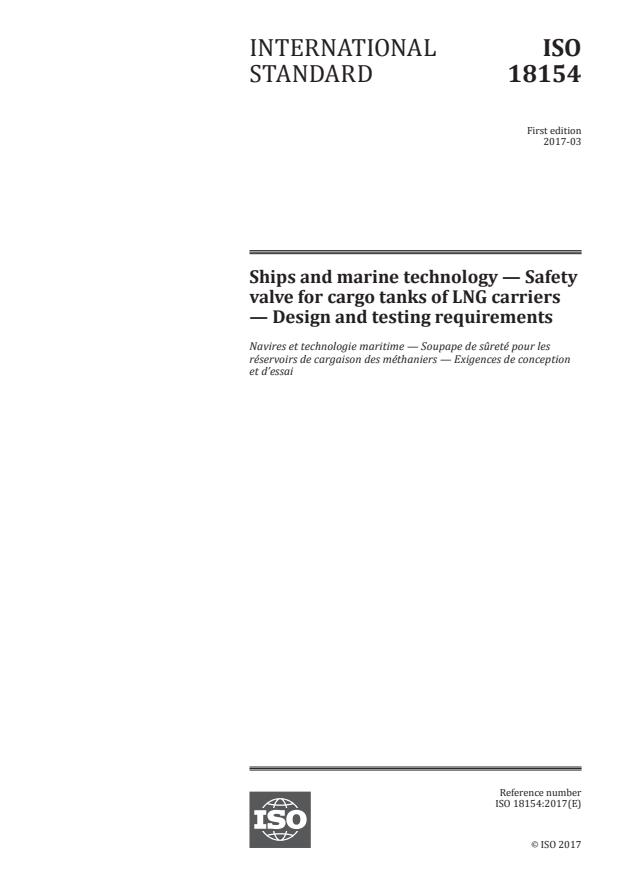
INTERNATIONAL ISO
STANDARD 18154
First edition
2017-03
Ships and marine technology — Safety
valve for cargo tanks of LNG carriers
— Design and testing requirements
Navires et technologie maritime — Soupape de sûreté pour les
réservoirs de cargaison des méthaniers — Exigences de conception
et d’essai
Reference number
©
ISO 2017
© ISO 2017, Published in Switzerland
All rights reserved. Unless otherwise specified, no part of this publication may be reproduced or utilized otherwise in any form
or by any means, electronic or mechanical, including photocopying, or posting on the internet or an intranet, without prior
written permission. Permission can be requested from either ISO at the address below or ISO’s member body in the country of
the requester.
ISO copyright office
Ch. de Blandonnet 8 • CP 401
CH-1214 Vernier, Geneva, Switzerland
Tel. +41 22 749 01 11
Fax +41 22 749 09 47
copyright@iso.org
www.iso.org
ii © ISO 2017 – All rights reserved
Contents Page
Foreword .v
1 Scope . 1
2 Normative references . 1
3 Terms and definitions . 1
4 Main valve components . 2
4.1 Body . 2
4.2 Nozzle. 2
4.3 Disk . 2
4.4 Cover . 2
4.5 Diaphragm . 2
5 Design . 3
6 Materials . 4
7 Production testing and inspection . 4
7.1 Purpose . 4
7.2 Impact test . 4
7.3 Non-destructive inspection . 4
7.4 Pressure test . 5
7.4.1 General requirement . 5
7.4.2 Fluid . 5
7.4.3 Duration. 5
7.4.4 Test equipment . 5
7.5 Surface inspection . 5
7.6 Visual inspection . 5
8 Performance test . 6
8.1 Performance test in ambient temperature . 6
8.1.1 Purpose . 6
8.1.2 Number of test times . 6
8.1.3 Fluid . 6
8.1.4 Acceptance criteria . 6
8.2 Leakage test in ambient temperature . 6
8.2.1 Purpose . 6
8.2.2 Fluid . 6
8.2.3 Test pressure . 6
8.2.4 Duration. 6
8.2.5 Acceptance leakage rate . 6
8.2.6 Test equipment . 7
8.3 Performance test in low temperature . 7
8.3.1 Purpose . 7
8.3.2 Number of test times . 7
8.3.3 Fluid . 7
8.3.4 Acceptance criteria . 7
8.4 Preparation for the performance test in low temperature . 7
8.4.1 Start temperature for the test . 7
8.4.2 Safety requirement . 7
8.4.3 Test system . 7
8.5 Leakage test in low temperature . 8
8.5.1 Purpose . 8
8.5.2 Fluid . 8
8.5.3 Test pressure . 8
8.5.4 Duration. 8
8.5.5 Acceptance tolerance . 9
8.5.6 Test equipment . 9
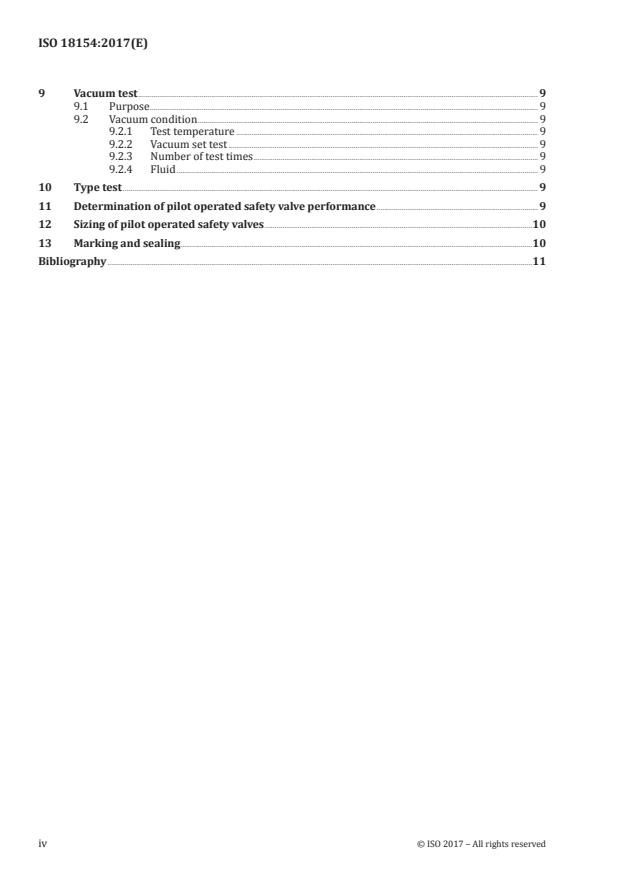
9 Vacuum test . 9
9.1 Purpose . 9
9.2 Vacuum condition . 9
9.2.1 Test temperature . 9
9.2.2 Vacuum set test . 9
9.2.3 Number of test times . 9
9.2.4 Fluid . 9
10 Type test . 9
11 Determination of pilot operated safety valve performance . 9
12 Sizing of pilot operated safety valves .10
13 Marking and sealing .10
Bibliography .11
iv © ISO 2017 – All rights reserved
Foreword
ISO (the International Organization for Standardization) is a worldwide federation of national standards
bodies (ISO member bodies). The work of preparing International Standards is normally carried out
through ISO technical committees. Each member body interested in a subject for which a technical
committee has been established has the right to be represented on that committee. International
organizations, governmental and non-governmental, in liaison with ISO, also take part in the work.
ISO collaborates closely with the International Electrotechnical Commission (IEC) on all matters of
electrotechnical standardization.
The procedures used to develop this document and those intended for its further maintenance are
described in the ISO/IEC Directives, Part 1. In particular the different approval criteria needed for the
different types of ISO documents should be noted. This document was drafted in accordance with the
editorial rules of the ISO/IEC Directives, Part 2 (see www .iso .org/ directives).
Attention is drawn to the possibility that some of the elements of this document may be the subject of
patent rights. ISO shall not be held responsible for identifying any or all such patent rights. Details of
any patent rights identified during the development of the document will be in the Introduction and/or
on the ISO list of patent declarations received (see www .iso .org/ patents).
Any trade name used in this document is information given for the convenience of users and does not
constitute an endorsement.
For an explanation on the meaning of ISO specific terms and expressions r
...
Questions, Comments and Discussion
Ask us and Technical Secretary will try to provide an answer. You can facilitate discussion about the standard in here.
Loading comments...