

ISO 23055:2020
(Main)Ships and marine technology — Design requirements for international ballast water transfer connection flange
General Information
- Abstract
This document specifies the material requirements and dimensions of an international flange for the transfer of ballast water between a ship and a shore reception facility, or between ships. It does not address any reconfiguration of the ship's ballast water piping system necessary to connect to the shore-side, e.g. construction of piping from the ship lower machinery levels to the main deck transfer area.
- Status
- Published
- Publication Date
- 30-Jan-2020
- Technical Committee
- ISO/TC 8/SC 3 - Piping and machinery
- Drafting Committee
- ISO/TC 8/SC 3 - Piping and machinery
- Current Stage
- 9093 - International Standard confirmed
- Start Date
- 23-Jun-2026
- Completion Date
- 29-Aug-2026
Buy Documents
ISO 23055:2020 - Ships and marine technology -- Design requirements for international ballast water transfer connection flange
ISO 23055:2020 - Ships and marine technology — Design requirements for international ballast water transfer connection flange/31/2020
Overview
ISO 23055:2020 - Ships and marine technology - Design requirements for international ballast water transfer connection flange - defines the material, dimensional and marking requirements for a standardized flange used to transfer ballast water between a ship and a shore reception facility or between ships. The standard specifies flat-faced steel (or equivalent) flanges, minimum pressure ratings, bolt arrangements and quality/installation expectations. It does not cover ship piping reconfiguration to reach the transfer point.
Key topics and technical requirements
- Flange construction: Flat-faced, steel or equivalent materials; galvanically compatible with connected piping; corrosion-resistant fasteners.
- Pressure rating: Minimum MAWP of 1 MPa (145 psig) - typically satisfied by PN 10 rated flanges.
- Standard dimensions:
- DN 200 (typical transfer connection): Outside Ø 340 mm, inside Ø 218–222 mm, bolt circle Ø 295 mm, bolt hole Ø 22 mm, flange thickness ≥ 24 mm; supplied with 8 bolts (bolts Ø 20 mm).
- DN 300 (higher capacity - Annex A): Outside Ø 445 mm, inside Ø 327.6 mm, bolt circle Ø 400 mm, bolt hole Ø 22 mm, thickness ≥ 26 mm; 12 bolts.
- Gaskets and non‑metallics: Materials suitable for the MAWP and seawater service.
- Accessories: Flanges supplied with matching bolts, nuts and washers. Alternative bolt‑hole notch design (Annex B) permits minor alignment adjustments.
- Workmanship & QA: Welding personnel and procedures to meet recognized standards; contractor responsible for inspections unless otherwise specified.
- Marking & ordering: Flanges must be permanently marked with manufacturer name, PN and DN (e.g., PN 10, DN 200) and a reference to ISO 23055. Orders should state PN, DN, flange design standard, end connection and preservation/coating.
Practical applications & users
ISO 23055 is intended for:
- Shipyards and marine engineers specifying shipboard ballast water transfer connections.
- Port and shore reception facilities designing intake hookups for ship-to-shore transfers.
- Manufacturers of flanges, fittings and ballast water transfer equipment seeking a globally compatible interface.
- Naval architects and regulatory authorities aligning installations with IMO guidelines (G5) for efficient ballast water handling.
Benefits include simplified ship/shore connectivity, reduced downtime during transfer operations, and consistent safety/pressure handling.
Related standards
ISO 23055 references compatibility with recognized flange design standards such as ASME B16.5, BS EN 1092, JIS B2220, DIN 2632/2633, GB/T 2501 and aligns with IMO Guidelines for Ballast Water Reception Facilities (MEPC.153(55) - G5).
Buy Documents
ISO 23055:2020 - Ships and marine technology -- Design requirements for international ballast water transfer connection flange
ISO 23055:2020 - Ships and marine technology — Design requirements for international ballast water transfer connection flange/31/2020
Get Certified
Connect with accredited certification bodies for this standard

DNV
DNV is an independent assurance and risk management provider.

Lloyd's Register
Lloyd's Register is a global professional services organisation specialising in engineering and technology.

FSC International
Forest Stewardship Council certification.
Sponsored listings
Frequently Asked Questions
ISO 23055:2020 is a standard published by the International Organization for Standardization (ISO). Its full title is "Ships and marine technology — Design requirements for international ballast water transfer connection flange". This standard covers: This document specifies the material requirements and dimensions of an international flange for the transfer of ballast water between a ship and a shore reception facility, or between ships. It does not address any reconfiguration of the ship's ballast water piping system necessary to connect to the shore-side, e.g. construction of piping from the ship lower machinery levels to the main deck transfer area.
This document specifies the material requirements and dimensions of an international flange for the transfer of ballast water between a ship and a shore reception facility, or between ships. It does not address any reconfiguration of the ship's ballast water piping system necessary to connect to the shore-side, e.g. construction of piping from the ship lower machinery levels to the main deck transfer area.
ISO 23055:2020 is classified under the following ICS (International Classification for Standards) categories: 47.020.30 - Piping systems. The ICS classification helps identify the subject area and facilitates finding related standards.
ISO 23055:2020 is available in PDF format for immediate download after purchase. The document can be added to your cart and obtained through the secure checkout process. Digital delivery ensures instant access to the complete standard document.
Standards Content (Sample)
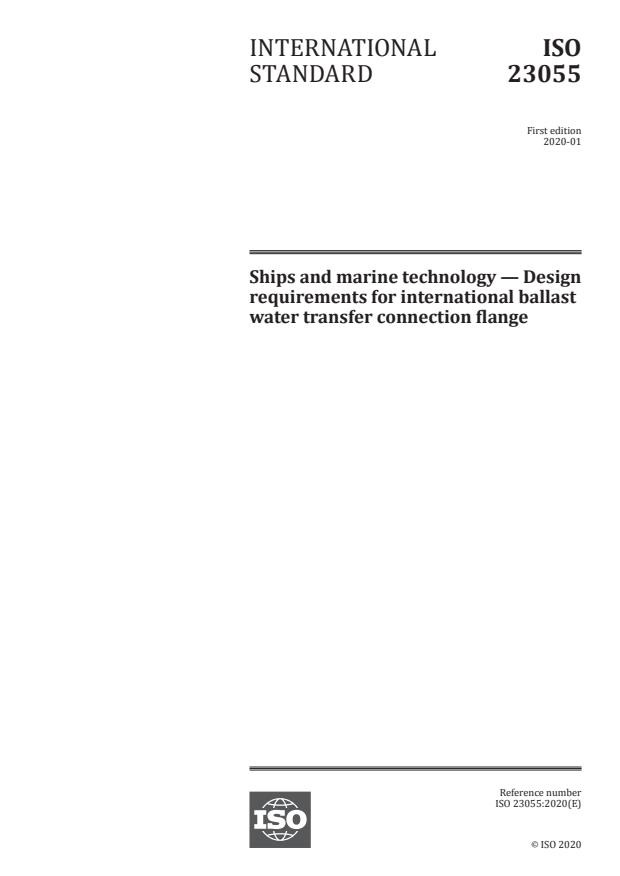
INTERNATIONAL ISO
STANDARD 23055
First edition
2020-01
Ships and marine technology — Design
requirements for international ballast
water transfer connection flange
Reference number
©
ISO 2020
© ISO 2020
All rights reserved. Unless otherwise specified, or required in the context of its implementation, no part of this publication may
be reproduced or utilized otherwise in any form or by any means, electronic or mechanical, including photocopying, or posting
on the internet or an intranet, without prior written permission. Permission can be requested from either ISO at the address
below or ISO’s member body in the country of the requester.
ISO copyright office
CP 401 • Ch. de Blandonnet 8
CH-1214 Vernier, Geneva
Phone: +41 22 749 01 11
Fax: +41 22 749 09 47
Email: copyright@iso.org
Website: www.iso.org
Published in Switzerland
ii © ISO 2020 – All rights reserved
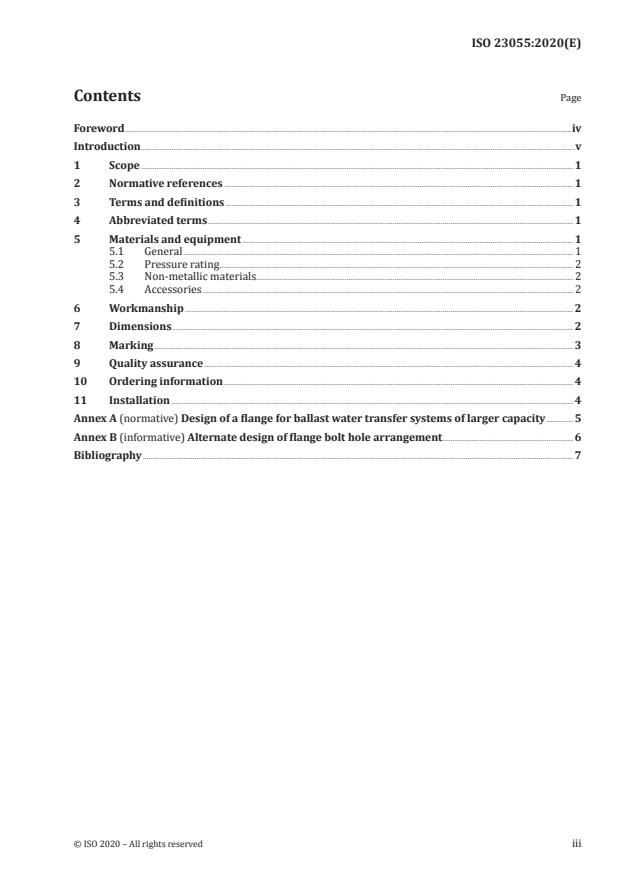
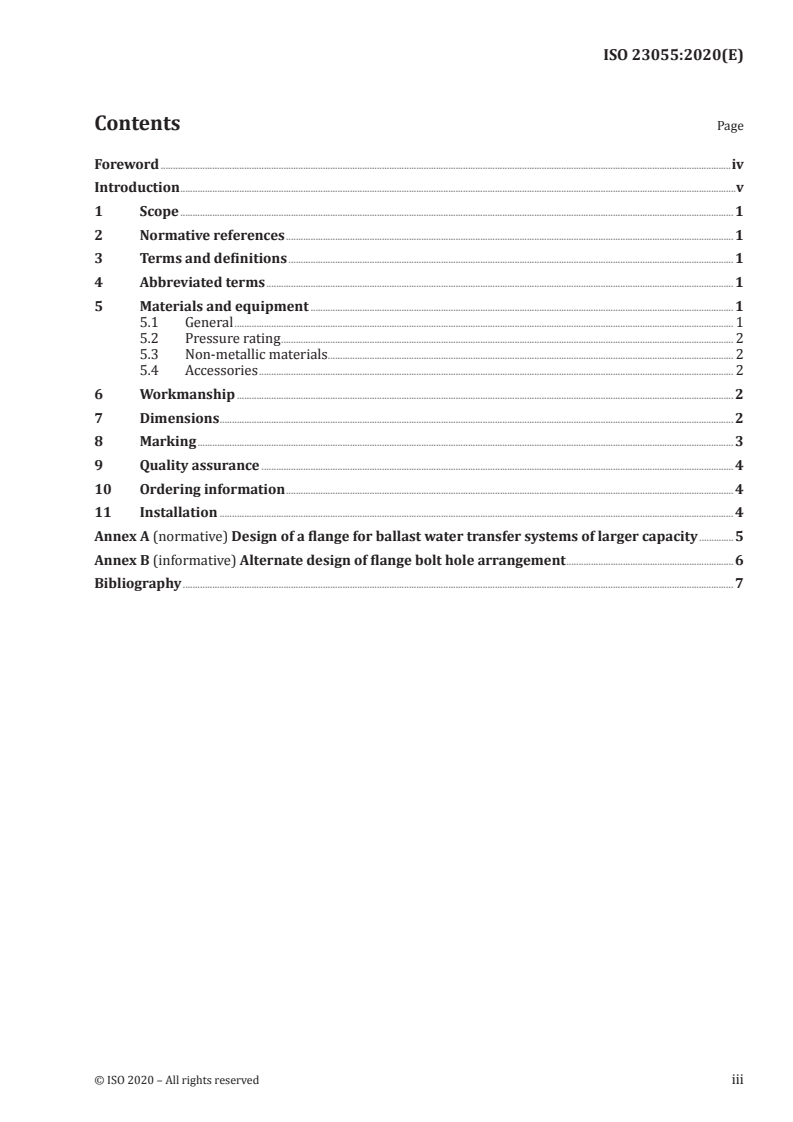
Contents Page
Foreword .iv
Introduction .v
1 Scope . 1
2 Normative references . 1
3 Terms and definitions . 1
4 Abbreviated terms . 1
5 Materials and equipment . 1
5.1 General . 1
5.2 Pressure rating . 2
5.3 Non-metallic materials . 2
5.4 Accessories . 2
6 Workmanship . 2
7 Dimensions . 2
8 Marking . 3
9 Quality assurance . 4
10 Ordering information . 4
11 Installation . 4
Annex A (normative) Design of a flange for ballast water transfer systems of larger capacity .5
Annex B (informative) Alternate design of flange bolt hole arrangement . 6
Bibliography . 7
Foreword
ISO (the International Organization for Standardization) is a worldwide federation of national standards
bodies (ISO member bodies). The work of preparing International Standards is normally carried out
through ISO technical committees. Each member body interested in a subject for which a technical
committee has been established has the right to be represented on that committee. International
organizations, governmental and non-governmental, in liaison with ISO, also take part in the work.
ISO collaborates closely with the International Electrotechnical Commission (IEC) on all matters of
electrotechnical standardization.
The procedures used to develop this document and those intended for its further maintenance are
described in the ISO/IEC Directives, Part 1. In particular, the different approval criteria needed for the
different types of ISO documents should be noted. This document was drafted in accordance with the
editorial rules of the ISO/IEC Directives, Part 2 (see www .iso .org/ directives).
Attention is drawn to the possibility that some of the elements of this document may be the subject of
patent rights. ISO shall not be held responsible for identifying any or all such patent rights. Details of
any patent rights identified during the development of the document will be in the Introduction and/or
on the ISO list of patent declarations received (see www .iso .org/ patents).
Any trade name used in this document is information given for the convenience of users and does not
constitute an endorsement.
For an explanation of the voluntary nature of standards, the meaning of ISO specific terms and
expressions related to conformity assessment, as well as information about ISO's adherence to the
World Trade Organization (WTO) principles in the Technical Barriers to Trade (TBT), see www .iso .org/
iso/ foreword .html.
This document was prepared by Technical Committee ISO/TC 8, Ships and marine technology,
Subcommittee SC 3, Piping and machinery.
Any feedback or questions on this document should be directed to the user’s national standards body. A
complete listing of these bodies can be found at www .iso .org/ members .html.
iv © ISO 2020 – All rights reserved
Introduction
It is recognized that transfer of ballast water between a ship and a shore-side facility, or another ship,
can be necessary to manage ballast water treatment.
In order for ships and shore facilities to connect the ballast water transfer piping in an efficient
manner, a standardized interface flange is necessary. This type of connection would be similar to the
international fire main ship/shore connection required by the International Convention for the Safety
of Life at Sea (SOLAS).
The need for a standardized international flange for ballast water transfer systems has been presented
to the International Maritime Organization (IMO) Marine Environmental Protection Committee
(MEPC). A standard transfer connection will help enable efficient transfer of ballast water between
ships and facilities in accordance with the Guidel
...
INTERNATIONAL ISO
STANDARD 23055
First edition
2020-01
Ships and marine technology — Design
requirements for international ballast
water transfer connection flange
Reference number
©
ISO 2020
© ISO 2020
All rights reserved. Unless otherwise specified, or required in the context of its implementation, no part of this publication may
be reproduced or utilized otherwise in any form or by any means, electronic or mechanical, including photocopying, or posting
on the internet or an intranet, without prior written permission. Permission can be requested from either ISO at the address
below or ISO’s member body in the country of the requester.
ISO copyright office
CP 401 • Ch. de Blandonnet 8
CH-1214 Vernier, Geneva
Phone: +41 22 749 01 11
Fax: +41 22 749 09 47
Email: copyright@iso.org
Website: www.iso.org
Published in Switzerland
ii © ISO 2020 – All rights reserved
Contents Page
Foreword .iv
Introduction .v
1 Scope . 1
2 Normative references . 1
3 Terms and definitions . 1
4 Abbreviated terms . 1
5 Materials and equipment . 1
5.1 General . 1
5.2 Pressure rating . 2
5.3 Non-metallic materials . 2
5.4 Accessories . 2
6 Workmanship . 2
7 Dimensions . 2
8 Marking . 3
9 Quality assurance . 4
10 Ordering information . 4
11 Installation . 4
Annex A (normative) Design of a flange for ballast water transfer systems of larger capacity .5
Annex B (informative) Alternate design of flange bolt hole arrangement . 6
Bibliography . 7
Foreword
ISO (the International Organization for Standardization) is a worldwide federation of national standards
bodies (ISO member bodies). The work of preparing International Standards is normally carried out
through ISO technical committees. Each member body interested in a subject for which a technical
committee has been established has the right to be represented on that committee. International
organizations, governmental and non-governmental, in liaison with ISO, also take part in the work.
ISO collaborates closely with the International Electrotechnical Commission (IEC) on all matters of
electrotechnical standardization.
The procedures used to develop this document and those intended for its further maintenance are
described in the ISO/IEC Directives, Part 1. In particular, the different approval criteria needed for the
different types of ISO documents should be noted. This document was drafted in accordance with the
editorial rules of the ISO/IEC Directives, Part 2 (see www .iso .org/ directives).
Attention is drawn to the possibility that some of the elements of this document may be the subject of
patent rights. ISO shall not be held responsible for identifying any or all such patent rights. Details of
any patent rights identified during the development of the document will be in the Introduction and/or
on the ISO list of patent declarations received (see www .iso .org/ patents).
Any trade name used in this document is information given for the convenience of users and does not
constitute an endorsement.
For an explanation of the voluntary nature of standards, the meaning of ISO specific terms and
expressions related to conformity assessment, as well as information about ISO's adherence to the
World Trade Organization (WTO) principles in the Technical Barriers to Trade (TBT), see www .iso .org/
iso/ foreword .html.
This document was prepared by Technical Committee ISO/TC 8, Ships and marine technology,
Subcommittee SC 3, Piping and machinery.
Any feedback or questions on this document should be directed to the user’s national standards body. A
complete listing of these bodies can be found at www .iso .org/ members .html.
iv © ISO 2020 – All rights reserved
Introduction
It is recognized that transfer of ballast water between a ship and a shore-side facility, or another ship,
can be necessary to manage ballast water treatment.
In order for ships and shore facilities to connect the ballast water transfer piping in an efficient
manner, a standardized interface flange is necessary. This type of connection would be similar to the
international fire main ship/shore connection required by the International Convention for the Safety
of Life at Sea (SOLAS).
The need for a standardized international flange for ballast water transfer systems has been presented
to the International Maritime Organization (IMO) Marine Environmental Protection Committee
(MEPC). A standard transfer connection will help enable efficient transfer of ballast water between
ships and facilities in accordance with the Guidel
...