

ISO 17579:2025
(Main)Ships and marine technology — Design and testing requirements of pneumatic quick-closing valves
General Information
- Abstract
This document specifies requirements for the design and tests of pneumatic driven quick-closing valves, used in ship fuel and lubricating oil systems to stop the fluid flow in the event of a leak. This document is applicable to valves of nominal diameter (DN): 15, 20, 25, 32, 40, 50, 65, 80, 100, 125, 150, 200, 250, and 300, corresponding to nominal pipe sizes (NPS): 1/2, 3/4, 1, 1 1/4, 1 1/2, 2, 2 1/2, 3, 4, 5, 6, 8, 10, and 12. NOTE This document is mainly intended for use by producers. Onboard ship inspection and maintenance after the delivery and installation of the valve can help ensure continued proper performance.
- Status
- Published
- Publication Date
- 20-Mar-2025
- Technical Committee
- ISO/TC 8/SC 3 - Piping and machinery
- Drafting Committee
- ISO/TC 8/SC 3 - Piping and machinery
- Current Stage
- 6060 - International Standard published
- Start Date
- 21-Mar-2025
- Due Date
- 08-Aug-2025
- Completion Date
- 21-Mar-2025
Overview
ISO 17579:2025 - Ships and marine technology - Design and testing requirements of pneumatic quick-closing valves (PQCV) specifies design and test requirements for pneumatic-driven quick-closing valves used in ship fuel and lubricating oil systems to stop flow in the event of a leak. Published in 2025, this first-edition International Standard is primarily aimed at producers and manufacturers of marine PQCVs but is also essential guidance for shipyards, classification societies, maintenance teams and ship operators.
Scope highlights
- Applies to nominal diameters (DN): 15, 20, 25, 32, 40, 50, 65, 80, 100, 125, 150, 200, 250, 300 (NPS 1/2 to 12).
- Focuses on valves used to prevent escape of flammable/combustible liquids (fuel and lubricating oil) onboard ships.
Key topics and technical requirements
ISO 17579:2025 organizes requirements across design, materials, testing and marking. Key technical topics include:
Structure and design
- Requirements for body, bonnet, disc, stem, seat, spring and pneumatic components.
- Material selection, manufacturing and surface treatment expectations.
- Stem sealing and connection design, plus hand wheel and pneumatic actuator considerations.
Pressure and temperature
- Design considerations to ensure reliable closure under specified system pressures and operational temperatures.
Testing and inspection
- Material testing and non‑destructive testing (NDT) such as dye penetrant testing (PT).
- Dimension checks, visual inspection and operating/function tests.
- Pressure testing procedures (ambient temperature tests) and fire‑resistance testing.
- Requirements for test records and submission of inspection results.
Marking and documentation
- Mandatory marking elements and traceability for installed valves.
Applications and users
ISO 17579:2025 is practical for:
- Manufacturers and suppliers designing and producing PQCVs for marine use.
- Shipyards and naval architects specifying compliant valves for new builds and retrofits.
- Ship operators, chief engineers and maintenance teams conducting onboard inspections, routine testing and maintenance.
- Classification societies and port state control performing conformity and safety checks (PQCV performance is commonly checked during port state inspections and under SOLAS requirements).
Using ISO 17579 helps ensure PQCVs perform reliably in emergencies, reduce fire risk, and avoid vessel detentions due to non‑compliant valve function.
Related standards
- ISO 24225 (pneumatic quick-closing control devices)
- ISO 4987 (liquid penetrant testing)
- ISO 5208 (pressure testing of metallic valves)
- ISO 5752, ISO 7005-1/3, ISO 17602, ASME B16.34 (valve/flange dimensions and standards)
Keywords: ISO 17579:2025, pneumatic quick-closing valve, PQCV, ships, marine technology, valve design, valve testing, fuel systems, lubricating oil systems, maritime safety.
Get Certified
Connect with accredited certification bodies for this standard

DNV
DNV is an independent assurance and risk management provider.

Lloyd's Register
Lloyd's Register is a global professional services organisation specialising in engineering and technology.

FSC International
Forest Stewardship Council certification.
Sponsored listings
Frequently Asked Questions
ISO 17579:2025 is a standard published by the International Organization for Standardization (ISO). Its full title is "Ships and marine technology — Design and testing requirements of pneumatic quick-closing valves". This standard covers: This document specifies requirements for the design and tests of pneumatic driven quick-closing valves, used in ship fuel and lubricating oil systems to stop the fluid flow in the event of a leak. This document is applicable to valves of nominal diameter (DN): 15, 20, 25, 32, 40, 50, 65, 80, 100, 125, 150, 200, 250, and 300, corresponding to nominal pipe sizes (NPS): 1/2, 3/4, 1, 1 1/4, 1 1/2, 2, 2 1/2, 3, 4, 5, 6, 8, 10, and 12. NOTE This document is mainly intended for use by producers. Onboard ship inspection and maintenance after the delivery and installation of the valve can help ensure continued proper performance.
This document specifies requirements for the design and tests of pneumatic driven quick-closing valves, used in ship fuel and lubricating oil systems to stop the fluid flow in the event of a leak. This document is applicable to valves of nominal diameter (DN): 15, 20, 25, 32, 40, 50, 65, 80, 100, 125, 150, 200, 250, and 300, corresponding to nominal pipe sizes (NPS): 1/2, 3/4, 1, 1 1/4, 1 1/2, 2, 2 1/2, 3, 4, 5, 6, 8, 10, and 12. NOTE This document is mainly intended for use by producers. Onboard ship inspection and maintenance after the delivery and installation of the valve can help ensure continued proper performance.
ISO 17579:2025 is classified under the following ICS (International Classification for Standards) categories: 47.020.30 - Piping systems. The ICS classification helps identify the subject area and facilitates finding related standards.
ISO 17579:2025 is available in PDF format for immediate download after purchase. The document can be added to your cart and obtained through the secure checkout process. Digital delivery ensures instant access to the complete standard document.
Standards Content (Sample)
International
Standard
ISO 17579
First edition
Ships and marine technology —
2025-03
Design and testing requirements of
pneumatic quick-closing valves
Navires et technologie maritime — Exigences de conception et
d'essai des soupapes pneumatiques à fermeture rapide
Reference number
© ISO 2025
All rights reserved. Unless otherwise specified, or required in the context of its implementation, no part of this publication may
be reproduced or utilized otherwise in any form or by any means, electronic or mechanical, including photocopying, or posting on
the internet or an intranet, without prior written permission. Permission can be requested from either ISO at the address below
or ISO’s member body in the country of the requester.
ISO copyright office
CP 401 • Ch. de Blandonnet 8
CH-1214 Vernier, Geneva
Phone: +41 22 749 01 11
Email: copyright@iso.org
Website: www.iso.org
Published in Switzerland
ii
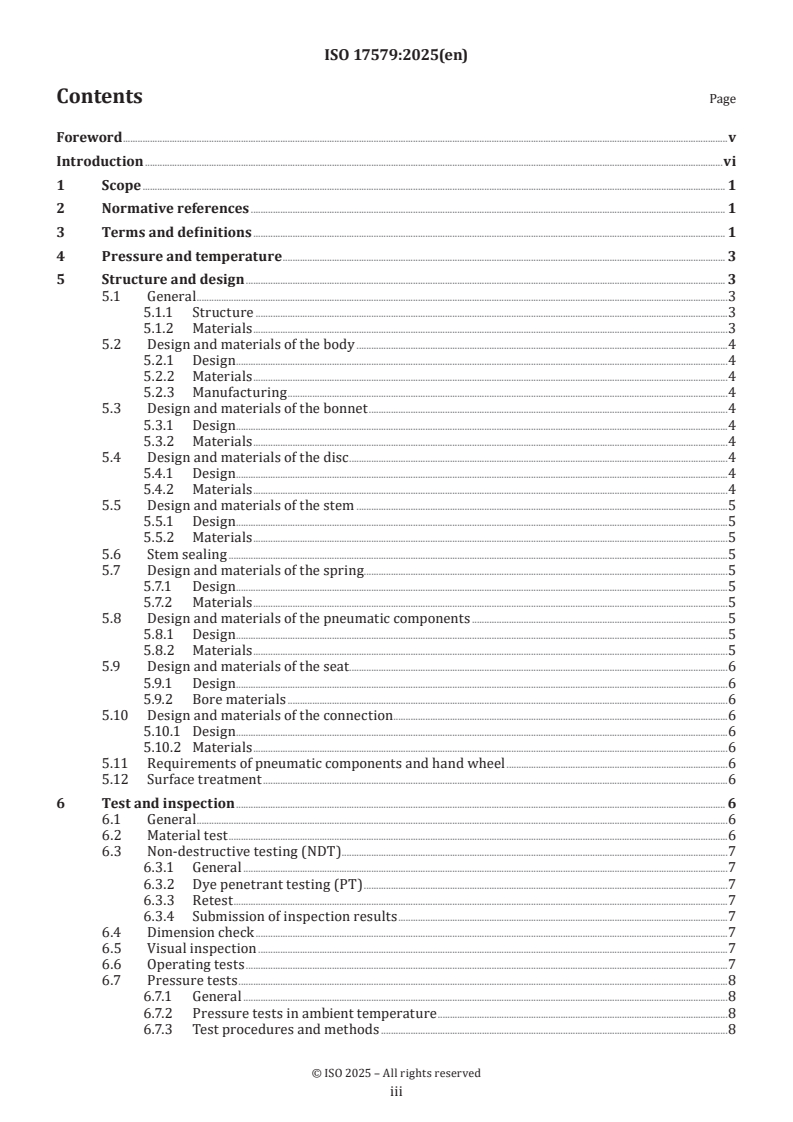
Contents Page
Foreword .v
Introduction .vi
1 Scope . 1
2 Normative references . 1
3 Terms and definitions . 1
4 Pressure and temperature . 3
5 Structure and design . 3
5.1 General .3
5.1.1 Structure .3
5.1.2 Materials .3
5.2 Design and materials of the body .4
5.2.1 Design . .4
5.2.2 Materials .4
5.2.3 Manufacturing .4
5.3 Design and materials of the bonnet .4
5.3.1 Design .4
5.3.2 Materials .4
5.4 Design and materials of the disc .4
5.4.1 Design .4
5.4.2 Materials .4
5.5 Design and materials of the stem .5
5.5.1 Design .5
5.5.2 Materials .5
5.6 Stem sealing .5
5.7 Design and materials of the spring.5
5.7.1 Design .5
5.7.2 Materials .5
5.8 Design and materials of the pneumatic components .5
5.8.1 Design . .5
5.8.2 Materials .5
5.9 Design and materials of the seat . .6
5.9.1 Design . .6
5.9.2 Bore materials .6
5.10 Design and materials of the connection .6
5.10.1 Design .6
5.10.2 Materials .6
5.11 Requirements of pneumatic components and hand wheel .6
5.12 Surface treatment .6
6 Test and inspection . 6
6.1 General .6
6.2 Material test .6
6.3 Non-destructive testing (NDT) . .7
6.3.1 General .7
6.3.2 Dye penetrant testing (PT) .7
6.3.3 Retest .7
6.3.4 Submission of inspection results .7
6.4 Dimension check .7
6.5 Visual inspection .7
6.6 Operating tests .7
6.7 Pressure tests .8
6.7.1 General .8
6.7.2 Pressure tests in ambient temperature .8
6.7.3 Test procedures and methods .8
iii
6.8 Fire-resistance test .8
7 Marking . . 8
Annex A (informative) Examples of PQCV construction . 10
Bibliography .12
iv
Foreword
ISO (the International Organization for Standardization) is a worldwide federation of national standards
bodies (ISO member bodies). The work of preparing International Standards is normally carried out through
ISO technical committees. Each member body interested in a subject for which a technical committee
has been established has the right to be represented on that committee. International organizations,
governmental and non-governmental, in liaison with ISO, also take part in the work. ISO collaborates closely
with the International Electrotechnical Commission (IEC) on all matters of electrotechnical standardization.
The procedures used to develop this document and those intended for its further maintenance are described
in the ISO/IEC Directives, Part 1. In particular, the different approval criteria needed for the different types
of ISO document should be noted. This document was drafted in accordance with the editorial rules of the
ISO/IEC Directives, Part 2 (see www.iso.org/directives).
ISO draws attention to the possibility that the implementation of this document may involve the use of (a)
patent(s). ISO takes no position concerning the evidence, validity or applicability of any claimed patent
rights in respect thereof. As of the date of publication of this document, ISO had not received notice of (a)
patent(s) which may be required to implement this document. However, implementers are cautioned that
this may not represent the latest information, which may be obtained from the patent database available at
www.iso.org/patents. ISO shall not be held responsible for identifying any or all such patent rights.
Any trade name used in this document is information given for the convenience of users and does not
constitute an endorsement.
For an explanation of the voluntary nature of standards, the meaning of ISO specific terms and expressions
related to conformity assessment, as well as information about ISO's adherence to the World Trade
Organization (WTO) principles in the Technical Barriers to Trade (TBT), see www.iso.org/iso/foreword.html.
This document was prepared by Technical Committee ISO/TC 8, Ships and marine technology, Subcommittee
SC 3, Piping and machinery.
Any feedback or questions on this document should be directed to the user’s national standards body. A
complete listing of these bodies can be found at www.iso.org/members.html.
v
Introduction
Marine pneumatic quick-closing valves are extremely important for the prevention of fires caused by
flammable liquids and the overall safety programme onboard ships. According to SOLAS Chapter II-2
[16]
Regulation 4, in the event of a fire, the following must be fitted with a cock or valve directly on the tank,
which can be closed from a safe position outside the space concerned:
a) oil fuel pipes, which, if damaged, would allow oil to escape from a storage;
b) settling or daily service tank having a capacity of 500 l and above, situated above the double bottom.
In older ships, the valve would normally be closed manually through a long mechanical connection from the
valve to the position outside the machinery space. In modern ships, this valve is usually a pneumatic quick-
closing valve (PQCV), which uses compressed air and spring tension to rapidly close off the fuel or oil flow
in the event of a leak downstream of the tank. The PQCV is operated by a pneumatic quick-closing control
devices, the specifications of which are defined by ISO 24225.
Proper operation of pneumatic quick-closing valves is one of the most important items to be checked during
port state supervision ship inspections. If the quick-closing valve operation fails, the port state will likely
require the problem to be corrected before the ship can proceed. This can result in detention of the ship,
with adverse effects on the ship’s schedule. Therefore, it is important to develop standards specifying the
design and tests for pneumatic quick-closing valves to ensure quality and performance. In addition, since
the PQCV is not used on an everyday basis, but is expected to perform as designed in an emergency, proper
operation should be verified regularly and periodic maintenance completed.
vi
International Standard ISO 17579:2025(en)
Ships and marine technology — Design and testing
requirements of pneumatic quick-closing valves
1 Scope
This document specifies requirements for the design and tests of pneumatic driven quick-closing valves,
used in ship fuel and lubricating oil systems to stop the fluid flow in the event of a leak. This document is
applicable to valves of nominal diameter (DN): 15, 20, 25, 32, 40, 50, 65, 80, 100, 125, 150, 200, 250, and 300,
corresponding to nominal pipe sizes (NPS): 1/2, 3/4, 1, 1 1/4, 1 1/2, 2, 2 1/2, 3, 4, 5, 6, 8, 10, and 12.
NOTE This document is mainly intended for use by producers. Onboard ship inspection and maintenance after
the delivery and installation of the valve can help ensure continued proper performance.
2 Normative references
The following documents are referred to in the text in such a way that some or all of their content constitutes
requirements of this document. For dated references, only the edition cited applies. For undated references,
the latest edition of the referenced document (including any amendments) applies.
ISO 4987, Steel and iron castings — Liquid penetrant testing
ISO 5208, Industrial valves — Pressure testing of metallic valves
ISO 5752, Metal valves for use in flanged pipe systems — Face-to-face and centre-to-face dimensions
ISO 7005-1, Pipe flanges — Part 1: Steel flanges for industrial a
...