

ISO 19037:2019
(Main)Ships and marine technology — Gate valves for use in low temperature applications — Design and testing requirements
General Information
- Abstract
This document specifies requirements of design, manufacture, and test methods for cryogenic gate valves to have excellent quality of leakage stability in very low temperature environments (−50 °C to −196 °C).
- Status
- Published
- Publication Date
- 06-Jun-2019
- Technical Committee
- ISO/TC 8/SC 3 - Piping and machinery
- Drafting Committee
- ISO/TC 8/SC 3 - Piping and machinery
- Current Stage
- 9060 - Close of review
- Completion Date
- 02-Dec-2029
Buy Documents


ISO 19037:2019 - Ships and marine technology -- Gate valves for use in low temperature applications -- Design and testing requirements
ISO 19037:2019 - Ships and marine technology — Gate valves for use in low temperature applications — Design and testing requirements/7/2019
Overview
ISO 19037:2019 - Ships and marine technology - Gate valves for use in low temperature applications - Design and testing requirements - establishes design, manufacturing and test methods for cryogenic gate valves intended to deliver stable low-leakage performance in very low temperature environments (−50 °C to −196 °C). The standard targets marine and shipboard cryogenic systems where valve integrity and reliable operation at cryogenic temperatures are critical.
Key topics and technical requirements
ISO 19037:2019 covers technical elements needed for robust cryogenic gate valve design and verification, including:
- Scope and definitions relevant to valve sizing and pressure classes (DN, PN, NPS, class).
- Pressure–temperature rating and classification for different fluid types and working conditions.
- Design requirements for major components:
- Valve body types and manufacturing methods
- Extended bonnet design and materials (to isolate low-temperature parts)
- Wedge, stem and seat ring designs for cryogenic compatibility
- Bolts, nuts, driving system and operating devices
- Surface treatment and corrosion protection
- Materials and heat treatment: welding practice and post‑weld heat treatment requirements to ensure toughness and integrity at low temperatures.
- Testing and inspection procedures:
- Material tests, dimensional and visual inspections
- Non‑destructive testing (NDT) such as radiographic testing (RT), penetrant testing (PT) and ultrasonic testing (UT)
- Pressure testing, back‑seat and leak tests, including high‑pressure pneumatic shell test
- Cryogenic tests and fire safety tests specific to marine applications
- Marking and documentation expectations to ensure traceability and conformity.
- Annex examples and references to normative documents.
Applications and users
ISO 19037:2019 is intended for professionals and organizations involved in design, procurement, manufacture, testing, installation and maintenance of cryogenic valves, including:
- Valve manufacturers designing gate valves for LNG and cryogenic fluids
- Shipbuilders and naval architects specifying valves for LNG carriers, FPSOs and specialized marine vessels
- Offshore and onshore LNG terminal operators
- Classification societies, inspection bodies and QA/QC teams
- Maintenance and engineering teams responsible for valve selection and in‑service verification
Typical applications include LNG cargo systems, cryogenic piping on ships and terminals, cold‑storage systems and other marine low‑temperature fluid handling systems.
Related standards
ISO 19037:2019 references and aligns with several industry standards often used together, such as ISO 5208, ISO 28921-1, API 598 / API 600, and ASME/ASTM specifications (ASME B16.34, ASME Sec. V, ASTM A320/A350, etc.), helping integrate cryogenic gate valve requirements into broader marine and industrial valve practice.
Relations
- Effective Date
- 06-Jun-2022
Buy Documents
ISO 19037:2019 - Ships and marine technology -- Gate valves for use in low temperature applications -- Design and testing requirements
ISO 19037:2019 - Ships and marine technology — Gate valves for use in low temperature applications — Design and testing requirements/7/2019
Get Certified
Connect with accredited certification bodies for this standard

DNV
DNV is an independent assurance and risk management provider.

Lloyd's Register
Lloyd's Register is a global professional services organisation specialising in engineering and technology.

FSC International
Forest Stewardship Council certification.
Sponsored listings
Frequently Asked Questions
ISO 19037:2019 is a standard published by the International Organization for Standardization (ISO). Its full title is "Ships and marine technology — Gate valves for use in low temperature applications — Design and testing requirements". This standard covers: This document specifies requirements of design, manufacture, and test methods for cryogenic gate valves to have excellent quality of leakage stability in very low temperature environments (−50 °C to −196 °C).
This document specifies requirements of design, manufacture, and test methods for cryogenic gate valves to have excellent quality of leakage stability in very low temperature environments (−50 °C to −196 °C).
ISO 19037:2019 is classified under the following ICS (International Classification for Standards) categories: 47.020.30 - Piping systems. The ICS classification helps identify the subject area and facilitates finding related standards.
ISO 19037:2019 has the following relationships with other standards: It is inter standard links to ISO 3175-6:2019. Understanding these relationships helps ensure you are using the most current and applicable version of the standard.
ISO 19037:2019 is available in PDF format for immediate download after purchase. The document can be added to your cart and obtained through the secure checkout process. Digital delivery ensures instant access to the complete standard document.
Standards Content (Sample)
INTERNATIONAL ISO
STANDARD 19037
First edition
2019-06
Ships and marine technology — Gate
valves for use in low temperature
applications — Design and testing
requirements
Navires et technologie maritime — Robinets vannes destinés aux
applications à basse température — Exigences de conception et d'essai
Reference number
©
ISO 2019
© ISO 2019
All rights reserved. Unless otherwise specified, or required in the context of its implementation, no part of this publication may
be reproduced or utilized otherwise in any form or by any means, electronic or mechanical, including photocopying, or posting
on the internet or an intranet, without prior written permission. Permission can be requested from either ISO at the address
below or ISO’s member body in the country of the requester.
ISO copyright office
CP 401 • Ch. de Blandonnet 8
CH-1214 Vernier, Geneva
Phone: +41 22 749 01 11
Fax: +41 22 749 09 47
Email: copyright@iso.org
Website: www.iso.org
Published in Switzerland
ii © ISO 2019 – All rights reserved
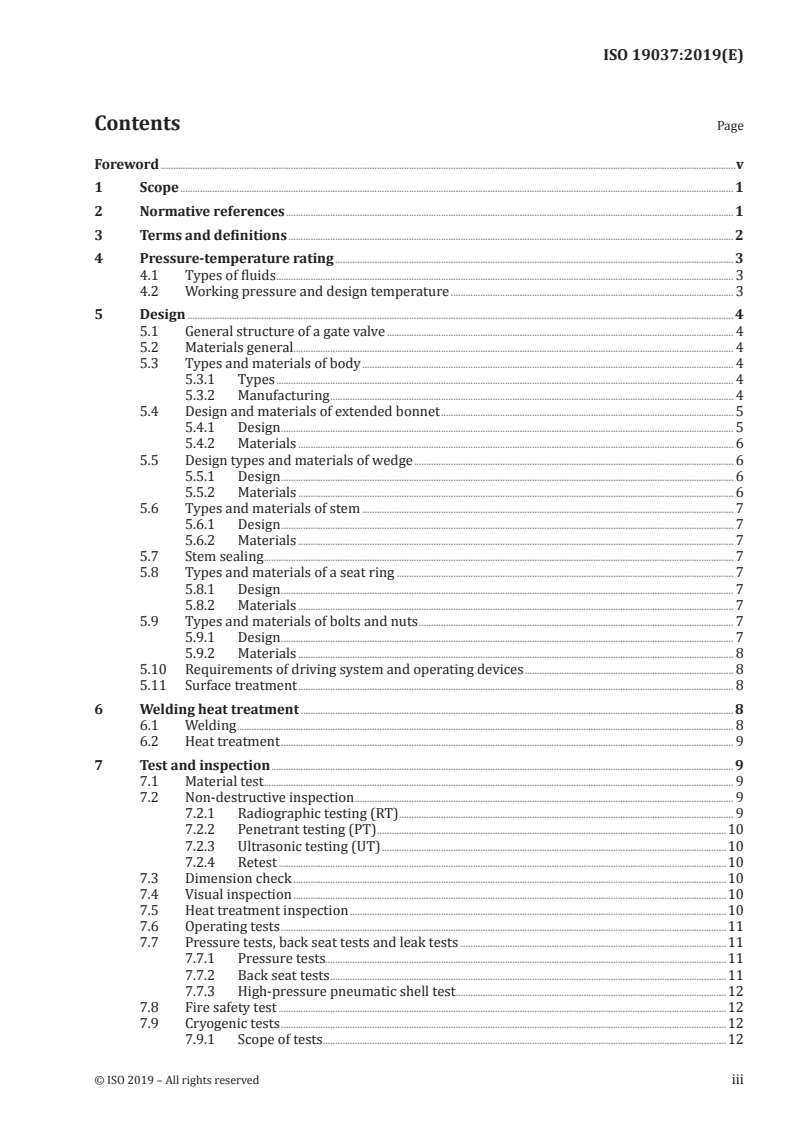
Contents Page
Foreword .v
1 Scope . 1
2 Normative references . 1
3 Terms and definitions . 2
4 Pressure-temperature rating . 3
4.1 Types of fluids . 3
4.2 Working pressure and design temperature . 3
5 Design . 4
5.1 General structure of a gate valve . 4
5.2 Materials general . . 4
5.3 Types and materials of body . 4
5.3.1 Types . 4
5.3.2 Manufacturing . 4
5.4 Design and materials of extended bonnet . 5
5.4.1 Design . 5
5.4.2 Materials . 6
5.5 Design types and materials of wedge . 6
5.5.1 Design . 6
5.5.2 Materials . 6
5.6 Types and materials of stem . 7
5.6.1 Design . 7
5.6.2 Materials . 7
5.7 Stem sealing . 7
5.8 Types and materials of a seat ring . 7
5.8.1 Design . 7
5.8.2 Materials . 7
5.9 Types and materials of bolts and nuts . 7
5.9.1 Design . 7
5.9.2 Materials . 8
5.10 Requirements of driving system and operating devices . 8
5.11 Surface treatment . 8
6 Welding heat treatment . 8
6.1 Welding . 8
6.2 Heat treatment . 9
7 Test and inspection . 9
7.1 Material test . 9
7.2 Non-destructive inspection . 9
7.2.1 Radiographic testing (RT) . 9
7.2.2 Penetrant testing (PT) .10
7.2.3 Ultrasonic testing (UT) .10
7.2.4 Retest .10
7.3 Dimension check .10
7.4 Visual inspection .10
7.5 Heat treatment inspection .10
7.6 Operating tests .11
7.7 Pressure tests, back seat tests and leak tests .11
7.7.1 Pressure tests.11
7.7.2 Back seat tests .11
7.7.3 High-pressure pneumatic shell test .12
7.8 Fire safety test .12
7.9 Cryogenic tests .12
7.9.1 Scope of tests .12
7.9.2 Test procedure .12
7.9.3 Submission of test result .14
8 Marking .14
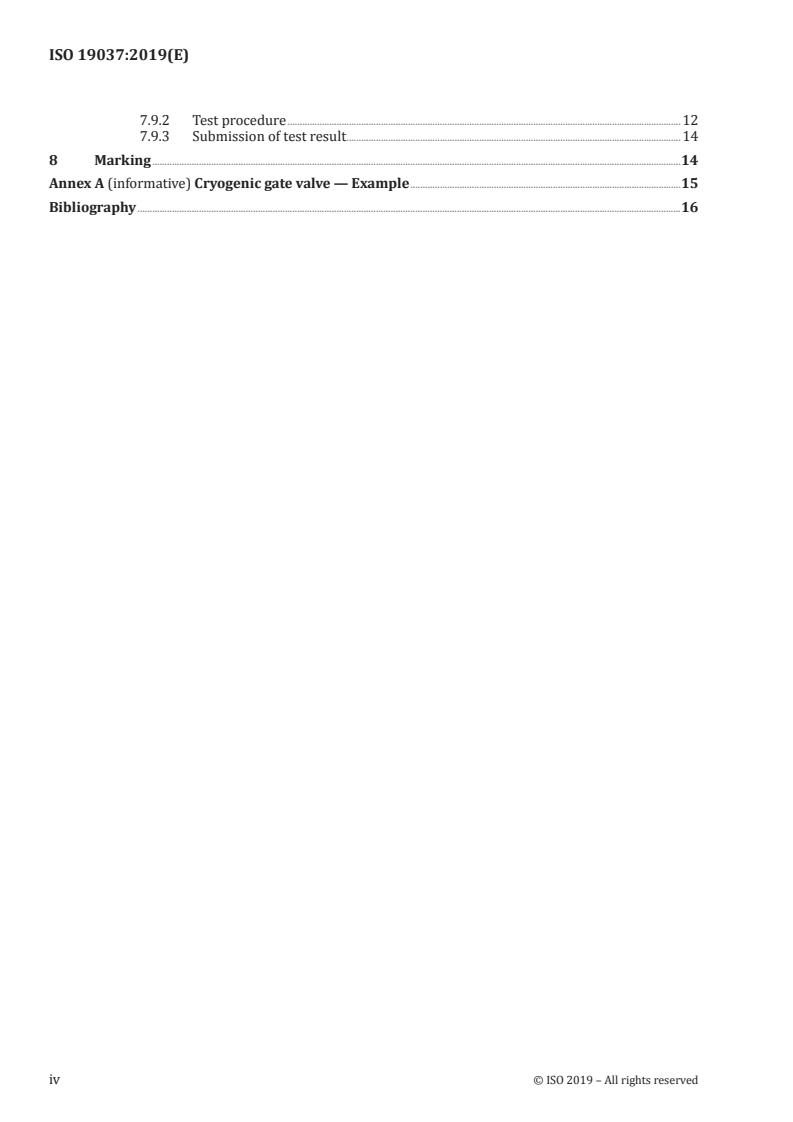
Annex A (informative) Cryogenic gate valve — Example .15
Bibliography .16
iv © ISO 2019 – All rights reserved
Foreword
ISO (the International Organization for Standardization) is a worldwide federation of national standards
bodies (ISO member bodies). The work of preparing International Standards is normally carried out
through ISO technical committees. Each member body interested in a subject for which a technical
committee has been established has the right to be represented on that committee. International
organizations, governmental and non-governmental, in liaison with ISO, also take part in the work.
ISO collaborates closely with the International Electrotechnical Commission (IEC) on all matters of
electrotechnical standardization.
The procedures used to develop this document and those intended for its further maintenance are
described in the ISO/IEC Directives, Part 1. In particular, the different approval criteria needed for the
different types of ISO documents should be noted. This document was drafted in accordance with the
editorial rules of the ISO/IEC Directives, Part 2 (see www .iso .org/directives).
Attention is drawn to the possibility that some of the elements of this document may be the subject of
patent rights. ISO shall not be held responsible for identifying any or all such patent rights. Details of
any patent rights identified during the development of the document will be in the Introduction and/or
on the ISO list of patent declarations received (see www .iso .org/patents).
Any trade name used in this document is information given for the convenience of users and does not
constitute an endorsement.
For an explanation of the voluntary nature of standards, the meaning of ISO specific terms and
expressions related to conformity assessment, as well as information about ISO's adherence to the
World Trade Organization (WTO) principles in the Technical Barriers to Trade (TBT), see www .iso
.org/iso/foreword .html.
This document was prepared by Technical Committee ISO/TC 8, Ships and marine technology,
Subcommittee SC 3, Piping and machinery.
Any feedback or questions on this document should be directed to the user’s national standards body. A
complete listing of these bodies can be found at www .iso .org/members .html.
INTERNATIONAL STANDARD ISO 19037:2019(E)
Ships and marine technology — Gate valves for use in
low temperature applications — Design and testing
requirements
1 Scope
This document specifies requirements of design, manufacture, and test methods for cryogenic gate
valves to have excellent quality of leakage stability in very low temperature environments (−50 °C to
−196 °C).
2 Normative references
The following documents are referred to in the text in such a way that some or all of their content
constitutes requirements of this document. For dated references, only the edition cited applies. For
undated references, the latest edition of the referenced document (including any amendments) applies.
ISO 5208, Industrial valves — Pressure testing of metallic valves
ISO 5209, General purpose industrial valves — Marking
ISO 28921-1, Industrial valves — Isolating valves for low-temperature applications — Part 1: Design,
manufacturing and production testing
API 598:2016, Valve Inspection and Testing
API 600:2015, Steel Gate Valves, Flanged and Butt-Welding Ends
ASME B1.5, Acme Screw Threads
ASME B1.8, Stub Acme Screw Threads
ASME B1.20.1, Pipe Threads, General Purpose (Inch)
ASME B16.5, Pipe Flanges and Flanged Fittings
ASME B16.10, Face-to-Face and End-to-End Dimensions of Valves
ASME B16.11, Forged Fittings, Socket-Welding and Threaded
ASME B16.25, Butt-welding Ends
ASME B16.34:2017, Valves-Flanged, Threads, and Welding End
ASME B46.1, Surface Texture (Surface Roughness, Waviness, and Lay)
ASME B16.47, Large diameter steel flanges: NPS 26 through NPS 60 Metric/Inch Standard
ASME Sec. V, Nondestructive examination, RT, UT, PT mentioned in this document
ASME Sec. VIII, Div.1:2018, Pressure Vessels
ASTM A53, Pipe, Steel, Black and Hot-Dipped, Zinc-Coated Welded and Seamless
ASTM A105/A105M, Forgings, Carbon Steel, for Piping Components
ASTM A106, Seamless Carbon Steel Pipe for High-Temperature Service
ASTM A182/A182M, Forged or Rolled Alloy-Steel Pipe Flanges, Forged Fittings and Valves and Parts for
High-temperature Service
ASTM A194/A194M, Carbon and Alloy Steel Nuts and Bolts for High-Pressure and High Temperature Service
ASTM A216/216M, Steel Castings, Carbon Suitable for Fusion Welding for High-Temperature Service
ASTM A312, Grade TP304L, TP316
ASTM A320/A320M, Alloys-Steel Bolting Material for Low-Temperature Service
ASTM A350/A350M, Forgings, Carbon and Low-Alloy Steel, Requiring Notch Toughness Testing for Piping
Components
ASTM A351/A351M, Casting, Austenitic, Austenitic-Ferritic (Duplex), for Pressure-Containing Parts
ASTM A358, Grade 304L, 316L
ASTM A694/694M, Forgings, Carbon and Alloy Steel, for Pipe Flanges, Fittings, Valves, and Parts for High-
Pressure Transmission service
ASTM E186, Reference Radiographs for Heavy-Walled (2 to 41/2-in) Steel Castings
ASTM E446, Reference Radiographs for Steel Castings up to 2in. in Thickness
MSS SP-55, Quality Standard for Steel Castings for Valves, Flanges and Fittings and Other Piping Components
(Visual Method)
3 Terms and definitions
For the purposes of this document, the following terms and definitions apply.
ISO and IEC maintain terminological databases for use in standardization at the following addresses:
— ISO Online browsing platform: available at https: //www .iso .org/obp
— IEC Electropedia: available at http: //www .electropedia .org/
3.1
nominal diameter
DN
alphanumeric designation of size for components of a pipework system, used for reference purposes
which comprises the letters DN followed by a dimensionless whole number that is related to the physical
size, in millimetres, of the bore or outside diameter of the end connections
Note 1 to entry: The number following the letters DN does not represent a measured value and shall not be used
for calculation purposes except where specified in the relevant standard.
Note 2 to entry: In those standards that use the DN designation system, any relationship between DN and
component dimensions shall be given, e.g. DN/OD or DN/ID.
[SOURCE: ISO 18139:2017, 3.1]
3.2
nominal pressure
PN
numerical designation relating to pressure that is a convenient round number for reference purposes
Note 1 to entry: It is intended that all equipment of the same nominal size (DN) designated by the same PN
number shall have the same mating dimensions appropriate to the type of end connections.
Note 2 to entry: The permissible working pressure depends upon materials, design and working temperature
and has to be selected from the pressure/temperature rating tables in corresponding standards.
2 © ISO 2019 – All rights reserved
[SOURCE: ISO 18139:2017, 3.2]
3.3
nominal pipe size
NPS
dimensionless number for the purpose of pipe, flange, or flanged fitting end connection size
identification
Note 1 to entry: The number is not necessarily the same as the flange or flanged fitting inside diameter.
[SOURCE: ISO 18139:2017, 3.3]
3.4
class
alphanumeric designation used for reference purposes related to a combination of mechanical and
dimensional characteristics of a component of a pipework system, which comprises the word “class”
followed by a dimensionless whole number
[SOURCE: ISO 18139:2017, 3.4]
4 Pressure-temperature rating
4.1 Types of fluids
The types of fluids and associated temperatures are shown in Table 1.
Table 1 — Types of fluids
Temperature
Type Liquid density (density)
(in atmospheric pressure)
LNG (Liquefied natural gas) −163 °C to –88 °C 434 kg to 478 kg/m
NG (Natural gas) −160 °C to −65 °C (0,7 kg to 0,89 kg/m )
LN2 (Liquefied nitrogen) −196 °C 804 kg/m
N2 (Nitrogen) −196 °C to −65 °C (1 184 kg/m )
4.2 Working pressure and design temperature
The valve shall be designed to operate without failure or leakage at the extreme temperatures and
pressure ranges expected in service.
Class and maximum working pressure shall satisfy the standard class specified in ASME B16.34.
The manufacturers and the purchasers may reach an agreement when Class exceeds 900.
The working pressure and design temperature for this valve are shown in Table 2.
Table 2 — Working pressure and design temperature
Maximum pressure
Class Note
MPa
150 2,0
300 5,2
600 10,3 in ambient temperature
800 13,8
900 15,5
NOTE Working pressure is set following a piping design condition that is provided by the purchasers.
5 Design
5.1 General structure of a gate valve
This valve shall be structured as outside screw and yoke (OS&Y), bolted bonnet (BB), flexible wedge
and extended bonnet. When the valve is opening, the stem of the valve shall be rising. The hand wheel
shall be rising or non-rising. Composition, function and standardization of the valve shall be satisfied
with the requirements of the following sections.
5.2 Materials general
Throughout this document, materials are specified for each of the various parts of the valve. In lieu
of the materials specified, other materials may be used provided they are manufactured by the same
process as the material specified, such as forging, casting, bar, or seamless pipe. In addition, the material
shall be suitable for the operating temperatures of the valve and the materials shall have mechanical
properties, including low temperature impact resistance, and resistance to corrosion equal to or better
than the material specified for the specific valve part.
5.3 Types and materials of body
5.3.1 Types
a) The gate valve shall be a top entry bolted bonnet type.
b) Materials shall be equal quality or better than the materials shown in Table 3. Welded ends type
valve materials may be used for flanged ends types.
Table 3 — Materials by manufacturing method
Materials
Manufacturing
method
Flanged ends type Welded ends type
Forging ASTM A182 F304, F316 ASTM A182 F304L, F316L
Casting ASTM A351 CF8, CF8M ASTM A351 CF3, CF3M
5.3.2 Manufacturing
The valve shall be manufactured per the following procedure except for special orders by the purchaser.
5.3.2.1 A port shall be a ‘full port (full bore) type’, and the inside diameter shall comply with
ASME B16.34:2017, Annex A.
5.3.2.2 Face-to-face and end-to-end dimensions shall satisfy ASME B16.10.
4 © ISO 2019 – All rights reserved
5.3.2.3 Minimum wall thickness of the body shall be as shown in ASME B16.34.
5.3.2.4 End connection of the body is classified with ‘welding ends’ type or ‘flanged ends’ type, and
shall be manufactured as below.
5.3.2.4.1 Welding
...
INTERNATIONAL ISO
STANDARD 19037
First edition
2019-06
Ships and marine technology — Gate
valves for use in low temperature
applications — Design and testing
requirements
Navires et technologie maritime — Robinets vannes destinés aux
applications à basse température — Exigences de conception et d'essai
Reference number
©
ISO 2019
© ISO 2019
All rights reserved. Unless otherwise specified, or required in the context of its implementation, no part of this publication may
be reproduced or utilized otherwise in any form or by any means, electronic or mechanical, including photocopying, or posting
on the internet or an intranet, without prior written permission. Permission can be requested from either ISO at the address
below or ISO’s member body in the country of the requester.
ISO copyright office
CP 401 • Ch. de Blandonnet 8
CH-1214 Vernier, Geneva
Phone: +41 22 749 01 11
Fax: +41 22 749 09 47
Email: copyright@iso.org
Website: www.iso.org
Published in Switzerland
ii © ISO 2019 – All rights reserved
Contents Page
Foreword .v
1 Scope . 1
2 Normative references . 1
3 Terms and definitions . 2
4 Pressure-temperature rating . 3
4.1 Types of fluids . 3
4.2 Working pressure and design temperature . 3
5 Design . 4
5.1 General structure of a gate valve . 4
5.2 Materials general . . 4
5.3 Types and materials of body . 4
5.3.1 Types . 4
5.3.2 Manufacturing . 4
5.4 Design and materials of extended bonnet . 5
5.4.1 Design . 5
5.4.2 Materials . 6
5.5 Design types and materials of wedge . 6
5.5.1 Design . 6
5.5.2 Materials . 6
5.6 Types and materials of stem . 7
5.6.1 Design . 7
5.6.2 Materials . 7
5.7 Stem sealing . 7
5.8 Types and materials of a seat ring . 7
5.8.1 Design . 7
5.8.2 Materials . 7
5.9 Types and materials of bolts and nuts . 7
5.9.1 Design . 7
5.9.2 Materials . 8
5.10 Requirements of driving system and operating devices . 8
5.11 Surface treatment . 8
6 Welding heat treatment . 8
6.1 Welding . 8
6.2 Heat treatment . 9
7 Test and inspection . 9
7.1 Material test . 9
7.2 Non-destructive inspection . 9
7.2.1 Radiographic testing (RT) . 9
7.2.2 Penetrant testing (PT) .10
7.2.3 Ultrasonic testing (UT) .10
7.2.4 Retest .10
7.3 Dimension check .10
7.4 Visual inspection .10
7.5 Heat treatment inspection .10
7.6 Operating tests .11
7.7 Pressure tests, back seat tests and leak tests .11
7.7.1 Pressure tests.11
7.7.2 Back seat tests .11
7.7.3 High-pressure pneumatic shell test .12
7.8 Fire safety test .12
7.9 Cryogenic tests .12
7.9.1 Scope of tests .12
7.9.2 Test procedure .12
7.9.3 Submission of test result .14
8 Marking .14
Annex A (informative) Cryogenic gate valve — Example .15
Bibliography .16
iv © ISO 2019 – All rights reserved
Foreword
ISO (the International Organization for Standardization) is a worldwide federation of national standards
bodies (ISO member bodies). The work of preparing International Standards is normally carried out
through ISO technical committees. Each member body interested in a subject for which a technical
committee has been established has the right to be represented on that committee. International
organizations, governmental and non-governmental, in liaison with ISO, also take part in the work.
ISO collaborates closely with the International Electrotechnical Commission (IEC) on all matters of
electrotechnical standardization.
The procedures used to develop this document and those intended for its further maintenance are
described in the ISO/IEC Directives, Part 1. In particular, the different approval criteria needed for the
different types of ISO documents should be noted. This document was drafted in accordance with the
editorial rules of the ISO/IEC Directives, Part 2 (see www .iso .org/directives).
Attention is drawn to the possibility that some of the elements of this document may be the subject of
patent rights. ISO shall not be held responsible for identifying any or all such patent rights. Details of
any patent rights identified during the development of the document will be in the Introduction and/or
on the ISO list of patent declarations received (see www .iso .org/patents).
Any trade name used in this document is information given for the convenience of users and does not
constitute an endorsement.
For an explanation of the voluntary nature of standards, the meaning of ISO specific terms and
expressions related to conformity assessment, as well as information about ISO's adherence to the
World Trade Organization (WTO) principles in the Technical Barriers to Trade (TBT), see www .iso
.org/iso/foreword .html.
This document was prepared by Technical Committee ISO/TC 8, Ships and marine technology,
Subcommittee SC 3, Piping and machinery.
Any feedback or questions on this document should be directed to the user’s national standards body. A
complete listing of these bodies can be found at www .iso .org/members .html.
INTERNATIONAL STANDARD ISO 19037:2019(E)
Ships and marine technology — Gate valves for use in
low temperature applications — Design and testing
requirements
1 Scope
This document specifies requirements of design, manufacture, and test methods for cryogenic gate
valves to have excellent quality of leakage stability in very low temperature environments (−50 °C to
−196 °C).
2 Normative references
The following documents are referred to in the text in such a way that some or all of their content
constitutes requirements of this document. For dated references, only the edition cited applies. For
undated references, the latest edition of the referenced document (including any amendments) applies.
ISO 5208, Industrial valves — Pressure testing of metallic valves
ISO 5209, General purpose industrial valves — Marking
ISO 28921-1, Industrial valves — Isolating valves for low-temperature applications — Part 1: Design,
manufacturing and production testing
API 598:2016, Valve Inspection and Testing
API 600:2015, Steel Gate Valves, Flanged and Butt-Welding Ends
ASME B1.5, Acme Screw Threads
ASME B1.8, Stub Acme Screw Threads
ASME B1.20.1, Pipe Threads, General Purpose (Inch)
ASME B16.5, Pipe Flanges and Flanged Fittings
ASME B16.10, Face-to-Face and End-to-End Dimensions of Valves
ASME B16.11, Forged Fittings, Socket-Welding and Threaded
ASME B16.25, Butt-welding Ends
ASME B16.34:2017, Valves-Flanged, Threads, and Welding End
ASME B46.1, Surface Texture (Surface Roughness, Waviness, and Lay)
ASME B16.47, Large diameter steel flanges: NPS 26 through NPS 60 Metric/Inch Standard
ASME Sec. V, Nondestructive examination, RT, UT, PT mentioned in this document
ASME Sec. VIII, Div.1:2018, Pressure Vessels
ASTM A53, Pipe, Steel, Black and Hot-Dipped, Zinc-Coated Welded and Seamless
ASTM A105/A105M, Forgings, Carbon Steel, for Piping Components
ASTM A106, Seamless Carbon Steel Pipe for High-Temperature Service
ASTM A182/A182M, Forged or Rolled Alloy-Steel Pipe Flanges, Forged Fittings and Valves and Parts for
High-temperature Service
ASTM A194/A194M, Carbon and Alloy Steel Nuts and Bolts for High-Pressure and High Temperature Service
ASTM A216/216M, Steel Castings, Carbon Suitable for Fusion Welding for High-Temperature Service
ASTM A312, Grade TP304L, TP316
ASTM A320/A320M, Alloys-Steel Bolting Material for Low-Temperature Service
ASTM A350/A350M, Forgings, Carbon and Low-Alloy Steel, Requiring Notch Toughness Testing for Piping
Components
ASTM A351/A351M, Casting, Austenitic, Austenitic-Ferritic (Duplex), for Pressure-Containing Parts
ASTM A358, Grade 304L, 316L
ASTM A694/694M, Forgings, Carbon and Alloy Steel, for Pipe Flanges, Fittings, Valves, and Parts for High-
Pressure Transmission service
ASTM E186, Reference Radiographs for Heavy-Walled (2 to 41/2-in) Steel Castings
ASTM E446, Reference Radiographs for Steel Castings up to 2in. in Thickness
MSS SP-55, Quality Standard for Steel Castings for Valves, Flanges and Fittings and Other Piping Components
(Visual Method)
3 Terms and definitions
For the purposes of this document, the following terms and definitions apply.
ISO and IEC maintain terminological databases for use in standardization at the following addresses:
— ISO Online browsing platform: available at https: //www .iso .org/obp
— IEC Electropedia: available at http: //www .electropedia .org/
3.1
nominal diameter
DN
alphanumeric designation of size for components of a pipework system, used for reference purposes
which comprises the letters DN followed by a dimensionless whole number that is related to the physical
size, in millimetres, of the bore or outside diameter of the end connections
Note 1 to entry: The number following the letters DN does not represent a measured value and shall not be used
for calculation purposes except where specified in the relevant standard.
Note 2 to entry: In those standards that use the DN designation system, any relationship between DN and
component dimensions shall be given, e.g. DN/OD or DN/ID.
[SOURCE: ISO 18139:2017, 3.1]
3.2
nominal pressure
PN
numerical designation relating to pressure that is a convenient round number for reference purposes
Note 1 to entry: It is intended that all equipment of the same nominal size (DN) designated by the same PN
number shall have the same mating dimensions appropriate to the type of end connections.
Note 2 to entry: The permissible working pressure depends upon materials, design and working temperature
and has to be selected from the pressure/temperature rating tables in corresponding standards.
2 © ISO 2019 – All rights reserved
[SOURCE: ISO 18139:2017, 3.2]
3.3
nominal pipe size
NPS
dimensionless number for the purpose of pipe, flange, or flanged fitting end connection size
identification
Note 1 to entry: The number is not necessarily the same as the flange or flanged fitting inside diameter.
[SOURCE: ISO 18139:2017, 3.3]
3.4
class
alphanumeric designation used for reference purposes related to a combination of mechanical and
dimensional characteristics of a component of a pipework system, which comprises the word “class”
followed by a dimensionless whole number
[SOURCE: ISO 18139:2017, 3.4]
4 Pressure-temperature rating
4.1 Types of fluids
The types of fluids and associated temperatures are shown in Table 1.
Table 1 — Types of fluids
Temperature
Type Liquid density (density)
(in atmospheric pressure)
LNG (Liquefied natural gas) −163 °C to –88 °C 434 kg to 478 kg/m
NG (Natural gas) −160 °C to −65 °C (0,7 kg to 0,89 kg/m )
LN2 (Liquefied nitrogen) −196 °C 804 kg/m
N2 (Nitrogen) −196 °C to −65 °C (1 184 kg/m )
4.2 Working pressure and design temperature
The valve shall be designed to operate without failure or leakage at the extreme temperatures and
pressure ranges expected in service.
Class and maximum working pressure shall satisfy the standard class specified in ASME B16.34.
The manufacturers and the purchasers may reach an agreement when Class exceeds 900.
The working pressure and design temperature for this valve are shown in Table 2.
Table 2 — Working pressure and design temperature
Maximum pressure
Class Note
MPa
150 2,0
300 5,2
600 10,3 in ambient temperature
800 13,8
900 15,5
NOTE Working pressure is set following a piping design condition that is provided by the purchasers.
5 Design
5.1 General structure of a gate valve
This valve shall be structured as outside screw and yoke (OS&Y), bolted bonnet (BB), flexible wedge
and extended bonnet. When the valve is opening, the stem of the valve shall be rising. The hand wheel
shall be rising or non-rising. Composition, function and standardization of the valve shall be satisfied
with the requirements of the following sections.
5.2 Materials general
Throughout this document, materials are specified for each of the various parts of the valve. In lieu
of the materials specified, other materials may be used provided they are manufactured by the same
process as the material specified, such as forging, casting, bar, or seamless pipe. In addition, the material
shall be suitable for the operating temperatures of the valve and the materials shall have mechanical
properties, including low temperature impact resistance, and resistance to corrosion equal to or better
than the material specified for the specific valve part.
5.3 Types and materials of body
5.3.1 Types
a) The gate valve shall be a top entry bolted bonnet type.
b) Materials shall be equal quality or better than the materials shown in Table 3. Welded ends type
valve materials may be used for flanged ends types.
Table 3 — Materials by manufacturing method
Materials
Manufacturing
method
Flanged ends type Welded ends type
Forging ASTM A182 F304, F316 ASTM A182 F304L, F316L
Casting ASTM A351 CF8, CF8M ASTM A351 CF3, CF3M
5.3.2 Manufacturing
The valve shall be manufactured per the following procedure except for special orders by the purchaser.
5.3.2.1 A port shall be a ‘full port (full bore) type’, and the inside diameter shall comply with
ASME B16.34:2017, Annex A.
5.3.2.2 Face-to-face and end-to-end dimensions shall satisfy ASME B16.10.
4 © ISO 2019 – All rights reserved
5.3.2.3 Minimum wall thickness of the body shall be as shown in ASME B16.34.
5.3.2.4 End connection of the body is classified with ‘welding ends’ type or ‘flanged ends’ type, and
shall be manufactured as below.
5.3.2.4.1 Welding
...