

ISO 8229:1991
(Main)Operations and baths relating to dry-cleaning machines — Vocabulary
General Information
- Abstract
Specifies 22 terms and definitions in English and French. Some may be used with different meanings in other fields. Contains the alphabetical indexes in English and French.
- Status
- Published
- Publication Date
- 14-Aug-1991
- Current Stage
- 9093 - International Standard confirmed
- Start Date
- 07-Jul-2023
- Completion Date
- 29-Aug-2026
Overview
ISO 8229:1991 is an international standard developed by the International Organization for Standardization (ISO) that defines the vocabulary used in the context of operations and baths related to dry-cleaning machines. This standard specifies 22 key terms and their definitions in both English and French, ensuring clear and consistent communication among manufacturers, service providers, and users in the textile care industry. By providing a standardized terminology, ISO 8229:1991 helps facilitate international trade, enhance understanding, and promote best practices in the field of dry-cleaning machinery.
Key Topics
ISO 8229:1991 covers essential terminology related to:
Operations of Dry-Cleaning Machines
Terms specifying procedures such as loading, cleaning processes, filtration, extraction, and deodorization.Types of Baths and Treatments
Definitions for various solvent bath processes, including circulating baths, charged solvents, and static (standing) baths.Equipment Components
Standardized names for major machine parts like “tage” (rotating load container), drums, and filters.Process Stages
Vocabulary for sequential operations such as pre-wash, washing, rinsing, distillation, and solvent recovery.Measurement and Load Terms
Definitions of load ratio, dry mass, and related calculations for machine operation.
ISO 8229:1991 also includes alphabetical indexes in both English and French, allowing quick reference and improved usability for bilingual or international users.
Applications
The vocabulary specified in ISO 8229:1991 is valuable for a range of practical applications, including:
Manufacturers of Dry-Cleaning Equipment
Ensuring product documentation, user manuals, and service instructions use unified terminology for global clarity.Service Providers and Operators
Supporting staff training, operational protocols, and quality control with a shared language for procedures and equipment.Technical Documentation
Enabling technical writers, translators, and standards organizations to create clear, accurate documentation for the dry-cleaning industry.International Trade and Regulation
Facilitating customs, trade negotiations, and compliance with international regulations by standardizing dry-cleaning machine terminology.Industry Training and Education
Providing a foundation for curricula and certification programs for operators, technicians, and maintenance personnel.
Using ISO 8229:1991 helps minimize misunderstandings, improves cross-border communication, and supports productivity and safety in textile care operations.
Related Standards
For comprehensive adherence to best practices and terminology in textile machinery and processes, the following ISO standards are also relevant:
- ISO 9398 - Installation and maintenance of textile machinery
- ISO 3758 - Care labeling code using symbols for textiles
- ISO 8230 - Safety requirements for dry-cleaning machines
- ISO/TC 72 - Series on textile machinery and allied machinery
Compliance with ISO 8229:1991, in conjunction with these related standards, ensures harmonization of terminology, supports risk management, and sustains quality throughout the textile cleaning and finishing industry.
Keywords: ISO 8229, dry-cleaning machines, solvent baths, textile care, cleaning equipment vocabulary, international standards, textile machinery, operational terminology, safety, technical documentation.
Frequently Asked Questions
ISO 8229:1991 is a standard published by the International Organization for Standardization (ISO). Its full title is "Operations and baths relating to dry-cleaning machines — Vocabulary". This standard covers: Specifies 22 terms and definitions in English and French. Some may be used with different meanings in other fields. Contains the alphabetical indexes in English and French.
Specifies 22 terms and definitions in English and French. Some may be used with different meanings in other fields. Contains the alphabetical indexes in English and French.
ISO 8229:1991 is classified under the following ICS (International Classification for Standards) categories: 01.040.97 - Domestic and commercial equipment. Entertainment. Sports (Vocabularies); 97.060 - Laundry appliances. The ICS classification helps identify the subject area and facilitates finding related standards.
ISO 8229:1991 is available in PDF format for immediate download after purchase. The document can be added to your cart and obtained through the secure checkout process. Digital delivery ensures instant access to the complete standard document.
Standards Content (Sample)
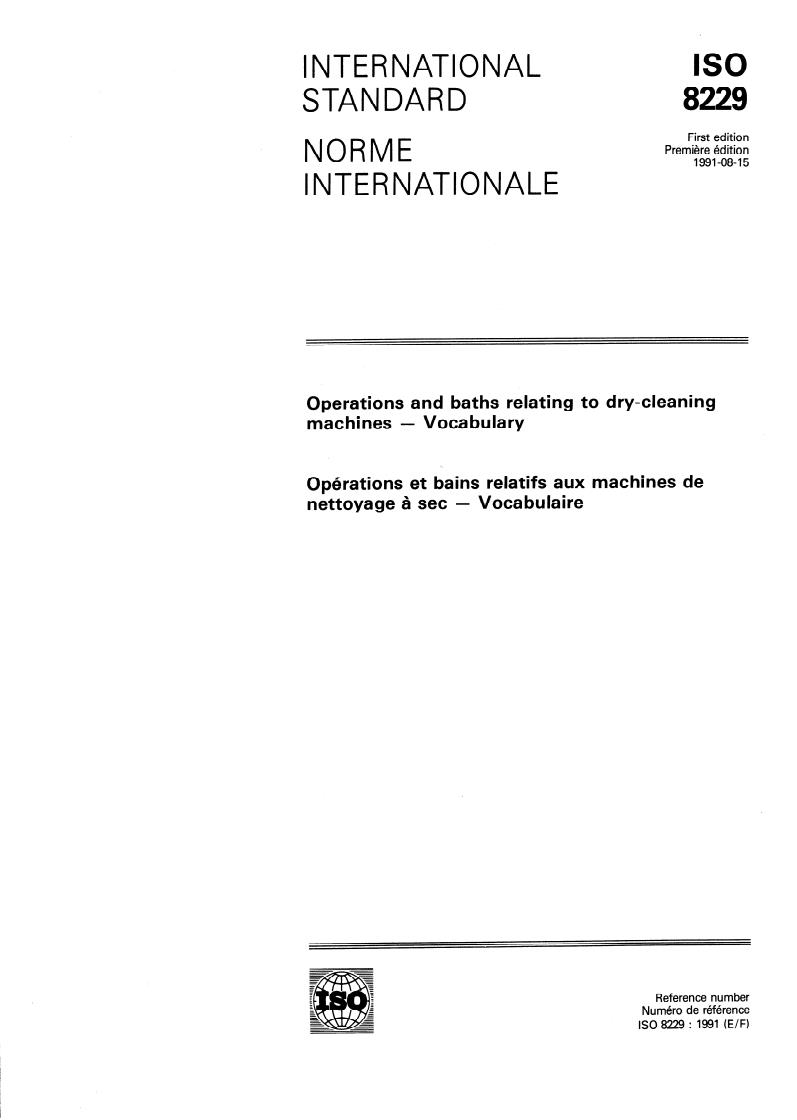
ISO
INTERNATIONAL
STANDARD
First edition
Premike Edition
NORME
1991-08-15
INTERNATIONALE
Operations and baths relating to dry-cleaning
- Vocabulary
machines
Opkations et bains relatifs aux machines de
nettoyage & sec - Vocabulaire
Reference number
Numero de rhference
ISO 8229 : 1991 (E/F)
ISO 8229 : 1991 (E/F)
Foreword
ISO (the lnternational Organization for Standardization) is a worldwide federation of
national Standards bodies (ISO member bedies). The work of preparing International
Standards is normally carried out through ISO technical committees. Esch member
body interested in a subject for which a technical committee has been established has
the right to be represented on that committee. International organizations, govern-
mental and non-governmental, in liaison with ISO, also take part in the work. ISO
collaborates closely with the International Electrotechnical Commission (IEC) on all
matters of electrotechnical standardization.
Draft International Standards adopted by the technical committees are circulated to
the member bodies for voting. Publication as an International Standard requires
approval by at least 75 % of the member bodies casting a vote.
International Standard ISO 8229 was prepared by Technical Committee ISO/TC 72,
Textile machinery and allied machinery and accessories, Sub-Committee SC 4, Dye-
ing, finishing and allied machinery and accessories.
0 ISO 1991
All rights reserved. No part of this publication may be reproduced or utilized in any form or by any
means, electronie or mechanical, including photocopying and microfilm, without Permission in
writing from the publisher./Droits de reproduction reserves. Aucune Partie de cette publication
ne peut etre reproduite ni utilisee sous quelque forme que ce soit et par aucun procede, electroni-
que ou mecanique, y compris Ia photocopie et les microfilms, sans I’accord ecrit de I’editeur.
International Organization for Standardization
Case postale 56 l CH-1211 Geneve 20 l Switzerland
Printed in Switzerland/lmprime en Suisse
ii
ISO 8229 : 1991 (E/F)
Avant-propos
L’ISO (Organisation internationale de normalisation) est une federation mondiale
d’organismes nationaux de normalisation (comites membres de I’ISO). L’elaboration
des Normes internationales est en general confiee aux comites techniques de I’ISO.
Chaque comite membre interesse par une etude a Ie droit de faire Partie du comite
technique cr& a cet effet. Les organisations internationales, gouvernementales et non
gouvernementales, en liaison avec I’ISO participent egalement aux travaux. L’ISO col-
labore etroitement avec Ia Commission electrotechnique internationale (GEI) en ce qui
concerne Ia normalisation electrotechnique.
Les projets de Normes internationales adoptes par les comites techniques sont soumis
aux comites membres pour vote. Leur publication comme Normes internationales
requiert I’approbation de 75 % au moins des comites membres votants.
La Norme internationale ISO 9229 a et6 elaboree par Ie comite technique ISO/TC 72,
Mathiel pour l’industrie textile et matkiel connexe, sous-comite SC 4, Mattkiel de
tein ture, de finissage et ma thriel connexe.
This page intentionaliy lef3 blank
INTERNATIONAL STANDARD
ISO8229 : 1991 (E/F)
NORME INTERNATIONALE
Operations and baths Opkations et bains relatifs
relating to dry-cleaning aux machines de nettoyage
Vocabulaire
machines - Vocabulary 6 sec -
1 Domaine d’application
1 Scope
La presente Norme internationale definit les termes concernant
This International Standard defines terms relating to operations
les operations et les bains rencontres sur des machines de
and baths in the field of dry-cleaning machines.
nettoyage a sec.
Terms and expressions are defined as they are used in the field
Ces termes et expressions sont definis conformement a leur
of dry-cleaning; some may be used with different meanings in
emploi dans Ie domaine du nettoyage a sec, independamment
other f ields.
du fait que certains d’entre eux peuvent etre utilises dans
d’autres domaines avec des acceptations parfois differentes.
2 Definitions
2 Definitions
2.1 dry mass: Mass of articles to be cleaned, either 2.1 masse Seche: Masse d’articles a nettoyer conditionnes
ou en I’etat 0U ils sont recus.
conditioned or as received.
2.2 rapport de Charge: Rapport entre Ia Charge, exprimee
2.2 ratio of the mass: Ratio of the load, in kilograms, to the
en kilogrammes, et Ie volume du panier (ou «tambour»),
volume of the tage, in cubic decimetres or in Iitres.
exprime en decimetres cubes ou en litres.
2.3 loading: Loading of articles into the tage. 2.3 chargement : Introduction des articles a nettoyer dans Ie
panier.
2.4 bain: Volume de solvant dans Ia cuve.
2.4 dip: Volume of solvent in the tage.
NOTE - Normalement, les constructeurs determinent les hauteurs
NOTE - Manufacturers normally specify the values for low dip and
correspondant aux «bains bas)) et «bains hauts» pour une machine
high dip for each machine.
d6f inie.
containing one or more 2.5 bain Charge: Bain contenant un ou plusieurs adjuvants
2.5 charged solvent: Solvent bath
avec du detergent et eventuellement de I’eau.
additives plus detergent and possibly water.
2.6 circulation du bain: Operation dans laquelle Ie solvant
2.6 circulating bath: Process Stage in which the solvent
discharged from the tage is continuously recirculated, directly evacue au bas de I’enveloppe est recycle en permanente vers
celle-ci, directement ou apres filtration.
back or through a filter, into the tage.
Ensemble des operations de
2.7 cycle de nettoyage:
2.7 cleaning process : Complete combination of operations
nettoyage en machine, pouvant comprendre par exemple, Ie
carried out in the machine which may include, for example, pre-
prelavage, Ie lavage, Ie rincage, I’essorage, Ie sechage, Ia
wash, wash, rinse, extraction, drying, deodorization, etc.
desodorisation, etc. ’
NOTE - Many combinations are possible.
NOTE - Beaucoup de reglages sont possibles.
.
...