


ISO/IEC 9796-2:2002
(Main)Information technology — Security techniques — Digital signature schemes giving message recovery — Part 2: Integer factorization based mechanisms
Information technology — Security techniques — Digital signature schemes giving message recovery — Part 2: Integer factorization based mechanisms
ISO/IEC 9796-2:2002 specifies three digital signature schemes giving message recovery, two of which are deterministic (non-randomized) and one of which is randomized. The security of all three schemes is based on the difficulty of factorizing large numbers. All three schemes can provide either total or partial message recovery. The method for key production for the three signature schemes is specified in this part of ISO/IEC 9796. However, techniques for key management and for random number generation (as required for the randomized signature scheme), are outside the scope of this part of ISO/IEC 9796. Users of this International Standard are, wherever possible, recommended to adopt the second mechanism (Digital signature scheme 2). However, in environments where generation of random variables by the signer is deemed infeasible, then Digital signature scheme 3 is recommended. Digital signature scheme 1 shall only be used in environments where compatibility is required with systems implementing the first edition of this International Standard. However, Digital signature scheme 1 is only compatible with systems implementing the first edition of this International Standard that use hash-codes of at least 160 bits.
Technologies de l'information — Techniques de sécurité — Schémas de signature numérique rétablissant le message — Partie 2: Mécanismes basés sur une factorisation entière
General Information
- Status
- Withdrawn
- Publication Date
- 09-Oct-2002
- Withdrawal Date
- 09-Oct-2002
- Drafting Committee
- ISO/IEC JTC 1/SC 27/WG 2 - Cryptography and security mechanisms
- Current Stage
- 9599 - Withdrawal of International Standard
- Start Date
- 15-Dec-2010
- Completion Date
- 14-Feb-2026
Relations
- Effective Date
- 06-Jun-2022
- Effective Date
- 11-Jul-2009
- Effective Date
- 15-Apr-2008
- Effective Date
- 15-Apr-2008
Get Certified
Connect with accredited certification bodies for this standard

BSI Group
BSI (British Standards Institution) is the business standards company that helps organizations make excellence a habit.

Bureau Veritas
Bureau Veritas is a world leader in laboratory testing, inspection and certification services.

DNV
DNV is an independent assurance and risk management provider.
Sponsored listings
Frequently Asked Questions
ISO/IEC 9796-2:2002 is a standard published by the International Organization for Standardization (ISO). Its full title is "Information technology — Security techniques — Digital signature schemes giving message recovery — Part 2: Integer factorization based mechanisms". This standard covers: ISO/IEC 9796-2:2002 specifies three digital signature schemes giving message recovery, two of which are deterministic (non-randomized) and one of which is randomized. The security of all three schemes is based on the difficulty of factorizing large numbers. All three schemes can provide either total or partial message recovery. The method for key production for the three signature schemes is specified in this part of ISO/IEC 9796. However, techniques for key management and for random number generation (as required for the randomized signature scheme), are outside the scope of this part of ISO/IEC 9796. Users of this International Standard are, wherever possible, recommended to adopt the second mechanism (Digital signature scheme 2). However, in environments where generation of random variables by the signer is deemed infeasible, then Digital signature scheme 3 is recommended. Digital signature scheme 1 shall only be used in environments where compatibility is required with systems implementing the first edition of this International Standard. However, Digital signature scheme 1 is only compatible with systems implementing the first edition of this International Standard that use hash-codes of at least 160 bits.
ISO/IEC 9796-2:2002 specifies three digital signature schemes giving message recovery, two of which are deterministic (non-randomized) and one of which is randomized. The security of all three schemes is based on the difficulty of factorizing large numbers. All three schemes can provide either total or partial message recovery. The method for key production for the three signature schemes is specified in this part of ISO/IEC 9796. However, techniques for key management and for random number generation (as required for the randomized signature scheme), are outside the scope of this part of ISO/IEC 9796. Users of this International Standard are, wherever possible, recommended to adopt the second mechanism (Digital signature scheme 2). However, in environments where generation of random variables by the signer is deemed infeasible, then Digital signature scheme 3 is recommended. Digital signature scheme 1 shall only be used in environments where compatibility is required with systems implementing the first edition of this International Standard. However, Digital signature scheme 1 is only compatible with systems implementing the first edition of this International Standard that use hash-codes of at least 160 bits.
ISO/IEC 9796-2:2002 is classified under the following ICS (International Classification for Standards) categories: 35.030 - IT Security; 35.040 - Information coding. The ICS classification helps identify the subject area and facilitates finding related standards.
ISO/IEC 9796-2:2002 has the following relationships with other standards: It is inter standard links to ISO/IEC 9796-2:2002/Amd 1:2008, ISO/IEC 9796-2:2010, ISO/IEC 9796-2:1997; is excused to ISO/IEC 9796-2:2002/Amd 1:2008. Understanding these relationships helps ensure you are using the most current and applicable version of the standard.
ISO/IEC 9796-2:2002 is available in PDF format for immediate download after purchase. The document can be added to your cart and obtained through the secure checkout process. Digital delivery ensures instant access to the complete standard document.
Standards Content (Sample)
INTERNATIONAL ISO/IEC
STANDARD 9796-2
Second edition
2002-10-01
Information technology — Security
techniques — Digital signature schemes
giving message recovery —
Part 2:
Integer factorization based mechanisms
Technologies de l'information — Techniques de sécurité — Schémas de
signature numérique rétablissant le message —
Partie 2: Mécanismes basés sur une factorisation entière
Reference number
©
ISO/IEC 2002
PDF disclaimer
This PDF file may contain embedded typefaces. In accordance with Adobe's licensing policy, this file may be printed or viewed but shall not
be edited unless the typefaces which are embedded are licensed to and installed on the computer performing the editing. In downloading this
file, parties accept therein the responsibility of not infringing Adobe's licensing policy. The ISO Central Secretariat accepts no liability in this
area.
Adobe is a trademark of Adobe Systems Incorporated.
Details of the software products used to create this PDF file can be found in the General Info relative to the file; the PDF-creation parameters
were optimized for printing. Every care has been taken to ensure that the file is suitable for use by ISO member bodies. In the unlikely event
that a problem relating to it is found, please inform the Central Secretariat at the address given below.
© ISO/IEC 2002
All rights reserved. Unless otherwise specified, no part of this publication may be reproduced or utilized in any form or by any means, electronic
or mechanical, including photocopying and microfilm, without permission in writing from either ISO at the address below or ISO's member body
in the country of the requester.
ISO copyright office
Case postale 56 • CH-1211 Geneva 20
Tel. + 41 22 749 01 11
Fax + 41 22 749 09 47
E-mail copyright@iso.ch
Web www.iso.ch
Printed in Switzerland
ii © ISO/IEC 2002 – All rights reserved
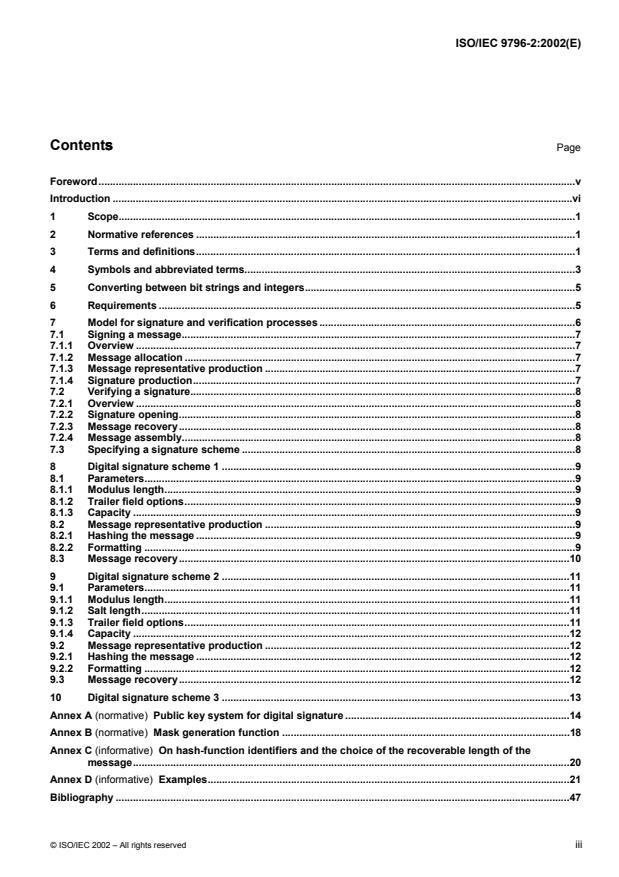
Contentss
Page
Foreword.v
Introduction .vi
1 Scope.1
2 Normative references .1
3 Terms and definitions.1
4 Symbols and abbreviated terms.3
5 Converting between bit strings and integers.5
6 Requirements .5
7 Model for signature and verification processes .6
7.1 Signing a message.7
7.1.1 Overview .7
7.1.2 Message allocation .7
7.1.3 Message representative production .7
7.1.4 Signature production.7
7.2 Verifying a signature.8
7.2.1 Overview .8
7.2.2 Signature opening.8
7.2.3 Message recovery.8
7.2.4 Message assembly.8
7.3 Specifying a signature scheme .8
8 Digital signature scheme 1 .9
8.1 Parameters.9
8.1.1 Modulus length.9
8.1.2 Trailer field options.9
8.1.3 Capacity .9
8.2 Message representative production .9
8.2.1 Hashing the message .9
8.2.2 Formatting .9
8.3 Message recovery.10
9 Digital signature scheme 2 .11
9.1 Parameters.11
9.1.1 Modulus length.11
9.1.2 Salt length.11
9.1.3 Trailer field options.11
9.1.4 Capacity .12
9.2 Message representative production .12
9.2.1 Hashing the message .12
9.2.2 Formatting .12
9.3 Message recovery.12
10 Digital signature scheme 3 .13
Annex A (normative) Public key system for digital signature .14
Annex B (normative) Mask generation function .18
Annex C (informative) On hash-function identifiers and the choice of the recoverable length of the
message.20
Annex D (informative) Examples.21
Bibliography .47
© ISO/IEC 2002 – All rights reserved iii
Foreword
ISO (the International Organization for Standardization) and IEC (the International Electrotechnical Commission)
form the specialized system for worldwide standardization. National bodies that are members of ISO or IEC
participate in the development of International Standards through technical committees established by the
respective organization to deal with particular fields of technical activity. ISO and IEC technical committees
collaborate in fields of mutual interest. Other international organizations, governmental and non-governmental, in
liaison with ISO and IEC, also take part in the work. In the field of information technology, ISO and IEC have
established a joint technical committee, ISO/IEC JTC 1.
International Standards are drafted in accordance with the rules given in the ISO/IEC Directives, Part 3.
The main task of the joint technical committee is to prepare International Standards. Draft International Standards
adopted by the joint technical committee are circulated to national bodies for voting. Publication as an International
Standard requires approval by at least 75 % of the national bodies casting a vote.
ISO/IEC 9796-2 was prepared by Joint Technical Committee ISO/IEC JTC 1, Information technology,
Subcommittee SC 27, IT Security techniques.
This second edition cancels and replaces the first edition (ISO/IEC 9796-2:1997), which has been technically
revised. Implementations which comply with ISO/IEC 9796-2 (1st edition), and which use a hash-code of at least
160 bits in length, will be compliant with ISO/IEC 9796-2 (2nd edition). Note, however, that implementations
complying with ISO/IEC 9796-2 (1st edition) that use a hash-code of less than 160 bits in length will not be
compliant with ISO/IEC 9796-2 (2nd edition).
ISO/IEC 9796 consists of the following parts, under the general title Information technology — Security
techniques — Digital signature schemes giving message recovery:
— Part 1: Mechanisms using redundancy
— Part 2: Integer factorization based mechanisms
— Part 3: Discrete logarithm based mechanisms
Further parts may follow.
Annexes A and B form a normative part of this part of ISO/IEC 9796. Annexes C and D are for information only.
iv © ISO/IEC 2002 – All rights reserved
Introduction
Digital signature mechanisms can be used to provide services such as entity authentication, data origin
authentication, non-repudiation, and integrity of data. A digital signature mechanism satisfies the following
requirements.
• Given the verification key but not the signature key it shall be computationally infeasible to produce a valid
signature for any message.
• Given the signatures produced by a signer, it shall be computationally infeasible to produce a valid signature
on a new message or to recover the signature key.
• It shall be computationally infeasible, even for the signer, to find two different messages with the same
signature.
NOTE Computational feasibility depends on the specific security requirements and environment.
Most digital signature mechanisms are based on asymmetric cryptographic techniques and involve three basic
operations.
• A process for generating pairs of keys, where each pair consists of a private signature key and the
corresponding public verification key.
• A process that uses the signature key, called the signature process.
• A process that uses the verification key, called the verification process.
There are two types of digital signature mechanisms.
• When, for a given signature key, two signatures produced for the same message are identical, the mechanism
is said to be non-randomized (or deterministic); see ISO/IEC 14888-1.
• When, for a given message and signature key, each application of the signature process produces a different
signature, the mechanism is said to be randomized.
The first and third of the three mechanisms specified in this part of ISO/IEC 9796 are deterministic (non-
randomized), whereas the second of the three mechanisms specified is randomized.
Digital signature mechanisms can also be divided into the following two categories:
• When the whole message has to be stored and/or transmitted along with the signature, the mechanism is
named a “signature mechanism with appendix” (see ISO/IEC 14888).
• When the whole message, or part of it, can be recovered from the signature, the mechanism is named a
“signature mechanism giving message recovery” (see ISO/IEC 9796 (all parts)).
NOTE Any signature mechanism giving message recovery, for example, the mechanisms specified in ISO/IEC 9796 (all
parts), can be converted to give a digital signature with appendix. This can be achieved by applying the signature mechanism
to a hash-code derived as a function of the message. If this approach is employed, then all parties generating and verifying
signatures must agree on this approach, and must also have a means of unambiguously identifying the hash-function to be
used to generate the hash-code from the message.
The mechanisms specified in ISO/IEC 9796 (all parts) give either total or partial recovery, with the objective of
reducing storage and transmission overhead. If the message is short enough, then the entire message can be
included in the signature, and recovered from the signature in the verification process. Otherwise, a part of the
message can be included in the signature, and the remainder stored and/or transmitted along with the signature.
© ISO/IEC 2002 – All rights reserved v
The mechanisms specified in this part of ISO/IEC 9796 use a hash-function for hashing the entire message
(possibly in more than one part). ISO/IEC 10118 specifies hash-functions for digital signatures.
vi © ISO/IEC 2002 – All rights reserved
Patent information
The International Organization for Standardization (ISO) and the International Electrotechnical Commission (IEC)
draw attention to the fact that it is claimed that compliance with this part of ISO/IEC 9796 may involve the use of a
patent concerning the “Probabilistic signature scheme” (U.S. Patent 6,266,771 issued 2001-07-24).
ISO and IEC take no position concerning the evidence, validity and scope of this patent right.
The holder of this patent right has assured ISO and IEC that they are willing to negotiate licences under reasonable
and non-discriminatory terms and conditions with applications throughout the world. In this respect, the statement
of the holder of this patent right is registered with ISO and IEC. Information may be obtained from:
University of California
Senior Licensing Officer
Office of Technology Transfer
th
1111 Franklin Street, 5 Floor
Oakland, California 94607-5200
USA
Attention is drawn to the possibility that some of the elements of this part of ISO/IEC 9796 may be the subject of
patent rights other than that identified above. ISO and IEC shall not be held responsible for identifying any or all
such patent rights.
© ISO/IEC 2002 – All rights reserved vii
INTERNATIONAL STANDARD
Information technology — Security techniques — Digital signature
schemes giving message recovery —
Part 2:
Integer factorization based mechanisms
1 Scope
This part of ISO/IEC 9796 specifies three digital signature schemes giving message recovery, two of which are
deterministic (non-randomized) and one of which is randomized. The security of all three schemes is based on the
difficulty of factorizing large numbers. All three schemes can provide either total or partial message recovery.
The method for key production for the three signature schemes is specified in this part of ISO/IEC 9796. However,
techniques for key management and for random number generation (as required for the randomized signature
scheme), are outside the scope of this part of ISO/IEC 9796.
Users of this standard are, wherever possible, recommended to adopt the second mechanism (Digital signature
scheme 2). However, in environments where generation of random variables by the signer is deemed infeasible,
then Digital signature scheme 3 is recommended. Digital signature scheme 1 shall only be used in environments
where compatibility is required with systems implementing the first edition of this standard. However, Digital
signature scheme 1 is only compatible with systems implementing the first edition of this standard that use hash-
codes of at least 160 bits.
2 Normative references
The following normative documents contain provisions which, through reference in this text, constitute provisions of
this part of ISO/IEC 9796. For dated references, subsequent amendments to, or revisions of, any of these
publications do not apply. However, parties to agreements based on this part of ISO/IEC 9796 are encouraged to
investigate the possibility of applying the most recent editions of the normative documents indicated below. For
undated references, the latest edition of the normative document referred to applies. Members of ISO and IEC
maintain registers of currently valid International Standards.
ISO/IEC 9796-3:2000, Information technology – Security techniques – Digital signature schemes giving message
recovery – Part 3: Discrete logarithm based mechanisms
ISO/IEC 9797-2, Information technology – Security techniques – Message Authentication Codes (MACs) –
Part 2: Mechanisms using a dedicated hash-function
ISO/IEC 9798-1:1997, Information technology – Security techniques – Entity authentication – Part 1: General
ISO/IEC 10118 (all parts), Information technology – Security techniques – Hash-functions
ISO/IEC 14888 (all parts), Information technology – Security techniques – Digital signatures with appendix
3 Terms and definitions
For the purposes of this part of ISO 9796, the following terms and definitions apply.
3.1
capacity
positive integer indicating the number of bits available within the signature for the recoverable part of the message.
© ISO/IEC 2002 – All rights reserved 1
3.2
certificate domain
collection of entities using public key certificates created by a single Certification Authority (CA) or a collection of
CAs operating under a single security policy.
3.3
certificate domain parameters
cryptographic parameters specific to a certificate domain and which are known and agreed by all members of the
certificate domain.
3.4
collision-resistant hash-function
hash-function satisfying the following property:
it is computationally infeasible to find any two distinct inputs which map to the same output.
[ISO/IEC 10118-1: 2000]
3.5
hash-code
string of bits which is the output of a hash-function.
[ISO/IEC 10118-1: 2000]
3.6
hash-function
function which maps strings of bits to fixed-length strings of bits, satisfying the following two properties
for a given output, it is computationally infeasible to find an input which maps to this output;
for a given input, it is computationally infeasible to find a second input which maps to the same output.
[ISO/IEC 9797-2: 2001]
3.7
mask generation function
function which maps strings of bits to strings of bits of arbitrary specified length, satisfying the following property
it is computationally infeasible to predict, given one part of an output but not the input, another part of the
output.
3.8
message
string of bits of any length.
[ISO/IEC 14888-1: 1998]
3.9
message representative
bit string derived as a function of the message and which is combined with the private signature key to yield the
signature.
3.10
nibble
block of four consecutive bits (half an octet).
3.11
non-recoverable part
part of the message stored or transmitted along with the signature; empty when message recovery is total.
3.12
octet
string of eight bits.
3.13
private key
that key of an entity’s asymmetric key pair which should only be used by that entity.
[ISO/IEC 9798-1: 1997]
2 © ISO/IEC 2002 – All rights reserved
3.14
private signature key
private key which defines the private signature transformation.
[ISO/IEC 9798-1: 1997]
3.15
public key
that key of an entity’s asymmetric key pair which can be made public.
[ISO/IEC 9798-1: 1997]
3.16
public key system (for digital signature)
cryptographic scheme consisting of three functions:
Key production, a method for generating a key pair made up of a private signature key and a public verification
key,
Signature production, a method for generating a signature Σ from a message representative F and a private
signature key, and
Signature opening, a method for obtaining the recovered message representative F* from a signature Σ and a
public verification key. The output of this function also contains an indication as to whether the signature
opening procedure succeeded or failed.
3.17
public verification key
public key which defines the public verification transformation.
[ISO/IEC 9798-1: 1997]
3.18
recoverable part
part of the message conveyed in the signature.
3.19
salt
random data item produced by the signing entity during the generation of the message representative in Signature
scheme 2.
3.20
signature
string of bits resulting from the signature process.
[ISO/IEC 14888-1: 1998]
3.21
trailer
string of bits of length one or two octets, concatenated to the end of the recoverable part of the message during
message representative production.
4 Symbols and abbreviated terms
For the purposes of this part of ISO/IEC 9796, the following symbols and abbreviations apply.
NOTE – In most cases upper case letters are used to represent bit strings and octet strings, whereas lower case letters are
used to represent functions.
C Octet string encoding the bit length of the recoverable part of the message (used in message representative
production in Signature schemes 2 and 3).
c The capacity of the signature scheme, i.e. the maximum number of bits available for the recoverable part of
the message.
c* The recoverable message length, i.e. the length in bits of the recoverable part of the message (c ≥ c*).
© ISO/IEC 2002 – All rights reserved 3
D, D′ Bit strings constructed during message representative production in Signature schemes 2 and 3.
D*, D′* Bit strings constructed during message recovery in Signature schemes 2 and 3.
F Message representative (a bit string).
F* Recovered message representative (as output from the Signature opening step).
g Mask generation function.
H Hash-code computed as a function of the message M (a bit string).
H* Recovered hash-code as derived during the Message recovery step.
h Collision-resistant hash-function.
k The bit length of the modulus of the private signature key and public verification key (see Annex A).
L The bit length of hash-codes produced by the hash-function h.
h
L The bit length of the salt S.
S
M Message to be signed (a bit string).
M* Message recovered from a signature as a result of the verification process.
M Recoverable part of the message M, i.e. M = M ||M .
1 1 2
M * Recovered recoverable part of the message (as generated during message recovery).
M Non-recoverable part of the message M, i.e. M = M ||M .
2 1 2
* Non-recoverable part of the message, as input to the verification process.
M
N Bit string constructed during message representative production in Signature schemes 2 and 3.
N* Bit string generated during message recovery in Signature schemes 2 and 3.
P A string of zero bits constructed during message representative production in Signature schemes 2 and 3.
S Salt (a bit string).
S* Recovered salt (a bit string).
t The number of octets in the Trailer field (t = 1 or 2).
T The Trailer field (a string of 8t bits used during message representative production).
∆ Integer in the range 0 to 7 used in the specification of message allocation.
δ Integer in the range 0 to 7 used in the specification of Signature schemes 2 and 3.
Σ Signature (a bit string containing k-1 or k bits).
|A| The bit length of the bit-string A, i.e. the number of bits in A.
A || B Concatenation of bit strings A and B (in that order).
�a� for a real number a, the smallest integer not less than a.
4 © ISO/IEC 2002 – All rights reserved
a mod n for integers a and n, (a mod n) denotes the (non-negative) remainder obtained when a is divided by n.
Equivalently if b = a mod n, then b is the unique integer satisfying:
(i) 0 ≤ b < n, and
(ii) ( b-a) is an integer multiple of n.
5 Converting between bit strings and integers
l
To represent a non-negative integer x as a bit string of length l (l has to be such that 2 > x), the integer shall be
written in its unique binary representation:
l–1 l–2
x = 2 x + 2 x + … + 2x + x
l–1 l–2 1 0
l–1
where 0 ≤ x < 2 (note that one or more leading digits will be zero if x < 2 ). The bit string shall be
i
x x … x .
l-1 l-2 0
To represent a bit string x x … x (of length l) as an integer x, the inverse process shall be followed, i.e. x shall
l-1 l-2 0
be the integer defined by
l–1 l–2
x = 2 x + 2 x + … + 2x + x .
l–1 l–2 1 0
6 Requirements
Users who wish to employ a digital signature mechanism compliant with this part of ISO/IEC 9796 shall ensure that
the following properties hold.
a) The message M to be signed shall be a binary string of any length, possibly empty.
b) The signature function uses a private signature key, while the verification function uses the corresponding
public verification key.
– Each signing entity shall use and keep secret its private signature key corresponding to its public
verification key.
– Each verifying entity should know the public verification key of the signing entity.
c) Use of the signature schemes specified in this standard requires the selection of a collision-resistant hash-
function h. There shall be a binding between the signature mechanism and the hash-function in use. Without
such a binding, an adversary might claim the use of a weak hash-function (and not the actual one) and thereby
forge a signature.
NOTE 1 There are various ways to accomplish this binding. The following options are listed in order of increasing risk.
1. Require a particular hash-function when using a particular signature mechanism. The verification process shall
exclusively use that particular hash-function. ISO/IEC 14888-3 gives an example of this option where the DSA
mechanism requires the use of Dedicated Hash-function 3 from ISO/IEC 10118-3 (otherwise known as SHA-1).
2. Allow a set of hash-functions and explicitly indicate the hash-function in use in the certificate domain parameters.
Inside the certificate domain, the verification process shall exclusively use the hash-function indicated in the certificate.
Outside the certificate domain, there is a risk arising from certification authorities (CAs) that may not adhere to the
user’s policy. If, for example, an external CA creates a certificate permitting other hash-functions, then signature
forgery problems may arise. In such a case a misled verifier may be in dispute with the CA that produced the other
certificate.
3. Allow a set of hash-functions and indicate the hash-function in use by some other method, e.g., an indication in the
message or a bilateral agreement. The verification process shall exclusively use the hash-function indicated by the
other method. However, there is a risk that an adversary may forge a signature using another hash-function.
NOTE 2 The ‘other method’ referred to in paragraph 3 immediately above could be in the form of a hash-function identifier
included in the message representative F (see clauses 8.1.2 and 9.1.3). If the hash-function identifier is included in F in
this way then an attacker cannot fraudulently reuse an existing signature with the same M and a different M , even when
1 2
© ISO/IEC 2002 – All rights reserved
the verifier could be persuaded to accept signatures created using a hash-function sufficiently weak that pre-images can be
found. However, as discussed in detail in [11] (see also Annex C), in this latter case and using the weak hash-function, an
attacker can still find a new signature with a ‘random’ M .
NOTE 3 The attack mentioned in Note 2 that yields a new signature with a ‘random’ M can be prevented by requiring the
presence of a specific structure in M . For instance, one may impose a length limit on M that is sufficiently less than the
1 1
capacity of the signature scheme (see Annex C for further discussion). For digital signature schemes 2 and 3, a length limit
on M may also prevent an attacker from reusing existing signatures even if no hash-function identifier is included in the
message representative, provided that the mask generation function g is based on the hash-function. This holds under the
reasonable assumption that the weak hash-function involved is a ‘general purpose’ hash-function, not one designed solely
for the purpose of forging a signature.
The user of a digital signature mechanism should conduct a risk assessment considering the costs and
benefits of the various alternative means of accomplishing the required binding. This assessment should
include an assessment of the cost associated with the possibility of a bogus signature being produced.
d) The verifier of a signature shall always have a secure independent means of determining which of the three
signature schemes specified in this standard have been employed to generate the signature. In addition, if
Digital signature scheme 2 or 3 is being used, the signature verifier shall also have a means of determining
which of the two signature production functions specified in Annex A have been used. This could, for example,
be achieved by specifying the mechanism and signature production function in agreed ‘domain parameters’ or
by including an unambiguous identifier for the signature scheme and signature production function in the
signer’s public key certificate. The signature production function may also be specified in an algorithm identifier
associated with the signed data.
e) The digital signature schemes specified in this part of ISO/IEC 9796 each have particular options, the range of
possible choices of which by the signer must be known to the verifier by a secure independent means. These
options are as follows.
− For all three digital signature schemes, the verifier must know whether trailer field option 1 or 2 is being
employed.
− For digital signature schemes 2 and 3, the verifier must know L , the length of the salt S.
S
This could, for example, be achieved by specifying the option selection in the ‘domain parameters’ or by
including option information in the signer’s public key certificate.
7 Model for signature and verification processes
The model for a signature scheme giving message recovery presented here applies to all three of the schemes in
this part of ISO/IEC 9796. When applied to a message M, a signature scheme of this type can provide either total
or partial message recovery.
• If M is sufficiently short, then message recovery can be total because it is possible for M to be entirely included
in the signature.
• If M is too long, then message recovery will be partial. In this case M shall be divided into the recoverable part,
a string of bits of limited length to be included in the signature, and the non-recoverable part, a string of octets
of any length to be stored and/or transmitted along with the signature.
The model is divided into three parts: a specification of the procedure for signing a message, a specification of the
procedure for verifying a signature, and details of the additional aspects of signing and verifying that need to be
defined in order to complete the specification of a signature scheme. Clauses 8, 9 and 10 specify these additional
aspects for the three schemes defined in this part of ISO/IEC 9796.
6 © ISO/IEC 2002 – All rights reserved
7.1 Signing a message
7.1.1 Overview
Given a message M to be signed, three steps need to be performed to generate a signature on M, namely
message allocation, recoverable string production, and signature production.
• Message allocation consists of the process whereby the message is divided into two parts: a recoverable part
M and a non-recoverable part M (which may be empty). The length of the recoverable part is bounded above
1 2
by the capacity c of the signature scheme, a value determined by the choice of the signature scheme and the
key for the scheme. The recoverable part will be recovered from the signature during the verification process,
whereas the non-recoverable part must be made available to the verifier by other means (e.g. it can be sent or
stored with the signature). Hence, if the message is sufficiently short, the entire message can be allocated to
the recoverable part, and the non-recoverable part will be empty.
• Message representative production takes as input the two parts of the message, and outputs a formatted
string, known as the message representative, which is input to the signature production step.
• Signature production takes as input the message representative and the private signature key and outputs the
signature Σ. This process is performed using a public key system.
7.1.2 Message allocation
The choice of signature scheme and key for the scheme determine the capacity c of the signature, where c must
satisfy c ≥ 7. The message M to be signed shall be divided into two parts, M and M , as follows.
1 2
A recoverable message length c* shall be chosen, where c* ≤ c, c* ≤ |M|, and c* ≡ |M| (mod 8). For Signature
scheme 1, c* shall be set equal to the minimum of c–∆ and |M|, where ∆ = (c–|M|) mod 8.
• If |M| = c* then the entire message shall be recoverable, i.e. M = M and M shall be empty.
1 2
• If |M| > c* then M shall be set equal to the left-most c* bits of M, and M shall be set equal to the remainder of
1 2
M, i.e. M contains |M|–c* bits.
In either case it follows that M = M ||M .
1 2
NOTE 1 For practical purposes, an application may wish to structure the message M to ensure that data it wants to be
explicitly stored or transmitted (e.g., address information) is allocated to the non-recoverable message part M . However, the
structure and interpretation of the message M are outside the scope of this part of ISO/IEC 9796.
NOTE 2 The method for message allocation ensures that M is always a whole number of octets in length. Moreover,
choosing c* to be the minimum of c–∆ and |M|, where ∆ = (c–|M|) mod 8, ensures that M is as long as possible subject to this
constraint. Also, if M is a whole number of octets in length, i.e. if |M| is an integer multiple of 8, then both M and M will consist
1 2
of a whole number of octets.
7.1.3 Message representative production
This step takes as input the recoverable and non-recoverable parts of the message, M and M , and outputs the
1 2
message representative F. This shall be achieved using one of the methods specified in clauses 8, 9 and 10 of this
part of ISO/IEC 9796. These methods require use of a hash-function h and, in the cases of the second and third
mechanisms, a mask generation function g that also uses h. The hash-function h to be used shall be selected from
amongst those standardised in ISO/IEC 10118; the mask generation function g shall be set equal to the function
specified in Annex B of this part of ISO/IEC 9796.
7.1.4 Signature production
This step takes as input the message representative F and the private signature key and outputs the signature Σ.
This shall be achieved using the public key system specified in Annex A to this part of ISO/IEC 9796.
© ISO/IEC 2002 – All rights reserved 7
7.2 Verifying a signature
7.2.1 Overview
A signed message consists of either the signature Σ alone in the case of total recovery, or the non-recoverable part
of the message M * together with the signature Σ in the case of partial recovery. A signature shall be accepted if
and only if the verification process is successful.
Given a signature Σ and non-recoverable message part M *, three steps need to be performed to verify Σ and
recover M*, namely signature opening, message recovery and message assembly.
• Signature opening takes as input the signature Σ and the public verification key and outputs a recovered
message representative F* or returns an indication that verification has failed. This process is performed using
a public key system.
• Message recovery takes as input the recovered message representative F* and the non-recoverable part of the
message M *, and outputs the (recovered) recoverable part of the message M *, or returns an indication that
2 1
verification has failed.
• Message assembly consists of the process whereby the recovered message M* is reconstituted from the
(recovered) recoverable part M * and the non-recoverable part M * (which may be empty).
1 2
7.2.2 Signature opening
This step takes as input the signature Σ and the public verification key and either outputs a recovered message
representative F* or returns an indication that verification has failed. This shall be achieved using the public key
system specified in Annex A to this part of ISO/IEC 9796.
7.2.3 Message recovery
This step takes as input the recovered message representative F* and the non-recoverable part of the message
M *, and outputs the recoverable part of the message M *, or returns an indication that verification has failed. This
2 1
shall be achieved using one of the methods specified in clauses 8, 9 and 10 of this part of ISO/IEC 9796. These
methods require use of a hash-function and, in the case of the second and third mechanisms, a mask generation
function. The hash-function to be used shall be selected from amongst those standardised in ISO/IEC 10118; the
mask generation function shall be set equal to the function specified in Annex B of this part of ISO/IEC 9796.
7.2.4 Message assembly
This step consists of the process whereby the message M* is reconstituted from the recoverable part M * and the
non-recoverable part M * (which may be empty). That is, the message M* is recovered as M* = M *||M *.
2 1 2
7.3 Specifying a signature scheme
The purpose of this clause is to define what choices need to be made to uniquely specify the signing and
verification processes specified in this part of ISO/IEC 9796.
a) The message allocation and message assembly steps are uniquely defined within this part of ISO/IEC 9796.
b) One of the three options for the message representative production and message recovery steps, as defined in
Clauses 8, 9 and 10 of this part of ISO/IEC 9796, must be chosen. Whichever of these three options is
selected, a hash-function must also be chosen, which shall be selected from amongst those standardised in
ISO/IEC 10118 subject to the constraint that the hash-code output shall contain at least 160 bits. In two of the
three cases a mask generation function is additionally required, and the function to be employed is defined in
Annex B of this part of ISO/IEC 9796.
c) The signature production and signature opening steps are uniquely defined within Annex A of this part of
ISO/IEC 9796, up to the choice of the private signature key used in the signature production process and, in
the case of Signature schemes 2 and 3 with an odd exponent, up to the choice between the basic and
8 © ISO/IEC 2002 – All rights reserved
alternative signature and verification functions. The method to be used to generate pairs of private signature
keys and public verification keys is defined in Annex A of this part of ISO/IEC 9796.
8 Digital signature scheme 1
This clause defines the message representative production and message recovery processes for a deterministic
digital signature scheme giving message recovery.
8.1 Parameters
8.1.1 Modulus length
The private signature key in use is assumed to have a modulus of length k bits (see Annex A). This determines
both c, the capacity of the signature, and the length of F, the message representative.
8.1.2 Trailer field options
In this scheme the trailer field (used as part of the construction of the Message representative) may be either one
or two octets in length. The trailer shall consist of t octets (t = 1 or 2) where the rightmost nibble shall always be
equal to hexadecimal ‘C’. The following two options are permitted.
− Option 1 (t = 1): the trailer shall consist of a single octet; this octet shall be equal to hexadecimal ‘BC’.
− Option 2 (t = 2): the trailer shall consist of two consecutive octets; the rightmost octet shall be equal to
hexadecimal ‘CC’ and the leftmost octet shall be the hash-function identifier. The hash-function identifier
indicates the hash-function in use.
The range ‘00’ to ‘7F’ is reserved for ISO/IEC JTC1; ISO/IEC 10118 specifies a unique identifier in that range for
every standardized hash-function. The range ‘80’ to ‘FF’ is reserved for proprietary use.
NOTE Use of the second option does not avoid the need for the verifier to have a secure independent means of knowing
which hash-function to use to verify the signature. Whilst this was previously believed to be the case, this has been shown to be
false, [11] (see also Annex C).
8.1.3 Capacity
The capacity c of the signature for this scheme is given by:
c = k – L – 8t – 4.
h
8.2 Message representative production
In this scheme message representative production involves two main steps:
− hashing the message;
− formatting.
8.2.1 Hashing the message
The message M (where M = M ||M ) shall be input to the hash-function h to obtain the hash-code H, i.e., H = h(M).
1 2
Note that H contains L bits.
h
8.2.2 Formatting
A string of k bits shall be constructed as follows (working from left to right):
© ISO/IEC 2002 – All rights reserved 9
− two bits set equal to ‘01’
− a single bit set equal to ‘0’ in the case of total recovery (i.e. when M = M ) and ‘1’ in the case of partial recovery
(i.e. when |M | > 0),
− k – L – |M | – 8t – 4 padding bits all set to ‘0’,
h 1
− a single bit set equal to ‘1’ (the final padding bit),
− the |M | bits of M ,
1 1
− the L bits of H, the hash-code,
h
− the 8t bits of the trailer field T.
NOTE Where partial recovery is provided, M is kept as short as possible subject to the constraint that it shall be a whole
number of octets; in this case the number of padding bits equal to ‘0’ will be less than eight.
The message representative F shall result from processing the above string from left to right in blocks of four
consecutive bits, i.e., in nibbles, following the steps below.
1. The leftmost nibble shall remain unchanged.
2. If the leftmost nibble has its rightmost bit set to ‘0’ then
a) every subsequent nibble equal to ‘0000’, if any, shall be replaced by a nibble equal to hexad
...
Questions, Comments and Discussion
Ask us and Technical Secretary will try to provide an answer. You can facilitate discussion about the standard in here.
Loading comments...