


ISO 2613-1:2023
(Main)Analysis of natural gas - Silicon content of biomethane - Part 1: Determination of total silicon by atomic emission spectroscopy (AES)
Analysis of natural gas - Silicon content of biomethane - Part 1: Determination of total silicon by atomic emission spectroscopy (AES)
This document is applicable to the measurement of the total silicon content in gaseous matrices such as biomethane and biogas. Silicon is present in a gas phase contained predominantly in siloxane compounds, trimethylsilane and trimethylsilanol. The analytical form of the silicon measured in liquid phase after conducted sampling and derivatization procedure is soluble hexafluorosilicate anion stable in slightly acidified media. Total silicon is expressed as a mass of silicon in the volume of the analysed gas. This document is applicable to stated gaseous matrices with silicon concentrations up to 5 mg/m3, and it is prevalently intended for the biomethane matrices with Si mass concentration of 0,1 mg/m3 to 0,5 mg/m3. With adaptation to ensure appropriate absorption efficiency, it can be used for higher concentrations. The detection limit of the method is estimated as 0,05 mg/m3 based on a gas sample volume of 0,020 m3. All compounds present in the gas phase are volatile at the absorption and derivatization temperature and gaseous organosilicon species are trapped in absorbance media and derivatized into analytical silicon that is measured by this method. The concentration of the silicon is measured in diluted derivatization media using atomic emission spectrometry upon atomisation/ionisation in microwave or inductively coupled plasma. Unless specified otherwise, all volumes and concentrations refer to standard reference conditions (temperature, 273 K, and pressure, 101,325 kPa). NOTE When using appropriate dilution factors, the method can also be applied for silicon concentrations above 5 mg/m3.
Analyse du gaz naturel — Teneur en silicium du biométhane — Partie 1: Détermination de la teneur totale en silicium par spectrométrie d’émission atomique (SEA)
Le présent document s'applique à la mesure de la teneur en silicium total dans des matrices gazeuses telles que le biométhane et le biogaz. Le silicium est présent sous forme gazeuse, et contenu principalement dans des composés de siloxane, le triméthylsilane et le triméthylsilanol. La forme analytique du silicium mesurée dans la phase liquide après échantillonnage et dérivatisation, est un anion hexafluorosilicate soluble stable dans les milieux légèrement acidifiés. Le silicium total est exprimé sous la forme d'une masse de silicium dans le volume du gaz analysé. Le présent document s'applique aux matrices gazeuses énoncées, avec des concentrations de silicium allant jusqu'à 5 mg/m3, et concerne principalement les matrices de biométhane avec une teneur en silicium comprise entre 0,1 mg/m3 et 0,5 mg/m3. Avec une adaptation assurant une efficacité d'absorption appropriée, il peut être utilisé pour des concentrations plus élevées. La limite de détection de cette méthode est estimée à 0,05 mg/m3 pour un volume d'échantillon de gaz de 0,020 m3. Tous les composés présents dans la phase gazeuse sont volatils à la température d'absorption et de dérivatisation, et les composés organosiliciés gazeux sont piégés dans le milieu d'absorption puis dérivés sous forme de silicium analytique qui est mesuré selon la présente méthode. La concentration de silicium est mesurée dans le milieu de dérivatisation dilué, par spectrométrie d'émission atomique, après atomisation/ionisation dans un plasma micro-ondes ou à couplage inductif. Sauf indication contraire, tous les volumes et concentrations sont établis pour des conditions normales (température, 273 K et pression, 101,325 kPa). NOTE Avec des facteurs de dilution appropriés, la méthode peut également être appliquée à des concentrations de silicium supérieures à 5 mg/m3.
General Information
Relations
Overview
ISO 2613-1:2023 - Analysis of natural gas: Silicon content of biomethane (Part 1) specifies a validated laboratory method for measuring total silicon in gaseous matrices such as biomethane and biogas. The method traps volatile organosilicon species (predominantly siloxanes, trimethylsilane, trimethylsilanol) into an acidic liquid absorbent, derivatizes them to a stable hexafluorosilicate (SiF6 2−) form, and quantifies silicon by atomic emission spectroscopy (AES) using microwave or inductively coupled plasma atomisation/ionisation.
Key numeric limits from the standard:
- Applicable range: up to 5 mg/m3 (prevalently intended for 0.1–0.5 mg/m3).
- Estimated detection limit: 0.05 mg/m3, based on a 0.020 m3 gas sample.
- Results reported as mass of silicon per unit volume of gas (standard reference conditions: 273 K, 101 325 kPa).
Key technical topics and requirements
- Sampling: Use of serial liquid impingers (bubblers) with nitric acid absorbent to collect volatile organosilicons.
- Derivatization: Conversion of trapped silicon species to hexafluorosilicate via controlled addition of hydroxide and hydrofluoric acid - producing an analytical form stable in slightly acidified media.
- Instrumental analysis: Measurement by AES (MWP/ICP-AES) at characteristic Si emission wavelengths; multipoint calibration against certified Si standards.
- Reagents & labware: High-purity acids (HNO3, HF), NaOH/KOH for derivatization, ISO 3696 grade 1 water, PTFE/quartz/plastic labware to avoid contamination.
- Quality control: Use of representative siloxane reference compounds, calibration solutions, procedural blanks, and QC samples; documentation of precision and measurement uncertainty.
- Safety: Specific warnings for handling concentrated nitric and hydrofluoric acids and for following laboratory safety practices.
- Adaptability: Method can be adjusted (absorption efficiency, dilution factors) for higher concentrations.
Practical applications and users
This standard is intended for:
- Environmental and industrial gas analysis laboratories
- Biomethane producers and biogas upgrading facilities performing quality control
- Gas grid operators and injection compliance testing
- Engine and turbine maintenance teams monitoring siloxane-related wear risk
- Regulatory bodies and certification labs assessing biomethane for transport or pipeline injection
Benefits include reproducible, traceable silicon measurements to prevent equipment damage (SiO2 abrasion), to ensure compliance with pipeline/fuel specifications, and to manage biomethane treatment processes.
Related standards
Normative references incorporated include ISO 3696, ISO 6143, ISO 14532, ISO 10715, and ISO 14912. The document was developed in collaboration with CEN (CEN/TC 408) under the Vienna Agreement.
Standards Content (Sample)
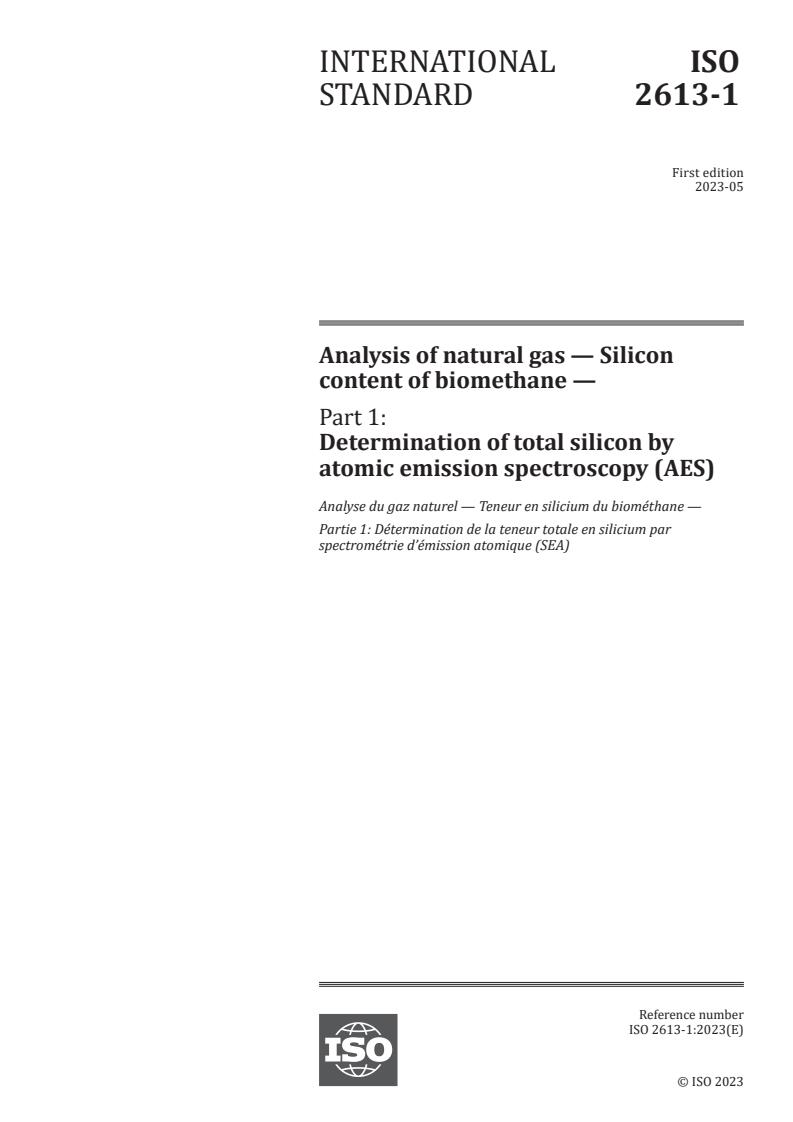
INTERNATIONAL ISO
STANDARD 2613-1
First edition
2023-05
Analysis of natural gas — Silicon
content of biomethane —
Part 1:
Determination of total silicon by
atomic emission spectroscopy (AES)
Analyse du gaz naturel — Teneur en silicium du biométhane —
Partie 1: Détermination de la teneur totale en silicium par
spectrométrie d’émission atomique (SEA)
Reference number
© ISO 2023
All rights reserved. Unless otherwise specified, or required in the context of its implementation, no part of this publication may
be reproduced or utilized otherwise in any form or by any means, electronic or mechanical, including photocopying, or posting on
the internet or an intranet, without prior written permission. Permission can be requested from either ISO at the address below
or ISO’s member body in the country of the requester.
ISO copyright office
CP 401 • Ch. de Blandonnet 8
CH-1214 Vernier, Geneva
Phone: +41 22 749 01 11
Email: copyright@iso.org
Website: www.iso.org
Published in Switzerland
ii
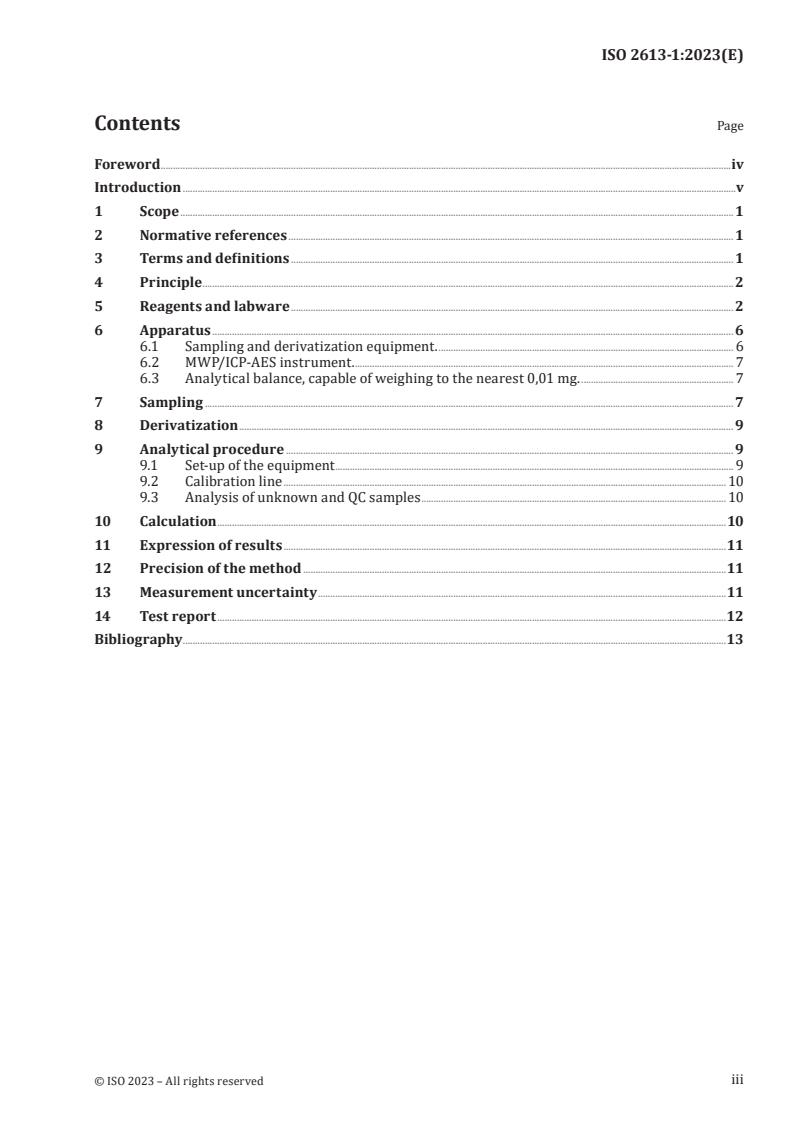
Contents Page
Foreword .iv
Introduction .v
1 Scope . 1
2 Normative references . 1
3 Terms and definitions . 1
4 Principle . 2
5 Reagents and labware . 2
6 Apparatus . 6
6.1 Sampling and derivatization equipment. . 6
6.2 MWP/ICP-AES instrument. . . 7
6.3 Analytical balance, capable of weighing to the nearest 0,01 mg. . 7
7 Sampling . 7
8 Derivatization . 9
9 Analytical procedure . 9
9.1 Set-up of the equipment . 9
9.2 Calibration line . 10
9.3 Analysis of unknown and QC samples . 10
10 Calculation .10
11 Expression of results .11
12 Precision of the method .11
13 Measurement uncertainty .11
14 Test report .12
Bibliography .13
iii
Foreword
ISO (the International Organization for Standardization) is a worldwide federation of national standards
bodies (ISO member bodies). The work of preparing International Standards is normally carried out
through ISO technical committees. Each member body interested in a subject for which a technical
committee has been established has the right to be represented on that committee. International
organizations, governmental and non-governmental, in liaison with ISO, also take part in the work.
ISO collaborates closely with the International Electrotechnical Commission (IEC) on all matters of
electrotechnical standardization.
The procedures used to develop this document and those intended for its further maintenance are
described in the ISO/IEC Directives, Part 1. In particular, the different approval criteria needed for the
different types of ISO documents should be noted. This document was drafted in accordance with the
editorial rules of the ISO/IEC Directives, Part 2 (see www.iso.org/directives).
Attention is drawn to the possibility that some of the elements of this document may be the subject of
patent rights. ISO shall not be held responsible for identifying any or all such patent rights. Details of
any patent rights identified during the development of the document will be in the Introduction and/or
on the ISO list of patent declarations received (see www.iso.org/patents).
Any trade name used in this document is information given for the convenience of users and does not
constitute an endorsement.
For an explanation of the voluntary nature of standards, the meaning of ISO specific terms and
expressions related to conformity assessment, as well as information about ISO's adherence to
the World Trade Organization (WTO) principles in the Technical Barriers to Trade (TBT), see
www.iso.org/iso/foreword.html.
This document was prepared by Technical Committee ISO/TC 193, Natural gas, Subcommittee SC 1,
Analysis of natural gas, in collaboration with the European Committee for Standardization (CEN)
Technical Committee CEN/TC 408, Biomethane for use in transport and injection in natural gas pipelines,
in accordance with the Agreement on technical cooperation between ISO and CEN (Vienna Agreement).
Any feedback or questions on this document should be directed to the user’s national standards body. A
complete listing of these bodies can be found at www.iso.org/members.html.
iv
Introduction
This document describes a method for the measurement of the total concentration of silicon in
biomethane, biogas and similar gaseous matrices when used in the natural gas grids and when using it
as a transport fuel. The method is based on using a liquid impinger to accumulate the silicon from a gas
sample, followed by instrumental analysis.
Due to the extensive usage of siloxane compounds, their volatility and great affinity to apolar
environments, siloxanes are considered as one of the most important impurities in biogas. They are
undesired because of their potential for abrasive SiO formation as combustion product that can
damage engines and appliances. Furthermore, some of these compounds present a health risk.
For the purpose of this document, silicon species measured is quoted as total silicon. Silicon measured
is from organosilicon species that are trapped from the gas phase in liquid media and derivatized into
2-
analytical form of hexafluorosilicate (SiF ) ions which remain present in solution when analysed.
v
INTERNATIONAL STANDARD ISO 2613-1:2023(E)
Analysis of natural gas — Silicon content of biomethane —
Part 1:
Determination of total silicon by atomic emission
spectroscopy (AES)
1 Scope
This document is applicable to the measurement of the total silicon content in gaseous matrices such
as biomethane and biogas. Silicon is present in a gas phase contained predominantly in siloxane
compounds, trimethylsilane and trimethylsilanol. The analytical form of the silicon measured in liquid
phase after conducted sampling and derivatization procedure is soluble hexafluorosilicate anion stable
in slightly acidified media. Total silicon is expressed as a mass of silicon in the volume of the analysed
gas.
This document is applicable to stated gaseous matrices with silicon concentrations up to 5 mg/m ,
and it is prevalently intended for the biomethane matrices with Si mass concentration of 0,1 mg/m to
0,5 mg/m .
With adaptation to ensure appropriate absorption efficiency, it can be used for higher concentrations.
3 3
The detection limit of the method is estimated as 0,05 mg/m based on a gas sample volume of 0,020 m .
All compounds present in the gas phase are volatile at the absorption and derivatization temperature
and gaseous organosilicon species are trapped in absorbance media and derivatized into analytical
silicon that is measured by this method. The concentration of the silicon is measured in diluted
derivatization media using atomic emission spectrometry upon atomisation/ionisation in microwave
or inductively coupled plasma.
Unless specified otherwise, all volumes and concentrations refer to standard reference conditions
(temperature, 273 K, and pressure, 101,325 kPa).
NOTE When using appropriate dilution factors, the method can also be applied for silicon concentrations
above 5 mg/m .
2 Normative references
The following documents are referred to in the text in such a way that some or all of their content
constitutes requirements of this document. For dated references, only the edition cited applies. For
undated references, the latest edition of the referenced document (including any amendments) applies.
ISO 3696, Water for analytical laboratory use — Specification and test methods
ISO 6143, Gas analysis — Comparison methods for determining and checking the composition of calibration
gas mixtures
ISO 14532, Natural gas — Vocabulary
ISO 10715, Natural gas — Gas sampling
ISO 14912, Gas analysis — Conversion of gas mixture composition data
3 Terms and definitions
For the purposes of this document, the terms and definitions given in ISO 14532 and the following apply.
ISO and IEC maintain terminological databases for use in standardization at the following addresses:
— ISO Online browsing platform: available at https:// www .iso .org/ obp
— IEC Electropedia: available at https:// www .electropedia .org/
3.1
siloxane
functional group where two silicon atoms are connected via an oxygen atom
Note 1 to entry: Depending on the substrate used to produce biogas and the process used for purification,
biomethane can contain siloxanes. During combustion, siloxanes can be oxidized to silicon dioxide, an abrasive
compound harmful for mechanical moving parts in e.g. engines and turbines.
3.2
atomic emission spectroscopy
AES
method of chemical analysis that uses the intensity of light emitted from a flame, plasma, arc, or spark
at a particular wavelength to determine the quantity of an element in a sample
4 Principle
WARNING — Persons using this document should be familiar with normal laboratory practice.
This standard does not purport to address all of the safety problems, if any, associated with its
use. It is the responsibility of the user to establish appropriate safety and health practices and to
ensure compliance with any national regulatory conditions.
A methane matrix gas sample (e.g. biomethane, biogas, natural gas and blends thereof) containing
siloxane compounds is passed through liquid absorbent (nitric acid) in serially connected gas bubblers/
impingers to collect the silicon-containing compounds. After sampling of an adequate gas volume,
content of sampling vessels (gas bubblers) is subjected to derivatization by adding hydroxide solution
2-
and hydrofluoric acid in order to obtain silicon in analytical from, hexafluorosilicate (SiF ) anion.
The derivatized sample is analysed for silicon content using an ICP/MWP atomic emission spectrometer
at selected characteristic silicon emission wavelengths using a multipoint calibration using a straight
line obtained from analysing a series of standard silicon solutions.
5 Reagents and labware
To carry out the method, the following reagents shall be of a recognized analytical grade and only
ISO 3696 grade 1 water. If it is visually determined that the reagents have changed their appearance
(colour, consistency, turbidity) they shall be discarded, and fresh ones shall be used.
5.1 Absorber media.
5.1.1 Nitric acid (HNO ), ρ = 1,41 g/ml; 65 % HNO (mass fraction) – for trace elemental
3 (20 ˚C) 3
analysis.
CAUTION — This chemical is especially dangerous if used outside specialized laboratory
conditions. Tests have been performed in which other non-oxo mineral acids (HCl) have been
used, but they have been shown to be inadequate for the absorption of siloxanes from the
gas phase. Special precautions are to be taken when handling this chemical in lab and field
conditions.
5.2 Derivatization media.
5.2.1 Sodium hydroxide pellets, for the preparation of 8 mol/l – 10 mol/l hydroxide solution.
Accurately weigh an appropriate amount of sodium hydroxide pellets and dissolve these in an
appropriate amount of reagent water (5.3). As an example for 100 ml of 10 mol/l sodium hydroxide
solutions, weigh 40 g of sodium hydroxide pellets and dissolve in 100 ml water.
Potassium hydroxide can also be used, but sodium hydroxide is preferred due to operation safety.
WARNING — Reaction of dissolving sodium hydroxide in water is highly exothermic! Heat will be
released and care should be taken when handling the reaction. Add pellets slowly to the water
and cool the dissolution vessel until the dissolution is complete.
5.2.2 Hydrofluoric acid (HF), ρ = 1,16 g/ml; 48 % HF (mass fraction).
(20 ˚C)
WARNING — Hydrofluoric acid is a very toxic acid and penetrates the skin and tissues deeply
if not treated immediately. Injury occurs in two stages: firstly, by hydration that induces tissue
necrosis; and secondly, by penetration of fluoride ions deep into the tissue and thereby reacting
with calcium. Boric acid and/or other complexing reagents and appropriate treatment agents
should be administered immediately. Consult appropriate safety literature for determining the
proper protective eyewear, clothing and gloves to use when handling hydrofluoric acid. Always
have appropriate treatment materials readily available prior to working with this acid.
CAUTION — This chemical is especially dangerous if used outside specialized laboratory
conditions. Tests have been performed in which other fluoride donor derivatization reagents
(NaF) have been used, but they have been shown to be inadequate for the derivatization of
absorbed siloxanes from the gas phase. Special precautions are to be taken when handling this
chemical in lab and field conditions
5.3 Water, complying with grade 1 of ISO 3696.
5.4 Pure siloxane compounds.
Linear siloxanes Molecular formula Cyclic siloxanes Molecular formula
Hexamethyldisiloxane – L2 C H OSi Hexamethylcyclotrisiloxane - D3 C H O Si
6 18 2 6 18 3 3
Octamethyltrisiloxane – L3 C H O Si Octamethylcyclotetrasiloxane C H O Si
8 24 2 3 8 24 4 4
- D4
Decamethyltetrasiloxane C H O Si Decamethylcyclopentasiloxane C H O Si
10 30 3 4 10 30 5 5
– L4 - D5
Dodecamethylpentasiloxane C H O Si Dodecamethylcyclohexasilox- C H O Si
12 36 4 5 12 36 6 6
– L5 ane - D6
Use at least one representative of chain and one representative of cyclic siloxane compounds for the
purpose of performing initial and regular quality control of the method validity.
5.5 pH colour-fixed indicator strips, pH range from 0 to 14, or, alternatively, a pH meter with HF
resistant electrode.
5.6 Calibration solutions.
5.6.1 General
The following procedure for the preparation of standard and calibration solutions of silicon is adjusted
to the lower range of silicon concentration in gas sample. If higher concentrations of silicon shall be
measured, adjust the concentrations of the working standard and calibration solutions accordingly.
When determining silicon in aqueous samples, only plastic, PTFE or quartz labware shall be used from
time of sample collection to completion of analysis.
5.6.2 Certified ICP-Si stock standard solution.
Example of certified Si standard solution is water solution (only trace level of HF is acceptable) with Si
mass concentration of 10 000 μg/ml and relative expanded uncertainty (coverage factor k = 2) 0,5 %.
This concentration is used in the example of the Si standard solution preparation in 5.6.3.
Certified Si stock standard solutions of other concentrations can also be used. Adjust the procedure for
preparing standard solution accordingly.
If Si stock standard solution is prepared in-house gravimetrically from salt-containing silicon, apply
required statistical procedure for obtaining accurate concentration accompanied with uncertainty
value.
NOTE References [1][2] provide guidance.
5.6.3 Si standard solution.
The target Si mass fraction is ρ(Si) ≈ 100 mg/kg. Weigh empty 50 ml plastic volumetric flask using
analytical balance (6.3). Add around 10 ml of 2 % nitric acid (mass fraction). Accurately pipette 0,5 ml
of stock solution (5.6.2) and add it to the plastic volumetric flask. Dilute with 2 % nitric acid (mass
fraction) to volume. Weigh full plastic volumetric flask and calculate the concentration of silicon.
Store the solution in plastic volumetric flask or similar vessel of silicon free material properly stoppered
at room temperature or refrigerated (~5 °C). The solution is stable for at least two weeks if stored
properly.
5.6.4 Si calibration solutions.
Gravimetrically prepare a minimum of five calibration solutions in accordance with expected silicon
concentration in the collected sample.
As an example proceed as follows for the Si mass fraction range from 10 μg/kg to 200 μg/kg.
Weigh empty 100 ml (or 200 ml) plastic volumetric flasks.
Pipette 10 μl; 20 μl; 50 μl; 75 μl; 100 μl; 150 μl; and 200 μl; respectively of silicon standard solution
(5.6.3) into 100 ml one-mark plastic volumetric flask that was empty-weighted and prefilled with
around 10 ml - 20 ml of 2 % nitric acid (mass fraction). Dilute with 2 % nitric acid (mass fraction) to
volume. Weigh full plastic volumetric flask and calculate the concentration of silicon.
The Si mass fraction in the calibration solutions is 10 μg/kg; 20 μg/kg; 50 μg/kg; 75 μg/kg; 100 μg/kg;
150 μg/kg and 200 μg/kg respectively.
Calculate the uncertainty of the mass fractions of the calibration solutions. Check what the contributions
are of the combination of shared effects, such as the uncertainty of the concentration of the stock
solution and the calibration of the pipette. If these effects account for more than 40 % of the uncertainty
budget, then calculate the dilution factors and their associated uncertainties. Then the concentrations
of these standards are substantially correlated.
5.6.5 Solution for wavelength calibration control.
Perform wavelength check using solution containing assorted elements covering the wavelength range
of the instrumentation used provided by the manufacturer prior to daily calibration of the instrument
for the analysis of silicon. This solution is usually provided as concentrate that needs to be diluted prior
to the analysis in accordance with the manufacturer’s instructions. Wavelength calibration control test
result shows if the optical settings of the instrument are appropriate, and if the readings of the emission
lines for each individual element correspond to the instrumental settings when selecting the analytical
wavelengths for the analyte of interest.
NOTE The solution for wavelength calibration control is usually provided by the manufacturer of the
equipment.
5.7 Quality control.
5.7.1 Blanks.
Three types of blanks are used during the analysis. The calibration blank is used in establishing the
analytical curve, the laboratory reagent blank is used to asses
...
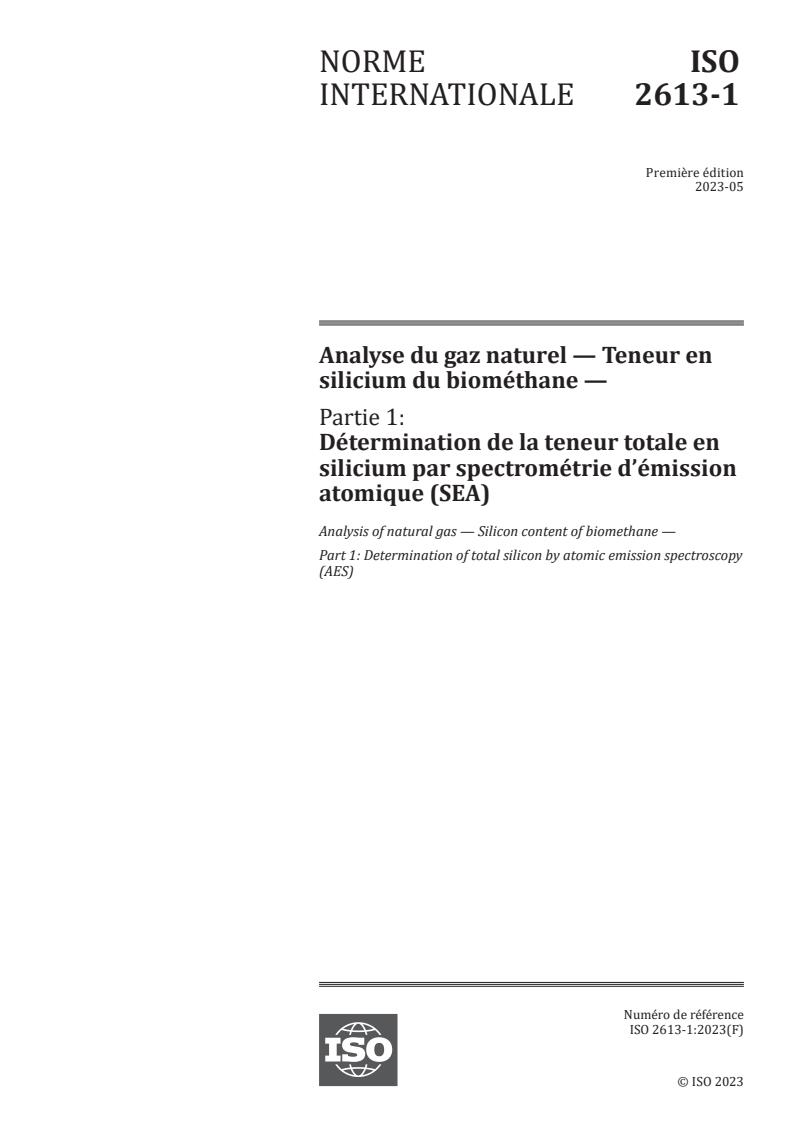
NORME ISO
INTERNATIONALE 2613-1
Première édition
2023-05
Analyse du gaz naturel — Teneur en
silicium du biométhane —
Partie 1:
Détermination de la teneur totale en
silicium par spectrométrie d’émission
atomique (SEA)
Analysis of natural gas — Silicon content of biomethane —
Part 1: Determination of total silicon by atomic emission spectroscopy
(AES)
Numéro de référence
DOCUMENT PROTÉGÉ PAR COPYRIGHT
© ISO 2023
Tous droits réservés. Sauf prescription différente ou nécessité dans le contexte de sa mise en œuvre, aucune partie de cette
publication ne peut être reproduite ni utilisée sous quelque forme que ce soit et par aucun procédé, électronique ou mécanique,
y compris la photocopie, ou la diffusion sur l’internet ou sur un intranet, sans autorisation écrite préalable. Une autorisation peut
être demandée à l’ISO à l’adresse ci-après ou au comité membre de l’ISO dans le pays du demandeur.
ISO copyright office
Case postale 401 • Ch. de Blandonnet 8
CH-1214 Vernier, Genève
Tél.: +41 22 749 01 11
E-mail: copyright@iso.org
Web: www.iso.org
Publié en Suisse
ii
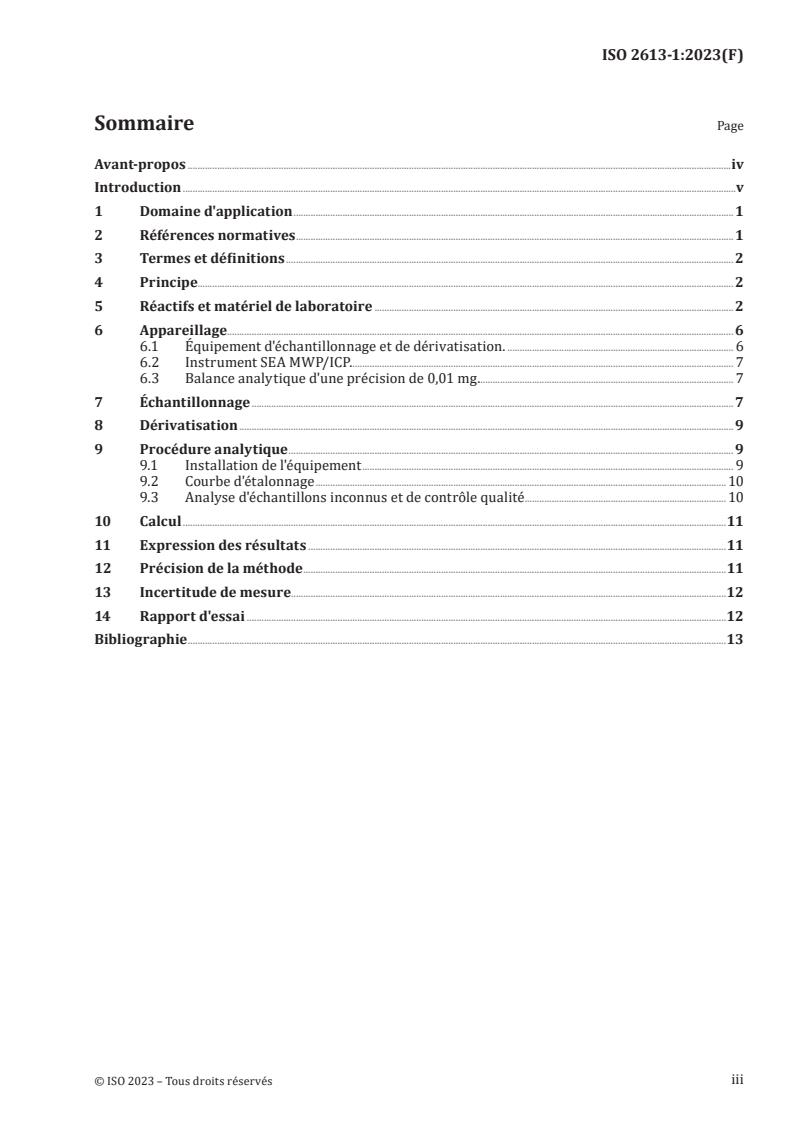
Sommaire Page
Avant-propos .iv
Introduction .v
1 Domaine d'application .1
2 Références normatives .1
3 Termes et définitions . 2
4 Principe. 2
5 Réactifs et matériel de laboratoire .2
6 Appareillage . 6
6.1 Équipement d'échantillonnage et de dérivatisation. . 6
6.2 Instrument SEA MWP/ICP. 7
6.3 Balance analytique d'une précision de 0,01 mg. . 7
7 Échantillonnage .7
8 Dérivatisation .9
9 Procédure analytique . 9
9.1 Installation de l'équipement . 9
9.2 Courbe d'étalonnage . 10
9.3 Analyse d'échantillons inconnus et de contrôle qualité. 10
10 Calcul .11
11 Expression des résultats .11
12 Précision de la méthode .11
13 Incertitude de mesure.12
14 Rapport d'essai .12
Bibliographie .13
iii
Avant-propos
L'ISO (Organisation internationale de normalisation) est une fédération mondiale d'organismes
nationaux de normalisation (comités membres de l'ISO). L'élaboration des Normes internationales est
en général confiée aux comités techniques de l'ISO. Chaque comité membre intéressé par une étude
a le droit de faire partie du comité technique créé à cet effet. Les organisations internationales,
gouvernementales et non gouvernementales, en liaison avec l'ISO participent également aux travaux.
L'ISO collabore étroitement avec la Commission électrotechnique internationale (IEC) en ce qui
concerne la normalisation électrotechnique.
Les procédures utilisées pour élaborer le présent document et celles destinées à sa mise à jour sont
décrites dans les Directives ISO/IEC, Partie 1. Il convient, en particulier de prendre note des différents
critères d'approbation requis pour les différents types de documents ISO. Le présent document
a été rédigé conformément aux règles de rédaction données dans les Directives ISO/IEC, Partie 2
(voir www.iso.org/directives).
L'attention est attirée sur le fait que certains des éléments du présent document peuvent faire l'objet de
droits de propriété intellectuelle. L'ISO ne saurait être tenue pour responsable de ne pas avoir identifié
de tels droits de propriété. Les détails concernant les références aux droits de propriété intellectuelle
identifiés lors de l'élaboration du document sont indiqués dans l'Introduction et/ou dans la liste des
déclarations de brevets reçues par l'ISO (voir www.iso.org/brevets).
Les appellations commerciales éventuellement mentionnées dans le présent document sont données
pour information, par souci de commodité, à l'intention des utilisateurs et ne sauraient constituer un
engagement.
Pour une explication de la nature volontaire des normes, la signification des termes et expressions
spécifiques de l'ISO liés à l'évaluation de la conformité, ou pour toute information au sujet de l'adhésion
de l'ISO aux principes de l'Organisation mondiale du commerce (OMC) concernant les obstacles
techniques au commerce (OTC), voir le lien suivant: www.iso.org/iso/fr/avant-propos.
Le présent document a été élaboré par le comité technique ISO/TC 193, Gaz naturel, sous-comité SC 1,
Analyse du gaz naturel, en collaboration avec le Comité Européen de Normalisation (CEN) Comité Technique
CEN/TC 408, Biométhane pour utilisation dans les transports et injection dans le réseau de gaz naturel,
conformément à l’accord de coopération technique entre l’ISO et le CEN (Accord de Vienne).
Il convient que l'utilisateur adresse tout retour d'information ou toute question concernant le présent
document à l'organisme national de normalisation de son pays. Une liste exhaustive desdits organismes
se trouve à l'adresse www.iso.org/fr/members.html.
iv
Introduction
Le présent document décrit une méthode pour mesurer la concentration totale de silicium dans le
biométhane, le biogaz ou des matrices gazeuses similaires lorsqu'ils sont injectés dans des réseaux de
gaz naturel ou utilisés comme combustibles pour le transport. Cette méthode est fondée sur l'utilisation
d’un barboteur en solution liquide pour piéger le silicium d’un échantillon de gaz, suivie d'une analyse
instrumentale.
En raison de l'utilisation intensive de composés de siloxane, de la volatilité de ces derniers et de leur
grande affinité avec les milieux apolaires, les siloxanes sont considérés comme l'une des impuretés
majeures du biogaz. Ces composés sont indésirables car leur combustion peut produire du SiO abrasif,
qui peut endommager les moteurs et les appareils. De plus, certains d'entre eux présentent un risque
pour la santé.
Pour les besoins du présent document, les composés au silicium mesurés sont exprimés en tant que
«silicium total». Le silicium mesuré provient de composés organo-siliciés qui sont piégés en phase
gazeuse dans des milieux liquides puis convertis sous forme analytique d’ions hexafluorosilicate
(SiF62-), toujours présents lors de l'analyse de la solution.
v
NORME INTERNATIONALE ISO 2613-1:2023(F)
Analyse du gaz naturel — Teneur en silicium du
biométhane —
Partie 1:
Détermination de la teneur totale en silicium par
spectrométrie d’émission atomique (SEA)
1 Domaine d'application
Le présent document s'applique à la mesure de la teneur en silicium total dans des matrices
gazeuses telles que le biométhane et le biogaz. Le silicium est présent sous forme gazeuse, et contenu
principalement dans des composés de siloxane, le triméthylsilane et le triméthylsilanol. La forme
analytique du silicium mesurée dans la phase liquide après échantillonnage et dérivatisation, est
un anion hexafluorosilicate soluble stable dans les milieux légèrement acidifiés. Le silicium total est
exprimé sous la forme d'une masse de silicium dans le volume du gaz analysé.
Le présent document s'applique aux matrices gazeuses énoncées, avec des concentrations de silicium
allant jusqu'à 5 mg/m , et concerne principalement les matrices de biométhane avec une teneur en
3 3
silicium comprise entre 0,1 mg/m et 0,5 mg/m .
Avec une adaptation assurant une efficacité d'absorption appropriée, il peut être utilisé pour des
concentrations plus élevées. La limite de détection de cette méthode est estimée à 0,05 mg/m pour
un volume d'échantillon de gaz de 0,020 m . Tous les composés présents dans la phase gazeuse sont
volatils à la température d'absorption et de dérivatisation, et les composés organosiliciés gazeux sont
piégés dans le milieu d'absorption puis dérivés sous forme de silicium analytique qui est mesuré selon
la présente méthode. La concentration de silicium est mesurée dans le milieu de dérivatisation dilué,
par spectrométrie d'émission atomique, après atomisation/ionisation dans un plasma micro-ondes ou
à couplage inductif.
Sauf indication contraire, tous les volumes et concentrations sont établis pour des conditions normales
(température, 273 K et pression, 101,325 kPa).
NOTE Avec des facteurs de dilution appropriés, la méthode peut également être appliquée à des
concentrations de silicium supérieures à 5 mg/m .
2 Références normatives
Les documents suivants sont cités dans le texte de sorte qu'ils constituent, pour tout ou partie de leur
contenu, des exigences du présent document. Pour les références datées, seule l'édition citée s'applique.
Pour les références non datées, la dernière édition du document de référence s'applique (y compris les
éventuels amendements).
ISO 3696, Eau pour laboratoire à usage analytique — Spécification et méthodes d'essai
ISO 6143, Analyse des gaz — Méthodes comparatives pour la détermination et la vérification de la
composition des mélanges de gaz pour étalonnage
ISO 14532, Gaz naturel — Vocabulaire
ISO 10715, Gaz naturel — Échantillonnage de gaz
ISO 14912, Analyse des gaz — Conversion des données de composition de mélanges gazeux
3 Termes et définitions
Pour les besoins du présent document, les termes et définitions donnés dans l'ISO 14532 ainsi que les
suivants s'appliquent.
L'ISO et l'IEC tiennent à jour des bases de données terminologiques destinées à être utilisées en
normalisation, consultables aux adresses suivantes:
— ISO Online browsing platform: disponible à l'adresse https:// www .iso .org/ obp.
— IEC Electropedia: disponible à l'adresse https:// www .electropedia .org/
3.1
siloxane
groupe fonctionnel composé de deux atomes de silicium liés par un atome d'oxygène
Note 1 à l'article: En fonction du substrat utilisé pour produire le biogaz et du procédé utilisé pour la purification,
le biométhane peut contenir des siloxanes. Lors de la combustion, les siloxanes peuvent être oxydés en dioxyde de
silicium, un composé abrasif dangereux pour les pièces mécaniques en mouvement des moteurs ou des turbines
par exemple.
3.2
spectrométrie d'émission atomique
SEA
méthode d'analyse chimique qui utilise l'intensité de la lumière émise par une flamme, un plasma, un
arc ou une étincelle à une longueur d'ondes donnée, pour déterminer la quantité d'un élément dans un
échantillon
4 Principe
AVERTISSEMENT — Il convient que l'utilisateur de la présente Norme internationale connaisse
bien les pratiques courantes de laboratoire. La présente norme n'a pas pour but de traiter tous
les problèmes de sécurité qui sont, le cas échéant, liés à son utilisation. Il incombe à l'utilisateur
d'établir des pratiques appropriées en matière d'hygiène et de sécurité et de s'assurer de la
conformité à la réglementation nationale en vigueur.
On fait passer un échantillon de matrice gazeuse de méthane (par exemple, biométhane, biogaz, gaz
naturel ou mélanges de ces composés) contenant des composés de siloxane dans un liquide absorbant
(acide nitrique) contenu dans des barboteurs à gaz/barboteurs connectés en série afin de recueillir
les composés contenant du silicium. Après échantillonnage d'un volume adéquat de gaz, on soumet
le contenu des récipients d'échantillonnage (barboteurs à gaz) à une dérivatisation en y ajoutant une
solution d'hydroxyde et de l'acide fluorhydrique afin d'obtenir du silicium sous forme analytique: l'anion
2-
hexafluorosilicate (SiF ).
On analyse la teneur en silicium de l'échantillon dérivé à l'aide d'un spectromètre d'émission atomique
ICP/MWP aux longueurs d'ondes d'émission caractéristiques du silicium, avec un étalonnage multi-
points linéaire obtenu par l'analyse d'une série de solutions étalons de silicium.
5 Réactifs et matériel de laboratoire
Pour appliquer la méthode, seuls les réactifs de qualité analytique reconnue suivants et de l'eau de
qualité 1 selon l'ISO 3696 doivent être utilisés. En cas de changement d'aspect (couleur, consistance,
turbidité) visible à l'œil nu, les réactifs doivent être éliminés et remplacés par de nouveaux réactifs.
5.1 Milieu d'absorption.
5.1.1 Acide nitrique (HNO ), ρ = 1,41 g/ml; 65 % HNO (fraction massique) – pour l'analyse des
3 (20 °C) 3
éléments à l'état de traces.
ATTENTION — Ce produit chimique est particulièrement dangereux s'il n'est pas utilisé dans
des conditions de laboratoire spécifiques. Des essais ont été réalisés avec d'autres acides
minéraux non oxydants (HCI), mais il a été démontré qu'ils ne conviennent pas pour l'absorption
des siloxanes de la phase gazeuse. Des précautions particulières sont à prendre lors de la
manipulation de ce produit chimique dans des conditions de laboratoire et en conditions réelles.
5.2 Milieu de dérivatisation.
5.2.1 Hydroxyde de sodium en pastilles, pour la préparation d'une solution d'hydroxyde
de 8 mol/l à 10 mol/l.
Peser avec précision la quantité appropriée d'hydroxyde de sodium en pastilles et la dissoudre dans la
quantité d'eau ultrapure correspondante (5.3). Par exemple, pour 100 ml de solution d'hydroxyde de
sodium à 10 mol/l, peser 40 g d'hydroxyde de sodium en pastilles et les dissoudre dans 100 ml d'eau.
Il est également possible d'utiliser de l'hydroxyde de potassium, mais l'hydroxyde de sodium est préféré
pour des raisons de sécurité.
AVERTISSEMENT — La réaction liée à la dissolution de l'hydroxyde de sodium dans l'eau est
fortement exothermique! Elle libère de la chaleur et il convient d'agir avec précaution lors des
manipulations. Ajouter les pastilles dans l'eau petit à petit, et refroidir le récipient jusqu'à ce
que la dissolution soit terminée.
5.2.2 Acide fluorhydrique (HF), ρ = 1,16 g/ml; 48 % HF (fraction massique).
(20 °C)
AVERTISSEMENT — L'acide fluorhydrique est un acide très toxique qui pénètre profondément
dans la peau et les tissus s'il n'est pas traité immédiatement. Les lésions se produisent en deux
temps: d'abord par l'hydratation, qui entraîne une nécrose des tissus, puis par la pénétration
d'ions fluorure en profondeur dans les tissus et leur réaction avec le calcium. Il convient
d'appliquer immédiatement de l'acide borique ou d'autres réactifs complexants ainsi que des
réactifs de traitement appropriés. Se référer aux documents de sécurité pour déterminer quels
équipements de sécurité (lunettes, vêtements, gants) porter lors de la manipulation d'acide
fluorhydrique. Toujours avoir le matériel de soin nécessaire à portée de main avant de démarrer
les travaux avec cet acide.
ATTENTION — Ce produit chimique est particulièrement dangereux s'il n'est pas utilisé dans
des conditions de laboratoire spécifiques. Des essais ont été réalisés avec d'autres réactifs de
dérivatisation donneurs de fluorure (NaF), cependant ils semblent être inadéquats pour la
dérivatisation des siloxanes absorbés en phase gazeuse. Il convient de prendre des précautions
particulières lors de la manipulation de ce produit chimique dans des conditions de laboratoire
et en conditions réelles.
5.3 Eau, de qualité 1 conformément à l'ISO 3696.
5.4 Composés de siloxanes purs.
Siloxanes linéaires Formule brute Siloxanes cycliques Formule brute
Hexaméthyldisiloxane - L2 C H OSi Hexaméthylcyclotrisiloxane - D3 C H O Si
6 18 2 6 18 3 3
Octaméthyltrisiloxane- L3 C H O Si Octaméthylcyclotétrasiloxane - D4 C H O Si
8 24 2 3 8 24 4 4
Décaméthyltétrasiloxane - L4 C H O Si Décaméthylcyclopentasiloxane - D5 C H O Si
10 30 3 4 10 30 5 5
Dodécaméthylpentasiloxane - L5 C H O Si Dodécaméthylcyclohexasiloxane - D6 C H O Si
12 36 4 5 12 36 6 6
Utiliser au moins un représentant linéaire et un représentant cycliques des composés de siloxanes afin
de réaliser un contrôle qualité initial et régulier de la validité de la méthode.
5.5 Bandelettes indicatrices de pH, plages de pH allant de 0 à 14, ou, le cas échéant, un pH-mètre
avec une électrode résistante à l'HF.
5.6 Solutions d'étalonnage.
5.6.1 Généralités
Le mode opératoire suivant, pour la préparation de solutions étalons et de solutions d'étalonnage du
silicium, est ajusté à la concentration de silicium la plus basse dans un échantillon gazeux. Dans le cas
où des concentrations de silicium plus élevées doivent être mesurées, régler les concentrations des
solutions étalons de travail et d'étalonnage en conséquence.
Pour déterminer la concentration de silicium dans des échantillons aqueux, seul du matériel de
laboratoire en plastique, en PTFE ou en quartz doit être utilisé, à partir du moment où l'échantillon est
recueilli et jusqu'à la fin de l'analyse.
5.6.2 Solution étalon mère de Silicium certifiée pour l’ICP.
Un exemple de solution étalon de Si certifiée peut être une solution avec une concentration massique en
Si de 10 000 μg/ml dans de l’eau (seul du HF a l’état de traces est acceptable) et une incertitude élargie
relative (facteur d’élargissement k = 2) de 0,5 %. Cette concentration est utilisée dans l’exemple de la
préparation de la solution étalon de si du 5.6.3.
Des solutions étalons mères de Si certifiées avec d'autres concentrations peuvent aussi être utilisées.
Ajuster le mode opératoire pour la préparation de solution étalon en conséquence.
Si la solution étalon mère de Si est préparée, en interne, par pesée de sels de silicium, appliquer les
méthodes statistiques requises afin d'obtenir une concentration précise, accompagnée d'une valeur
d'incertitude.
NOTE Les Références [1][2] fournissent des recommandations.
5.6.3 Solution étalon de Si.
La fraction massique de Si visée est ρ(Si) ≈ 100 mg/kg. Peser une fiole jaugée de 50 ml, vide et en
plastique, à l'aide d'une balance analytique (6.3). Ajouter environ 10 ml d'acide nitrique 2 % (fraction
massique). Pipetter avec précision 0,5 ml de solution étalon (5.6.2) et l'ajouter à la fiole jaugée. Diluer
au volume avec de l'acide nitrique 2 % (fraction massique). Peser la fiole jaugée remplie et calculer la
concentration de silicium.
Conserver la solution dans une fiole jaugée ou un récipient similaire sans silicone, correctement fermé,
à température ambiante ou au frais (~5 °C). La solution reste stable pendant deux semaines environ, si
elle est correctement conservée.
5.6.4 Solutions d'étalonnage de Si.
Préparer, par pesée, un minimum de cinq solutions d'étalonnage, en fonction de la concentration de
silicium attendue dans les échantillons prélevés.
Par exemple, procéder comme suit pour une plage de fractions massiques de Si de 10 μg/kg à 200 μg/
kg:
Peser des fioles jaugées de 100 ml (ou 200 ml), vides et en plastique.
Pipetter respectivement 10 μl, 20 μl, 50 μl, 75 μl, 100 μl, 150 μl et 200 μl de solution étalon de
silicium (5.6.3) dans une fiole jaugée en plastique à un trait de 100 ml, qui a été pesée vide, et préremplie
avec environ 10 ml à 20 ml d'acide nitrique 2 % (fraction massique). Diluer au volume avec de l'acide
nitrique 2 % (fraction massique). Peser la fiole jaugée remplie et calculer la concentration de silicium.
Les fractions massiques de silicium des solutions d'étalonnage sont respectivement 10 μg/kg; 20 μg/
kg; 50 μg/kg; 75 μg/kg; 100 μg/kg; 150 μg/kg et 200 μg/kg.
Calculer l’incertitude sur les fractions massiques des solutions d’étalonnage. Vérifiez quelles sont
les contributions de la combinaison des effets partagés, telles que l'incertitude de la concentration
de la solution mère ou de l'étalonnage de la pipette. Si ces effets contribuent pour plus de 40 % du
budget d’incertitude, alors calculer les facteurs de dilution et leurs incertitudes associées. Ainsi les
concentrations de ces solutions étalon sont substantiellement corrélées.
5.6.5 Solution pour le contrôle d'étalonnage de la longueur d'ondes.
Procéder à la vérification de la longueur d'ondes avant l'étalonnage quotidien de l'instrument pour
l'analyse en silicium, à l'aide d'une solution qui contient les différents éléments couvrant la plage de
longueur d'ondes de l'instrumentation utilisée, fournie par le fabricant. Cette solution est habituellement
fournie sous la forme d'un concentré qui doit être dilué avant l'analyse, conformément aux instructions
du fabricant. Le résultat de l'essai du contrôle d'étalonnage de la longueur d'ondes montre si les
paramètres optiques de l'instrument sont appropriés, et si le relevé des raies d'émission de chaque
élément correspond aux paramètres de l'instrument lorsque les longueurs d'ondes analytiques sont
sélectionnées pour l'analyte d'intérêt.
NOTE La solution pour le contrôle d'étalonnage est habituellement fournie par le fabricant de l'équipement.
5.7 Contrôle qualité.
5.7.1 Blancs.
Trois types de blancs sont utilisés lors de l'analyse. Le blanc d'étalonnage est utilisé pour établir la
courbe analytique, le blanc de réactif de laboratoire est utilisé pour repérer toute contamination issue
du mode opératoire de la préparation d'échantillon et un blanc de rinçage est utilisé pour rincer les
instruments et le nébuliseur entre les étalons, les solutions de contrôle et les échantillons pour réduire
les interférences de mémoire.
5.7.1.1 Le blanc d'étalonnage est préparé en acidifiant une eau ultrapure aux mêmes concentrations
que celles des acides utilisés pour les étalons; dans ce cas il s'agit d'acide nitri
...
Frequently Asked Questions
ISO 2613-1:2023 is a standard published by the International Organization for Standardization (ISO). Its full title is "Analysis of natural gas - Silicon content of biomethane - Part 1: Determination of total silicon by atomic emission spectroscopy (AES)". This standard covers: This document is applicable to the measurement of the total silicon content in gaseous matrices such as biomethane and biogas. Silicon is present in a gas phase contained predominantly in siloxane compounds, trimethylsilane and trimethylsilanol. The analytical form of the silicon measured in liquid phase after conducted sampling and derivatization procedure is soluble hexafluorosilicate anion stable in slightly acidified media. Total silicon is expressed as a mass of silicon in the volume of the analysed gas. This document is applicable to stated gaseous matrices with silicon concentrations up to 5 mg/m3, and it is prevalently intended for the biomethane matrices with Si mass concentration of 0,1 mg/m3 to 0,5 mg/m3. With adaptation to ensure appropriate absorption efficiency, it can be used for higher concentrations. The detection limit of the method is estimated as 0,05 mg/m3 based on a gas sample volume of 0,020 m3. All compounds present in the gas phase are volatile at the absorption and derivatization temperature and gaseous organosilicon species are trapped in absorbance media and derivatized into analytical silicon that is measured by this method. The concentration of the silicon is measured in diluted derivatization media using atomic emission spectrometry upon atomisation/ionisation in microwave or inductively coupled plasma. Unless specified otherwise, all volumes and concentrations refer to standard reference conditions (temperature, 273 K, and pressure, 101,325 kPa). NOTE When using appropriate dilution factors, the method can also be applied for silicon concentrations above 5 mg/m3.
This document is applicable to the measurement of the total silicon content in gaseous matrices such as biomethane and biogas. Silicon is present in a gas phase contained predominantly in siloxane compounds, trimethylsilane and trimethylsilanol. The analytical form of the silicon measured in liquid phase after conducted sampling and derivatization procedure is soluble hexafluorosilicate anion stable in slightly acidified media. Total silicon is expressed as a mass of silicon in the volume of the analysed gas. This document is applicable to stated gaseous matrices with silicon concentrations up to 5 mg/m3, and it is prevalently intended for the biomethane matrices with Si mass concentration of 0,1 mg/m3 to 0,5 mg/m3. With adaptation to ensure appropriate absorption efficiency, it can be used for higher concentrations. The detection limit of the method is estimated as 0,05 mg/m3 based on a gas sample volume of 0,020 m3. All compounds present in the gas phase are volatile at the absorption and derivatization temperature and gaseous organosilicon species are trapped in absorbance media and derivatized into analytical silicon that is measured by this method. The concentration of the silicon is measured in diluted derivatization media using atomic emission spectrometry upon atomisation/ionisation in microwave or inductively coupled plasma. Unless specified otherwise, all volumes and concentrations refer to standard reference conditions (temperature, 273 K, and pressure, 101,325 kPa). NOTE When using appropriate dilution factors, the method can also be applied for silicon concentrations above 5 mg/m3.
ISO 2613-1:2023 is classified under the following ICS (International Classification for Standards) categories: 75.060 - Natural gas. The ICS classification helps identify the subject area and facilitates finding related standards.
ISO 2613-1:2023 has the following relationships with other standards: It is inter standard links to ISO 1247-1:2021. Understanding these relationships helps ensure you are using the most current and applicable version of the standard.
You can purchase ISO 2613-1:2023 directly from iTeh Standards. The document is available in PDF format and is delivered instantly after payment. Add the standard to your cart and complete the secure checkout process. iTeh Standards is an authorized distributor of ISO standards.
Questions, Comments and Discussion
Ask us and Technical Secretary will try to provide an answer. You can facilitate discussion about the standard in here.
Loading comments...