


ISO 12616:2002
(Main)Translation-oriented terminography
Translation-oriented terminography
This International Standard provides guidelines to enable translators and translation support staff to record, maintain and quickly and easily retrieve terminological information in connection with translation work. The quality of a translation can be measured partly in terms of linguistic elements, such as style and grammar, and partly in terms of the accurate use of the terminology involved. The guidelines in this International Standard provide the necessary elements for quality control of terminological information in translations. The guidelines can also be adapted to provide a basis for the administration of source-language texts, parallel texts, translations, and other information (e.g. bibliographies, references) in the target language. This International Standard is applicable to the work of an individual translator as well as the work of a team or a department. It also lays down guidelines that are essential for the interchange of terminological data.
Terminographie axée sur la traduction
La présente Norme internationale fournit des recommandations permettant aux traducteurs et au personnel d'assistance à la traduction de consigner, de mettre à jour et d'extraire rapidement et avec facilité des informations terminologiques en rapport avec le travail de traduction. La qualité d'une traduction peut se mesurer en partie à travers des éléments linguistiques tels que le style et la grammaire, et en partie à travers une évaluation de l'adéquation de la terminologie utilisée. Les recommandations données dans la présente Norme internationale fournissent les éléments nécessaires au contrôle de la qualité des informations terminologiques dans les traductions. Ces recommandations peuvent également être adaptées pour fournir une base en vue de la gestion des textes en langue source, de textes parallèles, de traductions et de toute autre information (par exemple bibliographies, références) dans la langue cible. La présente Norme internationale s'applique au travail des traducteurs considérés individuellement ainsi qu'à celui d'une équipe ou d'un service. Elle fixe également des recommandations essentielles pour l'échange de données terminologiques.
General Information
- Status
- Withdrawn
- Publication Date
- 20-Mar-2002
- Withdrawal Date
- 20-Mar-2002
- Technical Committee
- ISO/TC 37/SC 2 - Terminology workflow and language coding
- Drafting Committee
- ISO/TC 37/SC 2/WG 2 - Terminography
- Current Stage
- 9599 - Withdrawal of International Standard
- Start Date
- 02-Sep-2021
- Completion Date
- 14-Feb-2026
Relations
- Effective Date
- 24-Sep-2016
Frequently Asked Questions
ISO 12616:2002 is a standard published by the International Organization for Standardization (ISO). Its full title is "Translation-oriented terminography". This standard covers: This International Standard provides guidelines to enable translators and translation support staff to record, maintain and quickly and easily retrieve terminological information in connection with translation work. The quality of a translation can be measured partly in terms of linguistic elements, such as style and grammar, and partly in terms of the accurate use of the terminology involved. The guidelines in this International Standard provide the necessary elements for quality control of terminological information in translations. The guidelines can also be adapted to provide a basis for the administration of source-language texts, parallel texts, translations, and other information (e.g. bibliographies, references) in the target language. This International Standard is applicable to the work of an individual translator as well as the work of a team or a department. It also lays down guidelines that are essential for the interchange of terminological data.
This International Standard provides guidelines to enable translators and translation support staff to record, maintain and quickly and easily retrieve terminological information in connection with translation work. The quality of a translation can be measured partly in terms of linguistic elements, such as style and grammar, and partly in terms of the accurate use of the terminology involved. The guidelines in this International Standard provide the necessary elements for quality control of terminological information in translations. The guidelines can also be adapted to provide a basis for the administration of source-language texts, parallel texts, translations, and other information (e.g. bibliographies, references) in the target language. This International Standard is applicable to the work of an individual translator as well as the work of a team or a department. It also lays down guidelines that are essential for the interchange of terminological data.
ISO 12616:2002 is classified under the following ICS (International Classification for Standards) categories: 01.120 - Standardization. General rules. The ICS classification helps identify the subject area and facilitates finding related standards.
ISO 12616:2002 has the following relationships with other standards: It is inter standard links to ISO 12616-1:2021. Understanding these relationships helps ensure you are using the most current and applicable version of the standard.
ISO 12616:2002 is available in PDF format for immediate download after purchase. The document can be added to your cart and obtained through the secure checkout process. Digital delivery ensures instant access to the complete standard document.
Standards Content (Sample)
INTERNATIONAL ISO
STANDARD 12616
First edition
2002-03-15
Translation-oriented terminography
Terminographie axée sur la traduction
Reference number
©
ISO 2002
PDF disclaimer
This PDF file may contain embedded typefaces. In accordance with Adobe's licensing policy, this file may be printed or viewed but shall not
be edited unless the typefaces which are embedded are licensed to and installed on the computer performing the editing. In downloading this
file, parties accept therein the responsibility of not infringing Adobe's licensing policy. The ISO Central Secretariat accepts no liability in this
area.
Adobe is a trademark of Adobe Systems Incorporated.
Details of the software products used to create this PDF file can be found in the General Info relative to the file; the PDF-creation parameters
were optimized for printing. Every care has been taken to ensure that the file is suitable for use by ISO member bodies. In the unlikely event
that a problem relating to it is found, please inform the Central Secretariat at the address given below.
© ISO 2002
All rights reserved. Unless otherwise specified, no part of this publication may be reproduced or utilized in any form or by any means, electronic
or mechanical, including photocopying and microfilm, without permission in writing from either ISO at the address below or ISO's member body
in the country of the requester.
ISO copyright office
Case postale 56 • CH-1211 Geneva 20
Tel. + 41 22 749 01 11
Fax + 41 22 749 09 47
E-mail copyright@iso.ch
Web www.iso.ch
Printed in Switzerland
ii © ISO 2002 – All rights reserved
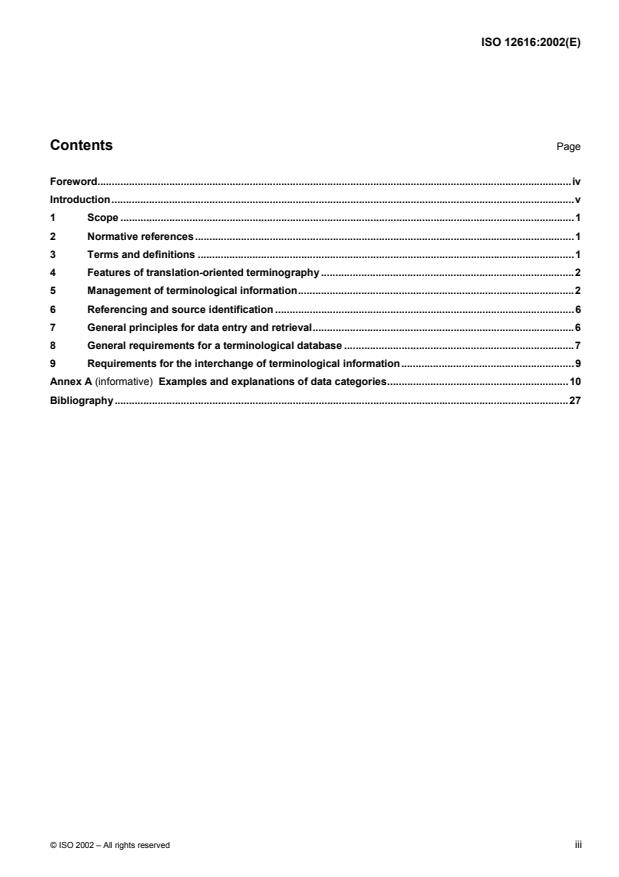
Contents Page
Foreword.iv
Introduction.v
1 Scope.1
2 Normative references.1
3 Terms and definitions .1
4 Features of translation-oriented terminography .2
5 Management of terminological information.2
6 Referencing and source identification .6
7 General principles for data entry and retrieval.6
8 General requirements for a terminological database .7
9 Requirements for the interchange of terminological information.9
Annex A (informative) Examples and explanations of data categories.10
Bibliography.27
Foreword
ISO (the International Organization for Standardization) is a worldwide federation of national standards bodies (ISO
member bodies). The work of preparing International Standards is normally carried out through ISO technical
committees. Each member body interested in a subject for which a technical committee has been established has
the right to be represented on that committee. International organizations, governmental and non-governmental, in
liaison with ISO, also take part in the work. ISO collaborates closely with the International Electrotechnical
Commission (IEC) on all matters of electrotechnical standardization.
International Standards are drafted in accordance with the rules given in the ISO/IEC Directives, Part 3.
The main task of technical committees is to prepare International Standards. Draft International Standards adopted
by the technical committees are circulated to the member bodies for voting. Publication as an International
Standard requires approval by at least 75 % of the member bodies casting a vote.
Attention is drawn to the possibility that some of the elements of this International Standard may be the subject of
patent rights. ISO shall not be held responsible for identifying any or all such patent rights.
ISO 12616 was prepared by Technical Committee ISO/TC 37, Terminology and other language resources,
Subcommittee SC 2, Terminology and lexicography.
Annex A of this International Standard is for information only.
iv © ISO 2002 – All rights reserved
Introduction
Translators have always had a need to record terminological information for later use. Translators dealing with
specialized texts face an increasing need to record and retrieve terminological information, as it saves time and
allows them to work more efficiently. Experience has shown that terminography facilitates translation by enabling
translators
to record and systematize terminology,
to use terminology consistently over time, and
to deal more efficiently with multiple languages.
By recording terminological information systematically, translators can enhance their performance, improve text
quality and increase productivity. An organized collection of terminological information makes it possible for
translators to keep track of, and reuse, their expertise, and facilitates cooperation between individuals or teams of
translators.
INTERNATIONAL STANDARD ISO 12616:2002(E)
Translation-oriented terminography
1 Scope
This International Standard provides guidelines to enable translators and translation support staff to record,
maintain and quickly and easily retrieve terminological information in connection with translation work.
The quality of a translation can be measured partly in terms of linguistic elements, such as style and grammar, and
partly in terms of the accurate use of the terminology involved. The guidelines in this International Standard provide
the necessary elements for quality control of terminological information in translations. The guidelines can also be
adapted to provide a basis for the administration of source-language texts, parallel texts, translations, and other
information (e.g. bibliographies, references) in the target language.
This International Standard is applicable to the work of an individual translator as well as the work of a team or a
department. It also lays down guidelines that are essential for the interchange of terminological data.
2 Normative references
The following normative documents contain provisions which, through reference in this text, constitute provisions of
this International Standard. For dated references, subsequent amendments to, or revisions of, any of these
publications do not apply. However, parties to agreements based on this International Standard are encouraged to
investigate the possibility of applying the most recent editions of the normative documents indicated below. For
undated references, the latest edition of the normative document referred to applies. Members of ISO and IEC
maintain registers of currently valid International Standards.
ISO 639:1988, Code for the representation of names of languages
ISO 6156:1987, Magnetic tape exchange format for terminological/lexicographical records (MATER)
ISO 12200:1999, Computer applications in terminology — Machine-readable terminology interchange format
(MARTIF) — Negotiated interchange
ISO 12620:1999, Computer applications in terminology — Data categories
3 Terms and definitions
For definitions specific to the field of terminology work, readers should refer to ISO 1087-1 and ISO 1087-2.
For the purposes of this International Standard, the following terms and definitions apply.
3.1
terminography
part of terminology work concerned with the recording and presentation of terminological data
[ISO 1087-1:2000]
3.2
data category
result of the specification of a given data field
[ISO 1087-2:2000]
3.3
data element
unit of data that, in a certain context, is considered indivisible
[ISO 1087-2:2000]
4 Features of translation-oriented terminography
Translators need to store and retrieve a much broader set of data than is traditionally stored in a terminology
database, and therefore translation-oriented terminography deals with not only all forms of terminology (i.e. terms,
names and certain symbols), but also phraseology, contexts and standard text segments.
The application of translation-oriented terminography involves storing text-related terminological information in an
agreed upon, predefined format (normally computerized) and in addition, identifying specific data categories which
are to be included in each entry.
The terminological information contained in a text shall be identified according to pre-established criteria. This
information shall then be investigated and documented using reliable, authoritative sources wherever possible. In
cases where such sources are not available, the translator should cooperate with subject specialists to find ways of
translating terminological information adequately.
5 Management of terminological information
5.1 General
Managing terminology and related information involves recording such information in terminological entries that are
part of a database or collection designed to meet specific user requirements. Computer-assisted management of
terminological information becomes essential when the collection has reached a certain size.
5.2 Terminological entry
The terminological entry is the basic unit of a collection of terminological information. It is made up of terminological
data categories that are related to each other. These data categories are grouped together according to different
criteria (see 5.3.4).
A collection of terminological entries can be consolidated into a database. The internal structure of such a database
should be as flexible as possible to enable users to adapt it to their specific needs. Terminological entries can also
be linked to other types of information such as bibliographic information, addresses of institutions, or names and
addresses of translation clients.
The format of terminological entries is also suitable for, and can be adapted to, the multilingual management of
information such as names (e.g. product names, names of institutions, job titles), phraseological units and standard
text segments.
The structure of the terminological entry shall ensure that
all terminological information, including changes in meaning, context-dependent use, etc., can be recorded
adequately, and
all information can be easily processed and retrieved.
2 © ISO 2002 – All rights reserved
5.3 Data categories for terminological information
5.3.1 General
The information recorded in a terminological entry is subdivided into data categories that consist of data elements.
Each type of information should be represented in an individual data category. In a translation environment,
term-related data categories will be recorded for at least two languages.
5.3.2 Essential and optional data categories
Essential data categories constitute the information required for a terminological entry to be complete.
The following data categories constitute the minimum basic information required to create a terminological entry.
This basic terminological entry may be extended by adding optional data categories, if necessary.
Main entry term;
input date;
source.
Optional data categories are categories that may be added to the terminological entry according to specific user
needs. A translator may choose to designate one or more optional data categories such as “subject field”, “entry
identifier” or “synonym” as essential, depending on the purpose of the terminological database or collection.
5.3.3 Repeatable data categories
Certain data categories must be repeatable within the terminological entry because several data elements may
belong to the same data category.
EXAMPLES:
A terminological entry will usually contain main entry terms in more than one language (repeatability by language but not
within a language).
An entry may contain more than one synonym for each language (repeatability within a language and by language).
Grammatical information (e.g. gender), may have to be repeated for each term (repeatability within a language).
An entry may contain more than one context, possibly one for each synonym. Each context, definition, etc. may require its
own source information (repeatability within a language).
5.3.4 Description of data categories
The data categories described in this clause are typically of particular use to translators. However, it is up to the
individual translator or team of translators to determine which categories shall be included in their respective
terminology collections. A complete list and full description of these categories can be found in ISO 12620.
The information recorded in each data category shall be entered consistently, taking into account existing
standards or conventions (e.g. selecting a specific format for entering dates according to International Standards).
In the following, the data categories are subdivided into data categories for terms and term-related information
(5.3.4.1), data categories related to concept description (5.3.4.2) and administrative data categories (5.3.4.3). See
informative annex A for examples and explanations of each of the data categories listed in 5.3.4.1 to 5.3.4.3.
In this International Standard, ESS indicates essential data categories, REP-IN-LANG indicates that a category is
repeatable within a language, REP-BY-LANG indicates that a category is repeatable in a terminological entry by
language, but not within a language. and NO-REP indicates that a category is not repeatable within a
terminological entry.
5.3.4.1 Data categories for terms and term-related information
5.3.4.1.1 Data categories for types of terms
Repeatability
REP-IN-LANG REP-BY-LANG NO-REP
main entry term (including names, e.g. names of ESS
x
institutions)
synonym x x
full form x x
abbreviated form of term (including
abbreviations, short forms, initialisms, acronyms x x
and clipped terms)
variant (e.g. spelling variants, deprecated
x x
variants)
symbol x x
formula x x
phraseological unit (including collocations and
x x
set phrases)
standard text x x
A terminological entry will normally contain one main entry term for each language. In translation-oriented
terminography, phraseological units and standard text segments should be recorded as main entry terms.
Furthermore, it is recommended that all abbreviated forms and variants be recorded as synonyms.
5.3.4.1.2 Data categories for term-related information
Repeatability
REP-IN-LANG REP-BY-LANG NO-REP
grammar (e.g. part of speech, gender, number,
x x
class)
usage (including geographical usage, temporal
x x
qualifier and proprietary restriction)
term status (including deprecated/admitted/
x x
preferred/ recommended/proposed term)
equivalence (including degree of equivalence,
x x
directionality and reliability code)
Data categories for term-related information are utilized to record the actual use of terminological information in a
given context.
4 © ISO 2002 – All rights reserved
5.3.4.2 Data categories related to concept description
5.3.4.2.1 Domain and subdomain
Repeatability
domain and subdomain REPEATABLE, BUT NOT LANGUAGE DEPENDENT
Terminological information may be classified in many ways, for example according to subject field (e.g. medicine,
economics) or type of information (e.g. names of institutions, job titles, customer or project name).
5.3.4.2.2 Concept-related description
Repeatability
REP-IN-LANG REP-BY-LANG NO-REP
definition x x
explanation x x
context x x
figure x x
note x x
If possible, at least one concept-related category, preferably a definition, an explanation or a context should be
recorded, as this enhances reliability. Other kinds of concept representation can supplement or replace the concept
description.
5.3.4.3 Administrative data categories
Repeatability
REP-IN-LANG REP-BY-LANG NO-REP
input date ESS x x
modification date x x
approval date x
responsibility (e.g. inputter, updater, approver) x x
subset identifier (e.g. customer subset, project
x x
subset)
language symbol x
entry identifier x
cross-reference x x
source ESS x x
These categories contain information regarding the establishment and maintenance of terminological data. In
addition to traditional bibliographic references, the source category will often contain data documenting oral
sources (for example data on subject field experts). For language symbols, see ISO 639.
6 Referencing and source identification
In translation-oriented terminography, the recording of sources is indispensable. Methods of documenting sources
can be found in ISO 690. It is important to ensure proper management of
information on sources (e.g. reference works, relevant literature, experts consulted), and
source language texts, translations and relevant citations.
Uniform rules for dealing with sources of terminological information
increase efficiency and facilitate the organization of translation work over time,
increase the reliability of the terminological information recorded, and
facilitate the interchange of terminological information.
Such rules ensure uniform recording and unambiguous identification of sources of terminological information, and
facilitate analysis of these sources from the translator's viewpoint.
Such factors are especially important for retrieving the sources when the entries are recorded, used, updated and
maintained. The identifiers used shall correspond to unambiguous bibliographic descriptions.
7 General principles for data entry and retrieval
7.1 Form layout for data entry
It is recommended that data entry be organized by setting up input models to facilitate entry of repetitive data (e.g.
date, inputter).
The input model should allow
practical and mnemonic arrangement of the data categories,
combinations of and links between data elements,
possibility of adding notes, and
optimum efficiency in entering terminological information.
7.1.1 Recording sheet
If a recording sheet is used for preparing terminological information for entry into a computerized terminology
collection, the recording sheet and the template must be compatible.
7.1.2 Template
Templates are recommended either in databases or as macros in word-processing systems for entering
terminological information in a terminological database. While the design of the screen template will always depend
on the software used, it should represent the logical structure of the information in a manner that is clear and easy
to understand.
7.2 Data retrieval
There are essentially two output options:
single entries: on screen or paper;
larger sets of entries: on paper or some other data medium.
The layout, arrangement and set of data categories output on paper or in other data media can differ from those of
the output screen, depending on the needs of the user and the purpose of the output.
6 © ISO 2002 – All rights reserved
7.2.1 Retrieval of entries
In a computerized collection of terminological information, it is important to be able to access the entries through
any data category contained in the terminological entry. For collections organized as word processing files, the
general search function in the word processing program will be adequate. If the information is compiled in a
database, it should be possible to access terminological information by means of various operations, such as
right-hand truncation,
left-hand truncation,
combined right-hand and left-hand truncation,
filters,
Boolean and distance operators, and
index browsing.
7.2.2 Selection and presentation of data categories for output
It should be possible to define which data categories are to be output (on screen or to another data medium) by
means of predefined profiles or interactively.
The resulting output may be manipulated using a word processor or desk-top publishing software to improve layout
and typography.
A printout of the screen should be possible (e.g. for system documentation). Furthermore, it should be possible to
print the entire set of data or a subset in the form of term lists containing the target language equivalents in both or,
in the case of more than two languages, in all directions. Alphabetically sorted indexes, subject field glossaries, etc.
may also be useful.
8 General requirements for a terminological database
8.1 Structure of a terminological database
Before taking any decisions regarding how to set up a terminological database, users must first identify the type,
number and repeatability of data categories to be included in the terminological entries. As it is not always possible
to foresee all future needs at the planning stage, it is advisable to define the database structure as flexibly as
possible, to allow the addition of new data categories at a later time.
If such considerations are disregarded, it may be necessary to redesign all or parts of the terminological database,
or to revise the individual terminological entries.
8.2 System requirements
The requirements to be met by hardware and software depend on the user's needs, available resources and the
intended mode of operation. Once the probable size of the resulting database has been estimated, decisions will
be required in the following areas:
type of operating system;
system performance (type of processor, access time of the hard disk, etc.);
performance of peripheral equipment (keyboard, monitor, printer, modem, etc.).
8.2.1 Software requirements
The requirements to be met by the software need to take into account the following features, among others:
the language(s) and the graphic design (e.g. windowing capacity) of the user interface;
appropriate character sets for the languages concerned;
the definition of input and output screen displays;
user-friendliness (e.g. tutorial or help functions, ease of access during translation function);
network capabilities;
integration capabilities;
access to external data (bibliographic databases, external sources);
import/export capabilities;
data security (diskettes, magnetic tape) and data protection (access restrictions).
8.3 Requirements for translators
8.3.1 Translators working alone
Even for translators working alone, it is important to devise and conform to certain minimum conventions, such as
the inclusion of input or update dates and subject field information and concept-related information (such as
definitions or contexts and notes). The reasons for doing so are manifold.
Translators may at some time need to coordinate their work with a colleague, for example in order to
collaborate efficiently on a large project.
Proper documentation eliminates duplicate effort.
A well-organized terminology collection can be used to establish the quality of the work carried out, and can be
of commercial interest to the client involved.
8.3.2 Translators working in a team
For translators working in a team, a terminological database structure allowing for separate input and output
templates for individual language pairs may be advisable. In this connection, special attention must be paid to the
uniform application of source identifiers and reliability codes.
8.4 Data maintenance and updating
Data protection mechanisms (e.g. type of media, back-up intervals, data redundancy) and data security methods
(e.g. access control, especially for multi-user systems) must be established. Protocols shall also be established to
ensure proper recording of terminological entries and update information.
Managing a database requires regular data maintenance and updating. This means revising, supplementing or
correcting existing entries on the basis of new material. This process is necessary to facilitate the following:
correction of errors in existing entries;
updating of existing entries to keep the data current;
elimination or reconciliation of doublets (duplicate entries with the same key or referring to the same concept);
addition of new entries;
creation of new cross-reference links to accommodate the addition of new material.
8 © ISO 2002 – All rights reserved
9 Requirements for the interchange of terminological information
The following minimum requirements must be met in order to ensure that the interchange of terminological
information may take place smoothly and without problem:
compatible selection and consistent application of data categories;
flexible conversion capability to restructure entry formats to meet different needs or reflect different
methodological approaches (for example: If no distinction is made between definition, explanation and context
in terminological entries received through interchange, it is advisable to identify these data categories initially
as explanations; a more precise categorization can be made after use and verification of these items);
conversion to a classification or thesaurus system that ensures compatibility of subject field references;
reversible transliteration to uniform character set representations.
Because terminological-database management systems may be mutually incompatible, every system should
provide, as a minimum requirement, the capability to convert the format of the terminological records into either the
MARTIF format (ISO 12200) or the MATER format (ISO 6156).
Annex A
(informative)
Examples and explanations of data categories
A.1 Introduction
This International Standard describes procedures to enable translators and translation support staff to record,
maintain and quickly and easily retrieve terminological information in connection with their work.
The application of translation-oriented terminography involves identifying the specific data categories which are to
be included in the entries and storing the relevant terminological information in a predefined, standardized format. It
must be emphasized that it is up to the individual translator or team of translators to determine the type, number
and repeatability of the data categories to be included in their respective terminology collections, as well as the
format or database structure they wish to use to systematize the information. The content and structure of the
terminological entries should be determined before the work commences. However, as it is not always possible to
foresee all future needs at the planning stage, it is advisable to define the structure as flexibly as possible, to allow
the addition of new data categories at a later time.
This annex contains a selection of the data categories considered to be of particular relevance to translators
(see.5.3.4) and examples demonstrating how these categories may be applied. For illustrative purposes, the
examples set out below employ full or shortened forms of the data category designations utilized in ISO 12620.
Other designations may be used in individual systems. It should also be noted that, while some categories
constitute separate “fields” in one system, they may be represented as “attributes” of a field in another. For
example, in one system, users may place “synonym”, “abbreviation” and “variant” (see clause A.2) in separate
fields, while another system may place all of these in a single field, appending a usage note to each occurrence
of this field to specify the type of synonym concerned. A third system may not consider this distinction to be
significant.
The examples given in this annex illustrate that, in some cases, the data categories can be used to record the
same type of information in somewhat different ways. The information recorded in each data category should be
entered as consistently as possible, taking into account existing international and/or company standards or
conventions (e.g., selecting a specific format for entering dates according to International Standards).
For an exhaustive list of data categories, consult ISO 12620:1999, annex A.
A.2 Data categories for terms and term-related information
A.2.1 Types of terms
This is the key group of data categories in most systems and information in at least one of the individual categories
listed below will normally be mandatory. Terms consist of one or more words that represent a single concept.
Types of terms, or information treated as if it were a term, include main entry terms, synonyms, abbreviated forms,
variants, symbols, formulae, phraseological units and standard text segments. Whatever system is used, it is
essential to indicate at least a main entry term in each terminological entry.
Item
number Name Example Explanation
(ISO 12620)
A.2.1.1 main entry term en term: bovine spongiform This is the key individual data
encephalopathy category in most systems. Main
entry term may be referred to
fr term: encéphalopathie spongiforme
straightforwardly as term in
bovine
relatively simple applications and
can consist of a single word or
el term: σπογγώδης εγκεφαλοπάθεια των
βοοειδών several words that represent a
single concept.
10 © ISO 2002 – All rights reserved
Item
number Name Example Explanation
(ISO 12620)
A.2.1.2 synonym en term: bovine spongiform If a synonym is known, it should
encephalopathy always be indicated so that the
en synonym: mad cow disease main entry term can easily be
traced. In some systems,
fr term: encéphalopathie spongiforme depending on specific
requirements, users may not
bovine
fr synonym: maladie de la vache folle consider it important to place
synonyms, abbreviations or
variants in separate fields, but may
el term: σπογγώδης εγκεφαλοπάθεια των
place them in a single field for
βοοειδών
synonyms, appending a usage
el synonym: ασθένεια των τρελλών
note to this field to specify the type
αγελάδων
of synonym concerned (see
RENFE under abbreviated forms
below).
A.2.1.7 full form en term: The Group of Eight This category is used to record the
en full form: The Eight Leading full form of a term that usually
Industrialized Nations appears in an abbreviated form.
For example, this category can be
used to record the full official titles
of bodies usually referred to by a
short title (recorded as the main
entry term).
A.2.1.8 abbreviated en term: bovine spongiform If the abbreviated form of a term is
form of term encephalopathy known, it should always be
en abbreviated form: BSE indicated so that the main entry
fr term: encéphalopathie spongiforme term can easily be traced. This
bovine category can be used to represent
fr abbreviated form: ESB not only conventional acronyms
el term: σπογγώδης εγκεφαλοπάθεια των
and abbreviations, but also other
βοοειδών short and clipped terms. The
el abbreviated form: ΣΕΒ comments made under synonym
regarding practical use apply
en term: poliomyelitis equally here.
en abbreviated form: polio
en usage note: short form The examples listed here
fr term: poliomyélite
demonstrate various ways of
fr abbreviated form: polio indicating abbreviated terms in a
terminological entry, using
fr term: messagerie électronique
1) a specific abbreviation field
fr abbreviated form: mél.
(see Provinciale Staten),
2) a generic abbreviated form
nl term: Provinciale Staten
field (see CTS-anlæg), and
nl abbreviation: PS
3) a generic synonym field with a
usage note (see RENFE).
da term: centraliseret tilstandskontrol-og
styringsanlæg
da abbreviated form: CTS-anlæg
es term: Red Nacional de los Ferrocarriles
Españoles
es synonym: RENFE
es usage note: acronym
Item
number Name Example Explanation
(ISO 12620)
A.2.1.9 variant en term: bovine spongiform This category can be used to
encephalopathy record all types of variants of a
en variant: mad cow disease main entry term, such as spelling
en usage note: the term “mad cow variants (see English example
disease” should be confined to judgment) or less common,
colloquial language and should not be possibly deprecated variants of
used in official texts or scientific terms. The comments made under
reports. synonym regarding practical use
fr term: encéphalopathie spongiforme apply equally here.
bovine
fr variant: maladie de la vache folle
fr usage note: the term “maladie de la
vache folle” should be confined to
colloquial language and should not be
used in official texts or scientific
reports.
en term: judgment
en variant: judgement
en usage note: both spellings are
acceptable, but in the UK there is an
increasing use of the form “judgment”.
fr term: arrêt
A.2.1.13 symbol en term: diameter It may be useful to indicate
en symbol: Ø symbols (if it is possible in the
fr term: diamètre particular system) so as to ensure
fr symbol: Ø that translators can match them
with the corresponding main entry
term.
en term: degrees
en symbol: °
fr term: degrés
fr symbol: °
es term: grados
es symbol: °
en term: registered trademark
en symbol: ®
fr term: marque déposée
fr symbol: ®
da term: registreret varemærke
da symbol: ®
A.2.1.14 formula en term: ammonia in aqueous solution Recording the formula can be
en formula: NH OH advantageous in avoiding
ambiguity of chemical terms,
particularly for non-specialist
fr term: ammoniac en solution aqueuse
translators.
fr formula: NH OH
el term: αµµωνία σε υδατικό διάλυµα, υγρή
αµµωνία
el formula: NH OH
12 © ISO 2002 – All rights reserved
Item
number Name Example Explanation
(ISO 12620)
A.2.1.18 phraseological en phraseological unit: submit the dispute This category can be used for a
unit to the International Court of Justice wide range of collocations, set
fr phraseological unit: porter le différend phrases and the like. Translators
devant la Cour internationale de generally find it useful to record
Justice phraseological units as main entry
terms, even though they may
contain more than one concept.
en phraseological unit: until further notice
This practice is recommended for
fr phraseological unit: jusqu'à nouvel avis
translation-oriented terminography,
although it represents a deviation
from traditional terminology
en phraseological unit: all rights reserved
methodology.
fr phraseological unit: tous droits réservés
en phraseological unit: floating exchange
rates
es phraseological unit: cambios flotantes
A.2.1.19 standard text en standard text: The Commission of the This category can be used for
European Communities, having regard fixed blocks of recurring text, such
to the Treaty establishing the European as are found in legal documents.
Community, and in particular the first In practice, a standard text can
subparagraph of Article 93(2) thereof, also be recorded as a
...has adopted this decision ... phraseological unit or main entry
term (see A.2.1.18 or A.2.1.1).
fr standard text: La Commission des
Communautés Européennes, vu le
traité instituant la Communauté
européenne, et notamment son
article 93, point 2, premier alinéa, .a
arrêté la présente décision .
A.2.2 Grammar
This group of data categories can be used to encode any kind of grammatical information and is especially useful
where such information may enable translators to avoid the need to refer to other sources such as a dictionary. The
examples given below illustrate some of the most commonly used grammatical categories, but translators may
need to consider whether there are other categories that will be of greater relevance to their collections.
Item
number Name Example Explanation
(ISO 12620)
A.2.2.1 part of speech en term: present It may be necessary to indicate the
en part of speech: adjective
appropriate part of speech in a
fr term: actuel term entry in order to avoid
fr part of speech: adjective confusion.
fr synonym: présent
en term: present
en part of speech: noun
fr term: présent
fr part of speech: noun
Item
number Name Example Explanation
(ISO 12620)
A.2.2.1 part of speech en term: present
(continued) (continued) en part of speech: verb
fr term: présenter
fr part of speech: verb
A.2.2.2 grammatical fr term: radio In the case of a noun where the
gender fr gender: feminine concept varies according to its
en term: X-ray gender, it may be necessary to
indicate the relevant gender in
fr term: radio
order to avoid confusion. There
fr gender: masculine
can be other reasons for adding
en term: radio operator
gender information in particular
systems, for example, where data
de term: Schild
may be used to generate machine
de gender: masculine
translation dictionaries.
en term: shield
de term: Schild
de gender: neuter
en term: signpost
A.2.2.3 grammatical en term: chisel In the case of a noun where the
number fr term: ciseau singular and plural do not
fr number: singular designate the same concept, it
may be necessary to indicate
en term: scissors
number in order to avoid
fr term: ciseaux
confusion.
fr number: plural
da term: saks
da number: singular
A.2.2.5 noun class en term: Earth This category can be used to
en noun class: proper noun indicate whether a term names a
es term: Tierra specific object or a class of
es noun class: proper noun objects.
en term: earth
en noun class: common noun
es term: tierra
es noun class: common noun
A.2.3 Usage
This group of categories can be appended to a specific field and used to record explanatory notes on the use of the
information contained there.
Item
number Name Example Explanation
(ISO 12620)
A.2.3.1 usage note en term: bovine spongiform A usage note can be used to
encephalopathy record information on the use of
en variant: mad cow disease
synonyms, variants, etc. (see
en usage note: the term “mad cow A.2.1.2 to A.2.1.9). In some
disease” should be confined to systems, it may include other
colloquial language and should not be useful information, such as
used in official texts or scientific reports grammar, geographical usage,
14 © ISO 2002 – All rights reserved
Item
number Name Example Explanation
(ISO 12620)
temporal qualifier and proprietary
A.2.3.1 usage note fr term: encéphalopathie spongiforme
restriction, when no separate field
(continued) (continued) bovine
for these has been provided.
fr variant: maladie de la vache folle
fr usage note: the term “maladie de la
Usage notes may be written in the
vache folle” should be confined to
language of the inputter or in the
colloquial language and should not be
language of the field to which they
used in official texts or scientific reports
apply.
A.2.3.2 geographical en term: folder This category can be used to
usage fr term: chemise indicate local, regional or national
fr geographical usage: France differences in the use of terms.
fr synonym: farde
fr geographical usage: Belgium and A usage note may be employed
Luxembourg when the system does not provide
a separate field for this
fr term: pot d'échappement
information.
en term: silencer
en geographical usage: United Kingdom
en synonym: muffler
en geographical usage: North America
A.2.3.5 temporal en term: tell (a story) This category can be used to
qualifier fr term: raconter record the use of a term over time,
fr synonym: narrer indicating terms which are no
fr temporal qualifier: archaic longer appropriate for active use
(obsolete, archaic, etc.) but which
fr term: paludisme
may nevertheless be encountered
fr synonym: fièvre tellurique in source texts.
fr temporal qualifier: archaic
en term: malaria
A usage note may be employed
en synonym: paludism
when the system does not provide
en temporal qualifier: obsolete
a separate field for this
–OR– information.
fr term: paludisme
fr synonym: fièvre tellurique This category can also be used in
cases where a translation or title
fr usage note: archaic
en term: malaria (e.g. of a committee or authority)
was correct in the past but ceased
en synonym: paludism
en usage note: obsolete to be so with the adoption of new
legislation or a reorganization. In
this case, the date of replacement
en term: Council of the European Union
(and the reason) ought to be
en variant: Council of the European
indicated in a usage note wherever
Communities
possible.
en temporal qualifier: obsolete
en usage note: replaced by “Council of the
European Union” pursuant to Council
Decision 93/591 of 8 November, 1993.
fr term: Conseil de l'Union Européenne
fr variant: Conseil des Communautés
Européennes
fr temporal qualifier: obsolete
fr usage note: replaced by “Conseil de
l'Union Européenne” pursuant to
Council Decision 93/591 of
8 November, 1993.
Item
number Name Example Explanation
(ISO 12620)
A.2.3.7 proprietary en term: vacuum cleaner This data category is used to
restriction en synonym: hoover record a restriction placed on a
en proprietary restriction: hoover, a term to protect the right of a
trademark company to the exclusive use of
en usage note: Trademark registered to the term. For copyright reasons,
The Hoover Company. trade names and terms that have
been registered as trademarks of a
particular company must not be
fr term: ruban adhésif
used to refer to the products of
fr synonym: Scotch
other companies. The proprietary
fr proprietary restriction: trademark
restriction may be usefully
fr usage note: Scotch is a brand name
completed with a usage note
exclusive to 3M.
naming the owner of the
trademark.
A.2.4 Status
There is a large group of categories for designating the status of a term in a terminological data collection. These
encompass qualifiers indicating normative authorization (standardization) as well as the advancement of a term
within the standardization process.
Item
number Name Example Explanation
(ISO 12620)
A.2.9 term status en term: intermediate radioactive waste Term status can be used to
storage indicate the approval, acceptability
fr term: entreposage de déchets or applicability of a term in a given
radioactifs context. Information recorded here
fr status: preferred term will often relate to normative or
fr usage note: term adopted and published other authorization. This category
in the Official Journal of the French can also b
...
NORME ISO
INTERNATIONALE 12616
Première édition
2002-03-15
Terminographie axée sur la traduction
Translation-oriented terminography
Numéro de référence
©
ISO 2002
PDF – Exonération de responsabilité
Le présent fichier PDF peut contenir des polices de caractères intégrées. Conformément aux conditions de licence d'Adobe, ce fichier peut
être imprimé ou visualisé, mais ne doit pas être modifié à moins que l'ordinateur employé à cet effet ne bénéficie d'une licence autorisant
l'utilisation de ces polices et que celles-ci y soient installées. Lors du téléchargement de ce fichier, les parties concernées acceptent de fait la
responsabilité de ne pas enfreindre les conditions de licence d'Adobe. Le Secrétariat central de l'ISO décline toute responsabilité en la
matière.
Adobe est une marque déposée d'Adobe Systems Incorporated.
Les détails relatifs aux produits logiciels utilisés pour la création du présent fichier PDF sont disponibles dans la rubrique General Info du
fichier; les paramètres de création PDF ont été optimisés pour l'impression. Toutes les mesures ont été prises pour garantir l'exploitation de
ce fichier par les comités membres de l'ISO. Dans le cas peu probable où surviendrait un problème d'utilisation, veuillez en informer le
Secrétariat central à l'adresse donnée ci-dessous.
© ISO 2002
Droits de reproduction réservés. Sauf prescription différente, aucune partie de cette publication ne peut être reproduite ni utilisée sous quelque
forme que ce soit et par aucun procédé, électronique ou mécanique, y compris la photocopie et les microfilms, sans l'accord écrit de l’ISO à
l’adresse ci-après ou du comité membre de l’ISO dans le pays du demandeur.
ISO copyright office
Case postale 56 • CH-1211 Geneva 20
Tel. + 41 22 749 01 11
Fax. + 41 22 749 09 47
E-mail copyright@iso.ch
Web www.iso.ch
Imprimé en Suisse
ii © ISO 2002 – Tous droits réservés
Sommaire Page
Avant-propos .iv
Introduction.v
1 Domaine d'application.1
2 Références normatives.1
3 Termes et définitions.1
4 Caractéristiques de la terminographie axée sur la traduction .2
5 Gestion des informations terminologiques .2
6 Référencement et identification des sources.6
7 Principes généraux pour l'entrée et l'extraction des données .6
8 Exigences générales d'une base de données terminologiques .7
9 Exigences relatives à l'échange d'informations terminologiques.9
Annexe A (informative) Exemples et explications concernant les catégories de données .10
Bibliographie.28
Avant-propos
L'ISO (Organisation internationale de normalisation) est une fédération mondiale d'organismes nationaux de
normalisation (comités membres de l'ISO). L'élaboration des Normes internationales est en général confiée aux
comités techniques de l'ISO. Chaque comité membre intéressé par une étude a le droit de faire partie du comité
technique créé à cet effet. Les organisations internationales, gouvernementales et non gouvernementales, en
liaison avec l'ISO participent également aux travaux. L'ISO collabore étroitement avec la Commission
électrotechnique internationale (CEI) en ce qui concerne la normalisation électrotechnique.
Les Normes internationales sont rédigées conformément aux règles données dans les Directives ISO/CEI,
Partie 3.
La tâche principale des comités techniques est d'élaborer les Normes internationales. Les projets de Normes
internationales adoptés par les comités techniques sont soumis aux comités membres pour vote. Leur publication
comme Normes internationales requiert l'approbation de 75 % au moins des comités membres votants.
L'attention est appelée sur le fait que certains des éléments de la présente Norme internationale peuvent faire
l'objet de droits de propriété intellectuelle ou de droits analogues. L'ISO ne saurait être tenue pour responsable de
ne pas avoir identifié de tels droits de propriété et averti de leur existence.
L'ISO 12616 a été élaborée par le comité technique ISO/TC 37, Terminologie et autres ressources linguistiques,
sous-comité SC 2, Terminologie et lexicographie.
L’annexe A de la présente Norme internationale est donnée uniquement à titre d’information.
iv © ISO 2002 – Tous droits réservés
Introduction
Les traducteurs ont toujours eu besoin de consigner des renseignements terminologiques à des fins d'utilisation
ultérieure. Les traducteurs qui sont confrontés à des textes spécialisés ont de plus en plus besoin de consigner et
d’extraire des informations terminologiques car cela leur permet de gagner du temps et de travailler plus
efficacement. L'expérience montre que la terminographie facilite la traduction en permettant aux traducteurs
de consigner et de systématiser la terminologie,
d’utiliser la terminologie de façon cohérente de façon durable,
et de travailler dans plusieurs langues avec plus d’efficacité.
En enregistrant systématiquement des informations terminologiques, les traducteurs sont en mesure d’améliorer
leurs performances et la qualité du texte tout en accroissant leur productivité. Un fonds structuré d’informations
terminologiques permet aux traducteurs de garder une trace de leurs connaissances et de les réutiliser. Il facilite
aussi la coopération entre individus ou entre équipes de traducteurs.
NORME INTERNATIONALE ISO 12616:2002(F)
Terminographie axée sur la traduction
1 Domaine d'application
La présente Norme internationale fournit des recommandations permettant aux traducteurs et au personnel
d’assistance à la traduction de consigner, de mettre à jour et d’extraire rapidement et avec facilité des informations
terminologiques en rapport avec le travail de traduction.
La qualité d’une traduction peut se mesurer en partie à travers des éléments linguistiques tels que le style et la
grammaire, et en partie à travers une évaluation de l'adéquation de la terminologie utilisée. Les recommandations
données dans la présente Norme internationale fournissent les éléments nécessaires au contrôle de la qualité des
informations terminologiques dans les traductions. Ces recommandations peuvent également être adaptées pour
fournir une base en vue de la gestion des textes en langue source, de textes parallèles, de traductions et de toute
autre information (par exemple bibliographies, références) dans la langue cible.
La présente Norme internationale s’applique au travail des traducteurs considérés individuellement ainsi qu’à celui
d’une équipe ou d’un service. Elle fixe également des recommandations essentielles pour l’échange de données
terminologiques.
2 Références normatives
Les documents normatifs suivants contiennent des dispositions qui, par suite de la référence qui y est faite,
constituent des dispositions valables pour la présente Norme internationale. Pour les références datées, les
amendements ultérieurs ou les révisions de ces publications ne s’appliquent pas. Toutefois, les parties prenantes
aux accords fondés sur la présente Norme internationale sont invitées à rechercher la possibilité d'appliquer les
éditions les plus récentes des documents normatifs indiqués ci-après. Pour les références non datées, la dernière
édition du document normatif en référence s’applique. Les membres de l'ISO et de la CEI possèdent le registre des
Normes internationales en vigueur.
ISO 639:1988, Code pour la représentation des noms de langue
ISO 6156:1987, Format d'échange sur bande magnétique des données terminologiques et/ou lexicographiques
(MATER)
ISO 12200:1999, Applications informatiques en terminologie — Format de transfert de données terminologiques
exploitables par la machine (MARTIF) — Transfert négocié
ISO 12620:1999, Aides informatiques en terminologie — Catégories de données
3 Termes et définitions
Pour les définitions propres au domaine du travail terminologique, il convient que le lecteur se réfère à l’ISO 1087-1
et ISO 1087-2.
Pour les besoins de la présente Norme internationale, les termes et définitions suivants s'appliquent.
3.1
terminographie
partie du travail terminologique portant sur la consignation et la présentation des données terminologiques
[ISO 1087-1:2000]
3.2
catégorie de données
résultat de la spécification d’un champ de données défini
[ISO 1087-2:2000]
3.3
élément de données
unité de donnée considérée comme étant indivisible dans un certain contexte
[ISO 1087-2:2000]
4 Caractéristiques de la terminographie axée sur la traduction
Les traducteurs ont besoin de stocker et d’extraire un ensemble de données beaucoup plus grand que ce qui est
traditionnellement stocké dans une base de données terminologiques, c’est pourquoi la terminographie axée sur la
traduction traite non seulement de terminologie sous toutes ses formes (c’est-à-dire les termes, les noms et
certains symboles), mais également de phraséologie, de contextes et de segments de textes normalisés.
L’application de la terminographie axée sur la traduction implique le stockage d’informations terminologiques
relatives au texte dans un format prédéfini et approuvé (normalement informatisé) et en outre, l’identification de
catégories spécifiques de données qui doivent être incluses dans chaque entrée.
Les informations terminologiques contenues dans un texte doivent être identifiées selon des critères
prédéterminés. Ces informations doivent ensuite être étudiées et consignées en utilisant des sources fiables et
autorisées chaque fois que possible. Lorsque le traducteur ne peut obtenir de telles sources, il convient qu’il
collabore avec les spécialistes du domaine pour trouver des moyens de traduire convenablement les informations
terminologiques.
5 Gestion des informations terminologiques
5.1 Généralités
La gestion de la terminologie et des informations connexes implique la consignation des informations dans des
articles terminologiques qui font partie d’une base de données ou d’un fonds conçu de manière à satisfaire aux
exigences spécifiques de l’utilisateur. La gestion assistée par ordinateur des informations terminologiques devient
essentielle lorsque le fonds a atteint une certaine ampleur.
5.2 L’article terminologique
L’article terminologique constitue l’unité de base d’un fonds d’informations terminologiques. Il est composé de
catégories de données terminologiques liées les unes aux autres et regroupées selon différents critères (voir
5.3.4).
Un fonds d’articles terminologiques peut être structuré sous forme de base de données. Il convient que la structure
interne d’une telle base de données soit aussi souple que possible pour que les utilisateurs puissent l’adapter à
leurs propres besoins. Les articles terminologiques peuvent également être reliés à d’autres types d’informations
tels que des informations bibliographiques, des adresses d’organismes ou des noms et adresses de clients
demandeurs de traductions.
Le format des articles terminologiques est également approprié et peut être adapté à la gestion multilingue
d’informations telles que des noms (par exemple noms de produits, noms d’institutions, titres professionnels), des
unités phraséologiques et des segments de textes normalisés.
La structure de l’article terminologique doit garantir
que toutes les informations terminologiques y compris les changements de signification, l’usage en fonction du
contexte, etc. peuvent être consignées adéquatement, et
que toutes les informations peuvent être facilement traitées et extraites.
2 © ISO 2002 – Tous droits réservés
5.3 Catégories de données pour informations terminologiques
5.3.1 Généralités
Les informations enregistrées dans un article terminologique sont subdivisées en catégories de données
constituées d’éléments de données. Il convient que chaque type d’information soit représenté dans une catégorie
individuelle de données. Dans un environnement de traduction, les catégories de données se rapportant au terme
sont enregistrées pour au moins deux langues.
5.3.2 Catégories de données essentielles et facultatives
Les catégories de données essentielles se composent des informations requises pour qu’un article terminologique
soit complet.
Les catégories de données suivantes correspondent aux informations fondamentales minimales requises pour
créer un article terminologique. L’article terminologique de base peut être étendu par l’ajout de catégories de
données facultatives, si nécessaire.
entrée principale;
date d’entrée;
source.
Les catégories de données facultatives sont des catégories qui peuvent être ajoutées à l’article terminologique
suivant les besoins spécifiques de l’utilisateur. Un traducteur peut choisir de considérer comme essentielle une ou
plusieurs catégories de données facultatives telles que «domaine», «entrée» ou «synonyme», en fonction de
l’objet du fonds ou de la base de données terminologiques.
5.3.3 Catégories de données répétables
Certaines catégories de données doivent être répétables dans un article terminologique car plusieurs éléments de
données peuvent appartenir à la même catégorie de données.
EXEMPLES
Un article terminologique contient généralement des entrées principales dans plus d’une langue (répétabilité par langue et
non dans une même langue).
Un article peut contenir plusieurs synonymes pour chaque langue (répétabilité dans une langue et par langue).
Des informations grammaticales (par exemple le genre) peuvent avoir à être répétées pour chaque terme (répétabilité
dans une langue).
Un article peut contenir plus d’un contexte, éventuellement un par synonyme. Chaque contexte, définition, etc. peut
nécessiter sa propre information en matière de source (répétabilité dans une langue).
5.3.4 Description des catégories de données
Les catégories de données décrites dans le présent article sont, en règle générale, particulièrement utilisées par
les traducteurs. Cependant, il appartient à chaque traducteur ou équipe de traducteurs de déterminer les
catégories qui doivent être incluses dans leurs fonds de terminologie respectifs. Une liste exhaustive et une
description complète de ces catégories sont données dans l’ISO 12620.
Les informations enregistrées dans chaque catégorie de données doivent être entrées de manière cohérente en
tenant compte des conventions ou normes existantes (par exemple en choisissant un format spécifique pour entrer
les dates conformément aux Normes internationales).
Ci-après, les catégories de données sont subdivisées en catégories concernant les termes et les informations liées
aux termes (5.3.4.1), en catégories de données liées à la description d’un concept (5.3.4.2) et en catégories de
données administratives (5.3.4.3). Se reporter à l’annexe informative A qui donne des exemples et des explications
concernant chacune des catégories de données énumérées en 5.3.4.1 à 5.3.4.2.
Dans la présente Norme internationale, ESS désigne des catégories de données essentielles, REP-IN-LANG
indique qu’une catégorie est répétable dans une même langue, REP-BY-LANG indique qu’une catégorie est
répétable dans un article terminologique par langue, mais pas dans une même langue, et NO-REP indique qu’une
catégorie n’est pas répétable dans un article terminologique.
5.3.4.1 Catégories de données concernant les termes et les informations liées aux termes
5.3.4.1.1 Catégories de données concernant les types de termes
Répétabilité
REP-IN-LANG REP-BY-LANG NO-REP
entrée principale (y compris les noms, par ESS
x
exemple les noms d’institutions)
synonyme x x
forme intégrale x x
forme abrégée d’un terme (y compris les
abréviations, les formes courtes, les sigles, les x x
acronymes et les termes tronqués)
variante (par exemple variantes orthographiques,
x x
variantes déconseillées)
symbole x x
formule x x
unité phraséologique (y compris les collocations
x x
et les syntagmes lexicalisés)
texte normalisé x x
Un article terminologique contient normalement une entrée principale par langue. En terminographie axée sur la
traduction, il convient d’enregistrer les unités phraséologiques et les segments de textes normalisés comme des
entrées principales. De plus, il est recommandé de consigner toutes les formes abrégées et les variantes comme
des synonymes.
5.3.4.1.2 Catégories de données concernant les informations liées aux termes
Répétabilité
REP-IN-LANG REP-BY-LANG NO-REP
grammaire (par exemple catégorie grammaticale,
x x
genre, nombre, classe)
usage (y compris usage géographique, marque
x x
chronologique et restriction de propriété)
statut du terme (y compris terme
déconseillé/admis/ privilégié/ x x
recommandé/proposé)
équivalence (y compris degré d’équivalence,
x x
directionnalité et indice de fiabilité)
Les catégories de données concernant les informations liées aux termes sont utilisées pour consigner l’utilisation
réelle des informations terminologiques dans un contexte donné.
4 © ISO 2002 – Tous droits réservés
5.3.4.2 Catégories de données concernant la description du concept
5.3.4.2.1 Domaine et sous-domaine
Répétabilité
domaine et sous-domaine Répétable mais non dépendant d’une langue
Les informations terminologiques peuvent être classées de diverses manières, et par exemple en fonction du
domaine (par exemple médecine, économie) ou du type d’informations (par exemple noms d’institutions, titres
professionnels, nom de client ou de projet).
5.3.4.2.2 Description liée au concept
Répétabilité
REP-IN-LANG REP-BY-LANG NO-REP
définition x x
explication x x
contexte x x
figure x x
note x x
Il convient, si possible, d’enregistrer au moins une catégorie liée au concept, de préférence, une définition, une
explication ou un contexte, car cela augmente la fiabilité. D’autres sortes de représentation du concept peuvent
compléter ou remplacer la description du concept.
5.3.4.3 Catégories de données administratives
Répétabilité
REP-IN-LANG REP-BY-LANG NO-REP
date d’entrée ESS x x
date de modification x x
date d’approbation x
responsabilité (par exemple entré par, mis à jour
x x
par, approuvé par)
sous-ensembles administratifs (par exemple
x x
sous-ensemble/client, sous-ensemble/projet)
indicatif de langue x
identificateur d’entrée x
renvoi x x
source ESS x x
Ces catégories contiennent des informations concernant la création et la mise à jour de données terminologiques.
Outre les références bibliographiques classiques, la catégorie de la source contient souvent des données émanant
de sources orales (par exemple des données concernant les experts d’un domaine). En ce qui concerne les
indicatifs de langue, voir l’ISO 639.
6 Référencement et identification des sources
En terminographie axée sur la traduction, l’enregistrement des sources est indispensable. Les méthodes utilisées
pour consigner les sources peuvent être consultées dans l’ISO 690. Il est important de garantir la gestion correcte
des informations relatives aux sources (par exemple ouvrages de référence, littérature pertinente, experts
consultés), et
des textes en langue source, des traductions et des citations pertinentes.
L’adoption de règles uniformes pour traiter les sources des informations terminologiques
renforce l’efficacité et facilite l’organisation du travail de traduction de façon durable,
augmente la fiabilité des informations terminologiques enregistrées, et
facilite les échanges d’informations terminologiques.
Ces règles garantissent l’enregistrement uniforme et l’identification non ambiguë des sources d’informations
terminologiques et facilitent l’analyse de ces sources du point de vue du traducteur.
Ces facteurs revêtent une importance particulière pour l’extraction des sources lors de l’enregistrement, de
l’utilisation, de la mise à jour et de la correction des articles. Les identificateurs utilisés doivent correspondre à des
descriptions bibliographiques non ambiguës.
7 Principes généraux pour l'entrée et l'extraction des données
7.1 Présentation formelle pour l’entrée des données
Il est recommandé d’organiser l’entrée des données en créant des modèles d’introduction visant à faciliter l’entrée
de données répétitives (par exemple la date, entré par).
Il convient que le modèle d’introduction permette
une disposition pratique et mnémonique des catégories de données,
des combinaisons d’éléments de données ainsi que des liens entre ceux-ci,
la possibilité d’ajouter des notes, et
une efficacité optimale lors de l’introduction des informations terminologiques.
7.1.1 Fiche d’enregistrement
Si l’on utilise une fiche d’enregistrement pour préparer les informations terminologiques destinées à être entrées
dans un fonds de terminologie informatisé, la fiche d’enregistrement et le gabarit doivent être compatibles.
7.1.2 Gabarit
Les gabarits sont recommandés soit dans les bases de données, soit sous forme de macros dans les systèmes de
traitement de texte pour l’introduction d’informations terminologiques dans une base de données terminologiques.
Le modèle de gabarit d’écran dépend toujours du logiciel utilisé et il convient qu’il représente la structure logique
des informations de manière claire et aisément compréhensible.
7.2 Extraction des données
Il existe globalement deux possibilités de sortie:
articles uniques: à l’écran ou sur papier;
série importante d’articles: sur papier ou sur tout autre support de données.
La présentation, la disposition et l’ensemble des catégories de données sorties sur papier ou sur tout autre support
de données peuvent être différents de ceux obtenus sur l’écran de sortie, en fonction des besoins de l’utilisateur et
de l’objet de la sortie.
6 © ISO 2002 – Tous droits réservés
7.2.1 Recherche des articles
Dans un fonds informatisé d’informations terminologiques, il est important de pouvoir avoir accès aux articles par
n’importe quelle catégorie de données contenue dans l’article terminologique. Pour les fonds structurés sous forme
de fichiers de traitement de texte, la fonction générale «Rechercher» d’un programme de traitement de texte
convient. Si les informations sont compilées dans une base de données, il convient de pouvoir accéder aux
informations terminologiques par l’intermédiaire d’opérations variées, telles que
la troncature à droite,
la troncature à gauche,
la troncature combinée à gauche et à droite,
l’utilisation de filtres,
l’utilisation d’opérateurs booléens et d’opérateurs à distance, et
la recherche dans l’index.
7.2.2 Sélection et présentation des catégories de données en sortie
Il convient de définir quelles catégories de données sont à sortir (à l’écran ou sur tout autre support de données)
au moyen de profils prédéfinis ou selon un mode interactif.
La sortie obtenue peut être modifiée à l’aide d’un logiciel de traitement de texte ou de publication assistée par
ordinateur pour améliorer la présentation et la typographie.
Il convient de rendre possible une impression d’écran (par exemple pour la documentation du système). De plus, il
convient de pouvoir imprimer l’ensemble complet des données ou un sous-ensemble sous forme de listes de
termes contenant les équivalents en langue cible dans les deux sens ou, en cas d’utilisation de plus de deux
langues, dans tous les sens. Les index triés par ordre alphabétique, les glossaires propres à un domaine, etc.
peuvent se révéler également utiles.
8 Exigences générales d'une base de données terminologiques
8.1 Structure de la base de données terminologiques
Avant toute prise de décision concernant la constitution d’une base de données terminologiques, les utilisateurs
doivent identifier le type, le nombre et la répétabilité des catégories de données devant être incluses dans les
articles terminologiques. Étant donné qu’il n’est pas toujours possible de prévoir tous les besoins futurs au stade
de la planification, il est conseillé de définir la structure de la base de données aussi souplement que possible pour
permettre l’ajout ultérieur de nouvelles catégories de données.
Si ces considérations ne sont pas prises en compte, il peut se révéler nécessaire de reconcevoir toute ou partie de
la base ou de modifier les différents articles terminologiques.
8.2 Exigences du système
Les exigences devant être satisfaites par le matériel et le logiciel sont fonction des besoins de l’utilisateur, des
ressources disponibles et du mode de fonctionnement prévu. Une fois estimée la taille probable de la base de
données, des décisions seront à prendre dans les domaines suivants:
type de système d’exploitation;
performances du système (type de processeur, temps d’accès du disque dur, etc.);
performances de l’équipement périphérique (clavier, moniteur, imprimante, modem, etc.).
8.2.1 Exigences du logiciel
Les exigences devant être satisfaites par le logiciel doivent tenir compte des caractéristiques suivantes, entre
autres:
langue(s) et conception graphique (par exemple capacité de fenêtrage) de l’interface utilisateur;
jeux de caractères appropriés aux langues concernées;
définition des affichages des écrans d’entrée et de sortie;
convivialité (par exemple didacticiels ou fonctions d’aide, facilité d’accès pendant la fonction traduction);
possibilité d’utilisation en réseau;
capacités d’intégration;
accès à des données extérieures (bases de données bibliographiques, sources extérieures);
capacités d’importation/d’exportation;
sécurité des données (disquettes, bandes magnétiques) et protection des données (restrictions d’accès).
8.3 Exigences pour les traducteurs
8.3.1 Traducteurs travaillant seuls
Même pour les traducteurs travaillant seuls, il est important de concevoir et de se conformer à certaines
conventions minimales telles que l’inclusion des dates d’entrée ou de mise à jour et des informations concernant le
domaine ainsi que celles qui sont liées au concept (comme les définitions ou les contextes et les notes), et ce pour
de multiples raisons:
les traducteurs peuvent, à certains moments, avoir besoin de coordonner leurs travaux avec un collègue, par
exemple pour collaborer de manière efficace dans le cadre d’un projet important;
une documentation adéquate permet d’éviter la répétition d’efforts;
un fonds terminologique bien organisé peut être utilisé pour démontrer la qualité du travail réalisé et peut
présenter un intérêt commercial pour le client concerné.
8.3.2 Traducteurs travaillant en équipe
Pour les traducteurs qui travaillent en équipe, il peut être souhaitable que la structure de la base de données
terminologiques permette l’utilisation de gabarits distincts pour l’entrée et la sortie des données pour des paires de
langues spécifiées. À cet égard, il est nécessaire de veiller tout particulièrement à l’application uniforme des
identificateurs de source et des indices de fiabilité.
8.4 Contrôle et mise à jour des données
Des mécanismes de protection des données (par exemple type de support, intervalles de sauvegarde, redondance
des données) et des méthodes de sécurisation des données (telles que le contrôle d’accès, notamment pour les
systèmes utilisés par plusieurs personnes) doivent être créés. Des protocoles doivent également être établis pour
garantir que les articles terminologiques et les informations relatives à la mise à jour sont convenablement
enregistrés.
La gestion d’une base de données nécessite un contrôle et une mise à jour réguliers des données. Cela implique
de réviser, compléter ou corriger les articles existants en se fondant sur les nouvelles données. Ce processus se
révèle nécessaire pour faciliter les opérations suivantes:
correction des erreurs dans les articles existants;
mise à jour des articles existants pour garantir le caractère actuel des données;
élimination ou rapprochement des doublets (articles en double ayant la même clé ou faisant référence au
même concept);
ajout de nouveaux articles;
création de nouveaux liens de renvoi pour permettre l’ajout de nouvelles données.
8 © ISO 2002 – Tous droits réservés
9 Exigences relatives à l'échange d'informations terminologiques
Les exigences minimales suivantes doivent être satisfaites pour garantir que l’échange d’informations
terminologiques puisse se faire aisément et sans problème:
choix compatibles et application cohérente des catégories de données;
souplesse de la capacité de conversion pour restructurer les formats des articles afin de satisfaire aux
différents besoins ou de refléter les différentes approches méthodologiques; (par exemple si aucune
distinction n’est faite entre la définition, l’explication et le contexte dans les articles terminologiques reçus par
échange, il est recommandé d’identifier au départ ces catégories de données comme étant des explications;
une catégorisation plus précise peut être faite après utilisation et vérification de ces points);
conversion dans un système de classification ou de thésaurus garantissant la compatibilité des références du
domaine;
translittération réversible en représentations uniformes de jeux de caractères.
Étant donné que les systèmes de gestion des bases de données terminologiques peuvent être incompatibles, il
convient que chaque système permette au moins de convertir le format des enregistrements terminologiques en
format MARTIF (ISO 12200) ou MATER (ISO 6156).
Annexe A
(informative)
Exemples et explications concernant les catégories de données
A.1 Introduction
La présente Norme internationale décrit des procédures permettant aux traducteurs et au personnel d’assistance à
la traduction de consigner, de contrôler et d’extraire rapidement et avec facilité des informations terminologiques
en rapport avec leur travail.
L’application de la terminographie axée sur la traduction implique l’identification des catégories de données
spécifiques qui doivent être incluses dans les articles ainsi que le stockage des informations terminologiques
pertinentes dans un format normalisé prédéfini. Il est nécessaire de souligner qu’il appartient au traducteur isolé ou
à l’équipe de traducteurs de déterminer le type, le nombre et la répétabilité des catégories de données à inclure
dans leurs fonds terminologiques, ainsi que le format ou la structure de la base de données qu’ils souhaitent
utiliser pour systématiser les informations. Il convient de déterminer le contenu et la structure des articles
terminologiques avant de commencer le travail. Cependant, du fait qu’il n’est pas toujours possible de prévoir
l’ensemble des besoins futurs au stade de la planification, il est conseillé de définir la structure aussi souplement
que possible pour permettre l’ajout ultérieur de nouvelles catégories de données.
La présente annexe contient une sélection de catégories de données considérées comme étant particulièrement
pertinentes pour les traducteurs (voir 5.3.4) ainsi que des exemples montrant comment elles peuvent être
appliquées. À titre explicatif, les exemples pris ci-dessous utilisent des formes complètes ou abrégées des
désignations de catégories de données utilisées dans l’ISO 12620. D’autres désignations peuvent être utilisées
dans les différents systèmes. Il convient également de noter que, tandis que certaines catégories constituent des
«champs» distincts dans un système donné, elles peuvent être représentées sous forme d’«attributs» d’un champ
dans un autre système. Par exemple, dans un système déterminé, les utilisateurs peuvent mettre le «synonyme»,
l’«abréviation» et la «variante» (voir article A.2) dans des champs séparés alors qu’un autre système les
regroupera tous dans un même champ, en ajoutant une note d’usage à chaque occurrence du champ pour
spécifier le type du synonyme concerné. Un troisième système pourra ne pas considérer cette distinction comme
étant significative.
Les exemples donnés dans la présente annexe montrent que, dans certains cas, les catégories de données
peuvent être utilisées pour consigner un même type d’information de plusieurs manières quelque peu différentes. Il
convient d’entrer les informations consignées dans chaque catégorie de données avec la plus grande cohérence
possible en tenant compte des conventions et/ou normes de sociétés/internationales existantes (par exemple en
choisissant un format spécifique pour entrer les dates conformément aux Normes internationales).
Pour consulter une liste exhaustive des catégories de données, voir l’ISO 12620 :1999, annexe A.
A.2 Catégories de données pour les informations concernant les termes et pour celles
liées aux termes
A.2.1 Types de termes
Il s’agit du principal groupe de catégories de données dans la plupart des systèmes; il est, en principe, obligatoire
d’indiquer au moins l’une des catégories énumérées ci-après. Les termes se composent d’un ou plusieurs mots qui
représentent un même concept. Les types de termes, ou les informations traitées comme des termes,
comprennent des entrées principales, des synonymes, des formes abrégées, des variantes, des symboles, des
formules, des unités phraséologiques et des segments de textes normalisés. Quel que soit le système utilisé, il est
essentiel d’indiquer au moins une entrée principale dans chaque article terminologique.
10 © ISO 2002 – Tous droits réservés
Numéro de
paragraphe Nom Exemple Explication
(ISO 12620)
A.2.1.1 entrée terme fr: encéphalopathie spongiforme Dans la plupart des systèmes,
principale bovine c’est la principale catégorie de
données. Il est possible de se
référer directement à l’entrée
terme en: bovine spongiform
encephalopathy principale en tant que terme dans
les applications relativement
simples. Elle peut être constituée
terme el: σπογγώδης εγκεφαλοπάθεια των
d’un seul mot ou de plusieurs,
βοοειδών
représentant un seul concept.
A.2.1.2 terme fr: encéphalopathie spongiforme Si un synonyme est connu, il
synonyme
bovine convient de toujours l’indiquer de
synonyme fr: maladie de la vache folle manière à pouvoir trouver
aisément l’entrée principale. Dans
terme en: bovine spongiform certains systèmes et selon des
exigences particulières, les
encephalopathy
synonyme en: mad cow disease utilisateurs peuvent ne pas estimer
qu’il est important de placer les
synonymes, abréviations ou
terme el: σπογγώδης εγκεφαλοπάθεια των
variantes dans des champs
βοοειδών
séparés, et peuvent les placer
synonyme el: ασθένεια των τρελλών
dans un champ unique réservé
αγελάδων
aux synonymes en ajoutant une
note d’usage au champ en
question pour spécifier le type du
synonyme concerné (voir RENFE
dans les formes abrégées ci-
dessous).
A.2.1.7 forme intégrale terme fr: Les huit Cette catégorie est utilisée pour
forme intégrale fr: Les huit pays les plus consigner la forme intégrale d’un
industrialisés terme qui apparaît généralement
sous forme abrégée. Par exemple,
cette catégorie peut être utilisée
pour consigner les titres officiels
complets d’organismes auxquels il
est habituellement fait référence
sous forme de titre abrégé
(enregistré en tant qu’entrée
principale).
A.2.1.8 forme abrégée terme fr: encéphalopathie spongiforme
Si la forme abrégée d’un terme
du terme bovine
est connue, il convient de
forme abrégée fr: ESB
toujours l’indiquer de manière
terme en: bovine spongiform
à pouvoir trouver aisément
encephalopathy
l’entrée principale. Cette
forme abrégée en: BSE
catégorie peut être utilisée
terme el: σπογγώδης εγκεφαλοπάθεια των
pour représenter non seulement
βοοειδών
des acronymes et abréviations
forme abrégée el: ΣΕΒ
classiques, mais aussi d’autres
termes abrégés et tronqués.
terme fr: poliomyélite
Les commentaires mentionnés
forme abrégée fr: polio
sous synonyme concernant
note d’usage fr: forme courte
l’usage pratique s’appliquent
terme en: poliomyelitis
également ici.
forme abrégée en: polio
Numéro de
paragraphe Nom Exemple Explication
(ISO 12620)
A.2.1.8 forme abrégée terme fr: messagerie électronique Les exemples énumérés ici
(suite) du terme forme abrégée fr: mél. illustrent les diverses manières
(suite) d’indiquer les termes abrégés
terme nl: Provinciale Staten
dans un article terminologique, en
abréviation nl: PS
utilisant
terme da: centraliseret tilstandskontrol-og
1) un champ spécifique abrévia-
styringsanlæg
tion (voir Provinciale Staten),
forme abrégée da: CTS-anlæg
2) un champ générique forme
terme es: Red Nacional de los Ferrocarriles
abrégée (voir CTS-anlæg), et
Españoles
3) un champ générique synonyme
synonyme es: RENFE
avec une note d’usage (voir
note d’usage es: acronyme
RENFE).
A.2.1.9 variante terme fr: encéphalopathie spongiforme Cette catégorie peut être utilisée
bovine pour enregistrer tous les types de
variante fr: maladie de la vache folle variantes d’une entrée principale,
note d’usage fr: il convient de réserver le tels que les variantes
terme «maladie de la vache folle» au orthographiques (voir l’exemple
langage familier et de ne pas l’utiliser anglais judgment) et les variantes
dans les textes officiels ou les rapports moins courantes, éventuellement
scientifiques déconseillées. Les commentaires
terme en: bovine spongiform sous synonyme concernant
encephalopathy l’usage pratique s’appliquent
également ici.
variante en: mad cow disease
note d’usage en: il convient de réserver le
terme «mad cow disease» au langage
familier et de ne pas l’utiliser dans les
textes officiels ou les rapports
scientifiques
terme fr: arrêt
terme en: judgment
variante en: judgement
note d’usage en: les deux orthographes
sont acceptables, mais au
Royaume-Uni, la forme «judgment» est
de plus en plus fréquente
A.2.1.13 symbole terme fr: diamètre Il peut être utile d’indiquer les
symbole fr: ∅ symboles (si cela est possible
terme en: diameter dans le système particulier) de
symbole en: ∅ façon à garantir que les
traducteurs peuvent les associer à
terme fr: degrés
l’entrée principale correspondante.
symbole fr: °
terme en: degrees
symbole en: °
terme es: grados
symbole es: °
terme fr: marque déposée
symbole fr: ®
terme en: registered trademark
symbole en: ®
terme da: registreret varemærke
symbole da: ®
12 © ISO 2002 – Tous droits réservés
Numéro de
paragraphe Nom Exemple Explication
(ISO 12620)
A.2.1.14 formule terme fr: ammoniac en solution aqueuse Le fait d’enregistrer la formule peut
formule fr: NH OH présenter l’avantage de
désambiguïser les termes
chimiques, en particulier pour les
terme en: ammonia in aqueous solution
formule en: NH OH traducteurs non spécialistes.
terme el: αµµωνία σε υδατικό διάλυµα,
υγρή αµµωνία
formule el: NH OH
A.2.1.18 unité unité phraséologique fr: porter le différend Cette catégorie peut être utilisée
phraséologique devant la Cour internationale de pour un large éventail de
Justice collocations, de locutions et
unité phraséologique en: submit the d'autres éléments semblables. Les
dispute to the International Court of traducteurs estiment généralement
Justice qu’il est utile d’enregistrer des
unités phraséologiques comme
entrées principales, même si elles
unité phraséologique fr: jusqu’à nouvel
avis contiennent plus d’un concept.
Cette pratique est recommandée
unité phraséologique en: until further
notice pour la terminographie axée sur la
traduction bien qu’elle s’écarte de
la méthodologie terminologique
unité phraséologique fr: tous droits
classique.
réservés
unité phraséologique en: all rights
reserved
unité phraséologique en: floating
exchange rates
unité phraséologique es: cambios
flotantes
A.2.1.19 texte normalisé texte normalisé fr: La Commission Cette catégorie peut être utilisée
des Communautés Européennes, pour les blocs fixes de textes
vu le traité instituant la Communauté répétitifs tels qu’on en trouve dans
européenne, et notamment son les documents légaux. En
article 93, paragraphe 2, premier pratique, un texte normalisé peut
alinéa, … a arrêté la présente également être enregistré en tant
décision … qu’unité phraséologique ou en tant
qu’entrée principale (voir A.2.1.18
texte normalisé en: The Commission of ou A.2.1.1).
the European Communities, having
regard to the Treaty establishing the
European Community, and in
particular the first subparagraph of
Article 93(2) thereof, … has adopted
this decision .
A.2.2 Grammaire
Ce groupe de catégories de données peut être utilisé pour encoder toutes sortes d’informations grammaticales et
se révèle particulièrement utile lorsque ces informations peuvent permettre aux traducteurs d’éviter d’avoir à se
référer à d’autres sources telles qu’un dictionnaire. Les exemples donnés ci-dessous illustrent quelques catégories
grammaticales, parmi les plus couramment utilisées, mais les traducteurs peuvent avoir à se demander si d’autres
catégories seraient susceptibles d’être plus pertinentes pour leur fonds.
Numéro de
paragraphe Nom Exemple Explication
(ISO 12620)
A.2.2.1 catégorie terme fr: actuel Il peut être nécessaire d’indiquer la
grammaticale catégorie grammaticale fr: adjectif catégorie grammaticale appropriée
synonyme fr: présent d’une entrée pour éviter toute
terme en: present confusion.
catégorie grammaticale en: adjectif
terme fr: présent
catégorie grammaticale fr: nom
terme en: present
catégorie grammaticale en: nom
terme fr: présenter
catégorie grammaticale fr: verbe
terme en: present
catégorie grammaticale en: verbe
A.2.2.2 genre terme fr: radio Dans le cas d’un nom dont le
genre fr: féminin concept varie selon son genre, il
terme en: X-ray peut être nécessaire d’indiquer le
genre approprié pour éviter toute
confusion. Il peut y avoir d’autres
terme fr: radio
raisons d’indiquer l’information
genre fr: masculin
relative au genre dans certains
terme en: radio operator
systèmes, par exemple lorsque les
données peuvent être utilisées
terme de: Schild
pour générer des dictionnaires
genre de: masculin
informatisés pou
...
Questions, Comments and Discussion
Ask us and Technical Secretary will try to provide an answer. You can facilitate discussion about the standard in here.
Loading comments...