


ISO/IEC 18000-63:2021
(Main)Information technology — Radio frequency identification for item management — Part 63: Parameters for air interface communications at 860 MHz to 960 MHz Type C
Information technology — Radio frequency identification for item management — Part 63: Parameters for air interface communications at 860 MHz to 960 MHz Type C
This document defines the air interface for radio frequency identification (RFID) devices operating in the 860 MHz to 960 MHz industrial, scientific, and medical (ISM) band used in item management applications. It provides a common technical specification for RFID devices that can be used to develop RFID application standards. This document is intended to allow for compatibility and to encourage inter-operability of products for the growing RFID market in the international marketplace. It defines the forward and return link parameters for technical attributes including, but not limited to, operating frequency, operating channel accuracy, occupied channel bandwidth, maximum effective isotropic radiated power (EIRP), spurious emissions, modulation, duty cycle, data coding, bit rate, bit rate accuracy, bit transmission order, and, where appropriate, operating channels, frequency hop rate, hop sequence, spreading sequence, and chip rate. It further defines the communications protocol used in the air interface. This document specifies the physical and logical requirements for a passive-backscatter, Interrogator-Talks-First (ITF) systems. The system comprises Interrogators, also known as readers, and tags, also known as labels. An Interrogator receives information from a tag by transmitting a continuous-wave (CW) RF signal to the tag; the tag responds by modulating the reflection coefficient of its antenna, thereby backscattering an information signal to the Interrogator. The system is ITF, i.e. a tag modulates its antenna reflection coefficient with an information signal only after being directed to do so by an Interrogator. This document specifies — physical interactions (the signalling layer of the communication link) between Interrogators and tags; — logical operating procedures and commands between Interrogators and Tags; — the collision arbitration scheme used to identify a specific tag in a multiple-tag environment; — optional security commands that allow the use of crypto suites of ISO/IEC 29167.
Technologies de l'information — Identification par radiofréquence (RFID) pour la gestion d'objets — Partie 63: Paramètres de communications d'une interface radio entre 860 MHz et 960 MHz, Type C
General Information
Relations
Standards Content (Sample)
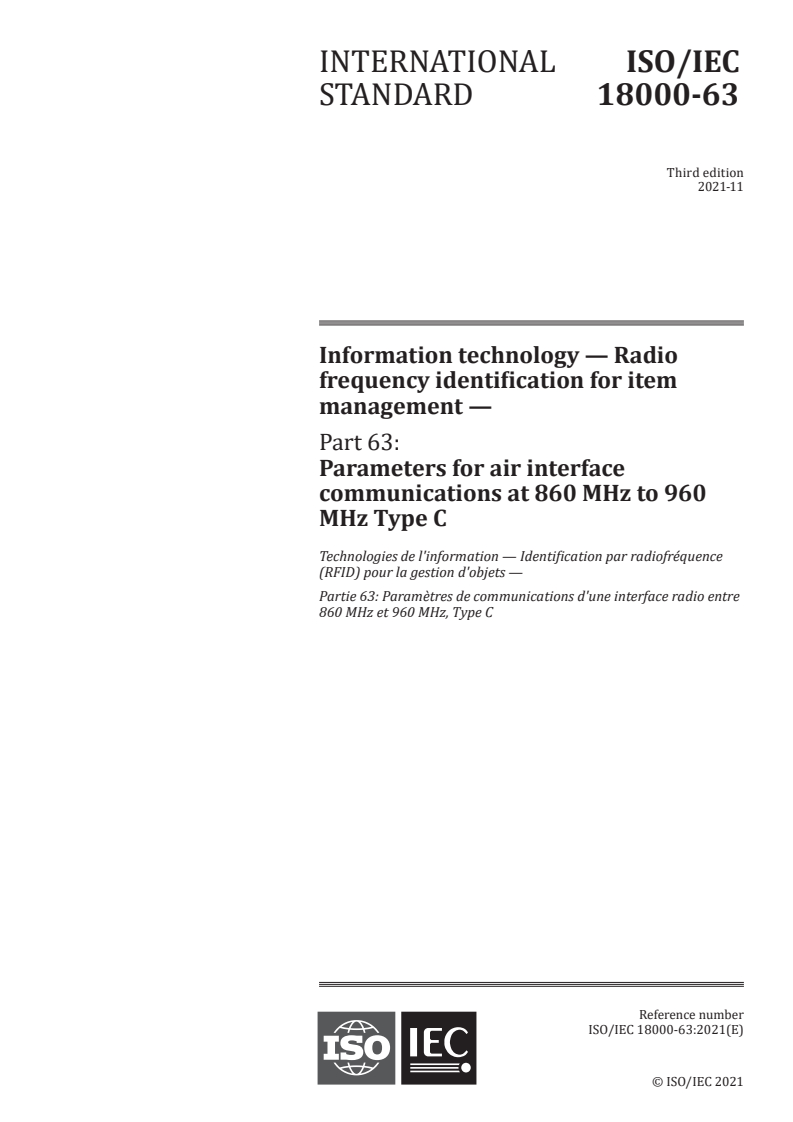
INTERNATIONAL ISO/IEC
STANDARD 18000-63
Third edition
2021-11
Information technology — Radio
frequency identification for item
management —
Part 63:
Parameters for air interface
communications at 860 MHz to 960
MHz Type C
Technologies de l'information — Identification par radiofréquence
(RFID) pour la gestion d'objets —
Partie 63: Paramètres de communications d'une interface radio entre
860 MHz et 960 MHz, Type C
Reference number
© ISO/IEC 2021
© ISO/IEC 2021
All rights reserved. Unless otherwise specified, or required in the context of its implementation, no part of this publication may
be reproduced or utilized otherwise in any form or by any means, electronic or mechanical, including photocopying, or posting on
the internet or an intranet, without prior written permission. Permission can be requested from either ISO at the address below
or ISO’s member body in the country of the requester.
ISO copyright office
CP 401 • Ch. de Blandonnet 8
CH-1214 Vernier, Geneva
Phone: +41 22 749 01 11
Email: copyright@iso.org
Website: www.iso.org
Published in Switzerland
ii
© ISO/IEC 2021 – All rights reserved
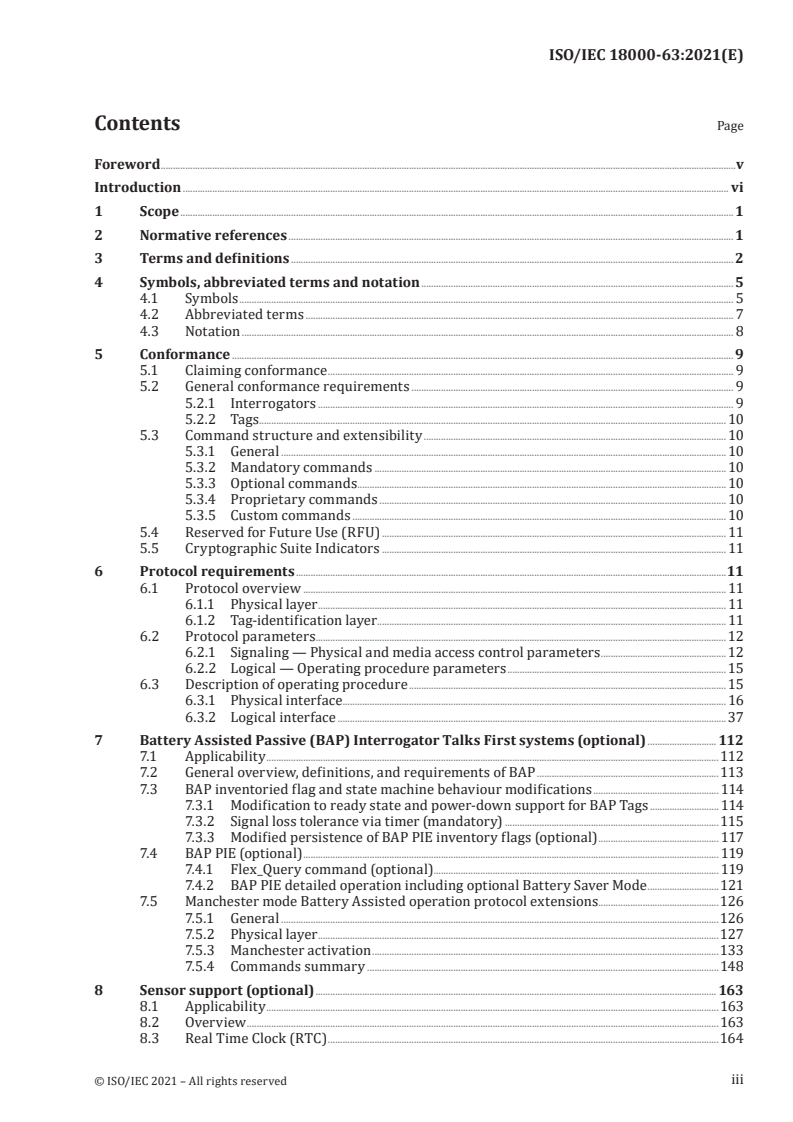
Contents Page
Foreword .v
Introduction . vi
1 Scope . 1
2 Normative references . 1
3 Terms and definitions . 2
4 Symbols, abbreviated terms and notation . 5
4.1 Symbols . 5
4.2 Abbreviated terms . 7
4.3 Notation . 8
5 Conformance . 9
5.1 Claiming conformance . 9
5.2 General conformance requirements . 9
5.2.1 Interrogators . 9
5.2.2 Tags. 10
5.3 Command structure and extensibility . 10
5.3.1 General . 10
5.3.2 Mandatory commands . 10
5.3.3 Optional commands . . 10
5.3.4 Proprietary commands . 10
5.3.5 Custom commands . 10
5.4 Reserved for Future Use (RFU) . 11
5.5 Cryptographic Suite Indicators . 11
6 Protocol requirements .11
6.1 Protocol overview . 11
6.1.1 Physical layer . 11
6.1.2 Tag-identification layer . . 11
6.2 Protocol parameters . 12
6.2.1 Signaling — Physical and media access control parameters .12
6.2.2 Logical — Operating procedure parameters . 15
6.3 Description of operating procedure . 15
6.3.1 Physical interface . 16
6.3.2 Logical interface . 37
7 Battery Assisted Passive (BAP) Interrogator Talks First systems (optional) . 112
7.1 Applicability .112
7.2 General overview, definitions, and requirements of BAP .113
7.3 BAP inventoried flag and state machine behaviour modifications . 114
7.3.1 Modification to ready state and power-down support for BAP Tags . 114
7.3.2 Signal loss tolerance via timer (mandatory) .115
7.3.3 Modified persistence of BAP PIE inventory flags (optional) . 117
7.4 BAP PIE (optional) . 119
7.4.1 Flex_Query command (optional) . 119
7.4.2 BAP PIE detailed operation including optional Battery Saver Mode .121
7.5 Manchester mode Battery Assisted operation protocol extensions.126
7.5.1 General .126
7.5.2 Physical layer .127
7.5.3 Manchester activation .133
7.5.4 Commands summary .148
8 Sensor support (optional) . 163
8.1 Applicability .163
8.2 Overview .163
8.3 Real Time Clock (RTC) .164
iii
© ISO/IEC 2021 – All rights reserved
8.3.1 General .164
8.3.2 Setting the RTC .164
8.3.3 BroadcastSync command (optional) .165
8.3.4 Time synchronisation .165
8.4 HandleSensor command (optional) .166
8.5 Simple Sensors . 167
8.5.1 Simple Sensor implementation . 167
8.6 Full Function Sensors and Sensor Directory System .169
8.6.1 General .169
8.6.2 Sensor Access — General approach. 170
8.7 Snapshot Sensors . 176
8.7.1 General . 176
8.7.2 Initiating Snapshot Sensor measurements .179
8.7.3 Reporting Snapshot Sensor Information .180
Annex A (normative) Extensible bit vectors (EBV) . 182
Annex B (normative) State-transition tables. 183
Annex C (normative) Command-response tables .240
Annex D (informative) Example slot-count (Q) selection algorithm . 267
Annex E (informative) Example Tag inventory and access .268
Annex F (informative) Calculation of 5-bit and 16-bit cyclic redundancy checks . 269
Annex G (normative) Multiple- and dense-Interrogator channelized signaling . 271
Annex H (informative) Interrogator-to-Tag link modulation .274
Annex I (normative) Error codes .276
Annex J (normative) Slot counter . 278
Annex K (informative) Example data-flow exchange. 279
Annex L (informative) Optional Tag features . 282
Annex M (informative) Cryptographic-Suite checklist . 285
Annex N (informative) Battery Assisted Tag to Interrogator synchronization.286
Annex O (normative) Simple Sensors Data Block.289
Annex P (normative) Record structures and commands for Ported Simple Sensors .300
Annex Q (informative) Battery Assisted Passive (BAP) PIE and Manchester mode tutorial
guide .316
Annex R (informative) Manchester mode RF power control . 327
Bibliography . 332
iv
© ISO/IEC 2021 – All rights reserved
Foreword
ISO (the International Organization for Standardization) and IEC (the International Electrotechnical
Commission) form the specialized system for worldwide standardization. National bodies that are
members of ISO or IEC participate in the development of International Standards through technical
committees established by the respective organization to deal with particular fields of technical
activity. ISO and IEC technical committees collaborate in fields of mutual interest. Other international
organizations, governmental and non-governmental, in liaison with ISO and IEC, also take part in the
work.
The procedures used to develop this document and those intended for its further maintenance
are described in the ISO/IEC Directives, Part 1. In particular, the different approval criteria
needed for the different types of document should be noted. This document was drafted in
accordance with the editorial rules of the ISO/IEC Directives, Part 2 (see www.iso.org/directives or
www.iec.ch/members_experts/refdocs).
Attention is drawn to the possibility that some of the elements of this document may be the subject
of patent rights. ISO and IEC shall not be held responsible for identifying any or all such patent
rights. Details of any patent rights identified during the development of the document will be in the
Introduction and/or on the ISO list of patent declarations received (see www.iso.org/patents) or the IEC
list of patent declarations received (see patents.iec.ch).
Any trade name used in this document is information given for the convenience of users and does not
constitute an endorsement.
For an explanation of the voluntary nature of standards, the meaning of ISO specific terms and
expressions related to conformity assessment, as well as information about ISO's adherence to
the World Trade Organization (WTO) principles in the Technical Barriers to Trade (TBT) see
www.iso.org/iso/foreword.html. In the IEC, see www.iec.ch/understanding-standards.
This document was prepared by Joint Technical Committee ISO/IEC JTC 1, Information technology,
Subcommittee SC 31, Automatic identification and data capture techniques.
This third edition cancels and replaces the second edition (ISO/IEC 18000-63:2015), which has been
technically revised.
The main changes are as follows:
— incorporation of the Technical Corrigendum;
— incorporation of a new sensor class for snapshot sensors.
A list of all parts in the ISO/IEC 18000 series can be found on the ISO and IEC websites.
Any feedback or questions on this document should be directed to the user’s national standards
body. A complete listing of these bodies can be found at www.iso.org/members.html and
www.iec.ch/national-committees.
v
© ISO/IEC 2021 – All rights reserved
Introduction
This document defines the physical and logical requirements for a passive-backscatter, Interrogator-
talks-first (ITF), radio-frequency identification (RFID) system operating in the 860 MHz to 960 MHz
frequency range. The system comprises Interrogators, also known as Readers, and Tags, also known as
Labels or Transponders.
An Interrogator transmits information to a Tag by modulating an RF signal in the 860 MHz to 960 MHz
frequency range. The Tag receives both information and operating energy from this RF signal. Tags are
passive, meaning that they receive all of their operating energy from the Interrogator’s RF signal.
An Interrogator receives information from a Tag by transmitting a continuous-wave (CW) RF signal to
the Tag; the Tag responds by modulating the reflection coefficient of its antenna, thereby backscattering
an information signal to the Interrogator. The system is ITF, meaning that a Tag modulates its antenna
reflection coefficient with an information signal only after being directed to do so by an Interrogator.
Interrogators and Tags are not required to talk simultaneously; rather, communications are half-duplex,
i.e. Interrogators talk and Tags listen, or vice versa.
The described backscatter radio frequency identification (RFID) system that supports the following
system capabilities:
— identification and communication with multiple tags in the field;
— selection of a subgroup of tags for identification or with which to communicate;
— reading from and writing to or rewriting data many times to individual tags;
— user-controlled permanently lockable memory;
— data integrity protection;
— Interrogator-to-tag communications link with error detection;
— tag-to-Interrogator communications link with error detection;
— support for both passive back-scatter tags with or without batteries.
The International Organization for Standardization (ISO) and International Electrotechnical
Commission (IEC) draw attention to the fact that it is claimed that compliance with this document may
involve the use of a patent.
ISO and IEC take no position concerning the evidence, validity and scope of this patent right.
The holder of this patent right has assured ISO and IEC that he/she is willing to negotiate licences under
reasonable and non-discriminatory terms and conditions with applicants throughout the world. In this
respect, the statement of the holder of this patent right is registered with ISO and IEC. Information may
be obtained from the patent database available at www.iso.org/patents.
Attention is drawn to the possibility that some of the elements of this document may be the subject
of patent rights other than those in the patent database. ISO and IEC shall not be held responsible for
identifying any or all such patent rights.Information on the declared patents may be obtained from:
vi
© ISO/IEC 2021 – All rights reserved
Contact details
Patent Holder:
Legal Name Atmel Automotive GmbH
Contact for license application:
Name & Department Leo Merken, Legal Department, ATMEL Corporation
Address 2325 Orchard Parkway
Address San Jose, CA 95131 USA
Tel. +1 408 436 4251
Fax +1 408 487 2615
E-mail leo.merken@atmel.com
URL (optional)
Patent Holder:
Legal Name CISC Semiconductor Design+Consulting GmbH
Contact for license application:
Name & Department Markus Pistauer, CEO
Address L a keside B07
Address 9020 Klagenfurt, Austria
Tel. +43(463) 508 808
Fax +43(463) 508 808-18
E-mail m.pistauer@cisc.at
URL (optional) www.cisc.at
Patent holder:
ETRI (Electronics Telecommunication Reseach Institute)
Contact for license application:
Name & Department: Min-Sheo Choi, Intellectual Property Management Team
Address: 138 Gajeongno, Yuseong-gu
Address: Daejeon, 305-700, Korea
Tel. +82-42-860-0756
Fax +82-42-860-3831
E-mail choims@etri.re.kr
URL (optional) www.etri.re.kr
Patent Holder:
Legal Name Impinj, Inc.
Contact for license application:
Name & Department Chris Diorio, CTO
Address 701 N. 34th Street, Suite 300
Address Seattle, WA 98103, USA
Tel. +1 206 834 1115
Fax +1 206 517.5262
E-mail diorio@impinj.com
URL (optional) www.impinj.com
vii
© ISO/IEC 2021 – All rights reserved
Contact details
Patent Holder:
Legal Name: Magellan Technology Pty. Limited
Contact for license application:
Name & Department: Ms Jean Angus
Address: 65 Johnston St
Address: Annandale, NSW 2038, Australia
Tel. +61 2 9562 9800
Fax +61 2 9518 7620
E-mail: license@magellan-technology.com
URL (optional):
Patent Holder:
Legal Name NXP B.V.
Contact for license application:
Name & Department Aaron Waxler – IP Licensing & Claims
Address 411 East Plumeria,
Address San Jose, CA 95134-1924, USA
Tel. +1 914 860-4296
Fax
E-mail Aaron.Waxler@nxp.com
URL (optional)
Patent Holder:
Legal Name SATO VICINITY Pty. Limited
Contact for license application:
Name & Department Mr. Hiromasa Konishi, Managing Director
Address 8 Guihen Street, Annandale, NSW 2038, Australia
Address
Tel. +61 295 629 800
Fax +61 295 187 620
E-mail hiromasa.konishi@sato-glo bal . com
URL (optional) www.satovicinity.com
Patent Holder:
Legal Name TAGSYS SAS
Contact for license application:
Name & Department Mr. Alain Fanet President
Address 785 Voie Antiope, TI Athélia 3
Address F-13600 La Ciotat
Tel. +33 332188900
Fax +33 332188900
E-mail alain.fanet@tagsysrfid.com
URL (optional) www.mojix.com
viii
© ISO/IEC 2021 – All rights reserved
Contact details
Patent Holder:
Legal Name University of Pittsburgh - Of the Commonwealth of Pennsylvania
Contact for license application:
Name & Department Marc S. Malandro, PhD, CLP, RTIP
Address University of Pittsburgh, 200 Gardner Steel Conference Center
Address Thackeray & O'Hara Streets, Pittsburgh, PA 15260
Tel. 412-624-8787
Fax 412-648-2259
E-mail mmalandro@innovation.pitt.edu
URL (optional)
Patent Holder:
Legal Name Zebra Technologies Corporation
Contact for license application:
Name & Department Glenn Frankenberger, Sr. IP Counsel, Legal Department
Address One Motorola Plaza
Address Holtsville, NY 11742
Tel. 631-738-5570
Fax 631-738-4110
E-mail glenn.frankenberger@zebra.com
URL (optional)
Attention is drawn to the possibility that some of the elements of this document may be the subject of
patent rights other than those identified above. ISO and IEC shall not be held responsible for identifying
any or all such patent rights.
The latest information on IP that may be applicable to this document can be found at www.iso.org/patents
ix
© ISO/IEC 2021 – All rights reserved
INTERNATIONAL STANDARD ISO/IEC 18000-63:2021(E)
Information technology — Radio frequency identification
for item management —
Part 63:
Parameters for air interface communications at 860 MHz
to 960 MHz Type C
1 Scope
This document defines the air interface for radio frequency identification (RFID) devices operating
in the 860 MHz to 960 MHz industrial, scientific, and medical (ISM) band used in item management
applications. It provides a common technical specification for RFID devices that can be used to develop
RFID application standards. This document is intended to allow for compatibility and to encourage
inter-operability of products for the growing RFID market in the international marketplace.
It defines the forward and return link parameters for technical attributes including, but not limited
to, operating frequency, operating channel accuracy, occupied channel bandwidth, maximum effective
isotropic radiated power (EIRP), spurious emissions, modulation, duty cycle, data coding, bit rate, bit
rate accuracy, bit transmission order, and, where appropriate, operating channels, frequency hop rate,
hop sequence, spreading sequence, and chip rate. It further defines the communications protocol used
in the air interface.
This document specifies the physical and logical requirements for a passive-backscatter, Interrogator-
Talks-First (ITF) systems. The system comprises Interrogators, also known as readers, and tags, also
known as labels. An Interrogator receives information from a tag by transmitting a continuous-wave
(CW) RF signal to the tag; the tag responds by modulating the reflection coefficient of its antenna,
thereby backscattering an information signal to the Interrogator. The system is ITF, i.e. a tag modulates
its antenna reflection coefficient with an information signal only after being directed to do so by an
Interrogator.
This document specifies
— physical interactions (the signalling layer of the communication link) between Interrogators and
tags;
— logical operating procedures and commands between Interrogators and Tags;
— the collision arbitration scheme used to identify a specific tag in a multiple-tag environment;
— optional security commands that allow the use of crypto suites of ISO/IEC 29167.
2 Normative references
The following documents are referred to in the text in such a way that some or all of their content
constitutes requirements of this document. For dated references, only the edition cited applies. For
undated references, the latest edition of the referenced document (including any amendments) applies.
ISO/IEC 15961 (all parts), Information technology — Data protocol for radio frequency identification
(RFID) for item management
ISO/IEC 15962, Information technology — Radio frequency identification (RFID) for item management —
Data protocol: data encoding rules and logical memory functions
© ISO/IEC 2021 – All rights reserved
ISO/IEC 15963-1, Information technology — Radio frequency identification for item management —
Part 1: Unique identification for RF tags numbering systems
ISO/IEC 18000-61, Information technology — Radio frequency identification for item management —
Part 61: Parameters for air interface communications at 860 MHz to 960 MHz Type A
ISO/IEC 18000-62, Information technology — Radio frequency identification for item management —
Part 62: Parameters for air interface communications at 860 MHz to 960 MHz Type B
ISO/IEC 18000-64, Information technology — Radio frequency identification for item management —
Part 64: Parameters for air interface communications at 860 MHz to 960 MHz Type D
ISO/IEC 19762, Information technology — Automatic identification and data capture (AIDC) techniques —
Harmonized vocabulary
EPC Tag Data Standard available at https:// www .gs1 .org/ standards/ epc -rfid/ tds
3 Terms and definitions
For the purposes of this document, the terms and definitions given in ISO/IEC 19762 and the following
apply.
ISO and IEC maintain terminology databases for use in standardization at the following addresses:
— ISO Online browsing platform: available at https:// www .iso .org/ obp
— IEC Electropedia: available at https:// www .electropedia .org/
3.1
air interface
complete communication link between an Interrogator and a Tag including the physical layer, collision-
arbitration algorithm, command and response structure, and data-coding methodology
3.2
authenticated communication
communication in which message integrity is protected
3.3
battery assisted mode
working mode of battery assisted tags with non-empty battery
3.4
crypto superuser
key with an asserted CryptoSuperuser privilege
3.5
data element
low-level, indivisible data construct
3.6
XTID
extended tag identifier
memory construct that defines a Tag’s capabilities and which may include a Tag serial number
Note 1 to entry: Further specified in the EPC Tag Data Standard.
3.7
extended temperature range
temperature range between –40 °C to +65 °C
Note 1 to entry: See nominal temperature range (3.18).
© ISO/IEC 2021 – All rights reserved
3.8
file type
8-bit string that specifies a file’s designated type
3.9
file superuser
access password or key with a 0011 secured-state file privilege value
3.10
full-duplex communications
communications channel that carries data in both directions at once
Note 1 to entry: See half-duplex communications (3.11).
3.11
half-duplex communications
communications channel that carries data in one direction at a time rather than in both directions at
once
Note 1 to entry: See full-duplex communications (3.10).
3.12
handle
16-bit tag identifier
3.13
hibernate
state of energy saving when the device is not required to be used
3.14
interrogator authentication
means for a Tag to determine, via cryptographic means, that an Interrogator’s identity is as claimed
3.15
keyID
numerical designator for a single key
3.16
MAC
message authentication code
code, computed over bits in a message, that an Interrogator or a Tag may use to verify the integrity of
the message
3.17
mutual authentication
means for a Tag and an Interrogator to each determine, via cryptographic means, that the others’
identity is as claimed
3.18
nominal temperature range
temperature range between –25 °C to +40 °C
Note 1 to entry: See extended temperature range (3.7).
3.19
nonremovable Tag
Tag that a consumer cannot physically detach from an item without special equipment or without
compromising the item’s intended functionality
Note 1 to entry: See removable Tag (3.24).
© ISO/IEC 2021 – All rights reserved
3.20
password
secret value sent by an Interrogator to a Tag to enable restricted Tag operations
Note 1 to entry: Passwords are not keys.
Note 2 to entry: The only passwords defined by this protocol are the kill and access passwords.
3.21
private key
undisclosed or non-distributed key in an asymmetric, or public-private key pair, cipher
Note 1 to entry: A private key is typically used for decryption or digital-signature generation.
Note 2 to entry: See public key (3.22).
3.22
public key
disclosed or distributed key in an asymmetric, or public-private key pair, cipher
Note 1 to entry: A public key is typically used for encryption or signature verification.
Note 2 to entry: See private key (3.21).
3.23
Q
parameter that an Interrogator uses to regulate the probability of Tag response
Note 1 to entry: An Interrogator instructs Tags in an inventory round to load a Q-bit random (or pseudo-random)
number into their slot counter; the Interrogator may also command Tags to decrement their slot counter. Tags
reply when the value in their slot counter, i.e. their slot (3.30), is zero. Q is an integer in the range (0,15); the
0 –15
corresponding Tag-response probabilities range from 2 = 1 to 2 = 0,000031.
3.24
removable Tag
Tag that a consumer can physically detach from an item without special equipment and without
compromising the item’s intended functionality
Note 1 to entry: See nonremovable Tag (3.19).
3.25
secure communication
communication in which message confidentiality is protected
3.26
security
degree of protection against threats identified in a security policy
Note 1 to entry: A system is secure if it is protected to the degree specified in the security policy (3.27).
Note 2 to entry: See security policy (3.27).
3.27
security policy
definition, either explicit or implicit, of the threats a system is intended to address
Note 1 to entry: See security (3.26).
3.28
session key
temporary key generated by one or both of Tag and Interrogator and typically used for authenticated
and/or secure communications
© ISO/IEC 2021 – All rights reserved
3.29
simple sensor functionality
functionality whereby a sensor provides a valid Simple Sensor data address and transmits Simple
Sensor data subsequent to the UII as part of the reply to the ACK command
3.30
slot
point, in an inventory round, at which a Tag may respond
Note 1 to entry: Slot is the value output by a Tag’s slot counter; Tags reply when their slot (i.e. the value in their
slot counter) is zero.
Note 2 to entry: See Q (3.23).
3.31
snapshot sensor
sensor that makes a measurement during power-up or on demand from an Interrogator
3.32
tag authentication
means for an Interrogator to determine, via cryptographic means, that a Tag’s identity is as claimed
3.33
traceable
not restricting the identifying information that a Tag exposes and/or the Tag’s operating range
Note 1 to entry: See untraceable (3.36).
3.34
untraceable privilege
privilege given to the access password or to a key that grants an Interrogator using the access password
or key the right to access untraceably hidden memory and/or to issue an Untraceable command
34.35
untraceably hidden memory
memory that an untraceable tag hides from Interrogators with a deasserted untraceable privilege
3.36
untraceable
restricting the identifying information that a Tag exposes and/or the Tag’s operating range
Note 1 to entry: See traceable (3.33).
4 Symbols, abbreviated terms and notation
4.1 Symbols
C computed-response indicator
F file-services indicator (whether a Tag supports the FileOpen command)
FrT frequency tolerance
FS full function sensor indicator
FT frequency tolerance
H hazmat indicator
INACT_T inactivity threshold
© ISO/IEC 2021 – All rights reserved
K killable indicator
M number of subcarrier cycles per symbol
M RF signal envelope ripple (overshoot)
h
M FHSS signal envelope ripple (overshoot)
hh
M FHSS signal envelope ripple (undershoot)
hl
M FHSS signal level during a hop
hs
M RF signal envelope ripple (undershoot)
l
M RF signal level when OFF
s
NR nonremovable Tag indicator
Q slot-count parameter. Q is an integer in the range (0,15)
R=>T interrogator-to-tag (reader-to-tag)
RTcal interrogator-to-tag (reader-to-tag) calibration symbol
S security-services indicator (whether a Tag supports the Challenge and/or Authenticate
commands)
SA sensor alarm indictor
SLI SL indicator
SN snapshot sensor indicator
SS simple sensor indicator
T numbering system identifier
T=>R tag-to-Interrogator (tag-to-reader)
T time from Interrogator transmission to Tag response for an immediate Tag reply
T time from tag response to Interrogator transmission
T time an Interrogator waits, after T , before it issues another command
3 1
T minimum time between Interrogator commands
T time from Interrogator transmission to Tag response for a delayed Tag reply
T time from Interrogator transmission to first Tag response for an in-process Tag reply
T time between Tag responses for an in-process Tag reply
T or T RF signal envelope fall time
f f,10-90 %
T fall time
f
T FHSS signal envelope fall time
hf
T FHSS signal envelope rise time
hr
T time for an FHSS signal to settle to within a specified percentage of its final value
hs
© ISO/IEC 2021 – All rights reserved
TN tag-notification indicator
T backscatter-link pulse-repetition interval (T = 1/BLF = TRcal/DR)
pri pri
T or T RF signal envelope rise time
r r,10-90 %
T rise time
r
T time duration of RTcal
RTcal
T time duration of TRcal
TRcal
TRcal tag-to-Interrogator (tag-to-reader) calibration symbol
T time for an RF signal to settle to within a specified percentage of its final value
s
U untraceability indicator
UMI user-memory indicator
X XTID indicator (whether a Tag implements an XTID)
XEB XPC_W2 indicator
x floating-point value
fp
XI XPC_W1 indicator
xxxx binary notation
xxxx hexadecimal notation
h
4.2 Abbreviated terms
AC activation code
AFI application family identifier
AM amplitude modulation
AMSK activation mask
ASIC application specific integrated circuit
BAM battery assisted mode
BAP battery assisted passive
BAT battery assisted tag
BLF backscatter-link frequency (BLF = 1/T = DR/TRcal)
pri
CSI cryptographic suite identifier
CW continuous wave
dBch decibels referenced to the integrated power in the reference channel
DBR dead battery response
DR divide ratio
© ISO/IEC 2021 – All rights reserved
FDM frequency-Division Multiplexing
MAC message authentication code
NoS number of sensors
NSI numbering system identifier
OTP one-time programmable
PC protocol control
PIE pulse interval encoding
pivot decision threshold differentiating an R=>T data-0 symbol from a data-1 symbol
PM passive mode
ppm parts per million
R/W read/write
RNG random or pseudo-random number generator
RO read only
RTC real time clock
SDS sensor directory system
SS simple sensor
SSB-ASK single-sideband amplitude-shift keying
SSD simple sensor data
TEDS transducer electronic data sheet
UMI user-memory indicator
UTC universal coordinated time
XPC_W1 XPC word 1
XPC_W2 XPC word 2
XTID extended tag identifier
4.3 Notation
This document uses the following notational conventions.
— States and flags are denoted in bold. Some command parameters are also flags; a command
parameter used as a flag will be bold. Example: ready.
— Command parameters are underlined. Some flags are also command parameters; a flag used as a
command parameter will be underlined. Example: Pointer.
— Commands are denoted in italics. Variables are also denoted in italics. Where there might be
confusion between commands and variables, this protocol will make an explicit statement. Example:
Query.
© ISO/IEC 2021 – All rights reserved
— For logical negation, labels are preceded by ‘~’. Example: If flag is true, then ~flag is false.
— The symbol, R=>T, refers to commands or signaling from an Interrogator to a Tag (Reader-to-Tag).
— The symbol, T=>R, refers to commands or signaling from a Tag to an Interrogator (Tag-to-Reader).
— The term “address” is used as a synonym for “bit address”. All addresses specified are bit-addresses,
unless specified differently (e.g. by adding an according prefix such as “word” in “word address”).
The same applies for figures, where all shown addresses are to be interpreted as bit-addresses,
unless specified differently.
— The term “word” always refers to a 16-bit word.
5 Conformance
5.1 Claiming conformance
A device shall not claim conformance with this protocol unless the device complies with
— all clauses in this protocol (except those marked as optional), and
— the conformance document associated with this protocol.
It is presupposed that it is operated in accordance with local regulatory requirements.
Relevant conformance test methods are provided in ISO/IEC 18047-6.
Conformance can also require a license from the owner of any intellectual property utilized by said
device.
5.2 General conformance requirements
5.2.1 Interrogators
To conform to this document, an Interrogator shall:
— meet the requirements of this document;
— implement the mandatory commands defined in this document;
— modulate/transmit and receive/demodulate a sufficient set of the electrical signals defined in the
signaling layer of this protocol to communicate with conformant Tags.
To conform to this document, an Interrogator may:
— implement any subset of the optional commands defined in this document;
— implement any proprietary and/or custom commands in conformance with this document.
To conform to this document, an Interrogator shall not:
— implement any command that conflicts with this document or any of the parts ISO/IEC 18000-61,
ISO/IEC 18000-62 and ISO/IEC 18000-64;
— require using an optional, proprietary, or custom command to meet the requirements of this
protocol.
© ISO/IEC 2021 – All rights reserved
5.2.2 Tags
To conform to this document, a Tag shall:
— meet the requirements of this document;
— implement the mandatory commands defined in this document;
— modulate a backscatter signal only after receiving the requisite command from an Interrogator.
To conform to this protocol, a Tag may:
— implement any of the optional Tag features in Clause 7, Clause 8, and Annex L;
— implement any subset of the optional commands defined in this document;
— implement any proprietary and/or custom commands as defined in 5.3.4 and 5.3.5, respectively.
To conform to this document, a Tag shall not:
— implement any command that conflicts with this document or any of the parts ISO/IEC 18000-61,
ISO/IEC 18000-62 and ISO/IEC 18000-64;
— require using an optional, proprietary, or custom command to meet the requirements of this
protocol;
— modulate a backscatter signal unless commanded to do so by an Interrogator using the signaling
layer defined in this document.
5.3 Command structure and extensibility
5.3.1 General
This document allows four command types: (1) mandatory, (2) optional, (3) proprietary, and (4) custom.
Subclause 6.3.2.12 and Table 6.28 define the structure of the command codes used by Interrogators and
Tags for each of the four types, as well as the availability of future extensions. All commands defined
by this protocol are either mandatory or optional. Proprietary or custom commands are manufacturer-
defined.
5.3.2 Mandatory commands
Conforming Tags shall support all mandatory commands. Conforming Interrogators shall support all
mandatory commands.
5.3.3 Optional commands
Conforming Tags may or may not support optional commands. Conforming Interrogators may or may
not support optional commands. If a Tag or an Interrogator implements an optional command, then it
shall implement it
...
Questions, Comments and Discussion
Ask us and Technical Secretary will try to provide an answer. You can facilitate discussion about the standard in here.
Loading comments...