


ISO 9211-2:2010
(Main)Optics and photonics — Optical coatings — Part 2: Optical properties
Optics and photonics — Optical coatings — Part 2: Optical properties
The ISO 9211 seriesidentifies surface treatments of components and substrates excluding ophthalmic optics (spectacles) by the application of optical coatings and gives a standard form for their specification. It defines the general characteristics and the test and measurement methods whenever necessary, but is not intended to define the process method. ISO 9211‑2:2010 indicates how to specify optical properties of coatings and to represent their spectral characterization graphically.
Optique et photonique — Traitements optiques — Partie 2: Propriétés optiques
La série de l'ISO 9211 décrit les traitements de surface des composants et des substrats, à l'exclusion de l'optique ophtalmique (lunettes), par l'application de traitements optiques, et normalise leur spécification. Elle définit les caractéristiques générales et les méthodes d'essai et de mesure toutes les fois où cela est nécessaire, mais elle n'est pas destinée à définir la méthode de fabrication. L'ISO 9211-2:2010 décrit la façon de spécifier les propriétés optiques des traitements et de représenter graphiquement leur caractérisation spectrale.
General Information
- Status
- Withdrawn
- Publication Date
- 10-Mar-2010
- Technical Committee
- ISO/TC 172/SC 3 - Optical materials and components
- Drafting Committee
- ISO/TC 172/SC 3/WG 2 - Coatings
- Current Stage
- 9599 - Withdrawal of International Standard
- Start Date
- 06-Feb-2024
- Completion Date
- 14-Feb-2026
Relations
- Effective Date
- 09-Feb-2026
- Effective Date
- 09-Feb-2026
- Effective Date
- 06-Jun-2022
- Revises
ISO 9211-2:1994 - Optics and optical instruments — Optical coatings — Part 2: Optical properties - Effective Date
- 15-Apr-2008
Frequently Asked Questions
ISO 9211-2:2010 is a standard published by the International Organization for Standardization (ISO). Its full title is "Optics and photonics — Optical coatings — Part 2: Optical properties". This standard covers: The ISO 9211 seriesidentifies surface treatments of components and substrates excluding ophthalmic optics (spectacles) by the application of optical coatings and gives a standard form for their specification. It defines the general characteristics and the test and measurement methods whenever necessary, but is not intended to define the process method. ISO 9211‑2:2010 indicates how to specify optical properties of coatings and to represent their spectral characterization graphically.
The ISO 9211 seriesidentifies surface treatments of components and substrates excluding ophthalmic optics (spectacles) by the application of optical coatings and gives a standard form for their specification. It defines the general characteristics and the test and measurement methods whenever necessary, but is not intended to define the process method. ISO 9211‑2:2010 indicates how to specify optical properties of coatings and to represent their spectral characterization graphically.
ISO 9211-2:2010 is classified under the following ICS (International Classification for Standards) categories: 37.020 - Optical equipment. The ICS classification helps identify the subject area and facilitates finding related standards.
ISO 9211-2:2010 has the following relationships with other standards: It is inter standard links to EN ISO 11151-1:2015, EN ISO 11151-2:2015, ISO 9211-2:2024, ISO 9211-2:1994. Understanding these relationships helps ensure you are using the most current and applicable version of the standard.
ISO 9211-2:2010 is available in PDF format for immediate download after purchase. The document can be added to your cart and obtained through the secure checkout process. Digital delivery ensures instant access to the complete standard document.
Standards Content (Sample)
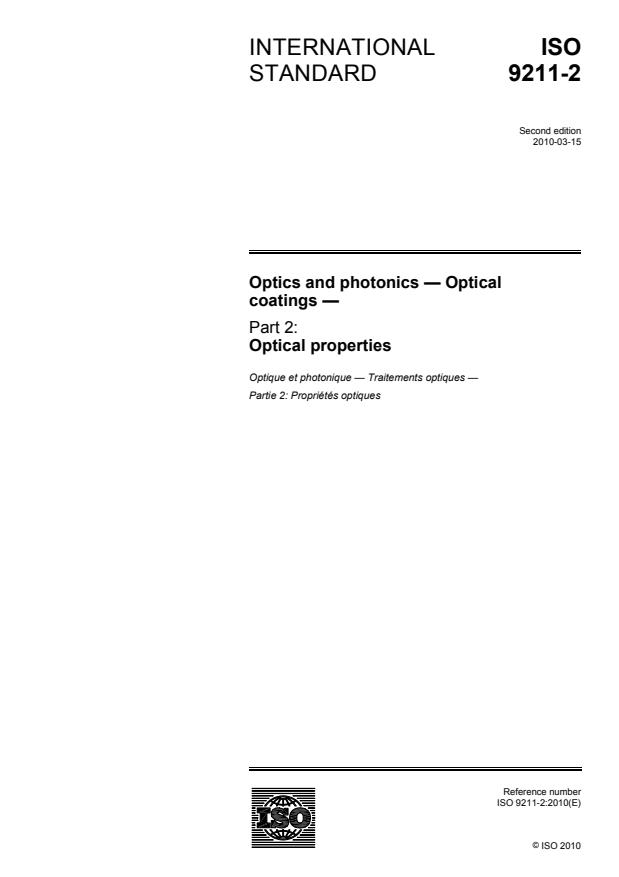
INTERNATIONAL ISO
STANDARD 9211-2
Second edition
2010-03-15
Optics and photonics — Optical
coatings —
Part 2:
Optical properties
Optique et photonique — Traitements optiques —
Partie 2: Propriétés optiques
Reference number
©
ISO 2010
PDF disclaimer
This PDF file may contain embedded typefaces. In accordance with Adobe's licensing policy, this file may be printed or viewed but
shall not be edited unless the typefaces which are embedded are licensed to and installed on the computer performing the editing. In
downloading this file, parties accept therein the responsibility of not infringing Adobe's licensing policy. The ISO Central Secretariat
accepts no liability in this area.
Adobe is a trademark of Adobe Systems Incorporated.
Details of the software products used to create this PDF file can be found in the General Info relative to the file; the PDF-creation
parameters were optimized for printing. Every care has been taken to ensure that the file is suitable for use by ISO member bodies. In
the unlikely event that a problem relating to it is found, please inform the Central Secretariat at the address given below.
© ISO 2010
All rights reserved. Unless otherwise specified, no part of this publication may be reproduced or utilized in any form or by any means,
electronic or mechanical, including photocopying and microfilm, without permission in writing from either ISO at the address below or
ISO's member body in the country of the requester.
ISO copyright office
Case postale 56 • CH-1211 Geneva 20
Tel. + 41 22 749 01 11
Fax + 41 22 749 09 47
E-mail copyright@iso.org
Web www.iso.org
Published in Switzerland
ii © ISO 2010 – All rights reserved
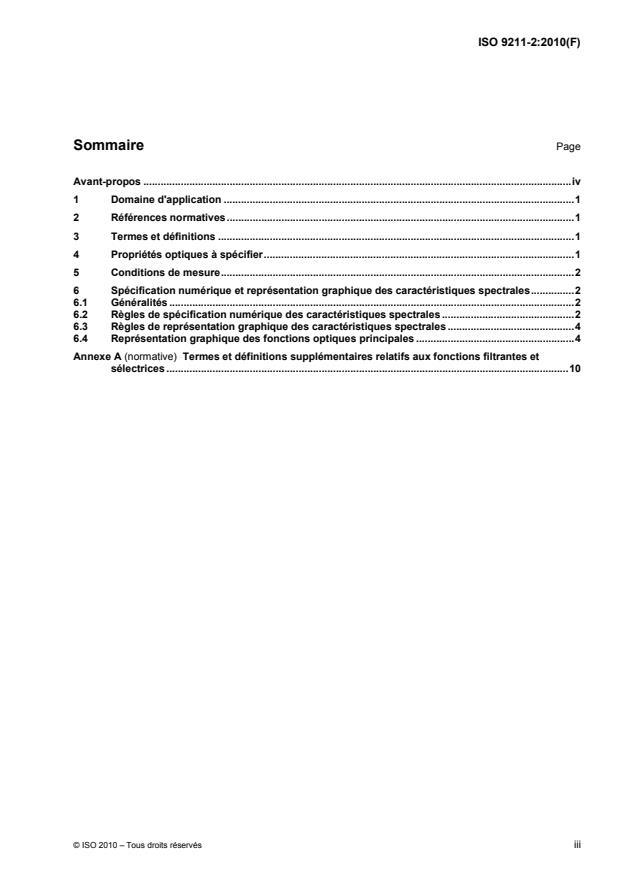
Contents Page
Foreword .iv
1 Scope.1
2 Normative references.1
3 Terms and definitions .1
4 Optical properties to be specified .1
5 Measurement conditions .1
6 Numerical specification and graphical representation of spectral characteristics .2
6.1 General .2
6.2 Rules for the numerical specification of spectral characteristics .2
6.3 Rules for the graphical representation of spectral characteristics .3
6.4 Graphical representation of principal optical functions .3
Annex A (normative) Supplementary terms and definitions for filtering and selecting functions .10
Foreword
ISO (the International Organization for Standardization) is a worldwide federation of national standards bodies
(ISO member bodies). The work of preparing International Standards is normally carried out through ISO
technical committees. Each member body interested in a subject for which a technical committee has been
established has the right to be represented on that committee. International organizations, governmental and
non-governmental, in liaison with ISO, also take part in the work. ISO collaborates closely with the
International Electrotechnical Commission (IEC) on all matters of electrotechnical standardization.
International Standards are drafted in accordance with the rules given in the ISO/IEC Directives, Part 2.
The main task of technical committees is to prepare International Standards. Draft International Standards
adopted by the technical committees are circulated to the member bodies for voting. Publication as an
International Standard requires approval by at least 75 % of the member bodies casting a vote.
Attention is drawn to the possibility that some of the elements of this document may be the subject of patent
rights. ISO shall not be held responsible for identifying any or all such patent rights.
ISO 9211-2 was prepared by Technical Committee ISO/TC 172, Optics and photonics, Subcommittee SC 3,
Optical materials and components.
This second edition cancels and replaces the first edition (ISO 9211-2:1994) which has been technically
revised.
ISO 9211 consists of the following parts, under the general title Optics and photonics — Optical coatings:
⎯ Part 1: Definitions
⎯ Part 2: Optical properties
⎯ Part 3: Environmental durability
⎯ Part 4: Specific test methods
iv © ISO 2010 – All rights reserved
INTERNATIONAL STANDARD ISO 9211-2:2010(E)
Optics and photonics — Optical coatings —
Part 2:
Optical properties
1 Scope
ISO 9211 identifies surface treatments of components and substrates excluding ophthalmic optics
(spectacles) by the application of optical coatings and gives a standard form for their specification. It defines
the general characteristics and the test and measurement methods whenever necessary, but is not intended
to define the process method.
This part of ISO 9211 indicates how to specify optical properties of coatings and to represent their spectral
characterization graphically.
2 Normative references
The following referenced documents are indispensable for the application of this document. For dated
references, only the edition cited applies. For undated references, the latest edition of the referenced
document (including any amendments) applies.
ISO 9211-1, Optics and photonics — Optical coatings — Part 1: Definitions
3 Terms and definitions
For the purposes of this document, the terms and definitions given in ISO 9211-1 apply.
4 Optical properties to be specified
When specifying optical properties, the refractive indices of the incidence medium and the emergent medium
shall be given. The polarization state of the incident radiation shall also be indicated if the angle of incidence,
θ, is different from zero or a range of angles of incidence is given. If there is no indication, unpolarized
radiation is assumed.
The optical properties τ(λ), ρ(λ), α(λ), D(λ) and ∆Φ(λ) of a coating shall be specified by using the formulation
given and explained in 6.2 in order to provide a comprehensive description of a coating with regard to its
minimum set of optical properties. Other optical properties like scattering or colorimetric parameters etc. shall
be subject to agreement between supplier and user if appropriate.
5 Measurement conditions
The measurement conditions for the spectrophotometric characterization shall be subject to agreement
between supplier and user. These conditions depend on the principle of the measurement method and the
instruments used, including the angle of incidence, the state of polarization, the spectral range and bandwidth
of the measurement beam, etc. and shall be recorded in sufficient detail to enable verification of the
measurement.
6 Numerical specification and graphical representation of spectral characteristics
6.1 General
This part of ISO 9211 defines the rules for the spectrophotometric characterization of optical coatings.
6.2 Rules for the numerical specification of spectral characteristics
The general structure of a numerical specification, as distinguished from a graphical specification, of a
spectral optical property shall follow the structure of an inequality with the following terms:
(lower limit term) < or u (spectral optical property term) < or u (upper limit term).
EXAMPLE 1 (lower limit term) < (spectral optical property term) u (upper limit term).
The inequality may contain only two terms if the spectral optical property needs to be bounded only on one
side.
EXAMPLE 2 (spectral optical property term) u (upper limit term) or (spectral optical property term) > (lower limit term).
Table 1 gives a schematic representation of elements necessary for the numerical specification of spectral
characteristics as shown in Table 2.
NOTE Unless otherwise specified, the symbols τ and ρ denote the specular transmittance and reflectance.
Table 1 — Scheme of elements for the numerical specification of spectral characteristics
Wavelength
Spectral (or wavenumber) range Z
Lower limit Comparator Comparator Upper limit
or single wavelength
optical represents
(subscript L) sign sign (subscript U)
property (or wavenumber), any of
a
angle of incidence
i = 1, 2, . i = 1, 2, . i = 1, 2, .
τ, ρ, α , D,
Z < or u Z (λ to λ , θ ) or (λ , θ) < or u Z
Li i i+1 i Ui
∆Φ or δΦ
τ, ρ, α, D,
b b
Z → Z < or u Z (λ to λ , θ) < or u Z → Z
L
Li+1 i i+1 Ui Ui+1
i
∆Φ or δΦ
τ, ρ, α, D, or
Z < or u Z (λ to λ , θ) < or u Z
ave,Li ave i i+1 ave,Ui
∆Φ or δΦ
Z < or u Z (λ to λ , θ) or (λ , θ) < or u Z τ, ρ, α, or D
s,Li s i i+1 i s,Ui
Z < or u Z (λ to λ , θ) < or u Z τ, ρ, α, or D
s,ave,Li s,ave i i+1 s,ave,Ui
Z < or u Z (λ to λ , θ) or (λ , θ) < or u Z τ, ρ, α, or D
p,Li p i i+1 p,Ui
i
Z < or u Z (λ to λ , θ) < or u Z τ, ρ , α, or D
p,ave,Li p,ave i i+1 p,ave,Ui
a
Each optical property can be specified for different wavelength (or wavenumber) ranges and/or different single wavelengths
(or wavenumbers), if necessary.
If the angle of incidence θ is not explicitly indicated, an angle of 0° is assumed.
For special applications, a range of angles of incidence (θ to θ ) instead of a single angle can be specified.
1 2
If the angle of incidence θ is different from 0° or a range of angles is given, but neither s- nor p-polarization is defined, the
radiation is assumed to be unpolarized.
b
The arrow → indicates a linear change of the tolerance limit from value Z at λ to value Z at λ (from value Z at λ to value
Li i Li+1 i+1 Ui i
Z at λ , respectively).
Ui+1 i+1
2 © ISO 2010 – All rights reserved
Table 2 — Numerical examples
a
Code designation Spectral characteristics (numerical specification)
AB 0,75 → 0,60 < α (500 nm to 600 nm) < 0,90 → 0,75
ρ (400 nm to 700 nm) > 0,98
RE
ρ (400 nm to 700 nm) W 0,995
ave
0,85 u τ (535 nm to 565 nm) u 0,95
FI-BP
τ (400 nm to 515 nm) < 0,05
τ (585 nm to 720 nm) < 0,15
89° u ∆Φ (10,6 µm, 45°) u 91°
PC
ρ (10,6 µm, 45°) > 0,97
ρ (450 nm to 650 nm, 45°) > 0,95
s
PO
ρ (450 nm to 650 nm, 45°) < 0,05
p
a
The code designations are given in ISO 9211-1:2010, Table 1.
6.3 Rules for the graphical representation of spectral characteristics
6.3.1 Spectrophotometric characterization consists of indicating the following in a graph:
a) on the abscissa, the spectral region in which the characteristics are specified as a function of wavelength,
λ, in nanometres or micrometres, or wavenumber, σ, in reciprocal centimetres;
b) on the ordinate, the values of the individual optical properties (τ, ρ, α, D or ∆Φ).
6.3.2 The upper and/or lower tolerance limits (indicated by subscripts U and L respectively) within which the
spectral characteristics must be located shall be indicated on the graph with hatched areas outside of the
tolerance band. An alternative is the marking with triangles (▲ for the lower tolerance limit and ▼ for the
upper tolerance limit) at both edges of the corresponding tolerance band. This way of marking is especially
suited for tolerance limits at defined single wavelengths. If average values are specified, this shall be indicated
as text on the graph, e.g. τ < τ (λ to λ ) < τ .
ave,L ave 1 2 ave,U
6.3.3 If the coating is employed in several spectral regions, the characterization of the function in those
different regions may appear on the same representation. Using different scales is permitted if necessary.
6.4 Graphical representation of principal optical functions
6.4.1 General
The following graphical representations of principal optical functions shall be used for specification and actual
measurement. If appropriate, specified and measured upper, lower and/or average values can be combined in
one graphical representation. The curves, the limits, and the numerical values shown in the following figures
are only examples used for illustration. They shall not be taken as typical or standard values and limits.
...
NORME ISO
INTERNATIONALE 9211-2
Deuxième édition
2010-03-15
Optique et photonique — Traitements
optiques —
Partie 2:
Propriétés optiques
Optics and photonics — Optical coatings —
Part 2: Optical properties
Numéro de référence
©
ISO 2010
PDF – Exonération de responsabilité
Le présent fichier PDF peut contenir des polices de caractères intégrées. Conformément aux conditions de licence d’Adobe, ce fichier
peut être imprimé ou visualisé, mais ne doit pas être modifié à moins que l’ordinateur employé à cet effet ne bénéficie d’une licence
autorisant l’utilisation de ces polices et que celles-ci y soient installées. Lors du téléchargement de ce fichier, les parties concernées
acceptent de fait la responsabilité de ne pas enfreindre les conditions de licence d’Adobe. Le Secrétariat central de l’ISO décline toute
responsabilité en la matière.
Adobe est une marque déposée d’Adobe Systems Incorporated.
Les détails relatifs aux produits logiciels utilisés pour la création du présent fichier PDF sont disponibles dans la rubrique General Info
du fichier; les paramètres de création PDF ont été optimisés pour l’impression. Toutes les mesures ont été prises pour garantir
l’exploitation de ce fichier par les comités membres de l’ISO. Dans le cas peu probable où surviendrait un problème d’utilisation,
veuillez en informer le Secrétariat central à l’adresse donnée ci-dessous.
DOCUMENT PROTÉGÉ PAR COPYRIGHT
© ISO 2010
Droits de reproduction réservés. Sauf prescription différente, aucune partie de cette publication ne peut être reproduite ni utilisée sous
quelque forme que ce soit et par aucun procédé, électronique ou mécanique, y compris la photocopie et les microfilms, sans l’accord écrit
de l’ISO à l’adresse ci-après ou du comité membre de l’ISO dans le pays du demandeur.
ISO copyright office
Case postale 56 • CH-1211 Geneva 20
Tel. + 41 22 749 01 11
Fax + 41 22 749 09 47
E-mail copyright@iso.org
Web www.iso.org
Publié en Suisse
ii © ISO 2010 – Tous droits réservés
Sommaire Page
Avant-propos .iv
1 Domaine d'application .1
2 Références normatives.1
3 Termes et définitions .1
4 Propriétés optiques à spécifier.1
5 Conditions de mesure.2
6 Spécification numérique et représentation graphique des caractéristiques spectrales.2
6.1 Généralités .2
6.2 Règles de spécification numérique des caractéristiques spectrales .2
6.3 Règles de représentation graphique des caractéristiques spectrales .4
6.4 Représentation graphique des fonctions optiques principales .4
Annexe A (normative) Termes et définitions supplémentaires relatifs aux fonctions filtrantes et
sélectrices .10
Avant-propos
L'ISO (Organisation internationale de normalisation) est une fédération mondiale d'organismes nationaux de
normalisation (comités membres de l'ISO). L'élaboration des Normes internationales est en général confiée
aux comités techniques de l'ISO. Chaque comité membre intéressé par une étude a le droit de faire partie du
comité technique créé à cet effet. Les organisations internationales, gouvernementales et non
gouvernementales, en liaison avec l'ISO participent également aux travaux. L'ISO collabore étroitement avec
la Commission électrotechnique internationale (CEI) en ce qui concerne la normalisation électrotechnique.
Les Normes internationales sont rédigées conformément aux règles données dans les Directives ISO/CEI,
Partie 2.
La tâche principale des comités techniques est d'élaborer les Normes internationales. Les projets de Normes
internationales adoptés par les comités techniques sont soumis aux comités membres pour vote. Leur
publication comme Normes internationales requiert l'approbation de 75 % au moins des comités membres
votants.
L'attention est appelée sur le fait que certains des éléments du présent document peuvent faire l'objet de
droits de propriété intellectuelle ou de droits analogues. L'ISO ne saurait être tenue pour responsable de ne
pas avoir identifié de tels droits de propriété et averti de leur existence.
L'ISO 9211-2 a été élaborée par le comité technique ISO/TC 172, Optique et photonique, sous-comité SC 3,
Matériaux et composants optiques.
Cette deuxième édition annule et remplace la première édition (ISO 9211-2:1994), qui a fait l'objet d'une
révision technique.
L'ISO 9211 comprend les parties suivantes, présentées sous le titre général Optique et photonique —
Traitements optiques:
⎯ Partie 1: Définitions
⎯ Partie 2: Propriétés optiques
⎯ Partie 3: Durabilité environnementale
⎯ Partie 4: Méthodes d'essai spécifiques
iv © ISO 2010 – Tous droits réservés
NORME INTERNATIONALE ISO 9211-2:2010(F)
Optique et photonique — Traitements optiques —
Partie 2:
Propriétés optiques
1 Domaine d'application
La série de l'ISO 9211 décrit les traitements de surface des composants et des substrats, à l'exclusion de
l'optique ophtalmique (lunettes), par l'application de traitements optiques, et normalise leur spécification. Elle
définit les caractéristiques générales et les méthodes d'essai et de mesure toutes les fois où cela est
nécessaire, mais elle n'est pas destinée à définir la méthode de fabrication.
La présente partie de l'ISO 9211 décrit la façon de spécifier les propriétés optiques des traitements et de
représenter graphiquement leur caractérisation spectrale.
2 Références normatives
Les documents de référence suivants sont indispensables pour l'application du présent document. Pour les
références datées, seule l'édition citée s'applique. Pour les références non datées, la dernière édition du
document de référence s'applique (y compris les éventuels amendements).
ISO 9211-1:2010, Optique et photonique — Traitements optiques — Partie 1: Définitions
3 Termes et définitions
Pour les besoins du présent document, les termes et définitions de l'ISO 9211-1 s'appliquent.
4 Propriétés optiques à spécifier
Lors de la spécification des propriétés optiques, les indices de réfraction du milieu incident et du milieu
émergent doivent être indiqués. L'état de polarisation du rayonnement incident doit également être mentionné
si l'angle d'incidence, θ, est différent de 0 ou si une plage des angles d'incidences est donnée. En l'absence
d'indication, un rayonnement non polarisé est implicite.
Les propriétés optiques, τ(λ), ρ(λ), α(λ), D(λ) et ∆Φ(λ), d'un traitement doivent être spécifiées selon les
formules données et expliquées en 6.2, afin de fournir une description détaillée d'un traitement en fonction de
ses propriétés optiques minimales. D'autres propriétés optiques comme l'effet de dispersion ou les
paramètres colorimétriques, par exemple, doivent faire l'objet d'un accord entre le fournisseur et l'utilisateur, si
nécessaire.
5 Conditions de mesure
Les conditions de mesure de caractérisation spectrophotométrique doivent faire l'objet d'un accord entre le
fournisseur et l'utilisateur. Ces conditions dépendent du principe de la méthode de mesure et de l'appareillage
utilisés, y compris l'angle d'incidence, l'état de polarisation, la plage spectrale et la largeur de bande du
faisceau de mesure, etc., et doivent être enregistrées de manière suffisamment détaillée pour permettre la
vérification du mesurage.
6 Spécification numérique et représentation graphique des caractéristiques
spectrales
6.1 Généralités
La présente partie de l'ISO 9211 définit les règles de caractérisation spectrophotométrique des traitements
optiques.
6.2 Règles de spécification numérique des caractéristiques spectrales
La représentation générale d'une spécification numérique d'une propriété optique spectrale, à différencier
d'une spécification graphique, doit suivre la représentation d'une inégalité à l'aide des termes suivants:
(terme de limite inférieure) < ou u (terme de propriété optique spectrale) < ou u (terme de limite supérieure).
EXEMPLE 1 (terme de limite inférieure) < (terme de propriété optique spectrale) u (terme de limite supérieure).
L'inégalité peut contenir seulement deux termes si la propriété optique spectrale doit être limitée sur un seul
côté.
EXEMPLE 2 (terme de propriété optique spectrale) u (terme de limite supérieure) ou (terme de propriété optique
spectrale) > (terme de limite inférieure).
Le Tableau 1 fournit une représentation schématique des éléments nécessaires à la spécification numérique
des caractéristiques spectrales indiquées dans le Tableau 2.
NOTE Sauf indication contraire, les symboles τ et ρ indiquent la transmittance et la réflectance.
2 © ISO 2010 – Tous droits réservés
Tableau 1 — Schéma des éléments nécessaires à la spécification des caractéristiques spectrales
Plage de longueurs
d'onde (ou nombre
Limite d'onde) ou longueur Limite
Propriété Z représente
inférieure Signe de d'onde unique (ou Signe de supérieure
optique toute valeur
(indice L) comparaison nombre d'onde comparaison (indice U)
spectrale de
i = 1, 2, … unique), angle i = 1, 2, …
a
d'incidence
i = 1, 2, …
τ ρ α D ∆Φ
, , , ,
Z < ou u Z (λ à λ θ) ou (λ , θ) < ou u Z
,
ii+1 i Ui
Li
ou δΦ
τ ρ α D ∆Φ
, , , ,
b b
Z → Z < ou u Z (λ à λ θ) < ou u Z → Z
,
i i+1 Ui Ui+1
Li Li + 1
ou δΦ
τ ρ α D ∆Φ
, , , ,
Z < ou u Z (λ à λ θ) < ou u Z
,
i i+1 ave,Ui
ave,Li ave
ou δΦ
Z < ou u Z (λ à λ θ) ou (λ θ) < ou u Z τ ρ α ou D
, , , , ,
i i+1 i s,Ui
s,Li s
Z < ou u Z (λ à λ θ) < ou u Z τ ρ α ou D
, , , ,
i i+1 s,ave,Ui
s,ave,Li s,ave
Z < ou u Z (λ à λ θ) ou (λ θ) < ou u Z τ ρ α ou D
, , , , ,
i i+1 i p,Ui
p,Li p
Z < ou u Z (λ à λ θ) < ou u Z τ ρ α ou D
, , , ,
i i+1 p,ave,Ui
p,ave,Li p,ave
a
Chaque propriété optique peut être spécifiée pour des plages de longueurs d'onde (ou nombre d'onde) différentes et/ou différentes
longueurs d'onde (ou nombres d'onde) uniques, si nécessaire.
Si l'angle d'incidence, θ, n'est pas mentionné explicitement, un angle de 0° est implicite.
Pour des applications spécifiques, une plage d'angles d'incidence (θ à θ ) au lieu d'un angle unique peut être spécifiée.
1 2
Si l'angle d'incidence, θ, est différent de 0° ou si une plage d'angles est donnée, mais la polarisation s et p n'est pas définie, un
rayonnement non polarisé est implicite.
b
La flèche → indique un changement linéaire de la limite de tolérance de la value Z à λ à la valeur Z à λ (de la valeur Z à
Li i Li+1 i+1 Ui
λ à la valeur Z à λ , respectivement).
i Ui+1 i+1
Tableau 2 — Exemples numériques
Caractéristique spectrale
a
Désignation du code
(spécification numérique)
AB 0,75 → 0,60 < α (500 nm à 600 nm) < 0,90 → 0,75
RE
ρ (400 nm à 700 nm) > 0,98
ρ (400 nm à 700 nm) W 0,995
ave
FI-BP 0,85 u τ (535 nm à 565 nm) u 0,95
τ (400 nm à 515 nm) < 0,05
τ (585 nm à 720 nm) < 0,15
PC 89°u ∆Φ (10,6 µm, 45°) u 91°
ρ (10,6 µm, 45°) > 0,97
PO ρ (450 nm à 650 nm, 45°) > 0,95
s
ρ (450 nm à 650 nm, 45°) < 0,05
p
a
Les désignations de code sont données dans l'ISO 9211-1:2010, Tableau 1.
6.3 Règles de représentation graphique des caractéristiques spectrales
6.3.1 La caractérisation spectrophotométrique consiste à reporter sur un graphique les paramètres
suivants:
a) en abscisse, la région spectrale dans laquelle les caractéristiques sont spécifiées, en fonction de la
longueur d'onde, λ, en nanomètres ou micromètres, ou du nombre d'ondes, σ, en centimètres à la
puissance moins un;
b) en ordonnée, les valeurs des propriétés optiques données respectivement par (τ, ρ, α, D, ou ∆Φ).
6.3.2 Les limites de tolérance supérieure et/ou inférieure (indiquées par les indices U et L respectivement)
à l'intérieur desquelles les caractéristiques spectrales doivent se situer, doivent être indiquées sur le
graphique par des zones hachurées à l'extérieur de la bande de tolérance. Une variante consistant à marquer
par des triangles (▲ pour la limite de tolérance inférieure et ▼ pour la limite de tolérance supérieure) la bande
de tolérance correspondante sur les deux bords est possible. Ce marquage est particulièrement adapté aux
limites de tolérance à des longueurs d'onde uniques définies. Si des valeurs moyennes sont spécifiées, cela
doit être indiqué sur le graphique, par exemple τ < τ (λ à λ ) < τ .
ave,L ave 1 2 ave,U
6.3.3 Si le traitement est utilisé dans plusieurs régions spectrales, la caractérisation de la fonction dans ces
différentes régions peut apparaître sur la même représentation. Si nécessaire, l'utilisation d'échelles
différentes est autorisée.
6.4 Représentation graphique des fonctions optiques principales
6.4.1 Généralités
Les représentations graphiques suivantes des fonctions optiques principales doivent être utilisées pour la
spécification et le mesurage réel. Le cas éché
...
Questions, Comments and Discussion
Ask us and Technical Secretary will try to provide an answer. You can facilitate discussion about the standard in here.
Loading comments...