

ISO 19214:2024
(Main)Microbeam analysis — Analytical electron microscopy — Method of determination for apparent growth direction of nanocrystals by transmission electron microscopy
General Information
- Abstract
This document gives a method for determination of the apparent growth direction of nanocrystals by transmission electron microscopy. This method is applicable to all kinds of wire-like crystalline materials synthetized by various methods. This document can also guide in determining an axis direction of the second-phase particles in steels, alloys, or other materials. The applicable diameter or width of the crystals to be tested is in the range of tens to one hundred nanometres, depending on the accelerating voltage of the transmission electron microscope (TEM) and the material itself. Position, which is curved, twisted, and folded, to determine the apparent growth direction, should not be used.
- Status
- Published
- Publication Date
- 15-Oct-2024
- Technical Committee
- ISO/TC 202/SC 3 - Analytical electron microscopy
- Drafting Committee
- ISO/TC 202/SC 3 - Analytical electron microscopy
- Current Stage
- 6060 - International Standard published
- Start Date
- 16-Oct-2024
- Due Date
- 30-Nov-2024
- Completion Date
- 16-Oct-2024
Overview
ISO 19214:2024 - Microbeam analysis - Analytical electron microscopy - Method of determination for apparent growth direction of nanocrystals by transmission electron microscopy defines a standardized TEM-based procedure for identifying the apparent growth direction (longest-axis/crystalline direction) of wire-like nanocrystals. Applicable to crystals with diameters or widths on the order of tens to about one hundred nanometres (depending on TEM accelerating voltage and material), the method also guides determination of axis directions of second‑phase particles in steels, alloys and related materials.
Key topics and technical requirements
- Scope and definitions: Establishes terms such as nanocrystal, apparent growth direction, Miller / Miller‑Bravais notation, and reciprocal vectors (clauses 1–3).
- Specimen preparation (clause 4): Clean, beam‑stable crystals; powder dispersion (e.g., ultrasonic dispersion onto microgrids) and thin‑foil specimens prepared by FIB or ion thinning are acceptable. Curved, twisted or folded crystal positions should not be used to determine growth direction.
- TEM operating conditions (clause 5.1): Procedures for instrument setup, accelerating voltage selection (based on specimen thickness and beam stability), specimen mounting (double‑tilt/tilt‑rotation holders), and calibration of rotation angle (molybdenum trioxide suggested reference).
- Data acquisition (clause 5.2): Selection of individual crystals, recording correlated bright‑field images and diffraction patterns (spot diffraction, SAED, or microbeam diffraction are discussed, with spot/microbeam preferred), and measuring interplanar spacings.
- Indexing and direction determination (clause 5.3): Index diffraction patterns (Miller/Miller‑Bravais for hexagonal crystals), convert indices to crystal directions, account for multiplicity/non‑uniqueness of solutions, and repeat as needed.
- Uncertainty estimation and reporting (clauses 6–7): Guidance for estimating measurement uncertainty and preparing a complete test report (examples provided in informative annexes).
Practical applications and users
ISO 19214:2024 is designed for:
- Materials scientists and electron microscopists characterizing nanocrystal morphology and orientation.
- Metallurgists and quality control labs assessing second‑phase particles (needle/rod precipitates) in steels and alloys.
- R&D teams in nanomaterials synthesis, failure analysis, and microstructure control where the longest-axis/crystalline orientation affects material properties.
Typical uses include microstructure control, process validation, correlation of growth direction with properties, and standardized reporting for research and industrial quality assurance.
Related standards
- ISO 25498:2018 - Microbeam analysis - Selected area electron diffraction (referenced for TEM working conditions and diffraction practice)
- ISO 15932 - Microbeam analysis - Analytical electron microscopy - Vocabulary
Keywords: ISO 19214:2024, microbeam analysis, analytical electron microscopy, TEM, apparent growth direction, nanocrystals, SAED, microbeam diffraction, crystallographic indexing, uncertainty estimation.
Relations
- Effective Date
- 10-Dec-2022
Get Certified
Connect with accredited certification bodies for this standard

ECOCERT
Organic and sustainability certification.

Eurofins Food Testing Global
Global leader in food, environment, and pharmaceutical product testing.

Intertek Bangladesh
Intertek certification and testing services in Bangladesh.
Sponsored listings
Frequently Asked Questions
ISO 19214:2024 is a standard published by the International Organization for Standardization (ISO). Its full title is "Microbeam analysis — Analytical electron microscopy — Method of determination for apparent growth direction of nanocrystals by transmission electron microscopy". This standard covers: This document gives a method for determination of the apparent growth direction of nanocrystals by transmission electron microscopy. This method is applicable to all kinds of wire-like crystalline materials synthetized by various methods. This document can also guide in determining an axis direction of the second-phase particles in steels, alloys, or other materials. The applicable diameter or width of the crystals to be tested is in the range of tens to one hundred nanometres, depending on the accelerating voltage of the transmission electron microscope (TEM) and the material itself. Position, which is curved, twisted, and folded, to determine the apparent growth direction, should not be used.
This document gives a method for determination of the apparent growth direction of nanocrystals by transmission electron microscopy. This method is applicable to all kinds of wire-like crystalline materials synthetized by various methods. This document can also guide in determining an axis direction of the second-phase particles in steels, alloys, or other materials. The applicable diameter or width of the crystals to be tested is in the range of tens to one hundred nanometres, depending on the accelerating voltage of the transmission electron microscope (TEM) and the material itself. Position, which is curved, twisted, and folded, to determine the apparent growth direction, should not be used.
ISO 19214:2024 is classified under the following ICS (International Classification for Standards) categories: 71.040.50 - Physicochemical methods of analysis. The ICS classification helps identify the subject area and facilitates finding related standards.
ISO 19214:2024 has the following relationships with other standards: It is inter standard links to ISO 19214:2017. Understanding these relationships helps ensure you are using the most current and applicable version of the standard.
ISO 19214:2024 is available in PDF format for immediate download after purchase. The document can be added to your cart and obtained through the secure checkout process. Digital delivery ensures instant access to the complete standard document.
Standards Content (Sample)
International
Standard
ISO 19214
Second edition
Microbeam analysis — Analytical
2024-10
electron microscopy — Method
of determination for apparent
growth direction of nanocrystals by
transmission electron microscopy
Reference number
© ISO 2024
All rights reserved. Unless otherwise specified, or required in the context of its implementation, no part of this publication may
be reproduced or utilized otherwise in any form or by any means, electronic or mechanical, including photocopying, or posting on
the internet or an intranet, without prior written permission. Permission can be requested from either ISO at the address below
or ISO’s member body in the country of the requester.
ISO copyright office
CP 401 • Ch. de Blandonnet 8
CH-1214 Vernier, Geneva
Phone: +41 22 749 01 11
Email: copyright@iso.org
Website: www.iso.org
Published in Switzerland
ii
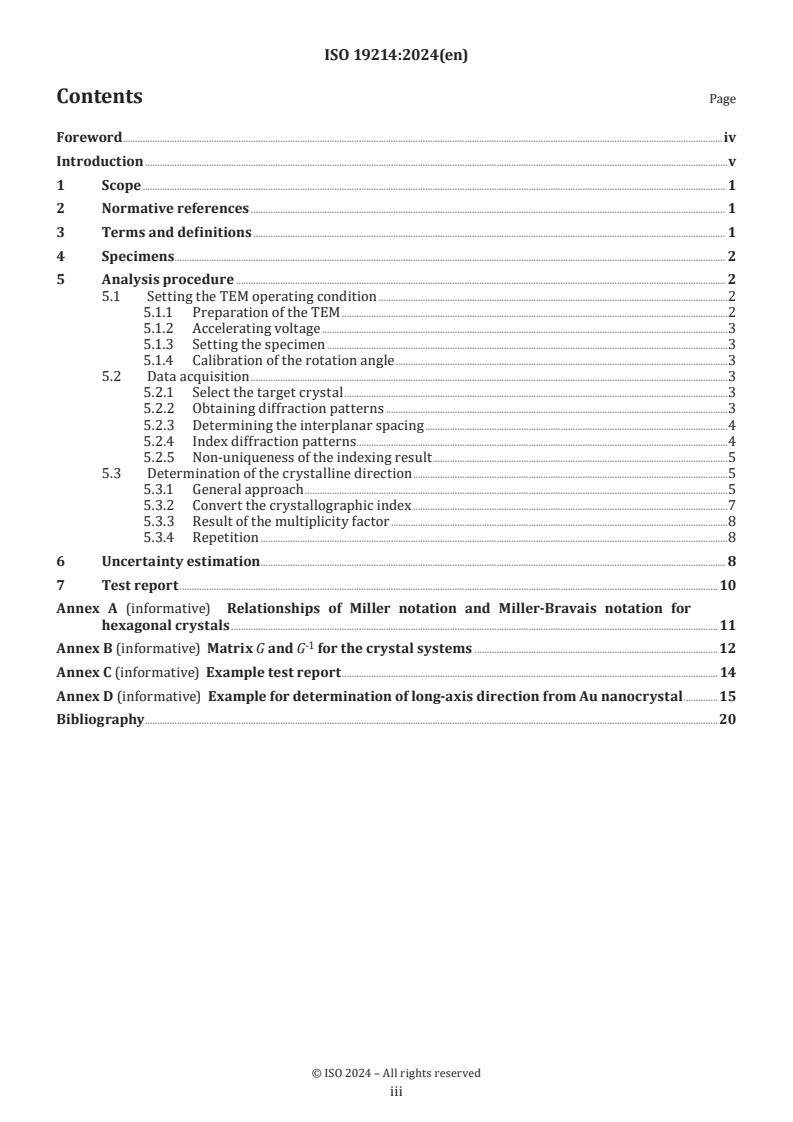
Contents Page
Foreword .iv
Introduction .v
1 Scope . 1
2 Normative references . 1
3 Terms and definitions . 1
4 Specimens. 2
5 Analysis procedure . 2
5.1 Setting the TEM operating condition .2
5.1.1 Preparation of the TEM .2
5.1.2 Accelerating voltage .3
5.1.3 Setting the specimen .3
5.1.4 Calibration of the rotation angle .3
5.2 Data acquisition .3
5.2.1 Select the target crystal .3
5.2.2 Obtaining diffraction patterns .3
5.2.3 Determining the interplanar spacing .4
5.2.4 Index diffraction patterns.4
5.2.5 Non-uniqueness of the indexing result .5
5.3 Determination of the crystalline direction .5
5.3.1 General approach .5
5.3.2 Convert the crystallographic index .7
5.3.3 Result of the multiplicity factor .8
5.3.4 Repetition .8
6 Uncertainty estimation . 8
7 Test report .10
Annex A (informative) Relationships of Miller notation and Miller-Bravais notation for
hexagonal crystals .11
-1
Annex B (informative) Matrix G and G for the crystal systems .12
Annex C (informative) Example test report . 14
Annex D (informative) Example for determination of long-axis direction from Au nanocrystal .15
Bibliography .20
iii
Foreword
ISO (the International Organization for Standardization) is a worldwide federation of national standards
bodies (ISO member bodies). The work of preparing International Standards is normally carried out through
ISO technical committees. Each member body interested in a subject for which a technical committee
has been established has the right to be represented on that committee. International organizations,
governmental and non-governmental, in liaison with ISO, also take part in the work. ISO collaborates closely
with the International Electrotechnical Commission (IEC) on all matters of electrotechnical standardization.
The procedures used to develop this document and those intended for its further maintenance are described
in the ISO/IEC Directives, Part 1. In particular, the different approval criteria needed for the different types
of ISO document should be noted. This document was drafted in accordance with the editorial rules of the
ISO/IEC Directives, Part 2 (see www.iso.org/directives).
ISO draws attention to the possibility that the implementation of this document may involve the use of (a)
patent(s). ISO takes no position concerning the evidence, validity or applicability of any claimed patent
rights in respect thereof. As of the date of publication of this document, ISO had not received notice of (a)
patent(s) which may be required to implement this document. However, implementers are cautioned that
this may not represent the latest information, which may be obtained from the patent database available at
www.iso.org/patents. ISO shall not be held responsible for identifying any or all such patent rights.
Any trade name used in this document is information given for the convenience of users and does not
constitute an endorsement.
For an explanation of the voluntary nature of standards, the meaning of ISO specific terms and expressions
related to conformity assessment, as well as information about ISO's adherence to the World Trade
Organization (WTO) principles in the Technical Barriers to Trade (TBT), see www.iso.org/iso/foreword.html.
This document was prepared by Technical Committee ISO/TC 202, Microbeam analysis, Subcommittee SC 3,
Analytical electron microscopy.
This second edition cancels and replaces the first edition (ISO 19214:2017), which has been technically
revised.
The main changes are as follows:
— the title, introduction and scope have been revised;
— Clause 3 has been revised;
— Figures 1 and 2 have been replaced;
— Annex D has been added;
— editorial revisions have been made.
Any feedback or questions on this document should be directed to the user’s national standards body. A
complete listing of these bodies can be found at www.iso.org/members.html.
iv
Introduction
Nanocrystals are a main component in some advanced materials, especially nanomaterials, and also
appear in traditional materials, such as needle-shaped precipitates in steels and alloys. Controlling the
microstructure of these materials during fabrication is very important for quality control considerations.
To control the microstructure and thereby improve the service properties of the relevant materials, the
apparent growth direction, or the longest axis of the nanocrystals is one of the essential parameters. This
direction of nanocrystals is generally determined by transmission electron microscopy (TEM).
v
International Standard ISO 19214:2024(en)
Microbeam analysis — Analytical electron microscopy —
Method of determination for apparent growth direction of
nanocrystals by transmission electron microscopy
1 Scope
This document gives a method for determination of the apparent growth direction of nanocrystals by
transmission electron microscopy. This method is applicable to all kinds of wire-like crystalline materials
synthetized by various methods. This document can also guide in determining an axis direction of the
second-phase particles in steels, alloys, or other materials. The applicable diameter or width of the crystals
to be tested is in the range of tens to one hundred nanometres, depending on the accelerating voltage of
the transmission electron microscope (TEM) and the material itself. Position, which is curved, twisted, and
folded, to determine the apparent growth direction, should not be used.
2 Normative references
The following documents are referred to in the text in such a way that some or all of their content constitutes
the requirements of this document. For dated references, only the edition cited applies. For undated
references, the latest edition of the referenced document (including any amendments) applies.
ISO 15932, Microbeam analysis — Analytical electron microscopy — Vocabulary
ISO 25498:2018, Microbeam analysis — Analytical electron microscopy — Selected area electron diffraction
analysis using a transmission electron microscope
3 Terms and definitions
For the purposes of this document, the terms and definitions given in ISO 15932 and the following apply.
ISO and IEC maintain terminology databases for use in standardization at the following addresses:
— ISO Online browsing platform: available at https:// www .iso .org/ obp
— IEC Electropedia: available at https:// www .electropedia .org/
3.1
nanocrystal
discrete piece of crystalline material exhibiting a dimensional anisotropy with an axial elongation in one of
the three nanocrystalline lattice direction in the nanoscale
3.2
apparent growth direction
crystalline direction which is parallel to the longest dimension of a single crystal
Note 1 to entry: Apparent growth direction does not involve mechanisms of the phase interface migration.
3.3
Miller notation
indexing system for diffraction patterns, which describes a crystal lattice by three axes coordinate
3.4
Miller-Bravais notation
indexing system for diffraction patterns of hexagonal crystal, which describes the lattice by four axes
coordinate
3.5
reciprocal vector
g
hkl
coordinate vector of hkl lattice point in the reciprocal lattice
Note 1 to entry: Reciprocal vector g is perpendicular to the plane (hkl) of crystal, its length is inversely proportional
hkl
to the interplanar spacing d .
hkl
[SOURCE: ISO 25498:2018, 3.8, modified — Note 1 to entry has been modified. ]
3.6
R vector
R
hkl
coordinate vector from the central spot 000 to the diffraction spot hkl in a diffraction pattern
[SOURCE: ISO 25498:2018, 3.9, modified — Note 1 to entry has been removed.]
3.7
reciprocal space
imaginary space where planes of atoms are represented by reciprocal points and all lengths are the inverse
of their length in real space
4 Specimens
4.1 The sample crystals shall be clean, without contamination or oxidation. They are stable under electron
beam irradiation during TEM analysis.
4.2 Powder or extracted powder specimens of the crystals may be analysed. The sample powder shall be
well dispersed by a suitable technique so that individual crystals can be observed under the TEM.
NOTE One of the techniques in common use is ultrasonic dispersion. In this method, the sample powder is
immersed in ethanol or pure water and dispersed by ultrasonication for about 0,5 h to 1 h, then dropped onto the
supporting film surface of a microgrid. Then, the microgrids are dried at room temperature. The wire-like crystals
are usually parallel to the supporting film plane. Other techniques to prepare individual crystal specimens can also be
[1]
adopted, depending on the physical characteristics of the sample.
4.3 The precipitates or second-phase particles in steels, alloys and the like should be extracted, then
treated as powder specimens; see 4.2.
4.4 Thin-foil specimens of various solid substances prepared by suitable methods (focused ion beam, ion
[2]
beam thinning, etc.) are applicable. The specimen shall be thin enough to transmit the electron beam.
5 Analysis procedure
5.1 Setting the TEM operating condition
5.1.1 Preparation of the TEM
The TEM working condition shall comply with ISO 25498:2018, 8.1.
5.1.2 Accelerating voltage
The applicable accelerating voltage of the TEM for the analysis mainly depends upon the thickness of the
specimen to be studied. Stability of the crystals under electron beam irradiation is also important for the
accelerating voltage setting. As long as the structure and/or morphology of the specimen is not altered during
the analysis, clear images and sharp diffraction patterns can be obtained on the TEM. The corresponding
accelerating voltage or higher may be suitable for the work.
5.1.3 Setting the specimen
Place the specimen to be tested firmly in the double-tilting or tilting-rotation specimen holder, then insert the
holder into the specimen chamber. It is recommended to use the cold finger of the TEM before conditioning.
5.1.4 Calibration of the rotation angle
As specified in ISO 25498:2018, 8.1.6, to be able to successfully correlate the axis of interest in an image with
the corresponding diffraction pattern, the rotation angle between the micrograph and its corresponding
diffraction pattern may need to be calibrated. A molybdenum trioxide crystal specimen may be used as a
reference for the rotation angle calibration. The analyst may refer to textbooks such as References [3] and
[4] for the experimental procedure for this calibration.
NOTE For some transmission electron microscopes, the rotation angle has been compensated by the manufacturer.
In this case, step 5.1.4 can be ignored.
5.2 Data acquisition
5.2.1 Select the target crystal
On the viewing screen, TV monitor, or computer screen of the TEM, get an overview image of the specimen in
low magnification mode. Select an individual crystal which is clean and free from damage or distortion as the
target. Under bright-field imaging mode, adjust the magnification to get a clear magnified image of the target
crystal. Adjust the specimen height (Z axis) to the eucentric position. Adjust the focal length of the images.
5.2.2 Obtaining diffraction patterns
5.2.2.1 General
Various electron diffraction techniques may be applicable for the determination of the crystal axis direction.
The selected area electron diffraction (SAED) and microbeam diffraction techniques are in common use;
however, for the present purpose, the spot diffraction patterns or the patterns formed by the incident beam
through a small angle aperture are preferred.
5.2.2.2 Procedure
The procedure for taking diffraction patterns and micrographs of the target crystal is as follows.
a) Select a suitable position of the target crystal in the specimen and select a diffraction mode (SAED,
microbeam diffraction, or other suitable mode). Switch to the diffraction mode to get a spot diffraction
pattern. Tilt the specimen slightly so that the brightness distribution on the diffraction pattern is
symmetrical and a zero-order Laue zone pattern is displayed. Therefore, the zone axis, Z (with index
[u v w ]), of this diffraction pattern is nearly reverse parallel to the incident beam direction, B . Record
1 1 1 1
this diffraction pattern, Z and take note of the reading on the X and Y tilting angle of the double tilting
1,
specimen stage as X and Y respectively.
1 1,
NOTE Refer to the instruction manual provided by the microscope manufacturer for the operation procedure
for each diffraction mode.
b) Switch back to the imaging mode without changing the specimen orientation to get a correlative
bright field image, M , of the target crystal. Check the focus of this image and take a photo or save
it in the computer system. This image, M is formed under the incident beam direction, B , which is
1, 1
approximately reversely parallel to the zone axis, Z .
c) Return to the diffraction mode and tilt the specimen to produce a second diffraction pattern with zone
axis Z . Record this diffraction pattern, Z , and take note of the reading on the X and Y tilt angle of the
2 2
specimen holder as X and Y , respectively.
2 2
d) Repeat step b) to form the second bright field image, M , of the target crystal. This image, M , is formed
2 2
under the incident beam direction, B , which is nearly reversely parallel to the zone axis, Z , of the
2 2
specimen.
e) The angle, ψ, between the two specimen holder positions (that is, the angle ψ* between the zone axis,
Z , with index [u v w ] and Z , with index [u v w ]) can be obtained from the differences between the
1 1 1 1 2 2 2 2
readings on the X and Y tilting angles at each position (see ISO 25498:2018, 8.2).
5.2.3 Determining the interplanar spacing
To determine the interplanar spacing, d , of the plane (hkl) in crystals, the simplified Bragg law, as shown
hkl
in Formula (1), shall be followed.
Lλ=R × d (1)
hkl hkl
where
L is the camera length;
λ is the wavelength of the incident electron beam;
R is the distance between the central spot and the diffracted spot of a crystalline plane (hkl) in the
hkl
diffraction pattern;
d is the interplanar spacing of the crystalline plane (hkl).
hkl
Lλ is the camera constant. Transmitted spot should be coincident with the optic axis. It is necessary that the
central spot is the transmitted spot of used diffraction pattern.
When the camera constant Lλ is known, the interplanar spacing d can be found, in principle, using
hkl
Formula (1) by measuring the distance R . However, in practice, 2R (the distance between the spots hkl
hkl hkl
and hk l ) shall be measured, then divided by two to calculate the distance R .
hkl
In most cases, the camera constant, Lλ, shall be calibrated for the present work. The practical procedure for
camera constant calibration is specified in ISO 25498:2018, 8.3.
Camera constant, Lλ, calibration is usually performed by using a reference specimen such as polycrystalline
pure gold or pure aluminium. At a given accelerating voltage, record the ring diffraction pattern of the
reference specimen. Index the diffraction rings and measure the diameters 2R of the corresponding
hkl
ring (hkl), respectively. Find the interplanar spacing d for a plane (hkl) of the reference specimen by the
hkl
crystallographic formulae. The camera constant, Lλ, can then be calculated using Formula (1). In practice,
either the Lλ ∼ D/2 plot or an average value of the camera constant may be used.
When the crystalline structure and the confident lattice parameters of the specimen are already known, the
diffraction constant, Lλ, may be calculated from its diffraction pattern directly. The approximate value of Lλ
can be found on a console readout display of a modern TEM.
5.2.4 Index diffraction patterns
For specimens comprised of crystals in the nanometre size regime, most of the time, only spot diffraction
patterns can be observed. Kikuchi patterns seldom appear owing to their small thickness. Therefore, only
the procedure for indexing spot diffraction patterns is specified in this document.
The practical procedure for indexing diffraction patterns may refer to ISO 25498:2018, Clause 9. For the
[3][4][5][6]
convenience of applying this document, the indexing process is briefly summarized as follows:
a) Select two diffracted spots, hk l and hk l , from the diffraction pattern such that these spots are
11 1 22 2
nearest and next-nearest to the central spot, 000, respectively. Measure the length of correlative vectors
R and R which are defined as the vector from the origin, 000, to the diffraction spot hk l
hk l hk l , 11 1
11 1 22 2
and the spot hk l , respectively, in the diffraction pattern. Calculate the corresponding inter-planar
22 2
spacing d and d Then, assign tentative index values for each spot.
hk lhk l .
11 1 22 2
b) Measure the included angle between the vectors R and R as well as the angle between
hk l hk l
11 1 22 2
R and R respectively, where R is defined as the R vector of the
hk l hh−−,,kk ll− hh−−,,kk ll−
22 2 21 21 21 21 21 21
diffraction spot with index h -h , k -k , l -l . Adjust the indices for each spot such that the angle is
2 1 2 1 2 1
coincident with the calculated angle by the crystallographic formulation. When the experimental value
is consistent with the known value within error, the diffraction spots can be indexed.
c) Calculate the zone axis, Z, of the diffraction pattern [u v w] by
...