

ISO 23971:2025
(Main)Surface chemical analysis — X-ray fluorescence analysis of particulate matter filters
General Information
- Abstract
This document gives guidance on sample preparation, and on qualitative and quantitative determination of elements in particulate matter collected on filtering membranes (PM filter) by energy dispersive X-ray Fluorescence (EDXRF) in different geometrical configurations. This document does not apply to PM filter sampling. This document only applies to the analysis of X-ray emission from filters that are probed using an X-ray beam as the exciting source. X-ray emissions generated by electron microscope are excluded[1]. This document is applicable under a range of contexts including, but not limited to, those highlighted in the introduction. The described method is generally applicable for the determination of elements with atomic number higher than 11 (Na) and having a deposited mass on the filter greater than 10 ng. The elements that can be identified and the detection limits depend on the specific instrumental configuration employed. Various types of filtering membranes (filter) materials can be used, such as glass fibre, quartz fibre, cellulose, nylon, polycarbonate (PC) and polytetrafluoroethylene (PTFE). The entire filter, or portions of various sizes thereof, can be submitted for analysis. NOTE Reference free analysis, based on fundamental parameters is excluded, as the nature of the PM filter samples means that the parameters are not sufficiently well defined.
- Status
- Published
- Publication Date
- 18-Nov-2025
- Technical Committee
- ISO/TC 201/SC 10 - X-ray Reflectometry (XRR) and X-ray Fluorescence (XRF) Analysis
- Drafting Committee
- ISO/TC 201/SC 10/WG 1 - XRF technique
- Current Stage
- 6060 - International Standard published
- Start Date
- 19-Nov-2025
- Due Date
- 08-Mar-2026
- Completion Date
- 19-Nov-2025



Overview
ISO 23971:2025 - Surface chemical analysis - X‑ray fluorescence analysis of particulate matter filters provides guidance for the non‑destructive elemental analysis of particulate matter collected on filtering membranes (PM filters) using energy dispersive X‑ray fluorescence (EDXRF). The standard covers sample preparation, qualitative identification and quantitative determination of elements (generally atomic number > 11, i.e., above sodium) when deposited mass on a filter is greater than about 10 ng. It applies to X‑ray excitation only (electron‑microscope generated emissions are excluded) and supports a range of air‑quality contexts (ambient monitoring, workplace, emissions). Note: PM sampling procedures themselves are outside the scope.
Key technical topics and requirements
- Sample preparation and handling: guidance on submitting whole filters or portions and minimising contamination and interferences from filter substrates (glass fibre, quartz fibre, cellulose, nylon, polycarbonate, PTFE).
- Measurement configurations: procedures for different geometrical setups when probing filters with an X‑ray beam.
- Qualitative analysis: identification of analytes, treatment of background, escape peaks and detector artefacts.
- Quantitative analysis: use of certified reference materials (CRMs), reference materials or calibrated test filters; calibration curve construction; limits of detection (LOD) considerations.
- Uncertainty and quality control: uncertainty budgets, precision (repeatability/reproducibility), accuracy checks, quality checks and reporting requirements.
- Excluded methods: reference‑free (fundamental‑parameter) analysis is excluded due to poorly defined sample parameters for PM filters.
- Supporting material: informative annexes on uncertainty contributions, calibration procedures and international interlaboratory comparison.
Practical applications and who uses this standard
ISO 23971:2025 is intended for:
- Environmental and air‑quality laboratories performing elemental analysis of PM filters.
- Regulatory and monitoring agencies that need standardised EDXRF methods for non‑destructive screening of metals and metalloids in air sampling.
- Instrument manufacturers and method developers validating EDXRF performance, calibration and detection limits.
- Research institutions conducting particulate composition studies where green, low‑waste analytical methods are preferred compared with destructive AAS/ICP techniques.
Benefits include non‑destructive testing (no sample digestion), lower environmental impact, and applicability across common filter media and analytical configurations.
Related standards
- Normative reference: ISO 18115‑1 (surface chemical analysis - vocabulary).
- ISO 23971 complements existing international methods for elemental analysis (AAS, ICP) by providing standardized guidance specific to EDXRF analysis of PM filters.
Get Certified
Connect with accredited certification bodies for this standard

ECOCERT
Organic and sustainability certification.

Eurofins Food Testing Global
Global leader in food, environment, and pharmaceutical product testing.

Intertek Bangladesh
Intertek certification and testing services in Bangladesh.
Sponsored listings
Frequently Asked Questions
ISO 23971:2025 is a standard published by the International Organization for Standardization (ISO). Its full title is "Surface chemical analysis — X-ray fluorescence analysis of particulate matter filters". This standard covers: This document gives guidance on sample preparation, and on qualitative and quantitative determination of elements in particulate matter collected on filtering membranes (PM filter) by energy dispersive X-ray Fluorescence (EDXRF) in different geometrical configurations. This document does not apply to PM filter sampling. This document only applies to the analysis of X-ray emission from filters that are probed using an X-ray beam as the exciting source. X-ray emissions generated by electron microscope are excluded[1]. This document is applicable under a range of contexts including, but not limited to, those highlighted in the introduction. The described method is generally applicable for the determination of elements with atomic number higher than 11 (Na) and having a deposited mass on the filter greater than 10 ng. The elements that can be identified and the detection limits depend on the specific instrumental configuration employed. Various types of filtering membranes (filter) materials can be used, such as glass fibre, quartz fibre, cellulose, nylon, polycarbonate (PC) and polytetrafluoroethylene (PTFE). The entire filter, or portions of various sizes thereof, can be submitted for analysis. NOTE Reference free analysis, based on fundamental parameters is excluded, as the nature of the PM filter samples means that the parameters are not sufficiently well defined.
This document gives guidance on sample preparation, and on qualitative and quantitative determination of elements in particulate matter collected on filtering membranes (PM filter) by energy dispersive X-ray Fluorescence (EDXRF) in different geometrical configurations. This document does not apply to PM filter sampling. This document only applies to the analysis of X-ray emission from filters that are probed using an X-ray beam as the exciting source. X-ray emissions generated by electron microscope are excluded[1]. This document is applicable under a range of contexts including, but not limited to, those highlighted in the introduction. The described method is generally applicable for the determination of elements with atomic number higher than 11 (Na) and having a deposited mass on the filter greater than 10 ng. The elements that can be identified and the detection limits depend on the specific instrumental configuration employed. Various types of filtering membranes (filter) materials can be used, such as glass fibre, quartz fibre, cellulose, nylon, polycarbonate (PC) and polytetrafluoroethylene (PTFE). The entire filter, or portions of various sizes thereof, can be submitted for analysis. NOTE Reference free analysis, based on fundamental parameters is excluded, as the nature of the PM filter samples means that the parameters are not sufficiently well defined.
ISO 23971:2025 is classified under the following ICS (International Classification for Standards) categories: 71.040.50 - Physicochemical methods of analysis. The ICS classification helps identify the subject area and facilitates finding related standards.
ISO 23971:2025 is available in PDF format for immediate download after purchase. The document can be added to your cart and obtained through the secure checkout process. Digital delivery ensures instant access to the complete standard document.
Standards Content (Sample)
International
Standard
ISO 23971
First edition
Surface chemical analysis — X-ray
2025-11
fluorescence analysis of particulate
matter filters
Reference number
© ISO 2025
All rights reserved. Unless otherwise specified, or required in the context of its implementation, no part of this publication may
be reproduced or utilized otherwise in any form or by any means, electronic or mechanical, including photocopying, or posting on
the internet or an intranet, without prior written permission. Permission can be requested from either ISO at the address below
or ISO’s member body in the country of the requester.
ISO copyright office
CP 401 • Ch. de Blandonnet 8
CH-1214 Vernier, Geneva
Phone: +41 22 749 01 11
Email: copyright@iso.org
Website: www.iso.org
Published in Switzerland
ii
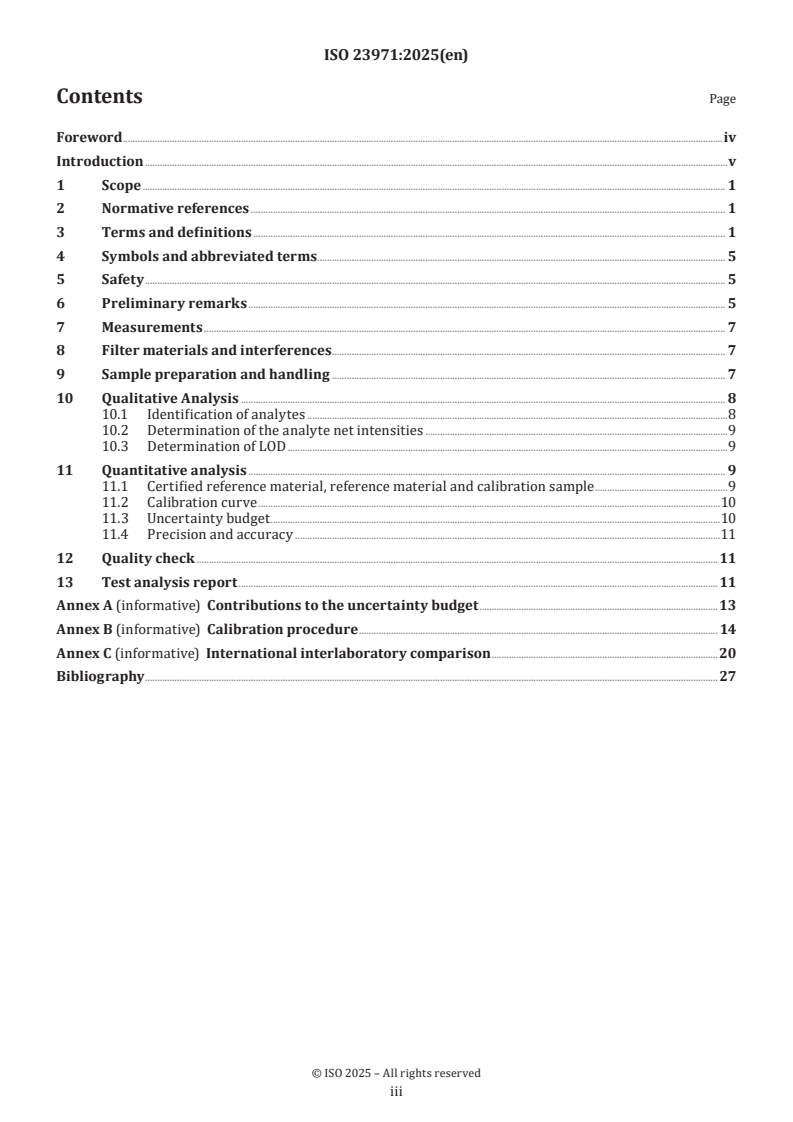
Contents Page
Foreword .iv
Introduction .v
1 Scope . 1
2 Normative references . 1
3 Terms and definitions . 1
4 Symbols and abbreviated terms. 5
5 Safety . 5
6 Preliminary remarks . 5
7 Measurements . 7
8 Filter materials and interferences . 7
9 Sample preparation and handling . 7
10 Qualitative Analysis . 8
10.1 Identification of analytes .8
10.2 Determination of the analyte net intensities .9
10.3 Determination of LOD .9
11 Quantitative analysis . 9
11.1 Certified reference material, reference material and calibration sample .9
11.2 Calibration curve .10
11.3 Uncertainty budget .10
11.4 Precision and accuracy .11
12 Quality check .11
13 Test analysis report .11
Annex A (informative) Contributions to the uncertainty budget .13
Annex B (informative) Calibration procedure . 14
Annex C (informative) International interlaboratory comparison .20
Bibliography .27
iii
Foreword
ISO (the International Organization for Standardization) is a worldwide federation of national standards
bodies (ISO member bodies). The work of preparing International Standards is normally carried out through
ISO technical committees. Each member body interested in a subject for which a technical committee
has been established has the right to be represented on that committee. International organizations,
governmental and non-governmental, in liaison with ISO, also take part in the work. ISO collaborates closely
with the International Electrotechnical Commission (IEC) on all matters of electrotechnical standardization.
The procedures used to develop this document and those intended for its further maintenance are described
in the ISO/IEC Directives, Part 1. In particular, the different approval criteria needed for the different types
of ISO document should be noted. This document was drafted in accordance with the editorial rules of the
ISO/IEC Directives, Part 2 (see www.iso.org/directives).
ISO draws attention to the possibility that the implementation of this document may involve the use of (a)
patent(s). ISO takes no position concerning the evidence, validity or applicability of any claimed patent
rights in respect thereof. As of the date of publication of this document, ISO had not received notice of (a)
patent(s) which may be required to implement this document. However, implementers are cautioned that
this may not represent the latest information, which may be obtained from the patent database available at
www.iso.org/patents. ISO shall not be held responsible for identifying any or all such patent rights.
Any trade name used in this document is information given for the convenience of users and does not
constitute an endorsement.
For an explanation of the voluntary nature of standards, the meaning of ISO specific terms and expressions
related to conformity assessment, as well as information about ISO's adherence to the World Trade
Organization (WTO) principles in the Technical Barriers to Trade (TBT), see www.iso.org/iso/foreword.html.
This document was prepared by Technical Committee ISO/TC 201, Surface Chemical Analysis, Subcommittee
SC 10, X-ray Reflectometry (XRR) and X-ray Fluorescence (XRF) Analysis.
Any feedback or questions on this document should be directed to the user’s national standards body. A
complete listing of these bodies can be found at www.iso.org/members.html.
iv
Introduction
Air pollution originates from both natural sources (volcanoes, dust winds) and anthropogenic activities
(industry, transportation, agricultural, household). It represents a major health, environmental, societal,
and economic burden. Particulate matter (PM) is one of the six primary pollutants in the air and its danger
varies depending on the size, concentration, and composition of the particles. Various sampling approaches
and analytical requirements have been applied to the study of PMs according to the specific frameworks for
and under which samples are collected, for instance for monitoring ambient air quality, workplace air, or
stationary source emissions. Air filtering membrane (PM filter) remains the preferred sampling substrate.
PM concentration in the volume of sampled air is determined gravimetrically by weighing filters collected
from air monitoring stations, which can also perform size fraction selection. PM chemical composition,
physical properties, and biological content are determined by analysing the whole or part of the PM filter.
The most widely used analytical techniques for determining the elemental composition, mainly for metals
and metalloids in PM filters are atomic absorption and inductively coupled plasma-based spectroscopies
(AAS and ICP). These methods are destructive as they require the complete solubilization of the solid
samples in a liquid mixture. Energy dispersive X-ray fluorescence (EDXRF) is an alternative technique to
the above mentioned for elemental analysis, which is non-destructive, with lower environmental impact,
and which does not require sample solubilization or the use of gasses for operation. Several International
Standards exist and describe methods for elemental analysis based on AAS and ICP, while only a few non
International Standards describe methods based on XRF techniques.
This document is developed in response to a worldwide demand to use green and environmentally
sustainable analytical methods according to the 2030 Agenda for Sustainable Development. This document
supports the use of energy dispersive XRF based techniques for elemental analysis of PM filters, targeting
the Sustainable Development Goals (SDGs) 11, 12, 14, 15.
v
International Standard ISO 23971:2025(en)
Surface chemical analysis — X-ray fluorescence analysis of
particulate matter filters
1 Scope
This document gives guidance on sample preparation, and on qualitative and quantitative determination
of elements in particulate matter collected on filtering membranes (PM filter) by energy dispersive X-ray
Fluorescence (EDXRF) in different geometrical configurations. This document does not apply to PM filter
sampling. This document only applies to the analysis of X-ray emission from filters that are probed using an
[1]
X-ray beam as the exciting source. X-ray emissions generated by electron microscope are excluded .
This document is applicable under a range of contexts including, but not limited to, those highlighted in the
introduction. The described method is generally applicable for the determination of elements with atomic
number higher than 11 (Na) and having a deposited mass on the filter greater than 10 ng. The elements that
can be identified and the detection limits depend on the specific instrumental configuration employed.
Various types of filtering membranes (filter) materials can be used, such as glass fibre, quartz fibre, cellulose,
nylon, polycarbonate (PC) and polytetrafluoroethylene (PTFE). The entire filter, or portions of various sizes
thereof, can be submitted for analysis.
NOTE Reference free analysis, based on fundamental parameters is excluded, as the nature of the PM filter
samples means that the parameters are not sufficiently well defined.
2 Normative references
The following documents are referred to in the text in such a way that some or all of their content constitutes
requirements of this document. For dated references, only the edition cited applies. For undated references,
the latest edition of the referenced document (including any amendments) applies.
ISO 18115-1, Surface chemical analysis — Vocabulary — Part 1: General terms and terms used in spectroscopy
3 Terms and definitions
For the purposes of this document, the terms and definitions given in ISO 18115-1 and the following apply.
ISO and IEC maintain terminology databases for use in standardization at the following addresses:
— ISO Online browsing platform: available at https:// www .iso .org/ obp
— IEC Electropedia: available at https:// www .electropedia .org/
3.1
absorption
attenuation of X-rays passing through matter, arising primarily from photoelectric absorption for X-ray
energies
3.2
absorption correction
matrix correction arising from the loss of X-ray intensity from an element due to photoelectric absorption
with all elements within the sample while passing through it to the detector
3.3
accuracy
systematic deviation of a measured parameter from a reference value for that parameter
3.4
background
non-characteristic component of an X-ray spectrum, sum of all detector artefacts and radiation contributions
arising from scattering of the primary radiation, emissions from the sample carrier, the sample, the ambient
atmosphere, or detector system
Note 1 to entry: In total refection X-ray fluorescence (TXRF), the Bremsstrahlung (3.6) contributes to the background
of the measured spectrum. It can be reduced considerably with good monochromatizating of the incident beam, but
this is often instrument specific.
3.5
beam stability
broad term that describes the variation in time of the incident beam characteristics
Note 1 to entry: Typically beam stability is used to describe any temporal variation of the incident beam flux, but it can
also be applied to any variations in position, divergence or other beam parameters as a function of time.
Note 2 to entry: For accurate quantification, the beam should be stable over the period of quantification including the
production of the calibration curve and any subsequent analyses based upon it.
3.6
bremsstrahlung
radiation emitted when high speed electrons are decelerated, or completely stopped, by the forces exerted
on them by the atoms within a material upon which they are incident
Note 1 to entry: Bremsstrahlung radiation is emitted over a continuous energy range up to the maximum energy of the
electrons.
3.7
calibration sample
test filter of known elemental masses that were deposited on its surface, either in the form of particulate
matter, thin film, salt crystals, or powders, which is used for establishment of the calibration curve
Note 1 to entry: The calibration sample can be prepared in house according to specifications (See Annex B).
3.8
certified reference material
CRM
reference material, characterized by a traceable procedure for one or more specified properties.
Note 1 to entry: It shall be accompanied by a certificate that provides the value of the specified property, its associated
uncertainty, and a statement of traceability.
3.9
dead time
time following the arrival of a photon in the detector in which the pulse processing takes place and during
which no subsequent photons can be processed.
Note 1 to entry: The dead time is usually measured in microseconds
3.10
escape peak
satellite line located on the low energy side of an analyte line, which results from an excitation within the
semiconducting crystal of the detector
Note 1 to entry: For Si detectors the escape peak lies at an energy which is lower than the main peak by an amount
corresponding to the Si Kα (1,74 keV) with an intensity of 1 % or less of the main peak
3.11
filter blank
filtering membranes used to collect particulate matter by air filtration
Note 1 to entry: Filter materials can be made of glass fibre, quartz fibres, cellulose, nylon, polycarbonate (PC) and
polytetrafluoroethylene (PTFE)
3.12
live time
time during which the detector is capable of processing events and usually expressed in seconds (s), which
equals the real time minus the dead time (3.9).
3.13
method validation
process used to confirm that a particular measurement is suitable for its intended use, and that it can be
fulfilled consistently for the intended use
Note 1 to entry: Results from method validation can be used to judge the quality, reliability and consistency of
analytical results; it is an integral part of any good analytical practice.
3.14
precision
measure of the statistical variance in a measurement that relates to the random uncertainties present
3.15
qualitative analysis
identification of elements which depends on the instrumental configuration, experimental setup, and the
variability of the laboratory filter blank (3.11)
3.16
quantitative analysis
determination of elements amount which depends on the availability of any reference material or calibration
sample (3.7)
3.17
reference material
material or substance whose properties (or parts of its properties) are sufficiently homogeneous, well-
established and stable and has been established to be fit for its intended use in measurement
Note 1 to entry: It can be used for analytical control (calibration of an apparatus, assessment of a measurement
method, or assigning value to materials).
3.18
repeatability
closeness of agreement between independent results obtained with the same method on the same analysis
sample and under the same experimental conditions (same operator, same apparatus, same laboratory and
after short intervals of time)
Note 1 to entry: The measure of repeatability is the standard deviation of the results.
3.19
reproducibility
closeness of agreement between independent results obtained with the same method on the same analysis
sample but under different conditions (different operators, different apparatus, different laboratories and/
or after different intervals of time)
Note 1 to entry: The measure of reproducibility is the standard deviation of the results.
3.20
reflector
appropriate substrate on which the sample is deposited, and which is placed in the primary X-ray beam
Note 1 to entry: Suitable reflector materials shall satisfy certain physical and chemical requirements:
— No, or only weak, X-ray lines in the energy range of the analytes under investigation;
— Good surface properties, such as flatness and low roughness (< 0,001° and < 5 nm within an area of 1 mm ,
respectively);
— Chemical inertness;
— For reusable carriers, insensitivity of mechanical and chemical properties to cleaning protocols.
Good sample carriers are high purity Si wafers, SiO (quartz), borosilicate glass (for heavy element lines only),
sapphire, and/or silicon carbide.
3.21
sensitivity
ratio of output signal (fluorescence emission peak intensity) to the input signal (photon rate) at a given energy
3.22
traceability
degree to which the calibration permits a quantitative analysis result to be traced to the SI unit (kg or mole
of analyte, with respect to a sample mass or amount) in an unbroken chain, according to a sequence of logical
steps involving comparative measurements with defined contributions to the measurement uncertainty in
the final results of the determination
3.23
uncertainty
confidence interval describing either the precision (random uncertainty) or the accuracy (systematic
uncertainty) of a measurement, or both
Note 1 to entry: Uncertainties arise at each step of the chemical measurement process including the sample handling
and preparation, measurement, and data analysis. Care is needed to capture realistic estimates of the uncertainties so
that a robust confidence level can be reported on any final result.
3.24
self absorption
absorption of the emitted radiation by the sample itself
Note 1 to entry: In TXRF, self-absorption effects are usually considered negligible due to the low mass per unit area used.
Note 2 to entry: In TXRF, external calibration with fit-for-purpose reference materials or robust samples may be
undertaken to compensate for (limited) matrix and self-absorption effects occurring when the sample to investigate
slightly deviates from the theoretical requirements for quantitative analysis.
Note 3 to entry: Self-absorption effects are also called matrix effects, although the concepts underlying both effects
are slightly different; self-absorption effects are linked to difference in energy for the excitation level of elements
in the sample, while matrix effects are due to the presence and density of matrix analytes that affect the emission
characteristics of the analyte of interest.
4 Symbols and abbreviated terms
CRM Certified Reference Material
CS Calibration Sample
EDXRF Energy Dispersive X-ray Fluorescence
PC Polycarbonate
PTFE Polytetrafluoroethylene
PM Particulate Matter
RM Reference Material
TXRF Total reflection X-ray Fluorescence
XRT X-ray Tube
LOD Limit of Detection
LOQ Limit of Quantification
5 Safety
WARNING — X-ray radiation is used with this test method. Safety precautions are necessary for
safeguarding the operator and avoiding exposing any part of the body to the X-rays produced by
the apparatus. The user of this document shall be aware of applicable national radiation protection
regulations.
6 Preliminary remarks
XRF is a mechanically non-destructive analytical technique that enables the collection of elemental
information from a sample. In the XRF emission process, photons from a primary X-ray beam interact with
atoms within the sample, resulting in the ionization of a core electron. As the atom returns to a more stable
electronic configuration, it releases energy in the form of fluorescent radiation. The intensity of this radiation
is directly proportional to the atomic concentration of the corresponding element within the information
volume defined by the illuminated area.
In EDXRF, the fluorescent radiation emitted by the sample is collected by an energy dispersive detector,
which measures the energy and intensity of the emitted X-ray photons, allowing for the identification and
quantification of the elemental composition.
Qualitative analysis relies on the identification of the elements based on the energy of the fluorescence
emission peaks observed in the spectrum. A quantitative analysis establishes a relationship between the
measured X-ray fluorescence emissions of an analyte, and the concentration of this analyte in the sample.
Various quantification strategies may be undertaken, depending on the sample itself, the measurement
conditions, as well as the instrumental set-up. This document is describing a quantification procedure based
on the establishment of a calibration function, also known as “external calibration”. For this purpose, a set
of calibration samples (best, of reference materials) of known composition (i.e., the analyte and its mass) is
required. Following the measurement, spectral analysis is performed with the aim to retrieve the analyte(s)
net intensity(ies) of the X-ray fluorescence emissions observed. Successively, a calibration function linking
the analyte net intensities and their respective certified or known masses is generated, together with their
uncertainties. The graphical representation, the calibration curve, may then be used to quantify the analyte
mass in an unknown sample based on the net intensity derived from the measurement.
The angle between the incoming X-ray beam and the sample surface (glancing angle) and the angle between
the detector and the sample surface define the two main geometries used in EDXRF spectroscopy and are
presented in Figure 1. Instruments exploiting a conventional configuration can have several tens of degrees
for excitation and detection angles, and these systems are usually referred to as EDXRF spectrometers.
Those systems which exploit a configuration with the incident beam under grazing incidence and the
[2]
detector positioned vertically above the sample (0°/90°) are referred to as TXRF spectrometers.
These two configurations give information over different information volumes of the sample under X-ray
excitation and can be chosen based on specific experimental requirements and/or analytical goals. A TXRF
spectrometer projects the beam size onto the filter surface which, due to the low incident angle, causes
the beam to be extended in one direction. The emission signals are enhanced by also exciting the residue
with both the incident and reflected beams. For non-reflecting filters, the formal conditions underpinning
the quantification formalism of TXRF are not met, and these measurements are referred to as XRF under
grazing incidence. If an angular scan of the sample is possible, then an optimum angle may be found that
maximises the X-ray excitation of the analytes in the sample.
a) b)
Key
a conventional with equal incident and exit angles (45°/45°)
b grazing incidence with the detector placed vertically above the sample (0°/90°)
1 X-ray beam
2 detector
3 substrate
Figure 1 — Schematic representation of two geometries used in EDXRF
In a comparison of various filtering media for the analysis of particulate matter by EDXRF, PTFE filters
were found to yield results that were better in line with inductively coupled plasma mass spectroscopy
[3]
findings . Since 2008, several studies have demonstrated that by measuring PM filters using XRF under
grazing incidence it is possible to build external calibration curves by measuring reference materials and
filter blanks to:
a) establish the linear dynamic range;
b) to calculate LOD; and
[4-9]
c) LOQ for different analytes .
These two geometries present different advantages and can be chosen based on specific experimental
requirements and analytical goals. In conventional geometry the beam footprint is generally an area around
a few tens mm while in grazing incidence geometry the analysis area is smaller, as if the beam footprint
extends widely in the beam propagation direction, its width is generally smaller. Recent studies have
shown an agreement between the results obtained by the two conventional and under grazing incidence
[10]
geometries, observing higher sensitivities using the latter .
7 Measurements
Measurements shall be performed in a spectrometer that uses either a conventional geometry or under
grazing incidence (TXRF) as shown in Figure 1. The fluorescence radiation emitted by the sample shall be
collected by an energy dispersive detector whose instrumental parameters are known.
NOTE 1 The energy of the primary radiation is set by the choice of the X-Ray tube (XRT) anode material and will
determine the elements within the sample that can be excited.
The X-ray fluorescence intensities of the analytes present in the test sample are dependent on the size, mass,
and spatial distribution of the PM on the filter surface, the illuminated area of the sample, as well as the
detector acceptance.
If the sample is not fully illuminated by the beam, it is advisable to change the sample's position with respect
to the beam to expose different volumes of the sample, helping to account for any sample inhomogeneity of
the PM on the filter surface. When measured by TXRF, the sample is generally almost entirely irradiated in
the direction of the propagation of the beam because of the geometrical configuration of the instrument.
The lateral excitation (perpendicular to the beam propagation axis) is generally much smaller than the
sample deposition (illuminating the sample laterally from tens of micrometres to less than 10 mm at best.
If the sample stage is not spinning during the acquisition, at least three spectra with different orientations
shall be measured, rotating the sample about its axis by roughly 90° to 120°. More measurements at varying
azimuthal orientations or sample lateral positions will further improve the representativeness of the
analysis, enhancing the reliability of the results. The weighted average of the measurand and its uncertainty
should then be determined.
The live time of the detector should be optimized to ensure that the fluorescence emissions obtained for
each analyte to be quantified are significantly above the limits of quantification established, and that the
desired precision is achieved.
NOTE 2 Some instruments provide a value for an apparent instrumental LOD which is based on the background of
the measured spectrum and can give an indication of the data quality.
8 Filter materials and interferences
The substrate that is collecting the PM, either by forcing air through it or by using various means of collection
upon it, shall be a flat and inert, homogeneous and plain filter. The filter can be made of different materials,
such as for example quartz fibres, cellulose, nylon, PTFE, or PC. Filter diameter and pore size depend on the
application, on the device used for PM collection, or specific indications if a standard is in use.
The sparsity of the PMs on the filters in many cases will mean that the primary radiation is likely to also
excite the elements present in the filter and these can cause some spectral overlaps with the XRF emissions
of the elements of interest present in the PM. The filter composition shall be homogeneous throughout its
surface both in terms of composition and in terms of physical properties (porosity, flatness, etc.). PTFE and
PC filters are the preferred substrates for PM analysis according to this document as they usually do not
contain analytes, have a clean spectrum, and present a lower background. The analysis of a filter blank shall
be performed prior to any data collection and to determine the LODs and LOQ levels.
An additional advantage of using PTFE filters is that they are easily handled if they have a plastic supporting
ring to stretch the membrane, which helps maintaining its flatness and avoiding shrinking.
NOTE Ensure that the PM size and overall sample thickness do not exceed the sample to detector distance, which is
quite small in TXRF spectrometers, to prevent potential damage to the detector and mechanical alignment stage mostly.
9 Sample preparation and handling
The surface of the filter containing the PM shall be illuminated by the X-ray beam.
During sample preparation and handling, the least amount of treatment that can guarantee a proper analysis
and prevent against damage, contamination and PM loss from the filter should always be favoured. If needed,
filters can be cut and sized to fit into the dimension of the sample holder in use. To prevent physical damage,
material loss and contamination, a low Z -element-based polymeric material covering the PM filter surface, or
sandwiching the filter via a proper technique, can be employed to shield and protect the test sample. Materials
free from contaminations, and especially from the analytes of interest to be measured, shall be used.
When using EDXRF spectrometers, the filter shall be placed on a sample holder, such as an XRF cup, which
shall be compatible with the alignment procedures used for the spectrometer measurement chamber, and
which shall allow any possible automatic movement. It is crucial to demonstrate that the sample holder does
not introduce any additional spectral interference nor modify the background. Special attention should be
placed on evaluating potential spectral artefacts issued from the back of the filter or the surrounding area.
To this purpose, a filter blank shall be measured at this specific stage of the method validation.
When using a TXRF spectrometer, the sample shall be placed onto a reflector. While quartz glass reflectors
shall be preferred, especially in the case where lower low mass(es) of analyte(s) is (are) to be measured,
reflectors made of other materials can also be used. However, within a measurement session of a series of
similar samples, and especially in the case of the measurement of the calibration materials or reference
samples to be used for the establishment of the external calibration, the same type of reflector and the same
sample preparation procedure shall be used for all measurements. If the filter has a plastic ring support
thicker than the filtering membrane, the ring shall be removed, by cutting the plastic ring or using a pressure
ring device, before the filter insertion in the TXRF spectrometer, providing that the filter's surface is taut.
[6-10]
EXAMPLE Procedure to mount a PM filter on a reflector sample holder .
— Affix a polymeric sheet to one or both sides of the filter, in the second case enclosing it like a sandwich. This helps
tighten the filter, prevents it from shrinking and eases its manipulation as the system becomes more rigid. It also
prevents further contamination or PM loss and extends the sample’s shelf-time and facilitate its storage.
— Cut the test sample into a disk of the same diameter than the sample holder (i.e., 30 mm).
— Wet the surface of the reflector with 10–30 microliters of absolute ethanol (spectrophotometric grade, 200 proof).
— Adhere the prepared sample to the reflector’s surface, ensuring the plastic sticks securely and the sample surface
is flat (sticking is reversible).
— The test sample such prepared can be directly measured with a TXRF spectrometer or an EDXRF if it fits into the
XRF cup.
It is recommended to use automatic devices to ensure the repeatability of the polymeric sheet sandwiching process
and sample flattening.
[10]
EXAMPLE 1 Procedure to mount a PM filter on a pressure ring device .
— Use a sample holder with an inner ring that has a bottom and an outer ring.
— Place the sandwiched filter onto the holder, ensuring that the system's surface is taut.
— Secure the sandwich in place by fastening the two rings together.
EXAMPLE 2 Procedure to mount a PM filter on a XRF cup
— Place the test sample in the XRF cup, ensuring that the surface loaded with PM is facing the measurement chamber.
— Secure the outer edge of the filter to the inner side of the cup using a spring mechanism or tape.
10 Qualitative Analysis
10.1 Identification of analytes
The spectrum acquired with an energy dispersive detector shall be analysed to ascertain the presence or
absence of the analytes (elements of interest) via the identification of their characteristic X-ray emission lines.
An XRF spectrum, however, is composed not only by the characteristic X-ray fluorescence emission lines
of the elements present in the sample under X-ray excitation, but also by various background (sample
scattering, sample environment) and instrumental interferences such as those resulting from the X-ray
source (Bremmstrsahlung) or from the detector (escape peak, pile up).
As an EDXRF detector has an intrinsic energy resolution (typically around 140 eV at the Mn KL line),
2+3
spectral interferences such as peak overlaps are to be expected.
Commercial and free, open-source dedicated software can be used to identify the peak corresponding to the
characteristic X-ray emission lines of the analytes excited in the sample, and to deal automatically with peak
overlaps.
10.2 Determination of the analyte net intensities
The net intensities of characteristic XRF emissions of an analyte are related to the amount present in the
sample. In any case, and especially with high PM amount, special attention should be placed in correctly
accounting for any matrix absorption correction and self-absorption effects, such as secondary excitation, etc.
Each spectrum shall be processed separately to determine each analyte net intensity corresponding to
the integrated intensity of suitable fluorescence emission peaks selected for each element using a fitting
procedure. Commercial and free, open-source dedicated software can be used.
The use of region of interest (ROI) integration should be avoided as peak overlap and background
contributions can introduce additional uncertainties. Likewise, fitting strategies which assess not only the
analytes fluorescence emissions, but also the background, should be used.
10.3 Determination of LOD
The LOD of the method shall be determined under specified and constant experimental conditions including
instrumental configuration, measurement parameters (e.g., live time), sample preparation and sample type.
The LOD of each analyte is calculated from the net area of multiple filter blanks measurements in the energy
range of interest of the selected analyte, according to Equation (1). The resulting LOD (L in equation 1) in
i
terms of net intensity can be converted to mass per unit area, or mass if a calibration curve for the selected
analyte is available.
Ly=+ks (1)
ibibi
where
y is the mean net intensity from a series of independent measures of the filter blank;
bi
s is the standard error, i.e. the standard deviation of the mean net intensity from a series of
bi
independent measures of the filter blank;
k is a numerical factor chosen according to the confidence level desired: the 95 % confidence
level is reached for k = 2, while the 99,7 % confidence limit is met when k = 3.
11 Quantitative analysis
11.1 Certified reference material, reference material and calibration sample
To qualify and validate the method employed to analyse PM on filters calibration samples must be used
The calibration samples shall use the same filter material and shall be submitted to the same sample
preparation and handling procedure(s) as the one(s) employed for the measurement of the test sample(s).
The composition of calibration samples should be as similar as possible to those of the sample to be analysed.
Both the calibration sample and samples to be analysed shall be measured under the same experimental
conditions with the spectra processed using the same data reduction and analysis pathways.
Different types of calibration samples exist and are used for quality check (Clause 12), for evaluating the
method precision and for creating the calibration curves (11.2). To evaluate the analysis method accuracy
(11.4) and provide details regarding the analysis's level of uncertainty. (11.3), the use of certified reference
materials (CRMs) and reference material (RMs) should be preferred.
11.2 Calibration curve
A blank filter, and a series of calibration samples shall be measured as detailed in Clause 7, using the same
experimental conditions, (i.e., instrumental and measurement parameters). The mass per unit area range
for each analyte shall be appropriately chosen to include the expected elemental mass per unit area, or mass,
in the (real) experimental samples, and to consider what is the calibration range required for the specific
application field targeted.
2 2
EXAMPLE For example, if the calibration range for determining Pb is 1 ng/cm to 1 000 ng/cm , calibration samples
2 2
with mass per unit area from 0,5 ng/cm to 5 000 ng/cm of Pb should be employed to build the calibration curve.
The calibration function for the analyte of interest is obtained via data regression using the analyte net
intensities and their uncertainties retrieved from multiple measurements of the calibration samples as a
function of mass per unit area, or mass. An example is presented in Annex B. The need and relevance of the
linear dynamic range or calibration range models, determined with or without weighted regression, should
be assessed on a case-by-case basis (IUPAC, EURACHEM or other national guidelines can be consulted for
reference).
EXAMPLE For instance, net intensities, recorded for the same live time, may be plotted as a function of the analyte
mass per unit area (typically in µg/cm ), or may be plotted as a function of a parameter which incorporates matrix
effect and self-absorption contributions scaling with the mass per unit area. Both approaches lead to linear calibration
[8,10]
functions as demonstrated in .
NOTE 1 The linear calibration range can be retrieved from the complete data set, or limited to specific subsets with
narrower mass per unit area, or mass range, to ensure that a linear relationship is maintained.
The retrieved calibration function is used to convert the mean net intensity of each analyte, obtained from
a series of independent measures of the same test sample, in mass per unit area, or mass, if the net intensity
falls within the identified calibration range. When converting the data, it is essential to account for the
uncertainties in the calibration function and its curve, whether a weighted or unweighted regression is used.
NOTE 2 The determined mass per unit area, or mass can be converted into mass per cubic meter or air (µg/m )
knowing the area within which the elemental depositions occur onto the filter, and air sampling parameters such as
the air filtered volume or the flow rate and sampling time.
11.3 Uncertainty budget
The estimation of the uncertainties of the quantitative analysis results shall be carried out based on the
uncertainty associated with the calibration curve, being often the dominant source of error in the overall
uncertainty budget.
NOTE 1 The commonly mentioned R statistical parameters is not suitable for defining the goodness of fit and
associated uncertainty budget.
Factors that increase the uncertainty budget of a measurement should be identified whenever possible
and their impact subsequently minimized. Common factors include those related to instrumental setup
(hardware and software), measurement conditions (sample environment, operator), sample stability,
sample preparation procedures and analytical process employed. Heterogeneity (i.e., the spatial variations
in the filter analytes distribution and/or PM mass per unit area) is a significant source of quantification
uncertainty.
A list of identified contributions to the uncertainty budget is presented in Annex A.
NOTE 2 When demonstrating compliance with national regulations and/or limit values is required, applicable
guidelines and procedures for determining the uncertainty budget can exist in national regulations.
[11]
EXAMPLE To demonstrate compliance with the 4th Daughter Directive , the procedure for determining the
[12]
uncertainty of the method for an individual laboratory described in EN14902:2005, Annex F can be used.
11.4 Precision and accuracy
Multiple measurements of the same samples shall be performed for assessing the precision of the results
obtained with the method presented in this document. If the instrumental setup allows, the contributions
to precision from multiple factors as listed in Annex A can be independently assessed during the pr
...