

ISO 16484-5:2026
(Main)Building automation and control systems (BACS) — Part 5: Data communication protocol
General Information
- Abstract
The purpose of this document is to define data communication services and protocols for computer equipment used for monitoring and control of HVAC&R and other building systems and to define, in addition, an abstract, object-oriented representation of information communicated between such equipment, thereby facilitating the application and use of digital control technology in buildings.
- Status
- Published
- Publication Date
- 18-Aug-2026
- Technical Committee
- ISO/TC 205 - Building environment design
- Drafting Committee
- ISO/TC 205/WG 3 - Building Automation and Control System (BACS) Design
- Current Stage
- 6060 - International Standard published
- Start Date
- 19-Aug-2026
- Due Date
- 30-Oct-2026
- Completion Date
- 19-Aug-2026
Buy Documents

ISO 16484-5:2026 - Building automation and control systems (BACS) — Part 5: Data communication protocol

ISO 16484-5:2026 - Systèmes d'automatisation et de gestion technique du bâtiment (BACS) — Partie 5: Protocole de communication de données
Overview
ISO 16484-5:2026 is the international standard for data communication protocols used in Building Automation and Control Systems (BACS). Released by ISO, this standard outlines the essential requirements for data communication services and protocols connecting computer equipment used for monitoring and controlling HVAC&R and other building systems. ISO 16484-5:2026 defines both the structural communication methods and an abstract, object-oriented representation of information exchanged between building systems, enabling interoperability across a wide variety of devices and digital control technologies.
Key Topics
BACnet Protocol Architecture
Specifies the BACnet communication layers, including application, network, and data link/physical layers, which provide a robust framework for device communication in building automation systems.Network Topology and Security
Details the design of BACnet networks and mechanisms to ensure secure data transmission and device authentication.Object-Oriented Device Modeling
Introduces a model for representing building control devices as collections of standardized object types, streamlining data exchange and system integration.Communication Services
Covers alarm and event services, file access, object access, remote device management, authentication, and authorization services essential for comprehensive system monitoring and control.Data Link and Physical Layers Support
Supports multiple network technologies such as Ethernet, ARCNET, MS/TP, Point-to-Point, and LonTalk, ensuring protocol flexibility and compatibility with various physical media.Conformance and Extensions
Provides guidance for BACnet conformity and interoperability, as well as extending the protocol to accommodate proprietary features and vendor-specific information.
Applications
ISO 16484-5:2026 is integral for organizations focused on building automation, ensuring standardized, interoperable communication between control devices used in:
HVAC (Heating, Ventilation, and Air Conditioning) control
Facilitates real-time monitoring and management of building climate for improved energy efficiency and comfort.Lighting and Electrical Systems
Enables automated lighting control and energy management through standardized device communication.Access Control and Security Systems
Supports secure communication and centralized monitoring of access control points, alarms, and surveillance systems.Elevator and Escalator Systems
Integrates vertical transportation control with overall building automation for enhanced user experience and safety.Facility Management
Simplifies integration and centralized control of various subsystems, paving the way for smarter buildings and streamlined facility operations.
Adoption of this standard promotes interoperability between devices from different manufacturers, reduces installation complexity, and supports scalable building control solutions.
Related Standards
To further build a complete, compliant building automation system, organizations should also consider these related standards:
- ISO 16484-1: General overview and definitions for BACS
- ISO 16484-2: Hardware requirements for building automation
- ISO 16484-3: Functions and system architecture
- ISO 16484-4: Application software requirements
- ISO/IEC 14908-1: Control network protocol (LonTalk)
- ISO 8802-3: Ethernet LANs
- EN 15232: Energy performance of buildings - Impact of BACS and TBM (Technical Building Management)
Conclusion
ISO 16484-5:2026 is a cornerstone for the efficient, reliable, and scalable communication required in modern building automation and control systems. Its focus on object-oriented device modeling, secure protocols, and multi-vendor interoperability ensures long-term value and compatibility for building owners, facility operators, and system integrators worldwide. Organizations adopting this standard can advance their smart building goals, facilitate seamless system integration, and future-proof their investments in building automation technology.
Relations
- Effective Date
- 12-Feb-2026
- Effective Date
- 17-May-2025
Buy Documents
ISO 16484-5:2026 - Building automation and control systems (BACS) — Part 5: Data communication protocol
ISO 16484-5:2026 - Systèmes d'automatisation et de gestion technique du bâtiment (BACS) — Partie 5: Protocole de communication de données
Get Certified
Connect with accredited certification bodies for this standard

BSI Group
BSI (British Standards Institution) is the business standards company that helps organizations make excellence a habit.

DIBt (Deutsches Institut für Bautechnik)
German Institute for Building Technology.
DIN CERTCO
DIN Group product certification.
Sponsored listings
Frequently Asked Questions
ISO 16484-5:2026 is a standard published by the International Organization for Standardization (ISO). Its full title is "Building automation and control systems (BACS) — Part 5: Data communication protocol". This standard covers: The purpose of this document is to define data communication services and protocols for computer equipment used for monitoring and control of HVAC&R and other building systems and to define, in addition, an abstract, object-oriented representation of information communicated between such equipment, thereby facilitating the application and use of digital control technology in buildings.
The purpose of this document is to define data communication services and protocols for computer equipment used for monitoring and control of HVAC&R and other building systems and to define, in addition, an abstract, object-oriented representation of information communicated between such equipment, thereby facilitating the application and use of digital control technology in buildings.
ISO 16484-5:2026 is classified under the following ICS (International Classification for Standards) categories: 35.240.67 - IT applications in building and construction industry; 91.040.01 - Buildings in general. The ICS classification helps identify the subject area and facilitates finding related standards.
ISO 16484-5:2026 has the following relationships with other standards: It is inter standard links to EN ISO 16484-5:2026, ISO 16484-5:2022. Understanding these relationships helps ensure you are using the most current and applicable version of the standard.
ISO 16484-5:2026 is available in PDF format for immediate download after purchase. The document can be added to your cart and obtained through the secure checkout process. Digital delivery ensures instant access to the complete standard document.
Standards Content (Sample)
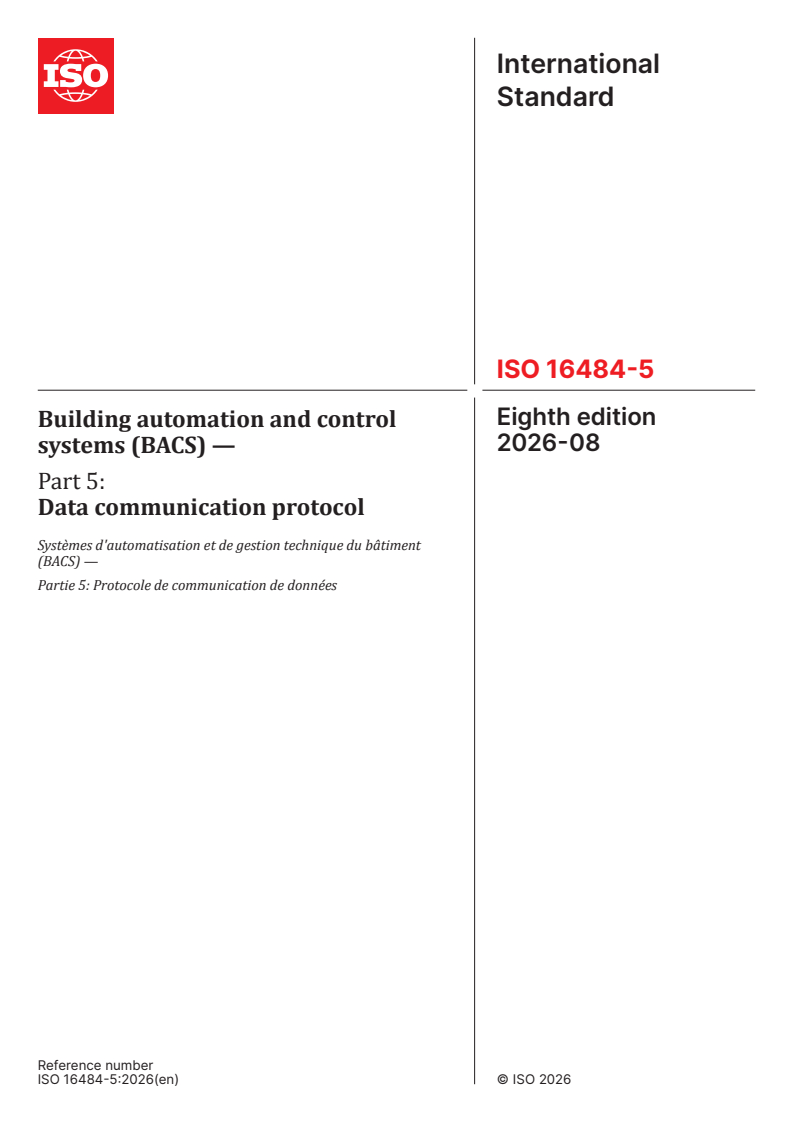
International
Standard
ISO 16484-5
Eighth edition
Building automation and control
2026-08
systems (BACS) —
Part 5:
Data communication protocol
Systèmes d'automatisation et de gestion technique du bâtiment
(BACS) —
Partie 5: Protocole de communication de données
Reference number
© ISO 2026
All rights reserved. Unless otherwise specified, or required in the context of its implementation, no part of this publication may
be reproduced or utilized otherwise in any form or by any means, electronic or mechanical, including photocopying, or posting on
the internet or an intranet, without prior written permission. Permission can be requested from either ISO at the address below
or ISO’s member body in the country of the requester.
ISO copyright office
CP 401 • Ch. de Blandonnet 8
CH-1214 Vernier, Geneva
Phone: +41 22 749 01 11
Email: copyright@iso.org
Website: www.iso.org
Published in Switzerland
ii
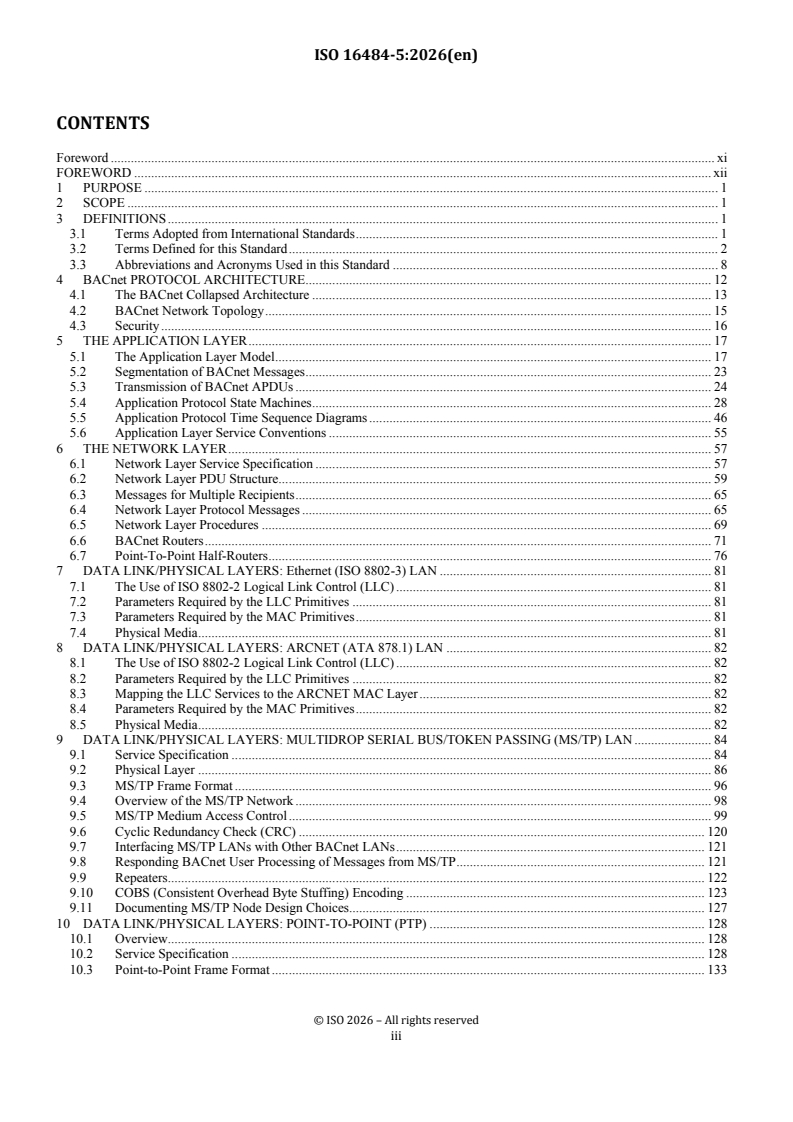
CONTENTS
Foreword . xi
FOREWORD . xii
1 PURPOSE . 1
2 SCOPE . 1
3 DEFINITIONS . 1
3.1 Terms Adopted from International Standards . 1
3.2 Terms Defined for this Standard . 2
3.3 Abbreviations and Acronyms Used in this Standard . 8
4 BACnet PROTOCOL ARCHITECTURE . 12
4.1 The BACnet Collapsed Architecture . 13
4.2 BACnet Network Topology . 15
4.3 Security . 16
5 THE APPLICATION LAYER . 17
5.1 The Application Layer Model . 17
5.2 Segmentation of BACnet Messages . 23
5.3 Transmission of BACnet APDUs . 24
5.4 Application Protocol State Machines . 28
5.5 Application Protocol Time Sequence Diagrams . 46
5.6 Application Layer Service Conventions . 55
6 THE NETWORK LAYER . 57
6.1 Network Layer Service Specification . 57
6.2 Network Layer PDU Structure . 59
6.3 Messages for Multiple Recipients . 65
6.4 Network Layer Protocol Messages . 65
6.5 Network Layer Procedures . 69
6.6 BACnet Routers . 71
6.7 Point-To-Point Half-Routers . 76
7 DATA LINK/PHYSICAL LAYERS: Ethernet (ISO 8802-3) LAN . 81
7.1 The Use of ISO 8802-2 Logical Link Control (LLC) . 81
7.2 Parameters Required by the LLC Primitives . 81
7.3 Parameters Required by the MAC Primitives . 81
7.4 Physical Media . 81
8 DATA LINK/PHYSICAL LAYERS: ARCNET (ATA 878.1) LAN . 82
8.1 The Use of ISO 8802-2 Logical Link Control (LLC) . 82
8.2 Parameters Required by the LLC Primitives . 82
8.3 Mapping the LLC Services to the ARCNET MAC Layer . 82
8.4 Parameters Required by the MAC Primitives . 82
8.5 Physical Media . 82
9 DATA LINK/PHYSICAL LAYERS: MULTIDROP SERIAL BUS/TOKEN PASSING (MS/TP) LAN . 84
9.1 Service Specification . 84
9.2 Physical Layer . 86
9.3 MS/TP Frame Format . 96
9.4 Overview of the MS/TP Network . 98
9.5 MS/TP Medium Access Control . 99
9.6 Cyclic Redundancy Check (CRC) . 120
9.7 Interfacing MS/TP LANs with Other BACnet LANs . 121
9.8 Responding BACnet User Processing of Messages from MS/TP . 121
9.9 Repeaters . 122
9.10 COBS (Consistent Overhead Byte Stuffing) Encoding . 123
9.11 Documenting MS/TP Node Design Choices. 127
10 DATA LINK/PHYSICAL LAYERS: POINT-TO-POINT (PTP) . 128
10.1 Overview . 128
10.2 Service Specification . 128
10.3 Point-to-Point Frame Format . 133
iii
10.4 PTP Medium Access Control Protocol . 135
11 DATA LINK/PHYSICAL LAYERS: LonTalk (ISO/IEC 14908.1) LAN . 157
11.1 The Use of ISO 8802-2 Logical Link Control (LLC) . 157
11.2 Parameters Required by the LLC Primitives . 157
11.3 Mapping the LLC Services to the LonTalk Application Layer . 157
11.4 Parameters Required by the Application Layer Primitives . 157
11.5 Physical Media . 158
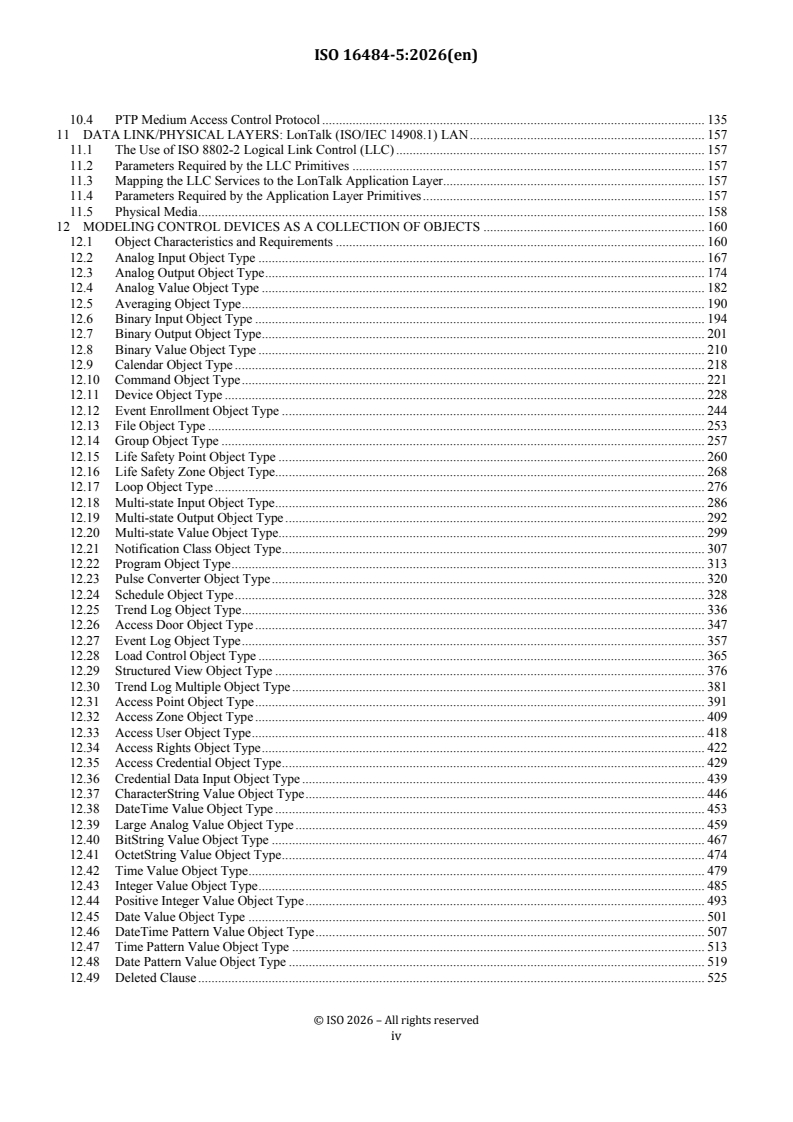
12 MODELING CONTROL DEVICES AS A COLLECTION OF OBJECTS . 160
12.1 Object Characteristics and Requirements . 160
12.2 Analog Input Object Type . 167
12.3 Analog Output Object Type . 174
12.4 Analog Value Object Type . 182
12.5 Averaging Object Type . 190
12.6 Binary Input Object Type . 194
12.7 Binary Output Object Type . 201
12.8 Binary Value Object Type . 210
12.9 Calendar Object Type . 218
12.10 Command Object Type . 221
12.11 Device Object Type . 228
12.12 Event Enrollment Object Type . 244
12.13 File Object Type . 253
12.14 Group Object Type . 257
12.15 Life Safety Point Object Type . 260
12.16 Life Safety Zone Object Type . 268
12.17 Loop Object Type . 276
12.18 Multi-state Input Object Type . 286
12.19 Multi-state Output Object Type . 292
12.20 Multi-state Value Object Type . 299
12.21 Notification Class Object Type . 307
12.22 Program Object Type . 313
12.23 Pulse Converter Object Type . 320
12.24 Schedule Object Type . 328
12.25 Trend Log Object Type . 336
12.26 Access Door Object Type . 347
12.27 Event Log Object Type . 357
12.28 Load Control Object Type . 365
12.29 Structured View Object Type . 376
12.30 Trend Log Multiple Object Type . 381
12.31 Access Point Object Type . 391
12.32 Access Zone Object Type . 409
12.33 Access User Object Type . 418
12.34 Access Rights Object Type . 422
12.35 Access Credential Object Type . 429
12.36 Credential Data Input Object Type . 439
12.37 CharacterString Value Object Type . 446
12.38 DateTime Value Object Type . 453
12.39 Large Analog Value Object Type . 459
12.40 BitString Value Object Type . 467
12.41 OctetString Value Object Type . 474
12.42 Time Value Object Type . 479
12.43 Integer Value Object Type . 485
12.44 Positive Integer Value Object Type . 493
12.45 Date Value Object Type . 501
12.46 DateTime Pattern Value Object Type . 507
12.47 Time Pattern Value Object Type . 513
12.48 Date Pattern Value Object Type . 519
12.49 Deleted Clause . 525
iv
12.50 Global Group Object Type . 526
12.51 Notification Forwarder Object Type . 534
12.52 Alert Enrollment Object Type . 542
12.53 Channel Object Type . 546
12.54 Lighting Output Object Type . 557
12.55 Binary Lighting Output Object Type . 575
12.56 Network Port Object Type . 587
12.57 Timer Object Type . 629
12.58 Elevator Group Object Type . 642
12.59 Lift Object Type. 646
12.60 Escalator Object Type . 659
12.61 Accumulator Object Type . 667
12.62 Staging Object Type . 677
12.63 Audit Reporter Object Type . 688
12.64 Audit Log Object Type . 694
12.65 Color Object Type . 701
12.66 Color Temperature Object Type . 707
13 ALARM AND EVENT SERVICES . 714
13.1 Change of Value Reporting . 714
13.2 Event Reporting . 719
13.3 Event Algorithms . 732
13.4 Fault Algorithms . 764
13.5 AcknowledgeAlarm Service . 772
13.6 ConfirmedCOVNotification Service . 774
13.7 UnconfirmedCOVNotification Service . 776
13.8 ConfirmedEventNotification Service . 777
13.9 UnconfirmedEventNotification Service . 780
13.10 GetAlarmSummary Service . 783
13.11 GetEnrollmentSummary Service . 785
13.12 GetEventInformation Service . 788
13.13 LifeSafetyOperation Service . 791
13.14 SubscribeCOV Service . 793
13.15 SubscribeCOVProperty Service . 796
13.16 SubscribeCOVPropertyMultiple Service . 799
13.17 ConfirmedCOVNotificationMultiple Service . 805
13.18 UnconfirmedCOVNotificationMultiple Service . 808
13.19 AuditLogQuery . 810
13.20 ConfirmedAuditNotification . 814
13.21 UnconfirmedAuditNotification . 815
14 FILE ACCESS SERVICES . 816
14.1 AtomicReadFile Service . 816
14.2 AtomicWriteFile Service . 819
15 OBJECT ACCESS SERVICES . 822
15.1 AddListElement Service . 822
15.2 RemoveListElement Service . 825
15.3 CreateObject Service . 827
15.4 DeleteObject Service . 830
15.5 ReadProperty Service . 831
15.6 Deleted Clause . 833
15.7 ReadPropertyMultiple Service . 834
15.8 ReadRange Service . 837
15.9 WriteProperty Service . 845
15.10 WritePropertyMultiple Service . 848
15.11 WriteGroup Service . 851
16 REMOTE DEVICE MANAGEMENT SERVICES . 853
16.1 DeviceCommunicationControl Service . 853
16.2 ConfirmedPrivateTransfer Service . 855
v
16.3 UnconfirmedPrivateTransfer Service . 857
16.4 ReinitializeDevice Service . 858
16.5 ConfirmedTextMessage Service . 860
16.6 UnconfirmedTextMessage Service . 862
16.7 TimeSynchronization Service . 863
16.8 UTCTimeSynchronization Service . 864
16.9 Who-Has and I-Have Services . 865
16.10 Who-Is and I-Am Services . 867
16.11 Who-Am-I and You-Are Services . 869
17 AUTHENTICATION AND AUTHORIZATION SERVICES . 872
17.1 Overview . 872
17.2 Trust of Intermediaries . 873
17.3 Authentication . 874
17.4 Authorization . 876
17.5 Conformance Requirements . 882
17.6 AuthRequest Service . 883
18 ERROR, REJECT, and ABORT CODES . 887
18.1 Error Class - DEVICE . 887
18.2 Error Class - OBJECT . 887
18.3 Error Class - PROPERTY . 888
18.4 Error Class - RESOURCES . 890
18.5 Error Class - SECURITY. 890
18.6 Error Class - SERVICES . 892
18.7 Error Class - COMMUNICATION . 893
18.8 Error Class - VT . 898
18.9 Reject Reason . 898
18.10 Abort Reason . 899
18.11 Confirmed Service Common Errors . 900
19 BACnet PROCEDURES . 901
19.1 Backup and Restore . 901
19.2 Command Prioritization . 906
19.3 Device Restart Procedure . 911
19.4 Determining Maximum Conveyable APDU . 912
19.5 Value Source Mechanism . 914
19.6 Audit Logging . 916
19.7 Unconfigured Device Discovery and Address Assignment . 927
19.8 Replacing Certificates in a BACnet/SC Network . 928
19.9 Device Address Proxying . 930
20 ENCODING BACnet PROTOCOL DATA UNITS . 934
20.1 Encoding the Fixed Part of BACnet APDUs . 935
20.2 Encoding the Variable Part of BACnet APDUs . 947
21 FORMAL DESCRIPTION OF APPLICATION PROTOCOL DATA UNITS . 963
21.1 APDU Definitions. 963
21.2 Confirmed Service Productions . 965
21.3 Unconfirmed Service Productions . 976
21.4 Error Productions . 980
21.5 Application Types . 992
21.6 Base Types . 994
22 CONFORMANCE AND INTEROPERABILITY . 1082
22.1 Conformance to BACnet. 1082
22.2 BACnet Interoperability . 1083
23 EXTENDING BACnet TO ACCOMMODATE VENDOR PROPRIETARY INFORMATION . 1085
23.1 Extending Enumeration Values . 1085
23.2 Using the PrivateTransfer Services to Invoke Non-Standardized Services . 1086
23.3 Adding Proprietary Properties to a Standardized Object . 1086
23.4 Adding Proprietary Object Types to BACnet . 1087
23.5 Restrictions on Extending BACnet . 1087
vi
24 DELETED CLAUSE . 1088
25 REFERENCES . 1089
ANNEX A - PROTOCOL IMPLEMENTATION CONFORMANCE STATEMENT (NORMATIVE) . 1094
ANNEX B - GUIDE TO SPECIFYING BACnet DEVICES (INFORMATIVE) . 1098
ANNEX C - Removed . 1099
ANNEX D - Removed . 1100
ANNEX E - EXAMPLES OF BACnet APPLICATION SERVICES (INFORMATIVE) . 1101
E.1 Alarm and Event Services . 1101
E.2 File Access Services . 1106
E.3 Object Access Services . 1107
E.4 Remote Device Management Services . 1114
E.5 Virtual Terminal Services . 1117
ANNEX F - EXAMPLES OF APDU ENCODING (INFORMATIVE) . 1120
F.1 Example Encodings for Alarm and Event Services . 1120
F.2 Example Encodings for File Access Services . 1131
F.3 Example Encodings for Object Access Services . 1134
F.4 Example Encodings for Remote Device Management Services . 1144
F.5 Example Encodings for Virtual Terminal Services . 1150
ANNEX G - CALCULATION OF CRC (INFORMATIVE) . 1153
G.1 Calculation of the Header CRC . 1153
G.2 Calculation of the Data CRC . 1159
G.3 Calculation of the Encoded CRC-32K . 1163
ANNEX H - COMBINING BACnet NETWORKS WITH NON-BACnet NETWORKS (NORMATIVE) . 1167
H.1 BACnet Gateways . 1167
H.2 Requirements and Best Practices for BACnet Gateway Implementations . 1167
H.3 Using BACnet with the DARPA Internet Protocols . 1169
H.4 Using BACnet with the IPX Protocol . 1171
H.5 Using BACnet with EIB/KNX . 1172
H.6 Using BACnet with the Former BACnet/WS Web Services Interface Defined by Annex N . 1182
H.7 Virtual MAC Addressing . 1183
ANNEX I - COMMANDABLE PROPERTIES WITH MINIMUM ON AND OFF TIMES (INFORMATIVE). 1185
ANNEX J - BACnet/IP (NORMATIVE) . 1187
J.1 General . 1187
J.2 BACnet Virtual Link Layer . 1188
J.3 BACnet/IP Directed Messages . 1191
J.4 BACnet/IP Broadcast Messages . 1191
J.5 Addition of Foreign B/IP Devices to an Existing B/IP Network . 1194
J.6 Routing Between B/IP and non-B/IP BACnet Networks . 1195
J.7 Routing Between Two B/IP BACnet Netw
...
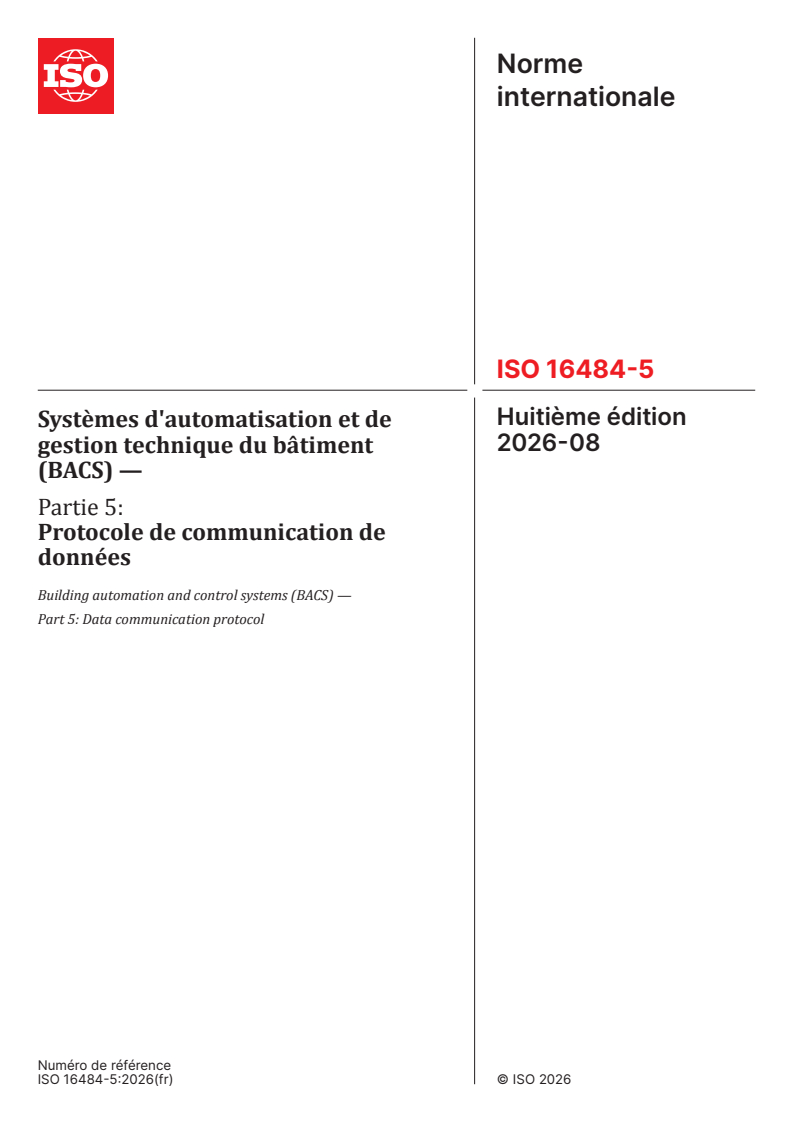
Norme
internationale
ISO 16484-5
Huitième édition
Systèmes d'automatisation et de
2026-08
gestion technique du bâtiment
(BACS) —
Partie 5:
Protocole de communication de
données
Building automation and control systems (BACS) —
Part 5: Data communication protocol
Numéro de référence
DOCUMENT PROTÉGÉ PAR COPYRIGHT
© ISO 2026
Tous droits réservés. Sauf prescription différente ou nécessité dans le contexte de sa mise en œuvre, aucune partie de cette
publication ne peut être reproduite ni utilisée sous quelque forme que ce soit et par aucun procédé, électronique ou mécanique,
y compris la photocopie, ou la diffusion sur l’internet ou sur un intranet, sans autorisation écrite préalable. Une autorisation peut
être demandée à l’ISO à l’adresse ci-après ou au comité membre de l’ISO dans le pays du demandeur.
ISO copyright office
Case postale 401 • Ch. de Blandonnet 8
CH-1214 Vernier, Genève
Tél.: +41 22 749 01 11
E-mail: copyright@iso.org
Web: www.iso.org
Publié en Suisse
ii
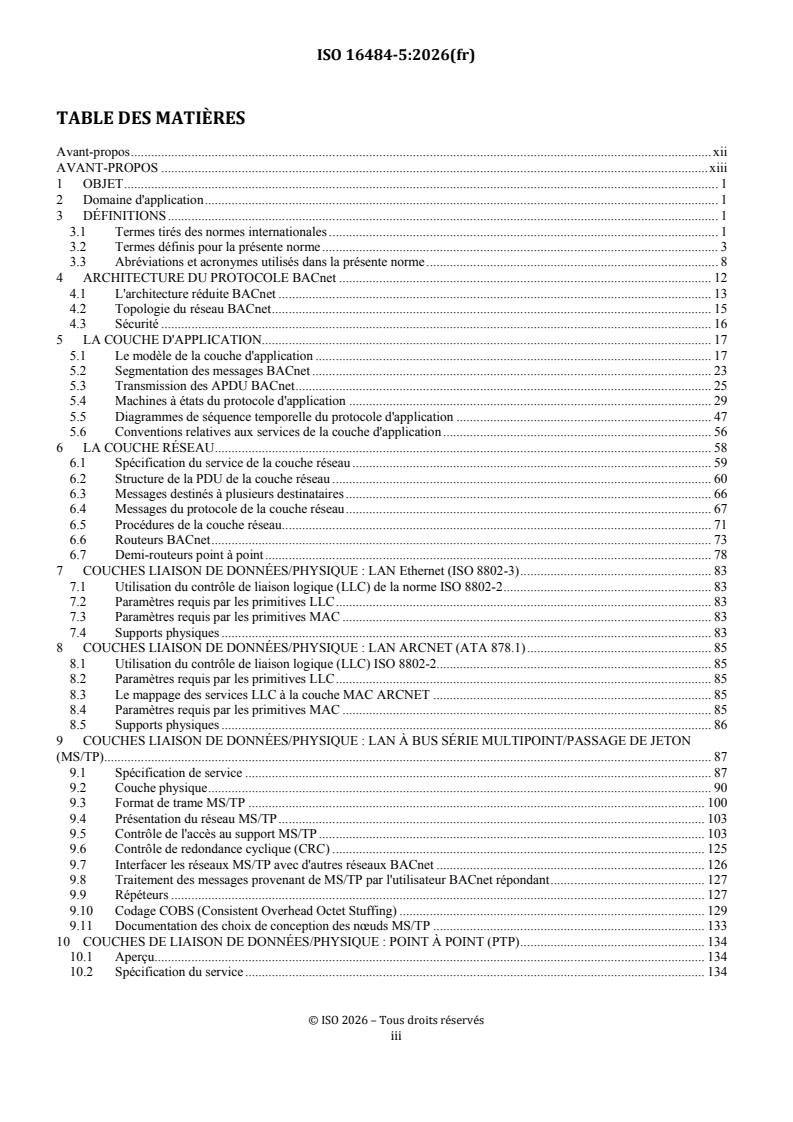
TABLE DES MATIÈRES
Avant-propos . xii
AVANT-PROPOS . xiii
1 OBJET . 1
2 Domaine d'application . 1
3 DÉFINITIONS . 1
3.1 Termes tirés des normes internationales . 1
3.2 Termes définis pour la présente norme . 3
3.3 Abréviations et acronymes utilisés dans la présente norme . 8
4 ARCHITECTURE DU PROTOCOLE BACnet . 12
4.1 L'architecture réduite BACnet . 13
4.2 Topologie du réseau BACnet . 15
4.3 Sécurité . 16
5 LA COUCHE D'APPLICATION. 17
5.1 Le modèle de la couche d'application . 17
5.2 Segmentation des messages BACnet . 23
5.3 Transmission des APDU BACnet . 25
5.4 Machines à états du protocole d'application . 29
5.5 Diagrammes de séquence temporelle du protocole d'application . 47
5.6 Conventions relatives aux services de la couche d'application . 56
6 LA COUCHE RÉSEAU . 58
6.1 Spécification du service de la couche réseau . 59
6.2 Structure de la PDU de la couche réseau . 60
6.3 Messages destinés à plusieurs destinataires . 66
6.4 Messages du protocole de la couche réseau . 67
6.5 Procédures de la couche réseau . 71
6.6 Routeurs BACnet . 73
6.7 Demi-routeurs point à point . 78
7 COUCHES LIAISON DE DONNÉES/PHYSIQUE : LAN Ethernet (ISO 8802-3) . 83
7.1 Utilisation du contrôle de liaison logique (LLC) de la norme ISO 8802-2 . 83
7.2 Paramètres requis par les primitives LLC . 83
7.3 Paramètres requis par les primitives MAC . 83
7.4 Supports physiques . 83
8 COUCHES LIAISON DE DONNÉES/PHYSIQUE : LAN ARCNET (ATA 878.1) . 85
8.1 Utilisation du contrôle de liaison logique (LLC) ISO 8802-2. 85
8.2 Paramètres requis par les primitives LLC . 85
8.3 Le mappage des services LLC à la couche MAC ARCNET . 85
8.4 Paramètres requis par les primitives MAC . 85
8.5 Supports physiques . 86
9 COUCHES LIAISON DE DONNÉES/PHYSIQUE : LAN À BUS SÉRIE MULTIPOINT/PASSAGE DE JETON
(MS/TP). 87
9.1 Spécification de service . 87
9.2 Couche physique . 90
9.3 Format de trame MS/TP . 100
9.4 Présentation du réseau MS/TP . 103
9.5 Contrôle de l'accès au support MS/TP . 103
9.6 Contrôle de redondance cyclique (CRC) . 125
9.7 Interfacer les réseaux MS/TP avec d'autres réseaux BACnet . 126
9.8 Traitement des messages provenant de MS/TP par l'utilisateur BACnet répondant . 127
9.9 Répéteurs . 127
9.10 Codage COBS (Consistent Overhead Octet Stuffing) . 129
9.11 Documentation des choix de conception des nœuds MS/TP . 133
10 COUCHES DE LIAISON DE DONNÉES/PHYSIQUE : POINT À POINT (PTP) . 134
10.1 Aperçu. 134
10.2 Spécification du service . 134
iii
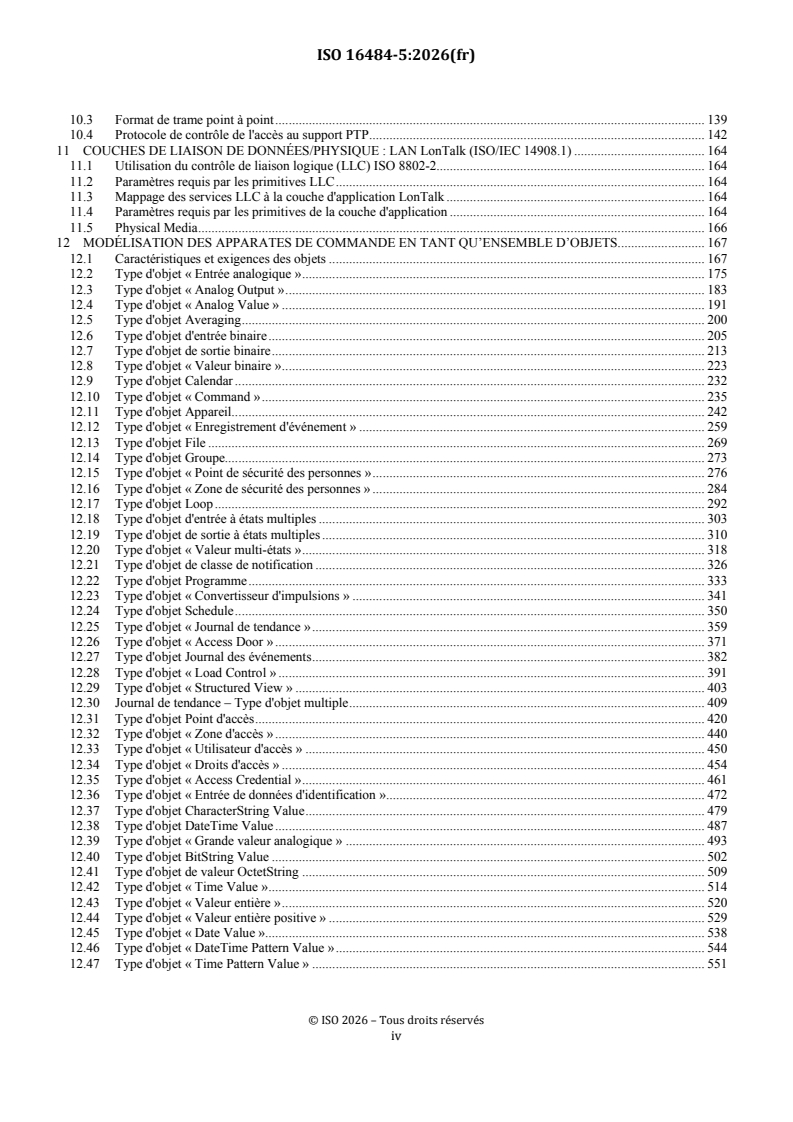
10.3 Format de trame point à point . 139
10.4 Protocole de contrôle de l'accès au support PTP . 142
11 COUCHES DE LIAISON DE DONNÉES/PHYSIQUE : LAN LonTalk (ISO/IEC 14908.1) . 164
11.1 Utilisation du contrôle de liaison logique (LLC) ISO 8802-2. 164
11.2 Paramètres requis par les primitives LLC . 164
11.3 Mappage des services LLC à la couche d'application LonTalk . 164
11.4 Paramètres requis par les primitives de la couche d'application . 164
11.5 Physical Media . 166
12 MODÉLISATION DES APPARATES DE COMMANDE EN TANT QU’ENSEMBLE D’OBJETS. 167
12.1 Caractéristiques et exigences des objets . 167
12.2 Type d'objet « Entrée analogique » . 175
12.3 Type d'objet « Analog Output » . 183
12.4 Type d'objet « Analog Value » . 191
12.5 Type d'objet Averaging . 200
12.6 Type d'objet d'entrée binaire . 205
12.7 Type d'objet de sortie binaire . 213
12.8 Type d'objet « Valeur binaire » . 223
12.9 Type d'objet Calendar . 232
12.10 Type d'objet « Command » . 235
12.11 Type d'objet Appareil. 242
12.12 Type d'objet « Enregistrement d'événement » . 259
12.13 Type d'objet File . 269
12.14 Type d'objet Groupe. 273
12.15 Type d'objet « Point de sécurité des personnes » . 276
12.16 Type d'objet « Zone de sécurité des personnes » . 284
12.17 Type d'objet Loop . 292
12.18 Type d'objet d'entrée à états multiples . 303
12.19 Type d'objet de sortie à états multiples . 310
12.20 Type d'objet « Valeur multi-états » . 318
12.21 Type d'objet de classe de notification . 326
12.22 Type d'objet Programme . 333
12.23 Type d'objet « Convertisseur d'impulsions » . 341
12.24 Type d'objet Schedule . 350
12.25 Type d'objet « Journal de tendance » . 359
12.26 Type d'objet « Access Door » . 371
12.27 Type d'objet Journal des événements . 382
12.28 Type d'objet « Load Control » . 391
12.29 Type d'objet « Structured View » . 403
12.30 Journal de tendance – Type d'objet multiple . 409
12.31 Type d'objet Point d'accès . 420
12.32 Type d'objet « Zone d'accès » . 440
12.33 Type d'objet « Utilisateur d'accès » . 450
12.34 Type d'objet « Droits d'accès » . 454
12.35 Type d'objet « Access Credential » . 461
12.36 Type d'objet « Entrée de données d'identification » . 472
12.37 Type d'objet CharacterString Value . 479
12.38 Type d'objet DateTime Value . 487
12.39 Type d'objet « Grande valeur analogique » . 493
12.40 Type d'objet BitString Value . 502
12.41 Type d'objet de valeur OctetString . 509
12.42 Type d'objet « Time Value » . 514
12.43 Type d'objet « Valeur entière » . 520
12.44 Type d'objet « Valeur entière positive » . 529
12.45 Type d'objet « Date Value ». 538
12.46 Type d'objet « DateTime Pattern Value » . 544
12.47 Type d'objet « Time Pattern Value » . 551
iv
12.48 Type d'objet « Date Pattern Value » . 557
12.49 Article supprimé . 563
12.50 Type d'objet « Groupe global » . 564
12.51 Type d'objet « Notification Forwarder » . 573
12.52 Type d'objet « Enregistrement d'alerte » . 581
12.53 Type d'objet Canal . 586
12.54 Type d'objet « Sortie d'éclairage » . 598
12.55 Type d'objet « Sortie d'éclairage binaire » . 617
12.56 Type d'objet « Port réseau » . 630
12.57 Type d'objet Minuteur . 676
12.58 Type d'objet « Groupe de monte-charges » . 690
12.59 Type d'objet « Ascenseur » . 694
12.60 Type d'objet Escalator . 708
12.61 Type d'objet Accumulateur . 716
12.62 Type d'objet Staging . 727
12.63 Type d'objet Audit Reporter . 738
12.64 Type d'objet Journal d'audit . 744
12.65 Type d'objet Couleur . 752
12.66 Type d'objet « Température de couleur » . 758
13 SERVICES D'ALARME ET D'ÉVÉNEMENT . 767
13.1 Rapport de changement de valeur . 767
13.2 Consignement des événements . 772
13.3 Algorithmes d'événements . 787
13.4 Algorithmes de détection de défaut . 820
13.5 Service AcknowledgeAlarm . 828
13.6 Service ConfirmedCOVNotification. 831
13.7 Service de notification de COV non confirmé . 833
13.8 Service ConfirmedEventNotification . 834
13.9 Service UnconfirmedEventNotification . 837
13.10 Service GetAlarmSummary . 840
13.11 Service GetEnrollmentSummary . 842
13.12 Service GetEventInformation . 845
13.13 Service LifeSafetyOperation . 848
13.14 Service SubscribeCOV . 850
13.15 Service SubscribeCOVProperty . 853
13.16 Service SubscribeCOVPropertyMultiple . 856
13.17 Service ConfirmedCOVNotificationMultiple . 862
13.18 Service UnconfirmedCOVNotificationMultiple . 865
13.19 AuditLogQuery . 868
13.20 ConfirmedAuditNotification . 872
13.21 UnconfirmedAuditNotification . 873
14 SERVICES D'ACCÈS AUX FICHIERS . 874
14.1 Service AtomicReadFile . 874
14.2 Service AtomicWriteFile . 877
15 SERVICES D'ACCÈS AUX OBJETS . 880
15.1 Service AddListElement . 880
15.2 Service RemoveListElement . 883
15.3 Service CreateObject . 885
15.4 Service DeleteObject . 888
15.5 Service ReadProperty . 889
15.6 Article supprimé . 891
15.7 Service ReadPropertyMultiple . 892
15.8 Service ReadRange . 896
15.9 Service WriteProperty . 904
15.10 Service WritePropertyMultiple . 907
15.11 Service WriteGroup . 911
v
16 SERVICES DE GESTION DES APPAREILS DISTANTS . 913
16.1 Service DeviceCommunicationControl . 913
16.2 Service ConfirmedPrivateTransfer . 915
16.3 Service UnconfirmedPrivateTransfer . 917
16.4 Service ReinitializeDevice . 918
16.5 Service ConfirmedTextMessage . 920
16.6 Service UnconfirmedTextMessage . 922
16.7 Service de synchronisation horaire . 923
16.8 Service UTCTimeSynchronization . 924
16.9 Services Who-Has et I-Have . 925
16.10 Services « Who-Is » et « I-Am » . 928
16.11 Services Who-Am-I et You-Are . 931
17 SERVICES D'AUTHENTIFICATION ET D'AUTORISATION . 934
17.1 générale . 934
17.2 Confiance des intermédiaires . 936
17.3 Authentification . 937
17.4 Autorisation . 939
17.5 Exigences de conformité . 946
17.6 Service AuthRequest . 947
18 CODES D'ERREUR, DE REJET ET D'ABANDON . 951
18.1 Classe d'erreurs - APPARATUS . 951
18.2 Classe d'erreurs - OBJECT . 951
18.3 Classe d'erreurs - PROPERTY . 952
18.4 Classe d'erreurs - RESSOURCES . 954
18.5 Classe d'erreurs - SÉCURITÉ . 954
18.6 Classe d'erreurs - SERVICES . 956
18.7 Classe d'erreurs - COMMUNICATION . 958
18.8 Classe d'erreurs - VT. 962
18.9 Motif du rejet . 963
18.10 Motif d'abandon . 963
18.11 Erreurs courantes des services confirmés . 964
19 PROCÉDURES BACnet . 965
19.1 Sauvegarde et restauration . 965
19.2 Priorisation des commandes P . 970
19.3 Procédure de redémarrage de l'appareil . 975
19.4 Détermination de la taille maximale d'APDU transmissible . 976
19.5 Mécanisme de source de valeur . 978
19.6 de la consignation d'audit . 981
19.7 de découverte des appareils non configurés et d'attribution d'adresses . 993
19.8 Remplacement des certificats dans un réseau BACnet/SC . 994
19.9 Proxy d'adresse d'appareil . 997
20 CODAGE DES UNITÉS DE DONNÉES DU PROTOCOLE BACnet . 1001
20.1 Codage de la partie fixe des APDU BACnet . 1002
20.2 Codage de la partie variable des APDU BACnet . 1014
21 DESCRIPTION FORMELLE DES UNITÉS DE DONNÉES DU PROTOCOLE DE COUCHE APPLICATION . 1030
21.1 Définitions des APDU . 1030
21.2 Productions de service confirmées . 1032
21.3 Productions de services non confirmées . 1043
21.4 Génération d'erreurs . 1047
21.5 Types d'application . 1059
21.6 Types de base . 1061
22 CONFORMITÉ ET INTEROPÉRABILITÉ . 1150
22.1 Conformité à BACnet . 1150
22.2 Interopérabilité BACnet . 1151
vi
23 EXTENSION DE BACnet POUR PRENDRE EN CHARGE LES INFORMATIONS PROPRIÉTAIRES DES
FOURNISSEURS . 1153
23.1 Extension des valeurs d'énumération . 1153
23.2 Utilisation des services PrivateTransfer pour invoquer des services non conformes aux normes . 1154
23.3 Ajout de propriétés propriétaires à un objet normalisé . 1155
23.4 Ajout de types d'objets propriétaires à BACnet . 1155
23.5 Restrictions relatives à l'extension de BACnet . 1156
24 ARTICLE SUPPRIMÉ . 1157
25 RÉFÉRENCES . 1158
ANNEXE A - DÉCLARATION DE CONFORMITÉ DE LA MISE EN ŒUVRE DU PROTOCOLE (NORMATIVE) . 1163
ANNEXE B - GUIDE DE SPÉCIFICATION DES DISPOSITIFS BACnet (À TITRE INDICATIF) . 1167
ANNEXE C - Supprimée . 1168
ANNEXE D - e supprimée . 1169
ANNEXE E - EXEMPLES DE SERVICES D'APPLICATION BACnet (À TITRE INDICATIF) . 1170
E.1 Services d'alarme et d'événement . 1170
E.2 Services d'accès aux fichiers . 1175
E.3 Services d'accès aux objets . 1176
E.4 Services de gestion distante des appareils . 1183
E.5 Services de terminal virtuel . 1187
ANNEXE F - EXEMPLES DE CODAGE APDU (À TITRE INDICATIF) . 1189
F.1 Exemples de codage pour les services d'alarme et d'événement . 1189
F.2 Exemples d'encodages pour les services d'accès aux fichiers . 1200
F.3 Exemples de codages pour les services d'accès aux objets . 1203
F.4 Exemples de codages pour les services de gestion distante des appareils . 1213
F.5 Exemples de codages pour les services de terminal virtuel . 1219
ANNEXE G - CALCUL DU CRC (À TITRE INDICATIF) . 1222
G.1 Calcul du CRC de l'en-tête . 1222
G.2 Calcul du CRC des données . 1229
G.3 Calcul du CRC-32K codé . 1233
ANNEXE H - COMBINAISON DE RÉSEAUX BACnet AVEC DES RÉSEAUX NON-BACnet (NORMATIVE) . 1238
H.1 Passerelles BACnet . 1238
H.2 Exigences et bonnes pratiques pour la mise en œuvre des passerelles BACnet . 1238
H.3 Utilisation de BACnet avec les protocoles Internet de la DARPA . 1240
H.4 Utilisation de BACnet avec le protocole IPX . 1242
H.5 Utilisation de BACnet avec l' EIB / KNX . 1243
H.6 Utilisation de BACnet avec l'ancienne interface de services Web BACnet/WS définie par l'annexe N . 1254
H.7 Adressage MAC virtuel . 1256
ANNEXE I - PROPRIÉTÉS COMMANDABLES AVEC DURÉES MINIMALES D'ACTIVATION ET DE DÉSACTIVATION (À
TITRE INDICATIF) . 1259
ANNEXE J - BACnet/IP (NORMATIVE) . 1261
J.1 Généralités . 1261
J.2 Couche de liaison virtuelle BACnet . 1262
J.3 Messages dirigés BACnet/IP . 1265
J.4 Messages de diffusion générale BACnet/IP . 1265
J.5 Ajout d'appareils B/IP étrangers à un réseau B/IP existant . 1268
J.6 Routage entre les réseaux BACnet B/IP et non B/IP . 126
...