


ISO 14720-2:2013
(Main)Testing of ceramic raw and basic materials — Determination of sulfur in powders and granules of non-oxidic ceramic raw and basic materials — Part 2: Inductively coupled plasma optical emission spectrometry (ICP/OES) or ion chromatography after burning in an oxygen flow
Testing of ceramic raw and basic materials — Determination of sulfur in powders and granules of non-oxidic ceramic raw and basic materials — Part 2: Inductively coupled plasma optical emission spectrometry (ICP/OES) or ion chromatography after burning in an oxygen flow
This part of ISO 14720 defines a method for the determination of sulfur in powdered and granular non-oxidic ceramic raw materials and materials, which are completely oxidized at a higher temperature in an oxygen atmosphere, e.g. carbon and graphite materials. For materials which are not completely oxidizable under these conditions, it is possible to determine sulfur that can be released under these conditions, e.g. the adherent sulfur. This part of ISO 14720 is applicable for materials with mass fractions of sulfur ≤ 10 % and mass fractions of ash For the lower detection limit of this method, a mass fraction of sulfur of 0,5 mg/kg in the case of inductively coupled plasma optical emission spectrometry (ICP/OES) and 5 mg/kg in the case of ion chromatography (IC) has to be considered as a recommended value.
Essais des matières premières pour produits réfractaires — Dosage du soufre dans les matières premières non oxydantes sous forme de poudre et de granulés — Partie 2: Spectrométrie d'émission optique avec plasma induit par haute fréquence (ICP/OES) ou chromatographie ionique après combustion dans un courant d'oxygène
General Information
- Status
- Withdrawn
- Publication Date
- 13-Feb-2013
- Technical Committee
- ISO/TC 33 - Refractories
- Drafting Committee
- ISO/TC 33/WG 17 - Chemical analysis
- Current Stage
- 9599 - Withdrawal of International Standard
- Start Date
- 09-Mar-2026
- Completion Date
- 14-Mar-2026
Relations
- Effective Date
- 12-Feb-2026
- Effective Date
- 06-Jun-2022
- Effective Date
- 13-Apr-2024
Overview
ISO 14720-2:2013 specifies a laboratory method for the determination of sulfur in powders and granules of non-oxidic ceramic raw and basic materials. The standard covers materials that are completely oxidized at high temperature in an oxygen atmosphere (for example carbon and graphite materials) and defines the procedure of burning samples in an oxygen flow followed by analysis of the absorbed sulfur oxides using ICP/OES (inductively coupled plasma optical emission spectrometry) or ion chromatography (IC).
Key scope limits:
- Applicable for sulfur mass fractions ≤ 10% and ash < 20%
- Not suitable for high barium content (barium sulfate-bound sulfur not detectable if Ba ≥ ~10 mg/kg)
- Recommended lower detection limits: 0.5 mg/kg (ICP/OES) and 5 mg/kg (IC)
Key Topics and Requirements
- Principle: Dried sample is combusted at (1 100 ± 20) °C in flowing oxygen; resulting SOx are absorbed in a NaOH/H2O2 solution. The absorption solution (and dissolved ash when applicable) is analysed as sulfate by ICP/OES (ISO 11885) or IC (ISO 10304-1).
- Apparatus & reagents: Combustion device, unglazed porcelain boats, gas-washing bottles, 0.45 µm filtration, ICP/OES (wavelengths for S: 180.731 nm, 182.034 nm), ion chromatograph with anion column and conductivity detector. Oxygen purity ≥ 99.998% and oxygen flow ≈ (20 ± 10) L/h.
- Sample preparation: Representative sampling (e.g., ISO 8656-1), particle size ≤ 160 µm, drying at (110 ± 5) °C to constant mass, contamination avoidance.
- Calibration & performance: Use certified sulfate standard stock solutions and matrix-appropriate calibration; blank determination, standard addition or matrix matching may be required to address matrix effects.
- Interferences: Spectral and physical interferences for ICP/OES (background, overlapping lines, plasma/transport effects); anion cross-interferences for IC (chloride, nitrate, etc.) - separation and suppression techniques recommended.
- Quality and validation: Sections on precision (repeatability, reproducibility), examples of operating parameters, round-robin results, and guidance on uncertainty; informative annexes include combustion device examples and recommended instrument parameters.
Applications and Users
ISO 14720-2 is intended for:
- Refractory and ceramic raw-material laboratories performing sulfur analysis in powders and granules
- Quality control and incoming inspection for ceramic, carbon and graphite feedstocks
- R&D and materials characterization teams needing reliable sulfur quantification
- Certification labs and regulatory bodies requiring standardized sulfur testing methods
Practical benefits include traceable sulfur results, options to choose ICP/OES for lower detection limits or IC for anionic separation, and a documented workflow for sample combustion and absorption.
Related Standards
- ISO 14720-1 - Determination of sulfur: infrared methods
- ISO 11885 - ICP-OES for selected elements
- ISO 10304-1 - IC for dissolved anions (including sulfate)
- ISO 8656-1 - Sampling guidance for powders/granules
Keywords: ISO 14720-2:2013, sulfur determination, ICP/OES, ion chromatography, combustion in oxygen flow, ceramic raw materials, refractory testing, sample preparation, detection limit.
Buy Documents
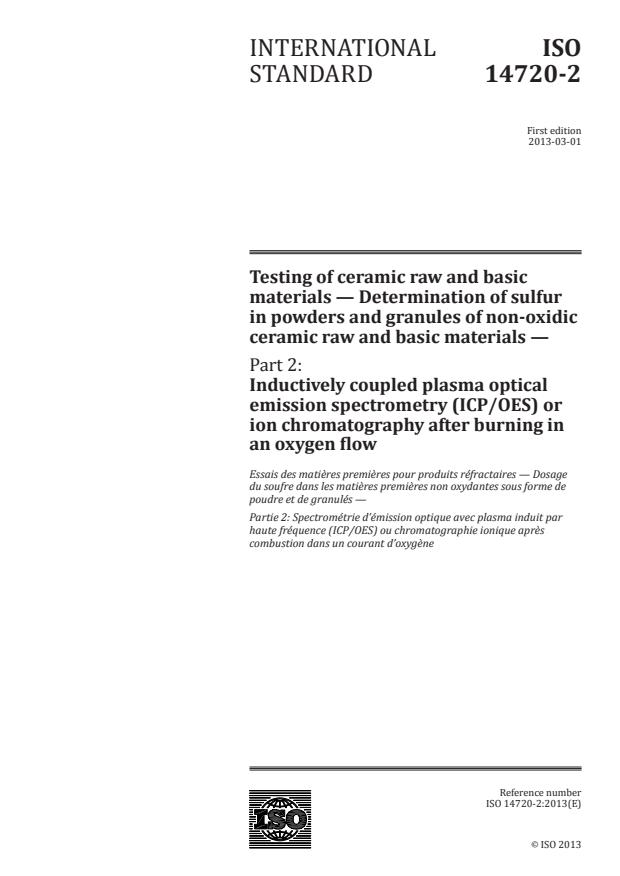

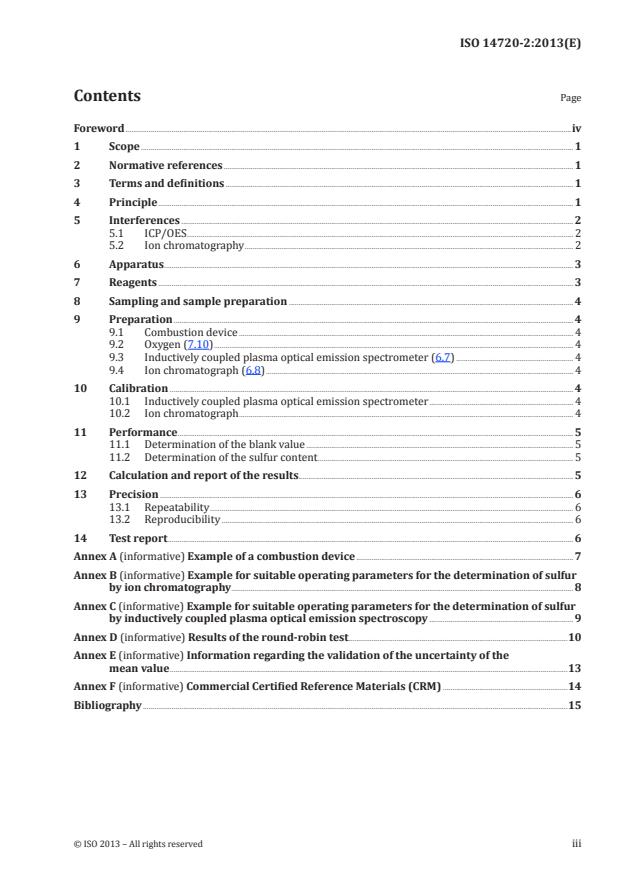
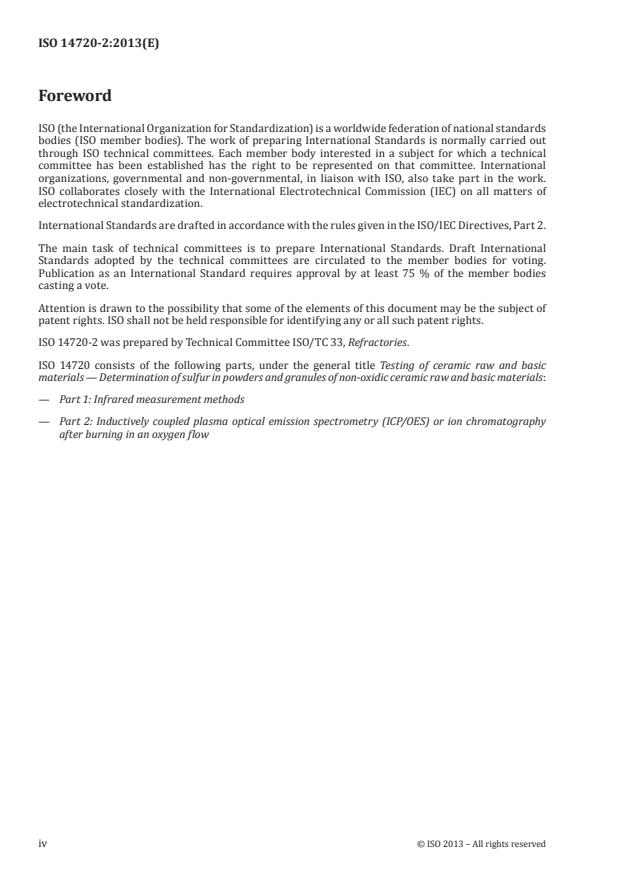
ISO 14720-2:2013 - Testing of ceramic raw and basic materials — Determination of sulfur in powders and granules of non-oxidic ceramic raw and basic materials — Part 2: Inductively coupled plasma optical emission spectrometry (ICP/OES) or ion chromatography after burning in an oxygen flow Released:2/14/2013
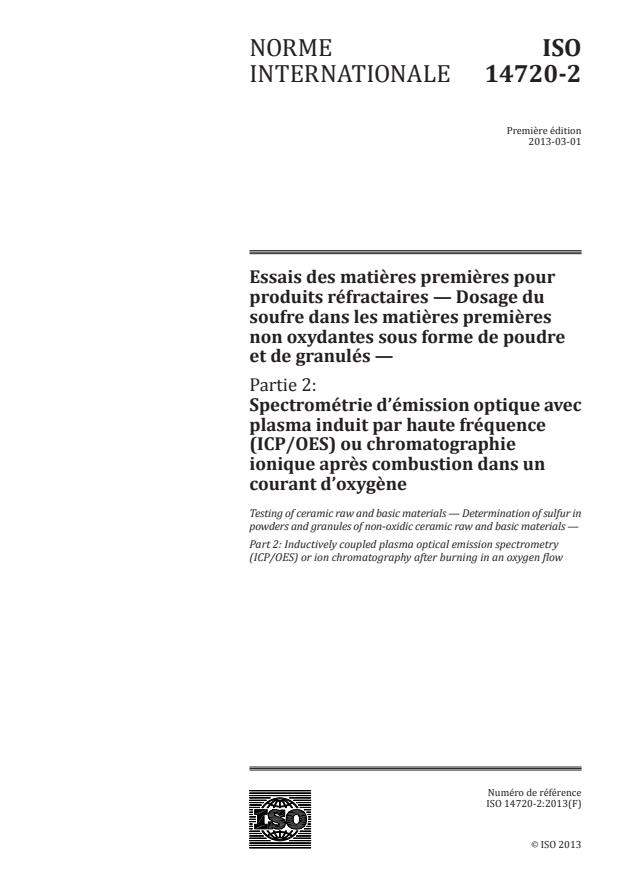
ISO 14720-2:2013 - Essais des matieres premieres pour produits réfractaires — Dosage du soufre dans les matieres premieres non oxydantes sous forme de poudre et de granulés — Partie 2: Spectrométrie d'émission optique avec plasma induit par haute fréquence (ICP/OES) ou chromatographie ionique apres combustion dans un courant d'oxygene Released:2/14/2013
Frequently Asked Questions
ISO 14720-2:2013 is a standard published by the International Organization for Standardization (ISO). Its full title is "Testing of ceramic raw and basic materials — Determination of sulfur in powders and granules of non-oxidic ceramic raw and basic materials — Part 2: Inductively coupled plasma optical emission spectrometry (ICP/OES) or ion chromatography after burning in an oxygen flow". This standard covers: This part of ISO 14720 defines a method for the determination of sulfur in powdered and granular non-oxidic ceramic raw materials and materials, which are completely oxidized at a higher temperature in an oxygen atmosphere, e.g. carbon and graphite materials. For materials which are not completely oxidizable under these conditions, it is possible to determine sulfur that can be released under these conditions, e.g. the adherent sulfur. This part of ISO 14720 is applicable for materials with mass fractions of sulfur ≤ 10 % and mass fractions of ash For the lower detection limit of this method, a mass fraction of sulfur of 0,5 mg/kg in the case of inductively coupled plasma optical emission spectrometry (ICP/OES) and 5 mg/kg in the case of ion chromatography (IC) has to be considered as a recommended value.
This part of ISO 14720 defines a method for the determination of sulfur in powdered and granular non-oxidic ceramic raw materials and materials, which are completely oxidized at a higher temperature in an oxygen atmosphere, e.g. carbon and graphite materials. For materials which are not completely oxidizable under these conditions, it is possible to determine sulfur that can be released under these conditions, e.g. the adherent sulfur. This part of ISO 14720 is applicable for materials with mass fractions of sulfur ≤ 10 % and mass fractions of ash For the lower detection limit of this method, a mass fraction of sulfur of 0,5 mg/kg in the case of inductively coupled plasma optical emission spectrometry (ICP/OES) and 5 mg/kg in the case of ion chromatography (IC) has to be considered as a recommended value.
ISO 14720-2:2013 is classified under the following ICS (International Classification for Standards) categories: 81.060.10 - Raw materials. The ICS classification helps identify the subject area and facilitates finding related standards.
ISO 14720-2:2013 has the following relationships with other standards: It is inter standard links to EN ISO 14720-2:2013, ISO 17604:2003, ISO 14720-2:2026. Understanding these relationships helps ensure you are using the most current and applicable version of the standard.
ISO 14720-2:2013 is available in PDF format for immediate download after purchase. The document can be added to your cart and obtained through the secure checkout process. Digital delivery ensures instant access to the complete standard document.
Standards Content (Sample)
INTERNATIONAL ISO
STANDARD 14720-2
First edition
2013-03-01
Testing of ceramic raw and basic
materials — Determination of sulfur
in powders and granules of non-oxidic
ceramic raw and basic materials —
Part 2:
Inductively coupled plasma optical
emission spectrometry (ICP/OES) or
ion chromatography after burning in
an oxygen flow
Essais des matières premières pour produits réfractaires — Dosage
du soufre dans les matières premières non oxydantes sous forme de
poudre et de granulés —
Partie 2: Spectrométrie d’émission optique avec plasma induit par
haute fréquence (ICP/OES) ou chromatographie ionique après
combustion dans un courant d’oxygène
Reference number
©
ISO 2013
© ISO 2013
All rights reserved. Unless otherwise specified, no part of this publication may be reproduced or utilized otherwise in any form
or by any means, electronic or mechanical, including photocopying, or posting on the internet or an intranet, without prior
written permission. Permission can be requested from either ISO at the address below or ISO’s member body in the country of
the requester.
ISO copyright office
Case postale 56 • CH-1211 Geneva 20
Tel. + 41 22 749 01 11
Fax + 41 22 749 09 47
E-mail copyright@iso.org
Web www.iso.org
Published in Switzerland
ii © ISO 2013 – All rights reserved
Contents Page
Foreword .iv
1 Scope . 1
2 Normative references . 1
3 Terms and definitions . 1
4 Principle . 1
5 Interferences . 2
5.1 ICP/OES . 2
5.2 Ion chromatography . 2
6 Apparatus . 3
7 Reagents . 3
8 Sampling and sample preparation . 4
9 Preparation . 4
9.1 Combustion device . 4
9.2 Oxygen (7.10) . 4
9.3 Inductively coupled plasma optical emission spectrometer (6.7) . 4
9.4 Ion chromatograph (6.8) . 4
10 Calibration . 4
10.1 Inductively coupled plasma optical emission spectrometer . 4
10.2 Ion chromatograph . 4
11 Performance . 5
11.1 Determination of the blank value . 5
11.2 Determination of the sulfur content . 5
12 Calculation and report of the results. 5
13 Precision . 6
13.1 Repeatability . 6
13.2 Reproducibility . 6
14 Test report . 6
Annex A (informative) Example of a combustion device . 7
Annex B (informative) Example for suitable operating parameters for the determination of sulfur
by ion chromatography . 8
Annex C (informative) Example for suitable operating parameters for the determination of sulfur
by inductively coupled plasma optical emission spectroscopy .9
Annex D (informative) Results of the round-robin test.10
Annex E (informative) Information regarding the validation of the uncertainty of the
mean value .13
Annex F (informative) Commercial Certified Reference Materials (CRM) .14
Bibliography .15
Foreword
ISO (the International Organization for Standardization) is a worldwide federation of national standards
bodies (ISO member bodies). The work of preparing International Standards is normally carried out
through ISO technical committees. Each member body interested in a subject for which a technical
committee has been established has the right to be represented on that committee. International
organizations, governmental and non-governmental, in liaison with ISO, also take part in the work.
ISO collaborates closely with the International Electrotechnical Commission (IEC) on all matters of
electrotechnical standardization.
International Standards are drafted in accordance with the rules given in the ISO/IEC Directives, Part 2.
The main task of technical committees is to prepare International Standards. Draft International
Standards adopted by the technical committees are circulated to the member bodies for voting.
Publication as an International Standard requires approval by at least 75 % of the member bodies
casting a vote.
Attention is drawn to the possibility that some of the elements of this document may be the subject of
patent rights. ISO shall not be held responsible for identifying any or all such patent rights.
ISO 14720-2 was prepared by Technical Committee ISO/TC 33, Refractories.
ISO 14720 consists of the following parts, under the general title Testing of ceramic raw and basic
materials — Determination of sulfur in powders and granules of non-oxidic ceramic raw and basic materials:
— Part 1: Infrared measurement methods
— Part 2: Inductively coupled plasma optical emission spectrometry (ICP/OES) or ion chromatography
after burning in an oxygen flow
iv © ISO 2013 – All rights reserved
INTERNATIONAL STANDARD ISO 14720-2:2013(E)
Testing of ceramic raw and basic materials —
Determination of sulfur in powders and granules of non-
oxidic ceramic raw and basic materials —
Part 2:
Inductively coupled plasma optical emission
spectrometry (ICP/OES) or ion chromatography after
burning in an oxygen flow
1 Scope
This part of ISO 14720 defines a method for the determination of sulfur in powdered and granular non-
oxidic ceramic raw materials and materials, which are completely oxidized at a higher temperature in
an oxygen atmosphere, e.g. carbon and graphite materials.
For materials which are not completely oxidizable under these conditions, it is possible to determine
sulfur that can be released under these conditions, e.g. the adherent sulfur.
This part of ISO 14720 is applicable for materials with mass fractions of sulfur ≤ 10 % and mass fractions
of ash < 20 %, The defined method is limited for materials with mass fractions of barium < 10 mg/kg,
because the sulfur bonded in barium sulfate is not detectable with this method.
For the lower detection limit of this method, a mass fraction of sulfur of 0,5 mg/kg in the case of
inductively coupled plasma optical emission spectrometry (ICP/OES) and 5 mg/kg in the case of ion
chromatography (IC) has to be considered as a recommended value.
2 Normative references
The following referenced documents are indispensable for the application of this document. For dated
references, only the edition cited applies. For undated references, the latest edition of the referenced
document (including any amendments) applies.
ISO 11885, Water quality — Determination of selected elements by inductively coupled plasma optical
emission spectrometry (ICP-OES)
ISO 10304-1, Water quality — Determination of dissolved anions by liquid chromatography of ions — Part 1:
Determination of bromide, chloride, fluoride, nitrate, nitrite, phosphate and sulfate
3 Terms and definitions
For the purposes of this document, the following terms and definitions apply.
3.1
sulfur content
mass fraction of inorganic and organic bound sulfur
4 Principle
The dried sample is oxidized in a flow of oxygen at a temperature of 1 100 °C using a porcelain crucible.
The resulting sulfur oxides are absorbed in a solution of sodium hydroxide and hydrogen peroxide. The
remaining material (ash) is dissolved and combined with the absorption liquid in the case of calcium-
sulfate-containing sample material. The concentration of sulfur in the sample solution is determined by
inductively coupled plasma optical emission spectrometry (ICP/OES) according to ISO 11885 or by ion
chromatography (IC) as sulfate according to ISO 10304-1 .
5 Interferences
5.1 ICP/OES
5.1.1 Spectral interferences
The compensation of spectral interferences is performed according to the manual of the manufacturer
of the spectrometer.
NOTE 1 Spectral interferences can be caused by:
a) Overlapping with the emission line of another element;
b) Overlapping with molecular bands;
c) Unspecific background (e.g. scattering, recombinations).
Overlapping of lines can be compensated for by arithmetical correction of the raw data if applicable.
Correction factors are determined by measuring at least one undisturbed additional emission line of the
interfering element and considering the relation of the intensity of this emission line to the emission line
which interferes with the analyte element.
In the case of overlapping with molecular bands, an alternative emission line has to be chosen.
NOTE 2 Unspecific background is usually compensated for by measuring the background signal in the
surroundings of the analyte emission line.
5.1.2 Physical interferences
To compensate physical interferences, suitable measures shall be taken.
NOTE Physical interferences occur as plasma interferences or as transport interferences. Both are caused by
a different behaviour of the calibration solution compared to the sample solution based on a different chemical
composition. Plasma interferences are caused by changes in plasma conditions, e.g. temperature distribution
and electron density, leading to a changed excitation of emission lines. Transport interferences are caused by
differences in physical characteristics of the calibration solution and sample solution, mainly density, viscosity
and surface tension.
Some of the transport interferences can be reduced by using appropriate (peristaltic) pumps. Plasma
interferences as well as transport interferences can be reduced significantly by using suitable reference
lines of a reference element with the same concentration in both the calibration and analyte solution
(internal standard). Other possibilities are to equalize the chemical composition of the calibration and
sample solution as much as possible (matrix matching) or to use a standard addition procedure or a
standard addition calibration procedure instead of the standard calibration procedure.
5.2 Ion chromatography
To avoid cross-interferences by additional anions, suitable measures shall be taken.
NOTE Anions like chloride, bromide, fluoride, nitrite, nitrate, formiate and acetate in the absorption liquid
may lead to cross-interferences. By using the chromatographic parameters given in Annex B, the sulfate signal
usually can be separated completely from the signals of the other anions.
2 © ISO 2013 – All rights reserved
6 Apparatus
6.1 Combustion device, adjustable to (1 100 ± 20) °C, suitable for oxidizing the sample in an oxygen
flow and suitable to absorb the reaction gases completely.
NOTE For an example of a suitable device see Annex A.
6.2 Porcelain boat, unglazed.
6.3 Gas-washing bottles, standard type, nominal volume 100 ml, filled with 25 ml of absorption
solution (7.6 and Annex A).
6.4 Filtration adaptor, with a membrane filter with a pore width of 0,45 µm, connectable to the outlet
of the disposable syringe (6.5).
6.5 Disposable syringe, nominal volume 5 ml.
6.6 Ultrasonic bath, preferably with a volume of ≥ 1 l and an ultrasonic power of ≥ 150 W.
6.7 Inductively coupled plasma optical emission spectrometer, sequential or simultaneous
spectrometer with a lower wavelength limit of at least 180 nm.
6.8 Ion chromatograph with a column for anions and conductivity detector, if available with
suppressor technique.
7 Reagents
7.1 General
Reagents of known analytical grade shall be used, provided it is first ascertained that the reagent is of
sufficiently high purity to permit its use without lessening the accuracy of the determination.
7.2 Hydrogen peroxide solution, H O , w(H O ) = 30 %.
2 2 2 2
7.3 Sodium hydroxide solution, NaOH, c(NaOH) = 0,001 mol/l.
7.4 Hydrochloric acid, HCl, w(HCl) = 18 %.
7.5 Ultrapure water, with a specific resistance of 18 MΩ ⋅ cm (at 25 °C).
7.6 Absorption solution, sodium hydroxide solution (7.3) and hydrogen peroxide solution (7.2) mixed
in a ratio of 9:1.
7.7 Sulfate standard stock solution, certified single- or multi-element standard stock solution,
preferably with a concentration of 1 000 µg/ml for sulfur.
7.8 Calibration solution, at least two calibration solutions have to be prepared by dilution of the
standard stock solution (7.7) with water (7.5) according to the expected sulfur concentrations.
7.9 Eluent, exclusively for IC; for its use the instructions of the manufacturer have to be followed.
NOTE Depending on the column different eluents are used. For a suitable eluent see Annex B.
7.10 Oxygen, from a compressed gas cylinder, purity ≥ 99,998 % V/V.
8 Sampling and sample preparation
Sampling shall be performed in such a way that the sample to be analysed is representative for the total
[1]
amount of material, for example according to ISO 8656-1.
The sample material shal
...
NORME ISO
INTERNATIONALE 14720-2
Première édition
2013-03-01
Essais des matières premières pour
produits réfractaires — Dosage du
soufre dans les matières premières
non oxydantes sous forme de poudre
et de granulés —
Partie 2:
Spectrométrie d’émission optique avec
plasma induit par haute fréquence
(ICP/OES) ou chromatographie
ionique après combustion dans un
courant d’oxygène
Testing of ceramic raw and basic materials — Determination of sulfur in
powders and granules of non-oxidic ceramic raw and basic materials —
Part 2: Inductively coupled plasma optical emission spectrometry
(ICP/OES) or ion chromatography after burning in an oxygen flow
Numéro de référence
©
ISO 2013
DOCUMENT PROTÉGÉ PAR COPYRIGHT
© ISO 2013
Droits de reproduction réservés. Sauf indication contraire, aucune partie de cette publication ne peut être reproduite ni utilisée
sous quelque forme que ce soit et par aucun procédé, électronique ou mécanique, y compris la photocopie, l’affichage sur
l’internet ou sur un Intranet, sans autorisation écrite préalable. Les demandes d’autorisation peuvent être adressées à l’ISO à
l’adresse ci-après ou au comité membre de l’ISO dans le pays du demandeur.
ISO copyright office
Case postale 56 • CH-1211 Geneva 20
Tel. + 41 22 749 01 11
Fax + 41 22 749 09 47
E-mail copyright@iso.org
Web www.iso.org
Publié en Suisse
ii © ISO 2013 – Tous droits réservés
Sommaire Page
Avant-propos .iv
1 Domaine d’application . 1
2 Références normatives . 1
3 Termes et définitions . 1
4 Principe . 2
5 Interférences . 2
5.1 ICP/OES . 2
5.2 Chromatographie ionique . . 3
6 Appareillage . 3
7 Réactifs . 3
8 Échantillonnage et préparation de l’échantillon . 4
9 Préparation . 4
9.1 Dispositif de combustion. 4
9.2 Oxygène (7.10) . 4
9.3 Spectromètre d’émission optique avec plasma induit par haute fréquence (6.7) . 4
9.4 Chromatographe ionique (6.8). 4
10 Étalonnage . 5
10.1 Spectromètre d’émission optique avec plasma induit par haute fréquence . 5
10.2 Chromatographe ionique . 5
11 Performance . 5
11.1 Détermination de la valeur à blanc . 5
11.2 Dosage du soufre . 5
12 Calcul et consignation des résultats . 6
13 Fidélité . 6
13.1 Répétabilité . 6
13.2 Reproductibilité . 6
14 Rapport d’essai . 7
Annexe A (informative) Exemple de dispositif de combustion . 8
Annexe B (informative) Exemple de paramètres opérationnels appropriés pour le dosage du
soufre par chromatographie ionique . 9
Annexe C (informative) Exemple de paramètres opérationnels appropriés pour le dosage
du soufre par chromatographie d’émission optique avec plasma induit par
haute fréquence .10
Annexe D (informative) Résultats de l’essai interlaboratoires .11
Annexe E (informative) Informations relatives à la validation de l’incertitude de la
valeur moyenne .14
Annexe F (informative) Matériaux de référence certifiés commerciaux (MRC) .15
Bibliographie .16
Avant-propos
L’ISO (Organisation internationale de normalisation) est une fédération mondiale d’organismes
nationaux de normalisation (comités membres de l’ISO). L’élaboration des Normes internationales est
en général confiée aux comités techniques de l’ISO. Chaque comité membre intéressé par une étude
a le droit de faire partie du comité technique créé à cet effet. Les organisations internationales,
gouvernementales et non gouvernementales, en liaison avec l’ISO participent également aux travaux.
L’ISO collabore étroitement avec la Commission électrotechnique internationale (CEI) en ce qui concerne
la normalisation électrotechnique.
Les Normes internationales sont rédigées conformément aux règles données dans les Directives
ISO/CEI, Partie 2.
La tâche principale des comités techniques est d’élaborer les Normes internationales. Les projets de
Normes internationales adoptés par les comités techniques sont soumis aux comités membres pour vote.
Leur publication comme Normes internationales requiert l’approbation de 75 % au moins des comités
membres votants.
L’attention est appelée sur le fait que certains des éléments du présent document peuvent faire l’objet de
droits de propriété intellectuelle ou de droits analogues. L’ISO ne saurait être tenue pour responsable de
ne pas avoir identifié de tels droits de propriété et averti de leur existence.
L’ISO 14720-2 a été élaborée par le comité technique ISO/TC 33, Matériaux réfractaires.
L’ISO 14720 comprend les parties suivantes, présentées sous le titre général Essais des matières premières
pour produits réfractaires — Dosage du soufre dans les matières premières non oxydantes sous forme de
poudre et de granulés:
— Partie 1: Méthodes d’essai par infrarouge
— Partie 2: Spectrométrie d’émission optique avec plasma induit par haute fréquence (ICP/OES) ou
chromatographie ionique après combustion dans un courant d’oxygène
iv © ISO 2013 – Tous droits réservés
NORME INTERNATIONALE ISO 14720-2:2013(F)
Essais des matières premières pour produits réfractaires —
Dosage du soufre dans les matières premières non
oxydantes sous forme de poudre et de granulés —
Partie 2:
Spectrométrie d’émission optique avec plasma induit par
haute fréquence (ICP/OES) ou chromatographie ionique
après combustion dans un courant d’oxygène
1 Domaine d’application
La présente partie de l’ISO 14720 définit une méthode de dosage du soufre dans des matières premières
et des matériaux céramiques en poudre et en granulés non oxydants, qui sont complètement oxydés
à haute température dans une atmosphère d’oxygène, par exemple des matériaux carbonés et des
matériaux de graphite.
Pour les matériaux qui ne peuvent être complètement oxydés dans ces conditions, il est possible de
doser le soufre qui peut être libéré dans ces conditions, par exemple le soufre adhérent.
La présente partie de l’ISO 14720 est applicable aux matériaux dont la fraction massique de soufre est
≤ 10 % et dont la fraction massique de cendres est < 20 %. La méthode définie est limitée aux matériaux
dont la fraction massique de baryum est < 10 mg/kg parce que le soufre lié dans le sulfate de baryum ne
peut pas être détecté par cette méthode.
Pour ce qui est de la limite de détection inférieure, une fraction massique de soufre de 0,5 mg/kg
dans le cas de la spectrométrie d’émission optique avec plasma induit par haute fréquence (ICP/OES)
et de 5 mg/kg dans le cas de la chromatographie ionique (IC) doit être considérée comme la valeur
recommandée pour cette méthode.
2 Références normatives
Les documents de référence suivants sont indispensables pour l’application du présent document. Pour
les références datées, seule l’édition citée s’applique. Pour les références non datées, la dernière édition
du document de référence s’applique (y compris les éventuels amendements).
ISO 11885, Qualité de l’eau — Dosage d’éléments choisis par spectroscopie d’émission optique avec plasma
induit par haute fréquence (ICP-OES)
ISO 10304-1, Qualité de l’eau — Dosage des anions dissous par chromatographie des ions en phase liquide —
Partie 1: Dosage du bromure, chlorure, fluorure, nitrate, nitrite, phosphate et sulfate
3 Termes et définitions
Pour les besoins du présent document, les termes et définitions suivants s’appliquent.
3.1
teneur en soufre
fraction massique de soufre inorganique et organique lié
4 Principe
L’échantillon sec, placé dans un creuset en porcelaine, est oxydé dans un courant d’oxygène à la
température de 1 100 °C. Les oxydes de soufre libérés sont absorbés dans une solution d’hydroxyde de
sodium et de peroxyde d’hydrogène. Si le matériau échantillon contient du sulfate de calcium, la matière
résiduelle (cendres) est dissoute et combinée au liquide d’absorption. La concentration en soufre de la
solution échantillon est déterminée par spectrométrie d’émission optique avec plasma induit par haute
fréquence (ICP/OES) conformément à l’ISO 11885 ou par chromatographie ionique (IC), sous forme de
sulfate, conformément à l’ISO 10304-1.
5 Interférences
5.1 ICP/OES
5.1.1 Interférences spectrales
La compensation des interférences spectrales s’effectue conformément aux instructions du fabricant du
spectromètre.
NOTE 1 Les interférences spectrales peuvent être causées par:
a) chevauchement avec la raie d’émission d’un autre élément;
b) chevauchement avec des bandes moléculaires;
c) bruit de fond non spécifique (par exemple dispersion, recombinaisons).
Le chevauchement des raies peut être compensé par correction arithmétique des données brutes, le cas
échéant.
Les facteurs de correction sont déterminés en mesurant au moins une raie d’émission supplémentaire,
non perturbée, de l’élément interférent et en étudiant la relation entre l’intensité de cette raie d’émission
et l’intensité de la raie d’émission qui interfère avec l’analyte.
En cas d’interférence avec des bandes moléculaires, il faut choisir une autre raie d’émission.
NOTE 2 Un bruit de fond non spécifique se compense, normalement, en mesurant le signal de fond autour de la
raie d’émission de l’analyte.
5.1.2 Interférences physiques
Des mesures appropriées doivent être prises pour compenser les interférences physiques.
NOTE Les interférences physiques sont des interférences soit dues au plasma, soit liées au transport. Les
deux types d’interférences ont pour origine une différence de comportement entre la solution d’étalonnage et la
solution échantillon en raison de leur composition chimique différente. Les interférences dues au plasma ont pour
origine des modifications des conditions du plasma, par exemple la distribution de la température et la densité
électronique, qui modifient les conditions d’excitation des raies d’émission. Les interférences liées au transport
ont pour origine des différences de caractéristiques physiques, principalement la densité, la viscosité et la tension
superficielle, entre la solution d’étalonnage et la solution échantillon.
On peut réduire certaines des interférences liées au transport en utilisant des pompes (péristaltiques)
appropriées. Les interférences dues au plasma, comme les interférences liées au transport, peuvent être
réduites de manière significative en utilisant les raies de référence d’un élément de référence présent
en concentration identique dans la solution d’étalonnage et dans la solution échantillon (étalon interne).
D’autres solutions consistent à faire en sorte que la composition chimique de la solution d’étalonnage
et celle de la solution échantillon soient aussi similaires que possible (correspondance matricielle) ou à
utiliser un mode opératoire d’ajout dosé ou un mode opératoire d’étalonnage par ajout dosé à la place du
mode opératoire d’étalonnage normalisé.
2 © ISO 2013 – Tous droits réservés
5.2 Chromatographie ionique
Des mesures appropriées doivent être prises pour éviter les interférences croisées d’anions
supplémentaires.
NOTE La présence d’anions chlorures, bromures, fluorures, nitrites, nitrates, formiates et acétates dans le
liquide d’absorption peut être à l’origine d’interférences croisées. L’utilisation des paramètres chromatographiques
donnés à l’Annexe B permet normalement de séparer complètement le signal correspondant au sulfate des signaux
correspondant aux autres anions.
6 Appareillage
6.1 Dispositif de combustion, réglable à la température de (1 100 ± 20) °C, adapté pour l’oxydation de
l’échantillon dans un courant d’oxygène et pour l’absorption complète des gaz de la réaction.
NOTE Un exemple de dispositif approprié est donné à l’Annexe A.
6.2 Creuset en porcelaine, non émaillé.
6.3 Flacons de lavage de gaz, de type normalisé, ayant un volume nominal de 100 ml, remplis de 25 ml
de solution d’absorption (7.6 et Annexe A).
6.4 Adaptateur de filtration, avec une membrane filtrante de 0,45 µm de porosité, pouvant être
connecté à la sortie de la seringue jetable (6.5).
6.5 Seringue jetable, d’un volume nominal de 5 ml.
6.6 Bain à ultrasons, de préférence d’un volume ≥ 1 l et de puissance ultrasonique ≥ 150 W.
6.7 Spectromètre d’émission optique avec plasma induit par haute fréquence, spectromètre
séquentiel ou simultané avec une limite de longueur d’onde inférieure d’au moins 180 nm.
6.8 Chromatographe ionique avec une colonne pour les anions et un détecteur de conductivité,
si possible avec suppresseur.
7 Réactifs
7.1 Généralités
Des réactifs de qualité analytique connue doivent être utilisés, sous réserve de s’être assuré auparavant
que le réactif est d’un niveau de pureté suffisamment élevé pour pouvoir être utilisé sans diminuer la
précision du dosage.
7.2 Solution de peroxyde d’hydrogène, H O , w(H O ) = 30 %.
2 2 2 2
7.3 Solution d’hydroxyde de sodium, NaOH, c(NaOH) = 0,001 mol/l.
7.4 Acide chlorhydrique, HCl, w(HCl) = 18 %.
7.5 Eau ultrapure, avec une résistance spécifique de 18 MΩ ⋅ cm (à 25 °C).
7.6 Solution d’absorption, solution d’hydroxyde de sodium (7.3) et solution de peroxyde
d’hydrogène (7.2) mélangées dans un rapport 9:1.
7.7 Solution mère étalon de sulfate, solution mère étalon monoélément ou multiéléments certifiée,
de préférence à concentration en soufre de 1 000 µg/ml.
7.8 Solution d’étalonnage, au moins deux solutions d’étalonnage doivent être préparées par dilution
de la solution mère étalon (7.7) avec de l’eau (7.5) en fonction des concentrations en soufre attendues.
7.9 Éluant, uniquement pour la chromatographie ionique; suivre les instructions du fabricant pour l’utiliser.
NOTE Selon la colonne, des éluants différents sont utilisés. Un éluant approprié est indiqué à l’Annexe B.
7.10 Oxygène, d’une bouteille de gaz comprimé, pureté ≥ 99,998 % V/V.
8 Échantillonnage et préparation de l’échantillon
L’échantillonnage doit être réalisé de sorte que l’échantillon à analyser soit représentatif de la totalité du
[1]
matériau, par exemple conformément à l’ISO 8656-1 .
La granulométrie du matériau échantillon doit être ≤ 160 µm; si nécessaire, broyer et homogénéiser le
matériau. Les échantillons qui brûlent complètement peuvent être utilisés sans être broyés à condition
de tenir dans le creuset en porcelaine (6.2).
Si l’état de séchage du matériau n’est pas connu, sécher l’échantillon à (110 ± 5) °C à masse constante.
Refroidir ensuite l’échantillon à la température ambiante et le conserver dans un dessiccateur.
...
Questions, Comments and Discussion
Ask us and Technical Secretary will try to provide an answer. You can facilitate discussion about the standard in here.
Loading comments...