


ISO/PRF 787-5
(Main)General methods of test for pigments and extenders — Part 5: Determination of oil absorption value
General methods of test for pigments and extenders — Part 5: Determination of oil absorption value
The oil absorption value is required to be compared with the value determined at the same time on an agreed sample of the product. The principle of the method is based on addition of linseed oil from a burette to the test portion. After each addition, rub the oil into the product until conglomerates are formed. Cease the addition of oil when a paste of smooth consistency has been formed. It should just spread without cracking or crumbling. Read the burette and note the quantity of oil used. The result is expressed in millilitres of oil per 100 g of product or in grams of oil per 100 g of product. - Cancels and replaces Part 5 of ISO/R 787-1968.
Méthodes générales d'essai des pigments et matières de charge — Partie 5: Détermination de la prise d'huile
General Information
- Status
- Not Published
- Technical Committee
- ISO/TC 256 - Pigments, dyestuffs and extenders
- Drafting Committee
- ISO/TC 256/WG 3 - General test methods for colorants and extenders
- Current Stage
- 5020 - FDIS ballot initiated: 2 months. Proof sent to secretariat
- Start Date
- 06-Feb-2026
- Completion Date
- 14-Feb-2026
Relations
- Effective Date
- 12-Feb-2026
- Effective Date
- 11-Nov-2023
- Effective Date
- 28-Oct-2023
Overview
ISO/PRF 787-5:2026 is an international standard developed by ISO for the determination of oil absorption value in pigments and extenders. As part of the ISO 787 series, this standard specifies general, uniform test methods to ensure reliable evaluation of pigment and extender performance in industrial applications. Oil absorption value is a key parameter for quality control in the production and use of pigments and extenders across the paints, coatings, plastics, and related industries.
The standard covers two recognized procedures to measure oil absorption: the burette method and the dropping bottle method. Both methods involve gradually incorporating refined linseed oil into a test portion of pigment or extender and assessing the quantity of oil required to achieve a smooth, spreadable paste. Results are reported as either millilitres or grams of oil per 100 grams of product, providing a benchmark to compare batch consistency and product quality.
Key Topics
- Scope: Determination of oil absorption value for pigments and extenders, with comparative analysis to an agreed reference sample.
- Methodology:
- Burette Method: Addition of linseed oil from a burette, with gradual mixing until a consistent paste forms.
- Dropping Bottle Method: Measurement of oil by mass using a dropping bottle and precision balance.
- Sample Conditioning: Standardizes temperature and humidity to improve repeatability and accuracy.
- Sample Preparation: Provides guidelines for selecting test portion mass based on the expected oil absorption range.
- Result Calculation and Reporting: Instructions for expressing results in standard units, ensuring comparability and traceability.
- Test Documentation: Outlines the essential elements required in a test report, including conditions, results, deviations, and observations.
Applications
ISO/PRF 787-5 is crucial for industries involved in the manufacturing, formulation, and quality assurance of pigments, extenders, and related products:
- Paints and Coatings: Oil absorption affects pigment dispersibility, viscosity, and final film properties, impacting product application and performance.
- Plastics and Polymers: Helps optimize formulations and compatibility in masterbatches and compound systems.
- Printing Inks: Quality control in ink production to maintain color strength and consistency.
- Construction Materials: Used in the development of colored concretes, mortars, and plasters.
- Ceramics and Rubber: Ensures raw material consistency for reliable end-use performance.
Routine determination of oil absorption enables producers and formulators to:
- Maintain batch-to-batch uniformity.
- Screen raw materials for suitability.
- Benchmark alternative sources or grades.
- Meet end-user specifications and regulatory requirements.
Related Standards
To ensure full compliance and consistency, users of ISO/PRF 787-5 should be aware of the following related international standards:
- ISO 787 series: General methods of test for pigments and extenders (various parts).
- ISO 150: Raw, refined and boiled linseed oil for paints and varnishes - Specifications and methods of test.
- ISO 385: Laboratory glassware - Burettes.
- ISO 15528: Paints, varnishes, and raw materials for paints and varnishes - Sampling.
- ISO 2811-1 / ISO 2811-3: Paints and varnishes - Determination of density.
- ISO 18451-1: Pigments, dyestuffs and extenders - Terminology - General terms.
Implementing ISO/PRF 787-5 helps organizations meet global best practices in pigment and extender testing, supporting enhanced product quality, regulatory compliance, and customer satisfaction.
Buy Documents
ISO/PRF 787-5 - General methods of test for pigments and extenders — Part 5: Determination of oil absorption value Released:6. 02. 2026
REDLINE ISO/PRF 787-5 - General methods of test for pigments and extenders — Part 5: Determination of oil absorption value Released:6. 02. 2026
Frequently Asked Questions
ISO/PRF 787-5 is a draft published by the International Organization for Standardization (ISO). Its full title is "General methods of test for pigments and extenders — Part 5: Determination of oil absorption value". This standard covers: The oil absorption value is required to be compared with the value determined at the same time on an agreed sample of the product. The principle of the method is based on addition of linseed oil from a burette to the test portion. After each addition, rub the oil into the product until conglomerates are formed. Cease the addition of oil when a paste of smooth consistency has been formed. It should just spread without cracking or crumbling. Read the burette and note the quantity of oil used. The result is expressed in millilitres of oil per 100 g of product or in grams of oil per 100 g of product. - Cancels and replaces Part 5 of ISO/R 787-1968.
The oil absorption value is required to be compared with the value determined at the same time on an agreed sample of the product. The principle of the method is based on addition of linseed oil from a burette to the test portion. After each addition, rub the oil into the product until conglomerates are formed. Cease the addition of oil when a paste of smooth consistency has been formed. It should just spread without cracking or crumbling. Read the burette and note the quantity of oil used. The result is expressed in millilitres of oil per 100 g of product or in grams of oil per 100 g of product. - Cancels and replaces Part 5 of ISO/R 787-1968.
ISO/PRF 787-5 is classified under the following ICS (International Classification for Standards) categories: 87.060.10 - Pigments and extenders. The ICS classification helps identify the subject area and facilitates finding related standards.
ISO/PRF 787-5 has the following relationships with other standards: It is inter standard links to prEN ISO 787-5, ISO/IEC 19075-4:2021, ISO 787-5:1980. Understanding these relationships helps ensure you are using the most current and applicable version of the standard.
ISO/PRF 787-5 is available in PDF format for immediate download after purchase. The document can be added to your cart and obtained through the secure checkout process. Digital delivery ensures instant access to the complete standard document.
Standards Content (Sample)
International
Standard
ISO 787-5
Second edition
General methods of test for
pigments and extenders —
Part 5:
Determination of oil absorption
value
Méthodes générales d'essai des pigments et matières de charge —
Partie 5: Détermination de la prise d'huile
PROOF/ÉPREUVE
Reference number
ISO 787-5:2026(en) © ISO 2026
ISO 787-5:2026(en)
© ISO 2026
All rights reserved. Unless otherwise specified, or required in the context of its implementation, no part of this publication may
be reproduced or utilized otherwise in any form or by any means, electronic or mechanical, including photocopying, or posting on
the internet or an intranet, without prior written permission. Permission can be requested from either ISO at the address below
or ISO’s member body in the country of the requester.
ISO copyright office
CP 401 • Ch. de Blandonnet 8
CH-1214 Vernier, Geneva
Phone: +41 22 749 01 11
Email: copyright@iso.org
Website: www.iso.org
Published in Switzerland
PROOF/ÉPREUVE
ii
ISO 787-5:2026(en)
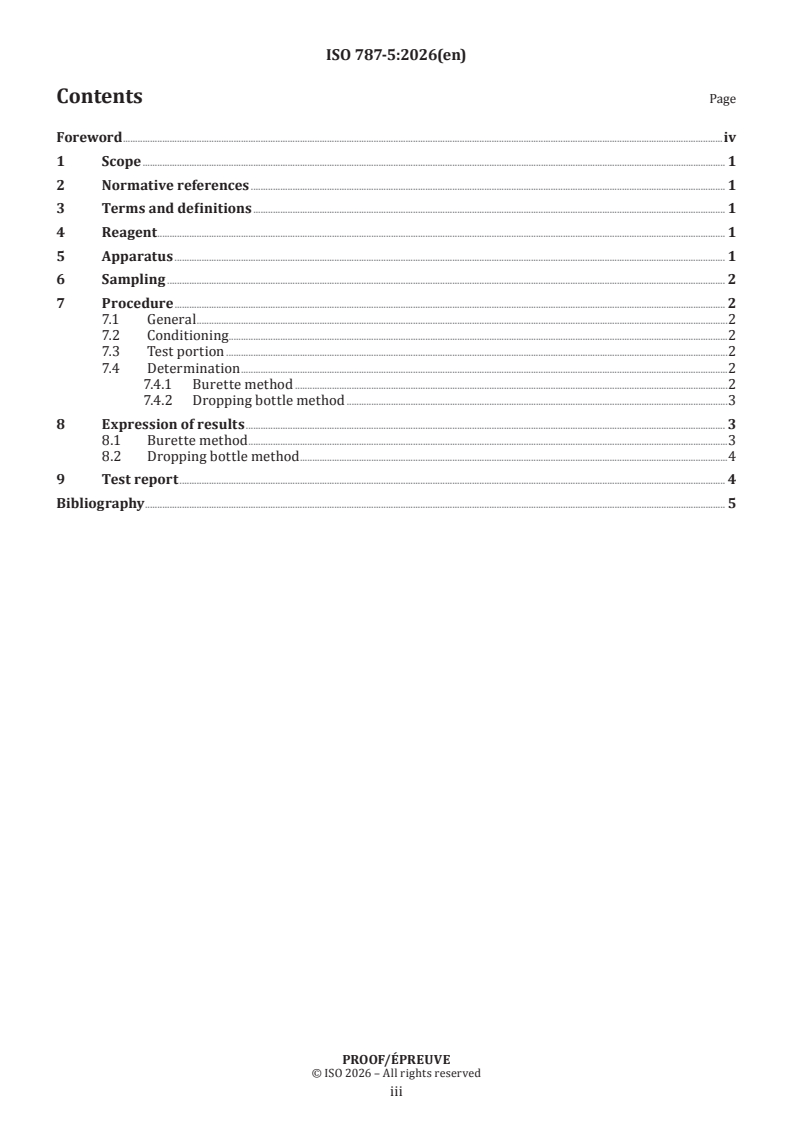
Contents Page
Foreword .iv
1 Scope . 1
2 Normative references . 1
3 Terms and definitions . 1
4 Reagent . 1
5 Apparatus . 1
6 Sampling . 2
7 Procedure . 2
7.1 General .2
7.2 Conditioning.2
7.3 Test portion .2
7.4 Determination .2
7.4.1 Burette method .2
7.4.2 Dropping bottle method .3
8 Expression of results . 3
8.1 Burette method .3
8.2 Dropping bottle method .4
9 Test report . 4
Bibliography . 5
PROOF/ÉPREUVE
iii
ISO 787-5:2026(en)
Foreword
ISO (the International Organization for Standardization) is a worldwide federation of national standards
bodies (ISO member bodies). The work of preparing International Standards is normally carried out through
ISO technical committees. Each member body interested in a subject for which a technical committee
has been established has the right to be represented on that committee. International organizations,
governmental and non-governmental, in liaison with ISO, also take part in the work. ISO collaborates closely
with the International Electrotechnical Commission (IEC) on all matters of electrotechnical standardization.
The procedures used to develop this document and those intended for its further maintenance are described
in the ISO/IEC Directives, Part 1. In particular, the different approval criteria needed for the different types
of ISO document should be noted. This document was drafted in accordance with the editorial rules of the
ISO/IEC Directives, Part 2 (see www.iso.org/directives).
ISO draws attention to the possibility that the implementation of this document may involve the use of (a)
patent(s). ISO takes no position concerning the evidence, validity or applicability of any claimed patent
rights in respect thereof. As of the date of publication of this document, ISO had not received notice of (a)
patent(s) which may be required to implement this document. However, implementers are cautioned that
this may not represent the latest information, which may be obtained from the patent database available at
www.iso.org/patents. ISO shall not be held responsible for identifying any or all such patent rights.
Any trade name used in this document is information given for the convenience of users and does not
constitute an endorsement.
For an explanation of the voluntary nature of standards, the meaning of ISO specific terms and expressions
related to conformity assessment, as well as information about ISO's adherence to the World Trade
Organization (WTO) principles in the Technical Barriers to Trade (TBT), see www.iso.org/iso/foreword.html.
This document was prepared by Technical Committee ISO/TC 256, Pigments, dyestuffs and extenders, in
collaboration with the European Committee for Standardization (CEN) Technical Committee CEN/TC 298,
Pigments and extenders, in accordance with the Agreement on technical cooperation between ISO and CEN
(Vienna Agreement).
This second edition cancels and replaces the first edition (ISO 787-5:1980), which has been technically
revised.
The main changes are as follows:
— the normative references have been updated;
— in Clause 5, a dropping bottle with a pipette has been added and the accuracy of the balance has been
specified;
— in Clause 7, the procedure of conditioning and its parameters have been added as 7.2, and the temperature
and humidity has been specified during the test;
— in 7.3, Table 1, the table header and expected oil absorption values, expressed in grams of oil per 100 g of
product, have been added;
— in 7.4, an additional method using the dropping bottle for adding the oil has been added as 7.4.2;
— in Clause 8, the expression of results by using the additional dropping bottle method (as 8.2) and two
calculation formulas have been added;
— a bibliography has been added.
A list of all parts in the ISO 787 series can be found on the ISO website.
Any feedback or questions on this document should be directed to the user’s national standards body. A
complete listing of these bodies can be found at www.iso.org/members.html.
PROOF/ÉPREUVE
iv
International Standard ISO 787-5:2026(en)
General methods of test for pigments and extenders —
Part 5:
Determination of oil absorption value
1 Scope
This document specifies a general method of test for determining the oil
...
Formatted
...
Style Definition
...
Style Definition
...
Style Definition
...
Style Definition
...
ISO/FDIS PRF 787-5:2026(en)
Style Definition
...
ISO/TC 256
Style Definition
...
Style Definition
...
Secretariat: DIN
Style Definition
...
Date: 2026-01-1402-05
Style Definition
...
Style Definition
...
Style Definition
...
Style Definition
...
Style Definition
...
Style Definition
...
General methods of test for pigments and extenders —
Style Definition
...
Style Definition
...
Style Definition
...
Style Definition
...
Style Definition
...
Part 5: Style Definition
...
Determination of oil absorption value Style Definition
...
Style Definition
...
Méthodes générales d'essai des pigments et matières de charge —
Style Definition
...
Partie 5: Détermination de la prise d'huile
Style Definition
...
Style Definition
...
Style Definition
...
Style Definition
...
Style Definition
...
Style Definition
...
Style Definition
...
Style Definition
...
Style Definition
PROOF .
Style Definition
...
Style Definition
...
Style Definition
...
TTTTTThhhhhhiiiiiissssss d d d d d drrrrrraftaftaftaftaftaft i i i i i issssss s s s s s suuuuuubbbbbbmmmmmmiiiiiittttttttttttedededededed t t t t t toooooo a pa pa pa pa pa pararararararallel vallel vallel vallel vallel vallel vooooootttttte e e e e e iiiiiinnnnnn I I I I I ISSSSSSOOOOOO,,,,,, C C C C C CEEEEEENNNNNN.
Style Definition
...
Style Definition
...
Style Definition
...
Style Definition
...
Style Definition
...
Style Definition
...
Style Definition
...
Style Definition
...
Style Definition
...
Style Definition
...
Style Definition
...
Style Definition
...
Style Definition
...
Style Definition
...
Style Definition
...
Style Definition
...
Style Definition
...
Style Definition
...
Style Definition
...
Style Definition
...
Style Definition
...
St l D fi iti
Formatted: Font: Bold
Formatted: HeaderCentered
Formatted: Default Paragraph Font
Formatted: Default Paragraph Font
All rights reserved. Unless otherwise specified, or required in the context of its implementation, no part of this publication
may be reproduced or utilized otherwise in any form or by any means, electronic or mechanical, including photocopying,
Formatted: Adjust space between Latin and Asian text,
or posting on the internet or an intranet, without prior written permission. Permission can be requested from either ISO
Adjust space between Asian text and numbers
at the address below or ISO’s member body in the country of the requester.
ISO copyright office
CP 401 • Ch. de Blandonnet 8
CH-1214 Vernier, Geneva
Phone: + 41 22 749 01 11
EmailE-mail: copyright@iso.org
Website: www.iso.orgwww.iso.org
Published in Switzerland
Formatted: English (United Kingdom)
Formatted: Font: 10 pt
Formatted: Font: 10 pt
Formatted: Font: 11 pt
Formatted: FooterPageRomanNumber, Space After: 0
pt, Line spacing: single
ii © ISO #### 2026 – All rights reserved
ii
ISO/FDISPRF 787-5:2026(en) Formatted: Font: 11 pt, Bold, Font color: Auto
Formatted: Font: 11 pt, Bold, Font color: Auto
Formatted: Font: Bold
Contents
Formatted: HeaderCentered, Left
Formatted: Adjust space between Latin and Asian text,
Foreword . iv
Adjust space between Asian text and numbers
1 Scope . 1
2 Normative references . 1
3 Terms and definitions . 1
4 Reagent . 1
5 Apparatus . 1
6 Sampling . 2
7 Procedure . 2
7.1 General. 2
7.2 Conditioning . 2
7.3 Test portion . 2
7.4 Determination . 2
8 Expression of results . 3
8.1 Burette method . 3
8.2 Dropping bottle method . 4
9 Test report . 4
Bibliography . 6
Foreword . iv
1 Scope . 1
2 Normative references . 1
3 Terms and definitions . 1
4 Reagent . 1
5 Apparatus . 1
6 Sampling . 2
7 Procedure . 2
7.1 General. 2
7.2 Conditioning . 2
7.3 Test portion . 2
7.4 Determination . 2
7.4.1 Burette method . 2
7.4.2 Dropping bottle method . 3
8 Expression of results . 3
8.1 Burette method . 3
Formatted: Font: 10 pt
8.2 Dropping bottle method . 4
Formatted: Font: 10 pt
9 Test report . 5
Formatted: Font: 10 pt
Bibliography . 6
Formatted: FooterCentered, Left, Space Before: 0 pt,
Tab stops: Not at 17.2 cm
Formatted: Font: 11 pt
Formatted: FooterPageRomanNumber, Left, Space
After: 0 pt, Tab stops: Not at 17.2 cm
© ISO 2026 – All rights reserved
iii
Formatted: Font: Bold
Formatted: HeaderCentered
Foreword Formatted: Adjust space between Latin and Asian text,
Adjust space between Asian text and numbers
ISO (the International Organization for Standardization) is a worldwide federation of national standards
bodies (ISO member bodies). The work of preparing International Standards is normally carried out through
ISO technical committees. Each member body interested in a subject for which a technical committee has been
established has the right to be represented on that committee. International organizations, governmental and
non-governmental, in liaison with ISO, also take part in the work. ISO collaborates closely with the
International Electrotechnical Commission (IEC) on all matters of electrotechnical standardization.
The procedures used to develop this document and those intended for its further maintenance are described
in the ISO/IEC Directives, Part 1. In particular, the different approval criteria needed for the different types of
ISO document should be noted. This document was drafted in accordance with the editorial rules of the
ISO/IEC Directives, Part 2 (see www.iso.org/directives).
Formatted: English (United Kingdom)
ISO draws attention to the possibility that the implementation of this document may involve the use of (a)
patent(s). ISO takes no position concerning the evidence, validity or applicability of any claimed patent rights
in respect thereof. As of the date of publication of this document, ISO had not received notice of (a) patent(s)
which may be required to implement this document. However, implementers are cautioned that this may not
represent the latest information, which may be obtained from the patent database available at
www.iso.org/patents.www.iso.org/patents. ISO shall not be held responsible for identifying any or all such
patent rights.
Any trade name used in this document is information given for the convenience of users and does not
constitute an endorsement.
For an explanation of the voluntary nature of standards, the meaning of ISO specific terms and expressions
related to conformity assessment, as well as information about ISO's adherence to the World Trade
Organization (WTO) principles in the Technical Barriers to Trade (TBT), see
www.iso.org/iso/foreword.htmlwww.iso.org/iso/foreword.html.
Formatted: English (United Kingdom)
This document was prepared by Technical Committee ISO/TC 256, Pigments, dyestuffs and extenders, in
Formatted: Adjust space between Latin and Asian text,
collaboration with the European Committee for Standardization (CEN) Technical Committee CEN/TC 298, Adjust space between Asian text and numbers
Pigments and extenders, in accordance with the Agreement on technical cooperation between ISO and CEN
(Vienna Agreement).
This second edition cancels and replaces the first edition (ISO 787--5:1980), which has been technically
Formatted: Default Paragraph Font
revised.
Formatted: Default Paragraph Font
Formatted: Default Paragraph Font
The main changes are as follows:
Formatted: Default Paragraph Font
— — the normative references have been updated;
Formatted: Adjust space between Latin and Asian text,
Adjust space between Asian text and numbers, Tab
— — in Clause 5,in Clause 5, a dropping bottle with a pipette has been added and the accuracy of the balance
stops: Not at 0.7 cm + 1.4 cm + 2.1 cm + 2.8 cm +
has been specified;
3.5 cm + 4.2 cm + 4.9 cm + 5.6 cm + 6.3 cm + 7 cm
— — in Clause 7,Clause 7, the procedure of conditioning and its parameters have been added as 7.2,7.2, and
the temperature and humidity has been specified during the test;
— — in 7.3, Table 1,in 7.3, Table 1, the table header and expected oil absorption values, expressed in grams
of oil per 100 g of product, have been added;
Formatted: Font: 10 pt
Formatted: Font: 10 pt
— — in 7.4,7.4, an additional method using the dropping bottle for adding the oil has been added as
7.4.2;7.4.2;
Formatted: Font: 11 pt
Formatted: FooterPageRomanNumber, Space After: 0
pt, Line spacing: single
iv © ISO #### 2026 – All rights reserved
iv
ISO/FDISPRF 787-5:2026(en) Formatted: Font: 11 pt, Bold, Font color: Auto
Formatted: Font: 11 pt, Bold, Font color: Auto
Formatted: Font: Bold
— — in Clause 8,Clause 8, the expression of results by using the additional dropping bottle method (as
Formatted: HeaderCentered, Left
8.2)8.2) and two calculation formulas have been added;
— — a bibliography has been added.
A list of all parts in the ISO 787 series can be found on the ISO website.
Formatted: Default Paragraph Font
Formatted: Default Paragraph Font
Any feedback or questions on this document should be directed to the user’s national standards body. A
Formatted: Default Paragraph Font
complete listing of these bodies can be found at www.iso.org/members.htmlwww.iso.org/members.html.
Formatted: Adjust space between Latin and Asian text,
Adjust space between Asian text and numbers
Formatted: English (United Kingdom)
Formatted: English (United Kingdom)
Formatted: Adjust space between Latin and Asian text,
Adjust space between Asian text and numbers
Formatted: Font: 10 pt
Formatted: Font: 10 pt
Formatted: Font: 10 pt
Formatted: FooterCentered, Left, Space Before: 0 pt,
Tab stops: Not at 17.2 cm
Formatted: Font: 11 pt
Formatted: FooterPageRomanNumber, Left, Space
After: 0 pt, Tab stops: Not at 17.2 cm
© ISO 2026 – All rights reserved
v
DRAFT International Standard ISO/DIS 787-5:2025(en)
Formatted: Font: Not Bold
Formatted: Header, Space After: 0 pt, Line spacing:
single
General methods of test for pigments and extenders —
Formatted: Main Title 2, Adjust space between Latin
Part 5:
and Asian text, Adjust space between Asian text and
Determination of oil absorption value
numbers
1 Scope
Formatted: Default Paragraph Font
This document specifies a general method of test for determining the oil absorption value of a sample of
Formatted: Default Paragr
...
Questions, Comments and Discussion
Ask us and Technical Secretary will try to provide an answer. You can facilitate discussion about the standard in here.
Loading comments...