


prEN ISO 787-5
(Main)General methods of test for pigments and extenders - Part 5: Determination of oil absorption value (ISO/DIS 787-5:2025)
General methods of test for pigments and extenders - Part 5: Determination of oil absorption value (ISO/DIS 787-5:2025)
The oil absorption value is required to be compared with the value determined at the same time on an agreed sample of the product. The principle of the method is based on addition of linseed oil from a burette to the test portion. After each addition, rub the oil into the product until conglomerates are formed. Cease the addition of oil when a paste of smooth consistency has been formed. It should just spread without cracking or crumbling. Read the burette and note the quantity of oil used. The result is expressed in millilitres of oil per 100 g of product or in grams of oil per 100 g of product. - Cancels and replaces Part 5 of ISO/R 787-1968.
Allgemeine Prüfverfahren für Pigmente und Füllstoffe - Teil 5: Bestimmung der Ölzahl (ISO/DIS 787‑5:2025)
Méthodes générales d'essai des pigments et matières de charge - Partie 5: Détermination de la prise d'huile (ISO/DIS 787-5:2025)
La présente partie de l'ISO 787 spécifie une méthode générale d'essai pour la détermination de la prise d'huile d'un pigment ou d'une matière de charge. La prise d'huile est généralement nécessaire pour être comparée avec la valeur déterminée au même moment sur un échantillon agréé de produit.
NOTE -- Chaque fois que cette méthode générale est applicable pour un pigment ou une matière de charge donné(e), il devra simplement y être fait référence dans la Norme internationale relative à ce pigment ou cette matière de charge, et il devra être mentionné, dans une note, toutes les modifications de détail qui peuvent être nécessaires en raison des propriétés spéciales du produit considéré. Ce n'est que dans le cas où une telle méthode générale ne serait pas applicable à un produit particulier, qu'il deviendrait nécessaire de spécifier une méthode spéciale pour la détermination de la prise d'huile.
Splošne metode preskušanja pigmentov in polnil - 5. del: Določanje oljnega števila (ISO/DIS 787-5:2025)
General Information
- Status
- Not Published
- Publication Date
- 04-Apr-2027
- Technical Committee
- CEN/TC 298 - Pigments and extenders
- Current Stage
- 4060 - Closure of enquiry - Enquiry
- Start Date
- 03-Dec-2025
- Completion Date
- 03-Dec-2025
Relations
- Effective Date
- 08-Nov-2023
Overview
The prEN ISO 787-5:2025 standard specifies the general methods for determining the oil absorption value of pigments and extenders. This test method is essential for assessing how much refined linseed oil a pigment or extender sample absorbs under defined conditions. The oil absorption value is a critical quality parameter in industries such as paint, varnish, and coatings production, impacting the handling, texture, and application properties of pigments and extenders.
This standard supersedes the previous ISO 787-5:1980, incorporating updated procedures, additional testing methods, and refined measurement accuracy. It ensures a consistent, reliable approach to comparing pigment and extender products by quantifying their oil absorption using controlled laboratory techniques.
Key Topics
Test Principle: The oil absorption value is determined by gradually adding linseed oil to a measured sample of pigment or extender. The oil is mixed in until a smooth, paste-like consistency forms that spreads without cracking or crumbling.
Reagents and Apparatus:
- Refined linseed oil compliant with ISO 150 standards, with a specific acid value and density.
- Testing plate made of ground glass or marble.
- Palette knife for mixing.
- Precise burette or dropping bottle fitted with a pipette for oil addition.
- Analytical balance accurate to 0.001 g or better.
Test Procedure:
- Samples and reagents are conditioned at 23 ± 2 °C and 50 ± 5% relative humidity.
- The test is performed in duplicate for reliability.
- Two addition methods are outlined: the burette method and the dropping bottle method.
- The oil is added gradually, first in drops and then one drop at a time when conglomerates form.
- The endpoint is the formation of a paste just capable of spreading smoothly.
Result Expression:
- Results are given as millilitres or grams of oil absorbed per 100 grams of pigment or extender.
- Specific formulae are used to convert pipetted volume and weight measurements into oil absorption values.
Quality Control: Comparison to an agreed sample tested simultaneously is recommended to ensure consistency.
Applications
The prEN ISO 787-5:2025 standard provides practical value across multiple industries where pigments and extenders are integral:
- Paints and Coatings Manufacturing: Helps determine pigment compatibility and optimum formulation by understanding oil absorption behaviour.
- Raw Material Quality Assurance: Enables manufacturers and suppliers to ensure product conformity and consistency.
- Research and Development: Supports formulation scientists in developing new pigment and extender blends with desired texture and spreadability.
- Regulatory Compliance: Facilitates adherence to international quality and testing standards for pigments and extenders.
The accurate determination of oil absorption influences product performance, drying time, durability, and application characteristics, making this test critical in industrial processes.
Related Standards
prEN ISO 787-5:2025 references and complements other key ISO standards related to pigments, extenders, and raw materials testing:
- ISO 150: Specifications for raw, refined, and boiled linseed oil, ensuring reagent quality.
- ISO 385: Requirements for burettes used in volumetric measurement.
- ISO 2811-1 & ISO 2811-3: Methods for determining density of paints and varnishes, essential for calculating oil absorption by mass.
- ISO 15528: Guidelines for sampling paints, varnishes, and raw materials to ensure representative testing.
Together, these standards provide a robust framework for comprehensive testing and quality control in pigment and extender applications.
By standardizing the determination of oil absorption value, prEN ISO 787-5:2025 plays a vital role in supporting consistent product quality, performance predictability, and compliance in pigment and extender testing worldwide.

Frequently Asked Questions
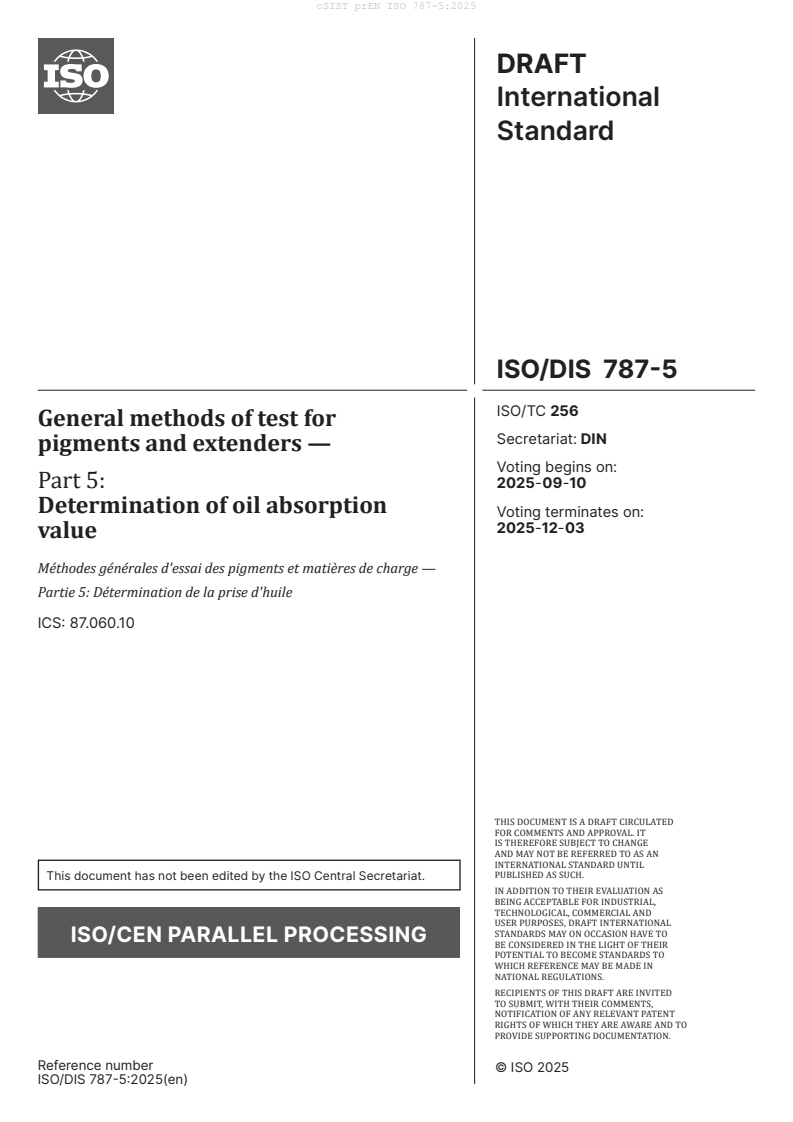
prEN ISO 787-5 is a draft published by the European Committee for Standardization (CEN). Its full title is "General methods of test for pigments and extenders - Part 5: Determination of oil absorption value (ISO/DIS 787-5:2025)". This standard covers: The oil absorption value is required to be compared with the value determined at the same time on an agreed sample of the product. The principle of the method is based on addition of linseed oil from a burette to the test portion. After each addition, rub the oil into the product until conglomerates are formed. Cease the addition of oil when a paste of smooth consistency has been formed. It should just spread without cracking or crumbling. Read the burette and note the quantity of oil used. The result is expressed in millilitres of oil per 100 g of product or in grams of oil per 100 g of product. - Cancels and replaces Part 5 of ISO/R 787-1968.
The oil absorption value is required to be compared with the value determined at the same time on an agreed sample of the product. The principle of the method is based on addition of linseed oil from a burette to the test portion. After each addition, rub the oil into the product until conglomerates are formed. Cease the addition of oil when a paste of smooth consistency has been formed. It should just spread without cracking or crumbling. Read the burette and note the quantity of oil used. The result is expressed in millilitres of oil per 100 g of product or in grams of oil per 100 g of product. - Cancels and replaces Part 5 of ISO/R 787-1968.
prEN ISO 787-5 is classified under the following ICS (International Classification for Standards) categories: 87.060.10 - Pigments and extenders. The ICS classification helps identify the subject area and facilitates finding related standards.
prEN ISO 787-5 has the following relationships with other standards: It is inter standard links to EN ISO 787-5:1995. Understanding these relationships helps ensure you are using the most current and applicable version of the standard.
prEN ISO 787-5 is available in PDF format for immediate download after purchase. The document can be added to your cart and obtained through the secure checkout process. Digital delivery ensures instant access to the complete standard document.
Standards Content (Sample)
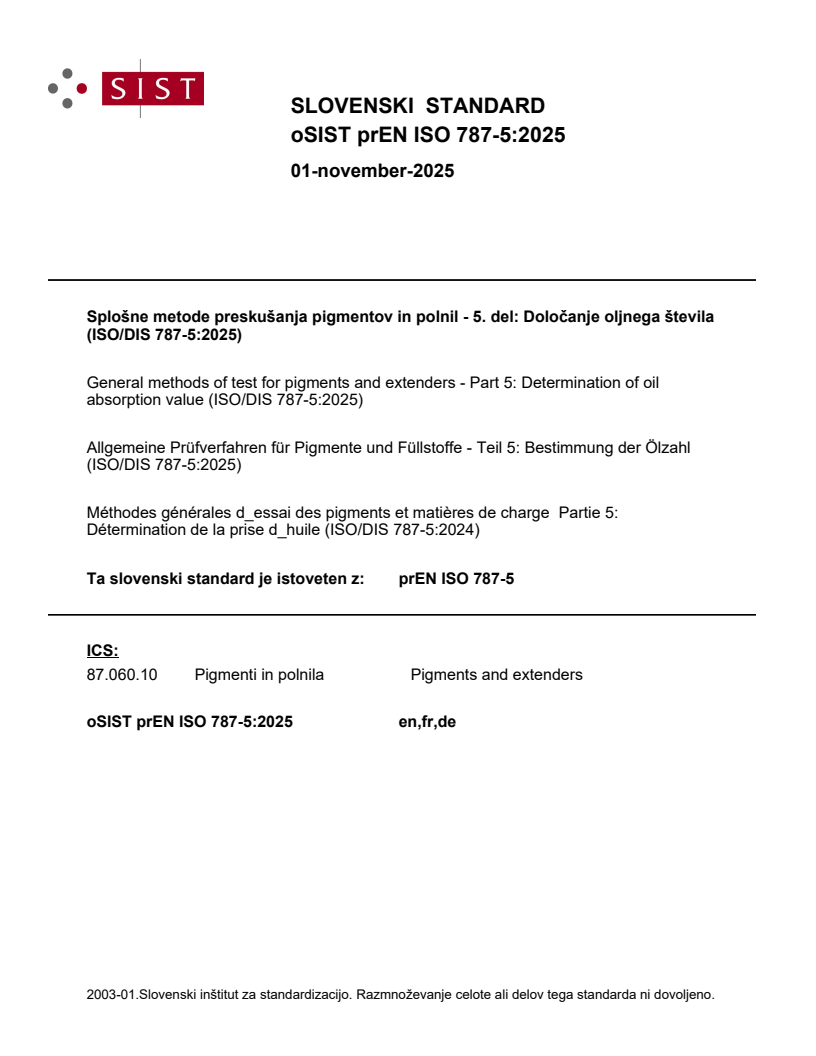
SLOVENSKI STANDARD
01-november-2025
Splošne metode preskušanja pigmentov in polnil - 5. del: Določanje oljnega števila
(ISO/DIS 787-5:2025)
General methods of test for pigments and extenders - Part 5: Determination of oil
absorption value (ISO/DIS 787-5:2025)
Allgemeine Prüfverfahren für Pigmente und Füllstoffe - Teil 5: Bestimmung der Ölzahl
(ISO/DIS 787-5:2025)
Méthodes générales d_essai des pigments et matières de charge Partie 5:
Détermination de la prise d_huile (ISO/DIS 787-5:2024)
Ta slovenski standard je istoveten z: prEN ISO 787-5
ICS:
87.060.10 Pigmenti in polnila Pigments and extenders
2003-01.Slovenski inštitut za standardizacijo. Razmnoževanje celote ali delov tega standarda ni dovoljeno.
DRAFT
International
Standard
ISO/DIS 787-5
ISO/TC 256
General methods of test for
Secretariat: DIN
pigments and extenders —
Voting begins on:
Part 5: 2025-09-10
Determination of oil absorption
Voting terminates on:
2025-12-03
value
Méthodes générales d'essai des pigments et matières de charge —
Partie 5: Détermination de la prise d'huile
ICS: 87.060.10
THIS DOCUMENT IS A DRAFT CIRCULATED
FOR COMMENTS AND APPROVAL. IT
IS THEREFORE SUBJECT TO CHANGE
AND MAY NOT BE REFERRED TO AS AN
INTERNATIONAL STANDARD UNTIL
PUBLISHED AS SUCH.
This document has not been edited by the ISO Central Secretariat.
IN ADDITION TO THEIR EVALUATION AS
BEING ACCEPTABLE FOR INDUSTRIAL,
TECHNOLOGICAL, COMMERCIAL AND
USER PURPOSES, DRAFT INTERNATIONAL
STANDARDS MAY ON OCCASION HAVE TO
ISO/CEN PARALLEL PROCESSING
BE CONSIDERED IN THE LIGHT OF THEIR
POTENTIAL TO BECOME STANDARDS TO
WHICH REFERENCE MAY BE MADE IN
NATIONAL REGULATIONS.
RECIPIENTS OF THIS DRAFT ARE INVITED
TO SUBMIT, WITH THEIR COMMENTS,
NOTIFICATION OF ANY RELEVANT PATENT
RIGHTS OF WHICH THEY ARE AWARE AND TO
PROVIDE SUPPORTING DOCUMENTATION.
Reference number
ISO/DIS 787-5:2025(en)
DRAFT
ISO/DIS 787-5:2025(en)
International
Standard
ISO/DIS 787-5
ISO/TC 256
General methods of test for
Secretariat: DIN
pigments and extenders —
Voting begins on:
Part 5:
Determination of oil absorption value
Voting terminates on:
Méthodes générales d'essai des pigments et matières de charge —
Partie 5: Détermination de la prise d'huile
ICS: 87.060.10
THIS DOCUMENT IS A DRAFT CIRCULATED
FOR COMMENTS AND APPROVAL. IT
IS THEREFORE SUBJECT TO CHANGE
AND MAY NOT BE REFERRED TO AS AN
INTERNATIONAL STANDARD UNTIL
PUBLISHED AS SUCH.
This document has not been edited by the ISO Central Secretariat.
IN ADDITION TO THEIR EVALUATION AS
BEING ACCEPTABLE FOR INDUSTRIAL,
© ISO 2025
TECHNOLOGICAL, COMMERCIAL AND
USER PURPOSES, DRAFT INTERNATIONAL
All rights reserved. Unless otherwise specified, or required in the context of its implementation, no part of this publication may
STANDARDS MAY ON OCCASION HAVE TO
ISO/CEN PARALLEL PROCESSING
be reproduced or utilized otherwise in any form or by any means, electronic or mechanical, including photocopying, or posting on
BE CONSIDERED IN THE LIGHT OF THEIR
the internet or an intranet, without prior written permission. Permission can be requested from either ISO at the address below
POTENTIAL TO BECOME STANDARDS TO
WHICH REFERENCE MAY BE MADE IN
or ISO’s member body in the country of the requester.
NATIONAL REGULATIONS.
ISO copyright office
RECIPIENTS OF THIS DRAFT ARE INVITED
CP 401 • Ch. de Blandonnet 8
TO SUBMIT, WITH THEIR COMMENTS,
CH-1214 Vernier, Geneva
NOTIFICATION OF ANY RELEVANT PATENT
Phone: +41 22 749 01 11
RIGHTS OF WHICH THEY ARE AWARE AND TO
PROVIDE SUPPORTING DOCUMENTATION.
Email: copyright@iso.org
Website: www.iso.org
Published in Switzerland Reference number
ISO/DIS 787-5:2025(en)
ii
ISO/DIS 787-5:2025(en)
Contents Page
Foreword .iv
1 Scope . 1
2 Normative references . 1
3 Terms and definitions . 1
4 Reagent . 1
5 Apparatus . 2
6 Sampling . 2
7 Procedure . 2
7.1 General .2
7.2 Conditioning.2
7.3 Test portion .2
7.4 Determination .2
7.4.1 Burette method .2
7.4.2 Dropping bottle method .3
8 Expression of results . 3
8.1 Burette method .3
8.2 Dropping bottle method .4
9 Test report . 4
Bibliography . 5
iii
ISO/DIS 787-5:2025(en)
Foreword
ISO (the International Organization for Standardization) is a worldwide federation of national standards
bodies (ISO member bodies). The work of preparing International Standards is normally carried out through
ISO technical committees. Each member body interested in a subject for which a technical committee
has been established has the right to be represented on that committee. International organizations,
governmental and non-governmental, in liaison with ISO, also take part in the work. ISO collaborates closely
with the International Electrotechnical Commission (IEC) on all matters of electrotechnical standardization.
The procedures used to develop this document and those intended for its further maintenance are described
in the ISO/IEC Directives, Part 1. In particular, the different approval criteria needed for the different types
of ISO documents should be noted. This document was drafted in accordance with the editorial rules of the
ISO/IEC Directives, Part 2 (see www.iso.org/directives).
ISO draws attention to the possibility that the implementation of this document may involve the use of (a)
patent(s). ISO takes no position concerning the evidence, validity or applicability of any claimed patent
rights in respect thereof. As of the date of publication of this document, ISO had not received notice of (a)
patent(s) which may be required to implement this document. However, implementers are cautioned that
this may not represent the latest information, which may be obtained from the patent database available at
www.iso.org/patents. ISO shall not be held responsible for identifying any or all such patent rights.
Any trade name used in this document is information given for the convenience of users and does not
constitute an endorsement.
For an explanation of the voluntary nature of standards, the meaning of ISO specific terms and expressions
related to conformity assessment, as well as information about ISO's adherence to the World Trade
Organization (WTO) principles in the Technical Barriers to Trade (TBT), see www.iso.org/iso/foreword.html.
This document was prepared by Technical Committee ISO/TC 256, Pigments, dyestuffs and extenders, in
collaboration with the European Committee for Standardization (CEN) Technical Committee CEN/TC 298,
Pigments and extenders, in accordance with the Agreement on technical cooperation between ISO and CEN
(Vi
...
Questions, Comments and Discussion
Ask us and Technical Secretary will try to provide an answer. You can facilitate discussion about the standard in here.
Loading comments...