

ISO 787-5:2026
(Main)General methods of test for pigments and extenders — Part 5: Determination of oil absorption value
General Information
- Abstract
This document specifies a general method of test for determining the oil absorption value of a sample of pigment or extender. The oil absorption value is usually required to be compared with the value determined at the same time on an agreed sample of the product.
- Status
- Published
- Publication Date
- 31-Mar-2026
- Technical Committee
- ISO/TC 256 - Pigments, dyestuffs and extenders
- Drafting Committee
- ISO/TC 256/WG 3 - General test methods for colorants and extenders
- Current Stage
- 6060 - International Standard published
- Start Date
- 01-Apr-2026
- Due Date
- 27-Oct-2026
- Completion Date
- 01-Apr-2026
Buy Documents
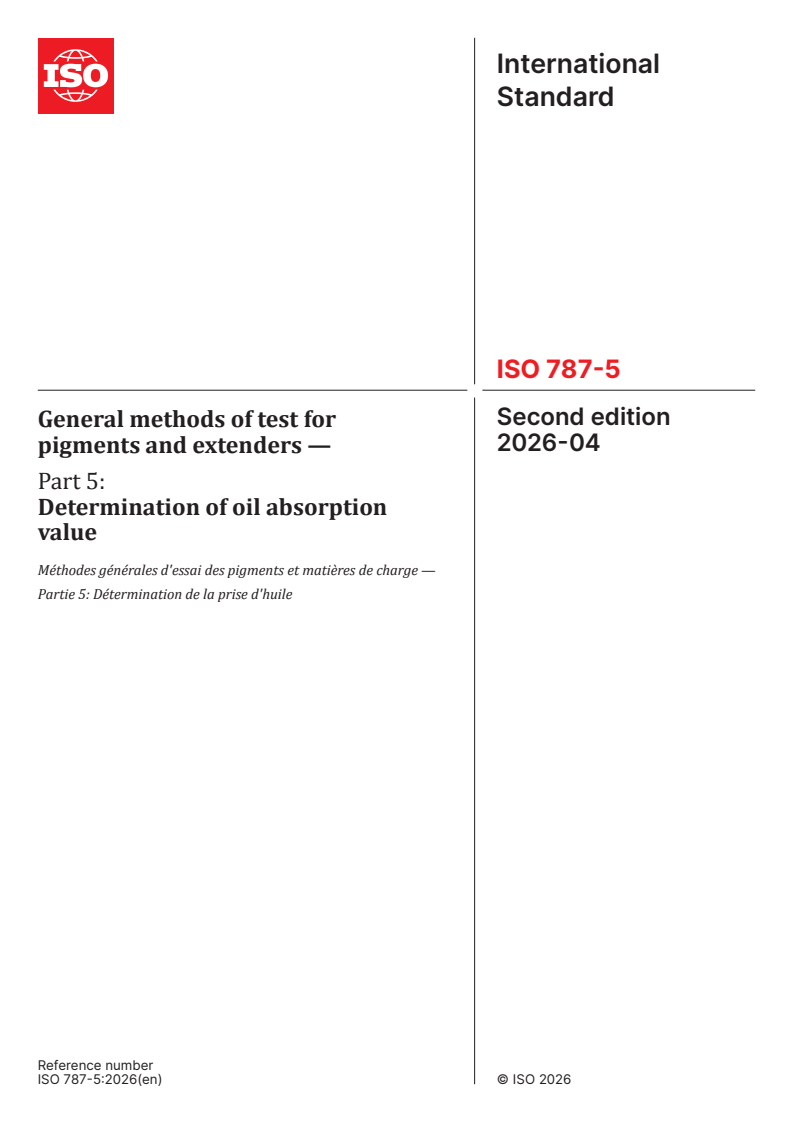
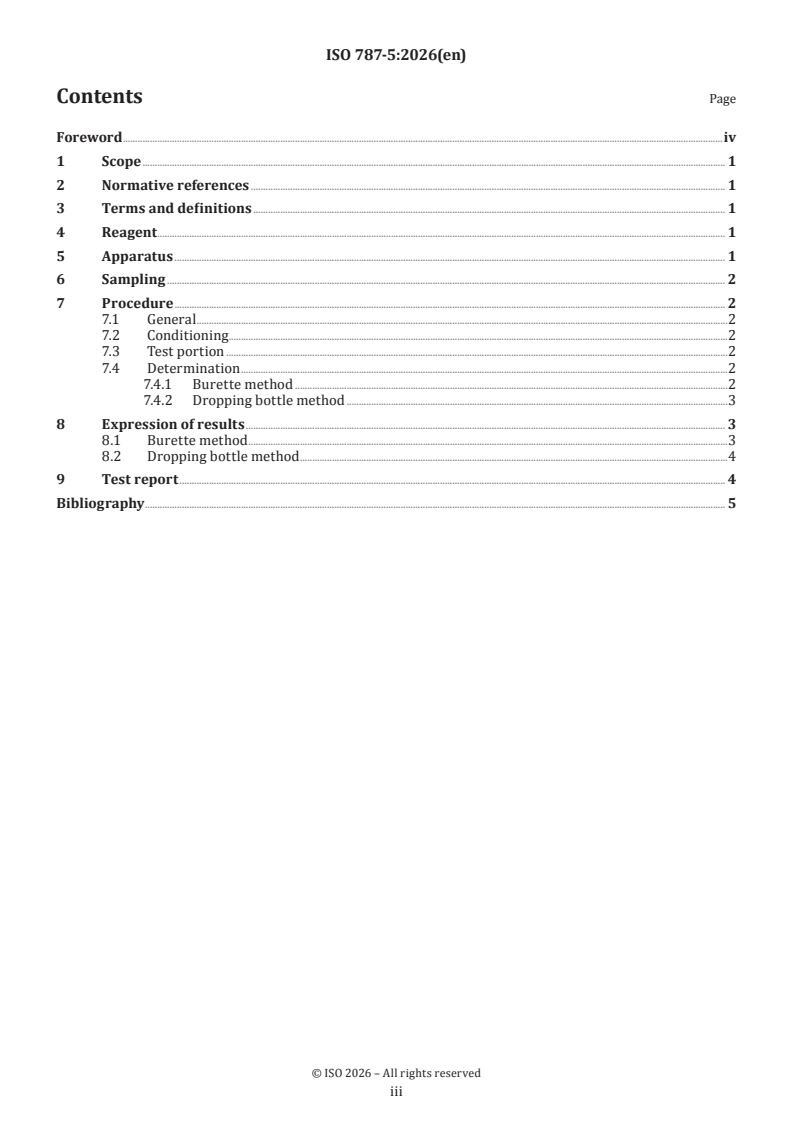
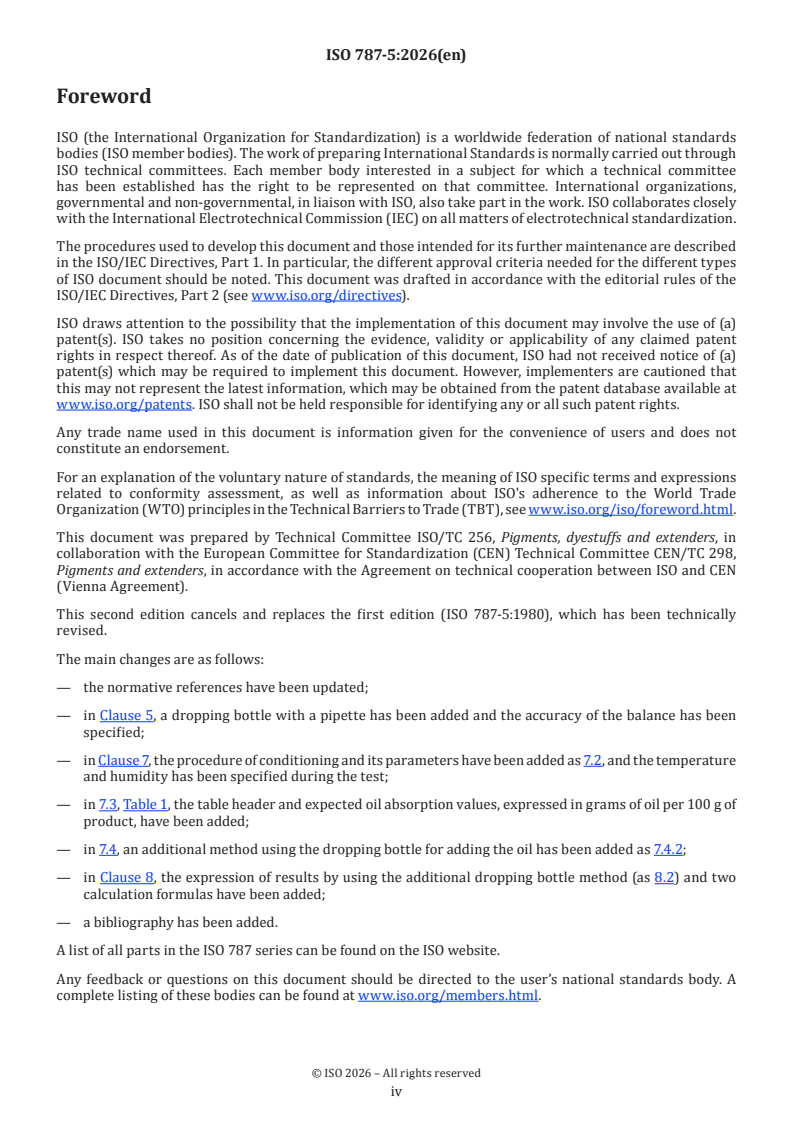
ISO 787-5:2026 - General methods of test for pigments and extenders — Part 5: Determination of oil absorption value
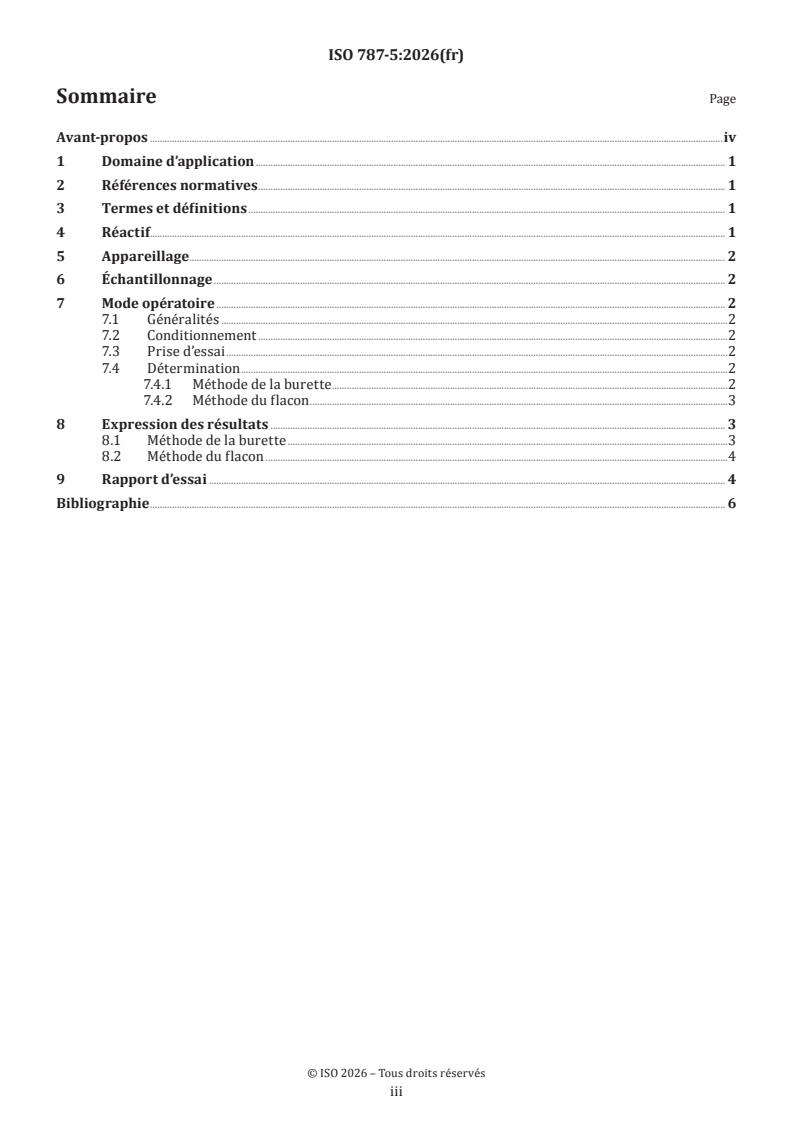
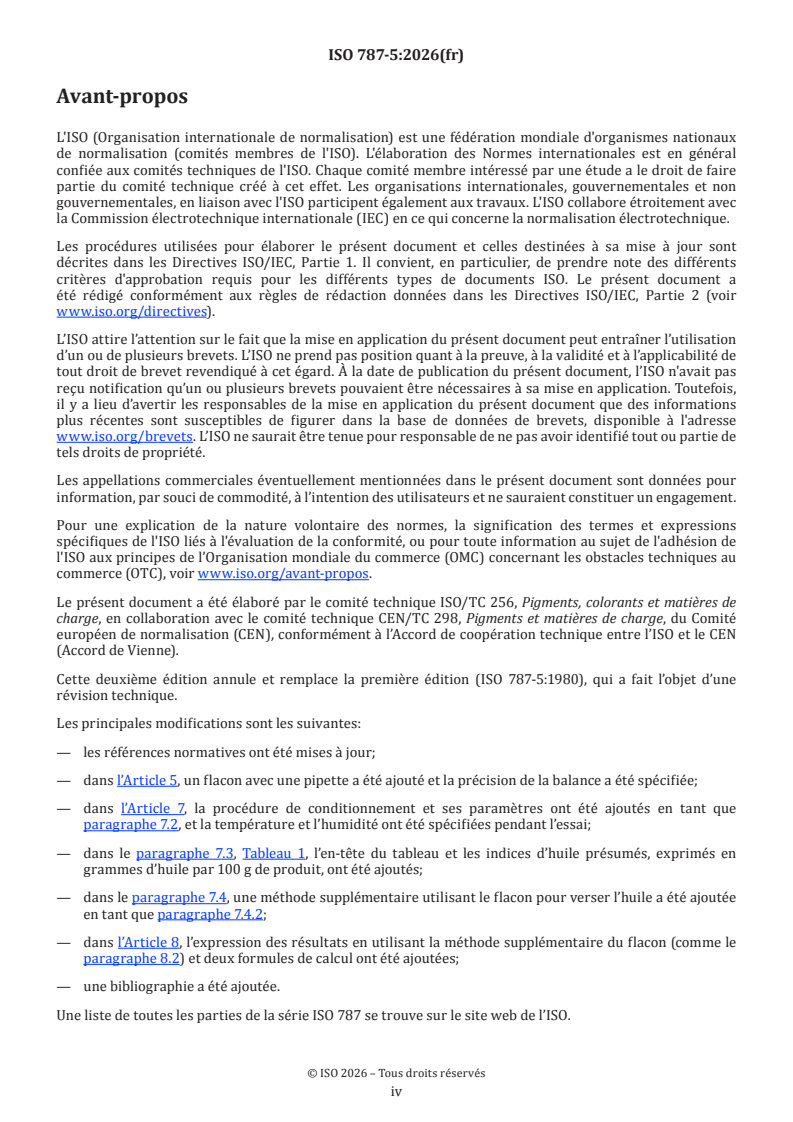
ISO 787-5:2026 - Méthodes générales d'essai des pigments et matières de charge — Partie 5: Détermination de l'indice d'huile
REDLINE ISO 787-5:2026 - Méthodes générales d'essai des pigments et matières de charge — Partie 5: Détermination de l'indice d'huile
Overview
ISO 787-5:2026 is an internationally recognized standard developed by the International Organization for Standardization (ISO) under the ISO 787 series. This document outlines general test methods for pigments and extenders, specifically detailing the procedure for determining the oil absorption value. The oil absorption value is a crucial parameter in industries relying on pigments and extenders, such as paints, coatings, plastics, inks, and construction materials. By standardizing the determination of oil absorption, ISO 787-5:2026 promotes consistency, reliability, and quality assurance in material characterization processes.
Key Topics
Purpose of the Standard:
ISO 787-5:2026 provides clear methodologies for measuring how much oil (typically refined linseed oil) a pigment or extender can absorb under specified testing conditions. This value is often compared to a reference or an agreed sample to ensure product conformity.Test Methods:
Two standardized methods are described:- The burette method (volume-based)
- The dropping bottle method (mass-based)
Sample Conditioning:
- Samples and reagents are conditioned at (23 ± 2) °C and relative humidity of (50 ± 5) % for a minimum of 16 hours to ensure reproducibility.
Result Expression:
- Results are reported in either grams or milliliters of oil per 100 grams of sample.
Reporting Requirements:
- Comprehensive reporting is mandated, including product identification, method used, environmental conditions, results, deviations, anomalies, and the date of testing.
Applications
The determination of oil absorption value is essential across various industries that utilize pigments and extenders. Its main applications include:
Paints and Coatings:
- Oil absorption indicates how much binder (oil) is required to achieve optimal dispersion and consistency in paint formulations, directly impacting product performance and cost.
Plastics and Polymer Composites:
- Understanding oil absorption helps optimize mixtures, improving material properties and processing behavior.
Printing Inks:
- Ensures the right balance between pigment/extender and vehicle components, affecting ink viscosity and print quality.
Construction Materials:
- Used in the formulation of colored cement, mortar, and other building materials where pigment performance is critical.
Quality Control and Product Development:
- Meets regulatory and performance requirements by verifying conformity to internal or external standards.
The standard benefits manufacturers, testing laboratories, product developers, and quality assurance professionals by enabling repeatable and comparable results.
Related Standards
ISO 787-5:2026 makes reference to several other international standards integral to the testing process:
- ISO 150: Raw, refined and boiled linseed oil for paints and varnishes - Specifications and methods of test.
- ISO 385: Laboratory glassware - Burettes.
- ISO 15528: Paints, varnishes and raw materials for paints and varnishes - Sampling.
- ISO 2811-1: Paints and varnishes - Determination of density - Part 1: Pycnometer method.
- ISO 2811-3: Paints and varnishes - Determination of density - Part 3: Oscillation method.
- ISO 18451-1: Pigments, dyestuffs and extenders - Terminology - Part 1: General terms.
These standards ensure accuracy, reliability, and harmonization across testing procedures for pigments and extenders.
ISO 787-5:2026 is an essential resource for anyone involved in the testing, formulation, or application of pigments and extenders, contributing to quality assurance and product consistency in the colorants industry. For more information, visit www.iso.org.
Relations
- Effective Date
- 12-Feb-2026
- Effective Date
- 11-Nov-2023
- Effective Date
- 28-Oct-2023
Buy Documents
ISO 787-5:2026 - General methods of test for pigments and extenders — Part 5: Determination of oil absorption value
ISO 787-5:2026 - Méthodes générales d'essai des pigments et matières de charge — Partie 5: Détermination de l'indice d'huile
REDLINE ISO 787-5:2026 - Méthodes générales d'essai des pigments et matières de charge — Partie 5: Détermination de l'indice d'huile
Frequently Asked Questions
ISO 787-5:2026 is a standard published by the International Organization for Standardization (ISO). Its full title is "General methods of test for pigments and extenders — Part 5: Determination of oil absorption value". This standard covers: This document specifies a general method of test for determining the oil absorption value of a sample of pigment or extender. The oil absorption value is usually required to be compared with the value determined at the same time on an agreed sample of the product.
This document specifies a general method of test for determining the oil absorption value of a sample of pigment or extender. The oil absorption value is usually required to be compared with the value determined at the same time on an agreed sample of the product.
ISO 787-5:2026 is classified under the following ICS (International Classification for Standards) categories: 87.060.10 - Pigments and extenders. The ICS classification helps identify the subject area and facilitates finding related standards.
ISO 787-5:2026 has the following relationships with other standards: It is inter standard links to EN ISO 787-5:2026, ISO/IEC 19075-4:2021, ISO 787-5:1980. Understanding these relationships helps ensure you are using the most current and applicable version of the standard.
ISO 787-5:2026 is available in PDF format for immediate download after purchase. The document can be added to your cart and obtained through the secure checkout process. Digital delivery ensures instant access to the complete standard document.
Standards Content (Sample)
International
Standard
ISO 787-5
Second edition
General methods of test for
2026-04
pigments and extenders —
Part 5:
Determination of oil absorption
value
Méthodes générales d'essai des pigments et matières de charge —
Partie 5: Détermination de la prise d'huile
Reference number
© ISO 2026
All rights reserved. Unless otherwise specified, or required in the context of its implementation, no part of this publication may
be reproduced or utilized otherwise in any form or by any means, electronic or mechanical, including photocopying, or posting on
the internet or an intranet, without prior written permission. Permission can be requested from either ISO at the address below
or ISO’s member body in the country of the requester.
ISO copyright office
CP 401 • Ch. de Blandonnet 8
CH-1214 Vernier, Geneva
Phone: +41 22 749 01 11
Email: copyright@iso.org
Website: www.iso.org
Published in Switzerland
ii
Contents Page
Foreword .iv
1 Scope . 1
2 Normative references . 1
3 Terms and definitions . 1
4 Reagent . 1
5 Apparatus . 1
6 Sampling . 2
7 Procedure . 2
7.1 General .2
7.2 Conditioning.2
7.3 Test portion .2
7.4 Determination .2
7.4.1 Burette method .2
7.4.2 Dropping bottle method .3
8 Expression of results . 3
8.1 Burette method .3
8.2 Dropping bottle method .4
9 Test report . 4
Bibliography . 5
iii
Foreword
ISO (the International Organization for Standardization) is a worldwide federation of national standards
bodies (ISO member bodies). The work of preparing International Standards is normally carried out through
ISO technical committees. Each member body interested in a subject for which a technical committee
has been established has the right to be represented on that committee. International organizations,
governmental and non-governmental, in liaison with ISO, also take part in the work. ISO collaborates closely
with the International Electrotechnical Commission (IEC) on all matters of electrotechnical standardization.
The procedures used to develop this document and those intended for its further maintenance are described
in the ISO/IEC Directives, Part 1. In particular, the different approval criteria needed for the different types
of ISO document should be noted. This document was drafted in accordance with the editorial rules of the
ISO/IEC Directives, Part 2 (see www.iso.org/directives).
ISO draws attention to the possibility that the implementation of this document may involve the use of (a)
patent(s). ISO takes no position concerning the evidence, validity or applicability of any claimed patent
rights in respect thereof. As of the date of publication of this document, ISO had not received notice of (a)
patent(s) which may be required to implement this document. However, implementers are cautioned that
this may not represent the latest information, which may be obtained from the patent database available at
www.iso.org/patents. ISO shall not be held responsible for identifying any or all such patent rights.
Any trade name used in this document is information given for the convenience of users and does not
constitute an endorsement.
For an explanation of the voluntary nature of standards, the meaning of ISO specific terms and expressions
related to conformity assessment, as well as information about ISO's adherence to the World Trade
Organization (WTO) principles in the Technical Barriers to Trade (TBT), see www.iso.org/iso/foreword.html.
This document was prepared by Technical Committee ISO/TC 256, Pigments, dyestuffs and extenders, in
collaboration with the European Committee for Standardization (CEN) Technical Committee CEN/TC 298,
Pigments and extenders, in accordance with the Agreement on technical cooperation between ISO and CEN
(Vienna Agreement).
This second edition cancels and replaces the first edition (ISO 787-5:1980), which has been technically
revised.
The main changes are as follows:
— the normative references have been updated;
— in Clause 5, a dropping bottle with a pipette has been added and the accuracy of the balance has been
specified;
— in Clause 7, the procedure of conditioning and its parameters have been added as 7.2, and the temperature
and humidity has been specified during the test;
— in 7.3, Table 1, the table header and expected oil absorption values, expressed in grams of oil per 100 g of
product, have been added;
— in 7.4, an additional method using the dropping bottle for adding the oil has been added as 7.4.2;
— in Clause 8, the expression of results by using the additional dropping bottle method (as 8.2) and two
calculation formulas have been added;
— a bibliography has been added.
A list of all parts in the ISO 787 series can be found on the ISO website.
Any feedback or questions on this document should be directed to the user’s national standards body. A
complete listing of these bodies can be found at www.iso.org/members.html.
iv
International Standard ISO 787-5:2026(en)
General methods of test for pigments and extenders —
Part 5:
Determination of oil absorption value
1 Scope
This document specifies a general method of test for deter
...
Norme
internationale
ISO 787-5
Deuxième édition
Méthodes générales d'essai des
2026-04
pigments et matières de charge —
Partie 5:
Détermination de l'indice d'huile
General methods of test for pigments and extenders —
Part 5: Determination of oil absorption value
Numéro de référence
DOCUMENT PROTÉGÉ PAR COPYRIGHT
© ISO 2026
Tous droits réservés. Sauf prescription différente ou nécessité dans le contexte de sa mise en œuvre, aucune partie de cette
publication ne peut être reproduite ni utilisée sous quelque forme que ce soit et par aucun procédé, électronique ou mécanique,
y compris la photocopie, ou la diffusion sur l’internet ou sur un intranet, sans autorisation écrite préalable. Une autorisation peut
être demandée à l’ISO à l’adresse ci-après ou au comité membre de l’ISO dans le pays du demandeur.
ISO copyright office
Case postale 401 • Ch. de Blandonnet 8
CH-1214 Vernier, Genève
Tél.: +41 22 749 01 11
E-mail: copyright@iso.org
Web: www.iso.org
Publié en Suisse
ii
Sommaire Page
Avant-propos .iv
1 Domaine d’application . 1
2 Références normatives . 1
3 Termes et définitions . 1
4 Réactif . 1
5 Appareillage . 2
6 Échantillonnage . 2
7 Mode opératoire . 2
7.1 Généralités .2
7.2 Conditionnement .2
7.3 Prise d’essai .2
7.4 Détermination .2
7.4.1 Méthode de la burette .2
7.4.2 Méthode du flacon .3
8 Expression des résultats . 3
8.1 Méthode de la burette .3
8.2 Méthode du flacon .4
9 Rapport d’essai . 4
Bibliographie . 6
iii
Avant-propos
L'ISO (Organisation internationale de normalisation) est une fédération mondiale d'organismes nationaux
de normalisation (comités membres de l'ISO). L'élaboration des Normes internationales est en général
confiée aux comités techniques de l'ISO. Chaque comité membre intéressé par une étude a le droit de faire
partie du comité technique créé à cet effet. Les organisations internationales, gouvernementales et non
gouvernementales, en liaison avec l'ISO participent également aux travaux. L'ISO collabore étroitement avec
la Commission électrotechnique internationale (IEC) en ce qui concerne la normalisation électrotechnique.
Les procédures utilisées pour élaborer le présent document et celles destinées à sa mise à jour sont
décrites dans les Directives ISO/IEC, Partie 1. Il convient, en particulier, de prendre note des différents
critères d'approbation requis pour les différents types de documents ISO. Le présent document a
été rédigé conformément aux règles de rédaction données dans les Directives ISO/IEC, Partie 2 (voir
www.iso.org/directives).
L’ISO attire l’attention sur le fait que la mise en application du présent document peut entraîner l’utilisation
d’un ou de plusieurs brevets. L’ISO ne prend pas position quant à la preuve, à la validité et à l’applicabilité de
tout droit de brevet revendiqué à cet égard. À la date de publication du présent document, l’ISO n'avait pas
reçu notification qu’un ou plusieurs brevets pouvaient être nécessaires à sa mise en application. Toutefois,
il y a lieu d’avertir les responsables de la mise en application du présent document que des informations
plus récentes sont susceptibles de figurer dans la base de données de brevets, disponible à l'adresse
www.iso.org/brevets. L’ISO ne saurait être tenue pour responsable de ne pas avoir identifié tout ou partie de
tels droits de propriété.
Les appellations commerciales éventuellement mentionnées dans le présent document sont données pour
information, par souci de commodité, à l’intention des utilisateurs et ne sauraient constituer un engagement.
Pour une explication de la nature volontaire des normes, la signification des termes et expressions
spécifiques de l'ISO liés à l'évaluation de la conformité, ou pour toute information au sujet de l'adhésion de
l'ISO aux principes de l’Organisation mondiale du commerce (OMC) concernant les obstacles techniques au
commerce (OTC), voir www.iso.org/avant-propos.
Le présent document a été élaboré par le comité technique ISO/TC 256, Pigments, colorants et matières de
charge, en collaboration avec le comité technique CEN/TC 298, Pigments et matières de charge, du Comité
européen de normalisation (CEN), conformément à l’Accord de coopération technique entre l’ISO et le CEN
(Accord de Vienne).
Cette deuxième édition annule et remplace la première édition (ISO 787-5:1980), qui a fait l’objet d’une
révision technique.
Les principales modifications sont les suivantes:
— les références normatives ont été mises à jour;
— dans l’Article 5, un flacon avec une pipette a été ajouté et la précision de la balance a été spécifiée;
— dans l’Article 7, la procédure de conditionnement et ses paramètres ont été ajoutés en tant que
paragraphe 7.2, et la température et l’humidité ont été spécifiées pendant l’essai;
— dans le paragraphe 7.3, Tableau 1, l’en-tête du tableau et les indices d’huile présumés, exprimés en
grammes d’huile par 100 g de produit, ont été ajoutés;
— dans le paragraphe 7.4, une méthode supplémentaire utilisant le flacon pour verser l’huile a été ajoutée
en tant que paragraphe 7.4.2;
— dans l’Article 8, l’expression des résultats en utilisant la méthode supplémentaire du flacon (comme le
paragraphe 8.2) et deux formules de calcul ont été ajoutées;
— une bibliographie a été ajoutée.
Une liste de toutes les parties de la série ISO 787 se trouve sur le site web de l’ISO.
iv
Il convient que l’utilisateur adresse tout retour d’information ou toute question concernant le présent
document à l’organisme national de normalisation de son pays. Une liste exhaustive desdits organismes se
trouve à l’adresse www.iso.org/fr/members.html.
v
Norme internationale ISO 787-5:2026(fr)
Méthodes générales d'essai des pigments et matières de
charge —
Partie 5:
Détermination de l'indice d'huile
1 Domaine d’application
Le présent document spécifie une méthode générale d’essai pour l
...
Style Definition
...
Style Definition
...
Style Definition
...
ISO 787-5:2026(fr)
Style Definition
...
ISO/TC 256
Style Definition
...
Style Definition
Secrétariat: DIN .
Style Definition
...
Deuxième édition
Style Definition
...
2026-04
Style Definition
...
Style Definition
...
Date: 2026-02-0503-30
Style Definition
...
Style Definition
...
Style Definition
...
Style Definition
...
Style Definition
...
Méthodes générales d’essaid'essai des pigments et matières de
Style Definition
...
charge —
Style Definition
...
Style Definition
...
Style Definition
...
Style Definition
...
Style Definition
...
Style Definition
...
Partie 5:
Style Definition
...
Détermination de la prise d’huilel'indice d'huile
Style Definition
...
Style Definition
...
General methods of test for pigments and extenders — —
Style Definition
...
Part 5: Determination of oil absorption value
Style Definition
...
Style Definition
...
Style Definition
...
Style Definition
...
Style Definition
...
Style Definition
...
Formatted
...
Formatted
...
ÉPREUVE Formatted
...
Formatted
...
Formatted
...
Formatted
...
Ce document est soumis à un vote parallèle à l'ISO et au CEN
Formatted
...
Formatted
...
Formatted
...
Formatted
...
Formatted
...
Formatted
...
Formatted
...
Formatted
...
Formatted
...
Formatted: French (Switzerland)
Tous droits réservés. Sauf prescription différente ou nécessité dans le contexte de sa mise en œuvreoeuvre, aucune partie
Formatted: French (Switzerland)
de cette publication ne peut être reproduite ni utilisée sous quelque forme que ce soit et par aucun procédé, électronique
ou mécanique, y compris la photocopie, ou la diffusion sur l’internet ou sur un intranet, sans autorisation écrite préalable.
Une autorisation peut être demandée à l’ISO à l’adresse ci-après ou au comité membre de l’ISO dans le pays du
demandeur.
ISO copyright office
Formatted: English (United Kingdom)
Case postaleCP 401 • Ch. de Blandonnet 8
Formatted: zzCopyright address, Indent: First line: 0
CH-1214 Vernier, GenèveGeneva
Tél.:+Phone: + 41 22 749 01 11
Formatted: French (Switzerland)
Formatted: French (Switzerland)
Fax: + 41 22 749 09 47
E-mail : copyright@iso.org Formatted: French (Switzerland)
Formatted: German (Germany)
Web: www.iso.org
Formatted: German (Germany)
Website: www.iso.org
Formatted: zzCopyright address, Indent: First line: 0
Publié en Suisse
Formatted: English (United Kingdom)
Formatted: Space After: 12 pt
ii
iii
Sommaire Page Formatted: Adjust space between Latin and Asian text,
Adjust space between Asian text and numbers, Tab
stops: Not at 17.2 cm
Avant-propos . v
1 Domaine d’application . 1
2 Références normatives . 1
3 Termes et définitions . 1
4 Réactif . 1
5 Appareillage . 2
6 Échantillonnage . 2
7 Mode opératoire . 2
7.1 Généralités . 2
7.2 Conditionnement . 2
7.3 Prise d’essai . 2
7.4 Détermination . 2
8 Expression des résultats . 3
8.1 Méthode de la burette . 3
8.2 Méthode du flacon . 4
9 Rapport d’essai . 4
Bibliographie . 6
Avant-propos . iv
1 Domaine d’application . 1
2 Références normatives . 1
3 Termes et définitions . 1
4 Réactif . 1
5 Appareillage . 2
6 Échantillonnage . 2
7 Mode opératoire . 2
7.1 Généralités . 2
7.2 Conditionnement . 2
7.3 Prise d’essai . 2
7.4 Détermination . 3
7.4.1 Méthode de la burette . 3
7.4.2 Méthode du flacon . 3
8 Expression des résultats . 3
8.1 Méthode de la burette . 3
8.2 Méthode du flacon . 4
9 Rapport d’essai . 5
Bibliographie . 6
iv
Avant-propos Formatted: French (Switzerland)
Formatted: Adjust space between Latin and Asian text,
L’ISOL'ISO (Organisation internationale de normalisation) est une fédération mondiale
Adjust space between Asian text and numbers
d’organismesd'organismes nationaux de normalisation (comités membres de l’ISO). L’élaborationl'ISO).
Formatted: French (Switzerland)
L'élaboration des Normes internationales est en général confiée aux comités techniques de l’ISOl'ISO. Chaque
comité membre intéressé par une étude a le droit de faire partie du comité technique créé à cet effet. Les Formatted: French (Switzerland)
organisations internationales, gouvernementales et non gouvernementales, en liaison avec l’ISOl'ISO
Formatted: French (Switzerland)
participent également aux travaux. L’ISOL'ISO collabore étroitement avec la Commission électrotechnique
Formatted: French (Switzerland)
internationale (IEC) en ce qui concerne la normalisation électrotechnique.
Formatted: French (Switzerland)
Les procédures utilisées pour élaborer le présent document et celles destinées à sa mise à jour sont décrites
Formatted: French (Switzerland)
dans les Directives ISO/IEC, Partie 1. Il convient, en particulier, de prendre note des différents critères
Formatted: French (Switzerland)
d’approbationd'approbation requis pour les différents types de documents ISO. Le présent document a été
rédigé conformément aux règles de rédaction données dans les Directives ISO/IEC, Partie 2
Formatted: French (Switzerland)
(voir www.iso.org/directives www.iso.org/directives).
Formatted: French (Switzerland)
L’ISO attire l’attention sur le fait que la mise en application du présent document peut entraîner l’utilisation Formatted: French (Switzerland)
d’un ou de plusieurs brevets. L’ISO ne prend pas position quant à la preuve, à la validité et à l’applicabilité de
Formatted: French (Switzerland)
tout droit de brevet revendiqué à cet égard. À la date de publication du présent document, l’ISO n’avaitn'avait
Formatted: French (Switzerland)
pas reçu notification qu’un ou plusieurs brevets pouvaient être nécessaires à sa mise en application. Toutefois,
il y a lieu d’avertir les responsables de la mise en application du présent document que des informations plus Formatted: French (Switzerland)
récentes sont susceptibles de figurer dans la base de données de brevets, disponible à l’adresse
Formatted: French (Switzerland)
www.iso.org/brevets.l'adresse www.iso.org/brevets. L’ISO ne saurait être tenue pour responsable de ne pas
Formatted: French (Switzerland)
avoir identifié tout ou partie de tels droits de propriété et averti de leur existence.
Formatted: French (Switzerland)
Les appellations commerciales éventuellement mentionnées dans le présent document sont données pour
Formatted: French (Switzerland)
information, par souci de commodité, à l’intention des utilisateurs et ne sauraient constituer un engagement.
Formatted: French (Switzerland)
Pour une explication de la nature volontaire des normes, la signification des termes et expressions spécifiques
Formatted: Default Paragraph Font, French
de l’ISOl'ISO liés à l’évaluationl'évaluation de la conformité, ou pour toute information au sujet de
(Switzerland)
l’adhésionl'adhésion de l’ISOl'ISO aux principes de l’Organisation mondiale du commerce (OMC) concernant
Formatted: French (Switzerland)
les obstacles techniques au commerce (OTC), voir www.iso.org/avant-proposwww.iso.org/avant-propos.
Formatted: Default Paragraph Font, French
(Switzerland)
Le présent document a été élaboré par le comité technique ISO/TC 256, Pigments, colorants et matières de
charge, en collaboration avec le comité technique CEN/TC 298, Pigments et matières de charge, du Comité
Formatted: Default Paragraph Font, French
européen de normalisation (CEN), conformément à l’Accord de coopération technique entre l’ISO et le CEN
(Switzerland)
(Accord de Vienne).
Formatted: French (Switzerland)
Formatted
Cette deuxième édition annule et remplace la première édition (ISO 787--5:1980), qui a fait l’objet d’une
...
révision technique.
Formatted: French (Switzerland)
Formatted
...
Les principales modifications sont les suivantes:
Formatted: French (Switzerland)
— les références normatives ont été mises à jour;
Formatted: French (Switzerland)
Formatted
— dans l’Article 5l’Article 5, un flacon avec une pipette a été ajouté;
...
Formatted: French (Switzerland)
— et la précision de la balance a été spécifiée;
Formatted: French (Switzerland)
— dans l’Article 7l’Article 7, la procédure de conditionnement et ses paramètres ont été ajoutés en tant que Formatted: French (Switzerland)
paragraphe 7.2paragraphe 7.2, et la température et l’humidité ont été spécifiées pendant l’essai;
Formatted: French (Switzerland)
Formatted: French (Switzerland)
— dans le paragraphe 7.3paragraphe 7.3, Tableau 1Tableau 1, l’en-tête du tableau et les prisesindices
d’huile présumées, expriméesprésumés, exprimés en grammes d’huile par 100 g de produit, ont été
Formatted: French (Switzerland)
ajoutés;
Formatted: French (Switzerland)
v
— dans le paragraphe 7.4paragraphe 7.4, une méthode supplémentaire utilisant le flacon pour verser l’huile
Formatted: French (Switzerland)
a été ajoutée en tant que paragraphe 7.4.2paragraphe 7.4.2;
Formatted: French (Switzerland)
— dans l’Article 8l’Article 8, l’expression des résultats en utilisant la méthode supplémentaire du flacon
Formatted: French (Switzerland)
(comme le paragraphe 8.2paragraphe 8.2) et deux formules de calcul ont été ajoutées;
Formatted: French (Switzerland)
— une bibliographie a été ajoutée.
Une liste de toutes les parties de la série ISO 787 se trouve sur le site web de l’ISO.
Formatted: Default Paragraph Font, French
(Switzerland)
Il convient que l’utilisateur adresse tout retour d’information ou toute question concernant le présent
Formatted: French (Switzerland)
document à l’organisme national de normalisation de son pays. Une liste exhaustive desdits organismes se
Formatted: Default Paragraph Font, French
trouve à l’adresse www.iso.org/fr/members.htmlwww.iso.org/fr/members.html.
(Switzerland)
Formatted: French (Switzerland)
Formatted: Default Paragraph Font, French
(Switzerland)
Formatted: French (Switzerland)
Formatted: Adjust space between Latin and Asian text,
Adjust space between Asian text and numbers
Formatted: French (Switzerland)
vi
NORME INTERNATIONALE ISO 787-5:2026 (fr)
Formatted
...
Méthodes générales d’essaid'essai des pigments et matières de
Formatted: French (Switzerland)
charge —
Formatted: Space After: 12 pt
Formatted: French (Switzerland)
Partie 5:
Formatted: French (Switzerland)
Détermination de la prise d’huilel'indice d'huile
Formatted: Dutch (Netherlands)
Formatted: Adjust space between Latin and Asian text,
1 Domaine d’application
Adjust space between Asian text and numbers
Formatt
...