

ISO/TS 4210-10:2020
(Main)Cycles — Safety requirements for bicycles — Part 10: Safety requirements for electrically power assisted cycles (EPACs)
General Information
- Abstract
This document specifies safety and performance requirements for the design, marking, assembly, and testing of two wheeled electrically power assisted cycles (hereafter EPACs), fully-assembled EPACs and subassemblies, and provides guidelines for information supplied by the manufacturers (i.e. instructions on the use and care of such EPACs). This document applies to two wheeled EPACs that have a maximum saddle height of 635 mm or more and are intended for private and commercial use with exception of EPACs intended for hire from unattended stations. This document is intended to cover all common significant hazards, hazardous situations and events listed in 5.3 of EPACs, when used as intended or under conditions of misuse that are reasonably foreseeable by the manufacturer. This document specifies requirements and test methods for engine power management systems, electrical circuits including the charger for the assessment of the design and assembly of EPACs and sub-assemblies for systems having a Safety Extra Low Voltage (SELV) maximum voltage up to 60 V d.c. including tolerances.
- Status
- Published
- Publication Date
- 19-Jul-2020
- Technical Committee
- ISO/TC 149/SC 1 - Cycles and major sub-assemblies
- Drafting Committee
- ISO/TC 149/SC 1 - Cycles and major sub-assemblies
- Current Stage
- 9093 - International Standard confirmed
- Start Date
- 19-Dec-2023
- Completion Date
- 29-Aug-2026
Buy Documents

ISO/TS 4210-10:2020 - Cycles — Safety requirements for bicycles — Part 10: Safety requirements for electrically power assisted cycles (EPACs) Released:7/20/2020

ISO/TS 4210-10:2020 - Cycles — Safety requirements for bicycles — Part 10: Safety requirements for electrically power assisted cycles (EPACs)/20/2020
Overview
ISO/TS 4210-10:2020 specifies safety and performance requirements for two‑wheeled electrically power assisted cycles (EPACs). It covers design, marking, assembly and testing of complete EPACs and subassemblies, plus guidance on manufacturer information (instructions for use and care). The technical specification applies to EPACs with a maximum saddle height of 635 mm or more, intended for private and commercial use (excluding hire from unattended stations). Electrical systems up to 60 V d.c. (SELV) are within scope.
Key topics and technical requirements
- Electrical requirements
- Motor controller performance and safety functions
- Battery design, management and mechanical strength
- Battery charger requirements (proprietary and non‑proprietary systems)
- Electrical wiring, cables, couplers and EMC (electromagnetic compatibility)
- Protection against ingress (IP code) and environmental/operational conditions
- Performance measurement methods (power/assistance levels, walk‑assist)
- Anti‑tampering and failure‑mode mitigation
- Mechanical requirements
- Brakes, handlebar/stem, frame and fork strength, impact and fatigue tests
- Thermal hazard limits for contact surfaces and ambient conditions
- Safety management
- Risk assessment, identification of significant hazards (see Clause 5.3)
- Safety functions for control systems and prevention of unauthorized use
- Manufacturer’s instructions, marking and labelling requirements
- Test methods and normative annexes
- Detailed test procedures for EMC, chargers, batteries, lighting and symbols are included as normative and informative annexes.
Practical applications - who uses this standard
- EPAC manufacturers and OEMs: to design and validate compliant bicycles and subassemblies.
- Component suppliers (motors, batteries, chargers, controllers): to ensure parts meet EPAC safety expectations.
- Test laboratories and certification bodies: to apply standardized test methods for performance and safety verification.
- Regulators and procurement teams: to reference consistent safety criteria for market surveillance and purchasing.
- Design and safety engineers: for risk assessments, failure‑mode analysis and label/instruction content.
Related standards
- Part of the ISO 4210 series for cycle safety (see parts 1, 2, 4, 5, 6, 9 referenced in the specification)
- Collaborative alignment with electrotechnical standards (ISO/IEC conventions noted in the foreword)
ISO/TS 4210-10:2020 helps harmonize EPAC safety requirements worldwide - improving rider safety, reducing product risk, and supporting market access through common test methods and clear manufacturer obligations.
Buy Documents
ISO/TS 4210-10:2020 - Cycles — Safety requirements for bicycles — Part 10: Safety requirements for electrically power assisted cycles (EPACs) Released:7/20/2020
ISO/TS 4210-10:2020 - Cycles — Safety requirements for bicycles — Part 10: Safety requirements for electrically power assisted cycles (EPACs)/20/2020
Get Certified
Connect with accredited certification bodies for this standard

TÜV Rheinland
TÜV Rheinland is a leading international provider of technical services.

TÜV SÜD
TÜV SÜD is a trusted partner of choice for safety, security and sustainability solutions.

DEKRA Certification Inc.
DEKRA US certification services.
Sponsored listings
Frequently Asked Questions
ISO/TS 4210-10:2020 is a technical specification published by the International Organization for Standardization (ISO). Its full title is "Cycles — Safety requirements for bicycles — Part 10: Safety requirements for electrically power assisted cycles (EPACs)". This standard covers: This document specifies safety and performance requirements for the design, marking, assembly, and testing of two wheeled electrically power assisted cycles (hereafter EPACs), fully-assembled EPACs and subassemblies, and provides guidelines for information supplied by the manufacturers (i.e. instructions on the use and care of such EPACs). This document applies to two wheeled EPACs that have a maximum saddle height of 635 mm or more and are intended for private and commercial use with exception of EPACs intended for hire from unattended stations. This document is intended to cover all common significant hazards, hazardous situations and events listed in 5.3 of EPACs, when used as intended or under conditions of misuse that are reasonably foreseeable by the manufacturer. This document specifies requirements and test methods for engine power management systems, electrical circuits including the charger for the assessment of the design and assembly of EPACs and sub-assemblies for systems having a Safety Extra Low Voltage (SELV) maximum voltage up to 60 V d.c. including tolerances.
This document specifies safety and performance requirements for the design, marking, assembly, and testing of two wheeled electrically power assisted cycles (hereafter EPACs), fully-assembled EPACs and subassemblies, and provides guidelines for information supplied by the manufacturers (i.e. instructions on the use and care of such EPACs). This document applies to two wheeled EPACs that have a maximum saddle height of 635 mm or more and are intended for private and commercial use with exception of EPACs intended for hire from unattended stations. This document is intended to cover all common significant hazards, hazardous situations and events listed in 5.3 of EPACs, when used as intended or under conditions of misuse that are reasonably foreseeable by the manufacturer. This document specifies requirements and test methods for engine power management systems, electrical circuits including the charger for the assessment of the design and assembly of EPACs and sub-assemblies for systems having a Safety Extra Low Voltage (SELV) maximum voltage up to 60 V d.c. including tolerances.
ISO/TS 4210-10:2020 is classified under the following ICS (International Classification for Standards) categories: 43.150 - Cycles. The ICS classification helps identify the subject area and facilitates finding related standards.
ISO/TS 4210-10:2020 is available in PDF format for immediate download after purchase. The document can be added to your cart and obtained through the secure checkout process. Digital delivery ensures instant access to the complete standard document.
Standards Content (Sample)
TECHNICAL ISO/TS
SPECIFICATION 4210-10
First edition
2020-07
Cycles — Safety requirements for
bicycles —
Part 10:
Safety requirements for electrically
power assisted cycles (EPACs)
Reference number
©
ISO 2020
© ISO 2020
All rights reserved. Unless otherwise specified, or required in the context of its implementation, no part of this publication may
be reproduced or utilized otherwise in any form or by any means, electronic or mechanical, including photocopying, or posting
on the internet or an intranet, without prior written permission. Permission can be requested from either ISO at the address
below or ISO’s member body in the country of the requester.
ISO copyright office
CP 401 • Ch. de Blandonnet 8
CH-1214 Vernier, Geneva
Phone: +41 22 749 01 11
Email: copyright@iso.org
Website: www.iso.org
Published in Switzerland
ii © ISO 2020 – All rights reserved
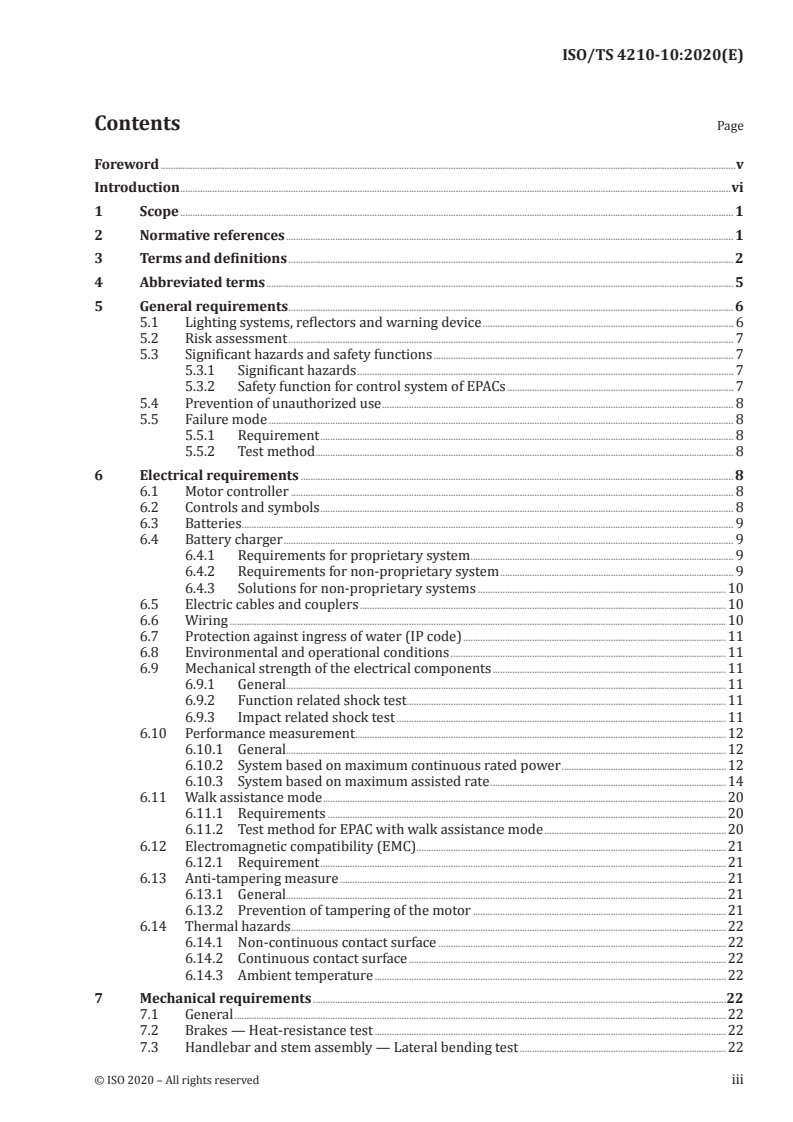
Contents Page
Foreword .v
Introduction .vi
1 Scope . 1
2 Normative references . 1
3 Terms and definitions . 2
4 Abbreviated terms . 5
5 General requirements . 6
5.1 Lighting systems, reflectors and warning device . 6
5.2 Risk assessment . 7
5.3 Significant hazards and safety functions . 7
5.3.1 Significant hazards . 7
5.3.2 Safety function for control system of EPACs . 7
5.4 Prevention of unauthorized use . 8
5.5 Failure mode . 8
5.5.1 Requirement . 8
5.5.2 Test method . 8
6 Electrical requirements . 8
6.1 Motor controller . 8
6.2 Controls and symbols . 8
6.3 Batteries . 9
6.4 Battery charger . 9
6.4.1 Requirements for proprietary system . 9
6.4.2 Requirements for non-proprietary system . 9
6.4.3 Solutions for non-proprietary systems .10
6.5 Electric cables and couplers .10
6.6 Wiring .10
6.7 Protection against ingress of water (IP code) .11
6.8 Environmental and operational conditions .11
6.9 Mechanical strength of the electrical components .11
6.9.1 General.11
6.9.2 Function related shock test.11
6.9.3 Impact related shock test .11
6.10 Performance measurement.12
6.10.1 General.12
6.10.2 System based on maximum continuous rated power .12
6.10.3 System based on maximum assisted rate .14
6.11 Walk assistance mode .20
6.11.1 Requirements .20
6.11.2 Test method for EPAC with walk assistance mode .20
6.12 Electromagnetic compatibility (EMC).21
6.12.1 Requirement .21
6.13 Anti-tampering measure .21
6.13.1 General.21
6.13.2 Prevention of tampering of the motor .21
6.14 Thermal hazards .22
6.14.1 Non-continuous contact surface .22
6.14.2 Continuous contact surface .22
6.14.3 Ambient temperature .22
7 Mechanical requirements .22
7.1 General .22
7.2 Brakes — Heat-resistance test .22
7.3 Handlebar and stem assembly — Lateral bending test .22
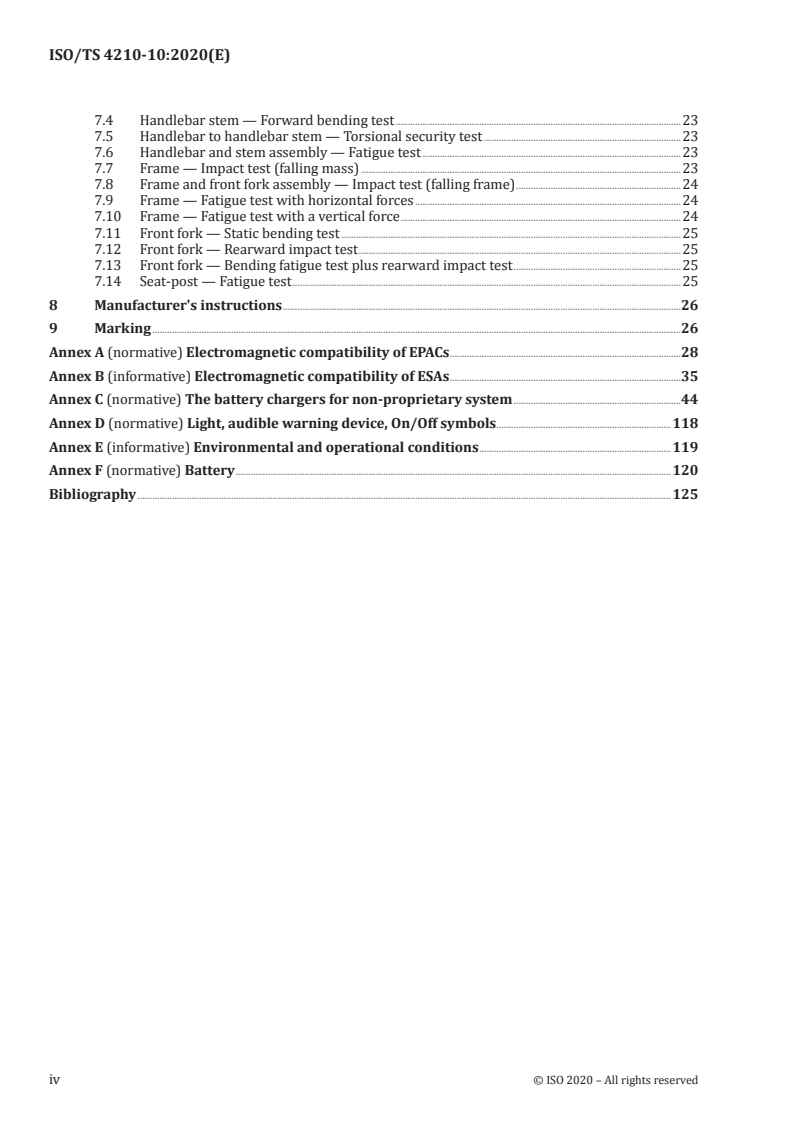
7.4 Handlebar stem — Forward bending test .23
7.5 Handlebar to handlebar stem — Torsional security test .23
7.6 Handlebar and stem assembly — Fatigue test .23
7.7 Frame — Impact test (falling mass) .23
7.8 Frame and front fork assembly — Impact test (falling frame) .24
7.9 Frame — Fatigue test with horizontal forces .24
7.10 Frame — Fatigue test with a vertical force .24
7.11 Front fork — Static bending test .25
7.12 Front fork — Rearward impact test .25
7.13 Front fork — Bending fatigue test plus rearward impact test .25
7.14 Seat-post — Fatigue test .25
8 Manufacturer's instructions .26
9 Marking .26
Annex A (normative) Electromagnetic compatibility of EPACs .28
Annex B (informative) Electromagnetic compatibility of ESAs .35
Annex C (normative) The battery chargers for non-proprietary system .44
Annex D (normative) Light, audible warning device, On/Off symbols .118
Annex E (informative) Environmental and operational conditions .119
Annex F (normative) Battery .120
Bibliography .125
iv © ISO 2020 – All rights reserved
Foreword
ISO (the International Organization for Standardization) is a worldwide federation of national standards
bodies (ISO member bodies). The work of preparing International Standards is normally carried out
through ISO technical committees. Each member body interested in a subject for which a technical
committee has been established has the right to be represented on that committee. International
organizations, governmental and non-governmental, in liaison with ISO, also take part in the work.
ISO collaborates closely with the International Electrotechnical Commission (IEC) on all matters of
electrotechnical standardization.
The procedures used to develop this document and those intended for its further maintenance are
described in the ISO/IEC Directives, Part 1. In particular, the different approval criteria needed for the
different types of ISO documents should be noted. This document was drafted in accordance with the
editorial rules of the ISO/IEC Directives, Part 2 (see www .iso .org/ directives).
Attention is drawn to the possibility that some of the elements of this document may be the subject of
patent rights. ISO shall not be held responsible for identifying any or all such patent rights. Details of
any patent rights identified during the development of the document will be in the Introduction and/or
on the ISO list of patent declarations received (see www .iso .org/ patents).
Any trade name used in this document is information given for the convenience of users and does not
constitute an endorsement.
For an explanation of the voluntary nature of standards, the meaning of ISO specific terms and
expressions related to conformity assessment, as well as information about ISO's adherence to the
World Trade Organization (WTO) principles in the Technical Barriers to Trade (TBT), see www .iso .org/
iso/ foreword .html.
This document was prepared by Technical Committee ISO/TC 149, Cycles, Subcommittee SC 1, Cycles
and major sub-assemblies.
A list of all parts in the ISO 4210 series can be found on the ISO website.
Any feedback or questions on this document should be directed to the user’s national standards body. A
complete listing of these bodies can be found at www .iso .org/ members .html.
Introduction
This document combines several countries’ safety requirements for Electrically Power Assisted Cycles
(EPACs). The commercialization of EPACs has accelerated in the global market, in response to global
concerns about CO reduction and energy saving. EPAC technologies for performance, electrical control,
battery management and battery charging are currently developing rapidly in a competitive market. It
is therefore necessary to standardize the safety of these technologies for EPACs.
This documentation will allow an easy and clear understanding of requirements for different types
of EPAC.
This document includes safety requirements for the charging of EPACs. This includes off-board parts
and EPAC battery chargers.
This document does not state the limit for the maximum permissible load of the EPAC. The manufacturer
is advised to consider amongst other factors the maximum permissible load (luggage plus rider) as well
as the intended use of the EPAC. Both have an influence on the mechanical requirements.
vi © ISO 2020 – All rights reserved
TECHNICAL SPECIFICATION ISO/TS 4210-10:2020(E)
Cycles — Safety requirements for bicycles —
Part 10:
Safety requirements for electrically power assisted
cycles (EPACs)
1 Scope
This document specifies safety and performance requirements for the design, marking, assembly, and
testing of two wheeled electrically power assisted cycles (hereafter EPACs), fully-assembled EPACs and
subassemblies, and provides guidelines for information supplied by the manufacturers (i.e. instructions
on the use and care of such EPACs).
This document applies to two wheeled EPACs that have a maximum saddle height of 635 mm or more
and are intended for private and commercial use with exception of EPACs intended for hire from
unattended stations.
This document is intended to cover all common significant hazards, hazardous situations and events
listed in 5.3 of EPACs, when used as intended or under conditions of misuse that are reasonably
foreseeable by the manufacturer.
This document specifies requirements and test methods for engine power management systems,
electrical circuits including the charger for the assessment of the design and assembly of EPACs and
sub-assemblies for systems having a Safety Extra Low Voltage (SELV) maximum voltage up to 60 V d.c.
including tolerances.
2 Normative references
The following documents are referred to in the text in such a way that some or all of their content
constitutes requirements of this document. For dated references, only the edition cited applies. For
undated references, the latest edition of the referenced document (including any amendments) applies.
ISO 2409, Paints and varnishes — Cross-cut test
ISO 4210-1, Cycles — Safety requirements for bicycles — Part 1: Terms and definitions
ISO 4210-2:2015, Cycles — Safety requirements for bicycles — Part 2: Requirements for city and trekking,
young adult, mountain and racing bicycles
ISO 4210-4:2014, Cycles — Safety requirements for bicycles — Part 4: Braking test methods
ISO 4210-5:2014, Cycles — Safety requirements for bicycles — Part 5: Steering test methods
ISO 4210-6:2015, Cycles — Safety requirements for bicycles — Part 6: Frame and fork test methods
ISO 4210-9:2014, Cycles — Safety requirements for bicycles — Part 9: Saddle and seat-post test methods
ISO 7010:2011, Graphical symbols — Safety colours and safety signs — Registered safety signs
ISO 11451-1, Road vehicles — Vehicle test methods for electrical disturbances from narrowband radiated
electromagnetic energy — Part 1: General principles and terminology
ISO 11451-2, Road vehicles — Vehicle test methods for electrical disturbances from narrowband radiated
electromagnetic energy — Part 2: Off-vehicle radiation sources
ISO 11452-1, Road vehicles — Component test methods for electrical disturbances from narrowband
radiated electromagnetic energy — Part 1: General principles and terminology
ISO 11452-2, Road vehicles — Component test methods for electrical disturbances from narrowband
radiated electromagnetic energy — Part 2: Absorber-lined shielded enclosure
ISO 11452-4:2011, Road vehicles — Component test methods for electrical disturbances from narrowband
radiated electromagnetic energy — Part 4: Harness excitation methods
ISO 11898-1, Road vehicles — Controller area network (CAN) —Part 1: Data link layer and physical
signalling
ISO 11898-2, Road vehicles — Controller area network (CAN) —Part 2: High-speed medium access unit
ISO 12100, Safety of machinery — General principles for design — Risk assessment and risk reduction
ISO 13849-1, Safety of machinery — Safety-related parts of control systems — Part 1: General principles
for design
ISO 13849-2, Safety of machinery — Safety-related parts of control systems — Part 2: Validation
IEC 60034-1, Rotating electrical machines — Part 1: Rating and performance
IEC 60068-2-27, Environmental testing — Part 2-27: Tests — Test Ea and guidance: Shock
IEC 60335-2-29, Household and similar electrical appliances — Safety — Part 2-29: Particular requirements
for battery chargers
IEC 60529, Degrees of protection provided by enclosures (IP Code)
IEC 62133-1:2017, Secondary cells and batteries containing alkaline or other non-acid electrolytes — Safety
requirements for portable sealed secondary cells, and for batteries made from them, for use in portable
applications — Part 1: Nickel systems
IEC 62133-2:2017, Secondary cells and batteries containing alkaline or other non-acid electrolytes —
Safety requirements for portable sealed secondary lithium cells, and for batteries made from them, for use
in portable applications — Part 2: Lithium systems
CISPR 12:2007 + A1: 2009, Vehicles, boats and internal combustion engines — Radio disturbance
characteristics — Limits and methods of measurement for the protection of off-board receivers
CISPR 16-1-1:2015, Specification for radio disturbance and immunity measuring apparatus and methods —
Part 1-1: Radio disturbance and immunity measuring apparatus — Measuring apparatus
CISPR 25:2016, Vehicles, boats and internal combustion engines — Radio disturbance characteristics —
Limits and methods of measurement for the protection of on-board receivers
EN 50604-1:2016, Secondary lithium batteries for light EV (electric vehicle) applications — Part 1: General
safety requirements and test methods
3 Terms and definitions
For the purposes of this document, the terms and definitions given in ISO 4210-1 and the following apply.
ISO and IEC maintain terminological databases for use in standardization at the following addresses:
— ISO Online browsing platform: available at https:// www .iso .org/ obp
— IEC Electropedia: available at http:// www .electropedia .org/
2 © ISO 2020 – All rights reserved
3.1
cycle
any vehicle which has at least two wheels and is propelled by the muscular energy of the person on that
vehicle, in particular by means of pedalling or the possibility of adding assistance provided by electric
motor when pedalling
Note 1 to entry: Pedalling also refers to use of hand cranks or other similar devices.
3.2
electrically power assisted cycle
EPAC
cycle (3.1), equipped with pedals and an auxiliary electric motor, which cannot be propelled exclusively
by means of this auxiliary electric motor, except in the walk assistance mode
3.3
mountain EPAC
electrically power assisted cycle (3.2) designed for use off-road on rough terrain, on public roads, and on
public pathways, equipped with a suitably strengthened frame and other components, and, typically,
with wide-section tyres with coarse tread patterns and a wide range of transmission gears
[SOURCE: ISO 4210-1:2014, 2.30, modified — bicycle has been changed to electrically power
assisted cycle.]
3.4
braking device cut-off switch
device that cuts off the motor assistance while braking
3.5
continuous rated power
output power specified by manufacturer, at which the motor reaches its thermal equilibrium at given
ambient conditions
3.6
assisted rate
ratio of between mechanical motor output-power and muscular human input-power
3.7
thermal equilibrium
temperatures of motor parts which do not vary more than 2 °C/h
3.8
assistance cut-off speed
speed at which the motor controller cuts off the assistance of the auxiliary electric motor
3.9
walk assistance mode
function by which the user can activate the auxiliary electric motor to propel the EPAC up to a defined
maximum speed without pedalling
3.10
electromagnetic compatibility
ability of an EPAC or one of its electrical/electronic systems to function satisfactorily in its
electromagnetic environment without introducing intolerable electromagnetic disturbance to anything
in that environment
[SOURCE: IEC 60050-161:1990/AMD8: 2018, IEV ref. 161-01-07, modified — an EPAC or one of its
electrical/electronic systems have been specified.]
3.11
ESA
electronic subassembly
electrical subassembly
electronic and/or electrical component, or an assembly of components provided for installation into
an EPAC, together with all electrical connections and associated wiring for the execution of several
specific functions
3.12
motor controller
device or group of devices that serves to govern in some predetermined manner the performance of an
electric motor
Note 1 to entry: Means for manual or automatic ON/OFF, selecting the drive direction, regulating the speed,
limiting the torque and providing protection against faults.
3.13
fault condition
condition in which one or more fault is present which could cause hazard
3.14
charging configuration
sets of physical parameters which are predefined to control a charging process
3.15
battery management system
BMS
local energy management system for the battery system, protecting the battery system from damage,
monitoring and increasing the lifetime, and maintaining the functional state
Note 1 to entry: BMS and BCU (according to ISO 12405) do not have the same functions.
3.16
narrow-band emission
emission which has a bandwidth less than that of a specific receiver or measuring instrument
3.17
no load current point
current measured at battery output with no change to the operating status of any auxiliary systems
during the test
3.18
safety extra-low voltage
SELV
voltage not exceeding ripple-free 60 V d.c. between conductors and earth, the no load voltage not
exceeding ripple-free 60 V d.c.
3.19
anti-tampering measures
technical requirements and specifications which prevent, as far as possible, unauthorized modifications
of the EPAC's drive system which may prejudice functional safety
3.20
maximum permissible load
maximum permissible weight of rider and luggage as defined by the manufacturer
3.21
proprietary system
manufacturer-specific system
4 © ISO 2020 – All rights reserved
3.22
non-proprietary system
non manufacturer-specific system
3.23
charger inlet
inlet on the EPAC or battery side for charging
[SOURCE: IEC 60050-714:1990, IEV ref. 714-03-04, this source is only for “inlet”]
3.24
charger connector
connector on charger side for charging
[SOURCE: IEC 60050-151:2001, IEV ref. 151-12-19, this source is only for “connector”]
3.25
rigid seat-post
seat-post that cannot be raised or lowered independently of the seat tube clamp, while riding, and does
not provide controlled axial flexibility to reduce the transmission of road shocks to the rider.
3.26
suspension seat-post
seat-post incorporating controlled, axial flexibility to reduce the transmission of road shocks to the rider
3.27
dropper seat-post
seat-post that can be raised or lowered independently of the seat tube clamp while riding
3.28
suspension dropper seat-post
seat-post incorporating controlled, axial flexibility to reduce the transmission of road shocks to the
rider and incorporating the capability of raising and lowering independently of the seat tube clamp
while riding
4 Abbreviated terms
See Table 1.
Table 1 — Abbreviated terms
Definition or
Abbreviation Description
occurrence
AC Alternating current C.3.1.1
ACK Acknowledge C.2.5.3.1
ALSE Absorber-lined shielded enclosure B.3.4
AM Amplitude modulation A.4.6.1
BCI Bulk current injection B.2.6.3
BCU Battery control unit 3.15
BMS Battery management system 3.15
BPSK Biphase shift keying C.2.5.4.1
CAN Controller area network C.3.1.1
CC Constant current mode Table C.10
CCF Common cause failure F.2.4.1.2
CDB Command descriptor block C.2.6.3.1
CSMA/CR Carrier sense multiple access with collision resolution C.3.1.2
Table 1 (continued)
Definition or
Abbreviation Description
occurrence
CV Constant voltage mode Table C.10
DA Destination address Figure C.10
DC Direct current C.2.1.1
DFMEA Design failure mode and effect analysis 5.2
DLC Data length code C.3.6.2.1
DUT Device under test F.2.3.4.2
EMC Electromagnetic compatibility 6.12
EPAC Electrically power assisted cycle Introduction
ESA Electronic/electrical subassembly 3.11
FCS Frame check sequence Table C.9
FMEA Failure mode and effect analysis 5.2
FTA Fault tree analysis 5.2
HMI Human machine interface Figure C.20
MPU Micro processing unit Figure C.1
NDN Network device number Table C.10
NM Network management C.3.6.2.4
NRZ Non-return-to-zero C.2.5.4.2
PC Page control Table C.40
PL Performance level 5.3.2.2.2
PLC Power line communication Figure C.1
PM Pulse modulation A.4.6.1
PnP Plug and play C.2.6.2
PS Parameter saveable C.2.6.5.12
RA Risk assessment 5.2
RF Radio frequency B.3.3
R-map Risk-map 5.2
rms Root mean square A.2.6.3
RT Room temperature F.2.4.1.3
SA Source address Figure C.12
SELV Safety extra low voltage Clause 1
SOPC Sub operation code Table C.33
SP Save pages C.2.6.5.12
TLS Transmission-line-system A.4.6.3
ToR Type of request C.2.6.5.7.2
VDD Voltage drain Figure C.1
5 General requirements
5.1 Lighting systems, reflectors and warning device
EPACs shall be in accordance with the requirements of ISO 4210-2:2015, 4.20 and 4.21.
6 © ISO 2020 – All rights reserved
5.2 Risk assessment
EPAC shall be designed using principles of Risk Assessment (RA) in accordance with ISO 12100.
The following RA methodology may be used, but is not limited to:
— fault tree analysis (FTA);
— failure mode and effect analysis (FMEA);
— design failure mode and effect analysis (DFMEA);
— risk-map (R-map).
EPAC shall be designed in accordance with the principles of ISO 12100 for relevant hazards which are
not dealt with by this document. This includes evaluation of such risks for all relevant components.
5.3 Significant hazards and safety functions
5.3.1 Significant hazards
The following significant hazards of EPACs have been considered in this document:
a) mechanical hazards: deceleration, acceleration, instability, kinetic energy, rotating elements and
moving elements, rough or slippery surfaces, sharp edges;
b) electrical hazards: electromagnetic phenomena, electrostatic phenomena, overload, short-circuit,
thermal radiation;
c) thermal hazards: explosion, flame, radiation from heat sources, objects or materials with a high or
low temperature;
d) ergonomic hazards: effort, local lighting, posture;
e) hazards associated with the environment in which the EPAC is used: water (dust).
5.3.2 Safety function for control system of EPACs
5.3.2.1 General
The EPAC control system risk shall be assessed in accordance with the series of ISO 13849.
The following methodology may be used, but is not limited to:
— IEC 61508 (all parts);
— R-map.
5.3.2.2 Requirements
5.3.2.2.1 Safety related parts of the mechanical, hydraulic control systems
The necessary performance levels and requirements which are related to the identified hazards are
covered by Clause 7.
5.3.2.2.2 Safety related parts of the electrical control systems
The safety requirements of Table 2 shall be necessary for an EPAC. If necessary, the manufacturer shall
add more safety requirements and determine the necessary PL or safety level for each of these safety
requirements and the related safety functions.
Table 2 — Safety functions related to defined hazards
Safety function Performance Level
Prevention of electric motor assistance functions without pedalling, and
PLr c
without activation of the walk assistance mode
Prevention of risk of fire in case of management system failure for batter-
PLr c
ies with electric energy above 100 Wh
5.3.2.3 Verification of the safety functions
The whole procedure for achieving functional safety shall be in accordance with the series of ISO 13849.
System suppliers shall document this process and take measures to achieve the required performance
level (see Table 2).
The minimum set of safety related functions shall be implemented at least by both system suppliers
and the manufacturer to achieve conformity with this document.
5.4 Prevention of unauthorized use
Means shall be provided to the user to prevent an unauthorized use of the electric assistance/walk
assistance mode of the EPAC e.g. key, locks, electronic control device.
5.5 Failure mode
5.5.1 Requirement
It shall be possible to ride the EPAC by pedalling even if the assistance failed. This requirement shall be
checked as described in 5.5.2.
5.5.2 Test method
a) Remove or disconnect the battery pack.
b) Ride the EPAC up to 10 km/h.
6 Electrical requirements
6.1 Motor controller
The motor controller shall be designed so that it switches off the power to the electric motor if a fault
condition occurs.
Subsequent switch on shall only be possible after user interaction.
6.2 Controls and symbols
A control device shall be fitted to switch on and off the assistance.
The control device shall be apparent, easy to reach and unmistakable. This control device shall be
activated by voluntary action.
Designs of the On/Off symbol, lighting symbol and audible warning device symbol shall be in accordance
with Annex D.
8 © ISO 2020 – All rights reserved
6.3 Batteries
The EPAC and batteries shall be designed in accordance with Annex F to avoid risk of fire and mechanical
deterioration resulting from abnormal use.
In case the EPAC batteries may be subjected to country-specific regulations, batteries should conform
to the country-specific regulations.
Batteries and the charger unit shall be labelled or be uniquely designed in order to ensure their
compatibility and prevent incorrect plugging.
6.4 Battery charger
6.4.1 Requirements for proprietary system
A proprietary system consists of batteries and chargers, that are not interoperable. By design intended
only to operate in combination with each other. A proprietary plug system shall assure that the EPAC
batteries are only to be charged with the dedicated charger. The specific combination of charger and
battery shall be considered for the hazard and risk analysis, as well as in the implementation of the
safety functions.
The battery charger for proprietary system shall be in accordance with the requirements of
IEC 60335-2-29.
6.4.2 Requirements for non-proprietary system
6.4.2.1 General
For non-proprietary systems, interoperable charging may be possible. The safety and risk analysis shall
consider charging processes where battery and charger are released independently from each other.
Therefore the safety requirements for the charging process on the EPAC side and on the charger side
shall be described. To guarantee a safe charging process of the EPAC for a non-proprietary system,
safety requirements shall be taken into consideration to prevent:
a) overvoltage and overcurrent;
b) over temperature;
c) hot disconnect;
d) short circuit.
For the charging configuration it is important, that the roles between the EPAC and the charger are
uniquely defined. The EPAC shall be the master and the charger shall be the slave. This means that the
EPAC controls the charging current and charging voltage at any time.
It shall only be possible to charge the EPAC, after a communication between the EPAC and the charger
has been established. If this communication is interrupted, the charging process shall be stopped and
the power lines shall become zero potential immediately.
The interface between EPAC and charger consists of a standardized plug system and a communication
protocol.
6.4.2.2 Protocol requirements
The following protocol requirements shall be satisfied:
a) heart beat: for bilateral continuous presence detection of the EPAC and the charger. The EPAC shall
transmit a heartbeat signal to the charger every 10 ms and the charger shall transmit a heartbeat
signal to the EPAC every 200 ms;
b) property exchange: to exchange property information between EPAC and charger;
c) charging configuration to adjust charger to the required voltage and current of the EPAC;
d) strategy to avoid overvoltage and overcurrent;
e) strategy to avoid charging at over temperature and under temperature;
f) diagnostic functions to avoid charging after occurrence of safety-critical malfunctions.
The communication between EPAC and charger, necessary for the charging process, shall be separated
from the EPAC internal communication.
6.4.2.3 Mechanical requirements
The following mechanical requirements shall be satisfied:
a) the charger connector cannot be disconnected from the charger inlet during power transfer
(shall have latch function and/or have enough time to stop the supplying power after detecting its
removal during the charging.);
b) A manufacturer device may be fitted to an EPAC to allow the charging of a proprietary battery
system using a non-proprietary charger.
The charger shall provide the requested energy with an accuracy of 0/−2 %.
6.4.3 Solutions for non-proprietary systems
Solution approaches concerning battery chargers for non-proprietary systems including the described
requirements are described in Annex C.
Manufacturers and/or service providers of non-proprietary system shall select System A or System B in
Annex C.
6.5 Electric cables and couplers
Electric cables and coupler shall be selected in consideration of designed maximum current, maximum
temperature and environmental conditions. Conformity is tested by inspection.
6.6 Wiring
Requirements on wiring shall be checked in accordance with the following sequence at an ambient
room temperature (20 ± 5) °C.
a) Wire ways shall be smooth and free from sharp edges.
b) Wires shall be protected so that they do not come into contact with burrs, cooling fins or similar
sharp edges that may cause damage to their insulation. Holes in metal through which are insulated
wires pass shall have smooth well-rounded surfaces or be provided with bushings.
c) Wiring shall be effectively prevented from coming into contact with moving parts.
Conformity with a), b), c) shall be checked by inspection.
d) Separate parts of the EPAC that can move in normal use or during user maintenance relative to
each other, shall not cause undue stress to electrical connectors and internal conductors, including
those providing ground continuity.
Conformity with d) shall be checked by inspection and by the following test method.
10 © ISO 2020 – All rights reserved
If flexing occurs in normal use, the appliance is placed in its normal operational position and is supplied
at rated voltage under normal operation.
The movable part is moved backwards and forwards, so that the conductor shall be flexed through the
largest angle permitted by its construction.
For conductors that are flexed in normal use, flex movable part for 10 000 cycles at a test frequency
of 0,5 Hz.
For conductors that are flexed during user maintenance, flex the movable part for 100 cycles at the
same frequency.
If an open coil spring is used to protect wire, it shall be correctly installed and insulated. Flexible
metallic tubes shall not cause damage to the insulation of the conductors contained within them.
6.7 Protection against ingress of water (IP code)
The electrical components of a fully assembled Mountain EPAC shall be tested and shall be in accordance
with at least IPX5 requirements of IEC 60529. The electrical components of a fully assembled EPAC of
the other bicycle types shall be tested and shall be in accordance with at least IPX4 requirements of
IEC 60529.
NOTE Battery charger is not included in the electrical components of a fully assembled EPAC.
These requirements should be checked for each rational component or unit of EPAC (e.g. the handle
assembly including the control switch, display, lamp and other electrical components, the drive unit,
the battery unit, etc.).
If any water has entered, it shall not be sufficient to interfere with the correct operation of the equipment
or impair safety.
6.8 Environmental and operational conditions
See Annex E.
6.9 Mechanical strength of the electrical components
6.9.1 General
The electrical components shall have adequate mechanical strength and be constructed to withstand
such rough handling that may be expected in normal use.
NOTE 1 Both complete EPAC and sub assembly conditions are acceptable.
NOTE 2 For environmental test, see Reference [15].
6.9.2 Function related shock test
In accordance with IEC 60068-2-27, half sine shocks shall be applied with a peak acceleration of
150 m/s and a duration equal to the nominal impulse of 6 ms in both directions of each of the three
perpendicular axes. Number of shocks in each direction: 100 ± 3 shocks (a total of 600 shocks). After
the test, the performance of the components shall be fully maintained and no failure shall occur.
6.9.3 Impact related shock test
The impact related shock test shall be carried out on a fully assembled EPAC.
Lateral overturning: The EPAC shall be left to fall 25 times both to the left and to the right from its
upright position. For this purpose, the steering shall be aligned in the straightforward position, and
crank shall be aligned horizontally prior to each fall. The test shall be carried out on a hard surface
(concrete or sett).
NOTE 25 times to the left and 25 times to the right, total 50 times.
After the test, electrical components shall not have any detachment any tearing out or any breaking of
fastening elements; Detachable electrical components shall not have any functional impairment (e.g.
inserting and removing the battery).
6.10 Performance measurement
6.10.1 General
Electrically power assisted system for EPAC has 2 types. One is the system based on the maximum
continuous rated power, another is the system based on the maximum assisted rate. Each measurement
is dependent on the requirement(s) from local regulation(s).
6.10.2 System based on maximum continuous rated power
6.10.2.1 Maximum speed for which the electric motor gives assistance
6.10.2.1.1 Requirements
The electrical motor assistance shall stop at velocity required from local regulation or lower values,
limited by design. The maximum speed of the EPAC for which the electric motor gives assistance shall
not differ by more than +10 % from the maximum assistance speed indicated in the marking required
by Clause 9.
6.10.2.1.2 Test method
6.10.2.1.2.1 Test conditions
a) The test shall be performed either on a test track (See 6.10.2.2.2.2), a test bench or on a stand that
keeps the motor driven wheel free off the ground.
b) The speed-measuring device used for the test shall have the following characteristics:
1) Accuracy:
...
TECHNICAL ISO/TS
SPECIFICATION 4210-10
First edition
2020-07
Cycles — Safety requirements for
bicycles —
Part 10:
Safety requirements for electrically
power assisted cycles (EPACs)
Reference number
©
ISO 2020
© ISO 2020
All rights reserved. Unless otherwise specified, or required in the context of its implementation, no part of this publication may
be reproduced or utilized otherwise in any form or by any means, electronic or mechanical, including photocopying, or posting
on the internet or an intranet, without prior written permission. Permission can be requested from either ISO at the address
below or ISO’s member body in the country of the requester.
ISO copyright office
CP 401 • Ch. de Blandonnet 8
CH-1214 Vernier, Geneva
Phone: +41 22 749 01 11
Email: copyright@iso.org
Website: www.iso.org
Published in Switzerland
ii © ISO 2020 – All rights reserved
Contents Page
Foreword .v
Introduction .vi
1 Scope . 1
2 Normative references . 1
3 Terms and definitions . 2
4 Abbreviated terms . 5
5 General requirements . 6
5.1 Lighting systems, reflectors and warning device . 6
5.2 Risk assessment . 7
5.3 Significant hazards and safety functions . 7
5.3.1 Significant hazards . 7
5.3.2 Safety function for control system of EPACs . 7
5.4 Prevention of unauthorized use . 8
5.5 Failure mode . 8
5.5.1 Requirement . 8
5.5.2 Test method . 8
6 Electrical requirements . 8
6.1 Motor controller . 8
6.2 Controls and symbols . 8
6.3 Batteries . 9
6.4 Battery charger . 9
6.4.1 Requirements for proprietary system . 9
6.4.2 Requirements for non-proprietary system . 9
6.4.3 Solutions for non-proprietary systems .10
6.5 Electric cables and couplers .10
6.6 Wiring .10
6.7 Protection against ingress of water (IP code) .11
6.8 Environmental and operational conditions .11
6.9 Mechanical strength of the electrical components .11
6.9.1 General.11
6.9.2 Function related shock test.11
6.9.3 Impact related shock test .11
6.10 Performance measurement.12
6.10.1 General.12
6.10.2 System based on maximum continuous rated power .12
6.10.3 System based on maximum assisted rate .14
6.11 Walk assistance mode .20
6.11.1 Requirements .20
6.11.2 Test method for EPAC with walk assistance mode .20
6.12 Electromagnetic compatibility (EMC).21
6.12.1 Requirement .21
6.13 Anti-tampering measure .21
6.13.1 General.21
6.13.2 Prevention of tampering of the motor .21
6.14 Thermal hazards .22
6.14.1 Non-continuous contact surface .22
6.14.2 Continuous contact surface .22
6.14.3 Ambient temperature .22
7 Mechanical requirements .22
7.1 General .22
7.2 Brakes — Heat-resistance test .22
7.3 Handlebar and stem assembly — Lateral bending test .22
7.4 Handlebar stem — Forward bending test .23
7.5 Handlebar to handlebar stem — Torsional security test .23
7.6 Handlebar and stem assembly — Fatigue test .23
7.7 Frame — Impact test (falling mass) .23
7.8 Frame and front fork assembly — Impact test (falling frame) .24
7.9 Frame — Fatigue test with horizontal forces .24
7.10 Frame — Fatigue test with a vertical force .24
7.11 Front fork — Static bending test .25
7.12 Front fork — Rearward impact test .25
7.13 Front fork — Bending fatigue test plus rearward impact test .25
7.14 Seat-post — Fatigue test .25
8 Manufacturer's instructions .26
9 Marking .26
Annex A (normative) Electromagnetic compatibility of EPACs .28
Annex B (informative) Electromagnetic compatibility of ESAs .35
Annex C (normative) The battery chargers for non-proprietary system .44
Annex D (normative) Light, audible warning device, On/Off symbols .118
Annex E (informative) Environmental and operational conditions .119
Annex F (normative) Battery .120
Bibliography .125
iv © ISO 2020 – All rights reserved
Foreword
ISO (the International Organization for Standardization) is a worldwide federation of national standards
bodies (ISO member bodies). The work of preparing International Standards is normally carried out
through ISO technical committees. Each member body interested in a subject for which a technical
committee has been established has the right to be represented on that committee. International
organizations, governmental and non-governmental, in liaison with ISO, also take part in the work.
ISO collaborates closely with the International Electrotechnical Commission (IEC) on all matters of
electrotechnical standardization.
The procedures used to develop this document and those intended for its further maintenance are
described in the ISO/IEC Directives, Part 1. In particular, the different approval criteria needed for the
different types of ISO documents should be noted. This document was drafted in accordance with the
editorial rules of the ISO/IEC Directives, Part 2 (see www .iso .org/ directives).
Attention is drawn to the possibility that some of the elements of this document may be the subject of
patent rights. ISO shall not be held responsible for identifying any or all such patent rights. Details of
any patent rights identified during the development of the document will be in the Introduction and/or
on the ISO list of patent declarations received (see www .iso .org/ patents).
Any trade name used in this document is information given for the convenience of users and does not
constitute an endorsement.
For an explanation of the voluntary nature of standards, the meaning of ISO specific terms and
expressions related to conformity assessment, as well as information about ISO's adherence to the
World Trade Organization (WTO) principles in the Technical Barriers to Trade (TBT), see www .iso .org/
iso/ foreword .html.
This document was prepared by Technical Committee ISO/TC 149, Cycles, Subcommittee SC 1, Cycles
and major sub-assemblies.
A list of all parts in the ISO 4210 series can be found on the ISO website.
Any feedback or questions on this document should be directed to the user’s national standards body. A
complete listing of these bodies can be found at www .iso .org/ members .html.
Introduction
This document combines several countries’ safety requirements for Electrically Power Assisted Cycles
(EPACs). The commercialization of EPACs has accelerated in the global market, in response to global
concerns about CO reduction and energy saving. EPAC technologies for performance, electrical control,
battery management and battery charging are currently developing rapidly in a competitive market. It
is therefore necessary to standardize the safety of these technologies for EPACs.
This documentation will allow an easy and clear understanding of requirements for different types
of EPAC.
This document includes safety requirements for the charging of EPACs. This includes off-board parts
and EPAC battery chargers.
This document does not state the limit for the maximum permissible load of the EPAC. The manufacturer
is advised to consider amongst other factors the maximum permissible load (luggage plus rider) as well
as the intended use of the EPAC. Both have an influence on the mechanical requirements.
vi © ISO 2020 – All rights reserved
TECHNICAL SPECIFICATION ISO/TS 4210-10:2020(E)
Cycles — Safety requirements for bicycles —
Part 10:
Safety requirements for electrically power assisted
cycles (EPACs)
1 Scope
This document specifies safety and performance requirements for the design, marking, assembly, and
testing of two wheeled electrically power assisted cycles (hereafter EPACs), fully-assembled EPACs and
subassemblies, and provides guidelines for information supplied by the manufacturers (i.e. instructions
on the use and care of such EPACs).
This document applies to two wheeled EPACs that have a maximum saddle height of 635 mm or more
and are intended for private and commercial use with exception of EPACs intended for hire from
unattended stations.
This document is intended to cover all common significant hazards, hazardous situations and events
listed in 5.3 of EPACs, when used as intended or under conditions of misuse that are reasonably
foreseeable by the manufacturer.
This document specifies requirements and test methods for engine power management systems,
electrical circuits including the charger for the assessment of the design and assembly of EPACs and
sub-assemblies for systems having a Safety Extra Low Voltage (SELV) maximum voltage up to 60 V d.c.
including tolerances.
2 Normative references
The following documents are referred to in the text in such a way that some or all of their content
constitutes requirements of this document. For dated references, only the edition cited applies. For
undated references, the latest edition of the referenced document (including any amendments) applies.
ISO 2409, Paints and varnishes — Cross-cut test
ISO 4210-1, Cycles — Safety requirements for bicycles — Part 1: Terms and definitions
ISO 4210-2:2015, Cycles — Safety requirements for bicycles — Part 2: Requirements for city and trekking,
young adult, mountain and racing bicycles
ISO 4210-4:2014, Cycles — Safety requirements for bicycles — Part 4: Braking test methods
ISO 4210-5:2014, Cycles — Safety requirements for bicycles — Part 5: Steering test methods
ISO 4210-6:2015, Cycles — Safety requirements for bicycles — Part 6: Frame and fork test methods
ISO 4210-9:2014, Cycles — Safety requirements for bicycles — Part 9: Saddle and seat-post test methods
ISO 7010:2011, Graphical symbols — Safety colours and safety signs — Registered safety signs
ISO 11451-1, Road vehicles — Vehicle test methods for electrical disturbances from narrowband radiated
electromagnetic energy — Part 1: General principles and terminology
ISO 11451-2, Road vehicles — Vehicle test methods for electrical disturbances from narrowband radiated
electromagnetic energy — Part 2: Off-vehicle radiation sources
ISO 11452-1, Road vehicles — Component test methods for electrical disturbances from narrowband
radiated electromagnetic energy — Part 1: General principles and terminology
ISO 11452-2, Road vehicles — Component test methods for electrical disturbances from narrowband
radiated electromagnetic energy — Part 2: Absorber-lined shielded enclosure
ISO 11452-4:2011, Road vehicles — Component test methods for electrical disturbances from narrowband
radiated electromagnetic energy — Part 4: Harness excitation methods
ISO 11898-1, Road vehicles — Controller area network (CAN) —Part 1: Data link layer and physical
signalling
ISO 11898-2, Road vehicles — Controller area network (CAN) —Part 2: High-speed medium access unit
ISO 12100, Safety of machinery — General principles for design — Risk assessment and risk reduction
ISO 13849-1, Safety of machinery — Safety-related parts of control systems — Part 1: General principles
for design
ISO 13849-2, Safety of machinery — Safety-related parts of control systems — Part 2: Validation
IEC 60034-1, Rotating electrical machines — Part 1: Rating and performance
IEC 60068-2-27, Environmental testing — Part 2-27: Tests — Test Ea and guidance: Shock
IEC 60335-2-29, Household and similar electrical appliances — Safety — Part 2-29: Particular requirements
for battery chargers
IEC 60529, Degrees of protection provided by enclosures (IP Code)
IEC 62133-1:2017, Secondary cells and batteries containing alkaline or other non-acid electrolytes — Safety
requirements for portable sealed secondary cells, and for batteries made from them, for use in portable
applications — Part 1: Nickel systems
IEC 62133-2:2017, Secondary cells and batteries containing alkaline or other non-acid electrolytes —
Safety requirements for portable sealed secondary lithium cells, and for batteries made from them, for use
in portable applications — Part 2: Lithium systems
CISPR 12:2007 + A1: 2009, Vehicles, boats and internal combustion engines — Radio disturbance
characteristics — Limits and methods of measurement for the protection of off-board receivers
CISPR 16-1-1:2015, Specification for radio disturbance and immunity measuring apparatus and methods —
Part 1-1: Radio disturbance and immunity measuring apparatus — Measuring apparatus
CISPR 25:2016, Vehicles, boats and internal combustion engines — Radio disturbance characteristics —
Limits and methods of measurement for the protection of on-board receivers
EN 50604-1:2016, Secondary lithium batteries for light EV (electric vehicle) applications — Part 1: General
safety requirements and test methods
3 Terms and definitions
For the purposes of this document, the terms and definitions given in ISO 4210-1 and the following apply.
ISO and IEC maintain terminological databases for use in standardization at the following addresses:
— ISO Online browsing platform: available at https:// www .iso .org/ obp
— IEC Electropedia: available at http:// www .electropedia .org/
2 © ISO 2020 – All rights reserved
3.1
cycle
any vehicle which has at least two wheels and is propelled by the muscular energy of the person on that
vehicle, in particular by means of pedalling or the possibility of adding assistance provided by electric
motor when pedalling
Note 1 to entry: Pedalling also refers to use of hand cranks or other similar devices.
3.2
electrically power assisted cycle
EPAC
cycle (3.1), equipped with pedals and an auxiliary electric motor, which cannot be propelled exclusively
by means of this auxiliary electric motor, except in the walk assistance mode
3.3
mountain EPAC
electrically power assisted cycle (3.2) designed for use off-road on rough terrain, on public roads, and on
public pathways, equipped with a suitably strengthened frame and other components, and, typically,
with wide-section tyres with coarse tread patterns and a wide range of transmission gears
[SOURCE: ISO 4210-1:2014, 2.30, modified — bicycle has been changed to electrically power
assisted cycle.]
3.4
braking device cut-off switch
device that cuts off the motor assistance while braking
3.5
continuous rated power
output power specified by manufacturer, at which the motor reaches its thermal equilibrium at given
ambient conditions
3.6
assisted rate
ratio of between mechanical motor output-power and muscular human input-power
3.7
thermal equilibrium
temperatures of motor parts which do not vary more than 2 °C/h
3.8
assistance cut-off speed
speed at which the motor controller cuts off the assistance of the auxiliary electric motor
3.9
walk assistance mode
function by which the user can activate the auxiliary electric motor to propel the EPAC up to a defined
maximum speed without pedalling
3.10
electromagnetic compatibility
ability of an EPAC or one of its electrical/electronic systems to function satisfactorily in its
electromagnetic environment without introducing intolerable electromagnetic disturbance to anything
in that environment
[SOURCE: IEC 60050-161:1990/AMD8: 2018, IEV ref. 161-01-07, modified — an EPAC or one of its
electrical/electronic systems have been specified.]
3.11
ESA
electronic subassembly
electrical subassembly
electronic and/or electrical component, or an assembly of components provided for installation into
an EPAC, together with all electrical connections and associated wiring for the execution of several
specific functions
3.12
motor controller
device or group of devices that serves to govern in some predetermined manner the performance of an
electric motor
Note 1 to entry: Means for manual or automatic ON/OFF, selecting the drive direction, regulating the speed,
limiting the torque and providing protection against faults.
3.13
fault condition
condition in which one or more fault is present which could cause hazard
3.14
charging configuration
sets of physical parameters which are predefined to control a charging process
3.15
battery management system
BMS
local energy management system for the battery system, protecting the battery system from damage,
monitoring and increasing the lifetime, and maintaining the functional state
Note 1 to entry: BMS and BCU (according to ISO 12405) do not have the same functions.
3.16
narrow-band emission
emission which has a bandwidth less than that of a specific receiver or measuring instrument
3.17
no load current point
current measured at battery output with no change to the operating status of any auxiliary systems
during the test
3.18
safety extra-low voltage
SELV
voltage not exceeding ripple-free 60 V d.c. between conductors and earth, the no load voltage not
exceeding ripple-free 60 V d.c.
3.19
anti-tampering measures
technical requirements and specifications which prevent, as far as possible, unauthorized modifications
of the EPAC's drive system which may prejudice functional safety
3.20
maximum permissible load
maximum permissible weight of rider and luggage as defined by the manufacturer
3.21
proprietary system
manufacturer-specific system
4 © ISO 2020 – All rights reserved
3.22
non-proprietary system
non manufacturer-specific system
3.23
charger inlet
inlet on the EPAC or battery side for charging
[SOURCE: IEC 60050-714:1990, IEV ref. 714-03-04, this source is only for “inlet”]
3.24
charger connector
connector on charger side for charging
[SOURCE: IEC 60050-151:2001, IEV ref. 151-12-19, this source is only for “connector”]
3.25
rigid seat-post
seat-post that cannot be raised or lowered independently of the seat tube clamp, while riding, and does
not provide controlled axial flexibility to reduce the transmission of road shocks to the rider.
3.26
suspension seat-post
seat-post incorporating controlled, axial flexibility to reduce the transmission of road shocks to the rider
3.27
dropper seat-post
seat-post that can be raised or lowered independently of the seat tube clamp while riding
3.28
suspension dropper seat-post
seat-post incorporating controlled, axial flexibility to reduce the transmission of road shocks to the
rider and incorporating the capability of raising and lowering independently of the seat tube clamp
while riding
4 Abbreviated terms
See Table 1.
Table 1 — Abbreviated terms
Definition or
Abbreviation Description
occurrence
AC Alternating current C.3.1.1
ACK Acknowledge C.2.5.3.1
ALSE Absorber-lined shielded enclosure B.3.4
AM Amplitude modulation A.4.6.1
BCI Bulk current injection B.2.6.3
BCU Battery control unit 3.15
BMS Battery management system 3.15
BPSK Biphase shift keying C.2.5.4.1
CAN Controller area network C.3.1.1
CC Constant current mode Table C.10
CCF Common cause failure F.2.4.1.2
CDB Command descriptor block C.2.6.3.1
CSMA/CR Carrier sense multiple access with collision resolution C.3.1.2
Table 1 (continued)
Definition or
Abbreviation Description
occurrence
CV Constant voltage mode Table C.10
DA Destination address Figure C.10
DC Direct current C.2.1.1
DFMEA Design failure mode and effect analysis 5.2
DLC Data length code C.3.6.2.1
DUT Device under test F.2.3.4.2
EMC Electromagnetic compatibility 6.12
EPAC Electrically power assisted cycle Introduction
ESA Electronic/electrical subassembly 3.11
FCS Frame check sequence Table C.9
FMEA Failure mode and effect analysis 5.2
FTA Fault tree analysis 5.2
HMI Human machine interface Figure C.20
MPU Micro processing unit Figure C.1
NDN Network device number Table C.10
NM Network management C.3.6.2.4
NRZ Non-return-to-zero C.2.5.4.2
PC Page control Table C.40
PL Performance level 5.3.2.2.2
PLC Power line communication Figure C.1
PM Pulse modulation A.4.6.1
PnP Plug and play C.2.6.2
PS Parameter saveable C.2.6.5.12
RA Risk assessment 5.2
RF Radio frequency B.3.3
R-map Risk-map 5.2
rms Root mean square A.2.6.3
RT Room temperature F.2.4.1.3
SA Source address Figure C.12
SELV Safety extra low voltage Clause 1
SOPC Sub operation code Table C.33
SP Save pages C.2.6.5.12
TLS Transmission-line-system A.4.6.3
ToR Type of request C.2.6.5.7.2
VDD Voltage drain Figure C.1
5 General requirements
5.1 Lighting systems, reflectors and warning device
EPACs shall be in accordance with the requirements of ISO 4210-2:2015, 4.20 and 4.21.
6 © ISO 2020 – All rights reserved
5.2 Risk assessment
EPAC shall be designed using principles of Risk Assessment (RA) in accordance with ISO 12100.
The following RA methodology may be used, but is not limited to:
— fault tree analysis (FTA);
— failure mode and effect analysis (FMEA);
— design failure mode and effect analysis (DFMEA);
— risk-map (R-map).
EPAC shall be designed in accordance with the principles of ISO 12100 for relevant hazards which are
not dealt with by this document. This includes evaluation of such risks for all relevant components.
5.3 Significant hazards and safety functions
5.3.1 Significant hazards
The following significant hazards of EPACs have been considered in this document:
a) mechanical hazards: deceleration, acceleration, instability, kinetic energy, rotating elements and
moving elements, rough or slippery surfaces, sharp edges;
b) electrical hazards: electromagnetic phenomena, electrostatic phenomena, overload, short-circuit,
thermal radiation;
c) thermal hazards: explosion, flame, radiation from heat sources, objects or materials with a high or
low temperature;
d) ergonomic hazards: effort, local lighting, posture;
e) hazards associated with the environment in which the EPAC is used: water (dust).
5.3.2 Safety function for control system of EPACs
5.3.2.1 General
The EPAC control system risk shall be assessed in accordance with the series of ISO 13849.
The following methodology may be used, but is not limited to:
— IEC 61508 (all parts);
— R-map.
5.3.2.2 Requirements
5.3.2.2.1 Safety related parts of the mechanical, hydraulic control systems
The necessary performance levels and requirements which are related to the identified hazards are
covered by Clause 7.
5.3.2.2.2 Safety related parts of the electrical control systems
The safety requirements of Table 2 shall be necessary for an EPAC. If necessary, the manufacturer shall
add more safety requirements and determine the necessary PL or safety level for each of these safety
requirements and the related safety functions.
Table 2 — Safety functions related to defined hazards
Safety function Performance Level
Prevention of electric motor assistance functions without pedalling, and
PLr c
without activation of the walk assistance mode
Prevention of risk of fire in case of management system failure for batter-
PLr c
ies with electric energy above 100 Wh
5.3.2.3 Verification of the safety functions
The whole procedure for achieving functional safety shall be in accordance with the series of ISO 13849.
System suppliers shall document this process and take measures to achieve the required performance
level (see Table 2).
The minimum set of safety related functions shall be implemented at least by both system suppliers
and the manufacturer to achieve conformity with this document.
5.4 Prevention of unauthorized use
Means shall be provided to the user to prevent an unauthorized use of the electric assistance/walk
assistance mode of the EPAC e.g. key, locks, electronic control device.
5.5 Failure mode
5.5.1 Requirement
It shall be possible to ride the EPAC by pedalling even if the assistance failed. This requirement shall be
checked as described in 5.5.2.
5.5.2 Test method
a) Remove or disconnect the battery pack.
b) Ride the EPAC up to 10 km/h.
6 Electrical requirements
6.1 Motor controller
The motor controller shall be designed so that it switches off the power to the electric motor if a fault
condition occurs.
Subsequent switch on shall only be possible after user interaction.
6.2 Controls and symbols
A control device shall be fitted to switch on and off the assistance.
The control device shall be apparent, easy to reach and unmistakable. This control device shall be
activated by voluntary action.
Designs of the On/Off symbol, lighting symbol and audible warning device symbol shall be in accordance
with Annex D.
8 © ISO 2020 – All rights reserved
6.3 Batteries
The EPAC and batteries shall be designed in accordance with Annex F to avoid risk of fire and mechanical
deterioration resulting from abnormal use.
In case the EPAC batteries may be subjected to country-specific regulations, batteries should conform
to the country-specific regulations.
Batteries and the charger unit shall be labelled or be uniquely designed in order to ensure their
compatibility and prevent incorrect plugging.
6.4 Battery charger
6.4.1 Requirements for proprietary system
A proprietary system consists of batteries and chargers, that are not interoperable. By design intended
only to operate in combination with each other. A proprietary plug system shall assure that the EPAC
batteries are only to be charged with the dedicated charger. The specific combination of charger and
battery shall be considered for the hazard and risk analysis, as well as in the implementation of the
safety functions.
The battery charger for proprietary system shall be in accordance with the requirements of
IEC 60335-2-29.
6.4.2 Requirements for non-proprietary system
6.4.2.1 General
For non-proprietary systems, interoperable charging may be possible. The safety and risk analysis shall
consider charging processes where battery and charger are released independently from each other.
Therefore the safety requirements for the charging process on the EPAC side and on the charger side
shall be described. To guarantee a safe charging process of the EPAC for a non-proprietary system,
safety requirements shall be taken into consideration to prevent:
a) overvoltage and overcurrent;
b) over temperature;
c) hot disconnect;
d) short circuit.
For the charging configuration it is important, that the roles between the EPAC and the charger are
uniquely defined. The EPAC shall be the master and the charger shall be the slave. This means that the
EPAC controls the charging current and charging voltage at any time.
It shall only be possible to charge the EPAC, after a communication between the EPAC and the charger
has been established. If this communication is interrupted, the charging process shall be stopped and
the power lines shall become zero potential immediately.
The interface between EPAC and charger consists of a standardized plug system and a communication
protocol.
6.4.2.2 Protocol requirements
The following protocol requirements shall be satisfied:
a) heart beat: for bilateral continuous presence detection of the EPAC and the charger. The EPAC shall
transmit a heartbeat signal to the charger every 10 ms and the charger shall transmit a heartbeat
signal to the EPAC every 200 ms;
b) property exchange: to exchange property information between EPAC and charger;
c) charging configuration to adjust charger to the required voltage and current of the EPAC;
d) strategy to avoid overvoltage and overcurrent;
e) strategy to avoid charging at over temperature and under temperature;
f) diagnostic functions to avoid charging after occurrence of safety-critical malfunctions.
The communication between EPAC and charger, necessary for the charging process, shall be separated
from the EPAC internal communication.
6.4.2.3 Mechanical requirements
The following mechanical requirements shall be satisfied:
a) the charger connector cannot be disconnected from the charger inlet during power transfer
(shall have latch function and/or have enough time to stop the supplying power after detecting its
removal during the charging.);
b) A manufacturer device may be fitted to an EPAC to allow the charging of a proprietary battery
system using a non-proprietary charger.
The charger shall provide the requested energy with an accuracy of 0/−2 %.
6.4.3 Solutions for non-proprietary systems
Solution approaches concerning battery chargers for non-proprietary systems including the described
requirements are described in Annex C.
Manufacturers and/or service providers of non-proprietary system shall select System A or System B in
Annex C.
6.5 Electric cables and couplers
Electric cables and coupler shall be selected in consideration of designed maximum current, maximum
temperature and environmental conditions. Conformity is tested by inspection.
6.6 Wiring
Requirements on wiring shall be checked in accordance with the following sequence at an ambient
room temperature (20 ± 5) °C.
a) Wire ways shall be smooth and free from sharp edges.
b) Wires shall be protected so that they do not come into contact with burrs, cooling fins or similar
sharp edges that may cause damage to their insulation. Holes in metal through which are insulated
wires pass shall have smooth well-rounded surfaces or be provided with bushings.
c) Wiring shall be effectively prevented from coming into contact with moving parts.
Conformity with a), b), c) shall be checked by inspection.
d) Separate parts of the EPAC that can move in normal use or during user maintenance relative to
each other, shall not cause undue stress to electrical connectors and internal conductors, including
those providing ground continuity.
Conformity with d) shall be checked by inspection and by the following test method.
10 © ISO 2020 – All rights reserved
If flexing occurs in normal use, the appliance is placed in its normal operational position and is supplied
at rated voltage under normal operation.
The movable part is moved backwards and forwards, so that the conductor shall be flexed through the
largest angle permitted by its construction.
For conductors that are flexed in normal use, flex movable part for 10 000 cycles at a test frequency
of 0,5 Hz.
For conductors that are flexed during user maintenance, flex the movable part for 100 cycles at the
same frequency.
If an open coil spring is used to protect wire, it shall be correctly installed and insulated. Flexible
metallic tubes shall not cause damage to the insulation of the conductors contained within them.
6.7 Protection against ingress of water (IP code)
The electrical components of a fully assembled Mountain EPAC shall be tested and shall be in accordance
with at least IPX5 requirements of IEC 60529. The electrical components of a fully assembled EPAC of
the other bicycle types shall be tested and shall be in accordance with at least IPX4 requirements of
IEC 60529.
NOTE Battery charger is not included in the electrical components of a fully assembled EPAC.
These requirements should be checked for each rational component or unit of EPAC (e.g. the handle
assembly including the control switch, display, lamp and other electrical components, the drive unit,
the battery unit, etc.).
If any water has entered, it shall not be sufficient to interfere with the correct operation of the equipment
or impair safety.
6.8 Environmental and operational conditions
See Annex E.
6.9 Mechanical strength of the electrical components
6.9.1 General
The electrical components shall have adequate mechanical strength and be constructed to withstand
such rough handling that may be expected in normal use.
NOTE 1 Both complete EPAC and sub assembly conditions are acceptable.
NOTE 2 For environmental test, see Reference [15].
6.9.2 Function related shock test
In accordance with IEC 60068-2-27, half sine shocks shall be applied with a peak acceleration of
150 m/s and a duration equal to the nominal impulse of 6 ms in both directions of each of the three
perpendicular axes. Number of shocks in each direction: 100 ± 3 shocks (a total of 600 shocks). After
the test, the performance of the components shall be fully maintained and no failure shall occur.
6.9.3 Impact related shock test
The impact related shock test shall be carried out on a fully assembled EPAC.
Lateral overturning: The EPAC shall be left to fall 25 times both to the left and to the right from its
upright position. For this purpose, the steering shall be aligned in the straightforward position, and
crank shall be aligned horizontally prior to each fall. The test shall be carried out on a hard surface
(concrete or sett).
NOTE 25 times to the left and 25 times to the right, total 50 times.
After the test, electrical components shall not have any detachment any tearing out or any breaking of
fastening elements; Detachable electrical components shall not have any functional impairment (e.g.
inserting and removing the battery).
6.10 Performance measurement
6.10.1 General
Electrically power assisted system for EPAC has 2 types. One is the system based on the maximum
continuous rated power, another is the system based on the maximum assisted rate. Each measurement
is dependent on the requirement(s) from local regulation(s).
6.10.2 System based on maximum continuous rated power
6.10.2.1 Maximum speed for which the electric motor gives assistance
6.10.2.1.1 Requirements
The electrical motor assistance shall stop at velocity required from local regulation or lower values,
limited by design. The maximum speed of the EPAC for which the electric motor gives assistance shall
not differ by more than +10 % from the maximum assistance speed indicated in the marking required
by Clause 9.
6.10.2.1.2 Test method
6.10.2.1.2.1 Test conditions
a) The test shall be performed either on a test track (See 6.10.2.2.2.2), a test bench or on a stand that
keeps the motor driven wheel free off the ground.
b) The speed-measuring device used for the test shall have the following characteristics:
1) Accuracy:
...