

ISO 24682:2024
(Main)Ships and marine technology — Technical requirements for "B" class fire-resistant compartment systems of composite mineral wool panel
General Information
- Abstract
This document provides requirements on fire resistance, acoustic insulation, opening and penetration for “B” class fire-resistant compartment systems made of composite mineral wool panel, which are aligned with the 2010 FTP Code and SOLAS 74 and its amendments. This document also specifies how these “B” class fire-resistant compartment systems are inspected. This document is applicable to accommodation spaces made by “B” class composite mineral wool panels for ships and offshore installations where “B” class divisions are required.
- Status
- Published
- Publication Date
- 15-Sep-2024
- Technical Committee
- ISO/TC 8/SC 8 - Ship design
- Drafting Committee
- ISO/TC 8/SC 8 - Ship design
- Current Stage
- 6060 - International Standard published
- Start Date
- 16-Sep-2024
- Due Date
- 03-Sep-2024
- Completion Date
- 16-Sep-2024
Overview - ISO 24682:2024 (Ships and marine technology)
ISO 24682:2024 specifies technical requirements for “B” class fire‑resistant compartment systems constructed from composite mineral wool panels for ships and offshore installations. Aligned with the 2010 FTP Code and SOLAS 74 (and related IMO guidance), the standard covers fire resistance, acoustic insulation, openings and penetrations, material limits, installation tolerances and inspection procedures for accommodation spaces where “B” class divisions are required.
Key technical topics and requirements
- Materials and composition
- Requirements for composite mineral wool panels and facings, including prohibition of asbestos and limits on combustible finishes.
- Limits on combustible surfacing: maximum calorific value and restricted total volume (see document for exact figures).
- Panel density and thickness tolerance: within ±10% of nominal values declared by the designer.
- Fire resistance
- Criteria that “B” class systems must meet under SOLAS Chapter II‑2 and the 2010 FTP Code (applies to “B‑0” and “B‑15” classes).
- Typical construction and connection details are illustrated; alternate arrangements consistent with IMO MSC/Circ.917 are acceptable.
- Acoustic insulation
- Laboratory and in‑service acoustic performance requirements and reference to ISO 10140‑2 measurement methods.
- Openings and penetrations
- Requirements and installation details for fire doors, window boxes, balcony doors, ventilation ducts, pipes and cable penetrations.
- Typical construction details provided in Annexes B and C to ensure penetration integrity.
- Tolerances, appearance and inspection
- Installation tolerance limits and appearance criteria.
- Inspection scope: materials, fire resistance, acoustic insulation, openings, penetrations, installation tolerances and visual appearance.
Practical applications and users
Who uses ISO 24682:2024:
- Shipbuilders and shipyards specifying accommodation and service spaces.
- Naval architects and marine engineers designing “B” class divisions.
- Classification societies and flag State surveyors performing compliance inspections.
- Manufacturers of composite mineral wool panels, doors, and penetration seals.
- Offshore installation designers and safety officers managing SOLAS/IMO compliance.
Practical benefits:
- Ensures consistent fire‑resistant construction for passenger and cargo ships and offshore units.
- Streamlines approval and inspection by aligning with SOLAS, FTP Code and IMO circulars.
- Provides construction and penetration details to maintain both fire performance and acoustic comfort.
Related standards and references
- 2010 FTP Code (International Code for Application of Fire Test Procedures)
- SOLAS (International Convention for the Safety of Life at Sea)
- IMO MSC.337(91), IMO MSC/Circ.917
- ISO 1716, ISO 10140‑2, ISO 22262‑1
Keywords: ISO 24682:2024, B class fire-resistant compartment systems, composite mineral wool panel, SOLAS, FTP Code, ship fire safety, acoustic insulation, penetration sealing, marine standards.
Relations
- Consolidated By
ISO 9693:2026 - Dentistry — Compatibility testing for metal-ceramic and ceramic-ceramic systems - Effective Date
- 20-Oct-2025
Get Certified
Connect with accredited certification bodies for this standard

DNV
DNV is an independent assurance and risk management provider.

Lloyd's Register
Lloyd's Register is a global professional services organisation specialising in engineering and technology.

FSC International
Forest Stewardship Council certification.
Sponsored listings
Frequently Asked Questions
ISO 24682:2024 is a standard published by the International Organization for Standardization (ISO). Its full title is "Ships and marine technology — Technical requirements for "B" class fire-resistant compartment systems of composite mineral wool panel". This standard covers: This document provides requirements on fire resistance, acoustic insulation, opening and penetration for “B” class fire-resistant compartment systems made of composite mineral wool panel, which are aligned with the 2010 FTP Code and SOLAS 74 and its amendments. This document also specifies how these “B” class fire-resistant compartment systems are inspected. This document is applicable to accommodation spaces made by “B” class composite mineral wool panels for ships and offshore installations where “B” class divisions are required.
This document provides requirements on fire resistance, acoustic insulation, opening and penetration for “B” class fire-resistant compartment systems made of composite mineral wool panel, which are aligned with the 2010 FTP Code and SOLAS 74 and its amendments. This document also specifies how these “B” class fire-resistant compartment systems are inspected. This document is applicable to accommodation spaces made by “B” class composite mineral wool panels for ships and offshore installations where “B” class divisions are required.
ISO 24682:2024 is classified under the following ICS (International Classification for Standards) categories: 47.020.05 - Materials and components for shipbuilding. The ICS classification helps identify the subject area and facilitates finding related standards.
ISO 24682:2024 has the following relationships with other standards: It is inter standard links to ISO 9693:2026. Understanding these relationships helps ensure you are using the most current and applicable version of the standard.
ISO 24682:2024 is available in PDF format for immediate download after purchase. The document can be added to your cart and obtained through the secure checkout process. Digital delivery ensures instant access to the complete standard document.
Standards Content (Sample)
International
Standard
ISO 24682
First edition
Ships and marine technology —
2024-09
Technical requirements for "B" class
fire-resistant compartment systems
of composite mineral wool panel
Navires et technologie maritime — Exigences techniques pour
les systèmes de compartiments résistants aux feux de classe B en
panneaux composites de laine minérale
Reference number
© ISO 2024
All rights reserved. Unless otherwise specified, or required in the context of its implementation, no part of this publication may
be reproduced or utilized otherwise in any form or by any means, electronic or mechanical, including photocopying, or posting on
the internet or an intranet, without prior written permission. Permission can be requested from either ISO at the address below
or ISO’s member body in the country of the requester.
ISO copyright office
CP 401 • Ch. de Blandonnet 8
CH-1214 Vernier, Geneva
Phone: +41 22 749 01 11
Email: copyright@iso.org
Website: www.iso.org
Published in Switzerland
ii
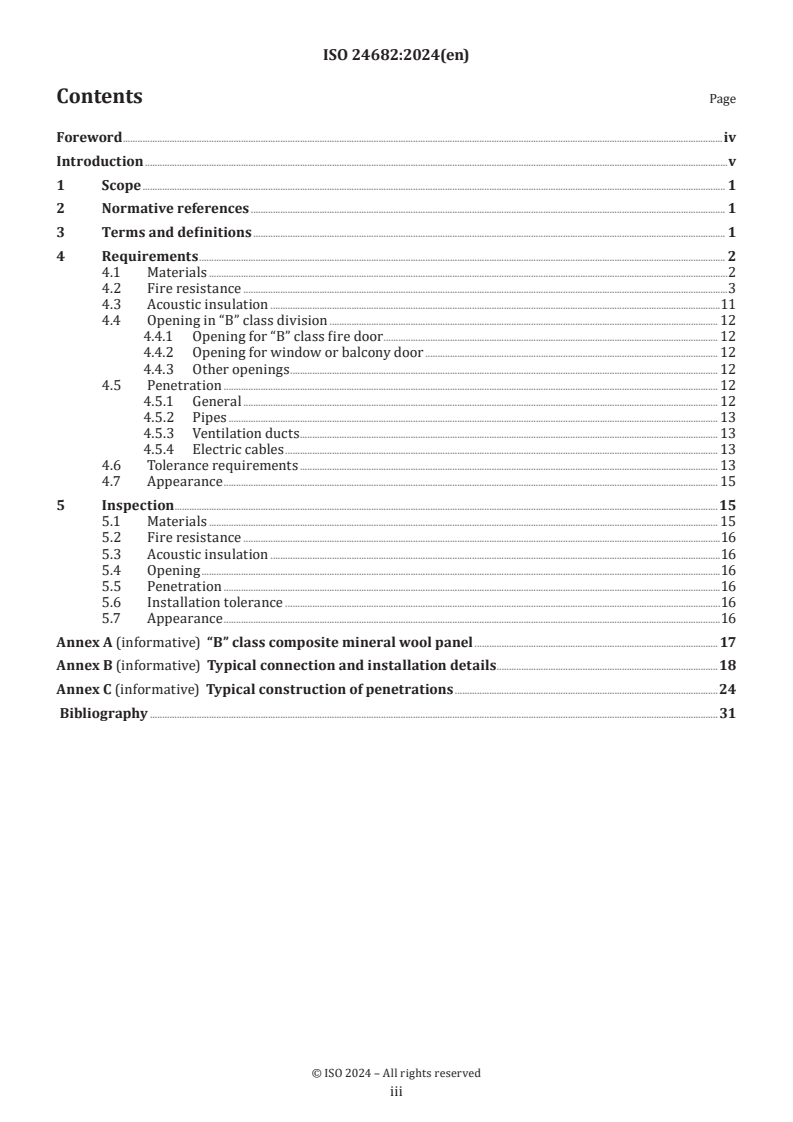
Contents Page
Foreword .iv
Introduction .v
1 Scope . 1
2 Normative references . 1
3 Terms and definitions . 1
4 Requirements . 2
4.1 Materials .2
4.2 Fire resistance .3
4.3 Acoustic insulation .11
4.4 Opening in “B” class division . 12
4.4.1 Opening for “B” class fire door . 12
4.4.2 Opening for window or balcony door . 12
4.4.3 Other openings . 12
4.5 Penetration . 12
4.5.1 General . 12
4.5.2 Pipes . 13
4.5.3 Ventilation ducts . . 13
4.5.4 Electric cables . 13
4.6 Tolerance requirements . 13
4.7 Appearance . 15
5 Inspection .15
5.1 Materials . 15
5.2 Fire resistance .16
5.3 Acoustic insulation .16
5.4 Opening .16
5.5 Penetration .16
5.6 Installation tolerance .16
5.7 Appearance .16
Annex A (informative) “B” class composite mineral wool panel . 17
Annex B (informative) Typical connection and installation details .18
Annex C (informative) Typical construction of penetrations .24
Bibliography .31
iii
Foreword
ISO (the International Organization for Standardization) is a worldwide federation of national standards
bodies (ISO member bodies). The work of preparing International Standards is normally carried out through
ISO technical committees. Each member body interested in a subject for which a technical committee
has been established has the right to be represented on that committee. International organizations,
governmental and non-governmental, in liaison with ISO, also take part in the work. ISO collaborates closely
with the International Electrotechnical Commission (IEC) on all matters of electrotechnical standardization.
The procedures used to develop this document and those intended for its further maintenance are described
in the ISO/IEC Directives, Part 1. In particular, the different approval criteria needed for the different types
of ISO document should be noted. This document was drafted in accordance with the editorial rules of the
ISO/IEC Directives, Part 2 (see www.iso.org/directives).
ISO draws attention to the possibility that the implementation of this document may involve the use of (a)
patent(s). ISO takes no position concerning the evidence, validity or applicability of any claimed patent
rights in respect thereof. As of the date of publication of this document, ISO had not received notice of (a)
patent(s) which may be required to implement this document. However, implementers are cautioned that
this may not represent the latest information, which may be obtained from the patent database available at
www.iso.org/patents. ISO shall not be held responsible for identifying any or all such patent rights.
Any trade name used in this document is information given for the convenience of users and does not
constitute an endorsement.
For an explanation of the voluntary nature of standards, the meaning of ISO specific terms and expressions
related to conformity assessment, as well as information about ISO's adherence to the World Trade
Organization (WTO) principles in the Technical Barriers to Trade (TBT), see www.iso.org/iso/foreword.html.
This document was prepared by Technical Committee ISO/TC 8, Ships and marine technology, Subcommittee
SC 8, Ship design.
Any feedback or questions on this document should be directed to the user’s national standards body. A
complete listing of these bodies can be found at www.iso.org/members.html.
iv
Introduction
“B” class fire-resistant compartment systems made of composite mineral wool panels are widely used in
accommodation spaces in ships and offshore installations. Both ships and offshore installations have fire
and acoustic insulation capability as required by 1974 International Convention for the Safety of Life at Sea
(SOLAS 74) and its amendments.
This document is aligned with IMO documents, in particular SOLAS 74, IMO Resolution MSC.337 (91), IMO
MSC/Circ.917 and the International code for application of fire test procedures (FTP Code).
v
International Standard ISO 24682:2024(en)
Ships and marine technology — Technical requirements for
"B" class fire-resistant compartment systems of composite
mineral wool panel
1 Scope
This document provides requirements on fire resistance, acoustic insulation, opening and penetration for
“B” class fire-resistant compartment systems made of composite mineral wool panel, which are aligned with
the 2010 FTP Code and SOLAS 74 and its amendments. This document also specifies how these “B” class fire-
resistant compartment systems are inspected.
This document is applicable to accommodation spaces made by “B” class composite mineral wool panels for
ships and offshore installations where “B” class divisions are required.
2 Normative references
The following documents are referred to in the text in such a way that some or all of their content constitutes
requirements of this document. For dated references, only the edition cited applies. For undated references,
the latest edition of the referenced document (including any amendments) applies.
ISO 1716, Reaction to fire tests for products — Determination of the gross heat of combustion (calorific value)
ISO 10140-2, Acoustics — Laboratory measurement of sound insulation of building elements — Part 2:
Measurement of airborne sound insulation
ISO 22262-1, Air quality — Bulk materials — Part 1: Sampling and qualitative determination of asbestos in
commercial bulk materials
2010 FTP Code — International code for application of fire test procedures
SOLAS — International Convention for the Safety of Life at Sea
IMO Resolution MSC.337 (91) — Code on noise levels on board ships
IMO MSC/Circ.917 — Guidelines on Fire Safety Construction in Accommodation Areas – (4 June 1999)
3 Terms and definitions
For the purposes of this document, the following terms and definitions apply.
ISO and IEC maintain terminology databases for use in standardization at the following addresses:
— ISO Online browsing platform: available at https:// www .iso .org/ obp
— IEC Electropedia: available at https:// www .electropedia .org/
3.1
“B” class
“B” class division
classification formed by bulkheads, decks, ceilings, or linings, including “B-15” and “B-0” class, constructed
of approved non-combustible materials (3.6)
[SOURCE: SOLAS, Chapter II-2, Reg. 3.4]
3.2
“B” class composite mineral wool panel
panel composed of a metal sheet, or sheets associated with mineral wool, and which meet “B-15” and “B-0”
class requirements
3.3
“B” class fire door
fixed door which has a fire resistance that is equivalent to “B” class division (3.1)
Note 1 to entry: See 2010 FTP Code, Annex 1, Part 3 for further details on the criteria with which a “B” class fire door
must comply.
3.4
window box
connection box between the “B” class composite mineral wool panel (3.2) and window or side scuttle
3.5
“B” class fire-resistant compartment system
compartment system consisting of a “B” class composite mineral wool panel (3.2), “B” class fire door (3.3),
window box (3.4), as well as any other openings and/or penetrations in the “B” class division (3.1)
3.6
non-combustible material
material which neither burns nor gives off flammable vapours in sufficient quantity for self-ignition when
heated to approximately 750 °C
3.7
combustible material
material other than non-combustible material (3.6)
3.8
low flame-spread characteristic
surface material of “B” class division (3.1) designed to adequately restrict the spread of flame
[SOURCE: SOLAS, Chapter II-2, Reg. 3.29]
3.9
“C” class
division constructed of approved non-combustible materials (3.6), which does not need to meet requirements
relative to the passage of smoke and flame nor limitations relative to the temperature rise
[SOURCE: SOLAS, Chapter II-2, Reg. 3.10]
4 Requirements
4.1 Materials
All materials shall be free of asbestos in accordance with SOLAS, Chapter II-1, Regulation 3-5.
Insulating materials shall be non-combustible, in accordance with SOLAS, Chapter II-2, Regulation 5.3.1.1.
Adhesives shall have low flame-spread characteristics in accordance with SOLAS II-2, Regulation 5.3.1.1.
Combustible materials which are used upon the exposed finishing surface of the “B” class fire-resistant
compartment systems, such as facings, mouldings, decorations and veneers, in accommodation and service
spaces on the combined area of the walls and ceiling linings, shall meet following requirements:
a) their maximum calorific value shall not exceed 45 MJ/m of the area for the thickness used;
b) the total volume of the materials shall have a value not exceeding a volume equivalent to 2,5 mm veneer
of the combined area of the interior surface of the “B” class fire-resistant compartment systems. Such
volume shall also include the one relevant to the combustible materials applied on the surfaces of the
divisions to decorate them, such as mouldings, decorations and skirting;
c) they shall not be capable of producing excessive quantities of smoke and toxic products, as per 2010 FTP
Code, Annex 1, Part 2;
d) they shall have low flame-spread characteristics, as per 2010 FTP Code, Annex 1, Part 5.
The density and thickness of composite mineral wool panel shall be within ± 10 % of the nominal values as
stated by the designer.
4.2 Fire resistance
“B” class fire-resistant compartment systems shall meet the requirements of SOLAS, Chapter II-2, Regulation
3, and Regulation 9.
For details on the basic construction of “B” class composite mineral wool panels, see Annex A.
For the typical connection and installation details of “B” class composite mineral wool panels, see Annex B.
Arrangements of Figure 1 to Figure 8 are examples. Other arrangements that are in line with IMO MSC/
Circ.917 shall be considered acceptable.
a) Top view
b) Side view
Key
1 “B-15” class bulkhead 7 window box
2 “B-0” class bulkhead 8 access door
3 “B-0” class ceiling 9 corridor
4 ”C” class bulkhead 10 cabin
5 “C” class ceiling 11 toilet
6 fire door
NOTE 1 The corridor has “B-15” bulkheads extending from deck to deck and “C” class ceiling (where provided). The
cabin has “B-0” continuous construction. Bulkheads (except the door) between the cabin and corridor or other cabins
are not common. The toilet is separated with a “C” class bulkhead from the cabin.
NOTE 2 This construction type is applicable to passenger ships and cargo ships.
Figure 1 — Construction details of “B” class fire-resistant compartment systems — Type I
construction
a) Top view
b) Side view
Key
1 “B-15” class bulkhead 6 window box
2 “B-0” class bulkhead 7 access door
3 “B-0” class ceiling 8 corridor
4 “C” class ceiling 9 cabin
5 fire door 10 toilet
NOTE 1 The corridor has “B-15” bulkheads extending from deck to deck and “C” class ceiling (where provided). The
cabin has “B-15” bulkhead against corridor and “B-0” bulkheads against other spaces, and it has a “B-0” continuous
ceiling. Bulkheads are common with corridors and other cabins. The toilet unit is fully separate including the ceiling.
There is a gap between the cabin and toilet unit. All bulkheads of the toilet unit are “B-0”.
NOTE 2 This construction type is applied to passenger ships and cargo ships.
Figure 2 — Construction details of “B” class fire-resistant compartment systems — Type II
construction
a) Top view
b) Side view
Key
1 “B-15” class bulkhead 6 access door
2 “B-15” class ceiling 7 corridor
3 “C” class bulkhead 8 cabin
4 fire door 9 toilet
5 window box
NOTE 1 The corridor has “B-15” continuous construction. The cabin has “B-15” continuous construction. Bulkheads
(except the door) between the cabin and corridor or other cabins are not common. The toilet is separated with a “C”
class bulkhead from the cabin.
NOTE 2 This construction type is applied to passenger ships carrying more than 36 passengers, passenger ships
carrying not more than 36 passengers who are protected by sprinklers in accommodation areas, or cargo ships that
adopt method IIC and method IIIC in accordance with SOLAS, Chapter II-2, Regulation 7.5.5, in accommodation areas.
Figure 3 — Construction details of “B” class fire-resistant compartment systems — Type III
construction
a) Top view
b) Side view
Key
1 “B-15” class bulkhead 6 access door
2 “B-15” class ceiling 7 corridor
3 “B-0” class bulkhead 8 cabin
4 fire door 9 toilet
5 window box
NOTE 1 The corridor has “B-15” corridor bulkheads from the deck to continuous “B-15” ceiling on both sides. The
cabin has B-0 bulkheads against other cabins and “B-15” bulkhead against other spaces and it has a “B-15” continuous
ceiling. Bulkheads are common with corridors and other cabins. The toilet unit is fully separate including the ceiling.
There is a gap between the cabin and toilet unit. All bulkheads of the toilet unit are “B-0”.
NOTE 2 This construction type is applied to passenger ships carrying more than 36 passengers, passenger ships
carrying not more than 36 passengers who are protected by sprinklers in accommodation areas, or cargo ships adopting
method IIC and method IIIC in accordance with SOLAS, Chapter II-2, Regulation 7.5.5, in accommodation areas.
Figure 4 — Construction details of “B” class fire-resistant compartment systems — Type IV
construction
a) Top view
b) Side view
Key
1 “B-0” class bulkhead 6 access door
2 “C” class
...