

ISO 23430:2019
(Main)Ships and marine technology — Specification of high manganese austenitic steel thin strips used for LNG tanks on board ships
General Information
- Abstract
This document describes the specification of high manganese (Mn) austenitic steel thin strips with good weldability and good resistance to atmospheric corrosion intended to be used for LNG tanks on board ships. It covers strips with a thickness ranging from 0,3 mm to 6,0 mm.
- Status
- Published
- Publication Date
- 15-Dec-2019
- Technical Committee
- ISO/TC 8/SC 8 - Ship design
- Drafting Committee
- ISO/TC 8/SC 8 - Ship design
- Current Stage
- 9093 - International Standard confirmed
- Start Date
- 06-Mar-2025
- Completion Date
- 29-Aug-2026
Buy Documents
ISO 23430:2019 - Ships and marine technology -- Specification of high manganese austenitic steel thin strips used for LNG tanks on board ships
ISO 23430:2019 - Ships and marine technology — Specification of high manganese austenitic steel thin strips used for LNG tanks on board ships/16/2019
Overview
ISO 23430:2019 specifies requirements for high manganese (Mn) austenitic steel thin strips intended for use in LNG tanks on board ships. The standard covers strips with a thickness range of 0.3 mm to 6.0 mm and focuses on ensuring good weldability, atmospheric corrosion resistance, and mechanical performance suitable for cryogenic shipboard service. It provides material, manufacturing and testing criteria tailored to shipyards, tank manufacturers, steel suppliers and shipping companies.
Key topics and technical requirements
- Scope & purpose: Material specification for thin strip application in LNG cargo and fuel tanks; aims to meet cryogenic strength and toughness needs.
- Thickness and dimensions: Covers 0.3–6.0 mm thin strips; maximum width 1 500 mm (−0/+0.8 mm).
- Manufacture:
- Electric furnace melting with ladle refining to control residuals.
- Hot-rolled plates (ingot or continuous casting), pickling or reducing heat treatment, then cold rolling and recrystallization annealing under a reducing atmosphere.
- Chemical composition (typical limits from the standard):
- Mn: 24.0 to 34.0%
- Ni: up to 3.50%
- Other controls: C, P, S, Si, Cr, Al, N with specific max/min values per Table 1.
- Mechanical properties:
- Minimum yield strength (0.2% offset): 300 N/mm²
- Minimum tensile strength: 670 N/mm²
- Minimum elongation: 40%
- Toughness and cryogenic testing:
- Design temperature: −165 °C; impact test temperature: −196 °C.
- Charpy V-notch requirements: average ≥27 J (transverse); ≥41 J when used as section member (longitudinal).
- Bend and non‑destructive tests:
- 180° bend test per ISO 7438 (no fracture permitted).
- Optional supplementary tests: ultrasonic testing, corrosion tests, macro/microsection, hardness.
- Weldability:
- Steel shall have good weldability; welding procedure specification (WPS) and qualification in accordance with IACS UR W1 rev.3 are required.
- Marking & documentation:
- Manufacturer, grade identification, year, delivery condition; test certificates must document cast ID, chemical and mechanical results and purchaser/hull references.
Applications and users
- Primary use: LNG cargo tanks and LNG-fuel tanks on carriers and gas-fuelled ships where thin strip material is needed (e.g., internal tank components, cladding, lightweight structural elements).
- Typical users:
- Steel producers and alloy suppliers
- Shipyards and tank manufacturers
- Naval architects and ship designers specifying cryogenic-compatible materials
- Classification societies and QA teams for procurement and inspection
Related standards
- ISO 7438 (bend test), ISO 148‑1 (Charpy impact), ISO 6892‑1 (tensile testing)
- IACS UR W1 (material and welding for gas tankers)
- ISO 21635 and IMO IGC/IGF Codes referenced for cryogenic material context
Keywords: ISO 23430:2019, high manganese austenitic steel thin strips, LNG tanks, ships and marine technology, weldability, cryogenic mechanical properties, chemical composition, thickness 0.3–6.0 mm.
Buy Documents
ISO 23430:2019 - Ships and marine technology -- Specification of high manganese austenitic steel thin strips used for LNG tanks on board ships
ISO 23430:2019 - Ships and marine technology — Specification of high manganese austenitic steel thin strips used for LNG tanks on board ships/16/2019
Get Certified
Connect with accredited certification bodies for this standard

DNV
DNV is an independent assurance and risk management provider.

Lloyd's Register
Lloyd's Register is a global professional services organisation specialising in engineering and technology.

FSC International
Forest Stewardship Council certification.
Sponsored listings
Frequently Asked Questions
ISO 23430:2019 is a standard published by the International Organization for Standardization (ISO). Its full title is "Ships and marine technology — Specification of high manganese austenitic steel thin strips used for LNG tanks on board ships". This standard covers: This document describes the specification of high manganese (Mn) austenitic steel thin strips with good weldability and good resistance to atmospheric corrosion intended to be used for LNG tanks on board ships. It covers strips with a thickness ranging from 0,3 mm to 6,0 mm.
This document describes the specification of high manganese (Mn) austenitic steel thin strips with good weldability and good resistance to atmospheric corrosion intended to be used for LNG tanks on board ships. It covers strips with a thickness ranging from 0,3 mm to 6,0 mm.
ISO 23430:2019 is classified under the following ICS (International Classification for Standards) categories: 47.020.05 - Materials and components for shipbuilding. The ICS classification helps identify the subject area and facilitates finding related standards.
ISO 23430:2019 is available in PDF format for immediate download after purchase. The document can be added to your cart and obtained through the secure checkout process. Digital delivery ensures instant access to the complete standard document.
Standards Content (Sample)
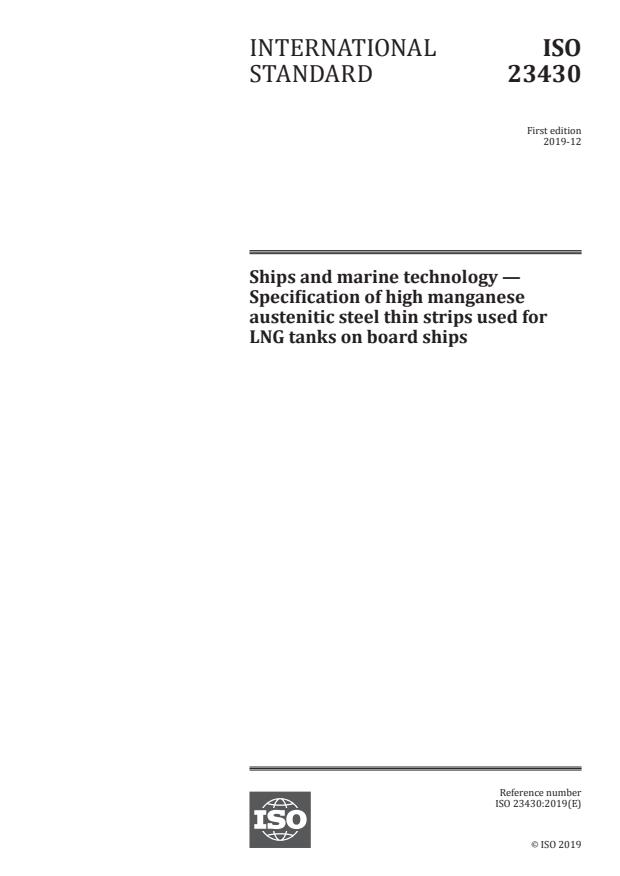
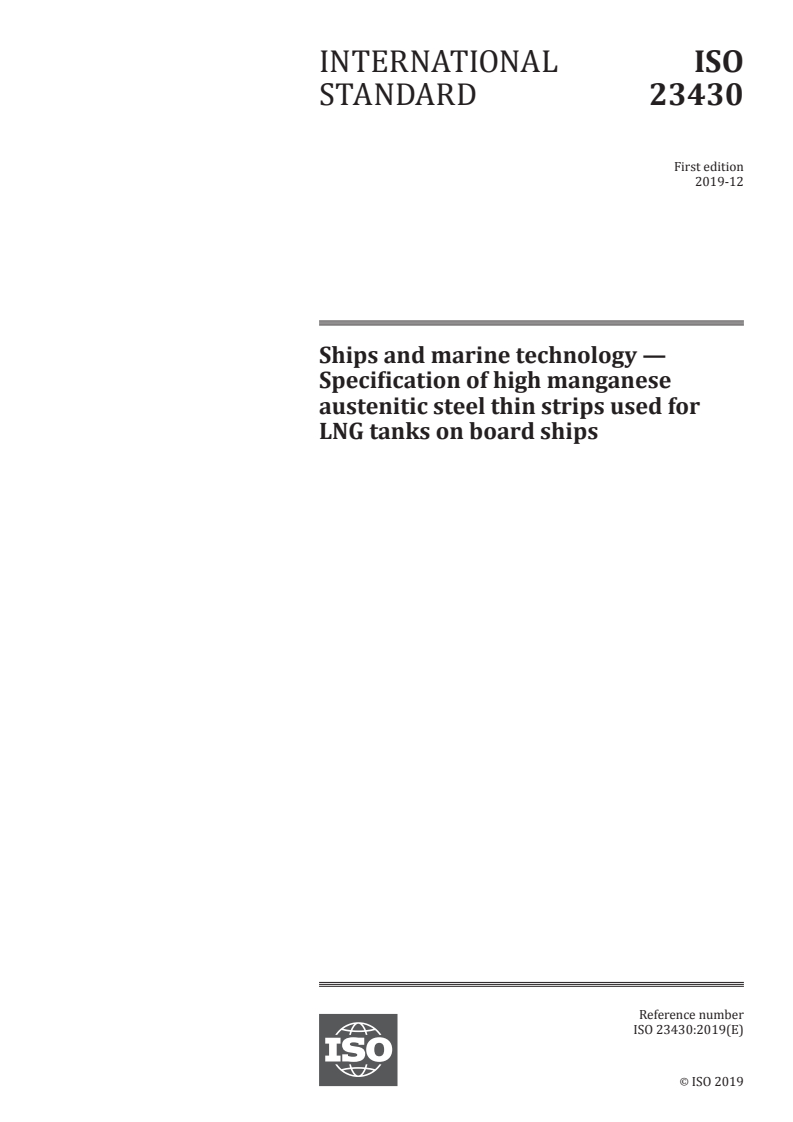
INTERNATIONAL ISO
STANDARD 23430
First edition
2019-12
Ships and marine technology —
Specification of high manganese
austenitic steel thin strips used for
LNG tanks on board ships
Reference number
©
ISO 2019
© ISO 2019
All rights reserved. Unless otherwise specified, or required in the context of its implementation, no part of this publication may
be reproduced or utilized otherwise in any form or by any means, electronic or mechanical, including photocopying, or posting
on the internet or an intranet, without prior written permission. Permission can be requested from either ISO at the address
below or ISO’s member body in the country of the requester.
ISO copyright office
CP 401 • Ch. de Blandonnet 8
CH-1214 Vernier, Geneva
Phone: +41 22 749 01 11
Fax: +41 22 749 09 47
Email: copyright@iso.org
Website: www.iso.org
Published in Switzerland
ii © ISO 2019 – All rights reserved
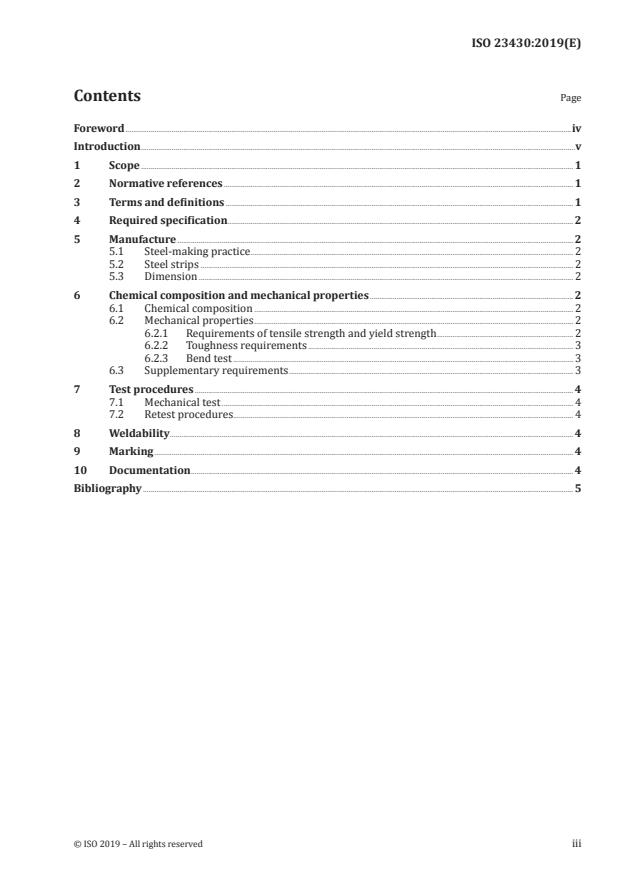
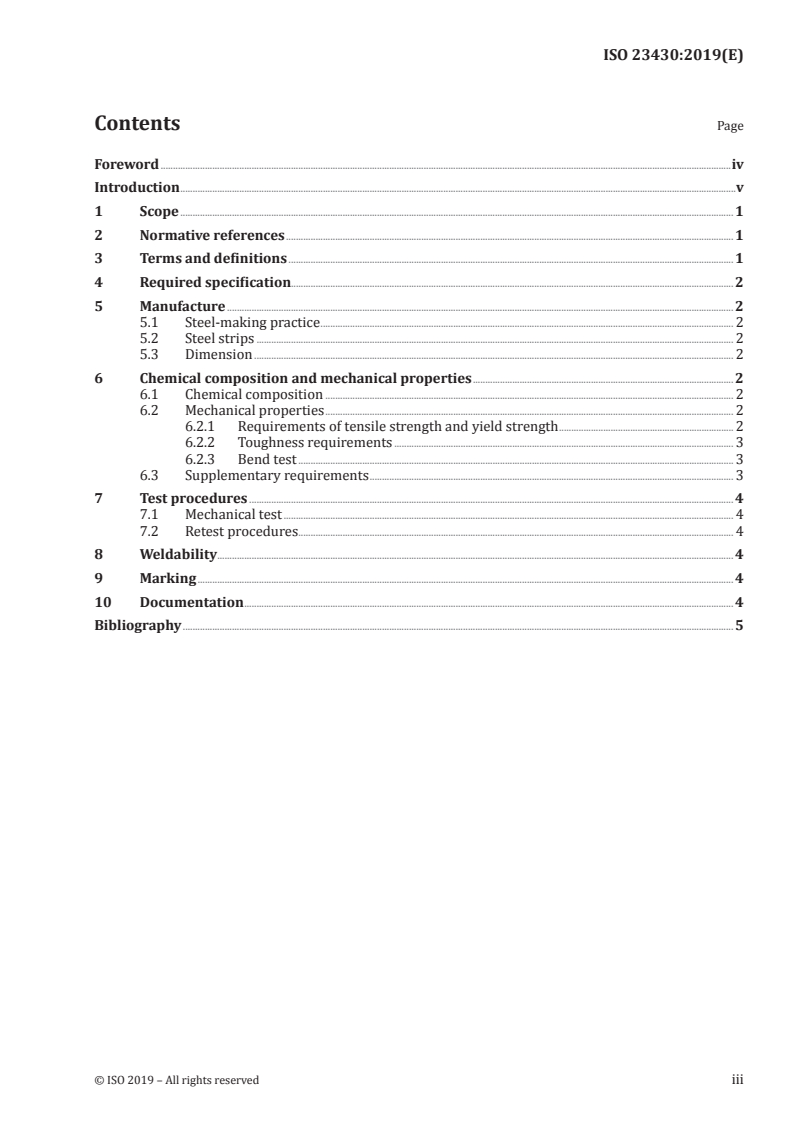
Contents Page
Foreword .iv
Introduction .v
1 Scope . 1
2 Normative references . 1
3 Terms and definitions . 1
4 Required specification. 2
5 Manufacture . 2
5.1 Steel-making practice . 2
5.2 Steel strips . 2
5.3 Dimension . 2
6 Chemical composition and mechanical properties . 2
6.1 Chemical composition . 2
6.2 Mechanical properties . 2
6.2.1 Requirements of tensile strength and yield strength . 2
6.2.2 Toughness requirements . 3
6.2.3 Bend test . 3
6.3 Supplementary requirements . 3
7 Test procedures . 4
7.1 Mechanical test . 4
7.2 Retest procedures . 4
8 Weldability . 4
9 Marking . 4
10 Documentation . 4
Bibliography . 5
Foreword
ISO (International Organization for Standardization) is a worldwide federation of national standards
bodies (ISO member bodies). The work of preparing International Standards is normally carried out
through ISO technical committees. Each member body interested in a subject for which a technical
committee has been established has the right to be represented on that committee. International
organizations, governmental and non-governmental, in liaison with ISO, also take part in the work.
ISO collaborates closely with the International Electrotechnical Commission (IEC) on all matters of
electrotechnical standardization.
The procedures used to develop this document and those intended for its further maintenance are
described in the ISO/IEC Directives, Part 1. In particular the different approval criteria needed for the
different types of ISO documents should be noted. This document was drafted in accordance with the
editorial rules of the ISO/IEC Directives, Part 2. www .iso .org/ directives.
Attention is drawn to the possibility that some of the elements of this document may be the subject of
patent rights. ISO shall not be held responsible for identifying any or all such patent rights. Details of
any patent rights identified during the development of the document will be in the introduction and/or
on the ISO list of patent declarations received. www .iso .org/ patents.
Any trade name used in this document is information given for the convenience of users and does not
constitute an endorsement.
For an explanation of the voluntary nature of standards, the meaning of ISO specific terms and
expressions related to conformity assessment, as well as information about ISO's adherence to the
World Trade Organization (WTO) principles in the Technical Barriers to Trade (TBT), see www .iso .org/
iso/ foreword .html.
This document was prepared by Technical Committee ISO/TC 8, Ships and marine technology,
Subcommittee SC 8, Ship design.
Any feedback or questions on this document should be directed to the user’s national standards body. A
complete listing of these bodies can be found at www .iso .org/ members .html.
iv © ISO 2019 – All rights reserved
Introduction
There have been several requirements regarding metallic materials for cryogenic applications since the
adoption of the IGC and IGF Codes. Recently, a new high manganese austenitic steel has been proposed
[2]
for thick plates and piping systems of LNG carriers and LNG-fuelled ships . However, only plates
with a thickness ranging from 6 mm to 30 mm are specified and the target tank capacity is limited to
30 000 m .
This document covers a newly developed high manganese austenitic steel for thin strip application. This
steel has mechanical properties comparable or even higher than those of materials for cryogenic service
[3] [4]
listed in both the IGC Code and IGF Code , with good weldability and good resistance to atmospheric
corrosion. Consequently, this high manganese austenitic steel is intended to satisfy the strength
requirements of the str
...
INTERNATIONAL ISO
STANDARD 23430
First edition
2019-12
Ships and marine technology —
Specification of high manganese
austenitic steel thin strips used for
LNG tanks on board ships
Reference number
©
ISO 2019
© ISO 2019
All rights reserved. Unless otherwise specified, or required in the context of its implementation, no part of this publication may
be reproduced or utilized otherwise in any form or by any means, electronic or mechanical, including photocopying, or posting
on the internet or an intranet, without prior written permission. Permission can be requested from either ISO at the address
below or ISO’s member body in the country of the requester.
ISO copyright office
CP 401 • Ch. de Blandonnet 8
CH-1214 Vernier, Geneva
Phone: +41 22 749 01 11
Fax: +41 22 749 09 47
Email: copyright@iso.org
Website: www.iso.org
Published in Switzerland
ii © ISO 2019 – All rights reserved
Contents Page
Foreword .iv
Introduction .v
1 Scope . 1
2 Normative references . 1
3 Terms and definitions . 1
4 Required specification. 2
5 Manufacture . 2
5.1 Steel-making practice . 2
5.2 Steel strips . 2
5.3 Dimension . 2
6 Chemical composition and mechanical properties . 2
6.1 Chemical composition . 2
6.2 Mechanical properties . 2
6.2.1 Requirements of tensile strength and yield strength . 2
6.2.2 Toughness requirements . 3
6.2.3 Bend test . 3
6.3 Supplementary requirements . 3
7 Test procedures . 4
7.1 Mechanical test . 4
7.2 Retest procedures . 4
8 Weldability . 4
9 Marking . 4
10 Documentation . 4
Bibliography . 5
Foreword
ISO (International Organization for Standardization) is a worldwide federation of national standards
bodies (ISO member bodies). The work of preparing International Standards is normally carried out
through ISO technical committees. Each member body interested in a subject for which a technical
committee has been established has the right to be represented on that committee. International
organizations, governmental and non-governmental, in liaison with ISO, also take part in the work.
ISO collaborates closely with the International Electrotechnical Commission (IEC) on all matters of
electrotechnical standardization.
The procedures used to develop this document and those intended for its further maintenance are
described in the ISO/IEC Directives, Part 1. In particular the different approval criteria needed for the
different types of ISO documents should be noted. This document was drafted in accordance with the
editorial rules of the ISO/IEC Directives, Part 2. www .iso .org/ directives.
Attention is drawn to the possibility that some of the elements of this document may be the subject of
patent rights. ISO shall not be held responsible for identifying any or all such patent rights. Details of
any patent rights identified during the development of the document will be in the introduction and/or
on the ISO list of patent declarations received. www .iso .org/ patents.
Any trade name used in this document is information given for the convenience of users and does not
constitute an endorsement.
For an explanation of the voluntary nature of standards, the meaning of ISO specific terms and
expressions related to conformity assessment, as well as information about ISO's adherence to the
World Trade Organization (WTO) principles in the Technical Barriers to Trade (TBT), see www .iso .org/
iso/ foreword .html.
This document was prepared by Technical Committee ISO/TC 8, Ships and marine technology,
Subcommittee SC 8, Ship design.
Any feedback or questions on this document should be directed to the user’s national standards body. A
complete listing of these bodies can be found at www .iso .org/ members .html.
iv © ISO 2019 – All rights reserved
Introduction
There have been several requirements regarding metallic materials for cryogenic applications since the
adoption of the IGC and IGF Codes. Recently, a new high manganese austenitic steel has been proposed
[2]
for thick plates and piping systems of LNG carriers and LNG-fuelled ships . However, only plates
with a thickness ranging from 6 mm to 30 mm are specified and the target tank capacity is limited to
30 000 m .
This document covers a newly developed high manganese austenitic steel for thin strip application. This
steel has mechanical properties comparable or even higher than those of materials for cryogenic service
[3] [4]
listed in both the IGC Code and IGF Code , with good weldability and good resistance to atmospheric
corrosion. Consequently, this high manganese austenitic steel is intended to satisfy the strength
requirements of the str
...