

ISO 18760:2026
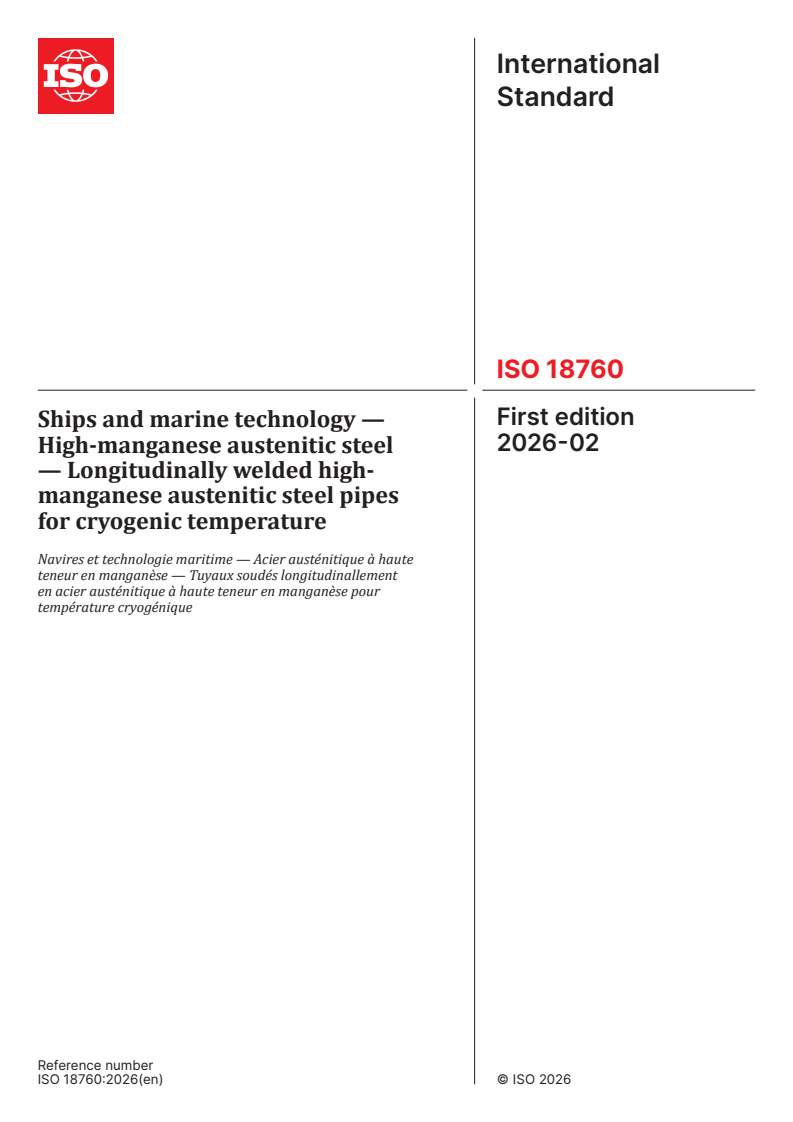
(Main)Ships and marine technology — High-manganese austenitic steel — Longitudinally welded high-manganese austenitic steel pipes for cryogenic temperature
General Information
- Abstract
This document specifies the delivery conditions for longitudinally welded pipes of circular cross-section, made of high-manganese austenitic steel, intended for cryogenic temperature applications under pressure. This document is applicable to all pressure-retaining components and any non-pressure-retaining components, such as members of pipe supports, which are welded directly to a pressure-retaining component.
- Status
- Published
- Publication Date
- 05-Feb-2026
- Technical Committee
- ISO/TC 8/SC 4 - Outfitting and deck machinery
- Drafting Committee
- ISO/TC 8/SC 4 - Outfitting and deck machinery
- Current Stage
- 6060 - International Standard published
- Start Date
- 06-Feb-2026
- Due Date
- 15-Dec-2025
- Completion Date
- 06-Feb-2026
Overview
ISO 18760:2026 sets forth requirements for longitudinally welded high-manganese austenitic steel pipes intended for cryogenic temperature applications under pressure. Published by the International Organization for Standardization (ISO), this standard addresses both pressure-retaining and certain non-pressure-retaining components, such as pipe supports welded directly to pressure components. The document is developed specifically for ships and marine technology sectors, ensuring suitable mechanical performance, quality, and safety for systems exposed to cryogenic conditions, including applications for liquefied natural gas (LNG) and, where agreed, liquefied hydrogen.
High-manganese austenitic steel offers excellent toughness and durability at extremely low temperatures, meeting stringent international marine regulations such as the International Gas Carrier (IGC) Code and International Code of Safety for Ships using Gases or other Low-flashpoint Fuels (IGF Code).
Key Topics
Scope & Applicability
- Delivery and acceptance conditions for welded pipes of circular cross-section made from high-manganese austenitic steel.
- Use for pressure-retaining components and pipe supports joined to pressure systems.
Health, Safety, and Quality
- Mandatory compliance with occupational health and safety management principles.
- Requirements for risk mitigation during manufacturing and welding activities.
- Obligations for manufacturers to implement robust quality management systems (QMS) ensuring product traceability, personnel competence, and welder/operator qualifications.
Welding Requirements
- Adherence to relevant welding quality standards (e.g., ISO 3834-2, ISO 14731).
- Strict criteria for welding procedure qualifications, operator certifications, and use of specified consumables.
- Provisions for welding under varying environmental conditions and for specific inspection and testing responsibilities.
Material and Manufacturing Controls
- Guidelines on steelmaking, pipe forming, seam welding, and finishing processes.
- Chemical composition and mechanical property requirements aligned with international norms for cryogenic service.
- Testing protocols for tensile strength, impact resistance (Charpy test), and bend or flattening tests to ensure consistent quality.
Applications
Marine and Offshore Engineering
- Critical for cargo and fuel piping systems in LNG carriers and vessels designed to operate with alternative low-temperature fuels such as hydrogen.
- Used in pressure-retaining pipework as well as integrated support structures welded directly to cryogenic piping.
Shipbuilding and Ship Repair
- Material standardization streamlines procurement, fabrication, and inspection procedures for shipyards, material suppliers, and maintenance operations.
- Applicable to both new construction and retrofitting projects requiring resistance to extremely low temperatures.
Safety and Regulatory Compliance
- Supports compliance with ISO, IMO, and classification society requirements for safety, quality, and reliability in cryogenic marine applications.
- Enhances documentation and traceability for approval by ship owners, regulators, and customers.
Related Standards
Material Testing and Welding
- ISO 148-1: Charpy pendulum impact test
- ISO 3834-2: Quality requirements for welding
- ISO 6892-1: Tensile testing of metallic materials
- ISO 9606: Qualification testing of welders
- ISO 14731: Welding coordination
Manufacturing and Inspection
- ISO 10893 Series: Non-destructive testing of steel tubes
- ASME B31.3: Process Piping
- ASME Boiler and Pressure Vessel Code, Section IX: Welding procedures
Occupational Health and Safety
- ISO 45001: Occupational health and safety management
By establishing uniform specifications for high-manganese austenitic steel pipes, ISO 18760:2026 facilitates the design, construction, and maintenance of safe and high-performance cryogenic piping systems in marine environments. This standard is essential for engineering teams, procurement specialists, and safety managers involved in advanced shipbuilding and marine engineering projects worldwide.
Get Certified
Connect with accredited certification bodies for this standard

DNV
DNV is an independent assurance and risk management provider.

Lloyd's Register
Lloyd's Register is a global professional services organisation specialising in engineering and technology.

FSC International
Forest Stewardship Council certification.
Sponsored listings
Frequently Asked Questions
ISO 18760:2026 is a standard published by the International Organization for Standardization (ISO). Its full title is "Ships and marine technology — High-manganese austenitic steel — Longitudinally welded high-manganese austenitic steel pipes for cryogenic temperature". This standard covers: This document specifies the delivery conditions for longitudinally welded pipes of circular cross-section, made of high-manganese austenitic steel, intended for cryogenic temperature applications under pressure. This document is applicable to all pressure-retaining components and any non-pressure-retaining components, such as members of pipe supports, which are welded directly to a pressure-retaining component.
This document specifies the delivery conditions for longitudinally welded pipes of circular cross-section, made of high-manganese austenitic steel, intended for cryogenic temperature applications under pressure. This document is applicable to all pressure-retaining components and any non-pressure-retaining components, such as members of pipe supports, which are welded directly to a pressure-retaining component.
ISO 18760:2026 is classified under the following ICS (International Classification for Standards) categories: 47.020.05 - Materials and components for shipbuilding. The ICS classification helps identify the subject area and facilitates finding related standards.
ISO 18760:2026 is available in PDF format for immediate download after purchase. The document can be added to your cart and obtained through the secure checkout process. Digital delivery ensures instant access to the complete standard document.
Standards Content (Sample)
International
Standard
ISO 18760
First edition
Ships and marine technology —
2026-02
High-manganese austenitic steel
— Longitudinally welded high-
manganese austenitic steel pipes
for cryogenic temperature
Navires et technologie maritime — Acier austénitique à haute
teneur en manganèse — Tuyaux soudés longitudinallement
en acier austénitique à haute teneur en manganèse pour
température cryogénique
Reference number
© ISO 2026
All rights reserved. Unless otherwise specified, or required in the context of its implementation, no part of this publication may
be reproduced or utilized otherwise in any form or by any means, electronic or mechanical, including photocopying, or posting on
the internet or an intranet, without prior written permission. Permission can be requested from either ISO at the address below
or ISO’s member body in the country of the requester.
ISO copyright office
CP 401 • Ch. de Blandonnet 8
CH-1214 Vernier, Geneva
Phone: +41 22 749 01 11
Email: copyright@iso.org
Website: www.iso.org
Published in Switzerland
ii
Contents Page
Foreword .iv
Introduction .v
1 Scope . 1
2 Normative references . 1
3 Terms and definitions . 2
4 Symbols and abbreviated terms. 3
4.1 Symbols .3
4.2 Abbreviated terms .3
5 Health, safety and quality requirements . 3
5.1 Health and safety requirements .3
5.2 Quality requirements .4
6 Manufacturing process . 5
6.1 Steelmaking process .5
6.2 Rolled product .5
7 Welding requirements . 5
7.1 General requirements .5
7.2 Welding processes .6
7.3 Preparation for welding .6
7.4 Welder and welding operator performance qualification .6
7.5 Welding consumables .7
8 Welding procedure qualification . 7
9 Metallurgical properties . 8
9.1 Chemical composition .8
9.2 Mechanical properties .8
9.2.1 Preparation of test specimens and extend of testing .8
9.2.2 Tensile testing .9
9.2.3 Impact test .10
9.2.4 Bend testing or flattening test .11
9.2.5 Retesting .11
10 Dimensions, mass and tolerances .12
10.1 Diameters, wall thickness and masses . 12
10.2 Tolerances on lengths . 12
11 Inspection .12
11.1 Visual inspection . 12
11.2 Hydrostatic test . 13
11.3 Non-destructive testing . 13
11.4 Preparation of ends . 13
12 Marking . . 14
13 Documentation . 14
Bibliography .15
iii
Foreword
ISO (the International Organization for Standardization) is a worldwide federation of national standards
bodies (ISO member bodies). The work of preparing International Standards is normally carried out through
ISO technical committees. Each member body interested in a subject for which a technical committee
has been established has the right to be represented on that committee. International organizations,
governmental and non-governmental, in liaison with ISO, also take part in the work. ISO collaborates closely
with the International Electrotechnical Commission (IEC) on all matters of electrotechnical standardization.
The procedures used to develop this document and those intended for its further maintenance are described
in the ISO/IEC Directives, Part 1. In particular, the different approval criteria needed for the different types
of ISO document should be noted. This document was drafted in accordance with the editorial rules of the
ISO/IEC Directives, Part 2 (see www.iso.org/directives).
ISO draws attention to the possibility that the implementation of this document may involve the use of (a)
patent(s). ISO takes no position concerning the evidence, validity or applicability of any claimed patent
rights in respect thereof. As of the date of publication of this document, ISO had not received notice of (a)
patent(s) which may be required to implement this document. However, implementers are cautioned that
this may not represent the latest information, which may be obtained from the patent database available at
www.iso.org/patents. ISO shall not be held responsible for identifying any or all such patent rights.
Any trade name used in this document is information given for the convenience of users and does not
constitute an endorsement.
For an explanation of the voluntary nature of standards, the meaning of ISO specific terms and expressions
related to conformity assessment, as well as information about ISO's adherence to the World Trade
Organization (WTO) principles in the Technical Barriers to Trade (TBT), see www.iso.org/iso/foreword.html.
This document was prepared by Technical Committee TC 8, Ships and marine technology, Subcommittee SC 4,
Outfitting and deck machinery.
Any feedback or questions on this document should be directed to the user’s national standards body. A
complete listing of these bodies can be found at www.iso.org/members.html.
iv
Introduction
The aim of this document is to provide a set of common requirements for metallic materials used in cryogenic
[1] [2]
applications, in alignment with the IGC Code and IGF Code adopted by the International Maritime
Organization (IMO).
The newly developed, high-manganese austenitic steel is expected to possess mechanical properties
including Charpy impact energy values comparable to those materials for cryogenic service listed in both the
IGC Code and IGF Code. Consequently, high-manganese steel is intended to satisfy the strength requirements
of the structure of cargo tanks, fuel tanks and piping systems.
In addition, upon agreement with a purchaser, this document can be applied to piping systems for liquefied
hydrogen.
This document provides a standard specification of high-manganese austenitic steel forgings for material
suppliers, ship owners, ship yards, manufacturers and shipping companies with regard to producing,
purchasing and using such materials.
v
International Standard ISO 18760:2026(en)
Ships and marine technology — High-manganese austenitic
steel — Longitudinally welded high-manganese austenitic
steel pipes for cryogenic temperature
1 Scope
This document specifies the delivery conditions for longitudinally welded pipes of circular cross-section,
made of high-manganese austenitic steel, intended for cryogenic temperature applications under pressure.
This document is applicable to all pressure-retaining components and any non-pressure-retaining
components, such as members of pipe supports, which are welded directly to a pressure-retaining
component.
2 Normative references
The following documents are referred to in the text in such a way that some or all of their content constitutes
requirements of this document. For dated references, only the edition cited applies. For undated references,
the latest edition of the referenced document (including any amendments) applies.
ISO 148-1, Metallic materials — Charpy pendulum impact test — Part 1: Test method
ISO 2566-1, Steel — Conversion of elongation values — Part 1: Carbon and low-alloy steels
ISO 2566-2, Steel — Conversion of elongation values — Part 2: Austenitic steels
ISO 3834-2, Quality requirements for fusion welding of metallic materials — Part 2: Comprehensive quality
requirements
ISO 4136, Destructive tests on welds in metallic materials — Transverse tensile test
ISO 5173, Destructive tests on welds in metallic materials — Bend tests
ISO 6892-1, Metallic materials — Tensile testing — Part 1: Method of test at room temperature
ISO 10893-2, Non-destructive testing of steel tubes — Part 2: Automated eddy current testing of seamless and
welded (except submerged arc-welded) steel tubes for the detection of imperfections
ISO 9606 (all parts), Qualification testing of welders — Fusion welding — Part 1: Steels
ISO 9712, Non-destructive testing — Qualification and certification of NDT personnel
ISO 10893-11, Non-destructive testing of steel tubes — Part 11: Automated ultrasonic testing of the weld seam
of welded steel tubes for the detection of longitudinal and/or transverse imperfections
ISO 10474, Steel and steel products — Inspection documents
ISO 14175, Welding consumables — Gases and gas mixtures for fusion welding and allied processes
ISO 14344, Welding consumables — Procurement of filler materials and fluxes
ISO 14731, Welding coordination — Tasks and responsibilities
ISO 14732, Welding personnel — Qualification testing of welding operators and weld setters for mechanized and
automatic welding of metallic materials
ISO 15609-1, Specification and qualification of welding procedures for metallic materials — Welding procedure
specification — Part 1: Arc welding
ISO 15614-1, Specification and qualification of welding procedures for metallic materials — Welding procedure
test — Part 1: Arc and gas welding of steels and arc welding of nickel and nickel alloys
ASME B31.3, Process Piping
ASME Boiler and Pressure Vessel Code, Section IX, Welding, Brazing and Fusing Qualifications
ASNT SNT-TC-1A, Personnel Qualification and Certification in Non-destructive Testing
ASNT CP-189, ASNT Standard for Qualification and Certification of Non-destructive Testing Personnel
3 Terms and definitions
For the purposes of this document, the following terms and definitions apply.
ISO and IEC maintain terminology databases for use in standardization at the following addresses:
— ISO Online browsing platform: available at https:// www .iso .org/ obp
— IEC Electropedia: available at https:// www .electropedia .org/
3.1
cryogenic service
service environments with a minimum design temperature lower than –104 °C
3.2
manufacturer
erector
organization responsible for the fabrication, welding, examination and testing of piping systems including
any externally provided products or services
3.3
heat input
energy introduced into the weld region during welding per unit run length
3.4
leak testing
hydrostatic leak test
pneumatic leak test
application of a pressure load, greater than the design load, to demonstrate the integrity of a pressure
system to safely withstand the design load
Note 1 to entry: ASME B31.3 uses the terms hydrostatic leak test, pneumatic leak test, or a combination of both methods,
such as a hydro-pneumatic test.
3.5
lot
pipe of the same steel grade, the same cast, the same manufacturing process (using the same type of
filler wires), the same nominal dimensions and, if applicable, subject to the same finishing treatment in a
continuous furnace or heat treated in the same furnace charge
3.6
owner
person, partnership, organization or business ultimately responsible for design, construction, operation,
and maintenance of a facility
4 Symbols and abbreviated terms
4.1 Symbols
D nominal pipe diameter, expressed in millimetres
W nominal wall thickness, expressed in millimetres
L length, expressed in millimetres
r nominal outside radius of the pipe, expressed in millimetres
t nominal material thickness at the weld, expressed in millimetres
U Geometric unsharpness
g
4.2 Abbreviated terms
ACCP ASNT Central Certification Program
ASNT American Society for Non-destructive Testing
AUT Automatic Ultrasonic Testing
AWS American Welding Society
CSWIP certification scheme for weldment inspection personnel
CWEng certified welding engineer
GTAW gas tungsten arc welding
IIW International Institute of Welding
ITP inspection and test plan
NDT non-destructive testing
PT liquid penetrant testing (for use on non-magnetic materials)
PWHT post weld heat treatment
QMS quality management system
SAW submerged arc welding
SMAW shielded metal arc welding
WPS welding procedure specification
5 Health, safety and quality requirements
5.1 Health and safety requirements
5.1.1 The manufacturer shall provide at least the following safety equipment and systems:
a) ventilation and extraction facilities for welding-related activities or work in a confined space;
b) personal protective equipment including eye, breathing and hearing protection;
c) access/scaffolding/working platforms and fall-arrest protective equipment for working at height;
d) access and secure temporary formwork for working below-grade;
e) protective systems to prevent electric shock, build-up or discharge of static electricity, and earthing of
welding current through susceptible components in the piping assembly;
f) ‘whip checks’ on test hoses for flushing, cleaning, leak testing/tightness testing.
5.1.2 All work undertaken in a confined space shall be managed using a permit-to-work system, i.e. a
formal written procedure that authorizes and controls hazardous activities.
[3]
NOTE 1 ISO 45001 specifies requirements for an occupational health and safety management system and gives
guidance for its use, to enable organizations to provide safe and healthy workplaces by preventing work-related injury
and ill health, as well as by proactively improving its occupational health and safety performance.
[4] [5]
NOTE 2 ANSI Z49.1 and ISO/TR 18786 give specific requirements and guidance on safety in welding fabrication
activities.
5.2 Quality requirements
5.2.1 The manufacturer shall have a quality management system in place to ensure consistent product
quality and compliance with this document.
5.2.2 The defined responsibilities for the manufacturer, and the welding, inspection and testing personnel
are as follows.
a) The manufacturer shall meet the comprehensive welding quality requirements of ISO 3834-2.
b) Welding coordination personnel shall demonstrate that they meet the requirements of ISO 14731 by
either a comprehensive level of competency or a specific level of competency as appropriate for the
relevant essential welding-related tasks described in ISO 3834-2.
NOTE 1 For the purposes of this provision, personnel with AWS CWEng certification in conformance to
[6]
AWS B5.16 can be considered equivalent to personnel holding EWF European welding engineer (EWE) or IIW
[7]
International Welding Engineer (IWE) certification as explained in EWF Publication EWF-663–19 and IIW
[8]
Publication IAB-362–19, respectively.
c) Welding inspection personnel shall be competent and shall meet the requirements of ISO 14731 or
ISO 9712, as applicable to the inspection activities performed.
NOTE 2 Examples of schemes that can provide evidence of meeting these requirements include IIW
International Welding Inspector (Standard or Comprehensive), AWS QC1 Certified Welding Inspector/Senior
Certified Welding Inspector, and CSWIP 3.1 or 3.2 schemes. Personnel with lower levels of qualification can
only perform inspection activities under the direct supervision of competent personnel meeting the above
requirements.
d) NDT personnel, including those performing techniques covered by the ASME Boiler and Pressure Vessel
[9]
Code, Section V, Article 1, Mandatory Appendix II, 2023 and UT operators responsible for examining
welds materials, shall be competent and shall meet the requirements of ISO 9712.
When automated ultrasonic testing (AUT) is used, personnel shall receive appropriate training in operating
the specific equipment, and a documented procedure shall be established to demonstrate the operator’s
ability to detect relevant defects.
NOTE 3 Examples of qualification or certification schemes that can provide evidence of meeting these requirements
[10] [11]
include ASNT SNT-TC-1A, ASNT CP-189, ASNT ACCP-CP-1 , and ASNT CP-106.
e) personnel responsible for undertaking PMI, hardness, flushing/cleaning and subsequent leak testing/
tightness testing activities shall demonstrate appropriate competency using industry-recognized or
employer-based assurance schemes.
5.2.3 The QMS of the manufacturer shall address the following activities:
a) traceability, storage and handling of pipes, welding consumables, NDT and testing to avoid damage or
degradation;
b) traceability and verification of each pressure retaining weld and direct attachment weld to the pipes,
WPS
...