

ISO 21635:2018
(Main)Ships and marine technology — Specification of high manganese austenitic steel used for LNG tanks on board ships
General Information
- Abstract
This document describes the specification of high manganese (Mn) austenitic steel plates to be used for LNG tanks on board ships. The specification of high manganese austenitic steel can be also considered for design and manufacture of cargo tanks and process pressure vessels of LNG supply/terminal and transportation of fuels and traded gases. This document is primarily applicable for the specification of LNG tanks below volumetric capacity of approximately 30 000 m3 using high manganese austenitic steel. The thickness of plates is limited to between 6 mm to 40 mm.
- Status
- Published
- Publication Date
- 16-Jul-2018
- Technical Committee
- ISO/TC 8/SC 8 - Ship design
- Drafting Committee
- ISO/TC 8/SC 8 - Ship design
- Current Stage
- 9093 - International Standard confirmed
- Start Date
- 06-Dec-2023
- Completion Date
- 29-Aug-2026
Buy Documents
ISO 21635:2018 - Ships and marine technology -- Specification of high manganese austenitic steel used for LNG tanks on board ships
ISO 21635:2018 - Ships and marine technology — Specification of high manganese austenitic steel used for LNG tanks on board ships/17/2018
Overview
ISO 21635:2018 specifies requirements for high manganese (Mn) austenitic steel plates intended for LNG tanks on board ships. The standard targets plates with thicknesses between 6 mm and 40 mm and is primarily applicable to LNG tanks with volumetric capacity up to approximately 30 000 m3. It provides material purchasers, shipyards, steelmakers and tank manufacturers with requirements covering chemical composition, mechanical properties, manufacture, testing and documentation.
Key Topics
- Chemical composition: The standard defines a high Mn chemistry to retain austenite as the primary phase (Mn typically in the range indicated by the standard). Other alloying and impurity elements are controlled per the specification.
- Mechanical properties: Tensile and yield strength, elongation and Charpy V-notch impact energy requirements are specified. Impact testing is required at cryogenic temperatures (default test temperature -196 °C) with minimum average absorbed energies stated for transverse and longitudinal specimens.
- Manufacture and processing: Plates must be produced by recognized steelmaking routes, be killed, hot-rolled and subject to controlled cooling to avoid grain boundary carbide precipitation. A recommended cooling rate faster than 10 °C/s is given and forming above 500 °C is not permitted.
- Testing and acceptance: Tensile tests (ISO 6892-1) and Charpy V-notch tests (ISO 148-1) are required from each piece. Sub-sized specimens are permitted for thin plates (t < 12 mm) as referenced. Retest procedures and optional supplementary tests (e.g., ultrasonic, fracture toughness) are included by agreement.
- Weldability: Welding procedure qualification and a Welding Procedure Specification (WPS) are required. Weldability considerations must follow applicable guidance (e.g., IACS UR W1) and may require bend tests for qualification.
- Marking & documentation: Finished pieces must be marked with manufacturer identification, grade (e.g., “Mn24Cr3”), year and delivery condition. Test certificates shall document cast/piece identification, chemical composition and mechanical properties.
Applications
ISO 21635:2018 is intended for:
- Primary specification of materials for LNG cargo and fuel tanks on ships.
- Consideration for cargo tanks and pressure vessels in LNG terminals and fuel supply/transport systems where high Mn austenitic steel's cryogenic performance is required.
Practical benefits include improved cryogenic toughness, consistent material quality for welded cryogenic structures, and clear testing and documentation practices that support safe design and manufacturing.
Related Standards
- ISO 148-1 (Charpy test)
- ISO 6892-1 (Tensile testing)
- ISO 5173 (Bend tests)
- ASTM A1106/A1106M (high Mn alloy plate for cryogenic use)
- IACS UR W1, W13, W16 (materials, welding and tolerances for ship structures)
For procurement, fabrication and certification, users should refer to ISO 21635:2018 together with the cited normative and industry codes to ensure full compliance with cryogenic material, weldability and testing requirements.
Relations
- Effective Date
- 06-Jun-2022
Buy Documents
ISO 21635:2018 - Ships and marine technology -- Specification of high manganese austenitic steel used for LNG tanks on board ships
ISO 21635:2018 - Ships and marine technology — Specification of high manganese austenitic steel used for LNG tanks on board ships/17/2018
Get Certified
Connect with accredited certification bodies for this standard

DNV
DNV is an independent assurance and risk management provider.

Lloyd's Register
Lloyd's Register is a global professional services organisation specialising in engineering and technology.

FSC International
Forest Stewardship Council certification.
Sponsored listings
Frequently Asked Questions
ISO 21635:2018 is a standard published by the International Organization for Standardization (ISO). Its full title is "Ships and marine technology — Specification of high manganese austenitic steel used for LNG tanks on board ships". This standard covers: This document describes the specification of high manganese (Mn) austenitic steel plates to be used for LNG tanks on board ships. The specification of high manganese austenitic steel can be also considered for design and manufacture of cargo tanks and process pressure vessels of LNG supply/terminal and transportation of fuels and traded gases. This document is primarily applicable for the specification of LNG tanks below volumetric capacity of approximately 30 000 m3 using high manganese austenitic steel. The thickness of plates is limited to between 6 mm to 40 mm.
This document describes the specification of high manganese (Mn) austenitic steel plates to be used for LNG tanks on board ships. The specification of high manganese austenitic steel can be also considered for design and manufacture of cargo tanks and process pressure vessels of LNG supply/terminal and transportation of fuels and traded gases. This document is primarily applicable for the specification of LNG tanks below volumetric capacity of approximately 30 000 m3 using high manganese austenitic steel. The thickness of plates is limited to between 6 mm to 40 mm.
ISO 21635:2018 is classified under the following ICS (International Classification for Standards) categories: 47.020.05 - Materials and components for shipbuilding. The ICS classification helps identify the subject area and facilitates finding related standards.
ISO 21635:2018 has the following relationships with other standards: It is inter standard links to ISO 8330:2022. Understanding these relationships helps ensure you are using the most current and applicable version of the standard.
ISO 21635:2018 is available in PDF format for immediate download after purchase. The document can be added to your cart and obtained through the secure checkout process. Digital delivery ensures instant access to the complete standard document.
Standards Content (Sample)
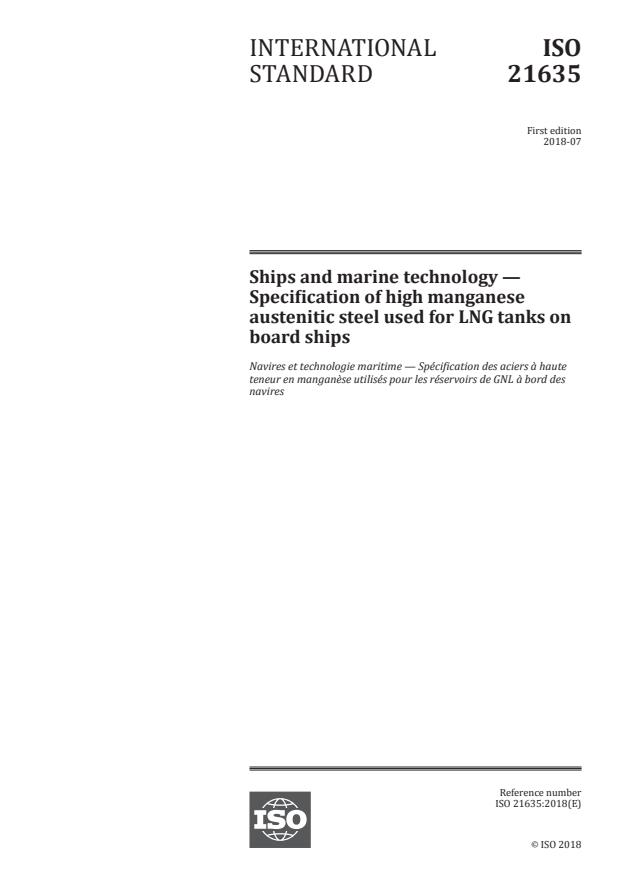
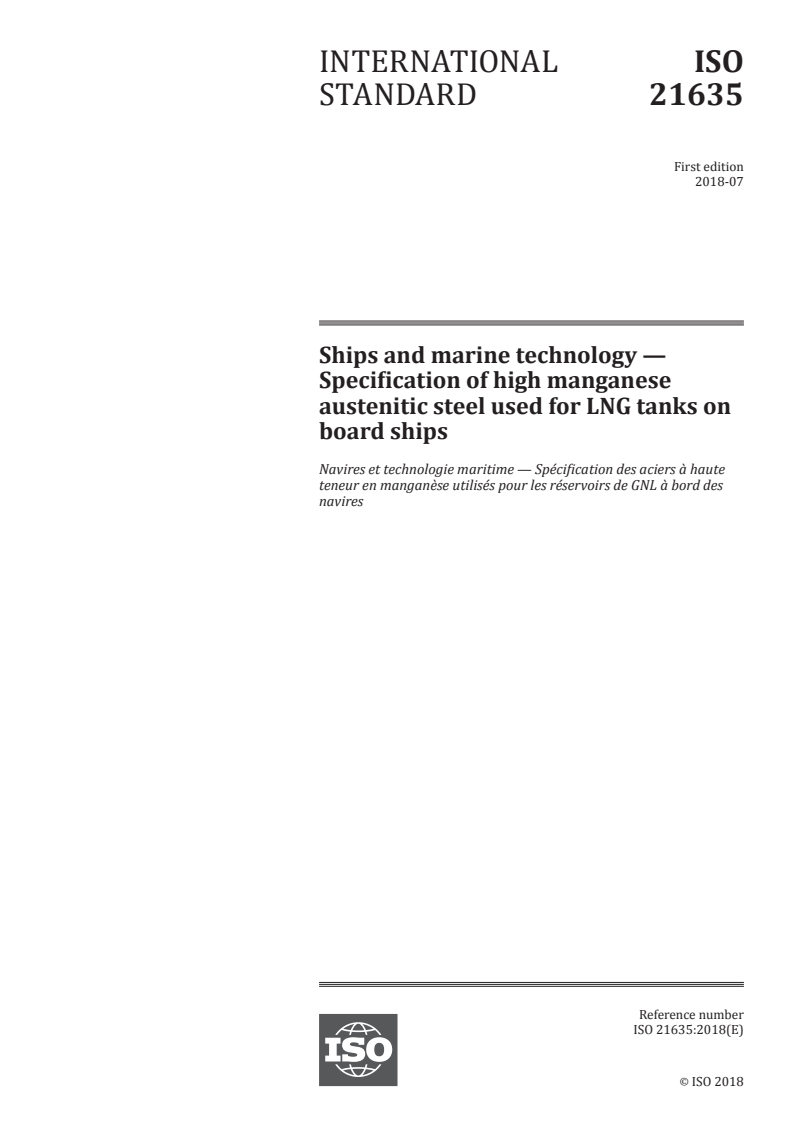
INTERNATIONAL ISO
STANDARD 21635
First edition
2018-07
Ships and marine technology —
Specification of high manganese
austenitic steel used for LNG tanks on
board ships
Navires et technologie maritime — Spécification des aciers à haute
teneur en manganèse utilisés pour les réservoirs de GNL à bord des
navires
Reference number
©
ISO 2018
© ISO 2018
All rights reserved. Unless otherwise specified, or required in the context of its implementation, no part of this publication may
be reproduced or utilized otherwise in any form or by any means, electronic or mechanical, including photocopying, or posting
on the internet or an intranet, without prior written permission. Permission can be requested from either ISO at the address
below or ISO’s member body in the country of the requester.
ISO copyright office
CP 401 • Ch. de Blandonnet 8
CH-1214 Vernier, Geneva
Phone: +41 22 749 01 11
Fax: +41 22 749 09 47
Email: copyright@iso.org
Website: www.iso.org
Published in Switzerland
ii © ISO 2018 – All rights reserved
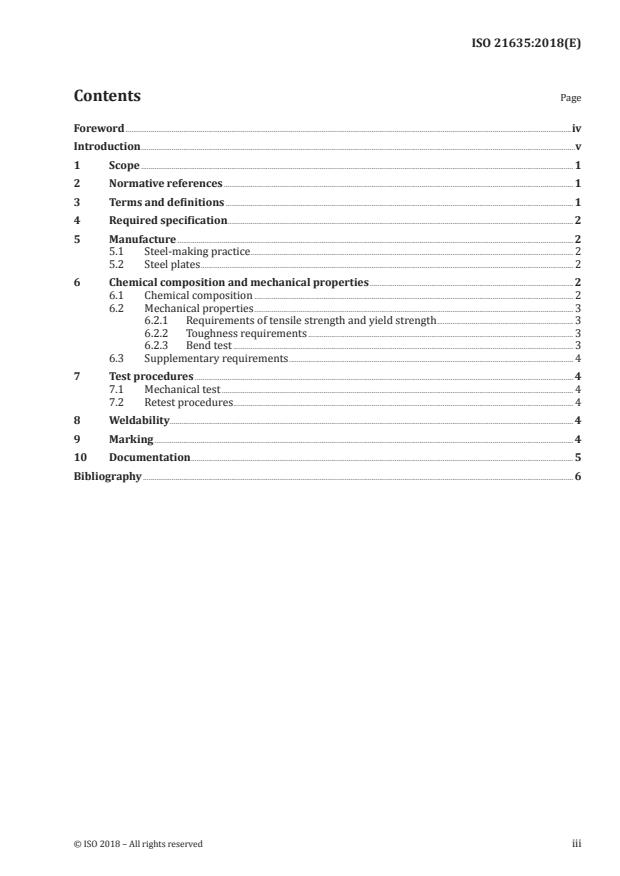
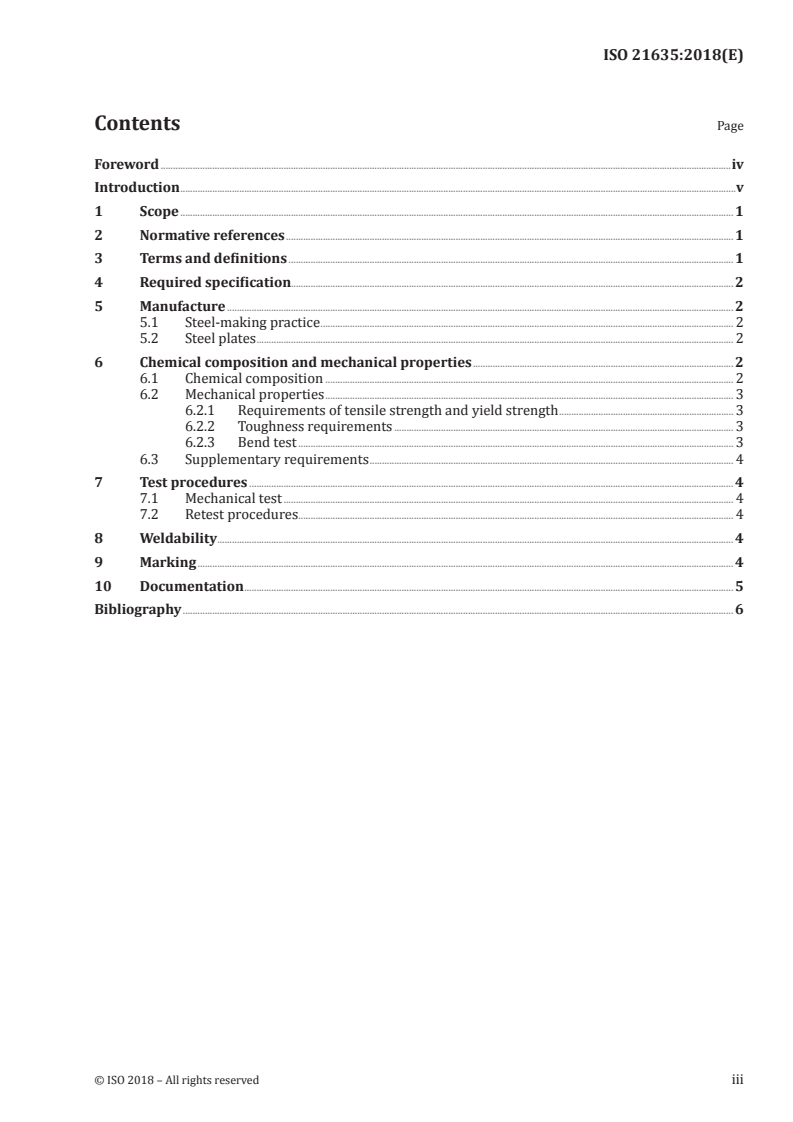
Contents Page
Foreword .iv
Introduction .v
1 Scope . 1
2 Normative references . 1
3 Terms and definitions . 1
4 Required specification. 2
5 Manufacture . 2
5.1 Steel-making practice . 2
5.2 Steel plates . 2
6 Chemical composition and mechanical properties . 2
6.1 Chemical composition . 2
6.2 Mechanical properties . 3
6.2.1 Requirements of tensile strength and yield strength . 3
6.2.2 Toughness requirements . 3
6.2.3 Bend test . 3
6.3 Supplementary requirements . 4
7 Test procedures . 4
7.1 Mechanical test . 4
7.2 Retest procedures . 4
8 Weldability . 4
9 Marking . 4
10 Documentation . 5
Bibliography . 6
Foreword
ISO (the International Organization for Standardization) is a worldwide federation of national standards
bodies (ISO member bodies). The work of preparing International Standards is normally carried out
through ISO technical committees. Each member body interested in a subject for which a technical
committee has been established has the right to be represented on that committee. International
organizations, governmental and non-governmental, in liaison with ISO, also take part in the work.
ISO collaborates closely with the International Electrotechnical Commission (IEC) on all matters of
electrotechnical standardization.
The procedures used to develop this document and those intended for its further maintenance are
described in the ISO/IEC Directives, Part 1. In particular the different approval criteria needed for the
different types of ISO documents should be noted. This document was drafted in accordance with the
editorial rules of the ISO/IEC Directives, Part 2 (see www .iso .org/directives).
Attention is drawn to the possibility that some of the elements of this document may be the subject of
patent rights. ISO shall not be held responsible for identifying any or all such patent rights. Details of
any patent rights identified during the development of the document will be in the Introduction and/or
on the ISO list of patent declarations received (see www .iso .org/patents).
Any trade name used in this document is information given for the convenience of users and does not
constitute an endorsement.
For an explanation on the voluntary nature of standards, the meaning of ISO specific terms and
expressions related to conformity assessment, as well as information about ISO's adherence to the
World Trade Organization (WTO) principles in the Technical Barriers to Trade (TBT) see the following
URL: www .iso .org/iso/foreword .html.
This document was prepared by Technical Committee ISO/TC 8, Ships and marine technology,
Subcommittee SC 8, Ship design.
Any feedback or questions on this document should be directed to the user’s national standards body. A
complete listing of these bodies can be found at www .iso .org/members .html.
iv © ISO 2018 – All rights reserved
Introduction
There have been several requirements regarding metallic materials for cryogenic applications since the
adoption of the IGC and IGF Codes. The newly developed, high manganese (Mn) austenitic steel should
possess mechanical properties including Charpy impact energy values comparable to those of materials
[1] [2]
for cryogenic service listed in both the IGC Code and IGF Code . Consequently, high Mn austenitic
steel is intended to satisfy the strength requirements of the structure of cargo tanks, fuel tanks and
piping systems of LNG carriers and LNG-fuelled ships.
This document provides a standard specification of high manganese austenitic steel for material
suppliers, ship owners, ship yards, manufacturers and shipping companies with regard to producing,
purchasing and using such materials.
INTERNATIONAL STANDARD ISO 21635:2018(E)
Ships and marine technology — Specification of high
manganese austenitic steel used for LNG tanks on board
ships
1 Scope
This document describes the specification of high manganese (Mn) austenitic steel plates to be used for
LNG tanks on board ships.
The specification of high manganese austenitic steel can be also considered for design and manufacture
of cargo tanks and process pressure vessels of LNG supply/terminal and transportation of fuels and
traded gases.
This document is primarily applicable for the specification of LNG tank
...
INTERNATIONAL ISO
STANDARD 21635
First edition
2018-07
Ships and marine technology —
Specification of high manganese
austenitic steel used for LNG tanks on
board ships
Navires et technologie maritime — Spécification des aciers à haute
teneur en manganèse utilisés pour les réservoirs de GNL à bord des
navires
Reference number
©
ISO 2018
© ISO 2018
All rights reserved. Unless otherwise specified, or required in the context of its implementation, no part of this publication may
be reproduced or utilized otherwise in any form or by any means, electronic or mechanical, including photocopying, or posting
on the internet or an intranet, without prior written permission. Permission can be requested from either ISO at the address
below or ISO’s member body in the country of the requester.
ISO copyright office
CP 401 • Ch. de Blandonnet 8
CH-1214 Vernier, Geneva
Phone: +41 22 749 01 11
Fax: +41 22 749 09 47
Email: copyright@iso.org
Website: www.iso.org
Published in Switzerland
ii © ISO 2018 – All rights reserved
Contents Page
Foreword .iv
Introduction .v
1 Scope . 1
2 Normative references . 1
3 Terms and definitions . 1
4 Required specification. 2
5 Manufacture . 2
5.1 Steel-making practice . 2
5.2 Steel plates . 2
6 Chemical composition and mechanical properties . 2
6.1 Chemical composition . 2
6.2 Mechanical properties . 3
6.2.1 Requirements of tensile strength and yield strength . 3
6.2.2 Toughness requirements . 3
6.2.3 Bend test . 3
6.3 Supplementary requirements . 4
7 Test procedures . 4
7.1 Mechanical test . 4
7.2 Retest procedures . 4
8 Weldability . 4
9 Marking . 4
10 Documentation . 5
Bibliography . 6
Foreword
ISO (the International Organization for Standardization) is a worldwide federation of national standards
bodies (ISO member bodies). The work of preparing International Standards is normally carried out
through ISO technical committees. Each member body interested in a subject for which a technical
committee has been established has the right to be represented on that committee. International
organizations, governmental and non-governmental, in liaison with ISO, also take part in the work.
ISO collaborates closely with the International Electrotechnical Commission (IEC) on all matters of
electrotechnical standardization.
The procedures used to develop this document and those intended for its further maintenance are
described in the ISO/IEC Directives, Part 1. In particular the different approval criteria needed for the
different types of ISO documents should be noted. This document was drafted in accordance with the
editorial rules of the ISO/IEC Directives, Part 2 (see www .iso .org/directives).
Attention is drawn to the possibility that some of the elements of this document may be the subject of
patent rights. ISO shall not be held responsible for identifying any or all such patent rights. Details of
any patent rights identified during the development of the document will be in the Introduction and/or
on the ISO list of patent declarations received (see www .iso .org/patents).
Any trade name used in this document is information given for the convenience of users and does not
constitute an endorsement.
For an explanation on the voluntary nature of standards, the meaning of ISO specific terms and
expressions related to conformity assessment, as well as information about ISO's adherence to the
World Trade Organization (WTO) principles in the Technical Barriers to Trade (TBT) see the following
URL: www .iso .org/iso/foreword .html.
This document was prepared by Technical Committee ISO/TC 8, Ships and marine technology,
Subcommittee SC 8, Ship design.
Any feedback or questions on this document should be directed to the user’s national standards body. A
complete listing of these bodies can be found at www .iso .org/members .html.
iv © ISO 2018 – All rights reserved
Introduction
There have been several requirements regarding metallic materials for cryogenic applications since the
adoption of the IGC and IGF Codes. The newly developed, high manganese (Mn) austenitic steel should
possess mechanical properties including Charpy impact energy values comparable to those of materials
[1] [2]
for cryogenic service listed in both the IGC Code and IGF Code . Consequently, high Mn austenitic
steel is intended to satisfy the strength requirements of the structure of cargo tanks, fuel tanks and
piping systems of LNG carriers and LNG-fuelled ships.
This document provides a standard specification of high manganese austenitic steel for material
suppliers, ship owners, ship yards, manufacturers and shipping companies with regard to producing,
purchasing and using such materials.
INTERNATIONAL STANDARD ISO 21635:2018(E)
Ships and marine technology — Specification of high
manganese austenitic steel used for LNG tanks on board
ships
1 Scope
This document describes the specification of high manganese (Mn) austenitic steel plates to be used for
LNG tanks on board ships.
The specification of high manganese austenitic steel can be also considered for design and manufacture
of cargo tanks and process pressure vessels of LNG supply/terminal and transportation of fuels and
traded gases.
This document is primarily applicable for the specification of LNG tank
...