


ISO/PAS 30003:2008
(Main)Ships and marine technology - Ship recycling management systems - Requirements for bodies providing audit and certification of ship recycling management
Ships and marine technology - Ship recycling management systems - Requirements for bodies providing audit and certification of ship recycling management
ISO/PAS 30003:2008 contains principles and requirements for bodies providing the audit and certification of ship recycling management systems according to management system specifications and standards such as ISO 30000.
Navires et technologie maritime — Systèmes de management de recyclage des navires — Exigences pour les organismes assurant l'audit et la certification de management de recyclage des navires
General Information
Relations
Frequently Asked Questions
ISO/PAS 30003:2008 is a technical specification published by the International Organization for Standardization (ISO). Its full title is "Ships and marine technology - Ship recycling management systems - Requirements for bodies providing audit and certification of ship recycling management". This standard covers: ISO/PAS 30003:2008 contains principles and requirements for bodies providing the audit and certification of ship recycling management systems according to management system specifications and standards such as ISO 30000.
ISO/PAS 30003:2008 contains principles and requirements for bodies providing the audit and certification of ship recycling management systems according to management system specifications and standards such as ISO 30000.
ISO/PAS 30003:2008 is classified under the following ICS (International Classification for Standards) categories: 47.020.01 - General standards related to shipbuilding and marine structures. The ICS classification helps identify the subject area and facilitates finding related standards.
ISO/PAS 30003:2008 has the following relationships with other standards: It is inter standard links to ISO 30003:2009. Understanding these relationships helps ensure you are using the most current and applicable version of the standard.
You can purchase ISO/PAS 30003:2008 directly from iTeh Standards. The document is available in PDF format and is delivered instantly after payment. Add the standard to your cart and complete the secure checkout process. iTeh Standards is an authorized distributor of ISO standards.
Standards Content (Sample)
PUBLICLY ISO/PAS
AVAILABLE 30003
SPECIFICATION
First edition
2008-07-01
Ships and marine technology — Ship
recycling management systems —
Requirements for bodies providing audit
and certification of ship recycling
management
Navires et technologie maritime — Systèmes de management de
recyclage des navires — Exigences pour les organismes assurant
l'audit et la certification de management de recyclage des navires
Reference number
©
ISO 2008
PDF disclaimer
This PDF file may contain embedded typefaces. In accordance with Adobe's licensing policy, this file may be printed or viewed but
shall not be edited unless the typefaces which are embedded are licensed to and installed on the computer performing the editing. In
downloading this file, parties accept therein the responsibility of not infringing Adobe's licensing policy. The ISO Central Secretariat
accepts no liability in this area.
Adobe is a trademark of Adobe Systems Incorporated.
Details of the software products used to create this PDF file can be found in the General Info relative to the file; the PDF-creation
parameters were optimized for printing. Every care has been taken to ensure that the file is suitable for use by ISO member bodies. In
the unlikely event that a problem relating to it is found, please inform the Central Secretariat at the address given below.
© ISO 2008
All rights reserved. Unless otherwise specified, no part of this publication may be reproduced or utilized in any form or by any means,
electronic or mechanical, including photocopying and microfilm, without permission in writing from either ISO at the address below or
ISO's member body in the country of the requester.
ISO copyright office
Case postale 56 • CH-1211 Geneva 20
Tel. + 41 22 749 01 11
Fax + 41 22 749 09 47
E-mail copyright@iso.org
Web www.iso.org
Published in Switzerland
ii © ISO 2008 – All rights reserved
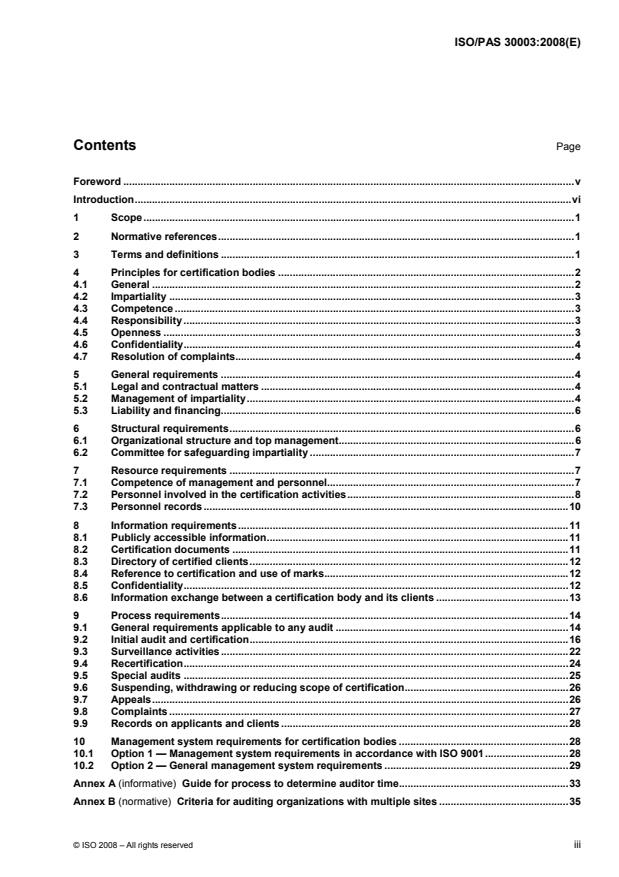
Contents Page
Foreword .v
Introduction.vi
1 Scope.1
2 Normative references.1
3 Terms and definitions .1
4 Principles for certification bodies .2
4.1 General .2
4.2 Impartiality .3
4.3 Competence .3
4.4 Responsibility .3
4.5 Openness .3
4.6 Confidentiality.4
4.7 Resolution of complaints.4
5 General requirements .4
5.1 Legal and contractual matters .4
5.2 Management of impartiality.4
5.3 Liability and financing.6
6 Structural requirements.6
6.1 Organizational structure and top management.6
6.2 Committee for safeguarding impartiality .7
7 Resource requirements .7
7.1 Competence of management and personnel.7
7.2 Personnel involved in the certification activities.8
7.3 Personnel records.10
8 Information requirements.11
8.1 Publicly accessible information.11
8.2 Certification documents .11
8.3 Directory of certified clients.12
8.4 Reference to certification and use of marks.12
8.5 Confidentiality.12
8.6 Information exchange between a certification body and its clients .13
9 Process requirements.14
9.1 General requirements applicable to any audit .14
9.2 Initial audit and certification.16
9.3 Surveillance activities.22
9.4 Recertification.24
9.5 Special audits .25
9.6 Suspending, withdrawing or reducing scope of certification.26
9.7 Appeals.26
9.8 Complaints .27
9.9 Records on applicants and clients .28
10 Management system requirements for certification bodies .28
10.1 Option 1 — Management system requirements in accordance with ISO 9001.28
10.2 Option 2 — General management system requirements .29
Annex A (informative) Guide for process to determine auditor time.33
Annex B (normative) Criteria for auditing organizations with multiple sites .35
Annex C (normative) Auditor education, work and audit experience and training durations .39
Annex D (normative) Auditor competence requirements .40
Bibliography .42
iv © ISO 2008 – All rights reserved
Foreword
ISO (the International Organization for Standardization) is a worldwide federation of national standards bodies
(ISO member bodies). The work of preparing International Standards is normally carried out through ISO
technical committees. Each member body interested in a subject for which a technical committee has been
established has the right to be represented on that committee. International organizations, governmental and
non-governmental, in liaison with ISO, also take part in the work. ISO collaborates closely with the
International Electrotechnical Commission (IEC) on all matters of electrotechnical standardization.
International Standards are drafted in accordance with the rules given in the ISO/IEC Directives, Part 2.
The main task of technical committees is to prepare International Standards. Draft International Standards
adopted by the technical committees are circulated to the member bodies for voting. Publication as an
International Standard requires approval by at least 75 % of the member bodies casting a vote.
In other circumstances, particularly when there is an urgent market requirement for such documents, a
technical committee may decide to publish other types of document:
— an ISO Publicly Available Specification (ISO/PAS) represents an agreement between technical experts in
an ISO working group and is accepted for publication if it is approved by more than 50 % of the members
of the parent committee casting a vote;
— an ISO Technical Specification (ISO/TS) represents an agreement between the members of a technical
committee and is accepted for publication if it is approved by 2/3 of the members of the committee casting
a vote.
An ISO/PAS or ISO/TS is reviewed after three years in order to decide whether it will be confirmed for a
further three years, revised to become an International Standard, or withdrawn. If the ISO/PAS or ISO/TS is
confirmed, it is reviewed again after a further three years, at which time it must either be transformed into an
International Standard or be withdrawn.
Attention is drawn to the possibility that some of the elements of this document may be the subject of patent
rights. ISO shall not be held responsible for identifying any or all such patent rights.
ISO/PAS 30003 was prepared by Technical Committee ISO/TC 8, Ships and marine technology.
Introduction
This Publicly Available Specification is intended for use by bodies that carry out audit and certification of ship
recycling management systems. Certification of ship recycling management systems is a third-party
conformity assessment activity (see ISO/IEC 17021:2006, 5.5). Bodies performing this activity are therefore
third-party conformity assessment bodies named in this Publicly Available Specification “certification
body/bodies”. This wording should not be an obstacle to the use of this Publicly Available Specification by
bodies with other designations that undertake activities covered by the scope of this document. Indeed, this
Publicly Available Specification should be usable by anybody involved in the assessment of ship recycling
management systems.
Certification of ship recycling management systems should be delivered by certification bodies who have
demonstrated competence to do so. One means of demonstrating competence for the certification bodies and
accreditation bodies is available from the International Accreditation Forum (IAF).
This document defines the minimum requirements of a certification body and its associated auditors
recognizing the unique need for insight and knowledge when auditing and certifying a client organization.
Requirements for ship recycling management systems can originate from a number of sources, and this
Publicly Available Specification has been developed to assist in the certification of ship recycling management
systems that fulfil the requirements of ISO 30000, Ships and marine technology — Ship recycling
management systems — Specifications for management systems for safe and environmentally sound ship
recycling facilities.
As such, this Publicly Available Specification:
⎯ provides harmonized guidance for the accreditation of certification bodies applying for ISO 30000
certification/registration;
⎯ defines the rules applicable for the audit and certification of a ship recycling management system
complying with the ship recycling management system standard’s requirements (or other sets of specified
ship recycling management systems requirements);
⎯ provides the customers the necessary information and confidence about the way certification of their
waste and other material handling or service companies have been granted.
Certification of ship recycling management systems of an organization is one means of providing assurance
that the organization has implemented a system for ship recycling management in line with its policy.
This Publicly Available Specification specifies requirements for certification bodies. Observance of these
requirements is intended to ensure that certification bodies operate ship recycling management system
certification in a competent, consistent and reliable manner, thereby facilitating the recognition of such bodies
and the acceptance of their certifications on a national and international basis. This Publicly Available
Specification should serve as a foundation for facilitating the recognition of ship recycling management system
certification in the interests of the international community.
Certification of a ship recycling management system provides independent verification that the ship recycling
management system of the organization
a) conforms to specified requirements,
b) is capable of consistently achieving its stated policy and objectives,
c) is effectively implemented.
vi © ISO 2008 – All rights reserved
Certification of a ship recycling management system thereby provides value to the organization, its customers
and interested parties.
This Publicly Available Specification aims at being the basis for recognition of the competence of certification
bodies in their provision of ship recycling management system certification. It can be used as the basis for
recognition of the competence of certification bodies in their provision of ship recycling management system
certification (such recognition may be in the form of notification, peer assessment, or direct recognition by
regulatory authorities or industry consortia).
Certification activities involve the audit of an organization’s ship recycling management system. The form of
attestation of conformity of an organization’s ship recycling management system to a specific standard (for
example ISO 30000) or other specified requirements is normally a certification document or a certificate.
It is for the organization being certified to develop its own ship recycling management systems (including the
ISO 30000 ship recycling management system, other sets of specified management system requirements,
quality systems, environmental management systems or occupational health and safety management
systems) and, other than where relevant legislative requirements specify the contrary, it is for the organization
to decide how the various components of these shall be arranged. The degree of integration between the
various ship recycling management system components will vary from organization to organization. It is
therefore appropriate for certification bodies that operate in accordance with this Publicly Available
Specification to take into account the culture and practices of their clients in respect of the integration of their
ship recycling management system within the wider organization.
PUBLICLY AVAILABLE SPECIFICATION ISO/PAS 30003:2008(E)
Ships and marine technology — Ship recycling management
systems — Requirements for bodies providing audit and
certification of ship recycling management
1 Scope
This Publicly Available Specification contains principles and requirements for bodies providing the audit and
certification of ship recycling management systems according to management system specifications and
standards such as ISO 30000.
Certification of ship recycling management systems is a third-party conformity assessment activity (see
ISO/IEC 17000:2004, 5.5). Bodies performing this activity are therefore third-party conformity assessment
bodies named in this Publicly Available Specification “certification body/bodies”.
NOTE 1 Certification of a ship recycling management system is sometimes also called registration, and certification
bodies are sometimes called registrars.
NOTE 2 A certification body can be non-governmental or governmental (with or without regulatory authority).
NOTE 3 This Publicly Available Specification can be used as a criteria document for accreditation or peer assessment
or other audit processes.
2 Normative references
The following referenced documents are indispensable for the application of this document. For dated
references, only the edition cited applies. For undated references, the latest edition of the referenced
document (including any amendments) applies.
ISO/IEC 17000:2004, Conformity assessment — Vocabulary and general principles
ISO 14001, Environmental management systems — Requirements with guidance for use
ISO 19011:2002, Guidelines for quality and/or environmental management systems auditing
ISO/PAS 30000, Ships and marine technology — Ship recycling management systems — Specifications for
management systems for safe and environmentally sound ship recycling facilities
3 Terms and definitions
For the purposes of this document, the terms and definitions given in ISO/IEC 17000 and the following apply.
3.1
certified client
organization whose ship recycling management system has been certified/registered by a qualified third party
3.2
management system consultancy and/or associated process and operation asessments
participation in designing, implementing or maintaining a ship recycling management system and in
conducting process and operation assessments such as
a) preparing or producing manuals or procedures,
b) giving specific advice, instructions or solutions towards the development and implementation of a ship
recycling management system,
c) conducting internal audits, and
d) conducting process and operation assessment and analysis
NOTE Arranging training and participating as a trainer is not considered consultancy, provided that, where the course
relates to ship recycling management systems or auditing, it is confined to the provision of generic information that is
freely available in the public domain, i.e. the trainer should not provide company-specific solutions.
4 Principles for certification bodies
4.1 General
4.1.1 This clause provides the basis for the subsequent specific performance and descriptive requirements
in this Publicly Available Specification. It does not give specific requirements for all situations that can occur.
These principles should be applied as guidance for the decisions that may need to be made for unanticipated
situations. Principles are not requirements.
4.1.2 The overall aim of certification is to give confidence to all parties that a ship recycling management
system, process or service fulfils specified requirements. The value of certification is the degree of public
confidence and trust that is established in a management system, process or service after it has been
impartially and competently assessed by a third party. Parties that have an interest in certification include, but
are not limited to:
a) the clients of the certification bodies;
b) the customers of the organizations whose management systems are certified;
c) governmental authorities;
d) non-governmental organizations;
e) waste and other material handling or service companies and other members of the public.
4.1.3 Principles for inspiring confidence include:
a) impartiality;
b) competence;
c) responsibility;
d) openness;
e) confidentiality;
f) resolution of complaints.
2 © ISO 2008 – All rights reserved
4.2 Impartiality
4.2.1 Being impartial, and being perceived to be impartial, is necessary for a certification body to deliver
certification that provides confidence.
4.2.2 It is recognized that the source of revenue for a certification body is its client paying for certification,
and that this is a potential threat to impartiality.
4.2.3 To obtain and maintain confidence, a certification body has to be able to demonstrate that its
decisions are based on objective evidence of conformity (or nonconformity) obtained by the certification body,
and that its decisions are not influenced by other interests or by other parties.
4.2.4 Threats to impartiality include:
a) Self-interest threats – threats that arise from a person or body acting in their own interest. A concern
related to certification, as a threat to impartiality, is financial self-interest.
b) Self-review threats – threats that arise from a person or body reviewing the work done by themselves.
Auditing the ship recycling management systems of a client to whom the certification body provided ship
recycling management systems consultancy would be a self-review threat and therefore is not acceptable.
c) Familiarity (or trust) threats – threats that arise from a person or body being too familiar or trusting of
another person instead of seeking audit evidence is a familiarity threat to impartiality.
d) Intimidation threats – threats that arise from a person or body having a perception of being coerced
openly or secretively, such as a threat to be replaced or reported to a supervisor.
4.3 Competence
Competence of the personnel supported by the organizational infrastructure is necessary for the certification
body to deliver certification that provides confidence. Competence is the demonstrated ability to apply
appropriate knowledge and skills effectively. Such competence may be demonstrated by suitable registration
with such bodes as the International Accreditation Forum (IAF).
4.4 Responsibility
4.4.1 The client organization, not the certification body, has the responsibility of conforming to the
requirements for certification.
4.4.2 The certification body has the responsibility to assess sufficient objective evidence upon which to
base a recommendation for certification. Based on audit recommendations it makes a decision to grant
certification if there is sufficient evidence of conformity, or not to grant certification if there is not sufficient
evidence of conformity.
NOTE Audit evidence is verifiable. It is based on samples of the information available, since an audit is conducted
during a finite period of time and with finite resources. The appropriate use of sampling is closely related to the confidence
that can be placed in the audit conclusions.
4.5 Openness
4.5.1 A certification body needs to provide public access or disclosure of appropriate and timely information
about the audit process and certification process, and about the certification status (i.e. granting, suspending,
reducing the scope of, or withdrawing, certification) of any organization, in order to gain confidence in the
integrity and credibility of certification. Therefore, openness is access to, or disclosure of, information.
4.5.2 To gain or maintain confidence in certification, a certification body needs to provide appropriate
access to, or disclosure of, nonconfidential information about the conclusions of specific audits (e.g. audits in
response to complaints) to specific interested parties.
4.6 Confidentiality
In order to gain the privileged access to information that is needed for the certification body to assess
conformity to requirements for certification adequately, a certification body needs to keep confidential any
sensitive, proprietary and/or vulnerability-related information about an organization’s ship recycling
management system.
4.7 Resolution of complaints
Parties that rely on certification expect to have complaints investigated and, if these are found to be valid,
should have confidence that the complaints will be appropriately addressed and that a reasonable effort will
be made to resolve them.
NOTE An appropriate balance between the principles of openness and confidentiality, including resolution of
complaints, is necessary in order to demonstrate integrity and credibility to all users of certification.
5 General requirements
5.1 Legal and contractual matters
5.1.1 Legal responsibility
The certification body shall be a legal entity, or a defined part of a legal entity, such that it can be held legally
responsible for all its certification activities. A governmental certification body is deemed to be a legal entity on
the basis of its governmental status.
5.1.2 Certification agreement
The certification body shall have a legally enforceable agreement for the provision of certification activities to
its client organizations. In addition, where there are multiple offices of certification bodies or multiple sites of a
certified client, the certification body shall ensure there is a legally enforceable agreement between the
certification body granting certification and issuing a certificate, and the certified client, explicitly covering each
certified site of the client. The agreement shall clearly define to which standard(s) and/or other normative
documents the certification shall take place.
5.1.3 Responsibility for certification decisions
The certification body shall retain authority and shall be responsible for its decisions relating to certification,
including the granting, maintaining, renewing, extending, reducing, suspending and withdrawing of certification.
5.2 Management of impartiality
5.2.1 The certification body shall have top-management commitment to impartiality in ship recycling
management system certification activities. The certification body shall have a publicly available statement
that it understands the importance of impartiality in carrying out its ship recycling management system
certification activities, manages conflict of interest and ensures objectivity of its ship recycling management
system certification activities.
5.2.2 The certification body shall identify, analyse and document the possibilities for conflict of interests
arising from provision of certification, including any conflicts arising from its relationships. Having relationships
does not necessarily present a certification body with a conflict of interest. However, if any relationship creates
processes and operations to impartiality, the certification body shall document how it eliminates or minimizes
such processes and operations and shall be able to demonstrate this to the committee specified in 6.2. The
demonstration shall cover all potential sources of conflict of interests that are identified, whether they arise
from within the certification body or from the activities of other persons, bodies or organizations.
4 © ISO 2008 – All rights reserved
NOTE A relationship that threatens the impartiality of the certification body can be based on ownership, governance,
management, personnel, shared resources, finances, contracts, marketing, and payment of a sales commission or other
inducement for the referral of new clients, etc.
5.2.3 When a relationship gives rise to a threat to impartiality that cannot be eliminated or minimized, such
as a wholly owned subsidiary of the certification body requesting certification from its parent, then certification
shall not be provided.
5.2.4 A certification body shall not certify another certification body for its ship recycling management
system certification activities.
NOTE A relationship that threatens the impartiality of the certification body can be based on ownership, governance,
management, personnel, shared resources, finances, contracts, marketing, and payment of a sales commission or other
inducement for the referral of new clients, etc.
5.2.5 The certification body and any part of the same legal entity shall not offer or provide ship recycling
management system consultancy and/or associated process and operation assessments. This applies also to
that part of government identified as the certification body.
5.2.6 The certification body and any part of the same legal entity shall not offer or provide internal audits to
its certified clients. This applies also to that part of government identified as the certification body.
NOTE Internal audits in which auditors suggest solutions (to identified nonconformities or opportunities for
improvement) are considered an unacceptable threat to impartiality.
5.2.7 The certification body shall not certify a ship recycling management system on which a client has
received ship recycling management system consultancy and/or associated process and operation
assessments or internal audits where the relationship between the consultancy organization and the
certification body poses an unacceptable threat to the impartiality of the certification body.
NOTE 1 Allowing a minimum period of two years to elapse following the end of the ship recycling management system
consultancy and/or associated process and operation assessments or internal audits is one way of reducing the threat to
impartiality to an acceptable level.
NOTE 2 Internal audits in which auditors suggest solutions (to identified nonconformities or opportunities for
improvement) are considered an unacceptable threat to impartiality.
5.2.8 The certification body shall not outsource audits to organizations that pose an unacceptable threat to
the impartiality of the certification body (see 7.2).
5.2.9 The certification body’s activities shall not be marketed as linked with the activities of an organization
that provides ship recycling management system consultancy and/or associated process and operation
assessments. The certification body shall take action to correct inappropriate claims by any consultancy
organization stating or implying that certification would be simpler, easier, faster or less expensive if the
certification body is used. A certification body shall not state or imply that certification would be simpler, easier,
faster or less expensive if a specified consultancy organization is used.
5.2.10 To ensure that there is no conflict of interests, personnel who have provided ship recycling
management system consultancy and/or associated process and operation assessments to the client,
including those acting in a managerial capacity, shall not be employed to take part in an audit or certification
activities within two years following the end of the consultancy.
5.2.11 The certification body shall take action to respond to any threats to its impartiality arising from the
actions of other persons, bodies or organizations.
5.2.12 All certification body personnel, either internal or external, or committees, who could influence the
certification activities, shall act impartially and shall not allow commercial, financial or other pressures to
compromise impartiality.
5.2.13 Certification bodies shall require personnel, internal and external, to reveal any situation known to
them that may present them or the certification body with a conflict of interests. Certification bodies shall use
this information as input to identifying threats to impartiality raised by the activities of such personnel or by the
organizations that employ them, and shall not use such personnel, internal or external, unless they can
demonstrate that there is no conflict of interests.
NOTE The fact that the organization employing the auditor is known to have provided ship recycling management
system consultancy and/or associated process and operation assessments on the ship recycling management system,
within two years following the end of the consultancy, is likely to be considered a serious threat to impartiality.
5.3 Liability and financing
5.3.1 The certification body shall be able to demonstrate that it has evaluated the processes and operations
arising from its certification activities and that it has arrangements (e.g. insurance or reserves) to cover
liabilities arising from its operations in each of its fields of activities and the geographic areas in which it
operates.
5.3.2 The certification body shall evaluate its finances and sources of income and demonstrate to the
committee specified in 6.2 that initially, and on an ongoing basis, commercial, financial or other pressures do
not compromise its impartiality.
6 Structural requirements
6.1 Organizational structure and top management
6.1.1 The structure of the certification body shall be such as to give confidence in its certification.
6.1.2 The certification body shall identify the top management (board, group of persons, or person) having
overall authority and responsibility for each of the following:
a) development of policies relating to the operation of the body;
b) supervision of the implementation of the policies and procedures;
c) supervision of the finances of the body;
d) performance of audits, certification and resolution of complaints;
e) decisions on certification;
f) delegation of authority to committees or individuals, as required, to undertake defined activities on its
behalf;
g) contractual arrangements;
h) providing adequate, qualified resources for certification activities.
6.1.3 The certification body shall document the organizational structure, showing duties, responsibilities and
authorities of management and other certification personnel and any committees. When the certification body
is a defined part of a legal entity, the structure shall include the line of authority and the relationship to other
parts within the same legal entity.
6.1.4 The certification body shall have formal rules for the appointment, terms of reference and operation of
any committees that are involved in the certification activities.
6 © ISO 2008 – All rights reserved
6.2 Committee for safeguarding impartiality
6.2.1 The structure of the certification body shall safeguard the impartiality of the activities of the
certification body and shall provide for a committee:
a) to assist in developing the policies relating to impartiality of its certification activities;
b) to counteract any tendency on the part of the owners of a certification body to allow commercial or other
considerations to prevent the consistent objective provision of certification activities;
c) to advise on matters affecting confidence in certification, including openness and public perception.
Other tasks or duties may be assigned to the committee. However, such additional tasks or duties should not
compromise its essential role of ensuring impartiality.
6.2.2 The composition, terms of reference, duties, authorities, competence of members and responsibilities
of this committee shall be formally documented and authorized by the top management of the certification
body to ensure:
a) representation of a balance of interests such that no single interest predominates (internal or external
employees of the certification body are considered to be a single interest and should not predominate);
b) access to all the information necessary to enable it to fulfil its functions (see also 5.2.2 and 5.3.2);
c) that, if the top management of the certification body does not respect the advice of this committee, the
committee shall have the right to take independent action (e.g. informing authorities, accreditation bodies,
stakeholders). In taking independent action, committees shall respect the confidentiality requirements of
8.5 relating to the client and certification body.
NOTE Although this committee cannot represent every interest, a certification body should identify and invite key
interests. Such interests can include: clients of the certification body, customers of organizations whose ship recycling
management systems are certified, representatives of industry trade associations, representatives of governmental
regulatory bodies or other governmental services, or representatives of non-governmental organizations, including waste
and other material handling or service companies.
7 Resource requirements
7.1 Competence of management and personnel
7.1.1 The certification body shall ensure that all personnel involved in the audit and certification of operating
companies of waste and other material handling or service companies are competent for the roles they carry
out.
It shall have processes to ensure that personnel have appropriate knowledge, skills and experience relevant
to the types of ship recycling management systems and geographic areas in which it operates.
It shall determine for each technical area (as relevant for the specific certification scheme), and for each
function in the certification activity, the qualifications and competence required.
It shall determine the means for the demonstration of competence prior to carrying out specific functions.
Records of the determination shall be maintained.
7.1.2 In determining the competence requirements for its personnel performing certification, the certification
body shall address the functions undertaken by management and administrative personnel in addition to those
directly performing audit and certification activities.
7.1.3 The certification body shall be able to document extensive experience in assessing the design,
construction and surveying of merchant ships and of shipyard, repair yard, recycling facility operations or
comparable activities.
7.1.4 The certification body should have comprehensive procedures for auditing ship recycling facility
management systems, published and continually upgraded through research and development programmes.
7.1.5 The certification body shall publish an annual register of the facilities it has certified.
7.1.6 Certification bodies shall consult with each other periodically with a view to maintaining equivalence of
their standards and the implementation thereof.
7.2 Personnel involved in the certification activities
7.2.1 The certification body shall have, as part of its own organization, personnel having sufficient
competence for managing the type and range of audit programmes and other certification work performed.
Certification shall only be carried out by personnel exclusively employed by the certification body.
7.2.2 The certification body shall ensure that personnel assigned to perform ship recycling certification
audits, as far as these have contact with confidential information, can be trusted to maintain confidential
information obtained during verification work and that they do not create a ship recycling breach.
7.2.3 Personnel assigned to perform ship recycling management system audits shall have, as a minimum
personal attributes, knowledge, skills and education as described in ISO 19011:2002, 7.2, 7.3.1, 7.3.2 and 7.4,
relevant to ship recycling management and processes and operations analysis.
7.2.3.1 Auditor competence should be demonstrated by relevant registration with an international
accreditation body (e.g. IAF).
7.2.3.2 The ship recycling management auditor shall have competences in processes and operations
analysis, analysis of critical control points, process and operation management methodologies, and
information confidentiality. This includes, but is not limited to:
a) understanding the requirement of the ship recycling management standard or specification
(e.g. ISO/PAS 30000) in addition to
⎯ understanding the environmental management systems (e.g. ISO 14001), and
⎯ understanding the requirements of the International Convention for ship recycling;
b) understanding the waste and other material handling, transport or service companies process flow,
including analysis of critical control points, knowledge of relevant processes and practices within waste
stream management and other material handling, transport or service companies;
c) process and operation assessment and analysis — understanding the principles of process and operation
assessment and analysis;
d) processes and operations minimization, mitigation, and control, which includes
⎯ understanding the principles of processes and operations minimization, mitigation, and management,
and
⎯ knowledge of ship recycling methodologies and technologies, especially preventive measures and
techniques;
e) accident, incident and pollution planning and preparedness, which includes
⎯ knowledge of the role of government and first responders,
⎯ knowledge of relevant communications protocols, and
⎯ knowledge of relevant mitigation, response, and recovery.
8 © ISO 2008 – All rights reserved
7.2.3.3 Each ship recycling management system auditor shall also have successfully completed training
(see Annex C or equivalent) and be able to demonstrate competence in the understanding and application of
ship recycling methodologies and processes and operations analysis and management principles and should
be a certified management system auditor.
7.2.3.4 Each ship recycling management system auditor shall undertake appropriate continual training
according to their specific qualification requirements. Certification bodies shall annually review a targeted
training plan for their auditors on ship recycling methodologies, processes and operations analysis and
management principles, analysis of critical control points, audit techniques, and in particular on the
competence items listed in 7.2.3.2, a) to e). This training shall
a) be planned as the result of an analysis of needs on the subjects and competence items given above,
b) be recorded,
c) include audit case studies allowing an auditor’s competence to be evaluated,
d) be supported by information such as interpretation of the application of applicable management system
standards, FAQs, workshop records, standard correction on case studies, which should be available to
the auditor,
e) be evaluated according to training requirements, (certification bodies shall take appropriate action on the
basis of the training result), and
f) be performed by qualified trainers.
7.2.3.5 The ship recycling management system auditor shall ha
...
Questions, Comments and Discussion
Ask us and Technical Secretary will try to provide an answer. You can facilitate discussion about the standard in here.
Loading comments...