

ISO 8933-2:2024
(Main)Ships and marine technology — Energy efficiency — Part 2: Energy efficiency of maritime functional systems
General Information
- Abstract
This document specifies generic measuring and calculation methods to evaluate the energy efficiency of multiple components connected in a functional system installed on board ships, vessels for inland navigation and offshore structures. A maritime functional system consists of multiple components integrating multiple functions, working together to achieve an overall goal. The purpose of this document is to show how the energy efficiency of various functional systems correspond to the other installations on board of same functionality, thus ensuring that efficient design is rewarded. Maritime systems are grouped according to their functionality, to compare the energy efficiency of functional systems which can fulfil the same task on board a ship. This document is applicable to only the functional systems for which a unit output can be clearly defined, and which require energy to function. This document is applicable to energy consuming functional systems. It does not provide a life cycle assessment (LCA). NOTE An LCA can prove useful when considering systems which consume substances, and which would not meet the functional requirements without the use of these substances. An example is a ballast water management system (BWMS) using active substances (these types are not considered in this document). This document is applicable to the following five types of functional systems: a) pressure and flow; b) lighting; c) heating and cooling; d) mechanical; e) propulsion.
- Status
- Published
- Publication Date
- 07-Aug-2024
- Technical Committee
- ISO/TC 8 - Ships and marine technology
- Drafting Committee
- ISO/TC 8 - Ships and marine technology
- Current Stage
- 6060 - International Standard published
- Start Date
- 08-Aug-2024
- Due Date
- 20-Oct-2024
- Completion Date
- 08-Aug-2024
Overview
ISO 8933-2:2024 - Ships and marine technology - Energy efficiency - Part 2: Energy efficiency of maritime functional systems provides standardized, generic methods to measure and calculate the energy efficiency of multi-component functional systems installed on ships, inland vessels and offshore structures. The document groups maritime systems by functionality and defines how to compare systems that fulfil the same task so that efficient design and operation can be objectively assessed and rewarded. It applies only to energy-consuming functional systems that have a clearly defined unit output and does not provide a life cycle assessment (LCA).
Key topics and technical requirements
- Scope of applicability: only functional systems with defined unit outputs and energy consumption are covered.
- System grouping: functional systems are grouped by function to enable like‑for‑like energy efficiency comparisons.
- Measurement and calculation methods: generic methods for evaluating energy use of multiple interconnected components (sensors, pumps, drives, controls).
- Examples of covered functional systems (detailed in the standard):
- Pressure and flow systems (e.g., ballast water management systems - ultraviolet and electro‑chlorination types are addressed; note active‑substance BWMS types are excluded from this document’s functional assessment)
- Freshwater generators, seawater/freshwater cooling systems
- Engine lube oil, steam boiler, thermal fluid and hot water systems
- Cargo pump and cargo heating systems, separator systems, VOC recovery
- Lighting systems (internal spaces) and heating/cooling (air‑conditioning with and without compressor)
- Mechanical and propulsion functional systems
- Boundary, input/output and media definitions: how to define measurement boundaries and unit outputs for reproducible benchmarking.
- Practical measurement guidance: examples, measuring methods and calculation steps for each system type.
Applications and intended users
Who uses ISO 8933-2:2024:
- Ship designers and naval architects for energy‑efficient system design and selection
- Shipyards and system integrators for verifying installed system performance
- Ship operators and energy managers for benchmarking, monitoring and retrofit decisions
- Classification societies, flag administrations and auditors for objective energy assessments
- Marine equipment manufacturers for product comparison and competitiveness
Practical uses:
- Benchmarking alternative system designs and configurations
- Supporting procurement decisions and tender specifications
- Evaluating retrofit opportunities and operational improvements
- Demonstrating energy performance for compliance and sustainability reporting
Related standards and notes
- Part of the ISO 8933 energy efficiency framework for ships; users should consult related parts and relevant IMO/regulatory guidance where applicable.
- ISO 8933-2:2024 does not replace a full LCA; an LCA can be useful for systems that rely on chemical substances (e.g., some BWMS types).
Keywords: ISO 8933-2:2024, maritime functional systems, ship energy efficiency, ballast water management, ship systems benchmarking, marine technology energy measurement.
Get Certified
Connect with accredited certification bodies for this standard

DNV
DNV is an independent assurance and risk management provider.

Lloyd's Register
Lloyd's Register is a global professional services organisation specialising in engineering and technology.

FSC International
Forest Stewardship Council certification.
Sponsored listings
Frequently Asked Questions
ISO 8933-2:2024 is a standard published by the International Organization for Standardization (ISO). Its full title is "Ships and marine technology — Energy efficiency — Part 2: Energy efficiency of maritime functional systems". This standard covers: This document specifies generic measuring and calculation methods to evaluate the energy efficiency of multiple components connected in a functional system installed on board ships, vessels for inland navigation and offshore structures. A maritime functional system consists of multiple components integrating multiple functions, working together to achieve an overall goal. The purpose of this document is to show how the energy efficiency of various functional systems correspond to the other installations on board of same functionality, thus ensuring that efficient design is rewarded. Maritime systems are grouped according to their functionality, to compare the energy efficiency of functional systems which can fulfil the same task on board a ship. This document is applicable to only the functional systems for which a unit output can be clearly defined, and which require energy to function. This document is applicable to energy consuming functional systems. It does not provide a life cycle assessment (LCA). NOTE An LCA can prove useful when considering systems which consume substances, and which would not meet the functional requirements without the use of these substances. An example is a ballast water management system (BWMS) using active substances (these types are not considered in this document). This document is applicable to the following five types of functional systems: a) pressure and flow; b) lighting; c) heating and cooling; d) mechanical; e) propulsion.
This document specifies generic measuring and calculation methods to evaluate the energy efficiency of multiple components connected in a functional system installed on board ships, vessels for inland navigation and offshore structures. A maritime functional system consists of multiple components integrating multiple functions, working together to achieve an overall goal. The purpose of this document is to show how the energy efficiency of various functional systems correspond to the other installations on board of same functionality, thus ensuring that efficient design is rewarded. Maritime systems are grouped according to their functionality, to compare the energy efficiency of functional systems which can fulfil the same task on board a ship. This document is applicable to only the functional systems for which a unit output can be clearly defined, and which require energy to function. This document is applicable to energy consuming functional systems. It does not provide a life cycle assessment (LCA). NOTE An LCA can prove useful when considering systems which consume substances, and which would not meet the functional requirements without the use of these substances. An example is a ballast water management system (BWMS) using active substances (these types are not considered in this document). This document is applicable to the following five types of functional systems: a) pressure and flow; b) lighting; c) heating and cooling; d) mechanical; e) propulsion.
ISO 8933-2:2024 is classified under the following ICS (International Classification for Standards) categories: 47.020.01 - General standards related to shipbuilding and marine structures. The ICS classification helps identify the subject area and facilitates finding related standards.
ISO 8933-2:2024 is available in PDF format for immediate download after purchase. The document can be added to your cart and obtained through the secure checkout process. Digital delivery ensures instant access to the complete standard document.
Standards Content (Sample)
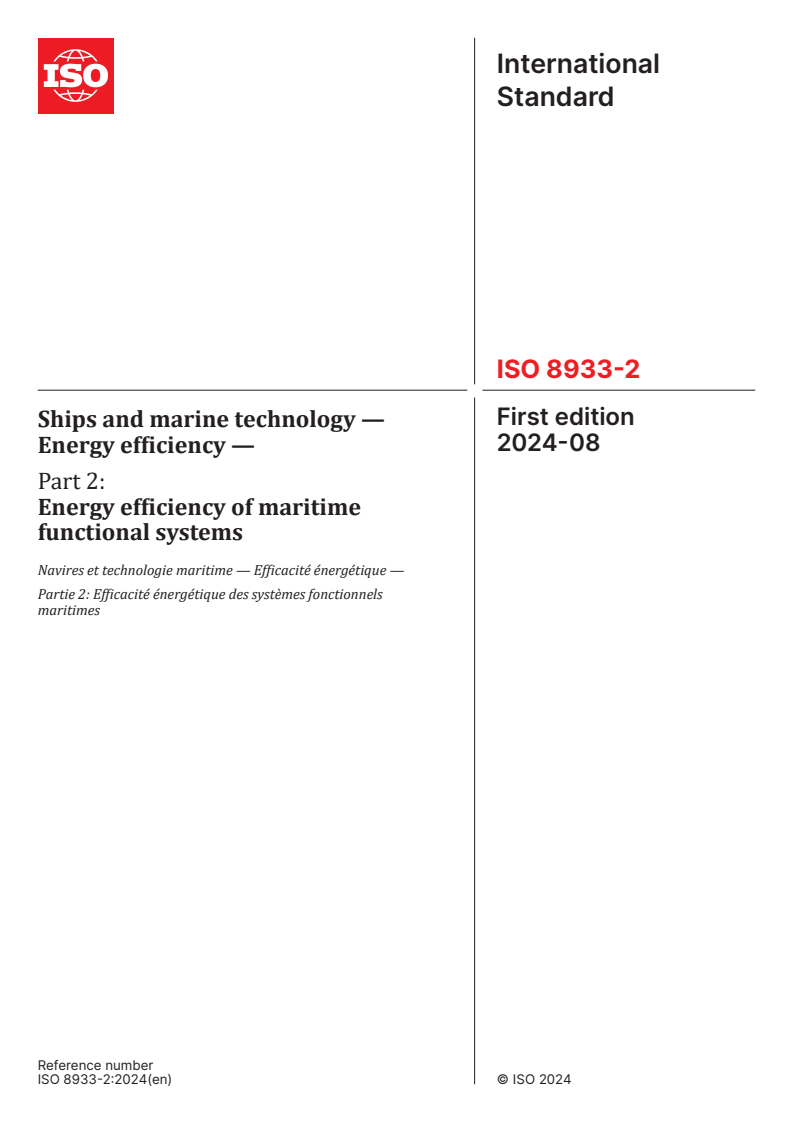
International
Standard
ISO 8933-2
First edition
Ships and marine technology —
2024-08
Energy efficiency —
Part 2:
Energy efficiency of maritime
functional systems
Navires et technologie maritime — Efficacité énergétique —
Partie 2: Efficacité énergétique des systèmes fonctionnels
maritimes
Reference number
© ISO 2024
All rights reserved. Unless otherwise specified, or required in the context of its implementation, no part of this publication may
be reproduced or utilized otherwise in any form or by any means, electronic or mechanical, including photocopying, or posting on
the internet or an intranet, without prior written permission. Permission can be requested from either ISO at the address below
or ISO’s member body in the country of the requester.
ISO copyright office
CP 401 • Ch. de Blandonnet 8
CH-1214 Vernier, Geneva
Phone: +41 22 749 01 11
Email: copyright@iso.org
Website: www.iso.org
Published in Switzerland
ii
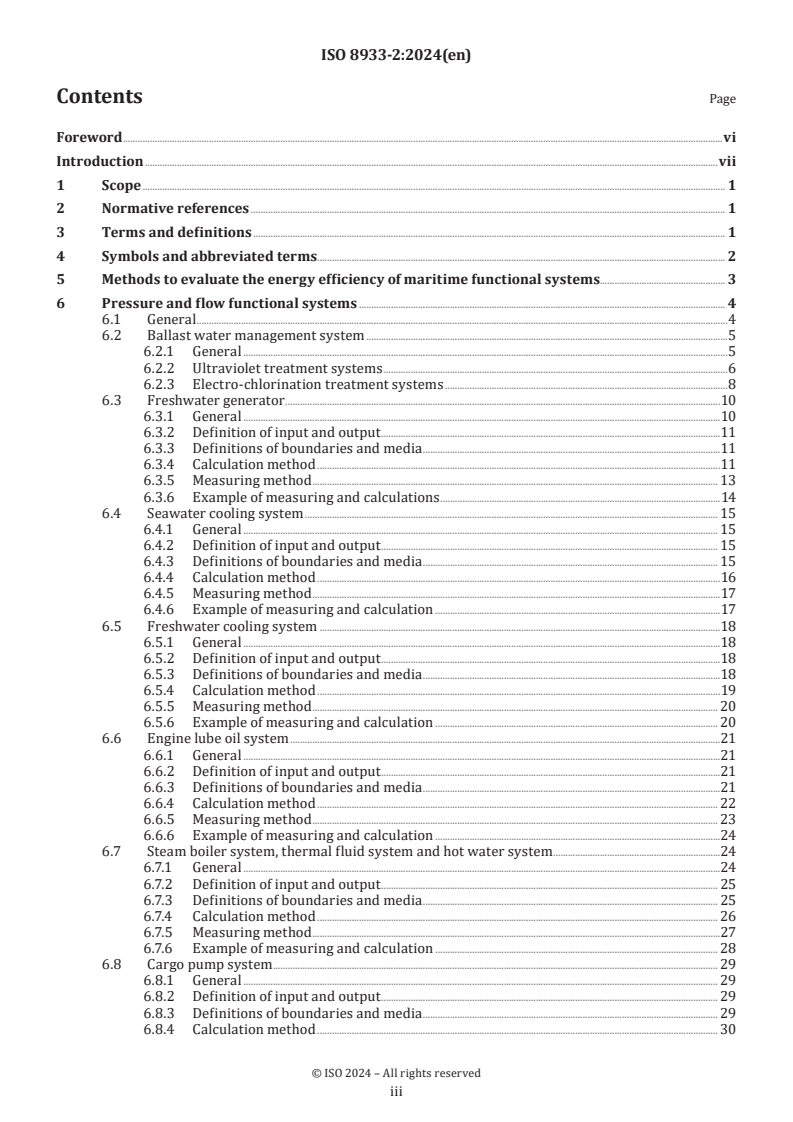
Contents Page
Foreword .vi
Introduction .vii
1 Scope . 1
2 Normative references . 1
3 Terms and definitions . 1
4 Symbols and abbreviated terms. 2
5 Methods to evaluate the energy efficiency of maritime functional systems. 3
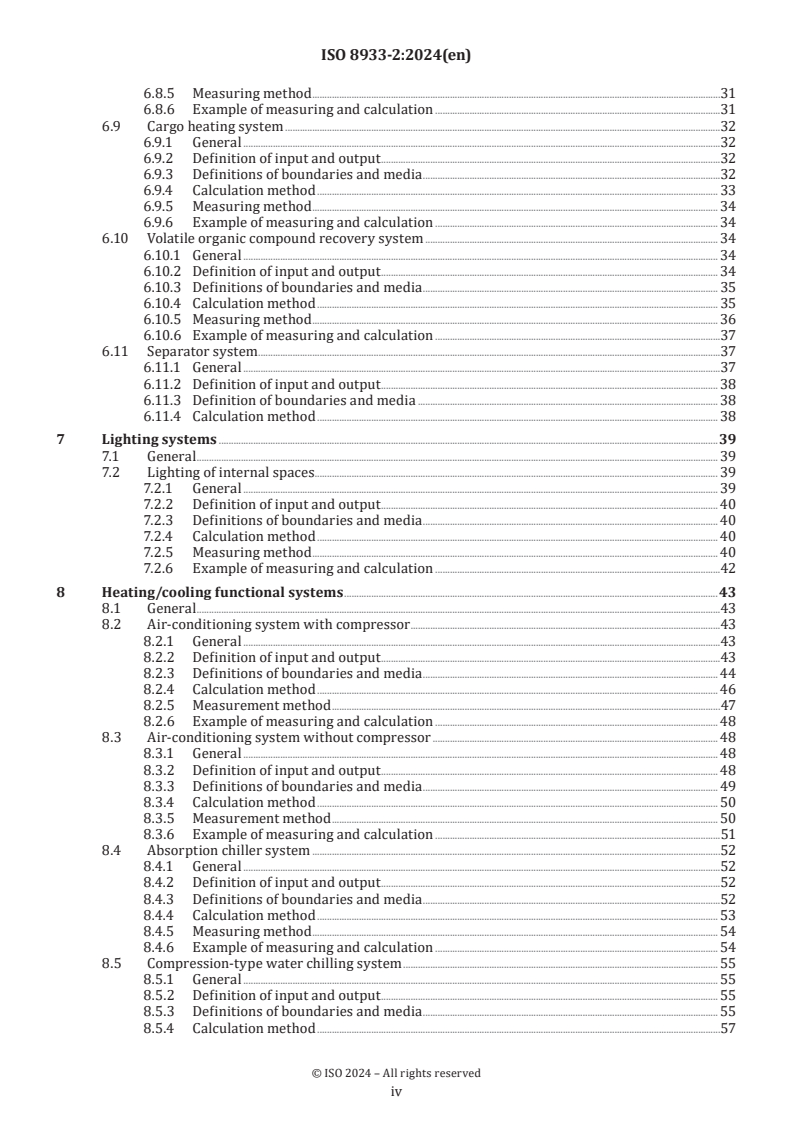
6 Pressure and flow functional systems . 4
6.1 General .4
6.2 Ballast water management system .5
6.2.1 General .5
6.2.2 Ultraviolet treatment systems .6
6.2.3 Electro-chlorination treatment systems .8
6.3 Freshwater generator .10
6.3.1 General .10
6.3.2 Definition of input and output .11
6.3.3 Definitions of boundaries and media .11
6.3.4 Calculation method .11
6.3.5 Measuring method . 13
6.3.6 Example of measuring and calculations .14
6.4 Seawater cooling system . 15
6.4.1 General . 15
6.4.2 Definition of input and output . 15
6.4.3 Definitions of boundaries and media . 15
6.4.4 Calculation method .16
6.4.5 Measuring method .17
6.4.6 Example of measuring and calculation .17
6.5 Freshwater cooling system .18
6.5.1 General .18
6.5.2 Definition of input and output .18
6.5.3 Definitions of boundaries and media .18
6.5.4 Calculation method .19
6.5.5 Measuring method . 20
6.5.6 Example of measuring and calculation . 20
6.6 Engine lube oil system .21
6.6.1 General .21
6.6.2 Definition of input and output .21
6.6.3 Definitions of boundaries and media .21
6.6.4 Calculation method . 22
6.6.5 Measuring method . 23
6.6.6 Example of measuring and calculation .24
6.7 Steam boiler system, thermal fluid system and hot water system .24
6.7.1 General .24
6.7.2 Definition of input and output . 25
6.7.3 Definitions of boundaries and media . 25
6.7.4 Calculation method . 26
6.7.5 Measuring method .27
6.7.6 Example of measuring and calculation . 28
6.8 Cargo pump system . 29
6.8.1 General . 29
6.8.2 Definition of input and output . 29
6.8.3 Definitions of boundaries and media . 29
6.8.4 Calculation method . 30
iii
6.8.5 Measuring method .31
6.8.6 Example of measuring and calculation .31
6.9 Cargo heating system .32
6.9.1 General .32
6.9.2 Definition of input and output .32
6.9.3 Definitions of boundaries and media .32
6.9.4 Calculation method . 33
6.9.5 Measuring method . 34
6.9.6 Example of measuring and calculation . 34
6.10 Volatile organic compound recovery system . 34
6.10.1 General . 34
6.10.2 Definition of input and output . 34
6.10.3 Definitions of boundaries and media . 35
6.10.4 Calculation method . 35
6.10.5 Measuring method . 36
6.10.6 Example of measuring and calculation .37
6.11 Separator system .37
6.11.1 General .37
6.11.2 Definition of input and output . 38
6.11.3 Definition of boundaries and media . 38
6.11.4 Calculation method . 38
7 Lighting systems .39
7.1 General . 39
7.2 Lighting of internal spaces . 39
7.2.1 General . 39
7.2.2 Definition of input and output . 40
7.2.3 Definitions of boundaries and media . 40
7.2.4 Calculation method . 40
7.2.5 Measuring method . 40
7.2.6 Example of measuring and calculation .42
8 Heating/cooling functional systems .43
8.1 General .43
8.2 Air-conditioning system with compressor .43
8.2.1 General .43
8.2.2 Definition of input and output .43
8.2.3 Definitions of boundaries and media . 44
8.2.4 Calculation method . 46
8.2.5 Measurement method .47
8.2.6 Example of measuring and calculation . 48
8.3 Air-conditioning system without compressor . 48
8.3.1 General . 48
8.3.2 Definition of input and output . 48
8.3.3 Definitions of boundaries and media . 49
8.3.4 Calculation method . 50
8.3.5 Measurement method . 50
8.3.6 Example of measuring and calculation .51
8.4 Absorption chiller system .52
8.4.1 General .52
8.4.2 Definition of input and output .52
8.4.3 Definitions of boundaries and media .52
8.4.4 Calculation method . 53
8.4.5 Measuring method . 54
8.4.6 Example of measuring and calculation . 54
8.5 Compression-type water chilling system . 55
8.5.1 General . 55
8.5.2 Definition of input and output . 55
8.5.3 Definitions of boundaries and media . 55
8.5.4 Calculation method .57
iv
8.5.5 Measuring method . 58
8.5.6 Example of measuring and calculation . 58
9 Mechanical functional systems .59
9.1 General .59
9.2 Propulsion shafting system .59
9.2.1 General .59
9.2.2 Definition of input and output .59
9.2.3 Definitions of boundaries and media .59
9.2.4 Calculation method . 60
9.2.5 Measuring method .61
9.3 Deck crane system .62
9.3.1 General .62
9.3.2 Definition of input and output .62
9.3.3 Definitions of boundaries and media .62
9.3.4 Calculation method . 63
9.3.5 Measuring method . 66
9.4 Ship anchor and mooring winch system .67
9.4.1 General .67
9.4.2 Definition of input and output .67
9.4.3 Definitions of boundaries and media .67
9.4.4 Calculation method . 68
9.4.5 Measuring method . 69
9.5 Steering gear system .70
9.5.1 General .70
9.5.2 Definition of input and output .70
9.5.3 Definitions of boundaries and media .71
9.5.4 Calculation method .71
9.5.5 Measuring method . 72
10 Propulsion functional systems .73
10.1 General . 73
10.2 Solar photovoltaic system .74
10.2.1 General .74
10.2.2 Definition of input and output .74
10.2.3 Definitions of boundaries and media .74
10.2.4 Calculation method .74
10.2.5 Measuring method .76
10.3 Wind propulsion system . 77
10.3.1 General . 77
10.3.2 Definition of input and output . 77
10.3.3 Definitions of boundaries and media . 77
10.3.4 Calculation method . 77
10.3.5 Measuring method . 78
10.4 Fuel cell system . 78
10.4.1 General . 78
10.4.2 Definition of input and output . 79
10.4.3 Definitions of boundaries and media . 79
10.4.4 Calculation method . 81
10.4.5 Measuring method . 83
10.4.6 Example of calculation . 83
10.5 Waste heat recovery system . 84
10.5.1 General . 84
10.5.2 Definition of input and output . 84
10.5.3 Definitions of boundaries and media . 84
10.5.4 Calculation method . 84
10.5.5 Measuring method . 85
10.5.6 Example of measuring and calculation . 85
Bibliography .86
v
Foreword
ISO (the International Organization for Standardization) is a worldwide federation of national standards
bodies (ISO member bodies). The work of preparing International Standards is normally carried out through
ISO technical committees. Each member body interested in a subject for which a technical committee
has been established has the right to be represented on that committee. International organizations,
governmental and non-governmental, in liaison with ISO, also take part in the work. ISO collaborates closely
with the International Electrotechnical Commission (IEC) on all matters of electrotechnical standardization.
The procedures used to develop this document and those intended for its further maintenance are described
in the ISO/IEC Directives, Part 1. In particular, the different approval criteria needed for the different types
of ISO document should be noted. This document was drafted in accordance with the editorial rules of the
ISO/IEC Directives, Part 2 (see www.iso.org/directives).
ISO draws attention to the possibility that the implementation of this document may involve the use of (a)
patent(s). ISO takes no position concerning the evidence, validity or applicability of any claimed patent
rights in respect thereof. As of the date of publication of this document, ISO had not received notice of (a)
patent(s) which may be required to implement this document. However, implementers are cautioned that
this may not represent the latest information, which may be obtained from the patent database available at
www.iso.org/patents. ISO shall not be held responsible for identifying any or all such patent rights.
Any trade name used in this document is information given for the convenience of users and does not
constitute an endorsement.
For an explanation of the voluntary nature of standards, the meaning of ISO specific terms and expressions
related to conformity assessment, as well as information about ISO’s adherence to the World Trade
Organization (WTO) principles in the Technical Barriers to Trade (TBT), see www.iso.org/iso/foreword.html.
This document was prepared by Technical Committee ISO/TC 8, Ships and marine technology.
A list of all parts in the ISO 8933 series can be found on the ISO website.
Any feedback or questions on this document should be directed to the user’s national standards body. A
complete listing of these bodies can be found at www.iso.org/members.html.
vi
Introduction
Environmental concerns, emission regulations, fuel prices and emission taxes are increasing the demand for
greater energy efficiency in the shipping industry. In 2013, the International Maritime Organization (IMO)
[10]
adopted the Ship Energy Efficiency Management Plan (SEEMP) to significantly decrease the amount of
carbon dioxide (CO ) emissions by 10 % to 50 % per transport work in international shipping. This strategy
[13]
refers to a pathway of CO emission reduction which is consistent with the goals of the Paris Agreement ,
[14]
alongside the United Nations 2030 Agenda for Sustainable Development .
Standardizing methods to evaluate energy efficiency in the maritime sector interface is valuable for a range
of different stakeholders, including:
— shipowners who are looking to buy maritime systems to comply with IMO SEEMP initiatives;
— maritime equipment and engine manufacturers who are responsible for the design and production of
ship systems;
— governments that are committed to environmental regulations and environmental targets such as the
“levels of ambition” adopted by the IMO.
The purpose of this document is to improve energy efficiency in ships by providing more energy-efficient
options that can be considered when replacing malfunctioning components throughout the ship’s lifetime.
This document allows shipowners and shipyard workers to objectively identify the most energy-efficient
components, systems and solutions for retrofits, as well as new-builds.
This document provides a method for comparing energy performance on an objective basis to prevent
energy loss and to improve cost-efficiency and environmental conditions during maritime transport. This
document makes it possible for users to compare the energy efficiency of different individual maritime
components or functional units based on a standardized method to measure and calculate the values.
It is widely established that the usual combination of the most efficient single systems on board do not
lead in sum to the most efficient ship. It is common practice that owners instruct shipyards to meet the
criteria for an optimized operating point of the respective ship system during the design phase (new-build
or reconstruction).
Accordingly, a shipyard checks before installation that each single system or component meets good energy
efficiency values. It is not possible to calculate the ship’s overall efficiency if the operating conditions are not
standardized.
An example of a system or component where the efficiency depends on the operational conditions is an
engine room ventilation without a given fan speed control system. If the fan is designed and optimized for
the tropical zone and the ship is operated under North Atlantic conditions, less power is necessary during
winter times. Owing to the absence of a controller, the fan rotation speed cannot be adjusted. In sum, every
single fan can operate efficiently on a test bed (value given by manufacturer). An efficient performance is
questionable if the ship sails under different operational conditions than what it is designed for.
To raise the overall operational energy efficiency of a ship in different operational conditions, the overall
ship-individual combined system efficiency check should be performed. In addition, manufacturers and
operators should take into account the possible variations between test bed conditions and onboard test
conditions when developing individual components and systems.
vii
International Standard ISO 8933-2:2024(en)
Ships and marine technology — Energy efficiency —
Part 2:
Energy efficiency of maritime functional systems
1 Scope
This document specifies generic measuring and calculation methods to evaluate the energy efficiency of
multiple components connected in a functional system installed on board ships, vessels for inland navigation
and offshore structures.
A maritime functional system consists of multiple components integrating multiple functions, working
together to achieve an overall goal.
The purpose of this document is to show how the energy efficiency of various functional systems correspond
to the other installations on board of same functionality, thus ensuring that efficient design is rewarded.
Maritime systems are grouped according to their functionality, to compare the energy efficiency of
functional systems which can fulfil the same task on board a ship.
This document is applicable to only the functional systems for which a unit output can be clearly defined,
and which require energy to function.
This document is applicable to energy consuming functional systems. It does not provide a life cycle
assessment (LCA).
NOTE An LCA can prove useful when considering systems which consume substances, and which would not meet
the functional requirements without the use of these substances. An example is a ballast water management system
(BWMS) using active substances (these types are not considered in this document).
This document is applicable to the following five types of functional systems:
a) pressure and flow;
b) lighting;
c) heating and cooling;
d) mechanical;
e) propulsion.
2 Normative references
There are no normative references in this document.
3 Terms and definitions
For the purposes of this document, the following terms and definitions apply.
ISO and IEC maintain terminology databases for use in standardization at the following addresses:
— ISO Online browsing platform: available at https:// www .iso .org/ obp
— IEC Electropedia: available at https:// www .electropedia .org/
3.1
energy efficiency
ratio or other quantitative relationship between an output (3.6) of performance, service, goods or energy,
and an input (3.5) of energy
EXAMPLE Efficiency conversion energy; energy required/energy used; output/input; theoretical energy used to
operate/energy used to operate.
Note 1 to entry: Both input and output shall be clearly specified in quantity and be measurable.
[SOURCE: ISO/IEC 13273-1:2015, 3.4.1, modified — “and quality” deleted in Note 1 to entry.]
3.2
component
element performing only one function (3.4) and whose efficiency is defined by the ratio between input (3.5)
and output (3.6)
EXAMPLE Electric motor, water pump.
3.3
functional system
collection of components (3.2) creating a system which performs a well-defined function (3.4)
Note 1 to entry: The components included in the functional system can be energy consuming or passive components. A
functional system can also contain a system, controlling the operation of the components.
Note 2 to entry: The energy consumption of a functional system is not only defined by the efficiency of the individual
components but is also influenced by the design of the integration between these components.
Note 3 to entry: A functional system is supplied by a single supplier who is responsible for the integration of the
components, and the function and performance of the unit based on a set of boundary conditions defining the quality/
amount of input (3.5) and output (3.6).
3.4
function
operation that is performed by the system
Note 1 to entry: The function will have an output (3.6) characterized by the type and amount of output, i.e. treated
volume/force/energy, and an input (3.5) in the form of consumed energy.
3.5
input
product, material or energy flow that enters a unit process
Note 1 to entry: Products and materials include raw materials, intermediate products and co-products.
3.6
output
product, material or energy flow that leaves a unit process
Note 1 to entry: Products and materials include raw materials, intermediate products, co-products and releases.
3.7
system boundary
boundary based on a set of criteria specifying which unit processes are part of the system under study
4 Symbols and abbreviated terms
The following symbols and abbreviated terms are used throughout the document.
η efficiency ratio dimensionless
EER efficiency ratio used in the heating/cooling industry non-dimensionless
COP performance coefficient used in the air-conditioning industry dimensionless
TPI thermal power index used in the air-conditioning industry dimensionless
ECI energy consumption index used in the ship cargo industry non-dimensionless
E energy consumption J
P power consumption W
Q thermal energy J
q volume flow rate m /s
V
q mass flow rate kg/s
m
ρ density of water kg/m
c heat capacity of water kJ/kg K
v
h enthalpy J/kg
T temperature K or °C
V volume m
5 Methods to evaluate the energy efficiency of maritime functional systems
Maritime functional systems are grouped according to their functionality. This makes it easier to compare
the energy efficiency of fu
...