

ISO 2005:2014
(Main)Rubber latex, natural, concentrate — Determination of sludge content
General Information
- Abstract
ISO 2005:2014 specifies a method for the determination of the sludge content of natural rubber latex concentrate. The method is not necessarily suitable for latices from natural sources other than Hevea brasiliensis. It is not suitable for compounded latex or vulcanized latex.
- Status
- Published
- Publication Date
- 08-Dec-2014
- Drafting Committee
- ISO/TC 45/SC 3/WG 2 - Latex
- Current Stage
- 9093 - International Standard confirmed
- Start Date
- 14-Jun-2024
- Completion Date
- 29-Aug-2026
Buy Documents
ISO 2005:2014 - Rubber latex, natural, concentrate -- Determination of sludge content
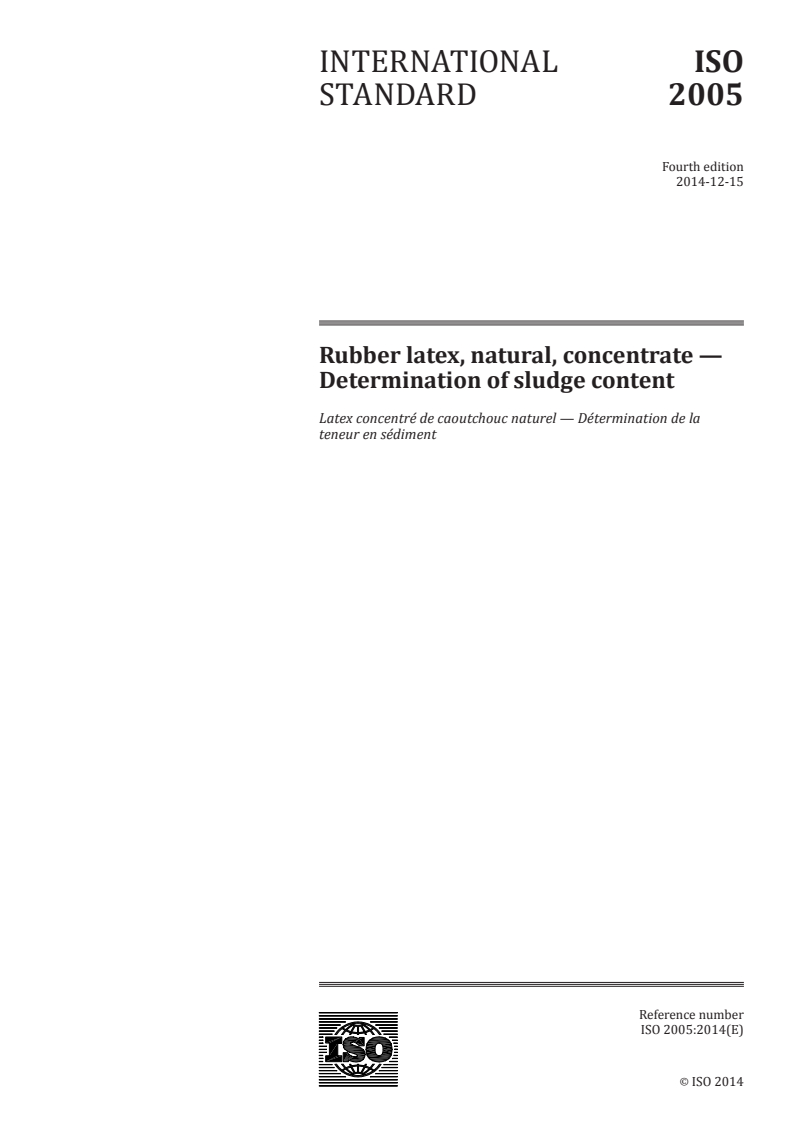
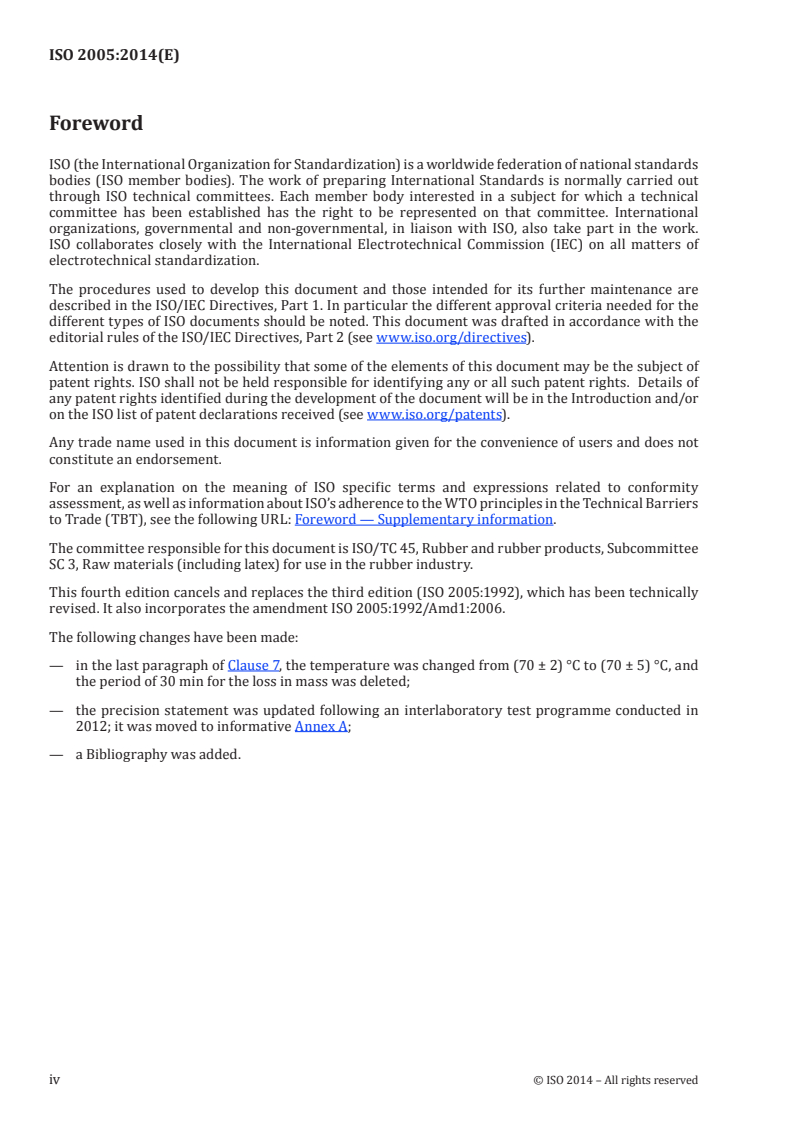
ISO 2005:2014 - Rubber latex, natural, concentrate — Determination of sludge content/9/2014
ISO 2005:2014 - Latex concentré de caoutchouc naturel -- Détermination de la teneur en sédiment
ISO 2005:2014 - Latex concentré de caoutchouc naturel — Détermination de la teneur en sédiment/12/2015
ISO 2005:2014 - Rubber latex, natural, concentrate — Determination of sludge content/30/2016
Overview
ISO 2005:2014 is an international standard that specifies a precise method for determining the sludge content in natural rubber latex concentrate. This standard applies specifically to latex derived from Hevea brasiliensis and is not suitable for compounded or vulcanized latex, nor for latex from other natural sources. The method involves centrifugation and chemical washing techniques to isolate and accurately weigh the sludge content, ensuring quality control in rubber latex production.
The standard was developed by ISO Technical Committee ISO/TC 45, Subcommittee SC 3, focusing on raw materials used in the rubber industry. The fourth edition revises earlier methods, updating procedural details and precision data based on recent interlaboratory test programs.
Key Topics
- Scope: Applicable to natural rubber latex concentrate from Hevea brasiliensis only; excludes compounded or vulcanized latex.
- Sampling: Follow ISO 123 for standardized rubber latex sampling methods to ensure representative test portions.
- Test Principle: Centrifuge latex samples and repeatedly wash the sediment with an ammonia-alcohol solution to remove impurities. Dry sludge to constant mass for accurate quantification.
- Reagents: Use analytically pure ammonia solution, ethanol (minimum 95% purity), and distilled water for preparing the washing solution.
- Apparatus: Requires a centrifuge capable of 12,000 m/s² acceleration, conical centrifuge tubes, and precise pipettes.
- Procedure:
- Sample between 40–45 g aliquots of latex concentrate.
- Centrifuge at approximately 12,000 m/s² for 20 minutes.
- Remove cream layer and supernatant carefully.
- Wash sludge repeatedly with ammonia-alcohol solution until clear.
- Dry sludge at 70 ± 5 °C until weight stabilizes.
- Expression of Results: Sludge content is calculated as a mass percentage of the original test portion.
- Precision: Repeatability and reproducibility have been statistically validated through interlaboratory studies, ensuring reliable test results.
- Test Reporting: Reports must reference ISO 2005:2014 and include test details, sample identification, measured sludge content, and any deviations or unusual aspects.
Applications
- Quality Control: ISO 2005:2014 enables rubber manufacturers to assess the sludge content in natural rubber latex concentrate, a critical factor affecting downstream processing and product quality.
- Supplier Verification: Rubber latex suppliers can use this method to certify the purity and consistency of their latex concentrates.
- Research and Development: Analytical laboratories developing improved rubber processing or formulation techniques require accurate sludge content measurements.
- Compliance and Standards: Ensures conformity with international quality standards in natural rubber latex handling and testing, facilitating global trade and regulatory approvals.
Related Standards
- ISO 123: Rubber latex - Sampling - Specifies procedures ensuring representative latex sample collection, which is integral to the accurate application of ISO 2005:2014.
- ISO/TR 9272: Rubber and rubber products - Determination of precision for test method standards - Provides guidance on assessing test method precision, referenced in the precision evaluation annex of ISO 2005:2014.
- ISO/IEC Directives, Part 1 and 2: Framework documents defining ISO standards development and editorial processes, ensuring consistency and quality in standardization.
By implementing ISO 2005:2014, stakeholders in the natural rubber industry maintain rigorous control over latex concentrate quality, improving product reliability and manufacturing efficiency. This standard forms an essential part of the quality assurance toolkit for laboratories, manufacturers, and suppliers engaged in natural rubber latex processing.
Relations
- Consolidated By
ISO 11704:2018 - Water quality — Gross alpha and gross beta activity — Test method using liquid scintillation counting - Effective Date
- 06-Jun-2022
- Effective Date
- 09-Feb-2013
- Effective Date
- 09-Feb-2013
Buy Documents
ISO 2005:2014 - Rubber latex, natural, concentrate -- Determination of sludge content
ISO 2005:2014 - Rubber latex, natural, concentrate — Determination of sludge content/9/2014
ISO 2005:2014 - Latex concentré de caoutchouc naturel -- Détermination de la teneur en sédiment
ISO 2005:2014 - Latex concentré de caoutchouc naturel — Détermination de la teneur en sédiment/12/2015
ISO 2005:2014 - Rubber latex, natural, concentrate — Determination of sludge content/30/2016
Get Certified
Connect with accredited certification bodies for this standard

DIN CERTCO
DIN Group product certification.

Smithers Quality Assessments
US management systems and product certification.
Sponsored listings
Frequently Asked Questions
ISO 2005:2014 is a standard published by the International Organization for Standardization (ISO). Its full title is "Rubber latex, natural, concentrate — Determination of sludge content". This standard covers: ISO 2005:2014 specifies a method for the determination of the sludge content of natural rubber latex concentrate. The method is not necessarily suitable for latices from natural sources other than Hevea brasiliensis. It is not suitable for compounded latex or vulcanized latex.
ISO 2005:2014 specifies a method for the determination of the sludge content of natural rubber latex concentrate. The method is not necessarily suitable for latices from natural sources other than Hevea brasiliensis. It is not suitable for compounded latex or vulcanized latex.
ISO 2005:2014 is classified under the following ICS (International Classification for Standards) categories: 83.040.10 - Latex and raw rubber. The ICS classification helps identify the subject area and facilitates finding related standards.
ISO 2005:2014 has the following relationships with other standards: It is inter standard links to ISO 11704:2018, ISO 2005:1992/Amd 1:2006, ISO 2005:1992. Understanding these relationships helps ensure you are using the most current and applicable version of the standard.
ISO 2005:2014 is available in PDF format for immediate download after purchase. The document can be added to your cart and obtained through the secure checkout process. Digital delivery ensures instant access to the complete standard document.
Standards Content (Sample)
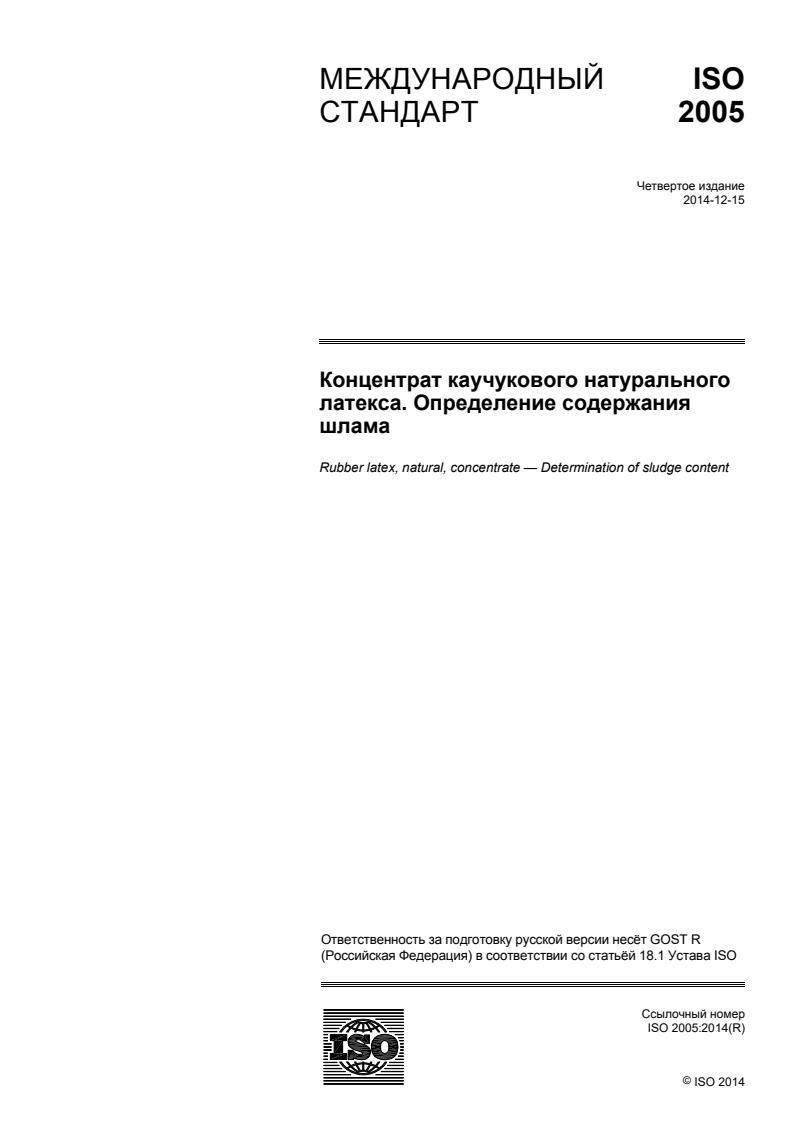
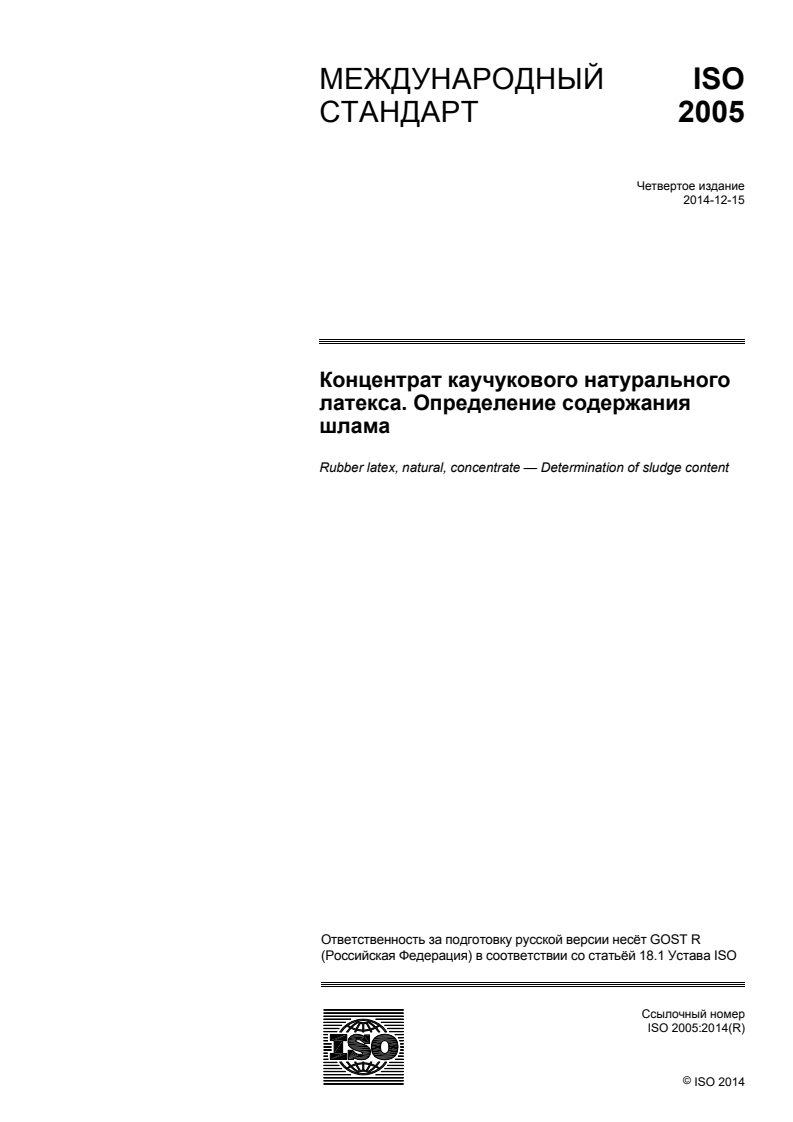
INTERNATIONAL ISO
STANDARD 2005
Fourth edition
2014-12-15
Rubber latex, natural, concentrate —
Determination of sludge content
Latex concentré de caoutchouc naturel — Détermination de la
teneur en sédiment
Reference number
©
ISO 2014
© ISO 2014
All rights reserved. Unless otherwise specified, no part of this publication may be reproduced or utilized otherwise in any form
or by any means, electronic or mechanical, including photocopying, or posting on the internet or an intranet, without prior
written permission. Permission can be requested from either ISO at the address below or ISO’s member body in the country of
the requester.
ISO copyright office
Case postale 56 • CH-1211 Geneva 20
Tel. + 41 22 749 01 11
Fax + 41 22 749 09 47
E-mail copyright@iso.org
Web www.iso.org
Published in Switzerland
ii © ISO 2014 – All rights reserved
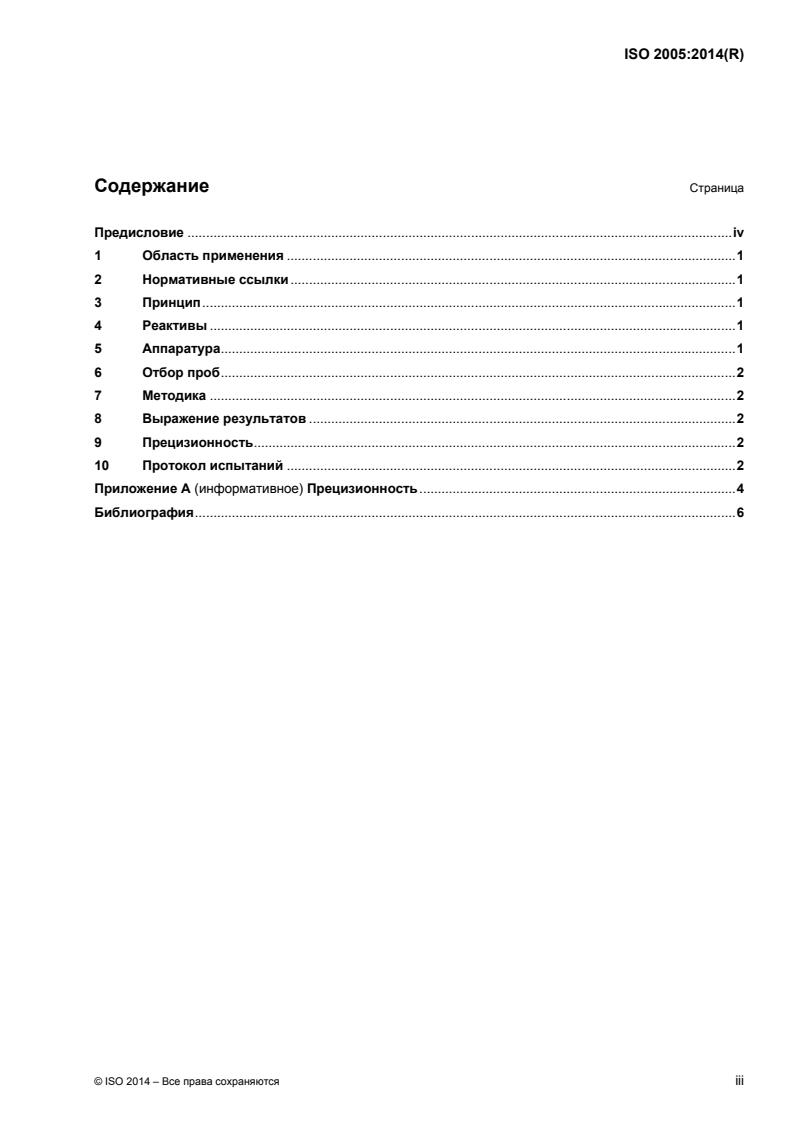
Contents Page
Foreword .iv
1 Scope . 1
2 Normative references . 1
3 Principle . 1
4 Reagents . 1
5 Apparatus . 1
6 Sampling . 1
7 Procedure. 2
8 Expression of results . 2
9 Precision . 2
10 Test report . 2
Annex A (informative) Precision . 3
Bibliography . 5
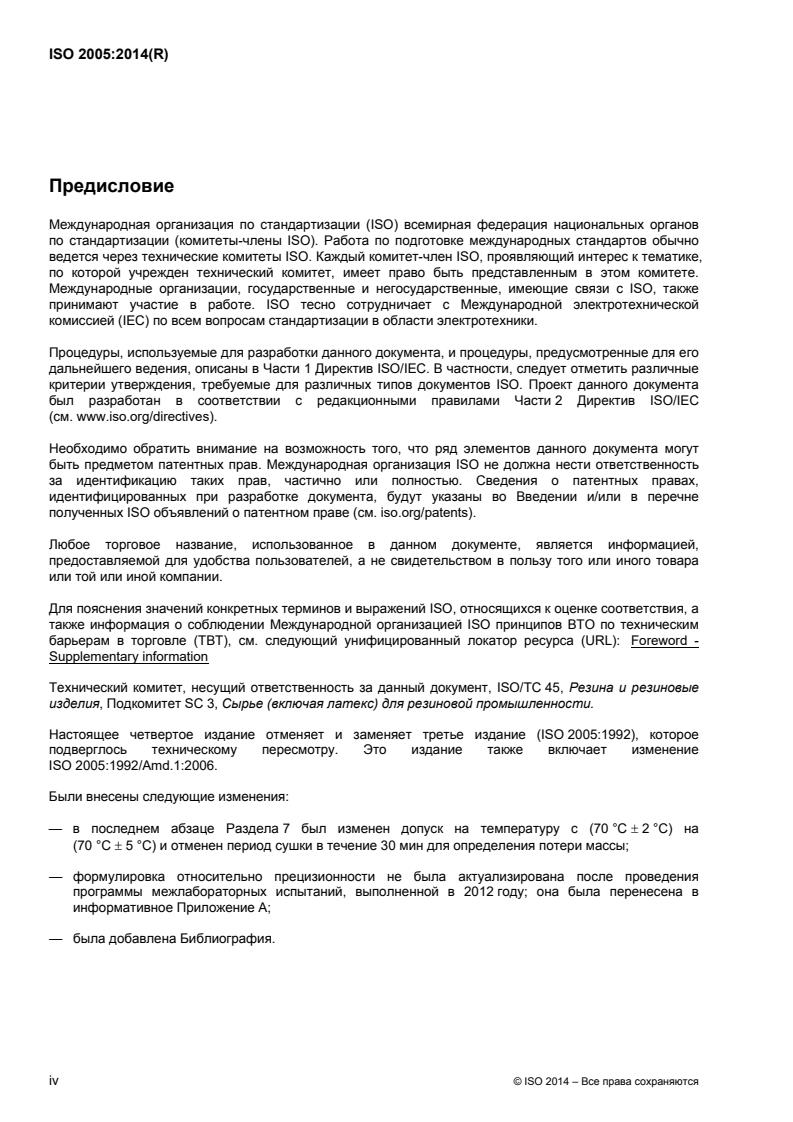
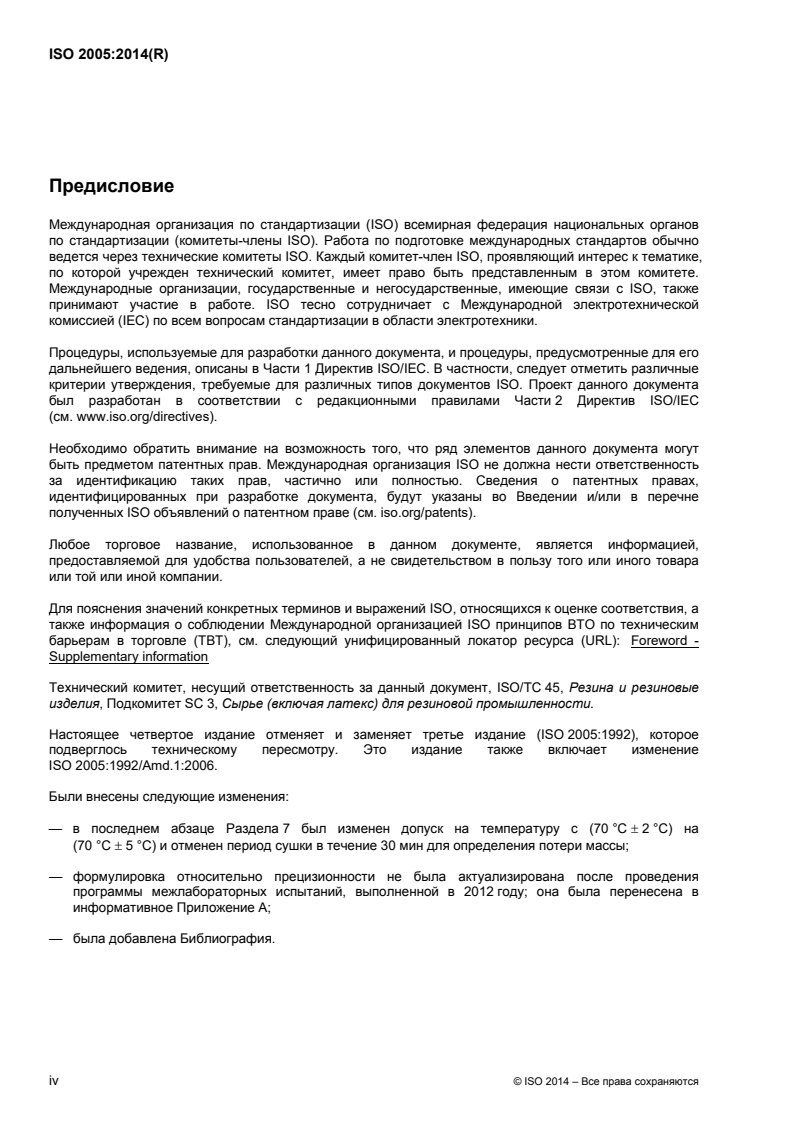
Foreword
ISO (the International Organization for Standardization) is a worldwide federation of national standards
bodies (ISO member bodies). The work of preparing International Standards is normally carried out
through ISO technical committees. Each member body interested in a subject for which a technical
committee has been established has the right to be represented on that committee. International
organizations, governmental and non-governmental, in liaison with ISO, also take part in the work.
ISO collaborates closely with the International Electrotechnical Commission (IEC) on all matters of
electrotechnical standardization.
The procedures used to develop this document and those intended for its further maintenance are
described in the ISO/IEC Directives, Part 1. In particular the different approval criteria needed for the
different types of ISO documents should be noted. This document was drafted in accordance with the
editorial rules of the ISO/IEC Directives, Part 2 (see www.iso.org/directives).
Attention is drawn to the possibility that some of the elements of this document may be the subject of
patent rights. ISO shall not be held responsible for identifying any or all such patent rights. Details of
any patent rights identified during the development of the document will be in the Introduction and/or
on the ISO list of patent declarations received (see www.iso.org/patents).
Any trade name used in this document is information given for the convenience of users and does not
constitute an endorsement.
For an explanation on the meaning of ISO specific terms and expressions related to conformity
assessment, as well as information about ISO’s adherence to the WTO principles in the Technical Barriers
to Trade (TBT), see the following URL: Foreword — Supplementary information.
The committee responsible for this document is ISO/TC 45, Rubber and rubber products, Subcommittee
SC 3, Raw materials (including latex) for use in the rubber industry.
This fourth edition cancels and replaces the third edition (ISO 2005:1992), which has been technically
revised. It also incorporates the amendment ISO 2005:1992/Amd1:2006.
The following changes have been made:
— in the last paragraph of Clause 7, the temperature was changed from (70 ± 2) °C to (70 ± 5) °C, and
the period of 30 min for the loss in mass was deleted;
— the precision statement was updated following an interlaboratory test programme conducted in
2012; it was moved to informative Annex A;
— a Bibliography was added.
iv © ISO 2014 – All rights reserved
INTERNATIONAL STANDARD ISO 2005:2014(E)
Rubber latex, natural, concentrate — Determination of
sludge content
1 Scope
This International Standard specifies a method for the determination of the sludge content of natural
rubber latex concentrate.
The method is not necessarily suitable for latices from natural sources other than Hevea brasiliensis.
It is not suitable for compounded latex or vulcanized latex.
2 Normative ref
...
INTERNATIONAL ISO
STANDARD 2005
Fourth edition
2014-12-15
Rubber latex, natural, concentrate —
Determination of sludge content
Latex concentré de caoutchouc naturel — Détermination de la
teneur en sédiment
Reference number
©
ISO 2014
© ISO 2014
All rights reserved. Unless otherwise specified, no part of this publication may be reproduced or utilized otherwise in any form
or by any means, electronic or mechanical, including photocopying, or posting on the internet or an intranet, without prior
written permission. Permission can be requested from either ISO at the address below or ISO’s member body in the country of
the requester.
ISO copyright office
Case postale 56 • CH-1211 Geneva 20
Tel. + 41 22 749 01 11
Fax + 41 22 749 09 47
E-mail copyright@iso.org
Web www.iso.org
Published in Switzerland
ii © ISO 2014 – All rights reserved
Contents Page
Foreword .iv
1 Scope . 1
2 Normative references . 1
3 Principle . 1
4 Reagents . 1
5 Apparatus . 1
6 Sampling . 1
7 Procedure. 2
8 Expression of results . 2
9 Precision . 2
10 Test report . 2
Annex A (informative) Precision . 3
Bibliography . 5
Foreword
ISO (the International Organization for Standardization) is a worldwide federation of national standards
bodies (ISO member bodies). The work of preparing International Standards is normally carried out
through ISO technical committees. Each member body interested in a subject for which a technical
committee has been established has the right to be represented on that committee. International
organizations, governmental and non-governmental, in liaison with ISO, also take part in the work.
ISO collaborates closely with the International Electrotechnical Commission (IEC) on all matters of
electrotechnical standardization.
The procedures used to develop this document and those intended for its further maintenance are
described in the ISO/IEC Directives, Part 1. In particular the different approval criteria needed for the
different types of ISO documents should be noted. This document was drafted in accordance with the
editorial rules of the ISO/IEC Directives, Part 2 (see www.iso.org/directives).
Attention is drawn to the possibility that some of the elements of this document may be the subject of
patent rights. ISO shall not be held responsible for identifying any or all such patent rights. Details of
any patent rights identified during the development of the document will be in the Introduction and/or
on the ISO list of patent declarations received (see www.iso.org/patents).
Any trade name used in this document is information given for the convenience of users and does not
constitute an endorsement.
For an explanation on the meaning of ISO specific terms and expressions related to conformity
assessment, as well as information about ISO’s adherence to the WTO principles in the Technical Barriers
to Trade (TBT), see the following URL: Foreword — Supplementary information.
The committee responsible for this document is ISO/TC 45, Rubber and rubber products, Subcommittee
SC 3, Raw materials (including latex) for use in the rubber industry.
This fourth edition cancels and replaces the third edition (ISO 2005:1992), which has been technically
revised. It also incorporates the amendment ISO 2005:1992/Amd1:2006.
The following changes have been made:
— in the last paragraph of Clause 7, the temperature was changed from (70 ± 2) °C to (70 ± 5) °C, and
the period of 30 min for the loss in mass was deleted;
— the precision statement was updated following an interlaboratory test programme conducted in
2012; it was moved to informative Annex A;
— a Bibliography was added.
iv © ISO 2014 – All rights reserved
INTERNATIONAL STANDARD ISO 2005:2014(E)
Rubber latex, natural, concentrate — Determination of
sludge content
1 Scope
This International Standard specifies a method for the determination of the sludge content of natural
rubber latex concentrate.
The method is not necessarily suitable for latices from natural sources other than Hevea brasiliensis.
It is not suitable for compounded latex or vulcanized latex.
2 Normative ref
...
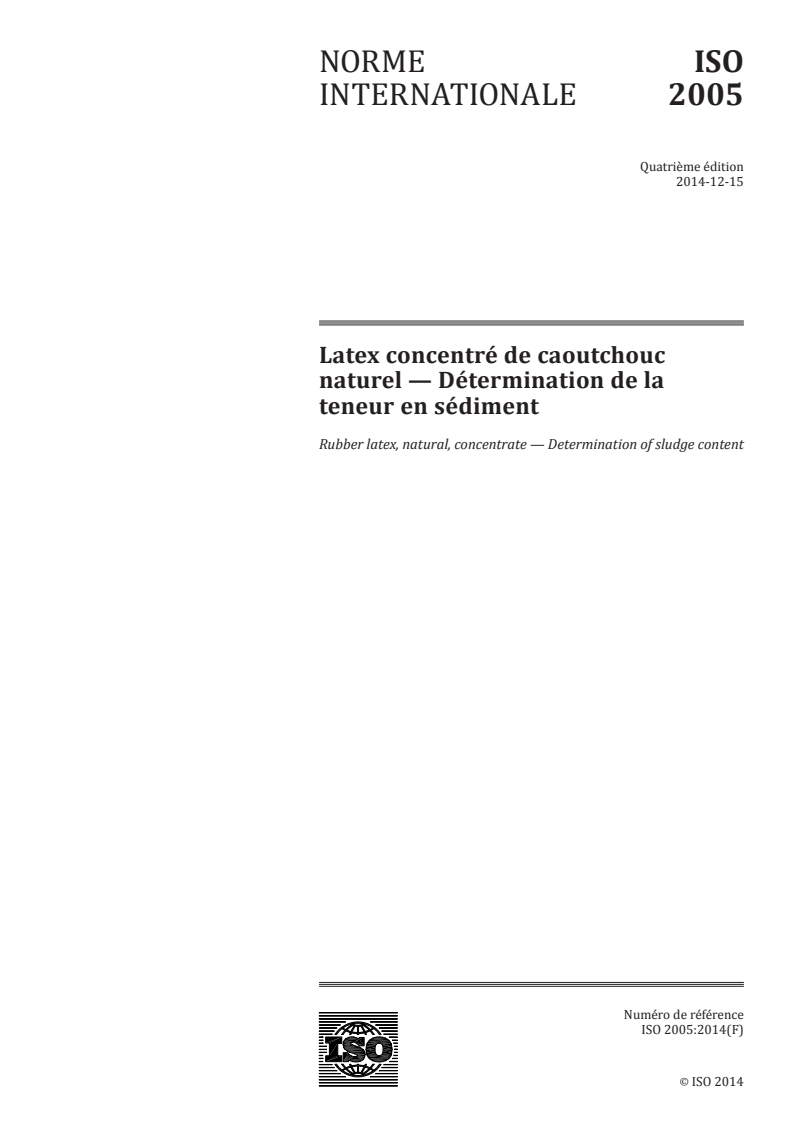
NORME ISO
INTERNATIONALE 2005
Quatrième édition
2014-12-15
Latex concentré de caoutchouc
naturel — Détermination de la
teneur en sédiment
Rubber latex, natural, concentrate — Determination of sludge content
Numéro de référence
©
ISO 2014
DOCUMENT PROTÉGÉ PAR COPYRIGHT
© ISO 2014
Droits de reproduction réservés. Sauf indication contraire, aucune partie de cette publication ne peut être reproduite ni utilisée
sous quelque forme que ce soit et par aucun procédé, électronique ou mécanique, y compris la photocopie, l’affichage sur
l’internet ou sur un Intranet, sans autorisation écrite préalable. Les demandes d’autorisation peuvent être adressées à l’ISO à
l’adresse ci-après ou au comité membre de l’ISO dans le pays du demandeur.
ISO copyright office
Case postale 56 • CH-1211 Geneva 20
Tel. + 41 22 749 01 11
Fax + 41 22 749 09 47
E-mail copyright@iso.org
Web www.iso.org
Publié en Suisse
ii © ISO 2014 – Tous droits réservés
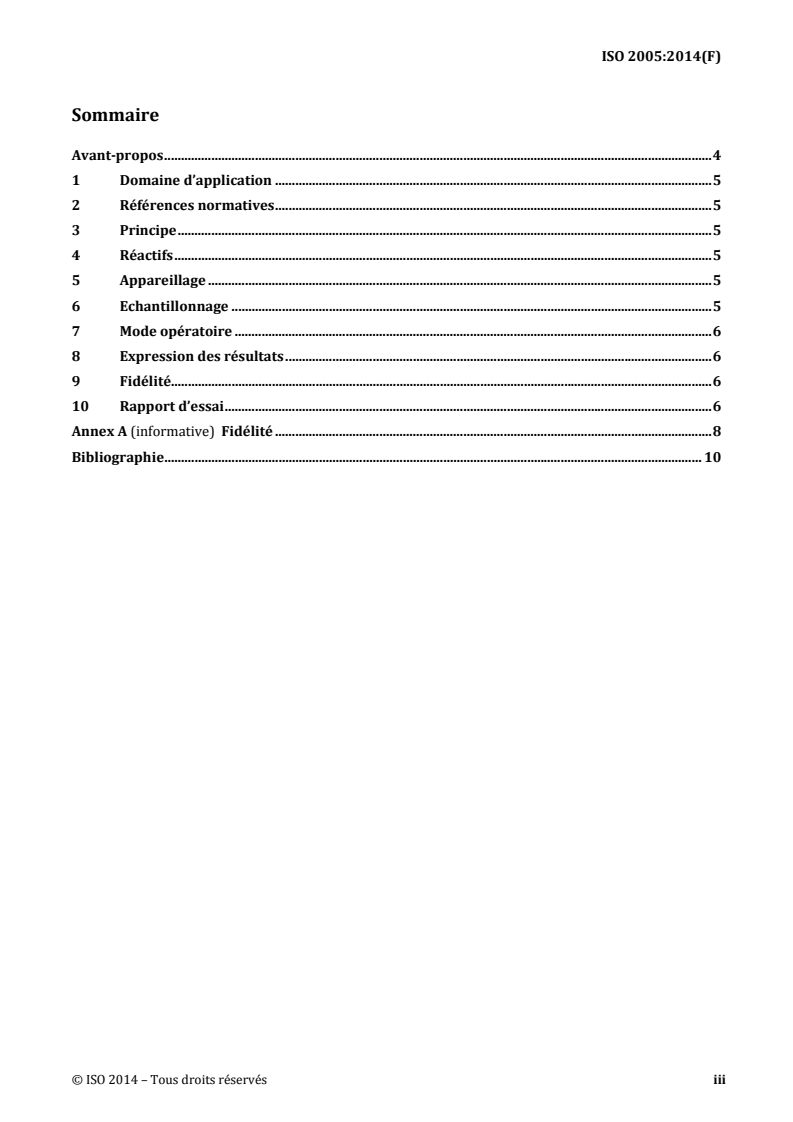
Sommaire
Avant-propos . 4
1 Domaine d’application . 5
2 Références normatives . 5
3 Principe . 5
4 Réactifs . 5
5 Appareillage . 5
6 Echantillonnage . 5
7 Mode opératoire . 6
8 Expression des résultats . 6
9 Fidélité. 6
10 Rapport d’essai . 6
Annex A (informative) Fidélité . 8
Bibliographie . 10
© ISO 2014 – Tous droits réservés iii
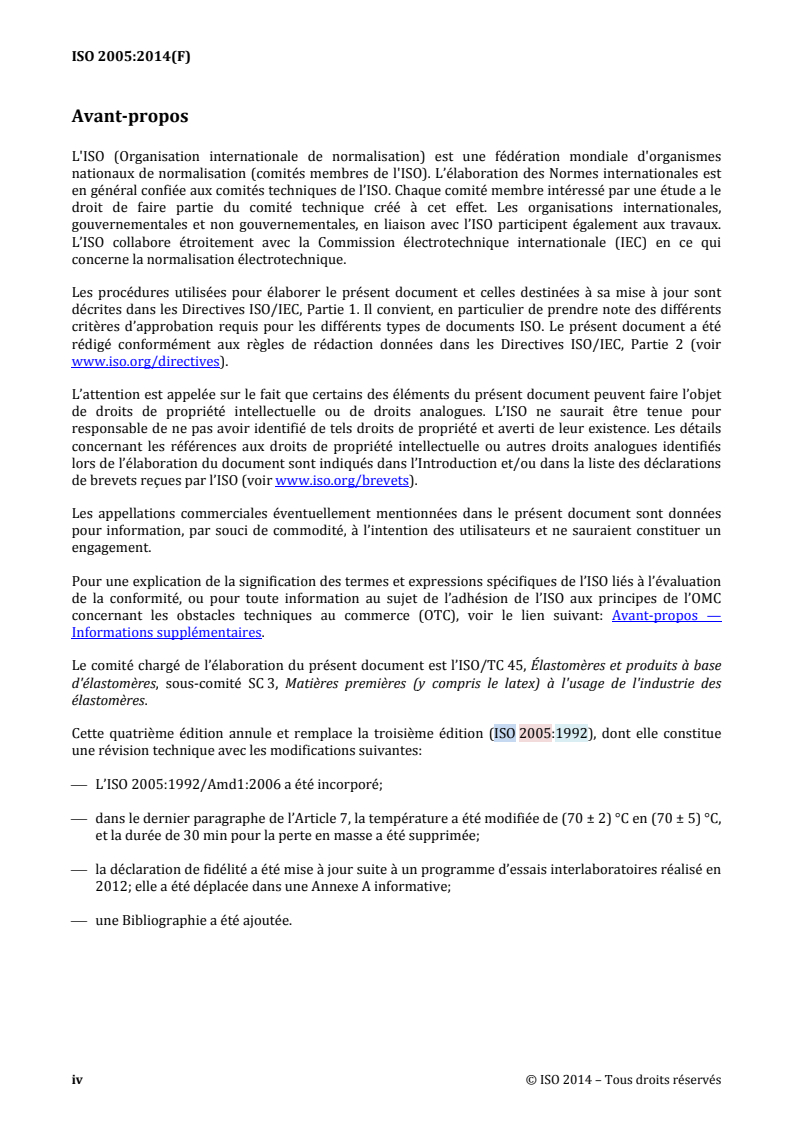
Avant-propos
L'ISO (Organisation internationale de normalisation) est une fédération mondiale d'organismes
nationaux de normalisation (comités membres de l'ISO). L’élaboration des Normes internationales est
en général confiée aux comités techniques de l’ISO. Chaque comité membre intéressé par une étude a le
droit de faire partie du comité technique créé à cet effet. Les organisations internationales,
gouvernementales et non gouvernementales, en liaison avec l’ISO participent également aux travaux.
L’ISO collabore étroitement avec la Commission électrotechnique internationale (IEC) en ce qui
concerne la normalisation électrotechnique.
Les procédures utilisées pour élaborer le présent document et celles destinées à sa mise à jour sont
décrites dans les Directives ISO/IEC, Partie 1. Il convient, en particulier de prendre note des différents
critères d’approbation requis pour les différents types de documents ISO. Le présent document a été
rédigé conformément aux règles de rédaction données dans les Directives ISO/IEC, Partie 2 (voir
www.iso.org/directives).
L’attention est appelée sur le fait que certains des éléments du présent document peuvent faire l’objet
de droits de propriété intellectuelle ou de droits analogues. L’ISO ne saurait être tenue pour
responsable de ne pas avoir identifié de tels droits de propriété et averti de leur existence. Les détails
concernant les références aux droits de propriété intellectuelle ou autres droits analogues identifiés
lors de l’élaboration du document sont indiqués dans l’Introduction et/ou dans la liste des déclarations
de brevets reçues par l’ISO (voir www.iso.org/brevets).
Les appellations commerciales éventuellement mentionnées dans le présent document sont données
pour information, par souci de commodité, à l’intention des utilisateurs et ne sauraient constituer un
engagement.
Pour une explication de la signification des termes et expressions spécifiques de l’ISO liés à l’évaluation
de la conformité, ou pour toute information au sujet de l’adhésion de l’ISO aux principes de l’OMC
concernant les obstacles techniques au commerce (OTC), voir le lien suivant: Avant‐propos —
Informations supplémentaires.
Le comité chargé de l’élaboration du présent document est l’ISO/TC 45, Élastomères et produits à base
d'élastomères, sous‐comité SC 3, Matières premières (y compris le latex) à l'usage de l'industrie des
élastomères.
Cette quatrième édition annule et remplace la troisième édition (ISO 2005:1992), dont elle constitue
une révision technique avec les modifications suivantes:
L’ISO 2005:1992/Amd1:2006 a été incorporé;
dans le dernier paragraphe de l’Article 7, la température a été modifiée de (70 ± 2) °C en (70 ± 5) °C,
et la durée de 30 min pour la perte en masse a été supprimée;
la déclaration de fidélité a été mise à jour suite à un programme d’essais interlaboratoires réalisé en
2012; elle a été déplacée dans une Annexe A informative;
une Bibliographie a été ajoutée.
iv © ISO 2014 – Tous droits réservés
Latex concentré de caoutchouc naturel — Détermination de la
teneur en sédiment
1 Domaine d’application
La présente Norme internationale spécifie une méthode pour la détermination de la teneur en sédiment
du latex concentré de caoutchouc naturel.
La méthode ne convient pas nécessairement aux latex d’origine naturelle autres que l’Hevea
brasiliensis.
Elle n’est pas applicable pour les mélanges à base de latex ou de latex vulcanisé.
2 Références normatives
Les documents suivants, en tout ou partie, sont référencés de façon normative dans le présent
document et sont indispensables à son application. Pour les références datées, seule l'édition citée
s'applique. Pour les références non datées, la dernière édition du document de référence s'applique (y
compris les éventuels amendements).
ISO 123, Latex de caoutchouc — Échantillonnage
3 Principe
Une prise d’essai est centrifugée et sédiment obtenu est lavé à plusieurs reprises avec une solution
d’ammoniaque et d’alcool. Le sédiment est alors séché jusqu’à masse constante.
4 Réactifs
Au cours de l’analy
...
NORME ISO
INTERNATIONALE 2005
Quatrième édition
2014-12-15
Latex concentré de caoutchouc
naturel — Détermination de la
teneur en sédiment
Rubber latex, natural, concentrate — Determination of sludge content
Numéro de référence
©
ISO 2014
DOCUMENT PROTÉGÉ PAR COPYRIGHT
© ISO 2014
Droits de reproduction réservés. Sauf indication contraire, aucune partie de cette publication ne peut être reproduite ni utilisée
sous quelque forme que ce soit et par aucun procédé, électronique ou mécanique, y compris la photocopie, l’affichage sur
l’internet ou sur un Intranet, sans autorisation écrite préalable. Les demandes d’autorisation peuvent être adressées à l’ISO à
l’adresse ci-après ou au comité membre de l’ISO dans le pays du demandeur.
ISO copyright office
Case postale 56 • CH-1211 Geneva 20
Tel. + 41 22 749 01 11
Fax + 41 22 749 09 47
E-mail copyright@iso.org
Web www.iso.org
Publié en Suisse
ii © ISO 2014 – Tous droits réservés
Sommaire
Avant-propos . 4
1 Domaine d’application . 5
2 Références normatives . 5
3 Principe . 5
4 Réactifs . 5
5 Appareillage . 5
6 Echantillonnage . 5
7 Mode opératoire . 6
8 Expression des résultats . 6
9 Fidélité. 6
10 Rapport d’essai . 6
Annex A (informative) Fidélité . 8
Bibliographie . 10
© ISO 2014 – Tous droits réservés iii
Avant-propos
L'ISO (Organisation internationale de normalisation) est une fédération mondiale d'organismes
nationaux de normalisation (comités membres de l'ISO). L’élaboration des Normes internationales est
en général confiée aux comités techniques de l’ISO. Chaque comité membre intéressé par une étude a le
droit de faire partie du comité technique créé à cet effet. Les organisations internationales,
gouvernementales et non gouvernementales, en liaison avec l’ISO participent également aux travaux.
L’ISO collabore étroitement avec la Commission électrotechnique internationale (IEC) en ce qui
concerne la normalisation électrotechnique.
Les procédures utilisées pour élaborer le présent document et celles destinées à sa mise à jour sont
décrites dans les Directives ISO/IEC, Partie 1. Il convient, en particulier de prendre note des différents
critères d’approbation requis pour les différents types de documents ISO. Le présent document a été
rédigé conformément aux règles de rédaction données dans les Directives ISO/IEC, Partie 2 (voir
www.iso.org/directives).
L’attention est appelée sur le fait que certains des éléments du présent document peuvent faire l’objet
de droits de propriété intellectuelle ou de droits analogues. L’ISO ne saurait être tenue pour
responsable de ne pas avoir identifié de tels droits de propriété et averti de leur existence. Les détails
concernant les références aux droits de propriété intellectuelle ou autres droits analogues identifiés
lors de l’élaboration du document sont indiqués dans l’Introduction et/ou dans la liste des déclarations
de brevets reçues par l’ISO (voir www.iso.org/brevets).
Les appellations commerciales éventuellement mentionnées dans le présent document sont données
pour information, par souci de commodité, à l’intention des utilisateurs et ne sauraient constituer un
engagement.
Pour une explication de la signification des termes et expressions spécifiques de l’ISO liés à l’évaluation
de la conformité, ou pour toute information au sujet de l’adhésion de l’ISO aux principes de l’OMC
concernant les obstacles techniques au commerce (OTC), voir le lien suivant: Avant‐propos —
Informations supplémentaires.
Le comité chargé de l’élaboration du présent document est l’ISO/TC 45, Élastomères et produits à base
d'élastomères, sous‐comité SC 3, Matières premières (y compris le latex) à l'usage de l'industrie des
élastomères.
Cette quatrième édition annule et remplace la troisième édition (ISO 2005:1992), dont elle constitue
une révision technique avec les modifications suivantes:
L’ISO 2005:1992/Amd1:2006 a été incorporé;
dans le dernier paragraphe de l’Article 7, la température a été modifiée de (70 ± 2) °C en (70 ± 5) °C,
et la durée de 30 min pour la perte en masse a été supprimée;
la déclaration de fidélité a été mise à jour suite à un programme d’essais interlaboratoires réalisé en
2012; elle a été déplacée dans une Annexe A informative;
une Bibliographie a été ajoutée.
iv © ISO 2014 – Tous droits réservés
Latex concentré de caoutchouc naturel — Détermination de la
teneur en sédiment
1 Domaine d’application
La présente Norme internationale spécifie une méthode pour la détermination de la teneur en sédiment
du latex concentré de caoutchouc naturel.
La méthode ne convient pas nécessairement aux latex d’origine naturelle autres que l’Hevea
brasiliensis.
Elle n’est pas applicable pour les mélanges à base de latex ou de latex vulcanisé.
2 Références normatives
Les documents suivants, en tout ou partie, sont référencés de façon normative dans le présent
document et sont indispensables à son application. Pour les références datées, seule l'édition citée
s'applique. Pour les références non datées, la dernière édition du document de référence s'applique (y
compris les éventuels amendements).
ISO 123, Latex de caoutchouc — Échantillonnage
3 Principe
Une prise d’essai est centrifugée et sédiment obtenu est lavé à plusieurs reprises avec une solution
d’ammoniaque et d’alcool. Le sédiment est alors séché jusqu’à masse constante.
4 Réactifs
Au cours de l’analy
...
МЕЖДУНАРОДНЫЙ ISO
СТАНДАРТ 2005
Четвертое издание
2014-12-15
Концентрат каучукового натурального
латекса. Определение содержания
шлама
Rubber latex, natural, concentrate — Determination of sludge content
Ответственность за подготовку русской версии несёт GOST R
(Российская Федерация) в соответствии со статьёй 18.1 Устава ISO
Ссылочный номер
©
ISO 2014
ДОКУМЕНТ ОХРАНЯЕТСЯ АВТОРСКИМ ПРАВОМ
© ISO 2014
Все права сохраняются. Если не указано иное, никакую часть настоящей публикации нельзя копировать или использовать в
какой-либо форме или каким-либо электронным или механическим способом, включая фотокопии и микрофильмы, без
предварительного письменного согласия ISO, которое должно быть получено после запроса о разрешении, направленного по
адресу, приведенному ниже, или в комитет-член ISO в стране запрашивающей стороны.
ISO copyright office
Case postale 56 CH-1211 Geneva 20
Tel. + 41 22 749 01 11
Fax + 41 22 749 09 47
E-mail copyright@iso.org
Web www.iso.org
Опубликовано в Швейцарии
ii © ISO 2014 – Все права сохраняются
Содержание Страница
Предисловие . iv
1 Область применения . 1
2 Нормативные ссылки . 1
3 Принцип . 1
4 Реактивы . 1
5 Аппаратура . 1
6 Отбор проб . 2
7 Методика . 2
8 Выражение результатов . 2
9 Прецизионность . 2
10 Протокол испытаний . 2
Приложение А (информативное) Прецизионность . 4
Библиография . 6
Предисловие
Международная организация по стандартизации (ISO) всемирная федерация национальных органов
по стандартизации (комитеты-члены ISO). Работа по подготовке международных стандартов обычно
ведется через технические комитеты ISO. Каждый комитет-член ISO, проявляющий интерес к тематике,
по которой учрежден технический комитет, имеет право быть представленным в этом комитете.
Международные организации, государственные и негосударственные, имеющие связи с ISO, также
принимают участие в работе. ISO тесно сотрудничает с Международной электротехнической
комиссией (IEC) по всем вопросам стандартизации в области электротехники.
Процедуры, используемые для разработки данного документа, и процедуры, предусмотренные для его
дальнейшего ведения, описаны в Части 1 Директив ISO/IEC. В частности, следует отметить различные
критерии утверждения, требуемые для различных типов документов ISO. Проект данного документа
был разработан в соответствии с редакционными правилами Части 2 Директив ISO/IEC
(см. www.iso.org/directives).
Необходимо обратить внимание на возможность того, что ряд элементов данного документа могут
быть предметом патентных прав. Международная организация ISO не должна нести ответственность
за идентификацию таких прав, частично или полностью. Сведения о патентных правах,
идентифицированных при разработке документа, будут указаны во Введении и/или в перечне
полученных ISO объявлений о патентном праве (см. iso.org/patents).
Любое торговое название, использованное в данном документе, является информацией,
предоставляемой для удобства пользователей, а не свидетельством в пользу того или иного товара
или той или иной компании.
Для пояснения значений конкретных терминов и выражений ISO, относящихся к оценке соответствия, а
также информация о соблюдении Международной организацией ISO принципов ВТО по техническим
барьерам в торговле (TВT), см. следующий унифицированный локатор ресурса (URL): Foreword -
Supplementary information
Технический комитет, несущий ответственность за данный документ, ISO/TC 45, Резина и резиновые
изделия, Подкомитет SC 3, Сырье (включая латекс) для резиновой промышленности.
Настоящее четвертое издание отменяет и заменяет третье издание (ISO 2005:1992), которое
подверглось техническому пересмотру. Это издание также включает изменение
ISO 2005:1992/Amd.1:2006.
Были внесены следующие изменения:
— в последнем абзаце Раздела 7 был изменен допуск на температуру с (70 °C 2 °C) на
(70 °C 5 °C) и отменен период сушки в течение 30 мин для определения потери массы;
— формулировка относительно прецизионности не была актуализирована после проведения
программы межлабораторных испытаний, выполненной в 2012 году; она была перенесена в
информативное Приложение А;
— была добавлена Библиография.
iv © ISO 2014 – Все права сохраняются
МЕЖДУНАРОДНЫЙ СТАНДАРТ ISO 2005:2014(R)
Концентрат каучукового натурального латекса.
Определение содержания шлама
1 Область применения
Настоящий международный стандарт устанавливает метод определения содержания шлама в
концентрате каучукового натурального латекса.
Метод не является обязательным для латексов из натуральных источников, кроме латекса из
бразильской гевеи (Hevea brasiliensis).
Данный метод не распространяется на наполненный или вулканизованный латекс.
2 Нормативные ссылки
Следующие ссылочные нормативные документы, частично или полностью, являются обязательными
при применении данного документа. Для датированных ссылок применяется только цитированное
издание документа. Для недатированных ссылок необходимо использовать самое последнее издание
нормативного ссылочного документа (включая любые изменения).
ISO 123, Латекс каучуковый. Отбор проб
3 Принцип
Пробу для анализа центрифугируют и полученный в результате шлам неоднократно промывают
спиртовым раствором аммиака. Затем шлам высушивают до постоянной массы.
4 Реактивы
При проведении анализа используют ре
...
МЕЖДУНАРОДНЫЙ ISO
СТАНДАРТ 2005
Четвертое издание
2014-12-15
Концентрат каучукового натурального
латекса. Определение содержания
шлама
Rubber latex, natural, concentrate — Determination of sludge content
Ответственность за подготовку русской версии несёт GOST R
(Российская Федерация) в соответствии со статьёй 18.1 Устава ISO
Ссылочный номер
©
ISO 2014
ДОКУМЕНТ ОХРАНЯЕТСЯ АВТОРСКИМ ПРАВОМ
© ISO 2014
Все права сохраняются. Если не указано иное, никакую часть настоящей публикации нельзя копировать или использовать в
какой-либо форме или каким-либо электронным или механическим способом, включая фотокопии и микрофильмы, без
предварительного письменного согласия ISO, которое должно быть получено после запроса о разрешении, направленного по
адресу, приведенному ниже, или в комитет-член ISO в стране запрашивающей стороны.
ISO copyright office
Case postale 56 CH-1211 Geneva 20
Tel. + 41 22 749 01 11
Fax + 41 22 749 09 47
E-mail copyright@iso.org
Web www.iso.org
Опубликовано в Швейцарии
ii © ISO 2014 – Все права сохраняются
Содержание Страница
Предисловие . iv
1 Область применения . 1
2 Нормативные ссылки . 1
3 Принцип . 1
4 Реактивы . 1
5 Аппаратура . 1
6 Отбор проб . 2
7 Методика . 2
8 Выражение результатов . 2
9 Прецизионность . 2
10 Протокол испытаний . 2
Приложение А (информативное) Прецизионность . 4
Библиография . 6
Предисловие
Международная организация по стандартизации (ISO) всемирная федерация национальных органов
по стандартизации (комитеты-члены ISO). Работа по подготовке международных стандартов обычно
ведется через технические комитеты ISO. Каждый комитет-член ISO, проявляющий интерес к тематике,
по которой учрежден технический комитет, имеет право быть представленным в этом комитете.
Международные организации, государственные и негосударственные, имеющие связи с ISO, также
принимают участие в работе. ISO тесно сотрудничает с Международной электротехнической
комиссией (IEC) по всем вопросам стандартизации в области электротехники.
Процедуры, используемые для разработки данного документа, и процедуры, предусмотренные для его
дальнейшего ведения, описаны в Части 1 Директив ISO/IEC. В частности, следует отметить различные
критерии утверждения, требуемые для различных типов документов ISO. Проект данного документа
был разработан в соответствии с редакционными правилами Части 2 Директив ISO/IEC
(см. www.iso.org/directives).
Необходимо обратить внимание на возможность того, что ряд элементов данного документа могут
быть предметом патентных прав. Международная организация ISO не должна нести ответственность
за идентификацию таких прав, частично или полностью. Сведения о патентных правах,
идентифицированных при разработке документа, будут указаны во Введении и/или в перечне
полученных ISO объявлений о патентном праве (см. iso.org/patents).
Любое торговое название, использованное в данном документе, является информацией,
предоставляемой для удобства пользователей, а не свидетельством в пользу того или иного товара
или той или иной компании.
Для пояснения значений конкретных терминов и выражений ISO, относящихся к оценке соответствия, а
также информация о соблюдении Международной организацией ISO принципов ВТО по техническим
барьерам в торговле (TВT), см. следующий унифицированный локатор ресурса (URL): Foreword -
Supplementary information
Технический комитет, несущий ответственность за данный документ, ISO/TC 45, Резина и резиновые
изделия, Подкомитет SC 3, Сырье (включая латекс) для резиновой промышленности.
Настоящее четвертое издание отменяет и заменяет третье издание (ISO 2005:1992), которое
подверглось техническому пересмотру. Это издание также включает изменение
ISO 2005:1992/Amd.1:2006.
Были внесены следующие изменения:
— в последнем абзаце Раздела 7 был изменен допуск на температуру с (70 °C 2 °C) на
(70 °C 5 °C) и отменен период сушки в течение 30 мин для определения потери массы;
— формулировка относительно прецизионности не была актуализирована после проведения
программы межлабораторных испытаний, выполненной в 2012 году; она была перенесена в
информативное Приложение А;
— была добавлена Библиография.
iv © ISO 2014 – Все права сохраняются
МЕЖДУНАРОДНЫЙ СТАНДАРТ ISO 2005:2014(R)
Концентрат каучукового натурального латекса.
Определение содержания шлама
1 Область применения
Настоящий международный стандарт устанавливает метод определения содержания шлама в
концентрате каучукового натурального латекса.
Метод не является обязательным для латексов из натуральных источников, кроме латекса из
бразильской гевеи (Hevea brasiliensis).
Данный метод не распространяется на наполненный или вулканизованный латекс.
2 Нормативные ссылки
Следующие ссылочные нормативные документы, частично или полностью, являются обязательными
при применении данного документа. Для датированных ссылок применяется только цитированное
издание документа. Для недатированных ссылок необходимо использовать самое последнее издание
нормативного ссылочного документа (включая любые изменения).
ISO 123, Латекс каучуковый. Отбор проб
3 Принцип
Пробу для анализа центрифугируют и полученный в результате шлам неоднократно промывают
спиртовым раствором аммиака. Затем шлам высушивают до постоянной массы.
4 Реактивы
При проведении анализа используют ре
...