

ISO 7836:2024
(Main)Natural rubber — Identification of phytosterols, including β-sitosterol
General Information
- Abstract
This document specifies a method to identify the presence of phytosterol including β-sitosterol in natural rubber in raw and vulcanised forms.
- Status
- Published
- Publication Date
- 16-Jul-2024
- Current Stage
- 6060 - International Standard published
- Start Date
- 17-Jul-2024
- Due Date
- 29-Jul-2025
- Completion Date
- 17-Jul-2024
Overview
ISO 7836:2024 - Natural rubber - Identification of phytosterols, including β-sitosterol specifies a laboratory method to detect the presence (presence/absence) of phytosterols, notably β‑sitosterol, in natural rubber in raw, vulcanised and latex forms. The standard uses acetone extraction followed by thin layer chromatography (TLC) with comparison to a β‑sitosterol standard. Results confirm whether natural rubber (which uniquely contains β‑sitosterol among cis‑1,4‑polyisoprene rubbers) is present.
Key topics and technical requirements
- Scope: Identification (qualitative) of phytosterols including β‑sitosterol in natural rubber (raw, vulcanised, latex).
- Extraction: Acetone extraction per procedure; 2–5 g sample; rotary evaporation (≤60 °C) and oven drying prior to re‑dissolution in acetone.
- TLC method:
- Silica gel plates activated (105 °C for 2 h or 80 °C overnight).
- Developing solvent: petroleum ether : diethyl ether (60:40 by volume).
- Spotting: 2–5 µl of sample and standard β‑sitosterol (>95 %).
- Spray reagent: cupric acetate + phosphoric acid solution; β‑sitosterol appears purple after spraying and drying.
- Identification: compare Rf of sample spot to standard; match within ±5 % confirms presence.
- Detection limit: minimum detection of natural rubber is approximately 3 %.
- Expression of results: reported as presence or absence of β‑sitosterol.
- Reporting requirements: include reference to ISO 7836:2024, sample identification, test result, detection limit, any deviations or unusual features, and test date.
Practical applications and users
- Quality control and raw‑material verification in the rubber industry - distinguishing natural rubber from synthetic cis‑1,4‑polyisoprene.
- Incoming goods inspection and supplier verification for tyre, automotive, pharmaceutical rubber goods and specialty elastomer manufacturers.
- Materials testing laboratories and forensic/materials analysts validating the botanical origin of rubber.
- Research and development groups performing composition analysis or product authentication.
Benefits:
- Simple, cost‑effective qualitative test using standard TLC equipment.
- Useful as a complementary method alongside polymer characterization techniques (e.g., FTIR, protein tests) to confirm natural rubber content.
Related standards
- ISO 124 - Latex, rubber - Determination of total solids content (referenced for latex sample prep).
- ISO 1407 - Rubber - Determination of solvent extract (referenced for extraction procedure).
Note: Users should follow normal laboratory safety practices. ISO provides the full procedural details and normative references in ISO 7836:2024.
Get Certified
Connect with accredited certification bodies for this standard

DIN CERTCO
DIN Group product certification.

Smithers Quality Assessments
US management systems and product certification.
Sponsored listings
Frequently Asked Questions
ISO 7836:2024 is a standard published by the International Organization for Standardization (ISO). Its full title is "Natural rubber — Identification of phytosterols, including β-sitosterol". This standard covers: This document specifies a method to identify the presence of phytosterol including β-sitosterol in natural rubber in raw and vulcanised forms.
This document specifies a method to identify the presence of phytosterol including β-sitosterol in natural rubber in raw and vulcanised forms.
ISO 7836:2024 is classified under the following ICS (International Classification for Standards) categories: 83.040.10 - Latex and raw rubber. The ICS classification helps identify the subject area and facilitates finding related standards.
ISO 7836:2024 is available in PDF format for immediate download after purchase. The document can be added to your cart and obtained through the secure checkout process. Digital delivery ensures instant access to the complete standard document.
Standards Content (Sample)
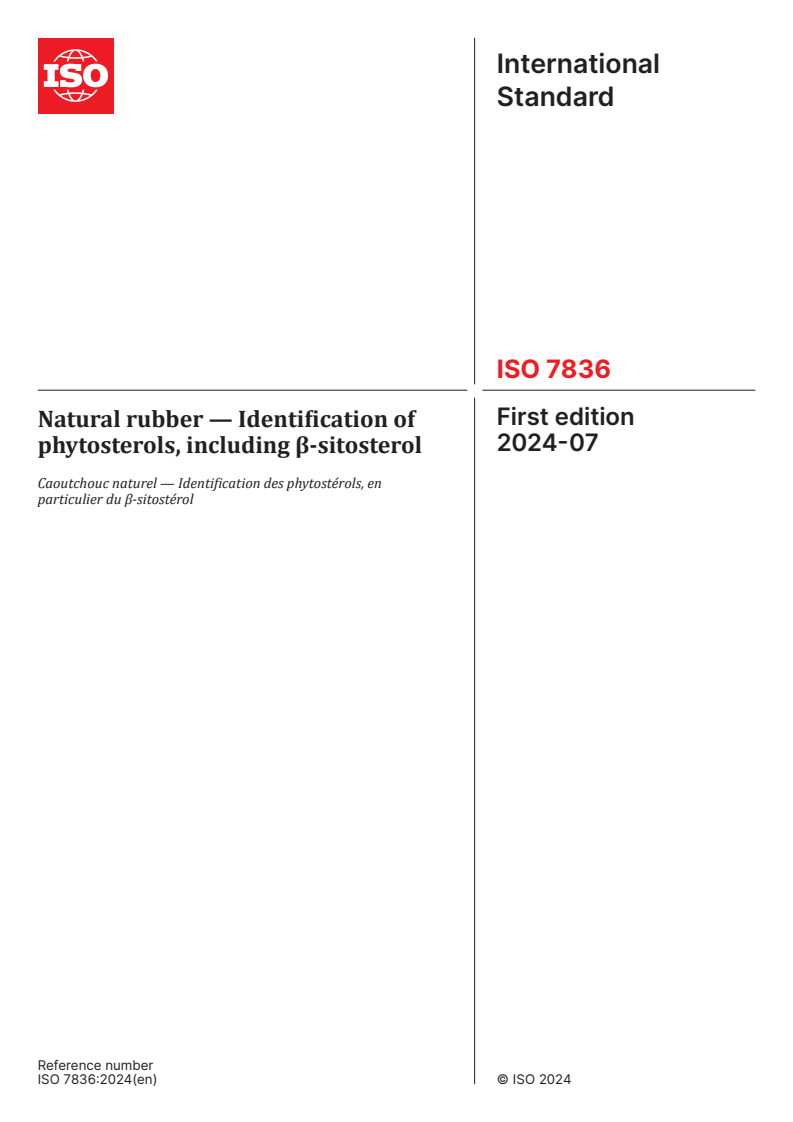
International
Standard
ISO 7836
First edition
Natural rubber — Identification of
2024-07
phytosterols, including β-sitosterol
Caoutchouc naturel — Identification des phytostérols, en
particulier du β-sitostérol
Reference number
© ISO 2024
All rights reserved. Unless otherwise specified, or required in the context of its implementation, no part of this publication may
be reproduced or utilized otherwise in any form or by any means, electronic or mechanical, including photocopying, or posting on
the internet or an intranet, without prior written permission. Permission can be requested from either ISO at the address below
or ISO’s member body in the country of the requester.
ISO copyright office
CP 401 • Ch. de Blandonnet 8
CH-1214 Vernier, Geneva
Phone: +41 22 749 01 11
Email: copyright@iso.org
Website: www.iso.org
Published in Switzerland
ii
Contents Page
Foreword .iv
1 Scope . 1
2 Normative references . 1
3 Terms and definitions . 1
4 Principle . 1
5 Reagents . 2
6 Apparatus . 2
7 Procedure . 3
7.1 Sample preparation .3
7.2 Thin layer chromatography technique .3
7.2.1 Preparation of the TLC plates .3
7.2.2 Marking the TLC plates.3
7.2.3 Spotting the TLC plates .3
7.2.4 Developing the TLC plates.3
7.2.5 Identification of β-sitosterol .3
8 Expression of results . 4
9 Test report . 4
iii
Foreword
ISO (the International Organization for Standardization) is a worldwide federation of national standards
bodies (ISO member bodies). The work of preparing International Standards is normally carried out through
ISO technical committees. Each member body interested in a subject for which a technical committee
has been established has the right to be represented on that committee. International organizations,
governmental and non-governmental, in liaison with ISO, also take part in the work. ISO collaborates closely
with the International Electrotechnical Commission (IEC) on all matters of electrotechnical standardization.
The procedures used to develop this document and those intended for its further maintenance are described
in the ISO/IEC Directives, Part 1. In particular, the different approval criteria needed for the different types
of ISO documents should be noted. This document was drafted in accordance with the editorial rules of the
ISO/IEC Directives, Part 2 (see www.iso.org/directives).
ISO draws attention to the possibility that the implementation of this document may involve the use of (a)
patent(s). ISO takes no position concerning the evidence, validity or applicability of any claimed patent
rights in respect thereof. As of the date of publication of this document, ISO had not received notice of (a)
patent(s) which may be required to implement this document. However, implementers are cautioned that
this may not represent the latest information, which may be obtained from the patent database available at
www.iso.org/patents. ISO shall not be held responsible for identifying any or all such patent rights.
Any trade name used in this document is information given for the convenience of users and does not
constitute an endorsement.
For an explanation of the voluntary nature of standards, the meaning of ISO specific terms and expressions
related to conformity assessment, as well as information about ISO's adherence to the World Trade
Organization (WTO) principles in the Technical Barriers to Trade (TBT), see www.iso.org/iso/foreword.html.
This document was prepared by Technical Committee ISO/TC 45, Rubber and rubber products, Subcommittee
SC 3, Raw materials (including latex) for use in the rubber industry.
Any feedback or questions on this document should be directed to the user’s national standards body. A
complete listing of these bodies can be found at www.iso.org/members.html.
iv
International Standard ISO 7836:2024(en)
Natural rubber — Identification of phytosterols, including
β-sitosterol
WARNING — Persons using this document should be familiar with normal laboratory practice. This
document does not purport to address all of the safety problems, if any, associated with its use. It is
the responsibility of the user to establish appropriate safety and health practices prior to use.
1 Scope
This document specifies a method to identify the presence of phytosterol including β-sitosterol in natural
rubber in raw and vu
...