

ISO 3136:2023
(Main)Rubber latex — Styrene-butadiene — Determination of bound styrene content
General Information
- Abstract
This document specifies a method for the determination of the bound styrene content of styrene-butadiene rubber (SBR) lattices. The method is applicable to hot (approximately 50 °C) emulsion polymerized SBR lattices having a bound styrene content, expressed on the SBR content, of up to 55 % and to cold (approximately 5 °C) emulsion polymerized SBR lattices having a bound styrene content between 18 % and 40 %. The method is not applicable to reinforced styrene-butadiene rubber (SBR. .Y) lattices, carboxylic-styrene-butadiene rubber (XSBR) lattices and pyridine-styrene-butadiene rubber (PSBR) lattices.
- Status
- Published
- Publication Date
- 02-May-2023
- Current Stage
- 6060 - International Standard published
- Start Date
- 03-May-2023
- Due Date
- 04-Dec-2023
- Completion Date
- 03-May-2023
Overview
ISO 3136:2023 specifies a standardized testing method for determining the bound styrene content in styrene-butadiene rubber (SBR) latex. This international standard is essential for quality control in the rubber industry, focusing on hot and cold emulsion polymerized SBR lattices. The method uses refractive index measurements of dry polymer sheets after solvent extraction to accurately quantify the bound styrene content. It excludes reinforced SBR, carboxylic SBR (XSBR), and pyridine SBR (PSBR) lattices, ensuring applicability only to relevant SBR types.
This third edition updates previous versions with refined procedures, improved precision data, and reorganized clauses for clarity and ease of use. The method supports manufacturers, testing laboratories, and regulatory bodies by providing reliable and repeatable results critical for material characterization and compliance.
Key Topics
Scope of Application
Applicable to:- Hot emulsion polymerized SBR latex (~50 °C) with bound styrene content up to 55%
- Cold emulsion polymerized SBR latex (~5 °C) with bound styrene content between 18% and 40%
Excluded types: reinforced SBR, XSBR, PSBR.
Sample Preparation
Latex is coagulated using suitable coagulants in the presence of antioxidants, following ISO 2028 procedures to produce dry polymer crumb.Refractive Index Measurement
Dry polymer sheets are extracted with ethanol-toluene azeotrope to remove unbound components, then pressed into thin sheets. The refractive index is measured at 25 °C as per ISO 2453 methods.Calculation of Bound Styrene Content
Bound styrene content is calculated from the refractive index using a defined formula or reference tables, enabling precise quantification of styrene within SBR lattices.Precision and Reliability
Extensive interlaboratory testing has established repeatability and reproducibility metrics, ensuring the method delivers consistent results across different operators and laboratories.Reporting Requirements
Test reports must include reference to ISO 3136:2023, detailed sample identification, coagulants used, test results, any deviations or unusual observations, and testing dates to ensure traceability.
Applications
Quality Control in SBR Manufacturing
Ensures that the bound styrene content of SBR latex products meets product specifications for performance and regulatory compliance.Material Characterization for Rubber Products
Provides critical data for assessing rubber latex composition that impacts mechanical properties, aging behavior, and suitability for end-use.Research and Development
Facilitates formulation adjustments and polymerization process monitoring in R&D laboratories exploring new SBR latex grades.Supplier and Regulatory Compliance Testing
Supports verification of supplier material specifications and compliance with industrial and international standards for synthetic rubber latex.Environmental and Safety Considerations
Laboratory users are advised to adhere to safe handling and disposal protocols for solvents and waste generated during testing in accordance with local regulations.
Related Standards
ISO 123: Rubber latex - Sampling
Defines sampling methods to obtain representative SBR latex samples for testing.ISO 2028: Synthetic rubber latex - Preparation of dry polymer
Specifies procedures for converting latex into dry polymer form necessary for refractive index determination.ISO 2453: Rubber, raw styrene-butadiene, emulsion-polymerized - Determination of bound styrene content - Refractive index method
Provides detailed apparatus and procedures related specifically to refractive index measurement of SBR polymers.ISO 19983:2022 Rubber - Determination of precision of test methods
Establishes the framework for evaluating test method precision, referenced in validating ISO 3136:2023 testing accuracy.
ISO 3136:2023 represents a critical benchmark in the analysis of SBR latex, enhancing quality assurance and fostering global consistency in rubber raw material characterization. Utilizing this standard supports industry stakeholders in maintaining high product integrity and meeting international market requirements.
Relations
- Effective Date
- 06-Jun-2022
Get Certified
Connect with accredited certification bodies for this standard

DIN CERTCO
DIN Group product certification.

Smithers Quality Assessments
US management systems and product certification.
Sponsored listings
Frequently Asked Questions
ISO 3136:2023 is a standard published by the International Organization for Standardization (ISO). Its full title is "Rubber latex — Styrene-butadiene — Determination of bound styrene content". This standard covers: This document specifies a method for the determination of the bound styrene content of styrene-butadiene rubber (SBR) lattices. The method is applicable to hot (approximately 50 °C) emulsion polymerized SBR lattices having a bound styrene content, expressed on the SBR content, of up to 55 % and to cold (approximately 5 °C) emulsion polymerized SBR lattices having a bound styrene content between 18 % and 40 %. The method is not applicable to reinforced styrene-butadiene rubber (SBR. .Y) lattices, carboxylic-styrene-butadiene rubber (XSBR) lattices and pyridine-styrene-butadiene rubber (PSBR) lattices.
This document specifies a method for the determination of the bound styrene content of styrene-butadiene rubber (SBR) lattices. The method is applicable to hot (approximately 50 °C) emulsion polymerized SBR lattices having a bound styrene content, expressed on the SBR content, of up to 55 % and to cold (approximately 5 °C) emulsion polymerized SBR lattices having a bound styrene content between 18 % and 40 %. The method is not applicable to reinforced styrene-butadiene rubber (SBR. .Y) lattices, carboxylic-styrene-butadiene rubber (XSBR) lattices and pyridine-styrene-butadiene rubber (PSBR) lattices.
ISO 3136:2023 is classified under the following ICS (International Classification for Standards) categories: 83.040.10 - Latex and raw rubber. The ICS classification helps identify the subject area and facilitates finding related standards.
ISO 3136:2023 has the following relationships with other standards: It is inter standard links to ISO 3136:1983. Understanding these relationships helps ensure you are using the most current and applicable version of the standard.
ISO 3136:2023 is available in PDF format for immediate download after purchase. The document can be added to your cart and obtained through the secure checkout process. Digital delivery ensures instant access to the complete standard document.
Standards Content (Sample)
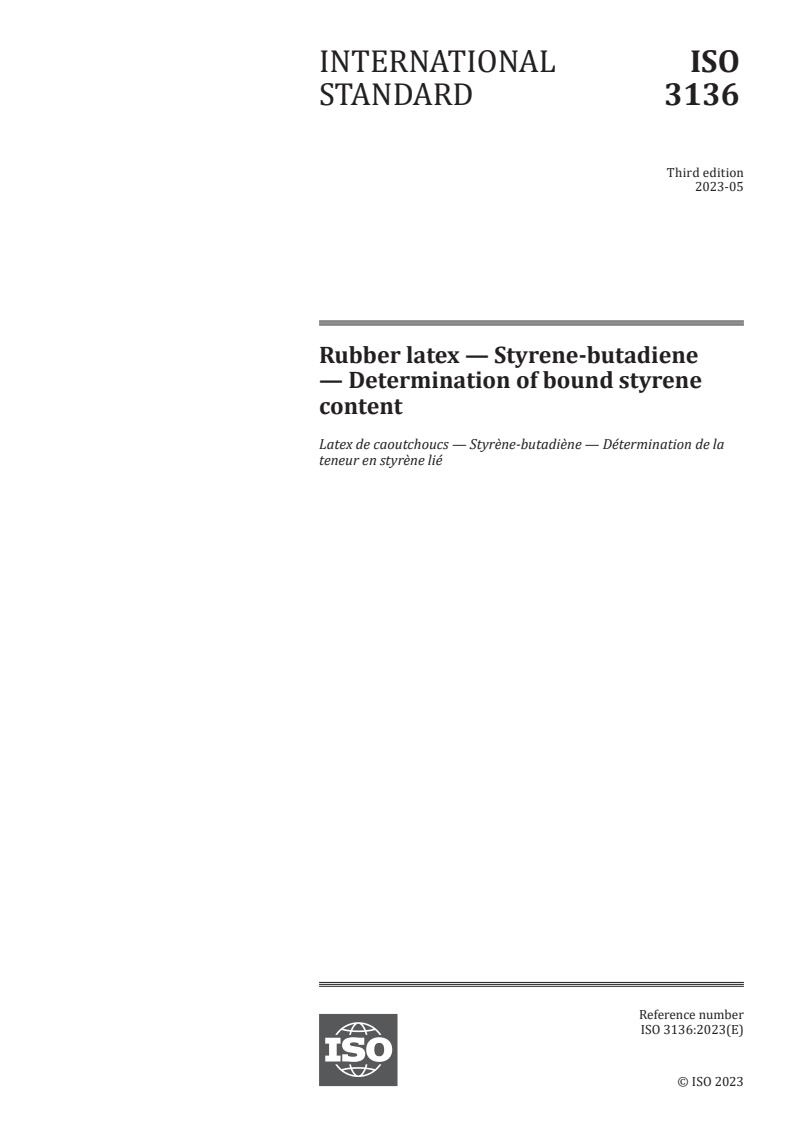
INTERNATIONAL ISO
STANDARD 3136
Third edition
2023-05
Rubber latex — Styrene-butadiene
— Determination of bound styrene
content
Latex de caoutchoucs — Styrène-butadiène — Détermination de la
teneur en styrène lié
Reference number
© ISO 2023
All rights reserved. Unless otherwise specified, or required in the context of its implementation, no part of this publication may
be reproduced or utilized otherwise in any form or by any means, electronic or mechanical, including photocopying, or posting on
the internet or an intranet, without prior written permission. Permission can be requested from either ISO at the address below
or ISO’s member body in the country of the requester.
ISO copyright office
CP 401 • Ch. de Blandonnet 8
CH-1214 Vernier, Geneva
Phone: +41 22 749 01 11
Email: copyright@iso.org
Website: www.iso.org
Published in Switzerland
ii
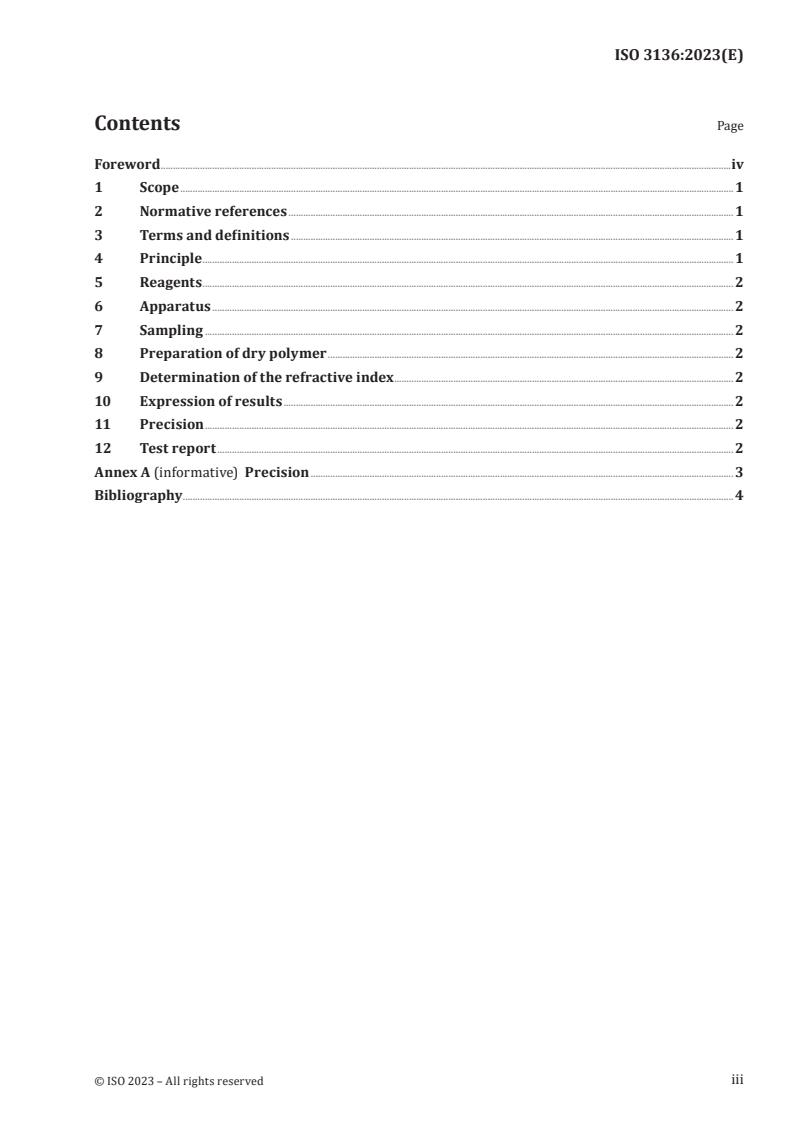
Contents Page
Foreword .iv
1 Scope . 1
2 Normative references . 1
3 Terms and definitions . 1
4 Principle . 1
5 Reagents . 2
6 Apparatus . 2
7 Sampling . 2
8 Preparation of dry polymer . 2
9 Determination of the refractive index . 2
10 Expression of results . 2
11 Precision . 2
12 Test report . 2
Annex A (informative) Precision . 3
Bibliography . 4
iii
Foreword
ISO (the International Organization for Standardization) is a worldwide federation of national standards
bodies (ISO member bodies). The work of preparing International Standards is normally carried out
through ISO technical committees. Each member body interested in a subject for which a technical
committee has been established has the right to be represented on that committee. International
organizations, governmental and non-governmental, in liaison with ISO, also take part in the work.
ISO collaborates closely with the International Electrotechnical Commission (IEC) on all matters of
electrotechnical standardization.
The procedures used to develop this document and those intended for its further maintenance are
described in the ISO/IEC Directives, Part 1. In particular, the different approval criteria needed for the
different types of ISO document should be noted. This document was drafted in accordance with the
editorial rules of the ISO/IEC Directives, Part 2 (see www.iso.org/directives).
ISO draws attention to the possibility that the implementation of this document may involve the use
of (a) patent(s). ISO takes no position concerning the evidence, validity or applicability of any claimed
patent rights in respect thereof. As of the date of publication of this document, ISO had not received
notice of (a) patent(s) which may be required to implement this document. However, implementers are
cautioned that this may not represent the latest information, which may be obtained from the patent
database available at www.iso.org/patents. ISO shall not be held responsible for identifying any or all
such patent rights.
Any trade name used in this document is information given for the convenience of users and does not
constitute an endorsement.
For an explanation of the voluntary nature of standards, the meaning of ISO specific terms and
expressions related to conformity assessment, as well as information about ISO's adherence to
the World Trade Organization (WTO) principles in the Technical Barriers to Trade (TBT), see
www.iso.org/iso/foreword.html.
This document was prepared by Technical Committee ISO/TC 45, Rubber and rubber products,
Subcommittee SC 3, Raw materials (including latex) for use in the rubber industry.
This third edition cancels and replaces the second edition (ISO 3136:1983), which has been technically
revised.
The main changes are as follows:
— the mandatory Terms and definitions clause (Clause 3) has been added and the subsequent clauses
have been renumbered;
— the former reagents and apparatus clause has been split into Clauses 5 and 6, respectively;
— the preparation of dry polymer has been moved to a new Clause 8 and the determination of the
refractive index to a new Clause 9;
— the preparation procedure of dry po
...