

ISO 3900:2023
(Main)Rubber — Nitrile latex — Determination of bound acrylonitrile content
General Information
- Abstract
This document specifies a method for the determination of the bound acrylonitrile content of emulsion-polymerized NBR lattices. The method is applicable to NBR lattices having a bound acrylonitrile content between 18 % and 45 %. It is also applicable to, for example, carboxylic-nitrile-butadiene (XNBR) lattices and nitrile-isoprene (NIR) lattices.
- Status
- Published
- Publication Date
- 09-Jul-2023
- Current Stage
- 6060 - International Standard published
- Start Date
- 10-Jul-2023
- Due Date
- 04-Dec-2023
- Completion Date
- 10-Jul-2023


Overview
ISO 3900:2023 specifies a validated laboratory method for determining the bound acrylonitrile content of emulsion‑polymerized nitrile butadiene rubber (NBR) lattices. The method uses the Kjeldahl macro‑method adapted for nitrile latex and is applicable to NBR lattices with bound acrylonitrile in the range 18 % to 45 %. It also applies to related lattices such as carboxylic‑nitrile‑butadiene (XNBR) and nitrile‑isoprene (NIR).
The procedure requires standard sampling and sample preparation (ISO 123; ISO 24698‑2), coagulation and drying to constant mass, followed by acid digestion to convert bound nitrogen to ammonium salts and titrimetric determination of released ammonia.
Keywords: ISO 3900:2023, nitrile latex, NBR, bound acrylonitrile, Kjeldahl macro‑method, nitrogen determination, quality control.
Key Topics
- Scope: Determination of bound acrylonitrile content in emulsion‑polymerized NBR lattices (18–45 %).
- Principle: Coagulate and dry latex; digest dried polymer with sulfuric acid and catalyst; convert nitrogen to ammonium hydrogen sulfate; make alkaline and distil ammonia into boric acid; titrate with standard sulfuric acid solution.
- Reagents & Apparatus: Reagents specified follow ISO 1656 macro‑method; sulfuric acid volumetric solution (c = 0.1 mol·dm⁻³) is used. Kjeldahl apparatus with an ~800 cm³ digestion flask is recommended.
- Sample Prep & Sampling: Take ~500 g sample per ISO 123 and prepare dried test portion per ISO 24698‑2; dry at 100 °C ± 2 °C until constant mass.
- Results Expression: Bound acrylonitrile is calculated from titration volumes and sample mass and reported to the nearest 0.01 %.
- Precision: Precision data are provided in Annex A based on an interlaboratory test program (six laboratories) and include repeatability and reproducibility estimates.
Applications
- Quality control: Accurate determination of acrylonitrile content supports batch release testing and in‑process monitoring for NBR and related latex materials.
- Specification compliance: Ensures that latex raw materials meet formulation and performance requirements where acrylonitrile content affects chemical, mechanical and barrier properties.
- Traceability & reporting: Standardized test method enables consistent reporting between suppliers, manufacturers and testing laboratories.
Related Standards
- ISO 1656:2019 - Kjeldahl macro‑method for nitrogen determination in rubber (referenced for reagents and macro‑method details).
- ISO 24698‑2:2018 - Preparation of dried NBR latex test samples.
- ISO 123 - Sampling of rubber latex.
- ISO 19983:2022 - Determination of precision of test methods (precision evaluation referenced in Annex A).
For implementation, laboratories should follow the full text of ISO 3900:2023 and the referenced standards, ensure appropriate safety practices, and record all test conditions in the test report (clause 11) for traceability and reproducibility.
Relations
- Effective Date
- 06-Jun-2022
Get Certified
Connect with accredited certification bodies for this standard

DIN CERTCO
DIN Group product certification.

Smithers Quality Assessments
US management systems and product certification.
Sponsored listings
Frequently Asked Questions
ISO 3900:2023 is a standard published by the International Organization for Standardization (ISO). Its full title is "Rubber — Nitrile latex — Determination of bound acrylonitrile content". This standard covers: This document specifies a method for the determination of the bound acrylonitrile content of emulsion-polymerized NBR lattices. The method is applicable to NBR lattices having a bound acrylonitrile content between 18 % and 45 %. It is also applicable to, for example, carboxylic-nitrile-butadiene (XNBR) lattices and nitrile-isoprene (NIR) lattices.
This document specifies a method for the determination of the bound acrylonitrile content of emulsion-polymerized NBR lattices. The method is applicable to NBR lattices having a bound acrylonitrile content between 18 % and 45 %. It is also applicable to, for example, carboxylic-nitrile-butadiene (XNBR) lattices and nitrile-isoprene (NIR) lattices.
ISO 3900:2023 is classified under the following ICS (International Classification for Standards) categories: 83.040.10 - Latex and raw rubber. The ICS classification helps identify the subject area and facilitates finding related standards.
ISO 3900:2023 has the following relationships with other standards: It is inter standard links to ISO 3900:1995. Understanding these relationships helps ensure you are using the most current and applicable version of the standard.
ISO 3900:2023 is available in PDF format for immediate download after purchase. The document can be added to your cart and obtained through the secure checkout process. Digital delivery ensures instant access to the complete standard document.
Standards Content (Sample)
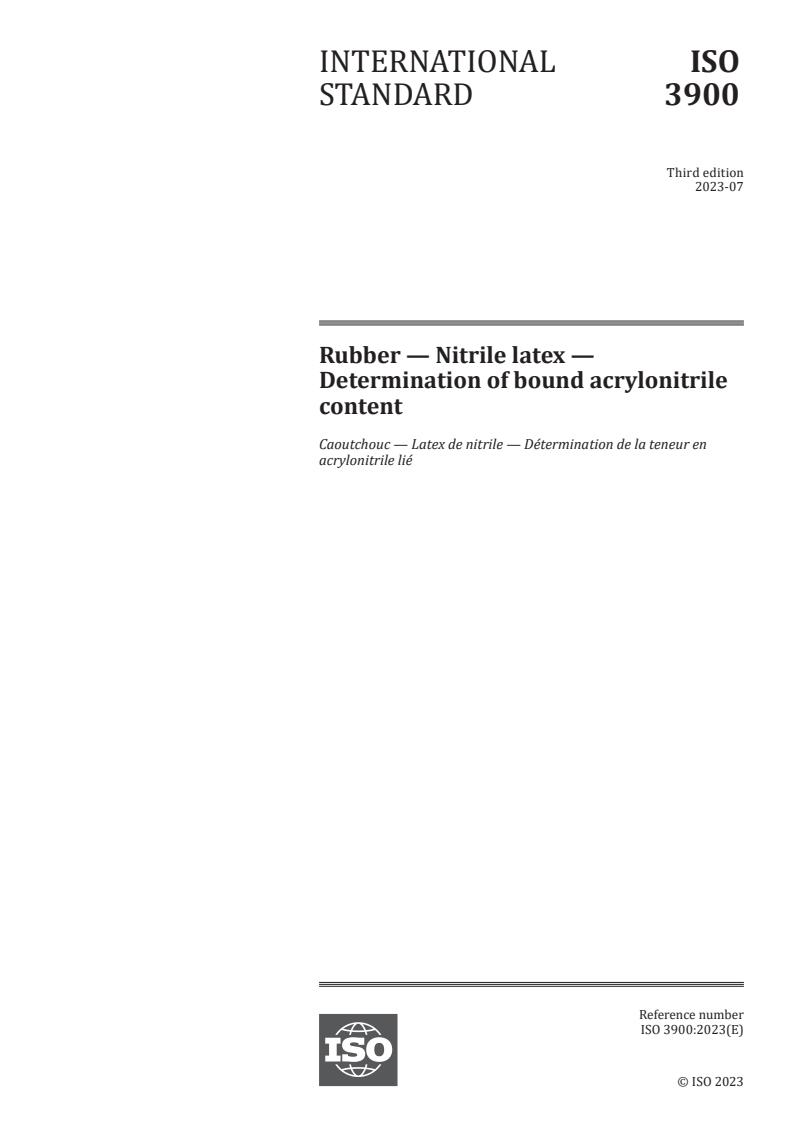
INTERNATIONAL ISO
STANDARD 3900
Third edition
2023-07
Rubber — Nitrile latex —
Determination of bound acrylonitrile
content
Caoutchouc — Latex de nitrile — Détermination de la teneur en
acrylonitrile lié
Reference number
© ISO 2023
All rights reserved. Unless otherwise specified, or required in the context of its implementation, no part of this publication may
be reproduced or utilized otherwise in any form or by any means, electronic or mechanical, including photocopying, or posting on
the internet or an intranet, without prior written permission. Permission can be requested from either ISO at the address below
or ISO’s member body in the country of the requester.
ISO copyright office
CP 401 • Ch. de Blandonnet 8
CH-1214 Vernier, Geneva
Phone: +41 22 749 01 11
Email: copyright@iso.org
Website: www.iso.org
Published in Switzerland
ii
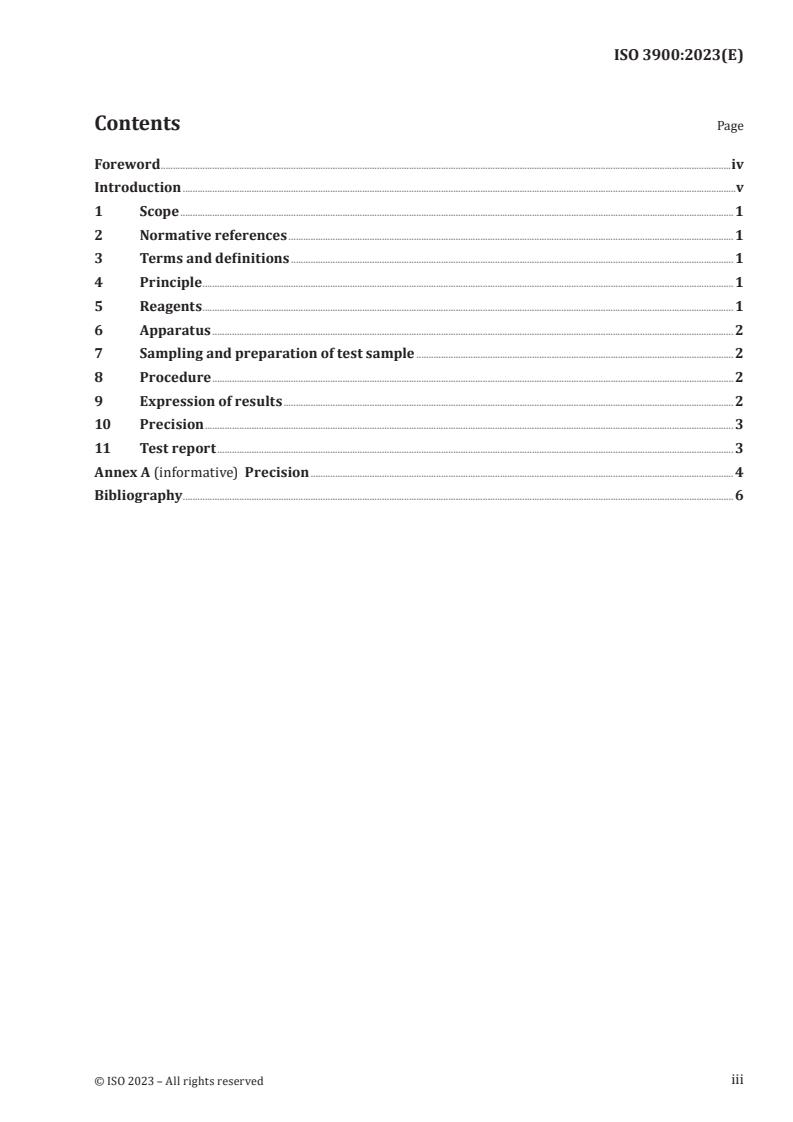
Contents Page
Foreword .iv
Introduction .v
1 Scope . 1
2 Normative references . 1
3 Terms and definitions . 1
4 Principle . 1
5 Reagents . 1
6 Apparatus . 2
7 Sampling and preparation of test sample . 2
8 Procedure .2
9 Expression of results . 2
10 Precision . 3
11 Test report . 3
Annex A (informative) Precision . 4
Bibliography . 6
iii
Foreword
ISO (the International Organization for Standardization) is a worldwide federation of national standards
bodies (ISO member bodies). The work of preparing International Standards is normally carried out
through ISO technical committees. Each member body interested in a subject for which a technical
committee has been established has the right to be represented on that committee. International
organizations, governmental and non-governmental, in liaison with ISO, also take part in the work.
ISO collaborates closely with the International Electrotechnical Commission (IEC) on all matters of
electrotechnical standardization.
The procedures used to develop this document and those intended for its further maintenance are
described in the ISO/IEC Directives, Part 1. In particular, the different approval criteria needed for the
different types of ISO document should be noted. This document was drafted in accordance with the
editorial rules of the ISO/IEC Directives, Part 2 (see www.iso.org/directives).
ISO draws attention to the possibility that the implementation of this document may involve the use
of (a) patent(s). ISO takes no position concerning the evidence, validity or applicability of any claimed
patent rights in respect thereof. As of the date of publication of this document, ISO had not received
notice of (a) patent(s) which may be required to implement this document. However, implementers are
cautioned that this may not represent the latest information, which may be obtained from the patent
database available at www.iso.org/patents. ISO shall not be held responsible for identifying any or all
such patent rights.
Any trade name used in this document is information given for the convenience of users and does not
constitute an endorsement.
For an explanation of the voluntary nature of standards, the meaning of ISO specific terms and
expressions related to conformity assessment, as well as information about ISO's adherence to
the World Trade Organization (WTO) principles in the Technical Barriers to Trade (TBT), see
www.iso.org/iso/foreword.html.
This document was prepared by Technical Committee ISO/TC 45, Rubber and rubber products,
Subcommittee SC 3, Raw materials (including latex) for use in the rubber industry.
This third edition cancels and replaces the second edition (ISO 3900:1995), which has been technically
revised.
The main changes are as follows:
— addition of an introduction to explain the purpose of this revision;
— deletion of the note in Clause 1 and in Clause 4;
— update of the apparatus in Clause 5;
— in Clause 7, deletion of the preparation for dried film of NBR latex and addition of the preparation
dried NBR latex in accordance with ISO 24698-2;
— modification of the determination method of bound acrylonitrile content in accordance with the
macro-method in ISO 1656;
— update of the procedure and addition of the suitable determination conditions, in Clause 8;
— addition of the precision data in Annex A.
Any feedback or questions on this document should be directed to the user’s national standards body. A
complete listing of these bodies can be found at www.iso.org/members.html.
iv
Introduction
Generally, the bound acrylonitrile content in nitrile latex is between 18 % and 45 %, expressed in the
nitrogen content in the range from 4,7 % to 11,9 %. In the previous version of this document, the bound
acrylonitrile content of emulsion-polymerized NBR lattices was determined in accordance with the
semi-micro method in ISO 1656. However, the semi-micro method is applicable to natural rubber and
natural rubber latex with lower nitrogen content; it is not applicable to determine nitrile latex. The
purpose of this document is to use the macro-method in ISO 1656 to determine the bound acrylonitrile
content in nitrile latex and to give the suitable determination conditions for nitrile latex.
v
INTERNATIONAL STANDARD ISO 3900:2023(E)
Rubber — Nitrile latex — Determination of bound
acrylonitrile content
WARNING — Persons us
...