


ISO 10555-4:2013
(Main)Intravascular catheters — Sterile and single-use catheters — Part 4: Balloon dilatation catheters
Intravascular catheters — Sterile and single-use catheters — Part 4: Balloon dilatation catheters
ISO 10555-4:2013 specifies requirements for balloon dilatation catheters supplied in the sterile condition, and intended for single use.
Cathéters intravasculaires — Cathéters stériles et non réutilisables — Partie 4: Cathéters de dilatation à ballonnets
L'ISO 10555-4:2013 spécifie les exigences générales relatives aux cathéters de dilatation à ballonnets fournis dans des conditions stériles, non réutilisables.
General Information
- Status
- Withdrawn
- Publication Date
- 05-Jun-2013
- Technical Committee
- ISO/TC 84 - Devices for administration of medicinal products and catheters
- Current Stage
- 9599 - Withdrawal of International Standard
- Start Date
- 14-Nov-2023
- Completion Date
- 14-Feb-2026
Relations
- Effective Date
- 12-Feb-2026
- Effective Date
- 23-Apr-2020
- Effective Date
- 25-Sep-2010
Buy Documents

ISO 10555-4:2013 - Intravascular catheters -- Sterile and single-use catheters

ISO 10555-4:2013 - Cathéters intravasculaires -- Cathéters stériles et non réutilisables
Get Certified
Connect with accredited certification bodies for this standard

BSI Group
BSI (British Standards Institution) is the business standards company that helps organizations make excellence a habit.

TÜV Rheinland
TÜV Rheinland is a leading international provider of technical services.

TÜV SÜD
TÜV SÜD is a trusted partner of choice for safety, security and sustainability solutions.
Sponsored listings
Frequently Asked Questions
ISO 10555-4:2013 is a standard published by the International Organization for Standardization (ISO). Its full title is "Intravascular catheters — Sterile and single-use catheters — Part 4: Balloon dilatation catheters". This standard covers: ISO 10555-4:2013 specifies requirements for balloon dilatation catheters supplied in the sterile condition, and intended for single use.
ISO 10555-4:2013 specifies requirements for balloon dilatation catheters supplied in the sterile condition, and intended for single use.
ISO 10555-4:2013 is classified under the following ICS (International Classification for Standards) categories: 11.040.25 - Syringes, needles an catheters. The ICS classification helps identify the subject area and facilitates finding related standards.
ISO 10555-4:2013 has the following relationships with other standards: It is inter standard links to EN ISO 10555-4:2013, ISO 10555-4:2023, ISO 10555-4:1996. Understanding these relationships helps ensure you are using the most current and applicable version of the standard.
ISO 10555-4:2013 is available in PDF format for immediate download after purchase. The document can be added to your cart and obtained through the secure checkout process. Digital delivery ensures instant access to the complete standard document.
Standards Content (Sample)
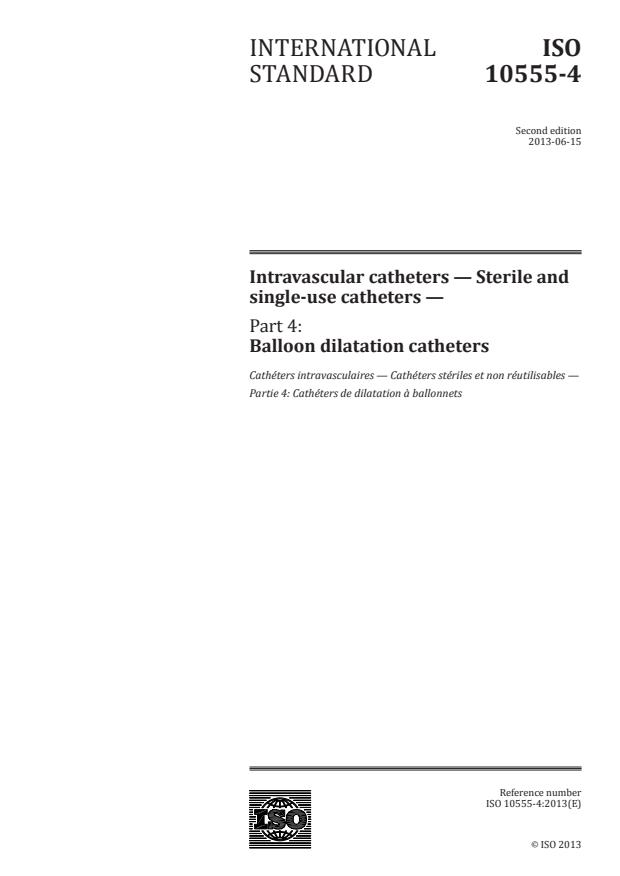
INTERNATIONAL ISO
STANDARD 10555-4
Second edition
2013-06-15
Intravascular catheters — Sterile and
single-use catheters —
Part 4:
Balloon dilatation catheters
Cathéters intravasculaires — Cathéters stériles et non réutilisables —
Partie 4: Cathéters de dilatation à ballonnets
Reference number
©
ISO 2013
© ISO 2013
All rights reserved. Unless otherwise specified, no part of this publication may be reproduced or utilized otherwise in any form
or by any means, electronic or mechanical, including photocopying, or posting on the internet or an intranet, without prior
written permission. Permission can be requested from either ISO at the address below or ISO’s member body in the country of
the requester.
ISO copyright office
Case postale 56 • CH-1211 Geneva 20
Tel. + 41 22 749 01 11
Fax + 41 22 749 09 47
E-mail copyright@iso.org
Web www.iso.org
Published in Switzerland
ii © ISO 2013 – All rights reserved
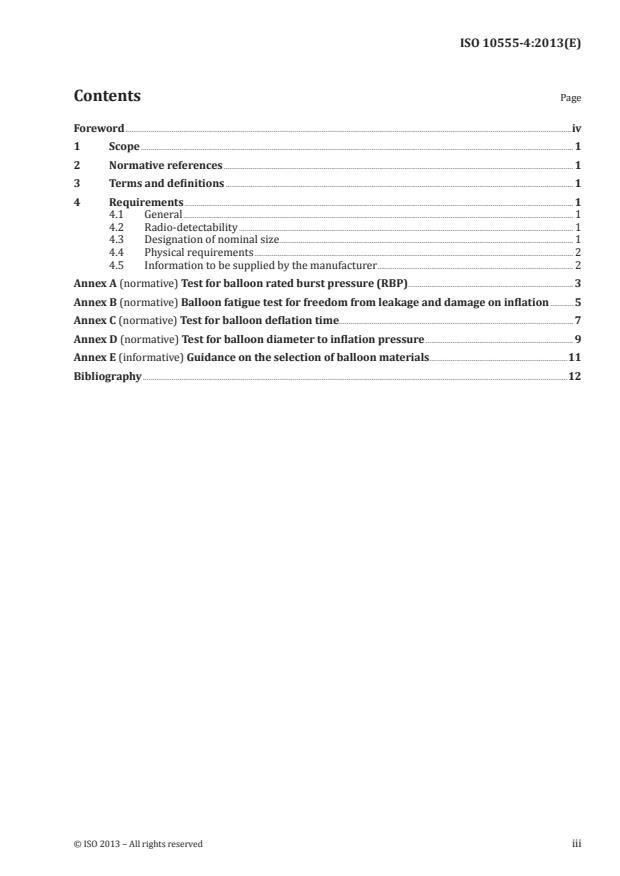
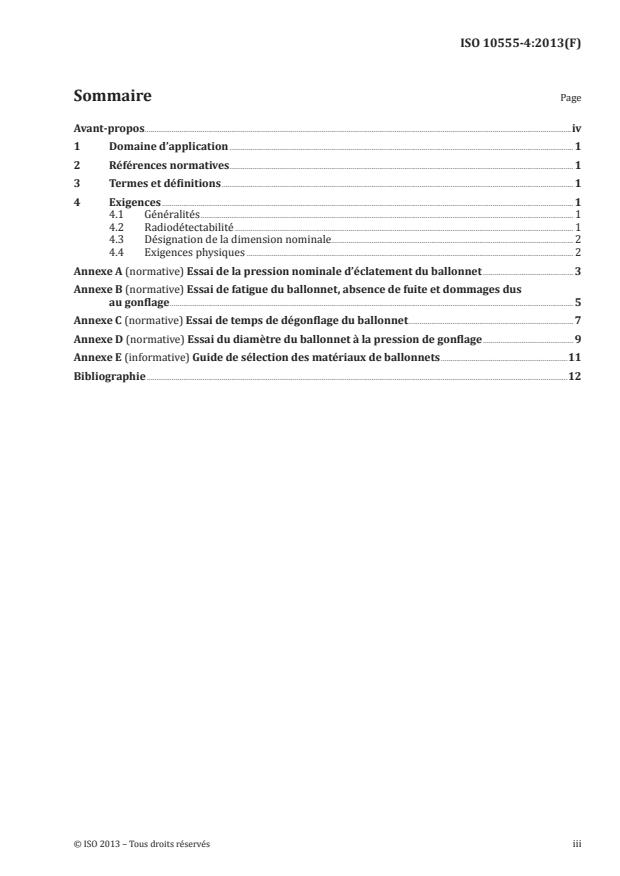
Contents Page
Foreword .iv
1 Scope . 1
2 Normative references . 1
3 Terms and definitions . 1
4 Requirements . 1
4.1 General . 1
4.2 Radio-detectability . 1
4.3 Designation of nominal size . 1
4.4 Physical requirements . 2
4.5 Information to be supplied by the manufacturer . 2
Annex A (normative) Test for balloon rated burst pressure (RBP) . 3
Annex B (normative) Balloon fatigue test for freedom from leakage and damage on inflation .5
Annex C (normative) Test for balloon deflation time. 7
Annex D (normative) Test for balloon diameter to inflation pressure . 9
Annex E (informative) Guidance on the selection of balloon materials.11
Bibliography .12
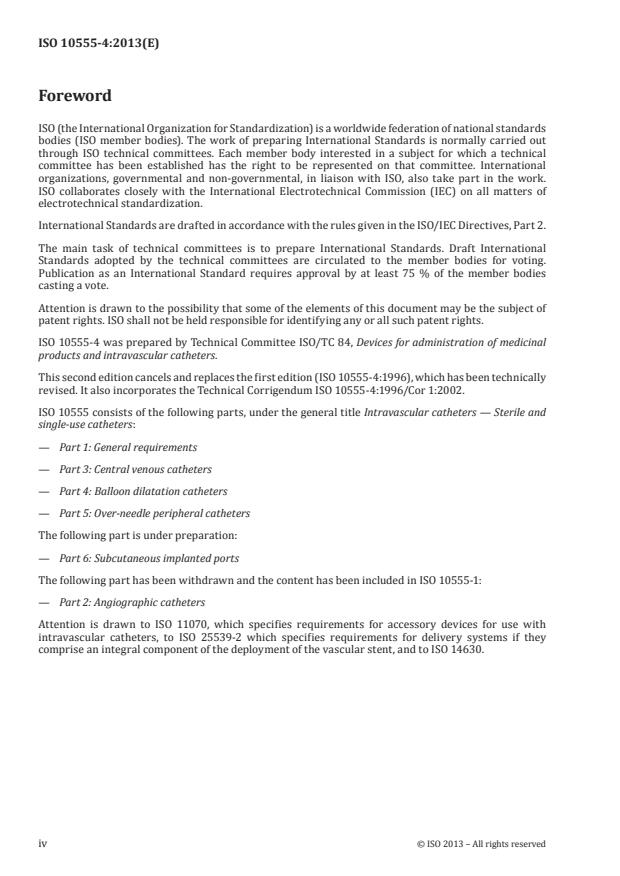
Foreword
ISO (the International Organization for Standardization) is a worldwide federation of national standards
bodies (ISO member bodies). The work of preparing International Standards is normally carried out
through ISO technical committees. Each member body interested in a subject for which a technical
committee has been established has the right to be represented on that committee. International
organizations, governmental and non-governmental, in liaison with ISO, also take part in the work.
ISO collaborates closely with the International Electrotechnical Commission (IEC) on all matters of
electrotechnical standardization.
International Standards are drafted in accordance with the rules given in the ISO/IEC Directives, Part 2.
The main task of technical committees is to prepare International Standards. Draft International
Standards adopted by the technical committees are circulated to the member bodies for voting.
Publication as an International Standard requires approval by at least 75 % of the member bodies
casting a vote.
Attention is drawn to the possibility that some of the elements of this document may be the subject of
patent rights. ISO shall not be held responsible for identifying any or all such patent rights.
ISO 10555-4 was prepared by Technical Committee ISO/TC 84, Devices for administration of medicinal
products and intravascular catheters.
This second edition cancels and replaces the first edition (ISO 10555-4:1996), which has been technically
revised. It also incorporates the Technical Corrigendum ISO 10555-4:1996/Cor 1:2002.
ISO 10555 consists of the following parts, under the general title Intravascular catheters — Sterile and
single-use catheters:
— Part 1: General requirements
— Part 3: Central venous catheters
— Part 4: Balloon dilatation catheters
— Part 5: Over-needle peripheral catheters
The following part is under preparation:
— Part 6: Subcutaneous implanted ports
The following part has been withdrawn and the content has been included in ISO 10555-1:
— Part 2: Angiographic catheters
Attention is drawn to ISO 11070, which specifies requirements for accessory devices for use with
intravascular catheters, to ISO 25539-2 which specifies requirements for delivery systems if they
comprise an integral component of the deployment of the vascular stent, and to ISO 14630.
iv © ISO 2013 – All rights reserved
INTERNATIONAL STANDARD ISO 10555-4:2013(E)
Intravascular catheters — Sterile and single-use catheters —
Part 4:
Balloon dilatation catheters
1 Scope
This part of ISO 10555 specifies requirements for balloon dilatation catheters supplied in the sterile
condition, and intended for single use.
2 Normative references
The following documents, in whole or in part, are normatively referenced in this document and are
indispensable for its application. For dated references, only the edition cited applies. For undated
references, the latest edition of the referenced document (including any amendments) applies.
ISO 594-1, Conical fittings with a 6 % (Luer) taper for syringes, needles and certain other medical
1)
equipment — Part 1: General requirements
ISO 594-2, Conical fittings with a 6 % (Luer) taper for syringes, needles and certain other medical
1)
equipment — Part 2: Lock fittings
ISO 10555-1, Intravascular catheters — Sterile and single-use catheters — Part 1: General requirements
3 Terms and definitions
For the purposes of this document, the terms and definitions given in ISO 10555-1 and the following apply.
3.1
balloon dilatation catheter
intravascular catheter fitted with a balloon near the distal end, which is introduced into an artery or
vein to dilate a part or parts of the vascular system
4 Requirements
4.1 General
Unless otherwise specified in this part of ISO 10555, balloon dilatation catheters shall comply with
ISO 10555-1.
4.2 Radio-detectability
The position of the balloon shall be radio detectable when the catheter has been inserted into the body.
4.3 Designation of nominal size
The nominal size of the catheter shall be designated by the following:
a) diameter(s) expressed in millimetres of the inflated balloon(s) or, for multidiameter balloon(s), the
diameter of each portion at recommended pressure;
1) Upon its publication, ISO 80369-7 will replace ISO 594-1 and ISO 594-2.
b) effective length of the balloon at recommended pressure;
c) diameter of the largest guidewire that can be used with the catheter, if applicable.
NOTE Where a balloon dilation catheter (see Figure B.1) is used as a stent delivery system, refer to the
appropriate standard for stents for designation of nominal size.
4.4 Physical requirements
4.4.1 Balloon rated burst pressure (RBP)
Determine the burst pressure with an appropriate safety margin when tested in accordance with
Annex A. Longitudinal failure is the desirable balloon failure mode.
4.4.2 Balloon fatigue; freedom from leakage and damage on inflation
Evaluate the ability of the balloon to withstand repeated inflation cycles to the RBP. When tested as
described in Annex B, there shall be no leakage or evidence of damage, such as herniation or bursting of
the catheter.
4.4.3 Balloon deflation time
Determine the time required to deflate the balloon from the RBP as described in Annex C.
4.4.4 Balloon diameter to inflation pressure
Determine the relationship between the balloon diameter and the balloon inflation pressure as described
in Annex D.
4.5 Information to be supplied by the manufacturer
Information supplied by the manufacturer shall comply with ISO 10555-1 and shall also include the following:
a) nominal size of the catheter, as designated in 4.3;
b) position(s) of radio-detectable marker(s);
c) RBP of the balloon, expressed in kilopascals;
d) balloon inflation pressure, expressed in kilopascals, required to achieve the nominal balloon diameter(s);
e) guidewire, guide catheter or sheath or introducer compatibility and size recommendations
appropriate to the intended clinical use.
NOTE Units of measurement systems other than those specified in this part of ISO 10555 can additionally be
used.
2 © ISO 2013 – All rights reserved
Annex A
(normative)
Test for balloon rated burst pressure (RBP)
A.1 Principle
The purpose of this test is to determine the RBP of the balloon.
A.2 Apparatus
A.2.1 Recommended guidewire or equivalent.
A.2.2 Water bath, controlled at (37 ± 2) °C.
A.2.3 Leak detection mechanism, e.g. dye in test fluid, pressure drop monitor, flow rate monitor.
A.2.4 Fluid for inflation, e.g. room temperature water or other justified clinically relevant media.
A.2.5 Timing mechanism, with specified accuracy.
A.2.6 Pressure generating device, fitted with a means of me
...
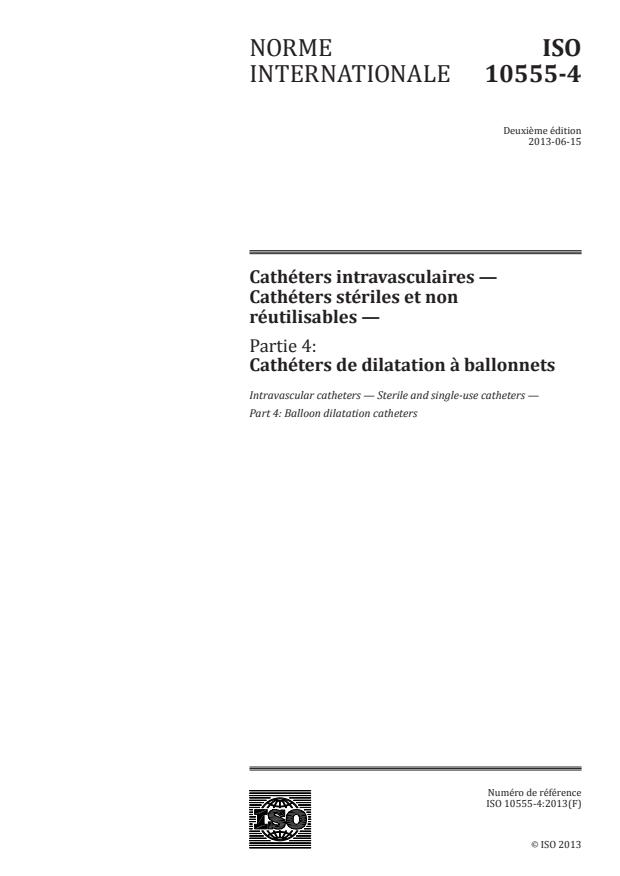
NORME ISO
INTERNATIONALE 10555-4
Deuxième édition
2013-06-15
Cathéters intravasculaires —
Cathéters stériles et non
réutilisables —
Partie 4:
Cathéters de dilatation à ballonnets
Intravascular catheters — Sterile and single-use catheters —
Part 4: Balloon dilatation catheters
Numéro de référence
©
ISO 2013
DOCUMENT PROTÉGÉ PAR COPYRIGHT
© ISO 2013
Droits de reproduction réservés. Sauf indication contraire, aucune partie de cette publication ne peut être reproduite ni utilisée
sous quelque forme que ce soit et par aucun procédé, électronique ou mécanique, y compris la photocopie, l’affichage sur
l’internet ou sur un Intranet, sans autorisation écrite préalable. Les demandes d’autorisation peuvent être adressées à l’ISO à
l’adresse ci-après ou au comité membre de l’ISO dans le pays du demandeur.
ISO copyright office
Case postale 56 • CH-1211 Geneva 20
Tel. + 41 22 749 01 11
Fax + 41 22 749 09 47
E-mail copyright@iso.org
Web www.iso.org
Publié en Suisse
ii © ISO 2013 – Tous droits réservés
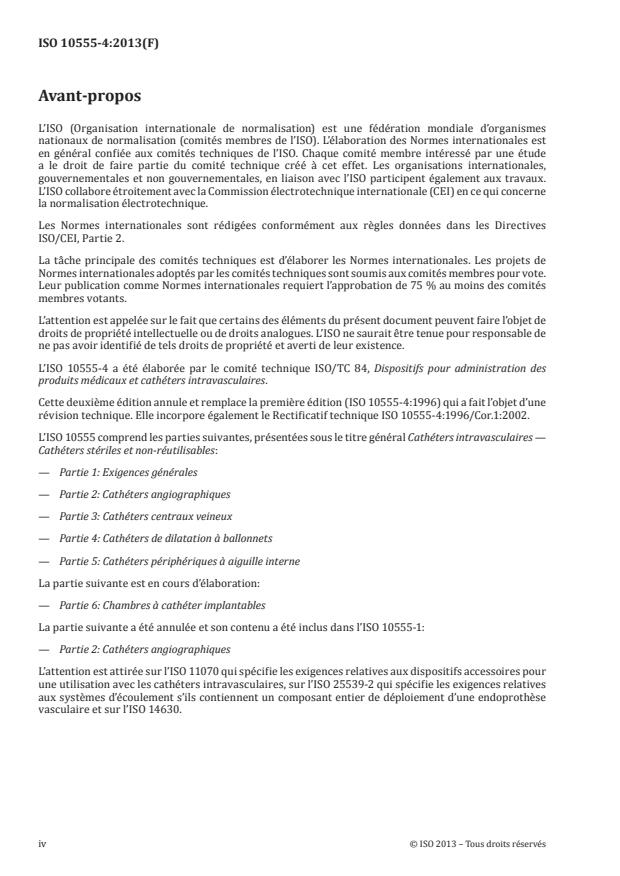
Sommaire Page
Avant-propos .iv
1 Domaine d’application . 1
2 Références normatives . 1
3 Termes et définitions . 1
4 Exigences . 1
4.1 Généralités . 1
4.2 Radiodétectabilité . 1
4.3 Désignation de la dimension nominale . 2
4.4 Exigences physiques . 2
Annexe A (normative) Essai de la pression nominale d’éclatement du ballonnet .3
Annexe B (normative) Essai de fatigue du ballonnet, absence de fuite et dommages dus
au gonflage . 5
Annexe C (normative) Essai de temps de dégonflage du ballonnet . 7
Annexe D (normative) Essai du diamètre du ballonnet à la pression de gonflage .9
Annexe E (informative) Guide de sélection des matériaux de ballonnets .11
Bibliographie .12
Avant-propos
L’ISO (Organisation internationale de normalisation) est une fédération mondiale d’organismes
nationaux de normalisation (comités membres de l’ISO). L’élaboration des Normes internationales est
en général confiée aux comités techniques de l’ISO. Chaque comité membre intéressé par une étude
a le droit de faire partie du comité technique créé à cet effet. Les organisations internationales,
gouvernementales et non gouvernementales, en liaison avec l’ISO participent également aux travaux.
L’ISO collabore étroitement avec la Commission électrotechnique internationale (CEI) en ce qui concerne
la normalisation électrotechnique.
Les Normes internationales sont rédigées conformément aux règles données dans les Directives
ISO/CEI, Partie 2.
La tâche principale des comités techniques est d’élaborer les Normes internationales. Les projets de
Normes internationales adoptés par les comités techniques sont soumis aux comités membres pour vote.
Leur publication comme Normes internationales requiert l’approbation de 75 % au moins des comités
membres votants.
L’attention est appelée sur le fait que certains des éléments du présent document peuvent faire l’objet de
droits de propriété intellectuelle ou de droits analogues. L’ISO ne saurait être tenue pour responsable de
ne pas avoir identifié de tels droits de propriété et averti de leur existence.
L’ISO 10555-4 a été élaborée par le comité technique ISO/TC 84, Dispositifs pour administration des
produits médicaux et cathéters intravasculaires.
Cette deuxième édition annule et remplace la première édition (ISO 10555-4:1996) qui a fait l’objet d’une
révision technique. Elle incorpore également le Rectificatif technique ISO 10555-4:1996/Cor.1:2002.
L’ISO 10555 comprend les parties suivantes, présentées sous le titre général Cathéters intravasculaires —
Cathéters stériles et non-réutilisables:
— Partie 1: Exigences générales
— Partie 2: Cathéters angiographiques
— Partie 3: Cathéters centraux veineux
— Partie 4: Cathéters de dilatation à ballonnets
— Partie 5: Cathéters périphériques à aiguille interne
La partie suivante est en cours d’élaboration:
— Partie 6: Chambres à cathéter implantables
La partie suivante a été annulée et son contenu a été inclus dans l’ISO 10555-1:
— Partie 2: Cathéters angiographiques
L’attention est attirée sur l’ISO 11070 qui spécifie les exigences relatives aux dispositifs accessoires pour
une utilisation avec les cathéters intravasculaires, sur l’ISO 25539-2 qui spécifie les exigences relatives
aux systèmes d’écoulement s’ils contiennent un composant entier de déploiement d’une endoprothèse
vasculaire et sur l’ISO 14630.
iv © ISO 2013 – Tous droits réservés
NORME INTERNATIONALE ISO 10555-4:2013(F)
Cathéters intravasculaires — Cathéters stériles et non
réutilisables —
Partie 4:
Cathéters de dilatation à ballonnets
1 Domaine d’application
La présente partie de I’ISO 10555 spécifie les exigences générales relatives aux cathéters de dilatation à
ballonnets fournis dans des conditions stériles, non réutilisables.
2 Références normatives
Les documents ci-après, dans leur intégralité ou non, sont des références normatives indispensables à
l’application du présent document. Pour les références datées, seule l’édition citée s’applique. Pour les
références non datées, la dernière édition du document de référence s’applique (y compris les éventuels
amendements).
ISO 594-1, Assemblages coniques à 6 % (Luer) des seringues et aiguilles et de certains autres appareils à
1)
usage médical — Partie 1: Spécifications générales
ISO 594-2, Assemblages coniques à 6 % (Luer) des seringues et aiguilles et de certains autres appareils à
1)
usage médical — Partie 2: Assemblages à verrouillage
ISO 10555-1, Cathéters intravasculaires — Cathéters stériles et non réutilisables — Partie 1: Exigences générales
3 Termes et définitions
Pour les besoins du présent document, les termes et définitions donnés dans l’ISO 10555-1 ainsi que les
suivants s’appliquent.
3.1
cathéter de dilatation à ballonnets
cathéter intravasculaire monté avec un ballonnet près de l’extrémité distale, introduit dans une artère
ou une veine pour dilater une ou plusieurs parties du système vasculaire
4 Exigences
4.1 Généralités
Sauf spécification contraire dans la présente partie de l’ISO 10555, les cathéters de dilatation à ballonnets
doivent être conformes à l’ISO 10555-1.
4.2 Radiodétectabilité
La position du ballonnet doit être radiodétectable une fois que le cathéter a été inséré dans l’organisme.
1) Lors de sa publication l’ISO 80369-7 remplacera l’ISO 594-1 et l’ISO 594-2.
4.3 Désignation de la dimension nominale
La dimension nominale du cathéter doit être désignée par les éléments suivants:
a) diamètre(s), exprimé(s) en millimètres, du/des ballonnet(s) gonflé(s) ou, pour les ballonnets à
plusieurs diamètres, le diamètre de chaque partie à une pression recommandée;
b) longueur utile du ballonnet à une pression recommandée;
c) diamètre du plus grand guide pouvant être utilisé avec le cathéter, le cas échéant.
NOTE Si un cathéter de dilatation à ballonnets est utilisé comme système d’endoprothèse vasculaire, se
référer à la Norme relative aux endoprothèses vasculaires pour la désignation de la taille nominale.
4.4 Exigences physiques
4.4.1 Pression nominale d’éclatement du ballonnet
Déterminer la pression d’éclatement avec une marge de sécurité appropriée après essai réalisé
conformément à l’Annexe A. La défaillance du ballonnet est généralement longitudinale.
4.4.2 Fatigue du ballonnet; absence de fuites et dommages dus au gonflage
Évaluer la capacité du ballonnet à résister à des cycles de gonflage répétés à la pression nominale
d’éclatement. Dans le cadre des essais conformes à la description donnée dans l’Annexe C, il ne doit plus
y avoir de fuite ni de preuve de dommages (par exemple hernie ou éclatement du cathéter).
4.4.3 Durée de dégonflage du ballonnet
Déterminer le temps nécessaire au dégonflage du ballonnet de la pression nominale d’éclatement,
comme indiqué dans l’Annexe C.
4.4.4 Diamètre du ballonnet à la pression de gonflage
Déterminer la relation entre le diamètre du ballonnet la pression de gonflage du ballonnet, comme
indiqué dans l’Annexe D.
4.4.5 Notice d’information du fabricant
La notice d’information du fabricant doit être conforme à l’ISO 10555-1 et doit également comprendre
les informations suivantes:
a) la taille nominale du cathéter, comme désignée en 4.3;
b) le(s) positionnement(s) du/des marque(s) radiodétectable(s);
c) la pression nominale d’éclatement du ballonnet, exprimée en kilopascals;
d) pression de gonflage du ballonnet, exprimée en kilopascals, requise pour atteindre le(s) diamètre(s)
nominal(aux) du ballonnet;
e) les recommandations appropriées à une utilisation clinique relatives à la compatibilité et à la taille
du guide, du guide du cathéter, ou de la gaine d’introduction.
NOTE Les unités des systèmes de mesure autres que celles spécifiées dans la présente partie de l’ISO 10555
peuvent également être utilisées.
2 © ISO 2013 – Tous droits réservés
Annexe A
(normative)
Essai de la pression nominale d’éclatement du ballonnet
A.1 Principe
Le présent essai a pour objectif de déterminer la pression nominale d’éclatement du ballonnet.
A.2 Appareillage
A.2.1 Guide recommandé ou équivalent.
A.2.2 Bain-marie, contrôlé à (37 ± 2) °C.
A.2.3 Mécanisme de détection des fuites, par exemple un colorant dans le fluide d’essai, un détecteur
de baisse de pression, un détecteur de débit.
A.2.4 Fluide de gonflage, par exmple eau à température ambiante ou autre milieu adapté justifié d’un
point de vue clinique.
A.2.5 Minuteur, avec précision spécifiée.
A.2.6 Dispositif de génération de pression, doté d’un dispositif de mesure de la pression d’une
précision de ±5 % de la valeur indiquée et maintenant la pression de gonflag
...
МЕЖДУНАРОДНЫЙ ISO
СТАНДАРТ 10555-4
Второе издание
2013-06-15
Сосудистые катетеры. Стерильные и
одноразовые катетеры.
Часть 4.
Катетеры для баллонной дилатации
Intravascular catheters — Sterile and single-use catheters —
Part 4: Balloon dilatation catheters
Ответственность за подготовку русской версии несѐт GOST R
(Российская Федерация) в соответствии со статьѐй 18.1 Устава ISO
Ссылочный номер
©
ISO 2013
Отказ от ответственности при работе в PDF
Настоящий файл PDF может содержать интегрированные шрифты. В соответствии с условиями лицензирования, принятыми
фирмой Adobe, этот файл можно распечатать или смотреть на экране, но его нельзя изменить, пока не будет получена
лицензия на интегрированные шрифты и они не будут установлены на компьютере, на котором ведется редактирование. В
случае загрузки настоящего файла заинтересованные стороны принимают на себя ответственность за соблюдение
лицензионных условий фирмы Adobe. Центральный секретариат ISO не несет никакой ответственности в этом отношении.
Adobe - торговый знак фирмы Adobe Systems Incorporated.
Подробности, относящиеся к программным продуктам, использованные для создания настоящего файла PDF, можно найти в
рубрике General Info файла; параметры создания PDF были оптимизированы для печати. Были приняты во внимание все
меры предосторожности с тем, чтобы обеспечить пригодность настоящего файла для использования комитетами-членами
ISO. В редких случаях возникновения проблемы, связанной со сказанным выше, просьба проинформировать Центральный
секретариат по адресу, приведенному ниже.
ДОКУМЕНТ ЗАЩИЩЕН АВТОРСКИМ ПРАВОМ
Все права сохраняются. Если не указано иное, никакую часть настоящей публикации нельзя копировать или использовать в
какой-либо форме или каким-либо электронным или механическим способом, включая фотокопии и микрофильмы, без
предварительного письменного согласия ISO по адресу ниже или представительства ISO в соответствующей стране.
Бюро авторского права ISO
Почтовый ящик 56 CH-1211 Женева 20
Тел. + 41 22 749 01 11
Факс + 41 22 749 09 47
E-mail copyright@iso.org
Web www.iso.org
Опубликовано в Швейцарии
ii © ISO 2013 – Все права сохраняются
Содержание Страница
Предисловие. iv
1 Область применения . 1
2 Нормативные ссылки . 1
3 Термины и определения . 1
4 Требования . 1
4.1 Общие положения . 1
4.2 Возможность обнаружения с помощью радиочастот . 1
4.3 Обозначение номинальных размеров . 2
4.4 Физические требования . 2
4.5 Информация, предоставляемая производителем . 2
Приложение A (нормативное) Испытание на номинальное давление разрыва (rated burst
pressure, RBP) . 3
Приложение B (нормативное) Усталостные испытания баллона на предмет отсутствия
утечек и повреждения при накачивании . 5
Приложение C (нормативное) Испытание на время спуска баллона . 7
Приложение D (нормативное) Испытание на зависимость диаметра баллона от времени
накачивания . 9
Приложение E (информативное) Руководство по выбору материалов для баллонов . 11
Библиография . 12
Предисловие
Международная организация по стандартизации (ISO) является всемирной федерацией национальных
организаций по стандартизации (комитетов-членов ISO). Разработка международных стандартов
обычно осуществляется техническими комитетами ISO. Каждый комитет-член, заинтересованный в
деятельности, для которой был создан технический комитет, имеет право быть представленным в этом
комитете. Международные правительственные и неправительственные организации, имеющие связи с
ISO, также принимают участие в работах. Что касается стандартизации в области электротехники, то
ISO работает в тесном сотрудничестве с Международной электротехнической комиссией (IEC).
Проекты международных стандартов разрабатываются в соответствии с правилами Директив ISO/IEC,
Часть 2.
Основная задача технических комитетов заключается в подготовке международных стандартов.
Проекты международных стандартов, принятые техническими комитетами, рассылаются комитетам-
членам на голосование. Их опубликование в качестве международных стандартов требует одобрения
не менее 75 % комитетов-членов, принимающих участие в голосовании.
Следует иметь в виду, что некоторые элементы настоящего международного стандарта могут быть
объектом патентных прав. ISO не может нести ответственность за идентификацию какого-либо одного
или всех патентных прав.
ISO 10555-4 был подготовлен Техническим Комитетом ISO/TC 84, Устройства для введения
лекарственных препаратов и внутрисосудистые катетеры.
Данное второе издание отменяет и заменяет первое издание (ISO 10555-4:1996), которое было
технически пересмотрено. Оно также включает Техническую поправку ISO 10555-4:1996/Cor.1:2002.
ISO 10555 состоит из следующих частей под общим заголовком Сосудистые катетеры. Стерильные
и одноразовые катетеры:
— Часть 1. Общие требования
— Часть 3. Центральные венозные катетеры
— Часть 4. Катетеры для баллонной дилатации
— Часть 5. Периферические катетеры на игле
Разрабатывается следующая часть:
— Часть 6. Подкожные имплантируемые порты
Следующая часть была отменена, а ее содержимое включено в ISO 10555-1:
— Часть 2. Ангиографические катетеры
Необходимо учитывать ISO 11070, в котором определены требования к вспомогательным устройствам,
используемым с сосудистыми катетерами, ISO 25539-2, в котором определены требования к системам
доставки, если они являются встроенным компонентом при развертывании сосудистого стента, и ISO 14630.
iv © ISO 2013 – Все права сохраняются
МЕЖДУНАРОДНЫЙ СТАНДАРТ ISO 10555-4:2013(R)
Сосудистые катетеры. Стерильные и одноразовые катетеры.
Часть 4.
Катетеры для баллонной дилатации
1 Область применения
В данной части ISO 10555 определены требования к катетерам для баллонной дилатации,
поставляемым стерильными и предназначенным для одноразового использования.
2 Нормативные ссылки
Ссылка на следующий документ обязательна при использовании данного документа. Для жестких ссылок
применяются только указанное по тексту издание. Для плавающих ссылок необходимо использовать самое
последнее издание нормативного ссылочного документа (включая любые изменения).
ISO 594-1, Конические соединители с конусностью 6 % (Люэра) для шприцев, игл и другого
)
медицинского оборудования. Часть 1. Общие требования
ISO 594-2, Конические соединители с конусностью 6 % (Люэра) для шприцев, игл и другого
1)
медицинского оборудования. Часть 2. Люэровские наконечники
ISO 10555-1:2013, Сосудистые катетеры. Стерильные и одноразовые катетеры. Часть 1. Общие
требования
3 Термины и определения
В рамках данного документа применяются термины и определения, приведенные в ISO 10555-1 и
следующие.
3.1
катетер для баллонной дилатации
balloon dilatation catheter
сосудистый катетер., соединенный с баллоном рядом с дистальным концом, который вводится в
4 Требования
4.1 Общие положения
Если иное не определено данной частью ISO 10555, периферические катетеры на игле должны
соответствовать ISO 10555-1.
4.2 Возможность обнаружения с помощью радиочастот
Должно быть возможно определить положение баллона с помощью радиочастот при введении
)
После публикации ISO 80369-7 заменит ISO 594-1 и ISO 594-2.
катетера в тело пациента.
4.3 Обозначение номинальных размеров
Номинальный размер катетера должен быть обозначен следующим образом:
a) диаметр(ы), выраженный в миллиметрах, надутого баллона (баллонов) или, для ступенчатого
баллона (баллонов), диаметр каждой части при рекомендованном давлении;
b) эффективная длина баллона при рекомендованном давлении;
c) диаметр наибольшего проводника, который может быть использован с катетером, если применимо.
ПРИМЕЧАНИЕ Если катетер для баллонной дилатации (см. Рисунок B.1) используется в качестве системы
доставки стента, на предмет обозначения номинального размера см. соответствующий стандарт по стентам.
4.4 Физические требования
4.4.1 Номинальное давление разрыва баллона (rated burst pressure, RBP)
Определите давление разрыва с соответствующим коэффициентом запаса при испытании в
соответствии с Приложением А. Поломка в продольном направлении является предпочтительным
режимом отказа баллона.
4.4.2 Износ баллона; отсутствие утечки и повреждений в надутом состоянии
Оцените способность баллона выдерживать повторяющиеся циклы накачивания до RBP. При
испытании, как описано в Приложении В, не должно быть утечек или свидетельств повреждений, таких
как образование локальных расширений или разрыв катетера.
4.4.3 Время спуска баллона
Определите время, необходимое для спуска баллона с RBP как описано в Приложении C.
4.4.4 Диаметр баллона в зависимости от давления накачивания
Определите соотношение между диаметром баллона и давлением накачивания баллона, как описано в Приложении D.
4.5 Информация, предоставляемая производителем
Информация, предоставляемая производителем, должна соответствовать ISO 10555-1 и также должна
содержать следующее:
a) номинальный размер катетеры, как определено в 4.3;
b) положение (положения) маркера (маркеров) для обнаружения с помощью радиочастот;
c) RBP баллона, выраженное в килопаскалях;
d) давление накачивания баллона, выраженное в килопаскалях, необходимое для достижения
номинального диаметра (диаметров) баллона;
e) совместимость с проводником, проводящим катетером или оболочкой или водителем и
рекомендации по размерам, соответствующие предполагаемому клиническому использованию.
ПРИМЕЧАНИЕ Дополнительно могут использоваться единицы измерения, отличные от определенных в
данной части ISO 10555. Номинальное давление разрыва баллона (rated burst pressure, RBP)
2 © ISO 2013 – Все права сохраняются
Приложение A
(нормативное)
Испытание на номинальное давление разрыва
(rated burst pressure, RBP)
A.1 Принцип
Целью данного испытания является определение RBP баллона.
A.2 Аппаратура
A.2.1 Рекомендованный проводник или эквивалент.
A.2.2 Водяная баня, контролируемая на уровне (37 ± 2) °C.
A.2.3 Механизм выявления утечек, например, краситель в испытательной жидкости, монитор
падения давления, монитор скорости потока.
A.2.4 Жидкость для накачивания, например, вода комнатной температуры или другая клинически
обоснованная соответств
...
Questions, Comments and Discussion
Ask us and Technical Secretary will try to provide an answer. You can facilitate discussion about the standard in here.
Loading comments...