

ISO 7396-1
(Main)Medical gas pipeline systems — Part 1: Pipeline systems for compressed medical gases and vacuum
- Abstract
ISO 7396-1:2016 specifies requirements for design, installation, function, performance, testing, commissioning and documentation of pipeline systems used in healthcare facilities for the following: - oxygen; - nitrous oxide; - medical air; - carbon dioxide; - oxygen/nitrous oxide mixtures (see Note 1); - helium/oxygen mixtures; - (*) oxygen 93; - gases and gas mixtures classified as medical device, gases delivered to medical devices or intended for medical purposes or gases and gas mixtures for medicinal use not specified above; - air for driving surgical tools; - nitrogen for driving surgical tools; - vacuum. NOTE 1 Regional or national regulations may prohibit the distribution of oxygen/nitrous oxide mixtures in medical gas pipeline systems. NOTE 2 Anaesthetic gas scavenging disposal systems are covered in ISO 7396‑2. This part of ISO 7396 includes requirements for supply systems, pipeline distribution systems, control systems, monitoring and alarm systems and non-interchangeability between components of different gas/vacuum systems. This part of ISO 7396 specifies safety requirements for pipeline systems used in healthcare facilities, both public and private. It applies to all facilities providing healthcare services regardless of type, size, location or range of services, including, but not limited to: a) acute care healthcare facilities; b) internal patient continuing care healthcare facilities; c) long-term care facilities; d) community-based providers; e) ambulatory and external patient care clinics (e.g. day surgery, endoscopy clinics and doctors' offices). NOTE 3 This part of ISO 7396 may also be used as reference for pipeline systems for medical gases and vacuum intended to be installed in places other than healthcare facilities. ISO 7396-1:2016 applies to the following different types of oxygen supply systems: - supply systems in which all sources of supply deliver oxygen; in this case the concentration of the oxygen will be greater than 99%; - supply systems in which all sources of supply deliver oxygen 93; in this case the concentration of the oxygen may vary between 90% and 96%; NOTE 4 A mixture of oxygen 93 and oxygen may be delivered by a medical gas supply system. In this case the concentration of the gas can vary between 90% and >99%. ISO 7396-1:2016 also applies to: - extensions of existing pipeline distribution systems; - modifications of existing pipeline distribution systems; - modifications or replacement of supply systems or sources of supply. Oxygen concentrators for domiciliary use are excluded from the scope of this part of ISO 7396. NOTE 5 Requirements for oxygen concentrators for domiciliary use are specified in ISO 80601‑2-69. (*) EN 14931 defines additional requirements for hyperbaric application, in particular for flows and pressures of compressed air required to pressurize the hyperbaric chamber and to drive other connected services. Also included are requirements for oxygen and other treatment gases administered to patients. ISO 7396-1:2016 does not apply to vacuum systems intended to be used in dentistry. ISO 7396-1:2016 does not apply to filling systems for transportable cylinders and transportable cylinder bundle systems.
- Status
- Not Published
- Technical Committee
- ISO/TC 121/SC 6 - Medical gas supply systems
- Drafting Committee
- ISO/TC 121/SC 6/WG 4 - Medical gas pipeline systems
- Current Stage
- 6000 - International Standard under publication - 60 Publication
- Start Date
- 23-Sep-2026
Buy Documents


ISO/FDIS 7396-1 - Medical gas pipeline systems — Part 1: Pipeline systems for compressed medical gases and vacuum/28/2025

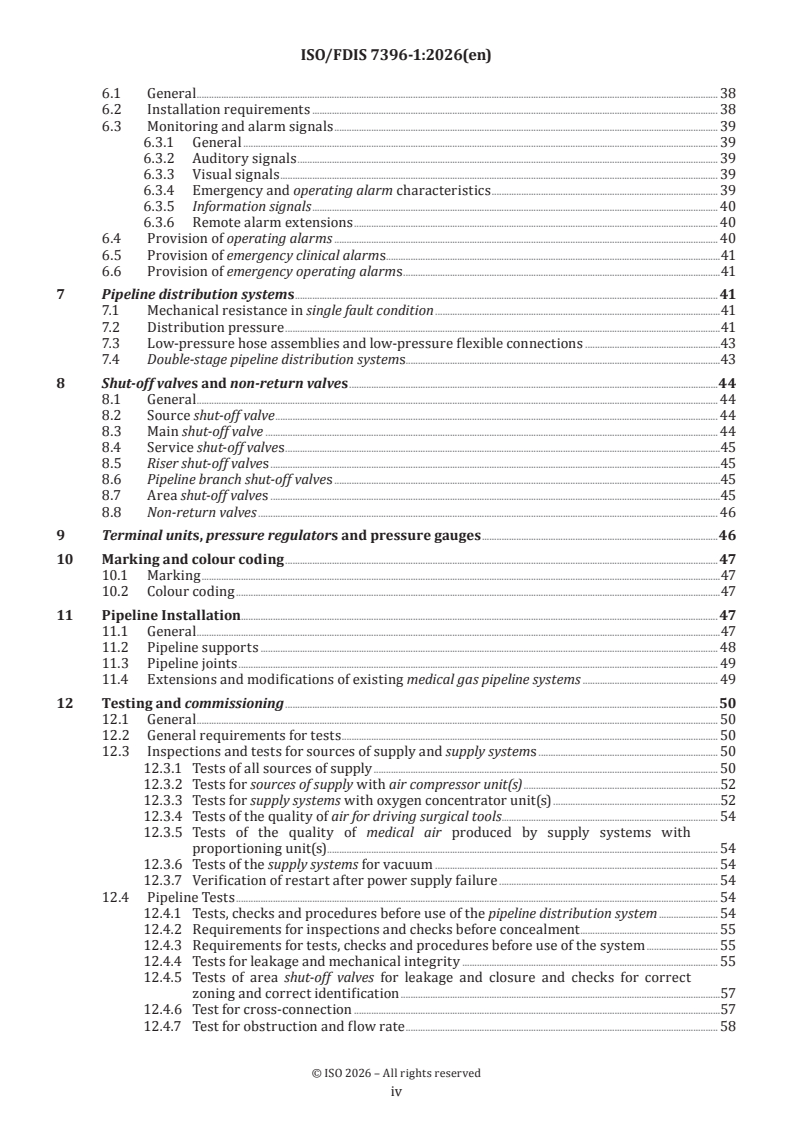
ISO/FDIS 7396-1 - Medical gas pipeline systems — Part 1: Pipeline systems for compressed medical gases and vacuum
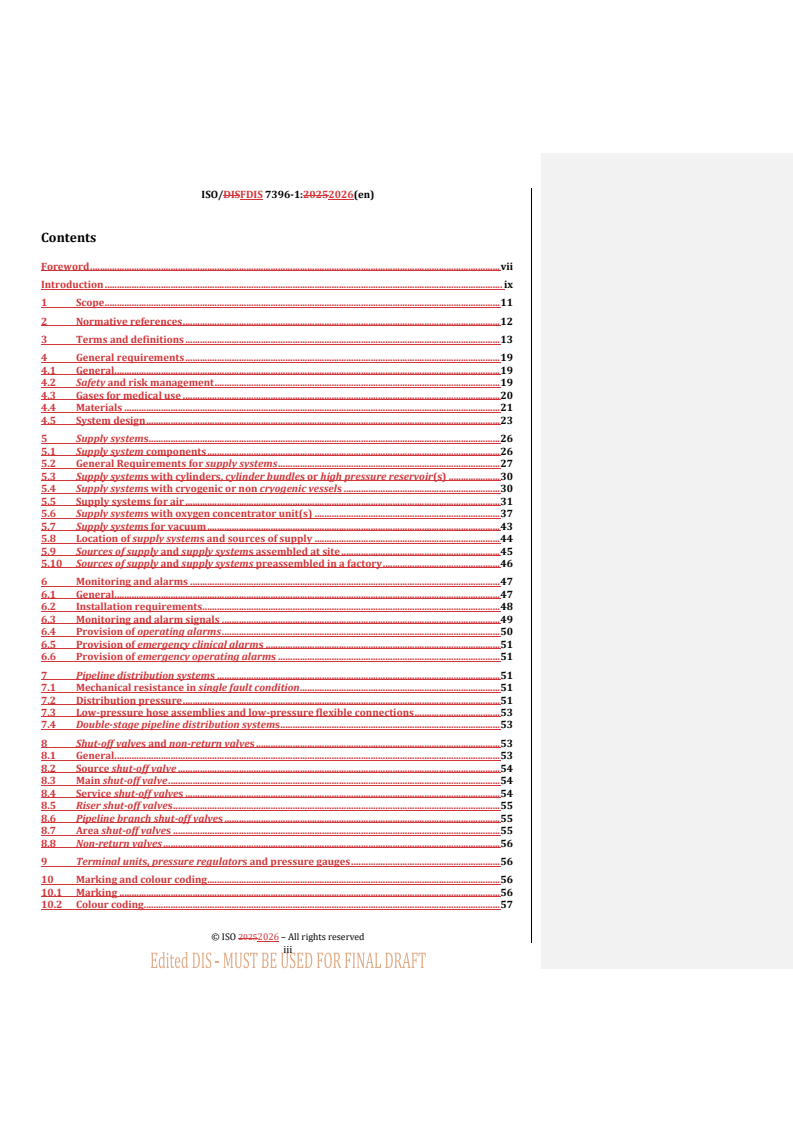
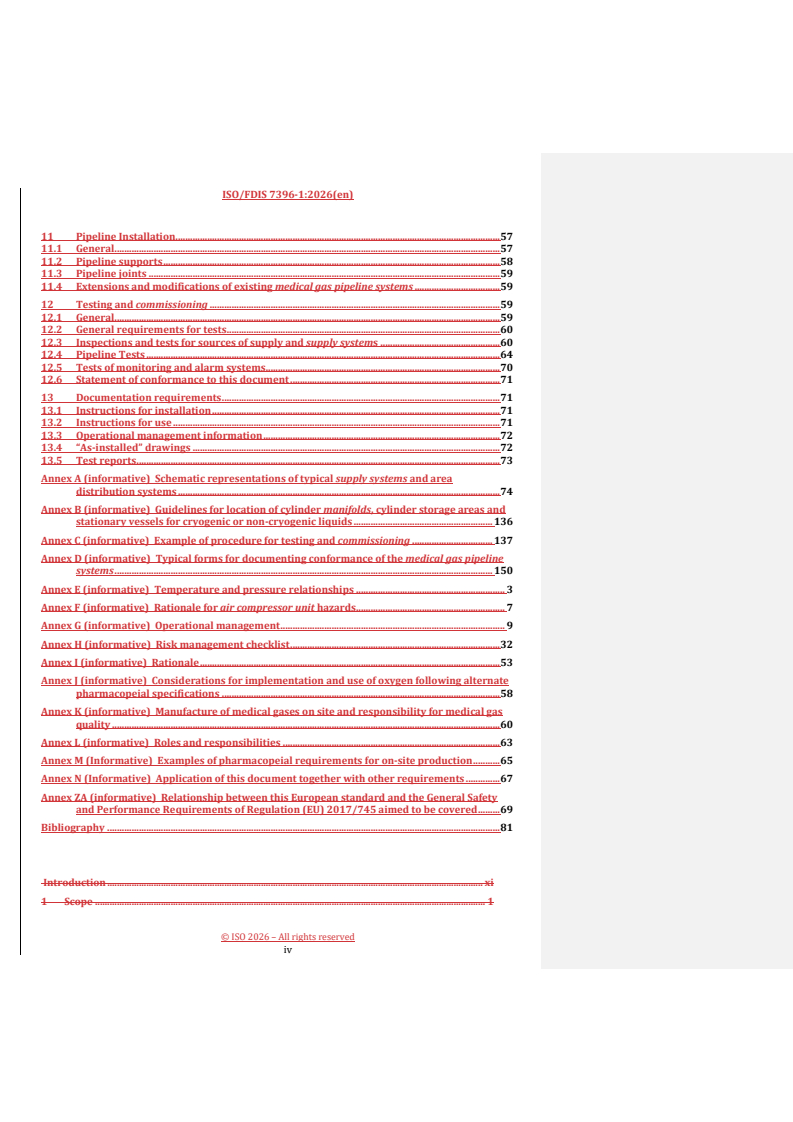
REDLINE ISO/FDIS 7396-1 - Medical gas pipeline systems — Part 1: Pipeline systems for compressed medical gases and vacuum

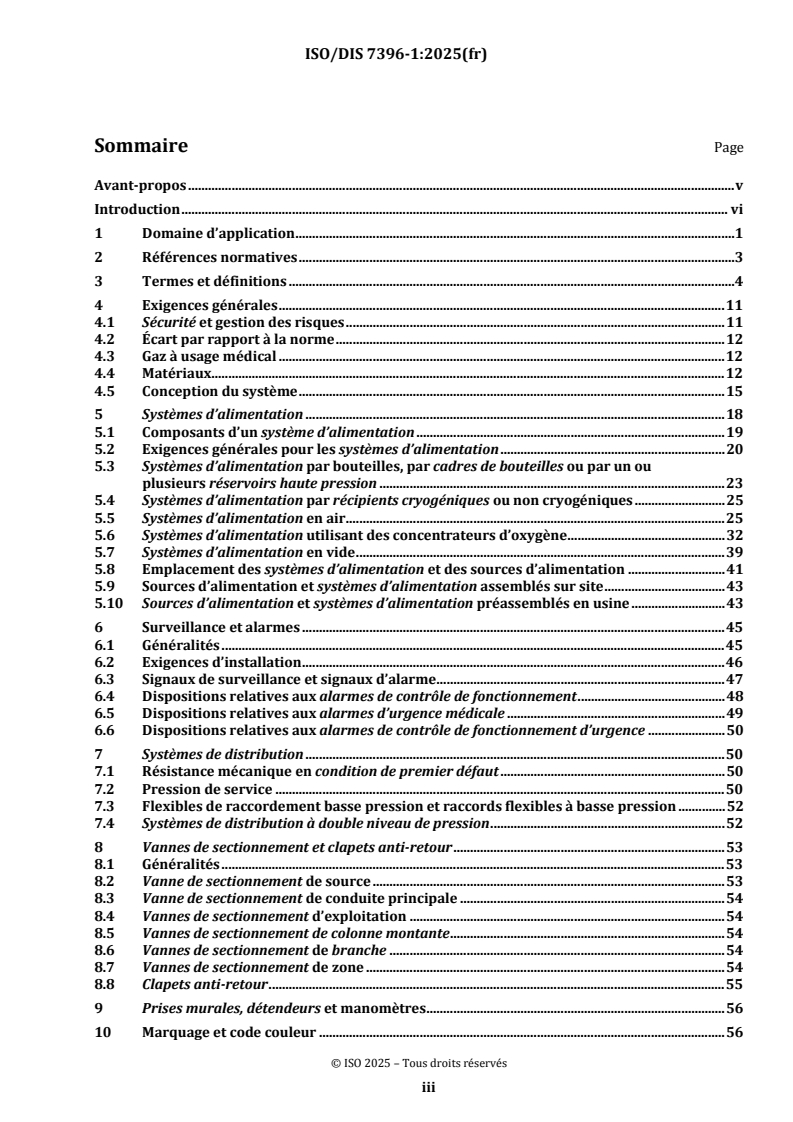
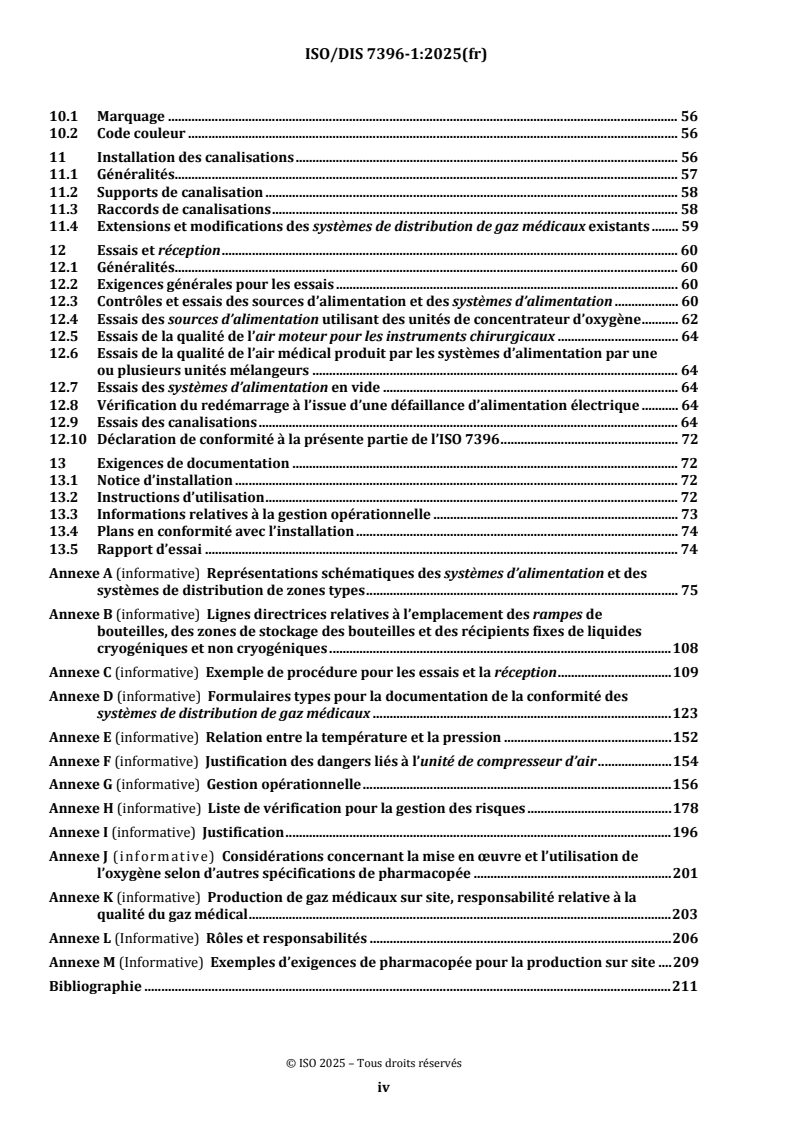
ISO/FDIS 7396-1 - Systèmes de distribution de gaz médicaux — Partie 1: Systèmes de distribution de gaz médicaux comprimés et de vide/30/2025

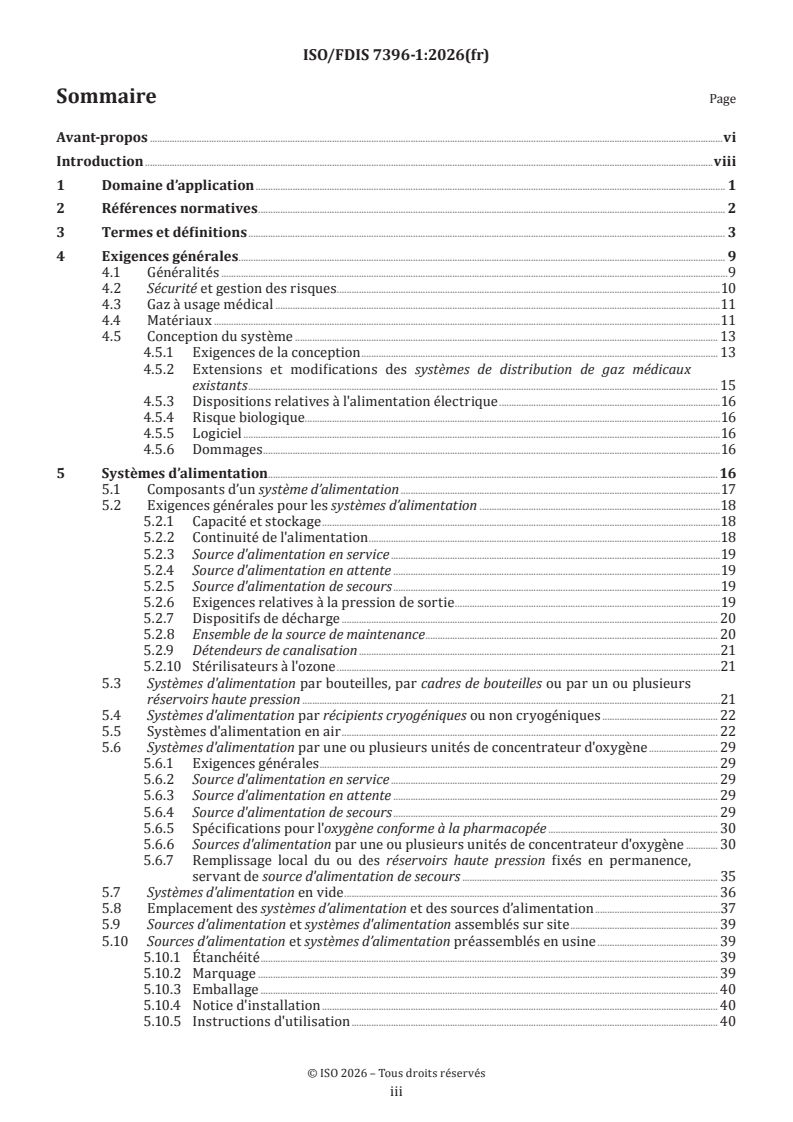
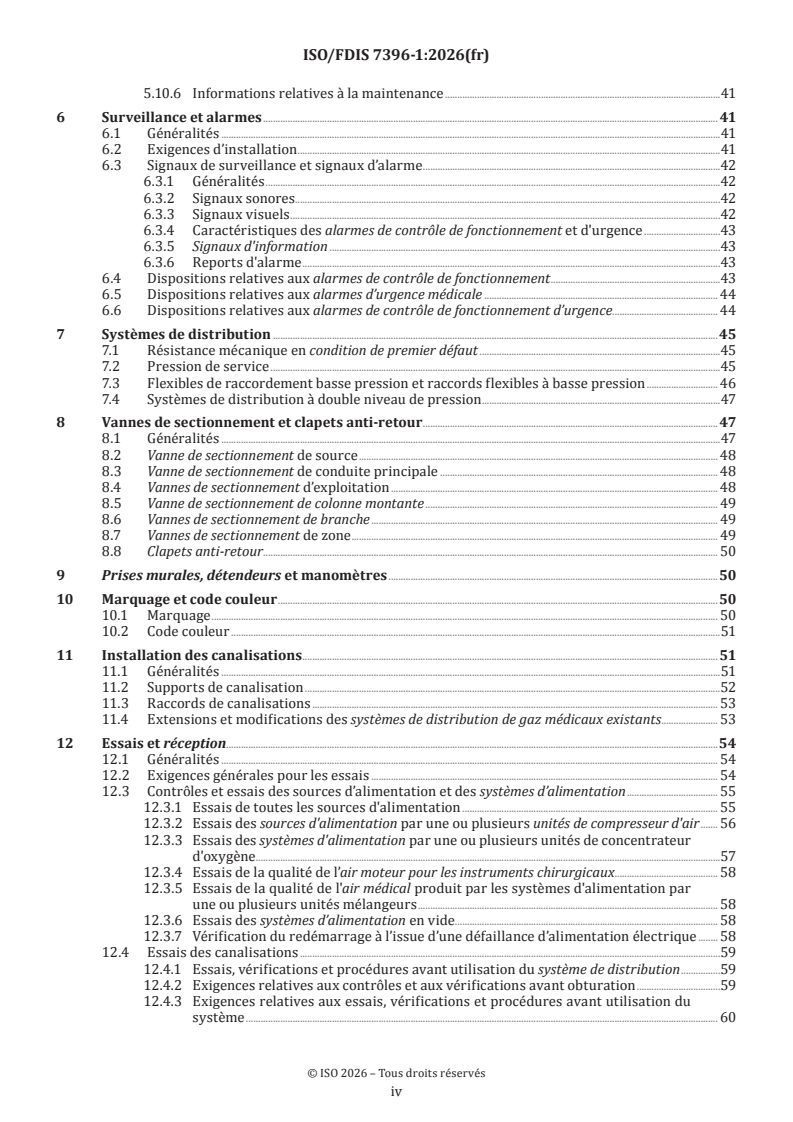
ISO/FDIS 7396-1 - Systèmes de distribution de gaz médicaux — Partie 1: Systèmes de distribution de gaz médicaux comprimés et de vide
ISO 7396-1 is an International Standard from ISO for medical gas pipeline systems in healthcare facilities. It specifies requirements for design, installation, function, performance, testing, commissioning and documentation of systems carrying compressed medical gases and vacuum, so engineers, hospital managers and buyers can specify and verify the pipeline system. The document also covers supply systems, distribution piping, alarms, shut-off valves, terminal units, marking and the records needed to put the system into service.
What does ISO 7396-1 specify?
ISO 7396-1 specifies the requirements for medical gas pipeline systems used in healthcare facilities, including public and private sites of any size or service mix. It applies to new systems, extensions, modifications and replacements, so it is relevant both to new builds and to work on existing installations.
The scope covers the pipeline systems for gases and services such as oxygen, nitrous oxide, medical air, carbon dioxide, oxygen/nitrous oxide mixtures, helium/oxygen mixtures, oxygen 93, other medicinal gases and gas mixtures, air for driving surgical tools, nitrogen for driving surgical tools and vacuum. It also notes that anaesthetic gas scavenging disposal systems are covered in ISO 7396-2.
The document is organized into 13 clauses:
- Scope
- Normative references
- Terms and definitions
- General requirements
- Supply systems
- Monitoring and alarms
- Pipeline distribution systems
- Shut-off valves and non-return valves
- Terminal units, pressure regulators and pressure gauges
- Marking and colour coding
- Pipeline installation
- Testing and commissioning
- Documentation requirements
The informative annexes support design, testing, operations and roles.
| Annex | What it covers |
|---|---|
| A | Schematic representations of typical supply systems and area distribution systems |
| B | Guidelines for locating cylinder manifolds, cylinder storage areas and stationary vessels |
| C | Example procedure for testing and commissioning |
| D | Typical forms for documenting conformance |
| E | Temperature and pressure relationships |
| F | Rationale for air compressor unit hazards |
| G | Operational management |
| H | Risk management checklist |
| I | Rationale for requirements |
| J | Considerations for oxygen following alternate pharmacopeial specifications |
| K | Manufacture of medical gases on site and responsibility for medical gas quality |
| L | Roles and responsibilities |
| M | Examples of pharmacopeial requirements for on-site production |
| N | Application of this document together with other requirements |
| ZA | Relationship with the General Safety and Performance Requirements of Regulation (EU) 2017/745 |
What are the key requirements of ISO 7396-1?
ISO 7396-1 is built around safety, continuity of supply, gas quality and traceable verification. In practice, it tells the project team what the system must do, how it must be arranged, and what has to be tested and documented before use.
Safety, risk management and design input
Clause 4 requires the system to deliver the correct gas or vacuum at the correct outlet, pressure and flow, and to protect patients, users and others from avoidable risk. The document expects risk management to be used for design, installation, operation and maintenance, which matters because medical gas systems are safety-critical and faults can remain hidden.
Clause 4 also places responsibility on the healthcare facility to select the relevant pharmacopeia with reference to the local Regulatory Authority. That choice is a design input, so the gas quality target is not something added later.
Materials that contact the gas must be compatible with the gas and with oxygen, and permanent pipeline materials must meet the document’s cleanliness and performance expectations. For the reader, this means material selection is not only about pressure strength - it is also about cleanliness, corrosion resistance and oxygen compatibility.
Supply systems and continuity
Clause 5 requires medicinal gas supply systems to have at least three independent sources of supply, while systems for air or nitrogen for driving surgical tools require at least two sources. The design intent is continuity of supply during normal use, maintenance and single faults.
The clause separates the main supply types by application. It covers cylinder and high-pressure reservoir systems, cryogenic or non-cryogenic vessel systems, air systems, oxygen concentrator unit systems and vacuum systems. It also requires capacity and storage to be based on flow profile, usage and delivery frequency, so the facility has to size the system from actual demand rather than guesswork.
For cylinder-based systems, the pipeline must be supported by a primary source, a secondary source that changes over automatically, and usually a reserve source. For vacuum, the system must include at least three sources of supply, one vacuum receiver, filters and a drainage trap. That means the vacuum plant is treated as a distributed clinical utility, not just a pump.
ISO 7396-1 also addresses systems assembled on site and systems preassembled in a factory. Site-assembled systems must be shown to comply with all applicable provisions, while factory-assembled systems must be leak-tested at the factory and then checked again on site. This matters because transport, reassembly and site work can introduce defects.
Monitoring, alarms and safe operation
Clause 6 requires monitoring and alarm systems to provide operating alarms, emergency operating alarms, emergency clinical alarms and information signals. The panel locations must allow continuous observation, and clinical alarm panels must be placed where they can be seen in clinical and critical care areas.
The alarm logic is tied to gas pressure, vacuum conditions and gas quality. The standard also requires audible signals to be distinctive and to meet the specified sound-level test method, so alarms are not just present - they are intended to be noticeable in a busy healthcare environment.
For medical air and oxygen systems, the alarms also cover compressor temperature and gas concentration outside the permitted range. In practice, this means operators need to respond not only to pressure loss but also to quality drift in on-site generated gases.
Distribution, valves, terminal units and installation
Clause 7 sets the distribution pressure rules for different service types and requires mechanical resistance in single fault condition. It also addresses low-pressure hose assemblies and flexible connections, including where flexibility is part of the permanent piping.
Clause 8 organizes the isolation strategy: source shut-off valves, main shut-off valves, service shut-off valves, riser shut-off valves, branch shut-off valves, area shut-off valves and non-return valves. Area shut-off valves are required for pipelines serving operating theatres, general wards and other clinical areas, so maintenance and emergency isolation can be controlled by zone.
Clause 9 links the pipeline system to the terminal equipment. Terminal units must be gas-specific and comply with ISO 9170-1, medical supply units must comply with ISO 11197, manifold and line pressure regulators must comply with ISO 10524-2, and pressure gauges must comply with EN 837-1. That means the interface at the point of use is controlled as tightly as the pipework.
Clause 10 requires pipeline marking with the gas name and/or symbol, flow direction and regular identification points, and colour coding where used must follow ISO 5359. This matters because misconnection risks are often created during maintenance or change work, not just during initial installation.
Clause 11 requires installation practices that reduce mechanical damage risk, keep gas-contacting components clean and protect terminal units from inappropriate connections. The installer is expected to have training within a current quality management process, so installation competence is part of compliance.
Testing, commissioning and documentation
Clause 12 requires post-installation testing and commissioning, with the manufacturer responsible for carrying out and documenting the tests, usually under healthcare facility supervision. Measuring devices must be suitable and calibrated, and terminal units must be labelled while the system is under test so they are not used accidentally.
The test programme covers leakage, mechanical integrity, valve operation, cross-connection checks, obstruction and flow rate, terminal-unit function, system performance, alarm tests and gas identity. For extensions or modifications, the manufacturer determines and documents which tests apply, so the test plan can be tailored to the work while still controlling risk.
Clause 13 requires installation instructions, instructions for use, operational management information, as-installed drawings and test reports. This matters because the facility needs records to operate, maintain, audit and later modify the system safely.
What terms does ISO 7396-1 define?
- Applicable policy - A set of requirements for the medical device or accessory, including its form, fit, function, process or information supplied by the manufacturer.
- Medical gas pipeline system (MGPS) - The healthcare facility pipeline system used to distribute medical gases and vacuum to points of use.
- Air compressor unit - A unit that provides compressed air for the supply system, especially for medical air or driving surgical tools.
- Oxygen concentrator unit - A unit that produces oxygen for a supply system, including systems intended to deliver oxygen 93.
- Authorized Person (AP) - The person appointed to manage day-to-day operation and coordination of the MGPS.
- Competent Person (CP) - A trained and experienced person who carries out installation, maintenance or repair work on the MGPS.
- Designated Medical Officer (DMO) - The medical contact point for communications about the MGPS in a healthcare area.
- Designated Nursing Officer (DNO) - The nursing contact point for local communication, interruptions and emergency actions related to the MGPS.
Who uses ISO 7396-1?
ISO 7396-1 is used by healthcare facility owners and managers, project designers, installers, maintenance contractors, medical gas suppliers, pharmacists or quality controllers, and clinical staff who depend on the system. It also matters to regulators, conformity assessment bodies and buyers who need to check that a system has been designed, installed, tested and documented correctly.
In practice, designers use it to size and arrange the supply and distribution system, installers use it for assembly and marking, and maintenance teams use it for safe isolation, testing and repairs. Clinical and nursing staff use the operational procedures and alarms to respond correctly when supplies change or failures occur.
Which standards are used with ISO 7396-1?
| Standard | What it contributes |
|---|---|
| ISO 3746 | Method for checking audible alarm sound levels |
| ISO 4126-1 | Safety valves for excessive-pressure protection |
| ISO 5011 | Performance testing of compressor inlet air cleaning equipment |
| ISO 5359 | Low-pressure hose assemblies, marking and colour coding |
| ISO 8573-1 | Compressed air contaminants and purity classes |
| ISO 9170-1 | Requirements for gas-specific terminal units |
| ISO 11197 | Requirements for medical supply units |
| ISO 10524-2 | Requirements for manifold and line pressure regulators |
| EN 837-1 | Requirements for pressure gauges |
| ISO 1217 | Reference conditions used for flow and volume reporting |
| ISO 20417 | Information to be supplied by the manufacturer |
| EN 13348 | Cleanliness requirements for copper tubes used in gas systems |
| ISO 15001 | Oxygen compatibility and ignition-related material considerations |
| ISO 21009-2 | Stationary cryogenic vessels in the storage context |
| ISO 80601-2-69 | Domiciliary oxygen concentrators referenced in the exclusion note |
| ISO 7396-2 | Anaesthetic gas scavenging disposal systems |
What does the ISO 7396-1 document contain?
The document contains the requirements, tables and procedures needed to design, install, test and document a medical gas pipeline system. It includes schematic examples of supply and area distribution systems in Annex A, location guidance in Annex B, a sample commissioning procedure in Annex C and conformance forms in Annex D.
It also includes a temperature-pressure relationship in Annex E, a rationale for compressor hazards in Annex F, and operational and role-based guidance in Annex G and Annex L. Annex H provides a risk management checklist, while Annex I explains why many of the requirements are written the way they are.
Clause 12 and Annex C are the practical core for acceptance testing and commissioning, and Annex D supports traceable records. The document also includes a worked temperature-pressure example and test-device figures for contamination checks, which are used when verifying system performance and gas quality before handover.
Relations
- Effective Date
- 12-Feb-2026
- Effective Date
- 10-Jun-2023
- Effective Date
- 10-Jun-2023
Buy Documents
ISO/FDIS 7396-1 - Medical gas pipeline systems — Part 1: Pipeline systems for compressed medical gases and vacuum/28/2025
ISO/FDIS 7396-1 - Medical gas pipeline systems — Part 1: Pipeline systems for compressed medical gases and vacuum
REDLINE ISO/FDIS 7396-1 - Medical gas pipeline systems — Part 1: Pipeline systems for compressed medical gases and vacuum
ISO/FDIS 7396-1 - Systèmes de distribution de gaz médicaux — Partie 1: Systèmes de distribution de gaz médicaux comprimés et de vide/30/2025
ISO/FDIS 7396-1 - Systèmes de distribution de gaz médicaux — Partie 1: Systèmes de distribution de gaz médicaux comprimés et de vide
Get Certified
Connect with accredited certification bodies for this standard

BSI Group
BSI (British Standards Institution) is the business standards company that helps organizations make excellence a habit.

TÜV Rheinland
TÜV Rheinland is a leading international provider of technical services.

TÜV SÜD
TÜV SÜD is a trusted partner of choice for safety, security and sustainability solutions.
Sponsored listings
Frequently Asked Questions
ISO 7396-1 is a draft published by the International Organization for Standardization (ISO). Its full title is "Medical gas pipeline systems — Part 1: Pipeline systems for compressed medical gases and vacuum". This standard covers: ISO 7396-1:2016 specifies requirements for design, installation, function, performance, testing, commissioning and documentation of pipeline systems used in healthcare facilities for the following: - oxygen; - nitrous oxide; - medical air; - carbon dioxide; - oxygen/nitrous oxide mixtures (see Note 1); - helium/oxygen mixtures; - (*) oxygen 93; - gases and gas mixtures classified as medical device, gases delivered to medical devices or intended for medical purposes or gases and gas mixtures for medicinal use not specified above; - air for driving surgical tools; - nitrogen for driving surgical tools; - vacuum. NOTE 1 Regional or national regulations may prohibit the distribution of oxygen/nitrous oxide mixtures in medical gas pipeline systems. NOTE 2 Anaesthetic gas scavenging disposal systems are covered in ISO 7396‑2. This part of ISO 7396 includes requirements for supply systems, pipeline distribution systems, control systems, monitoring and alarm systems and non-interchangeability between components of different gas/vacuum systems. This part of ISO 7396 specifies safety requirements for pipeline systems used in healthcare facilities, both public and private. It applies to all facilities providing healthcare services regardless of type, size, location or range of services, including, but not limited to: a) acute care healthcare facilities; b) internal patient continuing care healthcare facilities; c) long-term care facilities; d) community-based providers; e) ambulatory and external patient care clinics (e.g. day surgery, endoscopy clinics and doctors' offices). NOTE 3 This part of ISO 7396 may also be used as reference for pipeline systems for medical gases and vacuum intended to be installed in places other than healthcare facilities. ISO 7396-1:2016 applies to the following different types of oxygen supply systems: - supply systems in which all sources of supply deliver oxygen; in this case the concentration of the oxygen will be greater than 99%; - supply systems in which all sources of supply deliver oxygen 93; in this case the concentration of the oxygen may vary between 90% and 96%; NOTE 4 A mixture of oxygen 93 and oxygen may be delivered by a medical gas supply system. In this case the concentration of the gas can vary between 90% and >99%. ISO 7396-1:2016 also applies to: - extensions of existing pipeline distribution systems; - modifications of existing pipeline distribution systems; - modifications or replacement of supply systems or sources of supply. Oxygen concentrators for domiciliary use are excluded from the scope of this part of ISO 7396. NOTE 5 Requirements for oxygen concentrators for domiciliary use are specified in ISO 80601‑2-69. (*) EN 14931 defines additional requirements for hyperbaric application, in particular for flows and pressures of compressed air required to pressurize the hyperbaric chamber and to drive other connected services. Also included are requirements for oxygen and other treatment gases administered to patients. ISO 7396-1:2016 does not apply to vacuum systems intended to be used in dentistry. ISO 7396-1:2016 does not apply to filling systems for transportable cylinders and transportable cylinder bundle systems.
ISO 7396-1:2016 specifies requirements for design, installation, function, performance, testing, commissioning and documentation of pipeline systems used in healthcare facilities for the following: - oxygen; - nitrous oxide; - medical air; - carbon dioxide; - oxygen/nitrous oxide mixtures (see Note 1); - helium/oxygen mixtures; - (*) oxygen 93; - gases and gas mixtures classified as medical device, gases delivered to medical devices or intended for medical purposes or gases and gas mixtures for medicinal use not specified above; - air for driving surgical tools; - nitrogen for driving surgical tools; - vacuum. NOTE 1 Regional or national regulations may prohibit the distribution of oxygen/nitrous oxide mixtures in medical gas pipeline systems. NOTE 2 Anaesthetic gas scavenging disposal systems are covered in ISO 7396‑2. This part of ISO 7396 includes requirements for supply systems, pipeline distribution systems, control systems, monitoring and alarm systems and non-interchangeability between components of different gas/vacuum systems. This part of ISO 7396 specifies safety requirements for pipeline systems used in healthcare facilities, both public and private. It applies to all facilities providing healthcare services regardless of type, size, location or range of services, including, but not limited to: a) acute care healthcare facilities; b) internal patient continuing care healthcare facilities; c) long-term care facilities; d) community-based providers; e) ambulatory and external patient care clinics (e.g. day surgery, endoscopy clinics and doctors' offices). NOTE 3 This part of ISO 7396 may also be used as reference for pipeline systems for medical gases and vacuum intended to be installed in places other than healthcare facilities. ISO 7396-1:2016 applies to the following different types of oxygen supply systems: - supply systems in which all sources of supply deliver oxygen; in this case the concentration of the oxygen will be greater than 99%; - supply systems in which all sources of supply deliver oxygen 93; in this case the concentration of the oxygen may vary between 90% and 96%; NOTE 4 A mixture of oxygen 93 and oxygen may be delivered by a medical gas supply system. In this case the concentration of the gas can vary between 90% and >99%. ISO 7396-1:2016 also applies to: - extensions of existing pipeline distribution systems; - modifications of existing pipeline distribution systems; - modifications or replacement of supply systems or sources of supply. Oxygen concentrators for domiciliary use are excluded from the scope of this part of ISO 7396. NOTE 5 Requirements for oxygen concentrators for domiciliary use are specified in ISO 80601‑2-69. (*) EN 14931 defines additional requirements for hyperbaric application, in particular for flows and pressures of compressed air required to pressurize the hyperbaric chamber and to drive other connected services. Also included are requirements for oxygen and other treatment gases administered to patients. ISO 7396-1:2016 does not apply to vacuum systems intended to be used in dentistry. ISO 7396-1:2016 does not apply to filling systems for transportable cylinders and transportable cylinder bundle systems.
ISO 7396-1 is classified under the following ICS (International Classification for Standards) categories: 11.040.10 - Anaesthetic, respiratory and reanimation equipment. The ICS classification helps identify the subject area and facilitates finding related standards.
ISO 7396-1 has the following relationships with other standards: It is inter standard links to prEN ISO 7396-1, ISO 7396-1:2016, ISO 7396-1:2016/Amd 1:2017. Understanding these relationships helps ensure you are using the most current and applicable version of the standard.
ISO 7396-1 is available in PDF format for immediate download after purchase. The document can be added to your cart and obtained through the secure checkout process. Digital delivery ensures instant access to the complete standard document.
Standards Content (Sample)
154 Introduction
155 Many healthcare facilities use medical gas pipeline systems to deliver medical gases and to 156 provide vacuum to areas where they are used in patient care or to power equipment such as 157 ventilators and surgical tools.
158 This part of ISO 7396 specifies requirements for medical gas pipeline systems for gases for 159 medicinal use, medical device gases, gases for driving surgical tools and vacuum. It is intended 160 for use by those persons involved in the design, construction, inspection, and operation of 161 healthcare facilities treating human beings. Those persons involved in the design, manufacture 162 and testing of equipment intended to be connected to these medical gas pipeline systems should 163 also be aware of the contents of this part of ISO 7396.
164 This part of ISO 7396 seeks to ensure that medical gas pipelines contain only the specific gas (or 165 vacuum) intended to be supplied. For this reason, gas-specific components are used for terminal 166 units and for other connectors which are intended to be used by the operator. In addition, each 167 system is tested and certified to contain only the specific gas (or vacuum). 168 The objectives of this part of ISO 7396 are to ensure the following:
169 a) non-interchangeability between different medical gas pipeline systems by design, 170 installation and testing; 171 b) continuous supply of gases and vacuum at specified quality, pressures and design flow 172 rates by providing appropriate sources; 173 c) use of suitable materials; 174 d) cleanliness of components; 175 e) correct installation; 176 f) provision of monitoring and alarm systems; 177 g) correct marking of the pipeline system; 178 h) testing and commissioning; 179 i) quality of the gases delivered by the pipeline system; 180 j) correct operational management; 181 k) safety features of the sources to ensure the quality and pressure of the gases delivered to 182 the terminals according to specification.
183 The responsibility for the quality of the medical gas supplied via the medical gas pipeline system 184 should be assigned to a nominated person within the healthcare facility. This role would usually 185 be assigned to the Head Pharmacist, who may in turn nominate other responsible person(s) on 186 site to manage the day-to-day requirements.
187 Where the medical gas is supplied by a third party (in some jurisdictions under licence from the 188 national, regional or local regulatory body), the third party is responsible for ensuring that the 189 medical gas as delivered meets the relevant specification requirements. In this case, the 190 healthcare facility is responsible under local regulations for ensuring that the product meets the 191 specifications as ordered, that the product administered to patients is not adulterated and 192 complies with specifications and regulations, and that the product manufacturer is informed 193 immediately of any undesirable effects or defects in the quality of the product.
194 Where the healthcare facility manufactures the medical gas on site the healthcare facility is 195 responsible for all aspects of the medical gas quality.
196 Vacuum for medical suction is also the responsibility of the healthcare facility. 197 Annex G, J and K provides guidance for the assignment of responsibility for production and 198 quality control of the gases and vacuum.
199 Annexes G and H provide some guidance as to how the quality of the gas should be managed to 200 maintain patient safety at the highest level.
201 Annex I contains rationale statements for some of the requirements of this part of ISO 7396. It is 202 included to provide additional insight into the reasoning that led to the requirements and 203 recommendations that have been incorporated into this part of ISO 7396. The clauses and 204 subclauses marked with (*) after their number have a corresponding rationale in Annex I. 205 1 Scope 206 This part of ISO 7396 specifies requirements for design, installation, function, performance, 207 testing, commissioning and documentation of medical gas pipeline systems used in healthcare 208 facilities for the following:
209 - argon; 210 - oxygen; 211 - nitrous oxide; 212 - medical air; 213 - carbon dioxide; 214 - oxygen/nitrous oxide mixtures; 215 - helium/oxygen mixtures; 216 - gases and gas mixtures classified as medical device, gases delivered to medical devices or 217 intended for medical purposes or gases and gas mixtures for medicinal use not specified 218 above; 219 - air for driving surgical tools; 220 - nitrogen; 221 - vacuum.
222 NOTE 1: A rationale for this is contained in Annex I.
224 This part of ISO 7396 includes requirements for supply systems, medical gas pipeline
225 distribution systems, control system(s), monitoring and alarm systems and non-interchangeability 226 between different gas/vacuum systems.
227 This part of ISO 7396 specifies safety requirements for medical gas pipeline systems used in 228 healthcare facilities. It applies to all facilities providing healthcare services regardless of type, 229 size, location or range of services, including, but not limited to:
230 a) acute care healthcare facilities; 231 b) internal patient continuing care healthcare facilities;
232 c) long-term care facilities; 233 d) community-based providers; 234 e) ambulatory and external patient care clinics (e.g. day surgery, endoscopy clinics and 235 doctors’ offices).
236 NOTE 3: This part of ISO 7396 may also be used as reference for medical gas pipeline systems 237 intended to be installed in places other than healthcare facilities.
238 This part of ISO 7396 applies to the following different types of oxygen supply systems:
239 - supply systems in which all sources of supply deliver oxygen produced off-site; 240 - supply systems in which some or all sources of supply deliver oxygen produced on-site; in 241 this case the concentration of the oxygen may vary, depending on the pharmacopeial 242 specification selected by the healthcare facility 243 This part of ISO 7396 also applies to:
244 - extensions of existing pipeline distribution systems; 245 - modifications of existing pipeline distribution systems; 246 - modifications or replacement of supply systems or sources of supply.
247 Oxygen concentrators for domiciliary use are excluded from the scope of this part of ISO 7396. 248 EN 14931:2006 [37] defines additional requirements for hyperbaric application, in particular for 249 flow rates and pressures of compressed air required to pressurize the hyperbaric chamber and to 250 drive other connected services. Also included are requirements for oxygen and other treatment 251 gases administered to patients.
252 This part of ISO 7396 does not apply to vacuum systems intended to be used in dentistry. 253 This part of ISO 7396 does not apply to filling systems for transportable cylinders and 254 transportable cylinder bundle systems.
255 This part of ISO 7396 does not apply to liquid nitrogen cryogenic piping for cryobanks. 256 2. Normative References 257 The following documents, in whole or in part, are normatively referenced in this document and 258 are indispensable for its application. For dated references, only the edition cited applies. For 259 undated references, the latest edition of the referenced document (including any amendments) 260 applies.
261 NOTE Additional references are listed in the Bibliography.
262 ISO 3746:2010, Acoustics — Determination of sound power levels and sound energy levels of 263 noise sources using sound pressure — Survey method using an enveloping measurement surface 264 over a reflecting plane 265 ISO 4126-1:2013, Safety devices for protection against excessive pressure - Part 1: Safety valves 266 ISO 5011: 2020 Inlet air cleaning equipment for internal combustion engines and compressors 267 — Performance testing 268 ISO 5359:2014, Anaesthetic and respiratory equipment — Low-pressure hose assemblies for use 269 with medical gases
270 ISO 8573-1:2010, Compressed air — Part 1: Contaminants and purity classes
271 ISO 9170-1:2017, Terminal units for medical gas pipeline systems — Part 1: Terminal units for 272 use with compressed medical gases and vacuum 273 ISO 10524-2:2018, Pressure regulators for use with medical gases — Part 2: Manifold and line 274 pressure regulators
280 ISO 21969:2009, High-pressure flexible connections for use with medical gas systems
281 ISO 29463-1:2024, High-efficiency filters and filter media for removing particles in air — Part 282 1: Classification, performance testing and marking
283 ISO 18562-2:2024, Biocompatibility evaluation of breathing gas pathways in healthcare
284 applications – Part 2: Tests for emissions of particulate matter
285 IEC 60529:2019, Degrees of protection provided by enclosures (IP Code)
286 IEC 60601-1-8:2006, Medical electrical equipment — Part 1-8: General requirements for basic 287 safety and essential performance — Collateral standard: General requirements, tests and 288 guidance for alarm systems in medical electrical equipment and medical electrical systems
289 IEC 62304:2006, Medical device software – Software life cycle processes
290 EN 286-1:1998, Simple unfired pressure vessels designed to contain air or nitrogen — Part 1:
291 Pressure vessels for general purposes
292 EN 1254-1:2021, Copper and copper alloys - Plumbing fittings - Fittings with ends for capillary 293 soldering or capillary brazing to copper tubes
297 Pumps
298 EN 13348:2016, Copper and copper alloys — Seamless, round copper tubes for medical gases or 299 vacuum
300 EN 13445-1:2021, Unfired pressure vessels - Part 1: General
301 3. Terms and Definitions 302 3.1 303 applicable policy 304 set of requirements relating to the medical device or accessory and its attributes such as form, 305 fit, function, process or information to be supplied by the manufacturer 306 Note 1 to entry: The applicable policy shall be established by the authority having jurisdiction. 307 Note 2 to entry: The applicable policy may include specification for the format of the information to 308 be supplied by the manufacturer.
309 3.2 310 air compressor unit 311 the portion of the source of supply including the device for compressing or moving ambient air 312 (typical examples are compressors and blowers). The air compressor unit comprises the 313 compressor, a drive system and any component or device which is necessary for operation 314 3.3 315 air for driving surgical tools 316 natural or synthetic mixture of gases, mainly composed of oxygen and nitrogen in specified 317 proportions, with defined limits for the concentration of contaminants, supplied by a medical gas 318 pipeline system and intended for driving surgical tools 319 Note 1: Different names or symbols are used for air for driving surgical tools, such as instrument air, 320 surgical air, air motor, air - 700 and air - 800.
321 Note 2 Nitrogen can also be used to drive surgical tools.
322 3.4 323 audio paused 324 state of limited duration in which the alarm system or part of the alarm system does not generate 325 an auditory alarm signal 326 Note 1 to entry: This is sometimes referred to as silencing.
327 [SOURCE: IEC 60601-1-8] 328 3.5 329 booster compressor 330 compressor used to raise an elevated pressure to a higher pressure 331 Note 1 to entry: As used herein, the term applies to compressors used to fill high-pressure 332 reservoir(s).
333 3.6 334 commissioning 335 proof of function to verify that the agreed system specification is met and is accepted by the 336 responsible organization 337 3.7 338 control equipment 339 items necessary to maintain the medical gas pipeline system within the specified operating 340 parameters 341 Note 1 to entry: Examples of control equipment are pressure regulators, pressure relief valves, 342 sensors, manual or automatic valves and non-return valves.
343 3.8 344 control system 345 device or set of devices to manage, command, direct or regulate the behaviour of other device(s) 346 or system(s) 347 3.9 348 cryogenic vessel 349 vacuum jacketed vessel intended for application at low temperature involving liquefied gases 350 3.10 351 cylinder bundle 352 pack or pallet of cylinders linked together with one or more connectors for filling and emptying 353 3.11 354 diversity factor 355 number which represents the maximum proportion of terminal units in a defined clinical area 356 which will be used at the same time, at flow rates defined in agreement with the management of 357 the healthcare facility 358 3.12 359 double-stage pipeline distribution system 360 pipeline distribution system in which gas is initially distributed from the supply system at a 361 pressure higher than the nominal distribution pressure, and is then reduced to the nominal 362 distribution pressure by line pressure regulator(s) 363 Note: This initial higher pressure is the nominal supply system pressure (see 3.38). 364 3.13 365 emergency clinical alarm 366 alarm to indicate to medical and technical staff that there is a deviation from a monitored 367 parameter which requires an immediate response 368 3.14 369 emergency operating alarm 370 alarm to indicate to technical staff that there is a deviation from a monitored parameter which 371 requires an immediate response 372 3.15 373 emergency power supply 374 an emergency power supply is an independent source of electrical power that supports important 375 electrical systems on loss of normal power supply. An emergency power supply may include a 376 standby generator, batteries and other apparatus 377 3.16 378 feed air unit 379 means of compressing ambient air (e.g.: air compressor unit, air blower).
380 3.17 381 gas-specific 382 having characteristics which prevent connections between different gas services or vacuum 383 services 384 3.18 385 gas-specific connector 386 connector with dimensional characteristics which prevent connections between different gas 387 services 388 Note 1 to entry: Examples of gas-specific connectors are quick connectors, screw-threaded 389 connectors, diameter- indexed safety system (DISS) connectors, non-interchangeable screw-threaded 390 (NIST) connectors and sleeve indexed system (SIS) connectors.
391 3.19 392 healthcare facility 393 facility where professional health services are provided 394 3.20 395 high-dependency patient 396 patient with a continual need of a medical gas/vacuum supply, who will be adversely affected by 397 a medical gas/vacuum supply failure to such a degree that his/her clinical condition or safety can 398 be compromised 399 3.21 400 high pressure 401 pressures greater than 3 000 kPa 402 [SOURCE: ISO 15001] 403 3.22 404 high-pressure reservoir 405 permanently installed container(s) with nominal working pressures greater than 3 000 kPa and up 406 to 25 000 kPa at 15 °C 407 Note: installed container include cylinders and cylinders bundles, intended to be permanent in the 408 healthcare facility 409 3.23 410 information signal 411 signal that is not an alarm signal or a reminder signal 412 3.24 413 line pressure regulator 414 pressure regulator used in a pipeline distribution system to reduce the nominal supply system 415 pressure to the nominal distribution pressure 416 3.25 417 low pressure 418 pressures lower than 1 400 kPa 419 3.26 420 low-pressure hose assembly 421 assembly consisting of a flexible hose with permanently attached gas-specific inlet and outlet 422 connectors and designed to conduct a medical gas at pressures less than 1 400 kPa 423 3.27 424 main line 425 portion of the pipeline distribution system connecting the supply system to risers and/or pipeline 426 branches 427 3.28 428 maintenance supply assembly 429 source of supply intended to supply the system during maintenance 430 3.29 431 manifold 432 device for connecting the outlet(s) of one or more cylinders, cylinder bundles or high-pressure 433 reservoir(s) of the same gas to the pipeline system 434 3.30 435 manufacturer 436 natural or legal person with responsibility for the design, manufacture, packaging and labelling 437 of a device before it is placed on the market under his own name, regardless of whether these 438 operations are carried out by that person himself or on his behalf by a third party (see also Annex
439 L)
440 3.31 441 maximum distribution pressure 442 pressure at any terminal unit when the medical gas pipeline system is operating at zero flow 443 3.32 444 medical air 445 natural or synthetic mixture of gases, mainly composed of oxygen and nitrogen in specified 446 proportions, with defined limits for the concentration of contaminants, supplied by a medical gas 447 pipeline system and intended for administration to patients 448 Note: Medical air may be produced by supply systems with air compressor sources of supply or by 449 supply systems with proportioning units. Medical air produced by air compressor systems is called 450 “medicinal air”, and medical air produced by proportioning systems is called “synthetic medicinal 451 air” by the European Pharmacopoeia.
452 3.33 453 medical device gas 454 gas or mixture of gases intended by the manufacturer to be used for human beings for the 455 purpose of:
456 - diagnosis, prevention, monitoring, treatment or alleviation of disease; 457 - investigation, replacement or modification of the anatomy or of a physiological process; 458 - control of conception; 459 and that does not achieve its principal intended action in or on the human body by 460 pharmacological, immunological or metabolic means, but which may be assisted in its function 461 by such means.
462 3.34 463 medical gas pipeline system 464 complete system which comprises a supply system, a monitoring and alarm system and a 465 distribution system with terminal units at the points where medical gases or vacuum are required 466 3.35 467 nominal distribution pressure 468 pressure which the medical gas pipeline system is intended to deliver at the terminal units 469 3.36 470 nominal supply system pressure 471 pressure which the supply system is intended to deliver at the inlet to the line pressure regulator 472 when flowing at the design flow rate for the medical gas pipeline.
473 3.37 474 normal condition 475 condition in which all means provided for protection against hazards are intact 476 3.38 477 non-return valve 478 valve which permits flow in one direction only 479 3.39 480 operating alarm 481 alarm to indicate to technical staff that it is necessary to replenish the gas supply or to correct a 482 malfunction 483 3.40 484 pharmacopeial oxygen 485 oxygen compliant with the pharmacopeia required by the regulatory authority having jurisdiction 486 or the pharmacopeia selected by the healthcare facility.
...
Contents
- Introduction
- 1 Scope
- 2 Normative references
- 3 Terms and definitions
- 3.1 applicable policy
- 3.2 air compressor unit
- 3.3 air for driving surgical tools
- 3.4 audio off
- 3.5 booster compressor unit
- 3.6 commissioning
- 3.7 control equipment
- 3.8 control system
- 3.9 cryogenic vessel
- 3.10 cylinder bundle
- 3.11 diversity factor
- 3.12 double-stage pipeline distribution system
- 3.13 emergency clinical alarm
- 3.14 emergency operating alarm
- 3.15 emergency power supply
- 3.16 feed air unit
- 3.17 gas-specific
- 3.18 gas-specific connector
- 3.19 healthcare facility
- 3.20 high-dependency patient
- 3.21 high pressure
- 3.22 high-pressure reservoir
- 3.23 information signal
- 3.24 line pressure regulator
- 3.25 low pressure
- 3.26 low-pressure hose assembly
- 3.27 main line
- 3.28 maintenance supply assembly
- 3.29 manifold
- 3.30 manufacturer
- 3.31 maximum distribution pressure
- 3.32 medical air
- 3.33 medical device gas
- 3.34 medical gas pipeline system
- 3.35 nominal distribution pressure
- 3.36 nominal supply system pressure
- 3.37 normal condition
- 3.38 non-return valve
- 3.39 operating alarm
- 3.40 pharmacopeial oxygen
- 3.41 pipeline branch
- 3.42 pipeline distribution system
- 3.43 pressure regulator
- 3.44 pressure relief valve
- 3.45 primary source of supply
- 3.46 proportioning unit
- 3.47 reserve source of supply
- 3.48 riser
- 3.49 reservoir
- 3.50 safety
- 3.51 Sample port
- 3.52 secondary source of supply
- 3.53 shut-off valve
- 3.54 single fault condition
- 3.55 single-stage pipeline distribution system
- 3.56 source of supply
- 3.57 source of supply with proportioning unit
- 3.58 source of supply with air compressor unit
- 3.59 source of supply with oxygen concentrator unit(s)
- 3.60 supply system
- 3.61 system design flow
- 3.62 terminal unit
- 3.63 vacuum receiver
- 3.64 vacuum supply system
- 4 General requirements
- 4.1 General
- 4.2 Safety and risk management
- 4.3 Gases for medical use
- 4.4 Materials
- 4.5 System design
- 5 Supply systems
- 5.1 Supply system components
- 5.2 General Requirements for supply systems
- 5.3 Supply systems with cylinders, cylinder bundles or high pressure reservoir(s)
- 5.4 Supply systems with cryogenic or non cryogenic vessels
- 5.5 Supply systems for air
Introduction
Many healthcare facilities use medical gas pipeline systems to deliver medical gases and to provide vacuum to areas where they are used in patient care or to power equipment such as ventilators and surgical tools. This document specifies requirements for medical gas pipeline systems for gases for medicinal use, medical device gases, gases for driving surgical tools and vacuum. It is intended for use by those persons involved in the design, construction, inspection, and operation of healthcare facilities treating human beings. Those persons involved in the design, manufacture and testing of equipment intended to be connected to these medical gas pipeline systems should also be aware of the contents of this document. This document seeks to ensure that medical gas pipelines contain only the specific gas (or vacuum) intended to be supplied. For this reason, gas-specific components are used for terminal units and for other connectors which are intended to be used by the operator. In addition, each system is tested and certified to contain only the specific gas (or vacuum).
The objectives of this document are to ensure the following:
a) non-interchangeability between different medical gas pipeline systems by design, installation and testing; b) continuous supply of gases and vacuum at specified quality, pressures and design flow rates by providing appropriate sources; c) use of suitable materials; d) cleanliness of components; e) correct installation; f) provision of monitoring and alarm systems; g) correct marking of the pipeline system; h) testing and commissioning; i) quality of the gases delivered by the pipeline system; j) correct operational management; k) safety features of the sources to ensure the quality and pressure of the gases delivered to the terminals according to specification.
It is normal practice to assign responsibility for the quality of the medical gas supplied to a nominated person within the healthcare facility such as the head pharmacist. Where the healthcare facility manufactures the medical gas on site the healthcare facility is responsible for all aspects of the medical gas quality. Vacuum for medical suction is also the responsibility of the healthcare facility. [37] EN 14931:2006 defines additional requirements for hyperbaric application, in particular for flow rates and pressures of compressed air required to pressurize hyperbaric chambers and to drive other connected services. Also included are requirements for oxygen and other treatment gases administered to patients during hyperbaric therapies. Annex G, J and K provides guidance for the assignment of responsibility for production and quality control of the gases and vacuum.
Annexes G and H provide some guidance as to how the quality of the gas should be managed to maintain patient safety at the highest level.
Annex I contains rationale statements for some of the requirements of this document. It is included to provide additional insight into the reasoning that led to the requirements and recommendations that have been incorporated into this document.
FINAL DRAFT International Standard ISO/FDIS 7396-1:2026(en) Medical gas pipeline systems — Part 1:
Pipeline systems for compressed medical gases and vacuum
1 Scope
This document specifies requirements for design, installation, function, performance, testing, commissioning and documentation of medical gas pipeline systems used in healthcare facilities for the following:
- argon;
- pharmacopeial oxygen;
- nitrous oxide;
- medical air;
- carbon dioxide;
- oxygen/nitrous oxide mixtures;
- helium/oxygen mixtures;
- gases and gas mixtures classified as medical device, gases delivered to medical devices or intended for medical purposes or gases and gas mixtures for medicinal use not specified above;
- air for driving surgical tools;
- nitrogen;
- vacuum.
NOTE 1 A rationale for this is contained in Annex I.2 [6] NOTE 2 Anaesthetic gas scavenging disposal systems are covered in ISO 7396-2 . This document includes requirements for supply systems, medical gas pipeline distribution systems, control system(s), monitoring and alarm systems and non-interchangeability between different gas/vacuum systems.
This document specifies safety requirements for medical gas pipeline systems used in healthcare facilities. It applies to all facilities providing healthcare services regardless of type, size, location or range of services, including, but not limited to:
a) acute care healthcare facilities; b) internal patient continuing care healthcare facilities; c) long-term care facilities; d) community-based providers; e) ambulatory and external patient care clinics (e.g. day surgery, endoscopy clinics and doctors’ offices). This document may also be used as reference for medical gas pipeline systems intended to be installed in places other than healthcare facilities.
ISO/FDIS 7396-1:2026(en) This document applies to the following different types of oxygen supply systems:
- supply systems in which all sources of supply deliver oxygen produced off-site;
- supply systems in which some or all sources of supply deliver oxygen produced on-site; in this case the concentration of the oxygen may vary, depending on the pharmacopeial specification selected by the healthcare facility Oxygen concentrators for domiciliary use are excluded from the scope of this document. This document also applies to:
- extensions of existing pipeline distribution systems;
- modifications of existing pipeline distribution systems;
- modifications or replacement of supply systems or sources of supply. This document does not apply to vacuum systems intended to be used in dentistry (A rationale is discussed in Annex I.2) This document does not apply to filling systems for transportable cylinders and transportable cylinder bundle systems.
This document does not apply to cryogenic pipeline systems conveying liquified gases.
2 Normative references
The following documents are referred to in the text in such a way that some or all of their content constitutes requirements of this document. For dated references, only the edition cited applies. For undated references, the latest edition of the referenced document (including any amendments) applies. ISO 3746, Acoustics — Determination of sound power levels and sound energy levels of noise sources using sound pressure — Survey method using an enveloping measurement surface over a reflecting plane ISO 4126-1, Safety devices for protection against excessive pressure — Part 1: Safety valves ISO 5011, Inlet air cleaning equipment for internal combustion engines and compressors — Performance testing ISO 5359, Anaesthetic and respiratory equipment — Low-pressure hose assemblies for use with medical gases ISO 8573-1, Compressed air — Part 1: Contaminants and purity classes ISO 9170-1, Terminal units for medical gas pipeline systems — Part 1: Terminal units for use with compressed medical gases and vacuum ISO 10524-2, Pressure regulators for use with medical gases — Part 2: Manifold and line pressure regulators ISO 11197, Medical supply units ISO 14971, Medical devices — Application of risk management to medical devices ISO 15001:2010, Anaesthetic and respiratory equipment — Compatibility with oxygen ISO 17672, Brazing — Filler metals ISO 20417, Medical devices — Information to be supplied by the manufacturer ISO 21969, High-pressure flexible connections for use with medical gas systems ISO 29463-1, High efficiency filters and filter media for removing particles in air — Part 1: Classification, performance, testing and marking ISO 18562-2, Biocompatibility evaluation of breathing gas pathways in healthcare applications — Part 2: Tests for emissions of particulate matter
ISO/FDIS 7396-1:2026(en) IEC 60529, Degrees of protection provided by enclosures (IP Code) IEC 60601-1-8, Medical electrical equipment — Part 1-8: General requirements for basic safety and essential performance — Collateral standard: General requirements, tests and guidance for alarm systems in medical electrical equipment and medical electrical systems IEC 62304, Medical device software — Software life cycle processes EN 286-1, Simple unfired pressure vessels designed to contain air or nitrogen — Part 1: Pressure vessels for general purposes EN 837-1, Pressure gauges, Bourdon tube pressure gauges, Dimensions, metrology, requirements and testing EN 1254-1, Copper and copper alloys - Plumbing fittings - Fittings with ends for capillary soldering or capillary brazing to copper tubes EN 1012-1, Compressors and vacuum pumps - Safety requirements - Part 1: Air Compressors EN 1012-2, Compressors and vacuum pumps - Safety requirements - Part 2: Vacuum Pumps EN 13348, Copper and copper alloys — Seamless, round copper tubes for medical gases or vacuum EN 13445-1, Unfired pressure vessels - Part 1: General
3 Terms and definitions
For the purposes of this document, the following terms and definitions apply. ISO and IEC maintain terminology databases for use in standardization at the following addresses:
- ISO Online browsing platform: available at https:// www .iso .org/ obp
- IEC Electropedia: available at https:// www .electropedia .org/
3.1 applicable policy
set of requirements relating to the medical device or accessory and its attributes such as form, fit, function, process or information to be supplied by the manufacturer Note 1 to entry: The applicable policy can be established by the authority having jurisdiction. Note 2 to entry: The applicable policy can include specification for the format of the information to be supplied by the manufacturer.
3.2 air compressor unit
the portion of the source of supply including the device for compressing or moving ambient air (typical examples are compressors and blowers). The air compressor unit comprises the compressor, a drive system and any component or device which is necessary for operation
3.3 air for driving surgical tools
natural or synthetic mixture of gases, mainly composed of oxygen and nitrogen in specified proportions, with defined limits for the concentration of contaminants, supplied by a medical gas pipeline system and intended for driving surgical tools Note 1 to entry: Different names or symbols are used for air for driving surgical tools, such as instrument air, surgical air, air motor, air - 700 and air - 800.
Note 2 to entry: Nitrogen can also be used to drive surgical tools.
ISO/FDIS 7396-1:2026(en)
3.4 audio off
state of limited duration in which the alarm system or part of the alarm system does not generate an auditory alarm signal Note 1 to entry: This is sometimes referred to as silencing.
[SOURCE: IEC 60601-1-8 2006 3.12]
3.5 booster compressor unit
compressor unit used to raise an elevated pressure to a higher pressure Note 1 to entry: As used herein, the term applies to compressors used to fill high-pressure reservoir(s).
3.6 commissioning
proof of function to verify that the agreed system specification is met and is accepted by the responsible organization
3.7 control equipment
items necessary to maintain a medical gas pipeline system within the specified operating parameters Note 1 to entry: Examples of control equipment are pressure regulators, pressure relief valves, sensors, manual or automatic valves and non-return valves.
3.8 control system
device or set of devices to manage, command, direct or regulate the behaviour of other device(s) or system(s)
3.9 cryogenic vessel
vacuum jacketed vessel intended for application at low temperature involving liquefied gases
3.10 cylinder bundle
pack or pallet of cylinders linked together with one or more connectors for filling and emptying
3.11 diversity factor
number which represents the maximum proportion of terminal units in a defined clinical area which will be used at the same time, at flow rates defined in agreement with the management of the healthcare facility
3.12 double-stage pipeline distribution system
pipeline distribution system in which gas is initially distributed from the supply system at a pressure higher than the nominal distribution pressure, and is then reduced to the nominal distribution pressure by line pressure regulator(s) Note 1 to entry: This initial higher pressure is the nominal supply system pressure (see 3.38).
3.13 emergency clinical alarm
alarm to indicate to medical and technical staff that there is a deviation from a monitored parameter which requires an immediate response
3.14 emergency operating alarm
alarm to indicate to technical staff that there is a deviation from a monitored parameter which requires an immediate response
ISO/FDIS 7396-1:2026(en)
3.15 emergency power supply
an emergency power supply is an independent source of electrical power that supports important electrical systems on loss of normal power supply. An emergency power supply may include a standby generator, batteries and other apparatus
3.16 feed air unit
means of compressing ambient air (e.g.: air compressor unit, air blower unit).
3.17 gas-specific
having characteristics which prevent connections between different gas services or vacuum services
3.18 gas-specific connector
connector with dimensional characteristics which prevent connections between different gas services Note 1 to entry: Examples of gas-specific connectors are quick connectors, screw-threaded connectors, diameterindexed safety system (DISS) connectors, non-interchangeable screw-threaded (NIST) connectors and sleeve indexed system (SIS) connectors.
3.19 healthcare facility
dedicated setting where health care professionals deliver services for patient care
3.20 high-dependency patient
patient with a continual need of a medical gas/vacuum supply, who will be adversely affected by a medical gas/vacuum supply failure to such a degree that his/her clinical condition or safety can be compromised
3.21 high pressure
pressures greater than 3 000 kPa
3.22 high-pressure reservoir
permanently installed container(s) with nominal working pressures greater than 3 000 kPa and up to 25 000 kPa at 15 °C Note 1 to entry: installed container include cylinders and cylinders bundles, intended to be permanent in the healthcare facility
3.23 information signal
signal that is not an alarm signal or a reminder signal
3.24 line pressure regulator
pressure regulator used in a pipeline distribution system to reduce the nominal supply system pressure to the nominal distribution pressure
3.25 low pressure
pressures lower than 1 400 kPa
3.26 low-pressure hose assembly
assembly consisting of a flexible hose with permanently attached gas-specific inlet and outlet connectors and designed to conduct a medical gas at pressures less than 1 400 kPa
ISO/FDIS 7396-1:2026(en)
3.27 main line
portion of the pipeline distribution system connecting the supply system to risers and/or pipeline branches
3.28 maintenance supply assembly
source of supply intended to supply the system during maintenance
3.29 manifold
device for connecting the outlet(s) of one or more cylinders, cylinder bundles or high-pressure reservoir(s) of the same gas to the pipeline system using a high-pressure flexible connection
3.30 manufacturer
natural or legal person with responsibility for the design, manufacture, packaging and labelling of a device before it is placed on the market under his own name, regardless of whether these operations are carried out by that person or on their behalf by a third party Note 1 to entry: See also Annex L.
3.31 maximum distribution pressure
pressure at any terminal unit when the medical gas pipeline system isoperating at zero flow
3.32 medical air
natural or synthetic mixture of gases, mainly composed of oxygen and nitrogen in specified proportions, with defined limits for the concentration of contaminants, supplied by a medical gas pipeline system and intended for administration to patients Note 1 to entry: Medical air can be produced by supply systems with air compressor sources of supply or by supply systems with proportioning units on site or by a manufacturer off site. Medical air produced by air compressor systems is called “medicinal air”, and medical air produced by proportioning systems is called “synthetic medicinal air” by the European Pharmacopoeia
3.33 medical device gas
gas or mixture of gases intended by the manufacturer to be used for human beings for the purpose of:
- diagnosis, prevention, monitoring, treatment or alleviation of disease;
- investigation, replacement or modification of the anatomy or of a physiological process;
- control of conception; and that does not achieve its principal intended action in or on the human body by pharmacological, immunological or metabolic means, but which may be assisted in its function by such means.
3.34 medical gas pipeline system
complete system which comprises a supply system, a monitoring and alarm system and a distribution system with terminal units at the points where medical gases or vacuum are required
3.35 nominal distribution pressure
pressure which the medical gas pipeline system is intended to deliver at the terminal units
3.36 nominal supply system pressure
pressure which the supply system is intended to deliver at the inlet to the line pressure regulator when flowing at the design flow rate for the medical gas pipeline.
ISO/FDIS 7396-1:2026(en)
3.37 normal condition
condition in which all means provided for protection against hazards are intact
3.38 non-return valve
valve which permits flow in one direction only
3.39 operating alarm
alarm to indicate to technical staff that it is necessary to replenish the gas supply or to correct a malfunction
3.40 pharmacopeial oxygen
oxygen conforming to the pharmacopeia required by the regulatory authority having jurisdiction or the pharmacopeia selected by the healthcare facility
3.41 pipeline branch
portion of the pipeline distribution system which supplies one or more areas on the same floor of the healthcare facility
3.42 pipeline distribution system
portion of a medical gas or vacuum pipeline system linking the sources of supply of the supply system to the terminal units
3.43 pressure regulator
device which reduces the inlet pressure and maintains the set outlet pressure within specified limits
3.44 pressure relief valve
device intended to relieve excess pressure at a pre-set pressure
3.45 primary source of supply
portion of the supply system which is the first to be drawn upon to supply the medical gas pipeline distribution system
3.46 proportioning unit
device in which gases are mixed in a specified ratio
3.47 reserve source of supply
that source of supply which supplies the pipeline distribution system (or part(s) thereof) in the event both the primary and secondary sources of supply fail, are exhausted or under maintenance.
3.48 riser
portion of the pipeline distribution system traversing one or more floors and connecting the main line with pipeline branch lines on various levels
3.49 reservoir
permanently installed container(s) designed for storing gas at pressures up to 3 000 kPa Note 1 to entry: See also vacuum receiver (3.62)
ISO/FDIS 7396-1:2026(en)
3.50 safety
freedom from unacceptable risk
3.51 Sample port
A designated port on a medical gas pipeline system intended to allow the safe and controlled taking of a gas sample.
3.52 secondary source of supply
that source of supply which supplies the pipeline distribution system in the event the primary source of supply fails, is exhausted or is under maintenance.
3.53 shut-off valve
valve which prevents flow in both directions when closed
...
Contents
- Introduction
- 1 Scope
- 2 Normative references
- 3 Terms and definitions
- 3.33 3.33
- 4 General requirements
- 4.1 General
- 4.2 Safety and Risk Managementrisk management
- 4.3 Gases for medical use
- 4.4 Materials
- 4.5 System design
- 5 Supply systems
- 5.1 Supply system components
- 5.2 General Requirements for supply systems
- 5.3 Supply systems with cylinders, cylinder bundles or high pressure reservoir(s)
- 5.4 Supply systems with cryogenic or non cryogenic vessels
- 5.5 Supply systems for Airair
- 5.6 Supply systems with oxygen concentrator unit(s)
- 5.7 Supply systems for Vacuumvacuum
- 5.8 Location of supply systems and sources of supply
- 5.9 Sources of supply and supply systems assembled at site
- 5.10 Sources of supply and supply systems preassembled in a factory
- 6 Monitoring and alarms
- 6.1 General
- 6.2 Installation requirements
- 6.3 Monitoring and alarm signals
- 6.3.5 6.3.66.3.5 6.3.4 Information signals
- 6.4 Provision of operating alarms
- 6.5 Provision of emergency clinical alarms
- 6.6 Provision of emergency operating alarms
- 7 Pipeline distribution systems
- 7.1 Mechanical resistance in single fault condition
- 7.2 Distribution pressure
- 7.3 Low-pressure hose assemblies and low-pressure flexible connections
- 7.4 Double-stage pipeline distribution systems
- 8 Shut-off valves and non-return valves
- 8.1 General
- 8.2 Source shut-off valve
- 8.3 Main shut-off valve
- 8.4 Service shut-off valves
- 8.5 Riser shut-off valves
- 8.6 Pipeline branch shut-off valves
- 8.7 Area shut-off valves
- 8.8 Non-return valves
- 9 Terminal units, pressure regulators and pressure gauges
- 10 Marking and colorcolour coding
- 10.1 Marking
- 10.2 Colour coding
- 11 Pipeline Installation
- 11.1 General
- 11.1 General
- 11.2 Pipeline supports
- 12 Testing and Commissioningcommissioning
- 12.1 General
- 12.2 General requirements for tests
- 12.3 Inspections and tests for sources of supply and supply systems
- 12.4 Pipeline Tests
- 1 Gas gas specific probe (interchangeable)
- 3 Filter filter of 50 mm diameter and pore size 10 µm
- 13 Documentation Requirementsrequirements
- 13.1 Instructions for installation
- 13.2 Instructions for use
- 13.3 Operational management information
- 13.5 Test reports
- Annex A
- 1 Supply source shut-off valve
- 2 Main shut-off valve
- 3 Pipeline branch valve
- 4 By-pass valve
- 5 Riser shut-off valve
- 6 Area shut-off valve
- 7 Maintenance shut-off valve
- 8 Line pressure regulator
- 9 Terminal unit
- 10 Pressure relief valve
- 11 Non-return valve
- 12 Maintenance supply assembly
- 13 Pressure switch
- 14 Flexible connection
- Annex B
Introduction
Many healthcare facilities use medical gas pipeline systems to deliver medical gases and to provide vacuum to areas where they are used in patient care or to power equipment such as ventilators and surgical tools. This document specifies requirements for medical gas pipeline systems for gases for medicinal use, medical device gases, gases for driving surgical tools and vacuum. It is intended for use by those persons involved in the design, construction, inspection, and operation of healthcare facilities treating human beings. Those persons involved in the design, manufacture and testing of equipment intended to be connected to these medical gas pipeline systems should also be aware of the contents of this document. This document seeks to ensure that medical gas pipelines contain only the specific gas (or vacuum) intended to be supplied. For this reason, gas-specific components are used for terminal units and for other connectors which are intended to be used by the operator. In addition, each system is tested and certified to contain only the specific gas (or vacuum).
The objectives of this document are to ensure the following:
a) a) non-interchangeability between different medical gas pipeline systems by design, installation and testing; b) b) continuous supply of gases and vacuum at specified quality, pressures and design flow rates by providing appropriate sources; c) c) use of suitable materials; d) d) cleanliness of components; e) e) correct installation; f) f) provision of monitoring and alarm systems; g) g) correct marking of the pipeline system; h) h) testing and commissioning; i) i) quality of the gases delivered by the pipeline system; j) j) correct operational management; k) k) safety features of the sources to ensure the quality and pressure of the gases delivered to the terminals according to specification.
It is normal practice to assign responsibility for the quality of the medical gas supplied to a nominated person within the healthcare facility such as the head pharmacist. Where the healthcare facility manufactures the medical gas on site the healthcare facility is responsible for all aspects of the medical gas quality. Vacuum for medical suction is also the responsibility of the healthcare facility. [37][37] EN 14931:2006 defines additional requirements for hyperbaric application, in particular for flow rates and pressures of compressed air required to pressurize hyperbaric chambers and to drive other connected services. Also included are requirements for oxygen and other treatment gases administered to patients during hyperbaric therapies. Annex G, J and KAnnex G, J and K provides guidance for the assignment of responsibility for production and quality control of the gases and vacuum.
ISO/FDIS 7396-1:2026(en) Annexes G and HAnnexes G and H provide some guidance as to how the quality of the gas should be managed to maintain patient safety at the highest level.
Annex IAnnex I contains rationale statements for some of the requirements of this document. It is included to provide additional insight into the reasoning that led to the requirements and recommendations that have been incorporated into this document.
ISO/DISFDIS 7396-1:20252026(en) Title Medical gas pipeline systems — — Part 1:
Pipeline systems for compressed medical gases and vacuum
1 Scope
This document specifies requirements for design, installation, function, performance, testing, commissioning and documentation of medical gas pipeline systems used in healthcare facilities for the following:
- — argon;
- — pharmacopeial oxygen;
- — nitrous oxide;
- — medical air;
- — carbon dioxide;
- — oxygen/nitrous oxide mixtures;
- — helium/oxygen mixtures;
- — gases and gas mixtures classified as medical device, gases delivered to medical devices or intended for medical purposes or gases and gas mixtures for medicinal use not specified above;
- — air for driving surgical tools;
- — nitrogen;
- — vacuum.
NOTE 1: A rationale for this is contained in Annex I.2I.2 [6][6] NOTE 2 Anaesthetic gas scavenging disposal systems are covered in ISO 7396-2. . This document includes requirements for supply systems, medical gas pipeline distribution systems, control system(s), monitoring and alarm systems and non-interchangeability between different gas/vacuum systems. This document specifies safety requirements for medical gas pipeline systems used in healthcare facilities. It applies to all facilities providing healthcare services regardless of type, size, location or range of services, including, but not limited to:
a) a) acute care healthcare facilities; b) b) internal patient continuing care healthcare facilities; c) c) long-term care facilities; d) d) community-based providers; e) e) ambulatory and external patient care clinics (e.g. day surgery, endoscopy clinics and doctors’ offices).This document may also be used as reference for medical gas pipeline systems intended to be installed in places other than healthcare facilities.
This document applies to the following different types of oxygen supply systems:
ISO/FDIS 7396-1:2026(en) - — supply systems in which all sources of supply deliver oxygen produced off-site; - — supply systems in which some or all sources of supply deliver oxygen produced on-site; in this case the concentration of the oxygen may vary, depending on the pharmacopeial specification selected by the healthcare facility Oxygen concentrators for domiciliary use are excluded from the scope of this document. This document also applies to:
- — extensions of existing pipeline distribution systems;
- — modifications of existing pipeline distribution systems;
- — modifications or replacement of supply systems or sources of supply. This document does not apply to vacuum systems intended to be used in dentistry (A rationale is discussed in Annex I.2) I.2) This document does not apply to filling systems for transportable cylinders and transportable cylinder bundle systems. This document does not apply to cryogenic pipeline systems conveying liquified gases.
2 Normative references
The following documents are referred to in the text in such a way that some or all of their content constitutes requirements of this document. For dated references, only the edition cited applies. For undated references, the latest edition of the referenced document (including any amendments) applies. ISO 3746, Acoustics — Determination of sound power levels and sound energy levels of noise sources using sound pressure - Survey method using an enveloping measurement surface over a reflecting plane ISO 4126--1, Safety devices for protection against excessive pressure — Part 1: Safety valves ISO 5011, Inlet air cleaning equipment for internal combustion engines and compressors — Performance testing ISO 5359, Anaesthetic and respiratory equipment — Low-pressure hose assemblies for use with medical gases ISO 8573--1, Compressed air — Part 1: Contaminants and purity classes ISO 9170--1, Terminal units for medical gas pipeline systems — Part 1: Terminal units for use with compressed medical gases and vacuum ISO 10524--2, Pressure regulators for use with medical gases — Part 2: Manifold and line pressure regulators ISO 11197, Medical supply units ISO 14971, Medical devices — Application of risk management to medical devices ISO 15001:2010, Anaesthetic and respiratory equipment — Compatibility with oxygen ISO 17672, Brazing — Filler metals ISO 20417, Medical devices — Information to be supplied by the manufacturer ISO 21969, High-pressure flexible connections for use with medical gas systems
ISO/DISFDIS 7396-1:20252026(en) ISO 29463--1, High efficiency filters and filter media for removing particles in air — Part 1: Classification, performance, testing and marking ISO 18562--2, Biocompatibility evaluation of breathing gas pathways in healthcare applications — Part 2: Tests for emissions of particulate matter IEC 60529, Degrees of protection provided by enclosures (IP Code) IEC 60601--1-8, Medical electrical equipment — Part 1-8: General requirements for basic safety and essential performance — Collateral standard: General requirements, tests and guidance for alarm systems in medical electrical equipment and medical electrical systems IEC 62304, Medical device software — Software life cycle processes EN 286--1, Simple unfired pressure vessels designed to contain air or nitrogen — Part 1: Pressure vessels for general purposes EN 837-1, Pressure gauges, Bourdon tube pressure gauges, Dimensions, metrology, requirements and testing EN 1254--1, Copper and copper alloys - Plumbing fittings - Fittings with ends for capillary soldering or capillary brazing to copper tubes EN 1012--1, Compressors and vacuum pumps - Safety requirements - Part 1: Air Compressors EN 1012--2, Compressors and vacuum pumps - Safety requirements - Part 2: Vacuum Pumps EN 13348, Copper and copper alloys — Seamless, round copper tubes for medical gases or vacuum EN 13445--1, Unfired pressure vessels - Part 1: General
3 Terms and definitions
For the purposes of this document, the following terms and definitions apply. ISO and IEC maintain terminology databases for use in standardization at the following addresses:
- — ISO Online browsing platform: available at https://www.iso.org/obphttps://www.iso.org/obp
- — IEC Electropedia: available at https://www.electropedia.org/https://www.electropedia.org/
3.1 3.1 applicable policy set of requirements relating to the medical device or accessory and its attributes such as form, fit, function, process or information to be supplied by the manufacturer Note 1 to entry: The applicable policy can be established by the authority having jurisdiction. Note 2 to entry: The applicable policy can include specification for the format of the information to be supplied by the manufacturer.
3.2 3.2 air compressor unit the portion of the source of supply including the device for compressing or moving ambient air (typical examples are compressors and blowers). The air compressor unit comprises the compressor, a drive system and any component or device which is necessary for operation
ISO/FDIS 7396-1:2026(en) 3.3 3.3 air for driving surgical tools natural or synthetic mixture of gases, mainly composed of oxygen and nitrogen in specified proportions, with defined limits for the concentration of contaminants, supplied by a medical gas pipeline system and intended for driving surgical tools Note 1 to entry: Different names or symbols are used for air for driving surgical tools, such as instrument air, surgical air, air motor, air - 700 and air - 800.
Note 2 to entry: Nitrogen can also be used to drive surgical tools. 3.4 3.4 audio off state of limited duration in which the alarm system or part of the alarm system does not generate an auditory alarm signal Note 1 to entry: This is sometimes referred to as silencing.
[SOURCE: IEC 60601-1-8 2006 3.12] 3.5 3.5 booster compressor unit compressor unit used to raise an elevated pressure to a higher pressure Note 1 to entry: As used herein, the term applies to compressors used to fill high-pressure reservoir(s). 3.6 3.6 commissioning proof of function to verify that the agreed system specification is met and is accepted by the responsible organization 3.7 3.7 control equipment items necessary to maintain a medical gas pipeline system within the specified operating parameters Note 1 to entry: Examples of control equipment are pressure regulators, pressure relief valves, sensors, manual or automatic valves and non-return valves.
3.8 3.8 control system device or set of devices to manage, command, direct or regulate the behaviour of other device(s) or system(s) 3.9 3.9 cryogenic vessel vacuum jacketed vessel intended for application at low temperature involving liquefied gases 3.10 3.10 cylinder bundle pack or pallet of cylinders linked together with one or more connectors for filling and emptying 3.11 3.11 diversity factor number which represents the maximum proportion of terminal units in a defined clinical area which will be used at the same time, at flow rates defined in agreement with the management of the healthcare facility
ISO/DISFDIS 7396-1:20252026(en) 3.12 3.12 double-stage pipeline distribution system pipeline distribution system in which gas is initially distributed from the supply system at a pressure higher than the nominal distribution pressure, and is then reduced to the nominal distribution pressure by line pressure regulator(s) Note 1 to entry: This initial higher pressure is the nominal supply system pressure (see 3.38).3.38). 3.13 3.13 emergency clinical alarm alarm to indicate to medical and technical staff that there is a deviation from a monitored parameter which requires an immediate response 3.14 3.14 emergency operating alarm alarm to indicate to technical staff that there is a deviation from a monitored parameter which requires an immediate response 3.15 3.15 emergency power supply an emergency power supply is an independent source of electrical power that supports important electrical systems on loss of normal power supply. An emergency power supply may include a standby generator, batteries and other apparatus 3.16 3.16 feed air unit means of compressing ambient air (e.g.: air compressor unit, air blower unit). 3.17 3.17 gas-specific having characteristics which prevent connections between different gas services or vacuum services 3.18 3.18 gas-specific connector connector with dimensional characteristics which prevent connections between different gas services Note 1 to entry: Examples of gas-specific connectors are quick connectors, screw-threaded connectors, diameter- indexed safety system (DISS) connectors, non-interchangeable screw-threaded (NIST) connectors and sleeve indexed system (SIS) connectors. 3.19 3.19 healthcare facility dedicated setting where health care professionals deliver services for patient care 3.20 3.20 high-dependency patient patient with a continual need of a medical gas/vacuum supply, who will be adversely affected by a medical gas/vacuum supply failure to such a degree that his/her clinical condition or safety can be compromised 3.21 3.21 high pressure pressures greater than 3 000 kPa 3.22 3.22 high-pressure reservoir permanently installed container(s) with nominal working pressures greater than 3 000 kPa and up to 25 000 kPa at 15 °C Note 1 to entry: installed container include cylinders and cylinders bundles, intended to be permanent in the healthcare facility
ISO/FDIS 7396-1:2026(en) 3.23 3.23 information signal signal that is not an alarm signal or a reminder signal 3.24 3.24 line pressure regulator pressure regulator used in a pipeline distribution system to reduce the nominal supply system pressure to the nominal distribution pressure 3.25 3.25 low pressure pressures lower than 1 400 kPa 3.26 3.26 low-pressure hose assembly assembly consisting of a flexible hose with permanently attached gas-specific inlet and outlet connectors and designed to conduct a medical gas at pressures less than 1 400 kPa 3.27 3.27 main line portion of the pipeline distribution system connecting the supply system to risers and/or pipeline branches 3.28 3.28 maintenance supply assembly source of supply intended to supply the system during maintenance 3.29 3.29 manifold device for connecting the outlet(s) of one or more cylinders, cylinder bundles or high-pressure reservoir(s) of the same gas to the pipeline system using a high-pressure flexible connection 3.30 3.30 manufacturer natural or legal person with responsibility for the design, manufacture, packaging and labelling of a device before it is placed on the market under his own name, regardless of whether these operations are carried out by that person or on their behalf by a third party Note 1 to entry: See also Annex L.Annex L.
3.31 3.31 maximum distribution pressure pressure at any terminal unit when the medical gas pipeline system isoperating at zero flow 3.32 3.32 medical air natural or synthetic mixture of gases, mainly composed of oxygen and nitrogen in specified proportions, with defined limits for the concentration of contaminants, supplied by a medical gas pipeline system and intended for administration to patients Note 1 to entry: Medical air can be produced by supply systems with air compressor sources of supply or by supply systems with proportioning units on site or by a manufacturer off site. Medical air produced by air compressor systems is called “medicinal air”, and medical air produced by proportioning systems is called “synthetic medicinal air” by the European Pharmacopoeia
ISO/DISFDIS 7396-1:20252026(en)
3.33 3.33
medical device gas gas or mixture of gases intended by the manufacturer to be used for human beings for the purpose of:
- — diagnosis, prevention, monitoring, treatment or alleviation of disease;
- — investigation, replacement or modification of the anatomy or of a physiological process;
- — control of conception; and that does not achieve its principal intended action in or on the human body by pharmacological, immunological or metabolic means, but which may be assisted in its function by such means. 3.34 3.34 medical gas pipeline system complete system which comprises a supply system, a monitoring and alarm system and a distribution system with terminal units at the points where medical gases or vacuum are required 3.35 3.35 nominal distribution pressure pressure which the medical gas pipeline system is intended to deliver at the terminal units 3.36 3.36 nominal supply system pressure pressure which the supply system is intended to deliver at the inlet to the line pressure regulator when flowing at the design flow rate for the medical gas pipeline.
3.37 3.37 normal condition condition in which all means provided for protection against hazards are intact 3.38 3.38 non-return valve valve which permits flow in one direction only 3.39 3.39 operating alarm alarm to indicate to technical staff that it is necessary to replenish the gas supply or to correct a malfunction 3.40 3.40 pharmacopeial oxygen oxygen conforming to the pharmacopeia required by the regulatory authority having jurisdiction or the pharmacopeia selected by the healthcare facility 3.41 3.41 pipeline branch portion of the pipeline distribution system which supplies one or more areas on the same floor of the healthcare facility 3.42 3.42 pipeline distribution system portion of a medical gas or vacuum pipeline system linking the sources of supply of the supply system to the terminal units 3.43 3.43 pressure regulator device which reduces the inlet pressure and maintains the set outlet pressure within specified limits
ISO/FDIS 7396-1:2026(en) 3.44 3.44 pressure relief valve device intended to relieve excess pressure at a pre-set pressure 3.45 3.45 primary source of supply portion of the supply system which is the first to be drawn upon to supply the medical gas pipeline distribution system 3.46 3.46 proportioning unit device in which gases are mixed in a specified ratio 3.47 3.47 reserve source of supply that source of supply which supplies the pipeline distribution system (or part(s) thereof) in the event both the primary and secondary sources of supply fail, are exhausted or under maintenance. 3.48 3.48 riser portion of the pipeline distribution system traversing one or more floors and connecting the main line with pipeline branch lines on various levels 3.49 3.49 reservoir permanently installed container(s) designed for storing gas at pressures up to 3 000 kPa Note 1 to entry: See also vacuum receiver (3.62)(3.62) 3.50 3.50 safety freedom from unacceptable risk 3.51 3.51 Sample port
A designated port on a medical gas pipeline system intended to allow the safe and controlled taking of a gas sample. 3.52 3.52 secondary source of supply that source of supply which supplies the pipeline distribution system in the event the primary source of supply fails, is exhausted or is under maintenance.
...
Contents
- Introduction
- 1 Domaine d’application
- 2 Références normatives
- 3 Termes et définitions
- 3.1 politique applicable
- 3.2 unité de compresseur d’air
- 3.3 air moteur pour les instruments chirurgicaux
- 3.4 pause de l’alarme sonore
- 3.6 réception
- 3.7 tableau de mise en œuvre
- 3.8 système de contrôle
- 3.9 récipient cryogénique
- 3.10 cadre de bouteilles
- 3.11 coefficient de foisonnement
- 3.12 système de distribution à double niveau de pression
- 3.13 alarme d’urgence médicale
- 3.15 alimentation électrique d’urgence
- 3.16 unité d’air d’alimentation
- 3.17 spécifique à un gaz
- 3.18 raccord spécifique à un gaz
- 3.19 établissement de soins
- 3.20 patient hautement dépendant
- 3.21 haute pression
- 3.22 réservoir haute pression
- 3.24 détendeur de canalisation
- 3.25 basse pression
- 3.26 flexible de raccordement à basse pression
- 3.27 canalisation principale
- 3.28 ensemble de la source de maintenance
- 3.29 rampe
- 3.30 fabricant
- 3.31 pression de service maximale
- 3.32 air médical
- 3.34 système de distribution de gaz médicaux
- 3.35 pression nominale de service
- 3.36 pression nominale du système d’alimentation
- 3.37 condition normale
- 3.38 clapet anti-retour
- 3.39 alarme de contrôle de fonctionnement
- 3.40 oxygène conforme à la pharmacopée
- 3.41 branche
- 3.42 système de distribution
- 3.44 soupape de décharge
- 3.45 source d’alimentation en service
- 3.46 unité mélangeur
- 3.47 source d’alimentation de secours
- 3.48 colonne montante
- 3.49 réservoir
- 3.50 sécurité
- 3.51 source d’alimentation en attente
- 3.52 vanne de sectionnement
- 3.53 condition de premier défaut
- 3.55 source d’alimentation
- 3.56 source d’alimentation utilisant des unités mélangeurs
- 3.59 système d’alimentation
- 3.60 débit de conception du système
- 3.61 prise murale
- 3.62 capacité tampon pour vide
- 3.63 système d’alimentation en vide médical
- 4 Exigences générales
- 4.1 Sécurité et gestion des risques
- 4.2 Écart par rapport à la norme
- 4.3 Gaz à usage médical
- 4.4 Matériaux
- 4.5 Conception du système
- 5 Systèmes d’alimentation
- 5.1 Composants d’un système d’alimentation
- 5.2 Exigences générales pour les systèmes d’alimentation
- 5.3 Systèmes d’alimentation par bouteilles, par cadres de bouteilles ou par un ou
- 5.4 Systèmes d’alimentation par récipients cryogéniques ou non cryogéniques
- 5.5 Systèmes d’alimentation en air
- 5.6 Systèmes d’alimentation utilisant des concentrateurs d’oxygène
- 5.7 Systèmes d’alimentation en vide
- 5.8 Emplacement des systèmes d’alimentation et des sources d’alimentation
- 5.9 Sources d’alimentation et systèmes d’alimentation assemblés sur site
- 5.10 Sources d’alimentation et systèmes d’alimentation préassemblés en usine
- 6 Surveillance et alarmes
- 6.1 Généralités
- 6.2 Exigences d’installation
- 6.3 Signaux de surveillance et signaux d’alarme
Introduction
De nombreux établissements de soins utilisent des systèmes de distribution de gaz médicaux pour la fourniture de gaz médicaux et de vide aux services concernés dans le cadre des soins aux patients ou pour l’alimentation d’appareils tels que des respirateurs et des instruments chirurgicaux. La présente partie de l’ISO 7396 spécifie des exigences relatives aux systèmes de distribution de gaz médicaux tels que des gaz à usage médical, des gaz dispositifs médicaux, des gaz moteurs des instruments chirurgicaux et du vide. Elle s’adresse aux personnes en charge de la conception, de la construction, du contrôle et du fonctionnement des établissements de soins pour les êtres humains. Il convient que le contenu de la présente partie de l’ISO 7396 soit communiqué aux personnes en charge de la conception, la fabrication et l’essai des appareils devant être raccordés à ces systèmes de distribution de gaz médicaux.
La présente partie de l’ISO 7396 vise à s’assurer que les systèmes de distribution de gaz médicaux ne transportent que le gaz spécifique (ou le vide) dont la distribution est prévue. C’est pourquoi des composants spécifiques à un gaz sont utilisés au niveau des prises murales et des autres raccords devant être utilisés par l’opérateur. En outre, chaque système est soumis à essai et certifié comme ne contenant que le gaz spécifique (ou le vide).
La présente partie de l’ISO 7396 vise à garantir :
a) l’absence d’interchangeabilité des différents systèmes de distribution de gaz médicaux de par leur conception, installation et essai ; b) la continuité de distribution de gaz et de vide à une qualité, des pressions et des débits de conception spécifiés, à l’aide de sources adéquates ; c) l’utilisation de matériaux appropriés ; d) la propreté des composants ; e) une installation correcte ; f) la fourniture de systèmes de surveillance et d’alarme ; g) le marquage adéquat du système de distribution ; h) les essais et la réception ; i) la qualité des gaz distribués par le système de distribution ; j) une gestion opérationnelle adéquate ; k) les fonctions de sécurité des sources afin de garantir la qualité et la pression des gaz distribués aux prises murales conformément à la spécification.
Il convient que la responsabilité de la qualité du gaz médical fourni par le système de distribution de gaz médicaux soit affectée à une personne nommée au sein de l’établissement de soins. Cette fonction est généralement attribuée au Pharmacien en Chef qui peut, à son tour, nommer un ou plusieurs autres responsables sur site afin de gérer les exigences quotidiennes.
ISO/DIS ISO/D7396-1:2025(fr)IS 7396-1:2025(F) Lorsque le gaz médical est fourni par un tiers (faisant l’objet d’une licence octroyée par l’autorité
réglementaire nationale, régionale ou locale dans certaines juridictions), il relève de la responsabilité de ce tiers de s’assurer que le gaz médical tel qu’il est délivré satisfait aux exigences applicables de la spécification. En vertu des réglementations locales, il relève dans ce cas de la responsabilité de l’établissement de soins de s’assurer que le produit satisfait aux spécifications tel que commandé, que le produit administré aux patients n’est pas falsifié et est conforme aux spécifications et aux réglementations, et que le fabricant du produit est immédiatement informé de tout effet indésirable ou défaut dans la qualité du produit.
Lorsque l’établissement de soins produit le gaz médical sur site, il est entièrement responsable de tous les aspects de la qualité du gaz médical.
Le vide pour l’aspiration médicale relève également de la responsabilité de l’établissement de soins. Les Annexes G, J et K fournissent des recommandations pour l’attribution des responsabilités en matière de production et de contrôle de la qualité des gaz et du vide. Les Annexes G et H fournissent des recommandations concernant la manière dont il convient de gérer la qualité du gaz afin de maintenir la sécurité du patient au plus haut niveau. L’Annexe I contient la justification de certaines exigences de la présente partie de l’ISO 7396. Cet exposé vise à faciliter la compréhension du raisonnement à l’origine des exigences et des recommandations intégrées dans la présente partie de l’ISO 7396. Aux articles et paragraphes annotés d’un (*) après le numéro du paragraphe correspondent les justifications énoncées à l’Annexe I.
PROJET DE NORME INTERNATIONALE ISO/DIS 7396-1:2025(fr) Systèmes de distribution de gaz médicaux — Partie 1 :
Systèmes de distribution de gaz médicaux comprimés et de vide
1 Domaine d’application
La présente partie de l’ISO 7396 spécifie les exigences relatives à la conception, à l’installation, au fonctionnement, aux performances, aux essais, à la réception et à la documentation des systèmes de distribution de gaz médicaux utilisés dans les établissements de soins pour les gaz suivants :
- l’argon ;
- l’oxygène ;
- le protoxyde d’azote ;
- l’air médical ;
- le dioxyde de carbone ;
- les mélanges d’oxygène et de protoxyde d’azote ;
- les mélanges d’hélium et d’oxygène ;
- les gaz et les mélanges de gaz classés en tant que dispositif médical, les gaz fournis à des dispositifs médicaux ou ceux destinés à des usages médicaux ou les gaz et les mélanges de gaz destinés à un usage médical non spécifié ci-dessus ;
- l’air moteur pour les instruments chirurgicaux ;
- l’azote ;
- le vide.
NOTE 1 Une justification figure à l’Annexe I.
[6] NOTE 2 Les systèmes d’évacuation de gaz d’anesthésie non réutilisables sont traités dans l’ISO 7396-2 . La présente partie de l’ISO 7396 comporte des exigences relatives aux systèmes d’alimentation, de distribution de gaz médicaux, de contrôle, de surveillance et d’alarme, ainsi qu’à l’absence d’interchangeabilité entre les différents systèmes de distribution de gaz/de vide.
ISOISO/DIS /DIS 7397396-1:2025(fr)6-1:2025(F) La présente partie de l’ISO 7396 spécifie les exigences de sécurité applicables aux systèmes de
distribution de gaz médicaux utilisés dans les établissements de soins. Elle s’applique à tous les établissements fournissant des services de soins de santé indépendamment du type, de la taille, de la localisation ou de la gamme de services, comprenant, sans s’y limiter :
a) les établissements de soins intensifs ; b) les établissements de soins continus de patients internes ; c) les établissements de soins de longue durée ; d) les prestataires communautaires ; e) les unités de soins ambulatoires et les cliniques de soins de patients externes (par exemple, chirurgie ambulatoire, cliniques d’endoscopie et cabinets médicaux). NOTE 3 La présente partie de l’ISO 7396 peut également être utilisée en tant que référence pour les systèmes de distribution de gaz médicaux destinés à être installés ailleurs que dans des établissements de soins. La présente partie de l’ISO 7396 s’applique aux différents types de systèmes d’alimentation en oxygène suivants :
- les systèmes d’alimentation dans lesquels toutes les sources d’alimentation fournissent de l’oxygène produit hors site ;
- les systèmes d’alimentation dans lesquels certaines ou toutes les sources d’alimentation fournissent de l’oxygène produit sur site ; dans ce cas, la concentration de l’oxygène peut varier en fonction de la spécification de pharmacopée sélectionnée par l’établissement de soins. La présente partie de l’ISO 7396 s’applique également :
- aux extensions des systèmes de distribution installés ;
- aux modifications des systèmes de distribution installés ;
- aux modifications ou au remplacement des systèmes d’alimentation ou des sources d’alimentation. Les concentrateurs d’oxygène destinés à un usage à domicile n’entrent pas dans le domaine d’application de la présente partie de l’ISO 7396.
[37] L’EN 14931:2006 définit des exigences supplémentaires pour une application hyperbare, notamment des débits et des pressions d’air comprimé requis pour mettre la chambre hyperbare sous pression et pour mettre en œuvre les autres services rattachés. Sont également incluses des exigences applicables à l’oxygène, ainsi qu’aux autres gaz de traitement administrés aux patients. La présente partie de l’ISO 7396 ne s’applique pas aux systèmes de vide destinés à être utilisés en dentisterie.
La présente partie de l’ISO 7396 ne s’applique pas aux systèmes de remplissage destinés aux systèmes de bouteilles transportables ou aux systèmes de cadres de bouteilles transportables. La présente partie de l’ISO 7396 ne s’applique pas aux canalisations cryogéniques d’azote liquide pour les cryobanques.
ISO/DIS ISO/D7396-1:2025(fr)IS 7396-1:2025(F)
2 Références normatives
Les documents suivants, en totalité ou en partie, sont référencés de manière normative dans le présent document et sont indispensables pour son application. Pour les références datées, seule l’édition citée s’applique. Pour les références non datées, la dernière édition du document de référence s’applique (y compris les éventuels amendements).
NOTE La Bibliographie fournit une liste de références supplémentaires. ISO 3746:2010, Acoustique — Détermination des niveaux de puissance acoustique et des niveaux d’énergie acoustique émis par les sources de bruit à partir de la pression acoustique — Méthode de contrôle employant une surface de mesure enveloppante au-dessus d’un plan réfléchissant. ISO 4126-1:2013, Dispositifs de sécurité pour protection contre les pressions excessives — Partie 1 :
Soupapes de sûreté.
ISO 5011:2020, Séparateurs aérauliques placés à l’entrée des moteurs à combustion interne et des compresseurs — Détermination des performances.
ISO 5359:2014, Matériel d’anesthésie et de réanimation respiratoire — Flexibles de raccordement à basse pression pour utilisation avec les gaz médicaux.
ISO 8573-1:2010, Air comprimé — Partie 1 : Polluants et classes de pureté. ISO 9170-1:2017, Prises murales pour systèmes de distribution de gaz médicaux — Partie 1 :
Prises murales pour les gaz médicaux comprimés et le vide.
ISO 10524-2:2018, Détendeurs pour l’utilisation avec les gaz médicaux — Partie 2 : Détendeurs de rampes et de canalisations.
ISO 11197:2019, Gaines techniques à usage médical.
ISO 14971:2019, Dispositifs médicaux — Application de la gestion des risques aux dispositifs médicaux. ISO 15001:2010, Matériel d’anesthésie et de réanimation respiratoire — Compatibilité avec l’oxygène. ISO 17672:2024, Brasage fort — Métaux d’apport.
ISO 20417:2021, Dispositifs médicaux — Informations à fournir par le fabricant. ISO 21969:2009, Raccords flexibles haute pression pour utilisation avec les systèmes de gaz médicaux. ISO 29463-1:2024, Filtres à haut rendement et filtres pour l’élimination des particules dans l’air — Partie 1 : Classification, essais de performance et marquage.
ISO 18562-2:2024, Évaluation de la biocompatibilité des voies de gaz respiratoires dans les applications de soins de santé — Partie 2 : Essais concernant les émissions de matières particulaires. IEC 60529:2019, Degrés de protection procurés par les enveloppes (code IP). IEC 60601-1-8:2006, Appareils électromédicaux — Partie 1-8 : Exigences générales pour la sécurité de base et les performances essentielles — Norme collatérale : Exigences générales, essais et guides pour les systèmes d’alarme des appareils et des systèmes électromédicaux. IEC 62304:2006, Logiciels de dispositifs médicaux — Processus du cycle de vie du logiciel.
ISOISO/DIS /DIS 7397396-1:2025(fr)6-1:2025(F) EN 286-1:1998, Récipients à pression simples, non soumis à la flamme, destinés à contenir de l’air ou de
l’azote — Partie 1 : Récipients pour usage général.
EN 1254-1:2021, Cuivre et alliages de cuivre — Raccords — Partie 1 : Raccords à braser par capillarité pour tubes en cuivre.
EN 1012-1:2010, Compresseurs et pompes à vide — Prescriptions de sécurité — Partie 1 :
Compresseurs d’air.
EN 1012-2:2009, Compresseurs et pompes à vide — Prescriptions de sécurité — Partie 2 : Pompes à vide. EN 13348:2016, Cuivre et alliages de cuivre — Tubes ronds sans soudure en cuivre pour gaz médicaux ou le vide.
EN 13445-1:2021, Récipients sous pression non soumis à la flamme — Partie 1 : Généralités.
3 Termes et définitions
3.1 politique applicable
ensemble d’exigences relatives au dispositif médical ou à l’accessoire et à ses caractéristiques telles que la forme, l’ajustement, la fonction, le processus ou les informations à fournir par le fabricant Note 1 à l’article : La politique applicable doit être établie par l’autorité compétente. Note 2 à l’article : La politique applicable peut inclure des spécifications concernant le format des informations que le fabricant doit fournir.
3.2 unité de compresseur d’air
partie de la source d’alimentation comprenant le dispositif de compression ou de déplacement de l’air ambiant (les exemples types sont les compresseurs et les soufflantes). L’unité de compresseur d’air comprend le compresseur, un système d’entraînement et tout composant ou dispositif nécessaire au fonctionnement
3.3 air moteur pour les instruments chirurgicaux
mélange de gaz naturels ou reconstitués, principalement composé d’oxygène et d’azote selon des proportions spécifiées, avec des limites de concentration des contaminants définies, délivré par un système de distribution de gaz médicaux et destiné à actionner les instruments chirurgicaux Note 1 à l’article : Différents noms ou symboles sont utilisés pour désigner l’air moteur pour les instruments chirurgicaux, tels que : air instrument, air chirurgical, air moteur, air-700 et air-800. Note 2 à l’article : L’azote peut également être utilisé pour actionner les instruments chirurgicaux.
3.4 pause de l’alarme sonore
état de durée limitée dans lequel un système d’alarme ou une partie d’un système d’alarme ne génère pas de signaux d’alarme sonores Note 1 à l’article : La pause de l’alarme sonore est parfois appelée « mise sous silence ». [SOURCE : IEC 60601-1-8]
ISO/DIS ISO/D7396-1:2025(fr)IS 7396-1:2025(F) 3.5
surpresseur compresseur utilisé pour augmenter une pression élevée jusqu’à une pression encore plus élevée Note 1 à l’article : Dans la présente norme, le terme s’applique aux compresseurs utilisés pour remplir des réservoirs haute pression.
3.6 réception
preuve de fonctionnement visant à vérifier que la spécification convenue pour le système est obtenue et acceptée par l’organisme responsable
3.7 tableau de mise en œuvre
éléments nécessaires pour maintenir le système de distribution de gaz médicaux dans les limites de la gamme des paramètres de fonctionnement spécifiés Note 1 à l’article : Font partie de ces éléments, par exemple, les détendeurs, les soupapes de décharge, les capteurs, les vannes manuelles ou automatiques et les clapets anti-retour.
3.8 système de contrôle
dispositif ou ensemble de dispositifs servant à gérer, commander, diriger ou réguler le comportement d’un ou de plusieurs autres dispositifs ou systèmes
3.9 récipient cryogénique
récipient à double paroi sous vide, destiné à être utilisé à basse température avec des gaz liquéfiés
3.10 cadre de bouteilles
ensemble ou palette de bouteilles reliées entre elles par un ou plusieurs raccords permettant de les remplir et de les vider
3.11 coefficient de foisonnement
nombre représentant la proportion maximale de prises murales, dans un service médical donné, utilisées simultanément, à des débits définis ayant fait l’objet d’un accord avec la direction de l’établissement de soins
3.12 système de distribution à double niveau de pression
système de distribution par lequel le gaz est distribué, depuis le système d’alimentation, initialement à une pression plus élevée que la pression nominale de service et qui est ensuite réduite à la pression nominale de service par un ou plusieurs détendeurs de canalisation Note 1 à l’article : Cette pression initiale plus élevée est la pression nominale du système d’alimentation (voir 3.38).
3.13 alarme d’urgence médicale
alarme avertissant le personnel médical et technique en cas d’écart d’un paramètre surveillé qui nécessite une intervention immédiate
ISOISO/DIS /DIS 7397396-1:2025(fr)6-1:2025(F) 3.14
alarme de contrôle de fonctionnement d’urgence alarme avertissant le personnel technique en cas d’écart d’un paramètre surveillé qui nécessite une intervention immédiate
3.15 alimentation électrique d’urgence
source indépendante d’énergie électrique qui soutient les systèmes électriques importants en cas de perte de l’alimentation normale. L’alimentation électrique d’urgence peut comprendre un générateur de secours, des batteries et d’autres appareils
3.16 unité d’air d’alimentation
moyen de compression de l’air ambiant (par exemple unité de compresseur d’air, soufflante).
3.17 spécifique à un gaz
présentant des caractéristiques qui empêchent le raccordement entre différents gaz utilisés ou différentes alimentations en vide
3.18 raccord spécifique à un gaz
raccord présentant des caractéristiques dimensionnelles qui empêchent le raccordement entre différents gaz utilisés Note 1 à l’article : Des exemples de raccords spécifiques à un gaz sont les raccords rapides, les raccords à tête filetée, les raccords de type DISS (système de sécurité à diamètre indexé), les raccords filetés non interchangeables (NIST) et les raccords de type SIS (système à manchon indexé).
3.19 établissement de soins
établissement dans lequel sont fournis des services de soins de santé professionnels
3.20 patient hautement dépendant
patient/patiente ayant en permanence besoin d’une alimentation continue en gaz médical/vide et pour lequel/laquelle une interruption d'alimentation auraient des conséquences telles que sa condition clinique ou sa sécurité seraient compromises
3.21 haute pression
pression supérieures à 3 000 kPa [SOURCE : ISO 15001]
3.22 réservoir haute pression
récipient permanent ou ensemble de récipients permanents dont les pressions nominales de service sont supérieures à 3 000 kPa et peuvent aller jusqu’à 25 000 kPa à 15 °C Note 1 à l’article : Les récipients permanents comprennent les bouteilles et les cadres de bouteilles, destinés à rester en permanence dans l’établissement de soins.
ISO/DIS ISO/D7396-1:2025(fr)IS 7396-1:2025(F) 3.23
signal d’information signal qui n’est ni un signal d’alarme ni un signal de rappel
3.24 détendeur de canalisation
détendeur utilisé dans un système de distribution afin de ramener la pression nominale du système d’alimentation à la pression nominale de service
3.25 basse pression
pressions inférieures à 1 400 kPa
3.26 flexible de raccordement à basse pression
ensemble composé d’un flexible équipé de raccords d’entrée et de sortie spécifiques à un gaz, fixé en permanence et prévu pour le transport d’un gaz médical à des pressions inférieures à 1 400 kPa
3.27 canalisation principale
partie du système de distribution raccordant le système d’alimentation aux colonnes montantes et/ou aux branches
3.28 ensemble de la source de maintenance
source destinée à l’alimentation du système pendant la maintenance
3.29 rampe
dispositif permettant de brancher la ou les sorties d’une ou de plusieurs bouteilles ou d’un ou de plusieurs cadres de bouteilles ou réservoirs haute pression d’un même gaz au système de distribution
3.30 fabricant
personne physique ou morale en charge de la conception, de la fabrication, de l’emballage et de l’étiquetage d’un dispositif avant sa mise sur le marché sous son propre nom, que ces opérations soient effectuées par la personne ou par une tierce partie en son nom (voir également Annexe L)
3.31 pression de service maximale
pression de toute prise murale lorsque le système de distribution de gaz médicaux fonctionne à débit zéro
...
Contents
- Introduction
- 1 Domaine d’application
- 2 Références normatives
- 3 Termes et définitions
- 3.1 politique applicable
- 3.2 unité de compresseur d’air
- 3.3 air moteur pour les instruments chirurgicaux
- 3.4 alarme sonore arrêtée
- 3.5 unité de surpresseur
- 3.6 réception
- 3.7 tableau de mise en œuvre
- 3.8 système de contrôle
- 3.9 récipient cryogénique
- 3.10 cadre de bouteilles
- 3.11 coefficient de foisonnement
- 3.12 système de distribution à double niveau de pression
- 3.13 alarme d’urgence médicale
- 3.14 alarme de contrôle de fonctionnement d’urgence
- 3.15 alimentation électrique d’urgence
- 3.16 unité d’air d’alimentation
- 3.17 spécifique à un gaz
- 3.18 raccord spécifique à un gaz
- 3.19 établissement de soins
- 3.20 patient hautement dépendant
- 3.21 haute pression
- 3.22 réservoir haute pression
- 3.23 signal d’information
- 3.24 détendeur de canalisation
- 3.25 basse pression
- 3.26 flexible de raccordement à basse pression
- 3.27 canalisation principale
- 3.28 ensemble de la source de maintenance
- 3.29 rampe
- 3.30 fabricant
- 3.31 pression de service maximale
- 3.32 air médical
- 3.33 gaz dispositif médical
- 3.34 système de distribution de gaz médicaux
- 3.35 pression nominale de service
- 3.36 pression nominale du système d’alimentation
- 3.37 condition normale
- 3.38 clapet anti-retour
- 3.39 alarme de contrôle de fonctionnement
- 3.40 oxygène conforme à la pharmacopée
- 3.41 branche
- 3.42 système de distribution
- 3.43 détendeur
- 3.44 soupape de décharge
- 3.45 source d’alimentation en service
- 3.46 unité mélangeur
- 3.47 source d’alimentation de secours
- 3.48 colonne montante
- 3.49 réservoir
- 3.50 sécurité
- 3.51 port d'échantillonnage
- 3.52 source d’alimentation en attente
- 3.53 vanne de sectionnement
- 3.54 condition de premier défaut
- 3.55 système de distribution à simple niveau de pression
- 3.56 source d’alimentation
- 3.57 source d'alimentation par unité mélangeur
- 3.58 source d'alimentation par unité de compresseur d'air
- 3.60 système d’alimentation
- 3.61 débit de conception du système
- 3.62 prise murale
- 3.63 capacité tampon pour vide
- 3.64 système d’alimentation en vide médical
- 4 Exigences générales
- 4.1 Généralités
- 4.2 Sécurité et gestion des risques
- 4.3 Gaz à usage médical
- 4.4 Matériaux
- 4.5 Conception du système
- 5 Systèmes d’alimentation
- 5.1 Composants d’un système d’alimentation
- 5.2 Exigences générales pour les systèmes d’alimentation
- 5.3 Systèmes d'alimentation par bouteilles, par cadres de bouteilles ou par un ou plusieurs
- 5.4 Systèmes d'alimentation par récipients cryogéniques ou non cryogéniques
- 5.5 Systèmes d'alimentation en air
- 5.6 Systèmes d'alimentation par une ou plusieurs unités de concentrateur d'oxygène
Introduction
De nombreux établissements de soins utilisent des systèmes de distribution de gaz médicaux pour la fourniture de gaz médicaux et de vide aux services concernés dans le cadre des soins aux patients ou pour l'alimentation d'appareils tels que des respirateurs et des instruments chirurgicaux. Le présent document spécifie des exigences relatives aux systèmes de distribution de gaz médicaux tels que des gaz à usage médical, des gaz dispositifs médicaux, des gaz moteurs des instruments chirurgicaux et du vide. Elle s’adresse aux personnes en charge de la conception, de la construction, du contrôle et du fonctionnement des établissements de soins pour les êtres humains. Il convient que le contenu du présent document soit communiqué aux personnes en charge de la conception, la fabrication et l'essai des appareils devant être raccordés à ces systèmes de distribution de gaz médicaux. Le présent document vise à s'assurer que les systèmes de distribution de gaz médicaux ne transportent que le gaz spécifique (ou le vide) dont la distribution est prévue. C'est pourquoi des composants spécifiques à un gaz sont utilisés au niveau des prises murales et des autres raccords devant être utilisés par l'opérateur. En outre, chaque système est soumis à essai et certifié comme ne contenant que le gaz spécifique (ou le vide). Le présent document vise à garantir:
a) l'absence d'interchangeabilité des différents systèmes de distribution de gaz médicaux de par leur conception, installation et essai; b) la continuité de distribution de gaz et de vide à une qualité, des pressions et des débits de conception spécifiés, à l'aide de sources adéquates; c) l'utilisation de matériaux appropriés; d) la propreté des composants; e) une installation correcte; f) la fourniture de systèmes de surveillance et d'alarme; g) le marquage adéquat du système de distribution; h) les essais et la réception; i) la qualité des gaz distribués par le système de distribution; j) une gestion opérationnelle adéquate; k) les fonctions de sécurité des sources afin de garantir la qualité et la pression des gaz distribués aux prises murales conformément à la spécification.
Il est d'usage de confier la responsabilité de la qualité du gaz médical fourni à une personne nommée au sein de l'établissement de soins, telle que le pharmacien ou la pharmacienne en chef. Lorsque l’établissement de soins produit le gaz médical sur site, il est entièrement responsable de tous les aspects de la qualité du gaz médical.
Le vide pour l’aspiration médicale relève également de la responsabilité de l’établissement de soins. [37] L'EN 14931:2006 définit des exigences supplémentaires pour une application hyperbare, notamment des débits et des pressions d'air comprimé requis pour mettre les chambres hyperbares sous pression et pour mettre en œuvre les autres services rattachés. Sont également incluses des exigences applicables à l'oxygène, ainsi qu'aux autres gaz de traitement administrés aux patients au cours de traitements hyperbares. L'Annexe G, l'Annexe J et l'Annexe K fournissent des recommandations pour l'attribution des responsabilités en matière de production et de contrôle de la qualité des gaz et du vide. Les Annexe G et Annexe H fournissent des recommandations concernant la manière dont il convient de gérer la qualité du gaz afin de maintenir la sécurité du patient au plus haut niveau.
ISO/FDIS 7396-1:2026(fr) L'Annexe I comporte des justifications concernant certaines des exigences du présent document. Elle est fournie afin de mieux comprendre le raisonnement qui a permis d'aboutir aux exigences et recommandations incluses dans le présent document.
PROJET FINAL Norme internationale ISO/FDIS 7396-1:2026(fr) Systèmes de distribution de gaz médicaux — Partie 1:
Systèmes de distribution de gaz médicaux comprimés et de vide
1 Domaine d’application
Le présent document spécifie les exigences relatives à la conception, à l'installation, au fonctionnement, aux performances, aux essais, à la réception et à la documentation des systèmes de distribution de gaz médicaux utilisés dans les établissements de soins pour les gaz suivants:
- l'argon;
- l'oxygène conforme à la pharmacopée;
- le protoxyde d'azote;
- l'air médical;
- le dioxyde de carbone;
- les mélanges d'oxygène et de protoxyde d'azote;
- les mélanges d'hélium et d'oxygène;
- les gaz et les mélanges de gaz classés en tant que dispositif médical, les gaz fournis à des dispositifs médicaux ou ceux destinés à des usages médicaux ou les gaz et les mélanges de gaz destinés à un usage médical non spécifié ci-dessus;
- l'air moteur pour les instruments chirurgicaux;
- l'azote;
- le vide.
NOTE 1 Une justification figure à l'Annexe I.2.
[6] NOTE 2 Les systèmes d'évacuation de gaz d'anesthésie non réutilisables sont traités dans l'ISO 7396-2 . Le présent document comporte des exigences relatives aux systèmes d'alimentation, de distribution de gaz médicaux, de contrôle, de surveillance et d'alarme, ainsi qu'à l'absence d'interchangeabilité entre les différents systèmes de distribution de gaz/de vide.
Le présent document spécifie les exigences de sécurité applicables aux systèmes de distribution de gaz médicaux utilisés dans les établissements de soins. Il s’applique à tous les établissements fournissant des services de soins de santé indépendamment du type, de la taille, de la localisation ou de la gamme de services, comprenant, sans s’y limiter:
a) les établissements de soins intensifs; b) les établissements de soins continus de patients internes; c) les établissements de soins de longue durée; d) les prestataires communautaires;
ISO/FDIS 7396-1:2026(fr) e) les unités de soins ambulatoires et les cliniques de soins de patients externes (par exemple, chirurgie ambulatoire, cliniques d'endoscopie et cabinets médicaux). Le présent document peut également être utilisé en tant que référence pour les systèmes de distribution de gaz médicaux destinés à être installés ailleurs que dans des établissements de soins.
Le présent document s'applique aux différents types de systèmes d'alimentation en oxygène suivants:
- les systèmes d'alimentation dans lesquels toutes les sources d'alimentation fournissent de l'oxygène produit hors site;
- les systèmes d'alimentation dans lesquels certaines ou toutes les sources d'alimentation fournissent de l'oxygène produit sur site; dans ce cas, la concentration de l'oxygène peut varier en fonction de la spécification de pharmacopée sélectionnée par l'établissement de soins. Les concentrateurs d'oxygène destinés à un usage à domicile n'entrent pas dans le domaine d'application du présent document. Le présent document s'applique également:
- aux extensions des systèmes de distribution installés;
- aux modifications des systèmes de distribution installés;
- aux modifications ou au remplacement des systèmes d'alimentation ou des sources d'alimentation. Le présent document ne s'applique pas aux systèmes de vide destinés à être utilisés en dentisterie (les justifications de cette exclusion sont exposées à l'Article I.2). Le présent document ne s'applique pas aux systèmes de remplissage destinés aux systèmes de bouteilles transportables ou aux systèmes de cadres de bouteilles transportables. Le présent document ne s'applique pas aux réseaux de canalisations cryogéniques destinés au transport de gaz liquéfiés.
2 Références normatives
Les documents suivants sont cités dans le texte de sorte qu'ils constituent, pour tout ou partie de leur contenu, des exigences du présent document. Pour les références datées, seule l’édition citée s’applique. Pour les références non datées, la dernière édition du document de référence s’applique (y compris les éventuels amendements).
ISO 3746, Acoustique — Détermination des niveaux de puissance acoustique et des niveaux d'énergie acoustique émis par les sources de bruit à partir de la pression acoustique — Méthode de contrôle employant une surface de mesure enveloppante au-dessus d'un plan réfléchissant ISO 4126-1, Dispositifs de sécurité pour protection contre les pressions excessives — Partie 1: Soupapes de sûreté ISO 5011, Séparateurs aérauliques placés à l'entrée des moteurs à combustion interne et des compresseurs — Détermination des performances ISO 5359, Matériel d’anesthésie et de réanimation respiratoire — Flexibles de raccordement à basse pression pour utilisation avec les gaz médicaux ISO 8573-1, Air comprimé — Partie 1: Polluants et classes de pureté ISO 9170-1, Prises murales pour systèmes de distribution de gaz médicaux — Partie 1: Prises murales pour les gaz médicaux comprimés et le vide ISO 10524-2, Détendeurs pour l'utilisation avec les gaz médicaux — Partie 2: Détendeurs de rampes et de canalisations ISO 11197, Gaines techniques à usage médical ISO 14971, Dispositifs médicaux — Application de la gestion des risques aux dispositifs médicaux
ISO/FDIS 7396-1:2026(fr) ISO 15001:2010, Matériel d'anesthésie et de réanimation respiratoire — Compatibilité avec l'oxygène ISO 17672, Brasage fort — Métaux d'apport ISO 20417, Dispositifs médicaux — Informations à fournir par le fabricant ISO 21969, Raccords flexibles haute pression pour utilisation avec les systèmes de gaz médicaux ISO 29463-1, Filtres à haut rendement et filtres pour l'élimination des particules dans l'air — Partie 1:
Classification, essais de performance et marquage ISO 18562-2, Évaluation de la biocompatibilité des chemins de gaz respiratoire utilisés dans le domaine de la santé — Partie 2: Essais concernant les émissions de matières particulaires IEC 60529, Degrés de protection procurés par les enveloppes (Code IP) IEC 60601-1-8, Appareils électromédicaux — Partie 1-8: Exigences générales pour la sécurité de base et les performances essentielles — Norme collatérale: Exigences générales, essais et guides pour les systèmes d'alarme des appareils et des systèmes électromédicaux IEC 62304, Logiciels de dispositifs médicaux — Processus du cycle de vie du logiciel EN 286-1, Récipients à pression simples, non soumis à la flamme, destinés à contenir de l’air ou de l’azote — Partie 1: Récipients pour usage général EN 837-1, Manomètres à tubes de Bourdon — Dimensions, métrologie, prescriptions et essais EN 1254-1, Cuivre et alliages de cuivre — Raccords — Partie 1: Raccords à braser par capillarité pour tubes en cuivre EN 1012-1, Compresseurs et pompes à vide — Prescriptions de sécurité — Partie 1: Compresseurs d’air EN 1012-2, Compresseurs et pompes à vide — Prescriptions de sécurité — Partie 2: Pompes à vide EN 13348, Cuivre et alliages de cuivre — Tubes ronds sans soudure en cuivre pour gaz médicaux ou le vide EN 13445-1, Récipients sous pression non soumis à la flamme — Partie 1: Généralités
3 Termes et définitions
Pour les besoins du présent document, les termes et définitions suivants s'appliquent. L'ISO et l'IEC tiennent à jour des bases de données terminologiques destinées à être utilisées en normalisation, consultables aux adresses suivantes:
- ISO Online browsing platform: disponible à l'adresse https:// www .iso .org/ obp
- IEC Electropedia: disponible à l'adresse https:// www .electropedia .org/
3.1 politique applicable
ensemble d'exigences relatives au dispositif médical ou à l'accessoire et à ses caractéristiques telles que la forme, l'ajustement, la fonction, le processus ou les informations à fournir par le fabricant Note 1 à l'article: La politique applicable peut être établie par l'autorité compétente. Note 2 à l'article: La politique applicable peut inclure la spécification du format des informations fournies par le fabricant.
ISO/FDIS 7396-1:2026(fr)
3.2 unité de compresseur d’air
partie de la source d'alimentation comprenant le dispositif de compression ou de déplacement de l'air ambiant (les exemples types sont les compresseurs et les soufflantes). L'unité de compresseur d'air comprend le compresseur, un système d'entraînement et tout composant ou dispositif nécessaire au fonctionnement
3.3 air moteur pour les instruments chirurgicaux
mélange de gaz naturels ou reconstitués, principalement composé d'oxygène et d'azote selon des proportions spécifiées, avec des limites de concentration des contaminants définies, délivré par un système de distribution de gaz médicaux et destiné à actionner les instruments chirurgicaux Note 1 à l'article: Différents noms ou symboles sont utilisés pour désigner l'air moteur pour les instruments chirurgicaux, tels que: air instrument, air chirurgical, air moteur, air-700 et air-800. Note 2 à l'article: L’azote peut également être utilisé pour actionner les instruments chirurgicaux.
3.4 alarme sonore arrêtée
état de durée limitée dans lequel un système d’alarme ou une partie d’un système d’alarme ne génère pas de signaux d’alarme sonores Note 1 à l'article: La pause de l’alarme sonore est parfois appelée “mise sous silence”. [SOURCE: IEC 60601-1-8 2006, 3.12]
3.5 unité de surpresseur
unité de compresseur utilisée pour augmenter une pression élevée jusqu'à une pression encore plus élevée Note 1 à l'article: Dans la présente norme, le terme s'applique aux compresseurs utilisés pour remplir des réservoirs haute pression.
3.6 réception
preuve de fonctionnement visant à vérifier que la spécification convenue pour le système est obtenue et acceptée par l’organisme responsable
3.7 tableau de mise en œuvre
éléments nécessaires pour maintenir un système de distribution de gaz médicaux dans les limites de la gamme des paramètres de fonctionnement spécifiés Note 1 à l'article: Font partie de ces éléments, par exemple, les détendeurs, les soupapes de décharge, les capteurs, les vannes manuelles ou automatiques et les clapets anti-retour.
3.8 système de contrôle
dispositif ou ensemble de dispositifs servant à gérer, commander, diriger ou réguler le comportement d’un ou de plusieurs autres dispositifs ou systèmes
3.9 récipient cryogénique
récipient à double paroi sous vide, destiné à être utilisé à basse température avec des gaz liquéfiés
3.10 cadre de bouteilles
ensemble ou palette de bouteilles reliées entre elles par un ou plusieurs raccords permettant de les remplir et de les vider
ISO/FDIS 7396-1:2026(fr)
3.11 coefficient de foisonnement
nombre représentant la proportion maximale de prises murales, dans un service médical donné, utilisées simultanément, à des débits définis ayant fait l'objet d'un accord avec la direction de l'établissement de soins
3.12 système de distribution à double niveau de pression
système de distribution par lequel le gaz est distribué, depuis le système d'alimentation, initialement à une pression plus élevée que la pression nominale de service et qui est ensuite réduite à la pression nominale de service par un ou plusieurs détendeurs de canalisation Note 1 à l'article: Cette pression initiale plus élevée est la pression nominale du système d'alimentation (voir 3.36).
3.13 alarme d’urgence médicale
alarme avertissant le personnel médical et technique en cas d’écart d’un paramètre surveillé qui nécessite une intervention immédiate
3.14 alarme de contrôle de fonctionnement d’urgence
alarme avertissant le personnel technique en cas d’écart d’un paramètre surveillé qui nécessite une intervention immédiate
3.15 alimentation électrique d’urgence
source indépendante d'énergie électrique qui soutient les systèmes électriques importants en cas de perte de l'alimentation électrique normale. L'alimentation électrique d'urgence peut comprendre un générateur de secours, des batteries et d'autres appareils
3.16 unité d’air d’alimentation
moyen de compression de l'air ambiant (par exemple unité de compresseur d'air, système de soufflante).
3.17 spécifique à un gaz
présentant des caractéristiques qui empêchent le raccordement entre différents gaz utilisés ou différentes alimentations en vide
3.18 raccord spécifique à un gaz
raccord présentant des caractéristiques dimensionnelles qui empêchent le raccordement entre différents gaz utilisés Note 1 à l'article: Des exemples de raccords spécifiques à un gaz sont les raccords rapides, les raccords à tête filetée, les raccords de type DISS (système de sécurité à diamètre indexé), les raccords filetés non interchangeables (NIST) et les raccords de type SIS (système à manchon indexé).
3.19 établissement de soins
lieu dédié où des professionnels de santé dispensent des soins aux patients
3.20 patient hautement dépendant
patient/patiente ayant en permanence besoin d'une alimentation continue en gaz médical/vide et pour lequel/laquelle une interruption d'alimentation aurait des conséquences telles que sa condition clinique ou sa sécurité seraient compromises
3.21 haute pression
pression supérieures à 3 000 kPa
ISO/FDIS 7396-1:2026(fr)
3.22 réservoir haute pression
récipient permanent ou ensemble de récipients permanents dont les pressions nominales de service sont supérieures à 3 000 kPa et peuvent aller jusqu’à 25 000 kPa à 15 °C Note 1 à l'article: Les récipients permanents comprennent les bouteilles et les cadres de bouteilles, destinés à rester en permanence dans l'établissement de soins.
3.23 signal d’information
signal qui n’est ni un signal d’alarme ni un signal de rappel
3.24 détendeur de canalisation
détendeur utilisé dans un système de distribution afin de ramener la pression nominale du système d'alimentation à la pression nominale de service
3.25 basse pression
pressions inférieures à 1 400 kPa
3.26 flexible de raccordement à basse pression
ensemble composé d'un flexible équipé de raccords d'entrée et de sortie spécifiques à un gaz, fixé en permanence et prévu pour le transport d'un gaz médical à des pressions inférieures à 1 400 kPa
3.27 canalisation principale
partie du système de distribution raccordant le système d'alimentation aux colonnes montantes et/ou aux branches
3.28 ensemble de la source de maintenance
source destinée à l'alimentation du système pendant la maintenance
3.29 rampe
dispositif permettant de brancher la ou les sorties d'une ou de plusieurs bouteilles ou d'un ou de plusieurs cadres de bouteilles ou réservoirs haute pression d'un même gaz au système de distribution à l'aide d'un raccord flexible haute pression
3.30 fabricant
personne physique ou morale en charge de la conception, de la fabrication, de l'emballage et de l'étiquetage d'un dispositif avant sa mise sur le marché sous son propre nom, que ces opérations soient effectuées par la personne ou par une tierce partie en son nom Note 1 à l'article: Voir également l'Annexe L.
3.31 pression de service maximale
pression de toute prise murale lorsque le système de distribution de gaz médicaux fonctionne à débit zéro
ISO/FDIS 7396-1:2026(fr)
3.32 air médical
mélange de gaz reconstitué ou naturel principalement composé d'oxygène et d'azote selon des proportions spécifiées, avec des limites de concentration des contaminants définies, fourni par un système de distribution de gaz médicaux et devant être administré aux patients Note 1 à l'article: L'air médical peut être fourni par des systèmes d'alimentation dont les sources d'alimentation sont des compresseurs d'air, par des systèmes d'alimentation par unités mélangeurs ou par un fabricant hors site. L'air médical fourni par des systèmes de compresseurs d'air porte l'appellation “air médicinal” et l'air médical fourni par des systèmes d'alimentation par unité mélangeur porte l'appellation “air médicinal reconstitué”, définies par la Pharmacopée Européenne.
3.33 gaz dispositif médical
gaz ou mélange de gaz destiné par le fabricant à être utilisé pour les êtres humains à des fins:
...