


ISO 6225-1:1984
(Main)Rubber, raw, natural — Determination of castor oil content — Part 1: Determination of castor oil glycerides content — Thin layer chromatographic method
Rubber, raw, natural — Determination of castor oil content — Part 1: Determination of castor oil glycerides content — Thin layer chromatographic method
The addition of the mentioned ingredient is intended to facilitate crumbing. This part of standard aids the estimation of the amount of oil remaining in the rubber. Triglyceride of ricinoleic acid is the principal constituent of castor oil (80...85 %). Method applicable to all grades of natural rubber. Lower limit of detection approx. 0.05 % of castor oil glycerides. - Part 2 of this standard refers to the total ricinoleic acid content.
Caoutchouc naturel brut — Détermination de la teneur en huile de ricin — Partie 1: Détermination de la teneur en glycérides d'huile de ricin — Méthode par chromatographie en couche mince
General Information
- Status
- Withdrawn
- Publication Date
- 31-Mar-1984
- Withdrawal Date
- 31-Mar-1984
- Technical Committee
- ISO/TC 45/SC 2 - Testing and analysis
- Drafting Committee
- ISO/TC 45/SC 2 - Testing and analysis
- Current Stage
- 9599 - Withdrawal of International Standard
- Start Date
- 28-Sep-2006
- Completion Date
- 14-Feb-2026
Relations
- Effective Date
- 15-Apr-2008
Buy Documents
ISO 6225-1:1984 - Rubber, raw, natural -- Determination of castor oil content
ISO 6225-1:1984 - Caoutchouc naturel brut -- Détermination de la teneur en huile de ricin
Get Certified
Connect with accredited certification bodies for this standard

Smithers Quality Assessments
US management systems and product certification.

DIN CERTCO
DIN Group product certification.
Sponsored listings
Frequently Asked Questions
ISO 6225-1:1984 is a standard published by the International Organization for Standardization (ISO). Its full title is "Rubber, raw, natural — Determination of castor oil content — Part 1: Determination of castor oil glycerides content — Thin layer chromatographic method". This standard covers: The addition of the mentioned ingredient is intended to facilitate crumbing. This part of standard aids the estimation of the amount of oil remaining in the rubber. Triglyceride of ricinoleic acid is the principal constituent of castor oil (80...85 %). Method applicable to all grades of natural rubber. Lower limit of detection approx. 0.05 % of castor oil glycerides. - Part 2 of this standard refers to the total ricinoleic acid content.
The addition of the mentioned ingredient is intended to facilitate crumbing. This part of standard aids the estimation of the amount of oil remaining in the rubber. Triglyceride of ricinoleic acid is the principal constituent of castor oil (80...85 %). Method applicable to all grades of natural rubber. Lower limit of detection approx. 0.05 % of castor oil glycerides. - Part 2 of this standard refers to the total ricinoleic acid content.
ISO 6225-1:1984 is classified under the following ICS (International Classification for Standards) categories: 83.040.10 - Latex and raw rubber. The ICS classification helps identify the subject area and facilitates finding related standards.
ISO 6225-1:1984 has the following relationships with other standards: It is inter standard links to ISO 6225-1:2006. Understanding these relationships helps ensure you are using the most current and applicable version of the standard.
ISO 6225-1:1984 is available in PDF format for immediate download after purchase. The document can be added to your cart and obtained through the secure checkout process. Digital delivery ensures instant access to the complete standard document.
Standards Content (Sample)
International Standard
INTERNATIONAL ORGANIZATION FOR STANDARDIZATI~NOME)((LZYHAP~~HAR OPrAHbl3A~t4R n0 CTAH~APTUl3AWWl~ORGANISATION INTERNATIONALE DE NORMALISATI~N
Rubber, raw, natural - Determination of castor oil
content -
Part 1 : Determination of castor oil glycerides content -
Thin layer chromatographic method
Caoutchouc nature/ brut - Dktermina tion de la teneur en huile de ricin - Partie 7 : Dktermina tion de la teneur en g/y&ides
d ’huile de ricin - IWthode par chromatographie en couche mince
First edition - 1984-04-15
UDC 678.062 : 543.8 : 547.426.21/ .23
Ref. No. IS0 6225/l-1984 (E)
Descriptors : rubber, crude rubber, raw materials, tests, determination of content, castor oils, glycerides.
Price based on 3 pages
Foreword
IS0 (the International Organization for Standardization) is a worldwide federation of
national standards bodies (IS0 member bodies). The work of developing International
Standards is carried out through IS0 technical committees. Every member body
interested in a subject for which a technical committee has been authorized has the
right to be represented on that committee. International organizations, governmental
and non-governmental, in liaison with ISO, also take part in the work.
Draft International Standards adopted by the technical committees are circulated to
the member bodies for approval before their acceptance as International Standards by
the IS0 Council.
International Standard IS0 6225/l was developed by Technical Committee
ISO/TC 45, Rubber and rubber products, and was circulated to the member bodies in
August 1982.
It has been approved by the member bodies of the following countries :
Austria India Spain
Belgium Sri Lanka
Indonesia
Canada Italy Sweden
Czechoslovakia Korea, Rep. of Thailand
Denmark Malaysia Turkey
Egypt, Arab Rep. of Netherlands United Kingdom
France
Poland USA
Germany, F.R. Romania
Hungary South Africa, Rep. of
No member body expressed disapproval of the document.
0 International Organization for Standardization, 1984
Printed in Switzerland
IS0 6225/l-1984 (E)
INTERNATIONAL STANDARD
Determination of castor oil
Rubber, raw, natural -
content -
Part 1 : Determination of castor oil glycerides content -
Thin layer chromatographic method
0 Introduction chromatography, development of the castor oil glycerides
spots with phosphomolybdic acid or anisaldehyde, and ‘visual
Certain grades of natural rubber are treated with castor oil to or spectrometric evaluation.
facilitate crumbing of the rubber during production. This Inter-
national Standard is intended to facilitate estimation of the
amount of castor oil remaining in the rubber.
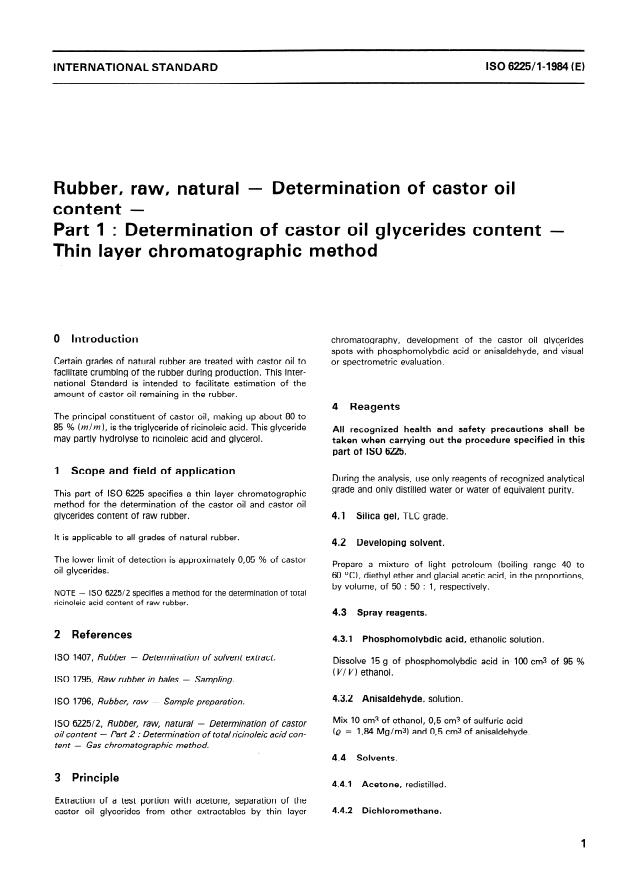
4 Reagents
The principal constituent of castor oil, making up about 80 to
85 % (m/m 1, is the triglyceride of ricinoleic acid. This glyceride
All recognized health and safety precautions shall be
may partly hydrolyse to ricinoleic acid and glycerol.
taken when carrying out the procedure specified in this
part of IS0 6225.
1 Scope and field of application
During the analysis, use only reagents of recognized analytical
grade and only distilled water or water of equivalent purity.
This part of IS0 6225 specifies a thin layer chromatographic
method for the determination of the castor oil and castor oil
glycerides content of raw rubber. 4.1 Silica gel, TLC grade.
It is applicable to all grades of natural rubber.
4.2 Developing solvent.
The lower limit of detection is approximately 0,05 % of castor
Prepare a mixture of light petroleum (boiling range 40 to
oil glycerides.
60 OC), diethyl ether and glacial acetic acid, in the proportions,
by volume, of 50 : 50 : 1, respectively.
NOTE - IS0 6225/2 specifies a method for the determination of total
ricinoleic acid content of raw rubber.
4.3 Spray reagents.
2 References
4.3.1 Phosphomolybdic acid, ethanolic solution.
IS0 1407, Rubber - Determination of solvent extract.
Dissolve 15 g of phosphomolybdic acid in 100 cm3 of 95 %
1 V/ V) ethanol.
IS0 1795, Raw rubber in bales - Sampling.
4.3.2 Anisaldehyde, solution.
IS0 1796, Rubber, raw - Sample preparation.
Mix 10 cm3 of ethanol, 0,5 cm3 of sulfuric acid
IS0 622512, Rubber, raw, natural - Determination of castor
(@ = I,84 Mg/m3) and 0,5 cm3 of anisaldehyde.
oil content - Part 2 : Determination of total ricinoleic acid con-
tent - Gas chroma tographic method.
4.4 Solvents.
3 Principle
4.4.1 Acetone, redistilled.
Extraction of a test portion with acetone, separation of the
4.4.2 Dichloromethane.
castor oil glycerides from other extractables by thin layer
IS0 6225/l-1984 (I3
If there is an excess of castor oil, the surface of the bale is liable
Standard castor oil solutions.
4.5
to feel oily. In this case, select a sufficient number of pieces,
each of at least 10 g, to provide adequate representation.
4.5.1 Weigh accurately 0,5 + 0,Ol g of castor oil (pharma-
Prepare and analyse each piece separately, making sure that
ceutical grades have been found satisfactory) and prepare a
cross-contamination does not occur during the preparation.
stock solution by diluting to 100 cm3 with dichloromethane
(4.42) in a one-mark volumetric flask (5.8).
NOTE - As there could be a high concentration of castor oil on the
surface of a piece, some of which might be lost if the rubber is milled,
the homogenization procedure described in IS0 1796 cannot be used.
4.5.2 Dilute 2; 4; 6; 8; and 10 cm3 aliquot portions of the
stock solution (4.5.1) to 10 cm3 with dichloromethane (4.4.2) in
one-mark volumetric flasks to give solutions corresponding to
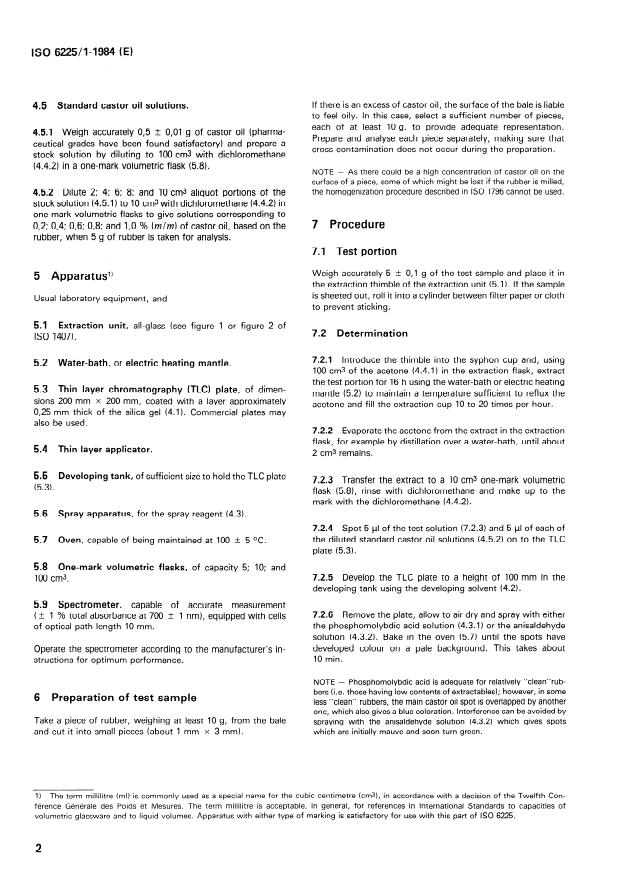
7 Procedure
0,2; 0,4; 0,6; 0,8; and 1,0 % (m/m) of castor oil, ba
...
Norme internationale 622511
INTERNATIONAL ORGANIZATION FOR STANDARDlZATION.MEIK~YHAPO~HAR OPf-AHM3AUi4R Il0 CTAH~APTUl3AWlM.ORGANlSAilON INTERNATIONALE DE NORMALISATION
Détermination de la teneur en
Caoutchouc naturel brut -
huile de ricin -
Partie 1 : Détermination de la teneur en glycérides d’huile
‘de ricin - Méthode par chromatographie en couche
mince
Part 7 : Determination of castor oil glycerides content - Thin
Rubber, raw, natural - Determination of castor oil content -
la yer chromatographic method
Première édition - 1984-04-W
ÜI
I
Y
CDU 678.062 : 547.426.21/ .23 Réf: no : ISO 6225/1-1984 (FI
g
: caoutchouc, caoutchouc brut, matiére première, essai, dosage, huile de ricin, glycéride.
Descripteurs
Prix basé sur 3 pages
Avant-propos
L’ISO (Organisation internationale de normalisation) est une fédération mondiale
d’organismes nationaux de normalisation (comités membres de I’ISO). L’élaboration
des Normes internationales est confiée aux comités techniques de I’ISO. Chaque
comité membre intéressé par une étude a le droit de faire partie du comité technique
correspondant. Les organisations internationales, gouvernementales et non gouverne-
mentales, en liaison avec I’ISO, participent également aux travaux.
Les projets de Normes internationales adoptés par les comités techniques sont soumis
aux comités membres pour approbation, avant leur acceptation comme Normes inter-
nationales par le Conseil de I’ISO.
La Norme internationale ISO 6225/1 a été élaborée par le comité technique ISO/TC 45,
Élastomères et produits à base d’élastomères, et a été soumise aux comités membres
en août 1982.
Les comités membres des pays suivants l’ont approuvée :
Afrique du Sud, Rép. d’ France Royaume-Uni
Allemagne, R.F. Hongrie Sri Lanka
Autriche Inde Suède
Belgique Indonésie Tchécoslovaquie
Italie Thaïlande
Canada
Corée, Rép. de Malaisie Turquie
Danemark Pays-Bas USA
Égypte, Rép. arabe d’ Pologne
Espagne Roumanie
Aucun comité membre ne l’a désapprouvée.
@ Organisation internationale de normalisation, 1984 0
Imprimé en Suisse
ISO 6225/1-1984 (F)
NORME INTERNATIONALE
- Détermination de la teneur en
Caoutchouc naturel brut
huile de ricin -
Partie 1 : Détermination de la teneur en glycérides d’huile
de ricin - Méthode par chromatographie en couche
mince
0 Introduction 4 Réactifs
Certaines catégories de caoutchouc naturel subissent un traite- Toutes les précautions d’hygiène et de sécurité classi-
ment à I’huile de ricin pour faciliter le déchiquetage du caout- ques doivent être observées lorsqu’on effectue les opéra-
chouc au cours de la production. La présente Norme internatio- tions spécifiées dans la présente partie de I’ISO 6225.
nale est destinée à faciliter l’estimation de la quantité d’huile de
ricin restant dans le caoutchouc.
Au cours de l’analyse, utiliser uniquement des réactifs de qua-
lité analytique reconnue, et de l’eau distillée ou de l’eau de
Le principal constituant de I’huile de ricin, représentant environ
pureté équivalente.
80 à 85 % (mlm), est le triglycéride d’acide ricinoléique. Ce
triglycéride peut s’hydrolyser partiellement en acide ricinoléique
4.1 Gel de silice, qualité pour TLC.
.et en glycérol.
4.2 Solvant de développement.
1 Objet et domaine d’application
Préparer un mélange composé d’éther de pétrole (intervalle de
La présente partie de I’ISO 6225 spécifie une méthode par chro-
distillation : 40 à 60 OC), d’oxyde diéthylique et d’acide acéti-
matographie en couche mince pour la détermination de la
que cristallisable, dans les proportions respectives, en volume,
teneur en huile de ricin et en glycérides d’huile de ricin du
de5050: 1.
caoutchouc brut.
4.3 Réactifs pour pulvérisation.
Elle est applicable à toutes les qualités de caoutchouc naturel.
La limite de détection la plus faible des glycérides d’huile de
ricin est approximativement de 0,05 %.
4.3.1 Acide molybdophosphorique, solution éthanolique.
- L’ISO 6225/2 spécifie une méthode de détermination de la
NOTE Dissoudre 15 g d’acide molybdophosphorique dans 100 cm3
teneur en acide ricinoléique total du caoutchouc brut.
d’éthanol à 95 % ( V/ VI.
4.3.2 Anisaldéhyde, solution.
2 Références
Mélanger 10 cm3 d’éthanol, 0,5 cm3 d’acide sulfurique
ISO 1407, Caoutchouc - Détermination de l’extrait par les sol-
= 1,84 Mg/m3) et 0,5 cm3 d’anisaldéhyde.
(Q
van ts.
ISO 1795, Caoutchouc brut en balles - Échantillonnage. 4.4 Solvants.
Préparation des échantillons.
ISO 1796, Caoutchouc brut -
4.4.1 Acétone, redistillée.
ISO 6225/2, Caoutchouc naturel brut - Détermination de la
4.4.2 Dichlorométhane.
teneur en huile de ricin - Partie 2 : Détermination de la teneur
en acide ricinoleique total - Méthode par chromatographie en
phase gazeuse.
4.5 Huile de ricin, solutions étalons.
4.5.1 Peser avec précision 0,5 + 0,Ol g d’huile de ricin (les
3 Principe
qualités pharmaceutiques donnent satisfaction) et préparer une
solution mère en diluant à 100 cm3 avec du dichlorométhane
Extraction d’une prise d’essai avec de l’acétone, séparation des
(4.4.2) dans une fiole jaugée à un trait (5.8).
glycérides d’huile de ricin des autres matières extraites par
chromatographie en couche mince, développement des taches
des glycérides d’huile de ricin à l’acide molybdophosphorique 4.5.2 Diluer des parties aliquotes de 2; 4; 6; 8 et 10 cm3 de la
solution mère (4.5.1) à 10 cm3 avec du dichlorométhane (4.4.2)
ou à l’anisaldéhyde, et évaluation visuelle ou spectrométrique.
ISO 6225/1-1984 (FI
dans des fioles jaugées à un trait (5.8) pour obtenir des solu- NOTE - Étant donné qu’il peut y avoir une forte concentration d’huile
de ricin sur la surface d’une pièce, un peu de cette huile peut être
tions correspondant à 0,2; 0,4; 0,6; 0,8 et 1,O % (mlm) d’huile
perdu, la méthode d’homogénéisation décrite dans I’ISO 1796 ne peut
de ricin, par rapport au caoutchouc, lorsque 5 g de caoutchouc
pas être utilisée.
sont prélevés en vue de l’analyse.
7 Mode opératoire
5 Appareillagel)
7.1 Prise d’essai
Matériel courant de laboratoire, et
Peser avec précision 5 + 0,l g de l’échantillon pour essai et les
placer dans la cartouche à extraction de l’appareil (5.1). Si
5.1 Appareil à extraction, entièrement en verre (voir
l’échantillon se présente sous forme d’une feuille mince, rouler
figure 1 ou figure 2 de I’ISO 1407).
celle-ci en forme de cylindre entre
...
Questions, Comments and Discussion
Ask us and Technical Secretary will try to provide an answer. You can facilitate discussion about the standard in here.
Loading comments...