


ISO/PRF 9897-2
(Main)Freight containers — Container equipment data exchange (CEDEX) — Part 2: Refrigerated containers
Freight containers — Container equipment data exchange (CEDEX) — Part 2: Refrigerated containers
Conteneurs pour le transport de marchandises — Échange de données sur les équipements de conteneurs (CEDEX) — Partie 2: Les conteneurs frigorifiques
General Information
- Status
- Withdrawn
- Technical Committee
- ISO/TC 104/SC 4 - Identification and communication
- Drafting Committee
- ISO/TC 104/SC 4/WG 3 - Communication and terminology
- Current Stage
- 5098 - Project deleted
- Start Date
- 20-Jan-2020
- Completion Date
- 14-Feb-2026
Relations
- Effective Date
- 16-Mar-2013
Get Certified
Connect with accredited certification bodies for this standard

BRCGS (Brand Reputation Compliance Global Standards)
Global food safety and quality standards owner.
Sponsored listings
Frequently Asked Questions
ISO/PRF 9897-2 is a draft published by the International Organization for Standardization (ISO). Its full title is "Freight containers — Container equipment data exchange (CEDEX) — Part 2: Refrigerated containers". This standard covers: Freight containers — Container equipment data exchange (CEDEX) — Part 2: Refrigerated containers
Freight containers — Container equipment data exchange (CEDEX) — Part 2: Refrigerated containers
ISO/PRF 9897-2 is classified under the following ICS (International Classification for Standards) categories: 55.180.10 - General purpose containers. The ICS classification helps identify the subject area and facilitates finding related standards.
ISO/PRF 9897-2 has the following relationships with other standards: It is inter standard links to ISO 9897:1997. Understanding these relationships helps ensure you are using the most current and applicable version of the standard.
ISO/PRF 9897-2 is available in PDF format for immediate download after purchase. The document can be added to your cart and obtained through the secure checkout process. Digital delivery ensures instant access to the complete standard document.
Standards Content (Sample)
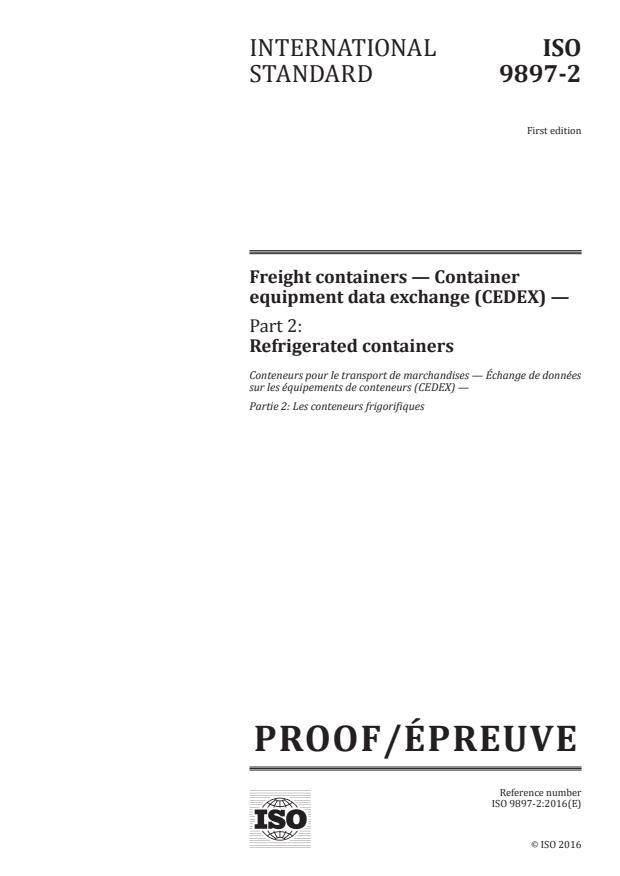
INTERNATIONAL ISO
STANDARD 9897-2
First edition
Freight containers — Container
equipment data exchange (CEDEX) —
Part 2:
Refrigerated containers
Conteneurs pour le transport de marchandises — Échange de données
sur les équipements de conteneurs (CEDEX) —
Partie 2: Les conteneurs frigorifiques
PROOF/ÉPREUVE
Reference number
ISO 9897-2:2016(E)
©
ISO 2016
ISO 9897-2:2016(E)
© ISO 2016, Published in Switzerland
All rights reserved. Unless otherwise specified, no part of this publication may be reproduced or utilized otherwise in any form
or by any means, electronic or mechanical, including photocopying, or posting on the internet or an intranet, without prior
written permission. Permission can be requested from either ISO at the address below or ISO’s member body in the country of
the requester.
ISO copyright office
Ch. de Blandonnet 8 • CP 401
CH-1214 Vernier, Geneva, Switzerland
Tel. +41 22 749 01 11
Fax +41 22 749 09 47
copyright@iso.org
www.iso.org
ii © ISO 2016 – All rights reserved
ISO 9897-2:2016(E)
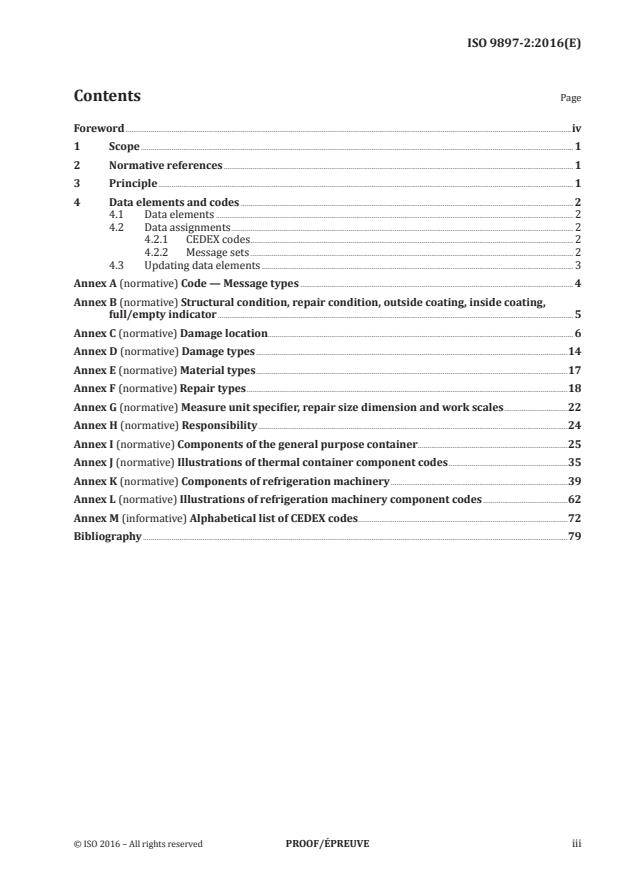
Contents Page
Foreword .iv
1 Scope . 1
2 Normative references . 1
3 Principle . 1
4 Data elements and codes . 2
4.1 Data elements . 2
4.2 Data assignments . 2
4.2.1 CEDEX codes . 2
4.2.2 Message sets . 2
4.3 Updating data elements . 3
Annex A (normative) Code — Message types . 4
Annex B (normative) Structural condition, repair condition, outside coating, inside coating,
full/empty indicator . 5
Annex C (normative) Damage location. 6
Annex D (normative) Damage types .14
Annex E (normative) Material types .17
Annex F (normative) Repair types .18
Annex G (normative) Measure unit specifier, repair size dimension and work scales .22
Annex H (normative) Responsibility .24
Annex I (normative) Components of the general purpose container.25
Annex J (normative) Illustrations of thermal container component codes .35
Annex K (normative) Components of refrigeration machinery .39
Annex L (normative) Illustrations of refrigeration machinery component codes .62
Annex M (informative) Alphabetical list of CEDEX codes .72
Bibliography .79
ISO 9897-2:2016(E)
Foreword
ISO (the International Organization for Standardization) is a worldwide federation of national standards
bodies (ISO member bodies). The work of preparing International Standards is normally carried out
through ISO technical committees. Each member body interested in a subject for which a technical
committee has been established has the right to be represented on that committee. International
organizations, governmental and non-governmental, in liaison with ISO, also take part in the work.
ISO collaborates closely with the International Electrotechnical Commission (IEC) on all matters of
electrotechnical standardization.
The procedures used to develop this document and those intended for its further maintenance are
described in the ISO/IEC Directives, Part 1. In particular the different approval criteria needed for the
different types of ISO documents should be noted. This document was drafted in accordance with the
editorial rules of the ISO/IEC Directives, Part 2 (see www.iso.org/directives).
Attention is drawn to the possibility that some of the elements of this document may be the subject of
patent rights. ISO shall not be held responsible for identifying any or all such patent rights. Details of
any patent rights identified during the development of the document will be in the Introduction and/or
on the ISO list of patent declarations received (see www.iso.org/patents).
Any trade name used in this document is information given for the convenience of users and does not
constitute an endorsement.
For an explanation on the meaning of ISO specific terms and expressions related to conformity assessment,
as well as information about ISO’s adherence to the World Trade Organization (WTO) principles in the
Technical Barriers to Trade (TBT) see the following URL: www.iso.org/iso/foreword.html.
The committee responsible for this document is ISO/TC 104, Freight containers, Subcommittee SC 4,
Identification and communication.
This first edition of ISO 9897-2, together with ISO 9897-1, ISO 9897-5 and ISO 9897-6, cancels and
replaces ISO 9897:1997, which has been technically revised with the following change:
— It has been split into parts to simplify and relate the technical content of each part to each type of
container and also to harmonize the parts of ISO 9897 with the order of container types as contained
in the parts of ISO 1496.
It also incorporates the Technical Corrigendum ISO 9897:1997/Cor 1:2001.
ISO 9897 consists of the following parts, under the general title Freight containers — Container
equipment data exchange (CEDEX):
— Part 1: General communication codes for general purpose containers
— Part 2: Refrigerated containers
— Part 5: General communication codes for chassis
— Part 6: Message sets for data transfer between local computer and host computer
iv PROOF/ÉPREUVE © ISO 2016 – All rights reserved
INTERNATIONAL STANDARD ISO 9897-2:2016(E)
Freight containers — Container equipment data exchange
(CEDEX) —
Part 2:
Refrigerated containers
1 Scope
This part of ISO 9897 specifies general communication codes for container equipment data exchange
(CEDEX).
It is intended for business entities for use in communications relating to freight container transactions.
2 Normative references
The following documents, in whole or in part, are normatively referenced in this document and are
indispensable for its application. For dated references, only the edition cited applies. For undated
references, the latest edition of the referenced document (including any amendments) applies.
ISO 3166-1, Codes for the representation of names of countries and their subdivisions — Part 1: Country codes
ISO 6346:1995, Freight containers — Coding, identification and marking
ISO 9897-6, Freight containers — Container equipment data exchange (CEDEX) — Part 6: Message sets for
data transfer between local computer and host computer
3 Principle
In the ISO 9897 series, codes are assigned to pieces of information, called “data elements”, which are
commonly used in transactions relating to freight containers. These data elements are named and
defined, and each element is assigned a CEDEX alphabetical or alphanumeric code. Separate code lists
for each type of information (damage, component, repair, location, etc.) are maintained. A code may be
reused in several different code lists, but a code is never used for more than one data element within a
single code list.
The data element may be phrased about material of construction of a container. For example, CEDEX code
“ST” in material type code list (Annex E) stands for “Steel, carbon”. A code may define the component of
the container that is damaged, its location, or its operating defect, depending on which data element is
being defined. A selection is made from the appropriate code list to indicate which component, location,
or defect, respectively, is chosen. Other coded data elements indicate essential physical characteristics
of the container and information pertinent to the use and management of the container, such as names
and addresses of owners.
It can be seen from these examples that the text of a message can be substantially reduced in length
by using the CEDEX codes instead of plain language. Use of the CEDEX codes results in messages much
reduced in length, transmission time and communication cost, yet conveying information as complete
as a much longer plain-language message.
Through proper programming of a computer, a CEDEX-encoded message can be printed out in plain
language for the benefit of the communicators, if so desired, or it can be left in its encoded form. The
personnel using the code routinely will develop the skill of being able to read messages in coded form;
in fact, experience using the code has borne out this assertion. Also, many operators will not require
ISO 9897-2:2016(E)
use of all CEDEX codes assigned in ISO 9897, but only a portion of them due to the limited variety of
containers and chassis in their domain.
Specific information about manufacturer, type and model of a container or chassis and its equipment is
contained in the message (see 4.2.2).
4 Data elements and codes
4.1 Data elements
Data elements and corresponding code sets required to describe equipment components, their
condition, repair methods, etc. are included in the appropriate Annex shown in Table 1.
4.2 Data assignments
4.2.1 CEDEX codes
All codes assignments of CEDEX shall be taken as obligatory. That is, an operator shall not pick and
choose alternative codes unilaterally, nor depart from the established protocol, nor introduce new
codes without having registered the codes in accordance with 4.3.
However, two trading partners may agree mutually to use alternative codes if necessary code are not
included in this part of ISO 9897. It is strongly recommended that such code be registered in accordance
with 4.3 as soon as possible after introduction.
4.2.2 Message sets
Message sets as per ISO 9897-6 are alternative interface messages used for electronic data interchange
transmission. An owner or operator can pick and choose amongst other standards and the standard
serves as a list of required and optional data elements.
The specific information about manufacturer, type and model of a container or chassis and its equipment
is contained in the message sets.
ISO 9897-6, Annex A describes the manner in which a directory of users is developed. The directory
is maintained by Bureau International des Containers et du Transport Intermodal (BIC) listed as BIC-
LOCODES at www.bic-code.org.
Table 1 — Data elements and code sets
Data elements Code set
Message type Annex A
Full/empty indicator (container) Annex B
Structural condition (container) Annex B
Repair condition (container) Annex B
Outside coating (container) Annex B
Inside coating (container) Annex B
Damage location Annex C
Damage type Annex D
Material type Annex E
Repair type Annex F
Measure unit specifier Annex G
2 PROOF/ÉPREUVE © ISO 2016 – All rights reserved
ISO 9897-2:2016(E)
Table 1 (continued)
Data elements Code set
Work scale (standard time factor) Annex G
Responsibility (for repair action) Annex H
Component for container Annex I
4.3 Updating data elements
The ISO Council has, in accordance with the provisions of the Directives for the technical work of
ISO, designated the Bureau International des Containers et du Transport Intermodal (BIC) as the
Registration authority for the data elements:
Registration authority for ISO 9897
Bureau International des Containers et du Transport Intermodal (BIC)
41, rue Réaumur
FR 75003 Paris
France
Phone: +33 1 47660390
Telefax: +33 1 47660891
E-mail: bic@bic-code.org
www.bic-code.org
Additional data elements will be added to Table 1 at the request of international organizations,
ISO/TC 104 member bodies, and approval of TC 104/SC 4. The actual process of registration will be
performed by the TC 104/SC 4 Secretariat in consultation with the experts of TC 104/SC 4.
Each additional data element will be allocated an alphabetic or alphanumeric code, not at present used
within the same code list covering a type of data.
ISO 9897-2:2016(E)
Annex A
(normative)
Code — Message types
Numerical code Name Description Message
a,b
01050 Damage repair estimate Description of damages and repair methods; DESTIM
authorization for repair work to proceed
c
01060 Damage/repair estimate Description of damages and repair methods; WESTIM
c
authorization for repair work to proceed WESTIMDT
a
To be used for electronic data interchange transmissions. See appropriate message descriptions published by UN/C-
FACT to determine messages to which the codes in this part of ISO 9897 may apply. Further message types and equivalent
EDIFACT codes will be added as released by C-FACT TBG3.
b
EDIFACT codes, message standards (including the relevant message type codes) are controlled by UN/C-FACT, a
subsidiary organization to UN/ECE/WP.4. ISO has assented to this arrangement via a memorandum of understanding
between ISO and UN/ECE.
c
To be used for electronic data interchange transmissions. See appropriate message descriptions in ISO 9897-6. The
messages of ISO 9897-6 are developed for trading partner systems that do not support EDI. These messages are also used
for import and export of data between systems.
4 PROOF/ÉPREUVE © ISO 2016 – All rights reserved
ISO 9897-2:2016(E)
Annex B
(normative)
Structural condition, repair condition, outside coating, inside
coating, full/empty indicator
B.1 Structural condition, repair condition, outside coating, inside coating
Numerical code Name Description Message
01110 Bad Inferior quality or state of structural parts, B
workmanship, surface treatment, etc.
01120 Poor Poor quality or state of structural parts, P
workmanship, surface treatment, etc.
01130 Medium Average or acceptable quality or state of M
structural parts, workmanship, surface
treatment, etc.
01140 Good Good quality or state of structural parts, G
workmanship, surface treatment, etc.
01150 Excellent Excellent quality or state of structural parts, X
workmanship, surface treatment, etc.
B.2 Full/empty indicator
Numerical code Name Description Message
01160 Empty Empty condition of equipment E
01170 Full Loaded condition of equipment F
ISO 9897-2:2016(E)
Annex C
(normative)
Damage location
C.1 All container bodies and refrigeration units
The location coding convention consists of the following.
— A 1 200 mm × 1 200 mm (4 ft × 4 ft) numerical square system is used to identify damage to any face
of a 20 ft or 40 ft container.
— A 600 mm × 600 mm (2 ft × 2 ft) numerical square system is used to identify damage to any face of
a 10 ft container.
— A 900 mm × 900 mm (3 ft × 3 ft) numerical square system is used to identify damage to any face of
a 30 ft container.
The container location coding convention locates damages within an area as large as a complete face of
the container or as small as a nominal square as above, or even less for the main components located on
its edges (rails, corner posts).
The location code shall consist of four characters depending upon the area to be described. It identifies
the smallest area containing the entire vertical and horizontal length of the damage.
C.1.1 First character
The first character shall be selected to identify the appropriate face of the container.
door end (rear) D
container exterior E
front end F
left side L
Container interior I
right side R
top/roof T
under-structure U
bottom floor B
Others:
Refrigeration unit components M
unspecified location or not applicable N
container exterior and interior (whole container) X
C.1.2 Second character
It shall be selected to identify the appropriate part of the container face where the damage is contained,
when applied to a closed container. The vertical faces of the container are divided into top and bottom
halves and upper and lower main components. The horizontal faces of the container (roof or top and floor
or bottom and under-structure) are divided into right and left halves when viewed from the door end.
6 PROOF/ÉPREUVE © ISO 2016 – All rights reserved
ISO 9897-2:2016(E)
The relevant codes for containers are as follows:
both halves (i.e. top and bottom, or left and right or cen- X
tre)
bottom half both halves (i.e. top and bottom, or left) B
higher portion (upper) H
left half L
lower portion (ground) G
right half R
top half T
For refrigeration units, the second character designates the major assembly of the unit in which the
damage is found. See C.1.2 for examples of how these codes are used.
Compressor Q
Condenser K
Electrical E
Evaporator V
Frame F
Miscellaneous Z
Piping P
Regulation/Control C
Unspecified assembly N
Whole unit X
C.1.3 Third and fourth characters
They shall be selected to identify the section of the container part in which the damage is contained.
On all containers, the front and door ends are divided into vertical sections numbered as follows when
viewed from the door end from left to right:
for the left-hand side corner post 1
for the left half 2
for the right half 3
for the right-hand side corner post. 4
On all containers, the right and left sides, the roof, the floor and the under-structure are divided into
equal sections as follows:
for 10 ft and 20 ft containers, five sections numbered 1 to 5
for 30 ft and 40 ft containers, 10 sections numbered 1 to 0
When the damage covers one section only, the third character indicates the appropriate section number
and the fourth character shall be N [see Figure C.1 a)].
When the damage covers several adjacent sections, the first and last section numbers are used [see
Figure C.1 b)].
When the damage covers several non-adjacent sections or if damage repair details are not the same,
then separate line items shall be used [see Figure C.1 c)].
ISO 9897-2:2016(E)
When the damage covers the entire length of the container face, the third and fourth characters shall
each be X [see Figure C.1 d)].
C.1.4 General location coding
When the damage/action covers several faces of the inside of the container such as steam cleaning,
inside refurbishment, reaffixing or sealing of panels, then the code IXXX shall be used.
When the damage/action covers several faces of the outside of the container such as outside refurbishment,
reaffixing or sealing of panels, removing of cargo stickers, then the code EXXX shall be used.
When the damage/action covers several inside and outside faces of the container such as examinations,
handling/transport, complete refurbishing, and then the code XXXX shall be used.
C.1.5 Examples of location coding for containers
Examples of location coding of components of typical containers are shown below. A diagram showing
the components is shown in Figure C.1.
Figure C.1 Location code Component Description
Reference code
a LT5N PAA Side panel, LHS, upper half, within the 5th 1 200 mm
(4 ft) section from rear
b RT24 PAA Side panel, RHS, upper half, extending through 2nd to
4th sections from rear
c RB2N PAA Side panel, RHS, lower half, within the second section
from the door
c RB4N PAA Side panel, RHS, lower half, within the fourth section
from rear
d TXXX PAA Roof panel, both sides, extending through all sections
e UX1N CMA Cross-member, both sides, within first section from
door
f UR12 CMA Several cross-members, RHS, extending through first
two sections*
g TL12 RBO Roof bows, both sides, extending through first two
sections*
h TR1N RBH Roof bow holder, RHS, within first section (bow hold-
er number will be defined in separate free-text field)
i UL8N CMA Outrigger, LHS, within the eighth section from door
(40 ft) (outrigger number will be defined in separate
free-text field)
j UX3N FLW Web (side) of fork-lift pocket, both sides, within third
section from door (pocket number will be defined in
separate free-text field)
k UR4N FLS Fork-lift pocket strap, RHS, within fourth section
from door (pocket number will be defined in separate
free-text field)
l RX1N SBO Side post, RHS, both halves, within the first section
from door (post number will be defined in separate
free-text field)
LHS left-hand side
RHS right-hand side
a
Specific sequential number of component will be defined in separate free-text field.
NOTE Specific sequential number of component will be defined in separate free-text field as follows: Roof bows,
crossmembers, outriggers and forklift pocket sides are to be numbered from rear (door) end to front. Locking bars are to be
numbered from left to right.
8 PROOF/ÉPREUVE © ISO 2016 – All rights reserved
ISO 9897-2:2016(E)
Figure C.1 Location code Component Description
Reference code
m UL15 RLA Centre spacer rail, extending through sections 1 to 5
from door
n UR89 RLA Tunnel rail, extending through sections 8 to 10 from
door
o DX2N LBA Locking bar, LH door, both halves (locking bar num-
ber will be defined in separate free-text field)
LHS left-hand side
RHS right-hand side
a
Specific sequential number of component will be defined in separate free-text field.
NOTE Specific sequential number of component will be defined in separate free-text field as follows: Roof bows,
crossmembers, outriggers and forklift pocket sides are to be numbered from rear (door) end to front. Locking bars are to be
numbered from left to right.
ISO 9897-2:2016(E)
10 PROOF/ÉPREUVE © ISO 2016 – All rights reserved
ISO 9897-2:2016(E)
ISO 9897-2:2016(E)
Figure C.1 — Examples of location coding for containers
C.2 Ancillary equipment
The specific components of ancillary equipment which are in integral part of a container such as
refrigeration machinery
— firstly, by the two alpha characters selected to identify the major functional group to which the
component belongs: they are the first and second characters of the location code,
— secondly, by the code NN: it forms the third and fourth characters of the location code.
EXAMPLE MQNN Reefer machinery — Compressor.
12 PROOF/ÉPREUVE © ISO 2016 – All rights reserved
ISO 9897-2:2016(E)
Components that occur more than once in an ancillary equipment or which are common or similar to
other components are given the same component code but are differentiated by functional group code.
EXAMPLE
Location code Component code Description
MKNN MAS Refrigerated machinery — Condenser fan motor
MVNN MAS Refrigeration machinery — Evaporator fan motor
MPNN VSS Refrigeration machinery — Suction solenoid valve
ISO 9897-2:2016(E)
Annex D
(normative)
Damage types
Numerical code Name Description CEDEX code
04020 Bent Component is damaged by being bent BT
04025 Overhead obstruction Damage usually to the upper sections of a OO
container caused by impact with a structure
such a bridge
04030 Bowed Component is damaged by being bowed. BW
Usually damage is gradual over the length of
the component
04040 Blocked Drain, tube, outlet, etc. is blocked BK
04060 Broken/split Component is damaged by being broken or BR
split
04069 Burned Component whose surface is damaged by BN
burns
04070 Burned out Electrical component is burned out BO
04090 Compression line A series of dents in a straight line that de- CL
creases the strength of a component when it
is placed in compression
04095 Forklift damage Impact or pressure damage caused by a FD
forklift
04100 Contaminated Equipment is rendered unsuitable for cargo CT
because of contamination by chemicals or
other cargo products, or by infestation
04110 Corroded/rusty Component is corroded or rusty CO
04112 Corroded/holed Component is holed by corrosion CH
04115 Cracked Crack apparent either in surface or through CK
part or all of component profile
04117 Cracked weld Welding seam is damaged by being cracked CW
04120 Cut Component is damaged by being cut CU
04140 Debris/dunnage Equipment is unusable due to cargo residue DB
or dunnage left inside
04150 Delaminated Component is damaged due to separation of DL
laminations
04160 Dent Component is damaged by being dented DT
04162 Dented and holed Component is dented and holed DH
04165 Dirty Unclean condition that may affect utility of DY
container
04166 Disconnected Wire, plug or pipe which is unconnected from DI
each other or from plug-in device
04167 Improper cleaning The component has had an inadequate clean- IC
ing procedure performed
04190 Frozen/seized Component is inoperable by being frozen or FZ
seized due to corrosion
04200 Gouged Component is damaged by being gouged GD
04230 Holed Component is damaged by being holed HO
14 PROOF/ÉPREUVE © ISO 2016 – All rights reserved
ISO 9897-2:2016(E)
Numerical code Name Description CEDEX code
04240 Improper repair A repair that does not conform to owner’s IR
requirements or industry standards
04245 New improper repair A repair performed during the most recent IN
lease that does not conform to owner’s re-
quirements or industry standards
04246 Vibrated Component or device broken by vibration VB
04247 Inactive Component or device that is no longer active IV
04250 Leak Equipment or component leaks LK
04260 Loose Component is loose LO
04270 Low fluid level Component or system has less than required LF
amount of fluid
04280 Markings/labels Labels, marks, logos, and graffiti, etc., not ML
required by owner
04290 Motor failure Motor will not function MF
04320 Missing/lost Component is missing or lost MS
04335 Remove for access Removal of a component to facilitate either a RA
repair or further inspection
04340 Not within ISO dimensions Equipment is not usable because it is no NI
longer within the ISO dimensional envelope
04350 Not to TIR requirements Equipment or component no longer complies NT
with TIR regulations
04355 Not applicable A condition for which no specific damage ZZ
type applies
04360 Not as required by owner Equipment or component no longer complies NO
with owner’s requirements
04362 Conversion required An alteration to the structure, rating, RC
designation, etc. as directed by the owner or
operator
04365 Not as required by user Equipment or component no longer complies NV
with user’s requirements
04368 Preventative maintenance A component requiring a maintenance proce- PM
dure to prevent a further failure
04370 Odour Equipment is rendered unsuitable for cargo OR
because of odour
04375 Food quality required The condition of the container requires work FQ
to reach Food Grade Quality
04390 Oil stains Component, usually flooring, is damaged by OS
being spotted with oil
04400 Other unacceptable repairs Any repair deemed unacceptable by the OU
owner or for reasons not specifically covered
04410 Out-of-date Renewal of a periodic inspection, test or doc- OD
ument is overdue
04415 Test required A statutory or non-statutory test is required TR
04417 Out of calibration The reading or output of a gauge or device OC
requires re-graduating
04440 Pin holes Component is damaged with minute holes PH
04455 Scratched/abraded mov- Moving part (bearing, piston, etc.) scored, SA
ing part scratched, or abraded by friction
04470 Short/open circuit Electrical system is inoperable due to a short SH
or open circuit
ISO 9897-2:2016(E)
Numerical code Name Description CEDEX code
04472 Inadequate electrical re- Electrical resistance below a minimum re- IE
sistance quirement
04520 Paint failure Component suffers from a breakdown of the PF
paint system
04530 Refurbishment program A programme of refurbishment as directed RV
by the owner or operator
04540 Warped Component is damaged by being warped WA
04555 Saturated/wet Excess moisture is present within the com- ST
ponent.
04560 Wear and tear The unavoidable deterioration of a compo- WT
nent during usage under proper operating
conditions
04570 Worn Component is rendered unusable by being WN
worn.
04580 Wrong material Previous repair or replacement was carried WM
out using the wrong material
04590 Existing manufacturing A manufacturing defect which is documented ME
defect and known about by the owner
04595 New manufacturing defect A potential or actual defect which may result MN
from the manufacturing process and is not
known about by the owner
04610 Consequential damage Damage caused by failure to perform an CD
adequate repair
04615 Operator failure Damage has been caused by the operator’s OE
failure to use the container correctly
16 PROOF/ÉPREUVE © ISO 2016 – All rights reserved
ISO 9897-2:2016(E)
Annex E
(normative)
Material types
Numerical code Name Description CEDEX code
05000 Material unspecified Material is not specified MU
05100 Steel unspecified Material is steel of no specific type SU
05110 Steel, carbon Material is of carbon steel ST
05120 Steel, corten Material is of corten steel SK
05130 Steel muffler Material is muffler grade steel (semi-corro- SM
sion resistant)
05140 Steel, stainless Material is stainless steel (corrosion resistant) SS
05150 Steel, galvanized Material is galvanized steel SG
05200 Aluminium unspecified Material is aluminium of no specific type AU
05210 Aluminium pre-painted Material is of pre-painted aluminium AP
05370 GRP plywood Plastic coated, glass fibre reinforced plywood PG
05380 Plymetal Material is plywood, faced with metal of no PM
specific type on both sides
05400 Plastic Plastic, unspecified type PU
05410 Plastic reinforced Plastic reinforced with fibres PE
05420 Insulation material un- Insulated material in slab IS
specified
05430 Insulation material in situ Insulated material injected II
05440 Rubber, unspecified Rubber, unspecified type RU
ISO 9897-2:2016(E)
Annex F
(normative)
Repair types
Numerical code Name Description CEDEX code
06001 No action necessary The damage to the component is within ac- NA
ceptable limits and will not require repair.
06002 Special repair The work necessary to repair the component SP
is not described by another single repair
code. A series of different repair steps may be
involved
06003 Prepare for work Time allowed to prepare the container and/ PW
or components for the repair steps to follow
06004 Standard repair The work is carried out to a standardized SR
procedure
06005 Technical bulletin complet- A specific schedule of work according to a set TB
ed of instructions issued by the owner or manu-
facturer detailing procedures for a modifica-
tion, repair, warranty, etc.
06010 Abrade and paint To remove rust/loose paint using abrasive AB
grit/shot blast and paint.
06015 Mechanical cleaning To clean the surface of a component by me- MC
(scrape off paint) chanical means, (i.e. scrape or grind off paint)
06040 Air clean To clean a component or equipment with high AC
pressure air
06050 Blank out To remove a ventilator/valve and “blank out” BU
the panel/shell behind
06070 Chemical clean To clean a component with chemical wash CC
06072 Dismantle and clean To clean a component having first taken it DC
apart.
06075 Deodorize Neutralize odour in container DO
06076 Pickle/passivate A series of chemical procedures where the PK
surface of a component is first cleaned by an
acidic solution, which is then neutralized by
chemicals
06080 Drain To drain the system DR
06090 Drain and fill To drain the system and fill with appropri- DF
ate fluid
06100 Inspect and report Inspect equipment or component for proper IP
function, damage or reason for non-opera-
tion, and re-estimate. An additional report
will follow on completion
06101 Take photos Take photos and transmit or upload to re- TP
questing party
06103 Temperature monitoring Perform a daily temperature monitoring TM
function to a refrigerated container
06104 Pre-cooling Pre-cooling of container as required or PC
requested
06105 Test calibrate A series of tests or calibration procedures TC
are required on a component.
18 PROOF/ÉPREUVE © ISO 2016 – All rights reserved
ISO 9897-2:2016(E)
Numerical code Name Description CEDEX code
06106 Set To set temperature, humidity and ventilation TS
as ordered for a specific cargo
06107 Running test Mechanical run checks on a refrigeration unit MR
06108 Pre-trip inspection Checks before a unit leave a location. These PI
checks can include both visual and mechani-
cal run checks.
06110 Free To free a frozen, seized or stiff component by FR
means of force, lubricants or heat
06112 Free-up and lubricate To free a frozen, seized or stiff component by LF
means of force, lubricants or heat, and then
apply lubricant
06115 Handling Equipment must be handled in order to make HN
available, but without other repair action
06120 Insert To remove and replace part of the cross sec- IT
tional profile of a component over part of its
length and/or width. The replacement por-
tion is butt welded to the original component
06125 Install To fit a component for the first time IN
06127 Reinforce (example T-floor To provide additional support to a component RI
members)
06130 Lubricate To apply lubrication LC
06135 Modifications, miscellane- To alter a component such that its specifica- MD
ous tion is changed
06138 Not applicable A condition for which no specific repair ZZ
type applies
06140 Overlapping partial section To remove and replace part of the cross sec- OP
tional profile of a component over its entire
length and/or width. The replacement por-
tion is overlapped with and fillet welded to
the original component. The exterior of the
patch is continuously welded to the original
component. The interior may be continuously
or skip welded with sealer applied to seams
between skip welds
06150 Paint To apply paint PA
06155 Overlay Cover a surface with a thin layer of the same OX
or similar material
06170 Patch Remove and replace a part of the cross sec- PT
tional profile of a component, over only part
of the component’s length and/or width.
The patch is secured either by riveting or
welding the sheet material to the panel
06172 Glue patch Remove and replace a part of the cross sec- GP
tional profile of a component, over only part
of the component’s length and/or width. The
patch is secured by an adhesive.
06175 Patch and foam Patch as indicated in 06170, and also remove PX
and replace underlying insulating foam
06177 Re-foam Remove and replace damage insulation FO
material
06178 Bracing and re-foaming Install a framework to retain shape during BF
the foaming process and then remove and
replace damage insulation material
ISO 9897-2:2016(E)
Numerical code Name Description CEDEX code
06180 Preventive maintenance Maintenance carried out under the owner’s VM
instruction
06195 Cross measurement To measure and compare the dimensions of CM
a container to ensure it is both dimensional
correct and square
06200 Rebuild To strip, clean, lubricate, and reassemble a RB
mechanical component
06205 Re-bush To remove and refit a bush(ing) into a com- RU
ponent
06209 Leak test Test with nitrogen of refrigerant system to NL
find leak(s)
06210 Recharge Supply a full charge of fluid to system CH
06215 Evacuate, recycle and re- Remove the refrigerant from a system, store ER
charge reefer system and then recycle after repair
06216 Nitrogen blow down Nitrogen blow down is a procedure used for BD
cleaning a contaminated refrigeration system.
06220 Recondition/refurbish To refurbish the container in accordance RX
with the owner’s instructions
06230 Refit To refit a removable component to its proper FT
position
06231 Refit recorder chart Refit recorder temperature chart or paper for FC
temperature recorder
06240 Re-glass To repair surface and veneer cracks or dam- RG
age to GRP panels
06260 Remove and dispose To remove and dispose of debris, dunnage, or RD
packing material
06270 Repairs prior to refurbish- Repairs ordered by owner prior to refur- PV
ment bishment
06280 Remove (without replace- To remove and not replace a component RM
ment)
06290 Remove and refit To remove and refit after repair RR
06295 Remove glue and tape To clean surfaces of glue and tape, including GT
their residues
06297 Remove markings To remove unwanted labels, marks, logos, MV
and graffiti
06300 Replace Remove and replace the complete cross sec- RP
tional profile of a component over its entire
length and width
06305 Fit part from owners stock Renew using a component from the owners EX
stock
06306 Supply of part Only part supply, no physical repair per- ZP
formed
06310 Re-rate To modify data relating to maximum gross RT
mass or tare on any data plate or weight
marking
06315 Re-secure To reapply or tighten fasteners on loose RE
components
06320 Rewire To repair an electrical component or system RW
by rewiring
06325 Sand To smooth a surface by sanding SD
20 PROOF/ÉPREUVE © ISO 2016 – All rights reserved
ISO 9897-2:2016(E)
Numerical code Name Description CEDEX code
06330 Seal/reseal a) To repair pin holes in a tarpaulin cover or SE
tilt using sealant
b) To apply sealant to or around component
06340 Section To remove and replace the complete cross SN
sectional profile of a component over part of
its length and/or width
06345 Section and foam Section as indicated in 06340, plus remove SF
and replace underlying insulating foam
06350 Splice To repair by section using rivets with, usual- SI
ly, a doubler piece or backing plate at the joint
06360 Straighten To repair by straightening GS
06370 Straighten and re-secure To repair by straightening and re-securing RS
the component when repaired
06380 Straighten and weld To repair by straightening a component and GW
re-welding it into position
06390 Steam clean To clean the component, usually the interior/ SC
floor, using high pressure steam
06400 Surface preparation and To remove rust/loose paint using grinding/ PS
paint scraping and paint
06410 Sweep Clean component, usually the floor, by WP
sweeping
06420 Top up Refill fluid to correct level TU
06430 Water wash To clean the component, usually the floor, WW
using water
06440 Weld To repair by welding WD
06441 Argon weld To repair by argon welding AW
06442 Solder To repair by soldering SO
06450 Grind and weld To repair by grinding and welding XW
06460 Conversion To amend the character or function of a com- CN
ponent/Unit
06461 Software modify To modify existing component software US
06462 Data download To upgrade existing component software UD
06470 Dry out To remove moisture, i.e. the floor or the inte- DU
rior of the unit
06475 Hook up/unhook to shore To connect or disconnect a shore or port PU
power power supply
06480 Combined repair item A series of repair processes which overlap CR
06500 Temporary repair Repair for temporary securement of cargo TR
worthiness until a permanent repair can be
made at a suitable repair shop. Either by use
of an adhesive tape or other means to effect a
repair of a temporary nature.
06510 Off-hire No action the container is designated for OF
off-hire
ISO 9897-2:2016(E)
Annex G
(normative)
Measure unit specifier, repair size dimension and work scales
G.1 Measure unit specifier
Numerical code Name Description CEDEX code
07010 Inches Measurement in inches INH
07012 Square inches Measurement in square inches SQI
07014 Cubic inches Measurement in cubic inches CUI
07020 Feet Measurement in feet FOT
07022 Square feet Measurement in square feet SQF
07024 Cubic feet Measurement in cubic feet CUF
07030 Millimetres Measurement in millimetres MMT
07032 Square millimetres Measurement in square millimetres SQT
07034 Cubic millimetres Measurement in cubic millimetres CUT
07040 Centimetres Measurement in centimetres CMT
07042 Square centimetres Measurement in square centimetres SQC
07044 Cubic centimetres Measurement in cubic centimetres CUC
07050 Metres Measurement in metres MTR
07052 Square metres Measurement in square metres SQM
07054 Cubic metres Measurement in cubic metres CUM
07060 Pounds Measurement in pounds LBS
07070 Kilograms Measurement in kilograms KGS
07080 Pints Measurement in pints PNT
07090 Litres Measurement in litres LTR
07100 Hours Measurement in hours HRS
07110 Minutes Measurement in minutes MTS
07120 Quantity Measurement in quantity QTY
G.2 Size of repair
Size of repair, where required, is defined as either length, length and height, or length and width.
EXAMPLE
Length only 15
Length and height 1 500 × 100
Length and width 60 × 30
22 PROOF/ÉPREUVE © ISO 2016 – All rights reserved
...
Questions, Comments and Discussion
Ask us and Technical Secretary will try to provide an answer. You can facilitate discussion about the standard in here.
Loading comments...