

ISO 4044:2017
(Main)Leather — Chemical tests — Preparation of chemical test samples
General Information
- Abstract
ISO 4044:2017 specifies how to prepare a test sample of leather for chemical analysis. The test sample can be either ground or cut into small pieces. Unless specified in this document, the method to be used depends on the size of leather sample available for testing.
- Status
- Published
- Publication Date
- 02-Jan-2017
- Technical Committee
- IULTCS - International Union of Leather Technologists and Chemists Societies
- Current Stage
- 9093 - International Standard confirmed
- Start Date
- 14-Jun-2022
- Completion Date
- 29-Aug-2026
Buy Documents

ISO 4044:2017 - Leather -- Chemical tests -- Preparation of chemical test samples
ISO 4044:2017 - Leather — Chemical tests — Preparation of chemical test samples/3/2017


ISO 4044:2017 - Cuir -- Essais chimiques - Préparation des échantillons pour essais chimiques
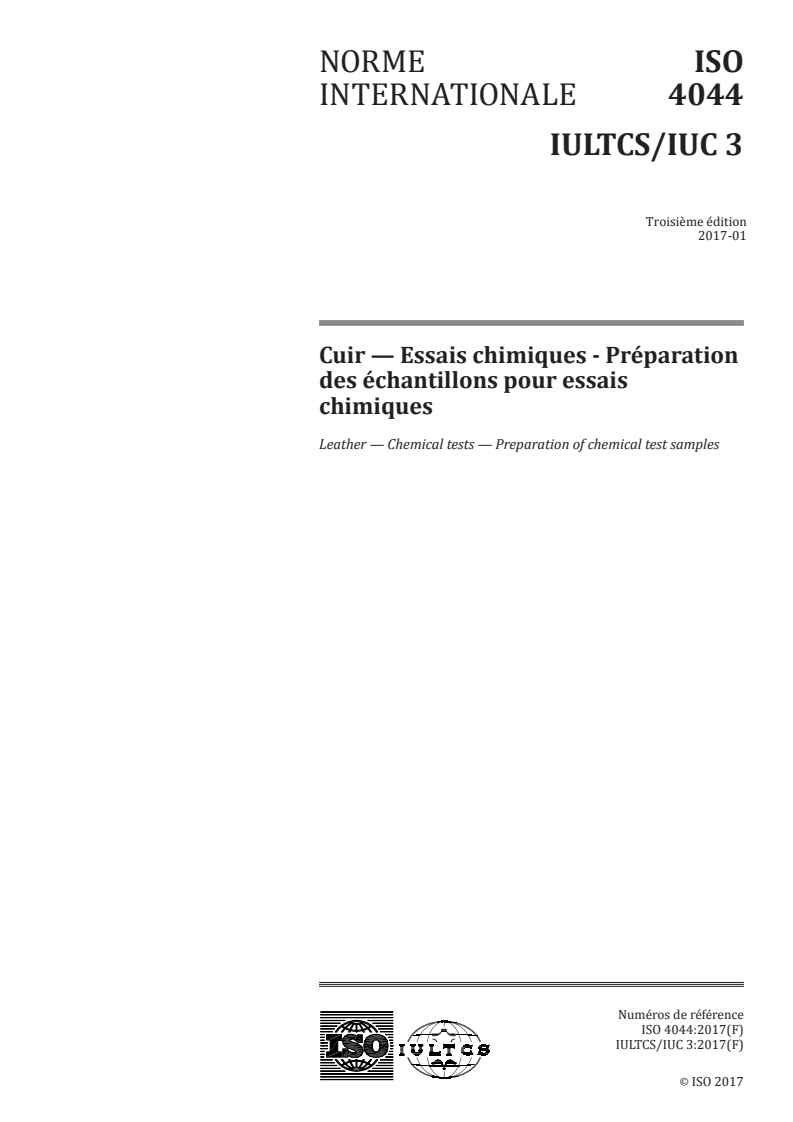
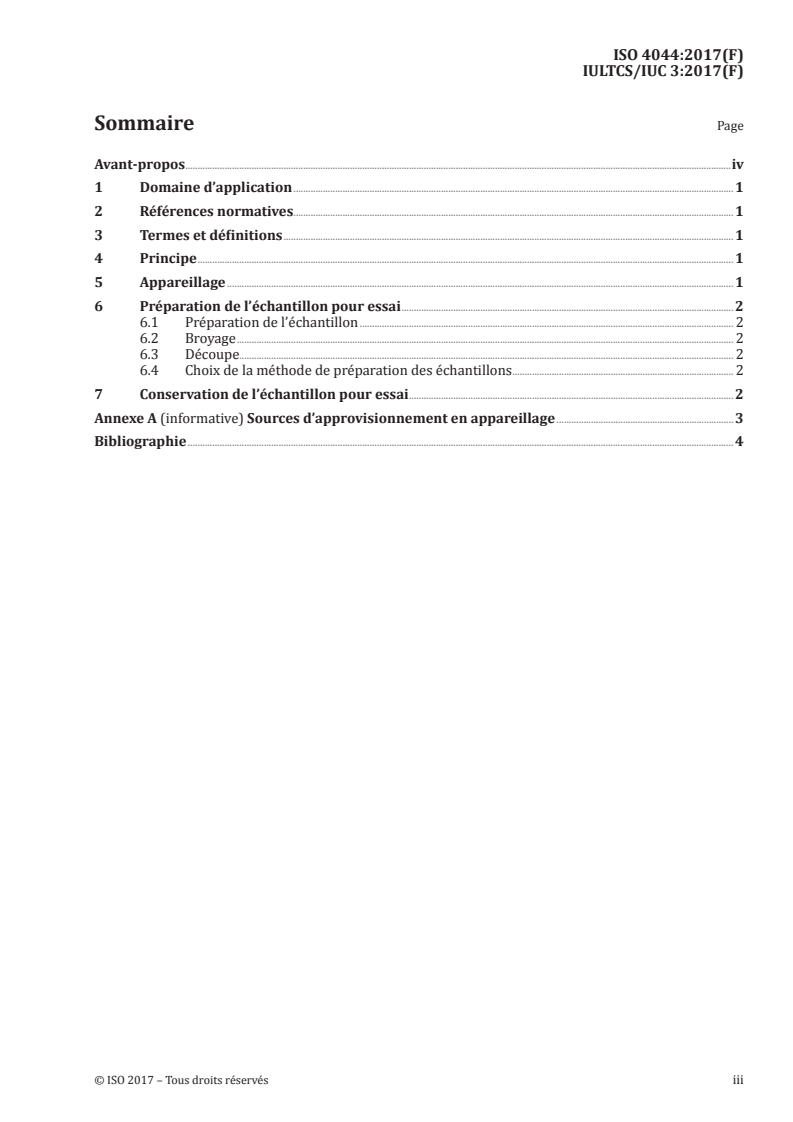
ISO 4044:2017 - Cuir — Essais chimiques - Préparation des échantillons pour essais chimiques/3/2017
Overview
ISO 4044:2017 - Leather - Chemical tests - Preparation of chemical test samples specifies standardized procedures for preparing leather samples for chemical analysis. It defines two accepted sample-preparation routes: grinding leather into a homogenized “ground leather” or cutting leather into small pieces. The standard ensures representative, reproducible test material for laboratory chemical tests and sets practical requirements for apparatus, sample handling and storage.
Key topics and requirements
- Two preparation methods
- Grinding: Use a grinding/cutting mill (blade speed recommended 300–1 000 rpm) with a perforated sieving plate of (4.0 ± 0.5) mm holes. Prefer slower rotation to avoid heating.
- Cutting: For small or consumer-item samples, cut into pieces with 2–3 mm edge length using a sharp blade.
- Sample size guideline
- Grinding is intended when a sufficiently large piece (typically ≥ 200 mm × 200 mm) is available; cutting is for smaller pieces.
- Pre-treatment
- Wet test pieces (> ~30 % moisture) should be pre-dried at temperatures not exceeding 40 °C. Consider analyte sensitivity when selecting drying temperature.
- If dried at elevated temperature, recondition samples per ISO 2419.
- Apparatus and contamination control
- Grinding mills should minimize heating, be easy to clean (no water for cleaning), and use chromium‑free steel parts and hardened tungsten‑carbide blades to avoid contamination (e.g., chromium).
- Mixing and storage
- After preparation, mix thoroughly and store in a clean, dry, airtight container away from localized heat.
- Reporting
- The chosen sample-preparation method must be recorded in the test report. If a test method specifies a preparation route, that route is mandatory.
Applications and users
ISO 4044 is used by:
- Chemical testing laboratories performing leather analysis (e.g., residual chemicals, heavy metals)
- Quality control teams in tanneries and leather product manufacturers
- Regulatory and compliance testing bodies verifying consumer product safety
- R&D and materials science labs studying leather chemistry
- Forensic and product-failure investigators requiring standardized sample prep
By following ISO 4044:2017, users obtain consistent, representative samples that reduce variability in downstream chemical tests and help ensure defensible laboratory results.
Related standards
- ISO 2419 - Leather - Physical and mechanical tests - Sample preparation and conditioning (referenced for conditioning)
- EN 15987 - Leather - Terminology - Key definitions for the leather trade
- IULTCS/IUC technical methods (historical basis and expert guidance)
Keywords: ISO 4044:2017, leather chemical tests, preparation of test samples, grinding mill, sample cutting, leather sample preparation, chemical analysis.
Relations
- Effective Date
- 09-Feb-2026
- Effective Date
- 09-Feb-2026
- Effective Date
- 09-Feb-2026
- Effective Date
- 09-Feb-2026
- Effective Date
- 09-Feb-2026
- Effective Date
- 09-Feb-2026
- Effective Date
- 09-Feb-2026
- Effective Date
- 09-Feb-2026
- Effective Date
- 09-Feb-2026
- Effective Date
- 09-Feb-2026
- Effective Date
- 09-Feb-2026
- Effective Date
- 09-Feb-2026
- Effective Date
- 09-Feb-2026
- Effective Date
- 09-Feb-2026
- Effective Date
- 09-Feb-2026
Buy Documents
ISO 4044:2017 - Leather -- Chemical tests -- Preparation of chemical test samples
ISO 4044:2017 - Leather — Chemical tests — Preparation of chemical test samples/3/2017
ISO 4044:2017 - Cuir -- Essais chimiques - Préparation des échantillons pour essais chimiques
ISO 4044:2017 - Cuir — Essais chimiques - Préparation des échantillons pour essais chimiques/3/2017
Get Certified
Connect with accredited certification bodies for this standard

Control Union Certifications
Global certification for agriculture and sustainability.

Hohenstein Institut
Textile testing and certification.

Bureau Veritas Bangladesh
Bureau Veritas certification services in Bangladesh.
Sponsored listings
Frequently Asked Questions
ISO 4044:2017 is a standard published by the International Organization for Standardization (ISO). Its full title is "Leather — Chemical tests — Preparation of chemical test samples". This standard covers: ISO 4044:2017 specifies how to prepare a test sample of leather for chemical analysis. The test sample can be either ground or cut into small pieces. Unless specified in this document, the method to be used depends on the size of leather sample available for testing.
ISO 4044:2017 specifies how to prepare a test sample of leather for chemical analysis. The test sample can be either ground or cut into small pieces. Unless specified in this document, the method to be used depends on the size of leather sample available for testing.
ISO 4044:2017 is classified under the following ICS (International Classification for Standards) categories: 59.140.30 - Leather and furs. The ICS classification helps identify the subject area and facilitates finding related standards.
ISO 4044:2017 has the following relationships with other standards: It is inter standard links to EN ISO 4098:2018, EN ISO 17226-1:2021, EN ISO 5398-4:2019, EN ISO 17072-2:2022, EN ISO 22517:2021, EN ISO 17072-2:2019, EN ISO 18219-2:2021, EN ISO 13365-1:2020, EN ISO 4045:2018, EN ISO 17226-2:2019, EN ISO 17072-1:2019, EN ISO 23702-1:2018, EN ISO 5398-1:2018, EN ISO 18218-1:2023, EN ISO 10195:2021. Understanding these relationships helps ensure you are using the most current and applicable version of the standard.
ISO 4044:2017 is available in PDF format for immediate download after purchase. The document can be added to your cart and obtained through the secure checkout process. Digital delivery ensures instant access to the complete standard document.
Standards Content (Sample)
INTERNATIONAL ISO
STANDARD 4044
IULTCS/IUC 3
Third edition
2017-01
Leather — Chemical tests —
Preparation of chemical test samples
Cuir — Essais chimiques - Préparation des échantillons pour essais
chimiques
Reference numbers
IULTCS/IUC 3:2017(E)
©
ISO 2017
IULTCS/IUC 3:2017(E)
© ISO 2017, Published in Switzerland
All rights reserved. Unless otherwise specified, no part of this publication may be reproduced or utilized otherwise in any form
or by any means, electronic or mechanical, including photocopying, or posting on the internet or an intranet, without prior
written permission. Permission can be requested from either ISO at the address below or ISO’s member body in the country of
the requester.
ISO copyright office
Ch. de Blandonnet 8 • CP 401
CH-1214 Vernier, Geneva, Switzerland
Tel. +41 22 749 01 11
Fax +41 22 749 09 47
copyright@iso.org
www.iso.org
ii © ISO 2017 – All rights reserved
IULTCS/IUC 3:2017(E)
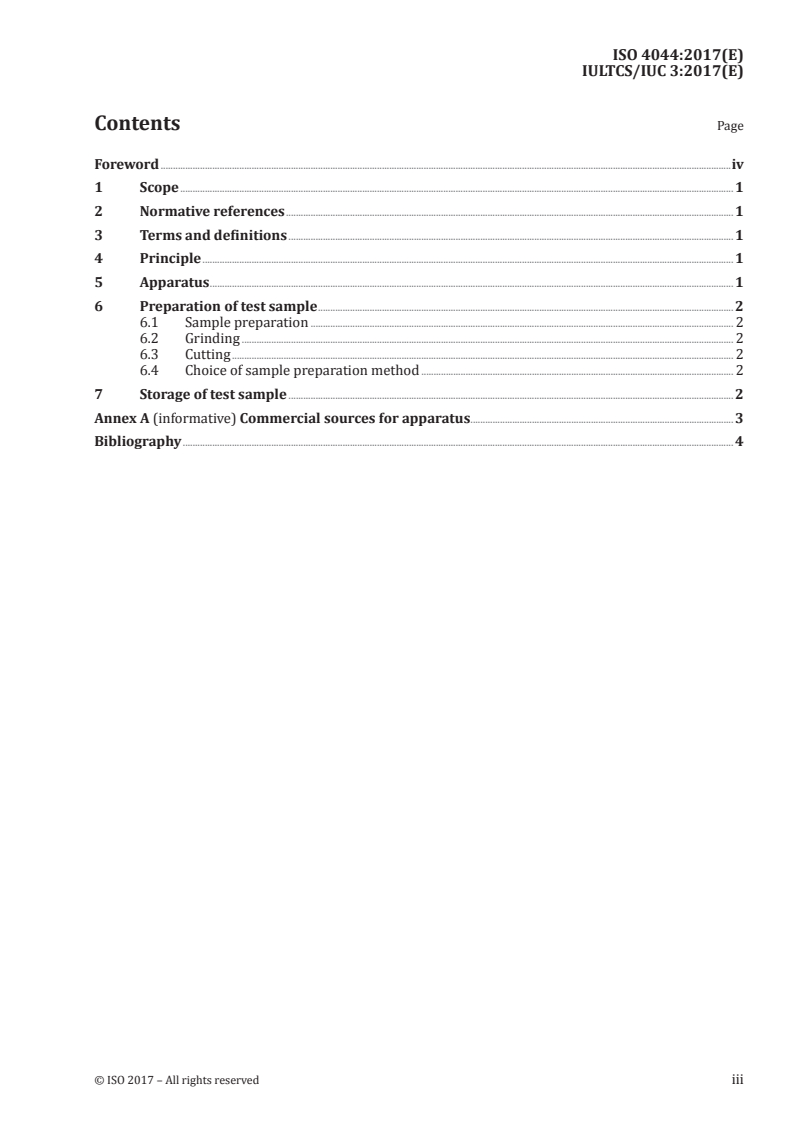
Contents Page
Foreword .iv
1 Scope . 1
2 Normative references . 1
3 Terms and definitions . 1
4 Principle . 1
5 Apparatus . 1
6 Preparation of test sample . 2
6.1 Sample preparation . 2
6.2 Grinding . 2
6.3 Cutting . 2
6.4 Choice of sample preparation method . 2
7 Storage of test sample . 2
Annex A (informative) Commercial sources for apparatus . 3
Bibliography . 4
IULTCS/IUC 3:2017(E)
Foreword
ISO (the International Organization for Standardization) is a worldwide federation of national standards
bodies (ISO member bodies). The work of preparing International Standards is normally carried out
through ISO technical committees. Each member body interested in a subject for which a technical
committee has been established has the right to be represented on that committee. International
organizations, governmental and non-governmental, in liaison with ISO, also take part in the work.
ISO collaborates closely with the International Electrotechnical Commission (IEC) on all matters of
electrotechnical standardization.
The procedures used to develop this document and those intended for its further maintenance are
described in the ISO/IEC Directives, Part 1. In particular the different approval criteria needed for the
different types of ISO documents should be noted. This document was drafted in accordance with the
editorial rules of the ISO/IEC Directives, Part 2 (see www.iso.org/directives).
Attention is drawn to the possibility that some of the elements of this document may be the subject of
patent rights. ISO shall not be held responsible for identifying any or all such patent rights. Details of
any patent rights identified during the development of the document will be in the Introduction and/or
on the ISO list of patent declarations received (see www.iso.org/patents).
Any trade name used in this document is information given for the convenience of users and does not
constitute an endorsement.
For an explanation on the meaning of ISO specific terms and expressions related to conformity assessment,
as well as information about ISO’s adherence to the World Trade Organization (WTO) principles in the
Technical Barriers to Trade (TBT) see the following URL: www.iso.org/iso/foreword.html
ISO 4044 was prepared by the Chemical Test Commission of the International Union of Leather
Technologists and Chemists Societies (IUC Commission, IULTCS) in collaboration with the European
Committee for Standardization (CEN) Technical Committee CEN/TC 289, Leather, the secretariat of
which is held by UNI, in accordance with the Agreement on technical cooperation between ISO and CEN
(Vienna Agreement).
It is based on IUC 3 originally published in J. Soc. Leather Trades Chemists, 49, pp. 8-10, 1965, and
declared an official method of the IULTCS in 1965.
IULTCS, originally formed in 1897, is a world-wide organization of professional leather societies to
further the advancement of leather science and technology. IULTCS has three Commissions, which
are responsible for establishing international methods for the sampling and testing of leather. ISO
recognizes IULTCS as an international standardizing body for the preparation of test methods for
leather.
This third edition cancels and replaces the second edition (ISO 4044:2008), which has been technically
revised.
Experience has shown it can be difficult to find a suitable grinding (or cutter) mills for preparing ground
leather samples without considerable heating of the milling chamber or blocking of the sieve. Those
mills commercially available require reasonably large leather samples to prepare a representative
ground sample. But in many cas
...
INTERNATIONAL ISO
STANDARD 4044
IULTCS/IUC 3
Third edition
2017-01
Leather — Chemical tests —
Preparation of chemical test samples
Cuir — Essais chimiques - Préparation des échantillons pour essais
chimiques
Reference numbers
IULTCS/IUC 3:2017(E)
©
ISO 2017
IULTCS/IUC 3:2017(E)
© ISO 2017, Published in Switzerland
All rights reserved. Unless otherwise specified, no part of this publication may be reproduced or utilized otherwise in any form
or by any means, electronic or mechanical, including photocopying, or posting on the internet or an intranet, without prior
written permission. Permission can be requested from either ISO at the address below or ISO’s member body in the country of
the requester.
ISO copyright office
Ch. de Blandonnet 8 • CP 401
CH-1214 Vernier, Geneva, Switzerland
Tel. +41 22 749 01 11
Fax +41 22 749 09 47
copyright@iso.org
www.iso.org
ii © ISO 2017 – All rights reserved
IULTCS/IUC 3:2017(E)
Contents Page
Foreword .iv
1 Scope . 1
2 Normative references . 1
3 Terms and definitions . 1
4 Principle . 1
5 Apparatus . 1
6 Preparation of test sample . 2
6.1 Sample preparation . 2
6.2 Grinding . 2
6.3 Cutting . 2
6.4 Choice of sample preparation method . 2
7 Storage of test sample . 2
Annex A (informative) Commercial sources for apparatus . 3
Bibliography . 4
IULTCS/IUC 3:2017(E)
Foreword
ISO (the International Organization for Standardization) is a worldwide federation of national standards
bodies (ISO member bodies). The work of preparing International Standards is normally carried out
through ISO technical committees. Each member body interested in a subject for which a technical
committee has been established has the right to be represented on that committee. International
organizations, governmental and non-governmental, in liaison with ISO, also take part in the work.
ISO collaborates closely with the International Electrotechnical Commission (IEC) on all matters of
electrotechnical standardization.
The procedures used to develop this document and those intended for its further maintenance are
described in the ISO/IEC Directives, Part 1. In particular the different approval criteria needed for the
different types of ISO documents should be noted. This document was drafted in accordance with the
editorial rules of the ISO/IEC Directives, Part 2 (see www.iso.org/directives).
Attention is drawn to the possibility that some of the elements of this document may be the subject of
patent rights. ISO shall not be held responsible for identifying any or all such patent rights. Details of
any patent rights identified during the development of the document will be in the Introduction and/or
on the ISO list of patent declarations received (see www.iso.org/patents).
Any trade name used in this document is information given for the convenience of users and does not
constitute an endorsement.
For an explanation on the meaning of ISO specific terms and expressions related to conformity assessment,
as well as information about ISO’s adherence to the World Trade Organization (WTO) principles in the
Technical Barriers to Trade (TBT) see the following URL: www.iso.org/iso/foreword.html
ISO 4044 was prepared by the Chemical Test Commission of the International Union of Leather
Technologists and Chemists Societies (IUC Commission, IULTCS) in collaboration with the European
Committee for Standardization (CEN) Technical Committee CEN/TC 289, Leather, the secretariat of
which is held by UNI, in accordance with the Agreement on technical cooperation between ISO and CEN
(Vienna Agreement).
It is based on IUC 3 originally published in J. Soc. Leather Trades Chemists, 49, pp. 8-10, 1965, and
declared an official method of the IULTCS in 1965.
IULTCS, originally formed in 1897, is a world-wide organization of professional leather societies to
further the advancement of leather science and technology. IULTCS has three Commissions, which
are responsible for establishing international methods for the sampling and testing of leather. ISO
recognizes IULTCS as an international standardizing body for the preparation of test methods for
leather.
This third edition cancels and replaces the second edition (ISO 4044:2008), which has been technically
revised.
Experience has shown it can be difficult to find a suitable grinding (or cutter) mills for preparing ground
leather samples without considerable heating of the milling chamber or blocking of the sieve. Those
mills commercially available require reasonably large leather samples to prepare a representative
ground sample. But in many cas
...
NORME ISO
INTERNATIONALE 4044
IULTCS/IUC 3
Troisième édition
2017-01
Cuir — Essais chimiques - Préparation
des échantillons pour essais
chimiques
Leather — Chemical tests — Preparation of chemical test samples
Numéros de référence
IULTCS/IUC 3:2017(F)
©
ISO 2017
IULTCS/IUC 3:2017(F)
DOCUMENT PROTÉGÉ PAR COPYRIGHT
© ISO 2017, Publié en Suisse
Droits de reproduction réservés. Sauf indication contraire, aucune partie de cette publication ne peut être reproduite ni utilisée
sous quelque forme que ce soit et par aucun procédé, électronique ou mécanique, y compris la photocopie, l’affichage sur
l’internet ou sur un Intranet, sans autorisation écrite préalable. Les demandes d’autorisation peuvent être adressées à l’ISO à
l’adresse ci-après ou au comité membre de l’ISO dans le pays du demandeur.
ISO copyright office
Ch. de Blandonnet 8 • CP 401
CH-1214 Vernier, Geneva, Switzerland
Tel. +41 22 749 01 11
Fax +41 22 749 09 47
copyright@iso.org
www.iso.org
ii © ISO 2017 – Tous droits réservés
IULTCS/IUC 3:2017(F)
Sommaire Page
Avant-propos .iv
1 Domaine d’application . 1
2 Références normatives . 1
3 Termes et définitions . 1
4 Principe . 1
5 Appareillage . 1
6 Préparation de l’échantillon pour essai . 2
6.1 Préparation de l’échantillon . 2
6.2 Broyage . 2
6.3 Découpe. 2
6.4 Choix de la méthode de préparation des échantillons . 2
7 Conservation de l’échantillon pour essai . 2
Annexe A (informative) Sources d’approvisionnement en appareillage . 3
Bibliographie . 4
IULTCS/IUC 3:2017(F)
Avant-propos
L’ISO (Organisation internationale de normalisation) est une fédération mondiale d’organismes
nationaux de normalisation (comités membres de l’ISO). L’élaboration des Normes internationales est
en général confiée aux comités techniques de l’ISO. Chaque comité membre intéressé par une étude
a le droit de faire partie du comité technique créé à cet effet. Les organisations internationales,
gouvernementales et non gouvernementales, en liaison avec l’ISO participent également aux travaux.
L’ISO collabore étroitement avec la Commission électrotechnique internationale (IEC) en ce qui
concerne la normalisation électrotechnique.
Les procédures utilisées pour élaborer le présent document et celles destinées à sa mise à jour sont
décrites dans les Directives ISO/IEC, Partie 1. Il convient, en particulier de prendre note des différents
critères d’approbation requis pour les différents types de documents ISO. Le présent document a été
rédigé conformément aux règles de rédaction données dans les Directives ISO/IEC, Partie 2 (voir www.
iso.org/directives).
L’attention est appelée sur le fait que certains des éléments du présent document peuvent faire l’objet de
droits de propriété intellectuelle ou de droits analogues. L’ISO ne saurait être tenue pour responsable
de ne pas avoir identifié de tels droits de propriété et averti de leur existence. Les détails concernant
les références aux droits de propriété intellectuelle ou autres droits analogues identifiés lors de
l’élaboration du document sont indiqués dans l’Introduction et/ou dans la liste des déclarations de
brevets reçues par l’ISO (voir www.iso.org/brevets).
Les appellations commerciales éventuellement mentionnées dans le présent document sont données
pour information, par souci de commodité, à l’intention des utilisateurs et ne sauraient constituer un
engagement.
Pour une explication de la signification des termes et expressions spécifiques de l’ISO liés à l’évaluation
de la conformité, ou pour toute information au sujet de l’adhésion de l’ISO aux principes de l’Organisation
mondiale du commerce (OMC) concernant les obstacles techniques au commerce (OTC), voir le lien
suivant: www.iso.org/iso/fr/avant-propos.html
L’ISO 4044 a été élaborée par la Commission des essais chimiques de l’Union internationale des sociétés
de techniciens et chimistes du cuir (commission IUC, IULTCS) en collaboration avec le comité technique
du Comité européen de normalisation (CEN) CEN/TC 289, Cuir, dont le secrétariat est tenu par l’UNI,
conformément à l’Accord de coopération technique entre l’ISO et le CEN (Accord de Vienne).
Elle est basée sur l’IUC 3, initialement publiée dans le J. Soc. Leather Trades Chemists, 49, pp. 8-10, 1965,
et déclarée méthode officielle de l’IULTCS en 1965.
L’IULTCS est une organisation mondiale de sociétés professionnelles des industries du cuir fondée en
1897 ayant pour mission de favoriser l’avancement des sciences et technologies du cuir. L’IULTCS a trois
commissions, qui sont responsables de l’établissement de méthodes internationales d’échantillonnage
et d’essai des cuirs. L’ISO reconnaît l’IULTCS en tant qu’organisme international à activités normatives
pour l’élaboration de méthodes d’essai relatives au cuir.
Cette troisième édition annule et remplace la seconde édition (ISO 4044:2008), qui a fait l’objet d’une
révision technique.
L’expérience montre qu’il peut être difficile de trouver un broyeur (ou moulin à couteaux) adéquat pour
préparer des échantillons de cuir broyé sans surchauffer le compartiment de broyage ou colmater le
tamis. Avec les broyeurs en vente dans le commerce, il faut des échantillons de cuir de taille suffisante
pour préparer un échantillon broyé représentatif. Cependant, dans un certain nombre de cas où les
essais portent sur des biens de consommation, on ne dispose que de pièces de cuir de petite taille.
Pour cette raison, le paragraphe 6.3 a été ajouté; il concerne la préparation des échantillons pour essai,
effectuée en découpant le cuir en petits morceaux à l’aide d’une lame effilée
...
NORME ISO
INTERNATIONALE 4044
IULTCS/IUC 3
Troisième édition
2017-01
Cuir — Essais chimiques - Préparation
des échantillons pour essais
chimiques
Leather — Chemical tests — Preparation of chemical test samples
Numéros de référence
IULTCS/IUC 3:2017(F)
©
ISO 2017
IULTCS/IUC 3:2017(F)
DOCUMENT PROTÉGÉ PAR COPYRIGHT
© ISO 2017, Publié en Suisse
Droits de reproduction réservés. Sauf indication contraire, aucune partie de cette publication ne peut être reproduite ni utilisée
sous quelque forme que ce soit et par aucun procédé, électronique ou mécanique, y compris la photocopie, l’affichage sur
l’internet ou sur un Intranet, sans autorisation écrite préalable. Les demandes d’autorisation peuvent être adressées à l’ISO à
l’adresse ci-après ou au comité membre de l’ISO dans le pays du demandeur.
ISO copyright office
Ch. de Blandonnet 8 • CP 401
CH-1214 Vernier, Geneva, Switzerland
Tel. +41 22 749 01 11
Fax +41 22 749 09 47
copyright@iso.org
www.iso.org
ii © ISO 2017 – Tous droits réservés
IULTCS/IUC 3:2017(F)
Sommaire Page
Avant-propos .iv
1 Domaine d’application . 1
2 Références normatives . 1
3 Termes et définitions . 1
4 Principe . 1
5 Appareillage . 1
6 Préparation de l’échantillon pour essai . 2
6.1 Préparation de l’échantillon . 2
6.2 Broyage . 2
6.3 Découpe. 2
6.4 Choix de la méthode de préparation des échantillons . 2
7 Conservation de l’échantillon pour essai . 2
Annexe A (informative) Sources d’approvisionnement en appareillage . 3
Bibliographie . 4
IULTCS/IUC 3:2017(F)
Avant-propos
L’ISO (Organisation internationale de normalisation) est une fédération mondiale d’organismes
nationaux de normalisation (comités membres de l’ISO). L’élaboration des Normes internationales est
en général confiée aux comités techniques de l’ISO. Chaque comité membre intéressé par une étude
a le droit de faire partie du comité technique créé à cet effet. Les organisations internationales,
gouvernementales et non gouvernementales, en liaison avec l’ISO participent également aux travaux.
L’ISO collabore étroitement avec la Commission électrotechnique internationale (IEC) en ce qui
concerne la normalisation électrotechnique.
Les procédures utilisées pour élaborer le présent document et celles destinées à sa mise à jour sont
décrites dans les Directives ISO/IEC, Partie 1. Il convient, en particulier de prendre note des différents
critères d’approbation requis pour les différents types de documents ISO. Le présent document a été
rédigé conformément aux règles de rédaction données dans les Directives ISO/IEC, Partie 2 (voir www.
iso.org/directives).
L’attention est appelée sur le fait que certains des éléments du présent document peuvent faire l’objet de
droits de propriété intellectuelle ou de droits analogues. L’ISO ne saurait être tenue pour responsable
de ne pas avoir identifié de tels droits de propriété et averti de leur existence. Les détails concernant
les références aux droits de propriété intellectuelle ou autres droits analogues identifiés lors de
l’élaboration du document sont indiqués dans l’Introduction et/ou dans la liste des déclarations de
brevets reçues par l’ISO (voir www.iso.org/brevets).
Les appellations commerciales éventuellement mentionnées dans le présent document sont données
pour information, par souci de commodité, à l’intention des utilisateurs et ne sauraient constituer un
engagement.
Pour une explication de la signification des termes et expressions spécifiques de l’ISO liés à l’évaluation
de la conformité, ou pour toute information au sujet de l’adhésion de l’ISO aux principes de l’Organisation
mondiale du commerce (OMC) concernant les obstacles techniques au commerce (OTC), voir le lien
suivant: www.iso.org/iso/fr/avant-propos.html
L’ISO 4044 a été élaborée par la Commission des essais chimiques de l’Union internationale des sociétés
de techniciens et chimistes du cuir (commission IUC, IULTCS) en collaboration avec le comité technique
du Comité européen de normalisation (CEN) CEN/TC 289, Cuir, dont le secrétariat est tenu par l’UNI,
conformément à l’Accord de coopération technique entre l’ISO et le CEN (Accord de Vienne).
Elle est basée sur l’IUC 3, initialement publiée dans le J. Soc. Leather Trades Chemists, 49, pp. 8-10, 1965,
et déclarée méthode officielle de l’IULTCS en 1965.
L’IULTCS est une organisation mondiale de sociétés professionnelles des industries du cuir fondée en
1897 ayant pour mission de favoriser l’avancement des sciences et technologies du cuir. L’IULTCS a trois
commissions, qui sont responsables de l’établissement de méthodes internationales d’échantillonnage
et d’essai des cuirs. L’ISO reconnaît l’IULTCS en tant qu’organisme international à activités normatives
pour l’élaboration de méthodes d’essai relatives au cuir.
Cette troisième édition annule et remplace la seconde édition (ISO 4044:2008), qui a fait l’objet d’une
révision technique.
L’expérience montre qu’il peut être difficile de trouver un broyeur (ou moulin à couteaux) adéquat pour
préparer des échantillons de cuir broyé sans surchauffer le compartiment de broyage ou colmater le
tamis. Avec les broyeurs en vente dans le commerce, il faut des échantillons de cuir de taille suffisante
pour préparer un échantillon broyé représentatif. Cependant, dans un certain nombre de cas où les
essais portent sur des biens de consommation, on ne dispose que de pièces de cuir de petite taille.
Pour cette raison, le paragraphe 6.3 a été ajouté; il concerne la préparation des échantillons pour essai,
effectuée en découpant le cuir en petits morceaux à l’aide d’une lame effilée
...