


ISO/IEC 8327-1:1996
(Main)Information technology — Open Systems Interconnection — Connection-oriented Session protocol: Protocol specification
Information technology — Open Systems Interconnection — Connection-oriented Session protocol: Protocol specification
Technologies de l'information — Interconnexion de systèmes ouverts (OSI) — Protocole de session en mode connexion: Spécification du protocole
General Information
- Status
- Published
- Publication Date
- 09-Oct-1996
- Technical Committee
- ISO/IEC JTC 1 - Information technology
- Drafting Committee
- ISO/IEC JTC 1 - Information technology
- Current Stage
- 9093 - International Standard confirmed
- Start Date
- 13-Aug-2001
- Completion Date
- 14-Feb-2026
Relations
- Effective Date
- 10-Feb-2026
- Effective Date
- 06-Jun-2022
- Effective Date
- 06-Jun-2022
- Effective Date
- 18-Dec-2008
- Effective Date
- 15-Apr-2008
- Effective Date
- 15-Apr-2008
- Effective Date
- 15-Apr-2008
Overview
ISO/IEC 8327-1:1996 is the international standard that specifies the connection-oriented Session Protocol for the OSI (Open Systems Interconnection) model. It provides the protocol-level rules and procedures (SPDU - Session Protocol Data Units) for establishing, managing, synchronizing, and terminating session connections over an underlying transport service. The standard organizes functional units, message types, timers, negotiation procedures and the mapping between session and transport connections.
Key topics and technical requirements
- Session/Transport interaction: assignment and reuse of session connections to transport connections and the expected services assumed from the transport layer (normal and expedited data, disconnection, flow control).
- SPDU types and semantics: detailed specification of many SPDU types including CONNECT, ACCEPT, REFUSE, FINISH, DISCONNECT, ABORT, DATA TRANSFER, EXPEDITED, TYPED DATA, CAPABILITY DATA, and others for capability negotiation and error reporting.
- Token management: procedures and SPDUs for GIVE TOKENS, PLEASE TOKENS, ACK/CONFIRM to control conversational turn-taking.
- Synchronization and recovery: mechanisms for MINOR/MAJOR SYNC POINT, RESYNCHRONIZE, RESYNCHRONIZE ACK to support consistent state, including symmetric and asymmetric resynchronization handling and contention resolution.
- Activity control and exceptions: SPDUs for ACTIVITY START/RESUME/INTERRUPT, EXCEPTION REPORT/EXCEPTION DATA, PREPARE to manage higher-level activities and error conditions.
- Timers, flow control and reliability: definitions for timer variables, local variables, and flow-control behavior to ensure dependable session operation.
- Negotiation and capabilities: procedures for exchanging and acknowledging capability information to agree session options and protocol version numbers.
- Normative structure: includes definitions, abbreviations, and references necessary for implementers to create conformant session protocol implementations.
Practical applications
- Implementing an OSI-compliant session layer in network stacks or middleware that require structured session management.
- Building interoperable distributed systems where ordered, connection-oriented sessions and synchronization are essential (e.g., legacy telecommunications, transaction processing).
- Creating protocol conformance tests, reference implementations, or vendor products that must follow OSI session semantics.
- Academic and training resources describing formal session-layer behavior and SPDU interactions.
Who should use this standard
- Protocol architects and network engineers
- Firmware and middleware developers implementing OSI session services
- Test laboratories and conformance assessors
- Standards bodies and technical writers documenting protocol stacks
Related standards
- Other OSI layer specifications (transport and presentation layer standards) and ISO/IEC protocol family documents that define complementary behaviors and normative references for interoperable implementations.
Keywords: ISO/IEC 8327-1:1996, OSI Session Layer, connection-oriented session protocol, SPDU, session protocol specification, token management, synchronization, flow control.
Buy Documents
ISO/IEC 8327-1:1996 - Information technology -- Open Systems Interconnection -- Connection-oriented Session protocol: Protocol specification
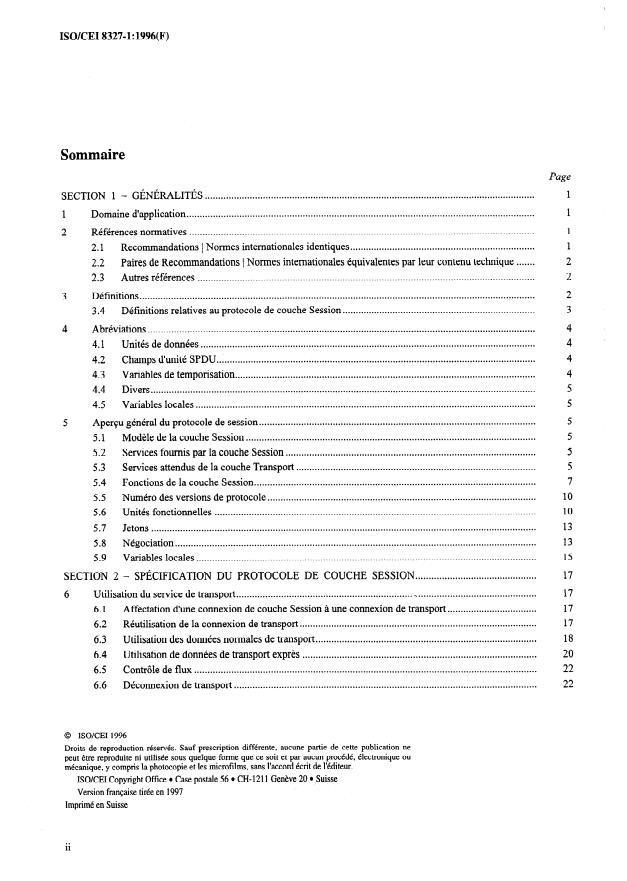
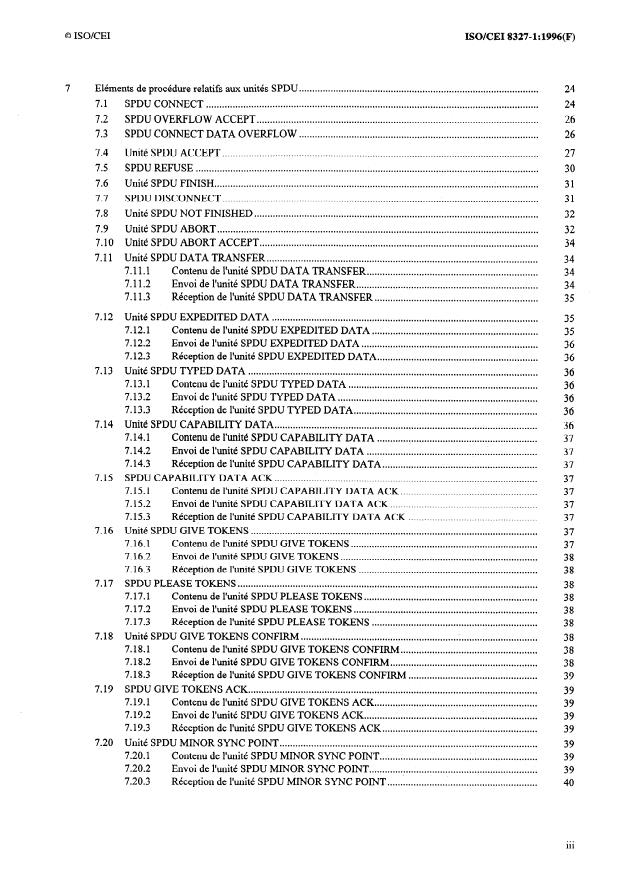
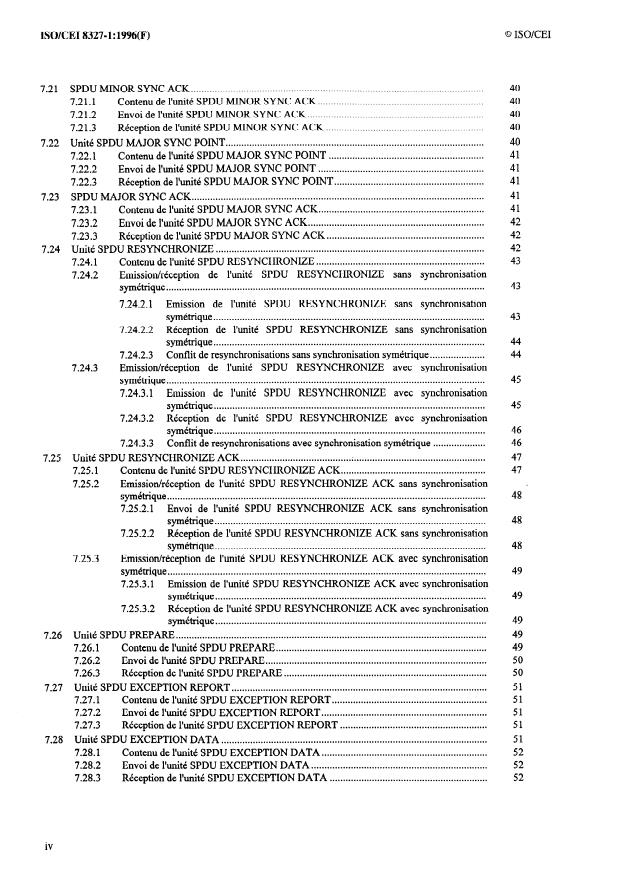
ISO/IEC 8327-1:1996 - Technologies de l'information -- Interconnexion de systemes ouverts (OSI) -- Protocole de session en mode connexion: Spécification du protocole
ISO/IEC 8327-1:1996 - Technologies de l'information -- Interconnexion de systemes ouverts (OSI) -- Protocole de session en mode connexion: Spécification du protocole
Get Certified
Connect with accredited certification bodies for this standard

BSI Group
BSI (British Standards Institution) is the business standards company that helps organizations make excellence a habit.

NYCE
Mexican standards and certification body.
Sponsored listings
Frequently Asked Questions
ISO/IEC 8327-1:1996 is a standard published by the International Organization for Standardization (ISO). Its full title is "Information technology — Open Systems Interconnection — Connection-oriented Session protocol: Protocol specification". This standard covers: Information technology — Open Systems Interconnection — Connection-oriented Session protocol: Protocol specification
Information technology — Open Systems Interconnection — Connection-oriented Session protocol: Protocol specification
ISO/IEC 8327-1:1996 is classified under the following ICS (International Classification for Standards) categories: 35.100.50 - Session layer. The ICS classification helps identify the subject area and facilitates finding related standards.
ISO/IEC 8327-1:1996 has the following relationships with other standards: It is inter standard links to EN 61400-25-4:2017, ISO/IEC 8327-1:1996/Amd 2:1998, ISO/IEC 8327-1:1996/Amd 1:1998, ISO 8327:1987/Amd 3:1992, ISO 8327:1987; is excused to ISO/IEC 8327-1:1996/Amd 1:1998, ISO/IEC 8327-1:1996/Amd 2:1998. Understanding these relationships helps ensure you are using the most current and applicable version of the standard.
ISO/IEC 8327-1:1996 is available in PDF format for immediate download after purchase. The document can be added to your cart and obtained through the secure checkout process. Digital delivery ensures instant access to the complete standard document.
Standards Content (Sample)
INTERNATIONAL ISO/IEC
STANDARD 8327-l
Second edition
1996-09-I 5
Information technology - Open Systems
Interconnection - Connection-oriented
Session protocol: Protocol specification
Technologies de I’informa tion - Interconnexion de systdmes ouverts
(OS/) - Protocole de session en mode orient6 connexion: Spkification du
pro tocole
Reference number
ISO/I EC 8327-1: 1996(E)
ISO/IEC 8327=1:1996(E)
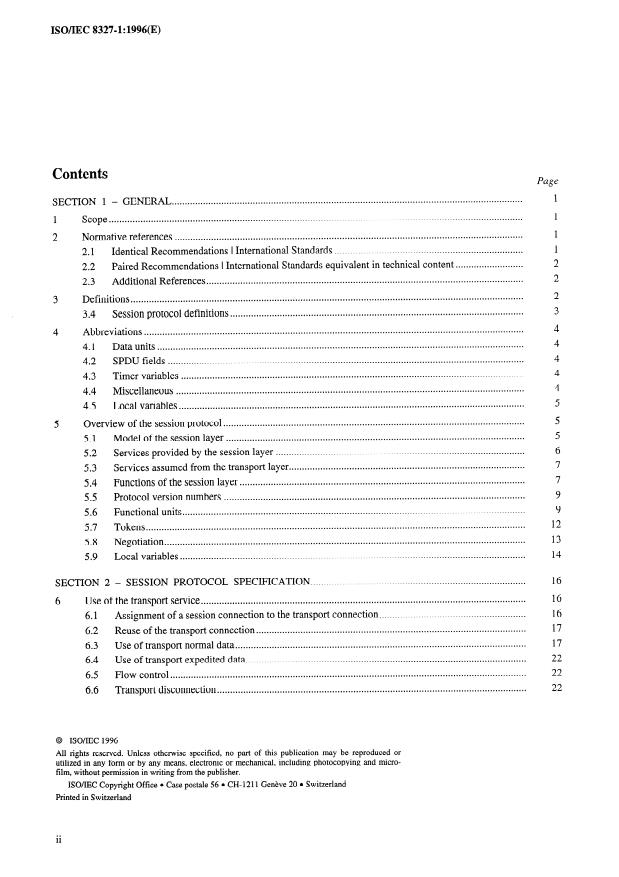
Contents
Page
. . . . . . . . . . . . . . . . . . . . . . . . . . . . . . . . . . . . . . . . . . . . . . . . . . . . . . . . . . . . . . . . . . . . . . . . . . . . . . . . . . . . . . . . . . . . . . . . . . . . . . . . . . . . . . . . . . . . . . . . .
SECTION 1 - GENERAL
Scope .
Normative references .
........................................................................
Identical Recommendations I International Standards
2.1
..........................
2.2 Paired Recommendations I International Standards equivalent in technical content
.........................................................................................................................
2.3 Additional References
Definitions .
................................................................................................................
3.4 Session protocol definitions
Abbreviations .
Data units .
4.1
........................................................................................................................................
4.2 SPDU fields
...................................................................................................................................
4.3 Timer variables
4.4 Miscellaneous .
4.5 Local variables .
...................................................................................................................
Overview of the session protocol
Model of the session layer .
5.1
...............................................................................................
5.2 Services provided by the session layer
..........................................................................................
5.3 Services assumed from the transport layer
.............................................................................................................
5.4 Functions of the session layer
Protocol version numbers .
Functional units .
5:6
5.7 Tokens .
58 Negotiation .
5:9 Local variables .
. . . . . . . . . . . . . . . . . . . . . . . . . . . . . . . . . . . . . . . . . . . . . . . . . . . . . . . . . . . . . . . . . . . . . . . . . . . . . . . . . .
2- SESSION PROTOCOL SPECIFICATION
SECTION
Use of the transport service . . . . . . . . . . . . . . . . . . . . . . . . . . . . . . . . . . . . . . . . . . . . . . . . . . . . . . . . . . . .*.
. . . . . . . . . . . . . . . . . . . . . . . . . . . . . . . . . . . . . . . . . . . . . . . . . . . . . . . .
61 . Assignment of a session connection to the transport connection
62 . Reuse of the transport connection . . . . . . . . . . . . . . . . . . . . . . . . . . . . . . . . . . . . . . . . . . . . . . . . . . . . . . . . . . . . . . . . . . . . . . . . . . . . . . . . . . . . . . . . . . . . . . . . . . . . . . .
63 . Use of transport normal data . . . . . . . . . . . . . . . . . . . . . . . . . . . . . . . . . . . . . . . . . . . . . . . . . . . . . . . . . . . . . . . . . . . . . . . . . . . . . . . . . . . . . . . . . . . . . . . . . . . . . . . . . . . . . . .
. . . . . . . . . . . . . . . . . . . . . . . . . . . . . . . . . . . . . . . . . . . . . . . . . . . . . . . . . . . .~.
64 . Use of transport expedited data
65 . Flow control . . . . . . . . . . . . . . . . . . . . . . . . . . . . . . . . . . . . . . . . . . . . . . . . . . . . . . . . . . . . . . . . . . . . . . . . . . . . . . . . . . . . . . . . . . . . . . . . . . . . . . . . . . . . . . . . . . . . . . . . .
66 . Transport disconnection . . . . . . . . . . . . . . . . . . . . . . . . . . . . . . . . . . . . . . . . . . . . . . . . . . . . . . . . . . . . . . . . . . . . . . . . . . . . . . . . . . . . . . . . . . . . . . . . . . . . . . . . . . . . . . . . . . . . . .
0 ISO/IEC 1996
All rights reserved. Unless otherwise specified, no part of this publication may be reproduced or
utilized in any form or by any means, electronic or mechanical, including photocopying and micro-
film, without permission in writing from the publisher.
ISODEC Copyright Office l Case postale 56 l U-I-P21 I Gerkve 20 l Switzerland
Printed in Switzerland
ii
@ ISO/IEC ISO/IEC 8327-1: 1996(E)
. . . . . . . . . . . . . . . . . . . . . . . . . . .*. 23
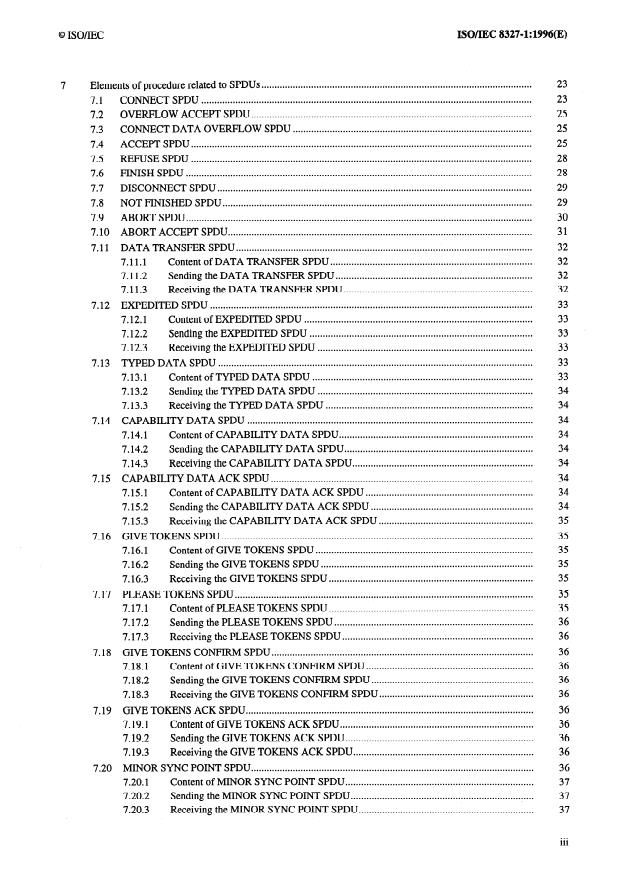
7 Elements of procedure related to SPDUs
.............................................................................................................................. 23
7.1 CONNECT SPDU
OVERFLOW ACCEPT SPDU . 25
7.2
........................................................................................... 25
7.3 CONNECT DATA OVERFLOW SPDU
7.4 ACCEPT SPDU .
7.5 REFUSE SPDU . 28
7.6 FINISH SPDU . 28
7.7 DISCONNECT SPDU . 29
NOT mNISHED SPDU . 29
7.8
ABORT SPDU . 30
7.9
.................................................................................................................... 31
7.10 ABORT ACCEPT SPDU
................................................................................................................. 32
7.11 DATA TRANSFER SPDU
7.11.1 Content of DATA TRANSFER SPDU .
7.11.2 Sending the DATA TRANSFER SPDU . 32
7.11.3 Receiving the DATA TRANSFER SPDU .
........................................................................................................................... 33
7.12 EXPEDITED SPDU
7.12.1 Content of EXPEDITED SPDU . 33
..................................................................................... 33
7.12.2 Sending the EXPEDITED SPDU
Receiving the EXPEDITED SPDU . 33
7.12.3
7.13 TYPED DATA SPDU . 33
.................................................................................... 33
7.13.1 Content of TYPED DATA SPDU
7.13.2 Sending the TYPED DATA SPDU . 34
Receiving the TYPED DATA SPDU . 34
7.13.3
............................................................................................................. 34
7.14 CAPABILITY DATA SPDU
7.14.1 Content of CAPABILITY DATA SPDU . 34
7.14.2 Sending the CAPABILITY DATA SPDU .
7.14.3 Receiving the CAPABILITY DATA SPDU . 34
CAPABILITY DATA ACK SPDU . 34
7.15
................................................................ 34
7.15.1 Content of CAPABILITY DATA ACK SPDU
7.15.2 Sending the CAPABILITY DATA ACK SPDU . 34
........................................................... 35
7.15.3 Receiving the CAPABILITY DATA ACK SPDU
7.16 GIVE TOKENS SPDU .
7.16.1 Content of GIVE TOKENS SPDU . 35
................................................................................. 35
7.16.2 Sending the GIVE TOKENS SPDU
Receiving the GIVE TOKENS SPDU . 35
7.16.3
7.17 PLEASE TOKENS SPDU . 35
.............................................................................. 35
7.17.1 Content of PLEASE TOKENS SPDU
Sending the PLEASE TOKENS SPDU . 36
7.17.2
7.17.3 Receiving the PLEASE TOKENS SPDU .
.................................................................................................... 36
7.18 GIVE TOKENS CONFIRM SPDU
Content of GIVE TOKENS CONFIRM SPDU . 36
7.18.1
7.18.2 Sending the GIVE TOKENS CONFIRM SPDU .
Receiving the GIVE TOKENS CONFIRM SPDU . 36
7.18.3
.............................................................................................................. 36
7.19 GIVE TOKENS ACK SPDU
7.19.1 Content of GIVE TOKENS ACK SPDU .
7.19.2 Sending the GIVE TOKENS ACK SPDU . 36
7.19.3 Receiving the GIVE TOKENS ACK SPDU . 36
7.20 MINOR SYNC POINT SPDU . 36
7.20.1 Content of MINOR SYNC POINT SPDU . 37
7.20.2 Sending the MINOR SYNC POINT SPDU . 37
7.20.3 Receiving the MINOR SYNC POINT SPDU . 37
. . .
@ ISO/IEC
ISO/IEC 8327=1:1996(E)
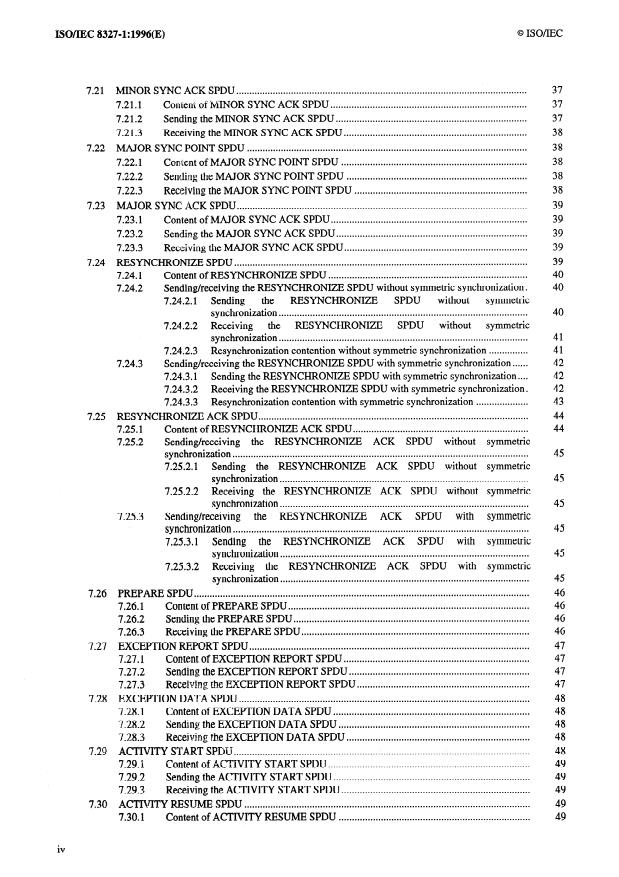
7.21 MINOR SYNC ACK SPDU .
7.21.1 Content of MINOR SYNC ACK SPDU . 37
......................................................................... 37
7.21.2 Sending the MINOR SYNC ACK SPDU
7.21.3 Receiving the MINOR SYNC ACK SPDU .
7.22 MAJOR SYNC POINT SPDU .
Content of MAJOR SYNC POINT SPDU . 38
7.22.1
7.22.2 Sending the MAJOR SYNC POINT SPDU .
.................................................................. 38
7.22.3 Receiving the MAJOR SYNC POINT SPDU
7.23 MAJOR SYNC ACK SPDU . 39
........................................................................... 39
7.23.1 Content of MAJOR SYNC ACK SPDU
7.23.2 Sendin.g the MAFOR SYNC ACK SPDU . 39
Receiving the MAJOR SYNC ACK SPDU . 39
7.23.3
................................................................................................................ 39
7.24 RESYNCHRONIZE SPDU
............................................................................ 40
7.24.1 Content of RESYNCHRONIZE SPDU
7.24.2 Sending/receiving the RESYNCHRONIZE SPDU without symmetric synchronization.
symmetric
7.24.2.1 Sending the RESYNCHRONIZE SPDU without
synchronization .
7.24.2.2 Receiving the RESYNCHRONIZE SPDU without symmetric
synchronization .
7.24.2.3 Resynchronization contention without symmetric synchronization . 41
....... 42
7.24.3 Sending/receiving the RESYNCHRONIZE SPDU with symmetric synchronization
.... 42
7.24.3.1 Sending the RESYNCHRONIZE SPDU with symmetric synchronization
7.24.3.2 Receiving the RESYNCHRONIZE SPDU with symmetric synchronization. 42
.................... 43
7.24.3.3 Resynchronization contention with symmetric synchronization
....................................................................................................... 44
7.25 RESYNCHRONIZE ACK SPDU
................................................................... 44
7.25.1 Content of RESYNCHRONIZE ACK SPDU
7.25.2 Sending/receiving the RESYNCHRONIZE ACK SPDU without symmetric
synchronization . 45
7.25.2.1 Sending the RESYNCHRONIZE ACK SPDU without symmetric
synchronization . 45
7.25.2.2 Receiving the RESYNCHRONIZE ACK SPDU without symmetric
synchronization . 45
Sending/receiving the RESYNCHRONIZE ACK SPDU with symmetric
7.25.3
synchronization . 45
the RESYNCHRONIZE ACK SPDU with symmetric
7.25.3.1 Sending
synchronization . 45
the RESYNCHRONIZE ACK SPDU with symmetric
7.25.3.2 Receiving
synchronization . 45
7.26 PREPARE SPDU . 46
Content of PREPARE SPDU . 46
7.26.1
.......................................................................................... 46
7.26.2 Sending the PREPARE SPDU
7.26.3 Receiving the PREPARE SPDU .
7.27 EXCEPTION REPORT SPDU .
7.27.1 Content of EXCEPTION REPORT SPDU .
Sending the EXCEPTION REPORT SPDU . 47
7.27.2
.................................................................. 47
7.27.3 Receiving the EXCEPTION REPORT SPDU
............................................................................................................... 48
7.28 EXCEPTION DATA SPDU
........................................................................... 48
3.28.1 Content of EXCEPTION DATA SPDU
7 628.2 Sen.ding the EXCEPTION DATA SPDU . 48
7.28.3 Receiving ?he EXCEPTION DATA SPDU . 48
7.29 ACTIVITY START SPDU . 48
............................................................................. 49
7.29. I Content of ACTIVITY START SPDU
........................................................................... 49
7.29.2 Sending the ACTIVITY START SPDU
7.29.3 Receiving the ACTIVITY START SPDU . 49
7.30 ACTIVITY RESUME SPDU . 49
Content of ACTIVITY RESUME SPDU . 49
7.30.1
iv
@ ISO/IEC ISO/IEC 8327-l: 1996(E)
7.30.2 Sending the ACTIVITY RESUME SPDU . 49
7.30.3 Receiving the ACTIVITY RESUME SPDU . 50
7.31 ACTIVITY INTERRUPT SPDU . 50
7.31.1 Content of ACTIVITY INTERRUPT SPDU . 50
7.31.2 Sending the ACTIVITY INTERRUPT SPDU . 50
7.31.3 Receiving the ACTIVITY INTERRUPT SPDU
............................................................... 50
7.32 ACTIVITY INTERRUPT ACK SPDU . 50
7.32.1 Content of ACTIVITY INTERRUPT ACK SPDU
.......................................................... 50
7.32.2 Sending the ACTIVITY INTERRUPT ACK SPDU . 51
7.32.3 Receiving the ACTIVITY INTERRUPT ACK SPDU . 51
ACTIVITY DISCARD SPDU
7.33 . 51
7.33.1 Content of ACTIVITY DISCARD SPDU . 51
7.33.2 Sending the ACTIVITY DISCARD SPDU . 51
7.33.3 Receiving the ACTIVITY DISCARD SPDU . 51
7.34 ACTIVITY DISCARD ACK SPDU
................................................................................................... 51
7.34.1 Content of ACTIVITY DISCARD ACK SPDU
............................................................... 52
7.34.2 Sending the ACTIVITY DISCARD ACK SPDU .
7.34.3 Receiving the ACTIVITY DISCARD ACK SPDU . 52
7.35 ACTIVITY END SPDU .
7.35.1 Content of ACTIVITY END SPDU . 52
7.35.2 Sending the ACTIVITY END SPDU . 52
7.35.3 Receiving the ACTIVITY END SPDU . 52
7.36 ACTIVITY END ACK SPDU .
7.36.1 Content of ACTIVITY END ACK SPDU . 53
7.36.2 Sending the ACTIVITY END ACK SPDU . 53
7.36.3 Receiving the ACTIVITY END ACK SPDU
................................................................... 53
7.37 Additional Elements of Procedure for Segmented SSDUs .
7.37.1 Content of the SPDU . 54
7.37.2 Sending the SPDU . 54
7.37.3 Receiving the SPDU .
8 Structure and encoding of SPDUs . 55
8.1 TSDU structure . 55
8.2 SPDU structure .
8.2.1 SPDUs .
8.2.2 PGI units . 57
8.2.3 PI units . 57
8.2.4 Identifier fields . 57
8.2.5 Length indicator field . 57
8.2.6 Parameter fields . 57
8.2.7
Parameter values . 58
8.2.8 .
User information fields 58
8.3 SPDU identifiers and associated parameter fields . 58
8.3.1 CONNECT (CN) SPDU . 58
8.3.2
OVERFLOW ACCEPT (OA) SPDU . 62
8.3.3 .
CONNECT DATA OVERFLOW (CDO) SPDU 62
8.3.4 ACCEPT (AC) SPDU .
8.3.5 REFUSE (RF) SPDU . 66
8.3.6 FINISH (FN) SPDU . 67
8.3.7 DISCONNECT (DN) SPDU . 68
8.3.8 NOT FINISHED (NF) SPDU . 68
8.3.9 ABORT (AB) SPDU . 69
8.3.10 ABORT ACCEPT (AA) SPDU . 70
8.3.11 DATA TRANSFER (DT) SPDU . 70
8.3.12 EXPEDITED (EX) SPDU
................................................................................................ 70
V
0 ISO/IEC
ISO/IEC 83274:1996(E)
TYPED DATA (TD) SPDU .
8.3.13
CAPABILITY DATA (CD) SPDU .
8.3.14
CAPABILITY DATA ACK (CDA) SPDU .
8.3.15
............................................................................................ 72
8.3.16 GIVE TOKENS (GT) SPDU
........................................................................................ 73
8.3.17 PLEASE TOKENS (PT) SPDU
GIVE TOKENS CONFIRM (GTC) SPDU . 74
8.3.18
GIVE TOKENS ACK (GTA) SPDU . 74
8.3.19
MINOR SYNC POINT (MIP) SPDU .
8.3.20
.................................................................................. 75
8.3.21 MINOR SYNC ACK (MIA) SPDU
............................................................................. 75
8.3.22 MAJOR SYNC POINT (MAP) SPDU
................................................................................ 76
8.3.23 MAJOR SYNC ACK (MAA) SPDU
RESYNCHRONIZE (RS) SPDU . 77
8.3.24
RESYNCHRONIZE ACK (RA) SPDU .
8.3.25
8.3.26 PREPARE (PR) SPDU .
................................................................................ 80
8.3.27 EXCEPTION REPORT (ER) SPDU
.................................................................................... 80
8.3.28 EXCEPTION DATA (ED) SPDU
...................................................................................... 81
8.3.29 ACTIVITY START (AS) SPDU
ACTIVITY RESUME (AR) SPDU . 82
8.3.30
ACTIVITY INTERRUPT (AI) SPDU .
8.3.3 1
................................................................. 84
8.3.32 ACTIVITY INTERRUPT ACK (AIA) SPDU
................................................................................. 84
8.3.33 ACTIVITY DISCARD (AD) SPDU
ACTIVITY DISCARD ACK (ADA) SPDU . 85
8.3.34
ACTIVITY END (AE) SPDU .
8.3.35
.............................................................................. 86
8.3.36 ACTIVITY END ACK (AEA) SPDU
8.4 Additional encoding rules for segmented SSDUs .
.................................................................................................... 86
8.4.1 First SPDU in sequence
Subsequent SPDUs in a sequence . 86
8.4.2
CONFORMANCE . . . . . . . . . . . . . . . . . . . . . . . . . . . . . . . . . . . . . . . . . . . . . . . . . . . . . . . . . . . . . . . . . . . . . . . . . . . . . . . . . . . . . . . . . . . . . . . . . . . . . . . . . . . . . . . . . . . . . . . . .
SECTION 3 -
Conformance to this Recommendation I International Standard . . . . . . . . . . . . . . . . . . . . . . . . . . . . . . . . . . . . . . . . . . . . . . . . . . . . . . . . . . . . . . . . . . . .
. . . . . . . . . . . . . . . . . . . . . . . . . . . . . . . . . . . . . . . . . . . . . . . . . . . . . . . . . . . . . . . . . . . . . . . . . . . . . . . . . . . . . . . . . . . . . . . . . . . . . . . . 88
91 Static conformance requirements
9:2 Dynamic conformance requirements . . . . . . . . . . . . . . . . . . . . . . . . . . . . . . . . . . . . . . . . . . . . . . . . . . . . . . . . . . . . . . . . . . . . . . . . . . . . . . . . . . . . . . . . . . . . . . . . . .
. Protocol Implementation Conformance Statement . . . . . . . . . . . . . . . . . . . . . . . . . . . . . . . . . . . . . . . . . . . . . . . . . . . . . . . . . . . . . . . . . . . . . . . . . . . . . 89
.............................................................................................................................................. 90
Annex A - State tables
................................................................................................................................................ 90
A. 1 General
A.2 Notation for state tables .
A.3 Conventions for entries in state tables . 90
A.4 Actions to be taken by the SPM .
.......................................................................................................... 91
A.4.1 Invalid intersections
A.4.2 Valid intersections . 91
A.4.3 Receipt of SPDUs . 91
A.5 Definitions of sets and variables . 92
A.5.1 Functional units . 92
A.5.2 Tokens .
SET of tokens . 94
A.5.3
A.5.4 Variables . 94
A.5.4.1 TEXP . 94
................................................................................................................. 94
A.5.4.2 Vact
A.5.4.3 Vnextact . 94
A.5.4.4 Vrsp and Vrspnb . 95
A.5.4.5 Vrsps, Vrspr, Vspnbs, and Vrspnbr . 95
A.5.4.6 SPMwinner .
A.5.4.7 Vtca .
A.5.4.8 Vtrr . 96
A.5.4.9 Vcoll . 97
A.5.4.10 Vdnr . 97
A.5.4.11 V(A) . . . . . . . . . . . . . . . . . . . . . . . . . . . . . . . . . . . . . . . . . . . . . . . . . . . . . . . . . . . . . . . . . . . . . . . . . . . . . . . . . . . . . . . . . . . . . . . . . . . . . . . . . . . . . . . .
vi
@ ISO/IEC
............................................................................................................... 97
A.5.4.12 V(M)
A.5.4.13 V(R) . 97
A.5.4.14 Vsc . 97
A.5.4.15 V(Ado) .
............................................................................................................. 97
A.5.4.16 V(Adi)
A.5.4.17 V(As), V(Ar) . 97
A.5.4.18 V(Ms), V(Mr) .
................................................................................................... 98
A.5.4.19 V(Rs), V(Rr)
A.5.4.20 Discard-rev-flow - Discard-snd-flow . 98
....................................................................... 162
Annex B - PGIs and PIs reserved for use by Recommendation T.62
Annex C - Relationship to Recommendation T.62 encoding . 163
........................................................... 166
Annex D - Differences between Protocol Version 1 and Protocol Version 2
vii
ISO/IEC 8327-l’: 1996(E) @ ISO/IEC
Foreword
IS0 (the International Organization for Standardization) and IEC (the Inter-
national Electrotechnical Commission) form the specialized system for worldwide
standardization. National bodies that are members of IS0 or IEC participate in the
development of International Standards through technical committees established
by the respective organization to deal with particular fields of technical activity.
IS0 and IEC technical committees collaborate in fields of mutual interest. Other
international organizations, governmental and non-governmental, in liaison with
IS0 and IEC, also take part in the work.
In the field of information technology, IS0 and IEC have established a joint
technical committee, ISO/IEC JTC 1. Draft International Standards adopted by the
joint technical committee are circulated to national bodies for voting. Publication
as an International Standard requires approval by at least 75 % of the national
bodies casting a vote.
International Standard ISO/IEC 8327-l was prepared by Joint Technical
Committee ISO/IEC JTC 1, Information technology, Subcommittee SC 21, Open
Systems Interconnection, data management and open distributed processing, in
collaboration with ITU-T. The identical text is published as KU-T Recommen-
dation X.225.
This second edition cancels and replaces the first edition (IS0 8327:1987), which
has been technically revised. It also incorporates Amendment 3: 1992.
ISO/IEC 8327 consists of the following parts, under the general title Information
technology - Open Systems Interconnection - Connection-oriented Session
protocol:
- Part I: Protocol specification
Part 2: Protocol Implementation Conformance Statement (PIGS) proforma
Annexes A to C form an integral part of this part of ISO/IEC 8327. Annex D is for
information only.
. . .
Vlll
0 ISOAEC
ISO/IEC 8327=1:1996(E)
Introduction
This Recommendation I International Standard is one of a set of Recommendations I International Standards produced to
facilitate the interconnection of computer systems. The set of Recommendations I International Standards covers the
services and protocols required to achieve such interconnection.
This Recommendation I International Standard is positioned with respect to other related Recommendations I
International Standards by the layers defined in the Reference Model for Open Systems Interconnection (see
ITU-T Rec. X.200 I ISO/IEC 7498-l). It is most closely related to and lies within the field of application of the Session
Service Definition (see ITU-T Rec. X.215 I ISO/IEC 8326). It also uses and references the Transport Service Definition
(see ITU-T Rec. X.214 I ISO/IEC 8072), whose provisions it assumes in order to accomplish the aims of the session
protocol. The interrelationship of these Recommendations I International Standards is depicted in Figure Intro. 1.
This Recommendation I International Standard specifies a single protocol with a common encoding.
It is intended that the session protocol should be general enough to cater for the range of session service users
without restricting future extensions.
The protocol is structured so that subsets of protocol can be defined.
-The primary aim of this Recommendations I International Standards is to provide a set of rules for communication
expressed in terms of the procedures to be carried out by peer session entities at the time of communication. These rules
for communication are intended to provide a sound basis for development in order to serve a variety of purposes:
as a guide for implementors and designers;
for use in the testing and procurement of equipment;
as a part of an agreement for the admittance of systems into the open systems environment;
Cl
as a refinement to the understanding of OSI.
d)
It is expected that the initial users of this Recommendation I International Standard will be designers and implementors
of equipment and the Recommendation I International Standard contains, in Notes or in annexes, guidance on the
implementation of the procedures defined in this Recommendation I International Standard.
It should be noted that, as the number of valid protocol sequences is very large, it is not possible with current technology
to verify that an implementation will operate the protocol defined in this Recommendation I International Standard
correctly under all circumstances. It is possible by means of testing to establish confidence that an implementation
It is, however, intended that this
correctly operates the protocol in a representative sample of circumstances.
Recommendation I International Standard can be used in circumstances where two implementations fail to communicate
in order to determine whether one or both have failed to operate the protocol correctly.
The variations and options available within this Recommendation I International Standard are essential as they enable a
session service to be provided for a wide variety of applications. Thus, a minimally conforming implementation will not
be suitable for use in all possible circumstances. It is important, therefore, to qualify all references to this
Recommendation I International Standard with statements of the options provided or required or with statements of the
intended purpose of provision or use.
Session Service Definition
Reference to aims
Session
Protocoi
Specification
I
Reference to assumptions
Transport Service Definition
TO723870-95ldOl
Figure Intro. 1 - Relationship between the connectionless session protocd and adjacent services
1X
This page intentionally left blank
ISO/IEC 8327-l : 1996 (E)
INTERNATIONAL STANDARD
IT&T RECOMMENDATION
INFORMATION TECHNOLOGY - OPEN SYSTEMS INTERCONNECTION -
CONNECTION-ORIENTED SESSION PROTOCOL: PROTOCOL SPECIFICATION
SECTION 1 - GENERAL
1 Scope
This Recommendation I International Standard specifies:
procedures for a single protocol for the transfer of data and control information from one session entity to
a)
a peer session entity;
b) the means of selecting the functional units to be used by the session entities;
and encoding of the session protocol data units used for the transfer of data and control
the structure
c)
information;
The procedures are defined in terms Of:
the interactions between peer session entities through the exchange of session protocol data units;
b) the interactions between a session entity and the session service user in the same system through the
exchange of session service primitives;
the interactions between a session entity and the transport service provider through the exchange of
c)
transport service primitives.
These procedures are applicable to instances of communication between systems which support the session layer of the
OS1 Reference Model and which wish to interconnect in an open systems environment.
This Recommendation I International Standard also specifies conformance requirements for systems implementing these
procedures. It does not contain tests which can be used to demonstrate this conformance.
The text pertaining to the symmetric synchronization functional unit is not applicable to the support of ITU-T
applications.
2 Normative references
The following Recommendations and International Standards contain provisions which, through reference in this text,
constitute provisions of this Recommendation I International Standard. At the time of publication, the editions indicated
were valid. All Recommendations and International Standards are subject to revision, and parties to agreements based on
this Recommendation I International Standard are encouraged to investigate the possibility of applying the most recent
edition of the Recommendations and International Standards listed below. Members of IS0 and IEC maintain registers
of currently valid International Standards. The Telecommunication Standardization Bureau of the ITU maintains a list of
currently valid ITU-T Recommendations.
21 . Identical Recommendations I International Standards
-
ITU-T Recommendation X.200 (1994) I ISO/IEC 7498-l : 1994, Information technology - Open Systems
Interconnection - Basic Reference Model: The Basic Model.
-
KU-T Recommendation X.214 (1993) I ISO/IEC 8072:1994, Information technology - Open Systems
Interconnection - Transport service definition.
IT&T Rec. X.225 (1995 E) 1
ISOLIEC 8327-l : 1996 (E)
-
...
NORME ISO/CEI
INTERNATIONALE 8327-1
Deuxième édition
1996-09-I 5
Technologies de l’information -
Interconnexion de systèmes ouverts
(OSI) - Protocole de session en mode
connexion: Spécification du protocole
Open S ys tems In terconnection - Connec tion-
Information technology -
Pro tocol speci fica tion
orien ted Session pro tocol:
Numéro de référence
ISO/CEI 8327-l :1996(F)
ISOKEI 83274:1996(F)
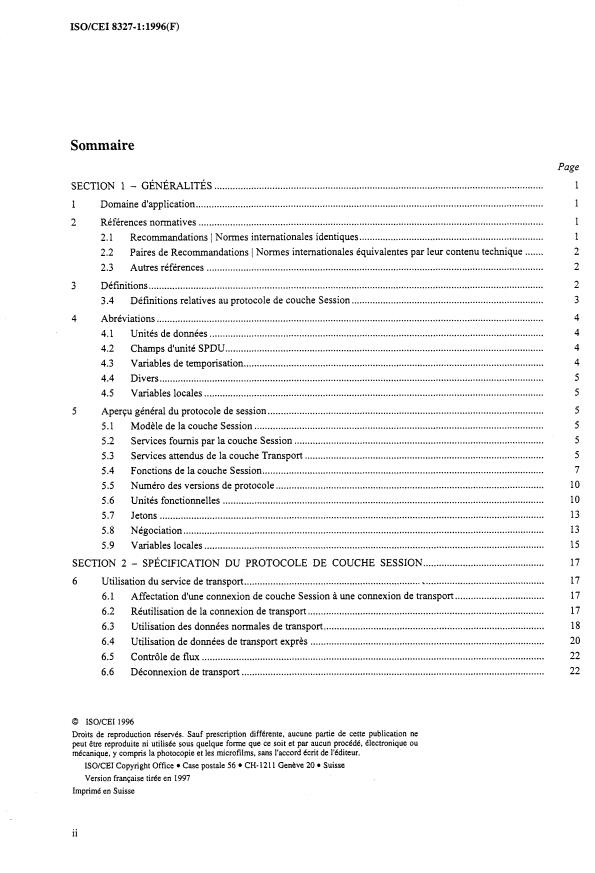
Sommaire
Page
GÉNÉRALITÉS . . . . . . . . . . . . . . . . . . . . . . . . . . . . . . . . . . . . . . . . . . . . . . . . . . . . . . . . . . . . . . . . . . . . . . . . . . . . . . . . . . . . . . . . . . . . . . . . . . . . . . . . . . . . . . . . . . . . . . . . .
SECTION 1 -
. . . . . . . . . . . . . . . . . . . . . . . . . . . . . . . . . . . . . . . . . . . . . . . . . . . . . . . . . . . . . . . . . . . . . . . . . . . . . . . . . . . . . . . . . . . . . . . . . . . . . . . . . . . . . . . . . . . . . . . . .
1 Domaine d’application
Références normatives .
......................................................................
2.1 Recommandations 1 Normes internationales identiques
.......
Paires de Recommandations 1 Normes internationales équivalentes par leur contenu technique
2.2
................................................................................................................................
2.3 Autres références
Définitions .
.........................................................................
3.4 Définitions relatives au protocole de couche Session
Abréviations .
...............................................................................................................................
4.1 Unités de données
4.2 Champs d’unité SPDU .
Variables de temporisation .
4.3
4.4 Divers .
4.5 Variables locales .
Aperçu général du protocole de session .
..............................................................................................................
5.1 Modèle de la couche Session
...............................................................................................
Services fournis par la couche Session
5.2
Services attendus de la couche Transport .
5.3
...........................................................................................................
5.4 Fonctions de la couche Session
Numéro des versions de protocole .
5.5
..........................................................................................................................
5.6 Unités fonctionnelles
5.7 Jetons .
.........................................................................................................................................
5.8 Négociation
5.9 Variables locales .
..............................................
SPÉCIFICATION DU PROTOCOLE DE COUCHE SESSION
SECTION 2 -
CI. 17
. . . . . . . . . . . . . . . . . . . . . . . . . . . . . . . . . . . . . . . . . . . . . . . . . . . . . . . . . . . . . . . . . . .
6 Utilisation du service de transport
. . . . . . . . . . . . . . . . . . . . . . . . . . . . . . . . . .
61 . Affectation d’une connexion de couche Session à une connexion de transport
. . . . . . . . . . . . . . . . . . . . . . . . . . . . . . . . . . . . . . . . . . . . . . . . . . . . . . . . . . . . . . . . . . . . . . . . . . . . . . . . . . . . . . . . . .
6.2 Réutilisation de la connexion de transport
. . . . . . . . . . . . . . . . . . . . . . . . . . . . . . . . . . . . . . . . . . . . . . . . . . . . . . . . . . . . . . . . . . . . . . . . . . . . . . . . . . . .
63 . Utilisation des données normales de transport
. . . . . . . . . . . . . . . . . . . . . . . . . . . . . . . . . . . . . . . . . . . . . . . . . . . . . . . . . . . . . . . . . . . . . . . . . . . . . . . . . . . . . . . . .
6.4 Utilisation de données de transport exprès
. Contrôle de flux . . . . . . . . . . . . . . . . . . . . . . . . . . . . . . . . . . . . . . . . . . . . . . . . . . . . . . . . . . . . . . . . . . . . . . . . . . . . . . . . . . .*.*.
66 . Déconnexion de transport . . . . . . . . . . . . . . . . . . . . . . . . . . . . . . . . . . . . . . . . . . . . . . . . . . . . . . . . . . . . . . . . . . . . . . . . . . . . . . . . . . . . . . . . . . . . . . . . . . . . . . . . . . . . . . . . . . .
0 ISOKEI 1996
Droits de reproduction r&ervés. Sauf prescription différente, aucune partie de cette publication ne
peut être reproduite ni utilisée sous quelque forme que ce soit et par aucun procédé, électronique ou
mécanique, y compris la photocopie et les microfilms, sans l’accord écrit de l’éditeur.
ISOKEI Copyright Office l Case postale 56 l CH-121 1 Genève 20 l Suisse
Version française tirée en 1997
Imprimé en Suisse
ii
@ ISO/CEI ISO/CEI 83274:1996(F)
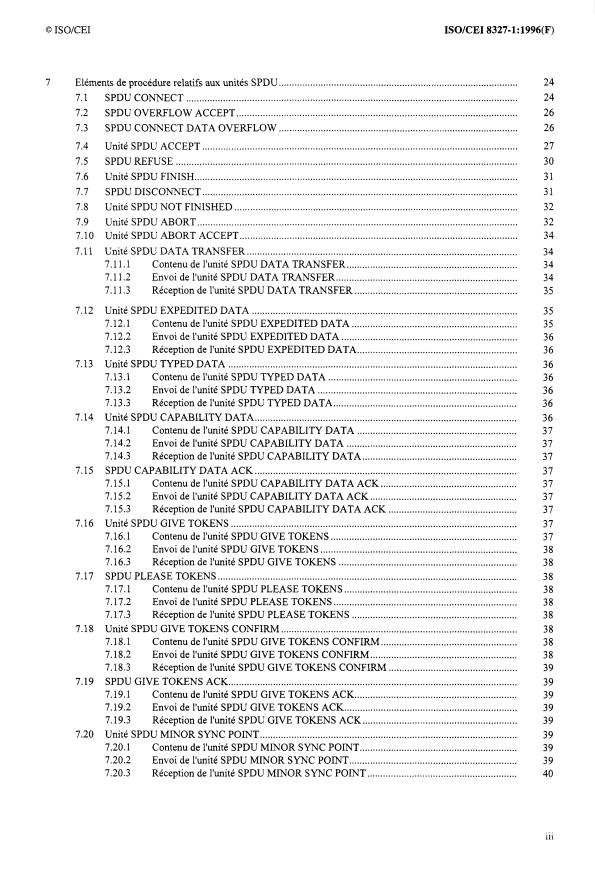
7 Eléments de procédure relatifs aux unités SPDU . . . . . . . . . . . . . . . . . . . . . . . . . . . . . . . . . . . . . . . . . . . . . . . . . . . . . . . . . . . . . . . . .*. 24
.............................................................................................................................. 24
7.1 SPDU CONNECT
72 SPDU OVERFLOW ACCEPT . 26
7:3 SPDU CONNECT DATA OVERFLOW .
7.4 Unité SPDU ACCEPT . 27
7.5 SPDU REFUSE . 30
7.6 Unité SPDU FINISH . 31
77 SPDU DISCONNECT . 31
............................................................................................................ 32
7:8 Unité SPDU NOT FINISHED
79 Unité SPDU ABORT . 32
7:10 Unité SPDU ABORT ACCEPT . 34
7.11 Unité SPDU DATA TRANSFER .
Contenu de l’unité SPDU DATA TRANSFER
7.11.1 . 34
7.11.2 Envoi de l’unité SPDU DATA TRANSFER .
Réception de l’unité SPDU DATA TRANSFER
7.11.3 . 35
7.12 Unité SPDU EXPEDITED DATA .
7.12.1 Contenu de l’unité SPDU EXPEDITED DATA . 35
7.12.2 Envoi de l’unité SPDU EXPEDITED DATA .
7.12.3 Réception de l’unité SPDU EXPEDITED DATA . 36
Unité SPDU TYPED DATA
7.13 . 36
7.13.1 Contenu de l’unité SPDU TYPED DATA . 36
7.13.2 Envoi de l’unité SPDU TYPED DATA
............................................................................ 36
7.13.3 Réception de l’unité SPDU TYPED DATA . 36
7.14 Unité SPDU CAPABILITY DATA . 36
7.14.1 Contenu de l’unité SPDU CAPABILITY DATA .
7.14.2 Envoi de l’unité SPDU CAPABILITY DATA . 37
7.14.3 Réception de l’unité SPDU CAPABILITY DATA . 37
’
7.15 SPDU CAPABILITY DATA ACK . 37
7.15.1 Contenu de l’unité SPDU CAPABILITY DATA ACK . 37
7.15.2 Envoi de l’unité SPDU CAPABILITY DATA ACK
........................................................ 37
7.15.3 Réception de l’unité SPDU CAPABILITY DATA ACK . 37
7.16 Unité SPDU GIVE TOKENS . 37
7.16.1 Contenu de l’unité SPDU GIVE TOKENS . 37
7.16.2 Envoi de l’unité SPDU GIVE TOKENS .
7.16.3 Réception de l’unité SPDU GIVE TOKENS . 38
7.17 SPDU PLEASE TOKENS .
7.17.1
Contenu de l’unité SPDU PLEASE TOKENS . 38
7.17.2 Envoi de l’unité SPDU PLEASE TOKENS . 38
7.17.3 Réception de l’unité SPDU PLEASE TOKENS . 38
7.18 Unité SPDU GIVE TOKENS CONFIRM . 38
7.18.1 Contenu de l’unité SPDU GIVE TOKENS CONFIRM .
7.18.2 Envoi de l’unité SPDU GIVE TOKENS CONFIRM . 38
7.18.3 Réception de l’unité SPDU GIVE TOKENS CONFIRM . 39
7.19 SPDU GIVE TOKENS ACK . 39
7.19.1 Contenu de l’unité SPDU GIVE TOKENS ACK . 39
7.19.2 Envoi de l’unité SPDU GIVE TOKENS ACK .
7.19.3 Réception de l’unité SPDU GIVE TOKENS ACK . 39
7.20 Unité SPDU MINOR SYNC POINT .
7.20.1 Contenu de l’unité SPDU MINOR SYNC POINT . 39
7.20.2 Envoi de l’unité SPDU MINOR SYNC POINT .
7.20.3 RéceDtion de l’unité SPDU MINOR SYNC POINT . 40
0 ISO/CEI
ISOKEI 8327-l: 1996(F)
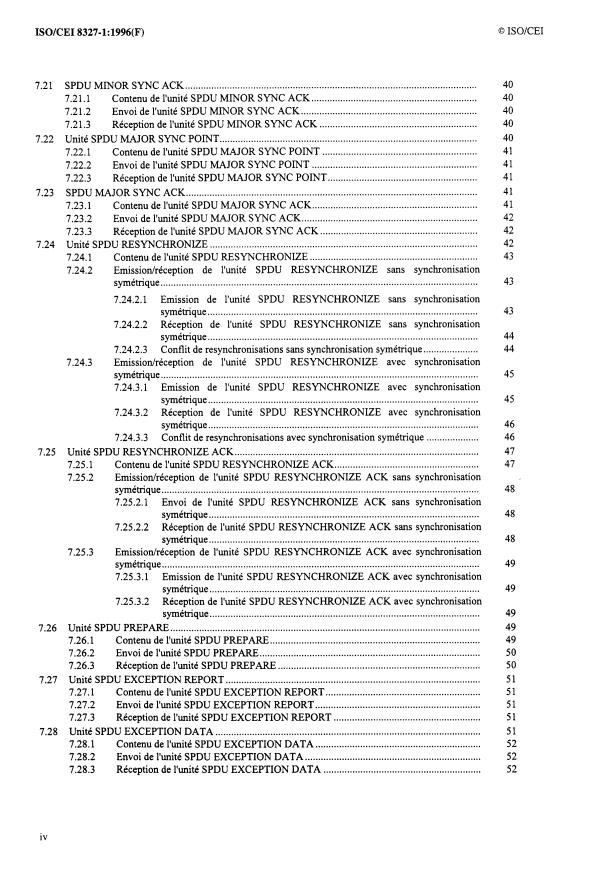
7.21 SPDU MINOR SYNC ACK .
7.21.1 Contenu de l’unité SPDU MINOR SYNC ACK . 40
................................................................... 40
7.21.2 Envoi de l’unité SPDU MINOR SYNC ACK
7.21.3 Réception de l’unité SPDU MINOR SYNC ACK .
7.22 Unité SPDU MAJOR SYNC POINT . 40
........................................................... 41
7.22.1 Contenu de l’unité SPDU MAJOR SYNC POINT
7.22.2 Envoi de l’unité SPDU MAJOR SYNC POINT .
......................................................... 41
7.22.3 Réception de l’unité SPDU MAJOR SYNC POINT
............................................................................................................... 41
7.23 SPDU MAJOR SYNC ACK
7.23.1 Contenu de l’unité SPDU MAJOR SYNC ACK .
................................................................... 42
7.23.2 Envoi de l’unité SPDU MAJOR SYNC ACK
7.23.3 Réception de l’unité SPDU MAJOR SYNC ACK .
...................................................................................................... 42
7.24 Unité SPDU RESYNCHRONIZE
................................................................ 43
7.24.1 Contenu de l’unité SPDU RESYNCHRONIZE
7.24.2 Emissionkéception de l’unité SPDU RESYNCHRONIZE sans synchronisation
symétrique .
7.24.2.1 Emission de l’unité SPDU RFSYNCHRONIZE sans synchronisation
symétrique . . . . . . . . . . . . . . . . . . . . . . . . . . . . . . . . . . . . . . . . . . . . . . . . . . . . . . . . . . . . . . . . . . . . . . . . . . . . . . . . . . . . . . . . . . . . . . . . . . . . . . . 43
7.24.2.2 Réception de l’unité SPDU RESYNCHRONIZE sans synchronisation
symétrique . . . . . . . . . . . . . . . . . . . . . . . . . . . . . . . . . . . . . . . . . . . . . . . . . . . . . . . . . . . . . . . . . .*. 44
7.24.2.3 Conflit de resynchronisations sans synchronisation symétrique . . . . . . . . . . . . . . . . . . . . .
7.24.3 Emissionkéception de l’unité SPDU RESYNCHRONIZE avec synchronisation
syméhque . . . . . . . . . . . . . . . . . . . . . . . . . . . . . . . . . . . . . . . . . . . . . . . . . . . . . . . . . . . . . . . . . . . . . . . . . . . . . . . . . . . . . . . . . . . . . . . . . . . . . . . . . . . . . . . . . . . . . . . . .
7.24.3.1 Emission de l’unité SPDU RESYNCHRONIZE avec synchronisation
symétrique . 45
7.24.3.2 Réception de l’unité SPDU RESYNCHRONIZE avec synchronisation
symétrique . 46
7.24.3.3 Conflit de resynchronisations avec synchronisation symétrique . 46
7.25 Unité SPDU RESYNCHRONIZE ACK .
7.25.1 Contenu de l’unité SPDU RESYNCHRONIZE ACK . 47
Emissionkéception de l’unité SPDU RESYNCHRONIZE ACK sans synchronisation
7.25.2
symétrique . 48
7.25.2.1 Envoi de l’unité SPDU RESYNCHRONIZE ACK sans synchronisation
symétrique . 48
7.25.2.2 Réception de l’unité SPDU RESYNCHRONIZE ACK sans synchronisation
symétrique .
7.25.3 Emissionkéception de l’unité SPDU RESYNCHRONIZE ACK avec synchronisation
symétrique .
7.25.3.1 Emission de l’unité SPDU RESYNCHRONIZE ACK avec synchronisation
....................................................................................................... 49
symétrique
7.25.3.2 Réception de l’unité SPDU RESYNCHRONIZE ACK avec synchronisation
symétrique . 49
7.26 Unité SPDU PREPARE . 49
7.26.1 Contenu de l’unité SPDU PREPARE . 49
7.26.2 Envoi de l’unité SPDU PREPARE . 50
7.26.3 Réception de l’unité SPDU PREPARE . 50
7.27 Unité SPDU EXCEPTION REPORT . 51
7.27.1 Contenu de l’unité SPDU EXCEPTION REPORT . 51
7.27.2 Envoi de l’unité SPDU EXCEPTION REPORT . 51
7.27.3 Réception de l’unité SPDU EXCEPTION REPORT . 51
7.28 Unité SPDU EXCEPTION DATA . 51
7.28.1 Contenu de l’unité SPDU EXCEPTION DATA . 52
7.28.2 Envoi de l’unité SPDU EXCEPTION DATA . 52
7.28.3 Réception de l’unité SPDU EXCEPTION DATA . 52
0 ISOKEI
ISOKEI 83274:1996(F)
7.29 Unité SPDU ACTIVITY START
....................................................................................................... 52
7.29.1 Contenu de l’unité SPDU ACTIVITY START . 52
7.29.2 Envoi de l’unité SPDU ACTIVITY START .
7.29.3 Réception de l’unité SPDU ACTIVITY START
.............................................................. 53
7.30 Unité SPDU ACTIVITY RESUME .
7.30.1 Contenu de l’unité SPDU ACTIVITY RESUME
............................................................. 53
7.30.2 Envoi de l’unité SPDU ACTIVITY RESUME . 53
7.30.3 Réception de l’unité SPDU ACTIVITY RESUME . 53
7.3 1 Unité SPDU ACTIVITY INTERRUPT . 54
7.31.1 Contenu de l’unité SPDU ACTIVITY INTERRUPT . 54
7.3 1.2 Envoi de l’unité SPDU ACTIVITY INTERRUPT .
7.31.3 Réception de l’unité SPDU ACTIVITY INTERRUPT . 54
7.32 Unité SPDU ACTIVITY INTERRUPT ACK . 54
7.32.1 Contenu de l’unité SPDU ACTIVITY INTERRUPT ACK . 54
7.32.2 Envoi de l’unité SPDU ACTIVITY INTERRUPT ACK . 54
7.32.3 Réception d’une unité SPDU ACTIVITY INTERRUPT ACK . 55
7.33 Unité SPDU ACTIVITY DISCARD . 55
7.33.1 Contenu de l’unité SPDU ACTIVITY DISCARD .
7.33.2 Envoi de l’unité SPDU ACTIVITY DISCARD . 55
7.33.3 Réception de l’unité SPDU ACTIVITY DISCARD . 55
7.34 Unité SPDU ACTIVITY DISCARD ACK
......................................................................................... 55
7.34.1 Contenu d’une unité SPDU ACTIVITY DISCARD ACK . 55
7.34.2 Envoi de l’unité SPDU ACTIVITY DISCARD ACK . 56
7.34.3 Réception de l’unité SPDU ACTIVITY DISCARD ACK . 56
7.35 Unité SPDU ACTIVITY END . 56
7.35.1 Contenu de l’unité SPDU ACTIVITY END . 56
7.35.2 Envoi de l’unité SPDU ACTIVITY END .
7.35.3 Réception de l’unité SPDU ACTIVITY END
................................................................... 56
7.36 Unité SPDU ACTIVITY END ACK .
7.36.1 Contenu de l’unité SPDU ACTIVITY END ACK
............................................................ 57
7.36.2 Envoi de l’unité SPDU ACTIVITY END ACK . 57
7.36.3 Réception de l’unité SPDU ACTIVITY END ACK . 57
7.37 Eléments supplémentaires de procédure applicables aux unités SSDU segmentées
........................... 57
7.37.1 Contenu de l’unité SPDU . 58
7.37.2 Envoi de l’unité SPDU . 58
7.37.3 Réception de l’unité SPDU . 59
8 Structure et codage des unités SPDU . 59
81 . Structure des unités TSDU . 59
82 . Structure des unités SPDU . 60
8.2.1 Les unités SPDU . 60
8.2.2 Unités d’identification PG1 . 61
8.2.3 Unités d’identification PI . 61
8.2.4 Champs d’identificateur . 62
8.2.5 Champ d’indicateur de longueur LI . 62
8.2.6 Champs de paramètre . 62
8.2.7 Valeurs des paramètres . 62
8.2.8 Champs d’informations de l’utilisateur . 62
ISOKEI 8327=1:1996(F) @ ISOKEI
. . . . . . . . . . . . . . . . . . . . . . . . . . . . . . . . . . . . . . . . . . . . .~. 62
8.3 Identificateurs et chamns de paramètres associés des unités SPDU
SPDU CONNE& (CN) . . . . . . . . . . . . . . . . . . . . . . . .O.~. 63
8.3.1
Unité SPDU OVERFLOW ACCEPT (OA) . 66
8.3.2
Unité SPDU CONNECT DATA OVERFLOW (CDO) . 67
8.3.3
Unité SPDU ACCEPT (AC) . 68
8.3.4
.............................................................................................. 71
8.3.5 Unité SPDU REFUSE (RF)
................................................................................................ 72
8.3.6 Unité SPDU FINISH (FN)
................................................................................... 73
8.3.7 Unité SPDU DISCONNECT (DN)
................................................................................. 73
8.3.8 Unité SPDU NOT FINISHED (NF)
............................................................................................... 74
8.3.9 Unité SPDU ABORT (AB)
.............................................................................. 75
8.3.10 Unité SPDU ABORT ACCEPT (AA)
’ 75
8.3.11 Unité SPDU DATA TRANSFER’(DT) .
8.3.12 Unité SPDU EXPEDITED (EX) .
8.3.13 Unité SPDU TYPED DATA (TD) .
8.3.14 Unité SPDU CAPABILITY DATA (CD) . .
Unité SPDU CAPABILITY DATA ACK (.CRA) . 77
8.3.15
Unité SPDU GEVE. TOKENS (GT) . 77
8.3.16
.............................................................................. 78
8.3.17 Unité SPDU PLEASE TOKENS (PT)
8.3.18 Unité SPDU GIVE TOKENS CONFIRM (GTC) .
8.3.19 Unité SPDU GIVE TOKENS ACK (GTA) . 79
8.3.20 Unité SPDU MINOR SYNC POINT (MIP) . 79
8.3.21 Unité SPDU MINOR SYNC ACK (MIA) . 80
................................................................... 81
8.3.22 Unité SPDU MAJOR SYNC POINT (MAP)
8.3.23 Unité SPDU MAJOR SYNC ACK (MAA) .
8.3.24 Unité SPDU RESYNCHRONIZE (RS) . 82
8.3.25 Unité SPDU RESYNCHRONIZE ACK (RA) . 83
8.3.26 Unité SPDU PREPARE (PR) . 84
Unité SPDU EXCEPTION REPORT (ER) . 85
8.3.27
Unité SPDU EXCEPTION DATA (ED) . 86
8.3.28
8.3.29 Unité SPDU ACTIVITY START (AS) .
........................................................................ $7
8.3.30 Unité SPDU ACTIVITY RESUME (AR)
8.3.3 1 Unité SPDU ACTIVITY INTERRUPT (AI) .
8.3.32 Unité SPDU ACTIVITY INTERRUPT ACK (AIA)l
.......................................................... 8>9
8.3.33 Unité SPDU ACTIVITY DISCARD (AD)
.......................................................................... 90
8.3.34 Unité SPDU ACTIVITY DISCARD ACK (ADA)
.......................................................... 90
8.3.35 Unité SPDU ACTIVITY END (AE)
................................................................................ 91
8.3.36 Unité SPDU ACTIVITY END ACK (AEA)
.................................................................... 91
84 . Règles de codage supplémentaires applicables aux unités SSDU segmentées
................................... 91
8.4.1 Première unité SPDU de la séquence .
8.4.2 Unités SPDU successives d’une séquence .
@ ISO/CEI
ISOKEI 83274:1996(F)
SECTION 3 - CONFORMITÉ .
Conditions de conformité à la présente Recommandation 1 Norme internationale
........................................ 94
91 . Conditions de conformité statique
......................................................................................................
9.1.3 Les déclarations de conformité doivent indiquer
..............................................................
Conditions de conformité dynamique
9.2 .
9.2.2 Le système doit également suivre- .
9.3 Déclaration de conformité d’une instance de protocole
......................................................................
Annexe A - Tables d’états
.........................................................................................................................................
A. 1 Généralités .
A.2 Notations utilisées dans les tables d’états
............................................................................................
A.3 Conventions relatives au contenu des tables d’états
............................................................................
A.4 Actions à effectuer par la machine SPM .
%97
A.4.1 Intersections non valides .
A.4.2 Intersections valides .
A.4.3 Réception d’unité SPDU .
‘98
A.5 Définitions des ensembles et des variables
.........................................................................................
A.5.1 Unités fonctionnelles .
A.5.2 Jetons .
A.5.3 ENSEMBLE des jetons .
A.S.4 Variables .
A.5.4.1 TEXP .
A.5.4.2 Vact .
A.5.4.3 Vnextact .
A.5.4.4 Vrsp et Vrspnb .
A.5.4.5 Variables Vrsps, Vrspr, Vrspnbs et Vrspnbr .
A.5.4.6 SPMwinner .
A.5.4.7 Vtca .
A.5.4.8 Vtrr .
A.5.4.9
Vcoll .
A.5.4.10 Vdnr
................................................................................................................
A.5.4.11 V(A) .
A.5.4.12 V(M) .
A.5.4.13 V(R) .
A-5.4.14 Vsc .
A.5.4.15 V(Ado) .
A.5.4.16 V(Adi) .
A.5.4.17 V(AS), V(Ar) .
A.5.4.18 V(Ms), V(Mr) .
A.5.4.19 V(Rs), V(Rr)
...................................................................................................
A.5.4.20 Discard-rcv-flow - Discard-snd-flow
.............................................................
Annexe B - Identificateurs PG1 et PI réservés pour utilisation par la Recommandation T.62
................................. 169
Annexe C - Relations avec le codage de la Recommandation T.62
.........................................................................
Annexe D - Différences entre les versions de protocole 1 et 2
.................................................................................
vii
ISOICEI 8327=1:1996(F) 0 ISOKEI
Avant-propos
LIS0 (Organisation internationale de normalisation) et la CE1 (Commission
électrotechnique internationale) forment ensemble un système consacré à la
normalisation internationale considérée comme un tout. Les organismes nationaux
membres de 1’ISO ou de la CE1 participent au développement de Normes
internationales par l’intermédiaire des comités techniques créés par l’organisation
concernée afin de s’occuper des différents domaines particuliers de l’activité
technique. Les comités techniques de I’ISO et de la CE1 collaborent dans des
domaines d’intérêt commun. D’autres organisations internationales, gouverne-
mentales et non gouvernementales, en liaison avec 1’ISO et la CE1 participent
également aux travaux.
Dans le domaine des technologies de l’information, I’ISO et la CE1 ont créé un
comité technique mixte, l’ISO/CEI JTC 1. Les projets de Normes internationales
adoptés par le comité technique mixte sont soumis aux organismes nationaux pour
approbation, avant leur acceptation comme Normes internationales. Les Normes
internationales sont approuvées conformément aux procédures qui requièrent
l’approbation de 75 % au moins des organismes nationaux votants.
La Norme internationale ISOKEI 8327-l a été élaborée par le comité technique
mixte ISO/CEI JTC 1, Technologies de l’information, sous-comité SC 21,
Interconnexion des systèmes ouverts, gestion des données et traitement distribué
ouvert, en collaboration avec I’UIT-T. Le texte identique est publié en tant que
Recommandation UIT-T X.225.
Cette deuxième édition annule et remplace la première édition (ISO 8327:1987),
qui a fait l’objet d’une révision technique. Elle incorpore également l’Amendement
3: 1992.
L’ISOKEI 8327 comprend les parties suivantes, présentées sous le titre général
Technologies de l’information - Interconnexion de systèmes ouverts (OSI) -
Protocole de session en mode connexion:
- Partie 1: Spécification du protocole
- Partie 2: Formulaire de déclaration de conformité d’instance de protocole
(PICS)
Les annexes A à C font partie intégrante de la présente partie de I’ISOKEI 8327.
L’annexe D est donnée uniquement à titre d’information. ,
. . .
VI11
0 ISOKEI ISOKEI 8327=1:1996(F)
Introduction
La présente Recommandation 1 Norme internationale appartient à une série de Recommandations 1 Normes
internationales établies pour faciliter l’interconnexion des équipements informatiques. Les Recommandations 1 Normes
internationales de cette série portent sur les services et protocoles à mettre en œuvre pour réaliser l’interconnexion de ces
équipements.
La structuration en couches définie dans le modèle de référence pour l’interconnexion des systèmes ouverts
(Rec. UIT-T X.200 1 ISOKEI 7498-l), permet de situer la présente Recommandation 1 Norme internationale par rapport
aux autres Recommandations 1 Normes internationales avec lesquelles elle se trouve en relation. Elle est surtout liée à la ’
définition du service de session (Rec. UIT-T X.215 1 ISOKEI 8326) et fait partie de son domaine d’application. Elle
utilise également la définition du service de transport (Rec. UIT-T X.214 1 ISO/CEI 8072), à laquelle elle se réfere et
dont elle suppose que les dispositions sont applicables pour que le protocole de session puisse atteindre ses objectifs. La
Figure Intro. 1 montre les relations entre ces Recommandations 1 Normes internationales.
La présente Recommandation 1 Norme internationale spécifie un protocole unique comportant un codage commun.
Le propos est de définir un protocole de session qui soit suffisamment général convenir à toute la des
Pour g-e
utilisateurs du service de session sans restreindre les extensions futures.
Le protocole est structuré en sorte que des sous-ensembles puissent y être définis.
L’objectif fondamental de la présente Recommandation 1 Norme internationale est de fournir un ensemble de règles de
communication exprimées en termes de procédures à mettre en œuvre par des entités de session homologues au moment
de la communication. Ces règles de communication sont prévues pour fournir une base solide de développement,
répondant à plusieurs objectifs:
servir de guide aux concepteurs et aux réalisateurs;
a)
être utilisée pour les tests et à l’occasion de l’acquisition d’équipements;
b)
c) faire partie d’accords pour l’admission de systèmes dans l’environnement de systèmes ouverts;
permettre une meilleure compréhension de 1’OSI (interconnexion des systèmes ouverts).
d)
Comme il est prévu que ses premiers utilisateurs seront des concepteurs et des réalisateurs d’équipements, la présente
Recommandation 1 Norme. internationale comporte, sous forme de Notes ou d’annexes, des indications concernant la
réalisation de systèmes mettant en œuvre les procédures qui y sont décrites.
Il convient de remarquer que, le nombre de séquences d’éléments de protocole valides étant très important, il n’est pas
possible, dans l’état actuel de la technologie, de vérifier qu’un système mettant en œuvre ces procédures exécutera
correctement, en toutes circonstances, le protocole défini dans la présente Recommandation 1 Norme internationale. Il est
possible, au moyen de tests, de s’assurer qu’un système mettant en œuvre ces procédures, exécutera correctement le
protocole dans un ensemble de circonstances constituant un échantillonnage représentatif. Il est toutefois prévu de
pouvoir utiliser la présente Recommandation 1 Norme internationale dans le cas où deux systèmes n’auraient pas réussi à
entrer en communication, pour déterminer si c’est l’un des deux systèmes qui n’a pas réussi à mettre en œuvre
correctement le protocole ou si ce sont les deux systèmes qui ont échoué dans cette tentative.
1x
0 ISO/CEI
ISOKEI 8327-1: 1996(F)
Les variantes et options décrites par la présente Recommandation 1 Norme internationale sont essentielles pour assurer
un service de session pour une large gamme d’applications. Une réalisation de système ne respectant que des conditions
minimales de conformité à cette norme ne conviendra donc pas dans toutes les circonstances possibles d’utilisation. Il est
donc important de spécifier, dans toute référence à la présente Recommandation 1 Norme internationale, les options
offertes ou requises, ou d’en spécifier la destination ou l’utilisation mévue.
Définition du service de couche Session
Référence
aux objectifs
Spécification
du protocole
de session
Référence
aux hypothèses
Définition du service
de couche Transport
T0723870-95/dOl
Figure Intro. 1 - Relations entre Ie protocole de session sans connexion
ISOKEI 8327-l : 1996 (F)
NORME INTERNATIONALE
RECOMMANDATION UIT-T
TECHNOLOGIES DE L’INFORMATION - INTERCONNEXION DE SYSTÈMES
OUVERTS (OSI) - PROTOCOLE DE SESSION EN MODE CONNEXION:
SPÉCIFICATION DU PROTOCOLE
SECTION 1 - GÉNÉRALITÉS
1 Domaine d’application
La présente Recommandation 1 Norme internationale spécifie:
les procédures d’un protocole unique de transfert - d’une entité de session à son homologue - de données
a)
et d’informations de contrôle;
b) les moyens à mettre en œuvre pour déterminer les unités fonctionnelles devant être utilisées par les entités
de session;
la structure et le codage des unités de données de protocole de session utilisées pour le transfert de
Cl
données et d’in formations de contrôle.
Les procédures sont définies en termes:
d’interactions entre entités de session homologues, par échange d’unités de données de protocole de
a)
session (unités SPDU);
b) d’interactions entre une entité de session et l’utilisateur du service de session du même système,
Par
échange de primitives du service de session;
c) d’interactions entre une entité de couche Session et le fournisseur du service de couche Transport,
Par
échange de primitives du service de transport.
Ces procédures sont applicables à des instances de communication entre systèmes qui supportent la couche Session du
modèle de référence OS1 et qui souhaitent s’interconnecter dans un environnement de systèmes ouverts.
La présente Recommandation 1 Norme internationale spécifie également les conditions de conformité de systèmes conçus
pour mettre en œuvre ces procédures. Mais elle ne spécifie pas de tests pouvant servir à prouver cette conformité.
Le texte relatif à l’unité fonctionnelle de synchronisation symétrique ne s’applique pas à la prise en charge des
applications de I’UIT-T.
2 Références normatives
Les Recommandations et Normes internationales suivantes contiennent de
...
NORME
ISO/CEI
I NTE R NAT1 ONALE 8327-1
Deuxibme edition
1996-09-1 5
Technologies de l'information -
Interconnexion de systèmes ouverts
(OSI) - Protocole de session en mode
connexion: Spécification du protocole
Information technology - Open Systems Interconnection - Connection-
oriented Session pro tocol: Protocol specification
Numéro de reference
ISO/CEI 8327-1 11 996(F)
ISOXEI 8327-1: 1996(F)
Sommaire
Page
SECTION 1 . GÉNÉRALITÉS . 1
1 Domaine d'application .
2 Références normatives .
Recommandations 1 Normes internationales identiques .
2.1
2.2 Paires de Recommandations 1 Normes internationales équivalentes par leur contenu technique .
2.3 Autres références .
3 Définitions .
Définitions relatives au protocole de couche Session . 3
3.4
4 Abréviations . 4
4.1 Unites de données . 4
4.2 Champs d'unité SPDU . 4
4.3 Variables de temporisation . 4
4.4 Divers . 5
4.5 Variables locales . 5
5 5
Aperçu général du protocole de session .
5.1 Modèle de la couche Session .
5.2 Services fournis par la couche Session . 5
5.3 Services attendus de la couche Transport . 5
5.4 Fonctions de la couche Session .
5.5 Numéro des versions de protocole .
5.6 Unités fonctionnelles . 10
5.7 Jetons . 13
5.8 Négociation . 13
5.9 Variables locales . 15
SECTION 2 - SPÉCIFICATION DU PROTOCOLE DE COUCHE SESSION . 17
6 Utilisation du service de transport . .
6.1 Affectation d'une connexion de couche Session à une connexion de transport . 17
6.2 Réutilisation de la connexion de transport .
6.3 Utilisation des données normales de transport . 18
6.4 Utilisation de données de transport exprès . 20
6.5 Contrôle de flux . 22
6.6 Déconnexion de transport .
0 ISOKEI 1996
Droits de reproduction réservés . Sauf prescription différente. aucune partie de cette publication ne
peut être reproduite ni utiliske sous quelque forme que ce soit et par aucun procédé. électronique ou
mécanique. y compris la photocopie et les microfilms . sans l'accord écrit de I'éditeur .
ISOEEI Copyright Office Case postale 56 CH-1211 Genkve 20 Suisse
Version française tirée en 1997
Imprimé en Suisse
0 ISO/CEI ISOKEI 8327-1: 1996(F)
7 Eléments de procédure relatifs aux unités SPDU .
7.1 SPDU CONNECT . . 24
7.2 SPDU OVERFLOW ACCEPT . . . 26
7.3 SPDU CONNECT DATA OVERF . 26
Unité SPDU ACCEPT .
7.4 27
7.5 SPDU REFUSE . 30
7.6 Unité SPDU FINISH. . . 31
SPDU DISCONNECT . 31
7.7
7.8 Unité SPDU NOT FINISHED . . 32
7.9 Unité SPDU ABORT . . 32
Unité SPDU ABORT ACCEPT . 34
7.10
1 Unité SPDU DATA TRANSFER .
7.1 34
7.1 1.1 Contenu de l'unité SPDU DATA TRANSFER . 34
7.1 1.2 Envoi de l'unité SPDU DATA TRANSFER .
7.1 1.3 Réception de l'unité SPDU DATA TRANSFER .
7.12 Unité SPDU EXPEDITED DATA .
7.12.1 Contenu de l'unité SPDU EXPEDITED DATA . 35
7.12.2 Envoi de l'unité SPDU EXPEDITED DATA .
7.12.3 Réception de l'unité SPDU EXPEDITED DATA . 36
7.13 Unité SPDU TYPED DATA . 36
7.13.1 Contenu de l'unité SPDU TYPED DATA .
7.13.2 Envoi de l'unité SPDU TYPED DATA . 36
7.13.3 Réception de l'unité SPDU TYPED DATA .
7.14 Unité SPDU CAPABILITY DATA .
7.14.1 Contenu de l'unité SPDU CAPABILITY DATA .
7.14.2 Envoi de l'unité SPDU CAPABILITY DATA . 37
7.14.3 Réception de l'unité SPDU CAPABILITY DATA .
7.15 SPDU CAPABILITY DATA ACK . 37
7.15.1 Contenu de l'unité SPDU CAPABILITY DATA ACK .
7.15.2 Envoi de l'unité SPDU CAPABILITY DATA ACK .
7.15.3 Réception de l'unité SPDU CAPABILITY DATA ACK . 37
7.16 Unité SPDU GIVE TOKENS . 37
7.16.1 Contenu de l'unité SPDU GIVE TOKENS .
7.16.2 Envoi de l'unité SPDU GIVE TOKENS .
7.16.3 Réception de l'unité SPDU GIVE TOKENS .
7.17 SPDU PLEASE TOKENS .
7.17.1 Contenu de l'unité SPDU PLEASE TOKENS . 38
7.17.2 Envoi de l'unité SPDU PLEASE TOKENS . 38
7.17.3 Réception de l'unité SPDU PLEASE TOKENS . 38
7.18 Unité SPDU GIVE TOKENS CONFIRM . 38
7.18.1 Contenu de l'unité SPDU GIVE TOKENS CONFIRM .
7.18.2 Envoi de l'unité SPDU GIVE TOKENS CONFIRM .
7.18.3 Réception de l'unité SPDU GIVE TOKENS CONFIRM . 39
7.19 SPDU GIVE TOKENS ACK .
7.19.1 Contenu de l'unité SPDU GIVE TOKENS ACK . 39
7.19.2 Envoi de l'unité SPDU GIVE TOKENS ACK .
7.19.3 Réception de l'unité SPDU GIVE TOKENS ACK .
7.20 Unité SPDU MINOR SYNC POINT .
7.20.1 Contenu de l'unité SPDU MINOR SYNC POINT .
7.20.2 Envoi de l'unité SPDU MINOR SYNC POINT . 39
7.20.3 Réception de l'unité SPDU MINOR SYNC POINT .
...
0 ISO/CEI
ISOKEI 8327-1: 1996(F)
SPDU MINOR SYNC ACK .
7.21
7.21.1 Contenu de l'unité SPDU MINOR SYNC ACK .
7.21.2 Envoi de l'unité SPDU MINOR SYNC ACK .
Réception de l'unité SPDU MINOR SYNC ACK . 40
7.21.3
Unité SPDU MAJOR SYNC POINT .
7.22
7.22.1 Contenu de l'unité SPDU MAJOR SYNC POINT .
7.22.2 Envoi de l'unité SPDU MAJOR SYNC POINT .
7.22.3 Réception de l'unité SPDU MAJOR SYNC POINT .
7.23 SPDU MAJOR SYNC ACK .
7.23.1 Contenu de l'unité SPDU MAJOR SYNC ACK .
7.23.2 Envoi de l'unité SPDU MAJOR SYNC ACK .
7.23.3 Réception de l'unité SPDU MAJOR SYNC ACK .
Unité SPDU RESYNCHRONIZE . 42
7.24
Contenu de l'unité SPDU RESYNCHRONIZE . 43
7.24.1
Emissiodréception de l'unité SPDU RESYNCHRONIZE sans synchronisation
7.24.2
symétrique .
7.24.2.1 Emission de l'unité SPDU RESYNCHRONIZE sans synchronisation
symétrique . 43
7.24.2.2 Réception de l'unité SPDU RESYNCHRONIZE sans synchronisation
symétrique . 44
7.24.2.3 Conflit de resynchronisations sans synchronisation symétrique .
7.24.3 Emissiodréception de l'unité SPDU RESYNCHRONIZE avec synchronisation
symétrique . 45
7.24.3.1 Emission de l'unité SPDU RESYNCHRONIZE avec synchronisation
symétrique . 45
7.24.3.2 Réception de l'unité SPDU RESYNCHRONIZE avec synchronisation
symétrique .
7.24.3.3 Conflit de resynchronisations avec synchronisation symétrique . 46
7.25 Unité SPDU RESYNCHRONIZE ACK .
7.25.1 Contenu de l'unité SPDU RESYNCHRONIZE ACK .
7.25.2 Emissiodréception de l'unité SPDU RESYNCHRONIZE ACK sans synchronisation
symétrique .
7.25.2.1 Envoi de l'unité SPDU RESYNCHRONIZE ACK sans synchronisation
symétrique .
7.25.2.2 Réception de l'unité SPDU RESYNCHRONIZE ACK sans synchronisation
symétrique .
7.25.3 Emissiodréception de l'unité SPDU RESYNCHRONIZE ACK avec synchronisation
symétrique .
7.25.3.1 Emission de l'unité SPDU RESYNCHRONIZE ACK avec synchronisation
symétrique . 49
7.25.3.2 Réception de l'unité SPDU RESYNCHRONIZE ACK avec synchronisation
symétrique . 49
7.26 Unité SPDU PREPARE .
7.26.1 Contenu de l'unité SPDU PREPARE .
7.26.2 Envoi de l'unité SPDU PREPARE .
7.26.3 Réception de l'unité SPDU PREPARE .
................................................................................................. 51
7.27 Unité SPDU EXCEPTION REPORT
7.27.1 Contenu de l'unité SPDU EXCEPTION REPORT . 51
7.27.2 Envoi de l'unité SPDU EXCEPTION REPORT .
7.27.3 Réception de l'unité SPDU EXCEPTION REPORT .
7.28 Unité SPDU EXCEPTION DATA . 51
7.28.1 Contenu de l'unité SPDU EXCEPTION DATA . 52
7.28.2 Envoi de l'unité SPDU EXCEPTION DATA . 52
7.28.3 Réception de l'unité SPDU EXCEPTION DATA .
iv
I
0 ISO/CEI ISO/CEI 8327-1: 1996(F)
7.29 Unité SPDU ACTIVITY START . 52
7.29.1 Contenu de l'unité SPDU ACTIVITY START . 52
7.29.2 Envoi de l'unit6 SPDU ACTIVITY START . 52
7.29.3 Réception de l'unité SPDU ACTIVITY START . 53
7.30 Unité SPDU ACTIVITY RESUME . 53
7.30.1 Contenu de l'unité SPDU ACTIVITY RESUME . 53
................................................................. 53
7.30.2 Envoi de l'unité SPDU ACTIVITY RESUME
7.30.3 Réception de l'unité SPDU ACTIVITY RESUME . 53
7.3 1 Unité SPDU ACTIVITY INTERRUPT .
7.3 1.1 Contenu de l'unité SPDU ACTIVITY INTERRUPT . 54
7.3 1.2 Envoi de l'unité SPDU ACTIVITY INTERRUPT . 54
Réception de l'unité SPDU ACTIVITY INTERRUPT . 54
7.3 1.3
7.32 Unité SPDU ACTIVITY INTERRUPT ACK .
7.32.1 Contenu de l'unité SPDU ACTIVITY INTERRUPT ACK .
7.32.2 Envoi de l'unité SPDU ACTIVITY INTERRUPT ACK . 54
7.32.3 Réception d'une unité SPDU ACTIVITY INTERRUPT ACK . 55
7.33 Unité SPDU ACTIVITY DISCARD . 55
7.33.1 Contenu de l'unité SPDU ACTIVITY DISCARD . 55
7.33.2 Envoi de l'unité SPDU ACTIVITY DISCARD . 55
......................................................... 55
7.33.3 Réception de l'unité SPDU ACTIVITY DISCARD
7.34 Unité SPDU ACTIVITY DISCARD ACK . 55
7.34.1 Contenu dune unité SPDU ACTIVITY DISCARD ACK . 55
7.34.2 Envoi de l'unité SPDU ACTIVITY DISCARD ACK . 56
7.34.3 Réception de l'unité SPDU ACTIVITY DISCARD ACK .
7.35 Unité SPDU ACTIVITY END . 56
7.35.1 Contenu de l'unité SPDU ACTIVITY END . 56
7.35.2 Envoi de l'unité SPDU ACTIVITY END . 56
7.35.3 Réception de l'unité SPDU ACTIVITY END . 56
7.36 Unité SPDU ACTIVITY END ACK . 57
7.36.1 Contenu de l'unité SPDU ACTIVITY END ACK . 57
7.36.2 Envoi de l'unité SPDU ACTIVITY END ACK . 57
7.36.3 Réception de l'unité SPDU ACTIVITY END ACK . 57
7.37 Eléments supplémentaires de procédure applicables aux unités SSDU segmentées . 57
7.37.1 Contenu de l'unité SPDU . 58
7.37.2 Envoi de l'unité SPDU . 58
7.37.3 Réception de l'unité SPDU . 59
8 Structure et codage des unités SPDU .
8.1 Structure des unités TSDU . 59
8.2 Structure des unités SPDU . 60
8.2.1 Les unités SPDU . 60
8.2.2 Unités d'identification PGI . 61
8.2.3 Unités d'identification PI . 61
8.2.4 Champs d'identificateur . 62
8.2.5 Champ d'indicateur de longueur LI . 62
8.2.6 Champs de paramètre .
8.2.7 Valeurs des paramètres .
8.2.8 Champs d'informations de l'utilisateur . 62
V
0 ISO/CEI
ISOKEI 8327-1: 1996(F)
Identificateurs et champs de paramètres associés des unités SPDU .
8.3
SPDU CONNECT (CN) .
8.3.1
Unité SPDU OVERFLOW ACCEPT (OA) .
8.3.2
Unité SPDU CONNECT DATA OVERFLOW (CDO) .
8.3.3
Unité SPDU ACCEPT (AC) .
8.3.4
Unité SPDU REFUSE (RF) .
8.3.5
Unité SPDU FINISH (FN) .
8.3.6
Unité SPDU DISCONNECT (DN) .
8.3.7
Unité SPDU NOT FINISHED (NF) .
8.3.8
Unité SPDU ABORT (AB) .
8.3.9
Unité SPDU ABORT ACCEPT (AA) .
8.3.10
Unité SPDU DATA TRANSFER (DT) .
8.3.11
Unité SPDU EXPEDITED (EX) .
8.3.12
8.3.13 Unité SPDU TYPED DATA (TD) .
8.3.14 Unité SPDU CAPABILITY DATA (CD) .
Unité SPDU CAPABILITY DATA ACK (CDA) .
8.3.15
Unité SPDU GIVE TOKENS (GT) .
8.3.16
Unité SPDU PLEASE TOKENS (PT) .
8.3.17
Unité SPDU GIVE TOKENS CONFIRM (GTC) .
8.3.18
Unité SPDU GIVE TOKENS ACK (GTA) .
8.3.19
8.3.20 Unité SPDU MINOR SYNC POINT (MIP) .
................................ 80
Unité SPDU MINOR SYNC ACK (MIA) .
8.3.21
Unité SPDU MAJOR SYNC POINT (MAP) .
8.3.22
Unité SPDU MAJOR SYNC ACK (MAA) .
8.3.23
Unité SPDU RESYNCHRONIZE (RS) .
8.3.24
8.3.25 Unité SPDU RESYNCHRONIZE ACK (RA) .
8.3.26 Unité SPDU PREPARE (PR) .
8.3.27 Unité SPDU EXCEPTION REPORT (ER) .
8.3.28 Unité SPDU EXCEPTION DATA (ED) .
8.3.29 Unité SPDU ACTIVITY START (AS) .
Unité SPDU ACTIVITY RESUME (AR) .
8.3.30
8.3.3 1 Unité SPDU ACTIVITY INTERRUPT (AI) . 88
8.3.32 Unité SPDU ACTIVITY INTERRUPT ACK (AIA) . 89
8.3.33 90
Unité SPDU ACTIVITY DISCARD (AD) .
8.3.34 Unité SPDU ACTIVITY DISCARD ACK (AD.4) . 90
8.3.35 91
Unité SPDU ACTIVITY END (AE) .
8.3.36 Unité SPDU ACTIVITY END ACK (AEA) .
8.4 Règles de codage supplémentaires applicables aux unités SSDU segmentées . 91
8.4.1 Première unité SPDU de la séquence . 92
8.4.2 Unités SPDU successives d'une séquence . 92
vi
@ ISO/CEI ISOKEI 8327-1:1996(F)
SECTION 3 . CONFORMITI? .
9 Conditions de conformité à la présente Recommandation 1 Norme internationale . 94
9.1 Conditions de conformité statique . 94
9.1.3 Les déclarations de conformité doivent indiquer: . 94
9.2 Conditions de conformité dynamique . 94
9.2.2 Le système doit également suivre: . 94
9.3 Déclaration de conformité dune instance de protocole . 95
Annexe A - Tables d'états .
A . 1 Généralités . 96
A.2 Notations utilisées dans les tables d'états . 96
A.3 Conventions relatives au contenu des tables d'états .
A.4 Actions à effectuer par la machine SPM . 97
A.4.1 Intersections non valides . 97
A.4.2 Intersections valides .
A.4.3 Réception d'unité SPDU .
AS Définitions des ensembles et des variables . 98
A.5.1 Unités fonctionnelles . 98
A.5.2 Jetons .
A.5.3 ENSEMBLE des jetons .
A.5.4 Variables .
A.5.4.1 TEXP . 100
A.5.4.2 Vact . 100
A.5.4.3 Vnextact . 101
A.5.4.4 Vrsp et Vrspnb . 101
A.5.4.5 101
Variables Vrsps, Vrspr, Vrspnbs et Vrspnbr .
A.5.4.6 101
SPMwinner .
A.5.4.7 Vtca .
A.5.4.8 vt rr .
A.5.4.9 Vcoll .
A.5.4.10 Vdnr . 103
A.5.4.11 V(A) . 103
A.5.4.12 V(M) . 103
A.5.4.13 V(R) . 104
A.5.4.14 vsc . 104
A.5.4.15 V(Ado) . 104
V(Adi) . 104
A.5.4.16
A.5.4.17 V(As), V(Ar) .
A.5.4.18 V(Ms), V(Mr) . 104
A.5.4.19 V(Rs), V(Rr) .
A.5.4.20 Discard-rcv-flow - Discard-snd-flow .
Annexe B . Identificateurs PGI et PI réservés pour utilisation par la Recommandation T.62 . 169
Annexe C . Relations avec le codage de la Recommandation T.62 .
Annexe D - Différences entre les versions de protocole 1 et 2 .
vii
ISOKEI 8327-1: 1996(F) @ ISO/CEI
Avant-propos
L'ISO (Organisation internationale de normalisation) et la CE1 (Commission
électrotechnique internationale) forment ensemble un système consacré à la
normalisation internationale considérée comme un tout. Les organismes nationaux
membres de US0 ou de la CE1 participent au développement de Normes
internationales par l'intermédiaire des comités techniques créés par l'organisation
concernée afin de s'occuper des différents domaines particuliers de l'activité
technique. Les comités techniques de I'ISO et de la CE1 collaborent dans des
domaines d'intérêt commun. D'autres organisations internationales, gouverne-
mentales et non gouvernementales, en liaison avec I'ISO et la CE1 participent
également aux travaux.
Dans le domaine des technologies de l'information, I'ISO et la CE1 ont créé un
comité technique mixte, l'ISO/CEI JTC 1. Les projets de Normes internationales
adoptés par le comité technique mixte sont soumis aux organismes nationaux pour
approbation, avant leur acceptation comme Normes internationales. Les Normes
internationales sont approuvées conformément aux procédures qui requièrent
l'approbation de 75 % au moins des organismes nationaux votants.
La Norme internationale ISO/CEI 8327-1 a été élaborée par le comité technique
mixte ISO/CEI JTC 1, Technologies de l'information, sous-comité SC 21,
Interconnexion des systkmes ouverts, gestion des données et traitement distribué
ouvert, en collaboration avec I'UIT-T. Le texte identique est publié en tant que
Recommandation UIT-T X.225.
Cette deuxième édition annule et remplace la première édition (IS0 8327:1987),
qui a fait l'objet d'une révision technique. Elle incorpore également l'Amendement
3:1992.
LISO/CEI 8327 comprend les parties suivantes, présentées sous le titre général
Technologies de l'information - Interconnexion de systkmes ouverts (OSI) -
Protocole de session en mode connexion:
-
Partie 1: Spécification du protocole
-
Partie 2: Formulaire de déclaration de conformité d'instance de protocole
(PICS)
Les annexes A à C font partie intégrante de la présente partie de l'ISO/CEI 8327.
L'annexe D est donnée uniquement à titre d'information.
...
Vlll
I
0 ISO/CEI ISOKEI 8327-1: 1996(F)
Introduction
La présente Recommandation I Norme internationale appartient à une série de Recommandations I Normes
internationales établies pour faciliter l'interconnexion des équipements informatiques. Les Recommandations 1 Normes
internationales de cette série portent sur les services et protocoles à mettre en œuvre pour réaliser l'interconnexion de ces
équipements.
La structuration en couches définie dans le modèle de référence pour l'interconnexion des systèmes ouverts
(Rec. UIT-T X.200 I ISO/CEI 7498-l), permet de situer la présente Recommandation I Norme internationale par rapport
aux autres Recommandations I Normes internationales avec lesquelles elle se trouve en relation. Elle est surtout liée à la
définition du service de session (Rec. UIT-T X.215 I ISO/CEI 8326) et fait partie de son domaine d'application. Elle
utilise également la définition du service de transport (Rec. UIT-T X.214 I ISO/CEI 8072), à laquelle elle se réfère et
dont elle suppose que les dispositions sont applicables pour que le protocole de session puisse atteindre ses objectifs. La
Figure Intro. 1 montre les relations entre ces Recommandations 1 Normes internationales.
La présente Recommandation 1 Norme internationale spécifie un protocole unique comportant un codage commun.
Le propos est de définir un protocole de session qui soit suffisamment général pour convenir à toute la gamme des
utilisateurs du service de session sans restreindre les extensions futures.
Le protocole est structuré en sorte que des sous-ensembles puissent y être définis.
L'objectif fondamental de la présente Recommandation I Norme internationale est de fournir un ensemble de règles de
communication exprimées en termes de procédures à mettre en œuvre par des entités de session homologues au moment
de la communication. Ces règles de communication sont prévues pour fournir une base solide de développement,
répondant à plusieurs objectifs:
servir de guide aux concepteurs et aux réalisateurs;
a)
être utilisée pour les tests et à l'occasion de l'acquisition d'équipements;
b)
faire partie d'accords pour l'admission de systèmes dans l'environnement de systèmes ouverts;
c)
permettre une meilleure compréhension de l'OS1 (interconnexion des systèmes ouverts).
d)
Comme il est prévu que ses premiers utilisateurs seront des concepteurs et des réalisateurs d'équipements, la présente
Recommandation I Norme internationale comporte, sous forme de Notes ou d'annexes, des indications concernant la
réalisation de systèmes mettant en œuvre les procédures qui y sont décrites.
Il convient de remarquer que, le nombre de séquences d'éléments de protocole valides étant très important, il n'est pas
possible, dans l'état actuel de la technologie, de vérifier qu'un système mettant en œuvre ces procédures exécutera
correctement, en toutes circonstances, le protocole défini dans la présente Recommandation I Norme internationale. I1 est
possible, au moyen de tests, de s'assurer qu'un système mettant en œuvre ces procédures, exécutera correctement le
protocole dans un ensemble de circonstances constituant un échantillonnage représentatif. I1 est toutefois prévu de
pouvoir utiliser la présente Recommandation I Norme internationale dans le cas où deux systèmes n'auraient pas réussi à
entrer en communication, pour déterminer si c'est l'un des deux systèmes qui n'a pas réussi à mettre en œuvre
correctement le protocole ou si ce sont les deux systèmes qui ont échoué dans cette tentative.
ix
ISOICEI 8327-1: 1996(F) 0 ISOKEI
Les variantes et options décrites par la présente Recommandation 1 Norme internationale sont essentielles pour assurer
un service de session pour une large gamme d'applications. Une réalisation de système ne respectant que des conditions
minimales de conformité à cette norme ne conviendra donc pas dans toutes les circonstances possibles d'utilisation. I1 est
donc important de spécifier, dans toute référence à la présente Recommandation I Norme internationale, les options
offertes ou requises, ou den spécifier la destination ou l'utilisation prévue.
Définition du service de couche Session
I
Référence
aux objectifs
Specification
du protocole
de session
Référence
aux hypotheses
I
Définition du service
de couche Transport
T0723870-95/601
Figure Intro. 1 -Relations entre le protocole de session sans connexion
X
ISOKEI 8327-1 : 1996 (F)
NORME INTERNATIONALE
RECOMMANDATION UIT-T
TECHNOLOGIES DE L'INFORMATION - INTERCONNEXION DE SYSTÈMES
OUVERTS (OSI) - PROTOCOLE DE SESSION EN MODE CONNEXION:
SPÉCIFICATION DU PROTOCOLE
SECTION 1 - GÉNÉRALITÉS
1 Domaine d'application
La présente Recommandation I Norme intemationale spécifie:
les procédures d'un protocole unique de transfert - d'une entité de session à son homologue - de données
a)
et d'informations de contrôle;
les moyens à mettre en œuvre pour déterminer les unités fonctionnelles devant être utilisées par les entités
b)
de session;
la structure et le codage des unités de données de protocole de session utilisées pour le transfert de
c)
données et d'informations de contrôle.
Les procédures sont définies en termes:
d'interactions entre entités de session homologues, par échange d'unités de données de protocole de
a)
session (unités SPDU);
d'interactions entre une entité de session et l'utilisateur du service de session du même système, par
b)
échange de primitives du service de session;
d'interactions entre une entité de couche Session et le fournisseur du service de couche Transport, par
c)
échange de primitives du service de transport.
Ces procédures sont applicables à des instances de communication entre systèmes qui supportent la couche Session du
modèle de référence OS1 et qui souhaitent s'interconnecter dans un environnement de systèmes ouverts.
La présente Recommandation I Norme internationale spécifie également les conditions de conformité de systèmes conçus
pour mettre en œuvre ces procédures. Mais elle ne spécifie pas de tests pouvant servir à prouver cette conformité.
Le texte relatif à l'unité fonctionnelle de synchronisation symétrique ne s'applique pas à la prise en charge des
applications de WIT-T.
2 Références normatives
Les Recommandations et Normes internationales suivantes contiennent des dispositions qui, par suite de la référence qui
y est faite, constituent des dispositions valables pour la présente Recommandation 1 Norme internationale. Au moment de
la publication, les éditions indiquées étaient en vigueur. Toutes Recommandations et Normes intemationales sont
sujettes à révision et les parties prenantes aux accords fondés sur la présente Recommandation I Norme internationale
sont invitées à rechercher la possibilité d'appliquer les éditions les plus récentes des Recommandations et Normes
internationales indiquées ci-après. Les membres de la CE1 et de US0 possèdent le registre des Normes internationales en
vigueur. Le Bureau de la normalisation des télécommunications de 1'UIT tient àjour une liste des Recommandations
UIT-T en vigueur.
2.1 Recommandations I Normes internationales identiques
- Recommandation UIT-T X.200 (1994) I ISOKEI 7498-1: 1994, Technologies de l'information -
Interconnexion des systèmes ouverts - Modèle de réfirence de base: le modèle de base.
- Recommandation UIT-T X.214 (1993) I ISOKEI 8072: 1994, Technologies de l'information -
Interconnexion des systèmes ouverts - Définition du service de transport.
Rec. UIT-T X.225 (1995 F) 1
ISO/CEI 8327-1 : 1996 (F)
- Recommandation UIT-T X.215 (1995) I ISO/CEI 8326:1996, Technologies de l'information -
Interconnexion des systèmes ouverts - Dé$nition du service de session.
- Recommand
...
Questions, Comments and Discussion
Ask us and Technical Secretary will try to provide an answer. You can facilitate discussion about the standard in here.
Loading comments...