

ISO/IEC 8326:1996/Amd 2:1998
(Amendment)Information technology — Open Systems Interconnection — Session service definition — Amendment 2: Nested Connections Functional Unit
General Information
- Abstract
- Status
- Published
- Publication Date
- 19-Dec-1998
- Technical Committee
- ISO/IEC JTC 1 - Information technology
- Drafting Committee
- ISO/IEC JTC 1 - Information technology
- Current Stage
- 6060 - International Standard published
- Start Date
- 20-Dec-1998
- Completion Date
- 29-Aug-2026
Buy Documents
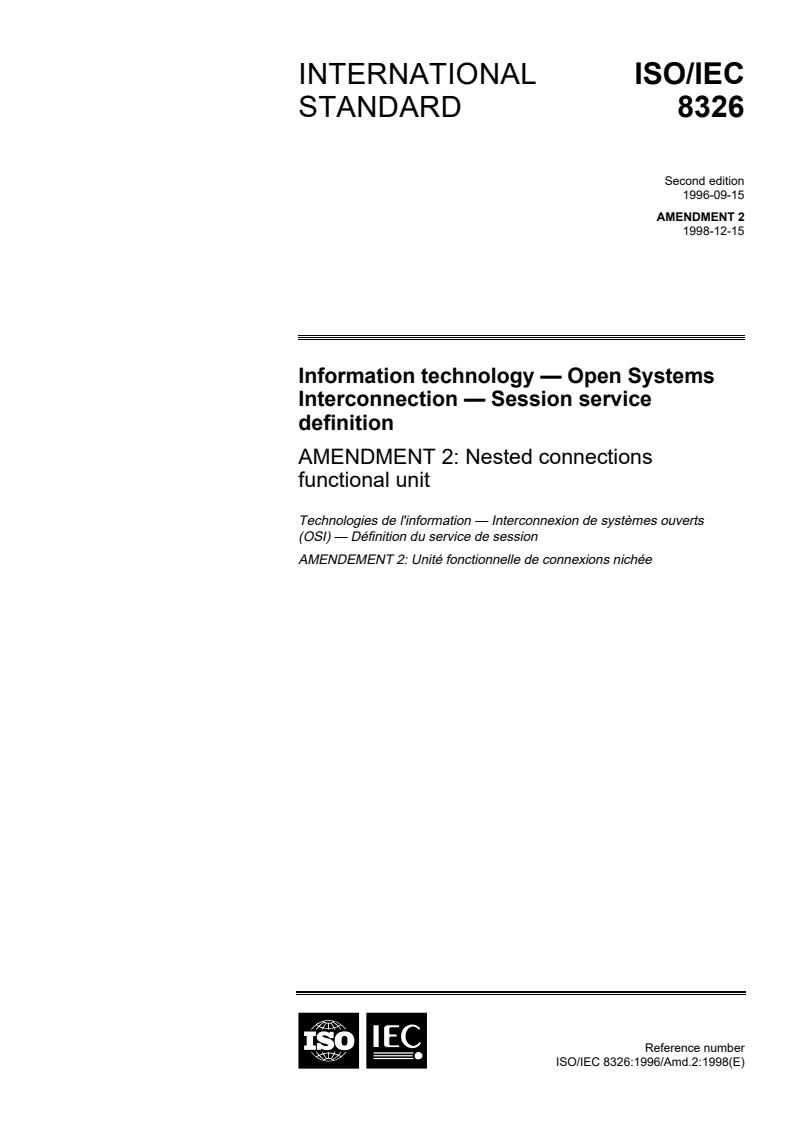

ISO/IEC 8326:1996/Amd 2:1998 - Information technology — Open Systems Interconnection — Session service definition — Amendment 2: Nested Connections Functional Unit Released:12/20/1998
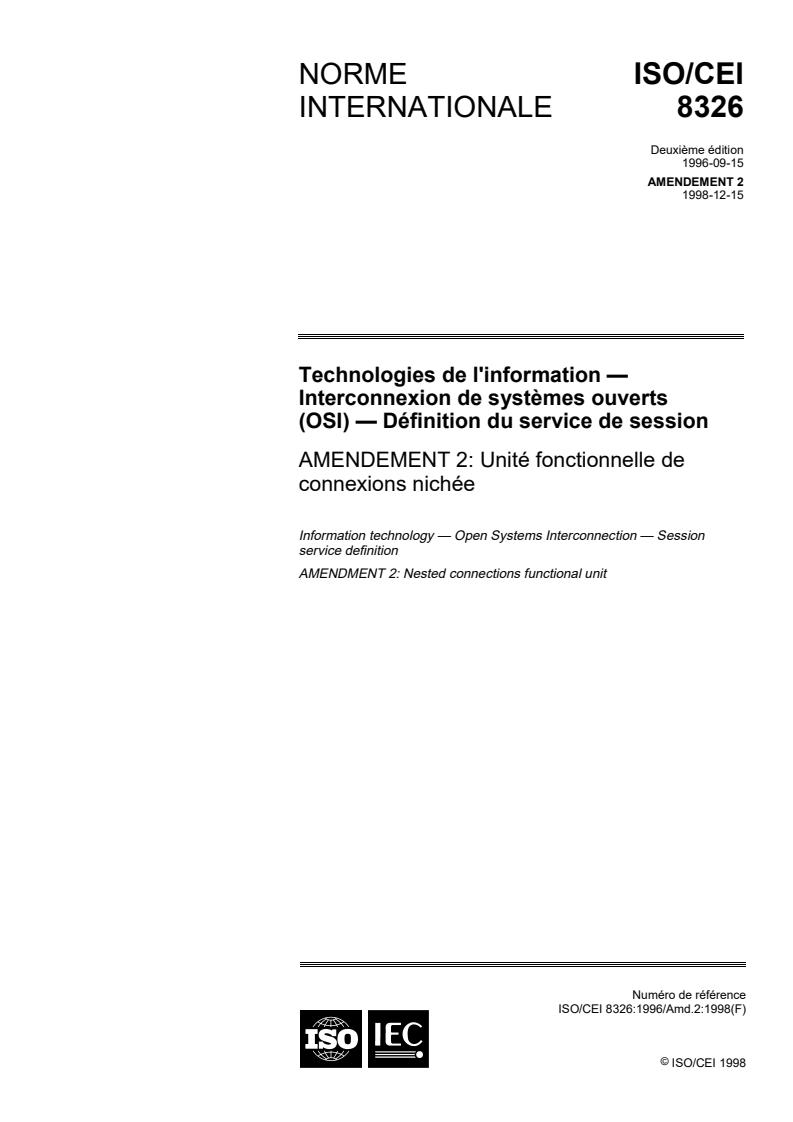

ISO/IEC 8326:1996/Amd 2:1998 - Technologies de l'information — Interconnexion de systemes ouverts (OSI) — Définition du service de session — Amendement 2: Unité fonctionnelle de connexions nichée Released:3/23/2000
Overview
ISO/IEC 8326:1996/Amd 2:1998 is an amendment to the International Standard defining the Session service within the Open Systems Interconnection (OSI) model. This amendment introduces the Nested Connections Functional Unit, enhancing session-layer communication by allowing the establishment of nested session connections within existing session connections. Developed by ISO/IEC JTC 1, this technical standard improves the flexibility and robustness of session management in information technology systems.
Key Topics
Nested Session Connections
This amendment defines the concept of nested connections, where additional session connections can be established inside an already existing session connection, at multiple possible nesting depths. Each nested connection operates semi-independently but shares the transport connection of the outer session.Functional Unit for Nested Connections
The nested connections functional unit controls the setup, management, and release of nested session connections. It includes specific service capabilities only available when this functional unit is selected during the initial session connection establishment.Sequencing and Flow Control Rules
Nested connections adhere to strict sequencing rules that ensure protocol messages within nested layers are delivered in order. Flow control mechanisms also govern interactions between nested connections to prevent data blocking or loss.Limitations on Nesting
The amendment specifies maximum numbers of nested connections allowed-up to 126 by the connection initiator and 127 by the acceptor within a single external session-to maintain manageable complexity.Exceptions and Abort Conditions
If an outer session connection is aborted or released, all nested connections within it are automatically aborted. Interruption services available on nested connections allow for exception reporting and abort operations without affecting the overall stability of the upper session layer.Interaction Rules Between Connections
- Nested connections use the same transport-level connection as the outer session.
- Services on parallel nested connections do not interrupt each other but may cause flow blocking.
- Services on an outer connection can interrupt nested connections, potentially triggering abort commands.
Applications
The Nested Connections Functional Unit as defined in ISO/IEC 8326:1996/Amd 2:1998 is critical for environments requiring:
Multilevel Session Management
Enables complex communication scenarios where applications maintain multiple sessions layered within a main session, improving control and resource allocation.Advanced Network Protocols
Facilitates implementation of sophisticated session protocols with nesting capabilities to enhance modular design and session coexistence.Reliable Data Exchange Over OSI Networks
Guarantees ordered and controlled interaction among nested sessions, vital for mission-critical systems that rely on stable session management.Session Layer Services in Distributed Systems
Supports the orchestration of multiple simultaneous session contexts, which is crucial in distributed applications such as telecommunication networks, database services, and transaction processing systems.
Related Standards
- ISO/IEC 8326:1996 - The original session service definition for OSI without nested connections.
- ITU-T Recommendation X.215 - The equivalent ITU-T specification aligned with ISO/IEC 8326, including amendments pertinent to nested connections.
- ISO/IEC 7498 (OSI Reference Model) - Provides the overall framework for OSI layers, including the session layer.
- ISO/IEC 8571 (File Transfer, Access and Management - FTAM) - Uses session layer services as defined in ISO/IEC 8326 for managing file transfer protocols.
Keywords: ISO/IEC 8326 amendment, OSI session service, nested connections, session layer, network protocol standards, information technology standards, session management, transport layer interaction, session functional units, data sequencing, flow control, session abort, ISO networking standards.
Relations
- Effective Date
- 06-Jun-2022
- Effective Date
- 15-Apr-2008
Buy Documents
ISO/IEC 8326:1996/Amd 2:1998 - Information technology — Open Systems Interconnection — Session service definition — Amendment 2: Nested Connections Functional Unit Released:12/20/1998
ISO/IEC 8326:1996/Amd 2:1998 - Technologies de l'information — Interconnexion de systemes ouverts (OSI) — Définition du service de session — Amendement 2: Unité fonctionnelle de connexions nichée Released:3/23/2000
Get Certified
Connect with accredited certification bodies for this standard

BSI Group
BSI (British Standards Institution) is the business standards company that helps organizations make excellence a habit.

NYCE
Mexican standards and certification body.
Sponsored listings
Frequently Asked Questions
ISO/IEC 8326:1996/Amd 2:1998 is a standard published by the International Organization for Standardization (ISO). Its full title is "Information technology — Open Systems Interconnection — Session service definition — Amendment 2: Nested Connections Functional Unit". This standard covers: Information technology — Open Systems Interconnection — Session service definition — Amendment 2: Nested Connections Functional Unit
Information technology — Open Systems Interconnection — Session service definition — Amendment 2: Nested Connections Functional Unit
ISO/IEC 8326:1996/Amd 2:1998 is classified under the following ICS (International Classification for Standards) categories: 35.100.50 - Session layer. The ICS classification helps identify the subject area and facilitates finding related standards.
ISO/IEC 8326:1996/Amd 2:1998 has the following relationships with other standards: It is inter standard links to ISO/IEC 8326:1996; is excused to ISO/IEC 8326:1996. Understanding these relationships helps ensure you are using the most current and applicable version of the standard.
ISO/IEC 8326:1996/Amd 2:1998 is available in PDF format for immediate download after purchase. The document can be added to your cart and obtained through the secure checkout process. Digital delivery ensures instant access to the complete standard document.
Standards Content (Sample)
INTERNATIONAL ISO/IEC
STANDARD 8326
Second edition
1996-09-15
AMENDMENT 2
1998-12-15
Information technology — Open Systems
Interconnection — Session service
definition
AMENDMENT 2: Nested connections
functional unit
Technologies de l'information — Interconnexion de systèmes ouverts
(OSI) — Définition du service de session
AMENDEMENT 2: Unité fonctionnelle de connexions nichée
Reference number
B C
ISO/IEC 8326:1996/Amd.2:1998(E)
ISO/IEC 8326:1996/Amd.2:1998(E)
© ISO/IEC 1998
All rights reserved. Unless otherwise specified, no part of this publication may be reproduced or
utilized in any form or by any means, electronic or mechanical, including photocopying and micro-
film, without permission in writing from the publisher.
ISO/IEC Copyright Office • Case postale 56 • CH-1211 Genève 20 • Switzerland
Printed in Switzerland
ii
©
ISO/IEC ISO/IEC 8326:1996/Amd.2:1998(E)
Foreword
ISO (the International Organization for Standardization) and IEC (the Inter-
national Electrotechnical Commission) form the specialized system for worldwide
standardization. National bodies that are members of ISO or IEC participate in the
development of International Standards through technical committees established
by the respective organization to deal with particular fields of technical activity.
ISO and IEC technical committees collaborate in fields of mutual interest. Other
international organizations, governmental and non-governmental, in liaison with
ISO and IEC, also take part in the work.
In the field of information technology, ISO and IEC have established a joint
technical committee, ISO/IEC JTC 1. Draft International Standards adopted by the
joint technical committee are circulated to national bodies for voting. Publication
as an International Standard requires approval by at least 75 % of the national
bodies casting a vote.
Amendment 2 to ISO/IEC 8326:1996 was prepared by ITU-T (as ITU-T
Rec. X.215/Amd.2) and was adopted, under a special “fast-track procedure”, by
Joint Technical Committee ISO/IEC JTC 1, Information technology, in parallel
with its approval by national bodies of ISO and IEC. The identical text is
published as ITU-T Rec. X.215/Amd.2.
iii
)3/�)%#�������������!MD�����������%�
).4%2.!4)/.!,��34!.$!2$
ISO/IEC 8326 : 1996/Amd.2 : 1998 (E)
ITU-T Rec. X.215 (1995)/Amd. 2 (1997 E)
)45�4��2%#/--%.$!4)/.
).&/2-!4)/.��4%#(./,/’9�� ��/0%.��3934%-3��).4%2#/.%#4)/.��
3%33)/.��3%26)#%��$%&).)4)/.
!-%.$-%.4���
.ESTED�CONNECTIONS�FUNCTIONAL�UNIT
�� .EW�SUBCLAUSES��������AND�������
!DD�AFTER��������
������ NESTED�SESSION�CONNECTION: A session connection which is logically embedded within an existing session
connection.
������ NESTED�SESSION�EXCEPTION: A condition which occurs if, as a result of discard by an enclosing session protocol
machine, session protocol data units for a nested session connection are discarded.
�� .EW�SUBCLAUSE����
!DD�A�NEW�SUBCLAUSE�����
��� .ESTED�SESSION�CONNECTIONS
A pair of session service users may communicate using a single session connection, or may choose to establish
additional session connections nested within the outermost connection (or within each other) to any depth.
The provisions of this Recommendation | International Standard apply independently to each such connection, except
where stated otherwise, with each connection independently determining at connection establishment time the session
functional units that are available on that connection.
The initiator of an outer-level session connection can initiate nested connections provided use of the nested connection
functional unit has been negotiated on the immediately enclosing session connection, and provided there are no more
than 126 nested session connections currently established (by the initiator) on this outer-level connection.
The acceptor of an outer-level session connection can initiate nested connections provided use of the nested connection
functional unit has been negotiated on the immediately enclosing session connection, and provided there are no more
than 127 nested session connections currently established (by the acceptor) on this outer-level connection.
)45�4�2EC��8������������!MD����������%� 1
)3/�)%#�������������!MD�����������%�
Interactions between connections that are nested within an outermost connection are as follows:
a) All such connections are carried on a single transport connection, and the sequenci
...
NORME ISO/CEI
INTERNATIONALE 8326
Deuxième édition
1996-09-15
AMENDEMENT 2
1998-12-15
Technologies de l'information —
Interconnexion de systèmes ouverts
(OSI) — Définition du service de session
AMENDEMENT 2: Unité fonctionnelle de
connexions nichée
Information technology — Open Systems Interconnection — Session
service definition
AMENDMENT 2: Nested connections functional unit
Numéro de référence
ISO/CEI 8326:1996/Amd.2:1998(F)
©
ISO/CEI 1998
ISO/CEI 8326:1996/Amd.2:1998(F)
PDF – Exonération de responsabilité
Le présent fichier PDF peut contenir des polices de caractères intégrées. Conformément aux conditions de licence d'Adobe, ce fichier peut
être imprimé ou visualisé, mais ne doit pas être modifié à moins que l'ordinateur employé à cet effet ne bénéficie d'une licence autorisant
l'utilisation de ces polices et que celles-ci y soient installées. Lors du téléchargement de ce fichier, les parties concernées acceptent de fait la
responsabilité de ne pas enfreindre les conditions de licence d'Adobe. Le Secrétariat central de l'ISO décline toute responsabilité en la
matière.
Adobe est une marque déposée d'Adobe Systems Incorporated.
Les détails relatifs aux produits logiciels utilisés pour la création du présent fichier PDF sont disponibles dans la rubrique General Info du
fichier; les paramètres de création PDF ont été optimisés pour l'impression. Toutes les mesures ont été prises pour garantir l'exploitation de
ce fichier par les comités membres de l'ISO. Dans le cas peu probable où surviendrait un problème d'utilisation, veuillez en informer le
Secrétariat central à l'adresse donnée ci-dessous.
© ISO/CEI 1998
Droits de reproduction réservés. Sauf prescription différente, aucune partie de cette publication ne peut être reproduite ni utilisée sous quelque
forme que ce soit et par aucun procédé, électronique ou mécanique, y compris la photocopie et les microfilms, sans l'accord écrit de l’ISO à
l’adresse ci-après ou du comité membre de l’ISO dans le pays du demandeur.
ISO copyright office
Case postale 56 � CH-1211 Geneva 20
Tel. + 41 22 749 01 11
Fax. + 41 22 734 10 79
E-mail copyright@iso.ch
Web www.iso.ch
Version française parue en 2000
ImpriméenSuisse
ii © ISO/CEI 1998 – Tous droits réservés
ISO/CEI 8326:1996/Amd.2:1998(F)
Avant-propos
L'ISO (Organisation internationale de normalisation) et la CEI (Commission électrotechnique internationale)
forment le système spécialisé de la normalisation mondiale. Les organismes nationaux membres de l'ISO ou de la
CEI participent au développement de Normes internationales par l'intermédiaire des comités techniques créés par
l'organisation concernée afin de s'occuper des domaines particuliers de l'activité technique. Les comités
techniques de l'ISO et de la CEI collaborent dans des domaines d'intérêt commun. D'autres organisations
internationales, gouvernementales et non gouvernementales, en liaison avec l'ISO et la CEI participent également
aux travaux.
Les Normes internationales sont rédigées conformément aux règles données dans les Directives ISO/CEI, Partie 3.
Dans le domaine des technologies de l'information, l'ISO et la CEI ont créé un comité technique mixte,
l'ISO/CEI JTC 1. Les projets de Normes internationales adoptés par le comité technique mixte sont soumis aux
organismes nationaux pour vote. Leur publication comme Normes internationales requiert l'approbation de 75 % au
moins des organismes nationaux votants.
L’attention est appelée sur le fait que certains des éléments du présent Amendement peuvent faire l’objet de droits
de propriété intellectuelle ou de droits analogues. L’ISO et la CEI ne sauraient être tenues pour responsables de
ne pas avoir identifié de tels droits de propriété et averti de leur existence.
L’Amendement 2 à l'ISO/CEI 8326:1996 a été élaboré par le comité technique mixte ISO/CEI JTC 1, Technologies
de l'information. Le texte identique est publié en tant que Rec. UIT-T X.215/Amd.2.
© ISO/CEI 1998 – Tous droits réservés iii
)3/�#%)�������������!MD�����������&�
./2-%��).4%2.!4)/.!,%
ISO/CEI 8326 : 1996/Amd.2 : 1998 (F)
Rec. UIT-T X.215 (1995)/Amd.2 (1997 F)
2%#/--!.$!4)/.��5)4�4
4%#(./,/’)%3��$%��,�).&/2-!4)/.�� ��).4%2#/.%8)/.��$%3��3934�-%3
/56%243�� ��$�&).)4)/.��$5��3%26)#%��$%��3%33)/.
!-%.$%-%.4���
5NIT'��FONCTIONNELLE�DE�CONNEXIONS�IMBRIQU'ES
�� .OUVEAUX�PARAGRAPHES��������ET�������
!JOUTER�APR¤S�LE�PARAGRAPHE��������
������ CONNEXION�DE�SESSION�IMBRIQU'E: est logiquement imbriquée dans une connexion de session existante.
������ EXCEPTION�DE�SESSION�IMBRIQU'E: condition qui intervient si, à la suite d'une suppression par une machine
protocolaire englobante, les unités de données protocolaires de session d'une connexion de session imbriquée sont
supprimées.
�� .OUVEAU�PARAGRAPHE����
!JOUTER�UN�NOUVEAU�PARAGRAPHE�����COMME�SUIT�
��� #ONNEXIONS�DE�SESSIONS�IMBRIQU'ES
Un couple d'utilisateurs du service de session peut communiquer au moyen d'une seule connexion de session, ou peut
choisir d'établir des connexions de sessions supplémentaires imbriquées à l'intérieur de connexions plus externes (ou
imbriquées les unes dans les autres) à une profondeur quelconque.
Les dispositions de la présente Recommandation | Norme internationale s'appliquent indépendamment de chacune de ces
connexions, sauf indication contraire; chaque connexion détermine séparément au moment de son établissement les
unités fonctionnelles de session dont elle dispose.
L'initiateur de la connexion de session au niveau externe peut établir des connexions imbriquées sous réserve que l'unité
fonctionnelle de connexion imbriquée ait été négociée sur la connexion de session englobante immédiatement
supérieure, et à condition qu'il n'y ait pas simultanément plus de 126 connexions de sessions imbriquées déjà établies
(par l'initiateur) sur cette connexion externe.
L'accepteur d'une connexion de session au niveau externe peut établir des connexions imbriquées sous réserve que l'unité
fonctionnelle de connexion imbriquée ait été négociée sur la connexion de session englobante immédiatement
supérieur
...