


ISO 8327:1987
(Main)Information processing systems — Open Systems Interconnection — Basic connection oriented session protocol specification
Information processing systems — Open Systems Interconnection — Basic connection oriented session protocol specification
Systèmes de traitement de l'information — Interconnexion de systèmes ouverts — Protocole de session en mode connexion
General Information
- Status
- Withdrawn
- Publication Date
- 05-Aug-1987
- Withdrawal Date
- 05-Aug-1987
- Technical Committee
- ISO/IEC JTC 1 - Information technology
- Drafting Committee
- ISO/IEC JTC 1 - Information technology
- Current Stage
- 9599 - Withdrawal of International Standard
- Start Date
- 10-Oct-1996
- Completion Date
- 12-Feb-2026
Relations
- Effective Date
- 06-Jun-2022
- Effective Date
- 15-Apr-2008
- Effective Date
- 18-Dec-2008
Get Certified
Connect with accredited certification bodies for this standard

BSI Group
BSI (British Standards Institution) is the business standards company that helps organizations make excellence a habit.

NYCE
Mexican standards and certification body.
Sponsored listings
Frequently Asked Questions
ISO 8327:1987 is a standard published by the International Organization for Standardization (ISO). Its full title is "Information processing systems — Open Systems Interconnection — Basic connection oriented session protocol specification". This standard covers: Information processing systems — Open Systems Interconnection — Basic connection oriented session protocol specification
Information processing systems — Open Systems Interconnection — Basic connection oriented session protocol specification
ISO 8327:1987 is classified under the following ICS (International Classification for Standards) categories: 35.100.50 - Session layer. The ICS classification helps identify the subject area and facilitates finding related standards.
ISO 8327:1987 has the following relationships with other standards: It is inter standard links to ISO 8327:1987/Amd 3:1992, ISO/IEC 8327-1:1996; is excused to ISO 8327:1987/Amd 3:1992. Understanding these relationships helps ensure you are using the most current and applicable version of the standard.
ISO 8327:1987 is available in PDF format for immediate download after purchase. The document can be added to your cart and obtained through the secure checkout process. Digital delivery ensures instant access to the complete standard document.
Standards Content (Sample)
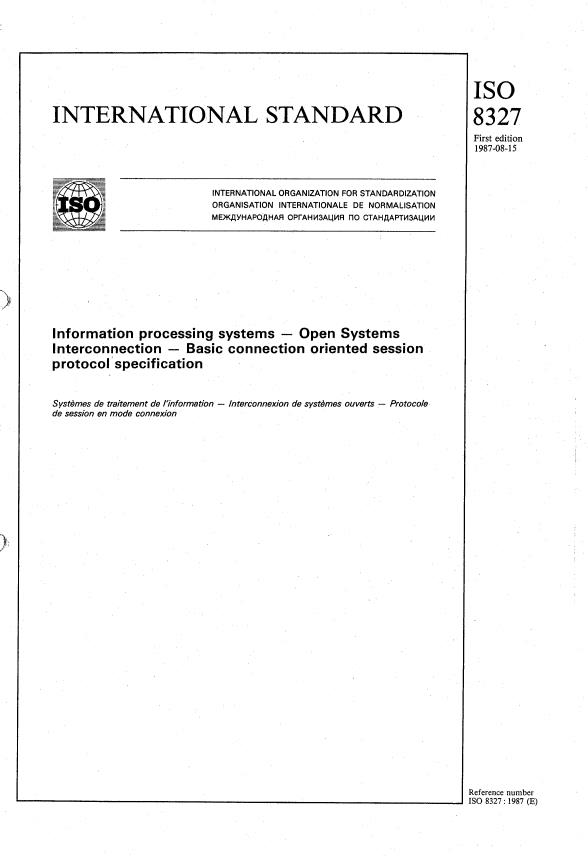
IS0
INTERNATIONAL STANDARD
First edition
1987-08-15
INTERNATIONAL ORGANIZATION FOR STANDARDIZATION
ORGANISATION INTERNATIONALE DE NORMALISATION
MEXAYHAPOAHAR OPrAHM3AL(Mfl il0 CTAHAAPTM3AL(MM
Information processing systems - Open Systems
Interconnection - Basic connection oriented session
protocol specification
Systèmes de traitement de l'information - Interconnexion de systèmes ouverts - Protocole
de session en mode connexion
Leference number
SO 8327 : 1987 (E)
Foreword
IS0 (the International Organization for Standardization) is a worldwide federation of
national standards bodies (IS0 member bodies). The work of preparing International
StandardKis normally carried out through IS0 technical committees. Each member
body interested in a subject for which a technical committee has been established has
the right to be represented on that committee. International organizations, govern-
mental and non-governmental, in liaison with ISO, also take part in the work.
Draft International Standards adopted by the technical committees are circulated to
the member bodies for approval before their acceptance as International Standards by
the IS0 Council. They are approved in accordance with IS0 procedures requiring at
least 75 % approval by the member bodies voting.
International Standard IS0 8327 was prepared by Technical Committee ISO/TC 97,
Information processing systems.
Users should note that all International Standards undergo revision from time to time
and that any reference made herein to any other International Standard implies its
latest edition, unless otherwise stated.
@ International Organization for Standardization, 1987 O
Printed in Switzerland
ii
IS0 8327 : 1987 (E)
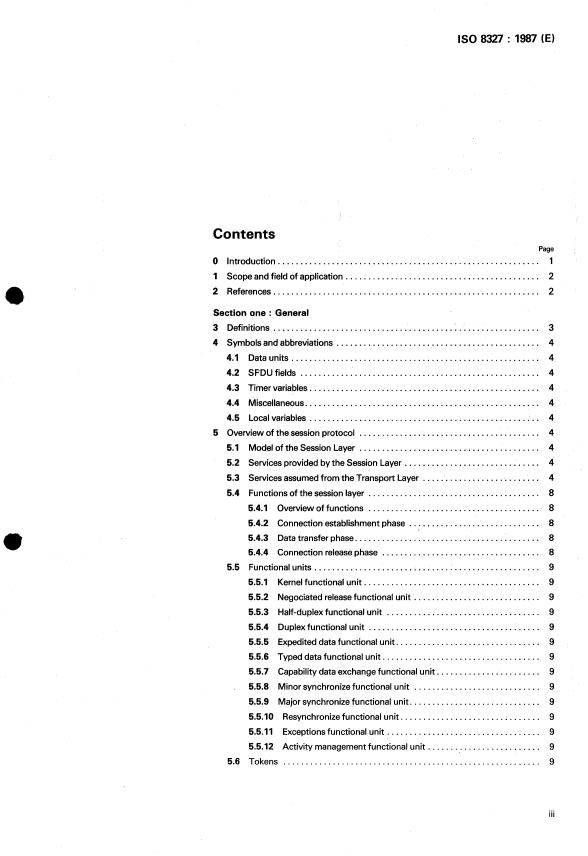
Contents
Page
O Introduction . 1
1 Scope and field of application . 2
2 References . 2
Section one : General
3 Definitions . 3
4 Symbols and abbreviations . 4
4.1 Dataunits . 4
4.2 SFDU fields . 4
4.3 Timer variables . 4
4.4 Miscellaneous . 4
4.5 Local variables .
5 Overview of the session protocol . 4
5.1 Model of the Session Layer . 4
5.2 Services provided by the Session Layer .
5.3 Services assumed from the Transport Layer . 4
5.4 Functions of the session layer . 8
5.4.1 Overview of functions . 8
5.4.2 Connection establishment phase .
5.4.3 Data transfer phase . 8
5.4.4 Connection release phase . 8
5.5 Functional units . 9
5.5.1 Kernel functional unit . . 9
5.5.2 Negociated release functional unit . 9
5.5.3 Half-duplex functional unit . 9
5.5.4 Duplex functional unit . 9
5.5.5 Expedited data functional unit . 9
5.5.6 Typed data functional unit . 9
5.5.7 Capability data exchange functional unit . 9
5.5.8 Minor synchronize functional unit .
5.5.9 Major synchronize functional unit . 9
5.5.10 Resynchronize functional unit . 9
5.5.11 Exceptions functional unit . 9
5.5.12 Activity management functional unit . 9
5.6 Tokens . 9
...
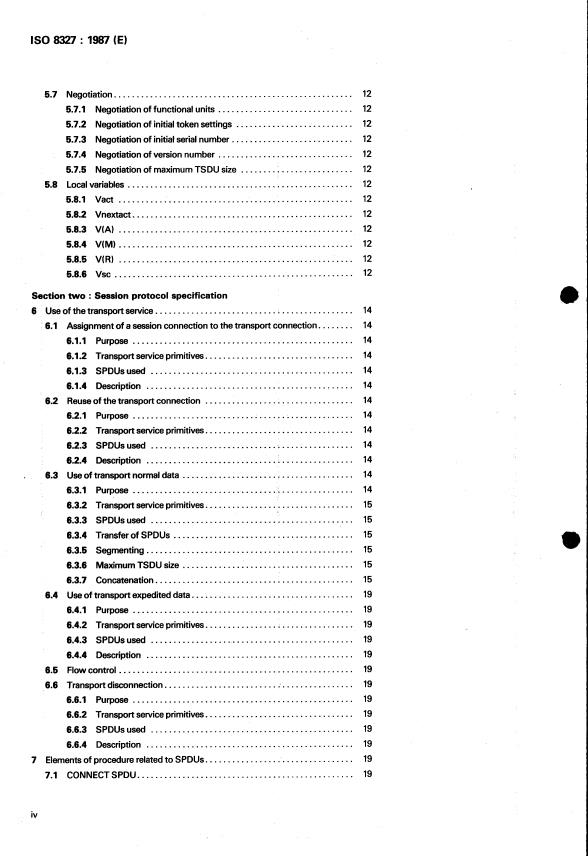
IS0 8327 : 1987 (E)
5.7 Negotiation .
5.7.1 Negotiation of functional units . 12
5.7.2 Negotiation of initial token settings .
5.7.3 Negotiation of initial serial number . 12
5.7.4 Negotiation of version number .
5.7.5 Negotiation of maximum TSDU size . 12
5.8 Localvariables .
5.8.1 Vact .
5.8.2 Vnextact . 12
5.8.3 V(A) .
5.8.4 V(M) .
5.8.5 V(R) . 12
5.8.6 Vsc . 12
Section two : Session protocol specification
6 Use of the transport service .
6.1 Assignment of a session connection to the transport connection . 14
6.1.1 Purpose .
6.1.2 Transport service primitives .
6.1.3 SPDUsused . 14
6.1.4 Description .
6.2 Reuse of the transport connection . 14
6.2.1 Purpose . 14
6.2.2 Transport service primitives . 14
6.2.3 SPDUsused .
6.2.4 Description . 14
6.3 Use of transport normal data .
6.3.1 Purpose .
6.3.2 Transport service primitives . . 15
6.3.3 SPDUsused . .
6.3.4 Transfer of SPDUs . . 15
6.3.5 Segmenting . .
6.3.6 Maximum TSDU size . .
6.3.7 Concatenation . . 15
6.4 Use of transport expedited data . 19
6.4.1 Purpose .
6.4.2 Transport service primitives . 19
6.4.3 SPDUsused .
6.4.4 Description .
6.5 Flowcontrol . 19
Transportdiçconnection .
6.6 19
6.6.1 Purpose .
6.6.2 Transport service primitives . 19
6.6.3 SPDUsused .
6.6.4 Description .
7 Elements of procedure related to SPDUs . 19
7.1 CONNECT SPDU .
iv
IS0 8327 : 1987 (E)
7.2 ACCEPTSPDU . 20
7.3 REFUSESPDU . 21
7.4 FINISHSPDU . 22
7.5 DISCONNECTSPDU . 22
7.6 NOT FINISHED SPDU . 22
7.7 ABORTSPDU . 22
7.8 ABORT ACCEPT SPDU . 23
7.9 DATA TRANSFER SPDU . 23
7.10 EXPEDITED SPDU . 24
7.11 TYPED DATA SPDU . 24
7.12 CAPABILITY DATA SPDU . 25
7.13 CAPABILITY DATA ACK SPDU . 25
7.14 GIVE TOKENS SPDU . 25
7.15 PLEASE TOKENS SPDU . 25
7.16 GIVE TOKENS CONFIRM SPDU . 26
7.17 GIVE TOKENS ACK SPDU . 26
7.18 MINOR SYNC POINT SPDU . 26
7.19 MINOR SYNC ACK SPDU . 26
7.20 MAJOR SYNC POINT SPDU . 27
7.21 MAJOR SYNC ACK SPDU . 27
7.22 RESYNCHRONIZE SPDU . 27
7.23 RESYNCHRONIZE ACK SPDU . 28
7.24 PREPARESPDU . 29
7.25 EXCEPTION REPORT SPDU . 30
7.26 EXCEPTION DATA SPDU . 30
7.27 ACTIVITY START SPDU . 31
7.28 ACTIVITY RESUME SPDU . 31
7.29 ACTIVITY INTERRUPTSPDU . 31
7.30 ACTIVITY INTERRUPTACK SPDU . 32
7.31 ACTIVITY DISCARD SPDU . 32
7.32 ACTIVITY DISCARD ACK SPDU . 32
7.33 ACTIVITYENDSPDU . 33
7.34 ACTIVITY END ACK SPDU . 33
8 Structureand encoding of SPDUs . 33
8.1 TSDUstructure . 33
8.2 SPDUstructure . 34
8.2.1 SPDUs . 34
8.2.2 PGIunits . 34
8.2.3 Plunits . 36
8.2.4 Identifier fields . 36
8.2.5 Length indicator field . 36
8.2.6 Parameter fields . 36
8.2.7 Parameter values . 36
8.2.8 User information fields . 36
V
IS0 8327 : 1987 (E)
8.3 SPDU identifiers and associated parameter fields .
8.3.1 CONNECT (CN) SPDU . 37
8.3.2 ACCEPT (AC) SPDU .
8.3.3 REFUSE (RF) SPDU .
8.3.4 FINISH (FN) SPDU . 41
8.3.5 DISCONNECT (DN) SPDU .
8.3.6 NOT FINISHED (NF) SPDU .
8.3.7 ABORT (AB) SPDU . 42
8.3.8 ABORT ACCEPT (AA) SPDU .
8.3.9 DATATRANSFER (DT) SPDU . 43
8.3.10 EXPEDITED (EX) SPDU .
8.3.11 TYPED DATA (TD) SPDU .
8.3.12 CAPABILITY DATA (CD) SPDU .
8.3.13 CAPABILITY DATA ACK (CDA) SPDU .
8.3.14 GIVETOKENS (GT) SPDU .
8.3.15 PLEASETOKENS (PT) SPDU .
8.3.16 GIVE TOKENS CONFIRM (GTC) SPDU .
8.3.17 GIVE TOKENS ACK (GTA) SPDU .
8.3.18 MINOR SYNC POINT(MIP) SPDU .
8.3.19 MINOR SYNCACK (MIA) SPDU .
8.3.20 MAJOR SYNC POINTACK (MAP) SPDU .
8.3.21 MAJOR SYNC ACK (MAA) SPDU .
8.3.22 RESYNCHRONIZE (RS) SPDU .
8.3.23 RESYNCHRONIZE ACK (RA) SPDU .
8.3.24 PREPARE (PR) SPDU .
8.3.25 EXCEPTION REPORT (ER) SPDU .
8.3.26 EXCEPTION DATA (ED) SPDU .
8.3.27 ACTIVITY START (AS) SPDU .
8.3.28 ACTIVITY RESUME (AR) SPDU .
8.3.29 ACTIVITY INTERRUPT (Al) SPDU .
8.3.30 ACTIVITY INTERRUPTACK (AIA) SPDU .
8.3.31 ACTIVITY DISCARD (AD) SPDU .
8.3.32 ACTIVITY DISCARD ACK (ADA) SPDU .
8.3.33 ACTIVITY END (AE) SPDU .
8.3.34 ACTIVITY END ACK (AEA) SPDU .
Section three : Conformance
9 Conformance to this International Standard . 53
Annexes
A Statetables . 54
B Relationship to CCllT Recommendation T.62 encoding . 87
PGI and PIS reserved for use by CCllT Recommendation T.62 . 90
C
D Corrections incorporated in IS0 8327 : 1987 . 91
vi
IS0 8327 : 1987 (E)
INTERNATIONAL STANDARD
Information processing systems - Open Systems
Interconnection - Basic connection oriented session
protocol specification
O Introduction c) as part of an agreement for the admittance of systems
into the open systems environment;
This International Standard is one of a set of International Stan-
dards produced to facilitate the interconnection of computer d) as a refinement to tbe understanding of OSI.
systems. The set of International Standards covers the services
e and protocols required to achieve such interconnection. As it is expected that the initial users of this International Stan-
dard will be designers and implementors of equipment this
This International Standard is related to other International
International Standard contains, in notes or in annexes,
Standards in the set as defined by the Reference Model for
guidance on the implementation of the procedures defined
Open Systems Interconnection (IS0 7498). The Reference
herein.
Model subdivides the area of standardization for interconnec-
tion into a series of layers of specification, each of manageable
It should be noted that, as the number of valid protocol se-
size. It is most closely related to and lies within the field of ap-
quences is very large, it is not possible with current technology
plication of the Session Service Definition (IS0 8326). It also
to verify that an implementation will operate the protocol de-
uses and references the Transport Service Definition
fined in this International Standard correctly under all
(IS0 8û72). whose provisions it assumes in order to accomplish
circumstances. It is possible by means of testing to establish
the aims of the session protocol. The interrelationship of these
confidence that an implementation correctly operates the pro-
International Standards is illustrated in figure 1.
tocol in a representative sample of circumstances. It is,
however, intended that this International Standard can be used
This International Standard specifies a single protocol with a
in circumstances where two implementations fail to com-
common encoding.
municate in order to determine whether one or both have failed
to operate the protocol correctly.
It is intended that the session protocol should be general
enough to cater for the total range of session service users
The variations and options available within this International
without restricting future extensions.
Standard are essential as they enable a session service to be
provided for a wide variety of applications. Thus, a minimally
The protocol is structured so that subsets of protocol can be
conforming implementation will not be suitable for use in all
defined.
possible circumstances. It is important, therefore, to qualify all
references to this International Standard with statements of the
The primary aim of this International Standard is to provide a
options provided or required or with statements of the intended
set of rules. for communication expressed in terms of the pro-
purpose of provision or use.
cedures to be carried out by peer session entities at the time of
communication. These rules for communication are intended
This International Standard contains the following annexes :
to provide a sound basis for development in order to serve a
variety of purposes :
ai annex A - State tables;
a) as a guide for implementors and designers;
b) annex 6 - Relationship to CCllT Recommendation
T.62 encoding;
b) for use in the testing and procurement of equipment;
Session Service Definition
Session Reference to aims
Protocol
Specification Reference to assumptions
Transport Service Definition -
Figure 1 - Relationship between the session protocol and adjacent services
IS0 8327 : 1987 (E)
These procedures are applicable to instances of communication
c) annex C - PGIs and PIS reserved for use by Recom-
between systems which support the Session Layer of the OS1
mendation T.62.
Reference Model and which wish to interconnect in an open
systems environment.
1 Scope and field of application
This International Standard also specifies conformance require-
ments for systems implementing these procedures. It does not
This International Standard specifies
contain tests which can be used to demonstrate this confor-
mance.
a) procedures for a single protocol for the transfer of data
and control information from one session entity to a peer
session entity;
2 References
b) the means of selecting the functional units to be used IS0 7498, Information processing systems - Open Systems
Interconnection - Basic Reference Model.
by the session entities;
IS0 7498fAdd. 3, lnformation processing systems - Open
ci the structure and encoding of the session protocol data
Systems Interconnection - Basic Reference Model - Adden-
units used for the transfer of data and control information.
dum 3: Naming including addressing. 7 1
IS0 8072, Information processing systems - Open Systems
The procedures are defined in terms of
Interconnection - Transport Service Definition.
a) the interactions between peer session entities through IS0 8326, Information processing systems - Open Systems
the exchange of session protocol data units;
Interconnection - Basic connection oriented session service
definition.
b) the interactions between a session entity and the ses-
CClTT Recommendation T.62, Control Procedures for the Tele-
sion service user in the same system through the exchange
tex and Group 4 Facsimile Services.
of session service primitives;
NOTE - CCITT Recommendation T.62 is not essential for the appli-
c) the interactions between a session entity and the trans-
cation of this International Standard, but is included in the list of refe-
port service provider through the exchange of transport ser- rences as it has been referred to, for information, in relation to inter-
CClTT Telematic services (see annex B and Cl.
vice primitives. working with the
1) At present at the stage of draft; publication anticipated in due course.
IS0 8327 : 1987 (El
Section one : General
3.3.2 session-service user (SS-user) : An abstract
3 Definitions
representation of the totality of those entities within a single
NOTE - The definitions contained in this clause make use of abbrevia-
system that make use of the session service.
tions defined in clause 4.
3.1 This International Standard is based on the concepts 3.3.3 transport-service provider (TS-provider) : An
developed in IS0 7498, and makes use of the following terms abstract machine which models the totality of the entities pro-
defined in it :
viding the transport service, as viewed by a session entity.
a) expedited-session-service-data-unit;
3.3.4 local matter : A decision made by a system concerning
b) session-connection;
its behaviour in the Session Layer that is not subject to the re-
c) Session Layer;
quirements of this protocol.
d) session-protocol-data-unit;
0 e) session-service;
3.3.5 initiator : An SPM that initiates a CONNECT SPU.
f) session-service-access-point;
3.3.6 responder : An SPM with whom an initiator wishes to
g) session-service-data-unit;
establish a session connection.
h) Transport Layer;
i) transport-connection;
NOTE - Initiator and responder are defined with respect to a single
session connection.
j) transport-service;
k) transport-service-access-point;
3.3.7 sending SPM : An SPM that sends a given SPDU.
I) concatenation;
m) segmenting;
3.3.8 receiving SPM : An SPM that receives a given SPDU.
n) session selector (defined in IS0 74!38/Add. 3).
3.3.9 owner (of a token) : The SPM to whom a token is
3.2 This International Standard is also based on concepts
assigned.
developed in IS0 8326 and makes use of the following terms
defined in it :
3.3.10 proposed parameter : The value for a parameter pro-
ai token;
posed by an SPM in a CONNECT SPDU or an ACCEPT SPDU
b) calling SS-user;
that it wishes to use on the session connection.
c) called SS-user;
9 d) sending SS-user;
3.3.11 negotiation : The process by which two SPMs agree
a common set of functional units and protocol values and on
on
e) receiving SS-user;
the initial setting of available tokens.
f) requesting SS-user;
g) accepting SS-user;
3.3.12 selected parameter : The value for a parameter that
h) requestor;
has been chosen for use on the session connection.
i) acceptor.
3.3.13 valid SPDU : An SPDU which complies with the
NOTE - The following terms used in this International Standard are
requirements of this International Standard with respect to
used in relation to tokens and are explained in IS0 8326 :
structure and encoding.
a) assigned;
b) not assigned;
3.3.14 invalid SPDU : An SPDU which does not comply
c) available; with the requirements of this International Standard with
respect to structure and encoding.
d) not available.
For the purposes of this International Standard, the
3.3
3.3.15 protocol error: Use of an SPDU that does not
following definitions also apply.
comply with the procedures agreed for the session connection.
3.3.1 Session Protocol Machine (SPM) : An abstract
3.3.16 transparent (data) : SS-user data which is transfer-
machine thatcarriesouttheproceduresspecified in this protocol.
red intact between SPMs and which is unavailable for use by
NOTE - A session entity comprises one or more SPMs.
the SPMs.
IS0 8327 : 1987 (E)
4.4 Miscellaneous
3.3.17 SPDU identifier (SI) : Heading information that
identifies the SPDU concerned.
Session Protocol Machine (see 3.3.1)
SPM
SS session-service
3.3.18 length indicator (LI) : An indicator that represents
SSAP session-service-access-point
the length of an associated parameter field.
TSAP transport-service-access-point
3.3.19 parameter field : A group of one or more octets used
4.5 Local variables
to represent a particular set of information.
Vact See 5.8.1
3.3.20 parameter identifier (PI) : An identifier, defined in
Vnextact See 5.8.2
this International Standard, that indicates the type of
ViA) See 5.8.3
information contained in its associated parameter field.
V(M) See 5.8.4
V(R) See 5.8.5
vsc See 5.8.6
3.3.21 PI unit : An element of an SPDU that contains a PI
field together with its associated LI field and parameter field.
5 Overview of the session protocol
3.3.22 parameter group identifier (PGI) : An identifier,
defined in this International Standard, that indicates the type of
5.1 Model of the Session Layer
information contained in its associated parameter field. The
associated parameter field may consist of a set of PI units.
The SPM (see the note) within the Session Layer
communicates with the SS-user through an SSAP by means of
3.3.23 PGI unit : An element of an SPDU that contains a PGI
the service primitives as defined by the session service
LI field and parameter field.
field together with its associated
definition (IS0 8326). Service primitives will cause or be the
result of session protocol data unit exchanges between the
peer SPMs using a transport connection. These protocol
3.3.24 parameter value (PV) : Information that represents
exchanges are effected using the services of the Transport
the value of the parameter identified by either a PI or PGI.
Layer as defined by the transport service definition (IS0 8072)
through two TSAPs.
3.3.25 local variable : A local variable within the SPM which
is used as a means of clarifying the effects of certain actions
Session connection endpoints are identified in end systems by
and clarifying the conditions under which certain actions are
so that the
an internal, implementation dependent, mechanism
permitted.
SS-user and the SPM can refer to each session connection.
The model of the Session Layer is illustrated in figure 2.
4 Symbols and abbreviations
NOTE - A session entity comprises one or more SPMs.
4.1 Data units
5.2 Services provided by the Session Layer
SPDU session-protocol-data-unit
SSDU session-service-data-unit
The protocol specified in this lnternhonal Standard supports
TSDU transport-service-data-unit
the session service defined in IS0 8326. Information is
transferred to and from the SS-user using the session service
primitives listed in table 1. Table 1 also defines the SPDUs
4.2 SPDU fields
associated with each of the service primitives.
SI SPDU identifier (see 3.3.17)
LI length indicator (see 3.3.18)
5.3 Services assumed from the Transport Layer
PI parameter identifier (see 3.3.20)
parameter group identifier (see 3.3.22)
PGI
The protocol specified in this International Standard assumes
PV parameter value (see 3.3.24)
the use of the connection-oriented transport service defined in
IS0 8072.
4.3 Timer variables
Information is transferred to and from the TS-provider in the
transport service primitives listed in table 2.
TIM Disconnection and abort timer
IS0 8327 : 1987 (E)
( SSAP )
( SSAP )
Session Protocol Sessior7 ,Protocol
Machine
Machine
I
I l
TSAP
( TSAP ) ( 1 )
Figure 2 - Model of the Session Layer
IS0 8327 : 1987 (E)
Table 1 - Session service primitives
Associated SPDUs
Service Primitives
Session CONNECT SPDU
S-CONNECT request
connection
CONNECT SPDU
S-CONNECT indication
S-CONNECT (accept) response ACCEPT SPDU
ACCEPT SPDU
S-CONNECT (accept) confirm
REFUSE SPDU
S-CONNECT (reject) response
REFUSE SPDU
S-CONNECT (reject) confirm
DATA TRANSFER SPDU
Normal S-DATA request
S-DATA indication DATA TRANSFER SPDU
transfer
Expedited S-EXPEDITED-DATA request EXPEDITED DATA SPDU
S-EXPEDITED-DATA indication EXPEDITED DATA SPDU
transfer
S-TYPED-DATA request TYPED DATA SPDU
S-TYPED-DATA indication TYPED DATA SPDU
CAPABILITY DATA SPDU
Capability S-CAPABILITY-DATA request
CAPABILITY DATA SPDU
S-CAPABILITY-DATA indication
exchange
CAPABILITY DATA ACK SPDU
S-CAPABILITY-DATA response
CAPABILITY DATA ACK SPDU
S-CAPABILITY-DATA confirm
GIVE TOKENS SPDU
S-TOKEN-GIVE request
tokens
GIVE TOKENS SPDU
S-TOKEN-GIVE indication
PLEASE TOKENS SPDU
Please S-TOKEN-PLEASE request
tokens
PLEASE TOKENS SPDU
S-TOKEN-PLEASE indication
GIVE TOKENS CONFIRM SPDU
Give S-CONTROL-GIVE request
t control
GIVE TOKENS CONFIRM SPDU
S-CONTROL-GIVE indication
MINOR SYNC POINT SPDU
Minor
S-SYNC-MINOR request
synchron-
MINOR SYNC POINT SPDU
S-SYNC-MINOR indication
ization
point MINOR SYNC ACK SPDU
S-SYNC-MINOR response
MINOR SYNC ACK SPDU
S-SYNC-MINOR confirm
MAJOR SYNC SPDU
S-SYNC-MAJOR request
synchron-
MAJOR SYNC POINT SPDU
S-SYNC-MAJOR indication
nization
point MAJOR SYNC ACK SPDU
S-SYNC-MAJOR response
MAJOR SYNC ACK SPDU
S-SYNC-MAJOR confirm
RESYNCHRONIZE SPDU
S-RESYNCHRONIZE request
ization
RESYNCHRONIZE SPDU
S-RESYNCHRONIZE indication
RESYNCHRONIZE ACK SPDU
S-RESYNCHRONIZE response
RESYNCHRONIZE ACK SPDU
S-RESYNCHRONIZE confirm
EXCEPTION REPORT SPDU
P;Exception
S-P-EXCEPTION-REPORT indication
report
EXCEPTION DATA SPDU
U-Exception S-U-EXCEPTION-REPORT request
reporting
EXCEPTION DATA SPDU
S-U-EXCEPTION-REPORT indication
ACTIVITY START SPDU
Activity S-ACTIVITY-START request
ACTIVITY START SPDU
S-ACTIVITY-START indication
IS0 8327 : 1987 (E)
Table 'I (concluded
Primitives Associated SPDUs
Service
Activity S-ACTIVITY-RESUME request ACTIVITY RESUME SPDU
resume
S-ACTIVITY-RESUME indication ACTIVITY RESUME SPDU
Activity S-ACTIVITY-INTERRUPT request ACTIVITY INTERRUPT SPDU
interrupt
S-ACTIVITY-INTERRUPT indication ACTIVITY INTERRUPT SPDU
ACTIVITY INTERRUPT ACK SPDU
S-ACTIVITY-INTERRUPT response
S-ACTIVITY-INTERRUPT confirm ACTIVITY INTERRUPT ACK SPDU
Activity ACTIVITY DISCARD SPDU
S-ACTIVITY-DISCARD request
discard
S-ACTIVITY-DISCARD indication ACTIVITY DISCARD SPDU
S-ACTIVITY-DISCARD response ACTIVITY DISCARD ACK SPDU
S-ACTIVITY-DISCARD confirm ACTIVITY DISCARD ACK SPDU
Activity S-ACTIVITY-END request ACTIVITY END SPDU
end
S-ACTIVITY-END indication ACTIVITY END SPDU
e
S-ACTIVITY-END response ACTIVITY END ACK SPDU
S-ACTIVITY-END confirm ACTIVITY END ACK SPDU
Orderly FINISH SPDU
S-RELEASE request
release
S-RELEASE indication FINISH SPDU
S-RELEASE (accept) response DISCONNECT SPDU
S-RELEASE (accept) confirm DISCONNECT SPDU
S-RELEASE (reject) response
NOT FINISHED SPDU
S-RELEASE (reject) confirm NOT FINISHED SPDU
U-Abort S-U-ABORT request ABORT SPDU
S-U-ABORT indication ABORT SPDU
P-Abort S-P-ABORT indication ABORT SPDU
Table 2 - Transport service primitives
Primitives XIY Parameters
e
T-CONNECT request
X Called address
indication
Calling address
Expedited data option
Quality of service
TS-user-data
X Quality of service
T-CONNECT response
confirm Responding address
Expedited data option
TS-user-data
T-DATA request I X I TS-user-data
indication
T-EXPEDITED-DATA request Y TS-user-data
indication
T-DISCONNECT request X TS-user-data
T-DISCONNECT indication X Disconnect reason
TS-user-data
Key :
X : The session protocol assumes that this service is always available.
Y : The session protocol assumes that this service is provided by the Transport Layer when requested by the SPM during the session connection
establishment phase.
IS0 8327 : 1987 (E)
c) exception reporting (see 7.25 and 7.261, to enable the
5.4 Functions of the Session Layer
SS-provider or the SS-user to report exception conditions
that are less than those requiring abort;
5.4.1 Overview of functions
d) typed data transfer (see 7.111, to enable transfer of in-
The functions in the Session Layer are those necessary to
formation which is not subject to assignment of the data
bridge the gap between the services available from the
token;
Transport Layer and those offered to the SS-users.
e) minor synchronization point (see 7.18 and 7.191, to
The functions in the Session Layer are concerned with dialogue
enable the SS-users to define minor synchronization points
management, data flow synchronization, and data flow resyn-
in the normal data flow. These minor synchronization points
chronization.
may optionally be confirmed, but have no implications on
the data flow. Minor synchronization points are identified by
These functions are described below; the descriptions are
synchronization point serial numbers. The serial number is
grouped into those concerned with the connection establish-
incremented by one on each occasion that a minor syn-
ment phase, the data transfer phase, and the release phase.
chronization point is placed in the data flow, and each time
a minor synchronization point is received, such that both
SS-users have the same serial numbers for the same syn-
5.4.2 Connection establishment phase
chronization point;
The purpose of the connection establishment phase is to
f) major synchronization point [see 7.20 and 7.21 and e)
establish a session connection between two SS-users, and
above], to enable the SS-users to define major synchroniza-
tion points in the normal data flow. These major syn-
a) to map session addresses onto transport addresses;
chronization points are required to be confirmed before the
requesting SS-user is permitted to send any subsequent
b) to select transport quality of service parameters needed
data on either the normal flow or the expedited flow and as
(see 6.1.4);
such clearly separate the dialogue units;
c) to negotiate session parameters (see 7.1 and 7.2);
resynchronize (see 7.22 and 7.231, a function that
g)
allows a session connection to be set or reset to a defined
to transfer session selectors (see 7.1 and 7.2) if re-
d)
synchronization point and reassign the tokens;
quired;
h) expedited data transfer (see 7.101, a function used to
e) to distinguish between session connections (see 7.1
convey a limited amount of user data with special handling.
and 7.2);
Such data may bypass normal data en route, but will be
delivered prior to any data subsequently sent on the
f) to transfer a limited amount of transparent user data
transport normal flow or the transport expedited flow;
(see 7.1 and 7.2).
i) activity management (see 7.27 to 7.34) provides a means
explicitly to start, end, assume, interrupt or discard an
5.4.3 Data transfer phase
activity. This provides a way
The purpose of the data transfer phase is to transport SSDUs
1) to identify the entered activity and commence syn-
between two SS-users connected by a session connection.
chronization point serial numbering;
This purpose is achieved by means of transmission of SPDUs
and by the following functions, each of which may or may not
2) to identify the continued activity and reset the syn-
be used, depending on the functional units selected in the
chronization point serial number in case of resumption;
session connection establishment phase. These concepts are
defined in IS0 8326 :
j) capability data exchange (see 7.12 and 7.131, to provide
a) normal data transfer (see 7.9). which may involve a confirmed transfer of a limited amount of user data.
segmenting of SSDUs into SPDUs and reassembly by the
destination SPM; and concatenation and separation of cer-
5.4.4 Connection release phase
tain SPDUs. There are two modes of operation :
1) half-duplex, when the right to send data is restricted The purpose of the release phase is to provide disconnection of
to the owner of the data token;
the session connection, by using the following functions :
2) duplex, when there is no restriction on the right to
a) orderly release (negotiated and non-negotiated);
send data.
b) abort (provider and user initiated);
b) token management (see 7.14 to 7.171, to enable the SS-
users to request and transfer tokens which control the
exclusive right to exercise certain functions (see table 5); c) transfer of a limited amount of transparent user data.
IS0 8327 : 1987
E)
5.5.7 Capability data exchange functional unit
5.5 Functional units
Functional units are logical groupings of related elements of
The capability data functional unit supports the capability data
procedure defined by this International Standard for the pur-
exchange service, which allows a confirmed transfer of a
pose of
limited amount of SS-user data when the activity management
functional unit has been selected, but when no activity is in
a) negotiation for use during session connection establish-
progress.
ment;
b) specification of conformance requirements.
5.5.8 Minor synchronize functional unit
The SPDUs associated with elements of procedure for each
The minor synchronize functional unit supports the minor syn-
functional unit are specified in table 3.
chronization service which enables the SS-user to request that
the SPM places minor synchronization points in the normal
Tokens are associated with functional units (see 5.6).
data flow. These minor synchronization points are identified by
serial numbers.
5.5.1 Kernel functional unit
5.5.9 Major synchronize functional unit
The kernel functional unit supports the basic protocol elements
of procedure required to establish a session connection,
transfer normal data and release the session connection.
The major synchronize functional unit supports the major syn-
chronize service which enables the SS-user to request that the
SPM places major synchronization points in the normal data
5.5.2 Negotiated release functional unit
flow. These major synchronization points are identified by serial
numbers, and clearly separate the data flow before and after
The negotiated release functional unit supports the negotiated
the major synchronization point.
release service which enables the SS-users to negotiate the
orderly release of the session connection. If this functional unit
has been selected, an attempt to release the session connection
5.5.10 Resynchronize functional unit
may be refused by the accepting SS-user.
The resynchronize functional unit supports the resynchronize
5.5.3 Half-duplex functional unit
service which enables the SS-users to modify the synchroniza-
tion point serial number and reassign the tokens.
The half-duplex functional unit is used to control the right to
send data. It is not valid to select both this functional unit and
the duplex functional unit for use on the same session connec-
5.5.11 Exceptions functional unit
tion.
The exceptions functional unit allows both the SPM and the
5.5.4 Duplex functional unit
SS-users to report detected errors, rather than aborting the
session connection.
The duplex functional unit is used when the right to send data
is not controlled. It is not valid to select both this functional unit
This functional unit can only be selected when the half-duplex
and the half-duplex functional unit for use on the same session
functional unit has been selected.
connection.
5.5.12 Activity management functional unit
5.5.5 Expedited data functional unit
The expedited data functional unit supports the expedited data
The activity management functional unit supports the activity
service and allows the transfer of a limited amount of SS-user management services which allows the SS-users to manage
data.
synchronized logical pieces of work.
The services supported by this functional unit can only be re-
5.6 Tokens
quested when the transport expedited flow is available to this
session connection.
Table 4 specifies those functional units that have tokens
associated with them.
5.5.6 Typed data functional unit
The typed data functional unit enables the SS-users to transfer
The SPM may only send an SPDU listed in table 5 (and accept
data in a manner which is not subject to the control imposed by the associated service primitive) subject to the availability and
the availability of the data token.
assignment of tokens defined in that table.
IS0 8327 : 1987 (E)
Table 3 - Functional units
Functional unit SPDU code SPDU name Reference
Kernel CN CONNECT (see note 1) 7.1
ACCEPT (see note 1) 7.2
AC
RF REFUSE isee note 11 7.3
FN FINISH 7.4
DN DISCONNECT 7.5
7.7
AB ABORT
AA ABORT ACCEPT (see note 2) 7.8
DT DATA TRANSFER 7.9
Negotiated release NF NOT FINISHED 7.6
GT GIVE TOKENS (see note 4) 7.14
PT PLEASE TOKENS (see note 4) 7.15
Half-duplex GT GIVE TOKENS isee note 3) 7.14
PT PLEASE TOKENS (see note 3) 7.15
Duplex No additional associated SPDUs
Expedited data EX EXPEDITED DATA 7.10
Typed data TD TYPED DATA 7.11
Capability data exchange CD CAPABILITY DATA 7.12
CDA CAPABILITY DATA ACK 7.13
Minor synchronize MIP MINOR SYNC POINT 7.18
MIA MINOR SYNC ACK 7.19
GT GIVE TOKENS (see note 5) 7.14
PT PLEASE TOKENS (see note 5) 7.15
Major synchronize MAP MAJOR SYNC POINT 7.20
MAA MAJORSYNCACK 7.21
PR PREPARE (see note 6) 7.24
GT GIVE TOKENS (see note 7) 7.14
PT PLEASE TOKENS (see note 7) 7.15
RS RESYNCHRONIZE 7.22
Resynchronize
RA RESYNCHRONIZE ACK 7.23
PR PREPARE (see note 6) 7.24
Exceptions ER EXCEPTION REPORT 7.25
ED EXCEPTION DATA 7.26
Activity management AS * ACTIVITY START 7.27
AR ACTIVITY RESUME 7.28
AI ACTIVITY INTERRUPT 7.29
AIA ACTIVITY INTERRUPT ACK 7.30
AD ACTIVITY DISCARD 7.31
ADA ACTIVITY DISCARD ACK 7.32
AE ACTIVITY END 7.33
AEA ACTIVITY END ACK 7.34
PR PREPARE (see note 61 7.24
GT GIVE TOKENS (see note 7) 7.14
PT PLEASE TOKENS (see note 7) 7.15
GTC GIVE TOKENS CONFIRM isee note 8) 7.16
GTA GIVE TOKENS ACK (see note 8) 7.17
NOTES
1 An implementation (see clause 9) is required to be able to
a) send a CONNECT SPDU and receive an ACCEPT SPDU or a REFUSE SPDU, or
b) receive a CONNECT SPDU and send an ACCEPT SPDU or a REFUSE SPDU, or
c) send and receive both.
2 Reception and correct action is mandatory; transmission is optional if the transport connection is not to be reused (see 7.8.2).
3 Used to manage the data token.
4 Used to manage the release token.
5 Used to manage the synchronize-minor token.
6 PREPARE SPDU is mandatory if the transport expedited flow is available to this session connection, othewise it is not used isee 6.4).
7 Used to manage the major/activity token.
8 Used only on session connections on which activity management has been selected, for giving all available tokens, when no activity is in progress.
IS0 8327 : 1987 (E)
Table 4 - Tokens associated with functional units
Negotiated release release token
Half-duplex data token
Minor synchronize synchronize-minor token
Major synchronize major/activity token
Activity management major/activity token
Table 5 - Token restrictions
data release
minor activity
I SPDUs
token 1 token
token token
01 FINISH SPDU 2 2
nr nr I nr 21 O
I NOT FINISHED SPDU
DATA TRANSFER SPDU (half-duplex) 1 nr
I DATA TRANSFER SPDU (duplex) 3 nr
2 nr
I CAPABILITY DATA SPDU
GIVE TOKEN SPDU
data token 1 nr nr nr
nr 1 nr nr
synchronize-minor token
major/activity token nr nr nr
release token nr nr nr 1
PLEASE TOKEN SPDU
O nr nr nr
data token
O nr nr
synchronize-minor token nr
O
major/activity token nr nr nr
release token nr nr nr O
2 2 I 1 2
I -G~Ë TOKENS CONFIRM SPDU
1 nr
MINOR SYNC POINT SPDU 2 nr
I MAJOR SYNC POINT SPDU 2 2 1 nr
O nr nr nr
EXCEPTION REPORT SPDU
nr
I EXCEPTION DATA SPDU O nr nr
2 1 nr
ACTIVITY START SPDU 2
2 1
ACTIVITY RESUME SPDU 2 nr
ACTIVITY INTERRUPT SPDU nr nr 1 nr
nr nr 1 nr
ACTIVITY DISCARD SPDU
2 2 I nr
ACTIVITY END SPDU
Key :
O : Token available and not assigned to the SS-user who initiated the associated service primitive.
1 : Token available and assigned to the SS-user who initiated the associated service primitive.
2 : Token not available or token assigned to the SS-user who initiated the associated service primitive.
3 : Token not available.
nr : No restriction.
IS0 8327 : 1987 (E)
5.7.5 Negotiation of maximum TSDU size
5.7 Negotiation
Each SPM proposes a maximum TSDU size that the initiator is
Negotiation takes place between both SPMs during session
permitted to send in the data transfer and connection release
connection establishment according to the following rules.
phases. The lesser of the two numbers is used. A zero value is
interpreted to mean unlimited TSDU size. If either SPM pro-
5.7.1 Negotiation of functional units
poses zero, the initiator may not send segmented SSDUs on
the session connection.
Each SPM proposes use or non-use of each functional unit,
except for the kernel functional unit, based on requirements
Each SPM also proposes a maximum TSDU size that the
from the SS-users. The functional unit is selected only if both
responder is permitted to send in the data transfer and connec-
the initiator and the responder propose use of the functional
tion release phases. The lesser of the two numbers is us
...
Questions, Comments and Discussion
Ask us and Technical Secretary will try to provide an answer. You can facilitate discussion about the standard in here.
Loading comments...