


ISO/FDIS 14577-3
(Main)Metallic materials — Instrumented indentation test for hardness and materials parameters — Part 3: Calibration of reference blocks
Metallic materials — Instrumented indentation test for hardness and materials parameters — Part 3: Calibration of reference blocks
ISO 14577-3:2015 specifies a method for the calibration of reference blocks to use for the indirect verification of testing machines for the instrumented indentation test as specified in ISO 14577‑2:2015.
Matériaux métalliques — Essai de pénétration instrumenté pour la détermination de la dureté et de paramètres des matériaux — Partie 3: Étalonnage des blocs de référence
L'ISO 14577-3:2015 spécifie une méthode pour l'étalonnage des blocs de référence à utiliser pour la vérification indirecte des machines d'essai pour l'essai de pénétration instrumenté, telle que spécifiée dans l'ISO 14577‑2:2015.
General Information
- Status
- Not Published
- Technical Committee
- ISO/TC 164/SC 3 - Hardness testing
- Drafting Committee
- ISO/TC 164/SC 3 - Hardness testing
- Current Stage
- 5020 - FDIS ballot initiated: 2 months. Proof sent to secretariat
- Start Date
- 29-Jan-2026
- Completion Date
- 29-Jan-2026
Relations
- Effective Date
- 12-Feb-2026
- Effective Date
- 25-Jun-2022
Overview
ISO/FDIS 14577-3:2025, titled Metallic materials - Instrumented indentation test for hardness and materials parameters - Part 3: Calibration of reference blocks, is an international standard published by ISO. It specifies a precise method for calibrating reference blocks used in the indirect verification of testing machines for instrumented indentation hardness testing, in accordance with ISO 14577-2. This standard is essential for ensuring consistent, accurate, and reliable measurements in material hardness testing using instrumented indentation techniques.
The instrumented indentation test provides a modern approach to hardness measurement by capturing force and displacement data during indentation cycles, enabling the derivation of traditional hardness measures and additional material parameters such as indentation modulus and elasto-plastic hardness. The calibration of reference blocks as outlined in ISO 14577-3 ensures traceability and confidence in these measurements.
Key Topics
Scope of Calibration
The standard defines procedures for calibrating metallic reference blocks specifically prepared for instrumented indentation testing. It excludes reference materials that require surface preparation involving removal of surface layers.Manufacture of Reference Blocks
Reference blocks must be homogeneous, uniform, and structurally stable with a constant hardness across the certified range of indentation sizes. Thickness requirements vary depending on test force range (from nano to macro scales). Blocks must be free from magnetism, feature a single polished test surface free of scratches, and be flat and properly oriented to meet tilt limits.Calibration Machine Requirements
Calibrating machines must comply with ISO 14577-2 requirements and undergo re-calibration every 24 months. Key machine components requiring regular calibration include:- Test force (with uncertainty limits of ±0.25% for macro range, ±0.5% for micro, and ±0.5% or ±10 µN for nano ranges)
- Indenter verification (geometry, angles, tip sharpness)
- Displacement measuring devices
Indenter Verification
Certified values such as angles and radius must be used in calculations. Direct measurements using high-precision instruments like Atomic Force Microscopes (AFM) validate these parameters. Different tolerances apply for Vickers, Berkovich, corner cube, and spherical indenters, with strict requirements for surface finish, geometry accuracy, and tip radius, especially at micro and nano scales.Calibration Procedure and Testing Cycles
The document details the step-by-step calibration protocols and testing cycle requirements to ensure the reference blocks meet uniformity and validity criteria. It also covers marking and traceability of calibrated blocks.Additional Information
An informative annex provides example procedures for measuring elasticity of reference materials using pulse echo methods, contributing to enhanced traceability and measurement accuracy.
Applications
ISO 14577-3 is vital for laboratories, manufacturing, and research settings that require instrumented hardness testing of metallic materials with high precision. Its practical applications include:
Calibration of Testing Machines
Ensuring instrumented indentation testing machines produce reliable and repeatable hardness and material parameter measurements by utilizing certified reference blocks.Quality Control in Manufacturing
Assists manufacturers in maintaining consistent material hardness characteristics by enabling traceable hardness measurements, crucial in sectors such as aerospace, automotive, and steel production.Material Research and Development
Facilitates detailed characterization of new metallic materials through accurate modulus and hardness profiling, enabling deeper insights into mechanical properties.Standardized Testing and Certification
Supports compliance with international quality standards and technical regulations by providing a uniform calibration approach applicable worldwide.
Related Standards
- ISO 14577-1: Defines the test method for instrumented indentation hardness and material parameters.
- ISO 14577-2: Specifies requirements for verification and calibration of instrumented indentation testing machines.
- ISO 376: Covers calibration of force-proving instruments used in uniaxial testing machines.
- ISO 21920 series: Addresses surface texture and roughness measurement essential for preparation of reference blocks.
Summary
ISO/FDIS 14577-3 delivers a comprehensive and authoritative methodology for calibrating reference blocks critical to instrumented indentation hardness testing of metallic materials. By standardizing calibration practices, this document enhances the accuracy, traceability, and reproducibility of hardness and material parameter measurements. The calibration process strengthens confidence in hardness testing results, promotes consistency across laboratories and industries, and supports advanced material characterization techniques. Implementing this standard is essential for laboratories and manufacturers aiming for excellence in materials testing and certification.
Buy Documents

ISO/FDIS 14577-3 - Metallic materials — Instrumented indentation test for hardness and materials parameters — Part 3: Calibration of reference blocks Released:15. 01. 2026

REDLINE ISO/FDIS 14577-3 - Metallic materials — Instrumented indentation test for hardness and materials parameters — Part 3: Calibration of reference blocks Released:15. 01. 2026

ISO/FDIS 14577-3 - Matériaux métalliques — Essai de pénétration instrumenté pour la détermination de la dureté et de paramètres des matériaux — Partie 3: Étalonnage des blocs de référence
Get Certified
Connect with accredited certification bodies for this standard

Element Materials Technology
Materials testing and product certification.

Inštitut za kovinske materiale in tehnologije
Institute of Metals and Technology. Materials testing, metallurgical analysis, NDT.
Sponsored listings
Frequently Asked Questions
ISO/FDIS 14577-3 is a draft published by the International Organization for Standardization (ISO). Its full title is "Metallic materials — Instrumented indentation test for hardness and materials parameters — Part 3: Calibration of reference blocks". This standard covers: ISO 14577-3:2015 specifies a method for the calibration of reference blocks to use for the indirect verification of testing machines for the instrumented indentation test as specified in ISO 14577‑2:2015.
ISO 14577-3:2015 specifies a method for the calibration of reference blocks to use for the indirect verification of testing machines for the instrumented indentation test as specified in ISO 14577‑2:2015.
ISO/FDIS 14577-3 is classified under the following ICS (International Classification for Standards) categories: 77.040.10 - Mechanical testing of metals. The ICS classification helps identify the subject area and facilitates finding related standards.
ISO/FDIS 14577-3 has the following relationships with other standards: It is inter standard links to FprEN ISO 14577-3, ISO 14577-3:2015. Understanding these relationships helps ensure you are using the most current and applicable version of the standard.
ISO/FDIS 14577-3 is available in PDF format for immediate download after purchase. The document can be added to your cart and obtained through the secure checkout process. Digital delivery ensures instant access to the complete standard document.
Standards Content (Sample)
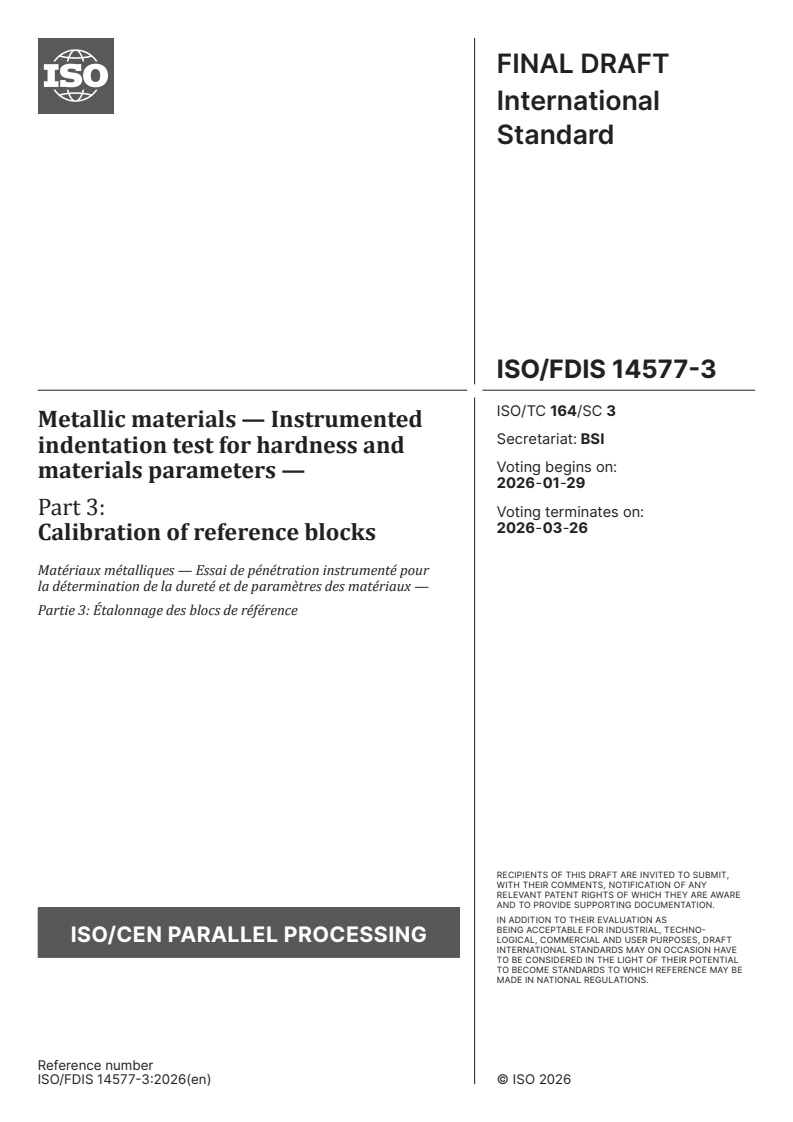
FINAL DRAFT
International
Standard
ISO/TC 164/SC 3
Metallic materials — Instrumented
Secretariat: BSI
indentation test for hardness and
Voting begins on:
materials parameters —
2026-01-29
Part 3:
Voting terminates on:
2026-03-26
Calibration of reference blocks
Matériaux métalliques — Essai de pénétration instrumenté pour
la détermination de la dureté et de paramètres des matériaux —
Partie 3: Étalonnage des blocs de référence
RECIPIENTS OF THIS DRAFT ARE INVITED TO SUBMIT,
WITH THEIR COMMENTS, NOTIFICATION OF ANY
RELEVANT PATENT RIGHTS OF WHICH THEY ARE AWARE
AND TO PROVIDE SUPPOR TING DOCUMENTATION.
IN ADDITION TO THEIR EVALUATION AS
BEING ACCEPTABLE FOR INDUSTRIAL, TECHNO-
ISO/CEN PARALLEL PROCESSING LOGICAL, COMMERCIAL AND USER PURPOSES, DRAFT
INTERNATIONAL STANDARDS MAY ON OCCASION HAVE
TO BE CONSIDERED IN THE LIGHT OF THEIR POTENTIAL
TO BECOME STAN DARDS TO WHICH REFERENCE MAY BE
MADE IN NATIONAL REGULATIONS.
Reference number
FINAL DRAFT
International
Standard
ISO/TC 164/SC 3
Metallic materials — Instrumented
Secretariat: BSI
indentation test for hardness and
Voting begins on:
materials parameters —
Part 3:
Voting terminates on:
Calibration of reference blocks
Matériaux métalliques — Essai de pénétration instrumenté pour
la détermination de la dureté et de paramètres des matériaux —
Partie 3: Étalonnage des blocs de référence
RECIPIENTS OF THIS DRAFT ARE INVITED TO SUBMIT,
WITH THEIR COMMENTS, NOTIFICATION OF ANY
RELEVANT PATENT RIGHTS OF WHICH THEY ARE AWARE
AND TO PROVIDE SUPPOR TING DOCUMENTATION.
© ISO 2026
IN ADDITION TO THEIR EVALUATION AS
All rights reserved. Unless otherwise specified, or required in the context of its implementation, no part of this publication may
BEING ACCEPTABLE FOR INDUSTRIAL, TECHNO-
ISO/CEN PARALLEL PROCESSING
LOGICAL, COMMERCIAL AND USER PURPOSES, DRAFT
be reproduced or utilized otherwise in any form or by any means, electronic or mechanical, including photocopying, or posting on
INTERNATIONAL STANDARDS MAY ON OCCASION HAVE
the internet or an intranet, without prior written permission. Permission can be requested from either ISO at the address below
TO BE CONSIDERED IN THE LIGHT OF THEIR POTENTIAL
or ISO’s member body in the country of the requester.
TO BECOME STAN DARDS TO WHICH REFERENCE MAY BE
MADE IN NATIONAL REGULATIONS.
ISO copyright office
CP 401 • Ch. de Blandonnet 8
CH-1214 Vernier, Geneva
Phone: +41 22 749 01 11
Email: copyright@iso.org
Website: www.iso.org
Published in Switzerland Reference number
ii
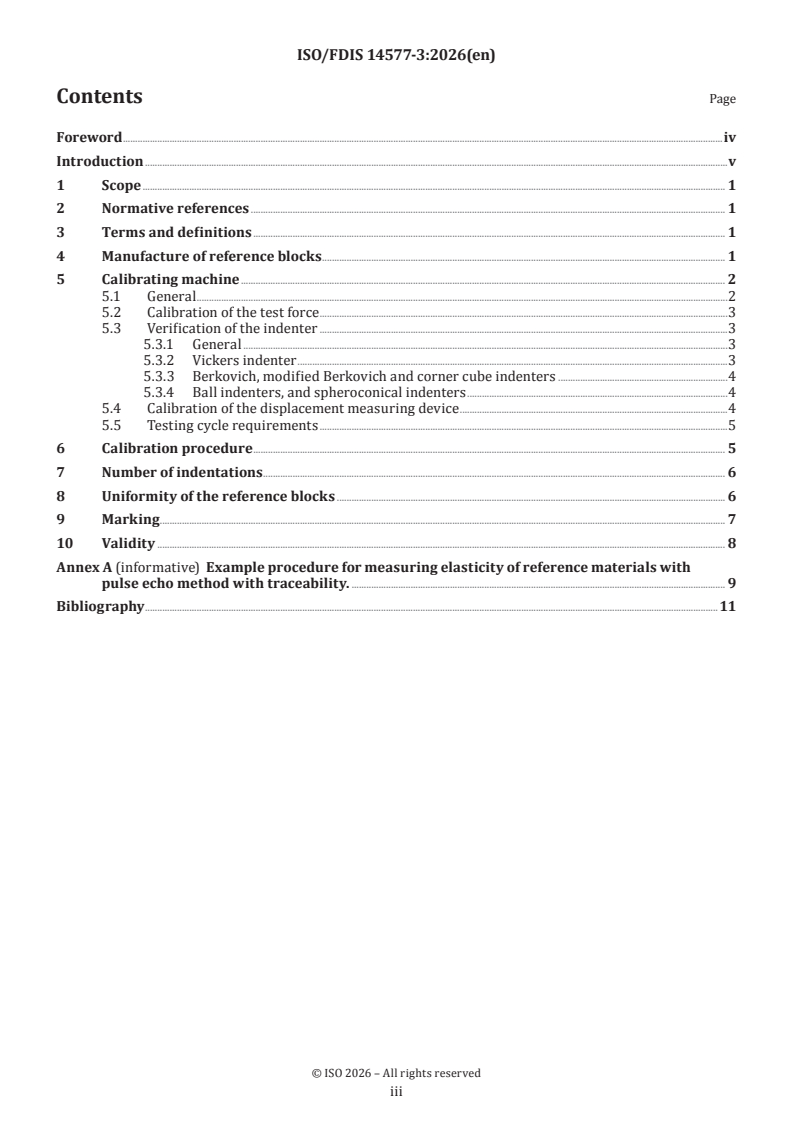
Contents Page
Foreword .iv
Introduction .v
1 Scope . 1
2 Normative references . 1
3 Terms and definitions . 1
4 Manufacture of reference blocks . 1
5 Calibrating machine . 2
5.1 General .2
5.2 Calibration of the test force .3
5.3 Verification of the indenter .3
5.3.1 General .3
5.3.2 Vickers indenter .3
5.3.3 Berkovich, modified Berkovich and corner cube indenters .4
5.3.4 Ball indenters, and spheroconical indenters .4
5.4 Calibration of the displacement measuring device .4
5.5 Testing cycle requirements .5
6 Calibration procedure . 5
7 Number of indentations . 6
8 Uniformity of the reference blocks . 6
9 Marking . . 7
10 Validity . 8
Annex A (informative) Example procedure for measuring elasticity of reference materials with
pulse echo method with traceability. . 9
Bibliography .11
iii
Foreword
ISO (the International Organization for Standardization) is a worldwide federation of national standards
bodies (ISO member bodies). The work of preparing International Standards is normally carried out through
ISO technical committees. Each member body interested in a subject for which a technical committee
has been established has the right to be represented on that committee. International organizations,
governmental and non-governmental, in liaison with ISO, also take part in the work. ISO collaborates closely
with the International Electrotechnical Commission (IEC) on all matters of electrotechnical standardization.
The procedures used to develop this document and those intended for its further maintenance are described
in the ISO/IEC Directives, Part 1. In particular, the different approval criteria needed for the different types
of ISO document should be noted. This document was drafted in accordance with the editorial rules of the
ISO/IEC Directives, Part 2 (see www.iso.org/directives).
ISO draws attention to the possibility that the implementation of this document may involve the use of (a)
patent(s). ISO takes no position concerning the evidence, validity or applicability of any claimed patent
rights in respect thereof. As of the date of publication of this document, ISO had not received notice of (a)
patent(s) which may be required to implement this document. However, implementers are cautioned that
this may not represent the latest information, which may be obtained from the patent database available at
www.iso.org/patents. ISO shall not be held responsible for identifying any or all such patent rights.
Any trade name used in this document is information given for the convenience of users and does not
constitute an endorsement.
For an explanation of the voluntary nature of standards, the meaning of ISO specific terms and expressions
related to conformity assessment, as well as information about ISO's adherence to the World Trade
Organization (WTO) principles in the Technical Barriers to Trade (TBT), see www.iso.org/iso/foreword.html.
This document was prepared by Technical Committee ISO/TC 164, Mechanical testing of metals,
Subcommittee SC 3, Hardness testing, in collaboration with the European Committee for Standardization
(CEN) Technical Committee CEN/TC 459, Test methods for steel (other than chemical analysis, in accordance
with the Agreement on technical cooperation between ISO and CEN (Vienna Agreement).
This third edition cancels and replaces the second edition (ISO 14577-3:2015), which has been technically
revised.
The main changes are as follows:
— Specification of the shape of the reference block.
— Modifications in the procedure for the verification of the indenter.
— Testing cycle requirements.
— Changing the conditions for the verification of the uniformity of the reference blocks.
— Annex A was added.
A list of all parts in the ISO 14577 series can be found on the ISO website.
Any feedback or questions on this document should be directed to the user’s national standards body. A
complete listing of these bodies can be found at www.iso.org/members.html.
iv
Introduction
Hardness has typically been defined as the resistance of a material to permanent penetration by another
harder material. The results obtained when performing Rockwell, Vickers, and Brinell tests are determined
after the test force has been removed. Therefore, the effect of elastic deformation under the indenter has
been ignored.
ISO 14577 (all parts) has been prepared to enable the user to evaluate the indentation of materials by
considering both the force and displacement during plastic and elastic deformation. By monitoring
the complete cycle of increasing and removal of the test force, hardness values equivalent to traditional
hardness values can be determined. More significantly, additional properties of the material such as its
indentation modulus and elasto-plastic hardness can also be determined. All these values can be calculated
without the requirement to measure the indent optically. Furthermore, by a variety of techniques, the
instrumented indentation test allows to record hardness and modulus depth profiles within a, probably
complex, indentation cycle.
ISO 14577 (all parts) has been written to allow a wide variety of post test data analysis.
v
FINAL DRAFT International Standard ISO/FDIS 14577-3:2026(en)
Metallic materials — Instrumented indentation test for
hardness and materials parameters —
Part 3:
Calibration of reference blocks
1 Scope
This document specifies a method for the calibration of reference blocks to use for the indirect verification
of testing machines for the instrumented indentation test as specified in ISO 14577-2.
Reference materials, where it is necessary to prepare a surface before the test in a manner that removes
surface layers are excluded from this standard.
2 Normative references
The following documents, in whole or in part, are normatively referenced in this document and are
indispensable for its application. For dated references, only the edition cited applies. For undated references,
the latest edition of the referenced document (including any amendments) applies.
ISO 376, Metallic materials — Calibration of force-proving instruments used for the verification of uniaxial
testing machines
ISO 14577-1, Metallic materials — Instrumented indentation test for hardness and materials parameters —
Part 1: Test method
ISO 14577-2, Metallic materials — Instrumented indentation test for hardness and materials parameters —
Part 2: Verification and calibration of testing machines
3 Terms and definitions
No terms and definitions are listed in this document.
ISO and IEC maintain terminology databases for use in standardization at the following addresses:
— ISO Online browsing platform: available at https:// www .iso .org/ obp
— IEC Electropedia: available at https:// www .electropedia .org/
4 Manufacture of reference blocks
4.1 The block shall be specially prepared and the attention of the manufacturer drawn to the requirement
to use a manufacturing process that gives the necessary homogeneity, uniformity, and stability of structure.
When the reference block is used for certifying hardness then it shall have a constant hardness over the
range of indentation sizes for which it is certified.
NOTE Variation in hardness with variation in indentation size occurs when the microstructural length scale of the
material is within an order of magnitude of the indentation size. Microstructural length scale is in this circumstance
the combined frequency of all length scales in the material, for example grain size, precipitate spacing, layer thickness
et cetera.
4.2 Each block being calibrated shall be of a thickness greater or equal to that given in Table 1.
Table 1 — Thickness requirements for reference blocks
Range according to Thickness
ISO 14577-1:202X, 1. mm
Nano 2
Micro up to 500 mN 3
Micro up to 2 N 5
Macro up to 60 N 6
Macro up to 1 kN 12
Macro up to 30 kN 16
4.3 The reference blocks shall be free from magnetism. The manufacturers should ensure that the blocks
are demagnetized at the end of the manufacturing process.
4.4 The reference block shall be constructed such that it can be mounted in the testing machine.
For bottom mounted samples, the reference block shall have a flat bottom surface such that the sample to
stage interface contact does not contribute an additional frame compliance e.g. by deformation of asperities.
The sample bottom surface shall be perpendicular to the indentation direction when mounted and parallel
to the top surface so that the indentation tilt limits of ISO 14577-1 are met.
NOTE A 1° tilt is a slope of 0,175 mm per 10 mm sample length.
4.5 There shall be only one test surface on the block and the test surface shall be free from scratches that
interfere with the measurement of the indentations. Indentations between scratches are permitted.
The surface roughness, Ra, shall not exceed 5 % of the minimum indentation depth specified for the CRM.
[2]
The sampling length l for the roughness measurement (see ISO 21920 (all parts) ) shall be larger than
the indentation size. A sampling length of 0,80 mm is recommended. If measured with an atomic-force-
microscope (AFM), the sampling length, l, shall be at least 10 µm.
It is recommended to consider the spatial wavelength of the roughness as well as the amplitude.
4.6 In order to check that no material has been subsequently removed from the reference block, its
thickness at the time of calibration shall be marked on it to the nearest 10 µm or an identifying mark shall be
made on the test surface (see Clause 8).
5 Calibrating machine
5.1 General
In addition to fulfilling the general conditions specified in ISO 14577-2, the calibrating machine shall also
meet the requirements listed in 5.2 to 5.5. The calibrating machine shall be calibrated and verified directly
at intervals not exceeding 24 months. Calibration and verification involve the following:
a) calibration of the test force;
b) verification of the indenter;
c) calibration of the displacement measuring system;
d) it should meet the requirements of indirect verification according to ISO 14577-2: 20XX Table 7
The instruments used for verification and calibration shall be traceable to the SI.
5.2 Calibration of the test force
The test force shall be calibrated according to ISO 14577-2:202X, 5.2 and shall be verified to have an
uncertainty at the 95 % confidence level less than
a) ±0,25 % for the macro range;
b) ±0,5 % for the micro range;
c) the larger of ±0,5 % or ±10 µN for the nano range.
The force shall be measured with elastic force-proving instruments of class 0,5 or better in accordance with
ISO 376 or by another method having the same accuracy.
5.3 Verification of the indenter
5.3.1 General
The certified measured values (e.g. angle, radius, etc.) of the indenter shall be u
...
Date: 2025-07-02
ISO/DISFDIS 14577-3:2025(en)
ISO/TC 164/SC 3/WG 1
Secretariat: DIN BSI
Date: 2026-01-15
Metallic materials — Instrumented indentation test for hardness and
materials parameters —
Part 3:
Calibration of reference blocks
Matériaux métalliques — Essai de pénétration instrumenté pour la détermination de la dureté et de
paramètres des matériaux — Partie 3: Etalonnage des blocs de référence
Partie 3: Étalonnage des blocs de référence
ThiThiThiThiThiThis drs drs drs drs drs drafafafafafaft is t is t is t is t is t is submitted tsubmitted tsubmitted tsubmitted tsubmitted tsubmitted toooooo a a a a a a p p p p p parallel arallel arallel arallel arallel arallel vovovovovovote in ISOte in ISOte in ISOte in ISOte in ISOte in ISO, CE, CE, CE, CE, CE, CEN.N.N.N.N.N.
FDIS stage
ISO/DISFDIS 14577-3:20252026(en)
All rights reserved. Unless otherwise specified, or required in the context of its implementation, no part of this publication
may be reproduced or utilized otherwise in any form or by any means, electronic or mechanical, including photocopying,
or posting on the internet or an intranet, without prior written permission. Permission can be requested from either ISO
at the address below or ISO'sISO’s member body in the country of the requester.
ISO Copyright Officecopyright office
CP 401 • Ch. de Blandonnet 8
CH-1214 Vernier, Geneva
Phone: + 41 22 749 01 11
Email: E-mail: copyright@iso.org
Website: www.iso.org
Published in Switzerland.
iii
Contents Page
Foreword . v
Introduction . vi
1 Scope . 1
2 Normative references . 1
3 Terms and definitions . 1
4 Manufacture of reference blocks. 1
5 Calibrating machine . 2
5.1 General . 2
5.2 Calibration of the test force . 3
5.3 Verification of the indenter . 3
5.4 Calibration of the displacement measuring device . 6
5.5 Testing cycle requirements . 6
6 Calibration procedure . 7
7 Number of indentations . 7
8 Uniformity of the reference blocks . 7
9 Marking . 8
10 Validity . 10
Annex A (informative) Example procedure for measuring elasticity of reference materials with
pulse echo method with traceability. . 12
Bibliography . 15
iv
ISO/DISFDIS 14577-3:20252026(en)
Foreword
ISO (the International Organization for Standardization) is a worldwide federation of national standards
bodies (ISO member bodies). The work of preparing International Standards is normally carried out through
ISO technical committees. Each member body interested in a subject for which a technical committee has been
established has the right to be represented on that committee. International organizations, governmental and
non-governmental, in liaison with ISO, also take part in the work. ISO collaborates closely with the
International Electrotechnical Commission (IEC) on all matters of electrotechnical standardization.
The procedures used to develop this document and those intended for its further maintenance are described
in the ISO/IEC Directives, Part 1. In particular, the different approval criteria needed for the different types of
ISO document should be noted. This document was drafted in accordance with the editorial rules of the
ISO/IEC Directives, Part 2 (see www.iso.org/directives).
ISO draws attention to the possibility that the implementation of this document may involve the use of (a)
patent(s). ISO takes no position concerning the evidence, validity or applicability of any claimed patent rights
in respect thereof. As of the date of publication of this document, ISO had not received notice of (a) patent(s)
which may be required to implement this document. However, implementers are cautioned that this may not
represent the latest information, which may be obtained from the patent database available at
www.iso.org/patents. ISO shall not be held responsible for identifying any or all such patent rights.
Any trade name used in this document is information given for the convenience of users and does not
constitute an endorsement.
For an explanation of the voluntary nature of standards, the meaning of ISO specific terms and expressions
related to conformity assessment, as well as information about ISO's adherence to the World Trade
Organization (WTO) principles in the Technical Barriers to Trade (TBT), see www.iso.org/iso/foreword.html.
This document was prepared by Technical Committee ISO/TC 164, Mechanical testing of metals,
Subcommittee SC 3, Hardness testing., in collaboration with the European Committee for Standardization
(CEN) Technical Committee CEN/TC 459, Test methods for steel (other than chemical analysis, in accordance
with the Agreement on technical cooperation between ISO and CEN (Vienna Agreement).
This third edition cancels and replaces the second edition (ISO 14577--3:2015), which has been technically
revised.
The main changes are as follows:
— — Specification of the shape of the reference block.
— — Modifications in the procedure for the verification of the indenter.
— — Testing cycle requirements.
— — Changing the conditions for the verification of the uniformity of the reference blocks.
— 0— Annex A was added.
A list of all parts in the ISO 14577 series can be found on the ISO website.
Any feedback or questions on this document should be directed to the user’s national standards body. A
complete listing of these bodies can be found at www.iso.org/members.html.
v
Introduction
Hardness has typically been defined as the resistance of a material to permanent penetration by another
harder material. The results obtained when performing Rockwell, Vickers, and Brinell tests are determined
after the test force has been removed. Therefore, the effect of elastic deformation under the indenter has been
ignored.
ISO 14577 (all parts) has been prepared to enable the user to evaluate the indentation of materials by
considering both the force and displacement during plastic and elastic deformation. By monitoring the
complete cycle of increasing and removal of the test force, hardness values equivalent to traditional hardness
values can be determined. More significantly, additional properties of the material such as its indentation
modulus and elasto-plastic hardness can also be determined. All these values can be calculated without the
requirement to measure the indent optically. Furthermore, by a variety of techniques, the instrumented
indentation test allows to record hardness and modulus depth profiles within a, probably complex,
indentation cycle.
ISO 14577 (all parts) has been written to allow a wide variety of post test data analysis.
vi
DRAFT International Standard ISO/DIS 14577-3:2024(en)
Metallic materials — Instrumented indentation test for hardness and
materials parameters —
Part 3:
Calibration of reference blocks
1 Scope
This document specifies a method for the calibration of reference blocks to use for the indirect verification of
testing machines for the instrumented indentation test as specified in ISO 14577--2.
Reference materials, where it is necessary to prepare a surface before the test in a manner that removes
surface layers are excluded from this standard.
2 Normative references
The following documents, in whole or in part, are normatively referenced in this document and are
indispensable for its application. For dated references, only the edition cited applies. For undated references,
the latest edition of the referenced document (including any amendments) applies.
ISO 376, Metallic materials — Calibration of force-proving instruments used for the verification of uniaxial
testing machines
ISO 14577--1, Metallic materials — Instrumented indentation test for hardness and materials parameters —
Part 1: Test method
ISO 14577--2, Metallic materials — Instrumented indentation test for hardness and materials parameters —
Part 2: Verification and calibration of testing machines
3 Terms and definitions
No terms and definitions are listed in this document.
ISO and IEC maintain terminology databases for use in standardization at the following addresses:
— — ISO Online browsing platform: available at https://www.iso.org/obp
— — IEC Electropedia: available at https://www.electropedia.org/
4 Manufacture of reference blocks
4.1 4.1 The block shall be specially prepared and the attention of the manufacturer drawn to the
requirement to use a manufacturing process that gives the necessary homogeneity, uniformity, and stability
of structure. When the reference block is used for certifying hardness then it shall have a constant hardness
over the range of indentation sizes for which it is certified.
NOTE: Variation in hardness with variation in indentation size occurs when the microstructural length scale of the
material is within an order of magnitude of the indentation size. Microstructural length scale is in this circumstance the
combined frequency of all length scales in the material, for example grain size, precipitate spacing, layer thickness et
cetera.
4.2 4.2 Each block being calibrated shall be of a thickness greater or equal to that given in 0Table 1.
Table 1 — Thickness requirements for reference blocks
Range according to Thickness
ISO 14577-1:202X, 1. mm
Nano 2
Micro up to 500 mN 3
Micro up to 2 N 5
Macro up to 60 N 6
Macro up to 1 kN 12
Macro up to 30 kN 16
4.3 4.3 The reference blocks shall be free from magnetism. The manufacturers should ensure that the
blocks are demagnetized at the end of the manufacturing process.
4.4 4.4 The reference block shall be constructed such that it can be mounted in the testing machine.
For bottom mounted samples, the reference block shall have a flat bottom surface such that the sample to
stage interface contact does not contribute an additional frame compliance e.g. by deformation of asperities.
The sample bottom surface shall be perpendicular to the indentation direction when mounted and parallel to
the top surface so that the indentation tilt limits of ISO 14577-1 are met.
NOTE A 1° tilt is a slope of 0,175 mm per 10 mm sample length.
4.5 4.5 There shall be only one test surface on the block and the test surface shall be free from
scratches that interfere with the measurement of the indentations. Indentations between scratches are
permitted.
The surface roughness, Ra, shall not exceed 5 % of the minimum indentation depth specified for the CRM. The
[
sampling length l for the roughness measurement (see ISO 21920 (all parts) Error! Reference source not
]
found.) [2]) ) shall be larger than the indentation size. A sampling length of 0,80 mm is recommended. If
measured with an atomic-force-microscope (AFM), the sampling length, l, shall be at least 10 µm.
It is recommended to consider the spatial wavelength of the roughness as well as the amplitude.
4.6 4.6 In order to check that no material has been subsequently removed from the reference block,
its thickness at the time of calibration shall be marked on it to the nearest 10 µm or an identifying mark shall
be made on the test surface (see 8Clause 8).).
5 Calibrating machine
5.1 General
In addition to fulfilling the general conditions specified in ISO 14577--2, the calibrating machine shall also
meet the requirements listed in 5.25.2 to 5.55.5. The calibrating machine shall be calibrated and verified
directly at intervals not exceeding 24 months. Calibration and verification involve the following:
a) a) calibration of the test force;
b) b) verification of the indenter;
ISO/DISFDIS 14577-3:20252026(en)
c) c) calibration of the displacement measuring system;
d) d) it should meet the requirements of indirect verification according to ISO 14577-2: 20XX
Table 7
The instruments used for verification and calibration shall be traceable to the SI.
5.2 Calibration of the test force
The test force shall be calibrated according to ISO 14577-2:202X, 5.2 and shall be verified to have an
uncertainty at the 95 % confidence level less than
a) a) ±0,25 % for the macro range;
b) b) ±0,5 % for the micro range;
c) c) the larger of ±0,5 % or ±10 µN for the nano range.
The force shall be measured with elastic force-proving instruments of class 0,5 or better in accordance with
ISO 376 or by another method having the same accuracy.
5.3 Verification of the indenter
5.3.1 General
The certified measured values (e.g. angle, radius, etc.) of the indenter shall be used in all calculations and,
where indentation depth is ≤6 µm, the certified indenter area function with the relative uncertainty of less
than 5 % shall be used.
Verification of the certified measured values of the indenter shall be done by direct measurement in the macro
and micro range. In the low micro and nano ranges, it is recommended to use direct measurement for the
certified measured values where possible. The certified area function shall be verified by indentation into
reference materials certified for elastic modulus (e.g. by acoustics or flexural resonance).
In the nano and low micro ranges (h < 1 000 nm), the tolerances on the indenter angles are not normally
achieved. The sharpness of the tip is likely to have the most significant impact on the measurement of
hardness, but if an accurate area function is used, the tip shape has relatively little effect on the measurement
of the indentation modulus. It is difficult to determine the radius of curvature of an indenter to better
than ±10 nm as this is likely the radius of an AFM probe. Indentation methods using certified indentation
modulus reference blocks are easier for users, but give only a projected area value and do not specify its cross-
sectional shape.
Except for Martens Hardness blocks all certifications of the reference blocks shall be done via elastic modulus.
For all shapes of indenters, the tolerances given in ISO 14577--2:202X, 5.5.2, 5.5.3, 5.5.4, and 5.5.5 shall be met
as the minimum requirement.
The verification of the indenter tolerances requires a direct imaging and 3D shape measurement with suitable
instruments (e.g. Atomic Force Microscope).
5.3.2 Vickers indenter
The four faces of the square-based pyramid shall be highly polished, free from surface defects, and flat to
within 0,3 µm in the macro range and 0.,1 µm in the micro and nano range.
...
PROJET FINAL
Norme
internationale
ISO/TC 164/SC 3
Matériaux métalliques — Essai de
Secrétariat: BSI
pénétration instrumenté pour la
Début de vote:
détermination de la dureté et de
2026-01-29
paramètres des matériaux —
Vote clos le:
2026-03-26
Partie 3:
Étalonnage des blocs de référence
Metallic materials — Instrumented indentation test for hardness
and materials parameters —
Part 3: Calibration of reference blocks
LES DESTINATAIRES DU PRÉSENT PROJET SONT
INVITÉS À PRÉSENTER, AVEC LEURS OBSERVATIONS,
NOTIFICATION DES DROITS DE PROPRIÉTÉ DONT ILS
AURAIENT ÉVENTUELLEMENT CONNAISSANCE ET À
FOURNIR UNE DOCUMENTATION EXPLICATIVE.
OUTRE LE FAIT D’ÊTRE EXAMINÉS POUR
ÉTABLIR S’ILS SONT ACCEPTABLES À DES FINS
INDUSTRIELLES, TECHNOLOGIQUES ET COM-MERCIALES,
AINSI QUE DU POINT DE VUE DES UTILISATEURS, LES
PROJETS DE NORMES
TRAITEMENT PARALLÈLE ISO/CEN
INTERNATIONALES DOIVENT PARFOIS ÊTRE CONSIDÉRÉS
DU POINT DE VUE DE LEUR POSSI BILITÉ DE DEVENIR DES
NORMES POUVANT
SERVIR DE RÉFÉRENCE DANS LA RÉGLEMENTATION
NATIONALE.
Numéro de référence
PROJET FINAL
Norme
internationale
ISO/TC 164/SC 3
Matériaux métalliques — Essai de
Secrétariat: BSI
pénétration instrumenté pour la
Début de vote:
détermination de la dureté et de
2026-01-29
paramètres des matériaux —
Vote clos le:
2026-03-26
Partie 3:
Étalonnage des blocs de référence
Metallic materials — Instrumented indentation test for hardness
and materials parameters —
Part 3: Calibration of reference blocks
LES DESTINATAIRES DU PRÉSENT PROJET SONT
INVITÉS À PRÉSENTER, AVEC LEURS OBSERVATIONS,
NOTIFICATION DES DROITS DE PROPRIÉTÉ DONT ILS
AURAIENT ÉVENTUELLEMENT CONNAISSANCE ET À
FOURNIR UNE DOCUMENTATION EXPLICATIVE.
DOCUMENT PROTÉGÉ PAR COPYRIGHT
OUTRE LE FAIT D’ÊTRE EXAMINÉS POUR
ÉTABLIR S’ILS SONT ACCEPTABLES À DES FINS
© ISO 2026 INDUSTRIELLES, TECHNOLOGIQUES ET COM-MERCIALES,
AINSI QUE DU POINT DE VUE DES UTILISATEURS, LES
Tous droits réservés. Sauf prescription différente ou nécessité dans le contexte de sa mise en œuvre, aucune partie de cette
PROJETS DE NORMES
TRAITEMENT PARALLÈLE ISO/CEN
INTERNATIONALES DOIVENT PARFOIS ÊTRE CONSIDÉRÉS
publication ne peut être reproduite ni utilisée sous quelque forme que ce soit et par aucun procédé, électronique ou mécanique,
DU POINT DE VUE DE LEUR POSSI BILITÉ DE DEVENIR DES
y compris la photocopie, ou la diffusion sur l’internet ou sur un intranet, sans autorisation écrite préalable. Une autorisation peut
NORMES POUVANT
être demandée à l’ISO à l’adresse ci-après ou au comité membre de l’ISO dans le pays du demandeur.
SERVIR DE RÉFÉRENCE DANS LA RÉGLEMENTATION
NATIONALE.
ISO copyright office
Case postale 401 • Ch. de Blandonnet 8
CH-1214 Vernier, Genève
Tél.: +41 22 749 01 11
E-mail: copyright@iso.org
Web: www.iso.org
Publié en Suisse Numéro de référence
ii
Sommaire Page
Avant-propos .iv
Introduction .v
1 Domaine d’application . 1
2 Références normatives . 1
3 Termes et définitions . 1
4 Fabrication des blocs de référence . 1
5 Machine d'étalonnage . 2
5.1 Généralités .2
5.2 Étalonnage de la force d'essai .3
5.3 Vérification du pénétrateur .3
5.3.1 Généralités .3
5.3.2 Pénétrateur Vickers .3
5.3.3 Pénétrateur Berkovich, pénétrateur Berkovich modifié et pénétrateur en forme
de trièdre.4
5.3.4 Pénétrateurs à billes et pénétrateurs sphéroconiques .5
5.4 Étalonnage du dispositif de mesure du déplacement .5
5.5 Exigences relatives au cycle d'essai .5
6 Mode opératoire d'étalonnage . 6
7 Nombre de pénétrations . 6
8 Uniformité des blocs de référence . 6
9 Marquage . 7
10 Validité . . 9
Annexe A (informative) Exemple de mode opératoire de mesure de l'élasticité des matériaux
de référence avec méthode par échos avec traçabilité .10
Bibliographie .12
iii
Avant-propos
L'ISO (Organisation internationale de normalisation) est une fédération mondiale d'organismes nationaux
de normalisation (comités membres de l'ISO). L'élaboration des Normes internationales est en général
confiée aux comités techniques de l'ISO. Chaque comité membre intéressé par une étude a le droit de faire
partie du comité technique créé à cet effet. Les organisations internationales, gouvernementales et non
gouvernementales, en liaison avec l'ISO participent également aux travaux. L'ISO collabore étroitement avec
la Commission électrotechnique internationale (IEC) en ce qui concerne la normalisation électrotechnique.
Les procédures utilisées pour élaborer le présent document et celles destinées à sa mise à jour sont
décrites dans les Directives ISO/IEC, Partie 1. Il convient, en particulier, de prendre note des différents
critères d'approbation requis pour les différents types de documents ISO. Le présent document
a été rédigé conformément aux règles de rédaction données dans les Directives ISO/IEC, Partie 2
(voir www.iso.org/directives).
L’attention est appelée sur le fait que la mise en œuvre du présent document peut impliquer l’utilisation d’un
ou de plusieurs brevets. L’ISO ne prend pas position relativement aux preuves, à la validité ou à la capacité
d’application de quelconques droits de propriété revendiqués par ceux-ci. À la date de publication du présent
document, l’ISO n’a connaissance d’aucun brevet éventuel pouvant être exigé pour la mise en œuvre du
présent document. Les personnes responsables de la mise en œuvre sont toutefois averties que les toutes
dernières informations peuvent ne pas être connues; celles-ci peuvent être obtenues dans la base de données
de brevets disponible à l’adresse www.iso.org/patents. L’ISO ne saurait être tenue pour responsable de ne
pas avoir identifié tout ou partie de tels droits de propriété.
Les appellations commerciales éventuellement mentionnées dans le présent document sont données pour
information, par souci de commodité, à l’intention des utilisateurs et ne sauraient constituer un engagement.
Pour une explication de la nature volontaire des normes, la signification des termes et expressions
spécifiques de l'ISO liés à l'évaluation de la conformité, ou pour toute information au sujet de l'adhésion de
l'ISO aux principes de l’Organisation mondiale du commerce (OMC) concernant les obstacles techniques au
commerce (OTC), voir le lien suivant: www.iso.org/iso/fr/avant-propos.
Le présent document a été élaboré par le comité technique ISO/TC 164, Essais mécaniques des métaux, sous-
comité SC 3, Essais de dureté, en collaboration avec le comité technique CEN/TC 459, Méthodes d’essai pour
l’acier (autres que l’analyse chimique) du Comité européen de normalisation (CEN) conformément à l’Accord
de coopération technique entre l’ISO et le CEN (Accord de Vienne).
Cette troisième édition annule et remplace la deuxième édition (ISO 14577-3:2015), qui a fait l'objet d'une
révision technique.
Les principales modifications sont les suivantes:
— Spécification de la forme du bloc de référence.
— Modification du mode opératoire de vérification du pénétrateur.
— Exigences relatives au cycle d’essai.
— Modification des conditions de vérification de l’uniformité des blocs de référence.
— Ajout de l’Annexe A.
Une liste de toutes les parties de la série ISO 14577 se trouve sur le site internet de l'ISO.
Il convient que l’utilisateur adresse tout retour d’information ou toute question concernant le présent
document à l’organisme national de normalisation de son pays. Une liste exhaustive desdits organismes se
trouve à l’adresse www.iso.org/fr/members.html.
iv
Introduction
La dureté a été typiquement définie comme la résistance d'un matériau à la pénétration rémanente par un
autre matériau plus dur. Les résultats obtenus lors d'essais Rockwell, Vickers et Brinell sont déterminés
après retrait de la force d'essai. En conséquence, l'effet de la déformation élastique sous le pénétrateur a été
ignoré.
L’ISO 14577 (toutes les parties) a été préparée pour permettre à l'utilisateur d'évaluer la pénétration des
matériaux en prenant en compte la force et le déplacement pendant les déformations plastique et élastique.
En suivant le cycle complet d'augmentation et de retrait de la force d'essai, il est possible de déterminer des
valeurs de dureté équivalentes aux valeurs traditionnelles de dureté. Plus important encore, il est également
possible de déterminer des caractéristiques supplémentaires du matériau telles que son module de
pénétration et sa dureté élasto-plastique. Toutes ces valeurs peuvent être calculées sans qu'il y ait à mesurer
l'empreinte par des moyens optiques. De plus, l’essai de pénétration instrumenté permet d’enregistrer des
profils de dureté et de module en fonction de la profondeur, par une variété de techniques, lors d’un cycle de
pénétration probablement complexe.
L'ISO 14577 (toutes les parties) a été rédigée pour permettre une grande diversité d'analyses des données
après essai.
v
PROJET FINAL Norme internationale ISO/FDIS 14577-3:2026(fr)
Matériaux métalliques — Essai de pénétration instrumenté
pour la détermination de la dureté et de paramètres des
matériaux —
Partie 3:
Étalonnage des blocs de référence
1 Domaine d’application
Le présent document spécifie une méthode pour l'étalonnage des blocs de référence à utiliser pour la
vérification indirecte des machines d'essai pour l'essai de pénétration instrumenté, telle que spécifiée dans
l'ISO 14577-2.
Les matériaux de référence utilisés lorsqu’il est nécessaire de préparer une surface avant l’essai de manière
à enlever les couches superficielles sont exclus de la présente norme.
2 Références normatives
Les documents suivants, en tout ou partie, sont référencés de manière normative dans le présent document
et sont indispensables à son application. Pour les références datées, seule l'édition citée s'applique. Pour
les références non datées, la dernière édition de la publication à laquelle il est fait référence s'applique (y
compris tous les amendements).
ISO 376, Matériaux métalliques — Étalonnage des instruments de mesure de force utilisés pour la vérification
des machines d'essais uniaxiaux
ISO 14577-1, Matériaux métalliques — Essai de pénétration instrumenté pour la détermination de la dureté et
de paramètres des matériaux — Partie 1: Méthode d’essai
ISO 14577-2, Matériaux métalliques — Essai de pénétration instrumenté pour la détermination de la dureté et
de paramètres des matériaux — Partie 2: Vérification et étalonnage des machines d’essai
3 Termes et définitions
Aucun terme n’est défini dans le présent document.
L’ISO et l’IEC tiennent à jour des bases de données terminologiques destinées à être utilisées en normalisation,
consultables aux adresses suivantes:
— ISO Online browsing platform: disponible à l'adresse https:// www .iso .org/ obp
— IEC Electropedia: disponible à l'adresse https:// www .electropedia .org/
4 Fabrication des blocs de référence
4.1 Le bloc doit être préparé spécialement et l’attention du fabricant doit être attirée sur la nécessité
d'utiliser un procédé de fabrication qui donne l'homogénéité, l'uniformité et la stabilité de structure
nécessaires. Lorsque le bloc de référence est utilisé pour certifier la dureté, il doit alors avoir une dureté
constante sur la plage de tailles de pénétration pour laquelle il est certifié.
NOTE La variation de dureté avec la variation de la taille de pénétration se produit lorsque l'échelle de longueur
microstructurale du matériau se situe dans un ordre de grandeur de la taille de pénétration. L'échelle de longueur
microstructurale est dans ce cas la fréquence combinée de toutes les échelles de longueur dans le matériau, par
exemple la taille des grains, l'espacement des précipités, l'épaisseur de la couche, etc.
4.2 Chaque bloc étalonné doit présenter une épaisseur supérieure ou égale à celle indiquée dans le
Tableau 1.
Tableau 1 — Exigences d'épaisseur pour les blocs de référence
Intervalle conformément à l'ISO 14577-1:202X, 1. Épaisseur
mm
Nano 2
Micro jusqu'à 500 mN 3
Micro jusqu'à 2 N 5
Macro jusqu'à 60 N 6
Macro jusqu'à 1 kN 12
Macro jusqu'à 30 kN 16
4.3 Les blocs de référence doivent être exempts de magnétisme. Il convient que les fabricants s'assurent
que les blocs sont démagnétisés à la fin du processus de fabrication.
4.4 Le bloc de référence doit être construit de manière à pouvoir être monté dans la machine d'essai.
Pour les échantillons montés sur le fond, le bloc de référence doit avoir une surface de fond plane de sorte
que le contact entre l'échantillon et la platine ne contribue pas à une conformité supplémentaire du cadre,
par exemple par déformation des aspérités. La surface inférieure de l'échantillon doit être perpendiculaire
à la direction de pénétration lorsqu'elle est montée et parallèle à la surface supérieure afin que les limites
d'inclinaison de la pénétration de l'ISO 14577-1 soient respectées.
NOTE Une inclinaison de 1° est une pente de 0,175 mm par tranche de 10 mm de longueur d'échantillon.
4.5 Il ne doit y avoir qu'une seule surface d'essai sur le bloc et la surface d'essai doit être exempte de rayures
qui interfèrent avec le mesurage des pénétrations. Les pénétrations entre les rayures sont autorisées.
La rugosité de la surface, Ra, ne doit pas dépasser 5 % de la profondeur minimale de pénétration spécifiée
pour le MRC. La longueur de prélèvement l pour le mesurage de la rugosité (voir l’ISO 21920 (toutes les
[2]
parties) ) doit être supérieure à la taille de la pénétration. Une longueur d'échantillonnage de 0,80 mm
est recommandée. Si la mesure est effectuée à l'aide d'un microscope à force atomique (AFM), la longueur
d'échantillonnage, l, doit être au moins égale à 10 μm.
Il est recommandé de prendre en compte la longueur d'onde spatiale de la rugosité ainsi que l'amplitude.
4.6 Afin de vérifier qu'aucun matériau n'a été enlevé ultérieurement du bloc de référence, son épaisseur,
au moment de l'étalonnage, doit y être marquée à 10 µm près, ou une marque d'identification doit être faite
sur la surface d'essai (voir l’Article 8).
5 Machine d'étalonnage
5.1 Généralités
En sus de répondre aux conditions générales spécifiées dans l'ISO 14577-2, la machine d'étalonnage doit
également satisfaire aux exigences de 5.2 à 5.5. La machine d'étalonnage doit être étalonnée et vérifiée par la
méthode directe à des intervalles ne dépassant pas 24 mois. L’étalonnage et la vérification impliquent:
a) l’étalonnage de la force d’essai;
b) la vérification du pénétrateur;
c) l'étalonnage du système de mesure du déplacement;
d) il convient qu'il satisfasse aux exigences de vérification indirecte conformément à l'ISO 14577-2: 20XX,
Tableau 7.
Les instruments utilisés pour la vérification et l’étalonnage doivent pouvoir être raccordés au SI.
5.2 Étalonnage de la force d'essai
La force d'essai doit être étalonnée conformément à l'ISO 14577-2:202X, 5.2 et il doit être vérifié qu'elle
présente une incertitude au niveau de confiance de 95 % inférieure à
a) ±0,25 % pour le macro-intervalle;
b) ±0,5 % pour le micro-intervalle;
c) la plus grande des valeurs entre ±0,5 % et ±10 µN pour le nano-intervalle.
La force doit être mesurée à l'aide d'instruments de mesure de force de classe 0,5 ou plus conformément à
l'ISO 376 ou par une autre méthode ayant la même exactitude.
5.3 Vérification du pénétrateur
5.3.1 Généralités
Les valeurs mesurées certifiées (par exemple angle, rayon, etc.) du pénétrateur doivent être utilisées dans
tous les calculs et, dans le cas où la profondeur de pénétration est ≤ 6 µm, la fonction d'aire du pénétrateur
certifiée avec une incertitude relative inférieure à 5 % doit être utilisée.
La vérification des valeurs mesurées certifiées du pénétrateur doit être effectuée par mesurage direct
les macro et micro-intervalles. Dans le nano-intervalle et le bas du micro-intervalle, il est recommandé
d'utiliser le mesurage di
...
Questions, Comments and Discussion
Ask us and Technical Secretary will try to provide an answer. You can facilitate discussion about the standard in here.
Loading comments...