

ISO 12480-1:2024
(Main)Cranes — Safe use — Part 1: General
General Information
- Abstract
This document establishes required practices for the safe use of cranes through implementing a safe system of work consisting of the task planning, selection, erection and dismantling, operation and maintenance of cranes, and the selection of operators, slingers and signallers. This document does not cover manually operated (non-powered) cranes, cranes in which at least one of its motions is manually operated and cranes mounted on water-borne vessels, except in those circumstances where a land-based crane is temporarily affixed to a vessel.
- Status
- Published
- Publication Date
- 05-Aug-2024
- Technical Committee
- ISO/TC 96/SC 5 - Use, operation and maintenance
- Drafting Committee
- ISO/TC 96/SC 5 - Use, operation and maintenance
- Current Stage
- 6060 - International Standard published
- Start Date
- 06-Aug-2024
- Due Date
- 27-Aug-2024
- Completion Date
- 06-Aug-2024



Overview
ISO 12480-1:2024 - Cranes - Safe use - Part 1: General defines required practices for the safe use of powered cranes by establishing a safe system of work. It covers task planning, crane selection, erection and dismantling, operation, maintenance, and the selection and duties of operators, slingers and signallers. The standard applies to land-based powered cranes (including temporary use on vessels) and explicitly excludes non‑powered/manual cranes and cranes with predominantly manual motions.
Key topics and requirements
The standard organizes safety around a managed safe system of work (Clause 4) and addresses practical responsibilities and controls:
- Safe system of work elements
- Task planning, site preparation and risk coordination
- Selection and use of suitable crane types and accessories
- Inspections, maintenance and condition monitoring (Clause 7)
- Emergency procedures, exclusion zones and documented capacity charts
- Personnel competence and duties (Clause 5)
- Competency requirements for crane operators, appointed persons, slingers and signallers
- Communication systems (audible/visual) and defined hand signals
- Personal protective equipment and safe access to cranes
- Crane activities and lifecycle (Clause 6)
- Crane selection, placement, erection/dismantling, electrical and lightning considerations
- Safe operation, remote operation (Clause 6.6) and operation near overhead power lines (Clause 6.7)
- Environmental factors: wind, visibility, rain/snow/ice (Clause 6.8)
- Complex lifting applications (Clause 8)
- Multiple-crane and multiple-hoist lifts, coordination and supervision
- Non-fixed load-lifting attachments (grabs, magnets, vacuum devices)
- Personnel lifting guidance (informative Annex A)
Practical applications - who uses this standard
ISO 12480-1:2024 is directly relevant to:
- Crane users and employers responsible for workplace lifting safety
- Appointed persons, site lifting supervisors and safety managers
- Crane operators, slingers and signallers seeking role-specific duties and communication protocols
- Maintenance personnel, inspectors and training organizations
- Project planners and contractors specifying crane selection, placement and lift coordination
Use cases include on‑site lift planning, development of crane operating procedures, competency frameworks, site safety briefings, and integration of crane operation controls into broader safety management systems.
Related standards
Normative references include crane vocabulary, inspection, testing and competency documents such as:
- ISO 4306 (vocabulary), ISO 4309 (wire ropes), ISO 4310 (test code)
- ISO 9927 series (inspections), ISO 12482 (monitoring), ISO 15513 (competency), ISO 16715 (hand signals) These referenced standards provide complementary technical detail for implementation.
Keywords: ISO 12480-1:2024, crane safety, safe use of cranes, crane operation, lifting operations, competent personnel, lifting equipment.
Relations
- Effective Date
- 06-Jun-2022
Frequently Asked Questions
ISO 12480-1:2024 is a standard published by the International Organization for Standardization (ISO). Its full title is "Cranes — Safe use — Part 1: General". This standard covers: This document establishes required practices for the safe use of cranes through implementing a safe system of work consisting of the task planning, selection, erection and dismantling, operation and maintenance of cranes, and the selection of operators, slingers and signallers. This document does not cover manually operated (non-powered) cranes, cranes in which at least one of its motions is manually operated and cranes mounted on water-borne vessels, except in those circumstances where a land-based crane is temporarily affixed to a vessel.
This document establishes required practices for the safe use of cranes through implementing a safe system of work consisting of the task planning, selection, erection and dismantling, operation and maintenance of cranes, and the selection of operators, slingers and signallers. This document does not cover manually operated (non-powered) cranes, cranes in which at least one of its motions is manually operated and cranes mounted on water-borne vessels, except in those circumstances where a land-based crane is temporarily affixed to a vessel.
ISO 12480-1:2024 is classified under the following ICS (International Classification for Standards) categories: 53.020.20 - Cranes. The ICS classification helps identify the subject area and facilitates finding related standards.
ISO 12480-1:2024 has the following relationships with other standards: It is inter standard links to ISO 12480-1:1997. Understanding these relationships helps ensure you are using the most current and applicable version of the standard.
ISO 12480-1:2024 is available in PDF format for immediate download after purchase. The document can be added to your cart and obtained through the secure checkout process. Digital delivery ensures instant access to the complete standard document.
Standards Content (Sample)
International
Standard
ISO 12480-1
Second edition
Cranes — Safe use —
2024-08
Part 1:
General
Appareils de levage à charge suspendue — Sécurité d'emploi —
Partie 1: Généralités
Reference number
© ISO 2024
All rights reserved. Unless otherwise specified, or required in the context of its implementation, no part of this publication may
be reproduced or utilized otherwise in any form or by any means, electronic or mechanical, including photocopying, or posting on
the internet or an intranet, without prior written permission. Permission can be requested from either ISO at the address below
or ISO’s member body in the country of the requester.
ISO copyright office
CP 401 • Ch. de Blandonnet 8
CH-1214 Vernier, Geneva
Phone: +41 22 749 01 11
Email: copyright@iso.org
Website: www.iso.org
Published in Switzerland
ii
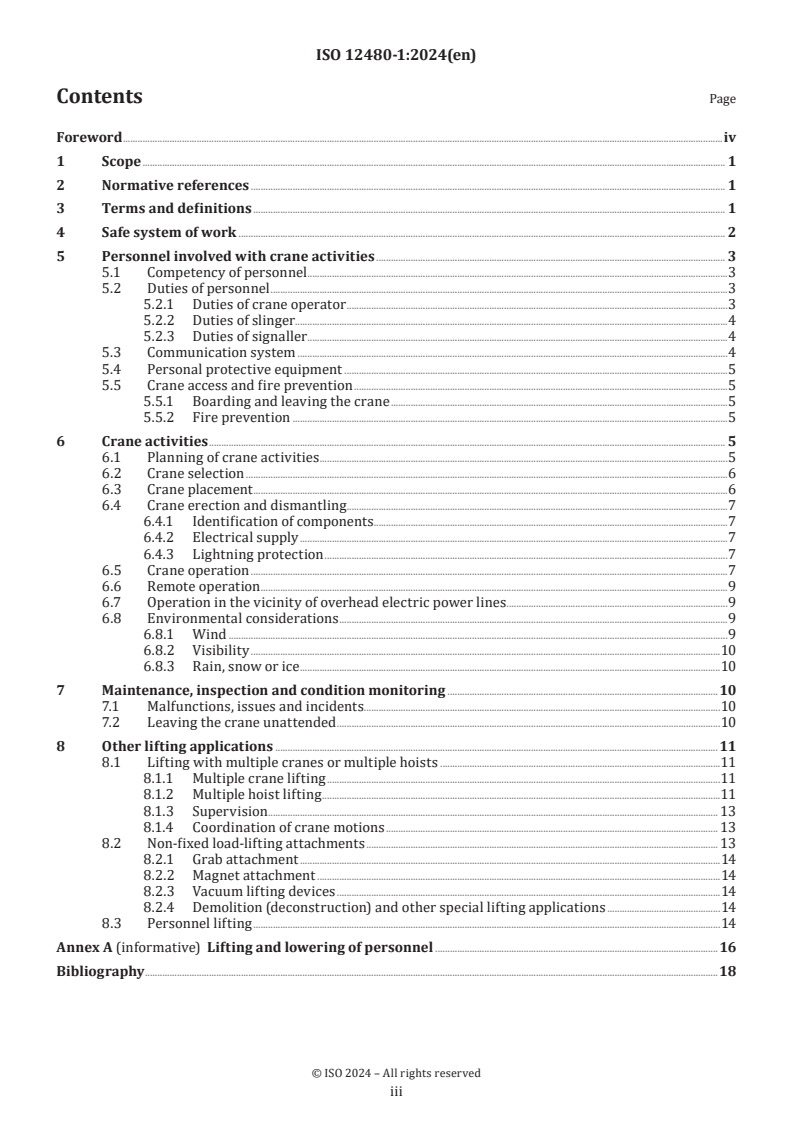
Contents Page
Foreword .iv
1 Scope . 1
2 Normative references . 1
3 Terms and definitions . 1
4 Safe system of work . 2
5 Personnel involved with crane activities . 3
5.1 Competency of personnel .3
5.2 Duties of personnel .3
5.2.1 Duties of crane operator .3
5.2.2 Duties of slinger.4
5.2.3 Duties of signaller .4
5.3 Communication system .4
5.4 Personal protective equipment .5
5.5 Crane access and fire prevention .5
5.5.1 Boarding and leaving the crane .5
5.5.2 Fire prevention .5
6 Crane activities . 5
6.1 Planning of crane activities .5
6.2 Crane selection .6
6.3 Crane placement .6
6.4 Crane erection and dismantling . .7
6.4.1 Identification of components.7
6.4.2 Electrical supply .7
6.4.3 Lightning protection .7
6.5 Crane operation .7
6.6 Remote operation .9
6.7 Operation in the vicinity of overhead electric power lines .9
6.8 Environmental considerations .9
6.8.1 Wind .9
6.8.2 Visibility .10
6.8.3 Rain, snow or ice .10
7 Maintenance, inspection and condition monitoring .10
7.1 Malfunctions, issues and incidents . .10
7.2 Leaving the crane unattended .10
8 Other lifting applications .11
8.1 Lifting with multiple cranes or multiple hoists .11
8.1.1 Multiple crane lifting .11
8.1.2 Multiple hoist lifting .11
8.1.3 Supervision . . 13
8.1.4 Coordination of crane motions . 13
8.2 Non-fixed load-lifting attachments . 13
8.2.1 Grab attachment .14
8.2.2 Magnet attachment .14
8.2.3 Vacuum lifting devices .14
8.2.4 Demolition (deconstruction) and other special lifting applications .14
8.3 Personnel lifting .14
Annex A (informative) Lifting and lowering of personnel .16
Bibliography .18
iii
Foreword
ISO (the International Organization for Standardization) is a worldwide federation of national standards
bodies (ISO member bodies). The work of preparing International Standards is normally carried out through
ISO technical committees. Each member body interested in a subject for which a technical committee
has been established has the right to be represented on that committee. International organizations,
governmental and non-governmental, in liaison with ISO, also take part in the work. ISO collaborates closely
with the International Electrotechnical Commission (IEC) on all matters of electrotechnical standardization.
The procedures used to develop this document and those intended for its further maintenance are described
in the ISO/IEC Directives, Part 1. In particular, the different approval criteria needed for the different types
of ISO document should be noted. This document was drafted in accordance with the editorial rules of the
ISO/IEC Directives, Part 2 (see www.iso.org/directives).
ISO draws attention to the possibility that the implementation of this document may involve the use of (a)
patent(s). ISO takes no position concerning the evidence, validity or applicability of any claimed patent
rights in respect thereof. As of the date of publication of this document, ISO had not received notice of (a)
patent(s) which may be required to implement this document. However, implementers are cautioned that
this may not represent the latest information, which may be obtained from the patent database available at
www.iso.org/patents. ISO shall not be held responsible for identifying any or all such patent rights.
Any trade name used in this document is information given for the convenience of users and does not
constitute an endorsement.
For an explanation of the voluntary nature of standards, the meaning of ISO specific terms and expressions
related to conformity assessment, as well as information about ISO's adherence to the World Trade
Organization (WTO) principles in the Technical Barriers to Trade (TBT), see www.iso.org/iso/foreword.html.
This document was prepared by Technical Committee ISO/TC 96, Cranes, Subcommittee SC 5, Use, operation
and maintenance.
This second edition cancels and replaces the first edition (ISO 12480-1:1997), which has been technically
revised.
The main changes are as follows:
— “driver” has been replaced by “operator” throughout the text;
— the requirements related to demolition ball operations have been removed;
— the requirements related to periodic checks have been removed;
— the requirements related to the communication system have been revised and incorporated into the
main text (see 5.3);
— the requirements related to crane activities ranging from crane planning, selection, placement, erection
and dismantling, operation, etc., have been combined into an independent clause (see Clause 6);
— the requirements related to remote operation have been added (see 6.6);
— the requirements related to lifting and lowering of persons have been made into an informative annex
(see Annex A).
A list of all parts in the ISO 12480 series can be found on the ISO website.
Any feedback or questions on this document should be directed to the user’s national standards body. A
complete listing of these bodies can be found at www.iso.org/members.html.
iv
International Standard ISO 12480-1:2024(en)
Cranes — Safe use —
Part 1:
General
1 Scope
This document establishes required practices for the safe use of cranes through implementing a safe system
of work consisting of the task planning, selection, erection and dismantling, operation and maintenance of
cranes, and the selection of operators, slingers and signallers.
This document does not cover manually operated (non-powered) cranes, cranes in which at least one of its
motions is manually operated and cranes mounted on water-borne vessels, except in those circumstances
where a land-based crane is temporarily affixed to a vessel.
2 Normative references
The following documents are referred to in the text in such a way that some or all of their content constitutes
requirements of this document. For dated references, only the edition cited applies. For undated references,
the latest edition of the referenced document (including any amendments) applies.
ISO 4306 (all parts), Cranes — Vocabulary
ISO 4309:2017, Cranes — Wire ropes — Care and maintenance, inspection and discard
ISO 4310, Cranes — Test code and procedures
ISO 9927-1, Cranes — Inspections — Part 1: General
ISO 9927-3, Cranes — Inspections — Part 3: Tower cranes
ISO 9927-5, Cranes — Inspections — Part 5: Bridge and gantry cranes, including portal and semi-portal cranes
and their supporting structures
ISO 12482, Cranes — Monitoring for crane design working period
ISO 15513, Cranes — Competency requirements for crane drivers (operators), slingers, signallers and assessors
ISO 16715, Cranes — Hand signals used with cranes
ISO 17096, Cranes — Safety — Load lifting attachments
ISO 23813, Cranes — Training of appointed persons
ISO 23814, Cranes — Competency requirements for crane inspectors
ISO 23815-1, Cranes — Maintenance — Part 1: General
IEC 60204-32, Safety of machinery — Electrical equipment of machines — Part 32: Requirements for hoisting
machines
3 Terms and definitions
For the purposes of this document, the terms and definitions given in ISO 4306 (all parts) and the following apply.
ISO and IEC maintain terminology databases for use in standardization at the following addresses:
For the purposes of this document, the following terms and definitions apply.
— ISO Online browsing platform: available at https:// www .iso .org/ obp
— IEC Electropedia: available at https:// www .electropedia .org/
3.1
competent person
person who has the necessary practical and theoretical knowledge and the necessary experience of the
crane and equipment used in the lifting operation
3.2
crane operator
person who operates a crane
3.3
user
person or organization which has the overall responsibility over the crane
Note 1 to entry: The user is not necessarily the owner of the crane.
3.4
appointed person
competent person who has overall control of crane activity(s)
3.5
remote operation
operation of the crane using an operator interface not located on the crane
4 Safe system of work
A safe system of work shall be established. For repetitive lifting operations, the same principles may be
applied, unless conditions affecting lifting operations change.
The same principles shall be applied when crane activities are carried out at a site or when the crane is a
permanent fixture, for example in a factory or at a dock.
Crane activities shall include: lifting operations, any necessary preparation of a site, erection, dismantling,
maintenance, or preparation of the crane for the out-of-service condition.
Prior to the start of crane activities, the safe system of work shall be effectively communicated to all parties
concerned.
An appointed person shall be designated to ensure the implementation of the safe system of work.
NOTE The crane operator can be the appointed person.
The safe system of work shall include the following:
a) planning of crane activities;
b) selection and use of suitable crane(s) and equipment;
c) inspections and maintenance of crane(s) and equipment following the manufacturers’ instructions;
d) ensuring that all personnel involved in crane activities are competent and have been made aware of
their relevant responsibilities;
e) ensuring that there is adequate supervision by competent personnel;
f) ensuring that the operating instructions and relevant capacity charts are maintained in the crane;
g) ensuring that all other required certificates and documents are available on the crane or at the worksite,
as appropriate;
h) ensuring the safety of persons and equipment not involved in the crane activities;
i) ensuring coordination with other applicable parties for appropriate approval compliance or cooperation
in avoiding hazards or guarding against hazards including those from other cranes or equipment
operating in close proximity;
j) ensuring there are emergency procedures for the evacuation of persons from the crane and the
danger zones;
k) ensuring that all personnel can communicate clearly either audibly or visually;
l) establishing a communication system which is understood by the persons involved in the actual lifting
operation (see 5.3);
m) prohibiting unauthorized movement or use of the crane;
n) ensuring that environmental conditions are monitored and actions to be taken are determined (see 6.8).
5 Personnel involved with crane activities
5.1 Competency of personnel
Safe operation of cranes depends on the selection of competent personnel. Competency requirements for
crane operators, slingers, signallers, maintenance personnel and inspectors shall be in accordance with
ISO 15513, ISO 9927-1, ISO 9927-3, ISO 9927-5, ISO 23813, ISO 23814 and ISO 23815-1.
The appointed person shall ensure that crane and rigging personnel are properly qualified and organized as
follows:
a) each person shall have training and experience suited to the duties;
b) each person shall have such certifications that are required by a local regulation;
c) responsibilities, decision-making authority and chain of command shall be firmly established and
communicated to the team;
d) no person shall participate in the work while impaired by drugs, alcohol or medication, nor by a deficient
physical or mental state;
e) trainees shall work under direct supervision at assignments circumscribed by their level of skill and
judgment.
NOTE In some circumstances, it can be appropriate for one person to undertake more than one of the duties
described in 5.2.
5.2 Duties of personnel
5.2.1 Duties of crane operator
The crane operator is responsible for operation of the crane in accordance with the manufacturer’s
instruction and within the safe system of work (see Clause 4). The crane operator shall at any one time
respond only to the signals from one slinger/signaller who shall be clearly identified (see 5.2.2 and 5.2.3),
except when a stop or emergency signal is received.
5.2.2 Duties of slinger
Duties of the slinger shall include the following:
a) attaching and detaching the load to and from the lifting device;
b) determining correct lifting points and that the lifting points are adequate for the rigging forces;
c) ensuring the use of correct lifting gear and equipment in accordance with the planning of the activities
for proper control and positioning of the load;
d) providing signals to the signaller when the rigging has been completed and the load is ready to be lifted.
If there is more than one slinger, only one shall have this responsibility at any one time, depending on
their position relative to the crane;
e) ensuring that shackles and other elements do not bind up as the rigging is tensioned, and to notify the
signaller immediately if this occurs;
f) monitoring the load as it is being picked to ensure that the load does not break or excessively deform.
5.2.3 Duties of signaller
Duties of the signaller shall include the following:
a) becoming familiar with the operating characteristics of the specific crane in the configuration that it is
being used;
b) directing all movements of the crane and load;
c) ensuring that signals allow the load to remain level, taking into account crane deflection and dynamic
movement of the load;
d) ensuring that only one person is responsible for giving signals to the crane operator at any one time
and when multiple signallers are required, ensuring the overall crane activities are reviewed among
the signallers prior to initiating activities. If, during crane activities, responsibility for directing the
crane and load is to be transferred to another person, the signaller shall clearly indicate to the crane
operator that this responsibility is being transferred and to whom. Furthermore, the operator and the
new person shall clearly indicate that they accept the transfer of responsibility;
e) being easily identifiable to the crane operator by wearing high-visibility clothing or using radio call signs;
f) using the communication system as established in 5.3.
5.3 Communication system
An effective communication system shall be established and consider the following:
a) prior to starting crane activities, confirmation of the communication method between the signaller and
operator and the associated signals that are to be used during movement of the crane and/or load;
b) when necessary, using equipment that enables direct communication between the signaller and
operator;
c) using a limited number of signals for the purpose of communication;
d) clear differentiation of signals to avoid misunderstanding;
e) using hand signals that meet the requirements given in ISO 16715;
f) using voice signals given in three steps describing: 1) function and direction, 2) distance and speed, 3)
function stop;
g) if an operator does not fully understand or receive a signal, crane motion shall be stopped or not
initiated;
h) should failure of the communication equipment occur, the ability for an operator(s) to detect the
failure and immediately stop crane movements (e.g. a signaller using a radio continuously instructs
the operator to lower a load by repeating “Lower-lower-lower …”. If the operator fails to receive this
continuous instruction from the signaller, the operator immediately stops all crane movements and a
determination is then made as to why the communication failed.).
5.4 Personal protective equipment
The appointed person shall ensure:
a) that personal protective equipment appropriate for the conditions of the location is available and in use,
e.g. helmets, safety spectacles, safety harness, safety boots and hearing protection;
b) that the selection, use and maintenance of personal protective equipment shall be in accordance with
the instruction manual of the crane and local regulations.
5.5 Crane access and fire prevention
Safe access and means of emergency escape shall be identified and maintained in such a condition that
enables safe use. Personnel shall be instructed to use only the proper access and means of emergency escape.
5.5.1 Boarding and leaving the crane
No person(s) shall be permitted to board or leave the crane or enter its physically designated area without
obtaining the operator’s permission. The operator shall be aware of and take necessary precautions for
personnel boarding and leaving the crane.
5.5.2 Fire prevention
Personnel shall be instructed in the use and care of any fire extinguishers provided. Do not obstruct airflow
around high-temperature components, such as engines, radiators and exhaust pipes. Do not place flammable
materials on or near any heat sources. Do not operate in environments with heat sources that can cause
overheating, fire or explosion.
6 Crane activities
6.1 Planning of crane activities
All crane activities shall be planned and properly supervised to ensure that they are carried out safely and
that all identifiable risks have been considered. Planning shall be carried out by personnel who have the
appropriate expertise and have been appointed for this purpose. In cases of repetitive or routine operations,
this planning may only be necessary in the first instance, with periodic reviews to ensure that no factors
have changed.
A correctly planned procedure shall ensure that:
a) crane is correctly selected and configured;
b) crane activities are in accordance with the applicable instructions;
c) crane activities do not commence until an instruction manual is available and clearly understood by
personnel;
d) all preparations have been completed and all preoperational requirements have been met;
e) consideration and implementation of additional safety measures to be taken when crane activities occur
in the vicinity of overhead electric power lines (see 6.7).
Any deviation from prescribed procedures or specifications shall be approved by the manufacturer or a
competent person if the manufacturer no longer exists.
Any restrictions identified during planning shall be reviewed with all personnel involved in the operation
and followed during crane activities.
6.2 Crane selection
Cranes are available in a number of forms and the characteristics of the various types of cranes shall be
considered in relation to the job requirements.
Points to be considered in making the selection include the following:
a) characteristics of lifted load, such as masses and dimensions;
b) characteristics of required activities, such as lift quantity, frequency, and duration;
c) needed operational requirements for the crane, such as lifting capacity, operating performance, and
operating range, e.g. int
...