

ISO 16000-28:2020
(Main)Indoor air — Part 28: Determination of odour emissions from building products using test chambers
General Information
- Abstract
This document specifies a laboratory test method using test chambers defined in ISO 16000-9 and further specified in EN 16516 and evaluation procedures for the determination of odours emitted from building products and materials. Sampling, transport and storage of materials under test, as well as preparation of test specimens are described in ISO 16000-11 and further specified in EN 16516.
- Status
- Published
- Publication Date
- 16-Nov-2020
- Technical Committee
- ISO/TC 146/SC 6 - Indoor air
- Drafting Committee
- ISO/TC 146/SC 6/WG 17 - Sensory testing of indoor air
- Current Stage
- 9093 - International Standard confirmed
- Start Date
- 09-Mar-2026
- Completion Date
- 29-Aug-2026
Buy Documents







ISO 16000-28:2020 - Indoor air — Part 28: Determination of odour emissions from building products using test chambers/17/2020


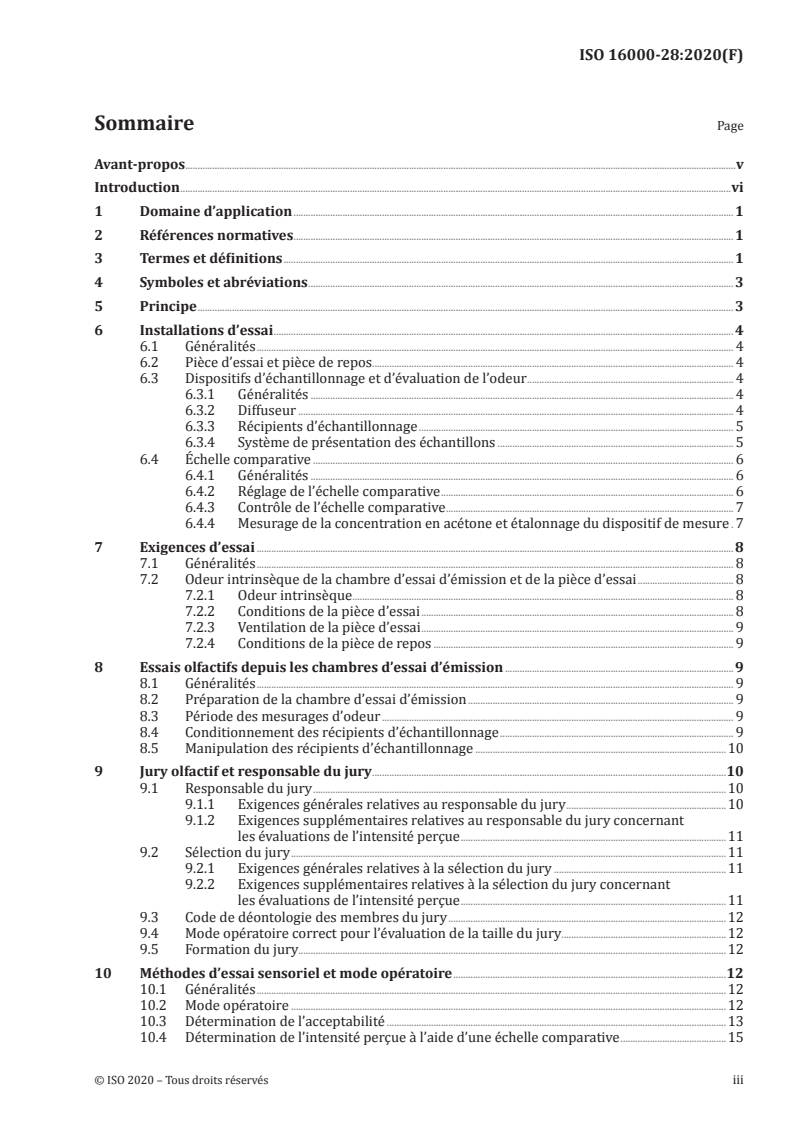
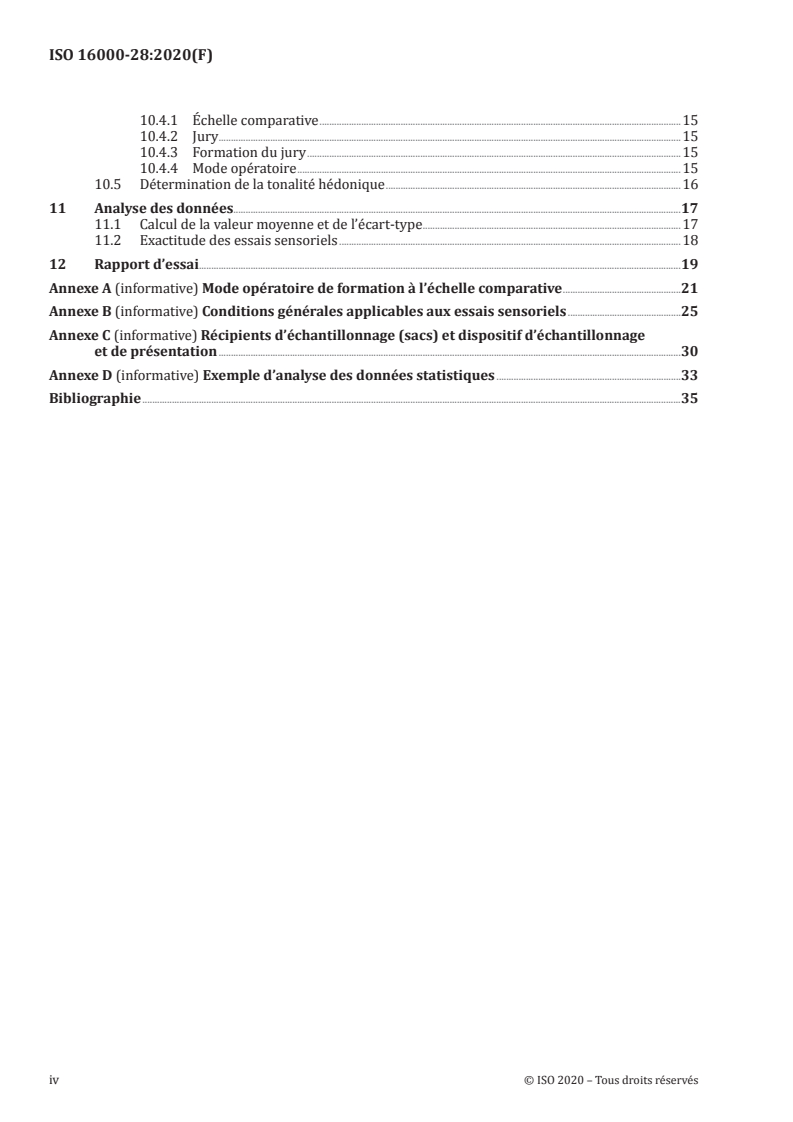
ISO 16000-28:2020 - Air intérieur — Partie 28: Détermination des émissions d'odeurs des produits de construction au moyen de chambres d'essai/17/2020
Overview
ISO 16000-28:2020 - "Indoor air - Part 28: Determination of odour emissions from building products using test chambers" specifies a laboratory method and evaluation procedures for measuring odours emitted from building products and materials. The standard defines how to collect air samples from emission test chambers (as per ISO 16000-9 and EN 16516), how to handle specimens (referencing ISO 16000-11), and how to assess odour using trained sensory panels.
Keywords: ISO 16000-28:2020, odour emissions, indoor air, test chambers, building products, sensory panel.
Key topics and technical requirements
- Test method framework: Uses emission test chambers defined in ISO 16000-9 and aligned with EN 16516 for representing indoor exposure scenarios.
- Sampling and sample handling: Specifies sampling, transport and storage procedures for odour samples in containers (bags/canisters) and conditioning/handling requirements drawn from ISO 16000-11 and EN 16516.
- Test facilities and equipment: Defines requirements for test room and recovery room setups, sampling devices (funnels, presentation systems, containers) and chamber background odour control.
- Sensory evaluation: Details panel management (panel leader duties), panel selection, training, code of conduct, recommended panel sizes for different assessments, and procedures for acceptability, perceived intensity and hedonic tone.
- Comparative scales and calibration: Includes a comparative scale methodology for perceived intensity, set-up and check-up procedures, and calibration checks (e.g., measurement of acetone concentration for device calibration).
- Data analysis and reporting: Describes statistical treatment (mean, standard deviation, accuracy), handling of confidence intervals and required elements of the test report.
- Informative annexes: Practical guidance on panel training, general sensory-testing conditions, sampling containers and example statistical analysis.
Practical applications and users
- Manufacturers and product developers use ISO 16000-28 to assess and reduce odour impact of construction materials, furnishings and consumer products.
- Independent test laboratories apply the method to produce reproducible odour emission data for compliance testing, R&D and quality control.
- Indoor air quality consultants, architects and specifiers rely on odour data to select low-odour materials and to predict occupant comfort.
- Regulatory bodies and certification schemes may reference the standard when defining acceptable odour performance or labeling criteria.
Related standards
- ISO 16000-9 (emission test chamber method)
- ISO 16000-11 (sampling, specimen preparation)
- EN 16516 (assessment of emissions into indoor air)
- ISO 5492 (olfactory-related terminology)
ISO 16000-28:2020 is part of the broader ISO 16000 series on indoor air quality and provides a sensory complement to chemical emission testing for a complete assessment of odour impact.
Relations
- Effective Date
- 23-Jul-2016
Buy Documents
ISO 16000-28:2020 - Indoor air — Part 28: Determination of odour emissions from building products using test chambers/17/2020
ISO 16000-28:2020 - Air intérieur — Partie 28: Détermination des émissions d'odeurs des produits de construction au moyen de chambres d'essai/17/2020
Get Certified
Connect with accredited certification bodies for this standard

CIS Institut d.o.o.
Personal Protective Equipment (PPE) certification body. Notified Body NB-2890 for EU Regulation 2016/425 PPE.

Kiwa BDA Testing
Building and construction product certification.
Kmetijski inštitut Slovenije
Agricultural Institute of Slovenia. Soil testing, plant health, agricultural product analysis.
Sponsored listings
Frequently Asked Questions
ISO 16000-28:2020 is a standard published by the International Organization for Standardization (ISO). Its full title is "Indoor air — Part 28: Determination of odour emissions from building products using test chambers". This standard covers: This document specifies a laboratory test method using test chambers defined in ISO 16000-9 and further specified in EN 16516 and evaluation procedures for the determination of odours emitted from building products and materials. Sampling, transport and storage of materials under test, as well as preparation of test specimens are described in ISO 16000-11 and further specified in EN 16516.
This document specifies a laboratory test method using test chambers defined in ISO 16000-9 and further specified in EN 16516 and evaluation procedures for the determination of odours emitted from building products and materials. Sampling, transport and storage of materials under test, as well as preparation of test specimens are described in ISO 16000-11 and further specified in EN 16516.
ISO 16000-28:2020 is classified under the following ICS (International Classification for Standards) categories: 13.040.20 - Ambient atmospheres. The ICS classification helps identify the subject area and facilitates finding related standards.
ISO 16000-28:2020 has the following relationships with other standards: It is inter standard links to ISO 16000-28:2012. Understanding these relationships helps ensure you are using the most current and applicable version of the standard.
ISO 16000-28:2020 is available in PDF format for immediate download after purchase. The document can be added to your cart and obtained through the secure checkout process. Digital delivery ensures instant access to the complete standard document.
Standards Content (Sample)
SLOVENSKI STANDARD
01-maj-2021
Nadomešča:
SIST ISO 16000-28:2013
Notranji zrak - 28. del: Določevanje emisij vonjav iz gradbenih proizvodov s
preskusno komoro
Indoor air - Part 28: Determination of odour emissions from building products using test
chambers
Air intérieur- Partie 28: Détermination des émissions d'odeurs des produits de
construction au moyen de chambres d'essai
Ta slovenski standard je istoveten z: ISO 16000-28:2020
ICS:
13.040.20 Kakovost okoljskega zraka Ambient atmospheres
2003-01.Slovenski inštitut za standardizacijo. Razmnoževanje celote ali delov tega standarda ni dovoljeno.
INTERNATIONAL ISO
STANDARD 16000-28
Second edition
2020-11
Indoor air —
Part 28:
Determination of odour emissions
from building products using test
chambers
Air intérieur —
Partie 28: Détermination des émissions d'odeurs des produits de
construction au moyen de chambres d'essai
Reference number
©
ISO 2020
© ISO 2020
All rights reserved. Unless otherwise specified, or required in the context of its implementation, no part of this publication may
be reproduced or utilized otherwise in any form or by any means, electronic or mechanical, including photocopying, or posting
on the internet or an intranet, without prior written permission. Permission can be requested from either ISO at the address
below or ISO’s member body in the country of the requester.
ISO copyright office
CP 401 • Ch. de Blandonnet 8
CH-1214 Vernier, Geneva
Phone: +41 22 749 01 11
Email: copyright@iso.org
Website: www.iso.org
Published in Switzerland
ii © ISO 2020 – All rights reserved
Contents Page
Foreword .v
Introduction .vi
1 Scope . 1
2 Normative references . 1
3 Terms and definitions . 1
4 Symbols and abbreviated terms . 3
5 Principle . 3
6 Test facilities . 3
6.1 General . 3
6.2 Test room and recovery room . 4
6.3 Odour sampling and assessment devices . 4
6.3.1 General. 4
6.3.2 Funnel . 4
6.3.3 Sample containers . 5
6.3.4 Sample presentation system . 5
6.4 Comparative scale . 5
6.4.1 General. 5
6.4.2 Set up of the comparative scale . 6
6.4.3 Check-up of the comparative scale . 7
6.4.4 Measurement of acetone concentration and calibration of the
measurement device . 7
7 Test requirements . 8
7.1 General . 8
7.2 Emission test chamber and test room background odour . 8
7.2.1 Background odour . 8
7.2.2 Test room conditions . . 8
7.2.3 Ventilation of the test room . 8
7.2.4 Recovery room conditions . 9
8 Odour testing from emission test chambers . 9
8.1 General . 9
8.2 Emission test chamber preparation . 9
8.3 Time of odour measurements . 9
8.4 Conditioning of sample containers . 9
8.5 Handling of sample containers . 9
9 Sensory odour panel and panel leader .10
9.1 Panel leader .10
9.1.1 General requirements for the panel leader .10
9.1.2 Additional requirements for the panel leader for perceived intensity
assessments .10
9.2 Panel selection .11
9.2.1 General requirements for panel selection.11
9.2.2 Additional requirements for the panel selection for perceived intensity
assessments .11
9.3 Code of conduct of the panel members .11
9.4 Correct procedure for determination of the panel size .12
9.5 Panel training .12
10 Sensory test methods and procedure .12
10.1 General .12
10.2 Procedure .12
10.3 Determination of acceptability .13
10.4 Determination of the perceived intensity using a comparative scale .14
10.4.1 Comparative scale .14
10.4.2 Panel .14
10.4.3 Panel training .15
10.4.4 Procedure .15
10.5 Determination of the hedonic tone .16
11 Data analysis .17
11.1 Calculation of mean value and standard deviation.17
11.2 Accurace of sensory testing .18
12 Test report .18
Annex A (informative) Training procedure for the comparative scale .20
Annex B (informative) General conditions for sensory testing .24
Annex C (informative) Sampling containers (bags) and sampling and presentation device .29
Annex D (informative) Example for statistical data analysis .32
Bibliography .34
iv © ISO 2020 – All rights reserved
Foreword
ISO (the International Organization for Standardization) is a worldwide federation of national standards
bodies (ISO member bodies). The work of preparing International Standards is normally carried out
through ISO technical committees. Each member body interested in a subject for which a technical
committee has been established has the right to be represented on that committee. International
organizations, governmental and non-governmental, in liaison with ISO, also take part in the work.
ISO collaborates closely with the International Electrotechnical Commission (IEC) on all matters of
electrotechnical standardization.
The procedures used to develop this document and those intended for its further maintenance are
described in the ISO/IEC Directives, Part 1. In particular, the different approval criteria needed for the
different types of ISO documents should be noted. This document was drafted in accordance with the
editorial rules of the ISO/IEC Directives, Part 2 (see www .iso .org/ directives).
Attention is drawn to the possibility that some of the elements of this document may be the subject of
patent rights. ISO shall not be held responsible for identifying any or all such patent rights. Details of
any patent rights identified during the development of the document will be in the Introduction and/or
on the ISO list of patent declarations received (see www .iso .org/ patents).
Any trade name used in this document is information given for the convenience of users and does not
constitute an endorsement.
For an explanation of the voluntary nature of standards, the meaning of ISO specific terms and
expressions related to conformity assessment, as well as information about ISO's adherence to
the World Trade Organization (WTO) principles in the Technical Barriers to Trade (TBT), see
www .iso .org/ iso/ foreword .html.
This document was prepared by Technical Committee ISO/TC 146, Air quality, Subcommittee SC 6,
Indoor air.
This second edition cancels and replaces the first edition (ISO 16000-28:2012), which has been
technically revised. The main changes compared to the previous edition are as follows:
— besides acceptability and perceived intensity, the hedonic tone is described as odour characteristic;
— a more detailed description of the comparative scale, including information on set-up, check-up and
calibration devices;
— recommendation on panel sizes for the different testing procedures (acceptability, perceived
intensity and hedonic tone);
— procedure in case of failing the confidence interval.
A list of all parts in the ISO 16000 series can be found on the ISO website.
Any feedback or questions on this document should be directed to the user’s national standards body. A
complete listing of these bodies can be found at www .iso .org/ members .html.
Introduction
Odour evaluation is a complementary method to the chemical testing of emissions from building
products and materials.
The determination of odour acceptability, intensity and hedonic tone of emissions from building
products and materials using test chambers has objectives such as:
— to provide manufacturers, builders and end users with data useful for the evaluation of the odour
impact of building products and materials on the indoor air quality;
— to promote the development of improved products.
The method can also be used for furnishings and consumer products. For this purpose, a suitable
exposure scenario (according to the reference room defined in EN 16516) needs to be defined.
vi © ISO 2020 – All rights reserved
INTERNATIONAL STANDARD ISO 16000-28:2020(E)
Indoor air —
Part 28:
Determination of odour emissions from building products
using test chambers
1 Scope
This document specifies a laboratory test method using test chambers defined in ISO 16000-9 and
further specified in EN 16516 and evaluation procedures for the determination of odours emitted from
building products and materials.
Sampling, transport and storage of materials under test, as well as preparation of test specimens are
described in ISO 16000-11 and further specified in EN 16516.
2 Normative references
The following documents are referred to in the text in such a way that some or all of their content
constitutes requirements of this document. For dated references, only the edition cited applies. For
undated references, the latest edition of the referenced document (including any amendments) applies.
ISO 16000-9, Indoor air — Part 9: Determination of the emission of volatile organic compounds from
building products and furnishing — Emission test chamber method
EN 16516, Construction products: Assessment of release of dangerous substances — Determination of
emissions into indoor air
3 Terms and definitions
For the purposes of this document, the following terms and definitions apply.
ISO and IEC maintain terminological databases for use in standardization at the following addresses:
— ISO Online browsing platform: available at https:// www .iso .org/ obp
— IEC Electropedia: available at http:// www .electropedia .org/
3.1
acceptability
assessment of an odour emission into indoor air which can be ascertained according to a scale ranging
from “clearly acceptable” to “clearly unacceptable” set by value on a defined evaluation scale
3.2
anosmia
lack of sensitivity to some olfactory stimulus due to physiological defects, which is not reversible
3.3
building product
product for incorporation in a permanent manner in construction works
Note 1 to entry: A building product can be solid, liquid or combined (see ISO 16000-11).
3.4
hedonic tone
odour (3.5) quality, which can be ascertained on a scale ranging from “extremely pleasant” to "extremely
unpleasant
3.5
odour
sensory attribute perceptible by the olfactory organ on sniffing certain volatile substances
3.6
odour sample
air sample collected from the test chamber outlet in containers and being tested for its odour (3.5)
3.7
background odours
odours (3.5) released by equipment or location that might disturb the test procedure
3.8
panel leader
person whose primary duties are to manage panel activities and recruit, train and monitor the assessors
3.9
panel member
person who is accepted to assess odours according to a defined method
Note 1 to entry: Depending on the method panel members may need to be trained.
3.10
perceived intensity
parameter to assess the strength of an odour based on a comparative scale
Note 1 to entry: See ISO 5492:2008, 2.8, 2.9 and 4.30.
3.11
recovery room
room where the panel members can recover and acclimatize before and between odour (3.5)
assessments
3.12
sample container
device for collection and transport of the odour (3.5) sample from the test chamber to the test room and
for presentation of the sample to the panel members (3.9)
3.13
sensory adaption
temporary modification of the sensitivity of a sense organ due to continued and/or repeated stimulation,
which is reversible
[SOURCE: see ISO 5492:2008, 2.6]
3.14
sensory odour panel
group of trained or untrained panel members (3.9) performing the sensory assessment of the odour
(3.5) emission from building products (3.3) or materials
[SOURCE: see ISO 5492:2008, 1.9]
3.15
test room
room where the odour (3.5) assessment takes place
2 © ISO 2020 – All rights reserved
3.16
test specimen
part of a sample specially prepared for emission testing in a test chamber in order to simulate the odour
(3.5) emission behaviour of the material or product being tested
4 Symbols and abbreviated terms
For the purposes of this document, the following symbols apply (see ISO 16000-9).
Symbol Meaning Unit
L product loading factor square metres per cubic metre
n air change rate changes per h
q area specific air flow rate (n/L) cubic metres per square metre and h
V,A
A surface area square metre
Π perceived intensity pi
q volumetric supply air flow rate cubic metres per h
V,c
For the purposes of this document, the following abbreviated terms apply.
PVF polyvinyl fluoride
PET polyethyleneterephthalate
rH relative humidity
VOC volatile organic compound
PAD photoacoustic detector
PID photo ionization detector
FID flame ionization detector
5 Principle
The odour emission from building products and materials is measured using a sensory odour panel. The
odour determination may be performed in parallel to chemical emission measurements in accordance
with ISO 16000-9 and further specified in EN 16516. The odour characteristics addressed in this part
of ISO 16000 are the acceptability, the perceived intensity and the hedonic tone. Depending on the
measurement task, these odour characteristics or a combination of those can be determined.
6 Test facilities
6.1 General
A facility designed and operated to determine odours emitted from building products and materials
consists of an emission test chamber containing the test specimen. The emission test chamber shall
contain a clean air generation and humidification system, an air mixing system and monitoring and
control systems to ensure that the test is performed to indicated conditions in accordance with
ISO 16000-9 and further specified in EN 16516.
The standard procedure for odour assessment is carried out by using sample containers (see 6.3.3).
Alternatively, direct assessment from the outlet of the emission test chamber is possible if sufficient air
flow is assured (see 6.3.1). In this case the outlet shall be fitted with a funnel.
NOTE Due to the requirements of 6.3.1 sufficient air flow is only possible if the following requirements are
3 −1
met: test chambers with more than 4,3 m volume at 0,5 h air change rate.
If the odour assessment is carried out directly from the outlet of the chamber, the chamber material
shall be non-transparent, or the chamber shall be covered in order to avoid the panel members being
influenced by visual recognition of the material in test.
The test room in which the sensory assessment is performed shall conform with the general
requirements described in 7.2. The panel members shall not be influenced by the working environment
(light, acoustics, background odours).
6.2 Test room and recovery room
The test room and the recovery room shall be odour neutral, sufficiently large and unobtrusively
designed. Contamination of the room air by any source, e.g. by coatings, wall and floor coverings,
furniture, shall be prevented. In preparation for sensory testing, the air in the test room and the
recovery room shall be assessed for acceptability or perceived intensity (7.2.1), and the requirements
set out in 7.2.2–7.2.4 shall be complied with.
6.3 Odour sampling and assessment devices
6.3.1 General
The odour sampling and assessment devices shall ensure that
— the air flow is sufficient to guarantee that the panel members inhale only sample air during the
assessment, and
— significant adsorption on the surfaces is avoided and the interface has no emissions of its own to
interfere with the sample air.
6.3.2 Funnel
The odour evaluation interface consists of a funnel, which is connected to the outlet of the sample
presentation system or to the outlet of the emission test chamber. The funnel and the inner surfaces
of the connection ducting shall be composed of glass or surface-treated (polished) stainless steel. The
air flow at the outlet from the funnel to the panel member shall be between 0,6 l/s to 1 l/s and shall
be constant for the duration of each test session. The design of the measurement funnel ensures that
no ambient air is sucked in and mixed with the sample air. An opening angle (both sides) of up to 12°
ensures a homogeneous outflow of sample air (see Figure 1). To prevent contamination of the test room
air, the excess air flow shall be extracted above the funnel.
4 © ISO 2020 – All rights reserved
Figure 1 — Schematic of a standard funnel
6.3.3 Sample containers
The following materials are suitable to be used as a sample container:
1)
— polyethylene terephthalate (PET, Nalophane® );
2)
— polyvinyl fluoride (PVF, Tedlar® ).
All batches of container material shall be evaluated for unusual emissions/bachground odours before
first use. PVF/Tedlar® containers need to be conditioned before first use, see 8.4 and Annex C.
Sample containers made of PET shall not be reused.
Other container materials may be used if the performance is tested according to Annex C.
6.3.4 Sample presentation system
A sample presentation system is a device designed for providing odour samples from the sample
containers to the interface (funnel) for odour testing. The size of the sample presentation system is
based on the size of the sample containers. The system shall be designed to minimise influence on the
odour samples and test room conditions. Any parts in direct contact with the odour sample shall be
made from glass, polished stainless steel or polytetrafluoroethylene (PTFE).
NOTE For an example of a suitable sample presentation system see Annex C.
6.4 Comparative scale
6.4.1 General
A comparative scale offers at least six different reference stimuli by means of presentation funnels. The
reference odorant is acetone (quality grade ≥99,8 %). The comparative scale is made up of three basic
parts: clean air ducts, acetone source and dosing device. Only materials of very low odour emission and ®
1) Nalophan is the trade name of a product of Kalle Nalo GmbH. This information is given for the convenience of
users of this document and does not constitute an endorsement by ISO of the product named. Equivalent products
may be used if they can be shown to lead to the same results. ®
2) Tedlar is the trade name of a product. This information is given for the convenience of users of this document
and does not constitute an endorsement by ISO of the product named. Equivalent products may be used if they can
be shown to lead to the same results.
absorption, such as glass, polished stainless steel or polytetrafluoroethylene (PTFE) shall be employed
for the parts that come in contact with sample air to avoid influencing the stimuli. The background
odour of the comparative scale, (i.e. the comparative scale is operated with supply air), must not exceed
the requirements in Table 1 (see 7.2.1).
The flow rate and the concentration of the reference odorant shall be constant both over time as well as
locally within the funnel outlet and independent of the ambient conditions. The flow rate at the outlet of
the funnel shall be between 0,6 l/s and 1,0 l/s and shall be constant for the duration of each test session.
The funnels shall meet the requirements of 6.3.2. The relative humidity and the temperature of the
mixture of air and reference odorant shall be kept constant and shall meet the requirements for the test
chamber 23 °C and 50 % RH (±3 K and ±10 % rH). A schematic of a possible comparative scale is given
in Figure 2.
6.4.2 Set up of the comparative scale
The comparative scale is connected to a supply of odour-neutral air. To cover the whole intensity
perception range of indoor odour samples the comparative scale shall be made of at least the six fixed
levels 0 pi, 3 pi, 6 pi, 9 pi, 12 pi, 15 pi. The test setup shall also provide neutral air to the panel members.
The presented concentrations shall be kept constant over the total measurement period. Between 0 and
10 pi, a maximum deviation of ±10 mg/m (±0,5 pi) is acceptable. From 10 pi on, a maximum deviation
of ±20 mg/m (±1 pi) is acceptable.
The scale levels of the comparative scale are defined by the following frame conditions:
— 0 pi is assigned to an acetone concentration of 20 mg/m ;
— the concentrations for 1 pi to 20 pi can be derived by means of a linear graduation of the acetone
concentrations, i.e. an increase of 20 mg/m corresponds to an increase of 1 pi;
— 15 pi correspond to an acetone concentration of 320 mg/m . If necessary, the scale can be extended
upward. Linearity is shown up to 380 mg/m by [37], [38]. National occupational exposure limits
shall be considered.
NOTE 2 All concentrations refer to a temperature of 23 °C and 50 % RH (±3 K and ±10 % rH and atmospheric
pressure.
If a reference odour other than acetone is chosen it shall be proven that the odours’ pi levels match the
pi levels of acetone. As concentration for the 0 pi level the odour threshold of the reference odour is
recommended. With reference odours other than acetone, it cannot be assumed that there is a linear
relationship between the magnitude of chemical stimulus (odour concentration) and the associated
magnitude of the odour intensity.
6 © ISO 2020 – All rights reserved
Key
1 funnel
2 dosing valve
3 air inlet
4 acetone injection
5 acetone source (in cool box with 10 °C ± 2 °C)
Figure 2 — Schematic of a possible comparative scale
6.4.3 Check-up of the comparative scale
The concentration at the funnel outlet of the comparative scale shall be checked every work day and
whenever settings are adjusted. When using needle valves to adjust the acetone gas flow, additional
checking of the acetone concentration during or between the assessments is recommended.
The concentration at the funnel shall be measured in the middle of the funnel opening and 1 cm to 3 cm
deep from the upper rim of the funnel. For this purpose, an adaptor fixing the position of the end of the
sampling line is helpful.
6.4.4 Measurement of acetone concentration and calibration of the measurement device
The comparative scale provides acetone concentrations over a large range. Therefore, a suitable detector
3 3
covering the entire range (e.g. 0 mg/m to 320 mg/m for 0 pi to 15 pi) is needed for the calibration of
each individual concentration. PAD, PID and FID are possible devices for the quick determination of the
acetone concentrations. The used detector/analyzer needs to be calibrated using acetone before use.
FID often feature an inbuilt oxygen compensation which can cause offsets with test gases supplied in
pure nitrogen — synthetic air is often better suited for such instruments. PID are sensitive to water
content; a calibration with humidified test gas is therefore required. Substantial deviations between
different detectors calibrated with the same calibration gas were observed. Sufficient cross-checks with
other analytical methods are recommended. PAD are sensitive towards the water content. The water
content of the analyzed air has to be measured simultaneously and used for an automatic correction of
the measured values.
7 Test requirements
7.1 General
Test conditions for the emission test chambers are described in ISO 16000-9 and further specified in
EN 16516 and shall be met.
The supply air shall be clean enough to ensure that the background requirements for the emission test
chambers can be met (see 7.2).
7.2 Emission test chamber and test room background odour
7.2.1 Background odour
The background odour of the air in the test room and of the emission test chamber including the sample
presentation system and sample container shall be low in order to avoid influences on the odour
assessment.
The background odour of the emission test chamber including the sample presentation system and
sample container shall be evaluated by the sensory odour panel (see 10.2).
The background odour (acceptability and perceived intensity) of the air in the recovery room and
the test room including all equipment under working conditions shall be evaluated according to
ISO 16000-30 before starting odour assessments for the first time.
[13][14]
Both assessment results shall meet the requirements in Tables 1 or 2 .
The odour evaluation in the test room should be repeated, if required (e.g. after construction works).
Table 1 — Requirements for background odour acceptability
Odour Acceptability (dimensionless); see Figure 4
Emission test chamber background odour including ≥0,8
the sample presentation system and sample container
Test room and recovery room background odour ≥0,6
Table 2 — Requirements for perceived background odour intensity
Odour Perceived intensity (pi); see Clause 10
Emission test chamber background odour including ≤3
the sample presentation system and sample container
Test room and recovery room background odour ≤4
7.2.2 Test room conditions
The conditions (temperature, humidity) of the test room shall be close to the conditions given by the
emission test chambers 23 °C and 50 % RH with a deviation of maximum ±3 K and ±10 % rH.
Exposing the panel members to direct sunlight shall be avoided. The room shall be free of any disturbing
sources such as noise and light that can negatively affect the measurement in all progress.
7.2.3 Ventilation of the test room
The test room shall be ventilated to maintain a neutral environment and to provide fresh air to the
panel members.
−1
In addition to the directly extracted air above the funnels, a minimum air change rate of 5 h with
clean fresh air is recommended.
8 © ISO 2020 – All rights reserved
7.2.4 Recovery room conditions
Orientating conditions: Relative humidity below 40 % leads to disturbance of the odour perception.
Higher values than 70 % interferes the acceptability evaluation (see Annex B).
8 Odour testing from emission test chambers
8.1 General
The standard procedure for odour assessment is carried out by using sample containers (see 6.3.3).
Alternatively, direct assessment from the outlet of the emission test chamber is possible if sufficient
air flow is assured (see 6.3.2) and it is provided that the results are comparable or correlate with the
result of the standard procedure under the conditions applied. The validity of the correlation with the
standard procedure is limited to the field of application for which it has been established.
8.2 Emission test chamber preparation
The specifications given by ISO 16000-9 and further specified in EN 16516 shall be considered. A
background odour test shall be performed previous to any loading of the emission test chambers in
order to confirm the efficiency of the cleaning step. The background odour test shall be performed
exactly as the standard procedure except that no test specimen is introduced into the emission test
chamber. The background odour shall conform with the requirement in 7.2.1 before proceeding with
the preparation of the odour assessment of the test specimen.
8.3 Time of odour measurements
The measurements shall be carried out at predefined sampling times.
Emission and odour test duration are determined by the purpose of the test. The test specimen shall be
kept in the emission test chamber during the whole testing period.
8.4 Conditioning of sample containers
Sample containers shall be airtight and shall not cause background odours that interfere with the
test result.
According to the chosen material (PVF or PET) of the sample containers, different pre-treatments are
required (see C.2). Sample containers made of PVF shall be heated and purged with clean air before use
(see C.2.3). The background odour of the sample container shall be ascertained for at least one sample
of each batch of cleaned containers. For this purpose, the blank container is filled with supply air and
assessed for its background odour after at least2 h storage time. The background odour shall conform
with the requirement in 7.2.1.
Due to cleaning processes or normal use, cracks or leaks may occur at the welds or in the material of
sample containers. Care shall be taken before use that each individual sample container is sufficiently
airtight.
8.5 Handling of sample containers
Odorous organic substances from the odour sample may adsorb to the inner surface of the container
material causing inaccurate low results. When filling the odour sample container, care must be taken
that the entire volume of the container is sufficiently rinsed with sample air to achieve a steady state
between adsorption and desorption at the inner surface. For this purpose, the container shall be filled
and emptied with the emissions test chamber exhaust air at least three times and emptied again before
being finally filled with sample air and sealed. Depending on the air flow available, this procedure
may take several hours. The container may also be connected to the exhaust and flushed overnight
before being filled with sample air (provided the air flow from the chamber is sufficient to replace the
container volume at least three times). More than one container may be flushed and filled in parallel
from one emission test chamber provided that the air flow is sufficient.
Rinsing or filling of sample containers shall not influence the air exchange rate of the emission test
chamber significantly. When using active sampling the requirements of ISO 16000-9 regarding
sampling air flow shall be followed.
The assement of the odour samples shall be finished within 6 h after finalization of sampling.
NOTE For some reactive substances, losses can occur within 6 hours, so it is advisable to assess the samples
as soon as possible, but within 6 hours at the latest.
After sampling, the sample containers shall be kept at conditions (temperature and relative humidity)
close to the conditions in the respective emission test chambers (±3 K; ±10 % rH) and shall not be
exposed to direct sunlight or strong daylight to minimize (photo) chemical reactions (see EN 13725).
9 Sensory odour panel and panel leader
9.1 Panel leader
9.1.1 General requirements for the panel leader
The panel leader shall be in charge of the sensory odour panel and shall guide and supervise them. The
panel leader should not be anosmic (needs to identify distractive odours around panel members, etc.),
but nonetheless shall never be part of the sensory odour panel.
The conditioning of the test and/or recovery room according to 7.2.1 to 7.2.4 shall be checked by the
panel leader before and during assessment. If necessary, the panel leader shall adjust the climate
conditions to meet the requirements. If it is not possible, the test shall be postponed.
The panel leader shall make sure that all panel members are aware of the code of conduct (see 9.3), that it
is well-understood and strictly considered. The code of conduct shall be accepted by each panel member.
It is the responsibility of the panel leader to make sure that each panel member acclimatised for at least
5 min before starting the assessment.
The panel leader shall explain to the panel members the importance of the test and time schedule.
Furthermore, the panel leader shall monitor the procedure of the panel members but shall avoid any
communication which may influence the result.
If a panel member does not fulfil the requirements given by the code of conduct or displays insufficient
performance during the measurement procedure the panel leader shall consequently exclude the panel
member at least from the current test run. Additionally, the panel leader shall consequently exclude
panel members with distractive body odours (e. g. lack of hygiene, smoke odours, perfumes, etc.).
The panel leader shall make sure that the measurement values determined by the panel members are
recorded without causing interference to other panel members.
9.1.2 Additional requirements for the panel leader for perceived intensity assessments
The panel leader shall make sure that the comparative scale provides reliably the desired acetone
concentrations (see 6.4) and that the sampling of the odorous air out of the emission test chambers is
conducted properly (see 8.4, 8.5).
The panel leader shall check if the panel members meets the criteria of the performance test (see 9.2.1).
The panel leader shall consider the development of each panel member to:
— identify changes in the panel members sense of smell;
10 © ISO 2020 – All rights reserved
— assure a reliable overview regarding the training and experience level of each panel member;
— schedule refresh trainings efficiently and without delay;
— identify the need to refresh the panel members training even though the scheduled refresh training
is not yet due.
9.2 Panel selection
9.2.1 General requirements for panel selection
Candidate panel members shall not be anosmic. There are different olfactory function tests available
(e.g. Sniffin Sticks [ISO 16000-30], EN 13725). The olfactory test results shall be documented.
Panel members shall be removed temporarily or permanently from the sensory odour panel if:
— a limitation in the sense of smell occurs (e. g. caused by an accident, a sinusitis, or other diseases);
— they violate the code of conduct.
9.2.2 Additional requirements for the panel selection for perceived intensity assessments
Candidate panel members shall not be anosmic.
[17][18]
There are different olfactory function tests available (e.g. Sniffin Sticks , or EN 13725). The
olfactory test results shall be documented.
The test should be conducted before the full training starts. Moreover, candidates shall pass the full
training (see 10.4.3) to become a member of the trained sensory odour panel.
Panel members shall be removed temporarily or permanently from the sensory odour panel if:
— frequently the correct pi-level in the calibration process cannot be determined within the second
try (see 10.4.4.3);
— they do not pass refresh trainings.
9.3 Code of conduct of the panel members
Each panel member shall fulfil the requirements of the code of conduct described below to be allowed
to participate in a test run.
...
INTERNATIONAL ISO
STANDARD 16000-28
Second edition
2020-11
Indoor air —
Part 28:
Determination of odour emissions
from building products using test
chambers
Air intérieur —
Partie 28: Détermination des émissions d'odeurs des produits de
construction au moyen de chambres d'essai
Reference number
©
ISO 2020
© ISO 2020
All rights reserved. Unless otherwise specified, or required in the context of its implementation, no part of this publication may
be reproduced or utilized otherwise in any form or by any means, electronic or mechanical, including photocopying, or posting
on the internet or an intranet, without prior written permission. Permission can be requested from either ISO at the address
below or ISO’s member body in the country of the requester.
ISO copyright office
CP 401 • Ch. de Blandonnet 8
CH-1214 Vernier, Geneva
Phone: +41 22 749 01 11
Email: copyright@iso.org
Website: www.iso.org
Published in Switzerland
ii © ISO 2020 – All rights reserved
Contents Page
Foreword .v
Introduction .vi
1 Scope . 1
2 Normative references . 1
3 Terms and definitions . 1
4 Symbols and abbreviated terms . 3
5 Principle . 3
6 Test facilities . 3
6.1 General . 3
6.2 Test room and recovery room . 4
6.3 Odour sampling and assessment devices . 4
6.3.1 General. 4
6.3.2 Funnel . 4
6.3.3 Sample containers . 5
6.3.4 Sample presentation system . 5
6.4 Comparative scale . 5
6.4.1 General. 5
6.4.2 Set up of the comparative scale . 6
6.4.3 Check-up of the comparative scale . 7
6.4.4 Measurement of acetone concentration and calibration of the
measurement device . 7
7 Test requirements . 8
7.1 General . 8
7.2 Emission test chamber and test room background odour . 8
7.2.1 Background odour . 8
7.2.2 Test room conditions . . 8
7.2.3 Ventilation of the test room . 8
7.2.4 Recovery room conditions . 9
8 Odour testing from emission test chambers . 9
8.1 General . 9
8.2 Emission test chamber preparation . 9
8.3 Time of odour measurements . 9
8.4 Conditioning of sample containers . 9
8.5 Handling of sample containers . 9
9 Sensory odour panel and panel leader .10
9.1 Panel leader .10
9.1.1 General requirements for the panel leader .10
9.1.2 Additional requirements for the panel leader for perceived intensity
assessments .10
9.2 Panel selection .11
9.2.1 General requirements for panel selection.11
9.2.2 Additional requirements for the panel selection for perceived intensity
assessments .11
9.3 Code of conduct of the panel members .11
9.4 Correct procedure for determination of the panel size .12
9.5 Panel training .12
10 Sensory test methods and procedure .12
10.1 General .12
10.2 Procedure .12
10.3 Determination of acceptability .13
10.4 Determination of the perceived intensity using a comparative scale .14
10.4.1 Comparative scale .14
10.4.2 Panel .14
10.4.3 Panel training .15
10.4.4 Procedure .15
10.5 Determination of the hedonic tone .16
11 Data analysis .17
11.1 Calculation of mean value and standard deviation.17
11.2 Accurace of sensory testing .18
12 Test report .18
Annex A (informative) Training procedure for the comparative scale .20
Annex B (informative) General conditions for sensory testing .24
Annex C (informative) Sampling containers (bags) and sampling and presentation device .29
Annex D (informative) Example for statistical data analysis .32
Bibliography .34
iv © ISO 2020 – All rights reserved
Foreword
ISO (the International Organization for Standardization) is a worldwide federation of national standards
bodies (ISO member bodies). The work of preparing International Standards is normally carried out
through ISO technical committees. Each member body interested in a subject for which a technical
committee has been established has the right to be represented on that committee. International
organizations, governmental and non-governmental, in liaison with ISO, also take part in the work.
ISO collaborates closely with the International Electrotechnical Commission (IEC) on all matters of
electrotechnical standardization.
The procedures used to develop this document and those intended for its further maintenance are
described in the ISO/IEC Directives, Part 1. In particular, the different approval criteria needed for the
different types of ISO documents should be noted. This document was drafted in accordance with the
editorial rules of the ISO/IEC Directives, Part 2 (see www .iso .org/ directives).
Attention is drawn to the possibility that some of the elements of this document may be the subject of
patent rights. ISO shall not be held responsible for identifying any or all such patent rights. Details of
any patent rights identified during the development of the document will be in the Introduction and/or
on the ISO list of patent declarations received (see www .iso .org/ patents).
Any trade name used in this document is information given for the convenience of users and does not
constitute an endorsement.
For an explanation of the voluntary nature of standards, the meaning of ISO specific terms and
expressions related to conformity assessment, as well as information about ISO's adherence to
the World Trade Organization (WTO) principles in the Technical Barriers to Trade (TBT), see
www .iso .org/ iso/ foreword .html.
This document was prepared by Technical Committee ISO/TC 146, Air quality, Subcommittee SC 6,
Indoor air.
This second edition cancels and replaces the first edition (ISO 16000-28:2012), which has been
technically revised. The main changes compared to the previous edition are as follows:
— besides acceptability and perceived intensity, the hedonic tone is described as odour characteristic;
— a more detailed description of the comparative scale, including information on set-up, check-up and
calibration devices;
— recommendation on panel sizes for the different testing procedures (acceptability, perceived
intensity and hedonic tone);
— procedure in case of failing the confidence interval.
A list of all parts in the ISO 16000 series can be found on the ISO website.
Any feedback or questions on this document should be directed to the user’s national standards body. A
complete listing of these bodies can be found at www .iso .org/ members .html.
Introduction
Odour evaluation is a complementary method to the chemical testing of emissions from building
products and materials.
The determination of odour acceptability, intensity and hedonic tone of emissions from building
products and materials using test chambers has objectives such as:
— to provide manufacturers, builders and end users with data useful for the evaluation of the odour
impact of building products and materials on the indoor air quality;
— to promote the development of improved products.
The method can also be used for furnishings and consumer products. For this purpose, a suitable
exposure scenario (according to the reference room defined in EN 16516) needs to be defined.
vi © ISO 2020 – All rights reserved
INTERNATIONAL STANDARD ISO 16000-28:2020(E)
Indoor air —
Part 28:
Determination of odour emissions from building products
using test chambers
1 Scope
This document specifies a laboratory test method using test chambers defined in ISO 16000-9 and
further specified in EN 16516 and evaluation procedures for the determination of odours emitted from
building products and materials.
Sampling, transport and storage of materials under test, as well as preparation of test specimens are
described in ISO 16000-11 and further specified in EN 16516.
2 Normative references
The following documents are referred to in the text in such a way that some or all of their content
constitutes requirements of this document. For dated references, only the edition cited applies. For
undated references, the latest edition of the referenced document (including any amendments) applies.
ISO 16000-9, Indoor air — Part 9: Determination of the emission of volatile organic compounds from
building products and furnishing — Emission test chamber method
EN 16516, Construction products: Assessment of release of dangerous substances — Determination of
emissions into indoor air
3 Terms and definitions
For the purposes of this document, the following terms and definitions apply.
ISO and IEC maintain terminological databases for use in standardization at the following addresses:
— ISO Online browsing platform: available at https:// www .iso .org/ obp
— IEC Electropedia: available at http:// www .electropedia .org/
3.1
acceptability
assessment of an odour emission into indoor air which can be ascertained according to a scale ranging
from “clearly acceptable” to “clearly unacceptable” set by value on a defined evaluation scale
3.2
anosmia
lack of sensitivity to some olfactory stimulus due to physiological defects, which is not reversible
3.3
building product
product for incorporation in a permanent manner in construction works
Note 1 to entry: A building product can be solid, liquid or combined (see ISO 16000-11).
3.4
hedonic tone
odour (3.5) quality, which can be ascertained on a scale ranging from “extremely pleasant” to "extremely
unpleasant
3.5
odour
sensory attribute perceptible by the olfactory organ on sniffing certain volatile substances
3.6
odour sample
air sample collected from the test chamber outlet in containers and being tested for its odour (3.5)
3.7
background odours
odours (3.5) released by equipment or location that might disturb the test procedure
3.8
panel leader
person whose primary duties are to manage panel activities and recruit, train and monitor the assessors
3.9
panel member
person who is accepted to assess odours according to a defined method
Note 1 to entry: Depending on the method panel members may need to be trained.
3.10
perceived intensity
parameter to assess the strength of an odour based on a comparative scale
Note 1 to entry: See ISO 5492:2008, 2.8, 2.9 and 4.30.
3.11
recovery room
room where the panel members can recover and acclimatize before and between odour (3.5)
assessments
3.12
sample container
device for collection and transport of the odour (3.5) sample from the test chamber to the test room and
for presentation of the sample to the panel members (3.9)
3.13
sensory adaption
temporary modification of the sensitivity of a sense organ due to continued and/or repeated stimulation,
which is reversible
[SOURCE: see ISO 5492:2008, 2.6]
3.14
sensory odour panel
group of trained or untrained panel members (3.9) performing the sensory assessment of the odour
(3.5) emission from building products (3.3) or materials
[SOURCE: see ISO 5492:2008, 1.9]
3.15
test room
room where the odour (3.5) assessment takes place
2 © ISO 2020 – All rights reserved
3.16
test specimen
part of a sample specially prepared for emission testing in a test chamber in order to simulate the odour
(3.5) emission behaviour of the material or product being tested
4 Symbols and abbreviated terms
For the purposes of this document, the following symbols apply (see ISO 16000-9).
Symbol Meaning Unit
L product loading factor square metres per cubic metre
n air change rate changes per h
q area specific air flow rate (n/L) cubic metres per square metre and h
V,A
A surface area square metre
Π perceived intensity pi
q volumetric supply air flow rate cubic metres per h
V,c
For the purposes of this document, the following abbreviated terms apply.
PVF polyvinyl fluoride
PET polyethyleneterephthalate
rH relative humidity
VOC volatile organic compound
PAD photoacoustic detector
PID photo ionization detector
FID flame ionization detector
5 Principle
The odour emission from building products and materials is measured using a sensory odour panel. The
odour determination may be performed in parallel to chemical emission measurements in accordance
with ISO 16000-9 and further specified in EN 16516. The odour characteristics addressed in this part
of ISO 16000 are the acceptability, the perceived intensity and the hedonic tone. Depending on the
measurement task, these odour characteristics or a combination of those can be determined.
6 Test facilities
6.1 General
A facility designed and operated to determine odours emitted from building products and materials
consists of an emission test chamber containing the test specimen. The emission test chamber shall
contain a clean air generation and humidification system, an air mixing system and monitoring and
control systems to ensure that the test is performed to indicated conditions in accordance with
ISO 16000-9 and further specified in EN 16516.
The standard procedure for odour assessment is carried out by using sample containers (see 6.3.3).
Alternatively, direct assessment from the outlet of the emission test chamber is possible if sufficient air
flow is assured (see 6.3.1). In this case the outlet shall be fitted with a funnel.
NOTE Due to the requirements of 6.3.1 sufficient air flow is only possible if the following requirements are
3 −1
met: test chambers with more than 4,3 m volume at 0,5 h air change rate.
If the odour assessment is carried out directly from the outlet of the chamber, the chamber material
shall be non-transparent, or the chamber shall be covered in order to avoid the panel members being
influenced by visual recognition of the material in test.
The test room in which the sensory assessment is performed shall conform with the general
requirements described in 7.2. The panel members shall not be influenced by the working environment
(light, acoustics, background odours).
6.2 Test room and recovery room
The test room and the recovery room shall be odour neutral, sufficiently large and unobtrusively
designed. Contamination of the room air by any source, e.g. by coatings, wall and floor coverings,
furniture, shall be prevented. In preparation for sensory testing, the air in the test room and the
recovery room shall be assessed for acceptability or perceived intensity (7.2.1), and the requirements
set out in 7.2.2–7.2.4 shall be complied with.
6.3 Odour sampling and assessment devices
6.3.1 General
The odour sampling and assessment devices shall ensure that
— the air flow is sufficient to guarantee that the panel members inhale only sample air during the
assessment, and
— significant adsorption on the surfaces is avoided and the interface has no emissions of its own to
interfere with the sample air.
6.3.2 Funnel
The odour evaluation interface consists of a funnel, which is connected to the outlet of the sample
presentation system or to the outlet of the emission test chamber. The funnel and the inner surfaces
of the connection ducting shall be composed of glass or surface-treated (polished) stainless steel. The
air flow at the outlet from the funnel to the panel member shall be between 0,6 l/s to 1 l/s and shall
be constant for the duration of each test session. The design of the measurement funnel ensures that
no ambient air is sucked in and mixed with the sample air. An opening angle (both sides) of up to 12°
ensures a homogeneous outflow of sample air (see Figure 1). To prevent contamination of the test room
air, the excess air flow shall be extracted above the funnel.
4 © ISO 2020 – All rights reserved
Figure 1 — Schematic of a standard funnel
6.3.3 Sample containers
The following materials are suitable to be used as a sample container:
1)
— polyethylene terephthalate (PET, Nalophane® );
2)
— polyvinyl fluoride (PVF, Tedlar® ).
All batches of container material shall be evaluated for unusual emissions/bachground odours before
first use. PVF/Tedlar® containers need to be conditioned before first use, see 8.4 and Annex C.
Sample containers made of PET shall not be reused.
Other container materials may be used if the performance is tested according to Annex C.
6.3.4 Sample presentation system
A sample presentation system is a device designed for providing odour samples from the sample
containers to the interface (funnel) for odour testing. The size of the sample presentation system is
based on the size of the sample containers. The system shall be designed to minimise influence on the
odour samples and test room conditions. Any parts in direct contact with the odour sample shall be
made from glass, polished stainless steel or polytetrafluoroethylene (PTFE).
NOTE For an example of a suitable sample presentation system see Annex C.
6.4 Comparative scale
6.4.1 General
A comparative scale offers at least six different reference stimuli by means of presentation funnels. The
reference odorant is acetone (quality grade ≥99,8 %). The comparative scale is made up of three basic
parts: clean air ducts, acetone source and dosing device. Only materials of very low odour emission and ®
1) Nalophan is the trade name of a product of Kalle Nalo GmbH. This information is given for the convenience of
users of this document and does not constitute an endorsement by ISO of the product named. Equivalent products
may be used if they can be shown to lead to the same results. ®
2) Tedlar is the trade name of a product. This information is given for the convenience of users of this document
and does not constitute an endorsement by ISO of the product named. Equivalent products may be used if they can
be shown to lead to the same results.
absorption, such as glass, polished stainless steel or polytetrafluoroethylene (PTFE) shall be employed
for the parts that come in contact with sample air to avoid influencing the stimuli. The background
odour of the comparative scale, (i.e. the comparative scale is operated with supply air), must not exceed
the requirements in Table 1 (see 7.2.1).
The flow rate and the concentration of the reference odorant shall be constant both over time as well as
locally within the funnel outlet and independent of the ambient conditions. The flow rate at the outlet of
the funnel shall be between 0,6 l/s and 1,0 l/s and shall be constant for the duration of each test session.
The funnels shall meet the requirements of 6.3.2. The relative humidity and the temperature of the
mixture of air and reference odorant shall be kept constant and shall meet the requirements for the test
chamber 23 °C and 50 % RH (±3 K and ±10 % rH). A schematic of a possible comparative scale is given
in Figure 2.
6.4.2 Set up of the comparative scale
The comparative scale is connected to a supply of odour-neutral air. To cover the whole intensity
perception range of indoor odour samples the comparative scale shall be made of at least the six fixed
levels 0 pi, 3 pi, 6 pi, 9 pi, 12 pi, 15 pi. The test setup shall also provide neutral air to the panel members.
The presented concentrations shall be kept constant over the total measurement period. Between 0 and
10 pi, a maximum deviation of ±10 mg/m (±0,5 pi) is acceptable. From 10 pi on, a maximum deviation
of ±20 mg/m (±1 pi) is acceptable.
The scale levels of the comparative scale are defined by the following frame conditions:
— 0 pi is assigned to an acetone concentration of 20 mg/m ;
— the concentrations for 1 pi to 20 pi can be derived by means of a linear graduation of the acetone
concentrations, i.e. an increase of 20 mg/m corresponds to an increase of 1 pi;
— 15 pi correspond to an acetone concentration of 320 mg/m . If necessary, the scale can be extended
upward. Linearity is shown up to 380 mg/m by [37], [38]. National occupational exposure limits
shall be considered.
NOTE 2 All concentrations refer to a temperature of 23 °C and 50 % RH (±3 K and ±10 % rH and atmospheric
pressure.
If a reference odour other than acetone is chosen it shall be proven that the odours’ pi levels match the
pi levels of acetone. As concentration for the 0 pi level the odour threshold of the reference odour is
recommended. With reference odours other than acetone, it cannot be assumed that there is a linear
relationship between the magnitude of chemical stimulus (odour concentration) and the associated
magnitude of the odour intensity.
6 © ISO 2020 – All rights reserved
Key
1 funnel
2 dosing valve
3 air inlet
4 acetone injection
5 acetone source (in cool box with 10 °C ± 2 °C)
Figure 2 — Schematic of a possible comparative scale
6.4.3 Check-up of the comparative scale
The concentration at the funnel outlet of the comparative scale shall be checked every work day and
whenever settings are adjusted. When using needle valves to adjust the acetone gas flow, additional
checking of the acetone concentration during or between the assessments is recommended.
The concentration at the funnel shall be measured in the middle of the funnel opening and 1 cm to 3 cm
deep from the upper rim of the funnel. For this purpose, an adaptor fixing the position of the end of the
sampling line is helpful.
6.4.4 Measurement of acetone concentration and calibration of the measurement device
The comparative scale provides acetone concentrations over a large range. Therefore, a suitable detector
3 3
covering the entire range (e.g. 0 mg/m to 320 mg/m for 0 pi to 15 pi) is needed for the calibration of
each individual concentration. PAD, PID and FID are possible devices for the quick determination of the
acetone concentrations. The used detector/analyzer needs to be calibrated using acetone before use.
FID often feature an inbuilt oxygen compensation which can cause offsets with test gases supplied in
pure nitrogen — synthetic air is often better suited for such instruments. PID are sensitive to water
content; a calibration with humidified test gas is therefore required. Substantial deviations between
different detectors calibrated with the same calibration gas were observed. Sufficient cross-checks with
other analytical methods are recommended. PAD are sensitive towards the water content. The water
content of the analyzed air has to be measured simultaneously and used for an automatic correction of
the measured values.
7 Test requirements
7.1 General
Test conditions for the emission test chambers are described in ISO 16000-9 and further specified in
EN 16516 and shall be met.
The supply air shall be clean enough to ensure that the background requirements for the emission test
chambers can be met (see 7.2).
7.2 Emission test chamber and test room background odour
7.2.1 Background odour
The background odour of the air in the test room and of the emission test chamber including the sample
presentation system and sample container shall be low in order to avoid influences on the odour
assessment.
The background odour of the emission test chamber including the sample presentation system and
sample container shall be evaluated by the sensory odour panel (see 10.2).
The background odour (acceptability and perceived intensity) of the air in the recovery room and
the test room including all equipment under working conditions shall be evaluated according to
ISO 16000-30 before starting odour assessments for the first time.
[13][14]
Both assessment results shall meet the requirements in Tables 1 or 2 .
The odour evaluation in the test room should be repeated, if required (e.g. after construction works).
Table 1 — Requirements for background odour acceptability
Odour Acceptability (dimensionless); see Figure 4
Emission test chamber background odour including ≥0,8
the sample presentation system and sample container
Test room and recovery room background odour ≥0,6
Table 2 — Requirements for perceived background odour intensity
Odour Perceived intensity (pi); see Clause 10
Emission test chamber background odour including ≤3
the sample presentation system and sample container
Test room and recovery room background odour ≤4
7.2.2 Test room conditions
The conditions (temperature, humidity) of the test room shall be close to the conditions given by the
emission test chambers 23 °C and 50 % RH with a deviation of maximum ±3 K and ±10 % rH.
Exposing the panel members to direct sunlight shall be avoided. The room shall be free of any disturbing
sources such as noise and light that can negatively affect the measurement in all progress.
7.2.3 Ventilation of the test room
The test room shall be ventilated to maintain a neutral environment and to provide fresh air to the
panel members.
−1
In addition to the directly extracted air above the funnels, a minimum air change rate of 5 h with
clean fresh air is recommended.
8 © ISO 2020 – All rights reserved
7.2.4 Recovery room conditions
Orientating conditions: Relative humidity below 40 % leads to disturbance of the odour perception.
Higher values than 70 % interferes the acceptability evaluation (see Annex B).
8 Odour testing from emission test chambers
8.1 General
The standard procedure for odour assessment is carried out by using sample containers (see 6.3.3).
Alternatively, direct assessment from the outlet of the emission test chamber is possible if sufficient
air flow is assured (see 6.3.2) and it is provided that the results are comparable or correlate with the
result of the standard procedure under the conditions applied. The validity of the correlation with the
standard procedure is limited to the field of application for which it has been established.
8.2 Emission test chamber preparation
The specifications given by ISO 16000-9 and further specified in EN 16516 shall be considered. A
background odour test shall be performed previous to any loading of the emission test chambers in
order to confirm the efficiency of the cleaning step. The background odour test shall be performed
exactly as the standard procedure except that no test specimen is introduced into the emission test
chamber. The background odour shall conform with the requirement in 7.2.1 before proceeding with
the preparation of the odour assessment of the test specimen.
8.3 Time of odour measurements
The measurements shall be carried out at predefined sampling times.
Emission and odour test duration are determined by the purpose of the test. The test specimen shall be
kept in the emission test chamber during the whole testing period.
8.4 Conditioning of sample containers
Sample containers shall be airtight and shall not cause background odours that interfere with the
test result.
According to the chosen material (PVF or PET) of the sample containers, different pre-treatments are
required (see C.2). Sample containers made of PVF shall be heated and purged with clean air before use
(see C.2.3). The background odour of the sample container shall be ascertained for at least one sample
of each batch of cleaned containers. For this purpose, the blank container is filled with supply air and
assessed for its background odour after at least2 h storage time. The background odour shall conform
with the requirement in 7.2.1.
Due to cleaning processes or normal use, cracks or leaks may occur at the welds or in the material of
sample containers. Care shall be taken before use that each individual sample container is sufficiently
airtight.
8.5 Handling of sample containers
Odorous organic substances from the odour sample may adsorb to the inner surface of the container
material causing inaccurate low results. When filling the odour sample container, care must be taken
that the entire volume of the container is sufficiently rinsed with sample air to achieve a steady state
between adsorption and desorption at the inner surface. For this purpose, the container shall be filled
and emptied with the emissions test chamber exhaust air at least three times and emptied again before
being finally filled with sample air and sealed. Depending on the air flow available, this procedure
may take several hours. The container may also be connected to the exhaust and flushed overnight
before being filled with sample air (provided the air flow from the chamber is sufficient to replace the
container volume at least three times). More than one container may be flushed and filled in parallel
from one emission test chamber provided that the air flow is sufficient.
Rinsing or filling of sample containers shall not influence the air exchange rate of the emission test
chamber significantly. When using active sampling the requirements of ISO 16000-9 regarding
sampling air flow shall be followed.
The assement of the odour samples shall be finished within 6 h after finalization of sampling.
NOTE For some reactive substances, losses can occur within 6 hours, so it is advisable to assess the samples
as soon as possible, but within 6 hours at the latest.
After sampling, the sample containers shall be kept at conditions (temperature and relative humidity)
close to the conditions in the respective emission test chambers (±3 K; ±10 % rH) and shall not be
exposed to direct sunlight or strong daylight to minimize (photo) chemical reactions (see EN 13725).
9 Sensory odour panel and panel leader
9.1 Panel leader
9.1.1 General requirements for the panel leader
The panel leader shall be in charge of the sensory odour panel and shall guide and supervise them. The
panel leader should not be anosmic (needs to identify distractive odours around panel members, etc.),
but nonetheless shall never be part of the sensory odour panel.
The conditioning of the test and/or recovery room according to 7.2.1 to 7.2.4 shall be checked by the
panel leader before and during assessment. If necessary, the panel leader shall adjust the climate
conditions to meet the requirements. If it is not possible, the test shall be postponed.
The panel leader shall make sure that all panel members are aware of the code of conduct (see 9.3), that it
is well-understood and strictly considered. The code of conduct shall be accepted by each panel member.
It is the responsibility of the panel leader to make sure that each panel member acclimatised for at least
5 min before starting the assessment.
The panel leader shall explain to the panel members the importance of the test and time schedule.
Furthermore, the panel leader shall monitor the procedure of the panel members but shall avoid any
communication which may influence the result.
If a panel member does not fulfil the requirements given by the code of conduct or displays insufficient
performance during the measurement procedure the panel leader shall consequently exclude the panel
member at least from the current test run. Additionally, the panel leader shall consequently exclude
panel members with distractive body odours (e. g. lack of hygiene, smoke odours, perfumes, etc.).
The panel leader shall make sure that the measurement values determined by the panel members are
recorded without causing interference to other panel members.
9.1.2 Additional requirements for the panel leader for perceived intensity assessments
The panel leader shall make sure that the comparative scale provides reliably the desired acetone
concentrations (see 6.4) and that the sampling of the odorous air out of the emission test chambers is
conducted properly (see 8.4, 8.5).
The panel leader shall check if the panel members meets the criteria of the performance test (see 9.2.1).
The panel leader shall consider the development of each panel member to:
— identify changes in the panel members sense of smell;
10 © ISO 2020 – All rights reserved
— assure a reliable overview regarding the training and experience level of each panel member;
— schedule refresh trainings efficiently and without delay;
— identify the need to refresh the panel members training even though the scheduled refresh training
is not yet due.
9.2 Panel selection
9.2.1 General requirements for panel selection
Candidate panel members shall not be anosmic. There are different olfactory function tests available
(e.g. Sniffin Sticks [ISO 16000-30], EN 13725). The olfactory test results shall be documented.
Panel members shall be removed temporarily or permanently from the sensory odour panel if:
— a limitation in the sense of smell occurs (e. g. caused by an accident, a sinusitis, or other diseases);
— they violate the code of conduct.
9.2.2 Additional requirements for the panel selection for perceived intensity assessments
Candidate panel members shall not be anosmic.
[17][18]
There are different olfactory function tests available (e.g. Sniffin Sticks , or EN 13725). The
olfactory test results shall be documented.
The test should be conducted before the full training starts. Moreover, candidates shall pass the full
training (see 10.4.3) to become a member of the trained sensory odour panel.
Panel members shall be removed temporarily or permanently from the sensory odour panel if:
— frequently the correct pi-level in the calibration process cannot be determined within the second
try (see 10.4.4.3);
— they do not pass refresh trainings.
9.3 Code of conduct of the panel members
Each panel member shall fulfil the requirements of the code of conduct described below to be allowed
to participate in a test run.
— the panel member shall be available for a longer period and carry out their job precisely;
— the panel member shall avoid activities which distract their concentration;
— at least 30 min (recommended: 60 min) before and during each test run, panel members shall not
smoke, eat (includes sweets, chewing gums, etc.) or drink (drinking of flavourless water is allowed
anytime);
— panel members shall take care not to cause any interference with their own perception or that of
others in the test room and/or recovery room. They should avoid interference, e.g., eating spicy food
or through lack of personal hygiene or the use of perfumes, odorous antiperspirants, body lotions,
cosmetics, odorous detergents and softeners, etc.;
— panel members suffering from a cold or any other factors affecting their perception of smell
(e.g. allergic fits or sinusitis) shall inform the panel leader;
— the panel leader shall be informed in case of significant differences in the perception of the reference
odorant concentrations compared to previous test runs;
— panel member
...
INTERNATIONAL ISO
STANDARD 16000-28
Second edition
2020-11
Indoor air —
Part 28:
Determination of odour emissions
from building products using test
chambers
Air intérieur —
Partie 28: Détermination des émissions d'odeurs des produits de
construction au moyen de chambres d'essai
Reference number
©
ISO 2020
© ISO 2020
All rights reserved. Unless otherwise specified, or required in the context of its implementation, no part of this publication may
be reproduced or utilized otherwise in any form or by any means, electronic or mechanical, including photocopying, or posting
on the internet or an intranet, without prior written permission. Permission can be requested from either ISO at the address
below or ISO’s member body in the country of the requester.
ISO copyright office
CP 401 • Ch. de Blandonnet 8
CH-1214 Vernier, Geneva
Phone: +41 22 749 01 11
Email: copyright@iso.org
Website: www.iso.org
Published in Switzerland
ii © ISO 2020 – All rights reserved
Contents Page
Foreword .v
Introduction .vi
1 Scope . 1
2 Normative references . 1
3 Terms and definitions . 1
4 Symbols and abbreviated terms . 3
5 Principle . 3
6 Test facilities . 3
6.1 General . 3
6.2 Test room and recovery room . 4
6.3 Odour sampling and assessment devices . 4
6.3.1 General. 4
6.3.2 Funnel . 4
6.3.3 Sample containers . 5
6.3.4 Sample presentation system . 5
6.4 Comparative scale . 5
6.4.1 General. 5
6.4.2 Set up of the comparative scale . 6
6.4.3 Check-up of the comparative scale . 7
6.4.4 Measurement of acetone concentration and calibration of the
measurement device . 7
7 Test requirements . 8
7.1 General . 8
7.2 Emission test chamber and test room background odour . 8
7.2.1 Background odour . 8
7.2.2 Test room conditions . . 8
7.2.3 Ventilation of the test room . 8
7.2.4 Recovery room conditions . 9
8 Odour testing from emission test chambers . 9
8.1 General . 9
8.2 Emission test chamber preparation . 9
8.3 Time of odour measurements . 9
8.4 Conditioning of sample containers . 9
8.5 Handling of sample containers . 9
9 Sensory odour panel and panel leader .10
9.1 Panel leader .10
9.1.1 General requirements for the panel leader .10
9.1.2 Additional requirements for the panel leader for perceived intensity
assessments .10
9.2 Panel selection .11
9.2.1 General requirements for panel selection.11
9.2.2 Additional requirements for the panel selection for perceived intensity
assessments .11
9.3 Code of conduct of the panel members .11
9.4 Correct procedure for determination of the panel size .12
9.5 Panel training .12
10 Sensory test methods and procedure .12
10.1 General .12
10.2 Procedure .12
10.3 Determination of acceptability .13
10.4 Determination of the perceived intensity using a comparative scale .14
10.4.1 Comparative scale .14
10.4.2 Panel .14
10.4.3 Panel training .15
10.4.4 Procedure .15
10.5 Determination of the hedonic tone .16
11 Data analysis .17
11.1 Calculation of mean value and standard deviation.17
11.2 Accurace of sensory testing .18
12 Test report .18
Annex A (informative) Training procedure for the comparative scale .20
Annex B (informative) General conditions for sensory testing .24
Annex C (informative) Sampling containers (bags) and sampling and presentation device .29
Annex D (informative) Example for statistical data analysis .32
Bibliography .34
iv © ISO 2020 – All rights reserved
Foreword
ISO (the International Organization for Standardization) is a worldwide federation of national standards
bodies (ISO member bodies). The work of preparing International Standards is normally carried out
through ISO technical committees. Each member body interested in a subject for which a technical
committee has been established has the right to be represented on that committee. International
organizations, governmental and non-governmental, in liaison with ISO, also take part in the work.
ISO collaborates closely with the International Electrotechnical Commission (IEC) on all matters of
electrotechnical standardization.
The procedures used to develop this document and those intended for its further maintenance are
described in the ISO/IEC Directives, Part 1. In particular, the different approval criteria needed for the
different types of ISO documents should be noted. This document was drafted in accordance with the
editorial rules of the ISO/IEC Directives, Part 2 (see www .iso .org/ directives).
Attention is drawn to the possibility that some of the elements of this document may be the subject of
patent rights. ISO shall not be held responsible for identifying any or all such patent rights. Details of
any patent rights identified during the development of the document will be in the Introduction and/or
on the ISO list of patent declarations received (see www .iso .org/ patents).
Any trade name used in this document is information given for the convenience of users and does not
constitute an endorsement.
For an explanation of the voluntary nature of standards, the meaning of ISO specific terms and
expressions related to conformity assessment, as well as information about ISO's adherence to
the World Trade Organization (WTO) principles in the Technical Barriers to Trade (TBT), see
www .iso .org/ iso/ foreword .html.
This document was prepared by Technical Committee ISO/TC 146, Air quality, Subcommittee SC 6,
Indoor air.
This second edition cancels and replaces the first edition (ISO 16000-28:2012), which has been
technically revised. The main changes compared to the previous edition are as follows:
— besides acceptability and perceived intensity, the hedonic tone is described as odour characteristic;
— a more detailed description of the comparative scale, including information on set-up, check-up and
calibration devices;
— recommendation on panel sizes for the different testing procedures (acceptability, perceived
intensity and hedonic tone);
— procedure in case of failing the confidence interval.
A list of all parts in the ISO 16000 series can be found on the ISO website.
Any feedback or questions on this document should be directed to the user’s national standards body. A
complete listing of these bodies can be found at www .iso .org/ members .html.
Introduction
Odour evaluation is a complementary method to the chemical testing of emissions from building
products and materials.
The determination of odour acceptability, intensity and hedonic tone of emissions from building
products and materials using test chambers has objectives such as:
— to provide manufacturers, builders and end users with data useful for the evaluation of the odour
impact of building products and materials on the indoor air quality;
— to promote the development of improved products.
The method can also be used for furnishings and consumer products. For this purpose, a suitable
exposure scenario (according to the reference room defined in EN 16516) needs to be defined.
vi © ISO 2020 – All rights reserved
INTERNATIONAL STANDARD ISO 16000-28:2020(E)
Indoor air —
Part 28:
Determination of odour emissions from building products
using test chambers
1 Scope
This document specifies a laboratory test method using test chambers defined in ISO 16000-9 and
further specified in EN 16516 and evaluation procedures for the determination of odours emitted from
building products and materials.
Sampling, transport and storage of materials under test, as well as preparation of test specimens are
described in ISO 16000-11 and further specified in EN 16516.
2 Normative references
The following documents are referred to in the text in such a way that some or all of their content
constitutes requirements of this document. For dated references, only the edition cited applies. For
undated references, the latest edition of the referenced document (including any amendments) applies.
ISO 16000-9, Indoor air — Part 9: Determination of the emission of volatile organic compounds from
building products and furnishing — Emission test chamber method
EN 16516, Construction products: Assessment of release of dangerous substances — Determination of
emissions into indoor air
3 Terms and definitions
For the purposes of this document, the following terms and definitions apply.
ISO and IEC maintain terminological databases for use in standardization at the following addresses:
— ISO Online browsing platform: available at https:// www .iso .org/ obp
— IEC Electropedia: available at http:// www .electropedia .org/
3.1
acceptability
assessment of an odour emission into indoor air which can be ascertained according to a scale ranging
from “clearly acceptable” to “clearly unacceptable” set by value on a defined evaluation scale
3.2
anosmia
lack of sensitivity to some olfactory stimulus due to physiological defects, which is not reversible
3.3
building product
product for incorporation in a permanent manner in construction works
Note 1 to entry: A building product can be solid, liquid or combined (see ISO 16000-11).
3.4
hedonic tone
odour (3.5) quality, which can be ascertained on a scale ranging from “extremely pleasant” to "extremely
unpleasant
3.5
odour
sensory attribute perceptible by the olfactory organ on sniffing certain volatile substances
3.6
odour sample
air sample collected from the test chamber outlet in containers and being tested for its odour (3.5)
3.7
background odours
odours (3.5) released by equipment or location that might disturb the test procedure
3.8
panel leader
person whose primary duties are to manage panel activities and recruit, train and monitor the assessors
3.9
panel member
person who is accepted to assess odours according to a defined method
Note 1 to entry: Depending on the method panel members may need to be trained.
3.10
perceived intensity
parameter to assess the strength of an odour based on a comparative scale
Note 1 to entry: See ISO 5492:2008, 2.8, 2.9 and 4.30.
3.11
recovery room
room where the panel members can recover and acclimatize before and between odour (3.5)
assessments
3.12
sample container
device for collection and transport of the odour (3.5) sample from the test chamber to the test room and
for presentation of the sample to the panel members (3.9)
3.13
sensory adaption
temporary modification of the sensitivity of a sense organ due to continued and/or repeated stimulation,
which is reversible
[SOURCE: see ISO 5492:2008, 2.6]
3.14
sensory odour panel
group of trained or untrained panel members (3.9) performing the sensory assessment of the odour
(3.5) emission from building products (3.3) or materials
[SOURCE: see ISO 5492:2008, 1.9]
3.15
test room
room where the odour (3.5) assessment takes place
2 © ISO 2020 – All rights reserved
3.16
test specimen
part of a sample specially prepared for emission testing in a test chamber in order to simulate the odour
(3.5) emission behaviour of the material or product being tested
4 Symbols and abbreviated terms
For the purposes of this document, the following symbols apply (see ISO 16000-9).
Symbol Meaning Unit
L product loading factor square metres per cubic metre
n air change rate changes per h
q area specific air flow rate (n/L) cubic metres per square metre and h
V,A
A surface area square metre
Π perceived intensity pi
q volumetric supply air flow rate cubic metres per h
V,c
For the purposes of this document, the following abbreviated terms apply.
PVF polyvinyl fluoride
PET polyethyleneterephthalate
rH relative humidity
VOC volatile organic compound
PAD photoacoustic detector
PID photo ionization detector
FID flame ionization detector
5 Principle
The odour emission from building products and materials is measured using a sensory odour panel. The
odour determination may be performed in parallel to chemical emission measurements in accordance
with ISO 16000-9 and further specified in EN 16516. The odour characteristics addressed in this part
of ISO 16000 are the acceptability, the perceived intensity and the hedonic tone. Depending on the
measurement task, these odour characteristics or a combination of those can be determined.
6 Test facilities
6.1 General
A facility designed and operated to determine odours emitted from building products and materials
consists of an emission test chamber containing the test specimen. The emission test chamber shall
contain a clean air generation and humidification system, an air mixing system and monitoring and
control systems to ensure that the test is performed to indicated conditions in accordance with
ISO 16000-9 and further specified in EN 16516.
The standard procedure for odour assessment is carried out by using sample containers (see 6.3.3).
Alternatively, direct assessment from the outlet of the emission test chamber is possible if sufficient air
flow is assured (see 6.3.1). In this case the outlet shall be fitted with a funnel.
NOTE Due to the requirements of 6.3.1 sufficient air flow is only possible if the following requirements are
3 −1
met: test chambers with more than 4,3 m volume at 0,5 h air change rate.
If the odour assessment is carried out directly from the outlet of the chamber, the chamber material
shall be non-transparent, or the chamber shall be covered in order to avoid the panel members being
influenced by visual recognition of the material in test.
The test room in which the sensory assessment is performed shall conform with the general
requirements described in 7.2. The panel members shall not be influenced by the working environment
(light, acoustics, background odours).
6.2 Test room and recovery room
The test room and the recovery room shall be odour neutral, sufficiently large and unobtrusively
designed. Contamination of the room air by any source, e.g. by coatings, wall and floor coverings,
furniture, shall be prevented. In preparation for sensory testing, the air in the test room and the
recovery room shall be assessed for acceptability or perceived intensity (7.2.1), and the requirements
set out in 7.2.2–7.2.4 shall be complied with.
6.3 Odour sampling and assessment devices
6.3.1 General
The odour sampling and assessment devices shall ensure that
— the air flow is sufficient to guarantee that the panel members inhale only sample air during the
assessment, and
— significant adsorption on the surfaces is avoided and the interface has no emissions of its own to
interfere with the sample air.
6.3.2 Funnel
The odour evaluation interface consists of a funnel, which is connected to the outlet of the sample
presentation system or to the outlet of the emission test chamber. The funnel and the inner surfaces
of the connection ducting shall be composed of glass or surface-treated (polished) stainless steel. The
air flow at the outlet from the funnel to the panel member shall be between 0,6 l/s to 1 l/s and shall
be constant for the duration of each test session. The design of the measurement funnel ensures that
no ambient air is sucked in and mixed with the sample air. An opening angle (both sides) of up to 12°
ensures a homogeneous outflow of sample air (see Figure 1). To prevent contamination of the test room
air, the excess air flow shall be extracted above the funnel.
4 © ISO 2020 – All rights reserved
Figure 1 — Schematic of a standard funnel
6.3.3 Sample containers
The following materials are suitable to be used as a sample container:
1)
— polyethylene terephthalate (PET, Nalophane® );
2)
— polyvinyl fluoride (PVF, Tedlar® ).
All batches of container material shall be evaluated for unusual emissions/bachground odours before
first use. PVF/Tedlar® containers need to be conditioned before first use, see 8.4 and Annex C.
Sample containers made of PET shall not be reused.
Other container materials may be used if the performance is tested according to Annex C.
6.3.4 Sample presentation system
A sample presentation system is a device designed for providing odour samples from the sample
containers to the interface (funnel) for odour testing. The size of the sample presentation system is
based on the size of the sample containers. The system shall be designed to minimise influence on the
odour samples and test room conditions. Any parts in direct contact with the odour sample shall be
made from glass, polished stainless steel or polytetrafluoroethylene (PTFE).
NOTE For an example of a suitable sample presentation system see Annex C.
6.4 Comparative scale
6.4.1 General
A comparative scale offers at least six different reference stimuli by means of presentation funnels. The
reference odorant is acetone (quality grade ≥99,8 %). The comparative scale is made up of three basic
parts: clean air ducts, acetone source and dosing device. Only materials of very low odour emission and ®
1) Nalophan is the trade name of a product of Kalle Nalo GmbH. This information is given for the convenience of
users of this document and does not constitute an endorsement by ISO of the product named. Equivalent products
may be used if they can be shown to lead to the same results. ®
2) Tedlar is the trade name of a product. This information is given for the convenience of users of this document
and does not constitute an endorsement by ISO of the product named. Equivalent products may be used if they can
be shown to lead to the same results.
absorption, such as glass, polished stainless steel or polytetrafluoroethylene (PTFE) shall be employed
for the parts that come in contact with sample air to avoid influencing the stimuli. The background
odour of the comparative scale, (i.e. the comparative scale is operated with supply air), must not exceed
the requirements in Table 1 (see 7.2.1).
The flow rate and the concentration of the reference odorant shall be constant both over time as well as
locally within the funnel outlet and independent of the ambient conditions. The flow rate at the outlet of
the funnel shall be between 0,6 l/s and 1,0 l/s and shall be constant for the duration of each test session.
The funnels shall meet the requirements of 6.3.2. The relative humidity and the temperature of the
mixture of air and reference odorant shall be kept constant and shall meet the requirements for the test
chamber 23 °C and 50 % RH (±3 K and ±10 % rH). A schematic of a possible comparative scale is given
in Figure 2.
6.4.2 Set up of the comparative scale
The comparative scale is connected to a supply of odour-neutral air. To cover the whole intensity
perception range of indoor odour samples the comparative scale shall be made of at least the six fixed
levels 0 pi, 3 pi, 6 pi, 9 pi, 12 pi, 15 pi. The test setup shall also provide neutral air to the panel members.
The presented concentrations shall be kept constant over the total measurement period. Between 0 and
10 pi, a maximum deviation of ±10 mg/m (±0,5 pi) is acceptable. From 10 pi on, a maximum deviation
of ±20 mg/m (±1 pi) is acceptable.
The scale levels of the comparative scale are defined by the following frame conditions:
— 0 pi is assigned to an acetone concentration of 20 mg/m ;
— the concentrations for 1 pi to 20 pi can be derived by means of a linear graduation of the acetone
concentrations, i.e. an increase of 20 mg/m corresponds to an increase of 1 pi;
— 15 pi correspond to an acetone concentration of 320 mg/m . If necessary, the scale can be extended
upward. Linearity is shown up to 380 mg/m by [37], [38]. National occupational exposure limits
shall be considered.
NOTE 2 All concentrations refer to a temperature of 23 °C and 50 % RH (±3 K and ±10 % rH and atmospheric
pressure.
If a reference odour other than acetone is chosen it shall be proven that the odours’ pi levels match the
pi levels of acetone. As concentration for the 0 pi level the odour threshold of the reference odour is
recommended. With reference odours other than acetone, it cannot be assumed that there is a linear
relationship between the magnitude of chemical stimulus (odour concentration) and the associated
magnitude of the odour intensity.
6 © ISO 2020 – All rights reserved
Key
1 funnel
2 dosing valve
3 air inlet
4 acetone injection
5 acetone source (in cool box with 10 °C ± 2 °C)
Figure 2 — Schematic of a possible comparative scale
6.4.3 Check-up of the comparative scale
The concentration at the funnel outlet of the comparative scale shall be checked every work day and
whenever settings are adjusted. When using needle valves to adjust the acetone gas flow, additional
checking of the acetone concentration during or between the assessments is recommended.
The concentration at the funnel shall be measured in the middle of the funnel opening and 1 cm to 3 cm
deep from the upper rim of the funnel. For this purpose, an adaptor fixing the position of the end of the
sampling line is helpful.
6.4.4 Measurement of acetone concentration and calibration of the measurement device
The comparative scale provides acetone concentrations over a large range. Therefore, a suitable detector
3 3
covering the entire range (e.g. 0 mg/m to 320 mg/m for 0 pi to 15 pi) is needed for the calibration of
each individual concentration. PAD, PID and FID are possible devices for the quick determination of the
acetone concentrations. The used detector/analyzer needs to be calibrated using acetone before use.
FID often feature an inbuilt oxygen compensation which can cause offsets with test gases supplied in
pure nitrogen — synthetic air is often better suited for such instruments. PID are sensitive to water
content; a calibration with humidified test gas is therefore required. Substantial deviations between
different detectors calibrated with the same calibration gas were observed. Sufficient cross-checks with
other analytical methods are recommended. PAD are sensitive towards the water content. The water
content of the analyzed air has to be measured simultaneously and used for an automatic correction of
the measured values.
7 Test requirements
7.1 General
Test conditions for the emission test chambers are described in ISO 16000-9 and further specified in
EN 16516 and shall be met.
The supply air shall be clean enough to ensure that the background requirements for the emission test
chambers can be met (see 7.2).
7.2 Emission test chamber and test room background odour
7.2.1 Background odour
The background odour of the air in the test room and of the emission test chamber including the sample
presentation system and sample container shall be low in order to avoid influences on the odour
assessment.
The background odour of the emission test chamber including the sample presentation system and
sample container shall be evaluated by the sensory odour panel (see 10.2).
The background odour (acceptability and perceived intensity) of the air in the recovery room and
the test room including all equipment under working conditions shall be evaluated according to
ISO 16000-30 before starting odour assessments for the first time.
[13][14]
Both assessment results shall meet the requirements in Tables 1 or 2 .
The odour evaluation in the test room should be repeated, if required (e.g. after construction works).
Table 1 — Requirements for background odour acceptability
Odour Acceptability (dimensionless); see Figure 4
Emission test chamber background odour including ≥0,8
the sample presentation system and sample container
Test room and recovery room background odour ≥0,6
Table 2 — Requirements for perceived background odour intensity
Odour Perceived intensity (pi); see Clause 10
Emission test chamber background odour including ≤3
the sample presentation system and sample container
Test room and recovery room background odour ≤4
7.2.2 Test room conditions
The conditions (temperature, humidity) of the test room shall be close to the conditions given by the
emission test chambers 23 °C and 50 % RH with a deviation of maximum ±3 K and ±10 % rH.
Exposing the panel members to direct sunlight shall be avoided. The room shall be free of any disturbing
sources such as noise and light that can negatively affect the measurement in all progress.
7.2.3 Ventilation of the test room
The test room shall be ventilated to maintain a neutral environment and to provide fresh air to the
panel members.
−1
In addition to the directly extracted air above the funnels, a minimum air change rate of 5 h with
clean fresh air is recommended.
8 © ISO 2020 – All rights reserved
7.2.4 Recovery room conditions
Orientating conditions: Relative humidity below 40 % leads to disturbance of the odour perception.
Higher values than 70 % interferes the acceptability evaluation (see Annex B).
8 Odour testing from emission test chambers
8.1 General
The standard procedure for odour assessment is carried out by using sample containers (see 6.3.3).
Alternatively, direct assessment from the outlet of the emission test chamber is possible if sufficient
air flow is assured (see 6.3.2) and it is provided that the results are comparable or correlate with the
result of the standard procedure under the conditions applied. The validity of the correlation with the
standard procedure is limited to the field of application for which it has been established.
8.2 Emission test chamber preparation
The specifications given by ISO 16000-9 and further specified in EN 16516 shall be considered. A
background odour test shall be performed previous to any loading of the emission test chambers in
order to confirm the efficiency of the cleaning step. The background odour test shall be performed
exactly as the standard procedure except that no test specimen is introduced into the emission test
chamber. The background odour shall conform with the requirement in 7.2.1 before proceeding with
the preparation of the odour assessment of the test specimen.
8.3 Time of odour measurements
The measurements shall be carried out at predefined sampling times.
Emission and odour test duration are determined by the purpose of the test. The test specimen shall be
kept in the emission test chamber during the whole testing period.
8.4 Conditioning of sample containers
Sample containers shall be airtight and shall not cause background odours that interfere with the
test result.
According to the chosen material (PVF or PET) of the sample containers, different pre-treatments are
required (see C.2). Sample containers made of PVF shall be heated and purged with clean air before use
(see C.2.3). The background odour of the sample container shall be ascertained for at least one sample
of each batch of cleaned containers. For this purpose, the blank container is filled with supply air and
assessed for its background odour after at least2 h storage time. The background odour shall conform
with the requirement in 7.2.1.
Due to cleaning processes or normal use, cracks or leaks may occur at the welds or in the material of
sample containers. Care shall be taken before use that each individual sample container is sufficiently
airtight.
8.5 Handling of sample containers
Odorous organic substances from the odour sample may adsorb to the inner surface of the container
material causing inaccurate low results. When filling the odour sample container, care must be taken
that the entire volume of the container is sufficiently rinsed with sample air to achieve a steady state
between adsorption and desorption at the inner surface. For this purpose, the container shall be filled
and emptied with the emissions test chamber exhaust air at least three times and emptied again before
being finally filled with sample air and sealed. Depending on the air flow available, this procedure
may take several hours. The container may also be connected to the exhaust and flushed overnight
before being filled with sample air (provided the air flow from the chamber is sufficient to replace the
container volume at least three times). More than one container may be flushed and filled in parallel
from one emission test chamber provided that the air flow is sufficient.
Rinsing or filling of sample containers shall not influence the air exchange rate of the emission test
chamber significantly. When using active sampling the requirements of ISO 16000-9 regarding
sampling air flow shall be followed.
The assement of the odour samples shall be finished within 6 h after finalization of sampling.
NOTE For some reactive substances, losses can occur within 6 hours, so it is advisable to assess the samples
as soon as possible, but within 6 hours at the latest.
After sampling, the sample containers shall be kept at conditions (temperature and relative humidity)
close to the conditions in the respective emission test chambers (±3 K; ±10 % rH) and shall not be
exposed to direct sunlight or strong daylight to minimize (photo) chemical reactions (see EN 13725).
9 Sensory odour panel and panel leader
9.1 Panel leader
9.1.1 General requirements for the panel leader
The panel leader shall be in charge of the sensory odour panel and shall guide and supervise them. The
panel leader should not be anosmic (needs to identify distractive odours around panel members, etc.),
but nonetheless shall never be part of the sensory odour panel.
The conditioning of the test and/or recovery room according to 7.2.1 to 7.2.4 shall be checked by the
panel leader before and during assessment. If necessary, the panel leader shall adjust the climate
conditions to meet the requirements. If it is not possible, the test shall be postponed.
The panel leader shall make sure that all panel members are aware of the code of conduct (see 9.3), that it
is well-understood and strictly considered. The code of conduct shall be accepted by each panel member.
It is the responsibility of the panel leader to make sure that each panel member acclimatised for at least
5 min before starting the assessment.
The panel leader shall explain to the panel members the importance of the test and time schedule.
Furthermore, the panel leader shall monitor the procedure of the panel members but shall avoid any
communication which may influence the result.
If a panel member does not fulfil the requirements given by the code of conduct or displays insufficient
performance during the measurement procedure the panel leader shall consequently exclude the panel
member at least from the current test run. Additionally, the panel leader shall consequently exclude
panel members with distractive body odours (e. g. lack of hygiene, smoke odours, perfumes, etc.).
The panel leader shall make sure that the measurement values determined by the panel members are
recorded without causing interference to other panel members.
9.1.2 Additional requirements for the panel leader for perceived intensity assessments
The panel leader shall make sure that the comparative scale provides reliably the desired acetone
concentrations (see 6.4) and that the sampling of the odorous air out of the emission test chambers is
conducted properly (see 8.4, 8.5).
The panel leader shall check if the panel members meets the criteria of the performance test (see 9.2.1).
The panel leader shall consider the development of each panel member to:
— identify changes in the panel members sense of smell;
10 © ISO 2020 – All rights reserved
— assure a reliable overview regarding the training and experience level of each panel member;
— schedule refresh trainings efficiently and without delay;
— identify the need to refresh the panel members training even though the scheduled refresh training
is not yet due.
9.2 Panel selection
9.2.1 General requirements for panel selection
Candidate panel members shall not be anosmic. There are different olfactory function tests available
(e.g. Sniffin Sticks [ISO 16000-30], EN 13725). The olfactory test results shall be documented.
Panel members shall be removed temporarily or permanently from the sensory odour panel if:
— a limitation in the sense of smell occurs (e. g. caused by an accident, a sinusitis, or other diseases);
— they violate the code of conduct.
9.2.2 Additional requirements for the panel selection for perceived intensity assessments
Candidate panel members shall not be anosmic.
[17][18]
There are different olfactory function tests available (e.g. Sniffin Sticks , or EN 13725). The
olfactory test results shall be documented.
The test should be conducted before the full training starts. Moreover, candidates shall pass the full
training (see 10.4.3) to become a member of the trained sensory odour panel.
Panel members shall be removed temporarily or permanently from the sensory odour panel if:
— frequently the correct pi-level in the calibration process cannot be determined within the second
try (see 10.4.4.3);
— they do not pass refresh trainings.
9.3 Code of conduct of the panel members
Each panel member shall fulfil the requirements of the code of conduct described below to be allowed
to participate in a test run.
— the panel member shall be available for a longer period and carry out their job precisely;
— the panel member shall avoid activities which distract their concentration;
— at least 30 min (recommended: 60 min) before and during each test run, panel members shall not
smoke, eat (includes sweets, chewing gums, etc.) or drink (drinking of flavourless water is allowed
anytime);
— panel members shall take care not to cause any interference with their own perception or that of
others in the test room and/or recovery room. They should avoid interference, e.g., eating spicy food
or through lack of personal hygiene or the use of perfumes, odorous antiperspirants, body lotions,
cosmetics, odorous detergents and softeners, etc.;
— panel members suffering from a cold or any other factors affecting their perception of smell
(e.g. allergic fits or sinusitis) shall inform the panel leader;
— the panel leader shall be informed in case of significant differences in the perception of the reference
odorant concentrations compared to previous test runs;
— panel member
...
NORME ISO
INTERNATIONALE 16000-28
Deuxième édition
2020-11
Air intérieur —
Partie 28:
Détermination des émissions d'odeurs
des produits de construction au
moyen de chambres d'essai
Indoor air —
Part 28: Determination of odour emissions from building products
using test chambers
Numéro de référence
©
ISO 2020
DOCUMENT PROTÉGÉ PAR COPYRIGHT
© ISO 2020
Tous droits réservés. Sauf prescription différente ou nécessité dans le contexte de sa mise en œuvre, aucune partie de cette
publication ne peut être reproduite ni utilisée sous quelque forme que ce soit et par aucun procédé, électronique ou mécanique,
y compris la photocopie, ou la diffusion sur l’internet ou sur un intranet, sans autorisation écrite préalable. Une autorisation peut
être demandée à l’ISO à l’adresse ci-après ou au comité membre de l’ISO dans le pays du demandeur.
ISO copyright office
Case postale 401 • Ch. de Blandonnet 8
CH-1214 Vernier, Genève
Tél.: +41 22 749 01 11
E-mail: copyright@iso.org
Web: www.iso.org
Publié en Suisse
ii © ISO 2020 – Tous droits réservés
Sommaire Page
Avant-propos .v
Introduction .vi
1 Domaine d’application . 1
2 Références normatives . 1
3 Termes et définitions . 1
4 Symboles et abréviations . 3
5 Principe . 3
6 Installations d’essai . 4
6.1 Généralités . 4
6.2 Pièce d’essai et pièce de repos . . 4
6.3 Dispositifs d’échantillonnage et d’évaluation de l’odeur . 4
6.3.1 Généralités . 4
6.3.2 Diffuseur . 4
6.3.3 Récipients d’échantillonnage . 5
6.3.4 Système de présentation des échantillons . 5
6.4 Échelle comparative . 6
6.4.1 Généralités . 6
6.4.2 Réglage de l’échelle comparative . 6
6.4.3 Contrôle de l’échelle comparative . 7
6.4.4 Mesurage de la concentration en acétone et étalonnage du dispositif de mesure . 7
7 Exigences d’essai . 8
7.1 Généralités . 8
7.2 Odeur intrinsèque de la chambre d’essai d’émission et de la pièce d’essai . 8
7.2.1 Odeur intrinsèque . 8
7.2.2 Conditions de la pièce d’essai . 8
7.2.3 Ventilation de la pièce d’essai . 9
7.2.4 Conditions de la pièce de repos . 9
8 Essais olfactifs depuis les chambres d’essai d’émission . 9
8.1 Généralités . 9
8.2 Préparation de la chambre d’essai d’émission . 9
8.3 Période des mesurages d’odeur . 9
8.4 Conditionnement des récipients d’échantillonnage . 9
8.5 Manipulation des récipients d’échantillonnage .10
9 Jury olfactif et responsable du jury .10
9.1 Responsable du jury .10
9.1.1 Exigences générales relatives au responsable du jury .10
9.1.2 Exigences supplémentaires relatives au responsable du jury concernant
les évaluations de l’intensité perçue .11
9.2 Sélection du jury .11
9.2.1 Exigences générales relatives à la sélection du jury .11
9.2.2 Exigences supplémentaires relatives à la sélection du jury concernant
les évaluations de l’intensité perçue .11
9.3 Code de déontologie des membres du jury .12
9.4 Mode opératoire correct pour l’évaluation de la taille du jury.12
9.5 Formation du jury.12
10 Méthodes d’essai sensoriel et mode opératoire .12
10.1 Généralités .12
10.2 Mode opératoire .12
10.3 Détermination de l’acceptabilité .13
10.4 Détermination de l’intensité perçue à l’aide d’une échelle comparative .15
10.4.1 Échelle comparative .15
10.4.2 Jury . .15
10.4.3 Formation du jury .15
10.4.4 Mode opératoire .15
10.5 Détermination de la tonalité hédonique .16
11 Analyse des données.17
11.1 Calcul de la valeur moyenne et de l’écart-type .17
11.2 Exactitude des essais sensoriels .18
12 Rapport d’essai .19
Annexe A (informative) Mode opératoire de formation à l’échelle comparative .21
Annexe B (informative) Conditions générales applicables aux essais sensoriels .25
Annexe C (informative) Récipients d’échantillonnage (sacs) et dispositif d’échantillonnage
et de présentation .30
Annexe D (informative) Exemple d’analyse des données statistiques .33
Bibliographie .35
iv © ISO 2020 – Tous droits réservés
Avant-propos
L’ISO (Organisation internationale de normalisation) est une fédération mondiale d’organismes
nationaux de normalisation (comités membres de l’ISO). L’élaboration des Normes internationales est
en général confiée aux comités techniques de l’ISO. Chaque comité membre intéressé par une étude
a le droit de faire partie du comité technique créé à cet effet. Les organisations internationales,
gouvernementales et non gouvernementales, en liaison avec l’ISO participent également aux travaux.
L’ISO collabore étroitement avec la Commission électrotechnique internationale (IEC) en ce qui
concerne la normalisation électrotechnique.
Les procédures utilisées pour élaborer le présent document et celles destinées à sa mise à jour sont
décrites dans les Directives ISO/IEC, Partie 1. Il convient, en particulier de prendre note des différents
critères d’approbation requis pour les différents types de documents ISO. Le présent document a été
rédigé conformément aux règles de rédaction données dans les Directives ISO/IEC, Partie 2 (voir www
.iso .org/ directives).
L’attention est appelée sur le fait que certains des éléments du présent document peuvent faire l’objet de
droits de propriété intellectuelle ou de droits analogues. L’ISO ne saurait être tenue pour responsable
de ne pas avoir identifié de tels droits de propriété et averti de leur existence. Les détails concernant
les références aux droits de propriété intellectuelle ou autres droits analogues identifiés lors de
l’élaboration du document sont indiqués dans l’Introduction et/ou dans la liste des déclarations de
brevets rédigées par l’ISO (voir www .iso .org/ brevets).
Les appellations commerciales éventuellement mentionnées dans le présent document sont données
pour information, par souci de commodité, à l’intention des utilisateurs et ne sauraient constituer un
engagement.
Pour une explication de la nature volontaire des normes, de la signification des termes et expressions
spécifiques de l’ISO liés à l’évaluation de la conformité, ou pour toute autre information au sujet de
l’adhésion de l’ISO aux principes de l’Organisation mondiale du commerce (OMC) concernant les
obstacles techniques au commerce (OTC) voir le lien suivant: www .iso .org/ iso/ fr/ avant -propos .html.
Le présent document a été élaboré par le comité technique ISO/TC 146, Qualité de l’air, sous-comité SC 6,
Air intérieur.
Cette deuxième édition annule et remplace la première édition (ISO 16000-28:2012), qui a fait l’objet
d’une révision technique. Les principales modifications par rapport à l’édition précédente sont les
suivantes:
— outre l’acceptabilité et l’intensité perçue, la tonalité hédonique est décrite comme une caractéristique
olfactive;
— une description plus détaillée de l’échelle comparative, y compris des informations sur le réglage, le
contrôle et les dispositifs d’étalonnage;
— des recommandations sur les tailles du jury pour les différents modes opératoires d’essai
(acceptabilité, intensité perçue et tonalité hédonique);
— le mode opératoire en cas de non-respect de l’intervalle de confiance.
Une liste de toutes les parties de la série ISO 16000 se trouve sur le site web de l’ISO.
Il convient que l’utilisateur adresse tout retour d’information ou toute question concernant le présent
document à l’organisme national de normalisation de son pays. Une liste exhaustive desdits organismes
se trouve à l’adresse www .iso .org/ members .html.
Introduction
L’évaluation des odeurs fait l’objet d’une méthode d’essai en complément des essais chimiques des
émissions de produits et matériaux de construction.
La détermination de l’acceptabilité, de l’intensité et de la tonalité hédonique de l’odeur des émissions de
produits et matériaux de construction au moyen de chambres d’essai a pour objectif:
— de fournir aux fabricants, constructeurs et utilisateurs finaux des informations utiles pour évaluer
l’impact olfactif des produits et matériaux de construction sur la qualité de l’air intérieur;
— de favoriser le développement de produits de meilleure qualité.
Cette méthode peut également être utilisée pour le mobilier et les produits de consommation. Pour
cela, un scénario d’exposition approprié (utilisant la chambre de référence définie dans l’EN 16516)
doit être défini.
vi © ISO 2020 – Tous droits réservés
NORME INTERNATIONALE ISO 16000-28:2020(F)
Air intérieur —
Partie 28:
Détermination des émissions d'odeurs des produits de
construction au moyen de chambres d'essai
1 Domaine d’application
Le présent document spécifie une méthode d’essai en laboratoire utilisant les chambres d’essai définies
dans l’ISO 16000-9 et précisées dans l’EN 16516 ainsi que des modes opératoires d’évaluation pour
déterminer les odeurs émises par des produits et matériaux de construction.
L’échantillonnage, le transport et le stockage des matériaux soumis à essai, ainsi que la préparation des
éprouvettes d’essai, sont décrits dans l’ISO 16000-11 et précisés dans l’EN 16516.
2 Références normatives
Les documents suivants sont cités dans le texte de sorte qu’ils constituent, pour tout ou partie de leur
contenu, des exigences du présent document. Pour les références datées, seule l’édition citée s’applique.
Pour les références non datées, la dernière édition du document de référence s’applique (y compris les
éventuels amendements).
ISO 16000-9, Air intérieur — Partie 9: Dosage de l'émission de composés organiques volatils de produits de
construction et d'objets d'équipement — Méthode de la chambre d'essai d'émission
EN 16516, Produits de construction: Évaluation de l’émission de substances dangereuses — Détermination
des émissions dans l’air intérieur
3 Termes et définitions
Pour les besoins du présent document, les termes et définitions suivants s’appliquent.
L’ISO et l’IEC tiennent à jour des bases de données terminologiques destinées à être utilisées en
normalisation, consultables aux adresses suivantes:
— ISO Online browsing platform: disponible à l’adresse https:// www .iso .org/ obp
— IEC Electropedia: disponible à l’adresse http:// www .electropedia .org/
3.1
acceptabilité
évaluation d’une émission d’odeurs dans l’air intérieur qui peut être estimée sur une échelle allant
de «clairement acceptable» à «clairement inacceptable», sous la forme d’une valeur sur une échelle
d’évaluation définie
3.2
anosmie
perte de sensibilité irréversible à certains stimuli olfactifs, due à des troubles physiologiques
3.3
produit de construction
produit destiné à être incorporé de manière permanente dans des ouvrages de construction
Note 1 à l'article: Un produit de construction peut être solide, liquide ou combiné (voir l’ISO 16000-11).
3.4
tonalité hédonique
qualité olfactive (3.5) qui peut être estimée sur une échelle allant de «extrêmement plaisante» à
«extrêmement déplaisante»
3.5
odeur
attribut sensoriel perceptible par l’organe olfactif en inspirant certaines substances volatiles
3.6
échantillon d’odeur
échantillon d’air prélevé dans des récipients à la sortie de la chambre d’essai et soumis à un essai
olfactif (3.5)
3.7
odeurs intrinsèques
odeurs (3.5) dégagées par l’équipement ou l’emplacement susceptibles de perturber le mode
opératoire d’essai
3.8
responsable du jury
personne chargée principalement de gérer les activités du jury ainsi que de recruter, former et surveiller
les sujets
3.9
membre du jury
personne choisie pour évaluer les odeurs selon une méthode définie
Note 1 à l'article: En fonction de la méthode, il peut être nécessaire de former les membres du jury.
3.10
intensité perçue
paramètre permettant d’évaluer l’intensité d’une odeur selon une échelle comparative
Note 1 à l'article: Voir l’ISO 5492:2008, 2.8, 2.9 et 4.30.
3.11
pièce de repos
pièce dans laquelle les membres du jury peuvent se reposer et s’acclimater avant et entre les évaluations
olfactives (3.5)
3.12
récipient d’échantillonnage
dispositif utilisé pour collecter et transporter l’échantillon d’odeur (3.5) de la chambre d’essai à la pièce
d’essai et pour présenter l’échantillon aux membres du jury (3.9)
3.13
adaptation sensorielle
modification temporaire réversible de l’acuité d’un organe sensoriel à la suite d’une stimulation
continue et/ou répétée
[SOURCE: voir l’ISO 5492:2008, 2.6]
2 © ISO 2020 – Tous droits réservés
3.14
jury olfactif
groupe de membres du jury (3.9) formés ou non, chargé de l’évaluation sensorielle de émissions d’odeurs
(3.5) provenant de produits de construction (3.3) ou de matériaux de construction
[SOURCE: voir l’ISO 5492:2008, 1.9]
3.15
pièce d’essai
pièce dans laquelle se déroule l’évaluation olfactive (3.5)
3.16
éprouvette d’essai
partie d’un échantillon spécialement préparée en vue des essais d’émissions conduits dans une chambre
d’essai afin de reproduire le comportement du matériau ou du produit soumis à l’essai d’émission
d’odeurs (3.5)
4 Symboles et abréviations
Pour les besoins du présent document, les symboles suivants s’appliquent (voir l’ISO 16000-9).
Symbole Signification Unité
L facteur de charge du produit mètres carrés par mètre cube
n taux de renouvellement d’air renouvellements par heure
q débit d’air spécifique par unité de surface (n/L) mètres cubes par mètre carré et par heure
V,A
A aire de la surface mètre carré
Π intensité perçue pi
q débit volumétrique d’air d’alimentation mètres cubes par heure
V,c
Pour les besoins du présent document, les abréviations suivantes s’appliquent.
PVF poly(fluorure de vinyle)
PET polyéthylène téréphtalate
HR humidité relative
COV composé organique volatil
DPA détecteur photo-acoustique
DPI détecteur à photo-ionisation
DIF détecteur à ionisation de flamme
5 Principe
Les émissions d’odeurs des produits et matériaux de construction sont mesurées à l’aide d’un jury
olfactif. La détermination des odeurs peut être effectuée parallèlement aux mesurages des émissions
chimiques réalisés conformément à l’ISO 16000-9 et précisés dans l’EN 16516. Les caractéristiques
olfactives traitées par la présente partie de l’ISO 16000 sont l’acceptabilité, l’intensité perçue et la
tonalité hédonique. Ces caractéristiques olfactives ou une combinaison de ces trois caractéristiques
peuvent être déterminées en fonction de la tâche de mesure.
6 Installations d’essai
6.1 Généralités
Une installation conçue et utilisée pour déterminer les odeurs émises par les produits et matériaux
de construction comprend une chambre d’essai d’émission contenant l’éprouvette d’essai. La chambre
d’essai d’émission doit contenir un système d’humidification et de production d’air propre, un système
de mélange d’air ainsi que des systèmes de contrôle et de surveillance pour s’assurer que l’essai est
réalisé dans les conditions spécifiées dans l’ISO 16000-9 et précisés dans l’EN 16516.
Le mode opératoire normalisé pour l’évaluation olfactive est appliqué en utilisant des récipients
d’échantillonnage (voir 6.3.3). Il est également possible de réaliser une évaluation directe depuis la
sortie de la chambre d’essai d’émission si un débit d’air suffisant est assuré (voir 6.3.1). Dans ce cas, la
sortie doit être équipée d’un diffuseur.
NOTE En raison des exigences mentionnées en 6.3.1, un débit d’air suffisant est uniquement possible si les
exigences suivantes sont satisfaites pour les chambres d’essai d’un volume supérieur à 4,3 m avec un taux de
−1
renouvellement d’air de 0,5 h .
Si l’évaluation de l’odeur est effectuée directement à la sortie de la chambre, cette dernière doit être
constituée d’un matériau non transparent ou doit être recouverte afin que les membres du jury ne
soient pas influencés par reconnaissance visuelle du matériau soumis à essai.
La pièce d’essai dans laquelle l’évaluation sensorielle est effectuée doit satisfaire aux exigences
générales décrites en 7.2. Les membres du jury ne doivent pas être influencés par l’environnement de
travail (lumière, acoustique, odeurs intrinsèques).
6.2 Pièce d’essai et pièce de repos
La pièce d’essai et la pièce de repos doivent être inodores, suffisamment grandes et avoir un design
discret. La contamination de l’air ambiant par une source quelconque, par exemple les revêtements
muraux et les revêtements de sol, les meubles, doit être évitée. En prévision des essais sensoriels, l’air
présent dans la pièce d’essai et dans la pièce de repos doit être évalué en termes d’acceptabilité ou
d’intensité perçue (7.2.1), et les exigences mentionnées en 7.2.2 à 7.2.4 doivent être satisfaites.
6.3 Dispositifs d’échantillonnage et d’évaluation de l’odeur
6.3.1 Généralités
Les dispositifs d’échantillonnage et d’évaluation de l’odeur doivent garantir:
— que le débit d’air est suffisant pour que les membres du jury inhalent uniquement l’air
d’échantillonnage pendant l’évaluation, et
— qu’une adsorption significative sur les surfaces est évitée et que l’interface ne contient aucune
émission interférant avec l’air d’échantillonnage.
6.3.2 Diffuseur
L’interface d’évaluation de l’odeur comprend un diffuseur raccordé à la sortie du système de présentation
des échantillons ou à la sortie de la chambre d’essai d’émission. Le diffuseur et les surfaces internes
de la conduite de raccordement doivent être constitués de verre ou d’acier inoxydable (poli) à surface
traitée. Le débit d’air à la sortie du diffuseur jusqu’au membre du jury doit être compris entre 0,6 l/s et
1 l/s et doit être constant pendant toute la durée de chaque session d’essai. La conception du diffuseur
de mesure garantit que l’air ambiant n’est pas aspiré et mélangé avec l’air d’échantillonnage. Un angle
d’ouverture (des deux côtés) maximal de 12° assure un débit homogène de l’air d’échantillonnage (voir
Figure 1). Pour éviter la contamination de l’air de la pièce d’essai, le débit d’air en excès doit être extrait
au-dessus du diffuseur.
4 © ISO 2020 – Tous droits réservés
Figure 1 — Schéma d’un diffuseur normalisé
6.3.3 Récipients d’échantillonnage
Les matériaux suivants sont aptes à une utilisation comme récipient d’échantillonnage:
1)
— polyéthylène téréphtalate (PET, Nalophan® );
2)
— poly(fluorure de vinyle) (PVF, Tedlar® ).
Tous les lots de matériau de récipient doivent être évalués en termes d’émissions inhabituelles/odeurs
intrinsèques avant d’être utilisés pour la première fois. Les récipients en PVF/Tedlar® doivent être
conditionnés avant d’être utilisés pour la première fois, voir 8.4 et l’Annexe C.
Les récipients d’échantillonnage en PET ne doivent pas être réutilisés.
D’autres matériaux de récipient peuvent être utilisés si la performance est soumise à essai conformément
à l’Annexe C.
6.3.4 Système de présentation des échantillons
Un système de présentation des échantillons est un dispositif conçu pour fournir des échantillons
d’odeur provenant des récipients d’échantillonnage jusqu’à l’interface (diffuseur) en vue d’effectuer des
essais olfactifs. La taille du système de présentation des échantillons dépend de la taille des récipients
d’échantillonnage. Le système doit être conçu pour réduire au minimum l’influence sur les échantillons
d’odeur et les conditions de la pièce d’essai. Toute partie en contact direct avec l’échantillon d’odeur doit
être en verre, en acier inoxydable poli ou en polytétrafluoroéthylène (PTFE).
NOTE Un exemple de système de présentation des échantillons est donné à l’Annexe C. ®
1) Nalophan est l’appellation commerciale d’un produit de Kalle Nalo GmbH. Cette information est donnée par
souci de commodité à l'intention des utilisateurs du présent document et ne saurait constituer un engagement de
l'ISO à l’égard de ce produit. Des produits équivalents peuvent être utilisés s’il est démontré qu’ils conduisent aux
mêmes résultats. ®
2) Tedlar est l’appellation commerciale d’un produit. Cette information est donnée par souci de commodité à
l'intention des utilisateurs du présent document et ne saurait constituer un engagement de l'ISO à l’égard de ce
produit. Des produits équivalents peuvent être utilisés s’il est démontré qu’ils conduisent aux mêmes résultats.
6.4 Échelle comparative
6.4.1 Généralités
Une échelle comparative propose au moins six différents stimuli de référence à l’aide de diffuseurs de
présentation. La substance odorante de référence est l’acétone (niveau de qualité ≥ 99,8 %). L’échelle
comparative se divise en trois parties principales: les tuyaux pour l’air propre, la source d’acétone et
le dispositif de dosage. Seuls des matériaux ayant une très faible émission d’odeur et une très faible
absorption, notamment le verre, l’acier inoxydable poli ou le polytétrafluoroéthylène (PTFE), doivent
être utilisés pour les parties en contact avec l’échantillon d’air, pour éviter d’influencer les stimuli.
L’odeur intrinsèque de l’échelle comparative (c’est-à-dire l’échelle comparative est utilisée avec de l’air
d’alimentation), ne doit pas dépasser les exigences indiquées dans le Tableau 1 (voir 7.2.1).
Le débit et la concentration de la substance odorante de référence doivent être constants aussi bien
dans le temps que localement dans la sortie du diffuseur et indépendants des conditions ambiantes.
Le débit à la sortie du diffuseur doit être compris entre 0,6 l/s et 1,0 l/s et doit être constant pendant
toute la durée de chaque session d’essai. Les diffuseurs doivent satisfaire aux exigences citées en 6.3.2.
L’humidité relative et la température du mélange d’air et de la substance odorante de référence doivent
être maintenues constantes et doivent satisfaire aux exigences relatives à la chambre d’essai de 23 °C
et 50 % HR (±3 K et ± 10 % HR). La Figure 2 est un schéma d’une échelle comparative possible.
6.4.2 Réglage de l’échelle comparative
L’échelle comparative est raccordée à une alimentation en air inodore. Pour couvrir toute la gamme
de perception de l’intensité des échantillons d’odeur intérieure, l’échelle comparative doit comprendre
au moins les six niveaux définis: 0 pi, 3 pi, 6 pi, 9 pi, 12 pi, 15 pi. L’installation d’essai doit également
alimenter les membres du jury en air neutre. Les concentrations présentées doivent être maintenues
constantes tout au long de la période de mesure. Entre 0 pi et 10 pi, un écart maximal de ± 10 mg/m
(±0,5 pi) est acceptable. À partir de 10 pi, un écart maximal de ± 20 mg/m (±1 pi) est acceptable.
Les niveaux de l’échelle comparative sont définis par les conditions cadres suivantes:
— une valeur de 0 pi est assignée à une concentration en acétone de 20 mg/m ;
— les concentrations pour 1 pi à 20 pi peuvent être dérivées à l’aide d’une graduation linéaire des
concentrations en acétone, par exemple une augmentation de 20 mg/m correspond à une hausse
de 1 pi;
— une valeur de 15 pi correspond à une concentration en acétone de 320 mg/m . Si nécessaire, l’échelle
peut être revue à la hausse. La linéarité persiste jusqu’à 380 mg/m comme indiquée par [37], [38].
Les limites nationales d’exposition professionnelle doivent être prises en compte.
NOTE 2 Toutes les concentrations sont obtenues à une température de 23 °C et 50 % HR (±3 K et ± 10 % HR et
à pression atmosphérique.
Si une odeur de référence autre que l’acétone est choisie, il faut prouver que les niveaux pi des odeurs
correspondent aux niveaux pi de l’acétone. Il est recommandé d’utiliser le seuil olfactif de l’odeur de
référence comme concentration pour le niveau de 0 pi. Avec des odeurs de référence autres que l’acétone,
on ne saurait présumer qu’il existe une relation linéaire entre la magnitude du stimulus chimique
(concentration odorante) et la magnitude associée de l’intensité d’odeur.
6 © ISO 2020 – Tous droits réservés
Légende
1 diffuseur
2 soupape de dosage
3 entrée d’air
4 injection d’acétone
5 source d’acétone (en boîte isotherme avec 10 °C ± 2 °C)
Figure 2 — Schéma d’une échelle comparative possible
6.4.3 Contrôle de l’échelle comparative
La concentration à la sortie du diffuseur de l’échelle comparative doit être contrôlée chaque jour
ouvrable et dès que des réglages sont modifiés. En cas d’utilisation de soupapes à pointeau pour régler
le débit du gaz acétone, il est recommandé d’effectuer un contrôle supplémentaire de la concentration
en acétone pendant ou entre les évaluations.
La concentration au niveau du diffuseur doit être mesurée au milieu de l’ouverture de celui-ci et à 1 cm
à 3 cm de profondeur du bord supérieur. Pour ce faire, il est utile d’employer un adaptateur fixant la
position de l’extrémité de la conduite d’échantillonnage.
6.4.4 Mesurage de la concentration en acétone et étalonnage du dispositif de mesure
L’échelle comparative fournit les concentrations en acétone sur une vaste gamme. Par conséquent, un
3 3
détecteur approprié couvrant toute la gamme (par exemple 0 mg/m à 320 mg/m pour 0 pi à 15 pi) est
nécessaire pour étalonner chaque concentration. Les dispositifs DPA, DPI et DIF peuvent être utilisés
pour déterminer rapidement les concentrations en acétone. Le détecteur/l’analyseur utilisé doit être
étalonné au moyen d’acétone avant emploi.
Le DIF est souvent équipé d’un système intégré de compensation de l’oxygène qui peut provoquer des
décalages avec les gaz d’essai fournis dans l’azote pur — l’air synthétique est souvent plus adapté à
ces instruments. Le DPI est sensible à l’humidité; un étalonnage avec un gaz d’essai humidifié est donc
requis. Des écarts substantiels entre différents détecteurs étalonnés avec le même gaz d’étalonnage
ont été observés. Il est recommandé d’effectuer des contre-vérifications suffisantes avec d’autres
méthodes d’analyse. Le DPA est sensible à l’humidité. La teneur en eau de l’air analysé doit être mesurée
simultanément et utilisée pour une correction automatique des valeurs mesurées.
7 Exigences d’essai
7.1 Généralités
Les conditions d’essai pour les chambres d’essai d’émission sont décrites dans l’ISO 16000-9 et spécifiées
dans l’EN 16516 et doivent être satisfaites.
L’air d’alimentation doit être suffisamment propre pour assurer que les exigences de base relatives aux
chambres d’essai d’émission peuvent être satisfaites (voir 7.2).
7.2 Odeur intrinsèque de la chambre d’essai d’émission et de la pièce d’essai
7.2.1 Odeur intrinsèque
L’odeur intrinsèque de l’air dans la pièce d’essai et de la chambre d’essai d’émission, y compris le système
de présentation des échantillons et le récipient d’échantillonnage, doit être suffisamment faible pour
éviter les influences sur l’évaluation olfactive.
L’odeur intrinsèque de la chambre d’essai d’émission, y compris le système de présentation des
échantillons et le récipient d’échantillonnage, doit être évaluée par le jury olfactif (voir 10.2).
L’odeur intrinsèque (acceptabilité et intensité perçue) de l’air dans la pièce de repos et la pièce d’essai,
y compris l’ensemble de l’équipement dans les conditions de service, doit être évaluée conformément à
l’ISO 16000-30 avant de commencer les évaluations olfactives pour la première fois.
[13][14]
Les deux résultats d’évaluation doivent être conformes aux exigences des Tableaux 1 ou 2 .
Il convient de répéter l’évaluation olfactive dans la pièce d’essai, si nécessaire (par exemple, après des
travaux de construction).
Tableau 1 — Exigences relatives à l’acceptabilité de l’odeur intrinsèque
Odeur Acceptabilité (sans dimension); voir Figure 4
Odeur intrinsèque de la chambre d’essai d’émission, ≥ 0,8
y compris le système de présentation des échantillons
et le récipient d’échantillonnage
Odeur intrinsèque de la pièce d’essai et de la pièce ≥ 0,6
de repos
Tableau 2 — Exigences relatives à l’intensité perçue de l’odeur intrinsèque
Odeur Intensité perçue (pi); voir Article 10
Odeur intrinsèque de la chambre d’essai d’émission, ≤ 3
y compris le système de présentation des échantillons
et le récipient d’échantillonnage
Odeur intrinsèque de la pièce d’essai et de la pièce ≤ 4
de repos
7.2.2 Conditions de la pièce d’essai
Les conditions (température, humidité) de la pièce d’essai doivent être proches des conditions indiquées
par les chambres d’essai d’émission de 23 °C et 50 % HR avec un écart d’au maximum ± 3 K et ± 10 % HR.
Toute exposition des membres du jury à la lumière directe du soleil doit être évitée. La pièce ne doit pas
contenir de sources perturbatrices telles que le bruit et la lumière qui peuvent affecter négativement le
mesurage en cours.
8 © ISO 2020 – Tous droits réservés
7.2.3 Ventilation de la pièce d’essai
La pièce d’essai doit être ventilée de façon à maintenir un environnement neutre et à envoyer de l’air
frais aux membres du jury.
Outre l’air directement extrait au-dessus des diffuseurs, un taux de renouvellement d’air minimal
−1
de 5 h avec de l’air frais propre est recommandé.
7.2.4 Conditions de la pièce de repos
Conditions d’orientation: une humidité relative inférieure à 40 % entraîne une perturbation de
la perception des odeurs. Des valeurs supérieures à 70 % ont une influence sur l’évaluation de
l’acceptabilité (voir Annexe B).
8 Essais olfactifs depuis les chambres d’essai d’émission
8.1 Généralités
Le mode opératoire normalisé pour l’évaluation olfactive est effectué en utilisant des récipients
d’échantillonnage (voir 6.3.3). Il est également possible d’effectuer une évaluation directe depuis la
sortie de la chambre d’essai d’émission si un débit d’air suffisant est assuré (voir 6.3.2) et il est prévu
que les résultats soient comparables ou correspondent au résultat du mode opératoire normalisé dans
les conditions appliquées. La validité de la corrélation avec le mode opératoire normalisé est limitée au
champ d’application pour lequel il a été établi.
8.2 Préparation de la chambre d’essai d’émission
Les spécifications indiquées dans l’ISO 16000-9 et précisées dans l’EN 16516 doivent être prises en
compte. Un essai de l’odeur intrinsèque doit être effectué avant de charger les chambres d’essai
d’émission pour confirmer l’efficacité de l’étape de nettoyage. L’essai de l’odeur intrinsèque doit se
dérouler exactement comme le mode opératoire normalisé, excepté qu’aucune éprouvette d’essai n’est
introduite dans la chambre d’essai. L’odeur intrinsèque doit être conforme à l’exigence indiquée en 7.2.1
avant de poursuivre avec la préparation de l’évaluation olfactive de l’éprouvette d’essai.
8.3 Période des mesurages d’odeur
Les mesurages doivent être effectués à des périodes d’échantillonnages prédéfinies.
La durée de l’essai d’émission et d’odeur est déterminée par l’objectif de l’essai. L’éprouvette d’essai doit
être conservée dans la chambre d’essai d’émission pendant toute la période d’essai.
8.4 Conditionnement des récipients d’échantillonnage
Les récipients d’échantillonnage doivent être étanches à l’air et ne pas créer d’odeurs intrinsèques
interférant avec le résultat d’essai.
Selon le matériau choisi (PVF ou PET) des récipients d’échantillonnage, différents pré-traitements sont
requis (voir C.2). Les récipients d’échantillonnage en PVF doivent être chauffés et purgés avec de l’air
propre avant emploi (voir C.2.3). L’odeur intrinsèque du récipient d’échantillonnage doit être évaluée
pour au moins un échantillon de chaque lot de récipients nettoyés. Pour ce faire, le récipient témoin est
rempli avec de l’air d’alimentation et son odeur intrinsèque est évaluée après une durée de stockage
d’au moins 2 h. L’odeur intrinsèque doit être conforme à l’exigence indiquée en 7.2.1.
En raison des processus de nettoyage ou de l’usage normal, des fissures ou des fuites peuvent apparaître
au niveau des soudures ou dans le matériau du récipient d’échantillonnage. Avant toute utilisation,
veiller à ce que chaque récipient d’échantillonnage soit suffisamment étanche à l’air.
8.5 Manipulation des récipients d’échantillonnage
Les substances organiques odorantes émises par l’échantillon d’odeur peuvent être adsorbées dans
la surface intérieure du matériau du récipient et provoquer des résultats faibles inexacts. Lors du
remplissage du récipient d’échantillonnage d’odeur, veiller à ce que tout le volume du récipient soit
suffisamment rincé avec l’air d’échantillonnage pour atteindre un état d’équilibre entre l’adsorption
et la désorption au niveau de la surface intérieure. Pour ce faire, le récipient doit être rempli et vidé
au moins trois fois avec l’air évacué de la chambre d’essai d’émission et vidé à nouveau avant d’être
finalement rempli avec l’air d’échantillonnage et fermé. Selon le débit d’air disponible, cette opération
peut prendre plusieurs heures. Le récipient peut également être raccordé à la sortie d’air de la chambre
et rincé toute une nuit avant d’être rempli avec l’air d’échantillonnage (à condition que le débit d’air de la
chambre soit suffisant pour renouveler au moins trois fois le volume du récipient). Plusieurs récipients
peuvent être rincés et remplis en parallèle d’une chambre d’essai d’émission à condition que le débit
d’air soit suffisant.
Le rinçage ou le remplissage des récipients d’échantillonnage ne doit pas influencer de façon significative
le taux de renouvellement d’air de la chambre d’essai d’émission. En cas d’utilisation de l’échantillonnage
actif, les exigences de l’ISO 16000-9 relatives au débit de l’air d’échantillonnage doivent être satisfaites.
L’évaluation des échantillons d’odeur doit être terminée dans les 6 h qui suivent la finalisation de
l’échantillonnage.
NOTE Pour certaines substances réactives, des pertes peuvent survenir dans les 6 h. Il est donc conseillé
d’évaluer les échantillons dès que possible, mais au plus tard dans les 6 h.
Après l’échantillonnage, les récipients d’échantillonnage doivent être conservés dans des conditions
(température et humidité relative) proches des conditions prévalant dans les chambres d’essai
d’émission respectives (±3 K; ± 10 % HR) et ne doivent pas être exposés à la lumière directe du soleil
ou à une lumière du jour intense afin de réduire au minimum les réactions (photo)chimiques (voir
l’EN 13725).
9 Jury olfactif et responsable du jury
9.1 Responsable du jury
9.1.1 Exigences générales relatives au responsable du jury
Le responsable du jury est responsable du jury olfactif et doit le guider et le superviser. Il convient que
le responsable du jury ne soit pas anosmique (il doit pouvoir identifier les odeurs perturbatrices autour
des membres du jury, etc.), mais il ne doit toutefois jamais faire partie du jury olfactif.
Le conditionnement de la pièce d’essai et/ou de repos conformément à 7.2.1 à 7.2.4 doit être contrôlé par
le responsable du jury avant et pendant l’évaluation. Si nécessaire, le responsable du jury doit ajuster
les conditions climatiques de façon à satisfaire aux exigences. Si ce n’est pas possible, l’essai doit être
reporté.
Le responsable du jury doit s’assurer que tous les membres du jury connaissent le code de déontologie
(voir 9.3), qu’il est bien compris et parfaitement respecté. Le code de déontologie doit être accepté par
chaque membre du jury.
Il incombe au responsable du jury de s’assurer que chaque membre du jury s’est acclimaté pendant au
moins 5 min avant le début de l’évaluation.
Le responsable du jury doit expliquer aux membres du jury l’importance de l’essai et du calendrier.
En
...
NORME ISO
INTERNATIONALE 16000-28
Deuxième édition
2020-11
Air intérieur —
Partie 28:
Détermination des émissions d'odeurs
des produits de construction au
moyen de chambres d'essai
Indoor air —
Part 28: Determination of odour emissions from building products
using test chambers
Numéro de référence
©
ISO 2020
DOCUMENT PROTÉGÉ PAR COPYRIGHT
© ISO 2020
Tous droits réservés. Sauf prescription différente ou nécessité dans le contexte de sa mise en œuvre, aucune partie de cette
publication ne peut être reproduite ni utilisée sous quelque forme que ce soit et par aucun procédé, électronique ou mécanique,
y compris la photocopie, ou la diffusion sur l’internet ou sur un intranet, sans autorisation écrite préalable. Une autorisation peut
être demandée à l’ISO à l’adresse ci-après ou au comité membre de l’ISO dans le pays du demandeur.
ISO copyright office
Case postale 401 • Ch. de Blandonnet 8
CH-1214 Vernier, Genève
Tél.: +41 22 749 01 11
E-mail: copyright@iso.org
Web: www.iso.org
Publié en Suisse
ii © ISO 2020 – Tous droits réservés
Sommaire Page
Avant-propos .v
Introduction .vi
1 Domaine d’application . 1
2 Références normatives . 1
3 Termes et définitions . 1
4 Symboles et abréviations . 3
5 Principe . 3
6 Installations d’essai . 4
6.1 Généralités . 4
6.2 Pièce d’essai et pièce de repos . . 4
6.3 Dispositifs d’échantillonnage et d’évaluation de l’odeur . 4
6.3.1 Généralités . 4
6.3.2 Diffuseur . 4
6.3.3 Récipients d’échantillonnage . 5
6.3.4 Système de présentation des échantillons . 5
6.4 Échelle comparative . 6
6.4.1 Généralités . 6
6.4.2 Réglage de l’échelle comparative . 6
6.4.3 Contrôle de l’échelle comparative . 7
6.4.4 Mesurage de la concentration en acétone et étalonnage du dispositif de mesure . 7
7 Exigences d’essai . 8
7.1 Généralités . 8
7.2 Odeur intrinsèque de la chambre d’essai d’émission et de la pièce d’essai . 8
7.2.1 Odeur intrinsèque . 8
7.2.2 Conditions de la pièce d’essai . 8
7.2.3 Ventilation de la pièce d’essai . 9
7.2.4 Conditions de la pièce de repos . 9
8 Essais olfactifs depuis les chambres d’essai d’émission . 9
8.1 Généralités . 9
8.2 Préparation de la chambre d’essai d’émission . 9
8.3 Période des mesurages d’odeur . 9
8.4 Conditionnement des récipients d’échantillonnage . 9
8.5 Manipulation des récipients d’échantillonnage .10
9 Jury olfactif et responsable du jury .10
9.1 Responsable du jury .10
9.1.1 Exigences générales relatives au responsable du jury .10
9.1.2 Exigences supplémentaires relatives au responsable du jury concernant
les évaluations de l’intensité perçue .11
9.2 Sélection du jury .11
9.2.1 Exigences générales relatives à la sélection du jury .11
9.2.2 Exigences supplémentaires relatives à la sélection du jury concernant
les évaluations de l’intensité perçue .11
9.3 Code de déontologie des membres du jury .12
9.4 Mode opératoire correct pour l’évaluation de la taille du jury.12
9.5 Formation du jury.12
10 Méthodes d’essai sensoriel et mode opératoire .12
10.1 Généralités .12
10.2 Mode opératoire .12
10.3 Détermination de l’acceptabilité .13
10.4 Détermination de l’intensité perçue à l’aide d’une échelle comparative .15
10.4.1 Échelle comparative .15
10.4.2 Jury . .15
10.4.3 Formation du jury .15
10.4.4 Mode opératoire .15
10.5 Détermination de la tonalité hédonique .16
11 Analyse des données.17
11.1 Calcul de la valeur moyenne et de l’écart-type .17
11.2 Exactitude des essais sensoriels .18
12 Rapport d’essai .19
Annexe A (informative) Mode opératoire de formation à l’échelle comparative .21
Annexe B (informative) Conditions générales applicables aux essais sensoriels .25
Annexe C (informative) Récipients d’échantillonnage (sacs) et dispositif d’échantillonnage
et de présentation .30
Annexe D (informative) Exemple d’analyse des données statistiques .33
Bibliographie .35
iv © ISO 2020 – Tous droits réservés
Avant-propos
L’ISO (Organisation internationale de normalisation) est une fédération mondiale d’organismes
nationaux de normalisation (comités membres de l’ISO). L’élaboration des Normes internationales est
en général confiée aux comités techniques de l’ISO. Chaque comité membre intéressé par une étude
a le droit de faire partie du comité technique créé à cet effet. Les organisations internationales,
gouvernementales et non gouvernementales, en liaison avec l’ISO participent également aux travaux.
L’ISO collabore étroitement avec la Commission électrotechnique internationale (IEC) en ce qui
concerne la normalisation électrotechnique.
Les procédures utilisées pour élaborer le présent document et celles destinées à sa mise à jour sont
décrites dans les Directives ISO/IEC, Partie 1. Il convient, en particulier de prendre note des différents
critères d’approbation requis pour les différents types de documents ISO. Le présent document a été
rédigé conformément aux règles de rédaction données dans les Directives ISO/IEC, Partie 2 (voir www
.iso .org/ directives).
L’attention est appelée sur le fait que certains des éléments du présent document peuvent faire l’objet de
droits de propriété intellectuelle ou de droits analogues. L’ISO ne saurait être tenue pour responsable
de ne pas avoir identifié de tels droits de propriété et averti de leur existence. Les détails concernant
les références aux droits de propriété intellectuelle ou autres droits analogues identifiés lors de
l’élaboration du document sont indiqués dans l’Introduction et/ou dans la liste des déclarations de
brevets rédigées par l’ISO (voir www .iso .org/ brevets).
Les appellations commerciales éventuellement mentionnées dans le présent document sont données
pour information, par souci de commodité, à l’intention des utilisateurs et ne sauraient constituer un
engagement.
Pour une explication de la nature volontaire des normes, de la signification des termes et expressions
spécifiques de l’ISO liés à l’évaluation de la conformité, ou pour toute autre information au sujet de
l’adhésion de l’ISO aux principes de l’Organisation mondiale du commerce (OMC) concernant les
obstacles techniques au commerce (OTC) voir le lien suivant: www .iso .org/ iso/ fr/ avant -propos .html.
Le présent document a été élaboré par le comité technique ISO/TC 146, Qualité de l’air, sous-comité SC 6,
Air intérieur.
Cette deuxième édition annule et remplace la première édition (ISO 16000-28:2012), qui a fait l’objet
d’une révision technique. Les principales modifications par rapport à l’édition précédente sont les
suivantes:
— outre l’acceptabilité et l’intensité perçue, la tonalité hédonique est décrite comme une caractéristique
olfactive;
— une description plus détaillée de l’échelle comparative, y compris des informations sur le réglage, le
contrôle et les dispositifs d’étalonnage;
— des recommandations sur les tailles du jury pour les différents modes opératoires d’essai
(acceptabilité, intensité perçue et tonalité hédonique);
— le mode opératoire en cas de non-respect de l’intervalle de confiance.
Une liste de toutes les parties de la série ISO 16000 se trouve sur le site web de l’ISO.
Il convient que l’utilisateur adresse tout retour d’information ou toute question concernant le présent
document à l’organisme national de normalisation de son pays. Une liste exhaustive desdits organismes
se trouve à l’adresse www .iso .org/ members .html.
Introduction
L’évaluation des odeurs fait l’objet d’une méthode d’essai en complément des essais chimiques des
émissions de produits et matériaux de construction.
La détermination de l’acceptabilité, de l’intensité et de la tonalité hédonique de l’odeur des émissions de
produits et matériaux de construction au moyen de chambres d’essai a pour objectif:
— de fournir aux fabricants, constructeurs et utilisateurs finaux des informations utiles pour évaluer
l’impact olfactif des produits et matériaux de construction sur la qualité de l’air intérieur;
— de favoriser le développement de produits de meilleure qualité.
Cette méthode peut également être utilisée pour le mobilier et les produits de consommation. Pour
cela, un scénario d’exposition approprié (utilisant la chambre de référence définie dans l’EN 16516)
doit être défini.
vi © ISO 2020 – Tous droits réservés
NORME INTERNATIONALE ISO 16000-28:2020(F)
Air intérieur —
Partie 28:
Détermination des émissions d'odeurs des produits de
construction au moyen de chambres d'essai
1 Domaine d’application
Le présent document spécifie une méthode d’essai en laboratoire utilisant les chambres d’essai définies
dans l’ISO 16000-9 et précisées dans l’EN 16516 ainsi que des modes opératoires d’évaluation pour
déterminer les odeurs émises par des produits et matériaux de construction.
L’échantillonnage, le transport et le stockage des matériaux soumis à essai, ainsi que la préparation des
éprouvettes d’essai, sont décrits dans l’ISO 16000-11 et précisés dans l’EN 16516.
2 Références normatives
Les documents suivants sont cités dans le texte de sorte qu’ils constituent, pour tout ou partie de leur
contenu, des exigences du présent document. Pour les références datées, seule l’édition citée s’applique.
Pour les références non datées, la dernière édition du document de référence s’applique (y compris les
éventuels amendements).
ISO 16000-9, Air intérieur — Partie 9: Dosage de l'émission de composés organiques volatils de produits de
construction et d'objets d'équipement — Méthode de la chambre d'essai d'émission
EN 16516, Produits de construction: Évaluation de l’émission de substances dangereuses — Détermination
des émissions dans l’air intérieur
3 Termes et définitions
Pour les besoins du présent document, les termes et définitions suivants s’appliquent.
L’ISO et l’IEC tiennent à jour des bases de données terminologiques destinées à être utilisées en
normalisation, consultables aux adresses suivantes:
— ISO Online browsing platform: disponible à l’adresse https:// www .iso .org/ obp
— IEC Electropedia: disponible à l’adresse http:// www .electropedia .org/
3.1
acceptabilité
évaluation d’une émission d’odeurs dans l’air intérieur qui peut être estimée sur une échelle allant
de «clairement acceptable» à «clairement inacceptable», sous la forme d’une valeur sur une échelle
d’évaluation définie
3.2
anosmie
perte de sensibilité irréversible à certains stimuli olfactifs, due à des troubles physiologiques
3.3
produit de construction
produit destiné à être incorporé de manière permanente dans des ouvrages de construction
Note 1 à l'article: Un produit de construction peut être solide, liquide ou combiné (voir l’ISO 16000-11).
3.4
tonalité hédonique
qualité olfactive (3.5) qui peut être estimée sur une échelle allant de «extrêmement plaisante» à
«extrêmement déplaisante»
3.5
odeur
attribut sensoriel perceptible par l’organe olfactif en inspirant certaines substances volatiles
3.6
échantillon d’odeur
échantillon d’air prélevé dans des récipients à la sortie de la chambre d’essai et soumis à un essai
olfactif (3.5)
3.7
odeurs intrinsèques
odeurs (3.5) dégagées par l’équipement ou l’emplacement susceptibles de perturber le mode
opératoire d’essai
3.8
responsable du jury
personne chargée principalement de gérer les activités du jury ainsi que de recruter, former et surveiller
les sujets
3.9
membre du jury
personne choisie pour évaluer les odeurs selon une méthode définie
Note 1 à l'article: En fonction de la méthode, il peut être nécessaire de former les membres du jury.
3.10
intensité perçue
paramètre permettant d’évaluer l’intensité d’une odeur selon une échelle comparative
Note 1 à l'article: Voir l’ISO 5492:2008, 2.8, 2.9 et 4.30.
3.11
pièce de repos
pièce dans laquelle les membres du jury peuvent se reposer et s’acclimater avant et entre les évaluations
olfactives (3.5)
3.12
récipient d’échantillonnage
dispositif utilisé pour collecter et transporter l’échantillon d’odeur (3.5) de la chambre d’essai à la pièce
d’essai et pour présenter l’échantillon aux membres du jury (3.9)
3.13
adaptation sensorielle
modification temporaire réversible de l’acuité d’un organe sensoriel à la suite d’une stimulation
continue et/ou répétée
[SOURCE: voir l’ISO 5492:2008, 2.6]
2 © ISO 2020 – Tous droits réservés
3.14
jury olfactif
groupe de membres du jury (3.9) formés ou non, chargé de l’évaluation sensorielle de émissions d’odeurs
(3.5) provenant de produits de construction (3.3) ou de matériaux de construction
[SOURCE: voir l’ISO 5492:2008, 1.9]
3.15
pièce d’essai
pièce dans laquelle se déroule l’évaluation olfactive (3.5)
3.16
éprouvette d’essai
partie d’un échantillon spécialement préparée en vue des essais d’émissions conduits dans une chambre
d’essai afin de reproduire le comportement du matériau ou du produit soumis à l’essai d’émission
d’odeurs (3.5)
4 Symboles et abréviations
Pour les besoins du présent document, les symboles suivants s’appliquent (voir l’ISO 16000-9).
Symbole Signification Unité
L facteur de charge du produit mètres carrés par mètre cube
n taux de renouvellement d’air renouvellements par heure
q débit d’air spécifique par unité de surface (n/L) mètres cubes par mètre carré et par heure
V,A
A aire de la surface mètre carré
Π intensité perçue pi
q débit volumétrique d’air d’alimentation mètres cubes par heure
V,c
Pour les besoins du présent document, les abréviations suivantes s’appliquent.
PVF poly(fluorure de vinyle)
PET polyéthylène téréphtalate
HR humidité relative
COV composé organique volatil
DPA détecteur photo-acoustique
DPI détecteur à photo-ionisation
DIF détecteur à ionisation de flamme
5 Principe
Les émissions d’odeurs des produits et matériaux de construction sont mesurées à l’aide d’un jury
olfactif. La détermination des odeurs peut être effectuée parallèlement aux mesurages des émissions
chimiques réalisés conformément à l’ISO 16000-9 et précisés dans l’EN 16516. Les caractéristiques
olfactives traitées par la présente partie de l’ISO 16000 sont l’acceptabilité, l’intensité perçue et la
tonalité hédonique. Ces caractéristiques olfactives ou une combinaison de ces trois caractéristiques
peuvent être déterminées en fonction de la tâche de mesure.
6 Installations d’essai
6.1 Généralités
Une installation conçue et utilisée pour déterminer les odeurs émises par les produits et matériaux
de construction comprend une chambre d’essai d’émission contenant l’éprouvette d’essai. La chambre
d’essai d’émission doit contenir un système d’humidification et de production d’air propre, un système
de mélange d’air ainsi que des systèmes de contrôle et de surveillance pour s’assurer que l’essai est
réalisé dans les conditions spécifiées dans l’ISO 16000-9 et précisés dans l’EN 16516.
Le mode opératoire normalisé pour l’évaluation olfactive est appliqué en utilisant des récipients
d’échantillonnage (voir 6.3.3). Il est également possible de réaliser une évaluation directe depuis la
sortie de la chambre d’essai d’émission si un débit d’air suffisant est assuré (voir 6.3.1). Dans ce cas, la
sortie doit être équipée d’un diffuseur.
NOTE En raison des exigences mentionnées en 6.3.1, un débit d’air suffisant est uniquement possible si les
exigences suivantes sont satisfaites pour les chambres d’essai d’un volume supérieur à 4,3 m avec un taux de
−1
renouvellement d’air de 0,5 h .
Si l’évaluation de l’odeur est effectuée directement à la sortie de la chambre, cette dernière doit être
constituée d’un matériau non transparent ou doit être recouverte afin que les membres du jury ne
soient pas influencés par reconnaissance visuelle du matériau soumis à essai.
La pièce d’essai dans laquelle l’évaluation sensorielle est effectuée doit satisfaire aux exigences
générales décrites en 7.2. Les membres du jury ne doivent pas être influencés par l’environnement de
travail (lumière, acoustique, odeurs intrinsèques).
6.2 Pièce d’essai et pièce de repos
La pièce d’essai et la pièce de repos doivent être inodores, suffisamment grandes et avoir un design
discret. La contamination de l’air ambiant par une source quelconque, par exemple les revêtements
muraux et les revêtements de sol, les meubles, doit être évitée. En prévision des essais sensoriels, l’air
présent dans la pièce d’essai et dans la pièce de repos doit être évalué en termes d’acceptabilité ou
d’intensité perçue (7.2.1), et les exigences mentionnées en 7.2.2 à 7.2.4 doivent être satisfaites.
6.3 Dispositifs d’échantillonnage et d’évaluation de l’odeur
6.3.1 Généralités
Les dispositifs d’échantillonnage et d’évaluation de l’odeur doivent garantir:
— que le débit d’air est suffisant pour que les membres du jury inhalent uniquement l’air
d’échantillonnage pendant l’évaluation, et
— qu’une adsorption significative sur les surfaces est évitée et que l’interface ne contient aucune
émission interférant avec l’air d’échantillonnage.
6.3.2 Diffuseur
L’interface d’évaluation de l’odeur comprend un diffuseur raccordé à la sortie du système de présentation
des échantillons ou à la sortie de la chambre d’essai d’émission. Le diffuseur et les surfaces internes
de la conduite de raccordement doivent être constitués de verre ou d’acier inoxydable (poli) à surface
traitée. Le débit d’air à la sortie du diffuseur jusqu’au membre du jury doit être compris entre 0,6 l/s et
1 l/s et doit être constant pendant toute la durée de chaque session d’essai. La conception du diffuseur
de mesure garantit que l’air ambiant n’est pas aspiré et mélangé avec l’air d’échantillonnage. Un angle
d’ouverture (des deux côtés) maximal de 12° assure un débit homogène de l’air d’échantillonnage (voir
Figure 1). Pour éviter la contamination de l’air de la pièce d’essai, le débit d’air en excès doit être extrait
au-dessus du diffuseur.
4 © ISO 2020 – Tous droits réservés
Figure 1 — Schéma d’un diffuseur normalisé
6.3.3 Récipients d’échantillonnage
Les matériaux suivants sont aptes à une utilisation comme récipient d’échantillonnage:
1)
— polyéthylène téréphtalate (PET, Nalophan® );
2)
— poly(fluorure de vinyle) (PVF, Tedlar® ).
Tous les lots de matériau de récipient doivent être évalués en termes d’émissions inhabituelles/odeurs
intrinsèques avant d’être utilisés pour la première fois. Les récipients en PVF/Tedlar® doivent être
conditionnés avant d’être utilisés pour la première fois, voir 8.4 et l’Annexe C.
Les récipients d’échantillonnage en PET ne doivent pas être réutilisés.
D’autres matériaux de récipient peuvent être utilisés si la performance est soumise à essai conformément
à l’Annexe C.
6.3.4 Système de présentation des échantillons
Un système de présentation des échantillons est un dispositif conçu pour fournir des échantillons
d’odeur provenant des récipients d’échantillonnage jusqu’à l’interface (diffuseur) en vue d’effectuer des
essais olfactifs. La taille du système de présentation des échantillons dépend de la taille des récipients
d’échantillonnage. Le système doit être conçu pour réduire au minimum l’influence sur les échantillons
d’odeur et les conditions de la pièce d’essai. Toute partie en contact direct avec l’échantillon d’odeur doit
être en verre, en acier inoxydable poli ou en polytétrafluoroéthylène (PTFE).
NOTE Un exemple de système de présentation des échantillons est donné à l’Annexe C. ®
1) Nalophan est l’appellation commerciale d’un produit de Kalle Nalo GmbH. Cette information est donnée par
souci de commodité à l'intention des utilisateurs du présent document et ne saurait constituer un engagement de
l'ISO à l’égard de ce produit. Des produits équivalents peuvent être utilisés s’il est démontré qu’ils conduisent aux
mêmes résultats. ®
2) Tedlar est l’appellation commerciale d’un produit. Cette information est donnée par souci de commodité à
l'intention des utilisateurs du présent document et ne saurait constituer un engagement de l'ISO à l’égard de ce
produit. Des produits équivalents peuvent être utilisés s’il est démontré qu’ils conduisent aux mêmes résultats.
6.4 Échelle comparative
6.4.1 Généralités
Une échelle comparative propose au moins six différents stimuli de référence à l’aide de diffuseurs de
présentation. La substance odorante de référence est l’acétone (niveau de qualité ≥ 99,8 %). L’échelle
comparative se divise en trois parties principales: les tuyaux pour l’air propre, la source d’acétone et
le dispositif de dosage. Seuls des matériaux ayant une très faible émission d’odeur et une très faible
absorption, notamment le verre, l’acier inoxydable poli ou le polytétrafluoroéthylène (PTFE), doivent
être utilisés pour les parties en contact avec l’échantillon d’air, pour éviter d’influencer les stimuli.
L’odeur intrinsèque de l’échelle comparative (c’est-à-dire l’échelle comparative est utilisée avec de l’air
d’alimentation), ne doit pas dépasser les exigences indiquées dans le Tableau 1 (voir 7.2.1).
Le débit et la concentration de la substance odorante de référence doivent être constants aussi bien
dans le temps que localement dans la sortie du diffuseur et indépendants des conditions ambiantes.
Le débit à la sortie du diffuseur doit être compris entre 0,6 l/s et 1,0 l/s et doit être constant pendant
toute la durée de chaque session d’essai. Les diffuseurs doivent satisfaire aux exigences citées en 6.3.2.
L’humidité relative et la température du mélange d’air et de la substance odorante de référence doivent
être maintenues constantes et doivent satisfaire aux exigences relatives à la chambre d’essai de 23 °C
et 50 % HR (±3 K et ± 10 % HR). La Figure 2 est un schéma d’une échelle comparative possible.
6.4.2 Réglage de l’échelle comparative
L’échelle comparative est raccordée à une alimentation en air inodore. Pour couvrir toute la gamme
de perception de l’intensité des échantillons d’odeur intérieure, l’échelle comparative doit comprendre
au moins les six niveaux définis: 0 pi, 3 pi, 6 pi, 9 pi, 12 pi, 15 pi. L’installation d’essai doit également
alimenter les membres du jury en air neutre. Les concentrations présentées doivent être maintenues
constantes tout au long de la période de mesure. Entre 0 pi et 10 pi, un écart maximal de ± 10 mg/m
(±0,5 pi) est acceptable. À partir de 10 pi, un écart maximal de ± 20 mg/m (±1 pi) est acceptable.
Les niveaux de l’échelle comparative sont définis par les conditions cadres suivantes:
— une valeur de 0 pi est assignée à une concentration en acétone de 20 mg/m ;
— les concentrations pour 1 pi à 20 pi peuvent être dérivées à l’aide d’une graduation linéaire des
concentrations en acétone, par exemple une augmentation de 20 mg/m correspond à une hausse
de 1 pi;
— une valeur de 15 pi correspond à une concentration en acétone de 320 mg/m . Si nécessaire, l’échelle
peut être revue à la hausse. La linéarité persiste jusqu’à 380 mg/m comme indiquée par [37], [38].
Les limites nationales d’exposition professionnelle doivent être prises en compte.
NOTE 2 Toutes les concentrations sont obtenues à une température de 23 °C et 50 % HR (±3 K et ± 10 % HR et
à pression atmosphérique.
Si une odeur de référence autre que l’acétone est choisie, il faut prouver que les niveaux pi des odeurs
correspondent aux niveaux pi de l’acétone. Il est recommandé d’utiliser le seuil olfactif de l’odeur de
référence comme concentration pour le niveau de 0 pi. Avec des odeurs de référence autres que l’acétone,
on ne saurait présumer qu’il existe une relation linéaire entre la magnitude du stimulus chimique
(concentration odorante) et la magnitude associée de l’intensité d’odeur.
6 © ISO 2020 – Tous droits réservés
Légende
1 diffuseur
2 soupape de dosage
3 entrée d’air
4 injection d’acétone
5 source d’acétone (en boîte isotherme avec 10 °C ± 2 °C)
Figure 2 — Schéma d’une échelle comparative possible
6.4.3 Contrôle de l’échelle comparative
La concentration à la sortie du diffuseur de l’échelle comparative doit être contrôlée chaque jour
ouvrable et dès que des réglages sont modifiés. En cas d’utilisation de soupapes à pointeau pour régler
le débit du gaz acétone, il est recommandé d’effectuer un contrôle supplémentaire de la concentration
en acétone pendant ou entre les évaluations.
La concentration au niveau du diffuseur doit être mesurée au milieu de l’ouverture de celui-ci et à 1 cm
à 3 cm de profondeur du bord supérieur. Pour ce faire, il est utile d’employer un adaptateur fixant la
position de l’extrémité de la conduite d’échantillonnage.
6.4.4 Mesurage de la concentration en acétone et étalonnage du dispositif de mesure
L’échelle comparative fournit les concentrations en acétone sur une vaste gamme. Par conséquent, un
3 3
détecteur approprié couvrant toute la gamme (par exemple 0 mg/m à 320 mg/m pour 0 pi à 15 pi) est
nécessaire pour étalonner chaque concentration. Les dispositifs DPA, DPI et DIF peuvent être utilisés
pour déterminer rapidement les concentrations en acétone. Le détecteur/l’analyseur utilisé doit être
étalonné au moyen d’acétone avant emploi.
Le DIF est souvent équipé d’un système intégré de compensation de l’oxygène qui peut provoquer des
décalages avec les gaz d’essai fournis dans l’azote pur — l’air synthétique est souvent plus adapté à
ces instruments. Le DPI est sensible à l’humidité; un étalonnage avec un gaz d’essai humidifié est donc
requis. Des écarts substantiels entre différents détecteurs étalonnés avec le même gaz d’étalonnage
ont été observés. Il est recommandé d’effectuer des contre-vérifications suffisantes avec d’autres
méthodes d’analyse. Le DPA est sensible à l’humidité. La teneur en eau de l’air analysé doit être mesurée
simultanément et utilisée pour une correction automatique des valeurs mesurées.
7 Exigences d’essai
7.1 Généralités
Les conditions d’essai pour les chambres d’essai d’émission sont décrites dans l’ISO 16000-9 et spécifiées
dans l’EN 16516 et doivent être satisfaites.
L’air d’alimentation doit être suffisamment propre pour assurer que les exigences de base relatives aux
chambres d’essai d’émission peuvent être satisfaites (voir 7.2).
7.2 Odeur intrinsèque de la chambre d’essai d’émission et de la pièce d’essai
7.2.1 Odeur intrinsèque
L’odeur intrinsèque de l’air dans la pièce d’essai et de la chambre d’essai d’émission, y compris le système
de présentation des échantillons et le récipient d’échantillonnage, doit être suffisamment faible pour
éviter les influences sur l’évaluation olfactive.
L’odeur intrinsèque de la chambre d’essai d’émission, y compris le système de présentation des
échantillons et le récipient d’échantillonnage, doit être évaluée par le jury olfactif (voir 10.2).
L’odeur intrinsèque (acceptabilité et intensité perçue) de l’air dans la pièce de repos et la pièce d’essai,
y compris l’ensemble de l’équipement dans les conditions de service, doit être évaluée conformément à
l’ISO 16000-30 avant de commencer les évaluations olfactives pour la première fois.
[13][14]
Les deux résultats d’évaluation doivent être conformes aux exigences des Tableaux 1 ou 2 .
Il convient de répéter l’évaluation olfactive dans la pièce d’essai, si nécessaire (par exemple, après des
travaux de construction).
Tableau 1 — Exigences relatives à l’acceptabilité de l’odeur intrinsèque
Odeur Acceptabilité (sans dimension); voir Figure 4
Odeur intrinsèque de la chambre d’essai d’émission, ≥ 0,8
y compris le système de présentation des échantillons
et le récipient d’échantillonnage
Odeur intrinsèque de la pièce d’essai et de la pièce ≥ 0,6
de repos
Tableau 2 — Exigences relatives à l’intensité perçue de l’odeur intrinsèque
Odeur Intensité perçue (pi); voir Article 10
Odeur intrinsèque de la chambre d’essai d’émission, ≤ 3
y compris le système de présentation des échantillons
et le récipient d’échantillonnage
Odeur intrinsèque de la pièce d’essai et de la pièce ≤ 4
de repos
7.2.2 Conditions de la pièce d’essai
Les conditions (température, humidité) de la pièce d’essai doivent être proches des conditions indiquées
par les chambres d’essai d’émission de 23 °C et 50 % HR avec un écart d’au maximum ± 3 K et ± 10 % HR.
Toute exposition des membres du jury à la lumière directe du soleil doit être évitée. La pièce ne doit pas
contenir de sources perturbatrices telles que le bruit et la lumière qui peuvent affecter négativement le
mesurage en cours.
8 © ISO 2020 – Tous droits réservés
7.2.3 Ventilation de la pièce d’essai
La pièce d’essai doit être ventilée de façon à maintenir un environnement neutre et à envoyer de l’air
frais aux membres du jury.
Outre l’air directement extrait au-dessus des diffuseurs, un taux de renouvellement d’air minimal
−1
de 5 h avec de l’air frais propre est recommandé.
7.2.4 Conditions de la pièce de repos
Conditions d’orientation: une humidité relative inférieure à 40 % entraîne une perturbation de
la perception des odeurs. Des valeurs supérieures à 70 % ont une influence sur l’évaluation de
l’acceptabilité (voir Annexe B).
8 Essais olfactifs depuis les chambres d’essai d’émission
8.1 Généralités
Le mode opératoire normalisé pour l’évaluation olfactive est effectué en utilisant des récipients
d’échantillonnage (voir 6.3.3). Il est également possible d’effectuer une évaluation directe depuis la
sortie de la chambre d’essai d’émission si un débit d’air suffisant est assuré (voir 6.3.2) et il est prévu
que les résultats soient comparables ou correspondent au résultat du mode opératoire normalisé dans
les conditions appliquées. La validité de la corrélation avec le mode opératoire normalisé est limitée au
champ d’application pour lequel il a été établi.
8.2 Préparation de la chambre d’essai d’émission
Les spécifications indiquées dans l’ISO 16000-9 et précisées dans l’EN 16516 doivent être prises en
compte. Un essai de l’odeur intrinsèque doit être effectué avant de charger les chambres d’essai
d’émission pour confirmer l’efficacité de l’étape de nettoyage. L’essai de l’odeur intrinsèque doit se
dérouler exactement comme le mode opératoire normalisé, excepté qu’aucune éprouvette d’essai n’est
introduite dans la chambre d’essai. L’odeur intrinsèque doit être conforme à l’exigence indiquée en 7.2.1
avant de poursuivre avec la préparation de l’évaluation olfactive de l’éprouvette d’essai.
8.3 Période des mesurages d’odeur
Les mesurages doivent être effectués à des périodes d’échantillonnages prédéfinies.
La durée de l’essai d’émission et d’odeur est déterminée par l’objectif de l’essai. L’éprouvette d’essai doit
être conservée dans la chambre d’essai d’émission pendant toute la période d’essai.
8.4 Conditionnement des récipients d’échantillonnage
Les récipients d’échantillonnage doivent être étanches à l’air et ne pas créer d’odeurs intrinsèques
interférant avec le résultat d’essai.
Selon le matériau choisi (PVF ou PET) des récipients d’échantillonnage, différents pré-traitements sont
requis (voir C.2). Les récipients d’échantillonnage en PVF doivent être chauffés et purgés avec de l’air
propre avant emploi (voir C.2.3). L’odeur intrinsèque du récipient d’échantillonnage doit être évaluée
pour au moins un échantillon de chaque lot de récipients nettoyés. Pour ce faire, le récipient témoin est
rempli avec de l’air d’alimentation et son odeur intrinsèque est évaluée après une durée de stockage
d’au moins 2 h. L’odeur intrinsèque doit être conforme à l’exigence indiquée en 7.2.1.
En raison des processus de nettoyage ou de l’usage normal, des fissures ou des fuites peuvent apparaître
au niveau des soudures ou dans le matériau du récipient d’échantillonnage. Avant toute utilisation,
veiller à ce que chaque récipient d’échantillonnage soit suffisamment étanche à l’air.
8.5 Manipulation des récipients d’échantillonnage
Les substances organiques odorantes émises par l’échantillon d’odeur peuvent être adsorbées dans
la surface intérieure du matériau du récipient et provoquer des résultats faibles inexacts. Lors du
remplissage du récipient d’échantillonnage d’odeur, veiller à ce que tout le volume du récipient soit
suffisamment rincé avec l’air d’échantillonnage pour atteindre un état d’équilibre entre l’adsorption
et la désorption au niveau de la surface intérieure. Pour ce faire, le récipient doit être rempli et vidé
au moins trois fois avec l’air évacué de la chambre d’essai d’émission et vidé à nouveau avant d’être
finalement rempli avec l’air d’échantillonnage et fermé. Selon le débit d’air disponible, cette opération
peut prendre plusieurs heures. Le récipient peut également être raccordé à la sortie d’air de la chambre
et rincé toute une nuit avant d’être rempli avec l’air d’échantillonnage (à condition que le débit d’air de la
chambre soit suffisant pour renouveler au moins trois fois le volume du récipient). Plusieurs récipients
peuvent être rincés et remplis en parallèle d’une chambre d’essai d’émission à condition que le débit
d’air soit suffisant.
Le rinçage ou le remplissage des récipients d’échantillonnage ne doit pas influencer de façon significative
le taux de renouvellement d’air de la chambre d’essai d’émission. En cas d’utilisation de l’échantillonnage
actif, les exigences de l’ISO 16000-9 relatives au débit de l’air d’échantillonnage doivent être satisfaites.
L’évaluation des échantillons d’odeur doit être terminée dans les 6 h qui suivent la finalisation de
l’échantillonnage.
NOTE Pour certaines substances réactives, des pertes peuvent survenir dans les 6 h. Il est donc conseillé
d’évaluer les échantillons dès que possible, mais au plus tard dans les 6 h.
Après l’échantillonnage, les récipients d’échantillonnage doivent être conservés dans des conditions
(température et humidité relative) proches des conditions prévalant dans les chambres d’essai
d’émission respectives (±3 K; ± 10 % HR) et ne doivent pas être exposés à la lumière directe du soleil
ou à une lumière du jour intense afin de réduire au minimum les réactions (photo)chimiques (voir
l’EN 13725).
9 Jury olfactif et responsable du jury
9.1 Responsable du jury
9.1.1 Exigences générales relatives au responsable du jury
Le responsable du jury est responsable du jury olfactif et doit le guider et le superviser. Il convient que
le responsable du jury ne soit pas anosmique (il doit pouvoir identifier les odeurs perturbatrices autour
des membres du jury, etc.), mais il ne doit toutefois jamais faire partie du jury olfactif.
Le conditionnement de la pièce d’essai et/ou de repos conformément à 7.2.1 à 7.2.4 doit être contrôlé par
le responsable du jury avant et pendant l’évaluation. Si nécessaire, le responsable du jury doit ajuster
les conditions climatiques de façon à satisfaire aux exigences. Si ce n’est pas possible, l’essai doit être
reporté.
Le responsable du jury doit s’assurer que tous les membres du jury connaissent le code de déontologie
(voir 9.3), qu’il est bien compris et parfaitement respecté. Le code de déontologie doit être accepté par
chaque membre du jury.
Il incombe au responsable du jury de s’assurer que chaque membre du jury s’est acclimaté pendant au
moins 5 min avant le début de l’évaluation.
Le responsable du jury doit expliquer aux membres du jury l’importance de l’essai et du calendrier.
En
...