

ISO 5295:2023
(Main)Synchronous belts — Calculation of power rating and drive centre distance
General Information
- Abstract
This document establishes formulae for the calculation of power rating and centre distance of standard synchronous belts on two pulley drives. It is applicable to trapezoidal belts only. It does not apply to curvilinear synchronous belts. The numerical values of certain parameters used in the calculations depend upon the pitch and the construction of the belt and are specified by the belt manufacturer.
- Status
- Published
- Publication Date
- 12-Jul-2023
- Technical Committee
- ISO/TC 41/SC 4 - Synchronous belt drives
- Drafting Committee
- ISO/TC 41/SC 4 - Synchronous belt drives
- Current Stage
- 6060 - International Standard published
- Start Date
- 13-Jul-2023
- Due Date
- 09-Jun-2024
- Completion Date
- 13-Jul-2023
Overview
ISO 5295:2023 is an internationally recognized standard that provides precise formulae for calculating the power rating and drive centre distance of standard synchronous belts used in two pulley drives. Specifically designed for trapezoidal synchronous belts, this standard excludes curvilinear synchronous belts from its scope. By using the numerical values of key parameters-such as pitch and belt construction, provided by the belt manufacturer-ISO 5295:2023 enables engineers and designers to perform accurate performance and dimensional calculations essential for reliable mechanical power transmission.
Key Topics
Power Rating Calculation
The standard defines both exact and approximate formulae to calculate the power rating of a synchronous belt, factoring in variables such as belt width, allowable working tension, belt velocity, angular velocity of the smaller pulley, and the number of teeth in mesh.Centre Distance Calculation
It provides methods to determine the centre distance between two pulleys in a synchronous belt drive, including exact formulae involving auxiliary angle calculations and simplified approximate expressions. The standard highlights the appropriate method based on pulley tooth ratios.Number of Teeth in Mesh
ISO 5295:2023 specifies the calculation for the number of teeth in mesh on the smaller pulley, which influences both power transmission and belt life.Factors Affecting Calculations
Two multiplying factors, k_z (teeth in mesh factor) and k_w (width factor), adjust power rating computations to more accurately reflect the belt’s physical dimensions and tooth engagement.Parameter Definitions and Units
Clear definitions and symbols are provided for all the essential parameters, facilitating standardized communication and calculation procedures.
Applications
Mechanical Power Transmission
The standard is vital for engineers designing synchronous belt drives to ensure optimal power transfer without premature failure or slippage.Belt Drive Design and Maintenance
By using these formulae, manufacturers and maintenance professionals can calculate precise belt tension and pulley centre distances to optimize installations and prolong system lifespan.Selection of Trapezoidal Synchronous Belts
ISO 5295:2023 assists in verifying that the chosen belt meets the required power handling capabilities under specified operating conditions.Automation and Machinery
Applicable in a broad range of industrial machinery and automotive applications where synchronous belt drives are preferred for efficient angular velocity ratios and compact drive layouts.
Related Standards
- ISO 2790 - Covers general dimensions for trapezoidal synchronous belts.
- ISO 13050 - Specifies geometrical testing for synchronous belt pulleys.
- ISO 4184 - Standard related to timing pulleys for synchronous drives.
- Industry-specific standards may complement ISO 5295, offering guidelines for materials, testing, and environmental considerations relevant to synchronous belt drives.
Keywords: ISO 5295:2023, synchronous belts, trapezoidal belts, power rating calculation, drive centre distance, pulley drives, belt tension, teeth in mesh, mechanical power transmission, belt drive design, belt manufacturer parameters, belt velocity, angular velocity, ISO standards for belts.
Relations
- Effective Date
- 10-Dec-2022
Frequently Asked Questions
ISO 5295:2023 is a standard published by the International Organization for Standardization (ISO). Its full title is "Synchronous belts — Calculation of power rating and drive centre distance". This standard covers: This document establishes formulae for the calculation of power rating and centre distance of standard synchronous belts on two pulley drives. It is applicable to trapezoidal belts only. It does not apply to curvilinear synchronous belts. The numerical values of certain parameters used in the calculations depend upon the pitch and the construction of the belt and are specified by the belt manufacturer.
This document establishes formulae for the calculation of power rating and centre distance of standard synchronous belts on two pulley drives. It is applicable to trapezoidal belts only. It does not apply to curvilinear synchronous belts. The numerical values of certain parameters used in the calculations depend upon the pitch and the construction of the belt and are specified by the belt manufacturer.
ISO 5295:2023 is classified under the following ICS (International Classification for Standards) categories: 21.220.10 - Belt drives and their components. The ICS classification helps identify the subject area and facilitates finding related standards.
ISO 5295:2023 has the following relationships with other standards: It is inter standard links to ISO 5295:2017. Understanding these relationships helps ensure you are using the most current and applicable version of the standard.
ISO 5295:2023 is available in PDF format for immediate download after purchase. The document can be added to your cart and obtained through the secure checkout process. Digital delivery ensures instant access to the complete standard document.
Standards Content (Sample)
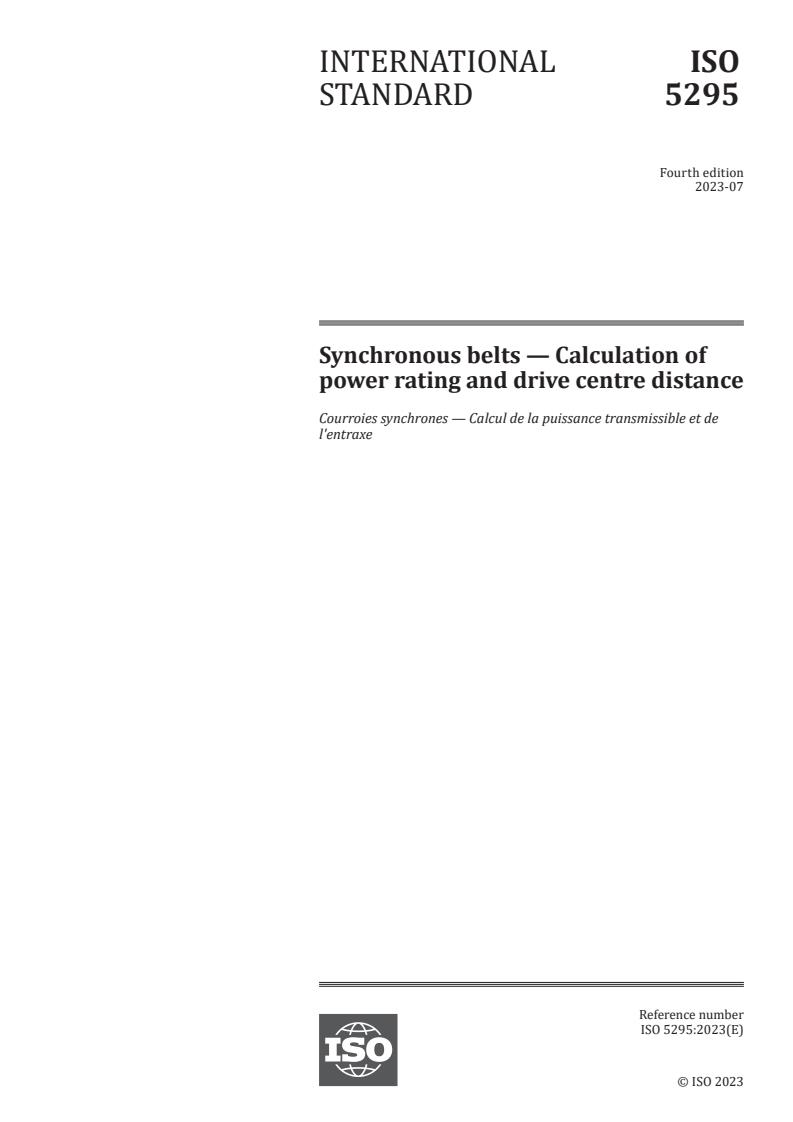
INTERNATIONAL ISO
STANDARD 5295
Fourth edition
2023-07
Synchronous belts — Calculation of
power rating and drive centre distance
Courroies synchrones — Calcul de la puissance transmissible et de
l'entraxe
Reference number
© ISO 2023
All rights reserved. Unless otherwise specified, or required in the context of its implementation, no part of this publication may
be reproduced or utilized otherwise in any form or by any means, electronic or mechanical, including photocopying, or posting on
the internet or an intranet, without prior written permission. Permission can be requested from either ISO at the address below
or ISO’s member body in the country of the requester.
ISO copyright office
CP 401 • Ch. de Blandonnet 8
CH-1214 Vernier, Geneva
Phone: +41 22 749 01 11
Email: copyright@iso.org
Website: www.iso.org
Published in Switzerland
ii
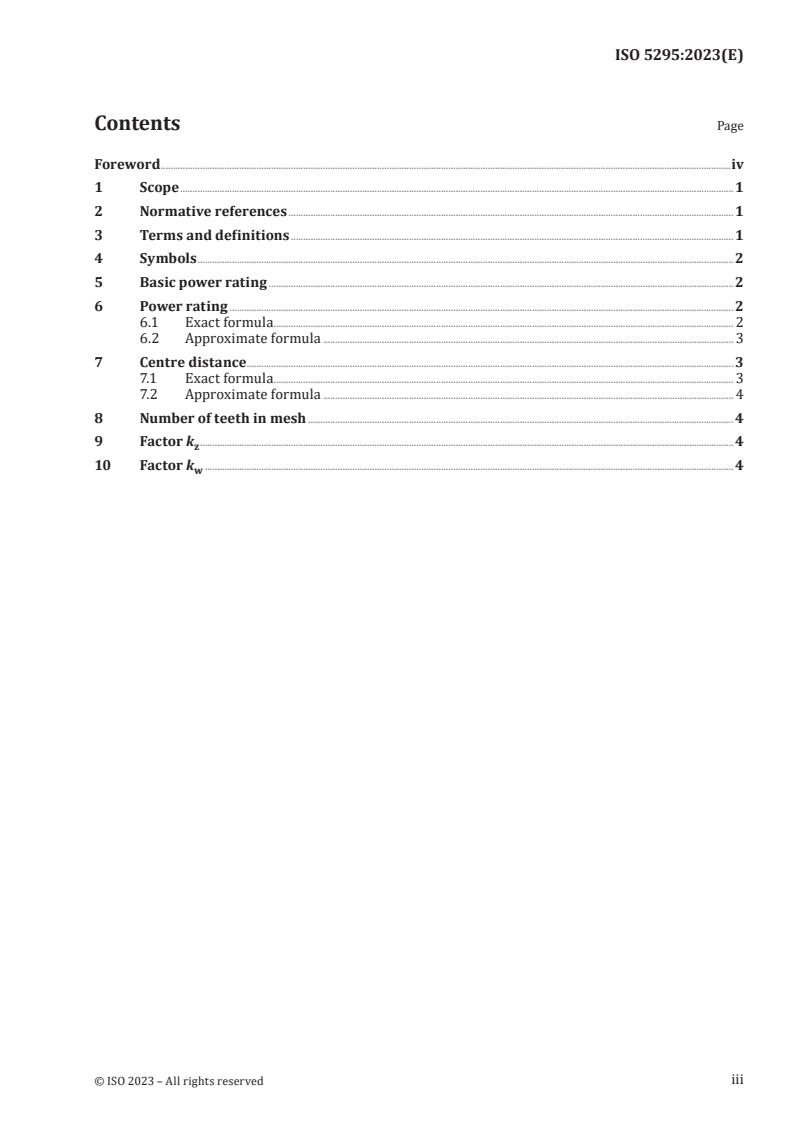
Contents Page
Foreword .iv
1 Scope . 1
2 Normative references . 1
3 Terms and definitions . 1
4 Symbols . 2
5 Basic power rating .2
6 Power rating . 2
6.1 Exact formula . 2
6.2 Approximate formula . 3
7 Centre distance . 3
7.1 Exact formula . 3
7.2 Approximate formula . 4
8 Number of teeth in mesh . 4
9 Factor k . 4
z
10 Factor k . 4
w
iii
Foreword
ISO (the International Organization for Standardization) is a worldwide federation of national standards
bodies (ISO member bodies). The work of preparing International Standards is normally carried out
through ISO technical committees. Each member body interested in a subject for which a technical
committee has been established has the right to be represented on that committee. International
organizations, governmental and non-governmental, in liaison with ISO, also take part in the work.
ISO collaborates closely with the International Electrotechnical Commission (IEC) on all matters of
electrotechnical standardization.
The procedures used to develop this document and those intended for its further maintenance are
described in the ISO/IEC Directives, Part 1. In particular, the different approval criteria needed for the
different types of ISO document should be noted. This document was drafted in accordance with the
editorial rules of the ISO/IEC Directives, Part 2 (see www.iso.org/directives).
ISO draws attention to the possibility that the implementation of this document may involve the use
of (a) patent(s). ISO takes no position concerning the evidence, validity or applicability of any claimed
patent rights in respect thereof. As of the date of publication of this document, ISO had not received
notice of (a) patent(s) which may be required to implement this document. However, implementers are
cautioned that this may not represent the latest information, which may be obtained from the patent
database available at www.iso.org/patents. ISO shall not be held responsible for identifying any or all
such patent rights.
Any trade name used in this document is information given for the convenience of users and does not
constitute an endorsement.
For an explanation of the voluntary nature of standards, the meaning of ISO specific terms and
expressions related to conformity assessment, as
...