

ISO 4183:2026
(Main)Belt drives — Classical and narrow V-belts — Grooved pulleys (system based on datum width)
General Information
- Abstract
This document specifies the principal dimensions of grooved pulleys for classical V-belts (sections Y, Z, A, B, C, D, and E) and narrow V-belts (sections SPZ, SPA, SPB, and SPC) specified in the terminology system based on datum width.
- Status
- Published
- Publication Date
- 29-Jan-2026
- Technical Committee
- ISO/TC 41/SC 1 - Friction
- Drafting Committee
- ISO/TC 41/SC 1 - Friction
- Current Stage
- 6060 - International Standard published
- Start Date
- 30-Jan-2026
- Due Date
- 15-Dec-2026
- Completion Date
- 30-Jan-2026


Overview
ISO 4183:2026 specifies the key dimensions and requirements for grooved pulleys used with classical and narrow V-belts in belt drive systems. These specifications are vital for ensuring compatibility, performance, and safety of mechanical power transmission assemblies that use V-belt drives. The standard applies to classical V-belts with sections Y, Z, A, B, C, D, and E, as well as narrow V-belts with sections SPZ, SPA, SPB, and SPC. All definitions and requirements are based on the datum width system, which standardizes groove and belt profiles for improved interoperability.
Key Topics
- Principal Dimensions: Specifies standardized profiles for pulley grooves to match classical and narrow V-belt sections, including groove width, angle, and tolerances.
- Datum Width and Diameter: Establishes datum width as the reference dimension for grooves and compatible belts, with series of preferred datum diameters for ease of selection and interchangeability.
- Groove Angles: Defines specific groove angles in relation to datum diameters, ensuring optimal belt fit and operating performance.
- Tolerance and Quality: Provides permissible deviations and tolerances for key dimensions, ensuring consistency in manufacturing and operation. Quality and surface finish requirements are referenced to ISO 254.
- Inspection Requirements: Specifies requirements and guidance for geometrical inspections of pulley grooves, referencing ISO 255 for procedures.
- Minimum Dimensions: Lists minimum datum diameters for each belt section to ensure reliable operation and avoid premature belt failure.
Applications
ISO 4183:2026 is essential for a wide range of industrial and commercial applications that utilize V-belt drive systems:
- Machinery Manufacturing: Ensures reliable and standard pulley profiles for use in general industrial machinery, pumps, fans, compressors, and agricultural equipment.
- Maintenance and Replacement: Facilitates straightforward replacement and maintenance of pulleys and belts by providing standardized dimensions, reducing machine downtime and simplifying procurement.
- OEM and Spare Parts: Supports original equipment manufacturers and spare part suppliers in aligning products with international specifications to reach global markets.
- Multiple Belt Drives: Assists engineers in designing machines with multiple groove pulleys for use in high-power or synchronized drive applications, ensuring consistent groove dimensions and minimal datum diameter differences.
Adherence to ISO 4183:2026 promotes interchangeability, safe operation, and extended component life, while reducing risk of mismatched drive components.
Related Standards
To ensure a fully compliant and high-performance V-belt drive system, the following related ISO standards should be referenced alongside ISO 4183:2026:
- ISO 3 - Preferred numbers-Series of preferred numbers: Used for selecting standard sizes.
- ISO 254 - Belt drives-Pulleys-Quality, finish and balance: Specifies quality, surface finish, and balancing requirements for pulleys.
- ISO 255 - Belt drives-Pulleys for V-belts (system based on datum width)-Geometrical inspection of grooves: Defines inspection methods and acceptance criteria for pulley grooves.
- ISO 1081 - Belt drives-V-belts and V-ribbed belts, and corresponding grooved pulleys-Vocabulary: Provides terminology to ensure clear communication in documentation and manufacturing.
ISO 4183:2026 is a core element of the V-belt drive standardization system that enhances reliability and efficiency for power transmission applications worldwide. For more details and guidance on implementation, consult your national standards body or visit iso.org.
Relations
- Effective Date
- 16-Dec-2023
Frequently Asked Questions
ISO 4183:2026 is a standard published by the International Organization for Standardization (ISO). Its full title is "Belt drives — Classical and narrow V-belts — Grooved pulleys (system based on datum width)". This standard covers: This document specifies the principal dimensions of grooved pulleys for classical V-belts (sections Y, Z, A, B, C, D, and E) and narrow V-belts (sections SPZ, SPA, SPB, and SPC) specified in the terminology system based on datum width.
This document specifies the principal dimensions of grooved pulleys for classical V-belts (sections Y, Z, A, B, C, D, and E) and narrow V-belts (sections SPZ, SPA, SPB, and SPC) specified in the terminology system based on datum width.
ISO 4183:2026 is classified under the following ICS (International Classification for Standards) categories: 21.220.10 - Belt drives and their components. The ICS classification helps identify the subject area and facilitates finding related standards.
ISO 4183:2026 has the following relationships with other standards: It is inter standard links to ISO 4183:1995. Understanding these relationships helps ensure you are using the most current and applicable version of the standard.
ISO 4183:2026 is available in PDF format for immediate download after purchase. The document can be added to your cart and obtained through the secure checkout process. Digital delivery ensures instant access to the complete standard document.
Standards Content (Sample)
International
Standard
ISO 4183
Fourth edition
Belt drives — Classical and narrow
2026-01
V-belts — Grooved pulleys (system
based on datum width)
Transmissions par courroies — Courroies trapézoïdales
classiques et étroites — Poulies à gorges (système basé sur la
largeur de référence)
Reference number
© ISO 2026
All rights reserved. Unless otherwise specified, or required in the context of its implementation, no part of this publication may
be reproduced or utilized otherwise in any form or by any means, electronic or mechanical, including photocopying, or posting on
the internet or an intranet, without prior written permission. Permission can be requested from either ISO at the address below
or ISO’s member body in the country of the requester.
ISO copyright office
CP 401 • Ch. de Blandonnet 8
CH-1214 Vernier, Geneva
Phone: +41 22 749 01 11
Email: copyright@iso.org
Website: www.iso.org
Published in Switzerland
ii
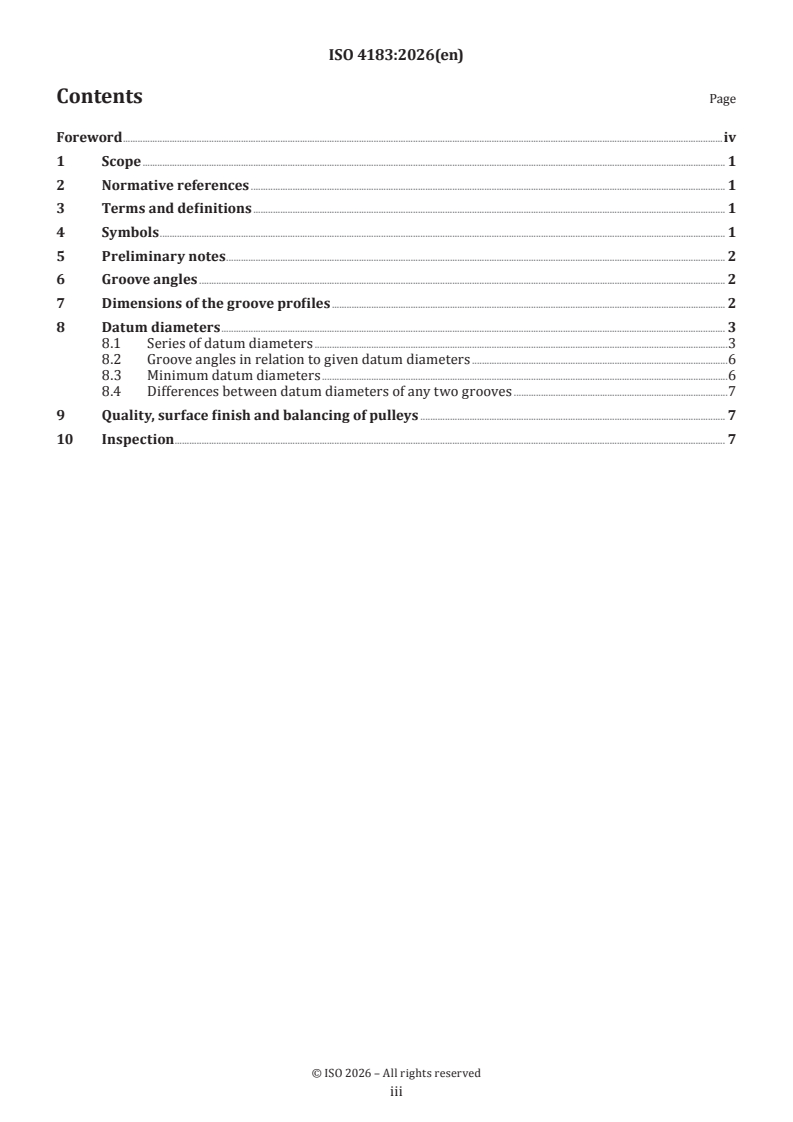
Contents Page
Foreword .iv
1 Scope . 1
2 Normative references . 1
3 Terms and definitions . 1
4 Symbols . 1
5 Preliminary notes . 2
6 Groove angles . 2
7 Dimensions of the groove profiles . 2
8 Datum diameters . 3
8.1 Series of datum diameters .3
8.2 Groove angles in relation to given datum diameters .6
8.3 Minimum datum diameters .6
8.4 Differences between datum diameters of any two grooves .7
9 Quality, surface finish and balancing of pulleys . 7
10 Inspection . 7
iii
Foreword
ISO (the International Organization for Standardization) is a worldwide federation of national standards
bodies (ISO member bodies). The work of preparing International Standards is normally carried out through
ISO technical committees. Each member body interested in a subject for which a technical committee
has been established has the right to be represented on that committee. International organizations,
governmental and non-governmental, in liaison with ISO, also take part in the work. ISO collaborates closely
with the International Electrotechnical Commission (IEC) on all matters of electrotechnical standardization.
The procedures used to develop this document and those intended for its further maintenance are described
in the ISO/IEC Directives, Part 1. In particular, the different approval criteria needed for the different types
of ISO document should be noted. This document was drafted in accordance with the editorial rules of the
ISO/IEC Directives, Part 2 (see www.iso.org/directives).
ISO draws attention to the possibility that the implementation of this document may involve the use of (a)
patent(s). ISO takes no position concerning the evidence, validity or applicability of any claimed patent
rights in respect thereof. As of the date of publication of this document, ISO had not received notice of (a)
patent(s) which may be required to implement this document. However, implementers are cautioned that
this may not represent the latest information, which may be obtained from the patent database available at
www.iso.org/patents. ISO shall not be held responsible for identifying any or all such patent rights.
Any trade name used in this document is information given for the convenience of users and does not
constitute an endorsement.
For an explanation of the voluntary nature of standards, the meaning of ISO specific terms and expressions
related to conformity assessment, as well as information about ISO's adherence to the World Trade
Organization (WTO) principles in the Technical Barriers to Trade (TBT), see www.iso.org/iso/foreword.html.
This document was prepared by Technical Committee ISO/TC 41, Pulleys and belts (including veebelts),
Subcommittee SC 1, Friction.
This fourth edition cancels and replaces the third edition (ISO 4183:1995), which has been technically
revised.
The main changes compared to the previous edition are as follows:
— addition of Clause 4;
— removal of parameters t for A and B in the Figure 1 along with notes 1 and 2;
— removal of Table 1 since datum width values are also shown in Table 2;
— merging of classical and narrow V-belts under the groove profile column in Table 3, and addition of a new
column titled "Tolerance";
— removal of "for use with V-belts" in the first column heading of Table 4.
Any feedback or questions on this document should be directed to the user’s national standards body. A
complete listing of these bodies can be found at www.iso.org/members.html.
iv
International Standard ISO 4183:2026(en)
Belt drives — Classical and narrow V-belts — Grooved pulleys
(system based on datum width)
1 Scope
This document specifies the principal dimensions of grooved pulleys for classical V-belts (sections Y, Z, A, B,
C, D, and E) and narrow V-belts (sections SPZ, SPA, SPB, and SPC) specified in the terminology system based
on datum width.
2 Normative references
The following documents are referred to in the text in such a way that some or all of their content constitutes
requirements of this document. For dated references, only the edition cited applies. For undated references,
the latest edition of the referenced document (including any amendments) applies.
ISO 3,
...