

ISO 13050:2022
(Main)Synchronous belt drives — Metric pitch, curvilinear profile systems G, H, R and S, belts and pulleys
General Information
- Abstract
This document specifies the principal characteristics of metric pitch curvilinear synchronous endless belts and pulleys in G, H, R, and S profile systems for use in synchronous belt drives (also known in the past as timing belt drives, positive belt drives, gear belt drives) for mechanical power transmission and where positive indexing or synchronization can be required. The principal belt and pulley characteristics include the following: a) nominal belt tooth dimensions; b) belt tooth pitch spacing; c) belt length and width dimensions and tolerances; d) belt length measurement specifications; e) pulley groove dimensions and tolerances; f) pulley diameter and width dimensions and tolerances; g) pulley quality specification.
- Status
- Published
- Publication Date
- 13-Mar-2022
- Technical Committee
- ISO/TC 41/SC 4 - Synchronous belt drives
- Drafting Committee
- ISO/TC 41/SC 4 - Synchronous belt drives
- Current Stage
- 6060 - International Standard published
- Start Date
- 14-Mar-2022
- Due Date
- 07-Nov-2022
- Completion Date
- 14-Mar-2022


Overview - ISO 13050:2022 / Synchronous belt drives (metric pitch)
ISO 13050:2022 is the international standard that defines the principal characteristics of metric-pitch curvilinear synchronous (timing) belts and pulleys in profile systems G, H, R and S. Published as the third edition (2022), it specifies dimensions, tolerances and measurement procedures for endless belts and matching pulleys used in mechanical power transmission where positive indexing or synchronization is required.
Key search terms: ISO 13050:2022, synchronous belt drives, timing belts, curvilinear profile, metric pitch, belts and pulleys.
Key topics and technical requirements
The standard covers technical requirements essential for interchangeability, performance and quality control, including:
- Nominal belt tooth dimensions and belt tooth geometry for G, H, R and S profile systems.
- Tooth pitch spacing (metric pitches such as 3 mm, 5 mm, 8 mm, 14 mm, 20 mm are included across profiles).
- Belt length and width dimensions and tolerances, plus improved belt width measurement methods.
- Belt length measurement specifications and enhanced length measurement procedures.
- Pulley groove profile dimensions and tolerances, including generating tool rack definitions for accurate groove form.
- Pulley outside diameters, widths and tolerances and pulley quality specifications (referencing ISO 254 for pulley quality, finish and balance).
- Symbols, nomenclature and identification rules for belts (e.g., 1400-G14M-40) and pulleys (e.g., P30-G14M-40).
- Informative annexes on belt pitch length tolerances, centre-distance relationships, pulley tolerances and flange dimensions.
Practical applications
ISO 13050 is applicable wherever precise timing, synchronization or positive drive is required:
- Automotive accessory drives, robotics and motion control systems
- Industrial machinery, conveyors and packaging equipment
- Printing, textile and machine-tools requiring exact indexing
- Any application needing reliable, backlash-free power transmission
Using the standard ensures correct mating of belts and pulleys, predictable service life, and consistent manufacturing quality.
Who should use this standard
- Mechanical designers and drivetrain engineers specifying synchronous belt drives
- Belt and pulley manufacturers and tooling suppliers
- Quality, testing and inspection labs verifying dimensions and tolerances
- Procurement and maintenance teams seeking compatible replacement parts
- Standards committees and component specifiers
Related standards
- ISO 254 - Belt drives: pulleys - quality, finish and balance
- ISO 5288 - Synchronous belt drives - Vocabulary
Adopting ISO 13050:2022 helps ensure compatibility, performance and safety for metric-pitch curvilinear synchronous belt drive systems.
Relations
- Effective Date
- 25-Aug-2026
- Effective Date
- 17-Jul-2021
Frequently Asked Questions
ISO 13050:2022 is a standard published by the International Organization for Standardization (ISO). Its full title is "Synchronous belt drives — Metric pitch, curvilinear profile systems G, H, R and S, belts and pulleys". This standard covers: This document specifies the principal characteristics of metric pitch curvilinear synchronous endless belts and pulleys in G, H, R, and S profile systems for use in synchronous belt drives (also known in the past as timing belt drives, positive belt drives, gear belt drives) for mechanical power transmission and where positive indexing or synchronization can be required. The principal belt and pulley characteristics include the following: a) nominal belt tooth dimensions; b) belt tooth pitch spacing; c) belt length and width dimensions and tolerances; d) belt length measurement specifications; e) pulley groove dimensions and tolerances; f) pulley diameter and width dimensions and tolerances; g) pulley quality specification.
This document specifies the principal characteristics of metric pitch curvilinear synchronous endless belts and pulleys in G, H, R, and S profile systems for use in synchronous belt drives (also known in the past as timing belt drives, positive belt drives, gear belt drives) for mechanical power transmission and where positive indexing or synchronization can be required. The principal belt and pulley characteristics include the following: a) nominal belt tooth dimensions; b) belt tooth pitch spacing; c) belt length and width dimensions and tolerances; d) belt length measurement specifications; e) pulley groove dimensions and tolerances; f) pulley diameter and width dimensions and tolerances; g) pulley quality specification.
ISO 13050:2022 is classified under the following ICS (International Classification for Standards) categories: 21.220.10 - Belt drives and their components. The ICS classification helps identify the subject area and facilitates finding related standards.
ISO 13050:2022 has the following relationships with other standards: It is inter standard links to EN 81-41:2024, ISO 13050:2014. Understanding these relationships helps ensure you are using the most current and applicable version of the standard.
ISO 13050:2022 is available in PDF format for immediate download after purchase. The document can be added to your cart and obtained through the secure checkout process. Digital delivery ensures instant access to the complete standard document.
Standards Content (Sample)
INTERNATIONAL ISO
STANDARD 13050
Third edition
2022-03
Synchronous belt drives — Metric
pitch, curvilinear profile systems G, H,
R and S, belts and pulleys
Transmissions synchrones — Pas métrique, systèmes à denture
curviligne G, H, R et S, courroies et poulies
Reference number
© ISO 2022
All rights reserved. Unless otherwise specified, or required in the context of its implementation, no part of this publication may
be reproduced or utilized otherwise in any form or by any means, electronic or mechanical, including photocopying, or posting on
the internet or an intranet, without prior written permission. Permission can be requested from either ISO at the address below
or ISO’s member body in the country of the requester.
ISO copyright office
CP 401 • Ch. de Blandonnet 8
CH-1214 Vernier, Geneva
Phone: +41 22 749 01 11
Email: copyright@iso.org
Website: www.iso.org
Published in Switzerland
ii
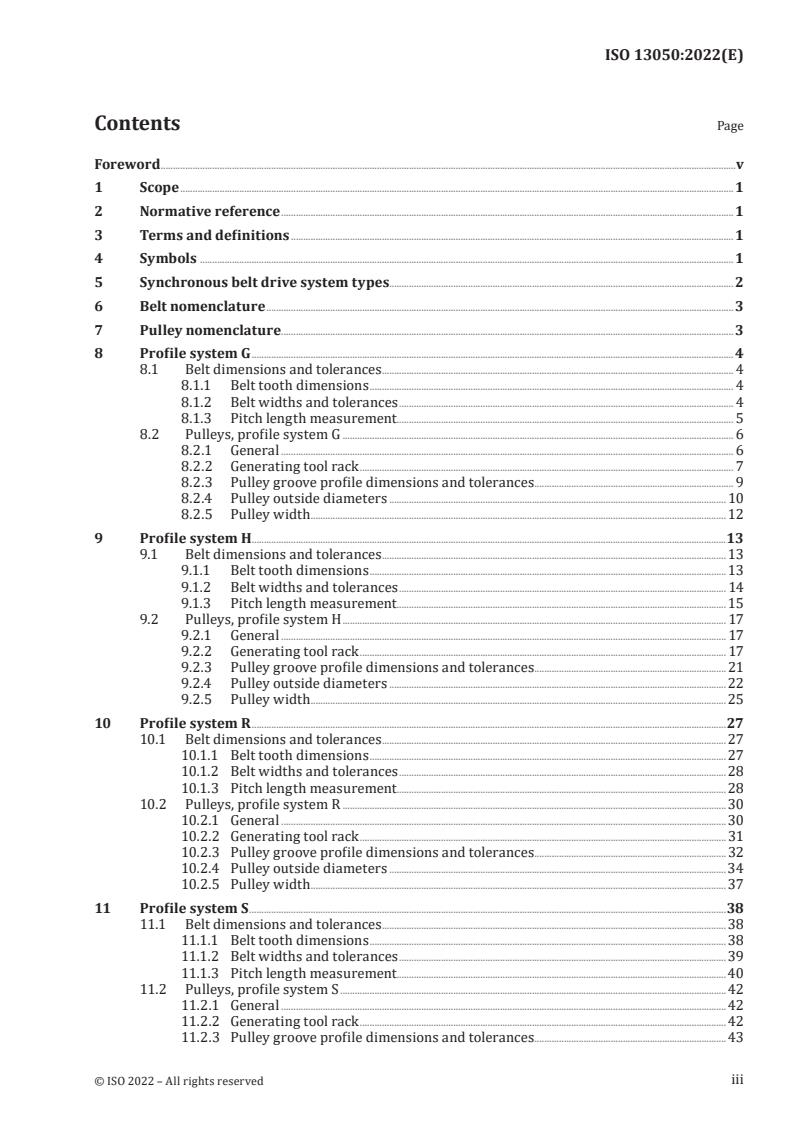
Contents Page
Foreword .v
1 Scope . 1
2 Normative reference .1
3 Terms and definitions . 1
4 Symbols . 1
5 Synchronous belt drive system types . .2
6 Belt nomenclature .3
7 Pulley nomenclature . .3
8 Profile system G . 4
8.1 Belt dimensions and tolerances . . 4
8.1.1 Belt tooth dimensions . 4
8.1.2 Belt widths and tolerances . 4
8.1.3 Pitch length measurement. 5
8.2 Pulleys, profile system G . 6
8.2.1 General . 6
8.2.2 Generating tool rack . 7
8.2.3 Pulley groove profile dimensions and tolerances . 9
8.2.4 Pulley outside diameters . 10
8.2.5 Pulley width . 12
9 Profile system H .13
9.1 Belt dimensions and tolerances . .13
9.1.1 Belt tooth dimensions .13
9.1.2 Belt widths and tolerances . 14
9.1.3 Pitch length measurement. 15
9.2 Pulleys, profile system H . 17
9.2.1 General . 17
9.2.2 Generating tool rack . 17
9.2.3 Pulley groove profile dimensions and tolerances . 21
9.2.4 Pulley outside diameters . 22
9.2.5 Pulley width . 25
10 Profile system R .27
10.1 Belt dimensions and tolerances . . 27
10.1.1 Belt tooth dimensions . 27
10.1.2 Belt widths and tolerances .28
10.1.3 Pitch length measurement.28
10.2 Pulleys, profile system R .30
10.2.1 General .30
10.2.2 Generating tool rack . 31
10.2.3 Pulley groove profile dimensions and tolerances . 32
10.2.4 Pulley outside diameters .34
10.2.5 Pulley width . 37
11 Profile system S .38
11.1 Belt dimensions and tolerances .38
11.1.1 Belt tooth dimensions .38
11.1.2 Belt widths and tolerances .39
11.1.3 Pitch length measurement.40
11.2 Pulleys, profile system S . 42
11.2.1 General . 42
11.2.2 Generating tool rack . 42
11.2.3 Pulley groove profile dimensions and tolerances . 43
iii
11.2.4 Pulley outside diameters .44
11.2.5 Pulley width .46
Annex A (informative) Belt pitch lengths and tolerances .48
Annex B (informative) Relationship between centre distance and belt pitch length .50
Annex C (informative) Pulley tolerances .52
Annex D (informative) Flange dimensions .55
Bibliography .56
iv
Foreword
ISO (the International Organization for Standardization) is a worldwide federation of national standards
bodies (ISO member bodies). The work of preparing International Standards is normally carried out
through ISO technical committees. Each member body interested in a subject for which a technical
committee has been established has the right to be represented on that committee. International
organizations, governmental and non-governmental, in liaison with ISO, also take part in the work.
ISO collaborates closely with the International Electrotechnical Commission (IEC) on all matters of
electrotechnical standardization.
The procedures used to develop this document and those intended for its further maintenance are
described in the ISO/IEC Directives, Part 1. In particular, the different approval criteria needed for the
different types of ISO documents should be noted. This document was drafted in accordance with the
editorial rules of the ISO/IEC Directives, Part 2 (see www.iso.org/directives).
Attention is drawn to the possibility that some of the elements of this document may be the subject of
patent rights. ISO shall not be held responsible for identifying any or all such patent rights. Details of
any patent rights identified during the development of the document will be in the Introduction and/or
on the ISO list of patent declarations received (see www.iso.org/patents).
Any trade name used in this document is information given for the convenience of users and does not
constitute an endorsement.
For an explanation of the voluntary nature of standards, the meaning of ISO specific terms and
expressions related to conformity assessment, as well as information about ISO's adherence to
the World Trade Organization (WTO) principles in the Technical Barriers to Trade (TBT), see
www.iso.org/iso/foreword.html.
This document was prepared by Technical Committee ISO/TC 41, Pulleys and belts (including veebelts),
Subcommittee SC 4, Synchronous belt drives.
This third edition cancels and replaces the second edition (ISO 13050:2014), which has been technically
revised.
The main changes are as follows:
— in Formulae (1) and (2), “A ” has been added before the first square bracket;
o
— the formulae in the document have been renumbered and symbols are now used;
— the nomenclature has been changed in Tables 1 and 14, and Figures 1 and 11;
— belt width measurement methods were improved in 8.1.2, 9.1.2, 10.1.2, 11.1.2;
— total measuring forces are now for reference only in 8.1.3.2, 9.1.3.2, 10.1.3.2, 11.1.3.2;
— belt length measurement procedures were enhanced in 8.1.3.3, 9.1.3.3, 10.1.3.3, 11.1.3.3;
— the taper specification in Annex C was removed.
Any feedback or questions on this document should be directed to the user’s national standards body. A
complete listing of these bodies can be found at www.iso.org/members.html.
v
INTERNATIONAL STANDARD ISO 13050:2022(E)
Synchronous belt drives — Metric pitch, curvilinear profile
systems G, H, R and S, belts and pulleys
1 Scope
This document specifies the principal characteristics of metric pitch curvilinear synchronous endless
belts and pulleys in G, H, R, and S profile systems for use in synchronous belt drives (also known in the
past as timing belt drives, positive belt drives, gear belt drives) for mechanical power transmission and
where positive indexing or synchronization can be required.
The principal belt and pulley characteristics include the following:
a) nominal belt tooth dimensions;
b) belt tooth pitch spacing;
c) belt length and width dimensions and tolerances;
d) belt length measurement specifications;
e) pulley groove dimensions and tolerances;
f) pulley diameter and width dimensions and tolerances;
g) pulley quality specification.
2 Normative reference
The following documents are referred to in the text in such a way that some or all of their content
constitutes requirements of this document. For dated references, only the edition cited applies. For
undated references, the latest edition of the referenced document (including any amendments) applies.
ISO 254, Belt drives — Pulleys — Quality, finish and balance
ISO 5288, Synchronous belt drives — Vocabulary
3 Terms and definitions
For the purposes of this document, the terms and definitions given in ISO 5288 apply.
ISO and IEC maintain terminology databases for use in standardization at the following addresses:
— ISO Online browsing platform: available at https:// www .iso .org/ obp
— IEC Electropedia: available at https:// www .electropedia .org/
4 Symbols
For the purpose of this document, the symbols given in ISO 5288 and the following apply,
Symbol Definition Symbol Definition
a Pitch line differential h Reference rack tooth height
r
2A Reference rack tooth angle h Tooth height
t
b Minimum flanged pulley width L Belt pitch length
f p
b’ Minimum unflanged pulley width n Number of grooves
f g
b Reference rack width at tooth tip P Tooth pitch
g b
b Width at groove crest r Radius at tooth tip
r a
b Reference rack width at tooth root r Radius at tooth root
t r
C Centre distance r Radius at the groove crest
t
d Pitch diameter S Width at tooth root
d Outside diameter 2β Tooth angle
o
h Total height of a double-sided belt 2ϕ Groove angle
d
h Total height of a single-sided belt
s
5 Synchronous belt drive system types
Four profile systems and 14 profiles for curvilinear synchronous drives are standardized.
Profile system G Profile system R
Profile G8M Profile R3M
(Tooth/groove pitch 8 mm) (Tooth/groove pitch 3 mm)
Profile G14M Profile R5M
(Tooth/groove pitch 14 mm) (Tooth/groove pitch 5 mm)
Profile R8M
(Tooth/groove pitch 8 mm)
Profile R14M
(Tooth/groove pitch 14 mm)
Profile R20M
(Tooth/groove pitch 20 mm)
Profile system H Profile system S
Profile H3M Profile S8M
(Tooth/groove pitch 3 mm) (Tooth/groove pitch 8 mm)
Profile H5M Profile S14M
(Tooth/groove pitch 5 mm) (Tooth/groove pitch 14 mm)
Profile H8M
(Tooth/groove pitch 8 mm)
Profile H14M
(Tooth/groove pitch 14 mm)
Profile H20M
(Tooth/groove pitch 20 mm)
6 Belt nomenclature
A belt is identified as follows:
a) the belt length or pitch length in millimetres, e.g. 1 400 mm;
b) the profile system, e.g. “G”,“H”, “R”, or “S”;
c) the pitch or tooth pitch in millimetres, e.g. 14 mm;
d) the width or belt width in millimetres, e.g. 40 mm (for Profile system S, the width in
millimetres × 10);
e) double-sided belts are designated by adding the letter “D” before the designation of the profile
system.
EXAMPLE A synchronous belt in the above profile systems of 1 400 mm length, 14 mm pitch, and 40 mm
wide is identified as follows:
Profile system G Profile system R
1400-G14M-40 1400-R14M-40
1400-DG14M-40 1400-DR14M-40
Profile system H Profile system S
1400-H14M-40 1400-S14M-400
1400-DH14M-40 1400-DS14M-400
7 Pulley nomenclature
A pulley is identified as follows:
a) the letter “P” indicates a pulley;
b) the number of grooves, e.g. 30;
c) the profile system, e.g. “G“, “H”, “R”, or “S”;
d) the pitch or groove pitch in millimetres, e.g. 14 mm;
e) the width or belt width in millimetres, e.g. 40 mm (for profile system S, the width in millimetres × 10).
EXAMPLE A pulley in the above profile systems of 30 grooves, 14 mm pitch, and 40 mm wide is identified as
follows:
Profile system G Profile system R
P30-R14M-40 P30-G14M-40
Profile system H Profile system S
P30-H14M-40 P30-S14M-400
8 Profile system G
8.1 Belt dimensions and tolerances
8.1.1 Belt tooth dimensions
The nominal belt tooth dimensions are given in Table 1 and shown in Figure 1.
Table 1 — Nominal tooth dimensions
Dimensions in millimetres
Profile Belt pitch S h h r A a x L
s t r o o 1
G8M 8 5,200 5,87 3,43 0,74 2,29 0,80 0,379 1,378
G14M 14 9,100 10,11 6,00 1,30 4,00 1,40 0,661 2,422
Figure 1 — Tooth dimensions — Profile system G
Detail of tooth face
For A ≥ x ≥ x :
o o
yA=+ln Ax//Ax −11−− xA/ (1)
() ()
oo()oo
NOTE 1 x corresponds to y = h .
o t
NOTE 2 L is equal to S – 2(A – x ).
1 o o
NOTE 3 Indicated base tooth profile remains constant in all parts.
NOTE 4 “o” reference points remain in contact with the part outer surface generated by part radius of
curvature.
NOTE 5 Groove profile bottom surface in circular part form is an arc whose chordal distance is L and whose
radius originates at the part centre.
8.1.2 Belt widths and tolerances
Belt widths and tolerances are given in Table 2. Evenly measure at least three points throughout
circumference and average them.
Table 2 — Widths and width tolerances
Dimensions in millimetres
Tolerance on width for belt pitch lengths
Over 840 mm and
Profile Nominal belt width
Up to and including Over
up to and including
840 mm 1 680 mm
1 680 mm
12 +0,8 −0,8 +0,8 −1,2 +0,8 −1,2
21 +0,8 −0,8 +0,8 −1,2 +0,8 −1,2
G8M
36 +0,8 −0,8 +0,8 −1,2 +0,8 −1,2
62 +1,2 −1,2 +1,2 −1,6 +1,6 −1,6
20 +0,8 −0,8 +0,8 −1,2 +0,8 −1,2
37 +0,8 −0,8 +0,8 −1,2 +0,8 −1,2
G14M 68 +1,2 −1,6 +1,6 −1,6 +1,6 −2,0
90 +1,6 −1,6 +1,6 −2,0 +2,0 −2,0
125 +2,4 −2,4 +2,4 −2,8 +2,4 −3,2
8.1.3 Pitch length measurement
See Annex A for tolerances and Annex B for the relationship between the centre distance and the belt
pitch length.
8.1.3.1 Measuring fixture (see Figure 2)
The pitch length of a synchronous belt shall be determined by placing the belt on a measuring fixture
composed of the following elements.
8.1.3.1.1 Two pulleys of equal diameter, as specified in Table 3, of the proper belt profile and having
standard tooth space dimensions. These pulleys should be made to the tolerances shown in Table 3.
One pulley shall be free to rotate on a fixed-position shaft, while the other shall be free to rotate on a
moveable shaft to permit the centre distance to change.
8.1.3.1.2 Means of applying a total measuring force to the moveable pulley.
8.1.3.1.3 Means of measuring the centre distance between the two pulleys with the necessary
degree of accuracy for centre distance measurement.
8.1.3.2 Total measuring force
The total measuring force to be applied for measuring belts is given in Table 4. The forces shown in
Table 4 are for reference only.
8.1.3.3 Procedure
In measuring the pitch length of a synchronous belt, the belt should be rotated at least two revolutions
to seat it properly and to divide the total force equally between the two spans of the belt. The pitch
length shall be calculated by adding the pitch circumference of one of the pulleys to twice the measured
centre distance.
Centre-to-centre distance measurement methodology should include multiple sensor readings from a
minimum of 3 belt revolutions averaged together.
Key
1 centre distance
2 total measuring force
Figure 2 — Diagram of fixture for measuring pitch length
Table 3 — Belt length measuring pulleys
Dimensions in millimetres
Radial Axial
Number of Pitch circumfer- Outside diam-
runout runout
Profile
a
grooves ence eter
b b
F.I.M. F.I.M.
84,980
G8M 34 272 0,013 0,025
±0,013
175,454
G14M 40 560 0,013 0,051
±0,025
a
Pulleys outside of the diameter tolerance range specified can be used if the resulting belt length measurements are
corrected for the actual pulley diameters.
b
F.I.M means the full indicator movement.
NOTE The number of pulley teeth specified in Table 3 determines the recommended sizes for measuring
the belt pitch length. Practically, other sizes of pulleys could be used provided both pulleys are of equal size, and
meet the outside diameter tolerance, radial runout, and axial runout specifications of Table 3.
Table 4 — Total measuring force
Forces in Newtons
Belt width
mm
Profile
12 20 21 36 37 62 68 90 125
G8M 267 — 467 756 — 1 223 — — —
G14M — 1 179 — — 2 046 — 3 447 4 315 5 627
NOTE Total measuring forces are for reference only.
8.2 Pulleys, profile system G
8.2.1 General
See Annex C for tolerances.
The pulley is characterized by a curvilinear groove profile. This groove profile is defined as the profile
formed by the generating tool rack form required to machine-finish the curvilinear profile. The profile
is different for each pulley diameter, but can be closely approximated by a nominal groove profile over
specified ranges of number of grooves.
8.2.2 Generating tool rack
Dimensions and tolerances for the generating tool rack for pulleys with profile system G are given in
Table 5 and shown in Figure 3.
Figure 3 — Pulley generating tool rack dimensions
Table 5 — Pulley generating tool rack dimensions
Dimensions in millimetres
P P P P P P P P P
Number of 0 1 2 3 4 5 6 7 8
Profile P h r r r r r r r r X
b r 1 2 3 4 5 6 7 8
grooves
(X,Y) (X,Y) (X,Y) (X,Y) (X,Y) (X,Y) (X,Y) (X,Y) (X,Y)
22 to 27 7,784 3,541 3,480 0,842 2,710 1,459 2,567 — — 8,833 2,427 5,882 1,841 3,123 1,324 1,450 0,979 0,552 0,856 0,856
0 −0,433 −0,788 −1,275 −2,580 −3,235 −3,491 −3,541
28 to 37 7,843 3,513 3,448 0,828 2,746 1,086 2,578 — — 9,487 2,447 5,901 1,894 3,152 1,367 1,505 1,009 0,640 0,843 0,843
0 −0,348 −0,715 −1,193 −2,486 −3,177 −3,447 −3,513
38 to 58 7,891 3,487 3,426 0,819 2,829 0,918 2,583 — — 9,964 2,462 5,921 1,940 3,181 1,410 1,562 1,024 0,669 0,831 0,831
G8M
0 −0,232 −0,668 −1,126 −2,402 −3,119 −3,414 −3,487
59 to 89 7,930 3,467 3,412 0,818 2,943 0,846 2,586 — — 10,385 2,470 5,932 1,978 3,205 1,443 1,614 1,039 0,725 0,820 0,820
0 −0,130 −0,632 −1,082 −2,328 −3,072 −3,384 −3,467
90 to 250 8,040 3,452 3,558 0,846 3,040 0,957 2,751 1,984 2,617 8,275 2,345 5,111 1,978 3,042 1,559 1,725 1,181 0,805 0,951 0,951
0 −0,164 −0,512 −0,873 −1,724 −2,495 −3,056 −3,359 −3,452
27 to 29 13,674 6,174 6,009 1,461 4,777 2,188 4,536 9,728 4,405 11,867 3,768 9,625 3,161 6,114 2,486 3,338 1,808 1,511 1,505 1,505
0 −0,684 −1,222 −1,696 −3,487 −4,619 −5,489 −6,041 −6,174
30 to 35 13,725 6,147 5,986 1,453 4,738 2,206 4,519 9,448 4,418 11,919 3,800 9,584 3,213 6,129 2,522 3,433 1,850 1,588 1,496 1,496
0 −0,717 −1,244 −1,626 −3,408 −4,531 −5,436 −5,990 −6,147
36 to 45 13,780 6,117 5,961 1,446 4,685 2,241 4,490 — — 13,051 3,951 10,115 3,297 6,163 2,582 3,489 1,883 1,672 1,485 1,485
0 −0,780 −1,312 −3,041 −4,387 −5,356 −5,942 −6,117
46 to 60 13,831 6,090 5,940 1,437 4,652 2,180 4,484 — — 13,091 3,971 10,092 3,417 6,222 2,649 3,541 1,913 1,745 1,476 1,476
G14M
0 −0,815 −1,313 −2,983 −4,172 −5,267 −5,899 −6,090
61 to 90 13,879 6,065 5,919 0 1,429 4,608 2,151 4,484 — — 13,183 3,988 10,067 3,463 6,236 2,702 3,586 1,940 1,812 1,467 1,467
−0,883 −1,285 −2,928 −4,081 −5,193 −5,857 −6,065
91 to 149 13,927 6,040 5,900 1,420 4,568 2,586 4,476 — — 13,304 4,014 10,051 3,505 6,245 2,746 3,629 1,969 1,872 1,458 1,458
0 −0,955 −1,292 −2,848 −3,997 −5,128 −5,815 −6,040
150 to 250 13,956 6,024 5,887 1,414 4,537 5,757 4,458 — — 13,150 4,030 10,051 3,533 6,249 2,701 3,652 1,983 1,908 1,453 1,453
0 −1,031 −1,352 −2,799 −3,938 −5,171 −5,792 −6,024
8.2.3 Pulley groove profile dimensions and tolerances
Dimensions and tolerances for the pulley groove profile for G8M and G14M pulleys are given in Table 6
and shown in Figures 4 and 5.
Table 6 — Pulley groove profile dimensions
Dimensions in millimetres
Number of
Profile b h r A x L a
r g t o o 1
grooves
G8M 22 to 89 5,400 3,43 0,80 2,29 0,379 1,60 0,80
90 to 250 5,660 3,43 0,80 2,29 0,379 1,60
G14M 28 to over 9,450 6,00 1,40 4,00 0,661 2,80 1,40
Figure 4 — Pulley groove profile
For A ≥ x ≥ x :
o o
2
A A
x
oo
yA=+ln −11−− (2)
o
x x A
o
NOTE 1 x corresponds to y = h .
o t
NOTE 2 L is equal to S – 2(A – x ).
1 o o
NOTE 3 Indicated base tooth profile remains constant in all parts.
NOTE 4 “o” reference points remain in contact with the part outer surface generated by part radius of
curvature.
NOTE 5 Groove profile bottom surface in circular part form is an arc whose chordal distance is L and whose
radius originates at the part centre.
NOTE The true profile of the groove sides can only be produced by plotting the function associated with the
cross-section.
Figure 5 — Groove profile — Tolerance bands — Millimetres
8.2.4 Pulley outside diameters
Pulleys outside diameters for the standard pulleys are given in Table 7. The relationship of the pulley
outside and pitch diameters is illustrated in Figure 6 and Formulae (3) and (4).
nP ×
gb
d= (3)
π
d = d - 2a (4)
o
where a is given in Table 1.
Key
1 pitch
2 belt pitch line
3 belt tooth
4 pitch diameter
5 outside diameter
6 pulley groove
Figure 6 — Pulley dimensions
Table 7 — Standard pulley sizes
Dimensions in millimetres
Profile
Number
G8M G14M
of
Pitch Outside Pitch Outside
grooves
diameter diameter diameter diameter
22 56,02 54,42 — —
25 63,66 62,06 — —
28 71,30 69,70 124,78 121,98
29 — — 129,23 126,43
30 76,39 74,79 133,69 130,89
31 — — 138,15 135,35
32 81,49 79,89 142,60 139,80
33 — — 147,06 144,26
34 86,58 84,98 151,52 148,72
35 — — 155,9 153,17
Table 7 (continued)
Profile
Number
G8M G14M
of
Pitch Outside Pitch Outside
grooves
diameter diameter diameter diameter
36 91,67 90,07 160,43 157,63
37 — — 164,88 162,08
38 96,77 95,17 169,34 166,54
39 — — 173,80 171,00
40 101,86 100,26 178,25 175,45
42 106,95 105,35 — —
43 — — 191,62 188,82
44 — — 196,08 193,28
45 114,59 112,99 200,54 197,74
48 122,23 120,63 213,90 211,10
50 127,32 125,72 222,82 220,02
53 134,96 133,36 236,19 233,39
56 142,60 141,00 249,55 246,75
60 152,79 151,19 267,38 264,58
63 160,43 158,83 280,75 277,95
64 162,97 161,37 285,21 282,41
67 170,61 169,01 298,57 295,77
71 180,80 179,20 316,40 313,60
72 — — 320,86 318,06
75 190,99 189,39 334,23 331,43
80 203,72 202,12 356,51 353,71
90 229,18 227,58 401,07 398,27
112 285,21 283,61 499,11 496,31
140 356,51 354,91 623,89 621,09
168 — — 748,66 745,86
192 488,92 487,32 — —
180 458,37 456,77 802,14 799,34
192 — — 855,62 852,82
200 — — 891,27 888,47
224 570,41 568,81 998,22 995,42
8.2.5 Pulley width
The standard nominal pulley width, and the minimum actual pulley width required, b for flanged
f
pulleys, b' for unflanged pulleys are given in Table 8 and shown in Figure 7. Users are advised that the
f
values given for b' apply also to pulleys with only one flange (see Annex D).
f
Table 8 — Standard pulley widths
Dimensions in millimetres
Standard nom- Minimum pulley width
inal
Profile
Flanged b Unflanged b'
f f
pulley width
12 14 22
21 23 30
G8M
36 40 47
62 66 74
20 26 35
37 44 52
G14M 68 76 85
90 99 107
125 134 143
The minimum unflanged pulley width can be reduced when the alignment of the drive can be controlled,
but shall not be less than the minimum flanged pulley width.
a) flanged pulley b) unflanged pulley
Figure 7 — Minimum pulley width
9 Profile system H
9.1 Belt dimensions and tolerances
9.1.1 Belt tooth dimensions
The nominal belt tooth dimensions are the same for single-sided and double-sided belts; they are given
in Table 9 and shown in Figure 8.
Table 9 — Nominal tooth dimensions
Dimensions in millimetres
P P P P P P P P
Belt 1 5 2 6 3 7 4 8
Profile h h h r r a
s d t 1 2
pitch
(X, Y) (X, Y) (X, Y) (X, Y) (X, Y) (X, Y) (X, Y) (X, Y)
−1,14 −0,83 −0,83 0,00
H3M 3 2,4 — 1,21 — 0,30 — — 0,86 — 0,381
0,00 −0,30 −0,35 −1,21
−1,14 −0,83 −0,83 0,00
DH3M 3 — 3,2 — — 0,30 — — 0,86 — 0,381
0,76 1,06 1,11 1,97
−1,85 −1,44 −1,44 0,00
H5M 5 3,8 — 2,08 — 0,41 — — 1,50 — 0,572
0,00 −0,42 −0,53 −2,08
−1,85 −1,44 −1,44 0,00
DH5M 5 — 5,3 — — 0,41 — — 1,50 — 0,572
1,14 1,56 1,67 3,22
−3,30 −2,55 −2,47 0,00
H8M 8 6,0 — 3,38 — 0,76 — — 2,59 — 0,686
0,00 −0,65 −1,17 −3,38
−3,30 −2,55 −2,47 0,00
DH8M 8 — 8,1 — — 0,76 — — 2,59 — 0,686
1,37 2,02 2,54 4,75
−5,78 −4,36 −4,30 0,00
H14M 14 10,0 — 6,02 — 1,42 — — 4,46 — 1,397
0,00 −1,29 −1,97 −6,02
−5,78 −4,36 −4,30 0,00
DH14M 14 — 14,8 — — 1,42 — — 4,46 — 1,397
2,79 4,08 4,76 8,81
−8,34 −6,32 −6,22 0,00
H20M 20 13,2 — 8,68 — 2,03 — — 6,40 — 2,159
0,00 −1,84 −2,90 −8,68
a) single-sided b) double-sided
Figure 8 — Tooth dimensions – Profile system H
9.1.2 Belt widths and tolerances
Belt widths and tolerances are given in Table 10. Evenly measure three points throughout circumference
and average them.
Table 10 — Widths and width tolerances
Dimensions in millimetres
Tolerance on width for belt pitch lengths
Nominal belt
Over 840 mm and
Profile
Up to and including Over
width
up to and including
840 mm 1 680 mm
1 680 mm
+0,4 +0,4
—
H3M, −0,8 −0,8
DH3M
+0,8 +0,8 +0,8
−0,8 −1,2 −1,2
+0,4 +0,4
9 —
−0,8 −0,8
H5M,
+0,8 +0,8 +0,8
DH5M
−0,8 −1,2 −1,2
+0,8 +0,8 +0,8
−0,8 −1,2 −1,2
H8M,
+0,8 +1,2 +1,2
DH8M −1,2 −1,2 −1,6
+1,6 +1,6 +2,0
−1,6 −2,0 −2,0
+0,8 +1,2 +1,2
−1,2 −1,2 −1,6
+1,2 +1,2 +1,6
−1,2 −1,6 −1,6
H14M,
+1,6 +1,6 +2,0
DH14M
−1,6 −2,0 −2,0
+2,4 +2,4 +2,4
−2,4 −2,8 −3,2
+2,4 +2,4 +2,4
−2,4 −2,8 −3,2
H20M
+4,8
290 — —
−6,4
9.1.3 Pitch length measurement
See Annex A for tolerances and Annex B for the relationship between the centre distance and the belt
pitch length.
9.1.3.1 Measuring fixture (see Figure 9)
The pitch length of a synchronous belt shall be determined by placing the belt on a measuring fixture
composed of the following elements.
9.1.3.1.1 Two pulleys of equal diameter, as specified in Table 11, of the proper belt type and having
standard tooth space dimensions. These pulleys should be made to the tolerances shown in Table 11.
One pulley shall be free to rotate on a fixed-position shaft, while the other shall be free to rotate on a
moveable shaft to permit the centre distance to change.
9.1.3.1.2 Means of applying a total measuring force to the moveable pulley.
9.1.3.1.3 Means of measuring the centre distance between the two pulleys with the necessary
degree of accuracy for centre distance measurement.
9.1.3.2 Total measuring force
The total measuring force to be applied for measuring belts is given in Table 12. The forces shown in
Table 12 are for reference only.
9.1.3.3 Procedure
In measuring the pitch length of a synchronous belt, the belt should be rotated at least two revolutions
to seat it properly and to divide the total force equally between the two spans of the belt. The pitch
length shall be calculated by adding the pitch circumference of one of the pulleys to twice the measured
centre distance.
Centre-to-centre distance measurement methodology should include multiple sensor readings from a
minimum of 3 belt revolutions averaged together.
Check double-sided belts on both tooth faces.
Key
1 centre distance
2 total measuring force
Figure 9 — Diagram of fixture for measuring pitch length
Table 11 — Belt length measuring pulleys
Dimensions in millimetres
Radial Axial
Number of Pitch Outside
runout runout
Profile
a
grooves circumference diameter
b b
F.I.M. F.I.M.
27,886
H3M, DH3M 30 90 0,013 0,025
±0,013
30,687
H5M, DH5M 20 100 0,013 0,025
±0,013
85,208
H8M, DH8M 34 272 0,013 0,025
±0,013
a
Pulleys outside of the diameter tolerance range specified can be used if the resulting belt length
measurements are corrected for the actual pulley diameters.
b
F.I.M. means full indicator movement.
Table 11 (continued)
Radial Axial
Number of Pitch Outside
runout runout
Profile
a
grooves circumference diameter
b b
F.I.M. F.I.M.
175,46
H14M, DH14M 40 560 0,013 0,051
±0,025
250,33
H20M 40 800 0,013 0,076
±0,036
a
Pulleys outside of the diameter tolerance range specified can be used if the resulting belt length
measurements are corrected for the actual pulley diameters.
b
F.I.M. means full indicator movement.
NOTE The number of pulley teeth specified in Table 11 determines the recommended sizes for measuring
the belt pitch length. Practically, other sizes of pulleys could be used provided both pulleys are of equal size, and
meet the outside diameter tolerance, radial runout, and axial runout specifications of Table 11.
Table 12 — Total measuring force
Forces in Newtons
Belt width
mm
Profile
6 9 15 20 25 30 40 50 55 85 115 170 230 290 340
H3M,
45 76 138 — — — — — — — — — — — —
DH3M
H5M,
— 111 214 — 376 — — — — — — — — — —
DH5M
H8M,
— — — 470 750 — 1 320 — 2 310 — — — — —
DH8M
H14M,
— — — — — — 1 350 — 2 130 3 660 5 180 7 960 — — —
DH14M
H20M — — — — — — — — — — 6 961 10 729 14 839 18 949 22 374
NOTE Total measuring forces are for reference only.
9.2 Pulleys, profile system H
9.2.1 General
See Annex C for tolerances.
The pulley is characterized by a curvilinear groove profile. This groove profile is defined as the profile
formed by the generating tool rack form required to machine-finish the curvilinear profile. The profile
is different for each pulley diameter, but can be closely approximated by a nominal groove profile over
specified ranges of number of grooves.
9.2.2 Generating tool rack
Dimensions and tolerances for the generating tool rack for pulleys with profile system H are given in
Table 13 and shown in Figure 10.
Figure 10 — Pulley generating tool rack form
Table 13 — Pulley generating tool rack dimensions
Num-
P h P r P r P r P r P r P
b r o 1 1 2 2 3 3 4 4 5 5
Profile ber of X
±0,012 ±0,015 (X,Y) ±0,012 (X,Y) ±0,012 (X,Y) ±0,012 (X,Y) ±0,012 (X,Y) ±0,012 (X,Y)
grooves
9 to 13 3,000 1,196 1,423 0,414 1,061 — — ∞ 0,712 0,559 0,574 0,869 0,029 0,029
0 −0,213 −0,840 −1,004 −1,196
14 to 25 3,000 1,173 1,324 0,254 1,139 0,792 0,992 ∞ 0,747 0,254 0,687 0,844 0,114 0,114
0 −0,080 −0,213 −0,860 −0,944 −1,168
H3M
26 to 80 3,000 1,227 1,223 0,262 0,982 2,616 0,820 — — 0,493 0,733 0,869 0,036 0,036
0 −0,159 −0,679 -0,877 -1,227
81 to 200 3,000 1,232 1,333 0,358 0,981 — — ∞ 0,923 — — 0,866 0,077 0,077
0 −0,290 −0,554 -1,232
12 to 16 5,000 1,986 2,344 0,659 1,739 4,475 1,522 ∞ 1,124 0,691 0,773 1,133 0,328 0,328
0 −0,316 −0,720 −1,560 −1,895 −1,986
17 to 31 5,000 2,024 2,242 0,610 1,871 1,431 1,540 ∞ 1,163 0,612 1,013 1,219 0,295 0,295
0 −0,126 −0,593 −1,566 −1,789 −2,024
H5M
32 to 79 5,000 2,032 2,073 0,493 1,675 1,359 1,501 ∞ 1,370 1,402 1,088 1,300 0,135 0,135
0 −0,203 −0,566 −1,035 −1,617 −2,032
80 to 200 5,000 2,056 2,160 0,610 1,564 — — ∞ 1,443 — — 1,471 0,043 0,043
0 −0,483 −1,050 −2,065
22 to 27 8,000 3,289 3,805 1,143 2,738 — — ∞ 2,322 — — 2,553 0 —
0 −0,648 −1,801 −3,289
28 to 89 8,000 3,612 3,754 1,067 2,748 12,903 2,360 — — 0,726 2,283 2,744 0 —
H8M
0 −0,711 −2,024 −2,215 −3,612
90 to 200 8,000 3,632 3,617 0,940 2,697 — — ∞ 2,459 — — 2,637 0 —
0 −0,757 −1,948 −3,632
28 to 36 14,000 6,320 6,761 1,880 5,037 20,828 4,064 — — 1,143 3,909 4,717 0 —
0 −1,133 −3,904 −4,242 −6,320
37 to 89 14,000 6,223 6,599 1,829 4,890 15,748 4,204 — — 1,143 4,089 4,663 0 —
H14M
0 −1,176 −3,493 −3,802 −6,223
90 to 216 14,000 6,350 6,546 1,905 4,704 20,117 4,288 — — 0,254 4,270 4,623 0 —
0 −1,425 −3,439 −3,498 −6,350
Table 13 (continued)
Num-
P h P r P r P r P r P r P
b r o 1 1 2 2 3 3 4 4 5 5
Profile ber of X
±0,012 ±0,015 (X,Y) ±0,012 (X,Y) ±0,012 (X,Y) ±0,012 (X,Y) ±0,012 (X,Y) ±0,012 (X,Y)
grooves
34 to 45 20,000 8,644 9,786 2,814 7,105 — — ∞ 5,972 — — 5,625 0,753 0,753
0 −1,852 −4,947 −8,644
46 to 100 20,000 8,591 9,529 2,667 7,041 20,329 6,015 — — — — 5,842 0,711 0,711
H20M
0 −1,662 −5,121 −8,591
101 to 20,000 8,690 9,787 2,676 7,305 — — ∞ 6,165 — — 5,733 0,739 0,739
220 0 −1,760 −4,855 −8,690
9.2.3 Pulley groove profile dimensions and tolerances
Dimensions and tolerances for the pulley grooves with profile H are given in Table 14 and shown in
Figure 11.
Table 14 — Pulley groove profile dimensions
Dimensions in millimetres
Number of Profile
Profile h X R ϕ r
g 1 t
a
grooves band
10 to 13 1,190 0,029 0,991 15 0,181
14 to 25 1,179 0,112 0,889 9 0,229
H3M ±0,051
26 to 80 1,219 0,028 0,927 8 0,191
81 to 200 1,234 0,074 0,925 4 0,301
12 to 16 1,989 0,307 1,265 10 0,432
17 to 25 2,009 0,320 1,270 6 0,508
H5M ±0,051
26 to 80 2,052 0,081 1,438 2 0,488
81 to 200 2,056 0,028 1,552 5 0,569
22 to 27 3,295 0,000 2,675 11,3 0,874
+0,090
H8M 28 to 89 3,604 0,000 2,629 7 1,024
−0,080
90 to 200 3,630 0,000 2,639 6,6 1,008
28 to 32 6,327 0,000 4,859 7,1 1,544
33 to 36 6,328 0,000 4,834 5,2 1,613
37 to 57 6,198 0,000 4,737 9,3 1,654 +0,090
H14M
58 to 89 6,198 0,000 4,669 8,9 1,902
−0,080
90 to 153 6,328 0,000 4,636 6,9 1,704
154 to 216 6,327 0,000 4,597 8,6 1,770
32 to 45 8,649 0,544 6,185 15 2,184
H20M 46 to 100 8,661 0,544 6,185 10 2,540 ±0,089
101 to 220 8,700 0,544 6,185 18 2,540
a
The profile band tolerance thru r blends into the pulley OD tolerance so that the pulley OD and profile band tolerances
t
do not conflict.
Key
1 minimum
2 maximum
Figure 11 — Pulley groove profile and tolerance bands
9.2.4 Pulley outside diameters
Pulley outside diameters for the standard pulleys are given in Table 15. The relationship of the pulley
outside and pitch diameters is illustrated in Figure 12 and Formulae (3) (shown also in 8.2.4) and (5) as
can be seen here below.
nP ×
gb
d=
π
d = d - 2a + N' (5)
o
where
a is given in Table 9;
N’ is given in Table 16.
Key
1 pitch
2 belt pitch line
3 belt tooth
4 pitch diameter
5 outside diameter
6 pulley groove
Figure 12 — Pulley dimensions
Table 15 — Standard pulley sizes
Dimensions in millimetres
Profile
Number
H3M H5M H8M H14M H20M
of
Pitch Outside Pitch Outside Pitch Outside Pitch Outside
Pitch Outside
grooves
diame- diame- diame- diame- diame- diame- diame- diame-
diameter diameter
ter ter ter ter ter ter ter ter
14 13,37 12,61 22,28 21,14 — — — — — —
15 14,32 13,56 23,87 22,73 — — — — — —
16 15,28 14,52 25,46 24,32 — — — — — —
17 16,23 15,47 27,06 25,91 — — — — — —
18 17,19 16,43 28,65 27,50 — — — — — —
19 18,14 17,38 30,24 29,10 — — — — — —
20 19,10 18,34 31,83 30,69 — — — — — —
Table 15 (continued)
Profile
Number
H3M H5M H8M H14M H20M
of
Pitch Outside Pitch Outside Pitch Outside Pitch Outside
Pitch Outside
grooves
diame- diame- diame- diame- diame- diame- diame- diame-
diameter diameter
ter ter ter ter ter ter ter ter
21 20,05 19,29 33,42 32,28 — — — — — —
22 21,01 20,25 35,01 33,87 56,02 54,65 — — — —
24 22,92 22,16 38,20 37,05 61,12 59,74 — — — —
25 — — — — 63,66 62,29 — — — —
26 24,83 24,07 41,38 40,24 66,21 64,84 — — — —
28 26,74 25,98 44,56 43,42 71,30 70,08 124,78 122,12 — —
29 — — — — — — 129,23 126,57 — —
30 28,65 27,89 47,75 46,60 76,39 75,13 133,69 130,99 — —
32 30,56 29,80 50,93 49,79 81,49 80,16 142,60 139,88 — —
34 32,47 31,71 54,11 52,97 86,58 85,21 151,52 148,79 216,45 212,13
36 34,38 33,62 57,30 56,15 91,67 90,30 160,43 157,68 229,18 224,87
38 36,29 35,53 60,48 59,34 96,77 95,39 169,34 166,60 241,92 237,60
40 38,20 37,44 63,66 62,52 101,86 100,49 178,25 175,49 254,65 250,33
43 41,06 40,30 68,44 67,29 — — — — — —
44 42,02 41,25 70,03 68,89 112,05 110,67 196,08 193,28 280,11 275,79
46 43
...