


ISO 8228:2026
(Main)Ecotoxicological evaluation and classification of sludge for land application
General Information
- Abstract
This document provides requirements and recommendations for the ecotoxicological evaluation and classification of sludge for land application, and suitable land application pathways. This document applies to sludge from wastewater treatment plants.
- Status
- Published
- Publication Date
- 02-Sep-2026
- Technical Committee
- ISO/TC 275 - Sludge recovery, recycling, treatment and disposal
- Drafting Committee
- ISO/TC 275 - Sludge recovery, recycling, treatment and disposal
- Current Stage
- 6060 - International Standard published
- Start Date
- 03-Sep-2026
- Due Date
- 21-Jul-2026
- Completion Date
- 03-Sep-2026

Overview
ISO 8228:2026 – Ecotoxicological Evaluation and Classification of Sludge for Land Application provides internationally recognized requirements and recommendations for assessing the environmental safety of applying sludge from wastewater treatment plants to land. Published by ISO, this standard specifies a comprehensive approach to evaluating sludge through chemical and ecotoxicological analyses, classification systems, and guidelines on suitable land application pathways. The goal is to ensure human health, ecological protection, and safe nutrient recycling while addressing potential risks associated with contaminants.
Key Topics
- Sludge Source and Applicability: ISO 8228:2026 focuses on sludges derived from municipal and industrial wastewater treatment plants and sets guidelines for their use in agriculture, landscaping, and land rehabilitation.
- Ecotoxicological Evaluation: The standard defines a two-step evaluation procedure:
- Step 1: Chemical analysis of heavy metals and persistent organic pollutants. If any contaminant exceeds prescribed limits, land application is not permitted.
- Step 2: Ecotoxicological testing (such as seed germination and earthworm reproduction toxicity tests) if chemical levels are below thresholds.
- Classification System: Sludge is classified into three toxicity classes based on ecotoxicological test results:
- Class I: Lowest toxicity, suitable for human-accessible land uses (feed, crops).
- Class II: Moderate toxicity, suitable for landscaping in public parks and green spaces.
- Class III: Higher toxicity, restricted to human-inaccessible applications (e.g., mine or sandy land rehabilitation).
- Sampling and Analysis: Provides standardized procedures for sludge sampling, sample preparation, and laboratory testing for contaminants outlined in other ISO standards.
- Limit Values and Application Rates: Outlines maximum allowable contaminant concentrations and sets default application rates (e.g., 7.5 tons/ha/year, maximum period of 10 years before reassessment).
Applications
ISO 8228:2026 is highly relevant to organizations, regulators, and stakeholders involved in sustainable waste management, environmental monitoring, and land restoration, including:
- Wastewater Treatment Facilities: Supports process validation and quality assurance for sludge intended for reuse.
- Agricultural Sector: Assists in determining the suitability and safety of sludge for use as fertilizer or soil conditioner, optimizing nutrient cycling and soil health.
- Urban Planning and Landscaping: Guides the safe use of treated sludge in public spaces, green infrastructure, and landscaping projects.
- Environmental Agencies and Consultants: Provides a robust procedural basis for risk assessment, permitting decisions, and the development of national requirements for land application.
- Mine and Land Rehabilitation Projects: Outlines safe practices for restoring degraded land using classified sludge according to its ecotoxicological profile.
Related Standards
ISO 8228:2026 aligns with and references several key international standards for analysis, testing, and assessment of soils and sludge, including:
- ISO 15799: Guidance on the ecotoxicological characterization of soils and soil materials.
- ISO 11268-2: Effects of pollutants on earthworm reproduction.
- ISO 11465: Determination of dry residue or water content in sludge and solid matrices.
- ISO 18763: Assessment of pollutant toxic effects on seed germination and early plant growth.
- ISO 21268-1: Batch leaching test for soil and soil-like materials for subsequent chemical and ecotoxicological testing.
- ISO 18400 series: Soil quality - Sampling.
Practical Value
Using ISO 8228:2026 ensures environmental safety, regulatory compliance, and sustainable resource management. By applying its procedures, organizations can:
- Reduce environmental and health risks associated with land application of sludge.
- Promote circular economy practices by enabling responsible recycling of nutrients.
- Meet national and international environmental policies and land application criteria.
- Ensure transparency and traceability in sludge management operations.
- Support the restoration of soils and ecosystems with scientifically validated, risk-based approaches.
Adoption of ISO 8228:2026 is essential for stakeholders seeking to balance resource recovery from wastewater treatment with robust protection of soils, human health, and the wider environment.
Get Certified
Connect with accredited certification bodies for this standard

NSF International
Global independent organization facilitating standards development and certification.

CIS Institut d.o.o.
Personal Protective Equipment (PPE) certification body. Notified Body NB-2890 for EU Regulation 2016/425 PPE.

Kiwa BDA Testing
Building and construction product certification.
Sponsored listings
Frequently Asked Questions
ISO 8228:2026 is a standard published by the International Organization for Standardization (ISO). Its full title is "Ecotoxicological evaluation and classification of sludge for land application". This standard covers: This document provides requirements and recommendations for the ecotoxicological evaluation and classification of sludge for land application, and suitable land application pathways. This document applies to sludge from wastewater treatment plants.
This document provides requirements and recommendations for the ecotoxicological evaluation and classification of sludge for land application, and suitable land application pathways. This document applies to sludge from wastewater treatment plants.
ISO 8228:2026 is classified under the following ICS (International Classification for Standards) categories: 13.030.20 - Liquid wastes. Sludge. The ICS classification helps identify the subject area and facilitates finding related standards.
ISO 8228:2026 is available in PDF format for immediate download after purchase. The document can be added to your cart and obtained through the secure checkout process. Digital delivery ensures instant access to the complete standard document.
Standards Content (Sample)
International
Standard
ISO 8228
First edition
Ecotoxicological evaluation and
2026-09
classification of sludge for land
application
Reference number
© ISO 2026
All rights reserved. Unless otherwise specified, or required in the context of its implementation, no part of this publication may
be reproduced or utilized otherwise in any form or by any means, electronic or mechanical, including photocopying, or posting on
the internet or an intranet, without prior written permission. Permission can be requested from either ISO at the address below
or ISO’s member body in the country of the requester.
ISO copyright office
CP 401 • Ch. de Blandonnet 8
CH-1214 Vernier, Geneva
Phone: +41 22 749 01 11
Email: copyright@iso.org
Website: www.iso.org
Published in Switzerland
ii
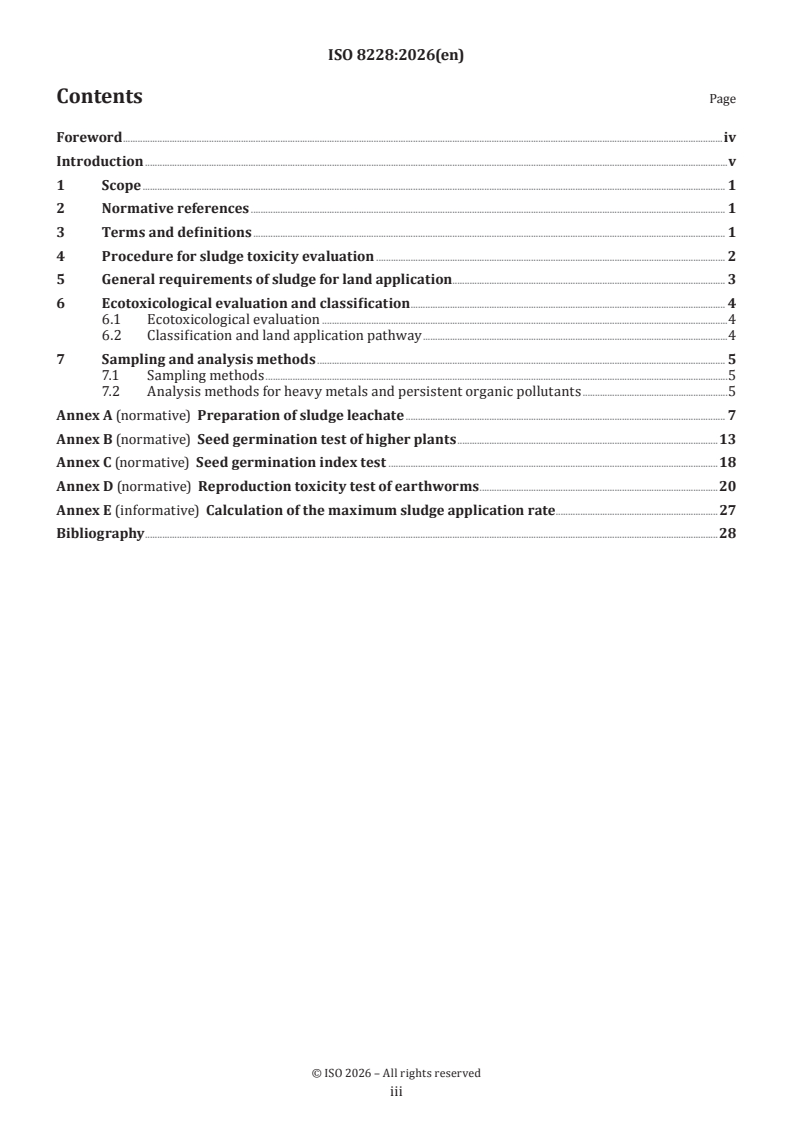
Contents Page
Foreword .iv
Introduction .v
1 Scope . 1
2 Normative references . 1
3 Terms and definitions . 1
4 Procedure for sludge toxicity evaluation . 2
5 General requirements of sludge for land application . 3
6 Ecotoxicological evaluation and classification . 4
6.1 Ecotoxicological evaluation .4
6.2 Classification and land application pathway .4
7 Sampling and analysis methods . 5
7.1 Sampling methods .5
7.2 Analysis methods for heavy metals and persistent organic pollutants .5
Annex A (normative) Preparation of sludge leachate . 7
Annex B (normative) Seed germination test of higher plants .13
Annex C (normative) Seed germination index test .18
Annex D (normative) Reproduction toxicity test of earthworms .20
Annex E (informative) Calculation of the maximum sludge application rate .27
Bibliography .28
iii
Foreword
ISO (the International Organization for Standardization) is a worldwide federation of national standards
bodies (ISO member bodies). The work of preparing International Standards is normally carried out through
ISO technical committees. Each member body interested in a subject for which a technical committee
has been established has the right to be represented on that committee. International organizations,
governmental and non-governmental, in liaison with ISO, also take part in the work. ISO collaborates closely
with the International Electrotechnical Commission (IEC) on all matters of electrotechnical standardization.
The procedures used to develop this document and those intended for its further maintenance are described
in the ISO/IEC Directives, Part 1. In particular, the different approval criteria needed for the different types
of ISO documents should be noted. This document was drafted in accordance with the editorial rules of the
ISO/IEC Directives, Part 2 (see www.iso.org/directives).
ISO draws attention to the possibility that the implementation of this document may involve the use of (a)
patent(s). ISO takes no position concerning the evidence, validity or applicability of any claimed patent
rights in respect thereof. As of the date of publication of this document, ISO had not received notice of (a)
patent(s) which may be required to implement this document. However, implementers are cautioned that
this may not represent the latest information, which may be obtained from the patent database available at
www.iso.org/patents. ISO shall not be held responsible for identifying any or all such patent rights.
Any trade name used in this document is information given for the convenience of users and does not
constitute an endorsement.
For an explanation of the voluntary nature of standards, the meaning of ISO specific terms and expressions
related to conformity assessment, as well as information about ISO’s adherence to the World Trade
Organization (WTO) principles in the Technical Barriers to Trade (TBT), see www.iso.org/iso/foreword.html.
This document was prepared by Technical Committee ISO/TC 275, Sludge recovery, recycling, treatment and
disposal.
Any feedback or questions on this document should be directed to the user’s national standards body. A
complete listing of these bodies can be found at www.iso.org/members.html.
iv
Introduction
Sludge is a kind of organic-based material originating from wastewater treatment, rich in humic substances,
nitrogen, phosphorus and other trace nutrients, and its application to land is a significant pathway for
nutrient cycling and improving soil fertility. However, sludge also contains various toxic pollutants, including
heavy metals, organic pollutants, pathogenic bacteria and emerging pollutants. These contaminants are
raising significant environmental and health concerns, with potential toxicity to humans and the ecosystem.
Therefore, ecotoxicological evaluation is essential to ensure their safe and beneficial reuse.
This document provides requirements and recommendations on ecotoxicological evaluation, classification,
and determination methods for sludge. It establishes a two-step evaluation procedure. The first step
is to analyse the concentrations of heavy metals and harmful organic pollutants. If the concentration
of any pollutant exceeds the limit of the standard, the sludge cannot be used for land application. If the
concentrations of all contaminants are below their respective concentration limits, a second step of
ecotoxicological evaluation is performed, including seed germination test of higher plants and reproduction
toxicity test of earthworms.
Based on ecotoxicological evaluation results, this document classifies sludge into three distinct
grades, Classes I, II, and III, to determine the appropriate land application pathway:
— class I, the lowest toxicity level, with inhibition ratios for both seed germination and earthworm
reproduction at or below 10 %, is suitable for land application in human-accessible areas;
— class II, with inhibition ratios up to 20 %, is suitable for landscaping in human-accessible areas;
— class III, a higher toxicity level with inhibition ratios up to 30 %, is restricted to landscaping in human-
inaccessible areas, such as sandy land rehabilitation, and mine rehabilitation.
v
International Standard ISO 8228:2026(en)
Ecotoxicological evaluation and classification of sludge for
land application
1 Scope
This document provides requirements and recommendations for the ecotoxicological evaluation and
classification of sludge for land application, and suitable land application pathways. This document applies
to sludge from wastewater treatment plants.
2 Normative references
The following documents are referred to in the text in such a way that some or all of their content constitutes
requirements of this document. For dated references, only the edition cited applies. For undated references,
the latest edition of the referenced document (including any amendments) applies.
ISO 11268-2:2023, Soil quality — Effects of pollutants on earthworms — Part 2: Determination of effects on
reproduction of Eisenia fetida/Eisenia andrei and other earthworm species
ISO 11465, Sludge and solid environmental matrices — Determination of dry residue or water content and
calculation of the dry matter fraction on a mass basis
ISO 15799, Soil quality — Guidance on the ecotoxicological characterization of soils and soil materials
ISO 18763, Soil quality — Determination of the toxic effects of pollutants on germination and early growth of
higher plants
ISO 21268-1, Soil quality — Leaching procedures for subsequent chemical and ecotoxicological testing of soil
and soil-like materials — Part 1: Batch test using a liquid to solid ratio of 2 l/kg dry matter
3 Terms and definitions
For the purposes of this document, the following terms and definitions apply.
ISO and IEC maintain terminology databases for use in standardization at the following addresses:
— ISO Online browsing platform: available at https:// www .iso .org/ obp
— IEC Electropedia: available at https:// www .electropedia .org/
3.1
sludge
mixture of water and solids originating from various types of wastewaters during natural and artificial
treatment
3.2
heavy metal
metal with relatively high density as a natural constituent of the environment, commonly detected in air,
water and soil
3.3
persistent organic pollutant
chemical substance that persists in the environment, bioaccumulates through the food web, poses a risk of
causing adverse effects to human health and the environment, and can be subject to long range transport
away from its original source
3.4
ecotoxicological assessment
ecotoxicological evaluation
process of evaluating the potential adverse effects of a substance, mixture or material on ecological
receptors, such as plants, soil organisms, aquatic organisms or microorganisms, using ecotoxicological test
methods and relevant lines of evidence
EXAMPLE The assessment can include seed germination tests, seed germination index tests and earthworm
reproduction toxicity tests.
3.5
toxic exposure test
test to determine adverse effects of pollutants or test materials on organisms under defined exposure
conditions.
Note 1 to entry: Toxic exposure tests can use different exposure pathways, exposure periods and toxicity endpoints to
support safety or risk evaluation.
4 Procedure for sludge toxicity evaluation
The evaluation procedure for sludge follows the two-step approach shown in Figure 1. Initially, chemical
analysis is conducted to determine the concentrations of heavy metals, persistent organic pollutants and
other organic compounds concerned. When all chemical contaminants in the sludge are below their respective
concentration limits (Table 1), the sludge may be used for land application. When the concentration of any
pollutant exceeds the concentration limit in this standard, the sludge should not be used for land application.
Subsequently, comprehensive toxicity exposure tests are performed to evaluate the overall toxicity levels.
Based on these test results, the sludge is classified into appropriate classes as shown in Table 2, to ensure
compatibility with specific land application types.
Figure 1 — Sludge toxicity evaluation procedure
5 General requirements of sludge for land application
The water content of sludge should be appropriate to the selected handling, transport and application method.
Where dewatered material is required for the land application pathway, the water content should not exceed
60 %. Odour emissions and pathogen levels can be subject to applicable local regulatory requirements.
Table 1 lists the concentration limits for heavy metals and organic pollutants in sludge intended for land
application. Sludge should not be used for land application when any chemical contaminant is confirmed to
be above its respective concentration limit shown in Table 1, which provides the baseline limits for countries
to develop their individual requirements.
The maximum sludge application rate with the specified concentrations is 7,5 tons per hectare per year (dry
solids). The maximum application period is 10 years. After 10 years, a reassessment should be conducted
based on pollutant accumulation to determine if land application can be continued or not. See Annex E for
further information. This document provides the baseline limits for countries to develop their individual
requirements on application rates and maximum application periods.
a
Table 1 — Concentration limits of individual pollutants
b
Concentration limit / (mg/kg DS
Number Analyte
b
except PCDD/F ng TEQ/kg DS )
1 Cu (in total) 1 000
2 Zn (in total) 2 500
3 Pb (in total) 750
4 Cd (in total) 20
5 Cr (VI) 1,0
6 Ni (in total) 300
7 Hg (in total) 16
8 As (in total) 75
9 Polychlorinated dibenzodioxins and Furans (PCDD/F) 30
c
10 Polychlorinated biphenyl (PCB) 0,1
11 Polycyclic aromatic hydrocarbons (PAH) 1
Perfluorooctanoic acid + Perfluorooctane sulfonic acid
12 0,1
(PFOA + PFOS)
a
The absence of certain organic and inorganic pollutants of less concern from this table does not imply their safety or lack of
risk.
b
Dry solid of sludge.
c
Per compound with similar chemical structure (congener).
6 Ecotoxicological evaluation and classification
6.1 Ecotoxicological evaluation
Ecotoxicological evaluation of sludge shall be conducted through toxic exposure tests in accordance with
ISO 15799. The preparation of sludge leachate shall be carried out as specified in Annex A, where leachate is
used.
The evaluation protocol shall include either the seed germination test of higher plants specified in Annex B
or the seed germination index test specified in Annex C, and the earthworm reproduction toxicity test
specified in Annex D.
For additional assessment of effects on soil flora, see the methods provided in ISO 15799, including
ISO 11269-1 and ISO 11269-2. For additional assessment of effects on the functions, diversity and abundance
of soil microorganisms, see the methods provided in ISO 15799:2019, A.1.3.
6.2 Classification and land application pathway
This document proposes a classification system based on comprehensive toxicity assessment results. Sludge
shall be classified in accordance with Table 2 based on the results of the ecotoxicological evaluation. The
applicability criteria are categorized into three classes: Class I, Class II, and Class III (Class III indicates
sludge with high toxicity level). In cases where toxicity test results show inconsistency across different
assessments, the classification is determined by the highest toxicity level observed, ensuring a conservative
approach to safety. This document provides the baseline classification criteria in Table 2 for countries to
develop their national requirements.
Table 2 — Sludge classification and land application pathway
Seed germination of Reproductive toxicity test of
higher plant earthworm
Class Land application pathway
Inhibition ratio of the Inhibition ratio of the
seed progeny counts/numbers of
a b
germination I earthworm I
sg e
Land application for human-accessible areas:
I ≤ 10 % ≤ 10 %
land for feed and crops, etc.
Landscape for human-accessible areas:
II ≤ 20 % ≤ 20 %
public parks and green spaces, etc.
Landscape for human-inaccessible areas:
III ≤ 30 % ≤ 30 %
sandy land rehabilitation and mine rehabilita-
tion, etc.
a
The inhibition ratio of seed germination, I , is calculated using Formula (1):
sg
I = [(r ,C − r ,S) / r ,C] × 100 (1)
sg sg sg sg
where
I is the inhibition ratio of seed germination, expressed in percent (%);
sg
r ,C is the mean seed germination rate in the control soil, expressed in percent (%);
sg
r ,S is the mean seed germination rate in the sludge sample, expressed in percent (%).
sg
b
The inhibition ratio of progeny counts or numbers of earthworms, I , is calculated using Formula (2):
e
I = [(N − N ) / N ] × 100 (2)
e e,C e,S e,C
where
Iₑ is the inhibition ratio of progeny counts or numbers of earthworms, expressed in percent (%);
Nₑ,C is the mean progeny count or number of earthworms in the control soil;
N is the mean progeny count or number of earthworms in the sludge sample.
e,S
7 Sampling and analysis methods
7.1 Sampling methods
Sampling of sludge should be carried out in accordance with the ISO 19698, the ISO 18400 series and
ISO 16720.
7.2 Analysis methods for heavy metals and persistent organic pollutants
The determination method of heavy metals and persistent organic pollutants in sludge should be performed
according to Table 3.
Table 3 — Recommended methods for the analysis of heavy metals and persistent organic
pollutants in sludge
Reference
Number Analyte Method
standards
Inductively coupled plasma optical emission spectrometry
ISO 22036
1 Cu (in total)
Flame and electrothermal atomic absorption spectrometric
ISO 11047
methods
Inductively coupled plasma optical emission spectrometry
ISO 22036
2 Zn (in total)
Flame and electrothermal atomic absorption spectrometric
ISO 11047
methods
Inductively coupled plasma optical emission spectrometry
ISO 22036
3 Pb (in total)
Flame and electrothermal atomic absorption spectrometric
ISO 11047
methods
Inductively coupled plasma mass spectrometry
ISO 16965
4 Cd (in total)
Flame and electrothermal atomic absorption spectrometric
ISO 11047
methods
Inductively coupled plasma optical emission spectrometry
ISO 22036
Flame and electrothermal atomic absorption spectrometric
5 Cr (in total) ISO 11047
methods
ISO 15192
Ion chromatography with spectrophotometric detection (Cr (VI))
Inductively coupled plasma optical emission spectrometry
ISO 22036
6 Ni (in total)
Flame and electrothermal atomic absorption spectrometric
ISO 11047
methods
7 Hg (in total) Cold vapour atomic fluorescence spectrometry ISO/TS 16727
Inductively coupled plasma mass spectrometry
ISO 16965
8 As (in total)
Electrothermal or hydride-generation atomic absorption
ISO 20280
spectrometry
Polychlorinated
Isotope dilution high resolution gas chromatography -
9 dibenzodioxins and ISO 13914
high resolution mass spectrometry
Furans (PCDD/F)
Polychlorinated
10 Gas chromatography-mass spectrometry EN 16167
biphenyls
Polycyclic aromatic
11 High-performance liquid chromatography ISO 13859
hydrocarbons
Perfluorooctanoic
acid (PFOA) and EPA Method
12 High-performance liquid chromatography - mass/mass
[26]
Perfluorooctane 1633
sulphonate (PFOS)
Annex A
(normative)
Preparation of sludge leachate
A.1 General
The preparation of sludge leachate shall follow the standardized procedures outlined in ISO 21268-1. The
resulting leachate may be subsequently used for the toxicity assessments specified in Annex B or Annex C.
A.2 Principle
The test portion, which originally or after suitable pretreatment has a particle size less than or equal to
2 mm, should be brought into contact with water containing a low concentration (0,001 mol/l) of calcium
chloride or demineralized water (A.3.1) under defined conditions. The standard method is based on the
assumption that equilibrium or near-equilibrium will be achieved between the liquid and solid phases
during the test period. The solid residue should be subsequently separated from the liquid. The separation
procedure can strongly influence the test results and should be particularly stringent for organic substances.
The properties of the eluate should be measured using methods developed for water analysis adapted to
meet criteria for analysis of eluates, and the eluate may be subjected to subsequent ecotoxicological testing.
A.3 Reagents
A.3.1 Demineralized water or deionized water or water of equivalent purity (5< pH <7,5) with a
conductivity of <0,5 mS/m made to 0,001 mol/l CaCl .
A.3.2 Calcium chloride (CaCl ·2H O), analytical grade.
2 2
A.3.3 Nitric acid (HNO ), analytical grade, made to 0,1 mol/l rinsing solution.
A.3.4 Organic solvent (acetone, analytical grade) for rinsing and cleaning.
A.4 Apparatus
A.4.1 Borosilicate glass, with a nominal volume of 1 l glass bottles having caps of inert material, for
example PTFE (polytetrafluoroethylene). Rinsing is compulsory, and it should be assured that previously
used bottles have no background level of analytes.
A.4.2 Glass bottle, of high quality (requirements as in A.4.1) with a nominal volume of e.g. 5 l to be used
when samples from replicate tests are recombined after centrifugation for further analysis or testing.
‒1
A.4.3 End-over-end tumbler (5 r/min to 10 r/min) or roller table, rotating at about 10 min . Other
shaking devices may be used provided that they can be shown to provide equivalent results. These agitation
devices are specified because excessive abrasion leading to significant particle size reduction should be
avoided.
A.4.4 Filtration apparatus, either a vacuum filtration device (between 2,5 kPa and 4,0 kPa) or a high-
pressure filtration apparatus (<0,5 MPa). Rinsing is compulsory. When semi-volatile substances are to be
analysed, vacuum filtration shall not be used.
A.4.5 0,45 μm membrane filters, pre-rinsed or similarly cleaned, e.g. rinsed with 0,1 mol/l HNO (A.3.3)
and water (A.3.1). The filters shall be chosen so as not to adsorb (or release) substances of interest.
NOTE This can be tested in preliminary experiments.
A.4.6 Glass fibre filters, with a degree of separation of 0,7 μm.
The filters shall be chosen so as not to adsorb (or release) substances of interest.
NOTE This can be tested in preliminary experiments.
A.4.7 Sieving equipment, with sieves of 2 mm nominal screen size.
NOTE Due to sieving, contamination of the sample can occur to an extent which affects the leaching of some
substances of concern, e.g. chromium, nickel and molybdenum from stainless steel equipment or plasticisers from
plastic sieves.
A.4.8 Centrifuge, operating at 20 000 r/min to 30 000 r/min using centrifuge tubes of PFA
(perfluoroalkoxyalkane), FEP (fluorinated ethylene propylene) or tubes of an alternative material which is
inert with regard to both inorganic and organic compounds and suitable for high-speed centrifugation.
A.4.9 Device for measuring electrical conductivity.
A.4.10 pH meter, with an accuracy of at least ±0,05 pH units.
A.4.11 Thermometer, for air temperature measurement.
A.4.12 Redox potential meter, (optional).
A.4.13 Balance, with an accuracy of at least 0,1 g.
A.4.14 Measuring cylinders, for volume determination with 1 % accuracy.
A.4.15 Sample splitter, for sub-sampling of laboratory samples (optional).
A.4.16 Turbidity meter.
A.4.17 Crushing equipment, a jaw crusher.
A.5 Sample pretreatment
A.5.1 Preparation of laboratory sample and specification of particle size
A representative laboratory sample of at least 2 kg (dry matter) shall be obtained (e.g. as described in
ISO 18400-101, ISO 18400-104, ISO 18400-105, ISO 18400-202 and ISO 23909) and shall be stored in closed
packages and at low temperatures (4 °C), in order to avoid unwanted changes in the material (see e.g.
ISO 18400-105).
The test shall be carried out on soil or soil-like material sieved to <2 mm. Oversized material of natural
origin in the sample shall be separated and discarded. The type and amount of all discarded material shall
be reported. If oversized material of anthropogenic origin is present and assumed to contain substances of
interest, this part may be subject to alternative sample preparation or testing.
If the laboratory sample cannot be homogenized or sieved because of its water content, it shall be allowed in
this case only to dry the laboratory sample. The drying temperature shall not exceed 30 °C.
NOTE 1 Sieving and drying at more than 30 °C, as well as crushing, can lead to a loss of semi-volatile substances
(inorganic and organic) and can alter the leaching characteristics.
NOTE 2 Due to sieving, contamination of the sample can occur to an extent that affects the leaching of some
substances of concern, e.g. chromium, nickel and molybdenum from stainless steel equipment or plasticisers from
plastic sieves.
A.5.2 Preparation of test sample
Use a sample splitter (A.4.15) or apply coning and quartering to split the laboratory sample and obtain a test
sample. The size of test sample required depends on the volume of eluate needed for the specific purpose
and the subsequent chemical analysis and/or ecotoxicological tests to be carried out on the eluate.
NOTE 1 If needed for chemical analysis or ecotoxicological testing, larger volumes of eluate can be obtained by
combining eluates from replicate tests after centrifugation (or filtration). Alternatively, larger volumes of eluate can
also be produced in a single test, provided that the liquid to solid ratio (L/S) and minimum headspace are maintained.
NOTE 2 The required amount of the test sample is dependent on the particle size distribution of the soil to be
analysed (see ISO 23909). The specified sample amount will generally be adequate. In specific cases, a smaller sample
amount can be accepted, for instance, if for specific reasons less material is available, provided that the test can be
carried out as specified.
A.5.3 Determination of dry matter content and water content
The whole test sample, conforming with the size criterion, shall not be further dried. The water content of
the test sample shall be determined on a separate test portion at (105 ± 5) °C. If the sludge sample is air-dried
prior to testing, the dry matter content W of the air-dried sample shall be determined as well. This shall be
im
taken into account when adjusting the L/S. The dry mass of the sample shall be determined at (105 ± 5) °C in
accordance with ISO 11465 and the dry matter content, W , is calculated using Formula (A.1).
am
W = 100 × m /m (A.1)
am p w
where
W is the dry matter content, expressed in percent (%);
am
m is the mass of the dried sample, expressed in kilograms (kg);
p
m is the mass of the undried sample, expressed in kilograms (kg).
w
The water content, W (in %) is calculated following Formula (A.2):
H2O
W = 100 (m ‒ m )/m (A.2)
H2O w 0 0
A.5.4 Preparation of the test portion
Prepare, from the test sample, a test portion with a total mass m containing (350 ± 5) g [measured with an
accuracy of 0,1 g (A.4.13)] of dry mass (m ), using Formula (A.3).
p
m = 100 × m /W (A.3)
p am
Use a sample splitter (A.4.15) or apply coning and quartering to split the sample.
In view of the minimum requirements of eluate volume for analytical purposes, it can be necessary to use a
larger test portion and a correspondingly larger volume of leachant. This deviation from this document shall
be specified in the test report.
A.6 Procedure
A.6.1 Temperature
The conformity test for leaching shall be carried out at room temperature (22 ± 3) °C.
A.6.2 Description of the procedure
A.6.2.1 Preparation of the eluent
Prepare a solution made to 0,001 M CaCl by dissolving 0,147 g CaCl in water and dilute to 1 000 ml.
2 2
In special cases (i.e. measurement of Ca or chloride, or both, in the eluate are of interest or the sample
exhibits an own salt load), water without addition of CaCl can also be used. The leachant type used shall be
recorded in the test report.
NOTE The application of demineralized water as leachant can induce higher turbidity and lower ionic strength
in the eluate for some types of soils (e.g. high content of organic matter) and can cause increased concentrations of
analytes adsorbed to colloids.
A.6.2.2 Leaching step
Place the test portion with the total mass m corresponding to (350 ± 5) g of dry mass (m ) in a bottle (A.4.1).
p
Depending on the particle size distribution, other test portions may be applied ensuring that a representative
portion is used.
Add an amount of leachant (V ) using a balance (A.4.13) or measuring cylinder (A.4.14), to establish a liquid
L
to solid ratio (L/S) of (2 ± 0,04) l/kg during the extraction, using Formula (A.4). Care shall be taken to obtain
good mixing of solid and liquid.
V = [2 – W /(ρ × 100)] × m (A.4)
L H2O H2O p
where
V is the volume of leachant used, in litres (l);
L
m is the mass of the dried sample, expressed in kilograms (kg);
p
ρ is the density of water (usually given in kg/l);
H2O
W is the water content for the test portion (%).
H2O
Place the capped bottle in an agitation device (A.4.3). Agitate for (24 ± 0,5) h.
As an alternative, instead of 24 h, 6 h can be adopted when it can be demonstrated that equilibrium or semi-
equilibrium is reached or that a quick turn-around time is required for quality control purposes. In this case,
it shall be recorded that the leaching was carried out for 6 h.
Settling of solids in the bottle during agitation shall be avoided. At the end of the agitation period, the bottle
is removed from the agitation device.
A.6.2.3 Liquid/solid separation step
Allow the suspended solids to settle for (15 ± 5) min.
Transfer the supernatant to centrifuge tubes (A.4.8). The centrifugation containers shall be chosen so as not
to adsorb (or release) analytes.
There are two options for centrifugation:
a) Centrifuge the eluate for 30 min at 20 000g to 30 000g using a high-speed centrifuge.
b) Centrifuge the eluate for 5 h at 2 000g to 3 000g in glass bottles using a lower-speed centrifuge (A.4.8).
Cooling shall be applied to maintain the temperature at (22 ± 3) °C (see A.6.1).
NOTE 1 Based on Stoke’s law, the results of both centrifugation methods are expected to be comparable. Other
alternative combinations of centrifugation acceleration and time can be applied given comparable conditions are
calculated related to the specification of the rotor.
Gentle braking of the centrifuge shall be applied in order to avoid resuspension. The deceleration time shall
not exceed 20 min.
NOTE 2 In case lightweight substances (e.g. coaly particles) are still floating after centrifugation, a glass fibre
filtration (A.4.6) can be applied to remove such particles or to reduce the turbidity.
After centrifugation, the eluate shall be transferred immediately to an appropriate container for
measurement of pH and redox potential (see also the next-to-last paragraph of A.6.2.2) and stored for
subsequent chemical analysis or ecotoxicological testing, or both. In general, this eluate can be used for both
analyses of inorganic and organic substances.
A.6.3 Further preparation of the eluate for analysis
If necessary, divide the eluate into an appropriate number of subsamples for different chemical analyses and
store them in accordance with the requirements.
A.6.4 Blank test for the application of the leaching procedure
Blank tests shall be carried out at regular intervals in order to check, as far as possible, how well the whole
procedure is performed. A volume of leachant of 900 ml shall be submitted to the whole procedure, starting
at A.6.2.1 and using no sludge sample.
The eluate of this blank test shall fulfil the following minimum requirements: in the eluate of the blank test,
the concentration of each considered element shall be less than 20 % of the concentration determined in the
eluate of the tested material or less than 20 % of the concentration in the eluate of a limit value to which the
measurement result is to be compared. The elements to be considered are all the elements which are to be
determined in the eluate of the tested material.
If the above requirements are not fulfilled, it is necessary to reduce the contamination. The blank test results
shall not be deducted from the results of the material leaching test.
The above provision does not take into account the sieving step, crushing step or the splitting step. In
order to minimize the possible contamination during these three steps, it is recommended to process a
representative portion of the laboratory sample through the sieving device, the crushing device and through
the splitting device and to discard such material thereafter.
A.7 Test report
The test report shall include at least the following information:
a) a reference to this document, i.e. ISO 8228:2026, and to the method used for the preparation of sludge
leachate;
b) identification of the sludge or biosolids sample, including sample origin, sampling date, storage
conditions and any pretreatment applied;
c) the dry matter content and water content of the test sample;
d) the particle size fraction used for the test and any material removed during sieving;
e) the type and volume of leachant used;
f) the liquid-to-solid ratio, L/S, used for leachate preparation;
g) the mass of the test portion and the volume of leachant added;
h) the agitation device, agitation time and temperature;
i) the solid-liquid separation method, including centrifugation or filtration conditions;
j) the pH, electrical conductivity and, where measured, redox potential of the eluate;
k) any deviation from the specified procedure;
l) any observations that could have affected the test result.
Annex B
(normative)
Seed germination test of higher plants
B.1 General
The seed germination test for higher plants shall be conducted in accordance with ISO 18763. The detailed
testing procedures are outlined in this annex.
B.2 Principles
Seeds of one monocotyledonous plant, such as Sorghum bicolor (L.) Moench, including sweet sorghum, or
other suitable Sorghum bicolor varieties, and two dicotyledonous plants, such as Lepidium sativum L. and
Sinapis alba L., shall be exposed to the test material under controlled conditions. After (72 ± 1) h, the number
of germinated seeds shall be recorded in the test sludge and in the control soil.
B.3 Reagents, test organisms and media
B.3.1 Water
Conductivity of pure water is below 10 μS/cm.
B.3.2 Test organisms
The test organisms are seeds of one monocotyledonous plant, such as Sorghum saccharatum (L.) Moench or
other suitable Sorghum bicolor varieties, and two dicotyledonous plants, such as Lepidium sativum L. and
Sinapis alba L. Investigations have been performed not only with the three plant species indicated here but
also with other monocotyl and dicotyl plant species.
Seeds coated with insecticides or fungicides, or both, should be avoided.
B.3.3 Control soil
Either reference or standard soils may be used as the control soil, if unhindered growth of the test plants
in these soils can be expected. Soils contain many living organisms, ranging from microscopic bacteria and
fungi to macro fauna such as earthworms. All play a significant part in maintaining the natural processes
which are vital for soil fertility.
Sludge land application influences the size and activity of soil microbial biomass, which is widely recognized
as an important agent in soil organic matter turnover, due to the addition of carbon and nitrogen as well
[27]
as other nutrients. Soil respiration is positively influenced by sludge and compost supply . Research has
shown that over a decade after a single sludge application higher microbial activity was found in comparison
with mineral fertilizer application.
B.4 Apparatus and materials
B.4.1 Incubator or temperature-controlled room, suitable for maintaining the specified conditions at
(25 ± 1) °C.
B.4.2 Digital camera, webcam camera or flatbed paper scanner, to shoot pictures of the test plates with
the germinated seeds, for storage in a computer file.
B.4.3 Test plates, transparent plates in polyvinylchloride (PVC).
The test plates are composed of a bottom part separated by a middle ridge into an upper part and a lower part
and a flat cover. Test plates may be handmade with the aid of transparent PVC sheets and small rectangular
sticks.
B.4.4 Test plate holders, cardboard holders for vertical incubation of six test plates (B.4.3) each.
B.4.5 Black filter papers, rectangular high purity black filter papers (e.g. 85 g/m , 0,17 mm thickness,
45 s filtration speed) fitting the lower part of the test plate, to be placed on top of the soil in the lower
compartment of the test plates (B.4.3).
B.4.6 Microsieve cylinder, small plastic cylinder provided at the bottom with a nylon gauze, to be used
for determination of the water to be added to the test sludge.
B.4.7 Wide mouth micropipette, plastic micropipette to be used with the microsieve cylinder (B.4.6) for
determination of the water to be added to the test sludge.
B.4.8 Sieve, sieve of 2 mm mesh for sieving the test sludge prior to use for the tests.
B.4.9 Thin spatula, hand tool with a thin blade used to mix the test soil with water.
B.4.10 Flat spatula, hand tool with a broad, flat blade that is used to spread and flatten the test sludge into
the lower compartment of the test plates (B.4.3).
B.4.11 Tweezers, a small pincer-like tool for handling the seeds.
B.5 Treatment and preparation of samples
B.5.1 Soil samples
The assays should be carried out at water saturation of the soil at the start of the tests.
B.5.2 Water-holding capacity determination
The water holding capacity of the control soil and the test sample shall be determined in accordance with
ISO 11268-2:2023, Annex E, where applicable.
The control soil and the test sample shall be moistened before the start of the test. The moisture condition
shall be sufficient to keep the filter paper moist throughout the exposure period, while avoiding free water
or waterlogging in the test plate.
The moisture condition used at the start of the test shall be recorded in the test report.
B.5.3 Alternative procedure for determination of the volume of water to be added in the test
plates for hydration of air-dried soils
A simple and quick alternative procedure may be used to determine the volume of water to be added to air-
dried soil in the test plates (B.4.3).
For the artificial soil recommended in B.6.2.1.1, the amount of water needed to be added for hydration has
been determined experimentally. Based on a water/soil ratio (on a vol/vol basis) of 0,39, 35 ml pure water
should be added to the 90 cm control soil in the test plate (B.4.3).
Test soil samples first shall be air-dried, then the dry soil should be sieved through a sieve (B.4.8) to eliminate
all coarse material. For other control soils, the amount of water that needs to be added for hydration should
be experimentally determined, following the procedure for test soil samples.
Air drying is required only on a separate soil sample for subsequent determination of the volume of water to
be added in the test plates.
50 ml pure water should be mixed thoroughly with 90 cm test soil in a beaker with the aid of a thin spatula
(B.4.9).
After 1 min to 2 min, two layers appear: the hydrated soil and a layer of water on top.
Lower vertically the microsieve cylinder (B.4.6) into the beaker, down to the surface of the hydrated soil,
and then lower it a little further down, so that it starts filling with supernatant.
With the wide mouth micropipette (B.4.7), suck up the water inside the microsieve and transfer it into a
graduated cylinder.
Put the microsieve cylinder (B.4.6) again into the beaker, and push it down a little further, so that it takes up
additional water from the soil. Transfer again the recovered water into the graduated cylinder and repeat
the former manipulations until no water comes out anymore from the soil.
Calculate how much water is needed for complete hydration of the test soil. This volume (V ) is the volume
sat
of water that has originally been added to the soil (= 50 ml) minus the volume of supernatant water (S)
which has been recovered in the graduated cylinder (V = 50 ‒ S).
sat
B.6 Procedure
B.6.1 General
The procedure described hereafter is intended for the use of 90 cm soil in the test plates (B.4.3).
For classification under this document, the seed germination test shall be performed using the test sample
and the control soil. The classification of sludge shall be based on the inhibition ratio of seed germination
calculated from the mean seed germination rate in the test sample and in the control soil.
Determination of a dose-response relationship is not required for classification under this document.
Dilution of the test sample is not required unless it is necessary for sample preparation, method validation
or quality control. Where dilution is used, the dilution procedure and dilution ratio shall be recorded in the
test report.
B.6.2 Test procedure for determination of the effects of sludge
B.6.2.1 Addition of control soil and test soil to the test plates and hydration of the samples
B.6.2.1.1 Control soil
If the artificial soil is used as control, put 90 cm control soil in the lower compartment of a test plate (B.4.3),
then slowly drop 35 ml pure water should be dropped slowly over the whole surface of the control soil in the
test plate.
If another control soil is used, add the amount of water should be experimentally determined.
Wait 1 min to 2 min so that the water hydrates the soil totally.
The wet soil should be flattened evenly over the total surface of the bottom compartment of the test plate
(B.4.3) with a flat blade spatula, in order to obtain a layer of uniform depth.
The former operations should be repeated for
...